

Submitted:
17 July 2026
Posted:
20 July 2026
You are already at the latest version
Abstract
Background: Carbapenem-resistant Klebsiella pneumoniae (CRKP) increasingly combines high-risk clonal expansion, mobile resistance platforms and limited treatment options. We investigated the genomic epidemiology, resistance and virulence architecture, plasmid backbones, and therapeutic vulnerabilities of CRKP circulating in Oman. Methods: Between 2021 and 2024, 135 non-duplicate CRKP isolates were recovered from diverse clinical specimens. New antimicrobial agents were evaluated phenotypically, while 38 representative XDR/PDR isolates underwent WGS for MLST, capsular typing, resistome, virulome, plasmid and MGE analysis. In-vitro synergy of ceftazidime-avibactam/aztreonam, meropenem/fosfomycin and amikacin/fosfomycin was assessed using E-test-based FICI. Results: WGS revealed a striking shift towards OXA-232-producing ST-2096, which dominated the sequenced collection and carried KL64 with a conserved multidrug-resistant backbone. NDM-5/ST147 and NDM-1+KPC-2/ST11 formed distinct high-risk lineages with broader ESBL repertoires, greater plasmid heterogeneity and, in co-producers, the highest MGE burden. Across isolates, resistance was reinforced by widespread blaCTX-M variants, armA, aac(6')-Ib-cr, fosA, porin alterations and fluoroquinolone-resistance mutations, while core virulence and fitness loci including fimH, mrkA, iutA, fyuA and irp2 were widely retained. Cefiderocol showed the most consistent in-vitro activity across carbapenemase groups, and eravacycline remained active, whereas plazomicin and fosfomycin activity was compromised by methyltransferase and fos genes. Ceftazidime-avibactam/aztreonam demonstrated universal synergy, while meropenem/fosfomycin and amikacin/fosfomycin showed limited, carbapenemase-dependent activity. Conclusion: CRKP in Oman is characterized by convergent clonal expansion, plasmid-mediated resistance, retained virulence potential and narrowing therapeutic options. Integrated genomic surveillance with carbapenemase-directed susceptibility and synergy testing is essential to guide precision antimicrobial stewardship in high-risk healthcare settings and inform early infection prevention responses to emerging regional CRKP lineages.
Keywords:
Carbapenem resistant K. pneumoniae
; AMR
; resistome
; virulome
; plasmidome
; newer antimicrobials
; antimicrobial synergistic combinations
1. Introduction
The rise of extremely drug-resistant (XDR) Gram-negative bacilli (GNB) has emerged as one of the most pressing challenges in modern medicine. Of particular concern are carbapenem-resistant Klebsiella pneumoniae (CRKP) which have been recognized by the World Health Organization (WHO) as a critical priority pathogen due to high mortality rates and limited treatment options [1].
Carbapenem resistance is commonly mediated by carbapenemase enzymes (CPE) (e.g., Klebsiella pneumoniae carbapenemase (KPC), New Delhi metallo-beta lactamase (NDM), and OXA-type carbapenemases (OXA types), efflux pumps, and porin alterations [2]. These genes are frequently carried on MGEs, facilitating rapid horizontal transmission within and between bacterial species [3].
Gulf Cooperation Council countries report the growing prevalence and genetic diversity of CRKP clones, alongside significant challenges in containment and treatment [4,5,6]. The dissemination of high-risk clones such as ST14, ST231, and ST147 has been documented across Saudi Arabia, Oman, the United Arab Emirates, Kuwait, and Bahrain [4,6]. Understanding the prevalent clades is essential not only for surveillance purposes but also optimizing empiric treatment and instituting appropriate infection prevention and control [7,8].
Ceftazidime-avibactam (CZA), imipenem-relebactam (IMR), meropenem-vaborbactam (MPV), cefiderocol (CFD), eravacycline (ERV) and plazomicin (PLZ) have recently been introduced for management of extremely drug resistant (XDR) GNB [9,10]. CFD possesses structural similarities with cefepime and ceftazidime but incorporates a siderophore moiety, enabling it to exploit iron transport systems for enhanced uptake into GNB [11,12]. CZA is a novel β-lactam/β-lactamase inhibitor combination active against class A, C, and some class D β-lactamases [13]. IMR and MPV are active against class A and C β-lactamases [14]. ERV, a fully synthetic fluorocycline, is active against carbapenem-resistant Enterobacterales (CRE). PLZ, a next-generation aminoglycoside imparts significant resistance to degradation by aminoglycoside-modifying enzymes (AMEs) [15].
Combining available antimicrobials often restores activity against resistant strains by leveraging synergistic pharmacodynamic interactions. Combinations of aztreonam (AZT) with CZA, MEM+fosfomycin (FOS), and amikacin (AK)+FOS, have demonstrated promising in vitro synergistic effects [16,17]. The synergistic effect between AZT and avibactam positions this combination as a promising therapeutic option for infections caused by MBL-producing strains [18,19]. AZT has intrinsic activity against MBLs but is hydrolysed by extended-spectrum β lactamase and AmpC-producing organisms [20]. Avibactam in turn inhibits class A, C, and some class D β-lactamases. In the absence of AZT/avibactam combination, AZT-CZA combination is a good alternative [17,21]. The MEM+FOS demonstrated significant synergy against CRKP strains expressing NDM, KPC, and OXA-48 [16,22,23]. AK+FOS has been reported as an alternative to colistin against OXA-48 and select KPC variants[16,24].
This study explored the molecular epidemiology, resistance evolution, and potential treatment strategies for high-risk CRKP lineages. We analyzed the genomic landscape of CRKP, assessed the susceptibility profile to the new antimicrobials, and investigated antimicrobial synergy in CZA+AZT, MEM+FOS and AK+FOS combinations.
2. Results
This study on genomic characterization, activity of newly introduced antibiotics and in-vitro synergy yielded thought provoking results. The CRKP were isolated from urine, blood, respiratory, peritoneal, abdominal and wound samples. Genomic characterization of 38 CRKP yielded 25 OXA-232, 6 NDM-5, 6 NDM-1+KPC-2 and 1 KPC-2 (Figure 1). Extremely drug resistant (XDR) OXA-232 MLST-2096 predominated, (88%, 22/25), followed by ST-231 (n=2), and ST-359 (n=1). All NDM-5 were ST-147 and NDM-1+ KPC-2 were ST-11. They displayed either XDR or pan-drug resistant (PDR) profile Isolate-wise distribution of carbapenemases, MLST and infection source is provided in (Table 1). Capsular typing revealed a distinct pattern, with all OXA-232, ST-2096 and NDM-5, ST-147 being characterised by KL-64, KPC-2+NDM-5 by KL-47 and OXA-232, ST-231 by KL-51 (Figure 1).
Antimicrobial Resistance Genes
A plethora of AMR genes were observed across all the carbapenemases (Figure 2C). A varied and distinct burden of ESBLs were carried by the different CPEs amongst which CTX-M-15, SHV-75 and SHV-12 (62.5%, 26/38) predominated, Figure 3. Others were CTX-M-65 (32.5%, 13/38), SHV-67 (22.5%, 9/38), SHV-11 (22.5%, 9/40), and SHV-28 (17.5%, 7/40) followed by SHV-106 (12.5%, 5/40), TEM-1C (10%, 4/40), TEM-1B (7.5%, 3/40), and TEM-1A (2.5%, 1/40).
OXA-232 exclusively carried CTX-M-15 (100%, 25/25) while all NDM/KPC isolates carried CTX-M-65 (12/12, 100%). Other ESBLs carried by OXA-232 were SHV-28 (92%, 23/25), and SHV-106 (100%, 25/25). NDM-5 isolates exhibited the most extensive ESBL spectra, with all strains (6/6) carrying CTX-M-65, SHV-11, SHV-12, SHV-67, and SHV-75. In contrast, NDM-1+KPC-2 co-harbouring isolates exhibited narrower spectrum (CTX-M-65, TEM-1B, TEM-1C, SHV-11, and SHV-28). The KPC-2 isolate carried CTX-M-65, SHV-11 and SHV-12. Remarkably, no Ambler class C β-lactamase (AmpC) genes (DHA, ACT or CMY) were identified in this study.
Alarmingly, the most frequently detected aminoglycoside resistance determinants were armA (86.8%, 33/38), aac(6’)-Ib-cr (78.9%, 30/38), followed by aadA2 (65.8%, 25/38), aph(3’)-Ia (34.2%, 13/38), aph(3’)-VI (31.6%, 12/38), aadA1 (15.8%, 6/38), aac(6’)-Ib-Hangzhou (13.2%, 5/38), rmtF (13.2%, 5/38), aac(6’)-Ib (10.5%, 4/38), and aac(6’)-IId (5.3%, 2/38). The least frequently detected determinants were aph(3’’)-Ib and aph(6)-Id, each present in 2.6% (1/38) of isolates. Notably, armA was widely distributed across the major carbapenemase-producing groups, supporting the presence of high-level aminoglycoside resistance among these CRKP isolates.
OXA-232-producing isolates were characterized by the predominant carriage of armA, aac(6’)-Ib-cr, and aadA2 with less frequent detection of aac(6’)-Ib-Hangzhou, rmtF, and aac(6’)-IId. NDM-5-producing isolates demonstrated a broader aminoglycoside resistance profile. Apart from armA and aac(6’)-Ib-cr, these isolates harboured diverse aminoglycoside-modifying enzymes including aadA2, aph(3’)-Ia, and aph(3’)-VI. Sporadic detection of aac(6’)-Ib-Hangzhou and rmtF was also observed. Isolates co-harbouring NDM-1+KPC-2 carried predominantly armA, aph(3’)-VI and aph(3’)-Ia.
The fluoroquinolone-modifying enzyme aac(6’)-Ib-cr predominated (78.9%;30/38), followed by qnrB1 (34.2%; 13/38) and qnrA1 (13.2%,5/38). OXA-232-producing isolates predominantly harboured aac(6’)-Ib-cr, with occasional carriage of qnrB1 and qnrA1. In contrast, several NDM-5-producing isolates co-harboured aac(6’)-Ib-cr, qnrB1, and qnrA1. Isolates co-harbouring NDM-1 and KPC-2 also carried aac(6’)-Ib-cr together with sporadic presence of qnr genes.
Sulphonamide resistance genes showed a distinct distribution across the three CPE groups. Among OXA-232-producing isolates, only sul1 was detected (88%, 22/25), whereas, all NDM-5- and NDM-1+KPC-2 producing isolates carried both sul1 and sul2 (100%, 6/6 each). Tetracycline resistance genes was exclusively observed among OXA-232, with tet(D) gene being present in 68% (17/25) of OXA-232 isolates, and tet(A) in (4%, 1/25). In contrast, neither tet(D) nor tet(A) were detected among NDM-5-and NDM-1+KPC-2 producing isolates.
Fosfomycin resistance was highly conserved across the major CPE groups. The fosA gene was detected in all OXA-232-producing isolates (100%, 25/25), all NDM-5-producing isolates (100%, 6/6), and all NDM+KPC co-producing isolates (100%, 6/6). In contrast, fosA3 was present in 50% (3/6) of NDM+KPC co-producing isolates only.
Mutations were detected in five chromosomal loci: ompK36, ompK37, acrR, gyrA, and parC. (Supplementary Table S 2) The fluoroquinolone-resistance-associated mutation parC p.S80I was present in all isolates, while gyrA p.D87G was detected in 29/38 isolates. In addition, 37/38 isolates carried the same acrR mutation profile, comprising p.P161R, p.G164A, p.F172S, p.R173G, p.L195V, p.F197I and p.K201M. Mutations in ompK36, ompK37 and acrR were detected in 37/38 isolates 97.4% (Figure 1). The ompK36 mutation profile was clustered into four main patterns. The dominant profile was detected in 21/38 isolates and included multiple substitutions together with predicted frameshift-associated changes, namely p.N49S, p.L59V, p.A190W frameshift, p.L191S, p.F207W, p.D224E, p.Q227S frameshift, p.L228V, p.E232R, p.T254S, p.N304E frameshift, p.A217S, and p.N218H. A second profile, characterised by ompK36 p.N49S, p.L59V, and p.T184P, was observed in 9/38 isolates. A third profile, comprising p.N49S, p.L59V, p.G189T, p.F198Y, p.F207Y, p.T222L, p.D223G, p.Q227S frameshift, p.L228K frame restoration, p.E232R, p.N304E, and p.A217S, was detected in 7/38 isolates. One isolate carried only p.A217S and p.N218H. Across all isolates, the most frequent ompK36 substitutions were p.N49S and p.L59V, each detected in 37/38 isolates, followed by p.A217S in 29/38 isolates, p.Q227S frameshift and p.E232R in 28/38 isolates each, and p.N218H in 22/38 isolates. For ompK37, p.I70M and p.I128M were detected in 37/38 isolates. Among these, 9 isolates additionally carried p.N230G and p.M233Q frameshift. Additionally, oqxA and oqxB were detected in (35/38, 92.1%) and (36/38, 94.74%) isolates, respectively while acrR mutations were near global. Point mutations (P161R, G164A, F172S, R173G, L195V, F197I, K201M) in the acrR gene were present in (37/38, 97.37%) isolates.
Distribution of Virulence Genes
Whole-genome analysis of CRKP isolates revealed presence of multiple virulence-associated genes, with varying prevalence across OXA-232, NDM-5, NDM-1+KPC-2 and KPC-2 (Figure 2A). All OXA-232, NDM-5, NDM-1+KPC-2 and KPC-2 producing isolates carried ferric aerobactin receptor (iutA), siderophore receptor (fyuA), high molecular weight protein synthetase (irp2), type 1 fimbrial adhesin (fimH), and the non-ribosomal peptide synthetase gene mrkA:ABW83989.
Apart from these, OXA-232, carried the outer membrane complement resistance gene traT (96%), aerobactin synthetase iucC, tellurium resistance gene terC (84%, 21/25), sitA (1/25), and NlpI in (1/25) isolates. Colicin-related genes (colE8, colE2-like) were each identified in 4%, isolates. In NDM-5, iucC, terC, and NlpI were detected in (83.3%, 5/6), (66.7%, 4/6), and (66.7%, 4/6) isolates respectively. In contrast, traT, was detected in 2/6 isolates, and the iron transport gene sitA was identified in a single strain (1/6). The rare clpK1 gene was identified in one isolate (16.7%, 1/6). Isolates co-carrying NDM-1+KPC-2 additionally possessed iucC, terC ccI and traJ.Plasmid Distribution
Distribution of Plasmids
Amongst 19 identified plasmids, (Figure 2B) IncFIB(pNDM-Mar) and IncHI1B(pNDM-Mar) predominated (89.4%, 34/38). ColKP3 and ColRNAI followed, (68.4%, 26/38) and (63.1%, 24/38), respectively with IncFIB(K) identified in 36.8%,14/38 isolatesLess commonly detected plasmid types included IncFII(pHN7A8) (17.5%, n=7), IncFIB(pQil) (15%, 6/40), and IncFIB(pKPHS1) (12.5%, 5/40). Percentages of other identified plasmids (IncFII(K), Col440I, Col(BS512), ColpVC, IncFIA, IncFII(pKPX1), IncFII(pAMA1167-NDM-5). The Sankey analysis (Figure 4) demonstrated a complex but structured relationship between carbapenemase type, plasmid replicon backbone and sequence type. The largest downstream convergence was observed in ST-2096, indicating that this sequence type was the principal clonal background associated with OXA-232 and diverse plasmid carriage. ST-147 and ST-11 also showed links with several plasmid groups, suggesting additional high-risk lineages with heterogeneous plasmid content. In contrast, NDM-5, NDM-1/KPC-2 co-carriage and KPC-2 alone contributed smaller flows. Figure 5 showcases the plasmid wise estimated AMR gene load.
Among OXA-232 isolates, ColKP3, was present uniformly (100%, 25/25), followed by IncFIB(pNDM-Mar) and IncHI1B(pNDM-MAR), (84%, 21/25) each. ColRNAI was present in (60%, 15/25) while IncFIB(K) at (48%, 12/25), and IncFIB(pQil) at (12%, 3/25), IncFII(pHN7A8) (8%, 2/25), Col440I (4%, 1/25), and Col (BS512) (4%, 1/25) were infrequent. In the NDM-5, a distinct plasmidome was noted. IncFIB(pNDM-Mar), IncHI1B(pNDM-MAR) and IncFIB(pKPHS1) were the most prevalent plasmid type replicons, (83.3%, 5/6) each, followed by IncR (66.7%, 4/6) and IncFIB(pQil), (33.3%, 2/6). IncFII(pKPX1), Col4401, Col(BS512), ColpVC and reB(R1701) were identified in one isolate only. The co-carriage NDM-1+KPC-2 revealed the highest diversity in plasmid type, with multiple replicons detected in all isolates. The plasmid types ColRNAI, IncFIB(pNDM-Mar), IncHI1B(pNDM-MAR), IncFII(pHN7A8), and IncR were consistently detected across all isolates (6/6). Isolate wise distribution of plasmids, MGE, AMR, and virulence genes is provided in Table 2.
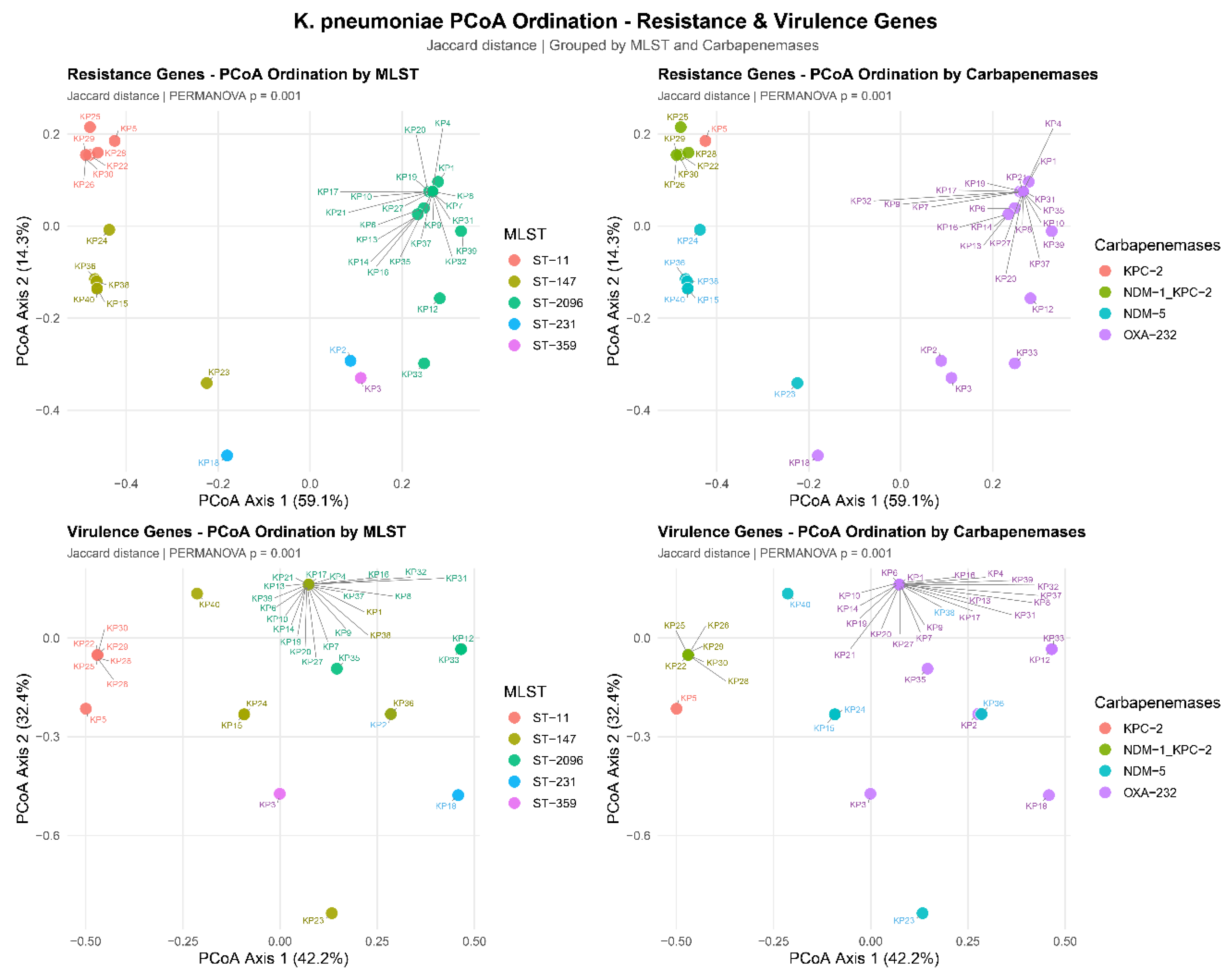

Table 2.
Distribution of Plasmids, MGEs, Resistance and virulence genes among XDR/PDR CRKP (n=38).
| CRKP | Plasmid | MGE | Resistance genes | Virulence genes |
|---|---|---|---|---|
| K.p1 | ColKP3, IncFIB(Mar),IncHI1B, IncFIB(K), ColRNAI, Col440I | 16 | blaOXA-232,blaSHV-28, blaSHV-106, catB3, catB3, msr(E), armA, dfrA1, OqxB, OqxA, blaTEM-1A, tet(D), fosA, dfrA14,blaCTX-M-15 | traT, iucC, terC, fyuA, irp2, mrkA:ABW83989, fimH, iutA |
| K.p2 | ColKP3,IncFIA,Col440I, IncFIB(pQil), ColRNAI, IncFII(K), IncFII(pAMA1167-NDM-5) | 13 | blaOXA-232,fosA, blaTEM-1B, qnrS, erm(B), ARR-2, OqxB, aac(6’)-Ib-cr, aac(6’)-Ib-Hangzhou,rmtF, mph(A), qacE,sul1,catA1, aadA2, dfrA12,OqxA, blaSHV-28, blaSHV-106, blaCTX-M-15, sitABCD | sitA, iucC, iutA, traT, fimH, mrkA:ABW83989, fyuA, irp2, nlpI |
| K.p3 | ColKP3, IncHI1B, Col440II, Col440I, IncFIB(Mar), IncFIB(pQil) | 10 | blaOXA-232,fosA, OqxB, OqxA, catB3, blaOXA-1,aac(6’)-Ib-cr, catB3, aac(3)-Iid, catA1, blaSHV-182, blaCTX-M-15, | fimH, mrkA:ABW83989, fyuA, irp2, iutA, terC, nlpI |
| K.p4 | ColKP3, IncFIB(K), IncFIB(Mar), Col440I, IncHI1B, ColRNAI | 17 | blaOXA-232, blaSHV-28, blaSHV-106,catB3, blaOXA-1, aac(6’)-Ib-cr, msr(E), armA, sul1, dfrA12, aadA2, qacE, mphE, dfrA1, OqxB, OqxA, blaTEM-1A, tet(D), fosA,dfrA14, blaCTX-M-15 | mrkA:ABW83989, terC, iucC, iutA, traT, fyuA, irp2, fimH |
| K.p5 | ColRNAI, IncHI1B, IncR, IncFIB(Mar), IncFII(pHN7A8), ColRNAI | 18 | sul2, fosA, OqxB, OqxA, blaKPC-2, aph(3’)-VI, qnrS1, blaSHV-12, blaCTX-M-65, fosA3, armA, mphE, msr | fimH, mrkA:ABW83989, iucC, iutA, fyuA, irp2, ccI, traJ |
| K.p6 | ColKP3, IncHI1B, ColRNAI, Col440I, IncFIB(Mar) | 21 | blaOXA-232,OqxB, OqxA, blaSHV-28, blaSHV-106, blaCTX-M-15, blaOXA-1, fosA, dfrA1,dfrA12, armA, msr(E),qacE,mphE,sul1,aadA2 , catB3, aac(6’)-Ib-cr | mrkA:ABW83989, iutA, fimH, terC, fyuA, irp2, traT, iucC |
| K.p7 | ColKP3, IncFIB(K), IncHI1B, ColRNAI, Col440I, IncFIB(Mar) | 19 | blaOXA-232, blaSHV-28, blaSHV-106, catB3, blaOXA-1, aac(6’)-Ib-cr, msrE, armA,sul1, dfrA12, aadA2, qacE, mphE, dfrA1, OqxB, OqxA, blaTEM-1A, tet(D), fosA, dfrA14, blaCTX-M-15 | mrkA:ABW83989, iutA, fimH, terC, fyuA, irp2, traT, iucC |
| K.p8 | ColKP3, Col440I, ColRNAI, IncFIB(Mar), IncHI1B, IncFIB(K) | 18 | blaOXA-232,blaSHV-28, blaSHV-106, catB3, blaOXA-1, aac(6’)-Ib-cr, msrE, armA,sul1, dfrA12, aadA2, qacE, mphE, dfrA1, OqxB, OqxA, blaTEM-1A, tet(D), fosA, dfrA14, blaCTX-M-15 | mrkA:ABW83989, iutA, fimH, terC, fyuA, irp2, traT, iucC |
| K.p9 | ColKP3, IncFIB(K), IncFIB(Mar), Col440I, IncHI1B, ColRNAI | 22 | blaOXA-232,blaSHV-28, blaSHV-106, catB3, blaOXA-1, aac(6’)-Ib-cr, msrE, armA,sul1, dfrA12, aadA2, qacE, mphE, dfrA1, OqxB, OqxA, blaTEM-1A, tet(D), fosA, dfrA14, blaCTX-M-16 | mrkA:ABW83989, iutA, fimH, terC, fyuA, irp2, traT, iucC |
| K.p10 | ColKP3, IncFIB(K), Col440I, IncFIB(Mar), ColRNAI, IncHI1B | 20 | blaOXA-232, blaSHV-28, blaSHV-106, catB3, blaOXA-1, aac(6’)-Ib-cr, msrE, armA,sul1, dfrA12, aadA2, qacE, mphE, dfrA1, OqxB, OqxA, blaTEM-1A, tet(D), fosA, dfrA14, blaCTX-M-17 | mrkA:ABW83989, iutA, fimH, terC, fyuA, irp2, traT, iucC, colE8, colE2-like |
| K.p12 | ColKP3, IncFIB(K), Col440I, ColRNAI | 15 | blaOXA-232,blaOXA-1, blaSHV-28, blaSHV-106, blaCTX-M-15, fosA,OqxB, OqxA, dfrA1, catB3,aac(6’)-Ib-cr | mrkA:ABW83989, iutA, fimH, fyuA, irp2, traT |
| K.p13 | ColKP3, IncFIB(K), ColRNAI, IncFIB(Mar),Col440I, IncHI1B | 19 | blaOXA-232,OqxB, OqxA, blaSHV-28, blaSHV-106, blaCTX-M-15, blaOXA-1, fosA, dfrA1,dfrA12, armA, msr(E), qacE,mphE,sul1,aadA2 , catB3, aac(6’)-Ib-cr | mrkA:ABW83989, iutA, fimH, terC, fyuA, irp2, traT, iucC |
| K.p14 | ColKP3, IncFIB(K), IncHI1B, ColRNAI, Col440I, IncFIB(Mar) | 23 | blaOXA-232,OqxB, OqxA, blaSHV-28, blaSHV-106, blaCTX-M-15, blaOXA-1, fosA, dfrA1,dfrA12, armA, msr(E), qacE,mphE,sul1,aadA2 , catB3, aac(6’)-Ib-cr | mrkA:ABW83989, iutA, fimH, terC, fyuA, irp2, traT, iucC |
| K.p15 | IncHI1B, IncFIB(K), Col440I, IncFIB(pKPHS1), IncR, IncFIB(Mar) | 29 | blaNDM-5, blaTEM-1B, blaOXA-9, aadA1, aac(6’)-Ib, blaTEM-1C, aac(6’)-Ib-cr, OqxB, OqxA, catA1, msr€, aph(3’)-VI, armA, qnrS1, mphA, mph(A), dfrA5, sul1, qacE, blaSHV-67, blaSHV-11, sul2, aph(3’)-Ia, fosA, blaCTX-M-15 | terC, iutA, fimH, nlpI,iucC, iutA, irp2, fyuA, clpK1, mrkA:ABW83989 |
| K.p16 | ColKP3, IncFIB(K), IncFIB(Mar), Col440I, IncHI1B, ColRNAI | 21 | blaOXA-232, OqxB, OqxA, blaSHV-28, blaSHV-106, blaCTX-M-15, blaOXA-1, fosA, dfrA1,dfrA12, armA, msr(E), qacE,mphE,sul1,aadA2 , catB3, aac(6’)-Ib-cr | mrkA:ABW83989, iutA, fimH, terC, fyuA, irp2, traT, iucC |
| K.p17 | ColKP3, IncFIB(Mar), IncHI1B, Col440I, ColRNAI, IncFIB(K) | 20 | blaOXA-232, blaSHV-28, blaSHV-106, catB3, blaOXA-1, aac(6’)-Ib-cr, msr€, armA,sul1, dfrA12, aadA2, qacE, mphE, dfrA1, OqxB, OqxA, blaTEM-1A, tet(D), fosA, dfrA14, blaCTX-M-15 | mrkA:ABW83989, iutA, fimH, terC, fyuA, irp2, traT, iucC |
| K.p18 | IncFII(K), ColKP3, Col440I, IncX4, IncFIB(pQil), IncFIB(K) | 24 | blaOXA-232,blaTEM-1B, aadA1, rmtF, aac(6’)-Ib-Hangzhou, ARR-2, aac(6’)-Ib-cr, tet(A),qacE, sul1, dfrA5, qnrA1, cmlA1, catA1, blaSHV-75, blaSHV-67, blaSHV-11, mph(A), OqxB, aph(3’)-Ia, OqxA, fosA, blaCTX-M-15 | fimH, mrkA:ABW83989, nlpI, traT, irp2, fyuA, iutA |
| K.p19 | ColKP3, IncHI1B, ColRNAI, IncFIB(K), Col440I, IncFIB(Mar) | 20 | blaOXA-232, blaSHV-28, blaSHV-106, catB3, blaOXA-1, aac(6’)-Ib-cr, , msr€, armA,sul1, dfrA12, aadA2, qacE, mphE, dfrA1, OqxB, OqxA, blaTEM-1A, tet(D), fosA, dfrA14, blaCTX-M-15 | mrkA:ABW83989, iutA, fimH, terC, fyuA, irp2, traT, iucC |
| K.p20 | ColKP3, IncFIB(K), IncFIB(Mar), ColRNAI, Col440I, IncHI1B | 20 | blaOXA-232, blaSHV-28, blaSHV-106, catB3, blaOXA-1, aac(6’)-Ib-cr, msrE, armA,sul1, dfrA12, aadA2, qacE, mphE, dfrA1, OqxB, OqxA, blaTEM-1A, tet(D), fosA, dfrA14, blaCTX-M-15 | mrkA:ABW83989, iutA, fimH, terC, fyuA, irp2, traT, iucC |
| K.p21 | ColKP3, IncFIB(K), ColRNAI, Col440I, IncHI1B, IncFIB(Mar) | 21 | blaOXA-232,blaSHV-28, blaSHV-106, catB3, blaOXA-1, aac(6’)-Ib-cr, msrE, armA,sul1, dfrA12, aadA2, qacE, mphE, dfrA1, OqxB, OqxA, blaTEM-1A, tet(D), fosA, dfrA14, blaCTX-M-15 | mrkA:ABW83989, iutA, fimH, terC, fyuA, irp2, traT, iucC |
| K.p22 | IncHI1B, IncFII(pHN7A8), ColRNAI, IncR, IncFIB(Mar), | 36 | blaNDM-1,blaKPC-2, OqxB, OqxA, msrE, aph(3’)-VI, armA, qnrS1,sul1, sul2,mphE, mph(A), dfrA5, qacE, blaSHV-12, fosA, blaCTX-M-65 | mrkA:ABW83989, traJ, fimH, iutA, irp2, fyuA, terC, iucC,ccI |
| K.p23 | IncR, Col440II, Col(BS512), ColpVC, IncFII(pKPX1) | 14 | blaNDM-5, blaTEM-1B, aph(3’’)-Ib, aph(6)-Id, sul2, sul1, qacE, qnrB1,mph(A), aac(6’)-Ib-Hangzhou, aac(6’)-Ib-cr, rmtF, OqxB, OqxA, dfrA12, aadA2, blaSHV-67, blaSHV-11, ARR-2, fosA, dfrA14, blaCTX-M-15 | mrkA:ABW83989,iutA, fimH, fyuA, irp2, nlpI |
| K.p24 | IncHI1B, IncFIB(pKPHS1), Col440I, IncFIB(Mar) | 12 | blaNDM-5, OqxB, OqxA, sul2, armA, aph(3’)-Ia, msrE, mphE, mph(A), dfrA5, qacE, sul1, catA1, blaSHV-67, blaSHV-11, fosA, aph(3’)-VI, qnrS1, blaCTX-M-15 | terC, iutA, iucC, fyuA, irp2, mrkA:ABW83989 fimH, nlpI |
| K.p25 | IncHI1B, IncFII(pHN7A8), ColRNAI, IncI1, IncFIB(Mar), IncR | 32 | blaNDM-1, blaKPC-2, blaCTX-M-65,blaSHV-182, erm(B), tet(X), sul2, fosA, mph(A), dfrA5, qacE, sul1,aph(3’)-VI, qnrS1, aadA12, armA, aph(3’)-Ia, mphE, msrE. | traJ, iucC, terC, ccI, fyuA, irp2, fimH, mrkA:ABW83989 iutA |
| K.p26 | IncHI1B, IncFII(pHN7A8), ColRNAI, ColKP3, IncR, IncFIB(Mar), Col440I | 35 | blaNDM-1, blaKPC-2, OqxB, OqxA, qnrS1, aph(3’)-VI, sul2, blaCTX-M-65, fosA3, fosA, mph(A), dfrA5, qacE, sul1, blaSHV-182, mphE, msrE, armA, aph(3’)-Ia | mrkA:ABW83989 fimH, fyuA, irp2, iutA, terC,traJ, ccI, iucC |
| K.p27 | ColKP3, IncFIB(K), IncHI1B, Col440I, IncFIB(Mar), ColRNAI | 20 | blaOXA-232, blaSHV-28, blaSHV-106, catB3, blaOXA-1, aac(6’)-Ib-cr, msrE, armA,sul1, dfrA12, aadA2, qacE, mphE, dfrA1, OqxB, OqxA, blaTEM-1A, tet(D), fosA, dfrA14, blaCTX-M-15 | mrkA:ABW83989 iutA, fimH, terC, fyuA, irp2, traT, iucC |
| K.p28 | IncFII(pHN7A8), ColRNAI, IncR, IncFIB(Mar), IncI1 | 36 | blaNDM-1,blaKPC-2, OqxB, OqxA, erm(B), tet(X), qnrS1, aph(3’)-VI, armA, aph(3’)-Ia, mphE, msrE, fosA, mph(A), dfrA5, qacE, sul1, blaCTX-M-65, sul2, aadA12, blaSHV-12 | mrkA:ABW83989 fimH, fyuA, irp2, iutA, terC,traJ, ccI, iucC |
| K.p29 | IncFII(pHN7A8), IncR, ColRNAI, IncHI1B, IncFIB(Mar), Col440I | 25 | blaNDM-1, blaKPC-2, OqxB, OqxA, blaSHV-182, sul2, fosA, fosA3,blaCTX-M-65, mph(A), aph(3’)-VI, qnrS1, dfrA5, qacE, sul1, mphE, msrE, aph(3’)-Ia, armA, | mrkA:ABW83989 fimH, fyuA, irp2, iutA, terC,traJ, ccI, iucC |
| K.p30 | IncHI1B, IncFII(pHN7A8), ColRNAI, IncFIB(Mar), IncR, ColRNAI | 34 | blaNDM-1, blaKPC-2, OqxB, OqxA, blaSHV-182, sul2, fosA, fosA3,blaCTX-M-65, mph(A), aph(3’)-VI, qnrS1, dfrA5, qacE, sul1, mphE, msrE, aph(3’)-Ia, armA, | mrkA:ABW83989 fimH, traJ, fyuA, irp2, terC, iutA, ccI, iucC |
| K.p31 | ColKP3, IncHI1B, Col440I, ColRNAI, IncFIB(K), IncFIB(Mar) | 19 | blaOXA-232, blaSHV-28, blaSHV-106, catB3, blaOXA-1, aac(6’)-Ib-cr, msrE, armA,sul1, dfrA12, aadA2, qacE, mphE, dfrA1, OqxB, OqxA, blaTEM-1A, tet(D), fosA, dfrA14, blaCTX-M-15 | mrkA:ABW83989 iutA, fyuA, irp2, iutA, terC, traT, fimH,iucC |
| K.p32 | ColKP3, Col440I, IncFIB(K), IncFIB(Mar), ColRNAI, IncHI1B | 23 | blaOXA-232, blaSHV-28, blaSHV-106, catB3, blaOXA-1, aac(6’)-Ib-cr, msrE, armA,sul1, dfrA12, aadA2, qacE, mphE, dfrA1, OqxB, OqxA, blaTEM-1A, tet(D), fosA, dfrA14, blaCTX-M-16 | mrkA:ABW83989 iutA, fyuA, irp2, iutA, terC, traT, fimH,iucC |
| K.p33 | ColKP3, ColRNAI, IncFIB(K), Col440I | 14 | blaOXA-232, blaSHV-28, blaSHV-106, fosA, OqxB, OqxA, blaCTX-M-15, dfrA1, aac(6’)-Ib-cr | mrkA:ABW83989 iutA, fyuA, irp2, iutA, traT, fimH |
| K.p35 | ColKP3, IncFIB(K), IncHI1B, ColRNAI, Col440I, IncFIB(Mar) | 21 | blaOXA-232, blaSHV-28, blaSHV-106, catB3, blaOXA-1, aac(6’)-Ib-cr, msrE, armA,sul1, dfrA12, aadA2, qacE, mphE, dfrA1, OqxB, OqxA, blaTEM-1A, tet(D), fosA, dfrA14, blaCTX-M-16 | mrkA:ABW83989 iutA, fyuA, irp2, iutA, terC, traT, fimH,iucC |
| K.p36 | IncFIB(pQil), IncHI1B, Col440I, IncFIB(Mar), IncR, IncFIB(pKPHS1) | 16 | blaNDM-5, blaTEM-1A, blaOXA-9, aadA1, aac(6’)-Ib ,aac(6’)-Ib-cr, OqxB, OqxA, catA1, msrE, aph(3’)-VI, armA, qnrS1, mphE, mph(A), dfrA5, sul1, qacE, blaSHV-67, blaSHV-11, sul2, aph(3’)-Ia, fosA, blaCTX-M-15 | fimH, nlpI, mrkA:ABW83989 terC, irp2, fyuA, iutA, iucC |
| K.p37 | ColKP3, IncFIB(K), IncHI1B, ColRNAI, Col440I, IncFIB(Mar) | 22 | blaOXA-232, blaSHV-28, blaSHV-106, catB3, blaOXA-1, aac(6’)-Ib-cr, , msrE, armA,sul1, dfrA12, aadA2, qacE, mphE, dfrA1, OqxB, OqxA, blaTEM-1A, tet(D), fosA, dfrA14, blaCTX-M-16 | mrkA:ABW83989 iutA, fyuA, irp2, terC, traT, fimH,iucC |
| K.p38 | IncFIB(Mar), IncFIB(pKPHS1), Col440I, IncFIB(pQil), IncR, IncHI1B | 12 | blaNDM-5, blaTEM-1C, blaOXA-9, aadA1, aac(6’)-Ib ,aac(6’)-Ib-cr, OqxB, OqxA, catA1, msrE, aph(3’)-VI, armA, qnrS1, mphE, mph(A), dfrA5, sul1, qacE, blaSHV-67, blaSHV-11, sul2, aph(3’)-Ia, fosA, blaCTX-M-15 | mrkA:ABW83989 iutA, fimH, fyuA, irp2, nlpI, iucC, terC |
| K.p39 | ColKP3, IncFIB(K), IncFIB(Mar), Col440I, IncHI1B, ColRNAI | 19 | blaOXA-232, blaSHV-28, blaSHV-106, catB3, blaOXA-1, aac(6’)-Ib-cr, armA,sul1, dfrA12, aadA2, qacE, dfrA1, OqxB, OqxA, blaTEM-1A, tet(D), fosA, dfrA14, blaCTX-M-15 | mrkA:ABW83989 iutA, fyuA, irp2, terC, traT, fimH,iucC |
| K.p40 | Col440I, IncHI1B, IncFIB(pKPHS1),IncFIB(Mar) | 11 | blaNDM-5, blaTEM-1B, blaOXA-9, aadA1, aac(6’)-Ib, blaTEM-1C, aac(6’)-Ib-cr, OqxB, OqxA, catA1, msrE, aph(3’)-VI, armA, qnrS1, mphE, mph(A), dfrA5, sul1, qacE, blaSHV-67, blaSHV-11, sul2, aph(3’)-Ia, fosA, blaCTX-M-15 | mrkA:ABW83989 iutA, fyuA, irp2, terC, fimH,iucC |
PCoA based on Jaccard distances demonstrated significant clustering of both resistance and virulence gene repertoires according to MLST and carbapenemase type (Figure 6).
Figure 6.
Clustering of resistance and virulence genes in MLST and carbapenemases.
The ST-2096/OXA-232 isolates formed a dominant cluster with a conserved resistance gene profile, while ST-11/NDM-1_KPC-2 and ST-147/NDM-5 isolates occupied distinct ordination spaces. Virulence gene profiles were also significantly structured, although with greater within-group dispersion, suggesting that resistance determinants are more tightly linked to clonal background whereas virulence genes show additional accessory genome variability.
Analysis of mobile genetic elements (MGEs) revealed substantial variability among the major carbapenemase-producing CRKP lineages (Table 2). OXA-232-producing isolates demonstrated moderate MGE burdens, ranging from 10 to 24 MGEs per isolate. In contrast, NDM-5-producing isolates exhibited greater variability, with MGE counts ranging from 11 to 29 per isolate. The highest MGE burden was observed among NDM-1+KPC-2 co-producing isolates, with counts ranging from 25 to 36 MGEs per isolate. Overall, isolates harbouring NDM-1+KPC-2 demonstrated consistently higher MGE content than OXA-232-producing isolates.
Susceptibility of CRKP to Newer Antimicrobial Agents
A total of 135 (72 OXA-48-like of which 25 were OXA-232; 40 NDM-producing isolates of which 6 were NDM-5, 22 KPC-producing isolates, and 6 with dual carriage of NDM-1+KPC-2) were tested.
Amongst the nine new antimicrobials tested, CFD demonstrated the greatest overall activity across all carbapenemase groups (Table 3). The MIC50/MIC90 of these antimicrobials is seen in Table 4 Among OXA-48-like including OXA-232, MIC50/MIC90 values were 0.125/0.5 µg/mL. Similarly low MIC values were observed among NDM-producing isolates (0.125/0.5 µg/mL) and NDM-5-producing isolates (0.064/0.5 µg/mL). Activity remained favourable against both KPC and NDM-1+KPC-2 co-producing isolates (0.5/1 µg/mL).
CZA demonstrated 625% susceptibility overall. It exhibited potent activity against OXA-48-like and OXA-232 with MIC50/MIC90 values of 1/2 µg/mL. KPC-producing isolates demonstrated 1/4 µg/mL. Poor activity was observed against NDM-producing isolates, with MIC50/MIC90 being ≥256 µg/mL. ERV displayed consistently potent activity across all carbapenemase groups. MIC50 values ranged from 0.25 to 0.5 µg/mL, while MIC90 values ranged from 0.5 to 1 µg/mL. The lowest MIC50 value was observed among KPC-producing isolates (0.25 µg/mL), whereas OXA-48-like, OXA-232, NDM-5, and NDM-1+KPC-2-producing isolates all demonstrated MIC50 values of 0.5 µg/mL. FOS exhibited variable activity across the carbapenemase groups. OXA-48-like and OXA-232-producing isolates demonstrated MIC50 values of 16 µg/mL; however, MIC90 values exceeded 256 µg/mL. NDM-5-, KPC-, and NDM-1+KPC-2-producing isolates showed markedly elevated MIC50 and MIC90 values ≥ 256 µg/mL. PLZ demonstrated alarmingly limited activity with 42% susceptibility. OXA-48-like and OXA-232-producing isolates showed MIC50 values of 64 µg/mL with MIC90 values exceeding 256 µg/mL. NDM-producing isolates similarly demonstrated poor susceptibility (MIC50/MIC90 ≥256/≥256 µg/mL). Although NDM-1+KPC-2-producing isolates exhibited a lower MIC50 of 2 µg/mL, the MIC90 remained >256 µg/mL. IMR and MVP demonstrated good activity against KPC-producing isolates, with MIC50/MIC90 being 0.5/ 2 µg/mL.
In Vitro Evaluation of Antimicrobial Synergy Against CRKP
The synergistic activity of MER+FOS and AK+FOS were evaluated against OXA-232-, NDM-5-, KPC-2-, and NDM-1+KPC-2 while CZA+AZT was evaluated against NDM-5-, KPC-2-, and NDM-1+KPC-2 producing CRKP using the E-test cross method and interpreted according to the fractional inhibitory concentration index (FICI). The results are described in Table 5.
The MER+FOS combination demonstrated variable activity depending on the underlying carbapenemase (Figure 7). Among OXA-232-producing isolates, synergy was observed in 32% (8/25), partial synergy in 16% (4/25), and additive activity in 8% (2/25), whereas 44% (11/25) of isolates demonstrated indifferent interactions. In contrast, no synergistic activity was observed among NDM-5- or NDM-1+KPC-2-producing isolates. Partial synergy was detected in only 16.7% (1/6) of isolates in each group, while the majority demonstrated indifferent interactions (83.3%, 5/6). The single KPC-2-producing isolate also demonstrated an indifferent response. No antagonism was observed for any isolate.
The AK+FOS combination showed moderate activity against OXA-232-producing isolates, with synergy observed in 40% (10/25), partial synergy in 12% (3/25), and additive activity in 4% (1/25) of isolates. However, 44% (11/25) demonstrated indifferent interactions. No synergy was observed among NDM-5-producing isolates, all of which demonstrated indifferent responses. Among NDM-1+KPC-2-producing isolates, synergy was observed in 16.7% (1/6), additive activity in 33.3% (2/6), and indifference in 50% (3/6) of isolates. The single KPC-2-producing isolate again demonstrated an indifferent interaction. No antagonistic effects were identified with any antimicrobial combination tested. Among OXA-232-producing isolates, AK+FOS and MER+FOS demonstrated overall synergy/partial synergy rates of 52% and 48%, respectively.
The CZA+AZT combination demonstrated 100% synergistic activity among all combinations tested (Figure 7). Synergy was observed in all OXA-48 like (25/25) and (6/6) of NDM-5-producing (6/6), NDM-1+KPC-2 co-producing (6/6), and the single KPC-2-producing isolate.
3. Discussion
Distinct associations between carbapenemase type, MLST, resistome, virulome, plasmidome were observed. Predominance of OXA-232, ST-2096, a high-risk derivative of the globally disseminated ST-14 clonal complex, prevalent in the Middle East and India, and emergence of NDM-5 and NDM-1+KPC-2 was observed [25,26].The prominent association of OXA-232 with multiple plasmid groups and its strong convergence within ST-2096 highlights the potential role of this clone as an important regional vehicle for the spread of carbapenem resistance [27]. This was a dramatic change from our previous study where ST-231 predominated and ST-147 had emerged recently [16]. The emergence of NDM-5 and dual NDM-1+KPC-2-producing CRKP represents a critical public health threat in the Middle East. Driven by transmissible plasmids, these multidrug-resistant isolates severely limit therapeutic options and have been linked to high mortality rates in intensive care units across the region [27]. Both ST-147 and ST-11 are internationally recognized high-risk CRKP clones frequently associated with dissemination of carbapenemases and multidrug resistance plasmids [28,29,30]. ST-147 has emerged globally as an important carrier of blaNDM variants and is frequently associated with extensive genomic plasticity and plasmid-mediated resistance acquisition [31]. Therapeutically challenging, the coexistence of NDM and KPC carbapenemases within ST-11 is increasingly being reported [32,33]. As observed in this study, a predominance of KL-64 in OXA-232, ST-2096 and NDM-5, ST-147, KL-47 in NDM-1+KPC-2, ST 147 KL-51 in ST-231, is being increasingly reported in high-risk hospital-associated CRKP clones [34]. A large multicentre longitudinal study from China reported that KL64 and KL47 were the dominant CRKP capsular types [35]. Some evidence is emerging that KL64 may have evolved from an ST11-KL47-like ancestor through capsular recombination [36]. KL-51 in NDM-1+KPC-2, ST-11 has been reported among CRKP, in association with ST23 previously [26].
OXA-232 were characterised by blaCTX-M-15, blaSHV-28, blaSHV-106, armA, aac(6’)-Ib-cr, fosA, and multiple dfrA and sul genes, consistent with previous reports [37]. Compared with OXA-232-, the NDM-5 group carried broader array of AMR genes including a larger ESBL repertoire, (blaCTX-M-65, blaSHV-11, blaSHV-12, blaSHV-67, and blaSHV-75), and armA, aac(6’)-Ib-cr, fosA among others, supporting ongoing horizontal acquisition of accessory resistance genes [38]. The NDM-1+KPC-2-producing ST-11 isolates demonstrated the most complex resistome architecture, with simultaneous carriage of blaNDM-1, blaKPC-2, blaCTX-M-65, armA, fosA3, and qnr gene.
As expected, aac(6’)-Ib-cr was widespread, highlighting the extensive dissemination of plasmid-mediated amikacin and fluoroquinolone resistance. The consistent presence of 16S rRNA methyltransferase genes, armA in most and rmtF in others across all but one 38 CPE (OXA-232, NDM-5, and NDM-1/KPC-2), is a grave public health concern [39]. This development has been unexpectedly rapid in Oman [16]. These enzymes confer pan-aminoglycosides resistance, PLZ including, by modifying the aminoglycoside target site, corroborated by PLZ’s unexpectedly poor activity (41%) in our study. Similar reductions in PLZ susceptibility have been reported among CRKP populations carrying armA and rmt methyltransferase genes [40].
The universal presence of fosA among all the CRKP and fosA3 in the NDM+KPC indicates active acquisition of mobile fosfomycin resistance determinants over the years. Previous study from our group had reported a far lower resistance [16]. FOS demonstrated limited activity with high MIC50/90 demonstrated against all CRKP. Similar associations between fosA carriage and elevated FOS MICs have been described globally [41]. It must however, be remembered that though armA, rmtF and fosA, fosA3, were widespread, transcription was limited as 28.6% and 41% susceptibility was observed in the CRKP.
Sulphonamide resistance genes differed by CRKP type, with OXA-232 isolates associated with sul1, while NDM-5 and NDM+KPC carried both sul1 and sul2. Tetracycline resistance determinants were largely restricted to the OXA-232-producing lineage in this cohort with 68% carrying tet(D) gene. ERV exhibited consistently low MIC50 and MIC90 values across all carbapenemase groups, confirming its broad activity against CRKP [42]. As a fully synthetic fluorocycline, ERV retains activity despite the presence of tet(D) and efflux pumps. ERV may be considered a valuable carbapenem-sparing option for management of CRKP infections.
The dominant ompK36 profile included multiple substitutions and predicted frameshift-associated changes further contributing to the CRKP phenotype. Structural and functional studies have shown that a GD insertion in OmpK36 loop 3 constricts the pore, restricts carbapenem diffusion and increases meropenem MICs in a KPC-producing background [43]. Compared with OmpK36, the contribution of OmpK37 to carbapenem resistance remains less established [44]. While parC mutations mediating fluoroquinolone resistance were present across the CRKPs, dual carriage of parC and gyr A mutations were carried by OXA-232 ST-2096 and NDM-1+KPC-2 ST-11 isolates [45]. The frequent detection acrR, parC supports a broader multifactorial resistance to fluoroquinolones, involving both target-site mutations and potential efflux dysregulation.
Excellent susceptibility was observed to CFD and CZA+AZT. CFD demonstrated the most consistent activity across all carbapenemase groups, consistent with other studies [46,47]. The unique siderophore-mediated mechanism of cefiderocol allows active transport into the bacterial periplasmic space via iron uptake systems, enabling it to overcome several resistance mechanisms, including MBL, porin loss, and efflux pump overexpression. CZA demonstrated potent activity against OXA-48-like, OXA-232, and KPC-producing isolates and should be considered an important therapeutic option for OXA-48-like CRKP infections, while MPV and IMR demonstrated favorable activity primarily against KPC-producing isolates [48].
Virulence profiling demonstrated universal carriage of adhesion-, biofilm-, and iron acquisition-associated (fimH, iutA, fyuA, irp2, mrkAABW83989) genes. The fimH and mrkA genes encode type 1 and type 3 fimbriae that facilitate adhesion to epithelial surfaces and biofilm formation on medical devices, enhancing persistence within hospital environments [49]. Iron acquisition systems including aerobactin (iutA, iucC) and yersiniabactin (fyuA, irp2) enhance bacterial survival under iron-limited host conditions and contribute significantly to invasive disease and bloodstream survival [50,51] OXA-232 additionally carried iucC, and traT.
NDM-5 and NDM-1+KPC-2 differed in carrying additional virulence genes: sitA/sitABCD, clpK1, nlpI, genes associated with oxidative stress resistance, heat tolerance, environmental persistence, and bacterial fitness in NDM-5 and traJ, ccI, and terC in NDM-1+KPC-2 isolates. The conjugative transfer-associated gene traJ may facilitate plasmid mobilization, while terC contributes to tellurite resistance and stress tolerance. Although classical hypervirulence-associated regulators such as rmpA, rmpA2, iro, and clb were not identified, the coexistence of siderophore-associated virulence genes suggests partial convergence of resistance and virulence among circulating CRKP lineages. The preservation of these core factors in carbapenemase-producing isolates suggests that resistance and virulence traits are co-maintained rather than mutually exclusive, echoing observations from global CRKP lineages in which successful clones retain both resistance and fitness determinants [52].
The plasmid and MGE distribution point to lineage-specific evolutionary patterns. The plasmid diversity indicates complex horizontal gene transfer mechanisms contributing to AMR. ColKP3 in OXA-232 are clearly linked with global dissemination [25,26]. The concurrent presence of IncFIB and IncHI1B replicons in all CPEs point to hybrid plasmids capable of maintaining XDR and virulence-associated genes [50].
The conserved plasmid distribution in OXA-232 is consistent with vertical transmission and long-term adaptation of plasmid-host combinations [53,54]. In contrast, NDM-5 were characterised with greater plasmid heterogeneity (IncR, IncFIB(pKPHS1), IncFII(pKPX1), Col440I, Col(BS512), and ColpVCcF). Their conjugative transfer capacities make them efficient vectors for blaNDM dissemination [55,56]. Non-conjugative IncR plasmids accumulate AMR cassettes through recombination with transposable elements and insertion sequences. The highest plasmid diversity was observed among NDM-1+KPC-2- isolates, where multiple replicons including IncHI1B, IncFII(pHN7A8), IncR, and IncFIB(pNDM-Mar) coexisted together with high MGE counts. It is noteworthy that pLVPK-like virulence plasmids that carry hypervirulence genes were missing in our cohort [30]. Elevated MGE burdens likely reflect intense recombination activity mediated by insertion sequences, transposons, and integrons, facilitating accumulation and mobilization of resistance determinants including blaNDM-1, blaKPC-2, armA, and fosA3 [57]. This raises significant clinical and epidemiological concerns, as they may serve as important reservoirs for dissemination of high-risk resistance plasmids [58]. The coexistence of aerobactin- and yersiniabactin-associated loci together with XDR determinants suggests partial convergence of virulence and resistance within these CRKP isolates.
Disturbingly low susceptibilities of CFD (95%), ERV (74%), PLZ (41%), CZA (62%), IMR (43%), and MPV (30%) against CRKP reinforce the need to explore effective antimicrobial combinations with the available options. Combination antimicrobial regimens have potential to restore activity against resistant strains by leveraging synergistic pharmacodynamic interactions, overcome complex resistance mechanisms and improve treatment outcomes [16,59]. They should be considered when therapeutic options are restricted to polymyxins, aminoglycosides, tigecycline, or fosfomycin [60]. The present study evaluated combinations that are available in routine clinical practice, particularly in resource-limited settings where access to newer agents remains restricted.
Among the combinations tested, CZA+AZT demonstrated the most potent in-vitro activity, exhibiting 100% synergy against all OXA-232 (25/25), NDM-5 (6/6), NDM-1+KPC-2 (6/6), and KPC-2-producing isolates. This combination relies on aztreonam’s resistance to MBL hydrolysis and avibactam’s inhibition of serine β-lactamases [61,62].
MEM+FOS and AK+FOS combinations demonstrated poor synergy, which contrasts with our prior report and aligns with the evolving AMR trends identified phenotypically and genotypically [16]. Both CPE and MIC appear to impact the outcome. Among OXA-232, complete or partial synergy was observed in 48% and 52% isolates for MEM+FOS and AK+FOS, respectively. In contrast, NDM-5-and NDM-1+KPC-2 producing isolates demonstrated indifferent interactions, with only occasional partial synergy. It was observed that OXA-232-producing isolates generally exhibited lower FOS and MEM MICs and greater reductions following combination testing, whereas NDM-producing isolates demonstrated elevated FOS and MEM MICs despite combination exposure. Similarly, AK+FOS showed no synergism among NDM-5 isolates with high AK MICs which remained unchanged after combination exposure. These findings suggest that, in NDM-5 isolates, high baseline MICs to MEM, FOS, AK were associated with poor combination activity. Slightly better response was observed with NDM-1+KPC-2 co-producing isolates with one isolate demonstrating partial synergy with MEM+FOS. With AK+FOS, one isolate demonstrated synergy, two showed additive effects, and three remained indifferent. Our findings suggest that individual MICs may be an important determinant of synergy and may partially explain the superior performance of fosfomycin-containing combinations among OXA-232-producing isolates.
It must be remembered that though fosA, fosA3, armA, rmtF and related aminoglycoside resistance genes were widely distributed across the carbapenemase groups, their presence did not uniformly predict loss of synergistic activity. This suggests that the genomic presence of resistance determinants may not fully predict phenotypic behaviour. Differences in gene expression, copy number, regulatory mechanisms, enzyme activity, may contribute to the observed variation in synergistic responses. Similar discrepancies between genotypic resistance markers and phenotypic susceptibility have been described previously for both FOS and AK [63].
4. Materials and Methods
This study was conducted from January 2021 to December 2024 at the Department of Microbiology and Immunology, College of Medicine and Health Sciences, Sultan Qaboos University and Hospital (SQU), in collaboration with the Central Public Health Laboratory (CPHL), Sultanate of Oman. The study was approved by the Medical Research Ethics Committee (MREC) in the College of Medicine & Health Sciences at SQU: REF. NO. SQU-EC/192/19.
Consecutive GNB from diverse clinical specimens (blood, 412; urine, 289; respiratory, 221; wounds/skin, 98; others, 35) were screened for CRKP and subjected to genotypic confirmation by Xpert Carba-R (Cepheid, Frankfurt, Germany). A total of 135 non-duplicate CRKP isolates were collected for further studies. Bacterial identification was confirmed using matrix-assisted laser desorption ionization time-of-flight mass spectrometry (MALDI-TOF; Bruker, Bremen, Germany), while antimicrobial susceptibility testing was performed using the BD Phoenix automated system (Becton Dickinson Diagnostic Systems, Sparks, MD, USA). Interpretation of susceptibility results was based on the 2025 Clinical and Laboratory Standards Institute (CLSI) M100 guidelines (35th edition) [64].
Evaluation of Newer Antimicrobial Agents
The minimum inhibitory concentrations (MICs) of CFD, FOS, ERV, PLZ, minocycline (MIN), and aztreonam (AZT) were assessed against 135 CRKP by the Epsilometer test (E-test). Ceftazidime-avibactam (CZA) was tested against OXA-48 and KPC isolates, while imipenem-relebactam (IMR) and meropenem-vaborbactam (MVP) were tested only against KPC producers. E-test strips for these agents were obtained from two manufacturers: Liofilchem (Italy) and bioMérieux (France). MIC50 and MIC90 values were calculated for each carbapenemase group separately. The test was performed as per the manufacturer’s instructions. Quality control strain Klebsiella pneumoniae (ATCC 700603) was utilized.
Whole-Genome Sequencing (WGS)
Representative 38 CRKP (25 OXA-48 like, 6 NDM, 6 NDM+KPC, 1 KPC) were subjected to WGS. DNA was extracted from an overnight culture using the QIAamp DNA Mini Kit (Qiagen, Hilden, Germany) as per the manufacturer’s instructions with minor modifications as previously described [65]. Detailed resistance gene profiling, with bioinformatics analysis, was carried out using the Center for Genomic Epidemiology (CGE) website (https://www.genomicepidemiology.org/) accessed on September 22, 2023. Plasmid Finder and ResFinder were used to identify plasmids and acquired antimicrobial resistance genes, respectively [66,67]. Additionally, the Comprehensive Antibiotic Resistance Database v3.2.8 (CARD) (https://card.mcmaster.ca/) was used to detect putative antimicrobial resistance genes using the Resistance Gene Identifier (RGI) tool v6.0.3. This tool identifies the antibiotic resistome(s) as well as point mutations within the resistance-conferring genes [68]. Capsular typing was performed from WGS FASTQ data using the Klebsiella PasteurMLST sequence definition database (https://bigsdb.pasteur.fr/cgi-bin/bigsdb/bigsdb.pl?db=pubmlst_klebsiella_seqdef.It was accessed on 16th June 2026 [69,70,71]. Chromosomal antimicrobial-resistance-associated mutations were analyzed from WGS FASTQ data using the online ResFinder tool (https://genepi.food.dtu.dk/resfinder).
All the genome sequences were submitted to NCBI and accession numbers are provided in Supplementary Document 2. K. pneumoniae RJF293 (GenBank accession number CP014008, https://www.ncbi.nlm.nih.gov/nuccore/) [accessed on 2nd February 2024] references were used. iTOL was used to visualize and annotate the tree.
Antimicrobial Synergy Testing
The thirty-eight WGS XDR/PDR CRKP were subjected to in-vitro assessment of synergy of three combinations (CZA+AZT, MER+FOS, AK+FOS) by the E test method. The CZA+AZT combination was tested by three different E strip methods: the cross method, the fixed ratio method, and the MIC:MIC method [72]. Details of the latter two tests are provided in the supplementary document 1. The results of all three methods were comparable (Supplementary Table S1). Due to the ease of performance, the other two combinations were assessed by the E test cross method as follows: The MIC of the individual antimicrobial agents was calculated as per CLSI guidelines [64]. The next day, strains were subjected to the E-test cross method. A 0.5 McFarland suspension of the test isolate was applied onto a Mueller Hinton plate. The E-test strips of the antibiotic combination were carefully placed one over the other perpendicularly, so that they intersected at the MIC of the individual agents. Following incubation, the MIC values of each drug in combination were assessed. The outcome was measured by calculating the fractional inhibitory concentration index (FICI) [72,73]:
FICI= FICA+FICB where FIC of agent A = MIC of agent A in combination/MIC of agent A alone. FIC of agent B = MIC of agent B in combination/MIC of agent B alone. The results were interpreted as follows: Synergy, FICI ≥ 0.5; Partial synergy, FICI < 0.5to >1, Addition, FICI ≥1 to ≤ 2: Indifference, FICI ≥ 2 to 4; Antagonism = FICI > 4.
Statistical Tests
PCoA based on the Jaccard distance matrix of the binary gene-presence matrices was performed to examine clustering patterns of resistance and virulence gene repertoires by MLST and carbapenemase family. PERMANOVA was used to assess the genetic relatedness among strains and dissimilarities between groups. Clustered heatmap was generated in R using dplyr/tidyr to calculate the percentage of isolates carrying each gene within each carbapenemase group (OXA-232, NDM-5, NDM-1/KPC-2, KPC-2), visualized via ComplexHeatmap (prevalence %).
Boxplot for AMR gene load together with the replicons were generated via ggplot2 with overlaid jitter points in [74,75], with replicons ordered by ascending median MDR_Load allowing for co-assessment of the central tendency, spread, and individual-level variation in resistance burden associated with each plasmid replicon type. Pathways consolidating carbapenemase genes, distinct multi-replicon plasmid combination profiles, and ST lineages were mapped sequentially through a multi-stage tracking framework implemented via the tidyverse package and ggsankey in [74,75].
5. Conclusions
The structured analysis of MLST, resistome, and virulome of CRKP illustrates that these organisms combine extensive resistance with virulence attributes. WGS revealed that our CRKP repertoire carried a conserved backbone of virulence genes (iutA, fyuA, irp2, fimH, mrk, iucC, terC, traT), indicating that carbapenemase production has not been acquired at the expense of core fitness traits. The plasmid profiles highlight the central role of mobile genetic elements in driving the evolution and persistence of CRKP in Oman and emphasize the importance of genomic surveillance to monitor the emergence and spread of high-risk plasmid-mediated resistance lineages. Cefiderocol and eravacycline remain the most promising therapeutic options against diverse CRKP carbapenemase backgrounds, whereas ceftazidime-avibactam and meropenem-vaborbactam retain important roles in the management of OXA-48-like and KPC-producing infections. The marked differences in susceptibility observed between carbapenemase groups highlight the importance of rapid carbapenemase identification to support targeted therapy and precision antimicrobial stewardship. The study further highlights the importance of integrating genomic resistance profiling, susceptibility testing, and phenotypic synergy assessment when evaluating treatment strategies for XDR and PDR CRKP. Such an approach is particularly relevant in settings where access to newer antimicrobial agents remains limited and optimization of existing therapeutic options is essential.
Supplementary Materials
The following supporting information can be downloaded at website of this paper posted on Preprints.org.
Author Contributions
Conceptualization, M.R. and A.A.R.; data curation, A.A.R., M.R., A.E.B., H.A.H., Z.A.J., F.S. and A.A.M.; formal analysis, A.A.R., M.R. and Z.A.J.; investigation, A.A.R., M.R. and Z.A.J.; methodology, M.R., A.A.R. and A.A.-J.; writing-original draft preparation, M.R. and A.A.R.; writing-review and editing, A.A.R., M.R., A.E.B., H.A.H., Z.A.J., F.S., Z.A.M. and A.A.M.; supervision, M.R. All authors have read and agreed to the published version of the manuscript.
Funding
This research was funded by the Ministry of Higher Education, Research and Innovation (MoHERI), grant number RCGRG-MEDMICR/21/01.
Acknowledgments
The authors would like to express their gratitude to the technical staff at the Department of Microbiology and Immunology and Department of Biomedical Science, College of Medicine and Health Sciences, Sultan Qaboos University; the Central Laboratory of Animal Health; the Department of Microbiology and Immunology, University Medical City; and the Central Public Health Laboratories (CPHL), Center for Disease Control and Prevention, Ministry of Health, for their invaluable technical support and assistance throughout the laboratory phases of this research. This work was made possible by their collective expertise and dedication.
Conflicts of Interest
The authors declare no conflicts of interest.
Abbreviations
The following abbreviations used in this manuscript:
| AMEs | Aminoglycoside-modifying enzymes |
| AZT | Aztreonam |
| CFD | Cefiderocol |
| CPE | Carbapenemase enzymes |
| CRE | Carbapenem-resistant Enterobacterales |
| CRKP | Carbapenem-resistant Klebsiella pneumoniae |
| CZA | Ceftazidime-avibactam |
| ERV | Eravacycline |
| GNB | Gram-negative bacilli |
| IMR | Imipenem-relebactam |
| KPC | Klebsiella pneumoniae carbapenemase |
| MDR | Multidrug-resistant |
| MGE | Mobile genetic elements |
| MPV | Meropenem-vaborbactam |
| NDM | New Delhi metallo-beta-lactamase |
| OXA | OXA-type carbapenemases |
| PLZ | Plazomicin |
References
- World Health Organization WHO Bacterial Priority Pathogens List, 2024- Bacterial Pathogens of Public Health Importance to Guide Research, Development and Strategies to Prevent and Control Antimicrobial Resistance. World Health Organization 2024, 1–72.
- Elbehiry, A.; Marzouk, E.; Abalkhail, A. Molecular Insights into Carbapenem Resistance in Klebsiella Pneumoniae: From Mobile Genetic Elements to Precision Diagnostics and Infection Control. Int. J. Mol. Sci. 2026, 27, 1229. [Google Scholar] [CrossRef] [PubMed]
- Rankin, D.A.; Walters, M.S.; Caicedo, L.; Gable, P.; Moulton-Meissner, H.A.; Chan, A.; Burks, A.; Edwards, K.; McAllister, G.; Kent, A.; et al. Concurrent Transmission of Multiple Carbapenemases in a Long-Term Acute-Care Hospital. Infect. Control Hosp. Epidemiol. 2024, 45, 292–301. [Google Scholar] [CrossRef] [PubMed]
- Fadhli, A.; Mouftah, A.H.; Jamal, S.F.; Rotimi, W.Y.; Al Fadhli, A.H.; Mouftah, S.F.; Jamal, W.Y.; Rotimi, V.O.; Ghazawi, A. Cracking the Code: Unveiling the Diversity of Carbapenem-Resistant Klebsiella Pneumoniae Clones in the Arabian Peninsula through Genomic Surveillance. Antibiotics 2023, 12, 1081. [Google Scholar] [CrossRef] [PubMed]
- Idrees, E.K.; Aldriwesh, M.G.; Alkhulaifi, M.M.; Alghoribi, M.F. Systematic Review of Multidrug-Resistant Klebsiella Pneumoniae in the Arabian Peninsula: Molecular Epidemiology and Resistance Patterns. Front. Microbiol. 2025, 16, 1489317. [Google Scholar] [CrossRef] [PubMed]
- Mouftah, S.F.; Pál, T.; Higgins, P.G.; Ghazawi, A.; Idaghdour, Y.; Alqahtani, M.; Omrani, A.S.; Rizvi, T.A.; Sonnevend, Á. Diversity of Carbapenem-Resistant Klebsiella Pneumoniae ST14 and Emergence of a Subgroup with KL64 Capsular Locus in the Arabian Peninsula. Eur. J. Clin. Microbiol. Infect. Dis. 2021, 1–9. [Google Scholar] [CrossRef] [PubMed]
- AL-Quraini, M.; Rizvi, M.; AL-Jabri, Z.; et al. Assessment of In-Vitro Synergy of Fosfomycin with Meropenem, Amikacin and Tigecycline in Whole Genome Sequenced Extended and Pan Drug Resistant. Antibiotics 2022, 11, 153. [Google Scholar] [CrossRef] [PubMed]
- AL Shizawi, N.; AL Jabri, Z.; Khan, F.; Sami, H.; AL Siyabi, T.; AL Muharrmi, Z.; Sirasanagandla, S.R.; Rizvi, M. Mapping Antimicrobial Resistance in Escherichia Coli and Klebsiella Pneumoniae from Complicated Urinary Tract Infections in Oman: Phenotypic and Genotypic Insights. Diagnostics 2025, 15. [Google Scholar] [CrossRef] [PubMed]
- Giurazza, R.; Mazza, M.C.; Andini, R.; Sansone, P.; Pace, M.C.; Durante-Mangoni, E. Emerging Treatment Options for Multi-Drug-Resistant Bacterial Infections. 2021, 11, 519. [Google Scholar] [CrossRef] [PubMed]
- Yusuf, E.; Bax, H.I.; Verkaik, N.J.; van Westreenen, M. An Update on Eight “New” Antibiotics against Multidrug-Resistant Gram-Negative Bacteria. J. Clin. Med. 2021, 10, 1–22. [Google Scholar] [CrossRef] [PubMed]
- Wu, J.Y.; Srinivas, P.; Pogue, J.M. Cefiderocol: A Novel Agent for the Management of Multidrug-Resistant Gram-Negative Organisms. Infect. Dis. Ther. 2020, 9, 17–40. [Google Scholar] [CrossRef] [PubMed]
- Lee, Y.R.; Yeo, S. Cefiderocol, a New Siderophore Cephalosporin for the Treatment of Complicated Urinary Tract Infections Caused by Multidrug-Resistant Pathogens: Preclinical and Clinical Pharmacokinetics, Pharmacodynamics, Efficacy and Safety. Clin. Drug Investig. 2020, 40, 901–913. [Google Scholar] [CrossRef] [PubMed]
- Lv, L.; Partridge, S.R.; He, L.; Zeng, Z.; He, D.; Ye, J.; Liu, J.H. Genetic Characterization of IncI2 Plasmids Carrying BlaCTX-M-55 Spreading in Both Pets and Food Animals in China. Antimicrob. Agents Chemother. 2013, 57, 2824. [Google Scholar] [CrossRef] [PubMed]
- Mansour, H.; El Ouweini, A.; Chahine, E.B.; Karaoui, L.R. Imipenem/Cilastatin/Relebactam: A New Carbapenem β-Lactamase Inhibitor Combination. Am. J. Health-Syst. Pharm. 2021, 78, 674–683. [Google Scholar] [CrossRef] [PubMed]
- Singh, A.; Tanwar, M.; Singh, T.P.; Sharma, S.; Sharma, P. An Escape from ESKAPE Pathogens: A Comprehensive Review on Current and Emerging Therapeutics against Antibiotic Resistance. Int. J. Biol. Macromol. 2024, 279, 135253. [Google Scholar] [CrossRef] [PubMed]
- AL-Quraini, M.; Rizvi, M.; AL-Jabri, Z.; Sami, H.; AL-Muzahmi, M.; AL-Muharrmi, Z.; Taneja, N.; AL-Busaidi, I.; Soman, R. Assessment of In-Vitro Synergy of Fosfomycin with Meropenem, Amikacin and Tigecycline in Whole Genome Sequenced Extended and Pan Drug Resistant Klebsiella Pneumoniae: Exploring A Colistin Sparing Protocol. Antibiotics 2022, 11, 153. [Google Scholar] [CrossRef] [PubMed]
- Szymański, M.; Skiba, M.; Piasecka, M.; Olender, A. Synergistic Effect of Ceftazidime-Avibactam with Aztreonam on Carbapenemase-Positive Klebsiella Pneumoniae MBL+, NDM+. Infect. Drug Resist. 2024, 17, 2307–2313. [Google Scholar] [CrossRef] [PubMed]
- Shields, R.K.; Doi, Y. Aztreonam Combination Therapy: An Answer to Metallo-β-Lactamase–Producing Gram-Negative Bacteria? Clin. Infect. Dis. 2020, 71, 1099–1101. [Google Scholar] [CrossRef] [PubMed]
- Sader, H.S.; Mendes, R.E.; Pfaller, M.A.; Shortridge, D.; Flamm, R.K.; Castanheira, M. Antimicrobial Activities of Aztreonam-Avibactam and Comparator Agents against Contemporary (2016) Clinical Enterobacteriaceae Isolates. Antimicrob. Agents Chemother. 2018, 62. [Google Scholar] [CrossRef] [PubMed]
- Brogden, R.N.; Heel, R.C. Aztreonam. Drugs 1986, 31, 96–130. [Google Scholar] [CrossRef] [PubMed]
- Wilhelm, C.M.; Inamine, E.; Martins, A.F.; Barth, A.L. Evaluation of Aztreonam and Ceftazidime/Avibactam Synergism against Klebsiella Pneumoniae by MALDI-TOF MS. Antibiotics 2023, 12, 1063. [Google Scholar] [CrossRef] [PubMed]
- Farooq, A.; Martens, M.; Kroemer, N.; Pfaffendorf, C.; Decousser, J.-W.; Nordmann, P.; Wicha, S.G. Pharmacokinetic/Pharmacodynamic Analysis of Meropenem and Fosfomycin Combinations in in Vitro Time–Kill and Hollow-Fibre Infection Models against Multidrug-Resistant and Carbapenemase-Producing Klebsiella Pneumoniae. J. Antimicrob. Chemother. 2025, 80, 701–712. [Google Scholar] [CrossRef] [PubMed]
- Erturk Sengel, B.; Altinkanat Gelmez, G.; Soyletir, G.; Korten, V. In Vitro Synergistic Activity of Fosfomycin in Combination with Meropenem, Amikacin and Colistin against OXA-48 and/or NDM-Producing Klebsiella Pneumoniae. J. Chemother. 2020, 32, 237–243. [Google Scholar] [CrossRef] [PubMed]
- Darlow, C.A.; Docobo-Perez, F.; Farrington, N.; Johnson, A.; McEntee, L.; Unsworth, J.; Jimenez-Valverde, A.; Gastine, S.; Kolamunnage-Dona, R.; de Costa, R.M.A.; et al. Amikacin Combined with Fosfomycin for Treatment of Neonatal Sepsis in the Setting of Highly Prevalent Antimicrobial Resistance. Antimicrob. Agents Chemother. 2021, 65. [Google Scholar] [CrossRef] [PubMed]
- Shankar, C.; Nabarro, L.E.B.; Devanga Ragupathi, N.K.; Muthuirulandi Sethuvel, D.P.; Daniel, J.L.K.; Doss C, G.P.; Veeraraghavan, B. Draft Genome Sequences of Three Hypervirulent Carbapenem-Resistant Klebsiella Pneumoniae Isolates from Bacteremia. Genome Announc. 2016, 4. [Google Scholar] [CrossRef] [PubMed]
- Nagaraj, G.; Shamanna, V.; Govindan, V.; Rose, S.; Sravani, D.; Akshata, K.P.; Shincy, M.R.; Venkatesha, V.T.; Ravikumar, K.L.; Abrudan, M.; et al. High-Resolution Genomic Profiling of Carbapenem-Resistant Klebsiella Pneumoniae Isolates: A Multicentric Retrospective Indian Study. 2021. [Google Scholar] [CrossRef]
- Li, J.; Wu, W.; Wu, H.; Huang, J.; Li, Z.; Wang, J.; Zhou, Z.; Wu, M.; Wu, X.; Zhao, Y.; et al. Rapid Emergence, Transmission, and Evolution of KPC and NDM Coproducing Carbapenem-Resistant Klebsiella Pneumoniae. Microbiol. Res. 2025, 293, 128049. [Google Scholar] [CrossRef] [PubMed]
- Budia-Silva, M.; Kostyanev, T.; Ayala-Montaño, S.; Bravo-Ferrer Acosta, J.; Garcia-Castillo, M.; Cantón, R.; Goossens, H.; Rodriguez-Baño, J.; Grundmann, H.; Reuter, S. International and Regional Spread of Carbapenem-Resistant Klebsiella Pneumoniae in Europe. Nat. Commun. 2024, 15. [Google Scholar] [CrossRef] [PubMed]
- Mendes, G.; Santos, M.L.; Ramalho, J.F.; Duarte, A.; Caneiras, C. Virulence Factors in Carbapenem-Resistant Hypervirulent Klebsiella Pneumoniae. Front. Microbiol. 2023, 14. [Google Scholar] [CrossRef] [PubMed]
- Gu, D.; Dong, N.; Zheng, Z.; Lin, D.; Huang, M.; Wang, L.; Chan, E.W.-C.; Shu, L.; Yu, J.; Zhang, R.; et al. A Fatal Outbreak of ST11 Carbapenem-Resistant Hypervirulent Klebsiella Pneumoniae in a Chinese Hospital: A Molecular Epidemiological Study. Lancet Infect. Dis. 2018, 18, 37–46. [Google Scholar] [CrossRef] [PubMed]
- Ofosu-Appiah, F.; Acquah, E.E.; Mohammed, J.; Sakyi Addo, C.; Agbodzi, B.; Ofosu, D.A.S.; Myers, C.J.; Mohktar, Q.; Ampomah, O.-W.; Ablordey, A.; et al. Klebsiella Pneumoniae ST147 Harboring BlaNDM-1, Multidrug Resistance and Hypervirulence Plasmids. Microbiol. Spectr. 2024, 12. [Google Scholar] [CrossRef] [PubMed]
- Chen, J.; Wang, C.; Wu, L.; Lan, Z.; Li, M.; Xu, J.; Hu, X.; Huang, J. First Identification of an ST11-KL64 Hypervirulent Klebsiella Pneumoniae Strain Coproducing KPC-2 and NDM-1 with an OmpK36 GD Mutation. Front. Microbiol. 2026, 17. [Google Scholar] [CrossRef] [PubMed]
- Mathers, A.J.; Cox, H.L.; Kitchel, B.; Bonatti, H.; Brassinga, A.K.C.; Carroll, J.; Scheld, W.M.; Hazen, K.C.; Sifri, C.D. Molecular Dissection of an Outbreak of Carbapenem-Resistant Enterobacteriaceae Reveals Intergenus KPC Carbapenemase Transmission through a Promiscuous Plasmid. mBio 2011, 2. [Google Scholar] [CrossRef] [PubMed]
- Al Fadhli, A.H.; Mouftah, S.F.; Jamal, W.Y.; Rotimi, V.O.; Ghazawi, A. Cracking the Code: Unveiling the Diversity of Carbapenem-Resistant Klebsiella Pneumoniae Clones in the Arabian Peninsula through Genomic Surveillance. Antibiotics 2023, 12, 1081. [Google Scholar] [CrossRef] [PubMed]
- Hu, F.; Pan, Y.; Li, H.; Han, R.; Liu, X.; Ma, R.; Wu, Y.; Lun, H.; Qin, X.; Li, J.; et al. Carbapenem-Resistant Klebsiella Pneumoniae Capsular Types, Antibiotic Resistance and Virulence Factors in China: A Longitudinal, Multi-Centre Study. Nat. Microbiol. 2024, 9, 814–829. [Google Scholar] [CrossRef] [PubMed]
- Zhou, K.; Xiao, T.; David, S.; Wang, Q.; Zhou, Y.; Guo, L.; Aanensen, D.; Holt, K.E.; Thomson, N.R.; Grundmann, H.; et al. Novel Subclone of Carbapenem-Resistant Klebsiella Pneumoniae Sequence Type 11 with Enhanced Virulence and Transmissibility, China. Emerg. Infect. Dis. 2020, 26, 289–297. [Google Scholar] [CrossRef] [PubMed]
- Das, B.J.; Banerjee, T.; Wangkheimayum, J.; Mishra, K.; Kumar, A.; Bhattacharjee, A. Characterization of BlaOXA-232 Carrying Carbapenem-Resistant Klebsiella Pneumoniae (CRKP) & Their Expression Profiles under Selective Carbapenem Pressure: An in-Depth Study from India. Indian J. Med. Res. 2024, 159, 644. [Google Scholar] [CrossRef] [PubMed]
- Warecki, B.A.; Tomatis, P.E.; Mojica, M.F.; Bethel, C.R.; Rodríguez Saravia, M.; Drusin, S.I.; Ono, D.; Bahr, G.; Papp-Wallace, K.; Tamma, P.D.; et al. Cefiderocol “under Siege”? Understanding the Rise of NDM-Mediated Resistance to Novel Agents. Chem. Sci. 2025, 16, 12519–12533. [Google Scholar] [CrossRef] [PubMed]
- Taylor, E.; Sriskandan, S.; Woodford, N.; Hopkins, K.L. High Prevalence of 16S RRNA Methyltransferases among Carbapenemase-Producing Enterobacteriaceae in the UK and Ireland. Int. J. Antimicrob. Agents 2018, 52, 278–282. [Google Scholar] [CrossRef] [PubMed]
- Galani, I.; Nafplioti, K.; Adamou, P.; Karaiskos, I.; Giamarellou, H.; Souli, M. Nationwide Epidemiology of Carbapenem Resistant Klebsiella Pneumoniae Isolates from Greek Hospitals, with Regards to Plazomicin and Aminoglycoside Resistance. BMC Infect. Dis. 2019, 19. [Google Scholar] [CrossRef] [PubMed]
- Wang, Y.-P.; Chen, Y.-H.; Hung, I.-C.; Chu, P.-H.; Chang, Y.-H.; Lin, Y.-T.; Yang, H.-C.; Wang, J.-T. Transporter Genes and FosA Associated With Fosfomycin Resistance in Carbapenem-Resistant Klebsiella Pneumoniae. Front. Microbiol. 2022, 13. [Google Scholar] [CrossRef] [PubMed]
- Li, X.; Gao, P.; Chen, M.; Li, B.; Xu, X. In Vitro Activity of Eravacycline against Carbapenem-Resistant Gram-Negative Bacilli and Associated Risk Factors for Non-Susceptible Infections from a Tertiary Hospital in Fujian, China from 2021 to 2024. BMC Microbiol. 2025, 25. [Google Scholar] [CrossRef] [PubMed]
- Wong, J.L.C.; Romano, M.; Kerry, L.E.; Kwong, H.-S.; Low, W.-W.; Brett, S.J.; Clements, A.; Beis, K.; Frankel, G. OmpK36-Mediated Carbapenem Resistance Attenuates ST258 Klebsiella Pneumoniae in Vivo. Nat. Commun. 2019, 10. [Google Scholar] [CrossRef] [PubMed]
- Zhao, S.; Ye, L.; Song, S.; Sun, J.; Xu, J.; Jiang, F.; Kang, H. KPC-33 and OmpK37 Mutations: Unraveling the Mechanism of Ceftazidime/Avibactam Resistance in ST11 Carbapenem-Resistant Klebsiella Pneumoniae. PLoS ONE 2026, 21, e0342729. [Google Scholar] [CrossRef] [PubMed]
- Mejía-Limones, I.; Andrade-Molina, D.; Morey-León, G.; Hidalgo-Olmedo, J.C.; Chang-Asinc, J.G.; Fernández-Cadena, J.C.; Rojas, M. Whole-Genome Sequencing of Klebsiella Pneumoniae MDR Circulating in a Pediatric Hospital Setting: A Comprehensive Genome Analysis of Isolates from Guayaquil, Ecuador. BMC Genom. 2024, 25. [Google Scholar] [CrossRef] [PubMed]
- Oueslati, S.; Bogaerts, P.; Dortet, L.; Bernabeu, S.; Ben Lakhal, H.; Longshaw, C.; Glupczynski, Y.; Naas, T. In Vitro Activity of Cefiderocol and Comparators against Carbapenem-Resistant Gram-Negative Pathogens from France and Belgium. Antibiotics 2022, 11, 1352. [Google Scholar] [CrossRef] [PubMed]
- Bassetti, M.; Monti, G.; Henriksen, A.S.; Longshaw, C. Predicting Early Appropriate Therapy for Patients Infected by Carbapenem-Resistant Gram-Negative Pathogens in Intensive Care Units in Italy. Antimicrob. Resist. Infect. Control 2024, 13. [Google Scholar] [CrossRef] [PubMed]
- Ceylan, A.N.; Kömeç, S.; Şanlı, K.; Öncel, B.; Durmuş, M.A.; Gülmez, A. Are New β-Lactam/β-Lactamase Inhibitor Combinations Promising Against Carbapenem-Resistant K. Pneumoniae Isolates? Pathogens 2025, 14, 220. [Google Scholar] [CrossRef] [PubMed]
- Paczosa, M.K.; Mecsas, J. Klebsiella Pneumoniae: Going on the Offense with a Strong Defense. Microbiol. Mol. Biol. Rev. 2016, 80, 629–661. [Google Scholar] [CrossRef] [PubMed]
- Lam, M.M.C.; Wyres, K.L.; Duchêne, S.; Wick, R.R.; Judd, L.M.; Gan, Y.-H.; Hoh, C.-H.; Archuleta, S.; Molton, J.S.; Kalimuddin, S.; et al. Population Genomics of Hypervirulent Klebsiella Pneumoniae Clonal-Group 23 Reveals Early Emergence and Rapid Global Dissemination. Nat. Commun. 2018, 9. [Google Scholar] [CrossRef] [PubMed]
- Lam, M.M.C.; Wick, R.R.; Watts, S.C.; Cerdeira, L.T.; Wyres, K.L.; Holt, K.E. A Genomic Surveillance Framework and Genotyping Tool for Klebsiella Pneumoniae and Its Related Species Complex. Nat. Commun. 2021, 12. [Google Scholar] [CrossRef] [PubMed]
- He, J.; Yin, Y.; Li, C.; Xie, N.; Zhang, P.; Wang, G.; Liang, X.; Liu, Y. Correlation between Antimicrobial Resistance and Virulence in Carbapenem-Resistant Klebsiella Pneumoniae at Colonization and Infection Stages. BMC Infect. Dis. 2025, 25. [Google Scholar] [CrossRef] [PubMed]
- Shu, L.; Dong, N.; Lu, J.; Zheng, Z.; Hu, J.; Zeng, W.; Sun, Q.; Chan, E.W.-C.; Zhou, H.; Hu, F.; et al. Emergence of OXA-232 Carbapenemase-Producing Klebsiella Pneumoniae That Carries a PLVPK-Like Virulence Plasmid among Elderly Patients in China. Antimicrob. Agents Chemother. 2019, 63. [Google Scholar] [CrossRef] [PubMed]
- Weng, X.; Shi, Q.; Wang, S.; Shi, Y.; Sun, D.; Yu, Y. The Characterization of OXA-232 Carbapenemase-Producing ST437 Klebsiella Pneumoniae in China. Can. J. Infect. Dis. Med. Microbiol. 2020, 2020, 1–5. [Google Scholar] [CrossRef] [PubMed]
- Partridge, S.R.; Kwong, S.M.; Firth, N.; Jensen, S.O. Mobile Genetic Elements Associated with Antimicrobial Resistance. Clin. Microbiol. Rev. 2018, 31. [Google Scholar] [CrossRef] [PubMed]
- Di Pilato, V.; Pollini, S.; Miriagou, V.; Rossolini, G.M.; D’Andrea, M.M. Carbapenem-Resistant Klebsiella Pneumoniae: The Role of Plasmids in Emergence, Dissemination, and Evolution of a Major Clinical Challenge. Expert Rev. Anti. Infect. Ther. 2024, 22, 25–43. [Google Scholar] [CrossRef] [PubMed]
- Mathers, A.J.; Stoesser, N.; Sheppard, A.E.; Pankhurst, L.; Giess, A.; Yeh, A.J.; Didelot, X.; Turner, S.D.; Sebra, R.; Kasarskis, A.; et al. Klebsiella Pneumoniae Carbapenemase (KPC)-Producing K. Pneumoniae at a Single Institution: Insights into Endemicity from Whole-Genome Sequencing. Antimicrob. Agents Chemother. 2015, 59, 1656–1663. [Google Scholar] [CrossRef] [PubMed]
- Wyres, K.L.; Holt, K.E. Klebsiella Pneumoniae as a Key Trafficker of Drug Resistance Genes from Environmental to Clinically Important Bacteria. Curr. Opin. Microbiol. 2018, 45, 131–139. [Google Scholar] [CrossRef] [PubMed]
- Karaaslan, E.; Oyardi, O.; Dosler, S. Enhancing Colistin Efficacy with Combination Therapies for Multidrug-Resistant P. Aeruginosa and A. Baumannii Isolates. Future Microbiol. 2025, 20, 523–531. [Google Scholar] [CrossRef] [PubMed]
- Paul, M.; Carrara, E.; Retamar, P.; Tängdén, T.; Bitterman, R.; Bonomo, R.A.; de Waele, J.; Daikos, G.L.; Akova, M.; Harbarth, S.; et al. European Society of Clinical Microbiology and Infectious Diseases (ESCMID) Guidelines for the Treatment of Infections Caused by Multidrug-Resistant Gram-Negative Bacilli (Endorsed by European Society of Intensive Care Medicine). Clin. Microbiol. Infect. 2022, 28, 521–547. [Google Scholar] [CrossRef] [PubMed]
- Falcone, M.; Giordano, C.; Leonildi, A.; Galfo, V.; Lepore, A.; Suardi, L.R.; Riccardi, N.; Barnini, S.; Tiseo, G. Clinical Features and Outcomes of Infections Caused by Metallo-β-Lactamase–Producing Enterobacterales: A 3-Year Prospective Study From an Endemic Area. Clin. Infect. Dis. 2024, 78, 1111–1119. [Google Scholar] [CrossRef] [PubMed]
- Tamma, P.D.; Heil, E.L.; Justo, J.A.; Mathers, A.J.; Satlin, M.J.; Bonomo, R.A. Infectious Diseases Society of America 2024 Guidance on the Treatment of Antimicrobial-Resistant Gram-Negative Infections. Clin. Infect. Dis. 2024. [Google Scholar] [CrossRef] [PubMed]
- Karaiskos, I.; Lagou, S.; Pontikis, K.; Rapti, V.; Poulakou, G. The “Old” and the “New” Antibiotics for MDR Gram-Negative Pathogens: For Whom, When, and How. Front. Public Health 2019, 7. [Google Scholar] [CrossRef] [PubMed]
- Lewis, J.S., II; Amy Mathers, F.J.; April Bobenchik, D.M.; Alexandra Lynn Bryson, D.; Shelley Campeau, D.; Sharon Cullen, D.K.; Tanis Dingle, R.; German Esparza, F.; Humphries, R.M.; Thomas Kirn, F.J.; et al. CLSI M100-Ed35 January 2025 Replaces CLSI M100-Ed34 Performance Standards for Antimicrobial Susceptibility Testing. 1986.
- Rujaibi, A. AL; Jabri, Z. AL; Jardani, A. Al; Rashdi, A. AL; Mamari, A. AL; Sumri, S. AL; Sami, H.; Muharrmi, Z. Al; Rizvi, M. Assessment of Phenotypic Tools for Detection of OXA-48, KPC, and NDM in Klebsiella Pneumoniae in Oman. Diagnostics 2025, 15, 949. [CrossRef] [PubMed]
- Carattoli, A.; Zankari, E.; García-Fernández, A.; Voldby Larsen, M.; Lund, O.; Villa, L.; Møller Aarestrup, F.; Hasman, H. In Silico Detection and Typing of Plasmids Using PlasmidFinder and Plasmid Multilocus Sequence Typing. Antimicrob. Agents Chemother. 2014, 58, 3895–3903. [Google Scholar] [CrossRef] [PubMed]
- Larsen, M.V.; Cosentino, S.; Rasmussen, S.; Friis, C.; Hasman, H.; Marvig, R.L.; Jelsbak, L.; Sicheritz-Pontén, T.; Ussery, D.W.; Aarestrup, F.M.; et al. Multilocus Sequence Typing of Total-Genome-Sequenced Bacteria. J. Clin. Microbiol. 2012, 50, 1355–1361. [Google Scholar] [CrossRef] [PubMed]
- Bortolaia, V.; Kaas, R.S.; Ruppe, E.; Roberts, M.C.; Schwarz, S.; Cattoir, V.; Philippon, A.; Allesoe, R.L.; Rebelo, A.R.; Florensa, A.F.; et al. ResFinder 4.0 for Predictions of Phenotypes from Genotypes. J. Antimicrob. Chemother. 2020, 75, 3491–3500. [Google Scholar] [CrossRef] [PubMed]
- Jolley, K.A.; Maiden, M.C.J. BIGSdb: Scalable Analysis of Bacterial Genome Variation at the Population Level. BMC Bioinform. 2010, 11 11, 1 595. [Google Scholar] [CrossRef] [PubMed]
- Brisse, S.; Passet, V.; Haugaard, A.B.; Babosan, A.; Kassis-Chikhani, N.; Struve, C.; Decre, D. Wzi Gene Sequencing, a Rapid Method for Determination of Capsular Type for Klebsiella Strains. J. Clin. Microbiol. 2013, 51, 4073. [Google Scholar] [CrossRef] [PubMed]
- Pan, Y.-J.; Lin, T.-L.; Chen, Y.-H.; Hsu, C.-R.; Hsieh, P.-F.; Wu, M.-C.; Wang, J.-T. Capsular Types of Klebsiella Pneumoniae Revisited by Wzc Sequencing. PLoS ONE 2013, 8, e80670. [Google Scholar] [CrossRef] [PubMed]
- Laishram, S.; Pragasam, A.K.; Bakthavatchalam, Y.D.; Veeraraghavan, B. An Update on Technical, Interpretative and Clinical Relevance of Antimicrobial Synergy Testing Methodologies. Indian J. Med. Microbiol. 2017, 35, 445–468. [Google Scholar] [CrossRef] [PubMed]
- Sopirala, M.M.; Mangino, J.E.; Gebreyes, W.A.; Biller, B.; Bannerman, T.; Balada-Llasat, J.-M.; Pancholi, P. Synergy Testing by Etest, Microdilution Checkerboard, and Time-Kill Methods for Pan-Drug-Resistant Acinetobacter Baumannii. Antimicrob. Agents Chemother. 2010, 54, 4678–4683. [Google Scholar] [CrossRef] [PubMed]
- R Core Team R: A Language and Environment for Statistical Computing 2025.
- Posit Team RStudio: Integrated Development Environment for R (Version 2026.04.0+526). 2025.
Figure 1.
Phylogenetic Tree.
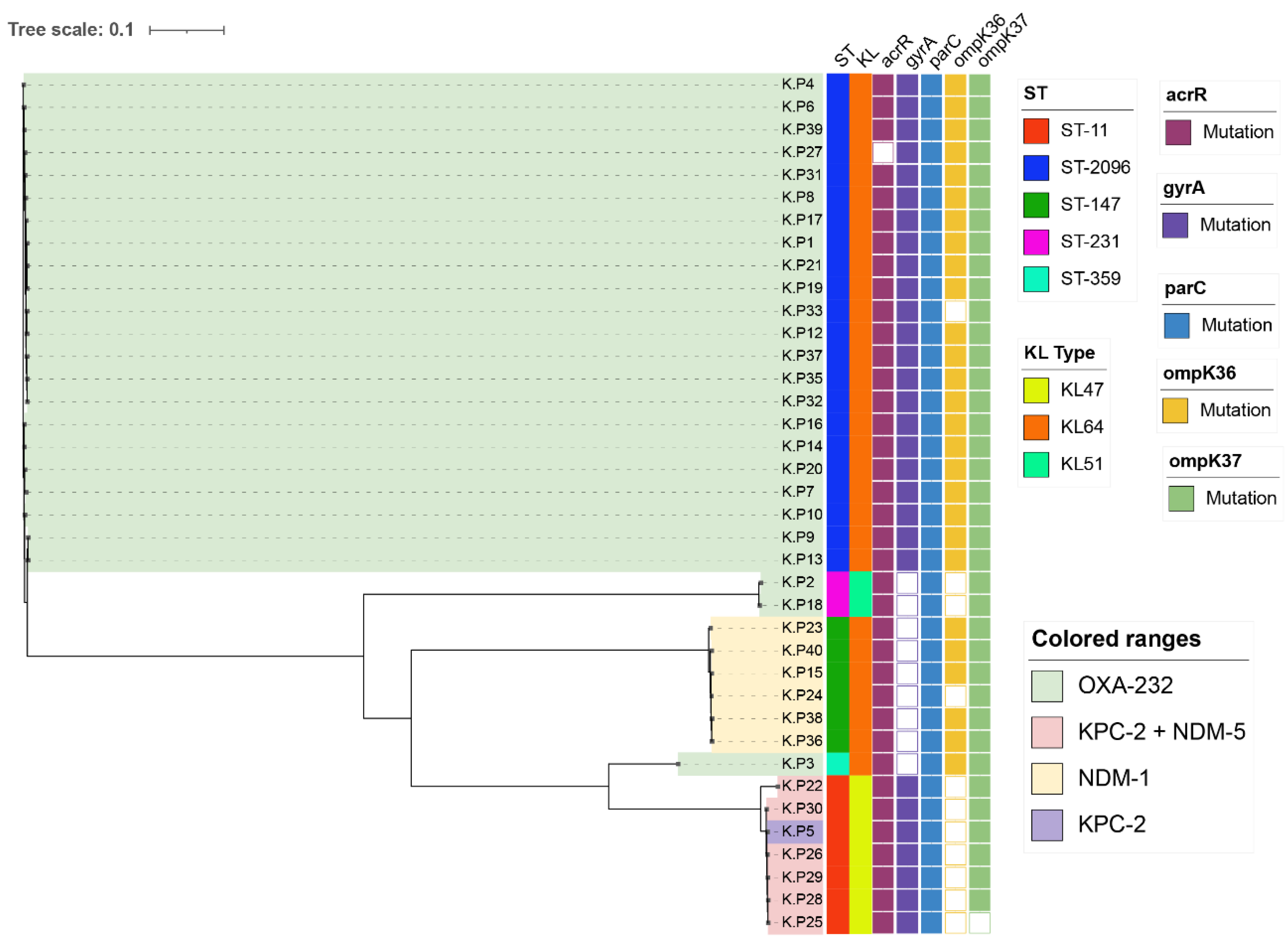
Figure 2.
Heatmap CRKP AMR Virulence Plasmid genes_prevalence.
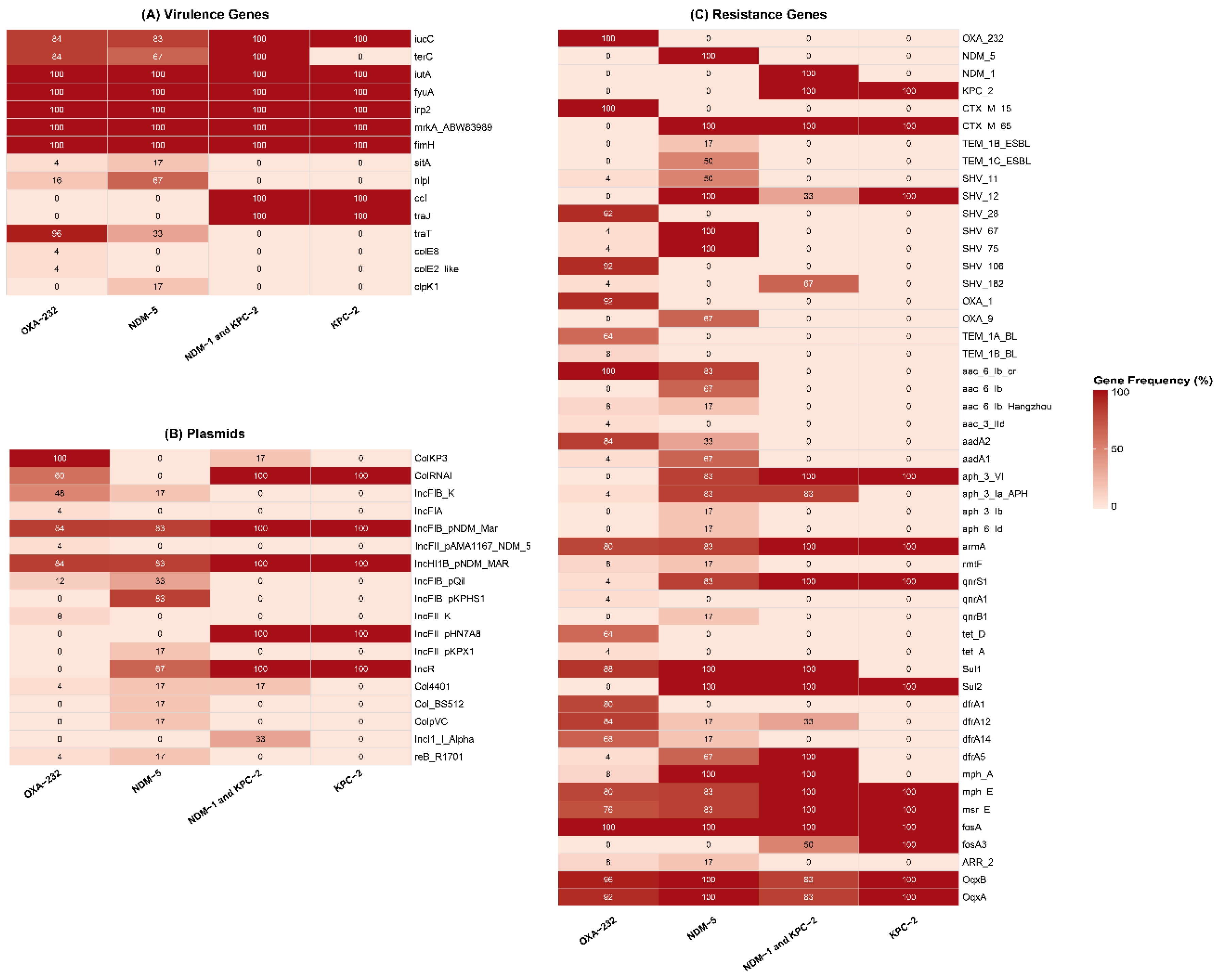
Figure 3.
ESBL distribution in specific carbapenemases in OXA-232; NDM-5; NDM-1+ KPC-2; KPC-2.
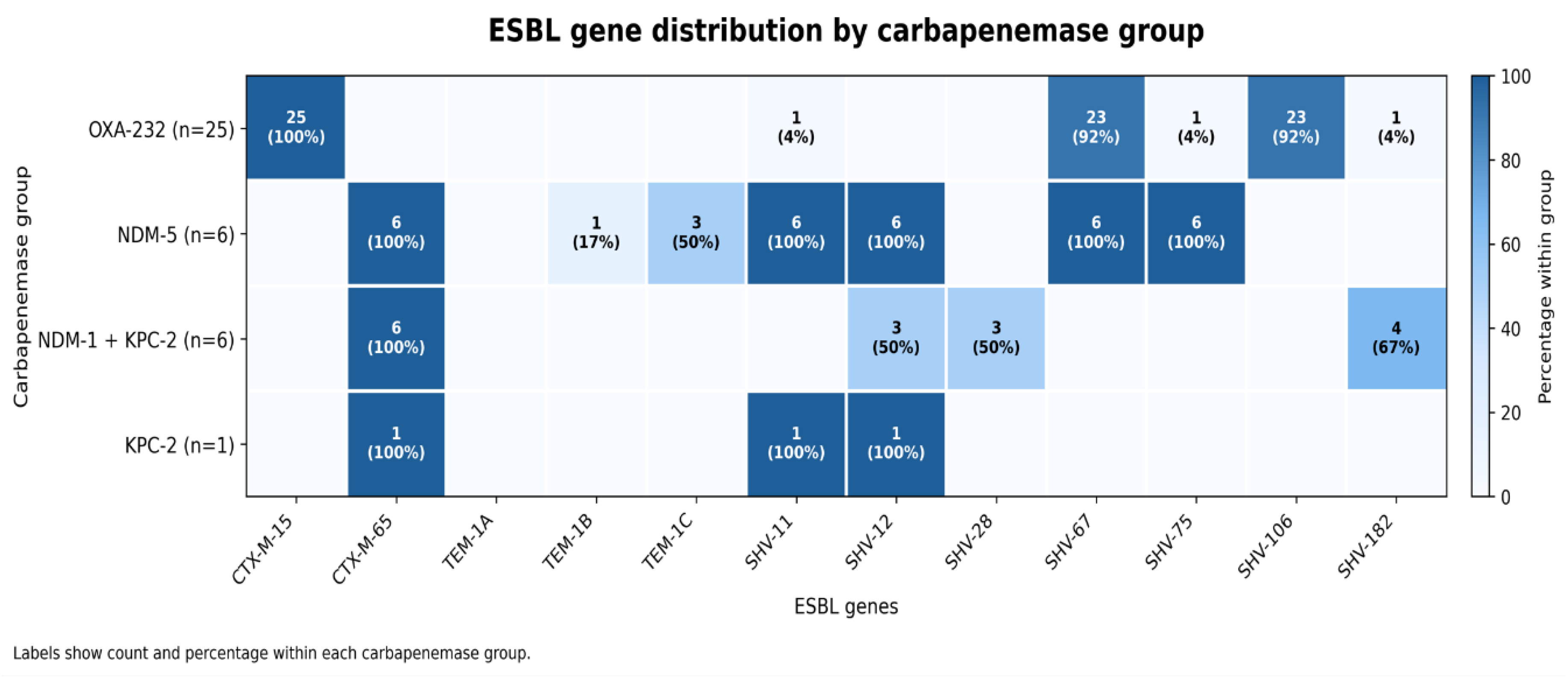
Figure 4.
Carbapenemase Plasmid ST CPE Sankey.
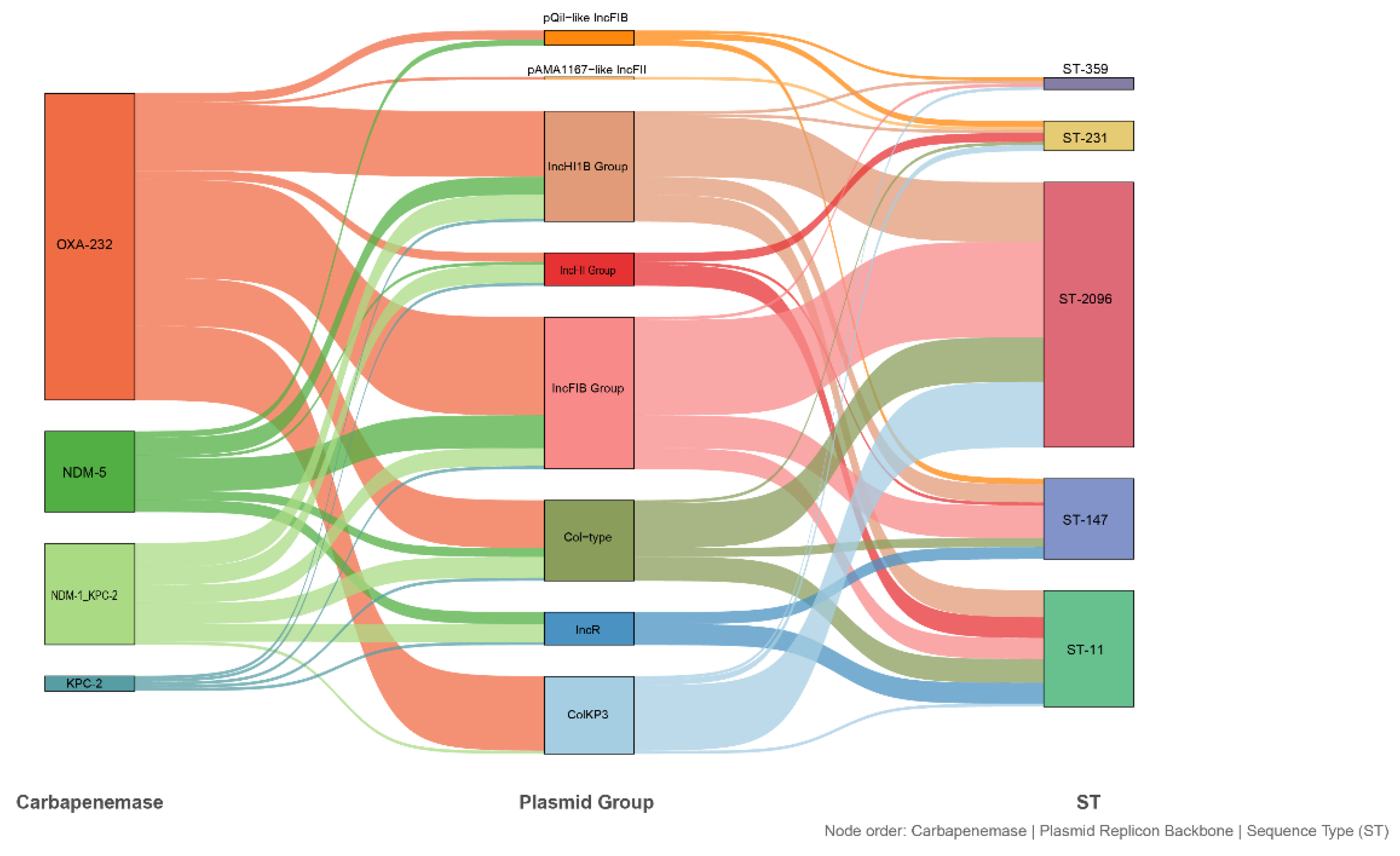
Figure 5.
Plasmid Replicon vs AMR Gene load.
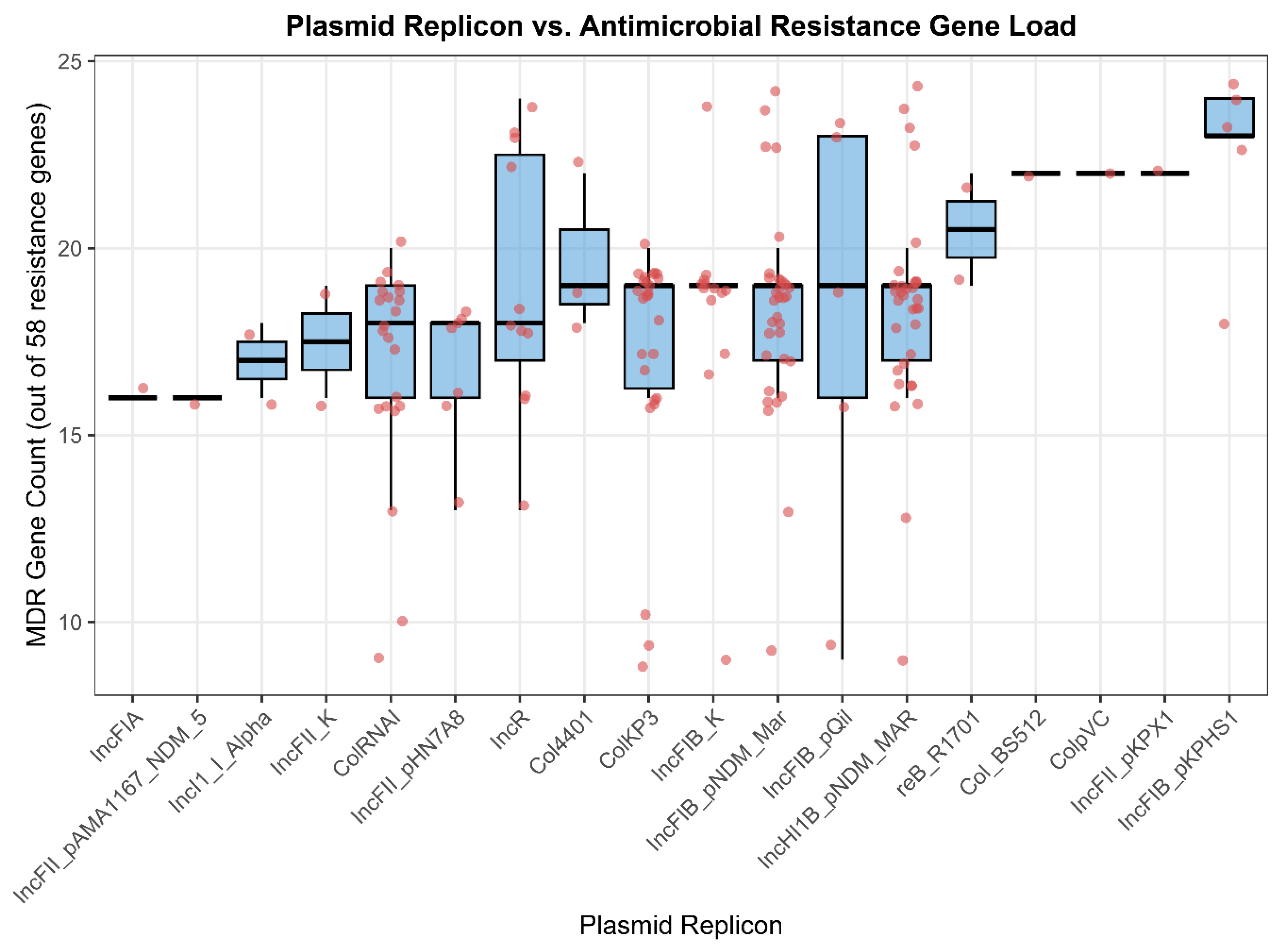
Figure 7.
Antimicrobial Synergy Testing by E test Cross Method.
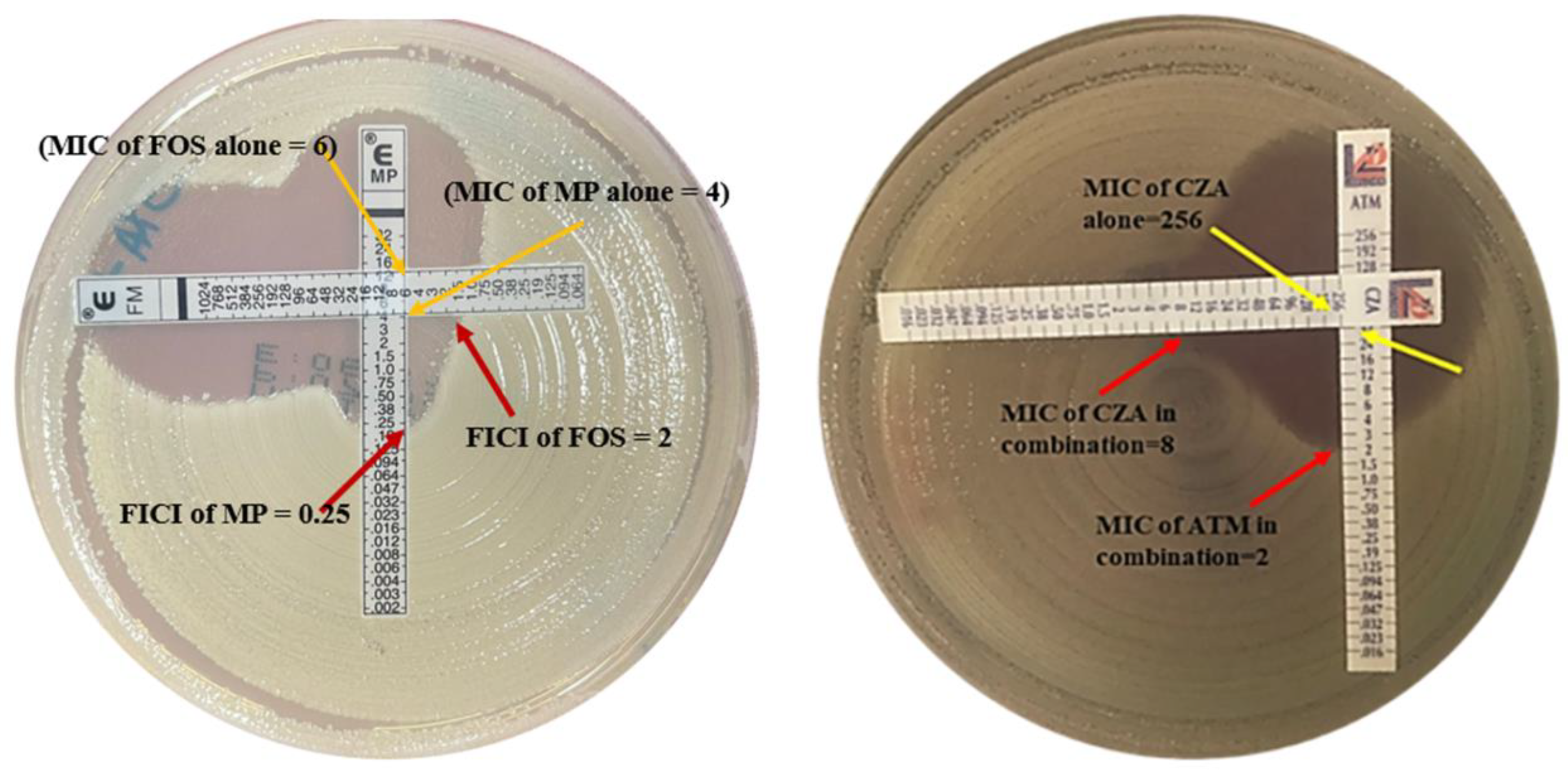
Table 1.
Carbapenemases, MLST and source of infection among XDR/PDR CRKP (n=38).
| S. No. | Carbapenemase | MLST | Source of infection | XDR/PDR status |
|---|---|---|---|---|
| 1 | OXA-232 | ST-2096 | Blood | XDR |
| 2 | OXA-232 | ST-231 | Blood | XDR |
| 3 | OXA-232 | ST-2096 | Blood | XDR |
| 4 | OXA-232 | ST-2096 | Blood | XDR |
| 5 | OXA-232 | ST-2096 | Suprapubic aspirate | XDR |
| 6 | OXA-232 | ST-2096 | Urine | XDR |
| 7 | OXA-232 | ST-2096 | Urine | XDR |
| 8 | OXA-232 | ST-2096 | Urine | XDR |
| 9 | OXA-232 | ST-231 | Urine | XDR |
| 10 | OXA-232 | ST-2096 | Urine | XDR |
| 11 | OXA-232 | ST-2096 | wound | XDR |
| 12 | OXA-232 | ST-2096 | wound | XDR |
| 13 | OXA-232 | ST-2096 | wound | XDR |
| 14 | OXA-232 | ST-2096 | wound | XDR |
| 15 | OXA-232 | ST-2096 | Pus(ear) | XDR |
| 16 | OXA-232 | ST-2096 | swab | XDR |
| 17 | OXA-232 | ST-2096 | swab | PDR |
| 18 | OXA-232 | ST-2096 | Peritoneal fluid | XDR |
| 19 | OXA-232 | ST-2096 | Tracheal Aspirate | XDR |
| 20 | OXA-232 | ST-359 | Tracheal Aspirate | XDR |
| 21 | OXA-232 | ST-2096 | Tracheal Aspirate | XDR |
| 22 | OXA-232 | ST-2096 | Sputum | XDR |
| 23 | OXA-232 | ST-2096 | Sputum | XDR |
| 24 | OXA-232 | ST-2096 | Sputum | XDR |
| 25 | OXA-232 | ST-2096 | Sputum | XDR |
| 26 | NDM-5 | ST-147 | Urine | PDR |
| 27 | NDM-5 | ST-147 | Abdominal wound | XDR |
| 28 | NDM-5 | ST-147 | wound | PDR |
| 29 | NDM-5 | ST-147 | swab | XDR |
| 30 | NDM-5 | ST-147 | Urine | PDR |
| 31 | NDM-5 | ST-147 | Urine | XDR |
| 32 | NDM-1+KPC-2 | ST-11 | Peritoneal fluid | XDR |
| 33 | NDM-1+KPC-2 | ST-11 | Tracheal Aspirate | XDR |
| 34 | NDM-1+KPC-2 | ST-11 | Blood | XDR |
| 35 | NDM-1+KPC-2 | ST-11 | tracheal Aspirate | XDR |
| 36 | NDM-1+KPC-2 | ST-11 | tracheal Aspirate | PDR |
| 37 | NDM-1+KPC-2 | ST-11 | blood | PDR |
| 38 | KPC-2 | ST-11 | Tracheal | XDR |
Table 3.
Susceptibility profile of new antibiotics against the different CRKP.
| Carbapenemase | Susceptibility no (%) | |||||||||
|---|---|---|---|---|---|---|---|---|---|---|
| New antibiotics | ||||||||||
| Cefiderocol | Ceftazidime avibactam | Imipenem-Relebactam | Meropenem Vaborbactam | Fosfomycin | Eravacycline | Plazomicin | Minocycline | Aztreonam | ||
| Breakpoint: ≤4 | Breakpoint: ≤8 | Breakpoint: ≤1 | Breakpoint: ≤4 | Breakpoint: ≤32 | Breakpoint: ≤0.5 | Breakpoint: ≤2 | Breakpoint: ≤4 | Breakpoint: ≤4 | ||
| OXA-48 like | OXA232 (n=25) | 24 (96%)a | 23 (92%) | 21 (84%)b | 10 (40%) | 13 (52%) | 23 (92%)c | 11 (44%) | 12 (48%)d | 0 |
| OXA-48 like (n=22) | 22 (100%) | 21 (96%) | 21 (96%) | ꟷ | 12(54.54%) | 20 (91%) | 9 (40.91%) | ꟷ | ꟷ | |
| Total (n=47) | 46 (98%) | 44 (94%) | 42 (89.36%) | 10 (40%) | 25(53.19%) | 43 (92%) | 20(42.55%) | 12 (48%) | 0 | |
| NDM | NDM-5 (n=6) | 6 (100%) | 0 | 0 | 0 | 1(16.66%) | 6 (100%) | 2 (33%) | 3 (50%)f | 0 |
| NDM (n=22) | 21 (96%) | - | - | - | 0 | 9 (41%) | 8 (36.36%) | 1 (5%) | ꟷ | |
| Total(n=28) | 27 (96%) | 0 | 0 | 0 | 1 (3.57%) | 15 (54%) | 10 (35.71%) | 4 (14.28%) | ꟷ | |
| KPC | KPC-2 (n=1) | 1(100%) | 1 (100%) | ꟷ | 1 (100%) | 0 | 1 (100%) | 1 (100%) | 1 (100%) | 0 |
| KPC(n=22) | 19 (86%) | 20 (91%) | ꟷ | 20(91%) | 1 | 12(55%) | 8 (36.36%) | ꟷ | ꟷ | |
| Total (n=23) | 20 (87%) | 21 (91%) | ꟷ | 21 (91%) | 1 (4.34%) | 13 (57%) | 9 (39.13%) | 1 (100%) | 0 | |
| Co-carriage | NDM-1+ KPC-2 (n=6) | 6 (100%) | 0 | 3 (50%)g | 0 | 2 (33.33%) | 6 (100%) | 4 (66.66%) | 5 (83%) | 0 |
| NDM+ KPC (n=1) | 1 (100%) | 0 | ꟷ | 0 | 1 (100%) | 1 (100%) | 0 | ꟷ | 0 | |
| Total (n=7) | 7 (100%) | 0 | 3 (50%) | 0 | 3 (42.85%) | 7(100%) | 4 (57.14%) | 5 (83%) | 0 | |
| Total S % | (n=105) | 95.00% | 62% | 43% | 30% | 28.57% | 74% | 41% | 37% | 0 |
Table 4.
MIC50 and MIC90 value of newer antimicrobial agents against CRKP.
| CARBAPENMASES | CFD | CZA | IMR | MVP | FOS | ERV | PZ | |||||||
|---|---|---|---|---|---|---|---|---|---|---|---|---|---|---|
| Breakpoint≤4 | Breakpoint≤8 | Breakpoint≤1 | Breakpoint≤4 | Breakpoint≤32 | Breakpoint≤0.5 | Breakpoint≤2 | ||||||||
| MIC50 | MIC90 | MIC50 | MIC90 | MIC50 | MIC90 | MIC50 | MIC90 | MIC50 | MIC90 | MIC50 | MIC90 | MIC50 | MIC90 | |
| OXA-48 (n=47) | 0.125 | 0.5 | 1 | 2 | - | - | - | - | 16 | ≥256 | 0.5 | 0.5 | 64 | ≥256 |
| OXA-232 (n=25) | 0.125 | 0.5 | 1 | 2 | - | - | - | - | 16 | ≥256 | 0.5 | 0.5 | 64 | ≥256 |
| NDM (n=34) | 0.125 | 0.5 | - | - | - | - | - | - | 0.5 | 2 | ≥256 | ≥256 | ≥256 | ≥256 |
| NDM-5(n=6) | 0.064 | 0.5 | - | - | - | - | - | - | ≥256 | ≥256 | 0.5 | 0.5 | 16 | ≥256 |
| KPC (n= 22) | 0.5 | 1 | 1 | 4 | 0.5 | 2 | 0.5 | 2 | ≥256 | ≥256 | 0.25 | 1 | ≥256 | ≥256 |
| KPC-2+NDM-1(n=6) | 0.5 | 1 | ≥256 | ≥256 | 1 | 32 | 32 | 32 | ≥256 | ≥256 | 0.5 | 0.5 | 2 | ≥256 |
CFD: Cefiderocol, CZA: Ceftazidime; IMR: Imipenem relebactam; MVP: Meropenem vaborbactam; FOS: Fosfomycin; ERV: Eravacycline, PLZ: Plazomicin.
Table 5.
Assessment of Synergistic Activity of some available antimicrobials against different CRKP isolates.
Table 5.
Assessment of Synergistic Activity of some available antimicrobials against different CRKP isolates.
| Combinations | Carbapenemases | Synergy n(%) | Partial synergy n(%) | Additive n(%) | Indifferent n(%) | Antagonism n(%) |
|---|---|---|---|---|---|---|
| ∑ FICI ≤ 0.50 | ∑ FICI=0.5–0.75 | ∑ FICI=0.76– 1.0 | ∑ FICI=1-4 | ∑ FICI> 4 | ||
| CZA+AZT | OXA-232 (n=25) | 25(100%) | 0 | 0 | 0 | 0 |
| NDM-5 (n=6) | 6 (100%) | 0 | 0 | 0 | 0 | |
| NDM-1+KPC-2 (n=6) | 6 (100%) | 0 | 0 | 0 | 0 | |
| KPC-2 (n=1) | 1 (100%) | 0 | 0 | 0 | 0 | |
| MER+FOS | OXA-232 (n=25) | 8 (32%) | 4 (16%) | 2 (8%) | 11 (44%) | 0 |
| NDM-5 (n=6) | 0 | 1 (17%) | 0 | 5 (83.3%) | 0 | |
| NDM-1+KPC-2 (n=6) | 0 | 1 (17%) | 0 | 5 (83.3%) | 0 | |
| KPC-2 (n=1) | 0 | 0 | 0 | 1 (100%) | 0 | |
| AK+FOS | AK+FOS | 10 (40%) | 3 (12%) | 1 (4%) | 11 (44%) | 0 |
| NDM-5 (n=6) | 0 | 0 | 0 | 6 (100%) | 0 | |
| NDM-1+KPC-2 (n=6) | 1 (17) | 0 | 2 (33.3%) | 3 (50%) | 0 | |
| KPC-2 (n=1) | 0 | 0 | 0 | 1 (100%) | 0 |
Disclaimer/Publisher’s Note: The statements, opinions and data contained in all publications are solely those of the individual author(s) and contributor(s) and not of MDPI and/or the editor(s). MDPI and/or the editor(s) disclaim responsibility for any injury to people or property resulting from any ideas, methods, instructions or products referred to in the content. |
© 2026 by the authors. Licensee MDPI, Basel, Switzerland. This article is an open access article distributed under the terms and conditions of the Creative Commons Attribution (CC BY) license (http://creativecommons.org/licenses/by/4.0/).
Copyright: This open access article is published under a Creative Commons CC BY 4.0 license, which permit the free download, distribution, and reuse, provided that the author and preprint are cited in any reuse.


