
Submitted:
16 July 2026
Posted:
20 July 2026
You are already at the latest version
Abstract
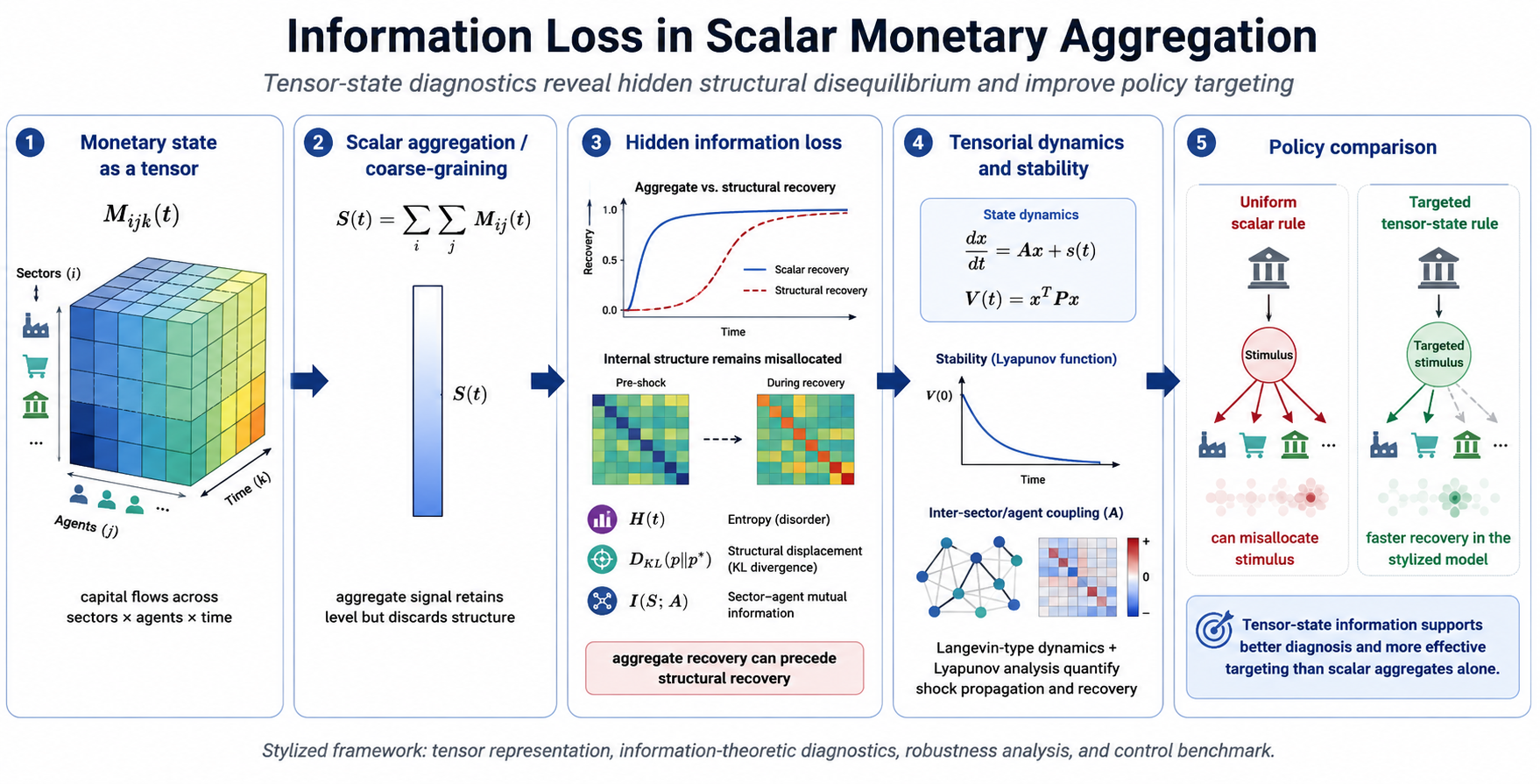
We develop a tensor-based dynamical framework for monetary flows in multi-sector, multi-agent economies and quantify the information destroyed when the monetary state is reduced to a scalar aggregate. The state is a third-order tensor encoding capital flows across sectors, agent classes, and time; deviations from equilibrium obey a tensorial Langevin equation with a coupling operator and sector-specific friction rates. We prove global asymptotic stability through a quadratic Lyapunov function, with a convergence bound valid for the non-normal system matrices typical of asymmetric economic coupling, and characterise the stochastically forced case in the mean-square sense. Shannon entropy, Kullback–Leibler divergence, and sector–agent mutual information measure the structural information discarded by scalar aggregation. In a 2008-inspired stylised scenario, Finance absorbs an 18.9% peak capital loss while Manufacturing and Services suffer 5.8% and 3.9% secondary drops; the scalar aggregate contracts by only 8.6% and, as measured by the Kullback–Leibler divergence, recovers about 21 quarters before the sectoral structure does. A targeted stimulus restores equilibrium in 13.7 quarters, versus 40.7 with no policy and 69.9 under an equal-budget uniform stimulus; the advantage persists under a symmetric exit rule. Scalar aggregation thus substantially underestimates sectoral heterogeneity, and tensor-based targeting produces quantitatively superior outcomes.
Keywords:
econophysics
; information theory
; entropy
; coarse-graining
; non-equilibrium dynamics
; tensor representation
; Lyapunov stability
; financial contagion
; policy optimisation
Copyright: This open access article is published under a Creative Commons CC BY 4.0 license, which permit the free download, distribution, and reuse, provided that the author and preprint are cited in any reuse.


