

Submitted:
16 July 2026
Posted:
17 July 2026
You are already at the latest version
Abstract
Autism spectrum disorder is characterized by marked heterogeneity in developmental trajectories, functional regulation, therapeutic engagement, and intervention responsiveness. Although behavioral, developmental, educational, and family-centered interventions remain central to autism support, children with similar diagnostic labels and apparently comparable intervention exposure may show substantially different trajectories of engagement and benefit. This Hypothesis and Theory article proposes a neurodevelopmental regulation framework for examining whether multidomain biological burden may contribute to variability in therapeutic engagement and intervention responsiveness in autism. The framework is deliberately presented as a hypothesis-generating model rather than as a validated clinical tool. It organizes biological burden, energetic capacity, adaptive neurodevelopmental window accessibility, neuroplastic capacity, therapeutic engagement, and intervention responsiveness into a testable sequence of research constructs. Biological burden is conceptualized as a multidomain, state-sensitive and trait-influenced construct informed by sleep-circadian regulation, gastrointestinal symptoms, immune/allergic vulnerability, fatigue, pain or discomfort, autonomic regulation, sensory-physiological stress, and, where feasible, reproducible biological markers. Therapeutic engagement is conceptualized as a multidimensional functional construct reflecting regulatory availability, attentional and interactional access, responsiveness to support, persistence and adaptive effort, contextual transfer, and relational-motivational engagement. The manuscript distinguishes the proposed model from existing allostatic load, Research Domain Criteria, developmental systems, predictive processing, social motivation, and precision psychiatry approaches. It also provides candidate operational domains for biological burden and therapeutic engagement, proposes a staged validation roadmap, and discusses developmental confounds, state-trait variability, measurement limitations, and safeguards against overmedicalization. The framework does not recommend biomarker screening, biological treatment, or treatment selection at this stage. Its purpose is to support future feasibility studies, construct validation, longitudinal modeling, and ethically cautious precision-stratified autism research.
Keywords:
autism spectrum disorder
; biological burden
; therapeutic engagement
; intervention responsiveness
; allostatic load
; RDoC
; neuroplasticity
; precision-stratified research
1. Introduction
Autism spectrum disorder (ASD) is a heterogeneous neurodevelopmental condition characterized by substantial variability in developmental trajectory, adaptive functioning, regulation, communication, behavior, and response to intervention (1-4). Although early developmental and behavioral interventions can improve outcomes for many children, responsiveness remains uneven across individuals (5-10). Some children show robust gains in communication, adaptive behavior, and social engagement, whereas others show limited, fluctuating, or context-dependent progress despite apparently comparable therapeutic exposure.
Explaining this variability remains a central challenge in autism research. Existing accounts often emphasize age at intervention onset, cognitive level, symptom severity, intervention intensity, treatment fidelity, family resources, service access, and environmental context (5-10). These factors are important, but they do not fully explain why similar interventions may produce different engagement and developmental responses across autistic children.
One underdeveloped question is whether the biological and physiological state of the child may influence access to therapeutic learning. Autism is associated, in subsets of individuals, with variation across immune, metabolic, mitochondrial, oxidative, gastrointestinal, sleep-circadian, sensory, autonomic, and stress-regulation systems (11-23). These findings are heterogeneous, often inconsistent across studies, and not specific to autism. Nonetheless, they raise a testable possibility: biological state may influence the regulation, energy availability, attention, recovery, and plasticity required for therapeutic engagement.
This manuscript proposes a neurodevelopmental regulation framework for studying how multidomain biological burden may relate to therapeutic engagement and intervention responsiveness in autism. The model is not presented as a treatment system, diagnostic tool, biomarker test, clinical decision algorithm, or validated precision-care platform. It is a hypothesis-generating framework intended to organize future research on the relationship between biological burden, energetic capacity, adaptive developmental timing, neuroplastic capacity, therapeutic engagement, and intervention responsiveness.
The revised manuscript responds to the need for greater scientific neutrality, operational clarity, and empirical caution. The framework is situated in relation to allostatic load, Research Domain Criteria (RDoC), developmental systems, predictive processing, social motivation, and precision psychiatry approaches. Candidate operational domains are proposed for biological burden and therapeutic engagement, but no validated index or score is claimed. A staged validation pathway is outlined to clarify how the constructs could be tested before any clinical or translational claims are made. The model was initially developed within the FIAP research Program; however, the present manuscript uses neutral scientific terminology to focus on the testable neurodevelopmental regulation hypothesis rather than on proprietary or implementation-oriented framing.
2. Relationship to Existing Frameworks
The proposed framework is not intended to replace existing theories of autism or biological regulation. It should be understood as a translational hypothesis that draws from, and must be tested against, several established bodies of work.
First, the model is closely related to the allostatic load literature. Allostatic load was introduced to describe the cumulative biological cost of adaptation to repeated or chronic demands (24-26). Multisystem allostatic load indices have typically integrated neuroendocrine, metabolic, immune, cardiovascular, and anthropometric indicators to estimate cumulative biological risk. The present framework does not claim that the proposed biological burden construct is novel in the broad sense of cumulative physiological load. Rather, it proposes an autism-specific research question: whether multidomain biological burden, broadly analogous to allostatic load but adapted to neurodevelopmental and therapeutic contexts, is associated with therapeutic engagement and intervention responsiveness.
Second, the model is related to the RDoC framework, which emphasizes dimensional constructs linking behavior, neural systems, physiology, and function across traditional diagnostic categories (27, 28). RDoC is important because it provides a precedent for organizing research around functional dimensions and multiple measurement classes rather than symptom categories alone. The present framework is narrower and more applied: it asks whether regulatory, energetic, and engagement-related constructs can help explain heterogeneity in autism intervention responsiveness. Therapeutic engagement overlaps conceptually with RDoC-relevant domains such as arousal/regulatory systems, cognitive systems, and social processes, but the present model focuses specifically on accessibility to therapeutic learning.
Third, the framework must be considered alongside autism theories such as predictive processing and Bayesian accounts, developmental systems models, social motivation theory, enhanced perceptual functioning, and dimensional psychopathology approaches. These frameworks address how autistic development may involve differences in perception, prediction, social learning, environmental adaptation, cognition, or dimensional variation. The present framework does not compete with these models. Instead, it asks a complementary question: how physiological burden, regulation, and adaptive reserve might influence when and how therapeutic learning is accessible.
Fourth, the framework is linked to precision psychiatry and precision neurodevelopmental research (29), but it does not claim readiness for clinical precision intervention. Precision-oriented research can be useful only if candidate constructs are operationalized, validated, replicated, and ethically implemented. The proposed framework therefore remains at the stage of hypothesis generation and construct development.
3. Conceptual Model
The model proposes that therapeutic responsiveness in autism may be influenced by interactions among biological burden, energetic capacity, adaptive neurodevelopmental window accessibility, neuroplastic capacity, therapeutic engagement, and intervention context. This sequence should not be interpreted as a deterministic causal chain. It is a provisional systems-level hypothesis intended to generate measurable questions.
Biological burden is conceptualized as a multidomain state-sensitive and trait-influenced construct. It may reflect sleep disruption, gastrointestinal burden, immune/allergic vulnerability, pain or discomfort, fatigue, autonomic dysregulation, sensory-physiological stress, metabolic vulnerability, or other biologically relevant indicators. Some components may be relatively stable, whereas others may fluctuate with illness, sleep, stress, medication, school demands, sensory overload, or environmental instability.
Energetic capacity refers to the adaptive reserve available for regulation, attention, recovery, social interaction, and learning. In this model, energetic capacity is not a direct metabolic measurement but a research construct linking biological demand to functional endurance. A child may have sufficient cognitive potential but limited reserve at a given time because of poor sleep, pain, fatigue, high arousal, or environmental stress.
Adaptive neurodevelopmental window accessibility refers to the state-dependent conditions under which therapeutic input becomes more or less usable. The window is not merely chronological; it is influenced by developmental stage, regulation, context, biological burden, reserve, and therapeutic fit. This concept is proposed to explain why the same intervention may be more accessible at some times than others.
Therapeutic engagement is conceptualized as the functional interface between biological state, developmental readiness, context, and intervention. It includes regulatory availability, attention, interactional access, responsiveness to support, persistence, adaptive effort, transfer across contexts, and relational-motivational engagement. It should not be reduced to compliance, attendance, or visible participation alone.
Intervention responsiveness is the outcome domain that future studies would attempt to explain. Responsiveness may include changes in communication, adaptive functioning, social participation, emotional regulation, learning generalization, functional autonomy, or caregiver/clinician-rated improvement. In this model, responsiveness is expected to depend not only on intervention exposure but also on the accessibility of learning conditions.
Figure 1 summarizes the conceptual model.
4. Candidate Operationalization of Biological Burden and Therapeutic Engagement
To make the framework testable, biological burden and therapeutic engagement must be translated into measurable research variables. The present manuscript does not propose a validated Biological Burden Index or Therapeutic Engagement Index. Instead, it proposes candidate domains and measurement pathways that could be refined through feasibility studies, expert review, psychometric testing, biomarker reproducibility analyses, and longitudinal validation.
A biological burden measure should not collapse heterogeneous biomarkers into a single score without evidence. Future work would need to define domain-specific indicators, standardize measurement timing, evaluate reliability, normalize variables appropriately, test whether domains cluster empirically, and determine whether any composite score predicts engagement or responsiveness beyond established predictors. In early work, domain-level profiles may be preferable to a single total score.
Similarly, therapeutic engagement should be developed as a measurable functional construct. Candidate indicators may include observable regulation, attentional access, interactional tolerance, response to prompting, persistence during challenge, recovery after stress, generalization across contexts, and relational-motivational engagement. Validation would require structured ratings, inter-rater reliability, caregiver/clinician convergence, sensitivity to change, and association with intervention outcomes.
Table 1 presents a provisional operationalization framework for future empirical development. It identifies candidate domains, observable indicators, potential measurement sources, preliminary domain-level scoring approaches, and the validation requirements associated with each construct. The table is intentionally conservative and should not be interpreted as defining a finalized Biological Burden Index, Therapeutic Engagement Index, validated composite score, weighting system, or clinical cutoff. Its purpose is to make the proposed constructs empirically examinable while preserving uncertainty regarding domain structure, measurement performance, aggregation, and predictive validity.
5. State-Trait Distinction, Developmental Change, and Confounds
A major challenge is distinguishing state-like and trait-like aspects of biological burden and engagement. Some biological vulnerabilities may be relatively stable, such as chronic sleep patterns, persistent gastrointestinal symptoms, or long-standing autonomic regulation differences. Others may fluctuate daily or weekly, including acute illness, sleep deprivation, pain, stress, medication changes, sensory overload, or school transition demands.
Developmental change is also central. Age, language level, intellectual/developmental disability, adaptive functioning, pubertal stage, and communication profile may influence both biological indicators and therapeutic engagement. For example, gastrointestinal symptoms, sleep problems, sensory dysregulation, medication exposure, and caregiver reporting may differ across developmental and communication profiles. Without careful modeling, biological burden could be confounded with developmental severity, service access, or reporting bias.
Environmental and contextual factors are equally important. Family stress, socioeconomic resources, intervention intensity, school support, clinician experience, cultural expectations, and access to medical evaluation may all influence measured burden and engagement. A low engagement profile should therefore never be interpreted as a fixed child characteristic. It may reflect modifiable environmental demands, poor therapeutic fit, insufficient accommodation, or measurement context.
Table 2 summarizes major sources of confounding, measurement distortion, and interpretive bias that should be anticipated in future empirical studies. These variables should be specified a priori and incorporated prospectively into study design, sampling, measurement schedules, statistical models, and sensitivity analyses, rather than invoked only as post hoc explanations of observed associations. Their inclusion will be necessary to determine whether relationships among biological burden, therapeutic engagement, and intervention responsiveness remain detectable beyond developmental characteristics, communication profile, intellectual or developmental disability, comorbidities, medication exposure, environmental context, service access, and informant-related measurement bias.
6. Validation Pathway
The framework will be scientifically useful only if its constructs are tested through staged validation. The first stage is content and face validity: experts, clinicians, caregivers, and autistic stakeholders should evaluate whether candidate domains are meaningful, non-stigmatizing, and measurable. The second stage is feasibility: researchers must determine whether data can be collected with acceptable burden and adequate completeness.
The third stage is measurement development. For therapeutic engagement, this includes item generation, structured observation, inter-rater reliability, caregiver-clinician convergence, internal consistency where appropriate, and sensitivity to change. For biological burden, this includes domain-specific reliability, assay reproducibility where biomarkers are used, temporal stability, missing-data analysis, and avoidance of unsupported biomarker aggregation.
The fourth stage is construct validity. Biological burden should be tested for convergent and discriminant relationships with sleep, GI burden, pain, fatigue, autonomic regulation, sensory stress, and other candidate domains. Therapeutic engagement should be tested against attention, regulation, persistence, contextual transfer, and observed participation, while remaining distinct from compliance or global symptom severity.
The fifth stage is longitudinal validation. Studies should test whether biological burden and engagement fluctuate over time, whether they predict responsiveness beyond intervention exposure and baseline developmental profile, and whether energetic capacity or engagement mediates the relationship between biological burden and responsiveness. The sixth stage is external replication across sites, populations, languages, service contexts, and resource levels.
Table 3 summarizes the staged validation roadmap required to progress from conceptual formulation to any future translational evaluation. The stages are sequential but may involve iterative refinement as construct definitions, measurement properties, feasibility constraints, and empirical relationships become clearer. Progression toward clinical utility should occur only after adequate evidence has been established for content validity, feasibility, measurement reliability, construct validity, longitudinal sensitivity, hypothesized pathway testing, external replication, fairness, and ethical acceptability. Until these requirements are met, the proposed framework should be interpreted exclusively as a hypothesis-generating research model and not as a validated index, clinical assessment system, treatment-selection framework, or decision-support tool.
7. Clinical and Ethical Boundaries
The framework should not be interpreted as recommending routine biomarker screening, biological treatment, or biological modulation strategies for autistic children. The evidence base is not sufficient for such claims. The framework also should not be used to assign treatment, predict individual outcomes, determine service eligibility, or rank children by biological burden.
Safeguards are needed to prevent overmedicalization. Autism is not reducible to biological abnormalities, and biological variation should not be used to pathologize autistic identity. The purpose of the framework is to study conditions that may affect access to learning and support, not to define autism as a disease state requiring biological correction.
A high biological burden or low engagement profile, if such constructs are eventually validated, should be interpreted as a signal of support needs, not as a fixed limitation. It should prompt questions about sleep, discomfort, stress, environment, therapeutic fit, pacing, sensory load, communication supports, and family context. The model should be used to reduce blame and improve accommodation, not to generate deterministic labels.
Any future clinical application would require ethics review, professional oversight, stakeholder involvement, validation across diverse populations, bias assessment, privacy protection, and clear communication with families. At this stage, the appropriate use is research structuring and hypothesis generation.
8. Discussion
This framework proposes that heterogeneity in therapeutic engagement and intervention responsiveness may partly reflect differences in biological regulation, adaptive reserve, developmental state, and therapeutic context. Its contribution is not the claim that biology matters in autism; this is already well established in multiple literatures. Rather, the contribution is to propose a structured research model for testing whether multidomain biological burden is associated with therapeutic engagement and responsiveness.
The model is intentionally integrative, but integration should not be confused with proof. Immune, mitochondrial, oxidative, gastrointestinal, sleep, autonomic, sensory, and stress-regulation findings in autism are heterogeneous and sometimes inconsistent across studies. Many biomarkers lack specificity, may reflect comorbidities or environmental conditions, and have uncertain causal relevance. Therefore, the proposed framework must be tested with careful measurement, transparent assumptions, and attention to contradictory evidence.
Engaging with allostatic load helps avoid conceptual overstatement. Biological burden is not an entirely new idea; multisystem load and cumulative biological risk have been studied extensively in stress and health research (24-26). The current framework adapts this logic to autism intervention research by asking whether cumulative or domain-specific burden relates to engagement and responsiveness. This adaptation requires empirical testing rather than conceptual assertion.
Engaging with RDoC also clarifies the framework's purpose. RDoC encourages dimensional, multi-level investigation of functional constructs across biological and behavioral systems (27, 28). Therapeutic engagement can be viewed as a functional construct that may involve arousal/regulatory systems, social processes, cognitive systems, and sensorimotor processes. This framing supports measurement development while reducing the risk of presenting a proprietary model as isolated from existing science.
The framework may be most useful if developed initially as a low-burden research tool. Early studies should prioritize caregiver report, clinician observation, structured engagement ratings, sleep/GI/pain/fatigue indicators, contextual variables, and longitudinal follow-up before introducing complex biomarker panels. This staged approach would reduce burden, improve feasibility, and prevent premature clinical claims.
9. Limitations
This manuscript is conceptual and does not present original empirical data, pilot results, computational modeling, biomarker validation, psychometric validation, or clinical trial evidence. The proposed constructs remain hypothetical.
No validated Biological Burden Index is currently provided. The domains listed are candidate research domains, not a clinically actionable score. Future work must determine whether domain-specific burden profiles or composite indices are reliable, valid, interpretable, and reproducible.
No validated Therapeutic Engagement Index is currently provided. The domains listed are candidate domains requiring item development, structured observation, inter-rater reliability, caregiver and clinician validation, sensitivity-to-change testing, and predictive validity analysis.
The framework does not establish causality. Relationships among biological burden, energetic capacity, neuroplasticity, therapeutic engagement, and intervention responsiveness may be bidirectional, confounded, mediated by context, or variable across individuals.
The framework may require revision after empirical testing. Some constructs may overlap, prove difficult to measure, show limited predictive value, or require subdivision. The model should therefore be considered provisional.
Finally, the framework should not be used to justify unsupported biological interventions, speculative biomarker testing, or deterministic clinical decision-making. Its current value is limited to hypothesis generation and research design.
10. Conclusions
This article proposes a neurodevelopmental regulation framework for studying the relationship among biological burden, energetic capacity, adaptive neurodevelopmental window accessibility, therapeutic engagement, and intervention responsiveness in autism. The framework is intended to generate testable hypotheses, not to provide a validated index, diagnostic tool, treatment algorithm, or clinical decision system.
The central hypothesis is that multidomain biological burden may influence therapeutic engagement and responsiveness by affecting regulation, adaptive reserve, and neuroplastic accessibility. This hypothesis is plausible within existing biological, allostatic load, RDoC, developmental, and intervention literatures, but it remains unvalidated.
Future work should focus on operationalizing candidate domains, testing reliability and construct validity, distinguishing state and trait components, addressing confounds, evaluating longitudinal associations, and replicating findings across diverse settings. Only after such validation could translational relevance be responsibly evaluated.
By reframing therapeutic engagement as a measurable and biologically contextualized research construct, the proposed framework may contribute to future precision-stratified autism research while maintaining scientific caution, ethical safeguards, and respect for the heterogeneity of autistic development.
Author Contributions
YF conceived the The framework, developed the conceptual architecture, and wrote the manuscript.
Funding Statement
No specific external funding was received for the preparation of this manuscript.
Ethics Statement
This manuscript does not report human-subject data, animal data, clinical intervention, identifiable health information, or retrospective record review. It presents a conceptual and translational research architecture. Therefore, research ethics board approval was not required for the present manuscript. Future feasibility studies, pilot validation, data collection, or implementation research involving autistic children, caregivers, clinicians, educational contexts, health-related information, or service records will require appropriate ethics review, consent procedures, privacy safeguards, and governance approval before initiation.
Data Availability Statement
No datasets were generated or analyzed for the present manuscript. The framework is presented as a conceptual and hypothesis-generating architecture. Future empirical studies will require predefined data governance procedures, privacy protections, data minimization, and ethics-approved data-sharing arrangements where applicable.
Conflicts of Interest Statement
The author is the founder of FIAP Autism & Equity Institute and the originator of the The BBI framework conceptual architecture. The framework , FIAP-related constructs, figures, terminology, translational models, and future digital implementation concepts may constitute intellectual assets under development. The present manuscript is conceptual and does not present a validated clinical product, commercial device, medical intervention, diagnostic tool, or autonomous decision-support system.
Clinical and Translational Caution
The framework is not a validated clinical instrument, diagnostic system, biomarker panel, medical device, treatment-selection algorithm, or autonomous decision-making technology. It should not be used to make clinical decisions, determine service eligibility, restrict care, diagnose autism or any other condition, or modify intervention delivery outside an approved research protocol.
Intellectual Property Notice
© 2026 FIAP Autism & Equity Institute / Yves Fuamba. All rights reserved. The conceptual architecture, terminology, figures, tables, and translational model described in this manuscript are presented for scientific communication and hypothesis generation. No license is granted for unauthorized clinical, commercial, digital, algorithmic, educational, or derivative use without prior written authorization.
Acknowledgments
Generative artificial intelligence tools were used for language refinement and figure-development support. All AI-assisted outputs were critically reviewed, revised, verified, and approved by the author, who takes full responsibility for the accuracy, originality, integrity, and scientific content of the manuscript. The tools used included ChatGPT (OpenAI) for language refinement and figure development support.
References
- Lord, C.; Brugha, T.S.; Charman, T.; Cusack, J.; Dumas, G.; Frazier, T.; et al. Autism spectrum disorder. Lancet 2020, 392, 508–520. [Google Scholar]
- Dawson, G.; Rogers, S.; Munson, J.; Smith, M.; Winter, J.; Greenson, J.; et al. Randomized, controlled trial of an intervention for toddlers with autism: the Early Start Denver Model. Pediatrics 2010, 125, e17–e23. [Google Scholar] [CrossRef] [PubMed]
- Rogers, S.J.; Vismara, L.A. Evidence-based comprehensive treatments for early autism. J. Clin. Child Adolesc. Psychol. 2008, 37, 8–38. [Google Scholar] [CrossRef] [PubMed]
- Schreibman, L.; Dawson, G.; Stahmer, A.C.; Landa, R.; Rogers, S.J.; McGee, G.G.; et al. Naturalistic developmental behavioral interventions: empirically validated treatments for autism spectrum disorder. J. Autism Dev. Disord. 2015, 45, 2411–2428. [Google Scholar] [CrossRef] [PubMed]
- Estes, A.; Munson, J.; Rogers, S.J.; Greenson, J.; Winter, J.; Dawson, G. Long-term outcomes of early intervention in 6-year-old children with autism spectrum disorder. J. Am. Acad. Child Adolesc. Psychiatry 2015, 54, 580–587. [Google Scholar] [CrossRef] [PubMed]
- Vivanti, G.; Prior, M.; Williams, K.; Dissanayake, C. Predictors of outcomes in autism early intervention: why don't we know more? Autism Res. 2014, 7, 132–142. [Google Scholar] [CrossRef]
- Smith, T.; Iadarola, S. Evidence base update for autism spectrum disorder. J. Clin. Child Adolesc. Psychol. 2015, 44, 897–922. [Google Scholar] [CrossRef] [PubMed]
- Landa, R.J. Efficacy of early interventions for infants and young children with, and at risk for, autism spectrum disorders. Pediatrics 2018, 141, S138–S148. [Google Scholar]
- Howlin, P.; Magiati, I.; Charman, T. Systematic review of early intensive behavioral interventions for children with autism. Am. J. Intellect. Dev. Disabil. 2009, 114, 23–41. [Google Scholar] [CrossRef] [PubMed]
- Green, S.A.; Hernandez, L.; Tottenham, N.; Krasileva, K.; Bookheimer, S.Y.; Dapretto, M. Neurobiology of sensory overresponsivity in youth with autism spectrum disorders. J. Child Psychol. Psychiatry 2015, 56, 865–873. [Google Scholar]
- Geschwind, D.H.; State, M.W. Gene hunting in autism spectrum disorder: on the path to precision medicine. Neuron 2015, 87, 121–134. [Google Scholar] [CrossRef]
- Lai, M.C.; Lombardo, M.V.; Baron-Cohen, S. Autism. Lancet 2014, 383, 896–910. [Google Scholar] [CrossRef]
- Lombardo, M.V.; Lai, M.C.; Baron-Cohen, S. Big data approaches to decomposing heterogeneity across the autism spectrum. Mol. Psychiatry 2019, 24, 1435–1450. [Google Scholar] [CrossRef] [PubMed]
- Estes, M.L.; McAllister, A.K. Immune contributions to the pathophysiology of autism spectrum disorders. Nat. Rev. Neurosci. 2015, 16, 469–486. [Google Scholar] [CrossRef] [PubMed]
- Rossignol, D.A.; Frye, R.E. Mitochondrial dysfunction in autism spectrum disorders: a systematic review and meta-analysis. Mol. Psychiatry 2012, 17, 290–314. [Google Scholar] [PubMed]
- Frye, R.E.; Rossignol, D.A. Metabolic disorders and abnormalities associated with autism spectrum disorder. J. Pediatr. Biochem. 2011, 1, 181–191. [Google Scholar]
- Cryan, J.F.; Dinan, T.G. Mind-altering microorganisms: the impact of the gut microbiota on brain and behaviour. Nat. Rev. Neurosci. 2012, 13, 701–712. [Google Scholar] [CrossRef] [PubMed]
- Hsiao, E.Y. Immune dysregulation in autism spectrum disorder. Int. Rev. Neurobiol. 2013, 113, 269–302. [Google Scholar] [CrossRef] [PubMed]
- James, S.J.; Melnyk, S.; Jernigan, S.; Hubanks, A.; Rose, S.; Gaylor, D.W. Abnormal transmethylation/transsulfuration metabolism and DNA hypomethylation among parents of children with autism. J. Autism Dev. Disord. 2008, 38, 1966–1975. [Google Scholar] [CrossRef] [PubMed]
- Sharon, G.; Cruz, N.J.; Kang, D.W.; Gandal, M.J.; Wang, B.; Kim, Y.M.; et al. Human gut microbiota from autism spectrum disorder promote behavioral symptoms in mice. Cell. 2019, 177, 1600–1618.e17. [Google Scholar] [CrossRef] [PubMed]
- Cohen, S.; Conduit, R.; Lockley, S.W.; Rajaratnam, S.M.W.; Cornish, K.M. The relationship between sleep and behavior in autism spectrum disorder. Sleep Med. Rev. 2014, 18, 379–387. [Google Scholar]
- Kushki, A.; Drumm, E.; Pla Mobarak, M.; Tanel, N.; Dupuis, A.; Chau, T.; et al. Investigating the autonomic nervous system response to anxiety in children with autism spectrum disorders. PLoS ONE 2013, 8, e59730. [Google Scholar] [CrossRef] [PubMed]
- McElhanon, B.O.; McCracken, C.; Karpen, S.; Sharp, W.G. Gastrointestinal symptoms in autism spectrum disorder: a meta-analysis. Pediatrics 2014, 133, 872–883. [Google Scholar] [CrossRef] [PubMed]
- McEwen, B.S.; Stellar, E. Stress and the individual: mechanisms leading to disease. Arch. Intern Med. 1993, 153, 2093–2101. [Google Scholar] [CrossRef] [PubMed]
- Seeman, T.E.; Singer, B.H.; Rowe, J.W.; Horwitz, R.I.; McEwen, B.S. Price of adaptation: allostatic load and its health consequences. MacArthur studies of successful aging. Arch. Intern Med. 1997, 157, 2259–2268. [Google Scholar] [CrossRef] [PubMed]
- Seeman, T.E.; McEwen, B.S.; Rowe, J.W.; Singer, B.H. Allostatic load as a marker of cumulative biological risk: MacArthur studies of successful aging. Proc. Natl. Acad. Sci. U S A 2001, 98, 4770–4775. [Google Scholar] [CrossRef] [PubMed]
- Insel, T.; Cuthbert, B.; Garvey, M.; Heinssen, R.; Pine, D.S.; Quinn, K.; et al. Research Domain Criteria (RDoC): toward a new classification framework for research on mental disorders. Am. J. Psychiatry 2010, 167, 748–751. [Google Scholar] [CrossRef] [PubMed]
- Cuthbert, B.N.; Insel, T.R. Toward the future of psychiatric diagnosis: the seven pillars of RDoC. BMC Med. 2013, 11, 126. [Google Scholar] [CrossRef] [PubMed]
- Fernandes, B.S.; Williams, L.M.; Steiner, J.; Leboyer, M.; Carvalho, A.F.; Berk, M. Precision psychiatry. Mol. Psychiatry 2017, 22, 1227–1238. [Google Scholar]
Figure 1.
Neurodevelopmental regulation framework linking biological burden, adaptive reserve, therapeutic engagement, and intervention responsiveness in autism. This schematic presents the proposed hypothesis-generating model. Multidomain biological burden is represented as a candidate construct informed by sleep-circadian regulation, gastrointestinal symptoms, immune/allergic vulnerability, pain or discomfort, fatigue, autonomic regulation, sensory-physiological stress, and reproducible biological markers where feasible. Biological burden is hypothesized to influence energetic capacity and adaptive reserve, which may affect neuroplastic accessibility and adaptive neurodevelopmental window accessibility. These state-dependent conditions may influence therapeutic engagement, including regulation, attention, responsiveness to support, persistence, contextual transfer, and relational-motivational engagement. Intervention responsiveness is represented as a downstream research outcome. Feedback arrows indicate that development, intervention context, environment, medication, comorbidity, stress, and service access may modify the relationship among constructs. The figure should be interpreted as a conceptual research model, not as a validated causal pathway or clinical decision too.
Figure 1.
Neurodevelopmental regulation framework linking biological burden, adaptive reserve, therapeutic engagement, and intervention responsiveness in autism. This schematic presents the proposed hypothesis-generating model. Multidomain biological burden is represented as a candidate construct informed by sleep-circadian regulation, gastrointestinal symptoms, immune/allergic vulnerability, pain or discomfort, fatigue, autonomic regulation, sensory-physiological stress, and reproducible biological markers where feasible. Biological burden is hypothesized to influence energetic capacity and adaptive reserve, which may affect neuroplastic accessibility and adaptive neurodevelopmental window accessibility. These state-dependent conditions may influence therapeutic engagement, including regulation, attention, responsiveness to support, persistence, contextual transfer, and relational-motivational engagement. Intervention responsiveness is represented as a downstream research outcome. Feedback arrows indicate that development, intervention context, environment, medication, comorbidity, stress, and service access may modify the relationship among constructs. The figure should be interpreted as a conceptual research model, not as a validated causal pathway or clinical decision too.
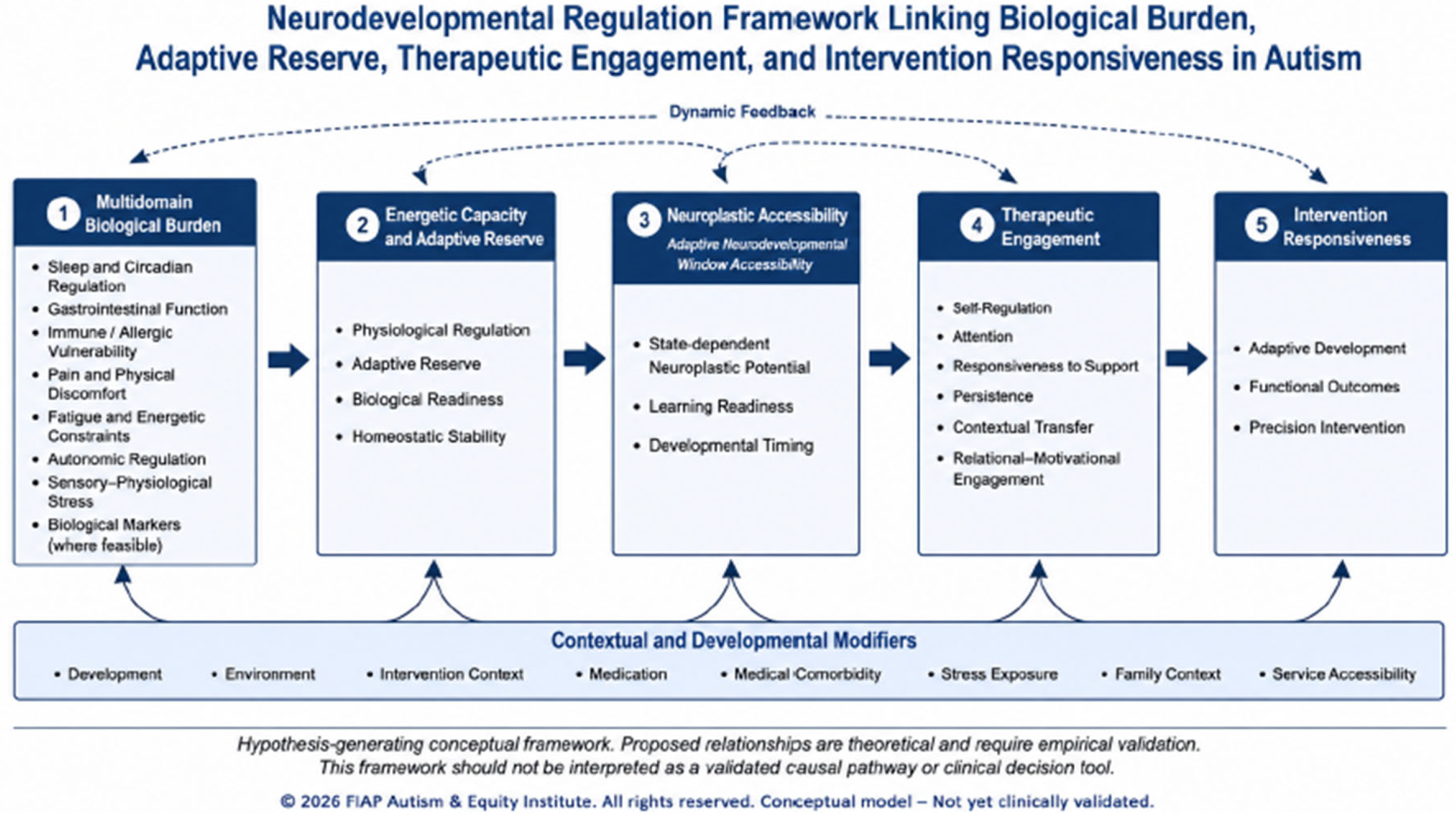

Table 1.
Provisional candidate operationalization framework for biological burden and therapeutic engagement constructs in future validation studies.
Table 1.
Provisional candidate operationalization framework for biological burden and therapeutic engagement constructs in future validation studies.
| Panel A. Biological burden | ||||
| Candidate domain | Candidate indicators | Measurement source | Provisional scoring logic | Validation requirement |
| Sleep-circadian regulation | Sleep duration; sleep onset latency; awakenings; sleep regularity; daytime sleepiness | Caregiver report; sleep diary; actigraphy where feasible | Domain-level burden flag or standardized domain score; no clinical cutoff assumed | Reliability; sensitivity to change; association with engagement |
| Gastrointestinal burden | Constipation; diarrhea; abdominal pain; reflux; feeding discomfort; GI-related distress | Caregiver report; clinical history; medical review | Frequency/severity profile; missingness documented | Specificity; comorbidity adjustment; clinician validation |
| Pain/discomfort and fatigue | Pain indicators; unexplained distress; fatigue; reduced endurance; recovery time | Caregiver report; clinician observation; functional logs | State-sensitive burden profile | Inter-rater reliability; relation to regulation and participation |
| Autonomic and sensory-physiological stress | Arousal instability; stress recovery; sensory overload; HRV where feasible | Observation; caregiver report; optional physiological measures | Domain profile with uncertainty indicators | Device reliability; context effects; feasibility |
| Immune/allergic/metabolic vulnerability | Allergic burden; inflammatory history; metabolic concerns; biomarkers only where ethically and clinically justified | Medical history; validated assays in research settings | Domain-specific profile; no unvalidated composite weighting | Assay reproducibility; normalization; specificity; external replication |
| Panel B. Therapeutic engagement | ||||
| Candidate domain | Candidate indicators | Measurement source | Provisional scoring logic | Validation requirement |
| Regulatory availability | Calm-alert state; emotional recovery; tolerance of transitions; readiness for support | Structured observation; caregiver/clinician ratings | Candidate item score or domain rating | Content validity; inter-rater reliability |
| Attentional and interactional access | Attention to task; joint-attention availability; response to name/instruction; interaction tolerance | Session observation; therapist rating; caregiver report | Domain score across contexts | Convergent validity with observed participation |
| Responsiveness to support | Response to prompting, scaffolding, reinforcement, modeling, and co-regulation | Therapy/session records; structured rating | Responsiveness profile | Predictive validity for intervention progress |
| Persistence and adaptive effort | Task persistence; frustration tolerance; recovery after challenge; adaptive effort | Observation; rating scales; longitudinal logs | State-sensitive engagement indicator | Sensitivity to change; test-retest properties |
| Contextual transfer and relational-motivational engagement | Generalization across contexts; relational access; motivation; meaningful participation | Caregiver/clinician report; functional observation | Profile score; context-specific flags | Cross-context reliability; outcome association |
- Note. The domains and indicators are provisional research candidates. They do not constitute validated scales, diagnostic criteria, clinical thresholds, biomarker panels, or treatment-selection tools. Domain structure, item selection, measurement sources, scoring, weighting, reliability, validity, longitudinal sensitivity, and predictive utility require empirical evaluation before any composite index can be proposed.
- © 2026 FIAP Autism & Equity Institute. All rights reserved. Conceptual model – Not yet clinically validated.
Table 2.
Major confounders, sources of measurement bias, and prospective mitigation strategies for future validation studies.
Table 2.
Major confounders, sources of measurement bias, and prospective mitigation strategies for future validation studies.
| Issue | Why it matters | Examples | Mitigation strategy |
|---|---|---|---|
| State vs trait biological burden | Biological burden may fluctuate and should not be treated as a fixed child characteristic | Sleep loss, illness, pain, stress, sensory overload, medication changes | Repeated measurement, time stamping, state/trait modeling, uncertainty flags |
| Developmental stage | Age and developmental level may influence both burden indicators and engagement | Early childhood vs adolescence; pubertal changes; developmental transitions | Age-stratified analyses, developmental covariates, longitudinal design |
| Communication and ID/DD | Lower expressive communication may affect reporting of pain, GI symptoms, fatigue, and engagement | Non-speaking children, intellectual disability, adaptive functioning differences | Multi-informant data, observational indicators, adaptive functioning covariates |
| Comorbidities and medication | Medical and psychiatric comorbidities may confound biological and engagement measures | GI disorders, epilepsy, ADHD, anxiety, antipsychotics, stimulants, sleep medication | Medical history, medication tracking, sensitivity analyses |
| Environment and service access | Engagement may reflect therapeutic fit, school demands, family stress, or service quality | High-demand settings, limited supports, clinician experience, socioeconomic access | Contextual variables, site documentation, ecological measurement |
| Measurement and reporting bias | Caregiver and clinician reports may differ by stress, expectations, culture, or access | Differential symptom reporting, missing medical evaluation | Multi-source measurement, standardized definitions, missingness analysis |
| Overmedicalization risk | Biological burden labels may be misused as deterministic or treatment-directing | Unsupported biomarker testing, speculative interventions | Clear boundaries, ethics review, stakeholder involvement, no clinical claims before validation |
- Note. The listed issues should be prespecified and incorporated prospectively into study design, measurement schedules, statistical models, and sensitivity analyses. They do not constitute clinical decision rules.
- © 2026 FIAP Autism & Equity Institute. All rights reserved. Conceptual model – Not yet clinically validated.
Table 3.
Staged evidentiary and validation roadmap for the proposed neurodevelopmental regulation framework.
Table 3.
Staged evidentiary and validation roadmap for the proposed neurodevelopmental regulation framework.
| Validation stage | Operational requirements and minimum evidence |
|---|---|
| Conceptual/content validity |
Core question: Are the domains meaningful, non-stigmatizing, and theoretically coherent? Candidate methods: Expert review; caregiver input; autistic stakeholder consultation; construct mapping. Minimum evidence before translation: Clear construct definitions and acceptable terminology. |
| Feasibility |
Core question: Can data be collected with acceptable burden? Candidate methods: Micro-pilot; completion rates; missing-data analysis; workflow timing. Minimum evidence before translation: Acceptable participant/family burden and data completeness. |
| Therapeutic engagement measure development |
Core question: Can TEI-like domains be measured reliably? Candidate methods: Item development; structured observation; inter-rater reliability; caregiver-clinician convergence. Minimum evidence before translation: Reliable domain ratings and interpretable scoring. |
| Biological burden measurement |
Core question: Can burden domains be measured reproducibly? Candidate methods: Domain-specific indicators; assay reliability where relevant; repeated measurement; missingness evaluation. Minimum evidence before translation: Reproducible domain measures; no unsupported composite weighting. |
| Construct validity |
Core question: Do constructs relate as expected while remaining distinct? Candidate methods: Convergent/discriminant validity; factor or latent structure when sample size permits. Minimum evidence before translation: Evidence that domains are coherent and not redundant. |
| Longitudinal validation |
Core question: Do burden and engagement change over time and predict responsiveness? Candidate methods: Repeated measures; trajectory analysis; state-trait models. Minimum evidence before translation: Temporal associations beyond baseline severity and intervention exposure. |
| Mediation/moderation testing |
Core question: Do energetic capacity or engagement mediate or moderate responsiveness? Candidate methods: Mediation models; moderation analysis; preregistered hypotheses. Minimum evidence before translation: Evidence for hypothesized pathways without causal overclaiming. |
| External replication |
Core question: Do findings generalize across settings and populations? Candidate methods: Multisite studies; diverse samples; cross-context replication. Minimum evidence before translation: Replicated patterns across sites and subgroups. |
| Clinical utility assessment |
Core question: Would validated constructs improve interpretation or support planning? Candidate methods: Prospective pilot studies; clinician usability assessment; ethical review. Minimum evidence before translation: Only after reliability, validity, fairness, and benefit are demonstrated. |
- Note. Progression toward translational or clinical utility requires staged evidence across content validity, feasibility, measurement reliability, construct validity, longitudinal sensitivity, pathway testing, external replication, fairness, and ethical acceptability. Until these requirements are met, the framework remains a hypothesis-generating research model and not a validated clinical or decision-support system.
- © 2026 FIAP Autism & Equity Institute. All rights reserved. Conceptual model - Not yet clinically validated.
Disclaimer/Publisher’s Note: The statements, opinions and data contained in all publications are solely those of the individual author(s) and contributor(s) and not of MDPI and/or the editor(s). MDPI and/or the editor(s) disclaim responsibility for any injury to people or property resulting from any ideas, methods, instructions or products referred to in the content. |
© 2026 by the author. Licensee MDPI, Basel, Switzerland. This article is an open access article distributed under the terms and conditions of the Creative Commons Attribution (CC BY) license.
Copyright: This open access article is published under a Creative Commons CC BY 4.0 license, which permit the free download, distribution, and reuse, provided that the author and preprint are cited in any reuse.


