

Submitted:
17 July 2026
Posted:
17 July 2026
You are already at the latest version
Abstract
Background: Radiography is a health profession that employs ionizing and non-ionizing radiations for diagnostic and therapeutic purposes. Students from other health professional courses share institutional and clinical environments with radiography students throughout their training, making mutual understanding of the profession professionally important. No study had previously assessed this relationship at Bayero University Kano. Objectives: To assess the knowledge and perception of students from other health professional courses in Bayero University Kano with respect to radiography profession. Methods: A prospective, cross-sectional study was conducted among other health professional departments. Stratified random sampling with proportionate allocation was used to select 322 respondents. Data were analyzed using SPSS version 22, applying descriptive statistics, Pearson correlation, and independent samples t-tests. Results: Of 322 questionnaires distributed, 306 (95.0%) were returned and fully completed (response rate of 95%). Medical Laboratory Sciences students recorded the highest knowledge score (87.5%) while Physiotherapy students recorded the lowest (48.1%). Optometry students held the most favorable perception of the profession (96.2%) while Physiotherapy students were the least favorable (66.7%). Strong positive correlations between knowledge and perception were found in MBBS (r = 0.737, p < 0.001), Physiotherapy (r = 0.681, p < 0.001), and Dentistry students (r = 0.658, p < 0.001). Conclusions: With the exception of Physiotherapy students, participants from other health professional courses at Bayero University Kano demonstrated satisfactory knowledge and generally favorable perception of radiography. Interprofessional educational initiatives are recommended to address the gaps identified.
Keywords:
knowledge
; perception
; students
; health professionals
; radiography
Introduction
Radiography is the art and science concerned with the use of both ionizing and non-ionizing radiations on humans or animals, with the purpose of promoting health, treating disease, and producing various diagnostic images [1,2]. In Nigeria, radiography is offered as a five-year undergraduate program leading to the Bachelor of Medical Radiography degree at accredited Nigerian universities including Bayero University Kano [3]. Graduates undertake a one-year internship at an accredited health facility, followed by a compulsory year of the National Youth Service Corps scheme, after which they are registered and licensed by the Radiographers Registration Board of Nigeria (RRBN), the statutory body established under Decree 42 of 1987, now Cap R1 LFN 2004 [3].
The profession encompasses three broad branches: diagnostic radiography, therapeutic radiography, and industrial radiography [2]. Diagnostic radiographers work across multiple imaging modalities including conventional X-ray, computed tomography (CT), magnetic resonance imaging (MRI), ultrasound, fluoroscopy, angiography, and interventional radiology, reflecting the expanding scope of modern imaging practice in healthcare delivery [4,5]. Advances in medical imaging and workforce development have further expanded radiographer roles into cross-sectional imaging and reporting practices, particularly in CT and MRI, where radiographers increasingly participate in image interpretation and clinical decision support [5,6].
Despite radiography’s recognized importance in clinical diagnosis and treatment, the profession has faced persistent challenges related to public image and recognition. Studies have consistently reported that it is perceived as a boring and routine career involving high workloads and receiving little acknowledgment from the general public or from allied health peers [7]. In a cross-sectional study of health professionals in a Nigerian teaching hospital, Chiegwu et al. [8] found that while respondents rated radiographers highly on educational and technical skills, average scores on other professional attributes such as integrity, morality, prestige, and altruism ranged from approximately 55-64%, which the investigators considered inadequate for a professional occupation. A study on Nigerian school children found that the awareness level of respondents with respect to radiography profession was below 76.6%, and that attitudes toward the profession were only moderately positive even among those who had received career guidance [9]. Among secondary school students in Bauchi, 70.7% had no knowledge of radiography as a distinct profession, despite 84.8% being aware of x-rays [10]. A qualitative study in Sweden found that while technological developments and opportunities for career advancement had a positive influence on radiography’s standing, persistent staff shortages constrained the profession’s growth and limited engagement in advancement activities [11]. These findings collectively describe a profession whose scope is routinely underestimated across audiences, including within healthcare.
Within university settings, students from different health professional programs frequently interact through shared lectures, clinical postings, and institutional spaces. The quality of these interprofessional encounters is shaped in part by how each group understands and regards the others’ professions. Health professional students who graduate with limited or inaccurate knowledge of radiography carry those gaps into clinical practice, where they are likely to become future colleagues and referring practitioners. Their perception of the profession therefore has direct implications for interprofessional collaboration. While studies of this nature have been conducted at other Nigerian institutions 8, none had been carried out at Bayero University Kano at the time of this study. This study was aimed to fill that gap by assessing the level of knowledge of radiography among students from other health professional courses at the institution, measuring their perception of the profession, comparing knowledge and perception scores across departments, and determining the nature and strength of the relationship between knowledge and perception within each department.
Methods
Study Design and Setting
This was a prospective, cross-sectional study carried out across two campuses of Bayero University Kano, Nigeria: The College of Health Sciences, located within the Aminu Kano Teaching Hospital premises along Zaria road, Kano metropolis, and the College of Natural and Pharmaceutical Sciences at the old campus along Gwarzo road, Kano metropolis.
Study Population and Eligibility Criteria
The study population comprised students enrolled in health professional courses at Bayero University Kano. Eligible departments included Medicine and Surgery (MBBS), Dentistry (BDS), Nursing Science (BNSc), Physiotherapy (BPT), Medical Laboratory Sciences (BMLS), Optometry (OD), and Pharmacy. Students from the Department of Medical Radiography were excluded to avoid response bias, and students from the Faculty of Basic Medical Sciences were excluded because their training does not lead directly to a clinical health profession within the scope of this study.
Sample Size and Sampling Method
The total population of eligible students across the seven departments was 2,204. Sample size was estimated using the Taro Yamane formula: n = N / (1 + Ne2), where N is the known population size and e is the margin of error set at 0.05, yielding a required minimum sample of 322 respondents. Stratified random sampling with proportionate allocation was then applied, with each of the seven departments serving as a stratum, and respondents selected from each department in proportion to its size relative to the total eligible population.
Instrument of Data Collection
A structured, self-administered questionnaire was developed by the researcher for this study. Content validity of the instrument was established through review by experienced colleagues in the Department of Medical Radiography. Reliability was assessed through a pilot study conducted prior to the main data collection, yielding a Cronbach alpha coefficient of 0.71, which indicates acceptable internal consistency.
It comprised three sections. Section A contained 8 socio-demographic items covering age, gender, course of study, and marital status. Section B contained 14 items assessing knowledge of radiography, including questions on its use of ionizing and non-ionizing radiation, clinical modalities, professional regulation by the RRBN, areas of specialization, and industrial application, with Yes, No, and Not Sure as response options. Section C contained 8 items assessing perception of the profession, covering its integrity, social prestige, relationship with non-radiographers, altruism, professional ethics, educational and technical competence, overall professional interest, and willingness to recommend it to relatives, with Good, Bad, and Not Sure as response options. For knowledge items, each response aligned with the correct answer was assigned a score of one, and the total was expressed as a percentage of the 14 items. Participants scoring 50 percent or above were classified as having adequate knowledge, while those below 50 percent were classified as having poor knowledge. Perception responses were scored and expressed as a percentage of the eight items, with higher percentages indicating more favorable perception.
Ethical Consideration
Ethical clearance was obtained from the Health Research Ethics Committee (HREC) of the Kano State Ministry of Health before data collection commenced (Reference: MOH/Off/797/T.1/2170). Written informed consent was obtained from each participant. Participants were briefed on the purpose and voluntary nature of the study, assured of the confidentiality of their responses, and informed that withdrawal at any point carried no penalty. The researcher personally administered and retrieved all questionnaires over a period of three months within the study period.
Data Analysis
Data were analyzed using the Statistical Package for Social Sciences (SPSS) version 22. Descriptive statistics were used to summarize socio-demographic characteristics and to present knowledge and perception scores for each department. Pearson’s correlation coefficient was computed to examine the relationship between knowledge and perception scores within each department. Independent samples t-tests were used to compare knowledge and perception score means across departments. The threshold for statistical significance was set at p < 0.05 for all tests.
Results
Of the 322 questionnaires distributed, 306 (95.0%) were returned with response rate of 95%, and all returned copies were fully completed and usable for analysis. The socio-demographic profile of respondents is presented in Table 1. The majority were aged 21 to 25 years (62.7%), male (58.5%), and single (83.0%). MBBS students constituted the largest departmental group (20.3%), while Physiotherapy students formed the smallest (8.8%).
Figure 1 presents the distribution of knowledge scores across departments. Medical Laboratory Sciences students recorded the highest score (87.5%), followed by Pharmacy (82.5%), Dentistry (76.5%), Optometry (75.5%), MBBS (69.4%), and Nursing Science (66.7%). Physiotherapy students recorded the lowest score (48.1%), the only group to fall below the 50 percent threshold.
Figure 2 presents the perception scores across departments. Optometry students were the most favorably disposed toward radiography (96.2%), followed by Pharmacy and Medical Laboratory Sciences students, both above 90 percent. MBBS and Dentistry students scored in the 80 to 85 percent range. Nursing Science students scored above 70 percent. Physiotherapy students recorded the lowest perception score (66.7%).
Table 2 presents Pearson correlation coefficients for the relationship between knowledge and perception scores within each department. MBBS students showed the strongest positive correlation (r = 0.737, p < 0.001), followed by Physiotherapy (r = 0.681, p < 0.001) and Dentistry (r = 0.658, p < 0.001). Pharmacy showed a moderate positive correlation (r = 0.498, p = 0.001). Nursing Science showed a statistically significant moderate negative correlation (r = -0.369, p = 0.016). MLS (r = -0.098, p = 0.509) and Optometry (r = -0.113, p = 0.421) showed weak negative correlations that did not reach statistical significance.
Table 3 presents the comparison of knowledge and perception scores using independent samples t-tests. Statistically significant differences were found in MBBS (t = 2.786, p = 0.007), Dentistry (t = 2.098, p = 0.044), Optometry (t = 3.055, p = 0.004), Physiotherapy (t = 2.431, p = 0.022), and Pharmacy (t = 2.360, p = 0.022). No statistically significant difference was found between knowledge and perception scores in Medical Laboratory Sciences (t = 1.000, p = 0.322) or Nursing Science (t = 1.044, p = 0.303).
Discussion
This study assessed the knowledge and perception of students from seven health professional departments at Bayero University Kano with respect to radiography. A total of 306 participants provided usable data, and the demographic distribution was broadly consistent with enrollment patterns at the institution. A commendable response rate of 95% was obtained. The higher proportion of male respondents (58.5%) is consistent with admission trends in Nigerian health science programs, where male enrollment tends to outnumber female enrollment, a pattern also reported in similar studies involving Nigerian students [9]. The age distribution, with 62.7% of respondents in the 21 to 25-year range, reflects the typical demographic of undergraduates in their mid-program years.
Six of the seven departments demonstrated knowledge scores above 60%, which is a broadly encouraging finding. Medical Laboratory Sciences students performed best at 87.5%, and this may reflect the relatively greater overlap between their training and radiography in terms of diagnostic science, laboratory-clinical workflow, and shared use of imaging in specimen-based procedures. Pharmacy students also performed well at 82.5%, possibly because of familiarity with imaging as a tool in drug efficacy monitoring and pharmacokinetic studies. Dentistry and Optometry students, whose curricula incorporate radiology and imaging components directly relevant to their clinical scope, both recorded scores above 75%. It is notable, however, that while Dentistry students at Bayero University Kano demonstrated adequate knowledge of radiography as a profession, a concurrent study at the same institution found significant deficits in their technical radiation protection knowledge and near-complete absence of awareness of radiation protection regulatory bodies, suggesting that discipline-specific knowledge does not automatically translate to competence across all radiography-related domains. 13 MBBS and Nursing Science students scored in the 66 to 70% range, suggesting that while these groups have contact with radiology departments during clinical postings, their formal knowledge of radiography as a distinct profession remains incomplete. The poor performance of Physiotherapy students at 48.1% is consistent with findings by Chiegwu et al.8, who similarly documented limited familiarity with radiography among physiotherapy practitioners in Nigeria. A plausible explanation is that the Physiotherapy curriculum at Bayero University Kano does not include structured radiology postings or cross-disciplinary lectures on radiographic science to the same extent as MBBS or Dentistry programs, leaving physiotherapy students with less direct professional exposure to radiography.
Perception findings were generally positive across most departments. Optometry students were the most favorably disposed at 96.2%, which may reflect the close diagnostic relationship between optometry and imaging sciences, particularly in ocular and orbital imaging. The high perception scores recorded by Pharmacy and Medical Laboratory Sciences students, both above 90%, are consistent with their strong knowledge scores and suggest that in these groups, familiarity with the profession translates into appreciation of it. Physiotherapy students recorded the lowest perception score at 66.7%, consistent with their low knowledge scores and with the broad expectation that limited familiarity with a profession contributes to a less positive view of it.
A noteworthy finding within the Physiotherapy results deserves specific attention. Although Physiotherapy students recorded the lowest scores in both knowledge (48.1%) and perception (66.7%), they showed the second strongest positive correlation between the two variables (r = 0.681, p < 0.001). The coexistence of low absolute scores and a strong positive correlation is not contradictory. It means that within the Physiotherapy group, those students who knew more about radiography also tended to hold more favorable views of it, and this relationship was consistent and proportionate. The entire group sits at a low knowledge baseline, but the direction and strength of the knowledge-perception link within the group is clear. This pattern carries an encouraging practical implication: because knowledge and perception move together strongly in this department, targeted efforts to raise knowledge of radiography among physiotherapy students are likely to produce corresponding improvements in perception, making knowledge-based interventions a particularly promising approach for this group.
However, the correlation analysis presents a more complex picture for other departments. Nursing Science showed a statistically significant moderate negative correlation (r = -0.369, p = 0.016), indicating that among nursing students, higher knowledge scores were paradoxically associated with less favorable perception of radiography. One possible explanation is that greater familiarity with radiography sharpens nursing students’ awareness of professional role boundaries and perceived clinical hierarchies, which may generate rather than reduce interprofessional tension. This may not be unique to this setting. The interprofessional education literature has noted that increased professional knowledge can, in some contexts, heighten awareness of professional distinctiveness in ways that reinforce competition rather than cooperation between health disciplines [12]. MLS and Optometry also showed negative correlations, though neither reached statistical significance (r = -0.098, p = 0.509 and r = -0.113, p = 0.421 respectively), suggesting this pattern may have broader relevance in departments with high existing familiarity.
The t-test comparisons showed that five of the seven departments had statistically significant differences between their knowledge and perception scores: MBBS, Dentistry, Optometry, Physiotherapy, and Pharmacy. This means that for these groups, the level of factual knowledge a respondent demonstrated did not proportionately predict how favorably they rated the profession. Medical Laboratory Sciences and Nursing Science showed no significant difference between their knowledge and perception score means, indicating greater alignment between knowing and perceiving in those groups. These contrasting patterns point to the need for interprofessional education approaches that go beyond knowledge transfer alone, since knowing about a profession and valuing it are distinct cognitive processes that do not always move together.
The findings carry practical implications. The deficits observed among Physiotherapy students argue for structured interprofessional learning activities that bring radiography and physiotherapy students together in both classroom and clinical settings, through joint seminars, shared case-based learning sessions, or facilitated clinical exchanges. Wider dissemination of information about the full scope of radiography, encompassing its therapeutic, industrial, and specialist diagnostic branches, could address gaps in awareness identified across several departments. The need for targeted curriculum reinforcement at Bayero University Kano is further underscored by findings from a concurrent study at the same institution, which identified significant deficits in radiation protection knowledge among clinical dental students and recommended earlier integration of radiation safety content and specialist-led practical workshops. 13 These recommendations are consistent with those proposed by Coombs et al.7, who noted that targeted professional outreach is an effective strategy for improving radiography’s visibility and professional image within healthcare institutions.
Several limitations of this study deserve acknowledgment. The single-institution design limits generalizability to other universities, regions, or health systems with different curricular structures. The cross-sectional design means that no causal direction can be established between knowledge and perception. The questionnaire relies on self-reported data, which cannot fully capture the depth or nuance of participants’ actual understanding or attitudes. Future work would benefit from multicenter designs, mixed-methods approaches incorporating qualitative interviews.
Conclusion
All respondents from other health professional courses at Bayero University Kano demonstrated adequate knowledge with the exception of Physiotherapy students, and a generally favorable perception of radiography. The statistically significant differences between knowledge and perception scores in five of seven departments, and the negative correlations observed in MLS, Optometry, and Nursing Science, indicate that knowledge alone does not guarantee favorable professional perception. The strong positive correlation found within the Physiotherapy group, despite its low knowledge baseline, suggests that knowledge-based interprofessional interventions are likely to be particularly effective for that department. Interprofessional educational initiatives targeting knowledge gaps in Physiotherapy and the perception dynamics in Nursing Science are specifically recommended. Similar studies at other Nigerian institutions would help to determine whether these patterns are generalizable and to guide the design of interprofessional curricula at a national level.
Funding
This research received no external funding.
Institutional Review Board Statement
The study was approved by the Health Research Ethics Committee (HREC) of the Kano State Ministry of Health (protocol code MOH/Off/797/T.1/2170, 10 August 2022).
Informed Consent Statement
Informed consent was obtained from all subjects involved in the study.
Acknowledgments
The authors acknowledge the support of the heads of participating departments and all students who voluntarily consented to participate in the study.
Conflicts of Interest
The authors declare no conflict of interest.
References
- Ehrlich, R.A.; Daly, J.A. Patient care in radiography: With an introduction to medical imaging, 7th ed.; Mosby Elsevier: St. Louis, 2009. [Google Scholar]
- Okeji, M.C.; Ugwuanyi, D.C.; Adejoh, T. Radiographers’ willingness to work in rural and underserved areas in Nigeria: A survey of final year radiography students. J. Assoc. Radiogr. Niger. 2014, 28(1), 6–10. [Google Scholar]
- Adejoh, T. An inquest into the quests and conquests of the radiography profession in Nigeria. J. Radiogr. Radiat. Sci. 2019, 33(1), 1–38. [Google Scholar] [CrossRef]
- Hardy, M.; Harvey, H. Artificial intelligence in diagnostic imaging: Impact on the radiography profession. Br. J. Radiol. 2020, 93(1108), 20190840. [Google Scholar] [CrossRef] [PubMed]
- Brage, K.; Pedersen, M.R.V.; Lauridsen, C.A.; Paulo, C.; Hansen, P.; Precht, H.; et al. Reporting radiographers in CT and MRI: A systematic literature review. In Radiography (Lond); 2025. [Google Scholar] [CrossRef] [PubMed]
- Hardy, M.; Johnson, L.; Sharples, R.; Boynes, S. Does radiography advanced practice improve patient outcomes and health service quality? A systematic review. Br. J. Radiol. 2016, 89, 1062. [Google Scholar] [CrossRef] [PubMed]
- Coombs, C.R.; Park, J.R.; Loan-Clarke, J.; Arnold, J.; Preston, D.; Wilkinson, A.J. Perceptions of radiography and the National Health Service: A qualitative study. Radiography 2003, 9(2), 109–122. [Google Scholar] [CrossRef]
- Chiegwu, H.U.; Nwokeocha, N.L.; Obi, O.L.; Uzuegbunam, C.U.; Okonkwo, C.C. Perception of sister health professionals about radiography profession in Nigeria. J. Radiogr. Radiat. Sci. 2019, 33(1), 13–16. [Google Scholar] [CrossRef]
- Ohagwu, C.C.; Nwankwo, U.C.; Eze, C.U. Perception and attitude of Nigerian school children towards radiography profession. Niger. J. Med. Imaging Radiat. Ther. 2012, 1(3), 30–42. [Google Scholar]
- Haruna, I.S.; Njitti, M.; Zira, D.J.; Richard, I.; Obetta, C. Knowledge and awareness of radiography profession among senior science secondary school students in Bauchi metropolis, North Eastern Nigeria. Int. J. Adv. Res. 2015, 3(11), 500–510. [Google Scholar]
- Andersson, B.T.; Lundgren, S.M.; Lundén, M. Trends that have influenced the Swedish radiography profession over the last four decades. Radiography 2017, 23(4), 292–297. [Google Scholar] [CrossRef] [PubMed]
- Goldie, J.; Dowie, A.; Cotton, P.; Morrison, J. Teaching professionalism in the early years of a medical curriculum: A qualitative study. Med. Educ. 2007, 41(6), 610–617. [Google Scholar] [CrossRef] [PubMed]
- Muhammad, L.U.; Umar, I.B.; Barde, M.A. Assessment of knowledge of radiation protection and biological effects of ionising radiation among clinical dental undergraduate students at Bayero University Kano, Nigeria. Kanem J. Med. Sci. 2026, 20(1), 93–101. [Google Scholar] [CrossRef]
Figure 1.
Knowledge scores of participants with respect to radiography profession, by department (n = 306).
Figure 1.
Knowledge scores of participants with respect to radiography profession, by department (n = 306).
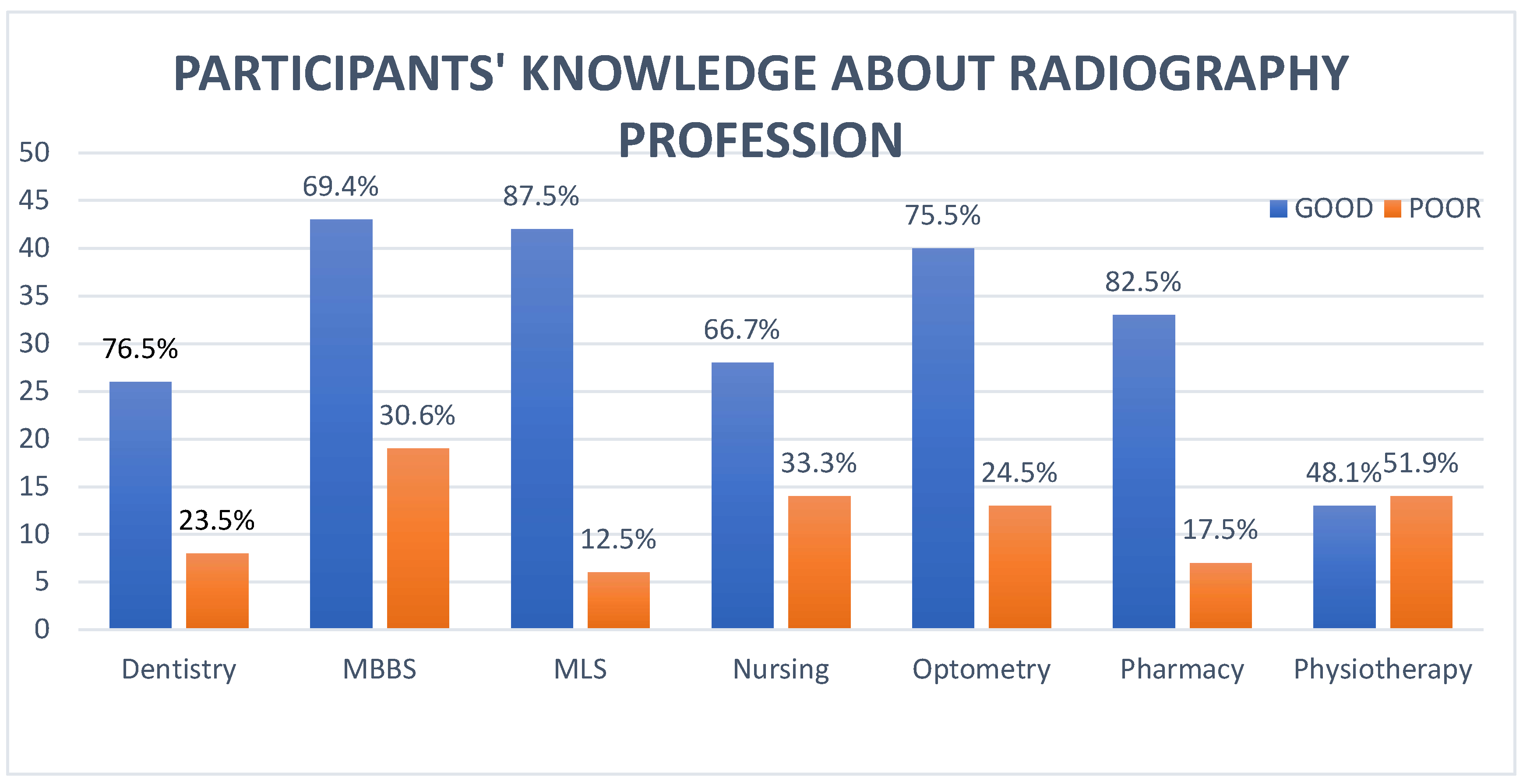
Figure 2.
Perception scores of participants with respect to radiography profession, by department (n = 306). Higher scores indicate more favorable perception.
Figure 2.
Perception scores of participants with respect to radiography profession, by department (n = 306). Higher scores indicate more favorable perception.
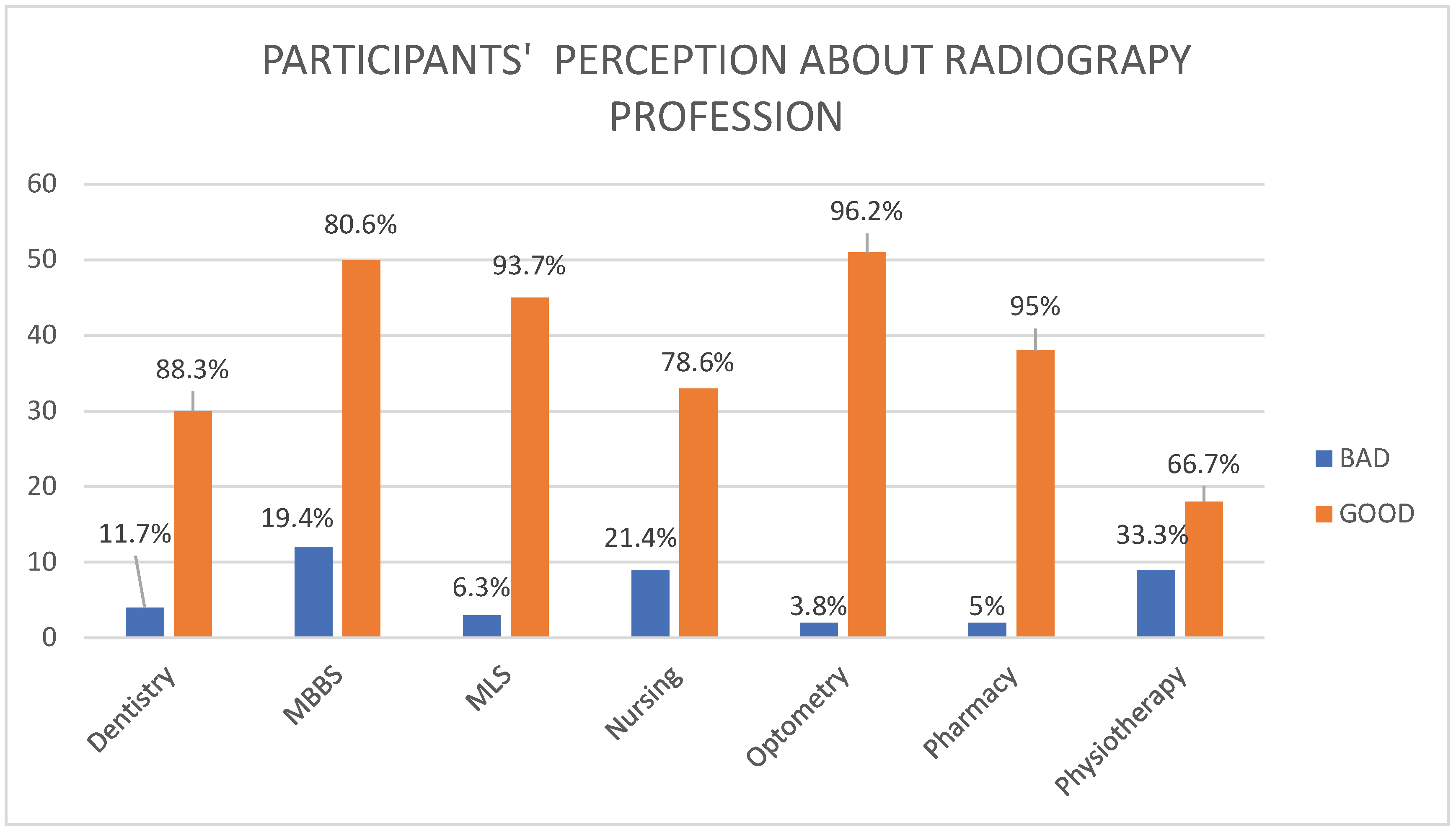

Table 1.
Distribution of socio-demographic variables of respondents (n = 306).
| S/N | Variable | Category | Frequency (n = 306) | Percentage (%) |
| 1 | Age (years) | 16 to 20 | 31 | 10.1 |
| 21 to 25 | 192 | 62.7 | ||
| 26 to 30 | 77 | 25.2 | ||
| 31 and above | 6 | 2.0 | ||
| 2 | Gender | Male | 179 | 58.5 |
| Female | 127 | 41.5 | ||
| 3 | Department | Medicine and Surgery (MBBS) | 62 | 20.3 |
| Dentistry (BDS) | 34 | 11.1 | ||
| Nursing Science (BNSc) | 42 | 13.7 | ||
| Physiotherapy (BPT) | 27 | 8.8 | ||
| Medical Laboratory Sciences (BMLS) | 48 | 15.7 | ||
| Optometry (OD) | 53 | 17.3 | ||
| Pharmacy | 40 | 13.1 | ||
| 4 | Marital Status | Single | 254 | 83.0 |
| Married | 47 | 15.4 | ||
| Divorced | 3 | 1.0 | ||
| Widowed | 2 | 0.7 |
Table 2.
Pearson correlation between knowledge and perception scores by department.
| Department | Correlation Coefficient (r) | Significance Level (p) | Interpretation |
| Medicine and Surgery (MBBS) | 0.737 | <0.001 | Strong positive |
| Physiotherapy (BPT) | 0.681 | <0.001 | Strong positive |
| Dentistry (BDS) | 0.658 | <0.001 | Strong positive |
| Pharmacy | 0.498 | 0.001 | Moderate positive |
| Nursing Science (BNSc) | -0.369 | 0.016 | Moderate negative |
| Optometry (OD) | -0.113 | 0.421 | Weak negative (NS) |
| Medical Laboratory Sciences (BMLS) | -0.098 | 0.509 | Weak negative (NS) |
NS = not statistically significant.
Table 3.
Comparison of knowledge and perception scores by department using independent samples t-test.
Table 3.
Comparison of knowledge and perception scores by department using independent samples t-test.
| Department | t value | Significance Level (p) | Difference |
| Medicine and Surgery (MBBS) | 2.786 | 0.007 | Significant |
| Dentistry (BDS) | 2.098 | 0.044 | Significant |
| Optometry (OD) | 3.055 | 0.004 | Significant |
| Physiotherapy (BPT) | 2.431 | 0.022 | Significant |
| Pharmacy | 2.360 | 0.022 | Significant |
| Medical Laboratory Sciences (BMLS) | 1.000 | 0.322 | Not significant |
| Nursing Science (BNSc) | 1.044 | 0.303 | Not significant |
Disclaimer/Publisher’s Note: The statements, opinions and data contained in all publications are solely those of the individual author(s) and contributor(s) and not of MDPI and/or the editor(s). MDPI and/or the editor(s) disclaim responsibility for any injury to people or property resulting from any ideas, methods, instructions or products referred to in the content. |
© 2026 by the authors. Licensee MDPI, Basel, Switzerland. This article is an open access article distributed under the terms and conditions of the Creative Commons Attribution (CC BY) license (http://creativecommons.org/licenses/by/4.0/).
Copyright: This open access article is published under a Creative Commons CC BY 4.0 license, which permit the free download, distribution, and reuse, provided that the author and preprint are cited in any reuse.


