

Submitted:
16 July 2026
Posted:
17 July 2026
You are already at the latest version
Abstract
Many results in quadrilateral geometry are traditionally stated for convex quadrilaterals. In this paper, we show that several of these results remain valid for self-intersecting quadrilaterals. In particular, we prove that, for any vertex, the maltitudes (midpoint altitudes) corresponding to two adjacent sides and the associated diagonal are concurrent; we call this point the malticenter of the vertex. This result holds uniformly for both simple and self-intersecting quadrilaterals. We further relate malticenters to classical centers (centroid, circumcenter, and orthocenter) via homotheties. Finally, we prove a conjecture of [1], previously observed for convex quadrilaterals, showing that \[ \operatorname{Area}(ABCD)=\operatorname{Area}(H_AH_BH_CH_D) \] holds for all quadrilaterals, where $H_A,H_B,H_C,H_D$ are the orthocenters of the triangles formed by the vertices of $ABCD$.
Keywords:
quadrilateral
; cyclic quadrilateral
; maltitudes
; malticenter
; concurrency
; homothety
MSC: Primary: 51M04, 51N20; Secondary: 51M15, 51N15
1. Introduction
Concurrency is a central theme in elementary geometry, most prominently illustrated in triangles by the orthocenter, centroid, and circumcenter. For quadrilaterals, however, such rigid structures are less apparent, and many known results are restricted to convex configurations.
In this paper, we show that several midpoint–perpendicular constructions extend naturally to all quadrilaterals, including self-intersecting ones. Our approach is based on a simple analogue of altitudes, known as the maltitudes. See Definition 2.
Although the four maltitudes are not concurrent in general, we prove that for each vertex the three maltitudes associated with the two adjacent sides and the corresponding diagonal always meet at a point. We call this point the malticenter of the vertex. This is valid for every quadrilateral.
Main Theorem.
Let be a quadrilateral. The following statements are equivalent:
- 1.
- is cyclic;
- 2.
- the malticenter corresponding to each vertex of coincide;
- 3.
- the malticenters corresponding to any two vertices of coincide;
- 4.
- the six maltitudes of the sides and diagonals of are concurrent.
The malticenter also exhibits a close relationship with classical centers: it is naturally linked to the circumcenter and orthocenter of the triangle formed by the remaining vertices, and these points are related via homotheties.
While altitude-like constructions for quadrilaterals have been studied previously, often in the convex setting (see, e.g., [1,2,3]), the present approach emphasizes a unified treatment valid for both simple and self-intersecting quadrilaterals.
Finally, we prove a conjecture of [1], previously observed for convex quadrilaterals, which asserts that
where are the orthocenters of the triangles formed by the vertices of . We prove that this identity holds for all quadrilaterals.
The present work was partly motivated by an ongoing work of the author on cyclic quadrilaterals circumscribed about central conics and their invariants.
We adopt the following notations. denotes the segment joining A and B, and the line through them. will denote the midpoint of the segment . E will denote the intersection point of the diagonals and of the quadrilateral . G denotes the centroid of , and O and T will denote the circumcenter and anticenter, whenever is a cyclic quadrilateral.
For each vertex X of , the symbols , , and denote the centroid, circumcenter, and orthocenter, respectively, of the triangle formed by the remaining three vertices. We denote by the malticenter (see Definition 4) corresponding to X.
A homothety with center P (with position vector ) and ratio k will be denoted by and defined by
2. Maltitudes and malticenters
Let us review the definition of a quadrilateral from [4].
Definition 1.
A quadrilateral is a closed polygon consists of four points, called vertices, in a plane, no three of which are collinear, and four segments, called sides, connecting two consecutive vertices.
The segment which connects two nonconsecutive vertices is called a diagonal.
Two vertices that are not connected by a side, are called opposite vertices. Two sides that have a common vertex, are called adjacent sides. Two sides that have no common vertex, are called opposite sides.
Remark 1.
By Definition 1, the pair of sides , and , and the diagonals of a quadrilateral are opposite. Note that the side of a self-intersecting quadrilateral is the diagonal of the simple quadrilateral (cf. Figure 1).
Definition 2.
A maltitude (midpoint altitude) of a side (respectively, a diagonal) of a quadrilateral is the segment through the midpoint of the side (respectively, diagonal) perpendicular to the opposite side (respectively, diagonal).
The maltitudes of the sides of a quadrilateral are not necessarily concurrent; they are for cyclic quadrilaterals. A well-known result is the following [5,6,7]:
In a cyclic quadrilateral, the maltitudes are concurrent.
The converse of the result is also true (see, e.g. [2] for the convex case).
Definition 3.
By the maltitudes corresponding to a vertex of a quadrilateral, we mean the maltitudes of the three segments: two sides and the diagonal that have the vertex in common. For example, the maltitudes of A are those of , , and (see Figure 1).
Our main goal is to characterize cyclic quadrilaterals via concurrency of maltitudes of vertices. The results apply uniformly to both simple and self-intersecting quadrilaterals and provide new results among maltitudes and classical centers.
We first prove the following theorem for any quadrilateral.
Theorem 1.
The three maltitudes corresponding to each vertex of a quadrilateral are concurrent.
Proof.
Let be a quadrilateral and consider the three maltitudes at the vertex A, namely those of , , and . Let be the midpoints of , respectively. See Figure 1.
Since the maltitude of is perpendicular to , and , so the maltitude of is perpendicular to and passes through .
Similarly, the maltitudes of and are perpendicular to the lines and , passes through and , respectively.
Thus, the three maltitudes of A are precisely the altitudes of the triangle formed by , , , and hence they are concurrent at the orthocenter of .
The same argument applies to each vertex of the quadrilateral. □
Remark 2.
The proofs shows that the concurrency of the maltitudes corresponding to a vertex of a quadrilateral is determined by the concurrency of the altitudes of the midpoint triangles associated with the three segments for each vertex.
Theorem 1 motivates the following definition.
Definition 4.
A malticenter corresponding to a vertex of a quadrilateral is the intersection point of the three maltitudes associated with that vertex (equivalently, any two of them). For example, , the point of intersection of the maltitudes of , and , is the malticenter of A. See Figure 1. In other words, for a quadrilateral , the malticenter of A is the orthocenter of .
Remark 3.
Since the definition of the malticenter involves the maltitudes of sides and diagonals, it does not depend on any convexity assumption. Consequently, all results formulated in terms of malticenters apply uniformly to both simple and self-intersecting quadrilaterals.
The centroid of a quadrilateral is defined as the point of intersection of the segments joining the midpoints of pairs of opposite sides. The following theorem establishes a relationship among the centroid of a quadrilateral, the circumcenter of a triangle formed by three of its vertices, and the malticenter of the remaining vertex.
Theorem 2.
The centroid of a quadrilateral is the midpoint of the malticenter of each vertex and the circumcenter of the triangle formed by the remaining vertices of the quadrilateral.
Proof.
Let be a quadrilateral and let G be its centroid. we prove the theorem for the vertex A. Let denote the malticenter of A.
Observe that G is the midpoint of and . Similarly, G is also the midpoint of , and , . Thus, and are homothetic with center G. See Figure 2.
Since is the orthocenter of (see the proof of Theorem 1), the reflection of about G is the orthocenter of . Since is the medial triangle of , so the orthocenter of is the circumcenter of , hence, G is the midpoint of the malticenter of A and the circumcenter of .
The same argument applies to any vertex, completing the proof. □
3. Cyclicity and Concurrency
We now prove our main result.
Theorem 3
(Cyclicity via Malticenters). Let be a quadrilateral. The following statements are equivalent:
- 1.
- is cyclic;
- 2.
- the malticenter corresponding to each vertex of coincide;
- 3
- the malticenters corresponding to any two vertices of coincide;
- 4.
- the six maltitudes of the sides and diagonals of are concurrent.
Proof.
We prove the equivalences in a cyclic manner.
- . If is cyclic, then the circumcenters coincide with the circumcenter of . By Theorem 2, each malticenter is the reflection of about the centroid G. Hence all coincide, say at a point T, known as the anticenter of .
- . This is immediate.
- . Suppose for two distinct vertices . By Theorem 2, the pairs of points and are centrally symmetric with respect to G. Hence . Since and are the circumcenters of the triangles formed by the complementary triples of vertices, it follows that all four vertices lie on a common circle. Thus is cyclic.
- . If all malticenters coincide, then in particular the maltitudes of each vertex pass through the same point. Hence the maltitudes of the sides of are concurrent. The maltitudes of the diagonals are also concurrent at the same point, namely, the anticenter.
- . If the four maltitudes of the sides are concurrent at a point T, then T lies on the maltitudes of both pairs of adjacent sides, for example those through and , and those through and . Hence T is simultaneously the malticenter of two vertices (e.g., A and C), so .
Thus cyclicity of a quadrilateral is completely characterized by the coincidence of any two of its malticenters. The proof is complete. □
Corollary 1.
The centroid of a cyclic quadrilateral is the midpoint of its circumcenter and the anticenter.
Proof.
It follows from Theorem 2 that the centroid of a cyclic quadrilateral is the midpoint of the circumcenter of and the malticenter of A.
Since is cyclic, the circumcenter of coincides with the circumcenter of , and the malticenter of A coincides with the anticenter T (cf. Theorem 3). Hence, the centroid is the midpoint of the circumcenter and the anticenter. □
Theorem 4
(Equivalent Concurrency Conditions). The following are equivalent for a quadrilateral:
- 1.
- it is cyclic;
- 2.
- the maltitudes of the sides are concurrent;
- 3.
- the maltitudes of the diagonals and any side are concurrent;
- 4.
- the maltitudes of two adjacent sides and their diagonal are concurrent.
(1)–(4) are immediate consequences of Theorem 3.
4. Relations with Classical Centers
The following theorem generalizes the relationship among a vertex of a cyclic quadrilateral, the anticenter, and the orthocenter of the triangle formed by the remaining vertices for any quadrilateral.
Theorem 5.
Proof.
Observe that the and are directly homothetic with center A and ratio . Therefore, the midpoint of the vertex A and the orthocenter is the orthocenter of which is the malticenter of A (cf. proof of Theorem 1).
More formally, one can consider the homothety
The same argument applies to any vertex of the quadrilateral. □
Corollary 2
(Theorem 261 [5]). In a cyclic quadrilateral, the anticenter is the midpoint of a vertex and the orthocenter of the triangle formed by the remaining vertices.
Proof.
Since the malticenters of a cyclic quadrilateral coincide with its anticenter, the conclusion follows from Theorem 5. □
Remark 5.
If is cyclic, then the quadrilaterals and are homothetic with center of symmetry at the anticenter of and ratio .
Corollary 3.
is cyclic if and only if is cyclic. Moreover, their anticenters coincide.
5. The Non-Cyclic Case
Theorem 6.
Let be a non-cyclic quadrilateral. Then, for any distinct vertices of , the line is parallel to the maltitude of the segment (Figure 3).
Proof.
We will prove the case of two adjacent vertices, say and .
Let and be the circumcenters of and , respectively.
Since is the circumcenter of , it lies on the perpendicular bisector of .
Similarly, , being the circumcenter of , also lies on the perpendicular bisector of .
Thus is perpendicular bisector of , and hence is parallel to the maltitude of . This proves the result for A and B.
A similar argument applies to any pair of distinct vertices , completing the proof. □
Remark 6.
Theorem 6 shows that the geometry of maltitudes is closely related to the configuration of circumcenters of the triangles formed by the remaining vertices. In particular, the directions of the sides of the quadrilateral formed by these circumcenters encode the perpendicular structure underlying the maltitudes.
Corollary 4.
Let be a non-cyclic quadrilateral. For any distinct vertices of , the line is the perpendicular bisector of the segment joining the remaining two vertices.
Remark 7.
This corollary shows that the quadrilateral formed by the circumcenters encodes all perpendicular bisectors of the segments determined by the vertices of , revealing a dual structure to the maltitude configuration.
Proposition 1.
Proof.
It suffices to prove the result for , and , .
Let denote the orthocenter of . Then lies on the perpendicular from C to the line . Thus, . □
Corollary 5.
Proof.
By Proposition 1, and are both perpendicular to the line joining the remaining two vertices, Hence, . □
6. Centroids and Polygons
Theorem 1 of [1] is actually a classic theorem can be found in [5]. This result, however, holds for points.
Let, for each , define to be the centroid of the polygon formed by the vertices . Then the following theorem is an immediate consequence of homothety.
Theorem 7.
Let be the set of n points in a plane and let G be their centroid. For each i, let denote the centroid of the points . For each i, the lines joining and are concurrent at G.
Proof.
Let denote the position vector of a point X with respect to some origin. It is sufficient for us to show that the n-gons and are homothetic with respect to G.
Define
Consider the homothety
Using , a direct calculation gives
Thus, maps each vertex to , and hence sends the polygon to . Since a homothety preserves incidence and parallelism, the two polygons are homothetic. □
Remark 8.
The triangle is called the medial triangle of .
Similar result holds for the centroids of the triangles formed by the midpoints of the segments connected to a vertex.
Theorem 8.
Let be the set of n points in a plane and let G be their centroid. For each i, let denote the centroid of the midpoints of the segments . For each i, the lines joining and are concurrent at G.
Proof.
Let denote the position vector of a point X with respect to some origin.
Define
Consider the homothety
A direct calculation gives
Thus, maps each vertex to , and hence sends the polygon to . Since a homothety preserves incidence and parallelism, the two polygons are homothetic. □
Corollary 6.
is the midpoint of .
Proof.
The equation (1) gives
This proves the claim. □
Corollary 7.
Let be a quadrilateral and G be its centroid. Let denote the midpoint of . Denote by the centroid of the . For each vertex X of , the lines joining and are concurrent at G.
7. Maltitudes and Area of Quadrilaterals
In their article, Micale and Pennisi derived a formula for the area of convex quadrilaterals in terms of a pair of opposite sides and the corresponding segments of maltitudes (see Theorem 1 in [2]).
We extend their result to arbitrary (not necessarily convex) quadrilaterals using signed areas.
Theorem 9.
Let be a quadrilateral. Let denote the signed area of triangle , and let denote the signed area of quadrilateral . Then
Proof.
The signed area of can be calculated by
which reduces to the shoelace formula upon expansion.
Using multilinearity of the determinant and subtracting times the determinant with last two columns , we obtain
Combining the first two determinants and the last two determinants using linearity in a row gives
The second decomposition follows similarly by regrouping the terms in (4).
□
Corollary 8.
The area of a convex quadrilateral is the sum of the areas of two triangles each formed by two adjacent vertices and the midpoint of the opposite side of the quadrilateral.
In other words, the area of a convex quadrilateral is the half-sum of the products of the pair of sides and the maltitudes (segments) of the opposite sides.
Proof.
Let be a convex quadrilateral. Then
□
Corollary 9.
The area of a self-intersecting quadrilateral is the absolute difference of the areas of two triangles each formed by two adjacent vertices and the midpoint of the opposite side of the quadrilateral.
In other words, the area of a crossed quadrilateral is the absolute difference of the products of the pair of sides and the maltitudes (segments) of the opposite sides.
Proof.
Let be a crossed quadrilateral. Then
□
8. Proof of The Conjecture
It was conjectured in [1] that, for convex quadrilaterals,
where are the orthocenters of the triangles formed by the vertices of . We prove that this identity holds for all quadrilaterals.
Theorem 10.
Let be any quadrilateral. Then
Proof.
We provide a coordinate proof of the statement.
Without loss of generality, we take and .
Acknowledgments
The author is grateful to his wife, Saba Fatema, for careful reading of the manuscript and for many helpful suggestions.
Conflicts of Interest
The author reports there is no conflict of interest.
References
- Mammana, M.; Micale, B. Quadrilaterals of triangle centres. Math. Gaz. 2008, 92, 466–475. [Google Scholar] [CrossRef]
- Micale, B.; Pennisi, M. On the altitudes of quadrilaterals. Internat. J. Math. Ed. Sci. Tech. 2005, 36, 15–24. [Google Scholar] [CrossRef]
- Bradley, C. Cyclic quadrilaterals. Math. Gaz. 2004, 88, 417–431. [Google Scholar] [CrossRef]
- Coxeter, H.; Greitzer, S. Geometry Revisited; Vol. 19, Anneli Lax New Mathematical Library, Mathematical Association of America, 2019. Softcover reprint.
- Altshiller-Court, N. College Geometry: An Introduction to the Modern Geometry of the Triangle and the Circle; Dover Publications, 2007. Dover reprint of 1952 edition.
- Johnson, R.A. Advanced Euclidean Geometry; Dover Publications, 2007. Dover reprint of 1929 edition.
- Honsberger, R. Episodes in Nineteenth and Twentieth Century Euclidean Geometry; Anneli Lax New Mathematical Library Vol. 37, The Mathematical Association of America, 1995.
Figure 1.
Theorem 1. The maltitudes of the sides and of the quadrilateral and the maltitude of the diagonal are concurrent at .
Figure 1.
Theorem 1. The maltitudes of the sides and of the quadrilateral and the maltitude of the diagonal are concurrent at .
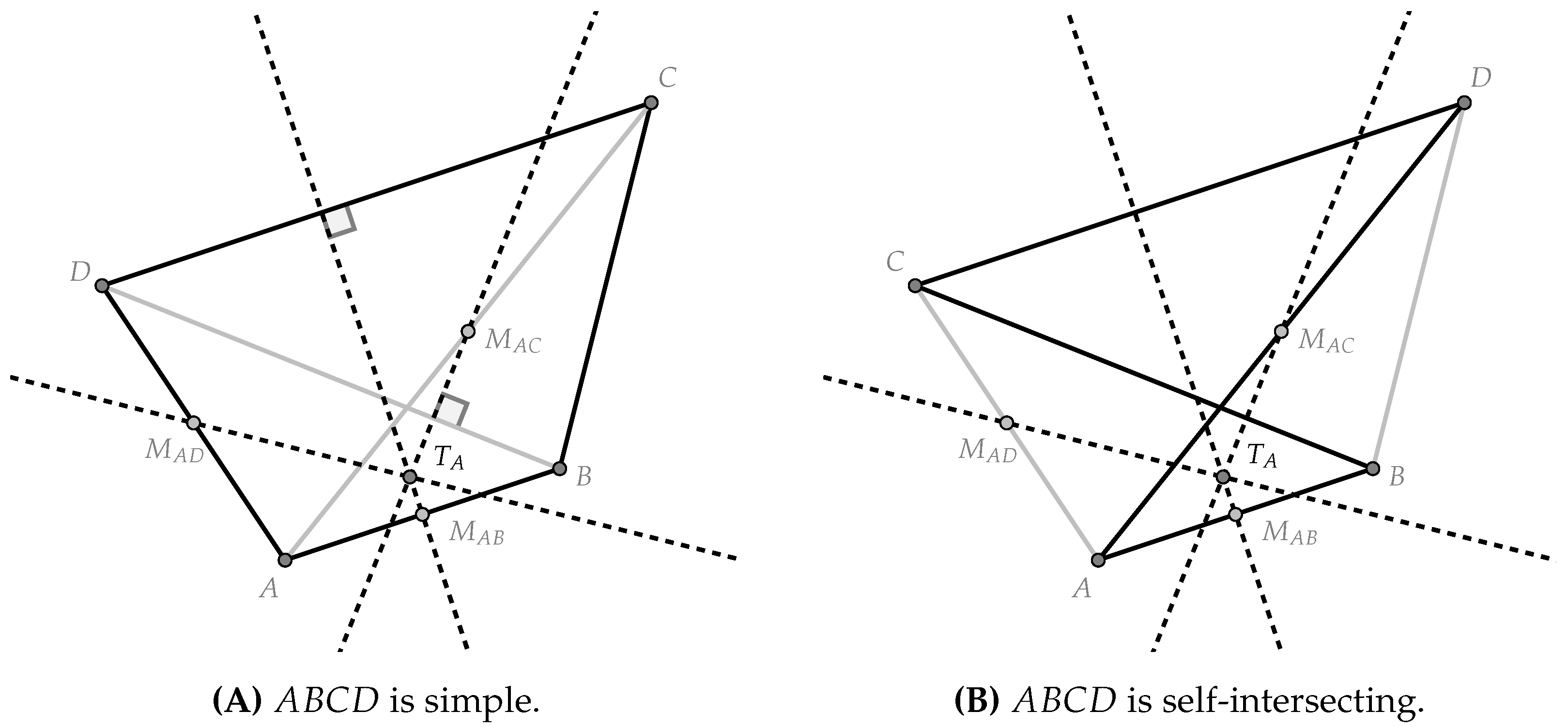
Figure 2.
Theorem 2.
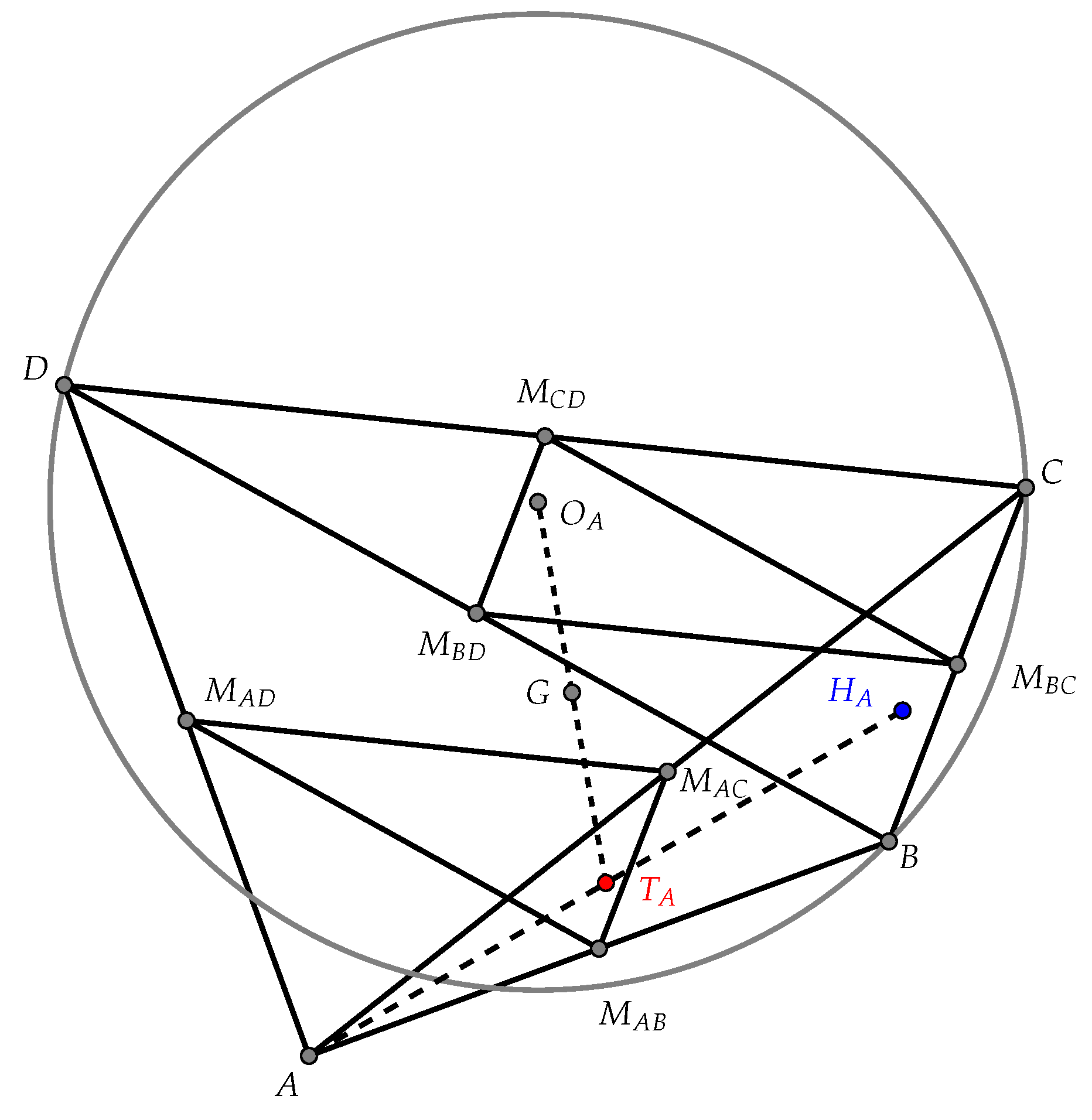
Figure 3.
is simple. The quadrilaterals and are centrally symmetric with respect to G. For each vertex X of , is midpoint of X and .
Figure 3.
is simple. The quadrilaterals and are centrally symmetric with respect to G. For each vertex X of , is midpoint of X and .
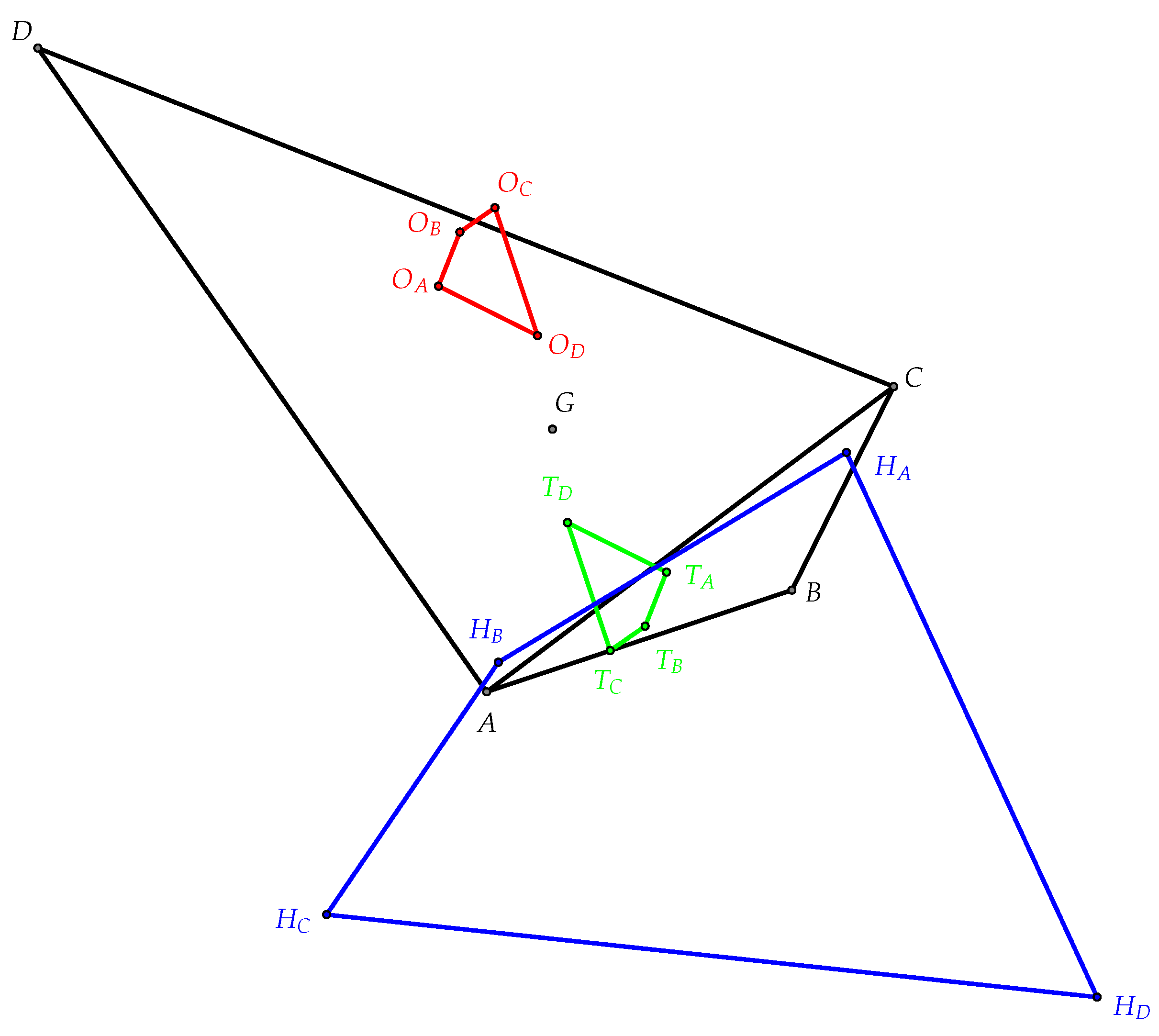
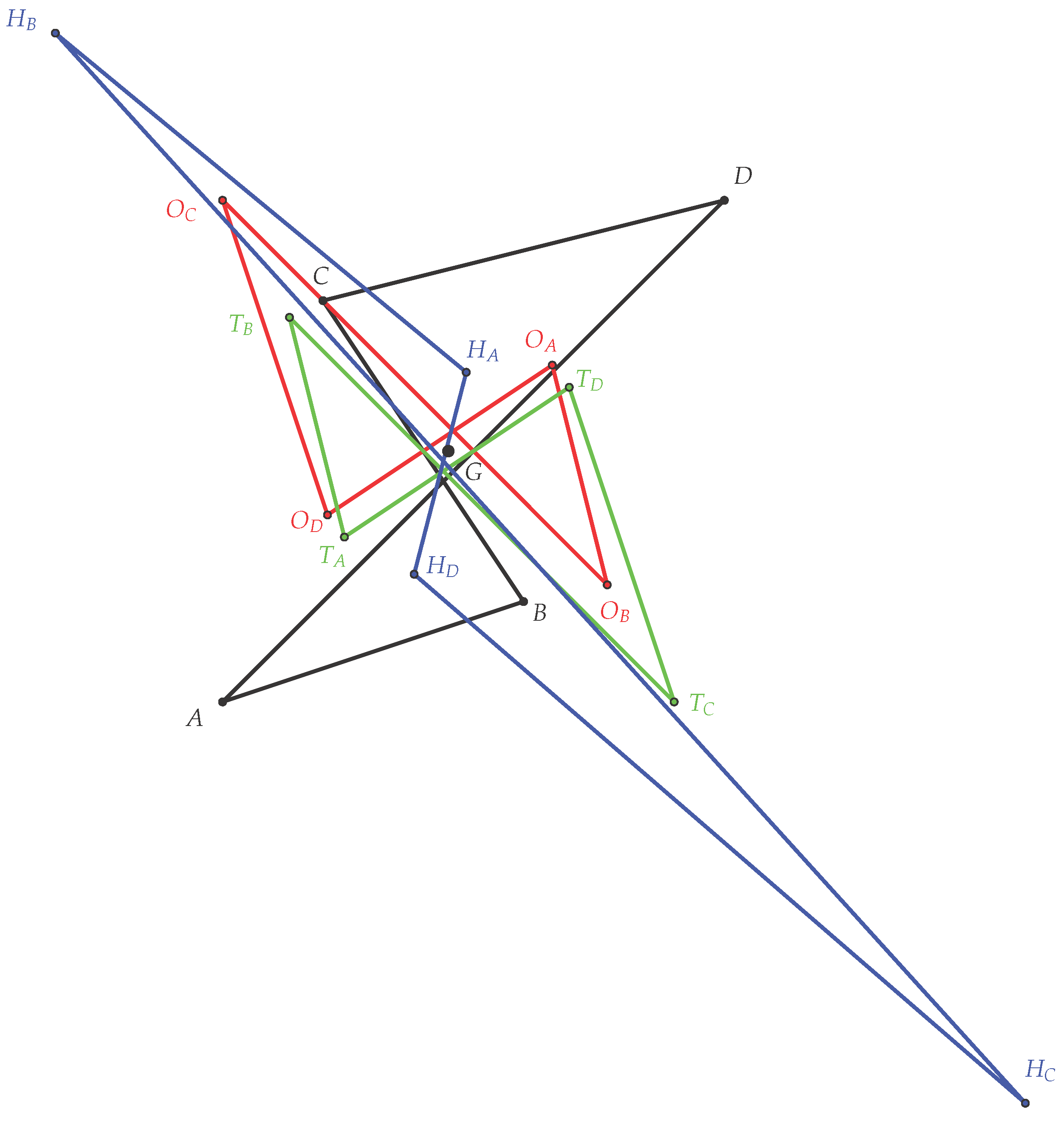
Figure 4.
is self-intersecting. The quadrilaterals and are centrally symmetric with respect to G. For each vertex X of , is the midpoint of X and .
Figure 4.
is self-intersecting. The quadrilaterals and are centrally symmetric with respect to G. For each vertex X of , is the midpoint of X and .
Disclaimer/Publisher’s Note: The statements, opinions and data contained in all publications are solely those of the individual author(s) and contributor(s) and not of MDPI and/or the editor(s). MDPI and/or the editor(s) disclaim responsibility for any injury to people or property resulting from any ideas, methods, instructions or products referred to in the content. |
© 2026 by the authors. Licensee MDPI, Basel, Switzerland. This article is an open access article distributed under the terms and conditions of the Creative Commons Attribution (CC BY) license (http://creativecommons.org/licenses/by/4.0/).
Copyright: This open access article is published under a Creative Commons CC BY 4.0 license, which permit the free download, distribution, and reuse, provided that the author and preprint are cited in any reuse.


