

Submitted:
15 July 2026
Posted:
17 July 2026
You are already at the latest version
Abstract
Using generalized Chapple--Euler relation, we prove that a triangle of unit circumradius may be circumscribed about a central conic with foci \( a_1,a_2\in\mathbb C \) if and only if the major axis of the conic has length \( |1-\overline{a_1}a_2| \). This characterization applies uniformly to both types of central conics.Our main result shows that Marden's theorem yields a parametrization of every such Poncelet family. The elementary symmetric polynomials of the vertices of a circumscribed triangle admit explicit formulas in terms of the foci \( a_1,a_2 \) and a unimodular parameter \( \lambda \in \mathbb C \). As a consequence, the classical degree-3 Blaschke-product equation arises directly from Marden's theorem and remains valid without requiring the foci to lie inside the unit disk.The parametrization provides a unified framework for deriving geometric invariants of families of circumscribed triangles. Using Marden's theorem, we provide a short proof of a classical theorem which states that the circumcircle of a triangle formed by three tangents to a parabola passes through the focus. Finally, we establish a higher-degree symmetric parametrization for partial fractions with finite numbers of poles, leading to generalized Möbius-product equations. The associated residues satisfy a partition-of-unity identity extending the classical Marden weights, thereby placing Marden's theorem within a broader residue-theoretic framework and suggesting possible higher-degree analogues in Poncelet geometry.
Keywords:
3-Poncelet pair
; Marden's theorem
; Blaschke product
; elementary symmetric polynomials
MSC: Primary: 51N20; Secondary: 30C15; 51M04
1. Introduction
The interplay between Poncelet geometry, finite Blaschke products, and numerical ranges has been an active area of research for several decades. Of particular importance is the surprising connection between finite Blaschke products of degree three and families of triangles inscribed in a circle and circumscribed about an ellipse.
To illustrate this approach, let denote the open unit disk in and let be the unit circle. A finite Blaschke product of degree three is defined by
For every , the equation
has three solutions which determine a triangle inscribed in the unit circle . A classical theorem of Daepp, Gorkin, and Mortini [1] (see also [2]) asserts that the sides of this triangle are tangent to an ellipse whose foci are and of major axis length
Consequently, Blaschke products provide a natural analytic parametrization of Poncelet triangles and allow many geometric questions to be translated into algebraic relations involving the foci , , and . More precisely, equations (1)–(2) give
This viewpoint has played an important role in the study of invariant quantities associated with families of triangles circumscribed about ellipses contained in their common circumcircle. See, for example, [3,4,5].
A key ingredient underlying this approach is the uniqueness of the conic inscribed in a triangle and tangent to its three sides. In the classical setting of degree-3 Blaschke products, this inconic is the Blaschke (or Marden) ellipse, which coincides with the Poncelet inellipse associated with the corresponding family of triangles.
A fundamental feature of the Blaschke product approach is the assumption that the foci satisfy
Geometrically, this means that the associated ellipse lies inside the circumcircle. From the point of view of Poncelet geometry, however, this captures only one part of the picture. Requiring both foci to lie inside the circumcircle excludes two other natural configurations: ellipses with both foci outside the circumcircle and hyperbolas with one focus inside and the other outside. A recent joint work of the present author [6] (see also [7]) shows that these cases fit naturally into the theory of 3-Poncelet pairs. See Figure 1B–C.
More precisely, it was shown in [6] that, given a circle and two points in the plane, there exists a unique central conic with foci such that forms a 3-Poncelet pair if and only if the foci do not lie on and are not inverse points with respect to . Moreover, the conic is an ellipse whenever the foci both lie inside or both lie outside , whereas it is a hyperbola precisely when one focus lies inside and the other lies outside.
Thus, the parametrization (3), derived from Blaschke product of degree 3, naturally applies only to the case in which both foci of the conic lie inside the circumcircle. In particular, (3) does not directly describe the situations illustrated in Figure 1B and Figure 1C, namely, ellipses whose foci both lie outside the circumcircle and hyperbolas with one focus inside and the other outside. This motivates the following.
Question.
Does the parametrization (3) for triangles also hold if the ellipse is replaced by a central conic whose one or both foci lie outside the common circumcircle of the triangles?
The first result in this direction that motivates us to explore this question is the characterization of central conics that form a 3-Poncelet pair with a given circle. See Theorem 1.
Unlike the assumption made in [1], this characterization directly follows from a generalized Chapple–Euler relation established in [6] and provides a geometric description of all admissible focal configurations.
Our main result (Theorem 3) shows that Marden’s theorem yields the parametrization (3) for every such 3-Poncelet pair. More precisely, if are the vertices of a triangle circumscribed about a central conic with foci , then there exists such that (3) holds. These formulas are derived here directly from Marden’s theorem under the substantially weaker assumption
Thus the same parametrization remains valid for both types of central conics.
An additional consequence of our approach is that the classical Blaschke product of degree 3 emerges naturally from Marden’s theorem. Indeed, the above symmetric relations (3) imply that the vertices satisfy (2). This establishes a direct bridge between Marden’s theorem and the Blaschke-product framework and shows that the latter may be viewed as a consequence of the geometry of central conics rather than as a starting assumption.
The principal contributions of this paper may be summarized as follows.
- We establish a complete characterization of central conics that form a 3-Poncelet pair with a unit circle. Specifically, we derive a necessary and sufficient condition, expressed in terms of the foci, that uniformly characterizes both types of central conics: ellipse and hyperbolas, forming 3-Poncelet pairs with a unit circle.
- We obtain a symmetric parametrization of Poncelet triangles associated with a unit circle and a central conic. The parametrization is derived directly from Marden’s theorem, thereby revealing the geometric origin of the classical Blaschke-product parametrization. Unlike the Blaschke-product setting, our parametrization remains valid even when one or both foci lie outside the circumcircle, thereby extending the theory beyond the unit-disk case.
- The symmetric parametrization obtained in this paper provides a unified framework for deriving geometric invariants of Poncelet triangles. As applications, we provide a new proof of a classical theorem that states that the circumcircle of a triangle formed by three tangents to a parabola passes through the focus of the parabola.
- Finally, we establish a higher-degree symmetric parametrization for partial fractions with arbitrary but finite numbers of poles, leading naturally to a Möbius-product equation. The associated residues satisfy a partition-of-unity identity that extends the classical Marden weights, placing Marden’s theorem within a broader residue-theoretic framework.
The paper is organized as follows. In Section 2 we establish a characterization of central conics that form a 3-Poncelet pair with the unit circle and derive a generalized symmetric parametrization of the associated Poncelet triangles. Section 3 shows how the classical degree-3 Blaschke-product framework arises naturally from Marden’s theorem and discuss its extension beyond the classical setting in which both foci lie inside the circumcircle. In Section 4, we discuss an interpretation of Marden weights in terms of residues. Section 5 is devoted to the construction of the unique ellipse inscribed in a given triangle whose center coincides with the circumcenter of the triangle. Finally, we conclude with a new proof of a classical result concerning triangles circumscribed about a parabola which states that the circumcircle of the triangle formed by any three tangents to a parabola passes through the focus of the parabola. See Theorem 6. For more results on 3-Poncelet pairs of a circle and a parabola, and properties of Poncelet triangles and quadrilaterals, see [8,9]. We will exploit the application of symmetric parametrization in a subsequent paper [10].
2. Characterization of 3-Poncelet Pairs of a Circle and Central Conics
In this section we recall a characterization of central conics that form 3-Poncelet pairs with the unit circle. This result follows from the generalized Chapple–Euler relation established in [6] and will provide the geometric interpretation of the parameters appearing in the symmetric parametrization of the next section.
Theorem 1.
Let be the unit circle and let be distinct points. Suppose that and are not inverse points with respect to . Then a central conic with foci and forms a 3-Poncelet pair if and only if the major axis of has length
Proof.
Let and denote the lengths of the semi-major and semi-minor axes, respectively. By the generalized Chapple–Euler relation (see [6], Theorem 2.1),
where for ellipses and for hyperbolas. Moreover,
where c is the focal distance.
Hence
Conversely, reversing the above argument yields (4), which is equivalent to the generalized Chapple–Euler relation. Therefore forms a 3-Poncelet pair. □
Remark 1.
The major-axis length formula in Theorem 1 was previously obtained in [1] in the setting of degree-3 Blaschke products, where both foci lie in the unit disk. The present proof derives the same formula directly from the generalized Chapple–Euler relation and therefore applies uniformly to all central conics forming a 3-Poncelet pair with the unit circle.
Theorem 1 has several immediate corollaries.
Corollary 1.
Let a triangle of unit circumradius be circumscribed about a central conic with foci . Then the eccentricity e of the conic satisfies
In particular, if the circumcenter of the triangle coincides with one of the foci of the conic, then the eccentricity of the conic equals the distance from the circumcenter to the other focus.
Corollary 2.
Let a triangle of unit circumradius be circumscribed about an ellipse whose center coincides with the circumcenter of the triangle. If is one of the foci of the ellipse, then
- (a)
- the major axis has length
- (b)
- the minor axis has length
Proof.
Since the ellipse is concentric with the circumcircle of the triangle, its foci are a and . Applying Theorem 1 with , and yields
This proves (b). □
Corollary 3.
Let a triangle be circumscribed about a central conic . Then the circumradius of the triangle is equal to the length of the major axis of if and only if the circumcenter of the triangle coincides with one of the foci of .
Proof.
Without loss of generality, assume that the circumcircle of the triangle is the unit circle , and let be the foci of . By Theorem 1,
Hence,
Since the origin is the circumcenter of the normalized triangle and the radius of is equal to 1, it follows that the circumcenter coincides with one of the foci of if and only if the circumradius of the triangle is equal to the length of the major axis of .
Moreover, if denotes the semi-minor axis and a be the focus distinct from the one coinciding with the circumcenter of the triangle, then
□
Theorem 1 shows that every 3-Poncelet pair with the unit circle is completely characterized by its focal parameters and . In the next section we use Marden’s theorem to show that these same parameters and a unimodular parameter also determine the vertices of every circumscribed Poncelet triangle through explicit symmetric parametrizations.
3. Marden’s Theorem and Symmetric Parametrization of Triangles
The purpose of this section is to establish a direct connection between Marden’s theorem and the classical Blaschke-product parametrization of Poncelet triangles. We begin by recalling Marden’s theorem and then derive a symmetric parametrization for triangles circumscribed about a central conic inscribed in the unit circle. This perspective reveals that the Blaschke-product formalism is a consequence of Marden’s theorem rather than being an independent analytic construction.
Theorem 2
(Marden 1945 [11]). The zeros of the partial fraction
where , , are three distinct noncollinear points lie at the foci of the conic which touches the line segments , and in the points , and that divide these segments in the ratio , and , respectively. If , this conic is an ellipse or hyperbola according as or . If , the conic is a parabola whose axis is parallel to the line joining the origin to the point .
3.1. Symmetric Parametrization
The following theorem is one of the main results of this paper.
Theorem 3
(Parametrization of Poncelet Triangles). Let be the vertices of a triangle circumscribed about a central conic with foci . Then there exists such that
Proof.
Let denote the conic inscribed in the triangle . Suppose that the sidelines of the triangle touches in the ratio determined by .
From the uniqueness of the inconic (see [6], Corollary 2.1) and Marden’s theorem it follows that the zeros of are precisely the foci .
Writing in polynomial form yields
where
Define
The assumption implies that .
Using , we obtain
This gives
Note that, by Marden’s theorem, . So, dividing (13) by n and using (11)–(12), we obtain
which proves (6).
This proves (7), while (8) follows directly from the definition of . □
3.2. From Marden to Blaschke
An important consequence of Theorem 3 is that the classical degree-3 Blaschke-product equation may be recovered directly from Marden’s theorem.
Corollary 4.
Under the assumptions of Theorem 3, the vertices satisfy
Proof.
By (6)–(8), the complex numbers are the roots of the cubic polynomial equation
A direct expansion shows that this polynomial is equivalent to
Dividing by gives the desired relation (14). □
Corollary 4 shows that the classical degree-3 Blaschke equation is a direct consequence of Marden’s theorem. Thus the Blaschke-product formalism arises naturally from the geometry of 3-Poncelet pairs rather than as a separate assumption.
Remark 2.
Conversely, let . If the solutions of (14) are distinct and all lie on , then the triangle with vertices is circumscribed about the unique central conic whose foci are and and whose major axis has length .
Daepp, Gorkin, and Mortini [1] proved that when , these hypotheses are satisfied for every . Thus, in the classical Blaschke setting, every determines a circumscribed triangle. Outside this setting, however, the equation (14) may admit solutions off the unit circle, so the above correspondence holds only for those values of for which all three solutions are distinct and unimodular. We discuss this phenomenon further in Section 4.
3.3. Elementary Symmetric Polynomials
The preceding subsections show that, regardless of whether the associated Poncelet conic is an ellipse or a hyperbola, Marden’s theorem leads to the same symmetric parametrization of the vertices of a circumscribed triangle. This indicates that the underlying mechanism is algebraic rather than specific to conics. Motivated by this observation, we replace the three-pole partial fraction arising from Marden’s theorem by a general partial fraction with poles and prove an analogous symmetric parametrization. As a consequence, generalized Möbius-product equations emerge naturally from the same residue structure, placing the classical degree-3 Blaschke-product parametrization into a broader framework.
Throughout this section, we write
for the rth elementary symmetric polynomial in the variables .
For convenience, we adopt the conventions
Thus
These conventions allow many of the identities appearing below to be written in a uniform form without treating boundary cases separately.
Let
where .
Lemma 1.
Let be defined as above and let
If , then, for every ,
Proof.
Since ,
Hence
For each fixed j, the complement of inside consists of exactly r indices . Therefore
and so
On the other hand, every monomial of either contains or it does not. Thus
Multiplying by and summing over j yields
as claimed. □
Theorem 4.
Let n be a positive integer, and let satisfy
Let be distinct, and let denote the zeros of the partial fraction
Then there exists a unimodular constant such that, for every ,
Proof.
Since
the numerator of F has degree n. Accordingly, we write
where
Since the zeros of P are precisely , Vieta’s formulas yield
where
Now define
Since for every j, it follows that
By Lemma 1,
Dividing by and using
we obtain
for every .
Finally, since
by convention, while
the identity also holds for , namely,
This completes the proof. □
Corollary 5.
With the notation of Theorem 4, the points satisfy the Möbius-product equation
4. Further Consequences of Marden’s Theorem
The preceding sections show that every central conic forming a 3-Poncelet pair with the unit circle gives rise, through Marden’s theorem, to a Möbius product equation of degree 3
In this section we discuss a further consequence of this viewpoint. We show that the Marden weights admit a natural residue-theoretic interpretation that extends beyond the cubic case.
4.1. Residue Partitions, Marden Weights, and Generalized Blaschke Equations
Theorem 4 shows that the classical degree-3 Blaschke equation arises naturally from Marden’s theorem. In the classical setting considered in [1], the focal parameters satisfy
For every , the equation (2) has three distinct solutions on the unit circle. Consequently, these solutions determine a triangle inscribed in , and Marden’s theorem yields an ellipse tangent to its sidelines.
When one or both focal parameters leave the unit disk, this behavior is no longer automatic. The solutions of the same equation need not all lie on the unit circle, and additional solution curves may appear. The following elementary examples illustrate this phenomenon already in degrees one and two.
Lemma 2.
Let and
Then
Proof.
A direct calculation gives the results. □
Corollary 6.
Suppose that . Then
either and , or
either and .
In particular, if , every solution of lies on the unit circle .
The preceding corollary shows that unimodularity of a Möbius product does not, in general, force its solutions to lie on the unit circle. Thus, outside the classical Blaschke setting, the geometric content lies not merely in the equation , but in determining those values of for which the resulting solutions lie on and therefore define an inscribed polygon.
A second feature of the classical theory is the appearance of the Marden weights. These weights are naturally interpreted as residues. The following theorem shows that the associated partition-of-unity condition is not special to and but persists for arbitrary but finite degree products of Möbius transformations.
Theorem 5.
Let
and let . Suppose that the equation
has distinct solutions
Define
Then
Proof.
Consider the rational function
Since are distinct zeros of , they are simple, and hence
As , the function M satisfies
for some nonzero constant C. Consequently,
Now define
The function F is rational. Moreover, the principal parts of R and
agree at each point , so every finite pole of F is removable. Hence F is entire.
Furthermore,
and therefore
Thus
so the point at infinity is also removable. Hence F extends to a holomorphic function on the Riemann sphere. It follows that F is constant, and since as , we conclude that
Therefore,
Comparing the coefficients of in the Laurent expansions at infinity gives
which completes the proof. □
Remark 3.
Let
For each , let be the solutions of . It can be shown that , so we can define
A direct computation shows that
Thus the Marden weights in the classical Daepp–Gorkin–Mortini setting form a genuine partition of unity, and Marden’s theorem produces an ellipse tangent to the three sidelines.
Theorem 5 shows that the identity
is in fact residue-theoretic in nature and holds beyond the classical elliptic regime. When the foci leave the unit disk, the weights need no longer be positive, and Marden’s theorem naturally accommodates both ellipses and hyperbolas.
4.2. Triangles Circumscribed About Parabolas
As applications of Marden’s theorem, we now provide a short proof of a classical result about triangles circumscribed about parabolas.
Theorem 6.
The circumcircle of a triangle formed by any three tangents to a parabola passes through the focus of the parabola. (See Figure 2).
Proof.
By Marden’s theorem, the unique finite zero of this linear polynomial is the focus of the parabola. Hence
On the other hand, (13) yields
Substituting into the previous identity gives
Since , we obtain
Therefore, . Since is the circumcircle of the triangle, the proof is complete. □
5. Constructions of Inconics with Prescribed Center
In this section, we investigate the unique inconic associated with a given triangle whose center is the circumcenter of the triangle. The construction illustrates the theory developed in the preceding sections and lead to explicit equation for the corresponding conic.
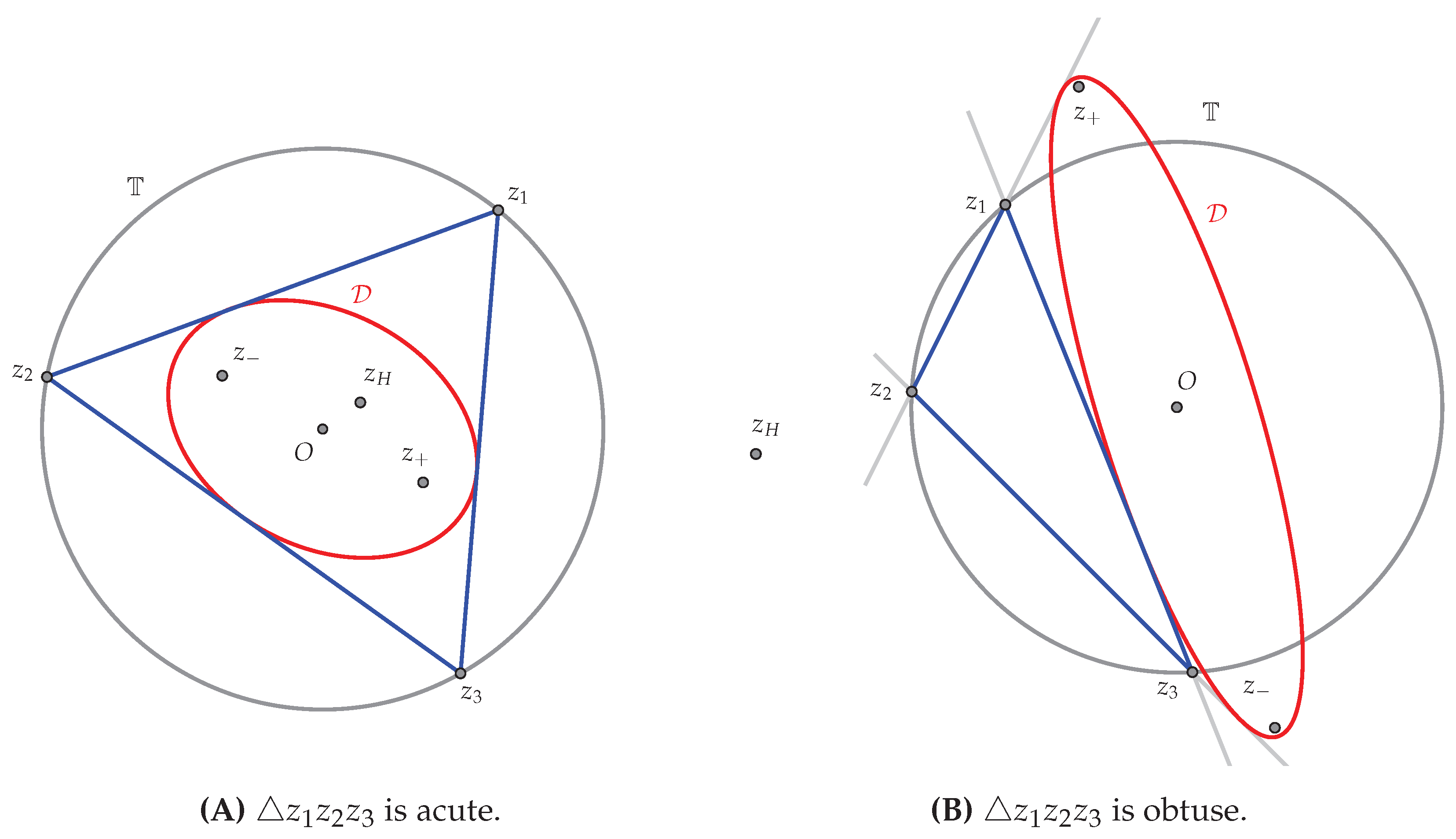
The following proposition establishes that every oblique triangle admits a unique inscribed ellipse centered at its circumcenter. We assume the circumradius of the triangle is normalized to 1.
Proposition 1.
Given an oblique triangle, there exists a unique ellipse inscribed in the triangle whose center coincides with the circumcenter of the triangle.
Proof.
Let be the vertices of an oblique triangle.
By Marden’s theorem (Theorem 2), every choice of nonzero real weights determines a conic inscribed in , whose foci are the zeros of (9). Thus, it suffices to determine the weights for which the center of the conic coincides with the origin.
The center of the conic is the midpoint of its foci. Hence the condition that the center is the circumcenter of the triangle is equivalent to
By Viète’s formulas, this is equivalent to
Equation (10b) is a homogeneous system of two real linear equations in the three unknowns , , . Consequently, its solution space is one-dimensional. A convenient nontrivial solution is
where
Since the triangle is oblique, its vertices are noncollinear, so . Moreover, , , , and (10a) yields
Therefore, Marden’s theorem applies and the corresponding inconic is a central conic. This conic is necessarily an ellipse (see [6], Corollary 2.1).
Since the solution space of (10b) is one-dimensional, every other solution differs from by a nonzero real scalar. Multiplying all three weights by the same constant leaves the zeros of (9) unchanged, and hence determines the same ellipse. Therefore, the inscribed ellipse centered at the circumcenter is unique.
Finally, the foci are
where q is defined by (10c). Hence, by Theorem 1, the ellipse is given by
Examples of the resulting ellipses are shown in Figure 3. □
Funding
The author received no financial support for the research, authorship, and/or publication of this article.
Data Availability Statement
Data sharing is not applicable to this article as no datasets were generated or analyzed during the current study.
Acknowledgments
The author is grateful to his wife, Saba Fatema, for her insightful discussions and suggestions.
Conflicts of Interest
The author reports there is no conflict of interest.
References
- Daepp, U.; Gorkin, P.; Mortini, R. Ellipses and Finite Blaschke Products. Am. Math. Mon. 2002, 109, 785–795. [Google Scholar] [CrossRef]
- Daepp, U.; Gorkin, P.; Shaffer, A.; Voss, K. Finding Ellipses: What Blaschke Products, Poncelet’s Theorem, and the Numerical Range Know about Each Other; Mathematical Association of America Textbooks; American Mathematical Society: Providence, RI, 2018. [Google Scholar]
- Helman, M.; Laurain, D.; Garcia, R.; Reznik, D. Poncelet Triangles: A Theory for Locus Ellipticity. Beitr. Algebra Geom. 2022, 63, 445–457. [Google Scholar] [CrossRef]
- Helman, M.; Laurain, D.; Garcia, R.; Reznik, D. Invariant Center Power and Elliptic Loci of Poncelet Triangles. J. Dyn. Control Syst. 2023, 29, 157–184. [Google Scholar] [CrossRef]
- Garcia, R.; Helman, M.; Reznik, D. Graceful Loci of Poncelet Triangles about the Incircle and their Degeneracies. Beitr. Algebra Geom. 2026. [Google Scholar] [CrossRef]
- Dragović, V.; Murad, M.H. Generalized Chapple–Euler Relation. To Appear Eur. J. Math. 2026, arXiv:2603.00001v3. [Google Scholar]
- Dragović, V.; Radnović, M. Isoperiodic Families of Poncelet Polygons Inscribed in a Circle and Circumscribed about Conics from a Confocal Pencil. Geom. Dedicata 2024, 218, 81. [Google Scholar] [CrossRef]
- Dragović, V.; Murad, M.H. Parable of the Parabola. Expo. Math. 2025, 43, 125717. [Google Scholar] [CrossRef]
- Dragović, V.; Murad, M.H. Poncelet Pairs of a Circle and Parabolas from a Confocal family and Painlevé VI Equations. Izv. Math. 2026, 90, 144–168. [Google Scholar] [CrossRef]
- Murad, M.H. A Symmetric Polynomial Approach to Poncelet Triangles Inscribed in a Circle and Circumscribed about Central Conics. in preparation.
- Marden, M. A Note on the Zeros of the Sections of a Partial Fraction. Bull. Am. Math. Soc. 1945, 51, 935–940. [Google Scholar] [CrossRef]
Figure 1.
The triangle is inscribed in a unit circle and circumscribed about a central conic with foci .
Figure 1.
The triangle is inscribed in a unit circle and circumscribed about a central conic with foci .
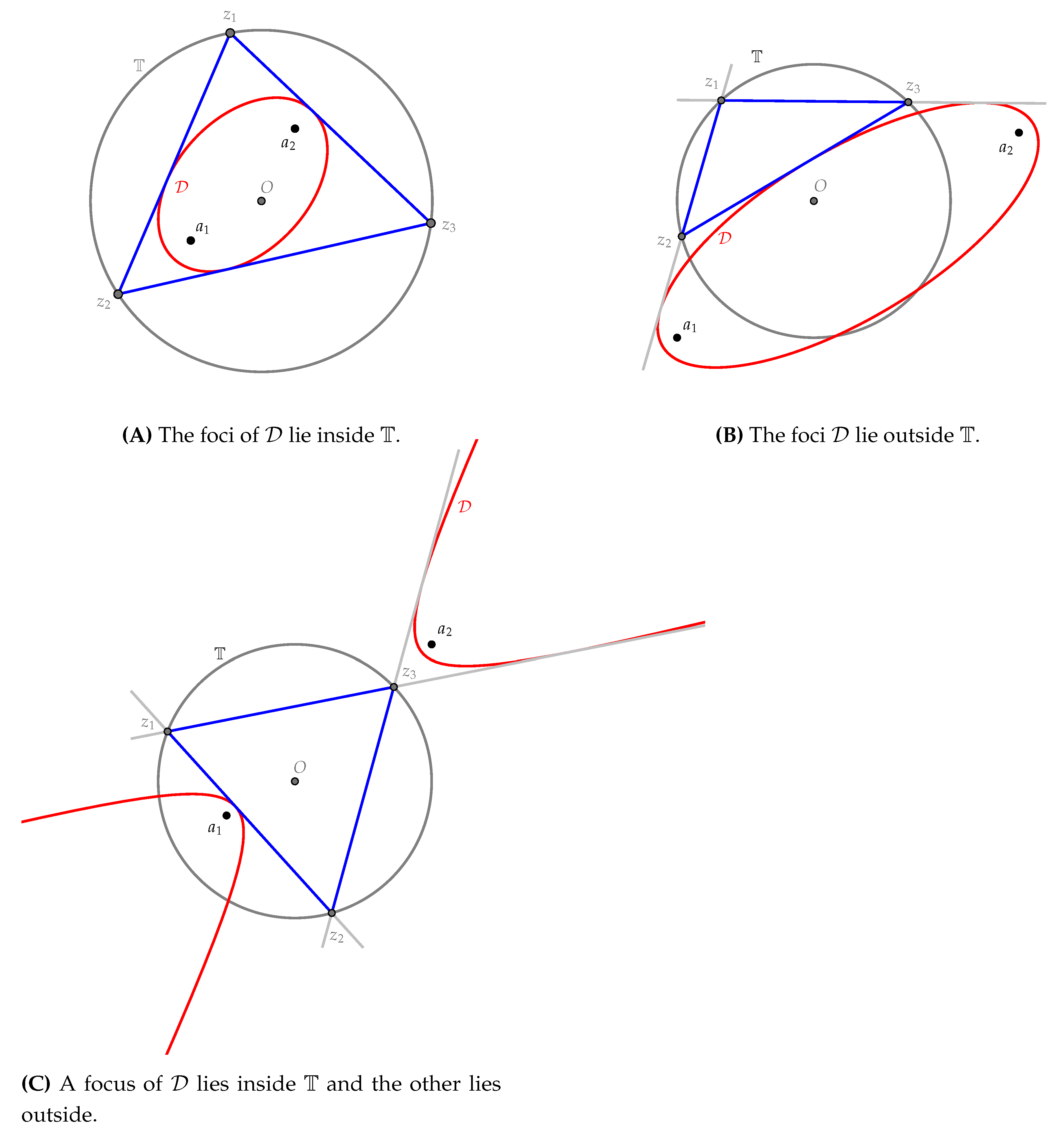
Figure 2.
The circumcircle of the triangle formed by three tangents to the parabola passes throught the focus F of the parabola.
Figure 2.
The circumcircle of the triangle formed by three tangents to the parabola passes throught the focus F of the parabola.
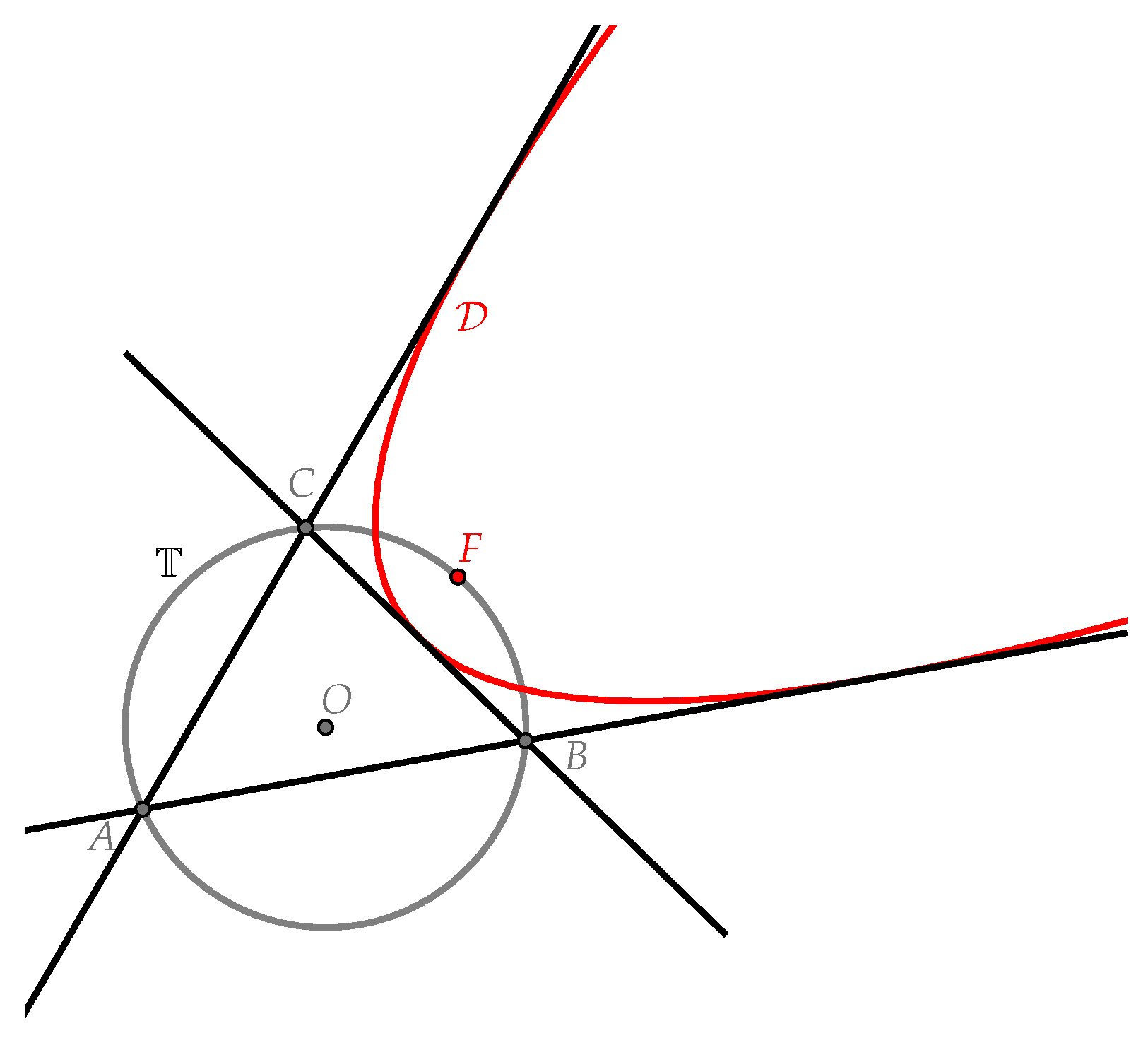
Figure 3.
Proposition 1. An ellipse inscribed in and with center at the circumcenter O of .
Disclaimer/Publisher’s Note: The statements, opinions and data contained in all publications are solely those of the individual author(s) and contributor(s) and not of MDPI and/or the editor(s). MDPI and/or the editor(s) disclaim responsibility for any injury to people or property resulting from any ideas, methods, instructions or products referred to in the content. |
© 2026 by the author. Licensee MDPI, Basel, Switzerland. This article is an open access article distributed under the terms and conditions of the Creative Commons Attribution (CC BY) license (http://creativecommons.org/licenses/by/4.0/).
Copyright: This open access article is published under a Creative Commons CC BY 4.0 license, which permit the free download, distribution, and reuse, provided that the author and preprint are cited in any reuse.


