

Submitted:
15 July 2026
Posted:
17 July 2026
You are already at the latest version
Abstract
The increasing global antibiotic resistance has created a pressing need for new antimicrobial drugs. Antimicrobial peptides (AMPs) come into the spotlight for their antibacterial properties, particularly against multidrug-resistant pathogens. Since AMPs act locally, they achieve optimal antimicrobial effectiveness and face maximum evolutionary pressure within spatially confined, highly competitive microbiomes. This ecological principle justifies marine particles as promising reservoirs of untapped marine AMPs. Marine particles are ubiquitous throughout the ocean, ranging from the sunlit surface waters to the deepest hadal environments. They are densely colonized microhabitats where nutrient gradients, spatial proximity, chemical signaling, and interspecies competition among microorganisms converge—unique characteristics that position marine particles as natural laboratories for the evolution of novel AMPs. However, most marine microorganisms are challenging to cultivate. Fortunately, metagenomics is revolutionizing marine AMP discovery by enabling researchers to screen for elusive peptide-encoding genes and complex biosynthetic gene clusters in uncultivated microbial communities. Additionally, advancements in artificial intelligence are further transforming marine AMP bioprospecting by moving from passive exploration to active molecular understanding and navigation. This review synthesizes our current understanding of the microbial ecology and emerging technologies that drive marine AMP discovery, and explores the application potentials of marine AMPs in human medicine, agriculture, and mariculture.
Keywords:
marine particles
; antimicrobial peptides
; biosynthetic gene clusters
; RiPPs
; NRPs
; smORFs
; marine microbiome
; machine learning
; deep learning
; bioprospecting
1. Introduction
Antibiotics have transformed modern medicine, making formerly lethal infections treatable and enabling procedures that depend on effective infection control, including surgery, transplantation, intensive care, cancer chemotherapy, and neonatal care [1,2,3]. Each year, hundreds of millions of people receive antibiotic treatment for infections. Ever since their discovery and widespread use, antibiotics have saved countless lives and significantly extended the average human lifespan [4,5]. However, the effectiveness and future achievements of antibiotics are threatened by antimicrobial resistance (AMR), a global ecological and evolutionary issue accelerated by antibiotic misuse and overuse in human medicine, animal production, agriculture, aquaculture, and the broader engineered and natural environments [6,7,8,9,10,11,12]. Worldwide estimates indicate that, in 2019, bacterial AMR was linked to approximately 5 million deaths [13], with over half a million of those occurring in China alone [14]. Systematic analyses predict that, without effective intervention, AMR could cause between 8 and 10 million deaths annually by 2050 [15,16]. These figures underscore AMR as one of the most pressing public-health and development challenges of the twenty-first century.
The slow pace of conventional antibiotic discovery exacerbates the AMR crisis [17,18,19]. Many antibiotics currently used in clinical settings target a limited set of conserved bacterial processes, such as cell wall biosynthesis, protein synthesis, DNA replication, RNA transcription, or folate metabolism [20,21]. The repeated targeting of these processes, combined with widespread antibiotic exposure, has selected for various resistance mechanisms, including reduced permeability, efflux, target modification, enzymatic inactivation, and biofilm-associated tolerance (Figure 1a) [11,20,21,22,23,24,25]. To make matters worse, most molecular mechanisms of AMR are associated with mobile genetic elements (MGEs), facilitating the global transmission of AMR through horizontal gene transfer (HGT) [26,27,28,29,30]. Multidrug-resistant pathogens, including those from the ESKAPE group [31,32,33,34,35,36], are now undermining the effectiveness of last-line therapies and highlighting the limitations of current discovery pipelines, which tend to rediscover variations of known drug scaffolds. This situation has sparked a renewed interest in developing antimicrobial agents with alternative structures, mechanisms, ecological origins, and evolutionary histories.
Antimicrobial peptides (AMPs), also referred to as host-defense peptides when produced by multicellular organisms [37,38,39,40,41,42], represent a promising new class of anti-infective agents [43,44,45,46,47,48,49,50,51]. Given the global threat of AMR, AMPs have come into the spotlight for their effectiveness against diverse microbial pathogens, including bacteria, fungi, protozoan parasites, and viruses [52,53,54,55,56,57]. For example, colistin, a cationic cyclic lipodecapeptide produced by Gram-positive bacteria of the genus Paenibacillus, is a last-line-of-defense antibiotic reserved for serious infections caused by multidrug-resistant Gram-negative bacterial pathogens [58]. Many AMPs act rapidly by directly interacting electrostatically with negatively charged microbial envelopes, leading to membrane permeabilization, pore formation, or destabilization. Some AMPs cross the microbial membrane and disrupt intracellular processes, impacting nucleic acid synthesis, protein translation, enzyme activity, and cell wall precursor cycling (Figure 1b) [57,59,60,61,62,63,64,65]. Beyond direct killing, many AMPs exhibit immunomodulatory, anti-inflammatory, antibiofilm, wound-healing, or synergistic activities, making them attractive not only as antibiotics but also as anti-infective adjuvants [39,64,65,66,67,68,69,70]. For instance, certain AMPs act as chemoattractants, recruiting host immune cells to sites of infection, while others help neutralize the cytotoxic effects of endotoxins, such as lipopolysaccharides (LPS) from Gram-negative bacteria, thereby preventing septic shock caused by excessive inflammation [71,72,73,74].
AMPs are typically short, cationic, and amphipathic peptides produced in all life forms, including bacteria, archaea, protists, fungi, plants, invertebrates, and vertebrates [42,75,76,77,78]. They constitute a critical component of the innate immune systems of fungi, plants, and animals, serving as the first line of defense against various pathogens [79,80,81,82,83,84,85,86]. AMPs exhibit a vast diversity in biological origins, sequences, lengths, structures, and bioactivities (Figure 2) [57,62,63,64,65,87,88]. Their defining advantages over traditional small-molecule antibiotics include remarkably broad-spectrum activity and rapid bactericidal kinetics [51,66,89,90,91,92,93]. Colistin (polymyxin E), for example, has been reserved as the last-line antimicrobial therapy for treating recalcitrant bacterial infections caused by multidrug-resistant pathogens [94]. Most critically, AMPs have a lower propensity than conventional antibiotics to promote bacterial resistance [92,95,96,97,98]. This resistance-avoidance property is largely attributable to the fundamental, non-specific, multi-target, and multifunctional nature of the AMP membrane-active mechanism, which creates a narrow time window and steep evolutionary barrier to microbial counter-adaptation [60,66,90,99,100]. There is also a low propensity for cross-resistance among different AMPs and between AMPs and antibiotics; instead, they typically demonstrate functional synergy, resulting in enhanced antimicrobial efficacy [67,97,101,102]. In addition, bacteria with multidrug resistance generally exhibit a high tendency toward collateral sensitivity to AMPs, a physiological phenomenon likely caused by antibiotic-induced changes in the lipopolysaccharide composition of the bacterial outer membrane [103]. Furthermore, limited functional compatibility poses a significant barrier to HGT of AMP resistance among phylogenetically distant bacteria [104]. As a result, their efficacy and low tendency to develop and spread resistance make AMPs “the most promising alternative to antibiotics” for the treatment of microbial diseases, particularly those caused by multidrug-resistant ESKAPE bacteria and WHO-priority fungi [105,106,107,108,109,110,111]. AMPs are highly regarded as the “pillars of next-generation antimicrobial agents” and “the game-changer in the epic battle against multidrug-resistant bacteria” [112,113].
AMPs are produced by virtually all cellular organisms, from prokaryotes to humans, as a means of signaling, competition, or defense [114,115]. They have evolved over billions of years in response to the diverse and ever-changing biological and physicochemical environments on planet Earth [116,117]. This extensive evolutionary history suggests that natural-based AMPs may possess nearly unlimited sequence diversity and remarkable functional versatility [118,119,120,121,122]. Microbial AMPs, in particular, play a substantial role in contributing to and expanding this vast chemical space [123,124,125,126,127,128,129,130,131]. Bacteriocins, lanthipeptides, lasso peptides, thiopeptides, microcins, and other ribosomally synthesized and post-translationally modified peptides (RiPPs) are produced by microorganisms as weapons, signals, and niche-structuring molecules [132]. These peptides can exhibit high potency, narrow or broad antimicrobial spectra, unusual post-translational modifications, and mechanisms distinct from those of many conventional antibiotics [133,134,135,136,137,138,139,140]. In addition to RiPPs, microbial AMPs can also be produced as non-ribosomally synthesized peptides (NRPs), a chemically rich and pharmacologically important class of peptidic natural products [141,142,143,144,145,146,147,148]. NRPs are biosynthesized by large modular non-ribosomal peptide synthetases (NRPSs), encoded by specific biosynthetic gene clusters (BGCs) [149,150,151,152]. The diversity and complexity of the BGCs and enzyme systems responsible for the cellular synthesis of RiPPs and NRPs yield an immense array of bioactive peptides [121,153,154,155,156,157,158,159], the vast majority of which remain undiscovered and unexplored [160,161,162]. Currently, both RiPPs and NRPs are experiencing a surge of research interest in genome mining and peptide engineering to generate non-natural peptides with enhanced or novel bioactivities, thereby further expanding the chemical space of AMPs [136,163,164,165,166,167,168,169].
Despite their vast diversity and inherent advantages over conventional antibiotics, only a handful of AMPs have successfully transitioned to clinical use to date [47,100,170,171,172,173,174], with challenges such as in vivo instability, systemic toxicity, and high manufacturing costs tempering early enthusiasm [37,75,175,176,177,178,179]. Nevertheless, the sustained acceleration of peptide engineering technologies, chemical modification strategies, and recombinant production platforms continues to drive a renaissance in AMP-based drug development [56,57,180,181,182,183,184,185,186]. In addition, recent innovations in genome mining and synthetic biology have demonstrated that previously undetected BGCs for RiPP and NRPs can now be rapidly identified, refactored, and expressed, yielding new AMP molecules with potentially novel bioactivities [96,187,188,189,190,191,192,193,194]. A central bottleneck, however, persists at the earliest stage of the AMP drug development pipeline: the identification of new lead sequences and novel scaffolds from underexplored biological and ecological origins [195,196,197]. This limitation reinforces the need to search for AMPs in unexplored and underexplored habitats where they have naturally evolved under chemically demanding, competitive, and fluctuating conditions [198].
The ocean, occupying approximately 71% of the Earth’s surface and 95% of the planet’s biosphere [199,200], harbors an extraordinary breadth of phylogenetic, metabolic, and ecological diversity that has been recognized since the mid-twentieth century as a prolific source of structurally unprecedented bioactive specialized metabolites [201,202,203,204,205]. As of June 1, 2026, the MarinLit database [206] documents 44,710 marine-derived metabolic compounds, showcasing a wide variety of structures and biological activities. These complex molecules reveal a vast chemical landscape with significant potential for pharmacological development and applications [195]. Landmark therapeutic translations include the anticancer drugs cytarabine (approved in 1969), eribulin mesylate (2010), brentuximab vedotin (2011), trabectedin (2015), plitidepsin (2018), and lurbinectedin (2020), as well as the analgesic drug ziconotide (2004), establishing the ocean as a vital forefront in natural product pharmacology [207,208,209,210,211,212,213,214,215]. Crucially, the past two decades have witnessed a decisive paradigm shift in marine natural products research: from a near-exclusive focus on sessile invertebrates (e.g., sponges, ascidians, and cnidarians) to the exploration of microorganisms and their communities, which often serve as the true biosynthetic producers of the valuable natural compounds identified from marine animals [216,217,218,219,220,221,222,223,224]. Microorganisms make up more than 95% of the total biomass in the ocean [225]. In particular, marine microorganisms represent a promising yet underexplored resource for bioactive peptides [226,227,228]. This refocusing has been further driven by advancements in cultivation-independent metagenomic technologies, which have revealed that the uncultured majority of marine microorganisms may represent a vast reservoir of novel BGCs for the biosynthesis of RiPPs and NRPs, as well as small open reading frames (smORFs) encoding AMPs that remain to be characterized and explored [192,229,230,231,232,233,234,235,236]. Another key factor fueling the search for new marine natural products is drug resistance. Beyond the issue of widespread antibiotic resistance in bacteria [9,34,237], cancer treatment drugs face the same challenge [238,239,240]. For instance, certain cancer cell lines have developed resistance to cytarabine and trabectedin, and cancer stem cells can enter a reversible dormant state to escape the therapeutic effects of eribulin mesylate and brentuximab vedotin [241]. The arms race between cellular (including microbial) evolutionary processes and human efforts to combat disease will probably never end, keeping the marine environment a central arena for drug discovery and development.
Within the marine ecosystem, particulate organic matter — collectively termed marine particles — constitutes a ubiquitous, unique, and microbiologically active microhabitat in the vast water body of the ocean [242,243,244]. These particles, which range in size from sub-micron colloidal aggregates to centimeter-scale macroscopic flocs, are continuously generated in the euphotic zone through the coagulation of phytoplankton exudates, cellular debris, zooplankton fecal pellets, and other organic matrices [245,246,247,248,249,250]. Marine particles play critical roles in the ocean’s biogeochemical cycling and climate regulation [251,252,253,254,255]. As they descend through the water column, they serve as concentrated oases of labile carbon and nutrients amidst the vast oligotrophic pelagic background, supporting microbial population densities that can exceed those in the surrounding seawater by three to five orders of magnitude [256,257,258,259]. Critically, this extraordinary enrichment transforms marine particles into intense arenas of microbial competition and antagonism, where densely packed, phylogenetically diverse assemblages of bacteria, archaea, protists, fungi, metazoa, and viruses engage in fierce, sustained ecological interactions for space and resources [243,260,261,262,263,264,265,266,267,268,269,270]. Moreover, the composition of particle-associated microbial communities differs from that of free-living microbial communities [243,271], thus enhancing the potential for functional innovation in marine microbiomes. It is precisely this elevated level of biotic conflict and functional novelty that positions marine particles as putative “hotspots” for the evolution, expression, and diversification of marine AMPs.
Marine-sourced peptides are at the forefront of novel natural product discovery and therapeutic drug development [272,273]. In this perspective article, we propose that marine particles represent a promising yet underexplored frontier for the discovery of marine AMPs. We synthesize current knowledge spanning marine microbial ecology and potential applications to evaluate the proposition that marine particles constitute a vast, untapped reservoir of novel marine AMPs. By connecting the global need for new anti-infective strategies with the ecological function of AMPs and the unique microscale ecology of marine particles, we highlight a conceptual shift: marine particles should not be viewed only as micro-reactors for important ecological and biogeochemical activities, but also as chemically active, interaction-rich niches where AMPs may evolve, accumulate, and function. Exploring these marine particle-associated peptide repertoires could expand the known diversity of AMPs and provide new leads for combating antibiotic-resistant infections and beyond.
2. Marine Particles: Ecology-Driven Hotspots for AMP Discovery
Life likely originated in the ocean [274,275], which currently hosts more living species than land does [276]. Populated by an estimated 10 billion microbial species [277], the ocean presents a fundamentally distinct biological and chemical landscape, where varying hydrostatic pressures, temperatures, salinities, and biological interactions create a variety of habitats that have driven the evolution of unique metabolic pathways and bioactive compounds not found in terrestrial ecosystems [278,279,280,281,282]. Anthropogenic perturbations, such as eutrophication, pollution, excessive CO2 emissions, and the resulting ocean warming, acidification, hypoxia, and harmful algal blooms, impose additional stresses on marine organisms, forcing them to adapt to changing environments and unseen biological interactions [283,284,285,286,287,288,289,290,291,292,293]. Biochemical and metabolic innovation, the key to ecological adaptation and physiological tolerance in such challenging and competitive environments, may yield novel molecules with unprecedented chemical scaffolds or enhanced specificity and potency—qualities that are increasingly critical as resistance to conventional therapeutics becomes more prevalent [294,295,296,297,298,299,300]. Moreover, marine biodiversity remains vastly unexplored, with less than 1% of marine microorganisms successfully cultured, less than 0.01% characterized, and far fewer screened for their bioprospecting potential [301]. To put this into perspective, it is estimated that fewer than one in a trillion microbes in soil have ever been screened globally for antibiotic activity [302], even though the terrestrial environment has been explored significantly more extensively than the marine realm. The ocean’s vast biological and environmental diversity highlights an enormous, untapped resource for pharmacologically relevant discoveries [234].
However, exploring this immense ocean comes with considerable challenges. To date, for example, only a tiny fraction (<0.01%) of the deep-sea floor has been thoroughly investigated [303]. In fact, it is simply not feasible to sample every milliliter of seawater or every gram of marine sediment. Moreover, not all seawater or sediment is the same. Some marine habitats are more abundant in natural product diversity than others due to specific environmental conditions and prevalent biological interactions [219]. Strategic habitat selection is essential in the quest to discover novel AMPs because habitats not only serve as sampling locations but also act as evolutionary filters [299,302,304,305,306,307]. Each habitat has its unique evolutionary history in natural product chemistry and imposes distinct physical, chemical, and biological selection pressures that influence the repertoire of AMPs and the likelihood of discovering novel ones. Recent global microbiome studies have confirmed that AMPs are indeed habitat-specific [235,308,309]. Effective abiotic and biotic factors—including temperature, salinity, pH, oxygen levels, pressure, microbial density, symbiosis, competition, amensalism, and antagonism (such as predation, parasitism, and pathogenesis)—can affect which AMPs are created, retained, diversified, transferred, and expressed within a given habitat [122,310]. Recent reviews indicate that marine environments produce AMPs with distinct structures, chemical modifications, amino acid preferences, salt tolerance, specialized membrane-targeting behaviors, and bioactive functions compared to AMPs from other habitats, suggesting an ecological adaptation of marine peptide chemistry [311,312]. A notable example is digitiferin, a novel AMP identified from Acropora digitifera. Its bactericidal activity against the coral pathogen Vibrio coralliilyticus is evident only under the low-salt conditions found in coral mucus, rather than at bulk seawater salinity [313]. Such a finding is strategically significant. Without an understanding of the habitat’s microenvironment and ecological complexity, a potential AMP could easily be overlooked during screening. Therefore, ecology-driven habitat selection is crucial for the discovery of natural products, and targeted investigations guided by habitat prioritization can greatly increase the likelihood of finding novel AMPs rather than repeatedly rediscovering known compounds and their close analogs.
Nowadays, bioprospecting for marine natural products primarily focuses on two types of marine habitats. The first type includes environments with significantly high densities of microorganisms and complex interactions, such as the holobionts of marine sponges, corals, and ascidians, the mucus layers found on marine invertebrates and vertebrates, and the biofilm communities [311,314,315,316,317,318,319,320,321,322,323,324,325]. Such habitats are the biological “front lines” where AMPs are under continuous, direct selection pressure for defense and competition, driving their structural and functional diversification. The second type consists of challenging and extreme marine environments, such as mangrove sediments, polar oceans, and deep-sea and hadal trench sediments [282,308,326,327,328,329,330,331]. Extreme environmental conditions, such as rapid salinity shifts, low temperatures, and high hydrostatic pressures, in such habitats impose unusual stability and functional constraints on AMPs, driving their structural innovation. Some habitats, such as deep-sea hydrothermal vents and cold seeps, fall into both categories [234,308,332,333,334,335,336,337,338,339]. In such habitats, where high microbial abundance and environmental extremity coexist, both biological and environmental selection pressures are at play. In addition to these traditionally targeted habitats for natural product discovery, the vast oceans likely harbor other promising habitats that warrant exploration. Modern AMP discovery is increasingly focused on marine microorganisms and is becoming progressively more genomics- and metagenomics-driven [233,320,323,340,341,342,343,344,345,346,347]. Recently, a marine particle-targeted investigation identified hundreds of microbial BGCs encoding diverse RiPPs, NRPs, and non-ribosomal peptide-polyketide hybrids [348]. This study highlights marine particles as hotspot (micro)habitats for natural product bioprospecting, supporting the long-held hypothesis that marine particle-associated bacteria could be a rich source of unexplored antimicrobial agents [260,304,349,350].
Most microorganisms lead social lifestyles characterized by diverse interactions [351,352,353]. In marine particle-associated microbiomes, various forms of cooperation, as well as competitive and antagonistic interactions, are common among microorganisms [243,261,348,354,355]. Intuitively, microorganisms employ competitive and antagonistic mechanisms to exclude competitors and monopolize shared resources such as nutrients, electron donors/acceptors, and space. Competition is a key factor in both the evolution of species within a population and the coevolution of multiple species in a community by driving microbial innovation to improve fitness and strengthen defense mechanisms [353,356]. However, counterintuitively, competition can also promote the stability and resilience of microbial communities [357]. In complex or spatially structured environments, such as biofilms and marine particles, competition can lead microorganisms to occupy distinct niches, either temporally or spatially [358]. This process enhances biodiversity and supports community succession through niche construction and partitioning, providing a strategy for adaptation to complex or changing environments [243,264,348,357,359]. Additionally, interspecies competition can stimulate both intraspecies and interspecies cooperation among collaborating partners, helping stabilize the interaction network of keystone species and, consequently, the core functions of a microbial community [356]. Therefore, the balance between competition and cooperation is crucial in shaping the community structure, dynamics, and ecological functions of the marine particle-associated microbiomes [360]. An in-depth understanding of microbial interactions and the ecological and evolutionary constraints that determine their distribution and dynamics in the ocean may aid in bioprospecting for marine AMPs.
Marine particles create unique ecological conditions that differ from the surrounding seawater. These particles concentrate organic carbon, nitrogen, phosphorus, trace metals, extracellular enzymes, metabolites, extracellular genetic materials, and microbial cells. They also create microscale gradients in oxygen, pH, redox state, and nutrients [243,258]. Such gradients promote spatial structuring and metabolic specialization among microorganisms. In densely colonized marine particle microhabitats, microorganisms compete for attachment sites, nutrients, and other resources, while antimicrobial compounds can provide selective advantages. As a result, marine particles may function as evolutionary microincubators for structurally diverse AMPs in the ocean. Numerous studies indicate that marine particles are characterized by steep physicochemical gradients, variable availability of nutrients and electron donors/acceptors, extremely high microbial densities and activities, rapid colonization–succession dynamics, biofilm-like structural organization, frequent chemical signaling, spatial confinement of competing taxa, and high incidences of antibiotic resistance genes and HGT [243,249,257,258,264,279,361,362,363,364,365,366,367,368,369]. These conditions intensify direct microbial competition and quorum-regulated chemical warfare [243,370,371,372,373,374,375,376], in which antimicrobial compounds may function as arsenals for competitive exclusion and chemical defense [324,354,377,378]. Multiple studies highlight that particle-associated microbial assemblages undergo rapid succession from primary degraders to secondary consumers [379,380], creating repeated interaction windows in which antagonistic traits—including AMP production—are likely to be selectively favored. As a result, marine particles transform the ocean from a dilute system, dominated by random microbial encounters, into a structured arena of deterministic microbial competition and antagonism. Metagenomic reconstruction of particle-associated microbial communities provides direct evidence that these habitats are enriched in biosynthetic potential. The particle-associated fractions contain diverse BGCs encoding RiPPs and NRPs. More importantly, expression-level analyses demonstrate that particle-associated lifestyles are associated with elevated transcription of secondary metabolite genes compared with free-living fractions [348]. These findings indicate that marine particles are not only reservoirs of latent biosynthetic potential but also active sites of secondary metabolite expression, reinforcing their relevance as functional AMP discovery hotspots.
Microbial community analyses reveal that marine particles are inherently multi-domain ecosystems [269,381]. Within these ecosystems, bacteria are the dominant colonizers of marine particles [243,266,382,383]. In particular, bacteria phylogenetically affiliated with competitive, copiotrophic groups that are adapted to rapid substrate exploitation and surface colonization likely dominate the AMP-relevant biosynthetic pathways [250,380,384]. In addition, several archaeal taxa have been recognized as an inherent component of the marine particle-associated microbiomes [385,386,387]. As the third domain of life on Earth, archaea possess unique cell membrane structures, distinct cell wall compositions, and extraordinary metabolic potentials alongside specialized stress-adaptation mechanisms not found in bacteria and eukaryotes [388]. These wide ranges of uniqueness suggest that archaea may also innovate to produce novel AMPs with distinct structural, mechanistic, and functional properties [389], equipping them with specialized molecular weaponry for ecological competition, defense, and survival in their environments. Indeed, recent proteome and (meta)genome mining efforts have revealed thousands of archaeal peptide candidates [337,347,348,390,391,392,393,394,395]. Some archaeal peptides have been experimentally validated to have antimicrobial activity against bacterial pathogens [347,395,396,397]. A recent investigation found that archaea have a higher density of smORFs than bacteria at the phylum level [398]. These previously overlooked potentials suggest that archaeal participation in marine particle-associated communities may expand the diversity of marine AMPs. Moreover, marine fungi have recently been found to colonize marine particles, a previously overlooked component of particulate microbiomes [381,399,400]. The biomass of fungi in the global ocean exceeds that of archaea by nearly one order of magnitude [401], and they actively participate in oceanic biogeochemical cycles by mediating enzymatic activities that degrade polysaccharides and proteins [270,402]. Their ability to produce cyclic peptides, depsipeptides, and other peptide-derived metabolites positions marine fungi as complementary sources of antimicrobial scaffolds [125,403,404,405,406,407,408], particularly in competitive detrital and biofilm-like particle environments. The competition among archaea, bacteria, and fungi intensified within confined particulate microenvironments likely represents an underexplored dimension of AMP evolution. Collectively, these prokaryotic and eukaryotic microorganisms form a convergent ecological unit in which inter-domain interactions may amplify the selective pressures that drive the development of new AMPs with unique structures and functions.
A defining but often underappreciated property of marine particles is their environmental heterogeneity in the ocean [248,409]. These particulate structures are ubiquitous throughout the entire water column, ranging from the sunlit surface waters to the deepest hadal environments. As a result, marine particle-associated microbial communities are exposed to a wide range of physicochemical conditions, including variations in temperature, pressure, oxygen levels, redox states, and substrate composition [410], thereby expanding the chemical landscape of antimicrobial evolution. Once formed, marine particles are rapidly colonized by various microorganisms, which often engage in dynamic, complex interactions and community succession as they sink to deeper waters [243,264,266,411,412,413]. The productive epipelagic zone is rich in phytoplankton-derived fresh aggregates, while the mesopelagic twilight zone is a hotspot environment for POM remineralization [414,415,416,417,418,419,420]. Although aged particulate materials populate the bathypelagic and abyssopelagic zones, particle association remains important, as over 95% of DOC is refractory to microbial utilization here [421,422]; thus, marine particles provide the primary source of organic carbon and energy for the survival and activity of both particle-associated and free-living microbes [271,418,419,423,424,425,426,427]. Interestingly, the hadopelagic zone hosts particle-associated microbial communities that likely exhibit enhanced metabolic activities, including both chemolithoautotrophy and heterotrophy, despite the extreme pressure conditions [428]. Such stratification indicates that marine particles do not represent a single ecological niche; rather, they comprise a globally distributed system of microhabitats that support distinct microbial communities and functions, expanding the chemical search space for marine AMP discovery.
The discovery of novel AMPs from marine microorganisms remains constrained by inadequate ecological targeting of biosynthetically rich and active habitats. Marine particles, such as phytodetritus, fecal pellets, transparent exopolymer particles, and detrital aggregates, function as discrete, nutrient-confined microhabitats embedded within the oligotrophic ocean matrix. They are active ecological “microreactors” where microbial interactions are intensified and metabolically costly traits, including antimicrobial production, become selectively advantageous. Throughout the immense oceanic gradients—from the euphotic surface waters to the mesopelagic twilight zone and further into the deep dark ocean and hadal zone—marine particles promote the expression of secondary metabolite BGCs, representing globally distributed yet underexploited resources that should be prioritized for uncovering structurally and functionally novel AMPs across marine bacteria, archaea, and fungi. Marine particles are not simply reservoirs of microbial life—they are engineered by nature as competitive arenas where antimicrobial chemistry is continuously selected, tested, and diversified. Prioritizing these systems, therefore, represents not only a methodological improvement but also a conceptual advance in our understanding of and search for AMPs in the global ocean.
3. Metagenomics: The Horsepower Driving Marine AMP Discovery
The ocean harbors the largest biome of microorganisms, with a tremendous diversity of taxa and functions. The extensive microbiomes in the world’s oceans have evolved over billions of years under a variety of challenging abiotic and biotic conditions, resulting in remarkable genetic and biosynthetic potential that is largely untapped [225,429,430,431,432]. According to the International Census of Marine Microbes (ICoMM), the ocean contains approximately 3.6×1030 microbial cells [433]. In just one liter of seawater, there can be over 100 million microbes, representing up to 20 thousand different bacterial species [429,433]. Marine particles, in particular, often have much higher microbial densities [256,257,258,259], making them an immense resource for AMPs. However, most marine microorganisms remain difficult, or even impossible, to cultivate [434,435], limiting the targeting of their biosynthetic capabilities in traditional natural product discovery.
Historically, marine natural product discovery has led to the identification of numerous bioactive compounds [201,203,205,436,437,438], yet the vast majority of marine microbial diversity remains poorly characterized and uncultivated. The traditional process of discovering natural products faces significant challenges, including high costs, time demands, and the need for early dereplication to eliminate metabolite candidates that have already been identified [439,440]. Consequently, only a small fraction of marine biosynthetic potential has been captured to date. To tackle these issues, it is strategically important to focus on underexplored biological resources or environments, such as marine particles, to increase the yield of previously uncharacterized chemical structures [430,441,442]. Additionally, metagenomics is revolutionizing this field by providing a central means of accessing hidden, unculturable diversity. Metagenomics, particularly genome-resolved metagenomics, overcomes the limitations of microbial cultivation, enabling the direct mining of genes and BGCs from complex environmental microbial communities for AMP discovery [192,233,345,431,443,444]. Metagenomics is the enabling engine that converts environmental microbial dark matter into a searchable chemical possibility (Figure 3). When coupled to genome-resolved reconstruction, metagenomics can link antimicrobial candidates to taxa, ecological niches, and evolutionary contexts [445,446,447]. When coupled to machine learning and deep learning, it can prioritize peptide candidates from billions of sequences [448,449,450]. When coupled to synthetic biology and robust activity validation, it can generate experimentally testable molecules at an unprecedented scale [451,452,453]
The rare biosphere is increasingly recognized as a reservoir of functional novelty [454,455,456,457,458,459]. Low-abundance microorganisms may experience unique evolutionary pressures, thrive in specific environmental conditions, and produce specialized metabolites absent from dominant taxa [323,460,461]. Rare species may be prevalent and particularly important in the marine particle-associated microbiomes. Marine particles are transient, heterogeneous, and rich in unique microenvironments, allowing rare taxa to flourish under certain emerging conditions and persist if they can provide core functions or occupy stable micro-niches [462]. In densely populated marine particle-associated communities, rare taxa may use AMPs to compete, survive, and respond to environmental and interspecific challenges. Although rare microorganisms are often low in abundance, they can be rich in biosynthetic variety [463,464]. As a result, marine particle-focused metagenomics, particularly through deep sequencing [465], may uncover a surprising diversity of bioactive peptides.
An important frontier in marine natural product discovery is the identification of AMPs encoded by smORFs [235,320,346,466]. Conventional genome annotation pipelines often overlook these short ORFs, treating them as noncoding noise or unlikely candidates for protein-coding regions [467,468,469]. However, small peptides can possess potent biological functions, including antimicrobial activity, signaling, stress response, and membrane interaction [470]. As a result, smORF-encoded peptides (SEPs) are now seen as hidden treasures in the search for AMPs [470]. This is especially relevant for metagenomic datasets, where short peptide-coding regions can be abundant but difficult to distinguish from random ORFs. Consequently, conventional bioinformatics methods tend to yield a high rate of false-positive predictions [471]. Recent advances driven by artificial intelligence (AI), including machine learning and deep learning, have effectively addressed this issue by enabling the screening of large sequence spaces for AMP-like characteristics with much improved accuracy [236,395,472,473,474,475]. Deep learning, in particular, has shifted AMP discovery from small-scale screening toward large-scale prediction and design. Traditional AMP identification depended on known sequence motifs or physicochemical filters. Modern deep learning models can learn higher-order sequence patterns and predict activity from large peptide datasets [476,477,478]. The discovery of bioactive SEPs from environmental microbiomes has been further accelerated by integrating genome-resolved metagenomics with other state-of-the-art meta-omics analytical platforms, such as metatranscriptomics, ribosome profiling, and metaproteomics [236,320,470,472]. For marine particle samples, these techniques can reveal which SEP genes are actively expressed under specific ecological conditions. For instance, expression levels may increase during particle colonization, nutrient depletion, competitor invasion, or environmental stress. By integrating DNA-based metagenomics with RNA- and ribosome-level data, AMP discovery can become more biologically relevant.
Other important classes of peptides include RiPPs and NRPs, the synthesis of which is linked to specific BGCs [136,137,140,149,152]. Genome- and metagenome-based BGC screening is transforming the discovery of microbial RiPPs and NRPs. Traditionally, the discovery of natural products has relied on a series of steps: isolation, cultivation, extraction, bioactivity screening, and chemical characterization. While this strategy remains valuable, it is insufficient to capture the full biosynthetic diversity present in marine microbiomes. Most marine microorganisms are difficult to cultivate [434,435], and many BGCs are silent under laboratory conditions [479,480,481,482,483,484], making them difficult to discover. Additionally, repeated screening efforts often result in the rediscovery of known compounds. Genome and metagenome mining overcomes these limitations by uncovering the biosynthetic potential prior to cultivation and metabolite isolation [485,486]. This innovative approach operates at high speed and throughput. When combined with AI-driven models for big data analysis and prediction [161,432,441,487,488,489,490,491], it significantly improves the detection rate of novel natural product-encoding BGCs in microbial genomes and metagenome-assembled genomes (MAGs).
Genome sequencing and analysis have revealed that microorganisms possess many more BGCs than traditional laboratory screening methods could detect [192,480]. Large-scale metagenomic studies of oceanic environments have shown that marine microbial communities encode vast numbers of previously uncharacterized genes, many of which lack close homologs in existing reference databases [492]. Recent metagenomic analyses of marine microbial communities, including those at a global ocean scale, have uncovered extensive biosynthetic potential, including abundant BGCs for RiPPs and NRPs [233,234,337,338,341,493,494]. These studies indicate that marine microorganisms produce not only simple ribosomal AMPs, such as SEPs, but also more complex peptide molecules, such as RiPPs and NRPs. The RiPP class encompasses various types of peptides, including ribosomally synthesized lanthipeptides, lasso peptides, thiopeptides, microcins, and other modified peptide families. In contrast, the highly diverse NRPs are synthesized nonribosomally by multimodular NRPSs. Many SEPs, RiPPs, and NRPs exhibit antimicrobial activity, making them promising targets for marine metagenomic discovery.
Marine particles represent spatially concentrated reservoirs of antimicrobial genetic potential, and metagenomics provides the core methodological engine for recovering all three major peptide-discovery targets: genes encoding SEPs and distinctive classes of BGCs for RiPPs and NRPs, respectively. For marine AMP discovery, BGC mining complements smORF and peptide prediction. Some AMPs are encoded by simple, small genes, while others require modifying enzymes, transporters, immune proteins, and regulatory elements. A comprehensive AMP discovery pipeline should therefore include both direct peptide prediction and BGC-aware mining. Although these three classes are often discussed together under the broad label of peptide natural products or AMPs, and they all can be mined from metagenomic data, they require different analytical strategies. RiPPs are ribosomally encoded but post-translationally modified, and their discovery depends on recognizing both precursor peptides and tailoring enzymes. NRPS products (i.e., NRPs) are assembled by large modular enzymes rather than being directly translated from a peptide gene, and thus NRPS discovery depends on predicting both the architectures of modular enzymatic domains and their substrates. A typical NRPS module contains adenylation, thiolation, and condensation domains. Adenylation domains select substrates; thiolation domains carry activated monomers; and condensation domains form peptide bonds. In addition, thioesterase domains (i.e., the termination domains located exclusively on the final module of a complete NRPS assembly line) release or cyclize products, and auxiliary modifying domains catalyze epimerization, methylation, hydroxylation, halogenation, or ring formation. So the lengths of BGCs encoding functional NRPSs can typically reach tens and even hundreds of kb [151,152,495]. SEPs are short ribosomal peptides encoded by smORFs that may lack an obvious biosynthetic context and are easily missed by conventional annotation, and their discovery depends on sensitive short-gene detection, coding-potential assessment, and downstream AMP prediction.
Different analytical strategies require specific technical details. Short-read sequencing is commonly used in metagenomic studies due to its high accuracy and depth. This method is suitable for community profiling, gene catalog construction, and the detection of abundant genes [496]. However, while metagenomes derived from short-read sequencing may not significantly influence the discovery of smORFs, short reads can fragment BGCs and complicate strain-resolved assembly [497]. These problems pose challenges for mining BGCs for RiPPs and NRPs. RiPP BGCs can be disrupted if precursor genes and genes for tailoring enzymes are located on separate contigs, making BGC mining difficult or even impossible. BGCs that encode NRPSs are often large, repetitive, and modular. Thus, gene cluster fragmentation may disrupt module boundaries and repeated domains, leading to truncated BGCs that do not produce mature, functional peptides. Long-read sequencing can improve assembly contiguity and aid in the recovery of complete BGCs [345,498,499]. Hybrid approaches that combine the accuracy of short-read sequencing with the scaffolding capabilities of long-read sequencing are particularly valuable for the metagenomic analysis of RiPPs and NRPSs [500,501,502]. The discovery of smORFs also benefits from accurate metagenome assemblies and error correction, though it is less dependent on the long-range continuity of BGCs.
Studies of microbial communities show that marine particles harbor dense bacterial populations whose activities transform and degrade particulate organic materials [261,503]. The high density of microbial cells and high microbial metabolic activities on marine particles increase the probability of competition and antagonism [250,379]. Microorganisms attached to the same marine particle may compete for carbon sources, nutrients, electron donors/acceptors, metabolic by-products, and microniches on and inside marine particles [243]. Under such spatially confined conditions, antimicrobial molecules may serve ecological functions by inhibiting competitors, shaping community structure, protecting producer lineages, or mediating colonization and community succession. Thus, marine particles create localized, resource-rich microenvironments within surrounding oligotrophic seawater. Additionally, there is significant microscale variability both within and between these marine particles [243,504]. Therefore, ecology-focused AMP discovery should be conducted with single-particle precision [380,505,506]. Employing single-particle sequencing and metagenomic studies will enhance our understanding of the intricate ecological interactions, their variations, and dynamics within the microbiomes colonizing individual marine particles, as well as their ecological roles in the evolution and expression of AMPs in these hotspot microenvironments.
4. Potential Applications of Marine AMPs in Human Medicine
The global crisis of antimicrobial resistance has created an urgent need for new anti-infective agents with a low likelihood of inducing pathogen resistance [9,10,11,12]. Marine AMPs represent a highly promising class of bioactive molecules with broad potential applications. Many marine AMPs exhibit unique structural features that are superior to those of conventional small-molecule antibiotics, including rare heterocyclic scaffolds, modified non-proteinogenic residues, and salt-tolerant, lipophilic backbones, evolved to help host microbes thrive in specialized, competitive marine environments [201,507]. Their generally rapid, multi-target antimicrobial actions, along with their effectiveness against diverse bacteria, fungi, parasites, and viruses, make marine AMPs attractive candidates for addressing the growing challenge of antimicrobial resistance and for developing next-generation anti-infective products [312,508,509]. Potential applications for marine AMP candidates include novel topical anti-infectives, wound-healing formulations, antibiofilm coatings for medical devices, and immunomodulatory therapeutics [510,511,512,513].
Unlike many antibiotics that target a single conserved enzyme or biosynthetic pathway, AMPs often employ multiple mechanisms to exert their effects. These mechanisms include destabilizing membranes, causing rapid depolarization, forming pores, remodeling cell envelopes, binding to intracellular targets, regulating the immune response, or employing multimodal approaches [47,49,56,87,201,437,514,515,516]. This ability to target multiple pathways or cellular structures can reduce, though not eliminate, the likelihood of resistance development [66,103,228,517,518,519,520,521]. Many marine AMPs act through electrostatic attraction to microbial membranes, followed by processes such as insertion, thinning, curvature induction, membrane permeabilization, or pore formation [201,507]. The membrane-targeting nature of AMPs offers several therapeutic advantages. Their killing action can be rapid, and modifying the target may be more challenging than simply mutating a single cellular component or enzyme. However, membrane activity also raises safety concerns. Excessive hydrophobicity or poor selectivity can lead to issues such as hemolysis, toxicity to mammalian membranes, or local tissue irritation [109,521,522,523,524,525]. Therefore, modern developments in AMPs focus on maximizing pathogen selectivity rather than solely disrupting membranes. Some marine AMPs have been found to interfere with intracellular processes or components [308]. These mechanisms are therapeutically significant, as they may enhance selectivity, reduce host-cell damage, and confer drug-like effects similar to those of traditional antibiotics while retaining the advantageous ability of AMPs to penetrate cells. Moreover, due to their long-term adaptation to the marine environment, certain marine AMPs can maintain their antimicrobial efficacy under physiological ionic conditions, showcasing promising therapeutic potential [526].
Many bacterial and fungal pathogens form biofilms that lead to persistent infections, increased antibiotic resistance, and the ability to evade host immune responses [22,527,528,529,530,531]. Biofilms play a significant role in various disease conditions, including chronic wounds, catheter infections, prosthetic joint infections, dental and airway infections, and recurrent urinary tract infections [532,533,534]. Some marine AMPs have shown strong antibiofilm activity. They prevent microbial adhesion, reduce extracellular polymeric substance production, inhibit biofilm maturation, disrupt microbial membranes within biofilms, block quorum-sensing signals, downregulate virulence toxin gene expression, promote degradation of the biofilm matrix, or enhance immune clearance [508,511,512,535,536,537,538,539,540,541,542]. These properties make marine AMPs highly attractive for developing coatings for catheters, implants, wound dressings, contact lenses, and dental materials, as well as marine-inspired anti-infective therapeutics and biomaterials.
Marine AMPs represent a promising but still underdeveloped class of therapeutic agents and drug leads. Beyond direct antimicrobial activities such as direct killing, antivirulence, and antibiofilm effects, some marine AMPs also exhibit antifungal, antiparasitic, antiviral, anti-cancer, anti-proliferative, anti-inflammatory, antioxidant, anti-diabetic, antihypertensive, antithrombotic, anticoagulant, anti-obesity, anti-allergic, anti-aging, antifatigue, and wound-healing activities [54,55,70,157,201,204,210,227,321,405,436,437,543,544,545,546,547,548,549,550,551,552,553,554,555,556,557]. Marine AMPs are structurally diverse molecules, including α-helical peptides, β-sheet disulfide-rich peptides, cyclic peptides, lipopeptides, and non-ribosomal peptide derivatives, offering great potential for a broad range of therapeutic applications [510,511]. For systemic therapy, substantial progress is needed in stability, selectivity, delivery, pharmacokinetics, and safety of marine AMPs [201,437].
Beyond their applications in human medicine, marine AMPs also hold promise in various other fields. In agriculture, AMPs offer potential as environmentally compatible alternatives or complements to conventional antibiotics and chemical pesticides, effectively suppressing bacterial and fungal phytopathogens, controlling pest insects, enhancing crop disease resistance, and reducing the selection pressure for antibiotic resistance within integrated plant protection systems [437,438]. In aquaculture, where infectious outbreaks and antibiotic dependence remain persistent challenges, marine AMPs may be developed as disease control agents, functional feed additives, immunostimulatory compounds, or antimicrobial surface coatings to improve the health and resilience of farmed fish and shellfish [558,559,560]. Other applications of marine AMPs include veterinary medicine [561], food preservation and safety [321,437,562,563], nutraceuticals [321], cosmeceuticals [321,437,562,563], and the prevention of biofouling and biocorrosion [511,536,537,564,565,566,567,568]. Given this translational potential, the ocean—particularly the marine particles within it—represents an underexplored source of AMP-producing microorganisms and peptide diversity, underscoring the need for in-depth investigation.
5. Perspectives
The next frontier in marine AMP discovery will require a transition from sequence-centered prospecting to ecology-informed functional bioprospecting. Rather than viewing marine particles merely as passive carriers of microbial diversity, they should be regarded as dynamic evolutionary microhabitats in which microbial competition, antagonism, chemical communication, and environmental heterogeneity collectively shape the emergence and expression of antimicrobial traits. Future investigations should therefore integrate single-particle ecology, genome-resolved metagenomics, metatranscriptomics, metaproteomics, metabolomics, and spatial imaging to identify not only which AMP genes are present but also when, where, why, and how they are expressed during particle colonization, microbial community succession, and interspecies interactions. Such an ecological framework will enable researchers to distinguish constitutively encoded peptides from environmentally induced antimicrobial molecules and to prioritize AMP candidates with demonstrated ecological functions. Equally important, coupling these multi-omics datasets with artificial intelligence, structural prediction, synthetic biology, and high-throughput functional validation will establish an end-to-end discovery pipeline that links environmental selection pressures to peptide structure, biological activity, and translational potential, thereby substantially improving the efficiency of identifying truly novel antimicrobial scaffolds from the vast uncultivated marine microbiome [192,229,231,235,395].
More broadly, this review advocates a conceptual shift in marine natural product discovery. The greatest opportunities may no longer lie simply in sampling unexplored marine organisms or environments, but in identifying ecological systems where natural selection continuously drives chemical innovation. Marine particles represent precisely such systems, functioning as globally distributed microscale arenas in which antimicrobial chemistry is repeatedly generated, tested, and refined through intense microbial interactions. As antimicrobial resistance continues to outpace conventional antibiotic discovery, integrating marine microbial ecology with natural products chemistry, computational biology, and peptide engineering offers a promising strategy for expanding the chemical space of next-generation anti-infective agents. Although substantial challenges remain—including experimental validation, scalable production, pharmacokinetic optimization, and clinical translation—the convergence of ecology-guided habitat prioritization, cultivation-independent (meta)genomics, and AI-enabled prediction and molecular design is poised to transform marine particle-associated microbiomes into one of the most productive frontiers for future AMP discovery. Ultimately, understanding why AMPs evolve in nature may become as important as identifying the peptides themselves, providing a new ecological paradigm for marine drug discovery.
Author Contributions
Conceptualization, X.L. and H.D.; writing—original draft preparation, X.L.; writing—review and editing, Y.G., Q.K. and H.D.; visualization, X.L. and H.D.; supervision, Q.K. and H.D.; project administration, H.D.; funding acquisition, X.L., Y.G. and H.D. All authors have read and agreed to the published version of the manuscript.
Funding
This research was funded by the Science and Technology Major Project of Inner Mongolia Autonomous Region of China, Natural Science Foundation of Beijing Municipality (8222047), National Key Research and Development Program of China (2020YFA0608302), and National Natural Science Foundation of China (42076111). The APC was funded by the Natural Science Foundation of Beijing Municipality (8222047).
Conflicts of Interest
The authors declare no conflicts of interest.:
Abbreviations
The following abbreviations are used in this manuscript:
| AI | Artificial intelligence |
| AMP | Antimicrobial peptide |
| AMR | Antimicrobial resistance |
| BGC | Biosynthetic gene cluster |
| CD | Circular dichroism |
| EPS | Extracellular polymeric substance |
| ESKAPE | Enterococcus faecium, Staphylococcus aureus, Klebsiella pneumoniae, Acinetobacter baumannii, Pseudomonas aeruginosa, and Enterobacter spp. |
| HGT | Horizontal gene transfer |
| LPS | Lipopolysaccharides |
| MAG | Metagenome-assembled genome |
| MGE | Mobile genetic element |
| MIC | Minimum inhibitory concentration |
| NMR | Nuclear magnetic resonance |
| NRP | Non-ribosomally synthesized peptide |
| NRPS | Non-ribosomal peptide synthetase |
| PCP | Peptidyl carrier protein |
| RiPP | Ribosomally synthesized and post-translationally modified peptide |
| SEP | smORF-encoded peptide |
| smORF | Small open reading frame |
References
- Hutchings, M.I.; Truman, A.W.; Wilkinson, B. Antibiotics: Past, Present and Future. Curr. Opin. Microbiol. 2019, 51, 72–80. [Google Scholar] [CrossRef] [PubMed]
- Cook, M.A.; Wright, G.D. The Past, Present, and Future of Antibiotics. Sci. Transl. Med. 2022, 14, eabo7793. [Google Scholar] [CrossRef] [PubMed]
- Tahmasebi, H.; Arjmand, N.; Monemi, M.; Babaeizad, A.; Alibabaei, F.; Alibabaei, N.; Bahar, A.; Oksenych, V.; Eslami, M. From Cure to Crisis: Understanding the Evolution of Antibiotic-Resistant Bacteria in Human Microbiota. Biomolecules 2025, 15, 93. [Google Scholar] [CrossRef] [PubMed]
- Demain, A.L. Antibiotics: Natural Products Essential to Human Health. Med. Res. Rev. 2009, 29, 821–842. [Google Scholar] [CrossRef] [PubMed]
- Multisanti, C.R.; Celi, V.; Dibra, A.; Pintus, A.; Calogero, R.; Rizzo, C.; Faggio, C. Microbial Blue Bioprospecting: Exploring the Advances of Compounds Post-Discovery. Mar. Drugs 2025, 23, 406. [Google Scholar] [CrossRef] [PubMed]
- Liu, X.; Steele, J.C.; Meng, X.-Z. Usage, Residue, and Human Health Risk of Antibiotics in Chinese Aquaculture: A Review. Environ. Pollut. 2017, 223, 161–169. [Google Scholar] [CrossRef] [PubMed]
- Watts, J.E.M.; Schreier, H.J.; Lanska, L.; Hale, M.S. The Rising Tide of Antimicrobial Resistance in Aquaculture: Sources, Sinks and Solutions. Mar. Drugs 2017, 15, 158. [Google Scholar] [CrossRef] [PubMed]
- Larsson, D.G.J.; Flach, C.-F. Antibiotic Resistance in the Environment. Nat. Rev. Microbiol. 2022, 20, 257–269. [Google Scholar] [CrossRef] [PubMed]
- Okeke, I.N.; de Kraker, M.E.A.; Van Boeckel, T.P.; Kumar, C.K.; Schmitt, H.; Gales, A.C.; Bertagnolio, S.; Sharland, M.; Laxminarayan, R. The Scope of the Antimicrobial Resistance Challenge. Lancet 2024, 403, 2426–2438. [Google Scholar] [CrossRef] [PubMed]
- Elbehiry, A.; Marzouk, E. From Farm to Fork: Antimicrobial-Resistant Bacterial Pathogens in Livestock Production and the Food Chain. Vet. Sci. 2025, 12, 862. [Google Scholar] [CrossRef] [PubMed]
- Ho, C.S.; Wong, C.T.H.; Aung, T.T.; Lakshminarayanan, R.; Mehta, J.S.; Rauz, S.; McNally, A.; Kintses, B.; Peacock, S.J.; de la Fuente-Nunez, C.; Hancock, R.E.W.; Ting, D.S.J. Antimicrobial Resistance: A Concise Update. Lancet Microbe 2025, 6, 100947. [Google Scholar] [CrossRef] [PubMed]
- La Rosa, M.C.; Maugeri, A.; Favara, G.; La Mastra, C.; Magnano San Lio, R.; Barchitta, M.; Agodi, A. The Impact of Wastewater on Antimicrobial Resistance: A Scoping Review of Transmission Pathways and Contributing Factors. Antibiotics 2025, 14, 131. [Google Scholar] [CrossRef] [PubMed]
- Antimicrobial Resistance Collaborators. Global Burden of Bacterial Antimicrobial Resistance in 2019: A Systematic Analysis. Lancet 2022, 399, 629–655. [Google Scholar] [CrossRef] [PubMed]
- Zhang, C.; Fu, X.; Liu, Y.; Zhao, H.; Wang, G. Burden of Infectious Diseases and Bacterial Antimicrobial Resistance in China: A Systematic Analysis for the Global Burden of Disease Study 2019. Lancet Reg. Health West. Pac. 2024, 43, 100972. [Google Scholar] [CrossRef] [PubMed]
- O’Neill, J. Tackling Drug-Resistant Infections Globally: Final Report and Recommendations. The Review on Antimicrobial Resistance. 2016. Available online: http://amr-review.org/sites/default/files/160525_Final%20paper_with%20cover.pdf (accessed on 2 May 2026).
- GBD 2021 Antimicrobial Resistance Collaborators. Global Burden of Bacterial Antimicrobial Resistance 1990–2021: A Systematic Analysis with Forecasts to 2050. Lancet 2024, 404, 1199–1226. [CrossRef] [PubMed]
- Brown, E.D.; Wright, G.D. Antibacterial Drug Discovery in the Resistance Era. Nature 2016, 529, 336–343. [Google Scholar] [CrossRef] [PubMed]
- Lewis, K. The Science of Antibiotic Discovery. Cell 2020, 181, 29–42. [Google Scholar] [CrossRef] [PubMed]
- Miethke, M.; Pieroni, M.; Weber, T.; Brönstrup, M.; Hammann, P.; Halby, L.; Arimondo, P.B.; Glaser, P.; Aigle, B.; Bode, H.B.; Moreira, R.; Li, Y.; Luzhetskyy, A.; Medema, M.H.; Pernodet, J.-L.; Stadler, M.; Tormo, J.R.; Genilloud, O.; Truman, A.W.; Weissman, K.J.; Takano, E.; Sabatini, S.; Stegmann, E.; Brötz-Oesterhelt, H.; Wohlleben, W.; Seemann, M.; Empting, M.; Hirsch, A.K.H.; Loretz, B.; Lehr, C.-M.; Titz, A.; Herrmann, J.; Jaeger, T.; Alt, S.; Hesterkamp, T.; Winterhalter, M.; Schiefer, A.; Pfarr, K.; Hoerauf, A.; Graz, H.; Graz, M.; Lindvall, M.; Ramurthy, S.; Karlén, A.; van Dongen, M.; Petkovic, H.; Keller, A.; Peyrane, F.; Donadio, S.; Fraisse, L.; Piddock, L.J.V.; Gilbert, I.H.; Moser, H.E.; Müller, R. Towards the Sustainable Discovery and Development of New Antibiotics. Nat. Rev. Chem. 2021, 5, 726–749. [Google Scholar] [CrossRef] [PubMed]
- Baran, A.; Kwiatkowska, A.; Potocki, L. Antibiotics and Bacterial Resistance—A Short Story of an Endless Arms Race. Int. J. Mol. Sci. 2023, 24, 5777. [Google Scholar] [CrossRef] [PubMed]
- Halawa, E.M.; Fadel, M.; Al-Rabia, M.W.; Behairy, A.; Nouh, N.A.; Abdo, M.; Olga, R.; Fericean, L.; Atwa, A.M.; El-Nablaway, M.; Abdeen, A. Antibiotic Action and Resistance: Updated Review of Mechanisms, Spread, Influencing Factors, and Alternative Approaches for Combating Resistance. Front. Pharmacol. 2024, 14, 1305294. [Google Scholar] [CrossRef] [PubMed]
- Ciofu, O.; Moser, C.; Jensen, P.Ø.; Høiby, N. Tolerance and Resistance of Microbial Biofilms. Nat. Rev. Microbiol. 2022, 20, 621–635. [Google Scholar] [CrossRef] [PubMed]
- Darby, E.M.; Trampari, E.; Siasat, P.; Solsona Gaya, M.; Alav, I.; Webber, M.A.; Blair, J.M.A. Molecular Mechanisms of Antibiotic Resistance Revisited. Nat. Rev. Microbiol. 2023, 21, 280–295. [Google Scholar] [CrossRef] [PubMed]
- Salam, M.A.; Al-Amin, M.Y.; Salam, M.T.; Pawar, J.S.; Akhter, N.; Rabaan, A.A.; Alqumber, M.A.A. Antimicrobial Resistance: A Growing Serious Threat for Global Public Health. Healthcare 2023, 11, 1946. [Google Scholar] [CrossRef] [PubMed]
- Almatroudi, A. Biofilm Resilience: Molecular Mechanisms Driving Antibiotic Resistance in Clinical Contexts. Biology 2025, 14, 165. [Google Scholar] [CrossRef] [PubMed]
- von Wintersdorff, C.J.H.; Penders, J.; van Niekerk, J.M.; Mills, N.D.; Majumder, S.; van Alphen, L.B.; Savelkoul, P.H.M.; Wolffs, P.F.G. Dissemination of Antimicrobial Resistance in Microbial Ecosystems through Horizontal Gene Transfer. Front. Microbiol. 2016, 7, 173. [Google Scholar] [CrossRef] [PubMed]
- Partridge, S.R.; Kwong, S.M.; Firth, N.; Jensen, S.O. Mobile Genetic Elements Associated with Antimicrobial Resistance. Clin. Microbiol. Rev. 2018, 31, e00088-17. [Google Scholar] [CrossRef] [PubMed]
- Imran, M.; Das, K.R.; Naik, M.M. Co-Selection of Multi-Antibiotic Resistance in Bacterial Pathogens in Metal and Microplastic Contaminated Environments: An Emerging Health Threat. Chemosphere 2019, 215, 846–857. [Google Scholar] [CrossRef] [PubMed]
- Michaelis, C.; Grohmann, E. Horizontal Gene Transfer of Antibiotic Resistance Genes in Biofilms. Antibiotics 2023, 12, 328. [Google Scholar] [CrossRef] [PubMed]
- Zhu, C.; Wu, L.; Ning, D.; Tian, R.; Gao, S.; Zhang, B.; Zhao, J.; Zhang, Y.; Xiao, N.; Wang, Y.; Brown, M.R.; Tu, Q.; Global Water Microbiome Consortium; Ju, F.; Wells, G.F.; Guo, J.; He, Z.; Nielsen, P.H.; Wang, A.; Zhang, Y.; Chen, T.; He, Q.; Criddle, C.S.; Wagner, M.; Tiedje, J.M.; Curtis, T.P.; Wen, X.; Yang, Y.; Alvarez-Cohen, L.; Stahl, D.A.; Alvarez, P.J.J.; Rittmann, B.E.; Zhou, J. Global Diversity and Distribution of Antibiotic Resistance Genes in Human Wastewater Treatment Systems. Nat. Commun. 2025, 16, 4006. [Google Scholar] [CrossRef] [PubMed]
- Santajit, S.; Indrawattana, N. Mechanisms of Antimicrobial Resistance in ESKAPE Pathogens. BioMed Res. Int. 2016, 2016, 2475067. [Google Scholar] [CrossRef] [PubMed]
- Mancuso, G.; Midiri, A.; Gerace, E.; Biondo, C. Bacterial Antibiotic Resistance: The Most Critical Pathogens. Pathogens 2021, 10, 1310. [Google Scholar] [CrossRef] [PubMed]
- De Oliveira, D.M.P.; Forde, B.M.; Kidd, T.J.; Harris, P.N.A.; Schembri, M.A.; Beatson, S.A.; Paterson, D.L.; Walker, M.J. Antimicrobial Resistance in ESKAPE Pathogens. Clin. Microbiol. Rev. 2020, 33, e00181-19. [Google Scholar] [CrossRef] [PubMed]
- Miller, W.R.; Arias, C.A. ESKAPE Pathogens: Antimicrobial Resistance, Epidemiology, Clinical Impact and Therapeutics. Nat. Rev. Microbiol. 2024, 22, 598–616. [Google Scholar] [CrossRef] [PubMed]
- Macesic, N.; Uhlemann, A.-C.; Peleg, A.Y. Multidrug-Resistant Gram-Negative Bacterial Infections. Lancet 2025, 405, 257–272. [Google Scholar] [CrossRef] [PubMed]
- Sati, H.; Carrara, E.; Savoldi, A.; Hansen, P.; Garlasco, J.; Campagnaro, E.; Boccia, S.; Castillo-Polo, J.A.; Magrini, E.; Garcia-Vello, P.; Wool, E.; Gigante, V.; Duffy, E.; Cassini, A.; Huttner, B.; Pardo, P.R.; Naghavi, M.; Mirzayev, F.; Zignol, M.; Cameron, A.; Tacconelli, E.; the WHO Bacterial Priority Pathogens List Advisory Group. The WHO Bacterial Priority Pathogens List 2024: A Prioritisation Study to Guide Research, Development, and Public Health Strategies against Antimicrobial Resistance. Lancet Infect. Dis. 2025, 25, 1033–1043. [Google Scholar] [CrossRef] [PubMed]
- Hancock, R.E.W.; Sahl, H.-G. Antimicrobial and Host-Defense Peptides as New Anti-Infective Therapeutic Strategies. Nat. Biotechnol. 2006, 24, 1551–1557. [Google Scholar] [CrossRef] [PubMed]
- Takahashi, D.; Shukla, S.K.; Prakash, O.; Zhang, G. Structural Determinants of Host Defense Peptides for Antimicrobial Activity and Target Cell Selectivity. Biochimie 2010, 92, 1236–1241. [Google Scholar] [CrossRef] [PubMed]
- Mookherjee, N.; Anderson, M.A.; Haagsman, H.P.; Davidson, D.J. Antimicrobial Host Defence Peptides: Functions and Clinical Potential. Nat. Rev. Drug Discov. 2020, 19, 311–332. [Google Scholar] [CrossRef] [PubMed]
- Guryanova, S.V.; Ovchinnikova, T.V. Innate Immunity Mechanisms in Marine Multicellular Organisms. Mar. Drugs 2022, 20, 549. [Google Scholar] [CrossRef] [PubMed]
- Gao, N.; Wang, J.; Fang, C.; Bai, P.; Sun, Y.; Wu, W.; Shan, A. Combating Bacterial Infections with Host Defense Peptides: Shifting Focus from Bacteria to Host Immunity. Drug Resist. Updat. 2024, 72, 101030. [Google Scholar] [CrossRef] [PubMed]
- Wang, G.; Schmidt, C.; Li, X.; Wang, Z. APD6: The Antimicrobial Peptide Database Is Expanded to Promote Research and Development by Deploying an Unprecedented Information Pipeline. Nucleic Acids Res. 2026, 54, D363–D374. [Google Scholar] [CrossRef] [PubMed]
- Zasloff, M. Antimicrobial Peptides of Multicellular Organisms. Nature 2002, 415, 389–395. [Google Scholar] [CrossRef] [PubMed]
- Findlay, B.; Zhanel, G.G.; Schweizer, F. Cationic Amphiphiles, a New Generation of Antimicrobials Inspired by the Natural Antimicrobial Peptide Scaffold. Antimicrob. Agents Chemother. 2010, 54, 4049–4058. [Google Scholar] [CrossRef] [PubMed]
- Mahlapuu, M.; Håkansson, J.; Ringstad, L.; Björn, C. Antimicrobial Peptides: An Emerging Category of Therapeutic Agents. Front. Cell. Infect. Microbiol. 2016, 6, 194. [Google Scholar] [CrossRef] [PubMed]
- Bertrand, B.; Munoz-Garay, C. Marine Antimicrobial Peptides: A Promising Source of New Generation Antibiotics and Other Bio-active Molecules. Int. J. Pept. Res. Ther. 2019, 25, 1441–1450. [Google Scholar] [CrossRef]
- Magana, M.; Pushpanathan, M.; Santos, A.L.; Leanse, L.; Fernandez, M.; Ioannidis, A.; Giulianotti, M.A.; Apidianakis, Y.; Bradfute, S.; Ferguson, A.L.; Cherkasov, A.; Seleem, M.N.; Pinilla, C.; de la Fuente-Nunez, C.; Lazaridis, T.; Dai, T.; Houghten, R.A.; Hancock, R.E.W.; Tegos, G.P. The Value of Antimicrobial Peptides in the Age of Resistance. Lancet Infect. Dis. 2020, 20, e216–e230. [Google Scholar] [CrossRef] [PubMed]
- Wang, L.; Wang, N.; Zhang, W.; Cheng, X.; Yan, Z.; Shao, G.; Wang, X.; Wang, R.; Fu, C. Therapeutic Peptides: Current Applications and Future Directions. Sig. Transduct. Target. Ther. 2022, 7, 48. [Google Scholar] [CrossRef] [PubMed]
- Li, G.; Lai, Z.; Shan, A. Advances of Antimicrobial Peptide-Based Biomaterials for the Treatment of Bacterial Infections. Adv. Sci. 2023, 10, 2206602. [Google Scholar] [CrossRef] [PubMed]
- Xuan, J.; Feng, W.; Wang, J.; Wang, R.; Zhang, B.; Bo, L.; Chen, Z.-S.; Yang, H.; Sun, L. Antimicrobial Peptides for Combating Drug-Resistant Bacterial Infections. Drug Resist. Updat. 2023, 68, 100954. [Google Scholar] [CrossRef] [PubMed]
- Datta, M.; Rajeev, A.; Chattopadhyay, I. Application of Antimicrobial Peptides as Next-Generation Therapeutics in the Biomedical World. Biotechnol. Genet. Eng. Rev. 2024, 40, 2458–2496. [Google Scholar] [CrossRef] [PubMed]
- Ashaolu, T.J.; Nawaz, A.; Walayat, N.; Khalifa, I. Potential “Biopeptidal” Therapeutics for Severe Respiratory Syndrome Coronaviruses: A Review of Antiviral Peptides, Viral Mechanisms, and Prospective Needs. Appl. Microbiol. Biotechnol. 2021, 105, 3457–3470. [Google Scholar] [CrossRef] [PubMed]
- Rojas-Pirela, M.; Kemmerling, U.; Quiñones, W.; Michels, P.A.M.; Rojas, V. Antimicrobial Peptides (AMPs): Potential Therapeutic Strategy against Trypanosomiases? Biomolecules 2023, 13, 599. [Google Scholar] [CrossRef] [PubMed]
- Bharathi, D.; Lee, J. Recent Advances in Marine-Derived Compounds as Potent Antibacterial and Antifungal Agents: A Comprehensive Review. Mar. Drugs 2024, 22, 348. [Google Scholar] [CrossRef] [PubMed]
- Finamore, C.; Festa, C.; Cammarota, M.; De Marino, S.; D’Auria, M.V. A Journey into the Blue: Current Knowledge and Emerging Insights into Marine-Derived Peptaibols. Mar. Drugs 2025, 23, 458. [Google Scholar] [CrossRef] [PubMed]
- Oliveira Júnior, N.G.; Souza, C.M.; Buccini, D.F.; Cardoso, M.H.; Franco, O.L. Antimicrobial Peptides: Structure, Functions and Translational Applications. Nat. Rev. Microbiol. 2025, 23, 687–700. [Google Scholar] [CrossRef] [PubMed]
- Yang, R.; Ma, X.; Peng, F.; Wen, J.; Allahou, L.W.; Williams, G.R.; Knowles, J.C.; Poma, A. Advances in Antimicrobial Peptides: From Mechanistic Insights to Chemical Modifications. Biotechnol. Adv. 2025, 81, 108570. [Google Scholar] [CrossRef] [PubMed]
- Biswas, S.; Brunel, J.-M.; Dubus, J.-C.; Reynaud-Gaubert, M.; Rolain, J.-M. Colistin: An Update on the Antibiotic of the 21st Century. Expert Rev. Anti-Infect. Ther. 2012, 10, 917–934. [Google Scholar] [CrossRef] [PubMed]
- Brogden, K.A. Antimicrobial Peptides: Pore Formers or Metabolic Inhibitors in Bacteria? Nat. Rev. Microbiol. 2005, 3, 238–250. [Google Scholar] [CrossRef] [PubMed]
- Bechinger, B.; Gorr, S.-U. Antimicrobial Peptides: Mechanisms of Action and Resistance. J. Dent. Res. 2017, 96, 254–260. [Google Scholar] [CrossRef] [PubMed]
- Luo, Y.; Song, Y. Mechanism of Antimicrobial Peptides: Antimicrobial, Anti-Inflammatory and Antibiofilm Activities. Int. J. Mol. Sci. 2021, 22, 11401. [Google Scholar] [CrossRef] [PubMed]
- Chen, N.; Jiang, C. Antimicrobial Peptides: Structure, Mechanism, and Modification. Eur. J. Med. Chem. 2023, 255, 115377. [Google Scholar] [CrossRef] [PubMed]
- Ma, X.; Wang, Q.; Ren, K.; Xu, T.; Zhang, Z.; Xu, M.; Rao, Z.; Zhang, X. A Review of Antimicrobial Peptides: Structure, Mechanism of Action, and Molecular Optimization Strategies. Fermentation 2024, 10, 540. [Google Scholar] [CrossRef]
- Gani, Z.; Kumar, A.; Raje, M.; Raje, C.I. Antimicrobial Peptides: An Alternative Strategy to Combat Antimicrobial Resistance. Drug Discov. Today 2025, 30, 104305. [Google Scholar] [CrossRef] [PubMed]
- Zhang, H.; Lv, J.; Ma, Z.; Ma, J.; Chen, J. Advances in Antimicrobial Peptides: Mechanisms, Design Innovations, and Biomedical Potential. Molecules 2025, 30, 1529. [Google Scholar] [CrossRef] [PubMed]
- Lazzaro, B.P.; Zasloff, M.; Rolff, J. Antimicrobial Peptides: Application Informed by Evolution. Science 2020, 368, eaau5480. [Google Scholar] [CrossRef] [PubMed]
- Mhlongo, J.T.; Waddad, A.Y.; Albericio, F.; de la Torre, B.G. Antimicrobial Peptide Synergies for Fighting Infectious Diseases. Adv. Sci. 2023, 10, 2300472. [Google Scholar] [CrossRef] [PubMed]
- Chen, C.; Shi, J.; Wang, D.; Kong, P.; Wang, Z.; Liu, Y. Antimicrobial Peptides as Promising Antibiotic Adjuvants to Combat Drug-Resistant Pathogens. Crit. Rev. Microbiol. 2024, 50, 267–284. [Google Scholar] [CrossRef] [PubMed]
- Roque-Borda, C.A.; Primo, L.M.D.G.; Medina-Alarcón, K.P.; Campos, I.C.; Nascimento, C.F.; Saraiva, M.M.S.; Berchieri Junior, A.; Fusco-Almeida, A.M.; Mendes-Giannini, M.J.S.; Perdigão, J.; Pavan, F.R.; Albericio, F. Antimicrobial Peptides: A Promising Alternative to Conventional Antimicrobials for Combating Polymicrobial Biofilms. Adv. Sci. 2025, 12, 2410893. [Google Scholar] [CrossRef] [PubMed]
- Guryanova, S.V.; Belogurova-Ovchinnikova, O.Y.; Ovchinnikova, T.V. Human and Marine Host Defense Peptides for Healthy Skin. Mar. Drugs 2026, 24, 134. [Google Scholar] [CrossRef] [PubMed]
- Mookherjee, N.; Hancock, R.E.W. Cationic Host Defence Peptides: Innate Immune Regulatory Peptides as a Novel Approach for Treating Infections. Cell. Mol. Life Sci. 2007, 64, 922–933. [Google Scholar] [CrossRef] [PubMed]
- Guilhelmelli, F.; Vilela, N.; Albuquerque, P.; Derengowski, L.d.S.; Silva-Pereira, I.; Kyaw, C.M. Antibiotic Development Challenges: The Various Mechanisms of Action of Antimicrobial Peptides and of Bacterial Resistance. Front. Microbiol. 2013, 4, 353. [Google Scholar] [CrossRef] [PubMed]
- Boto, A.; Pérez de la Lastra, J.M.; González, C.C. The Road from Host-Defense Peptides to a New Generation of Antimicrobial Drugs. Molecules 2018, 23, 311. [Google Scholar] [CrossRef] [PubMed]
- Wedamulla, P.G.; Straus, S.K. Tackling Sepsis Using Host Defense Peptides That Reduce Proinflammatory Cytokine Production. ACS Infect. Dis. 2026, 12, 967–977. [Google Scholar] [CrossRef] [PubMed]
- Kumar, P.; Kizhakkedathu, J.N.; Straus, S.K. Antimicrobial Peptides: Diversity, Mechanism of Action and Strategies to Improve the Activity and Biocompatibility In Vivo. Biomolecules 2018, 8, 4. [Google Scholar] [CrossRef] [PubMed]
- Dini, I.; De Biasi, M.-G.; Mancusi, A. An Overview of the Potentialities of Antimicrobial Peptides Derived from Natural Sources. Antibiotics 2022, 11, 1483. [Google Scholar] [CrossRef] [PubMed]
- Ji, S.; An, F.; Zhang, T.; Lou, M.; Guo, J.; Liu, K.; Zhu, Y.; Wu, J.; Wu, R. Antimicrobial Peptides: An Alternative to Traditional Antibiotics. Eur. J. Med. Chem. 2024, 265, 116072. [Google Scholar] [CrossRef] [PubMed]
- Zhong, H.; Chen, X.; Han, S.; Zhang, L. The Functional Mechanism and Structure-Activity Relationship of Antibacterial Peptides. Curr. Top. Med. Chem. 2025, 25, 2385–2398. [Google Scholar] [CrossRef] [PubMed]
- Zhang, Q.-Y.; Yan, Z.-B.; Meng, Y.-M.; Hong, X.-Y.; Shao, G.; Ma, J.-J.; Cheng, X.-R.; Liu, J.; Kang, J.; Fu, C.-Y. Antimicrobial Peptides: Mechanism of Action, Activity and Clinical Potential. Mil. Med. Res. 2021, 8, 48. [Google Scholar] [CrossRef] [PubMed]
- Hancock, R.E.W.; Brown, K.L.; Mookherjee, N. Host Defence Peptides from Invertebrates – Emerging Antimicrobial Strategies. Immunobiology 2006, 211, 315–322. [Google Scholar] [CrossRef] [PubMed]
- Wilmes, M.; Cammue, B.P.A.; Sahl, H.-G.; Thevissen, K. Antibiotic Activities of Host Defense Peptides: More to It Than Lipid Bilayer Perturbation. Nat. Prod. Rep. 2011, 28, 1350–1358. [Google Scholar] [CrossRef] [PubMed]
- Pasupuleti, M.; Schmidtchen, A.; Malmsten, M. Antimicrobial Peptides: Key Components of the Innate Immune System. Crit. Rev. Biotechnol. 2012, 32, 143–171. [Google Scholar] [CrossRef] [PubMed]
- Campos, M.L.; de Souza, C.M.; de Oliveira, K.B.S.; Dias, S.C.; Franco, O.L. The Role of Antimicrobial Peptides in Plant Immunity. J. Exp. Bot. 2018, 69, 4997–5011. [Google Scholar] [CrossRef] [PubMed]
- Finkina, E.I.; Melnikova, D.N.; Bogdanov, I.V.; Ovchinnikova, T.V. Peptides of the Innate Immune System of Plants. Part I. Structure, Biological Activity, and Mechanisms of Action. Russ. J. Bioorg. Chem. 2018, 44, 573–585. [Google Scholar] [CrossRef]
- Haney, E.F.; Straus, S.K.; Hancock, R.E.W. Reassessing the Host Defense Peptide Landscape. Front. Chem. 2019, 7, 43. [Google Scholar] [CrossRef] [PubMed]
- Cresti, L.; Cappello, G.; Pini, A. Antimicrobial Peptides towards Clinical Application—A Long History to Be Concluded. Int. J. Mol. Sci. 2024, 25, 4870. [Google Scholar] [CrossRef] [PubMed]
- Shirsat, H.; Datt, M.; Kale, A.; Mishra, M. Plant Defense Peptides: Exploring the Structure−Function Correlation for Potential Applications in Drug Design and Therapeutics. ACS Omega 2025, 10, 7583–7596. [Google Scholar] [CrossRef] [PubMed]
- Islam, M.M.; Shuvo, F.R.; Yadab, S.K.; Chowdhury, S.M.M.H.; Botul, U.; Hisham, A.A.; Hasan, M. Unlocking the Therapeutic Potential of AMPs: From Mechanism to Future Research Approaches. Microbe 2026, 11, 100715. [Google Scholar] [CrossRef]
- Li, J.; Koh, J.-J.; Liu, S.; Lakshminarayanan, R.; Verma, C.S.; Beuerman, R.W. Membrane Active Antimicrobial Peptides: Translating Mechanistic Insights to Design. Front. Neurosci. 2017, 11, 73. [Google Scholar] [CrossRef] [PubMed]
- Ciumac, D.; Gong, H.; Hu, X.; Lu, J.R. Membrane Targeting Cationic Antimicrobial Peptides. J. Colloid Interface Sci. 2019, 537, 163–185. [Google Scholar] [CrossRef] [PubMed]
- Mwangi, J.; Hao, X.; Lai, R.; Zhang, Z.-Y. Antimicrobial Peptides: New Hope in the War Against Multidrug Resistance. Zool. Res. 2019, 40, 488–505. [Google Scholar] [CrossRef] [PubMed]
- Yang, R.; Hou, E.; Cheng, W.; Yan, X.; Zhang, T.; Li, S.; Yao, H.; Liu, J.; Guo, Y. Membrane-Targeting Neolignan-Antimicrobial Peptide Mimic Conjugates to Combat Methicillin-Resistant Staphylococcus aureus (MRSA) Infections. J. Med. Chem. 2022, 65, 16879–16892. [Google Scholar] [CrossRef] [PubMed]
- Bakare, O.O.; Gokul, A.; Niekerk, L.-A.; Aina, O.; Abiona, A.; Barker, A.M.; Basson, G.; Nkomo, M.; Otomo, L.; Keyster, M.; Klein, A. Recent Progress in the Characterization, Synthesis, Delivery Procedures, Treatment Strategies, and Precision of Antimicrobial Peptides. Int. J. Mol. Sci. 2023, 24, 11864. [Google Scholar] [CrossRef] [PubMed]
- Sierra, J.M.; Fusté, E.; Rabanal, F.; Vinuesa, T.; Viñas, M. An Overview of Antimicrobial Peptides and the Latest Advances in Their Development. Expert Opin. Biol. Ther. 2017, 17, 663–676. [Google Scholar] [CrossRef] [PubMed]
- Lam, S.J.; O’Brien-Simpson, N.M.; Pantarat, N.; Sulistio, A.; Wong, E.H.H.; Chen, Y.Y.; Lenzo, J.C.; Holden, J.A.; Blencowe, A.; Reynolds, E.C.; Qiao, G.G. Combating Multidrug-Resistant Gram-Negative Bacteria with Structurally Nanoengineered Antimicrobial Peptide Polymers. Nat. Microbiol. 2016, 1, 16162. [Google Scholar] [CrossRef] [PubMed]
- Li, Y.-X.; Zhong, Z.; Zhang, W.-P.; Qian, P.-Y. Discovery of Cationic Nonribosomal Peptides as Gram-Negative Antibiotics Through Global Genome Mining. Nat. Commun. 2018, 9, 3273. [Google Scholar] [CrossRef] [PubMed]
- Spohn, R.; Daruka, L.; Lázár, V.; Martins, A.; Vidovics, F.; Grézal, G.; Méhi, O.; Kintses, B.; Számel, M.; Jangir, P.K.; Csörgő, B.; Györkei, Á.; Bódi, Z.; Faragó, A.; Bodai, L.; Földesi, I.; Kata, D.; Maróti, G.; Pap, B.; Wirth, R.; Papp, B.; Pál, C. Integrated Evolutionary Analysis Reveals Antimicrobial Peptides with Limited Resistance. Nat. Commun. 2019, 10, 4538. [Google Scholar] [CrossRef] [PubMed]
- Mulkern, A.J.; Oyama, L.B.; Cookson, A.R.; Creevey, C.J.; Wilkinson, T.J.; Olleik, H.; Maresca, M.; da Silva, G.C.; Fontes, P.P.; Bazzolli, D.M.S.; Mantovani, H.C.; Damaris, B.F.; Mur, L.A.J.; Huws, S.A. Microbiome-Derived Antimicrobial Peptides Offer Therapeutic Solutions for the Treatment of Pseudomonas aeruginosa Infections. npj Biofilms Microbiomes 2022, 8, 70. [Google Scholar] [CrossRef] [PubMed]
- Peschel, A.; Sahl, H.-G. The Co-Evolution of Host Cationic Antimicrobial Peptides and Microbial Resistance. Nat. Rev. Microbiol. 2006, 4, 529–536. [Google Scholar] [CrossRef] [PubMed]
- Zheng, S.; Tu, Y.; Li, B.; Qu, G.; Li, A.; Peng, X.; Li, S.; Shao, C. Antimicrobial Peptide Biological Activity, Delivery Systems and Clinical Translation Status and Challenges. J. Transl. Med. 2025, 23, 292. [Google Scholar] [CrossRef] [PubMed]
- Luong, H.X.; Ngan, H.D.; Thi Phuong, H.B.; Quoc, T.N.; Tung, T.T. Multiple Roles of Ribosomal Antimicrobial Peptides in Tackling Global Antimicrobial Resistance. R. Soc. Open Sci. 2022, 9, 211583. [Google Scholar] [CrossRef] [PubMed]
- Zhu, Y.; Hao, W.; Wang, X.; Ouyang, J.; Deng, X.; Yu, H.; Wang, Y. Antimicrobial Peptides, Conventional Antibiotics, and Their Synergistic Utility for the Treatment of Drug-Resistant Infections. Med. Res. Rev. 2022, 42, 1377–1422. [Google Scholar] [CrossRef] [PubMed]
- Lázár, V.; Martins, A.; Spohn, R.; Daruka, L.; Grézal, G.; Fekete, G.; Számel, M.; Jangir, P.K.; Kintses, B.; Csörgő, B.; Nyerges, Á.; Györkei, Á.; Kincses, A.; Dér, A.; Walter, F.R.; Deli, M.A.; Urbán, E.; Hegedűs, Z.; Olajos, G.; Méhi, O.; Bálint, B.; Nagy, I.; Martinek, T.A.; Papp, B.; Pál, C. Antibiotic-Resistant Bacteria Show Widespread Collateral Sensitivity to Antimicrobial Peptides. Nat. Microbiol. 2018, 3, 718–731. [Google Scholar] [CrossRef] [PubMed]
- Kintses, B.; Méhi, O.; Ari, E.; Számel, M.; Györkei, A.; Jangir, P.K.; Nagy, I.; Pál, F.; Fekete, G.; Tengölics, R.; Nyerges, Á.; Likó, I.; Bálint, A.; Molnár, T.; Bálint, B.; Vásárhelyi, B.M.; Bustamante, M.; Papp, B.; Pál, C. Phylogenetic Barriers to Horizontal Transfer of Antimicrobial Peptide Resistance Genes in the Human Gut Microbiota. Nat. Microbiol. 2019, 4, 447–458. [Google Scholar] [CrossRef] [PubMed]
- Rima, M.; Rima, M.; Fajloun, Z.; Sabatier, J.-M.; Bechinger, B.; Naas, T. Antimicrobial Peptides: A Potent Alternative to Antibiotics. Antibiotics 2021, 10, 1095. [Google Scholar] [CrossRef] [PubMed]
- Chen, X.; Zhou, J.; Qian, Y.; Zhao, L. Antibacterial Coatings on Orthopedic Implants. Mater. Today Bio 2023, 19, 100586. [Google Scholar] [CrossRef] [PubMed]
- Gonçalves, R.M.; Dutra Monges, B.E.; Oshiro, K.G.N.; Cândido, E.d.S.; Pimentel, J.P.F.; Franco, O.L.; Cardoso, M.H. Advantages and Challenges of Using Antimicrobial Peptides in Synergism with Antibiotics for Treating Multidrug-Resistant Bacteria. ACS Infect. Dis. 2025, 11, 323–334. [Google Scholar] [CrossRef] [PubMed]
- Roque-Borda, C.A.; Medina-Alarcón, K.P.; Gonçalves Pereira, J.P.S.; dos Anjos Sevilhano, T.C.; Aguilar-Morón, B.; Díaz-Cárdenas, F.; da Cruz, L.S.; Xavier-Júnior, F.H.; Vicente, E.F.; Perdigão, J.; de la Torre, B.G.; Albericio, F.; Pavan, F.R. Repositioning Antimicrobial Peptides Against WHO-Priority Fungi. Adv. Sci. 2025, 12, e09567. [Google Scholar] [CrossRef] [PubMed]
- Rashid, Z.; Ahmed, H.; Saleem, K.; Siddiqui, M.R.U. Towards Safer Antimicrobial Peptide Therapeutics: A Predictive–Generative Framework Targeting ESKAPE Pathogens. Probiotics Antimicro. Prot. 2026. Online ahead of print. [Google Scholar] [CrossRef]
- Surabhi, V.; Prabhu, V.; Nayak, U.Y.; Kumar, N.; Prasad AS, B. Harnessing AMPs to Tackle ESKAPE Pathogens. ACS Infect. Dis. 2026, 12, 32–47. [Google Scholar] [CrossRef] [PubMed]
- Wu-Mo, C.; Flores-González, A.; Meléndez-Delgado, J.; Ortiz-Gómez, V.; Meléndez-González, H.; Maldonado-Hernández, R. Artificial Intelligence-Driven Discovery and Optimization of Antimicrobial Peptides Targeting ESKAPE Pathogens and Multidrug-Resistant Fungi. Microorganisms 2026, 14, 591. [Google Scholar] [CrossRef] [PubMed]
- Hetta, H.F.; Sirag, N.; Alsharif, S.M.; Alharbi, A.A.; Alkindy, T.T.; Alkhamali, A.; Albalawi, A.S.; Ramadan, Y.N.; Rashed, Z.I.; Alanazi, F.E. Antimicrobial Peptides: The Game-Changer in the Epic Battle Against Multidrug-Resistant Bacteria. Pharmaceuticals 2024, 17, 1555. [Google Scholar] [CrossRef] [PubMed]
- Behera, B.; Singh, R.; Sharma, K.; Rai, A.; Singh, S.; Balan, B. A Comprehensive Review of Advanced Strategies to Combat Antimicrobial Resistance. Arch. Microbiol. 2025, 207, 281. [Google Scholar] [CrossRef] [PubMed]
- Mahlapuu, M.; Björn, C.; Ekblom, J. Antimicrobial Peptides as Therapeutic Agents: Opportunities and Challenges. Crit. Rev. Biotechnol. 2020, 40, 978–992. [Google Scholar] [CrossRef] [PubMed]
- Saubenova, M.; Rapoport, A.; Yermekbay, Z.; Oleinikova, Y. Antimicrobial Peptides, Their Production, and Potential in the Fight Against Antibiotic-Resistant Pathogens. Fermentation 2025, 11, 36. [Google Scholar] [CrossRef]
- Linde, A.; Wachter, B.; Höner, O.P.; Dib, L.; Ross, C.; Tamayo, A.R.; Blecha, F.; Melgarejo, T. Natural History of Innate Host Defense Peptides. Probiotics Antimicro. Prot. 2009, 1, 97–112. [Google Scholar] [CrossRef] [PubMed]
- Smith, W.P.J.; Wucher, B.R.; Nadell, C.D.; Foster, K.R. Bacterial Defences: Mechanisms, Evolution and Antimicrobial Resistance. Nat. Rev. Microbiol. 2023, 21, 519–534. [Google Scholar] [CrossRef] [PubMed]
- Yu, G.; Baeder, D.Y.; Regoes, R.R.; Rolff, J. Combination Effects of Antimicrobial Peptides. Antimicrob. Agents Chemother. 2016, 60, 1717–1724. [Google Scholar] [CrossRef] [PubMed]
- Torres, M.D.T.; Sothiselvam, S.; Lu, T.K.; de la Fuente-Nunez, C. Peptide Design Principles for Antimicrobial Applications. J. Mol. Biol. 2019, 431, 3547–3567. [Google Scholar] [CrossRef] [PubMed]
- Annunziato, G.; Costantino, G. Antimicrobial Peptides (AMPs): A Patent Review (2015–2020). Expert Opin. Ther. Pat. 2020, 30, 931–947. [Google Scholar] [CrossRef] [PubMed]
- Lozo, J.; Topisirovic, L.; Kojic, M. Natural Bacterial Isolates as an Inexhaustible Source of New Bacteriocins. Appl. Microbiol. Biotechnol. 2021, 105, 477–492. [Google Scholar] [CrossRef] [PubMed]
- Angeles Flores, G.; Cusumano, G.; Venanzoni, R.; Angelini, P. Biodiversity-Driven Natural Products and Bioactive Metabolites. Plants 2026, 15, 104. [Google Scholar] [CrossRef] [PubMed]
- Rojas, V.; Rivas, L.; Cárdenas, C.; Guzmán, F. Cyanobacteria and Eukaryotic Microalgae as Emerging Sources of Antibacterial Peptides. Molecules 2020, 25, 5804. [Google Scholar] [CrossRef] [PubMed]
- Ayswaria, R.; Vijayan, J.; Nathan, V.K. Antimicrobial Peptides Derived from Microalgae for Combating Antibiotic Resistance: Current Status and Prospects. Cell Biochem. Funct. 2023, 41, 142–151. [Google Scholar] [CrossRef] [PubMed]
- Hafez Ghoran, S.; Taktaz, F.; Sousa, E.; Fernandes, C.; Kijjoa, A. Peptides from Marine-Derived Fungi: Chemistry and Biological Activities. Mar. Drugs 2023, 21, 510. [Google Scholar] [CrossRef] [PubMed]
- Perera, R.M.T.D.; Herath, K.H.I.N.M.; Sanjeewa, K.K.A.; Jayawardena, T.U. Recent Reports on Bioactive Compounds from Marine Cyanobacteria in Relation to Human Health Applications. Life 2023, 13, 1411. [Google Scholar] [CrossRef] [PubMed]
- Mihaylova-Garnizova, R.; Davidova, S.; Hodzhev, Y.; Satchanska, G. Antimicrobial Peptides Derived from Bacteria: Classification, Sources, and Mechanism of Action against Multidrug-Resistant Bacteria. Int. J. Mol. Sci. 2024, 25, 10788. [Google Scholar] [CrossRef] [PubMed]
- Chitthan, S.V.; Rasheed, A.S.; Muniyandi, M.; Dhanasekaran, D.; Thajuddin, N. Bioactive Peptides from Microalgae and Cyanobacteria and Their Possible Mechanisms of Action. Int. J. Pept. Res. Ther. 2025, 31, 86. [Google Scholar] [CrossRef]
- Erriah, P.; Puan, S.L.; Yahaya, N.M.; Kamil, W.N.I.W.A.; Nordin, S.A.; Muhamad, A.; Sabri, S. Harnessing Bacterial Antimicrobial Peptides: a Comprehensive Review on Properties, Mechanisms, Applications, and Challenges in Combating Antimicrobial Resistance. J. Appl. Microbiol. 2025, 136, lxae290. [Google Scholar] [CrossRef] [PubMed]
- Qoms, M.S.; Wong, S.K.; Mohd Fauzi, N.; Husain, K.; Makpol, S.; Tan, J.K. Microalgae-Derived Peptides Targeting Lifestyle-Related Diseases: Discovery, Mechanisms, Structure–Activity Relationships, and Structural Modifications. Antioxidants 2025, 14, 1170. [Google Scholar] [CrossRef] [PubMed]
- Pei, H.; Bao, K.; Han, T.; Cao, X. Comprehensive Insights into Microbial-Derived Antimicrobial Peptides (AMPs): Classification, Mechanisms, Applications, and Purification Strategies. Crit. Rev. Biotechnol. 2025, 45, 1652–1679. [Google Scholar] [CrossRef] [PubMed]
- Hudson, G.A.; Mitchell, D.A. RiPP Antibiotics: Biosynthesis and Engineering Potential. Curr. Opin. Microbiol. 2018, 45, 61–69. [Google Scholar] [CrossRef] [PubMed]
- Riley, M.A.; Gordon, D.M. The Ecological Role of Bacteriocins in Bacterial Competition. Trends Microbiol. 1999, 7, 129–132. [Google Scholar] [CrossRef] [PubMed]
- Heilbronner, S.; Krismer, B.; Brötz-Oesterhelt, H.; Peschel, A. The Microbiome-Shaping Roles of Bacteriocins. Nat. Rev. Microbiol. 2021, 19, 726–739. [Google Scholar] [CrossRef] [PubMed]
- Ramírez-Rendón, D.; Guzmán-Chávez, F.; García-Ausencio, C.; Rodríguez-Sanoja, R.; Sánchez, S. The Untapped Potential of Actinobacterial Lanthipeptides as Therapeutic Agents. Mol. Biol. Rep. 2023, 50, 10605–10616. [Google Scholar] [CrossRef] [PubMed]
- Han, S.-W.; Won, H.-S. Advancements in the Application of Ribosomally Synthesized and Post-Translationally Modified Peptides (RiPPs). Biomolecules 2024, 14, 479. [Google Scholar] [CrossRef] [PubMed]
- Pfeiffer, I.P.-M.; Schröder, M.-P.; Mordhorst, S. Opportunities and Challenges of RiPP-Based Therapeutics. Nat. Prod. Rep. 2024, 41, 990–1019. [Google Scholar] [CrossRef] [PubMed]
- Jangra, M.; Travin, D.Y.; Aleksandrova, E.V.; Kaur, M.; Darwish, L.; Koteva, K.; Klepacki, D.; Wang, W.; Tiffany, M.; Sokaribo, A.; Chen, X.; Deng, Z.; Tao, M.; Coombes, B.K.; Vázquez-Laslop, N.; Polikanov, Y.S.; Mankin, A.S.; Wright, G.D. A Broad-Spectrum Lasso Peptide Antibiotic Targeting the Bacterial Ribosome. Nature 2025, 640, 1022–1030. [Google Scholar] [CrossRef] [PubMed]
- Qiao, X.; Sun, X.; Wang, S.; Zhai, C.; Tang, W.; Tang, T.; Zhang, J.; He, Z. Characterization of Flexusin A, a Novel Circular Bacteriocin Produced by Marine Bacterium Bacillus flexus R29-2. Mar. Drugs 2025, 23, 95. [Google Scholar] [CrossRef] [PubMed]
- Liang, J.; Shi, R.; Cheng, L.; Huang, C.; Tu, Z.; Wang, X.; Hu, L.; Wang, J.; Fang, X.; Wang, L. Food-Grade Microbial-Origin Antimicrobial Peptides: Structure–Activity Relationships, Mechanisms of Action, and Applications in Food Preservation. Compr. Rev. Food Sci. Food Saf. 2026, 25, e70438. [Google Scholar] [CrossRef] [PubMed]
- Lohans, C.T.; van Belkum, M.J.; Li, J.; Vederas, J.C. Characterization of Bacterial Antimicrobial Peptides Active Against Campylobacter jejuni. Can. J. Chem. 2015, 93, 381–388. [Google Scholar] [CrossRef]
- Tajbakhsh, M.; Karimi, A.; Fallah, F.; Akhavan, M.M. Overview of Ribosomal and Non-Ribosomal Antimicrobial Peptides Produced by Gram Positive Bacteria. Cell. Mol. Biol. 2017, 63, 20–32. [Google Scholar] [CrossRef] [PubMed]
- Abdel Monaim, S.A.H.; Somboro, A.M.; El-Faham, A.; de la Torre, B.G.; Albericio, F. Bacteria Hunt Bacteria through an Intriguing Cyclic Peptide. ChemMedChem 2019, 14, 24–51. [Google Scholar] [CrossRef] [PubMed]
- Rončević, T.; Puizina, J.; Tossi, A. Antimicrobial Peptides as Anti-Infective Agents in Pre-Post-Antibiotic Era? Int. J. Mol. Sci. 2019, 20, 5713. [Google Scholar] [CrossRef] [PubMed]
- Buda De Cesare, G.; Cristy, S.A.; Garsin, D.A.; Lorenz, M.C. Antimicrobial Peptides: A New Frontier in Antifungal Therapy. mBio 2020, 11, e02123-20. [Google Scholar] [CrossRef] [PubMed]
- Bin Hafeez, A.; Jiang, X.; Bergen, P.J.; Zhu, Y. Antimicrobial Peptides: An Update on Classifications and Databases. Int. J. Mol. Sci. 2021, 22, 11691. [Google Scholar] [CrossRef] [PubMed]
- Lopes, B.S.; Hanafiah, A.; Nachimuthu, R.; Muthupandian, S.; Md Nesran, Z.N.; Patil, S. The Role of Antimicrobial Peptides as Antimicrobial and Antibiofilm Agents in Tackling the Silent Pandemic of Antimicrobial Resistance. Molecules 2022, 27, 2995. [Google Scholar] [CrossRef] [PubMed]
- Prazdnova, E.V.; Kulikov, M.P.; Khmelevtsova, L.E. The Potential of Non-Ribosomal Peptide Engineering for Creating New Antimicrobial Complexes. Molecules 2026, 31, 683. [Google Scholar] [CrossRef] [PubMed]
- Schwarzer, D.; Finking, R.; Marahiel, M.A. Nonribosomal Peptides: from Genes to Products. Nat. Prod. Rep. 2003, 20, 275–287. [Google Scholar] [CrossRef] [PubMed]
- Desriac, F.; Jégou, C.; Balnois, E.; Brillet, B.; Chevalier, P.L.; Fleury, Y. Antimicrobial Peptides from Marine Proteobacteria. Mar. Drugs 2013, 11, 3632–3660. [Google Scholar] [CrossRef] [PubMed]
- Walsh, C.T. Insights into the Chemical Logic and Enzymatic Machinery of NRPS Assembly Lines. Nat. Prod. Rep. 2016, 33, 127–135. [Google Scholar] [CrossRef] [PubMed]
- Süssmuth, R.D.; Mainz, A. Nonribosomal Peptide Synthesis—Principles and Prospects. Angew. Chem. Int. Ed. 2017, 56, 3770–3821. [Google Scholar] [CrossRef] [PubMed]
- Arnison, P.G.; Bibb, M.J.; Bierbaum, G.; Bowers, A.A.; Bugni, T.S.; Bulaj, G.; Camarero, J.A.; Campopiano, D.J.; Challis, G.L.; Clardy, J.; Cotter, P.D.; Craik, D.J.; Dawson, M.; Dittmann, E.; Donadio, S.; Dorrestein, P.C.; Entian, K.-D.; Fischbach, M.A.; Garavelli, J.S.; Göransson, U.; Gruber, C.W.; Haft, D.H.; Hemscheidt, T.K.; Hertweck, C.; Hill, C.; Horswill, A.R.; Jaspars, M.; Kelly, W.L.; Klinman, J.P.; Kuipers, O.P.; Link, A.J.; Liu, W.; Marahiel, M.A.; Mitchell, D.A.; Moll, G.N.; Moore, B.S.; Müller, R.; Nair, S.K.; Nes, I.F.; Norris, G.E.; Olivera, B.M.; Onaka, H.; Patchett, M.L.; Piel, J.; Reaney, M.J.T.; Rebuffat, S.; Ross, R.P.; Sahl, H.-G.; Schmidt, E.W.; Selsted, M.E.; Severinov, K.; Shen, B.; Sivonen, K.; Smith, L.; Stein, T.; Süssmuth, R.D.; Tagg, J.R.; Tang, G.-L.; Truman, A.W.; Vederas, J.C.; Walsh, C.T.; Walton, J.D.; Wenzel, S.C.; Willey, J.M.; van der Donk, W.A. Ribosomally Synthesized and Post-Translationally Modified Peptide Natural Products: Overview and Recommendations for a Universal Nomenclature. Nat. Prod. Rep. 2013, 30, 108–160. [Google Scholar] [CrossRef] [PubMed]
- Payne, J.A.E.; Schoppet, M.; Hansen, M.H.; Cryle, M.J. Diversity of Nature’s Assembly Lines – Recent Discoveries in Non-Ribosomal Peptide Synthesis. Mol. BioSyst. 2017, 13, 9–22. [Google Scholar] [CrossRef] [PubMed]
- Koehbach, J.; Craik, D.J. The Vast Structural Diversity of Antimicrobial Peptides. Trends Pharmacol. Sci. 2019, 40, 517–528. [Google Scholar] [CrossRef] [PubMed]
- Wenski, S.L.; Thiengmag, S.; Helfrich, E.J.N. Complex Peptide Natural Products: Biosynthetic Principles, Challenges and Opportunities for Pathway Engineering. Synth. Syst. Biotechnol. 2022, 7, 631–647. [Google Scholar] [CrossRef] [PubMed]
- Cutolo, E.A.; Campitiello, R.; Caferri, R.; Pagliuca, V.F.; Li, J.; Agathos, S.N.; Cutolo, M. Immunomodulatory Compounds from the Sea: From the Origins to a Modern Marine Pharmacopoeia. Mar. Drugs 2024, 22, 304. [Google Scholar] [CrossRef] [PubMed]
- Sugrue, I.; Ross, R.P.; Hill, C. Bacteriocin Diversity, Function, Discovery and Application as Antimicrobials. Nat. Rev. Microbiol. 2024, 22, 556–571. [Google Scholar] [CrossRef] [PubMed]
- Nivina, A.; Pizarro, P.T. Evolutionary Strategies of Late-Stage Diversification in Bacterial Biosynthetic Gene Clusters. Essays Biochem. 2026, EBC20250026, Online ahead of print. [Google Scholar] [CrossRef] [PubMed]
- Adamska, A.; Janecka, A. Endless Peptides—Circular Forms in Nature. Curr. Med. Chem. 2015, 22, 352–359. [Google Scholar] [CrossRef] [PubMed]
- Kloosterman, A.M.; Cimermancic, P.; Elsayed, S.S.; Du, C.; Hadjithomas, M.; Donia, M.S.; Fischbach, M.A.; van Wezel, G.P.; Medema, M.H. Expansion of RiPP Biosynthetic Space through Integration of Pan-Genomics and Machine Learning Uncovers a Novel Class of Lanthipeptides. PLoS Biol. 2020, 18, e3001026. [Google Scholar] [CrossRef] [PubMed]
- Kumar, V.; Singh, B.; van Belkum, M.J.; Diep, D.B.; Chikindas, M.L.; Ermakov, A.M.; Tiwari, S.K. Halocins, Natural Antimicrobials of Archaea: Exotic or Special or Both? Biotechnol. Adv. 2021, 53, 107834. [Google Scholar] [CrossRef] [PubMed]
- Ruijne, F.; Kuipers, O.P. Combinatorial Biosynthesis for the Generation of New-to-Nature Peptide Antimicrobials. Biochem. Soc. Trans. 2021, 49, 203–215. [Google Scholar] [CrossRef] [PubMed]
- Fu, Y.; Xu, Y.; Ruijne, F.; Kuipers, O.P. Engineering Lanthipeptides by Introducing a Large Variety of RiPP Modifications to Obtain New-to-Nature Bioactive Peptides. FEMS Microbiol. Rev. 2023, 47, fuad017. [Google Scholar] [CrossRef] [PubMed]
- Vinogradov, A.A.; Yin, Y.; Suga, H. Macrocyclic Peptides as Drug Candidates: Recent Progress and Remaining Challenges. J. Am. Chem. Soc. 2019, 141, 4167–4181. [Google Scholar] [CrossRef] [PubMed]
- Zimmer, L.; Crüsemann, M. Amino Acid Tailoring Strategies in Peptide Natural Product Biosynthesis. Trends Chem. 2025, 7, 705–718. [Google Scholar] [CrossRef]
- Butler, L.; Awan, A.R.; Ellis, T.; Akram, M.S. Engineering Non-Ribosomal Peptide Synthesis: Tuning the Antibiotics Engine of the Microbial World. Crit. Rev. Biotechnol. 2026, 46, 501–521. [Google Scholar] [CrossRef] [PubMed]
- Chen, B.; Bülbül, E.F.; Bang, S.G.; Minas, H.A.; Bozhüyük, K.A.J. Toward a Unified Pipeline for Natural Product Discovery: Tools and Strategies for NRPS and PKS Pathway Exploration and Engineering. Nat. Prod. Rep. 2026, 43, 352–370. [Google Scholar] [CrossRef] [PubMed]
- Chen, S.Q.; Xiang, H.; Chen, Y.; Bode, H.B.; Shi, Y.M. From Known Knowns to Unknown Unknowns: Synthetic Biology Paths to Antimicrobial Discovery. Curr. Opin. Microbiol. 2026, 91, 102759. [Google Scholar] [CrossRef] [PubMed]
- Dijksteel, G.S.; Ulrich, M.M.W.; Middelkoop, E.; Boekema, B.K.H.L. Review: Lessons Learned From Clinical Trials Using Antimicrobial Peptides (AMPs). Front. Microbiol. 2021, 12, 616979. [Google Scholar] [CrossRef] [PubMed]
- Costa, L.; Sousa, E.; Fernandes, C. Cyclic Peptides in Pipeline: What Future for These Great Molecules? Pharmaceuticals 2023, 16, 996. [Google Scholar] [CrossRef] [PubMed]
- Bucataru, C.; Ciobanasu, C. Antimicrobial Peptides: Opportunities and Challenges in Overcoming Resistance. Microbiol. Res. 2024, 286, 127822. [Google Scholar] [CrossRef] [PubMed]
- Al Musaimi, O. FDA-Approved Antibacterials and Echinocandins. Antibiotics 2025, 14, 166. [Google Scholar] [CrossRef] [PubMed]
- Wang, Y.; Cong, H.; Shen, Y.; Yu, B. Advances in the Discovery, Mechanism of Action, Optimization of Activity and Potential for Clinical Application of Antimicrobial Peptides. Chem. Eng. J. 2025, 504, 158962. [Google Scholar] [CrossRef]
- Yeung, A.T.Y.; Gellatly, S.L.; Hancock, R.E.W. Multifunctional Cationic Host Defence Peptides and Their Clinical Applications. Cell. Mol. Life Sci. 2011, 68, 2161–2176. [Google Scholar] [CrossRef] [PubMed]
- Afacan, N.J.; Yeung, A.T.Y.; Pena, O.M.; Hancock, R.E.W. Therapeutic Potential of Host Defense Peptides in Antibiotic-resistant Infections. Curr. Pharm. Des. 2012, 18, 807–819. [Google Scholar] [CrossRef] [PubMed]
- Mansour, S.C.; Pena, O.M.; Hancock, R.E.W. Host Defense Peptides: Front-Line Immunomodulators. Trends Immunol. 2014, 35, 443–450. [Google Scholar] [CrossRef] [PubMed]
- Nagarajan, K.; Marimuthu, S.K.; Palanisamy, S.; Subbiah, L. Peptide Therapeutics Versus Superbugs: Highlight on Current Research and Advancements. Int. J. Pept. Res. Ther. 2018, 24, 19–33. [Google Scholar] [CrossRef]
- Ting, D.S.J.; Beuerman, R.W.; Dua, H.S.; Lakshminarayanan, R.; Mohammed, I. Strategies in Translating the Therapeutic Potentials of Host Defense Peptides. Front. Immunol. 2020, 11, 983. [Google Scholar] [CrossRef] [PubMed]
- Fjell, C.D.; Hiss, J.A.; Hancock, R.E.W.; Schneider, G. Designing Antimicrobial Peptides: Form Follows Function. Nat. Rev. Drug Discov. 2012, 11, 37–51. [Google Scholar] [CrossRef] [PubMed]
- Chen, C.H.; Lu, T.K. Development and Challenges of Antimicrobial Peptides for Therapeutic Applications. Antibiotics 2020, 9, 24. [Google Scholar] [CrossRef] [PubMed]
- Gan, B.H.; Gaynord, J.; Rowe, S.M.; Deingruber, T.; Spring, D.R. The Multifaceted Nature of Antimicrobial Peptides: Current Synthetic Chemistry Approaches and Future Directions. Chem. Soc. Rev. 2021, 50, 7820–7880. [Google Scholar] [CrossRef] [PubMed]
- Gare, C.L.; White, A.M.; Malins, L.R. From Lead to Market: Chemical Approaches to Transform Peptides into Therapeutics. Trends Biochem. Sci. 2025, 50, 467–480. [Google Scholar] [CrossRef] [PubMed]
- Martínez, H.; Santos, M.; Pedraza, L.; Testera, A.M. Advanced Technologies for Large Scale Supply of Marine Drugs. Mar. Drugs 2025, 23, 69. [Google Scholar] [CrossRef] [PubMed]
- Sadeeq, M.; Li, Y.; Wang, C.; Hou, F.; Zuo, J.; Xiong, P. Unlocking the Power of Antimicrobial Peptides: Advances in Production, Optimization, and Therapeutics. Front. Cell. Infect. Microbiol. 2025, 15, 1528583. [Google Scholar] [CrossRef] [PubMed]
- Zhang, Q. Antimicrobial Peptides: From Discovery to Developmental Applications. Appl. Environ. Microbiol. 2025, 91, e02115-24. [Google Scholar] [CrossRef] [PubMed]
- Ayikpoe, R.S.; Shi, C.; Battiste, A.J.; Eslami, S.M.; Ramesh, S.; Simon, M.A.; Bothwell, I.R.; Lee, H.; Rice, A.J.; Ren, H.; Tian, Q.; Harris, L.A.; Sarksian, R.; Zhu, L.; Frerk, A.M.; Precord, T.W.; van der Donk, W.A.; Mitchell, D.A.; Zhao, H. A Scalable Platform to Discover Antimicrobials of Ribosomal Origin. Nat. Commun. 2022, 13, 6135. [Google Scholar] [CrossRef] [PubMed]
- Xu, Y.; Du, X.; Yu, X.; Jiang, Q.; Zheng, K.; Xu, J.; Wang, P. Recent Advances in the Heterologous Expression of Biosynthetic Gene Clusters for Marine Natural Products. Mar. Drugs 2022, 20, 341. [Google Scholar] [CrossRef] [PubMed]
- Han, P.; Ma, A.; Ning, Y.; Chen, Z.; Liu, Y.; Liu, Z.; Li, S.; Jia, Y. Global Gene-Mining Strategy for Searching Nonribosomal Peptides as Antimicrobial Agents from Microbial Sources. LWT 2023, 180, 114708. [Google Scholar] [CrossRef]
- Park, H.; Jin, H.; Kim, D.; Lee, J. Cell-Free Systems: Ideal Platforms for Accelerating the Discovery and Production of Peptide-Based Antibiotics. Int. J. Mol. Sci. 2024, 25, 9109. [Google Scholar] [CrossRef] [PubMed]
- Blin, K.; Shaw, S.; Vader, L.; Szenei, J.; Reitz, Z.L.; Augustijn, H.E.; Cediel-Becerra, J.D.D.; de Crécy-Lagard, V.; Koetsier, R.A.; Williams, S.E.; Cruz-Morales, P.; Wongwas, S.; Segurado Luchsinger, A.E.; Biermann, F.; Korenskaia, A.; Zdouc, M.M.; Meijer, D.; Terlouw, B.R.; van der Hooft, J.J.J.; Ziemert, N.; Helfrich, E.J.N.; Masschelein, J.; Corre, C.; Chevrette, M.G.; van Wezel, G.P.; Medema, M.H.; Weber, T. AntiSMASH 8.0: Extended Gene Cluster Detection Capabilities and Analyses of Chemistry, Enzymology, and Regulation. Nucleic Acids Res. 2025, 53, W32–W38. [Google Scholar] [CrossRef] [PubMed]
- Dinglasan, J.L.N.; Otani, H.; Doering, D.T.; Udwary, D.; Mouncey, N.J. Microbial Secondary Metabolites: Advancements to Accelerate Discovery Towards Application. Nat. Rev. Microbiol. 2025, 23, 338–354. [Google Scholar] [CrossRef] [PubMed]
- Rice, A.J.; Sword, T.T.; Chengan, K.; Mitchell, D.A.; Mouncey, N.J.; Moore, S.J.; Bailey, C.B. Cell-Free Synthetic Biology for Natural Product Biosynthesis and Discovery. Chem. Soc. Rev. 2025, 54, 4314–4352. [Google Scholar] [CrossRef] [PubMed]
- Zhou, H.; Gao, Y.; Wu, B.; Xu, G.; Tian, L.; Sun, Y.; Yang, F.; Ni, K. Phyllosphere Microbiomes in Grassland Plants Harbor a Vast Reservoir of Novel Antimicrobial Peptides and Biosynthetic Diversity. J. Adv. Res. 2025. [Google Scholar] [CrossRef] [PubMed]
- Ragozzino, C.; Casella, V.; Coppola, A.; Scarpato, S.; Buonocore, C.; Consiglio, A.; Palma Esposito, F.; Galasso, C.; Tedesco, P.; Della Sala, G.; de Pascale, D.; Vitale, L.; Coppola, D. Last Decade Insights in Exploiting Marine Microorganisms as Sources of New Bioactive Natural Products. Mar. Drugs 2025, 23, 116. [Google Scholar] [CrossRef] [PubMed]
- Toulis, V.; Marfany, G.; Mirra, S. Marine Derived Strategies Against Neurodegeneration. Mar. Drugs 2025, 23, 315. [Google Scholar] [CrossRef] [PubMed]
- Correia, S.; Ribeiro, I.; Braga-Henriques, A.; Leão, P.N.; Urbatzka, R.; Carvalho, M.F. Exploring Deep-Sea Actinomycetota Chemical Diversity by Using the OSMAC Approach. Front. Mar. Sci. 2026, 13, 1754764. [Google Scholar] [CrossRef]
- Tan, L.T.; Widyantoro, C.; Hanif, N. Tides of Promise: Sponge-Derived Marine Natural Products in Southeast Asia. Molecules 2026, 31, 914. [Google Scholar] [CrossRef] [PubMed]
- Davidson, B.S. New Dimensions in Natural Products Research: Cultured Marine Microorganisms. Curr. Opin. Biotechnol. 1995, 6, 284–291. [Google Scholar] [CrossRef]
- Jimeno, J.; Faircloth, G.; Sousa-Faro, J.F.; Scheuer, P.; Rinehart, K. New Marine Derived Anticancer Therapeutics ─ A Journey from the Sea to Clinical Trials. Mar. Drugs 2004, 2, 14–29. [Google Scholar] [CrossRef]
- Gao, B.; Yang, N.; Teng, D.; Hao, Y.; Wang, J.; Mao, R. Marine Antimicrobial Peptides: Advances in Discovery, Multifunctional Mechanisms, and Therapeutic Translation Challenges. Mar. Drugs 2025, 23, 463. [Google Scholar] [CrossRef] [PubMed]
- Xue, J.; Lu, Y. Marine Natural Products as Drug Leads: A Recent Overview of Bioactivity and Mechanistic Insights. Chem. Biodivers. 2025, 22, e00970. [Google Scholar] [CrossRef] [PubMed]
- Carroll, A.R.; Copp, B.R.; Grkovic, T.; Keyzers, R.A.; Prinsep, M.R. Marine natural products. Nat. Prod. Rep. 2026, 43, 89–131. [Google Scholar] [CrossRef] [PubMed]
- Huang, Z.; Du, Y.; Hu, J.; Ying, L.; Zhou, B.; Hua, Y.; Wang, H.; Yang, Z. Marine Natural Products as Potent Anticancer Agents (2020–2024): Structural Diversity, SARs and Target Prediction. Mar. Drugs 2026, 24, 173. [Google Scholar] [CrossRef] [PubMed]
- Mayer, A.M.S.; Mayer, V.A.; Swanson-Mungerson, M.; Pierce, M.L.; Roberts, C.M.; Rodríguez, A.D.; Nakamura, F.; Taglialatela-Scafati, O. Marine Pharmacology in 2022–2023: Marine Compounds with Antibacterial, Antidiabetic, Antifungal, Anti-Inflammatory, Antiprotozoal, Antituberculosis and Antiviral Activities, Affecting the Immune and Nervous Systems, and Other Miscellaneous Mechanisms of Action. Mar. Drugs 2026, 24, 133. [Google Scholar] [CrossRef] [PubMed]
- Dabb, S.; Blunt, J.; Munro, M. MarinLit: Database and Essential Tools for the Marine Natural Products Community. Abstr. Pap. Am. Chem. Soc. 2014, 248, 1–34. [Google Scholar]
- Olivera, B.M.; Gray, W.R.; Zeikus, R.; McIntosh, J.M.; Varga, J.; Rivier, J.; de Santos, V.; Cruz, L.J. Peptide Neurotoxins from Fish-Hunting Cone Snails. Science 1985, 230, 1338–1343. [Google Scholar] [CrossRef] [PubMed]
- Schwartsmann, G.; da Rocha, A.B.; Berlinck, R.G.S.; Jimeno, J. Marine Organisms as a Source of New Anticancer Agents. Lancet Oncol. 2001, 2, 221–225. [Google Scholar] [CrossRef] [PubMed]
- Molinski, T.F.; Dalisay, D.S.; Lievens, S.L.; Saludes, J.P. Drug Development from Marine Natural Products. Nat. Rev. Drug Discov. 2009, 8, 69–85. [Google Scholar] [CrossRef] [PubMed]
- Cheung, R.C.F.; Ng, T.B.; Wong, J.H. Marine Peptides: Bioactivities and Applications. Mar. Drugs 2015, 13, 4006–4043. [Google Scholar] [CrossRef] [PubMed]
- Dyshlovoy, S.A.; Honecker, F. Marine Compounds and Cancer: Updates 2022. Mar. Drugs 2022, 20, 759. [Google Scholar] [CrossRef] [PubMed]
- Haque, N.; Parveen, S.; Tang, T.; Wei, J.; Huang, Z. Marine Natural Products in Clinical Use. Mar. Drugs 2022, 20, 528. [Google Scholar] [CrossRef] [PubMed]
- Papon, N.; Copp, B.R.; Courdavault, V. Marine Drugs: Biology, Pipelines, Current and Future Prospects for Production. Biotechnol. Adv. 2022, 54, 107871. [Google Scholar] [CrossRef] [PubMed]
- Nguyen, L.T.T.; Craik, D.J.; Kaas, Q. Bibliometric Review of the Literature on Cone Snail Peptide Toxins from 2000 to 2022. Mar. Drugs 2023, 21, 154. [Google Scholar] [CrossRef] [PubMed]
- Kantarjian, H.M.; DiNardo, C.D.; Kadia, T.M.; Daver, N.G.; Altman, J.K.; Stein, E.M.; Jabbour, E.; Schiffer, C.A.; Lang, A.; Ravandi, F. Acute Myeloid Leukemia Management and Research in 2025. CA Cancer J. Clin. 2025, 75, 46–67. [Google Scholar] [CrossRef] [PubMed]
- Piel, J. Metabolites from Symbiotic Bacteria. Nat. Prod. Rep. 2009, 26, 338–362. [Google Scholar] [CrossRef] [PubMed]
- Gerwick, W.H.; Moore, B.S. Lessons from the Past and Charting the Future of Marine Natural Products Drug Discovery and Chemical Biology. Chem. Biol. 2012, 19, 85–98. [Google Scholar] [CrossRef] [PubMed]
- Wilson, M.C.; Mori, T.; Rückert, C.; Uria, A.R.; Helf, M.J.; Takada, K.; Gernert, C.; Steffens, U.A.E.; Heycke, N.; Schmitt, S.; Rinke, C.; Helfrich, E.J.N.; Brachmann, A.O.; Gurgui, C.; Wakimoto, T.; Kracht, M.; Crüsemann, M.; Hentschel, U.; Abe, I.; Matsunaga, S.; Kalinowski, J.; Takeyama, H.; Piel, J. An Environmental Bacterial Taxon with a Large and Distinct Metabolic Repertoire. Nature 2014, 506, 58–62. [Google Scholar] [CrossRef] [PubMed]
- Trindade, M.; van Zyl, L.J.; Navarro-Fernández, J.; Abd Elrazak, A. Targeted Metagenomics as a Tool to Tap into Marine Natural Product Diversity for the Discovery and Production of Drug Candidates. Front. Microbiol. 2015, 6, 890. [Google Scholar] [CrossRef] [PubMed]
- Fenical, W. Marine Microbial Natural Products: the Evolution of a New Field of Science. J. Antibiot. 2020, 73, 481–487. [Google Scholar] [CrossRef] [PubMed]
- McCauley, E.P.; Piña, I.C.; Thompson, A.D.; Bashir, K.; Weinberg, M.; Kurz, S.L.; Crews, P. Highlights of Marine Natural Products Having Parallel Scaffolds Found from Marine-Derived Bacteria, Sponges, and Tunicates. J. Antibiot. 2020, 73, 504–525. [Google Scholar] [CrossRef] [PubMed]
- Carroll, A.R.; Copp, B.R.; Grkovic, T.; Keyzers, R.A.; Prinsep, M.R. Marine Natural Products. Nat. Prod. Rep. 2025, 42, 257–297. [Google Scholar] [CrossRef] [PubMed]
- Veluchamy, C.; Nallakaruppan, N.; Nachiappan, K.; Sekaran, M.; Vartak, R.B.; Zambare, R.B.; Panneerselvam, S.; Chandrasekaran, R.; Sharma, A.; Thiagarajan, K. Marine Microbial Bioprospecting and Bioactive Bioproducts: Seven Decades of Discovery and Contemporary Perspectives. Front. Mar. Sci. 2025, 12, 1698327. [Google Scholar] [CrossRef]
- Yang, Z.; Hu, J.; Huang, Z.; Du, Y.; Zhou, B.; Hua, Y.; Emam, M.; Wang, H. Recent Advances in Marine Natural Products as Antibacterial Agents: Structural Elucidation, Pharmacological Activities, and Structure-Activity Relationship (2020–2024). Mar. Med. 2026, 2, 102–125. [Google Scholar] [CrossRef]
- Abida, H.; Ruchaud, S.; Rios, L.; Humeau, A.; Probert, I.; De Vargas, C.; Bach, S.; Bowler, C. Bioprospecting Marine Plankton. Mar. Drugs 2013, 11, 4594–4611. [Google Scholar] [CrossRef] [PubMed]
- Deva Darshinii, B.; Anbarasu, K.; Devarajan, Y. Marine Biodiversity as a Reservoir of Innovative Biomaterials for Regenerative Medicine. Regen. Eng. Transl. Med. 2025. Online ahead of print. [Google Scholar] [CrossRef]
- Gao, J.; Xu, S.; Zhou, X.; Liu, Y.; Wang, X.; Yang, B. Marine Fungal-Derived Natural Products against Prostate Cancer: A Comprehensive Review of Discoveries and Mechanisms. Phytochemistry 2026, 247, 114885. [Google Scholar] [CrossRef] [PubMed]
- Talha, M.; Roque-Borda, C.A. Enhanced Antibacterial Activity of Antimicrobial Peptide—Antibiotic Combinations against Multidrug-Resistant Bacteria. FEMS Microbes 2026, 7, xtag003. [Google Scholar] [CrossRef] [PubMed]
- Ziemert, N.; Alanjary, M.; Weber, T. The Evolution of Genome Mining in Microbes – A Review. Nat. Prod. Rep. 2016, 33, 988–1005. [Google Scholar] [CrossRef] [PubMed]
- Lloyd, K.G.; Steen, A.D.; Ladau, J.; Yin, J.; Crosby, L. Phylogenetically Novel Uncultured Microbial Cells Dominate Earth Microbiomes. mSystems 2018, 3, e00055-18. [Google Scholar] [CrossRef] [PubMed]
- Gavriilidou, A.; Kautsar, S.A.; Zaburannyi, N.; Krug, D.; Müller, R.; Medema, M.H.; Ziemert, N. Compendium of Specialized Metabolite Biosynthetic Diversity Encoded in Bacterial Genomes. Nat. Microbiol. 2022, 7, 726–735. [Google Scholar] [CrossRef] [PubMed]
- King, A.M.; Zhang, Z.; Glassey, E.; Siuti, P.; Clardy, J.; Voigt, C.A. Systematic Mining of the Human Microbiome Identifies Antimicrobial Peptides with Diverse Activity Spectra. Nat. Microbiol. 2023, 8, 2420–2434. [Google Scholar] [CrossRef] [PubMed]
- Chen, J.W.; Jia, Y.Y.; Sun, Y.; Liu, K.; Zhou, C.H.; Liu, C.; Li, D.H.; Liu, G.L.; Zhang, C.S.; Yang, T.; Huang, L.; Zhuang, Y.Y.; Wang, D.Z.; Xu, D.Y.; Zhong, Q.L.; Guo, Y.; Li, A.D.; Seim, I.; Jiang, L.; Wang, L.S.; Lee, S.M.Y.; Liu, Y.J.; Wang, D.T.; Zhang, G.Q.; Liu, S.S.; Wei, X.F.; Yue, Z.; Zheng, S.M.; Shen, X.C.; Wang, S.; Qi, C.; Chen, J.; Ye, C.; Zhao, F.; Wang, J.; Fan, J.; Li, B.T.; Sun, J.H.; Jia, X.D.; Xia, Z.Y.; Zhang, H.; Liu, J.N.; Zheng, Y.; Liu, X.; Wang, J.; Yang, H.M.; Kristiansen, K.; Xu, X.; Mock, T.; Li, S.Y.; Zhang, W.W.; Fan, G.Y. Global Marine Microbial Diversity and Its Potential in Bioprospecting. Nature 2024, 633, 371–379. [Google Scholar] [CrossRef] [PubMed]
- Medeiros, W.; Hidalgo, K.; Leão, T.; de Carvalho, L.M.; Ziemert, N.; Oliveira, V. Unlocking the Biosynthetic Potential and Taxonomy of the Antarctic Microbiome along Temporal and Spatial Gradients. Microbiol. Spectr. 2024, 12, e00244-24. [Google Scholar] [CrossRef] [PubMed]
- Santos-Júnior, C.D.; Torres, M.D.T.; Duan, Y.; Rodríguez del Río, Á.; Schmidt, T.S.B.; Chong, H.; Fullam, A.; Kuhn, M.; Zhu, C.; Houseman, A.; Somborski, J.; Vines, A.; Zhao, X.-M.; Bork, P.; Huerta-Cepas, J.; de la Fuente-Nunez, C.; Coelho, L.P. Discovery of Antimicrobial Peptides in the Global Microbiome with Machine Learning. Cell 2024, 187, 3761–3778. [Google Scholar] [CrossRef] [PubMed]
- Torres, M.D.T.; Brooks, E.F.; Cesaro, A.; Sberro, H.; Gill, M.O.; Nicolaou, C.; Bhatt, A.S.; de la Fuente-Nunez, C. Mining Human Microbiomes Reveals an Untapped Source of Peptide Antibiotics. Cell 2024, 187, 5453–5467. [Google Scholar] [CrossRef] [PubMed]
- Bertagnolio, S.; Dobreva, Z.; Centner, C.M.; Olaru, I.D.; Donà, D.; Burzo, S.; Huttner, B.D.; Chaillon, A.; Gebreselassie, N.; Wi, T.; Hasso-Agopsowicz, M.; Allegranzi, B.; Sati, H.; Ivanovska, V.; Kothari, K.U.; Balkhy, H.H.; Cassini, A.; Hamers, R.L.; Van Weezenbeek, K. on behalf of the WHO Research Agenda for AMR in Human Health Collaborators. WHO Global Research Priorities for Antimicrobial Resistance in Human Health. Lancet Microbe 2024, 5, 100902. [Google Scholar] [CrossRef] [PubMed]
- Nussinov, R.; Tsai, C.-J.; Jang, H. Anticancer Drug Resistance: An Update and Perspective. Drug Resist. Updat. 2021, 59, 100796. [Google Scholar] [CrossRef] [PubMed]
- Ge, M.; Chen, X.-Y.; Huang, P.; Fleishman, J.S.; Yang, D.-H.; Wu, Z.-X.; Ke, Z.-F.; Chen, Z.-S. Understanding and Overcoming Multidrug Resistance in Cancer. Nat. Rev. Clin. Oncol. 2025, 22, 760–780. [Google Scholar] [CrossRef] [PubMed]
- Wei, J.-R.; Lu, M.-Y.; Wei, T.-H.; Fleishman, J.S.; Yu, H.; Chen, X.-L.; Kong, X.-T.; Sun, S.-L.; Li, N.-G.; Yang, Y.; Ni, H.-W. Overcoming Cancer Therapy Resistance: From Drug Innovation to Therapeutics. Drug Resist. Updat. 2025, 81, 101229. [Google Scholar] [CrossRef] [PubMed]
- Servillera, M.; Peña, M.; Cabeza, L.; Pula, H.J.; Prados, J.; Melguizo, C. Nudibranchs as Sources of Marine Natural Products with Antitumor Activity: A Comprehensive Review. Mar. Drugs 2025, 23, 319. [Google Scholar] [CrossRef] [PubMed]
- Azam, F.; Long, R.A. Sea Snow Microcosms. Nature 2001, 414, 495–498. [Google Scholar] [CrossRef] [PubMed]
- Dang, H.; Lovell, C.R. Microbial Surface Colonization and Biofilm Development in Marine Environments. Microbiol. Mol. Biol. Rev. 2016, 80, 91–138. [Google Scholar] [CrossRef] [PubMed]
- Wang, F.-Q.; Bartosik, D.; Sidhu, C.; Siebers, R.; Lu, D.-C.; Trautwein-Schult, A.; Becher, D.; Huettel, B.; Rick, J.; Kirstein, I.V.; Wiltshire, K.H.; Schweder, T.; Fuchs, B.M.; Bengtsson, M.M.; Teeling, H.; Amann, R.I. Particle-Attached Bacteria Act as Gatekeepers in the Decomposition of Complex Phytoplankton Polysaccharides. Microbiome 2024, 12, 32. [Google Scholar] [CrossRef] [PubMed]
- Alldredge, A.L.; Silver, M.W. Characteristics, Dynamics and Significance of Marine Snow. Prog. Oceanogr. 1988, 20, 41–82. [Google Scholar] [CrossRef]
- Verdugo, P.; Alldredge, A.L.; Azam, F.; Kirchman, D.L.; Passow, U.; Santschi, P.H. The Oceanic Gel Phase: A Bridge in the DOM–POM Continuum. Mar. Chem. 2004, 92, 67–85. [Google Scholar] [CrossRef]
- Bar-Zeev, E.; Berman-Frank, I.; Girshevitz, O.; Berman, T. Revised Paradigm of Aquatic Biofilm Formation Facilitated by Microgel Transparent Exopolymer Particles. Proc. Natl. Acad. Sci. U.S.A. 2012, 109, 9119–9124. [Google Scholar] [CrossRef] [PubMed]
- Turner, J.T. Zooplankton Fecal Pellets, Marine Snow, Phytodetritus and the Ocean’s Biological Pump. Prog. Oceanogr. 2015, 130, 205–248. [Google Scholar] [CrossRef]
- Decho, A.W.; Gutierrez, T. Microbial Extracellular Polymeric Substances (EPSs) in Ocean Systems. Front. Microbiol. 2017, 8, 922. [Google Scholar] [CrossRef] [PubMed]
- Durkin, C.A. The Biology of Marine Snowflakes. Annu. Rev. Mar. Sci. 2026, 18, 327–350. [Google Scholar] [CrossRef] [PubMed]
- Boyd, P.W.; Claustre, H.; Levy, M.; Siegel, D.A.; Weber, T. Multi-Faceted Particle Pumps Drive Carbon Sequestration in the Ocean. Nature 2019, 568, 327–332. [Google Scholar] [CrossRef] [PubMed]
- Dang, H. Grand Challenges in Microbe-Driven Marine Carbon Cycling Research. Front. Microbiol. 2020, 11, 1039. [Google Scholar] [CrossRef] [PubMed]
- Turner, J.T. Zooplankton Fecal Pellets, Marine Snow and Sinking Phytoplankton Blooms. Aquat. Microb. Ecol. 2002, 27, 57–102. [Google Scholar] [CrossRef]
- Iversen, M.H. Carbon Export in the Ocean: A Biologist’s Perspective. Annu. Rev. Mar. Sci. 2023, 15, 357–381. [Google Scholar] [CrossRef] [PubMed]
- Siegel, D.A.; DeVries, T.; Cetinić, I.; Bisson, K.M. Quantifying the Ocean’s Biological Pump and Its Carbon Cycle Impacts on Global Scales. Annu. Rev. Mar. Sci. 2023, 15, 329–356. [Google Scholar] [CrossRef] [PubMed]
- Ploug, H.; Grossart, H.-P.; Azam, F.; Jørgensen, B.B. Photosynthesis, Respiration, and Carbon Turnover in Sinking Marine Snow from Surface Waters of Southern California Bight: Implications for the Carbon Cycle in the Ocean. Mar. Ecol. Prog. Ser. 1999, 179, 1–11. [Google Scholar] [CrossRef]
- Simon, M.; Grossart, H.-P.; Schweitzer, B.; Ploug, H. Microbial Ecology of Organic Aggregates in Aquatic Ecosystems. Aquat. Microb. Ecol. 2002, 28, 175–211. [Google Scholar] [CrossRef]
- Azam, F.; Malfatti, F. Microbial Structuring of Marine Ecosystems. Nat. Rev. Microbiol. 2007, 5, 782–791. [Google Scholar] [CrossRef] [PubMed]
- Stocker, R.; Seymour, J.R. Ecology and Physics of Bacterial Chemotaxis in the Ocean. Microbiol. Mol. Biol. Rev. 2012, 76, 792–812. [Google Scholar] [CrossRef] [PubMed]
- Long, R.A.; Azam, F. Antagonistic Interactions among Marine Pelagic Bacteria. Appl. Environ. Microbiol. 2001, 67, 4975–4983. [Google Scholar] [CrossRef] [PubMed]
- Kiørboe, T.; Tang, K.; Grossart, H.-P.; Ploug, H. Dynamics of Microbial Communities on Marine Snow Aggregates: Colonization, Growth, Detachment, and Grazing Mortality of Attached Bacteria. Appl. Environ. Microbiol. 2003, 69, 3036–3047. [Google Scholar] [CrossRef] [PubMed]
- Grossart, H.-P.; Schlingloff, A.; Bernhard, M.; Simon, M.; Brinkhoff, T. Antagonistic Activity of Bacteria Isolated from Organic Aggregates of the German Wadden Sea. FEMS Microbiol. Ecol. 2004, 47, 387–396. [Google Scholar] [CrossRef] [PubMed]
- Cordero, O.X.; Datta, M.S. Microbial Interactions and Community Assembly at Microscales. Curr. Opin. Microbiol. 2016, 31, 227–234. [Google Scholar] [CrossRef] [PubMed]
- Datta, M.S.; Sliwerska, E.; Gore, J.; Polz, M.F.; Cordero, O.X. Microbial Interactions Lead to Rapid Micro-Scale Successions on Model Marine Particles. Nat. Commun. 2016, 7, 11965. [Google Scholar] [CrossRef] [PubMed]
- Cordero, O.X.; Stocker, R. A Particularly Useful System to Study the Ecology of Microbes. Environ. Microbiol. Rep. 2017, 9, 16–17. [Google Scholar] [CrossRef] [PubMed]
- Boeuf, D.; Edwards, B.R.; Eppley, J.M.; Hu, S.K.; Poff, K.E.; Romano, A.E.; Caron, D.A.; Karl, D.M.; DeLong, E.F. Biological Composition and Microbial Dynamics of Sinking Particulate Organic Matter at Abyssal Depths in the Oligotrophic Open Ocean. Proc. Natl. Acad. Sci. U.S.A. 2019, 116, 11824–11832. [Google Scholar] [CrossRef] [PubMed]
- Gralka, M.; Szabo, R.; Stocker, R.; Cordero, O.X. Trophic Interactions and the Drivers of Microbial Community Assembly. Curr. Biol. 2020, 30, R1176–R1188. [Google Scholar] [CrossRef] [PubMed]
- Kost, C.; Patil, K.R.; Friedman, J.; Garcia, S.L.; Ralser, M. Metabolic Exchanges Are Ubiquitous in Natural Microbial Communities. Nat. Microbiol. 2023, 8, 2244–2252. [Google Scholar] [CrossRef] [PubMed]
- Li, F.; Burger, A.; Eppley, J.M.; Poff, K.E.; Karl, D.M.; DeLong, E.F. Planktonic Microbial Signatures of Sinking Particle Export in the Open Ocean’s Interior. Nat. Commun. 2023, 14, 7177. [Google Scholar] [CrossRef] [PubMed]
- Guo, K.; Zhao, Z.; Breyer, E.; Baltar, F. Organic Matter Degradation by Oceanic Fungi Differs between Polar and Non-Polar Waters. Nat. Commun. 2025, 16, 7589. [Google Scholar] [CrossRef] [PubMed]
- Heitger, M.; Amano, C.; Reinthaler, T.; Papadatou, M.; Pokorny, L.; Alvarez-Salgado, X.A.; Herndl, G.J. Major Contribution of Particle-Associated Microbes to Deep-Sea Organic Carbon Degradation. Limnol. Oceanogr. 2026, 71, e70310. [Google Scholar] [CrossRef]
- Nurkolis, F. Marine Bioactives: Pioneering Sustainable Solutions for Advanced Cosmetics and Therapeutics. Pharmacol. Res. 2025, 218, 107868. [Google Scholar] [CrossRef] [PubMed]
- Zhang, T.; Ouyang, Z.; Zhang, Y.; Sun, H.; Kong, L.; Xu, Q.; Qu, J.; Sun, Y. Marine Natural Products in Inflammation-Related Diseases: Opportunities and Challenges. Med. Res. Rev. 2025, 45, 1375–1406. [Google Scholar] [CrossRef] [PubMed]
- Bhatnagar, I.; Kim, S.-K. Immense Essence of Excellence: Marine Microbial Bioactive Compounds. Mar. Drugs 2010, 8, 2673–2701. [Google Scholar] [CrossRef] [PubMed]
- Weiss, M.C.; Sousa, F.L.; Mrnjavac, N.; Neukirchen, S.; Roettger, M.; Nelson-Sathi, S.; Martin, W.F. The Physiology and Habitat of the Last Universal Common Ancestor. Nat. Microbiol. 2016, 1, 16116. [Google Scholar] [CrossRef] [PubMed]
- Malve, H. Exploring the Ocean for New Drug Developments: Marine Pharmacology. J. Pharm. Bioallied Sci. 2016, 8, 83–91. [Google Scholar] [CrossRef] [PubMed]
- Svendsen, P.B.; Alfastsen, L.; Gram, L.; Henriksen, N.N.S.E.; Bentzon-Tilia, M.; Zhang, S.-D. Roles of Marine Microbial Natural Products. Annu. Rev. Microbiol. 2025, 79, 361–382. [Google Scholar] [CrossRef] [PubMed]
- Macedo, M.W.F.S.; Cunha, N.B.; Carneiro, J.A.; Costa, R.A.; Alencar, S.A.; Cardoso, M.H.; Franco, O.L.; Dias, S.C. Marine Organisms as a Rich Source of Biologically Active Peptides. Front. Mar. Sci. 2021, 8, 667764. [Google Scholar] [CrossRef]
- Nawaz, M.Z.; Subin Sasidharan, R.; Alghamdi, H.A.; Dang, H. Understanding Interaction Patterns within Deep-Sea Microbial Communities and Their Potential Applications. Mar. Drugs 2022, 20, 108. [Google Scholar] [CrossRef] [PubMed]
- Wibowo, J.T.; Bayu, A.; Aryati, W.D.; Fernandes, C.; Yanuar, A.; Kijjoa, A.; Putra, M.Y. Secondary Metabolites from Marine-Derived Bacteria with Antibiotic and Antibiofilm Activities against Drug-Resistant Pathogens. Mar. Drugs 2023, 21, 50. [Google Scholar] [CrossRef] [PubMed]
- Han, J.-R.; Li, S.; Li, W.-J.; Dong, L. Mining Microbial and Metabolic Dark Matter in Extreme Environments: a Roadmap for Harnessing the Power of Multi-Omics Data. Adv. Biotechnol. 2024, 2, 26. [Google Scholar] [CrossRef] [PubMed]
- Phi, K.-H.; Heo, E.J.; Kwon, S.; Youn, U.J.; Lee, S. Bioactive Secondary Metabolites at the Ends of the Earth (2015–2025): Insights into Arctic and Antarctic Aquatic Sources. Mar. Drugs 2026, 24, 93. [Google Scholar] [CrossRef] [PubMed]
- Cloern, J.E.; Abreu, P.C.; Carstensen, J.; Chauvaud, L.; Elmgren, R.; Grall, J.; Greening, H.; Johansson, J.O.R.; Kahru, M.; Sherwood, E.T.; Xu, J.; Yin, K.D. Human Activities and Climate Variability Drive Fast-Paced Change across the World’s Estuarine–Coastal Ecosystems. Glob. Chang. Biol. 2016, 22, 513–529. [Google Scholar] [CrossRef] [PubMed]
- Gobler, C.J.; Baumann, H. Hypoxia and Acidification in Ocean Ecosystems: Coupled Dynamics and Effects on Marine Life. Biol. Lett. 2016, 12, 20150976. [Google Scholar] [CrossRef] [PubMed]
- Zhu, Y.-G.; Zhao, Y.; Li, B.; Huang, C.-L.; Zhang, S.-Y.; Yu, S.; Chen, Y.-S.; Zhang, T.; Gillings, M.R.; Su, J.-Q. Continental-Scale Pollution of Estuaries with Antibiotic Resistance Genes. Nat. Microbiol. 2017, 2, 16270. [Google Scholar] [CrossRef] [PubMed]
- Wurtsbaugh, W.A.; Paerl, H.W.; Dodds, W.K. Nutrients, Eutrophication and Harmful Algal Blooms along the Freshwater to Marine Continuum. WIREs Water 2019, 6, e1373. [Google Scholar] [CrossRef]
- Glibert, P.M. Harmful Algae at the Complex Nexus of Eutrophication and Climate Change. Harmful Algae 2020, 91, 101583. [Google Scholar] [CrossRef] [PubMed]
- Gobler, C.J. Climate Change and Harmful Algal Blooms: Insights and Perspective. Harmful Algae 2020, 91, 101731. [Google Scholar] [CrossRef] [PubMed]
- Maghsodian, Z.; Sanati, A.M.; Mashifana, T.; Sillanpää, M.; Feng, S.; Nhat, T.; Ramavandi, B. Occurrence and Distribution of Antibiotics in the Water, Sediment, and Biota of Freshwater and Marine Environments: A Review. Antibiotics 2022, 11, 1461. [Google Scholar] [CrossRef] [PubMed]
- Morin-Crini, N.; Lichtfouse, E.; Liu, G.; Balaram, V.; Ribeiro, A.R.L.; Lu, Z.; Stock, F.; Carmona, E.; Teixeira, M.R.; Picos-Corrales, L.A.; Moreno-Piraján, J.C.; Giraldo, L.; Li, C.; Pandey, A.; Hocquet, D.; Torri, G.; Crini, G. Worldwide Cases of Water Pollution by Emerging Contaminants. Environ. Chem. Lett. 2022, 20, 2311–2338. [Google Scholar] [CrossRef]
- Dai, Y.H.; Yang, S.B.; Zhao, D.; Hu, C.M.; Xu, W.; Anderson, D.M.; Li, Y.; Song, X.-P.; Boyce, D.G.; Gibson, L.; Zheng, C.M.; Feng, L. Coastal Phytoplankton Blooms Expand and Intensify in the 21st Century. Nature 2023, 615, 280–284. [Google Scholar] [CrossRef] [PubMed]
- El-Sharkawy, M.; Alotaibi, M.O.; Li, J.; Du, D.; Mahmoud, E. Heavy Metal Pollution in Coastal Environments: Ecological Implications and Management Strategies: A Review. Sustainability 2025, 17, 701. [Google Scholar] [CrossRef]
- Zhao, S.; Kvale, K.F.; Zhu, L.; Zettler, E.R.; Egger, M.; Mincer, T.J.; Amaral-Zettler, L.A.; Lebreton, L.; Niemann, H.; Nakajima, R.; Thiel, M.; Bos, R.P.; Galgani, L.; Stubbins, A. The Distribution of Subsurface Microplastics in the Ocean. Nature 2025, 641, 51–61. [Google Scholar] [CrossRef] [PubMed]
- Davies, J.; Davies, D. Origins and Evolution of Antibiotic Resistance. Microbiol. Mol. Biol. Rev. 2010, 74, 417–433. [Google Scholar] [CrossRef] [PubMed]
- Zhang, Q.; Yu, Y.; Vélasquez, J.E.; van der Donk, W.A. Evolution of Lanthipeptide Synthetases. Proc. Natl. Acad. Sci. U.S.A. 2012, 109, 18361–18366. [Google Scholar] [CrossRef] [PubMed]
- Holohan, C.; Van Schaeybroeck, S.; Longley, D.B.; Johnston, P.G. Cancer Drug Resistance: An Evolving Paradigm. Nat. Rev. Cancer 2013, 13, 714–726. [Google Scholar] [CrossRef] [PubMed]
- Cubillos-Ruiz, A.; Berta-Thompson, J.W.; Becker, J.W.; van der Donk, W.A.; Chisholm, S.W. Evolutionary Radiation of Lanthipeptides in Marine Cyanobacteria. Proc. Natl. Acad. Sci. U.S.A. 2017, 114, E5424–E5433. [Google Scholar] [CrossRef] [PubMed]
- Adamek, M.; Alanjary, M.; Ziemert, N. Applied Evolution: Phylogeny-Based Approaches in Natural Products Research. Nat. Prod. Rep. 2019, 36, 1295–1312. [Google Scholar] [CrossRef] [PubMed]
- Chevrette, M.G.; Gutiérrez-García, K.; Selem-Mojica, N.; Aguilar-Martínez, C.; Yáñez-Olvera, A.; Ramos-Aboites, H.E.; Hoskisson, P.A.; Barona-Gómez, F. Evolutionary Dynamics of Natural Product Biosynthesis in Bacteria. Nat. Prod. Rep. 2020, 37, 566–599. [Google Scholar] [CrossRef] [PubMed]
- Peng, Q.; Huang, W.; Zhang, X.; Pang, X.; Liu, Y.; Ruan, W.; Li, Q.; Ding, L.; Jin, H.; Yang, D.; Wang, J.; Wang, M.-W. Structurally Diverse New Metabolites from Three Hadal Trench-Derived Microorganisms. ACS Omega 2025, 10, 6201–6209. [Google Scholar] [CrossRef] [PubMed]
- Barzkar, N.; Sukhikh, S.; Babich, O. Study of Marine Microorganism Metabolites: New Resources for Bioactive Natural Products. Front. Microbiol. 2024, 14, 1285902. [Google Scholar] [CrossRef] [PubMed]
- Chevrette, M.G.; Handelsman, J. Needles in Haystacks: Reevaluating Old Paradigms for the Discovery of Bacterial Secondary Metabolites. Nat. Prod. Rep. 2021, 38, 2083–2099. [Google Scholar] [CrossRef] [PubMed]
- Khalifa, S.A.M.; Elias, N.; Farag, M.A.; Chen, L.; Saeed, A.; Hegazy, M.-E.F.; Moustafa, M.S.; Abd El-Wahed, A.; Al-Mousawi, S.M.; Musharraf, S.G.; Chang, F.-R.; Iwasaki, A.; Suenaga, K.; Alajlani, M.; Göransson, U.; El-Seedi, H.R. Marine Natural Products: A Source of Novel Anticancer Drugs. Mar. Drugs 2019, 17, 491. [Google Scholar] [CrossRef] [PubMed]
- Smanski, M.J.; Schlatter, D.C.; Kinkel, L.L. Leveraging Ecological Theory to Guide Natural Product Discovery. J. Ind. Microbiol. Biotechnol. 2016, 43, 115–128. [Google Scholar] [CrossRef] [PubMed]
- Miller, I.J.; Chevrette, M.G.; Kwan, J.C. Interpreting Microbial Biosynthesis in the Genomic Age: Biological and Practical Considerations. Mar. Drugs 2017, 15, 165. [Google Scholar] [CrossRef] [PubMed]
- Grenade, N.L.; Howe, G.W.; Ross, A.C. The Convergence of Bacterial Natural Products from Evolutionarily Distinct Pathways. Curr. Opin. Biotechnol. 2021, 69, 17–25. [Google Scholar] [CrossRef] [PubMed]
- Rodríguez del Río, Á.; Giner-Lamia, J.; Cantalapiedra, C.P.; Botas, J.; Deng, Z.; Hernández-Plaza, A.; Munar-Palmer, M.; Santamaría-Hernando, S.; Rodríguez-Herva, J.J.; Ruscheweyh, H.-J.; Paoli, L.; Schmidt, T.S.B.; Sunagawa, S.; Bork, P.; López-Solanilla, E.; Coelho, L.P.; Huerta-Cepas, J. Functional and Evolutionary Significance of Unknown Genes from Uncultivated Taxa. Nature 2024, 626, 377–384. [Google Scholar] [CrossRef] [PubMed]
- Jiang, Q.; Han, Y.; Ye, C.; Duan, Y.; Li, F.; Han, Z.; Santos-Júnior, C.D.; Luo, Z.; Dong, X. A Global Deep-Sea Small Protein Atlas Reveals a Reservoir of Noncanonical Antimicrobial Peptides. bioRxiv 2025. [Google Scholar] [CrossRef]
- Salamzade, R.; Kalan, L.R. Context Matters: Assessing the Impacts of Genomic Background and Ecology on Microbial Biosynthetic Gene Cluster Evolution. mSystems 2025, 10, e01538-24. [Google Scholar] [CrossRef] [PubMed]
- Mara, P.; Geller-McGrath, D.; Suter, E.; Taylor, G.T.; Pachiadaki, M.G.; Edgcomb, V.P. Plasmid-Borne Biosynthetic Gene Clusters within a Permanently Stratified Marine Water Column. Microorganisms 2024, 12, 929. [Google Scholar] [CrossRef] [PubMed]
- Wang, S.; Fan, L.; Pan, H.; Li, Y.; Qiu, Y.; Lu, Y. Antimicrobial Peptides from Marine Animals: Sources, Structures, Mechanisms and the Potential for Drug Development. Front. Mar. Sci. 2023, 9, 1112595. [Google Scholar] [CrossRef]
- Chen, P.Y.; Ye, T.; Li, C.Y.; Praveen, P.; Hu, Z.L.; Li, W.Y.; Shang, C.J. Embracing the Era of Antimicrobial Peptides with Marine Organisms. Nat. Prod. Rep. 2024, 41, 331–346. [Google Scholar] [CrossRef] [PubMed]
- Aoyama, K.; Okai, M.; Ogawa, N.; Fukumaru, R.; Ishida, M.; Inoue, K.; Takagi, T. A Coral Peptide with Bactericidal Activity against a Global Marine Pathogen, Vibrio coralliilyticus. iScience 2025, 28, 113286. [Google Scholar] [CrossRef] [PubMed]
- Radjasa, O.K.; Vaske, Y.M.; Navarro, G.; Vervoort, H.C.; Tenney, K.; Linington, R.G.; Crews, P. Highlights of Marine Invertebrate-Derived Biosynthetic Products: Their Biomedical Potential and Possible Production by Microbial Associants. Bioorg. Med. Chem. 2011, 19, 6658–6674. [Google Scholar] [CrossRef] [PubMed]
- Ramesh, C.; Tulasi, B.R.; Raju, M.; Thakur, N.; Dufossé, L. Marine Natural Products from Tunicates and Their Associated Microbes. Mar. Drugs 2021, 19, 308. [Google Scholar] [CrossRef] [PubMed]
- Romano, G.; Almeida, M.; Varela Coelho, A.; Cutignano, A.; Gonçalves, L.G.; Hansen, E.; Khnykin, D.; Mass, T.; Ramšak, A.; Rocha, M.S.; Silva, T.H.; Sugni, M.; Ballarin, L.; Genevière, A.M. Biomaterials and Bioactive Natural Products from Marine Invertebrates: From Basic Research to Innovative Applications. Mar. Drugs 2022, 20, 219. [Google Scholar] [CrossRef] [PubMed]
- Devkar, H.U.; Thakur, N.L.; Kaur, P. Marine-Derived Antimicrobial Molecules from the Sponges and Their Associated Bacteria. Can. J. Microbiol. 2023, 69, 1–16. [Google Scholar] [CrossRef] [PubMed]
- Díaz-Puertas, R.; Adamek, M.; Mallavia, R.; Falco, A. Fish Skin Mucus Extracts: An Underexplored Source of Antimicrobial Agents. Mar. Drugs 2023, 21, 350. [Google Scholar] [CrossRef] [PubMed]
- Tan, L.T. Impact of Marine Chemical Ecology Research on the Discovery and Development of New Pharmaceuticals. Mar. Drugs 2023, 21, 174. [Google Scholar] [CrossRef] [PubMed]
- Fan, S.; Qin, P.; Lu, J.; Wang, S.T.; Zhang, J.; Wang, Y.; Cheng, A.F.; Cao, Y.; Ding, W.; Zhang, W.P. Bioprospecting of Culturable Marine Biofilm Bacteria for Novel Antimicrobial Peptides. iMeta 2024, 3, e244. [Google Scholar] [CrossRef] [PubMed]
- Shahidi, F.; Saeid, A. Bioactivity of Marine-Derived Peptides and Proteins: A Review. Mar. Drugs 2025, 23, 157. [Google Scholar] [CrossRef] [PubMed]
- Zhong, W.M.; Lin, Z.J.; Schmidt, E.W.; Agarwal, V. Discovery, Biosynthesis, and Bioactivities of Peptidic Natural Products from Marine Sponges and Sponge-Associated Bacteria. Nat. Prod. Rep. 2025, 42, 2034–2074. [Google Scholar] [CrossRef] [PubMed]
- Fan, S.; Lu, J.; Cui, H.; Ding, W.; Li, S.; Sun, J.; Li, Y.-X.; Zhang, W. Unlocking the Unexplored AMPSphere in Marine Rare Species. Microbiome 2026, 14, 100. [Google Scholar] [CrossRef] [PubMed]
- Lu, J.; Fan, S.; Shi, J.; Hu, X.; Ding, W.; Hao, J.; Zhang, W. Genomic and Chemical Analyses of 713 Marine Biofilm-Derived Bacterial Strains. Appl. Environ. Microbiol. 2026, 92, e02593-25. [Google Scholar] [CrossRef] [PubMed]
- Wiederkehr, F.; Paoli, L.; Richter, D.; Racunica, D.; Ruscheweyh, H.-J.; Sperfeld, M.; O’Brien, J.; Miravet-Verde, S.; Streiff, A.B.; Ransome, J.; Chepkirui, C.; Priest, T.; Sintsova, A.; Salazar, G.; Bistolas, K.S.I.; Sawyer, T.; Labadie, K.; Mayer, K.-I.; Perdereau, A.; Reddy, M.M.; Moulin, C.; Boissin, E.; Bourdin, G.; Cailliau, J.; Iwankow, G.; Poulain, J.; Romac, S.; Tara Pacific Consortium Coordinators; Planes, S.; Allemand, D.; Agostini, S.; Bowler, C.; Douville, E.; Forcioli, D.; Galand, P.E.; Lombard, F.; Oliveira, P.H.; Thomas, O.P.; Vega Thurber, R.; Troublé, R.; Voolstra, C.R.; Wincker, P.; Ziegler, M.; Piel, J.; Sunagawa, S. Coral Microbiomes as Reservoirs of Unknown Genomic and Biosynthetic Diversity. Nature 2026, 652, 686–693. [Google Scholar] [CrossRef] [PubMed]
- Xu, D.-B.; Ye, W.-W.; Han, Y.; Deng, Z.-X.; Hong, K. Natural Products from Mangrove Actinomycetes. Mar. Drugs 2014, 12, 2590–2613. [Google Scholar] [CrossRef] [PubMed]
- Zain ul Arifeen, M.; Ma, Y.-N.; Xue, Y.-R.; Liu, C.-H. Deep-Sea Fungi Could Be the New Arsenal for Bioactive Molecules. Mar. Drugs 2020, 18, 9. [Google Scholar] [CrossRef] [PubMed]
- Hu, D.; Lee, S.M.-Y.; Li, K.; Mok, K.M. Secondary Metabolite Production Potential of Mangrove-Derived Streptomyces olivaceus. Mar. Drugs 2021, 19, 332. [Google Scholar] [CrossRef] [PubMed]
- Giddings, L.-A.; Newman, D.J. Extremophilic Fungi from Marine Environments: Underexplored Sources of Antitumor, Anti-Infective and Other Biologically Active Agents. Mar. Drugs 2022, 20, 62. [Google Scholar] [CrossRef] [PubMed]
- Lo Giudice, A.; Rizzo, C. Bacteria Associated with Benthic Invertebrates from Extreme Marine Environments: Promising but Underexplored Sources of Biotechnologically Relevant Molecules. Mar. Drugs 2022, 20, 617. [Google Scholar] [CrossRef] [PubMed]
- Zhang, J.-W.; Wang, R.; Liang, X.; Han, P.; Zheng, Y.-L.; Li, X.-F.; Gao, D.-Z.; Liu, M.; Hou, L.-J.; Dong, H.-P. Novel Gene Clusters for Natural Product Synthesis Are Abundant in the Mangrove Swamp Microbiome. Appl. Environ. Microbiol. 2023, 89, e00102-23. [Google Scholar] [CrossRef] [PubMed]
- Wilson, Z.E.; Brimble, M.A. Molecules Derived from the Extremes of Life. Nat. Prod. Rep. 2009, 26, 44–71. [Google Scholar] [CrossRef] [PubMed]
- Thornburg, C.C.; Zabriskie, T.M.; McPhail, K.L. Deep-Sea Hydrothermal Vents: Potential Hot Spots for Natural Products Discovery? J. Nat. Prod. 2010, 73, 489–499. [Google Scholar] [CrossRef] [PubMed]
- Guo, L.-L.; Wang, S.-L.; Zhu, F.-C.; Xue, F.; He, L.-S. Characteristics of Two Crustins from Alvinocaris longirostris in Hydrothermal Vents. Mar. Drugs 2021, 19, 600. [Google Scholar] [CrossRef] [PubMed]
- Wang, Y.; Zhang, J.; Sun, Y.; Sun, L. A Crustin from Hydrothermal Vent Shrimp: Antimicrobial Activity and Mechanism. Mar. Drugs 2021, 19, 176. [Google Scholar] [CrossRef] [PubMed]
- Cong, M.; Pang, X.; Zhao, K.; Song, Y.; Liu, Y.; Wang, J. Deep-Sea Natural Products from Extreme Environments: Cold Seeps and Hydrothermal Vents. Mar. Drugs 2022, 20, 404. [Google Scholar] [CrossRef] [PubMed]
- Dong, X.; Zhang, T.; Wu, W.; Peng, Y.; Liu, X.; Han, Y.; Chen, X.; Gao, Z.; Xia, J.; Shao, Z.; Greening, C. A Vast Repertoire of Secondary Metabolites Potentially Influences Community Dynamics and Biogeochemical Processes in Cold Seeps. Sci. Adv. 2024, 10, eadl2281. [Google Scholar] [CrossRef] [PubMed]
- Yu, T.; Luo, Y.F.; Tan, X.Y.; Zhao, D.H.; Bi, X.C.; Li, C.J.; Zheng, Y.N.; Xiang, H.; Hu, S.N. Global Marine Cold Seep Metagenomes Reveal Diversity of Taxonomy, Metabolic Function, and Natural Products. Genom. Proteom. Bioinform. 2024, 22, qzad006. [Google Scholar] [CrossRef] [PubMed]
- Hu, G.-A.; Sun, H.-Y.; Yin, Q.-J.; Wang, H.; Liu, S.-Y.; Wang, B.-G.; Wang, H.; Li, X.; Wei, B. Exploring the Biosynthetic Potential of Microorganisms from the South China Sea Cold Seep Using Culture-Dependent and Culture-Independent Approaches. Mar. Drugs 2025, 23, 313. [Google Scholar] [CrossRef] [PubMed]
- Kaari, M.; Manikkam, R.; Baskaran, A. Exploring Newer Biosynthetic Gene Clusters in Marine Microbial Prospecting. Mar. Biotechnol. 2022, 24, 448–467. [Google Scholar] [CrossRef] [PubMed]
- Paoli, L.; Ruscheweyh, H.-J.; Forneris, C.C.; Hubrich, F.; Kautsar, S.; Bhushan, A.; Lotti, A.; Clayssen, Q.; Salazar, G.; Milanese, A.; Carlström, C.I.; Papadopoulou, C.; Gehrig, D.; Karasikov, M.; Mustafa, H.; Larralde, M.; Carroll, L.M.; Sánchez, P.; Zayed, A.A.; Cronin, D.R.; Acinas, S.G.; Bork, P.; Bowler, C.; Delmont, T.O.; Gasol, J.M.; Gossert, A.D.; Kahles, A.; Sullivan, M.B.; Wincker, P.; Zeller, G.; Robinson, S.L.; Piel, J.; Sunagawa, S. Biosynthetic Potential of the Global Ocean Microbiome. Nature 2022, 607, 111–118. [Google Scholar] [CrossRef] [PubMed]
- Chen, B.; Zhang, Z.; Zhang, Q.; Xu, N.; Lu, T.; Wang, T.; Hong, W.; Fu, Z.; Penuelas, J.; Gillings, M.; Qian, H. Antimicrobial Peptides in the Global Microbiome: Biosynthetic Genes and Resistance Determinants. Environ. Sci. Technol. 2023, 57, 7698–7708. [Google Scholar] [CrossRef] [PubMed]
- Li, L. Accessing Hidden Microbial Biosynthetic Potential from Underexplored Sources for Novel Drug Discovery. Biotechnol. Adv. 2023, 66, 108176. [Google Scholar] [CrossRef] [PubMed]
- Wei, B.; Hu, G.-A.; Zhou, Z.-Y.; Yu, W.-C.; Du, A.-Q.; Yang, C.-L.; Yu, Y.-L.; Chen, J.-W.; Zhang, H.-W.; Wu, Q.; Xuan, Q.; Xu, X.-W.; Wang, H. Global Analysis of the Biosynthetic Chemical Space of Marine Prokaryotes. Microbiome 2023, 11, 144. [Google Scholar] [CrossRef] [PubMed]
- Wang, S.; Li, X.; Yang, W.; Huang, R. Exploring the Secrets of Marine Microorganisms: Unveiling Secondary Metabolites through Metagenomics. Microb. Biotechnol. 2024, 17, e14533. [Google Scholar] [CrossRef] [PubMed]
- Wu, K.; Xu, G.; Tian, Y.; Li, G.; Yi, Z.; Tang, X. Synthesis and Evaluation of Aquatic Antimicrobial Peptides Derived from Marine Metagenomes Using a High-Throughput Screening Approach. Mar. Drugs 2025, 23, 178. [Google Scholar] [CrossRef] [PubMed]
- Jiang, P.; Liang, Z.; Kovacevic, V.; Shi, J.; Milicevic, N.; Wang, F.; Liu, L.; Liu, Y.; Jiang, Y.; Han, M.; Lin, X.; Petronić, Č.; Stanojevic, N.; Wang, L.; Wang, S.; Cheng, H.; Li, J.; Chen, R.; Zhang, Y.; Li, Y.; Li, J.; Fang, X.; Yue, Z.; Xue, C.; Yin, P.; Chen, H. The Extreme Environment Microbiome Catalog (EEMC): a Global Resource for Microbial Diversity and Antimicrobial Discovery. Nat. Commun. 2026, 17, 4791. [Google Scholar] [CrossRef] [PubMed]
- Geller-McGrath, D.; Mara, P.; Taylor, G.T.; Suter, E.; Edgcomb, V.; Pachiadaki, M. Diverse Secondary Metabolites Are Expressed in Particle-Associated and Free-Living Microorganisms of the Permanently Anoxic Cariaco Basin. Nat. Commun. 2023, 14, 656. [Google Scholar] [CrossRef] [PubMed]
- Nair, S.; Simidu, U. Distribution and Significance of Heterotrophic Marine Bacteria with Antibacterial Activity. Appl. Environ. Microbiol. 1987, 53, 2957–2962. [Google Scholar] [CrossRef] [PubMed]
- Long, R.A.; Rowley, D.C.; Zamora, E.; Liu, J.; Bartlett, D.H.; Azam, F. Antagonistic Interactions among Marine Bacteria Impede the Proliferation of Vibrio cholerae. Appl. Environ. Microbiol. 2005, 71, 8531–8536. [Google Scholar] [CrossRef] [PubMed]
- Velicer, G.J. Social Strife in the Microbial World. Trends Microbiol. 2003, 11, 330–337. [Google Scholar] [CrossRef] [PubMed]
- Mitri, S.; Foster, K.R. The Genotypic View of Social Interactions in Microbial Communities. Annu. Rev. Genet. 2013, 47, 247–273. [Google Scholar] [CrossRef] [PubMed]
- Granato, E.T.; Meiller-Legrand, T.A.; Foster, K.R. The Evolution and Ecology of Bacterial Warfare. Curr. Biol. 2019, 29, R521–R537. [Google Scholar] [CrossRef] [PubMed]
- Gu, T.; Chen, Z.; Sun, J. Variability of Microbial Network Complexity and Stability along the Size-Fraction Particles in the Global Ocean. Glob. Planet. Change 2025, 252, 104859. [Google Scholar] [CrossRef]
- Zhang, C.; Tian, J.; Shao, H.; Wang, M.; Zhou, C.; McMinn, A.; Liang, Y.; Wang, H. Contrasting Lifestyle of Free-Living and Particle-Attached Microbes Shaped Community Dynamics and Stability in the Seamount Environment. Mol. Ecol. 2026, 35, e70205. [Google Scholar] [CrossRef] [PubMed]
- Hibbing, M.E.; Fuqua, C.; Parsek, M.R.; Peterson, S.B. Bacterial Competition: Surviving and Thriving in the Microbial Jungle. Nat. Rev. Microbiol. 2010, 8, 15–25. [Google Scholar] [CrossRef] [PubMed]
- Ghoul, M.; Mitri, S. The Ecology and Evolution of Microbial Competition. Trends Microbiol. 2016, 24, 833–845. [Google Scholar] [CrossRef] [PubMed]
- Debray, R.; Herbert, R.A.; Jaffe, A.L.; Crits-Christoph, A.; Power, M.E.; Koskella, B. Priority Effects in Microbiome Assembly. Nat. Rev. Microbiol. 2022, 20, 109–121. [Google Scholar] [CrossRef] [PubMed]
- Bäcker, M.; Doekes, H.M.; Garza, D.R.; Meijer, J.; van Vliet, S.; Allen, R.J.; Hogeweg, P.; Dutilh, B.E.; van Dijk, B. Spatial Structure: Shaping the Ecology and Evolution of Microbial Communities. FEMS Microbiol. Rev. 2026, 50, fuaf067. [Google Scholar] [CrossRef] [PubMed]
- Saier, M.H., Jr. Cooperation and Competition Were Primary Driving Forces for Biological Evolution. Microb. Physiol. 2025, 35, 13–29. [Google Scholar] [CrossRef] [PubMed]
- Alldredge, A.L.; Cohen, Y. Can Microscale Chemical Patches Persist in the Sea? Microelectrode Study of Marine Snow, Fecal Pellets. Science 1987, 235, 689–691. [Google Scholar] [CrossRef]
- Ganesh, S.; Parris, D.J.; DeLong, E.F.; Stewart, F.J. Metagenomic Analysis of Size-Fractionated Picoplankton in a Marine Oxygen Minimum Zone. ISME J. 2014, 8, 187–211. [Google Scholar] [CrossRef] [PubMed]
- Nadell, C.D.; Drescher, K.; Foster, K.R. Spatial Structure, Cooperation and Competition in Biofilms. Nat. Rev. Microbiol. 2016, 14, 589–600. [Google Scholar] [CrossRef] [PubMed]
- Hmelo, L.R. Quorum Sensing in Marine Microbial Environments. Annu. Rev. Mar. Sci. 2017, 9, 257–281. [Google Scholar] [CrossRef] [PubMed]
- Bianchi, D.; Weber, T.S.; Kiko, R.; Deutsch, C. Global Niche of Marine Anaerobic Metabolisms Expanded by Particle Microenvironments. Nat. Geosci. 2018, 11, 263–268. [Google Scholar] [CrossRef]
- Kragh, K.N.; Tolker-Nielsen, T.; Lichtenberg, M. The Non-Attached Biofilm Aggregate. Commun. Biol. 2023, 6, 898. [Google Scholar] [CrossRef] [PubMed]
- Yu, S.; Lu, X.; Lu, H. Marine Microbial Biofilms on Diverse Abiotic Surfaces. Front. Mar. Sci. 2025, 12, 1482946. [Google Scholar] [CrossRef]
- Douglas, G.M.; Tromas, N.; Gaudin, M.; Lypaczewski, P.; Bobay, L.-M.; Shapiro, B.J.; Chaffron, S. Co-Occurrence is Associated with Horizontal Gene Transfer across Marine Bacteria Independent of Phylogeny. ISME J. 2026, 20, wraf275. [Google Scholar] [CrossRef] [PubMed]
- Mao, Z.; Jiang, M.; Zhao, Z.; Xu, S.; Wang, H.; Chen, K.; Duan, J.; Chen, Z.; He, D.; Xing, P.; Wu, Q.L. Biofilm-Forming Traits Enrich the Plasmid Diversity and Functional Potential in Particle-Attached Bacteria in Coastal Ecosystems. Microbiol. Spectr. 2026. Ahead of Print. [Google Scholar] [CrossRef] [PubMed]
- Zan, J.; Liu, Y.; Fuqua, C.; Hill, R.T. Acyl-Homoserine Lactone Quorum Sensing in the Roseobacter Clade. Int. J. Mol. Sci. 2014, 15, 654–669. [Google Scholar] [CrossRef] [PubMed]
- Cude, W.N.; Prevatte, C.W.; Hadden, M.K.; May, A.L.; Smith, R.T.; Swain, C.L.; Campagna, S.R.; Buchan, A. Phaeobacter sp. Strain Y4I Utilizes Two Separate Cell-to-Cell Communication Systems To Regulate Production of the Antimicrobial Indigoidine. Appl. Environ. Microbiol. 2015, 81, 1417–1425. [Google Scholar] [CrossRef] [PubMed]
- Timmermans, M.L.; Picott, K.J.; Ucciferri, L.; Ross, A.C. Culturing Marine Bacteria from the Genus Pseudoalteromonas on a Cotton Scaffold Alters Secondary Metabolite Production. MicrobiologyOpen 2019, 8, e724. [Google Scholar] [CrossRef] [PubMed]
- Armes, A.C.; Buchan, A. Cyclic di-GMP Is Integrated Into a Hierarchal Quorum Sensing Network Regulating Antimicrobial Production and Biofilm Formation in Roseobacter Clade Member Rhodobacterales Strain Y4I. Front. Mar. Sci. 2021, 8, 681551. [Google Scholar] [CrossRef]
- Armes, A.C.; Walton, J.L.; Buchan, A. Quorum Sensing and Antimicrobial Production Orchestrate Biofilm Dynamics in Multispecies Bacterial Communities. Microbiol. Spectr. 2022, 10, e02615-22. [Google Scholar] [CrossRef] [PubMed]
- Liu, H.Y.; Prentice, E.L.; Webber, M.A. Mechanisms of Antimicrobial Resistance in Biofilms. npj Antimicrob. Resist. 2024, 2, 27. [Google Scholar] [CrossRef] [PubMed]
- Zhong, J.; Osborn, T.; Del Rosario Hernández, T.; Kyrysyuk, O.; Tully, B.J.; Anderson, R.E. Increasing Transposase Abundance with Ocean Depth Correlates with a Particle-Associated Lifestyle. mSystems 2024, 9, e00067-24. [Google Scholar] [CrossRef] [PubMed]
- Henriksen, N.N.S.E.; Lindqvist, L.L.; Wibowo, M.; Sonnenschein, E.C.; Bentzon-Tilia, M.; Gram, L. Role Is in the Eye of the Beholder—the Multiple Functions of the Antibacterial Compound Tropodithietic Acid Produced by Marine Rhodobacteraceae. FEMS Microbiol. Rev. 2022, 46, fuac007. [Google Scholar] [CrossRef] [PubMed]
- Svendsen, P.B.; Henriksen, N.N.S.E.; Jarmusch, S.A.; Andersen, A.J.C.; Smith, K.; Selsmark, M.W.; Zhang, S.-D.; Schostag, M.D.; Gram, L. Co-existence of Two Antibiotic-Producing Marine Bacteria: Pseudoalteromonas piscicida Reduce Gene Expression and Production of the Antibacterial Compound, Tropodithietic Acid, in Phaeobacter sp. Appl. Environ. Microbiol. 2024, 9, e00588-24. [Google Scholar] [CrossRef] [PubMed]
- Comstock, J.; Henderson, L.C.; Close, H.G.; Liu, S.; Vergin, K.; Worden, A.Z.; Wittmers, F.; Halewood, E.; Giovannoni, S.; Carlson, C.A. Marine Particle Size-Fractionation Indicates Organic Matter Is Processed by Differing Microbial Communities on Depth-Specific Particles. ISME Commun. 2024, 4, ycae090. [Google Scholar] [CrossRef] [PubMed]
- Stephens, B.M.; Durkin, C.A.; Sharpe, G.; Nguyen, T.T.H.; Albers, J.; Estapa, M.L.; Steinberg, D.K.; Levine, N.M.; Gifford, S.M.; Carlson, C.A.; Boyd, P.W.; Santoro, A.E. Direct Observations of Microbial Community Succession on Sinking Marine Particles. ISME J. 2024, 18, wrad010. [Google Scholar] [CrossRef] [PubMed]
- Bochdansky, A.B.; Clouse, M.A.; Herndl, G.J. Eukaryotic Microbes, Principally Fungi and Labyrinthulomycetes, Dominate Biomass on Bathypelagic Marine Snow. ISME J. 2017, 11, 362–373. [Google Scholar] [CrossRef] [PubMed]
- Rath, J.; Wu, K.Y.; Herndl, G.J.; DeLong, E.F. High Phylogenetic Diversity in a Marine-Snow-Associated Bacterial Assemblage. Aquat. Microb. Ecol. 1998, 14, 261–269. [Google Scholar] [CrossRef]
- Dang, H.; Lovell, C.R. Seasonal Dynamics of Particle-Associated and Free-Living Marine Proteobacteria in a Salt Marsh Tidal Creek as Determined Using Fluorescence In Situ Hybridization. Environ. Microbiol. 2002, 4, 287–295. [Google Scholar] [CrossRef] [PubMed]
- Leu, A.O.; Eppley, J.M.; Burger, A.; DeLong, E.F. Diverse Genomic Traits Differentiate Sinking-Particle-Associated versus Free-Living Microbes throughout the Oligotrophic Open Ocean Water Column. mBio 2022, 13, e01569-22. [Google Scholar] [CrossRef] [PubMed]
- Orsi, W.D.; Smith, J.M.; Wilcox, H.M.; Swalwell, J.E.; Carini, P.; Worden, A.Z.; Santoro, A.E. Ecophysiology of Uncultivated Marine Euryarchaea Is Linked to Particulate Organic Matter. ISME J. 2015, 9, 1747–1763. [Google Scholar] [CrossRef] [PubMed]
- Jain, A.; Krishnan, K.P. Marine Group-II Archaea Dominate Particle-Attached as well as Free-Living Archaeal Assemblages in the Surface Waters of Kongsfjorden, Svalbard. Antonie van Leeuwenhoek 2021, 114, 633–647. [Google Scholar] [CrossRef] [PubMed]
- Li, J.; Gu, L.; Bai, S.; Wang, J.; Su, L.; Wei, B.; Zhang, L.; Fang, J. Characterization of Particle-Associated and Free-Living Bacterial and Archaeal Communities along the Water Columns of the South China Sea. Biogeosciences 2021, 18, 113–133. [Google Scholar] [CrossRef]
- van Wolferen, M.; Pulschen, A.A.; Baum, B.; Gribaldo, S.; Albers, S.-V. The Cell Biology of Archaea. Nat. Microbiol. 2022, 7, 1744–1755. [Google Scholar] [CrossRef] [PubMed]
- Du, H.; Liu, Y. Archaeasins as a Promising Resource for Developing Next-Generation Antibiotics Uncovered via Deep Learning. Eng. Microbiol. 2025, 5, 100241. [Google Scholar] [CrossRef] [PubMed]
- Walker, M.C.; Eslami, S.M.; Hetrick, K.J.; Ackenhusen, S.E.; Mitchell, D.A.; van der Donk, W.A. Precursor Peptide-Targeted Mining of More Than One Hundred Thousand Genomes Expands the Lanthipeptide Natural Product Family. BMC Genom. 2020, 21, 387. [Google Scholar] [CrossRef] [PubMed]
- Castro, I.; Costa, H.; Turgeman-Grott, I.; Allers, T.; Mendo, S.; Caetano, T. The Lanthipeptide Biosynthetic Clusters of the Domain Archaea. Microbiol. Res. 2021, 253, 126884. [Google Scholar] [CrossRef] [PubMed]
- Galal, A.; Abou Elhassan, S.; Saleh, A.H.; Ahmed, A.I.; Abdelrahman, M.M.; Kamal, M.M.; Khalel, R.S.; Ziko, L. A Survey of the Biosynthetic Potential and Specialized Metabolites of Archaea and Understudied Bacteria. Curr. Res. Biotechnol. 2023, 5, 100117. [Google Scholar] [CrossRef]
- Liang, H.; Song, Z.-M.; Zhong, Z.; Zhang, D.; Yang, W.; Zhou, L.; Older, E.A.; Li, J.; Wang, H.; Zeng, Z.; Li, Y.-X. Genomic and Metabolic Analyses Reveal Antagonistic Lanthipeptides in Archaea. Microbiome 2023, 11, 74. [Google Scholar] [CrossRef] [PubMed]
- Song, Z.-M.; Cai, C.; Gao, Y.; Lin, X.; Yang, Q.; Zhang, D.; Wu, G.; Liang, H.; Zhuo, Q.; Zhang, J.; Cai, P.; Jiang, H.; Liu, W.; Li, Y.-X. Decoding the Chemical Language of Ribosomally Synthesized and Post-Translationally Modified Peptides from the Untapped Archaea Domain. Angew. Chem. Int. Ed. 2025, 64, e202501074. [Google Scholar] [CrossRef] [PubMed]
- Torres, M.D.T.; Wan, F.; de la Fuente-Nunez, C. Deep Learning Reveals Antibiotics in the Archaeal Proteome. Nat. Microbiol. 2025, 10, 2153–2167. [Google Scholar] [CrossRef] [PubMed]
- Notomista, E.; Falanga, A.; Fusco, S.; Pirone, L.; Zanfardino, A.; Galdiero, S.; Varcamonti, M.; Pedone, E.; Contursi, P. The Identification of a Novel Sulfolobus islandicus CAMP-Like Peptide Points to Archaeal Microorganisms as Cell Factories for the Production of Antimicrobial Molecules. Microb. Cell Fact. 2015, 14, 126. [Google Scholar] [CrossRef] [PubMed]
- Chen, S.; Dai, Y.; Ke, J.; Luo, Y.; Wang, C.; Hao, Y.; Zhang, A.; Han, J.; Xiang, H. Halocin H4 Is Activated through Cleavage by Halolysin HlyR4. Appl. Environ. Microbiol. 2024, 90, e02284-23. [Google Scholar] [CrossRef] [PubMed]
- Duan, Y.; Santos-Júnior, C.D.; Schmidt, T.S.; Fullam, A.; de Almeida, B.L.S.; Zhu, C.; Kuhn, M.; Zhao, X.-M.; Bork, P.; Coelho, L.P. A Catalog of Small Proteins from the Global Microbiome. Nat. Commun. 2024, 15, 7563. [Google Scholar] [CrossRef] [PubMed]
- Poff, K.E.; Leu, A.O.; Eppley, J.M.; Karl, D.M.; DeLong, E.F. Microbial Dynamics of Elevated Carbon Flux in the Open Ocean’s Abyss. Proc. Natl. Acad. Sci. U.S.A. 2021, 118, e2018269118. [Google Scholar] [CrossRef] [PubMed]
- Zhao, Z.; Klawonn, I.; Baltar, F.; Grossart, H.-P. Size-Fractionated Fungal Communities in the Sunlit Ocean. Commun. Biol. 2026, 9, 47. [Google Scholar] [CrossRef] [PubMed]
- Breyer, E.; Stix, C.; Kilker, S.; Roller, B.R.K.; Panagou, F.; Doebke, C.; Amano, C.; Saavedra, D.E.M.; Coll-García, G.; Steger-Mähnert, B.; Dachs, J.; Berrojalbiz, N.; Vila-Costa, M.; Sobrino, C.; Fuentes-Lema, A.; Berthiller, F.; Polz, M.F.; Baltar, F. The Contribution of Pelagic Fungi to Ocean Biomass. Cell 2025, 188, 3992–4002. [Google Scholar] [CrossRef] [PubMed]
- Peng, X.; Amend, A.S.; Baltar, F.; Blanco-Bercial, L.; Breyer, E.; Burgaud, G.; Cunliffe, M.; Edgcomb, V.P.; Grossart, H.-P.; Mara, P.; Masigol, H.; Pang, K.-L.; Retter, A.; Roberts, C.; van Bleijswijk, J.; Walker, A.K.; Whitner, S. Planktonic Marine Fungi: A Review. J. Geophys. Res. Biogeosci. 2024, 129, e2023JG007887. [Google Scholar] [CrossRef]
- Bugni, T.S.; Ireland, C.M. Marine-Derived Fungi: a Chemically and Biologically Diverse Group of Microorganisms. Nat. Prod. Rep. 2004, 21, 143–163. [Google Scholar] [CrossRef] [PubMed]
- Jin, L.; Quan, C.; Hou, X.; Fan, S. Potential Pharmacological Resources: Natural Bioactive Compounds from Marine-Derived Fungi. Mar. Drugs 2016, 14, 76. [Google Scholar] [CrossRef] [PubMed]
- Youssef, F.S.; Ashour, M.L.; Singab, A.N.B.; Wink, M. A Comprehensive Review of Bioactive Peptides from Marine Fungi and Their Biological Significance. Mar. Drugs 2019, 17, 559. [Google Scholar] [CrossRef] [PubMed]
- Ameen, F.; AlNAdhari, S.; Al-Homaidan, A.A. Marine Fungi Showing Multifunctional Activity against Human Pathogenic Microbes and Cancer. PLoS ONE 2022, 17, e0276926. [Google Scholar] [CrossRef] [PubMed]
- Gao, Y.; Wang, J.; Meesakul, P.; Zhou, J.; Liu, J.; Liu, S.; Wang, C.; Cao, S. Cytotoxic Compounds from Marine Fungi: Sources, Structures, and Bioactivity. Mar. Drugs 2024, 22, 70. [Google Scholar] [CrossRef] [PubMed]
- Breyer, E.; Baltar, F. The Rise of Marine Fungi: Drug Discovery’s Blue Frontier. Clin. Transl. Med. 2026, 16, e70623. [Google Scholar] [CrossRef] [PubMed]
- Kharbush, J.J.; Close, H.G.; Van Mooy, B.A.S.; Arnosti, C.; Smittenberg, R.H.; Le Moigne, F.A.C.; Mollenhauer, G.; Scholz-Böttcher, B.; Obreht, I.; Koch, B.P.; Becker, K.W.; Iversen, M.H.; Mohr, W. Particulate Organic Carbon Deconstructed: Molecular and Chemical Composition of Particulate Organic Carbon in the Ocean. Front. Mar. Sci. 2020, 7, 518. [Google Scholar] [CrossRef]
- Siebers, R.; Schultz, D.; Farza, M.S.; Brauer, A.; Zühlke, D.; Mücke, P.A.; Wang, F.; Bernhardt, J.; Teeling, H.; Becher, D.; Riedel, K.; Kirstein, I.V.; Wiltshire, K.H.; Hoff, K.J.; Schweder, T.; Urich, T.; Bengtsson, M.M. Marine Particle Microbiomes during a Spring Diatom Bloom Contain Active Sulfate-Reducing Bacteria. FEMS Microbiol. Ecol. 2024, 100, fiae037. [Google Scholar] [CrossRef] [PubMed]
- Pelve, E.A.; Fontanez, K.M.; DeLong, E.F. Bacterial Succession on Sinking Particles in the Ocean’s Interior. Front. Microbiol. 2017, 8, 2269. [Google Scholar] [CrossRef] [PubMed]
- Enke, T.N.; Datta, M.S.; Schwartzman, J.; Cermak, N.; Schmitz, D.; Barrere, J.; Pascual-García, A.; Cordero, O.X. Modular Assembly of Polysaccharide-Degrading Marine Microbial Communities. Curr. Biol. 2019, 29, 1528–1535. [Google Scholar] [CrossRef] [PubMed]
- Lindemann, S.R. Microbial Ecology: Functional ‘Modules’ Drive Assembly of Polysaccharide-Degrading Marine Microbial Communities. Curr. Biol. 2019, 29, R330–R332. [Google Scholar] [CrossRef] [PubMed]
- Buesseler, K.O.; Boyd, P.W. Shedding Light on Processes that Control Particle Export and Flux Attenuation in the Twilight Zone of the Open Ocean. Limnol. Oceanogr. 2009, 54, 1210–1232. [Google Scholar] [CrossRef]
- Giering, S.L.C.; Sanders, R.; Lampitt, R.S.; Anderson, T.R.; Tamburini, C.; Boutrif, M.; Zubkov, M.V.; Marsay, C.M.; Henson, S.A.; Saw, K.; Cook, K.; Mayor, D.J. Reconciliation of the Carbon Budget in the Ocean’s Twilight Zone. Nature 2014, 507, 480–483. [Google Scholar] [CrossRef] [PubMed]
- Cavan, E.L.; Laurenceau-Cornec, E.C.; Bressac, M.; Boyd, P.W. Exploring the Ecology of the Mesopelagic Biological Pump. Prog. Oceanogr. 2019, 176, 102125. [Google Scholar] [CrossRef]
- Wenley, J.; Currie, K.; Lockwood, S.; Thomson, B.; Baltar, F.; Morales, S.E. Seasonal Prokaryotic Community Linkages Between Surface and Deep Ocean Water. Front. Mar. Sci. 2021, 8, 659641. [Google Scholar] [CrossRef]
- Lloyd, C.C.; Brown, S.; Balmonte, J.P.; Hoarfrost, A.; Ghobrial, S.; Arnosti, C. Particles Act as ‘Specialty Centers’ with Expanded Enzymatic Function throughout the Water Column in the Western North Atlantic. Front. Microbiol. 2022, 13, 882333. [Google Scholar] [CrossRef] [PubMed]
- Herndl, G.J.; Bayer, B.; Baltar, F.; Reinthaler, T. Prokaryotic Life in the Deep Ocean’s Water Column. Annu. Rev. Mar. Sci. 2023, 15, 461–483. [Google Scholar] [CrossRef] [PubMed]
- Miller, L.C.; Close, H.G.; Grabb, K.C.; Huffard, C.L.; Li, F.; Karl, D.M.; Smith, K.L.; DeLong, E.F.; Benitez-Nelson, C.R.; Drazen, J.C.; Popp, B.N. Transformations of Particulate Organic Matter from the Surface to the Abyssal Plain in the North Pacific as Inferred from Compound-Specific Stable Isotope and Microbial Community Analyses. Deep-Sea Res. Part I 2025, 225, 104597. [Google Scholar] [CrossRef]
- Hansell, D.A. Recalcitrant Dissolved Organic Carbon Fractions. Annu. Rev. Mar. Sci. 2013, 5, 421–445. [Google Scholar] [CrossRef] [PubMed]
- Dittmar, T.; Lennartz, S.T.; Buck-Wiese, H.; Hansell, D.A.; Santinelli, C.; Vanni, C.; Blasius, B.; Hehemann, J.-H. Enigmatic Persistence of Dissolved Organic Matter in the Ocean. Nat. Rev. Earth Environ. 2021, 2, 570–583. [Google Scholar] [CrossRef]
- Zhao, Z.; Baltar, F.; Herndl, G.J. Linking Extracellular Enzymes to Phylogeny Indicates a Predominantly Particle-Associated Lifestyle of Deep-Sea Prokaryotes. Sci. Adv. 2020, 6, eaaz4354. [Google Scholar] [CrossRef] [PubMed]
- Amano, C.; Zhao, Z.; Sintes, E.; Reinthaler, T.; Stefanschitz, J.; Kisadur, M.; Utsumi, M.; Herndl, G.J. Limited Carbon Cycling due to High-Pressure Effects on the Deep-Sea Microbiome. Nat. Geosci. 2022, 15, 1041–1047. [Google Scholar] [CrossRef] [PubMed]
- Zhao, Z.; Amano, C.; Reinthaler, T.; Baltar, F.; Orellana, M.V.; Herndl, G.J. Metaproteomic Analysis Decodes Trophic Interactions of Microorganisms in the Dark Ocean. Nat. Commun. 2024, 15, 6411. [Google Scholar] [CrossRef] [PubMed]
- Zhao, Z.; Amano, C.; Reinthaler, T.; Orellana, M.V.; Herndl, G.J. Substrate Uptake Patterns Shape Niche Separation in Marine Prokaryotic Microbiome. Sci. Adv. 2024, 10, eadn5143. [Google Scholar] [CrossRef] [PubMed]
- Fernandez, V.I.; Blitvić, N.; Keegstra, J.M.; Stocker, R. Stochastic Resilience Enables Particle Foraging in Oligotrophic Marine Environments. Proc. Natl. Acad. Sci. U.S.A. 2026, 123, e2508238123. [Google Scholar] [CrossRef] [PubMed]
- Li, X.; Zhao, X.; Dang, H.; Zhang, C.; Fernández-Urruzola, I.; Liu, Z.; Wenzhöfer, F.; Glud, R.N. High Variability in Organic Carbon Sources and Microbial Activities in the Hadopelagic Waters. Limnol. Oceanogr. 2023, 68, 1704–1718. [Google Scholar] [CrossRef]
- Sogin, M.L.; Morrison, H.G.; Huber, J.A.; Welch, D.M.; Huse, S.M.; Neal, P.R.; Arrieta, J.M.; Herndl, G.J. Microbial Diversity in the Deep Sea and the Underexplored “Rare Biosphere”. Proc. Natl. Acad. Sci. U.S.A. 2006, 103, 12115–12120. [Google Scholar] [CrossRef] [PubMed]
- Voser, T.M.; Campbell, M.D.; Carroll, A.R. How Different are Marine Microbial Natural Products Compared to Their Terrestrial Counterparts? Nat. Prod. Rep. 2022, 39, 7–19. [Google Scholar] [CrossRef] [PubMed]
- Raman, A.S. Combatting Superbugs Using the Evolutionary Record of Microbial Warfare. Cell Host Microbe 2024, 32, 1037–1039. [Google Scholar] [CrossRef] [PubMed]
- Lai, Q.; Yao, S.; Zha, Y.; Zhang, H.; Zhang, H.; Ye, Y.; Zhang, Y.; Bai, H.; Ning, K. Deciphering the Biosynthetic Potential of Microbial Genomes Using a BGC Language Processing Neural Network Model. Nucleic Acids Res. 2025, 53, gkaf305. [Google Scholar] [CrossRef] [PubMed]
- Census of Marine Life. International Census of Marine Microbes (ICoMM). 2010. Available online: http://www.coml.org/international-census-marine-microbes-icomm/ (accessed on 9 May 2026).
- Amann, R.I.; Ludwig, W.; Schleifer, K.H. Phylogenetic Identification and In Situ Detection of Individual Microbial Cells without Cultivation. Microbiol. Rev. 1995, 59, 143–169. [Google Scholar] [CrossRef] [PubMed]
- Steen, A.D.; Crits-Christoph, A.; Carini, P.; DeAngelis, K.M.; Fierer, N.; Lloyd, K.G.; Thrash, J.C. High Proportions of Bacteria and Archaea across most Biomes Remain Uncultured. ISME J. 2019, 13, 3126–3130. [Google Scholar] [CrossRef] [PubMed]
- Colarusso, E.; Giordano, A.; Chini, M.G.; Bifulco, G.; Lauro, G. Marine Natural Products in Preclinical Cancer Studies: Ten Years of Advanced Total Synthesis. Mar. Drugs 2025, 23, 430. [Google Scholar] [CrossRef] [PubMed]
- Guryanova, S.V.; Ovchinnikova, T.V. Multifaceted Marine Peptides and Their Therapeutic Potential. Mar. Drugs 2025, 23, 288. [Google Scholar] [CrossRef] [PubMed]
- Yao, M.; Shaheen, H.M.U.; Zuo, C.; Xiong, Y.; He, B.; Ye, Y.; Yan, W. Natural Products from Marine Microorganisms with Agricultural Applications. Mar. Drugs 2025, 23, 438. [Google Scholar] [CrossRef] [PubMed]
- Gaudêncio, S.P.; Pereira, F. Dereplication: Racing to Speed Up the Natural Products Discovery Process. Nat. Prod. Rep. 2015, 32, 779–810. [Google Scholar] [CrossRef] [PubMed]
- Gaudêncio, S.P.; Bayram, E.; Lukić Bilela, L.; Cueto, M.; Díaz-Marrero, A.R.; Haznedaroglu, B.Z.; Jimenez, C.; Mandalakis, M.; Pereira, F.; Reyes, F.; Tasdemir, D. Advanced Methods for Natural Products Discovery: Bioactivity Screening, Dereplication, Metabolomics Profiling, Genomic Sequencing, Databases and Informatic Tools, and Structure Elucidation. Mar. Drugs 2023, 21, 308. [Google Scholar] [CrossRef] [PubMed]
- Han, T.; He, Q.; Zhai, G.; Cai, X. Antimicrobial Discovery from Underexplored Environments: Unlocking Specialized Metabolism. Curr. Opin. Microbiol. 2026, 91, 102745. [Google Scholar] [CrossRef] [PubMed]
- Sedeek, A.M.; Hassan, M.; Elsayed, T.R.; Ramadan, M.A. Recent Strategies and Methodological Advances for Microbial Natural Product Research in the Post-Genomics Era. Arch. Microbiol. 2026, 208, 43. [Google Scholar] [CrossRef] [PubMed]
- Scherlach, K.; Hertweck, C. Mining and Unearthing Hidden Biosynthetic Potential. Nat. Commun. 2021, 12, 3864. [Google Scholar] [CrossRef] [PubMed]
- Hemmerling, F.; Piel, J. Strategies to Access Biosynthetic Novelty in Bacterial Genomes for Drug Discovery. Nat. Rev. Drug Discov. 2022, 21, 359–378. [Google Scholar] [CrossRef] [PubMed]
- Kim, N.; Ma, J.; Kim, W.; Kim, J.; Belenky, P.; Lee, I. Genome-Resolved Metagenomics: A Game Changer for Microbiome Medicine. Exp. Mol. Med. 2024, 56, 1501–1512. [Google Scholar] [CrossRef] [PubMed]
- Mirete, S.; Sánchez-Costa, M.; Díaz-Rullo, J.; González de Figueras, C.; Martínez-Rodríguez, P.; González-Pastor, J.E. Metagenome-Assembled Genomes (MAGs): Advances, Challenges, and Ecological Insights. Microorganisms 2025, 13, 985. [Google Scholar] [CrossRef] [PubMed]
- Qayyum, H.; Ishaq, Z.; Ali, A.; Kayani, M.U.R.; Huang, L. Genome-Resolved Metagenomics from Short-Read Sequencing Data in the Era of Artificial Intelligence. Funct. Integr. Genom. 2025, 25, 124. [Google Scholar] [CrossRef] [PubMed]
- Saleem, N.; Kumar, N.; El-Omar, E.; Willcox, M.; Jiang, X.-T. Harnessing Machine Learning Approaches for the Identification, Characterization, and Optimization of Novel Antimicrobial Peptides. Antibiotics 2025, 14, 1263. [Google Scholar] [CrossRef] [PubMed]
- Clements, A.E.; Fieldhouse, M.R.; Walker, A.S. Harnessing Artificial Intelligence for Antimicrobial Discovery and Optimization. Curr. Opin. Microbiol. 2026, 91, 102724. [Google Scholar] [CrossRef] [PubMed]
- Jayawardena, A.; Hung, A.; Qiao, G.; Hajizadeh, E. Advances in Computational and Data-Driven Methodologies for Accelerating Antimicrobial Peptide Design and Discovery. Prog. Polym. Sci. 2026, 177, 102119. [Google Scholar] [CrossRef]
- Pandi, A.; Adam, D.; Zare, A.; Trinh, V.T.; Schaefer, S.L.; Burt, M.; Klabunde, B.; Bobkova, E.; Kushwaha, M.; Foroughijabbari, Y.; Braun, P.; Spahn, C.; Preußer, C.; Pogge von Strandmann, E.; Bode, H.B.; von Buttlar, H.; Bertrams, W.; Jung, A.L.; Abendroth, F.; Schmeck, B.; Hummer, G.; Vázquez, O.; Erb, T.J. Cell-Free Biosynthesis Combined with Deep Learning Accelerates De Novo-Development of Antimicrobial Peptides. Nat. Commun. 2023, 14, 7197. [Google Scholar] [CrossRef] [PubMed]
- Li, X.; Hao, Y.; Teng, D.; Mao, R.; Yang, N.; Wang, J. Review on Microbial Recombination Expression of Antimicrobial Peptides. Chem. Eng. J. 2025, 525, 170733. [Google Scholar] [CrossRef]
- Seshadri, K.; Abad, A.N.D.; Nagasawa, K.K.; Yost, K.M.; Johnson, C.W.; Dror, M.J.; Tang, Y. Synthetic Biology in Natural Product Biosynthesis. Chem. Rev. 2025, 125, 3814–3931. [Google Scholar] [CrossRef] [PubMed]
- Lynch, M.D.J.; Neufeld, J.D. Ecology and Exploration of the Rare Biosphere. Nat. Rev. Microbiol. 2015, 13, 217–229. [Google Scholar] [CrossRef] [PubMed]
- Jousset, A.; Bienhold, C.; Chatzinotas, A.; Gallien, L.; Gobet, A.; Kurm, V.; Küsel, K.; Rillig, M.C.; Rivett, D.W.; Salles, J.F.; van der Heijden, M.G.A.; Youssef, N.H.; Zhang, X.; Wei, Z.; Hol, W.H.G. Where Less May Be More: How the Rare Biosphere Pulls Ecosystems Strings. ISME J. 2017, 11, 853–862. [Google Scholar] [CrossRef] [PubMed]
- Subramani, R.; Sipkema, D. Marine Rare Actinomycetes: A Promising Source of Structurally Diverse and Unique Novel Natural Products. Mar. Drugs 2019, 17, 249. [Google Scholar] [CrossRef] [PubMed]
- Pascoal, F.; Costa, R.; Magalhães, C. The Microbial Rare Biosphere: Current Concepts, Methods and Ecological Principles. FEMS Microbiol. Ecol. 2021, 97, fiaa227. [Google Scholar] [CrossRef] [PubMed]
- Silva, S.G.; Paula, P.; da Silva, J.P.; Mil-Homens, D.; Teixeira, M.C.; Fialho, A.M.; Costa, R.; Keller-Costa, T. Insights into the Antimicrobial Activities and Metabolomes of Aquimarina (Flavobacteriaceae, Bacteroidetes) Species from the Rare Marine Biosphere. Mar. Drugs 2022, 20, 423. [Google Scholar] [CrossRef] [PubMed]
- Parra, J.; Beaton, A.; Seipke, R.F.; Wilkinson, B.; Hutchings, M.I.; Duncan, K.R. Antibiotics from Rare Actinomycetes, beyond the Genus Streptomyces. Curr. Opin. Microbiol. 2023, 76, 102385. [Google Scholar] [CrossRef] [PubMed]
- Litchman, E.; Villéger, S.; Zinger, L.; Auguet, J.-C.; Thuiller, W.; Munoz, F.; Kraft, N.J.B.; Philippot, L.; Violle, C. Refocusing the Microbial Rare Biosphere through a Functional Lens. Trends Ecol. Evol. 2024, 39, 923–936. [Google Scholar] [CrossRef] [PubMed]
- Mesquita, A.; Cerqueira, D.; Rocha, M.; Silva, D.; Martins, C.; Souza, B. A Review on Rare and Symbiotic Actinobacteria: Emerging Biotechnological Tools Against Antimicrobial Resistance. J. Basic Microbiol. 2025, 65, e70036. [Google Scholar] [CrossRef] [PubMed]
- Chakraborty, D.; Jousset, A.; Wei, Z.; Banerjee, S. Rare Taxa in the Core Microbiome. Trends Microbiol. 2025, 33, 727–737. [Google Scholar] [CrossRef] [PubMed]
- Beck, M.L.; Song, S.; Shuster, I.E.; Miharia, A.; Walker, A.S. Diversity and Taxonomic Distribution of Bacterial Biosynthetic Gene Clusters Predicted to Produce Compounds with Therapeutically Relevant Bioactivities. J. Ind. Microbiol. Biotechnol. 2023, 50, kuad024. [Google Scholar] [CrossRef] [PubMed]
- González-Salazar, L.A.; Quezada, M.; Rodríguez-Orduña, L.; Ramos-Aboites, H.; Capon, R.J.; Souza-Saldívar, V.; Barona-Gomez, F.; Licona-Cassani, C. Biosynthetic Novelty Index Reveals the Metabolic Potential of Rare Actinobacteria Isolated from Highly Oligotrophic Sediments. Microb. Genom. 2023, 9, 000921. [Google Scholar] [CrossRef] [PubMed]
- Bickhart, D.M.; Kolmogorov, M.; Tseng, E.; Portik, D.M.; Korobeynikov, A.; Tolstoganov, I.; Uritskiy, G.; Liachko, I.; Sullivan, S.T.; Shin, S.B.; Zorea, A.; Pascal Andreu, V.; Panke-Buisse, K.; Medema, M.H.; Mizrahi, I.; Pevzner, P.A.; Smith, T.P.L. Generating Lineage-Resolved, Complete Metagenome-Assembled Genomes from Complex Microbial Communities. Nat. Biotechnol. 2022, 40, 711–719. [Google Scholar] [CrossRef] [PubMed]
- Li, Q.-M.; He, L.-S.; Wang, Y. Small Proteins from Prokaryotes in the Marine Water Column. iScience 2026, 29, 114585. [Google Scholar] [CrossRef] [PubMed]
- Storz, G.; Wolf, Y.I.; Ramamurthi, K.S. Small Proteins Can No Longer Be Ignored. Annu. Rev. Biochem. 2014, 83, 753–777. [Google Scholar] [CrossRef] [PubMed]
- Scheidler, C.M.; Kick, L.M.; Schneider, S. Ribosomal Peptides and Small Proteins on the Rise. ChemBioChem 2019, 20, 1479–1486. [Google Scholar] [CrossRef] [PubMed]
- Orr, M.W.; Mao, Y.; Storz, G.; Qian, S.-B. Alternative ORFs and Small ORFs: Shedding Light on the Dark Proteome. Nucleic Acids Res. 2020, 48, 1029–1042. [Google Scholar] [CrossRef] [PubMed]
- Ren, X.; Liu, Z.H.; Zhang, P. Small Open Reading Frame-Encoded Peptides (SEPs) as Hidden Treasures: A Review. Expert Opin. Drug Discov. 2026, 21, 73–100. [Google Scholar] [CrossRef] [PubMed]
- Coelho, L.P.; Santos-Júnior, C.D.; de la Fuente-Nunez, C. Challenges in Computational Discovery of Bioactive Peptides in ‘Omics Data. Proteomics 2024, 24, 2300105. [Google Scholar] [CrossRef] [PubMed]
- Ma, Y.; Guo, Z.; Xia, B.; Zhang, Y.; Liu, X.; Yu, Y.; Tang, N.; Tong, X.; Wang, M.; Ye, X.; Feng, J.; Chen, Y.; Wang, J. Identification of Antimicrobial Peptides from the Human Gut Microbiome Using Deep Learning. Nat. Biotechnol. 2022, 40, 921–931. [Google Scholar] [CrossRef] [PubMed]
- Fang, Y.; Ma, Y.; Yu, K.; Dong, J.; Zeng, W. Integrated Computational Approaches for Advancing Antimicrobial Peptide Development. Trends Pharmacol. Sci. 2024, 45, 1046–1060. [Google Scholar] [CrossRef] [PubMed]
- Wan, F.; Wong, F.; Collins, J.J.; de la Fuente-Nunez, C. Machine Learning for Antimicrobial Peptide Identification and Design. Nat. Rev. Bioeng. 2024, 2, 392–407. [Google Scholar] [CrossRef] [PubMed]
- Brizuela, C.A.; Liu, G.; Stokes, J.M.; de la Fuente-Nunez, C. AI Methods for Antimicrobial Peptides: Progress and Challenges. Microb. Biotechnol. 2025, 18, e70072. [Google Scholar] [CrossRef] [PubMed]
- Lin, C.; Xiong, S.; Cui, F.; Zhang, Z.; Shi, H.; Wei, L. Deep Learning in Antimicrobial Peptide Prediction. J. Chem. Inf. Model. 2025, 65, 7373–7392. [Google Scholar] [CrossRef] [PubMed]
- Szymczak, P.; Zarzecki, W.; Wang, J.; Duan, Y.; Wang, J.; Coelho, L.P.; de la Fuente-Nunez, C.; Szczurek, E. AI-Driven Antimicrobial Peptide Discovery: Mining and Generation. Acc. Chem. Res. 2025, 58, 1831–1846. [Google Scholar] [CrossRef] [PubMed]
- Torres, M.D.T.; Zeng, Y.; Wan, F.; Maus, N.; Gardner, J.; de la Fuente-Nunez, C. A Generative Artificial Intelligence Approach for Peptide Antibiotic Optimization. Nat. Mach. Intell. 2026, 8, 841–856. [Google Scholar] [CrossRef] [PubMed]
- Reen, F.J.; Romano, S.; Dobson, A.D.W.; O’Gara, F. The Sound of Silence: Activating Silent Biosynthetic Gene Clusters in Marine Microorganisms. Mar. Drugs 2015, 13, 4754–4783. [Google Scholar] [CrossRef] [PubMed]
- Rutledge, P.J.; Challis, G.L. Discovery of Microbial Natural Products by Activation of Silent Biosynthetic Gene Clusters. Nat. Rev. Microbiol. 2015, 13, 509–523. [Google Scholar] [CrossRef] [PubMed]
- Zhang, X.; Hindra; Elliot, M.A. Unlocking the Trove of Metabolic Treasures: Activating Silent Biosynthetic Gene Clusters in Bacteria and Fungi. Curr. Opin. Microbiol. 2019, 51, 9–15. [Google Scholar] [CrossRef] [PubMed]
- Atanasov, A.G.; Zotchev, S.B.; Dirsch, V.M.; the International Natural Product Sciences Taskforce; Supuran, C.T. Natural Products in Drug Discovery: Advances and Opportunities. Nat. Rev. Drug Discov. 2021, 20, 200–216. [Google Scholar] [CrossRef] [PubMed]
- Covington, B.C.; Xu, F.; Seyedsayamdost, M.R. A Natural Product Chemist’s Guide to Unlocking Silent Biosynthetic Gene Clusters. Annu. Rev. Biochem. 2021, 90, 763–788. [Google Scholar] [CrossRef] [PubMed]
- Zhou, Z.-Y.; Guan, Y.-T.; Li, Z.-Y.; Wu, X.-W.; Xin, J.-X.; Wang, H.; Wei, B. Towards the Targeted Activation of Silent Biosynthetic Gene Clusters by Chemical Elicitors. Biotechnol. Adv. 2026, 89, 108870. [Google Scholar] [CrossRef] [PubMed]
- Kloosterman, A.M.; Medema, M.H.; van Wezel, G.P. Omics-Based Strategies to Discover Novel Classes of RiPP Natural Products. Curr. Opin. Biotechnol. 2021, 69, 60–67. [Google Scholar] [CrossRef] [PubMed]
- Wang, Z.; Yu, J.; Wang, C.; Hua, Y.; Wang, H.; Chen, J. The Deep Mining Era: Genomic, Metabolomic, and Integrative Approaches to Microbial Natural Products from 2018 to 2024. Mar. Drugs 2025, 23, 261. [Google Scholar] [CrossRef] [PubMed]
- Sahayasheela, V.J.; Lankadasari, M.B.; Dan, V.M.; Dastager, S.G.; Pandian, G.N.; Sugiyama, H. Artificial Intelligence in Microbial Natural Product Drug Discovery: Current and Emerging Role. Nat. Prod. Rep. 2022, 39, 2215–2230. [Google Scholar] [CrossRef] [PubMed]
- Zhang, Z.; Zhou, Y.; Xie, S.; Liu, R.-Z.; Huang, Z.; Kumar, P.S.; Feng, G.; Yuan, F.; Zhang, L. NRPStransformer, an Accurate Adenylation Domain Specificity Prediction Algorithm for Genome Mining of Nonribosomal Peptides. J. Am. Chem. Soc. 2025, 147, 32662–32670. [Google Scholar] [CrossRef] [PubMed]
- Sagar, K.; Priti, K.; Chandra, H. Artificial intelligence in metagenome-assembled genome reconstruction: Tools, pipelines, and future directions. J. Microbiol. Methods 2026, 241, 107390. [Google Scholar] [CrossRef] [PubMed]
- Terlouw, B.R.; Huang, C.; Meijer, D.; Cediel-Becerra, J.D.D.; He, R.; Rothe, M.L.; Jenner, M.; Zhou, S.; Zhang, Y.; Fage, C.D.; Tsunematsu, Y.; van Wezel, G.P.; Robinson, S.L.; Alberti, F.; Alkhalaf, L.M.; Chevrette, M.G.; Challis, G.L.; Medema, M.H. PARAS: High-Accuracy Machine Learning of Substrate Specificity in Nonribosomal Peptide Synthetases. JACS Au 2026, 6, 2315–2336. [Google Scholar] [CrossRef] [PubMed]
- Wang, X.-W.; Wang, T.; Liu, Y.-Y. Artificial Intelligence for Microbiology and Microbiome Research. Cell Syst. 2026, 17, 101531. [Google Scholar] [CrossRef] [PubMed]
- Sunagawa, S.; Coelho, L.P.; Chaffron, S.; Kultima, J.R.; Labadie, K.; Salazar, G.; Djahanschiri, B.; Zeller, G.; Mende, D.R.; Alberti, A.; Cornejo-Castillo, F.M.; Costea, P.I.; Cruaud, C.; d’Ovidio, F.; Engelen, S.; Ferrera, I.; Gasol, J.M.; Guidi, L.; Hildebrand, F.; Kokoszka, F.; Lepoivre, C.; Lima-Mendez, G.; Poulain, J.; Poulos, B.T.; Royo-Llonch, M.; Sarmento, H.; Vieira-Silva, S.; Dimier, C.; Picheral, M.; Searson, S.; Kandels-Lewis, S.; Tara Oceans coordinators; Bowler, C.; de Vargas, C.; Gorsky, G.; Grimsley, N.; Hingamp, P.; Iudicone, D.; Jaillon, O.; Not, F.; Ogata, H.; Pesant, S.; Speich, S.; Stemmann, L.; Sullivan, M.B.; Weissenbach, J.; Wincker, P.; Karsenti, E.; Raes, J.; Acinas, S.G.; Bork, P. Structure and Function of the Global Ocean Microbiome. Science 2015, 348, 1261359. [CrossRef] [PubMed]
- Keller-Costa, T.; Lago-Lestón, A.; Saraiva, J.P.; Toscan, R.; Silva, S.G.; Gonçalves, J.; Cox, C.J.; Kyrpides, N.; da Rocha, U.N.; Costa, R. Metagenomic Insights into the Taxonomy, Function, and Dysbiosis of Prokaryotic Communities in Octocorals. Microbiome 2021, 9, 72. [Google Scholar] [CrossRef] [PubMed]
- Chen, N.; Liu, L.; Wang, J.; Mao, D.; Lu, H.; Shishido, T.K.; Zhi, S.; Chen, H.; He, S. Novel Gene Clusters for Secondary Metabolite Synthesis in Mesophotic Sponge-Associated Bacteria. Microb. Biotechnol. 2025, 18, e70107. [Google Scholar] [CrossRef] [PubMed]
- Finking, R.; Marahiel, M.A. Biosynthesis of Nonribosomal Peptides. Annu. Rev. Microbiol. 2004, 58, 453–488. [Google Scholar] [CrossRef] [PubMed]
- Bharti, R.; Grimm, D.G. Current Challenges and Best-Practice Protocols for Microbiome Analysis. Brief. Bioinform. 2021, 22, 178–193. [Google Scholar] [CrossRef] [PubMed]
- van Dijk, E.L.; Jaszczyszyn, Y.; Naquin, D.; Thermes, C. The Third Revolution in Sequencing Technology. Trends Genet. 2018, 34, 666–681. [Google Scholar] [CrossRef] [PubMed]
- Waschulin, V.; Borsetto, C.; James, R.; Newsham, K.K.; Donadio, S.; Corre, C.; Wellington, E. Biosynthetic Potential of Uncultured Antarctic Soil Bacteria Revealed through Long-Read Metagenomic Sequencing. ISME J. 2022, 16, 101–111. [Google Scholar] [CrossRef] [PubMed]
- Agustinho, D.P.; Fu, Y.; Menon, V.K.; Metcalf, G.A.; Treangen, T.J.; Sedlazeck, F.J. Unveiling Microbial Diversity: Harnessing Long-Read Sequencing Technology. Nat. Methods 2024, 21, 954–966. [Google Scholar] [CrossRef] [PubMed]
- Sánchez-Navarro, R.; Nuhamunada, M.; Mohite, O.S.; Wasmund, K.; Albertsen, M.; Gram, L.; Nielsen, P.H.; Weber, T.; Singleton, C.M. Long-Read Metagenome-Assembled Genomes Improve Identification of Novel Complete Biosynthetic Gene Clusters in a Complex Microbial Activated Sludge Ecosystem. mSystems 2022, 7, e00632-22. [Google Scholar] [CrossRef] [PubMed]
- Kim, C.; Pongpanich, M.; Porntaveetus, T. Unraveling Metagenomics through Long-Read Sequencing: A Comprehensive Review. J. Transl. Med. 2024, 22, 111. [Google Scholar] [CrossRef]
- Berg, M.; Reiter, T.; Emerson, J.; Brown, C.T.; Roux, S. Comparison of short-read and long-read metagenome assemblies in a natural soil community highlights systematic bias in recovery of high-diversity populations. NAR Genom. Bioinform. 2025, 7, lqaf163. [Google Scholar] [CrossRef] [PubMed]
- Bižić-Ionescu, M.; Ionescu, D.; Grossart, H.-P. Organic Particles: Heterogeneous Hubs for Microbial Interactions in Aquatic Ecosystems. Front. Microbiol. 2018, 9, 2569. [Google Scholar] [CrossRef] [PubMed]
- Baumas, C.; Bizic, M. A Focus on Different Types of Organic Matter Particles and Their Significance in the Open Ocean Carbon Cycle. Prog. Oceanogr. 2024, 224, 103233. [Google Scholar] [CrossRef]
- Kapellos, G.E.; Eberl, H.J.; Kalogerakis, N.; Doyle, P.S.; Paraskeva, C.A. Bacterial Clustering Amplifies the Reshaping of Eutrophic Plumes around Marine Particles: A Hybrid Data-Driven Model. PLoS Comput. Biol. 2024, 20, e1012660. [Google Scholar] [CrossRef] [PubMed]
- Parra, J.; Macias-Contreras, M.I.; Guillén Matus, D.G.; Duncan, K.R. Ecological Context for Bacterial Natural Products. Nat. Prod. Rep. 2026. Online ahead of print. [Google Scholar] [CrossRef]
- Aboul-Ella, H.; Aboul-Ella, H.; De Zoysa, M. Marine Antimicrobial Peptides: From Ocean Biodiversity to Genome Mining, Multi-Omics Discovery, and Biotechnological Innovation in the Battle Against Antimicrobial Resistance. Probiotics Antimicro. Prot. 2026. Online ahead of print. [Google Scholar] [CrossRef]
- Magalhães, R.; Mil-Homens, D.; Cruz, S.; Oliveira, M. Marine Antimicrobial Peptides: Emerging Strategies Against Multidrug-Resistant and Biofilm-Forming Bacteria. Antibiotics 2025, 14, 808. [Google Scholar] [CrossRef] [PubMed]
- Xuma, C.; Bourles, A.; Colot, J.; Guentas, L.; Matsui, M. Marine Bacteria as a Source of Antibiotics Against Staphylococcus aureus: Natural Compounds, Mechanisms of Action, and Discovery Strategies. Mar. Drugs 2026, 24, 44. [Google Scholar] [CrossRef] [PubMed]
- Falanga, A.; Lombardi, L.; Franci, G.; Vitiello, M.; Iovene, M.R.; Morelli, G.; Galdiero, M.; Galdiero, S. Marine Antimicrobial Peptides: Nature Provides Templates for the Design of Novel Compounds against Pathogenic Bacteria. Int. J. Mol. Sci. 2016, 17, 785. [Google Scholar] [CrossRef] [PubMed]
- Patra, A.; Das, J.; Agrawal, N.R.; Kushwaha, G.S.; Ghosh, M.; Son, Y.-O. Marine Antimicrobial Peptides-Based Strategies for Tackling Bacterial Biofilm and Biofouling Challenges. Molecules 2022, 27, 7546. [Google Scholar] [CrossRef] [PubMed]
- Kim, T.; Tabassum, N.; Javaid, A.; Hassan, M.I.; Khan, F. Marine-derived Peptides As Anti-biofilm and Anti-virulence Agents: Mechanistic Insights and Applications Against Microbial Pathogens. Probiotics Antimicro. Prot. Online ahead of print. 2026. [CrossRef]
- Saini, Y.; Wani, M.Y.; Hameed, S. Antifungal Peptides for Biofilm Disruption: Mechanisms, Design Strategies, and Translational Outlook. Microb. Pathog. 2026, 217, 108601. [Google Scholar] [CrossRef] [PubMed]
- Huan, Y.; Kong, Q.; Mou, H.; Yi, H. Antimicrobial Peptides: Classification, Design, Application and Research Progress in Multiple Fields. Front. Microbiol. 2020, 11, 582779. [Google Scholar] [CrossRef] [PubMed]
- Talapko, J.; Meštrović, T.; Juzbašić, M.; Tomas, M.; Erić, S.; Horvat Aleksijević, L.; Bekić, S.; Schwarz, D.; Matić, S.; Neuberg, M.; Škrlec, I. Antimicrobial Peptides—Mechanisms of Action, Antimicrobial Effects and Clinical Applications. Antibiotics 2022, 11, 1417. [Google Scholar] [CrossRef] [PubMed]
- Beyer, L.I.; Thoma, J.; Alarcon, L.A.; Unksov, I.N.; Karlsson, R.; Inda-Díaz, J.S.; Tietze, A.A. Marine-Inspired Antimicrobial Peptides Disrupt Gene Expression at the DNA Level. ACS Infect. Dis. 2026, 12, 447–459. [Google Scholar] [CrossRef] [PubMed]
- Andersson, D.I.; Hughes, D.; Kubicek-Sutherland, J.Z. Mechanisms and Consequences of Bacterial Resistance to Antimicrobial Peptides. Drug Resist. Updat. 2016, 26, 43–57. [Google Scholar] [CrossRef] [PubMed]
- Rodríguez-Rojas, A.; Baeder, D.Y.; Johnston, P.; Regoes, R.R.; Rolff, J. Bacteria Primed by Antimicrobial Peptides Develop Tolerance and Persist. PLoS Pathog. 2021, 17, e1009443. [Google Scholar] [CrossRef] [PubMed]
- Tajer, L.; Paillart, J.-C.; Dib, H.; Sabatier, J.-M.; Fajloun, Z.; Abi Khattar, Z. Molecular Mechanisms of Bacterial Resistance to Antimicrobial Peptides in the Modern Era: An Updated Review. Microorganisms 2024, 12, 1259. [Google Scholar] [CrossRef] [PubMed]
- Lu, Y.; Zhang, B.; Wang, Z.; He, Y.; Ge, H.; Ma, H.; Cui, P. From Host-Derived Pressures to the Environmental Anti-Antimicrobial Peptides Resistome: Mechanisms, Reservoirs and Implications for Therapeutic Peptide Design. Mar. Drugs 2026, 24, 76. [Google Scholar] [CrossRef] [PubMed]
- Tabarzad, M.; Torshabi, M.; Haeri, A.; Fathi, F.; Mortazavi, S.M. Peptide-Based Antibiotics: Structure-Driven Strategies to Tackle Toxicity and Resistance of Antimicrobial Peptides. Bioorg. Med. Chem. 2026, 133, 118486. [Google Scholar] [CrossRef] [PubMed]
- Fathi, F.; Alizadeh, B.; Tabarzad, M.V.; Tabarzad, M. Important Structural Features of Antimicrobial Peptides towards Specific Activity: Trends in the Development of Efficient Therapeutics. Bioorg. Chem. 2024, 149, 107524. [Google Scholar] [CrossRef] [PubMed]
- Ding, X.; Li, Y. Engineering Bispecific Peptides for Precision Immunotherapy and Beyond. Int. J. Mol. Sci. 2025, 26, 10082. [Google Scholar] [CrossRef] [PubMed]
- Qiu, J.; Wu, D.; Xu, C.; Zhuang, Y.; Lu, Y.; Sun, A.; Lu, X.; Han, J.; Ni, L. Current Advances and Emerging Prospects of Specifically Targeted Antimicrobial Peptides: A Comprehensive Review. Int. J. Biol. Macromol. 2025, 322, 147037. [Google Scholar] [CrossRef] [PubMed]
- Sreepathi, B.; Bhukkal, H.; Saraf, S.A.; Awasthi, S. Engineering Rules for Optimizing Antimicrobial Peptides from Sequence to Translation. Chem. Eng. J. 2026, 530, 173238. [Google Scholar] [CrossRef]
- Xian, W.; Hennefarth, M.R.; Lee, M.W.; Do, T.; Lee, E.Y.; Alexandrova, A.N.; Wong, G.C.L. Histidine-Mediated Ion Specific Effects Enable Salt Tolerance of a Pore-Forming Marine Antimicrobial Peptide. Angew. Chem. Int. Ed. 2022, 61, e202108501. [Google Scholar] [CrossRef] [PubMed]
- Costerton, J.W.; Stewart, P.S.; Greenberg, E.P. Bacterial Biofilms: A Common Cause of Persistent Infections. Science 1999, 284, 1318–1322. [Google Scholar] [CrossRef] [PubMed]
- Stewart, P.S.; Costerton, J.W. Antibiotic Resistance of Bacteria in Biofilms. Lancet 2001, 358, 135–138. [Google Scholar] [CrossRef] [PubMed]
- Hall-Stoodley, L.; Costerton, J.W.; Stoodley, P. Bacterial Biofilms: From the Natural Environment to Infectious Diseases. Nat. Rev. Microbiol. 2004, 2, 95–108. [Google Scholar] [CrossRef] [PubMed]
- Hall, C.W.; Mah, T.-F. Molecular Mechanisms of Biofilm-Based Antibiotic Resistance and Tolerance in Pathogenic Bacteria. FEMS Microbiol. Rev. 2017, 41, 276–301. [Google Scholar] [CrossRef] [PubMed]
- Ramage, G.; Kean, R.; Rautemaa-Richardson, R.; Williams, C.; Lopez-Ribot, J.L. Fungal Biofilms in Human Health and Disease. Nat. Rev. Microbiol. 2025, 23, 355–370. [Google Scholar] [CrossRef] [PubMed]
- Arciola, C.R.; Campoccia, D.; Montanaro, L. Implant Infections: Adhesion, Biofilm Formation and Immune Evasion. Nat. Rev. Microbiol. 2018, 16, 397–409. [Google Scholar] [CrossRef] [PubMed]
- Su, Y.; Yrastorza, J.T.; Matis, M.; Cusick, J.; Zhao, S.; Wang, G.; Xie, J. Biofilms: Formation, Research Models, Potential Targets, and Methods for Prevention and Treatment. Adv. Sci. 2022, 9, 2203291. [Google Scholar] [CrossRef] [PubMed]
- Mishra, A.; Aggarwal, A.; Khan, F. Medical Device-Associated Infections Caused by Biofilm-Forming Microbial Pathogens and Controlling Strategies. Antibiotics 2024, 13, 623. [Google Scholar] [CrossRef] [PubMed]
- Kjaerulff, L.; Nielsen, A.; Mansson, M.; Gram, L.; Larsen, T.O.; Ingmer, H.; Gotfredsen, C.H. Identification of Four New agr Quorum Sensing-Interfering Cyclodepsipeptides from a Marine Photobacterium. Mar. Drugs 2013, 11, 5051–5062. [Google Scholar] [CrossRef] [PubMed]
- Doiron, K.; Beaulieu, L.; St-Louis, R.; Lemarchand, K. Reduction of Bacterial Biofilm Formation Using Marine Natural Antimicrobial Peptides. Colloid Surf. B-Biointerfaces 2018, 167, 524–530. [Google Scholar] [CrossRef] [PubMed]
- Wang, K.-L.; Dou, Z.-R.; Gong, G.-F.; Li, H.-F.; Jiang, B.; Xu, Y. Anti-Larval and Anti-Algal Natural Products from Marine Microorganisms as Sources of Anti-Biofilm Agents. Mar. Drugs 2022, 20, 90. [Google Scholar] [CrossRef] [PubMed]
- Caudal, F.; Roullier, C.; Rodrigues, S.; Dufour, A.; Artigaud, S.; Le Blay, G.; Bazire, A.; Petek, S. Anti-Biofilm Extracts and Molecules from the Marine Environment. Mar. Drugs 2024, 22, 313. [Google Scholar] [CrossRef] [PubMed]
- Sukmarini, L.; Atikana, A.; Hertiani, T. Antibiofilm Activity of Marine Microbial Natural Products: Potential Peptide- and Polyketide-Derived Molecules from Marine Microbes toward Targeting Biofilm-Forming Pathogens. J. Nat. Med. 2024, 78, 1–20. [Google Scholar] [CrossRef] [PubMed]
- Almutairi, F.A.; Edrada-Ebel, R.A. Marine Fungal Metabolites: A Promising Source for Antibiofilm Compounds. Molecules 2025, 30, 4266. [Google Scholar] [CrossRef] [PubMed]
- Khan, M.A.; Zhu, L.; Zhu, H. Peptide-Based Approaches to Quorum-Sensing Disruption: Emerging Trends and Applications in Antimicrobial Therapy. Bioorg. Med. Chem. 2026, 133, 118496. [Google Scholar] [CrossRef] [PubMed]
- Prakash, S.; Bharathi, S.; Soundara Rajan, Y.A.P.A.; Nisha, R.G.; Mohanasundaram, S.; Alagendran, S.; Kannapiran, E.; Ramasubburayan, R. Harnessing Marine Bacteria-Derived Compounds as Anti-Quorum Sensing Agents: a Spotlight on Sources, Mechanisms and Emerging Technologies. Bioorg. Chem. 2026, 170, 109463. [Google Scholar] [CrossRef] [PubMed]
- Rangel, M.; Correia de Santana, C.J.; Pinheiro, A.; dos Anjos, L.; Barth, T.; Rodrigues Pires Júnior, O.; Fontes, W.; Castro, M.S. Marine Depsipeptides as Promising Pharmacotherapeutic Agents. Curr. Protein Pept. Sci. 2017, 18, 72–91. [Google Scholar] [CrossRef] [PubMed]
- Semreen, M.H.; El-Gamal, M.I.; Abdin, S.; Alkhazraji, H.; Kamal, L.; Hammad, S.; El-Awady, F.; Waleed, D.; Kourbaj, L. Recent Updates of Marine Antimicrobial Peptides. Saudi Pharm. J. 2018, 26, 396–409. [Google Scholar] [CrossRef] [PubMed]
- Al-Khayri, J.M.; Asghar, W.; Khan, S.; Akhtar, A.; Ayub, H.; Khalid, N.; Alessa, F.M.; Al-Mssallem, M.Q.; Rezk, A.A.-S.; Shehata, W.F. Therapeutic Potential of Marine Bioactive Peptides against Human Immunodeficiency Virus: Recent Evidence, Challenges, and Future Trends. Mar. Drugs 2022, 20, 477. [Google Scholar] [CrossRef] [PubMed]
- Sukmarini, L. Antiviral Peptides (AVPs) of Marine Origin as Propitious Therapeutic Drug Candidates for the Treatment of Human Viruses. Molecules 2022, 27, 2619. [Google Scholar] [CrossRef] [PubMed]
- do Amaral, S.C.; Xavier, L.P.; Vasconcelos, V.; Santos, A.V. Cyanobacteria: A Promising Source of Antifungal Metabolites. Mar. Drugs 2023, 21, 359. [Google Scholar] [CrossRef] [PubMed]
- Ribeiro, R.; Costa, L.; Pinto, E.; Sousa, E.; Fernandes, C. Therapeutic Potential of Marine-Derived Cyclic Peptides as Antiparasitic Agents. Mar. Drugs 2023, 21, 609. [Google Scholar] [CrossRef] [PubMed]
- Yang, H.; Zhang, Q.; Zhang, B.; Zhao, Y.; Wang, N. Potential Active Marine Peptides as Anti-Aging Drugs or Drug Candidates. Mar. Drugs 2023, 21, 144. [Google Scholar] [CrossRef] [PubMed]
- Yang, G.; Lin, M.; Kaliaperumal, K.; Lu, Y.; Qi, X.; Jiang, X.; Xu, X.; Gao, C.; Liu, Y.; Luo, X. Recent Advances in Anti-Inflammatory Compounds from Marine Microorganisms. Mar. Drugs 2024, 22, 424. [Google Scholar] [CrossRef] [PubMed]
- Zhang, X.; Zhuang, H.; Wu, S.; Mao, C.; Dai, Y.; Yan, H. Marine Bioactive Peptides: Anti-Photoaging Mechanisms and Potential Skin Protective Effects. Curr. Issues Mol. Biol. 2024, 46, 990–1009. [Google Scholar] [CrossRef] [PubMed]
- Lee, H.; Nihan, K.; Kwon, Y.R. Cyanobacterial Peptides in Anticancer Therapy: A Comprehensive Review of Mechanisms, Clinical Advances, and Biotechnological Innovation. Mar. Drugs 2025, 23, 233. [Google Scholar] [CrossRef] [PubMed]
- Debnath, I.; Ghosh, S.; Duttagupta, N.; Mondal, S.; Debata, J.; Nandi, S.; Bhattacharjee, S.; Dutta, R.; Jha, S.K.; Banik, N.; Bhowmik, M.; Chatterjee, A.; Roy, S.; Sil, A.; Gangopadhyay, A.; Ghosh, A.; Patra, S.; Das, S.; Das, D.; Mahato, P.; Khan, B. Unexplored Marine-Derived Microbial Metabolites as Next-Generation Antiparasitic Agents: Phytochemistry, Mechanistic Insights, and Translational Prospects. Pharmacogn. Res. 2026, 18, 279–294. [Google Scholar] [CrossRef]
- Saisavoey, T.; Boonserm, P.; Sangtanoo, P.; Srimongkol, P.; Karnchanatat, A. Antioxidant Peptide from Synechococcus Marine Microalgae with Therapeutic Potential against Human Colon Adenocarcinoma. Future Foods 2026, 13, 100895. [Google Scholar] [CrossRef]
- Tiwari, V.; Elste, J.; Wang, C.; Zhang, F. Marine Derived Natural Products: Emerging Therapeutics Against Herpes Simplex Virus Infection. Biomolecules 2026, 16, 100. [Google Scholar] [CrossRef] [PubMed]
- Xu, X.; Peng, J.; Shi, H. Isolation, Structures, and Mechanisms of Anti-Tumor Peptides from Marine Organisms: A Review. Protein Pept. Lett. 2026, 33, 422–438. [Google Scholar] [CrossRef] [PubMed]
- Zakariya, M.; Montuori, E.; Kopp, G.; Coppola, A.; Giordano, D.; Bruno, S.; Lauritano, C. Antioxidant, Anti-Inflammatory and Anticancer Peptides from Extreme Marine Environments. Antioxidants 2026, 15, 615. [Google Scholar] [CrossRef] [PubMed]
- Offret, C.; Desriac, F.; Le Chevalier, P.; Mounier, J.; Jégou, C.; Fleury, Y. Spotlight on Antimicrobial Metabolites from the Marine Bacteria Pseudoalteromonas: Chemodiversity and Ecological Significance. Mar. Drugs 2016, 14, 129. [Google Scholar] [CrossRef] [PubMed]
- Desriac, F.; El Harras, A.; Simon, M.; Bondon, A.; Brillet, B.; Le Chevalier, P.; Pugnière, M.; Got, P.; Destoumieux-Garzón, D.; Fleury, Y. Alterins Produced by Oyster-Associated Pseudoalteromonas Are Antibacterial Cyclolipopeptides with LPS-Binding Activity. Mar. Drugs 2020, 18, 630. [Google Scholar] [CrossRef] [PubMed]
- Rahmani, A.; Parizadeh, L.; Baud, M.; Francois, Y.; Bazire, A.; Rodrigues, S.; Fleury, Y.; Cuny, H.; Debosse, E.; Cabon, J.; Louboutin, L.; Bellec, L.; Danion, M.; Morin, T. Potential of Marine Strains of Pseudoalteromonas to Improve Resistance of Juvenile Sea Bass to Pathogens and Limit Biofilm Development. Probiotics Antimicro. Prot. 2025, 17, 640–654. [Google Scholar] [CrossRef] [PubMed]
- Andryukov, B.G.; Mikhaylov, V.V.; Besednova, N.N.; Zaporozhets, T.S.; Bynina, M.P.; Matosova, E.V. The Bacteriocinogenic Potential of Marine Microorganisms. Russ. J. Mar. Biol. 2018, 44, 433–441. [Google Scholar] [CrossRef]
- Fernando, I.P.S.; Jayawardena, T.U.; Wu, J. Marine Proteins and Peptides: Production, Biological Activities, and Potential Applications. Food Innov. Adv. 2023, 2, 69–84. [Google Scholar] [CrossRef]
- Cui, Y.; Li, X.; Sun, Y.; Liu, Y.; Zhang, W.; Jiang, Y.; Zhou, Y.; Liu, J.; Gong, B.; Wu, Y.; Li, S.; Zhuang, L.; Cong, W.; Zhang, J. Separation, Characterization, AI Screening, and Bioactivities of Marine Bioactive Peptides: A Review. Food Chem. 2025, 495, 146312. [Google Scholar] [CrossRef] [PubMed]
- Bowman, J.P. Bioactive Compound Synthetic Capacity and Ecological Significance of Marine Bacterial Genus Pseudoalteromonas. Mar. Drugs 2007, 5, 220–241. [Google Scholar] [CrossRef] [PubMed]
- Antunes, J.; Pereira, S.; Ribeiro, T.; Plowman, J.E.; Thomas, A.; Clerens, S.; Campos, A.; Vasconcelos, V.; Almeida, J.R. A Multi-Bioassay Integrated Approach to Assess the Antifouling Potential of the Cyanobacterial Metabolites Portoamides. Mar. Drugs 2019, 17, 111. [Google Scholar] [CrossRef] [PubMed]
- Liu, D.; Shu, H.; Zhou, J.; Bai, X.; Cao, P. Research Progress on New Environmentally Friendly Antifouling Coatings in Marine Settings: A Review. Biomimetics 2023, 8, 200. [Google Scholar] [CrossRef] [PubMed]
- Arroussi, M.; Al-Athel, K.; ulhaq Toor, I.; Zhang, R. Interspecies electron transfer of mixed-species biofilms in microbial corrosion of metals: mechanisms and mitigation strategies. World J. Microbiol. Biotechnol. 2025, 41, 375. [Google Scholar] [CrossRef] [PubMed]
- Miftah, J.A.; Hanif, N.; Tan, L.T.; Mulijani, S.; Mubarik, N.R. The Next Generation of Integrated Eco-Friendly Anti-Biofouling and Anti-Biocorrosion Marine Natural Products. Chem. Biodivers. 2025, 22, e02263. [Google Scholar] [CrossRef] [PubMed]
Figure 1.
Cartoon presentation of the major bacterial resistance mechanisms against conventional antibiotics and the antibacterial mechanisms of antimicrobial peptides in Gram-negative bacteria. (a) Schematic overview of major strategies by which bacteria resist conventional antibiotics. These include reduced membrane permeability through porin loss or closure, active efflux of antibiotics, enzymatic inactivation of antibiotics, modification of envelope-associated or intracellular drug targets, target protection/replacement or metabolic bypass, and biofilm-associated protection and persister-cell formation with reduced drug penetration. These mechanisms collectively limit intracellular antibiotic accumulation, reduce target accessibility, or preserve essential cellular functions. (b) Schematic overview of principal antibacterial mechanisms of cationic antimicrobial peptides (AMPs). Cationic AMPs act primarily through electrostatic interactions with negatively charged lipopolysaccharides (LPS) and bacterial membranes, disrupt membrane integrity, form transmembrane pores, destabilize membranes through carpet-like surface interactions, and induce membrane depolarization and leakage of ions or intracellular contents. Some AMPs can further translocate into the cytoplasm and interfere with DNA, RNA, or protein synthesis, while others exhibit anti-biofilm activity by inhibiting attachment, disrupting the extracellular polymeric substance (EPS) matrix, and promoting biofilm dispersal. Together, these mechanisms illustrate the contrast between bacterial strategies that reduce antibiotic efficacy and the multi-target actions of AMPs.
Figure 1.
Cartoon presentation of the major bacterial resistance mechanisms against conventional antibiotics and the antibacterial mechanisms of antimicrobial peptides in Gram-negative bacteria. (a) Schematic overview of major strategies by which bacteria resist conventional antibiotics. These include reduced membrane permeability through porin loss or closure, active efflux of antibiotics, enzymatic inactivation of antibiotics, modification of envelope-associated or intracellular drug targets, target protection/replacement or metabolic bypass, and biofilm-associated protection and persister-cell formation with reduced drug penetration. These mechanisms collectively limit intracellular antibiotic accumulation, reduce target accessibility, or preserve essential cellular functions. (b) Schematic overview of principal antibacterial mechanisms of cationic antimicrobial peptides (AMPs). Cationic AMPs act primarily through electrostatic interactions with negatively charged lipopolysaccharides (LPS) and bacterial membranes, disrupt membrane integrity, form transmembrane pores, destabilize membranes through carpet-like surface interactions, and induce membrane depolarization and leakage of ions or intracellular contents. Some AMPs can further translocate into the cytoplasm and interfere with DNA, RNA, or protein synthesis, while others exhibit anti-biofilm activity by inhibiting attachment, disrupting the extracellular polymeric substance (EPS) matrix, and promoting biofilm dispersal. Together, these mechanisms illustrate the contrast between bacterial strategies that reduce antibiotic efficacy and the multi-target actions of AMPs.
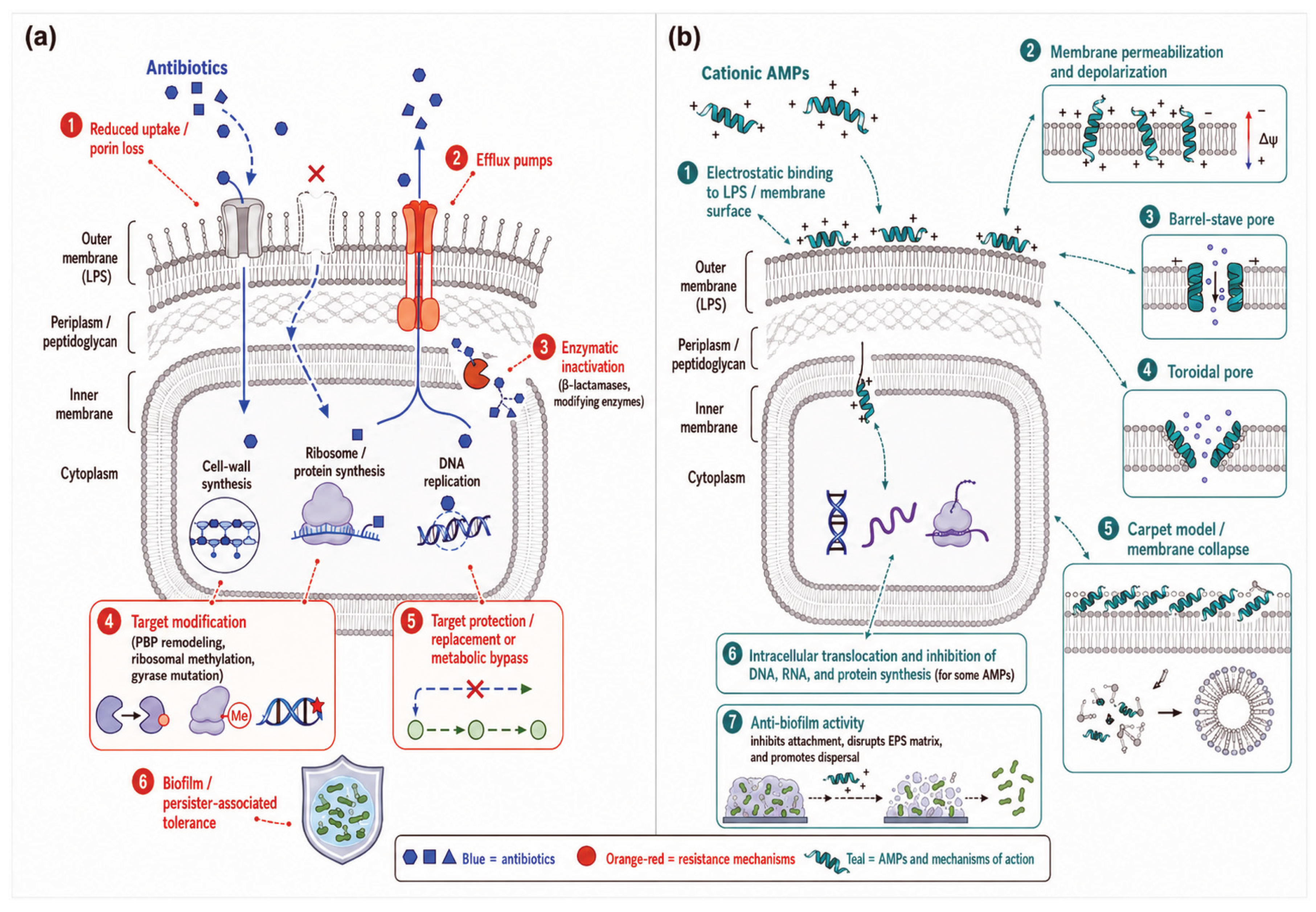
Figure 2.
Overview of marine antimicrobial peptides (AMPs): biological sources, structural characteristics, biosynthetic pathways, and application potential. (a) Marine AMPs are derived from diverse biological sources across marine habitats, including marine bacteria, archaea, protists, fungi, algae, invertebrates, and vertebrates. The bar chart summarizes the number of natural AMPs with known sequences and activities reported from major source groups of both marine and non-marine living organisms retrieved from the APD6 antimicrobial peptide database (accessed on 10 June 2026) [42]. (b) Representative structural and physicochemical features of AMPs. Marine AMPs can adopt α-helical, β-sheet, extended/random-coil, cyclic, and mixed α/β conformations. Their biological activities are commonly associated with amphipathicity, cationic charge, hydrophobic residues, relatively short peptide length, disulfide bond formation, and cyclization-enhanced stability. (c) Primary biosynthetic pathways contributing to marine AMP diversity. Ribosomal peptides, such as ribosomally synthesized and post-translationally modified peptides (RiPPs), are encoded by biosynthetic gene clusters, translated as precursor peptides, and subsequently processed through enzymatic tailoring, post-translational modification, and proteolytic cleavage to generate mature peptides. Non-ribosomal peptides (NRPs) are assembled by non-ribosomal peptide synthetases (NRPSs) through modular domain-mediated biosynthesis. Adenylation (A), peptidyl carrier protein (PCP), condensation (C), epimerization (E), and thioesterase (TE) domains mediate substrate selection, carrier loading, peptide bond formation, stereochemical conversion, and product release or cyclization, respectively. (d) Biological activities and translational relevance of marine AMPs. Marine AMPs exhibit broad antibacterial, antifungal, antiviral, antiparasitic, anti-biofilm, anti-inflammatory, wound-healing, and anticancer activities. These functional properties support their potential development as antimicrobial drug leads, aquaculture health-promoting agents, and bioactive biomaterials or surface coatings.
Figure 2.
Overview of marine antimicrobial peptides (AMPs): biological sources, structural characteristics, biosynthetic pathways, and application potential. (a) Marine AMPs are derived from diverse biological sources across marine habitats, including marine bacteria, archaea, protists, fungi, algae, invertebrates, and vertebrates. The bar chart summarizes the number of natural AMPs with known sequences and activities reported from major source groups of both marine and non-marine living organisms retrieved from the APD6 antimicrobial peptide database (accessed on 10 June 2026) [42]. (b) Representative structural and physicochemical features of AMPs. Marine AMPs can adopt α-helical, β-sheet, extended/random-coil, cyclic, and mixed α/β conformations. Their biological activities are commonly associated with amphipathicity, cationic charge, hydrophobic residues, relatively short peptide length, disulfide bond formation, and cyclization-enhanced stability. (c) Primary biosynthetic pathways contributing to marine AMP diversity. Ribosomal peptides, such as ribosomally synthesized and post-translationally modified peptides (RiPPs), are encoded by biosynthetic gene clusters, translated as precursor peptides, and subsequently processed through enzymatic tailoring, post-translational modification, and proteolytic cleavage to generate mature peptides. Non-ribosomal peptides (NRPs) are assembled by non-ribosomal peptide synthetases (NRPSs) through modular domain-mediated biosynthesis. Adenylation (A), peptidyl carrier protein (PCP), condensation (C), epimerization (E), and thioesterase (TE) domains mediate substrate selection, carrier loading, peptide bond formation, stereochemical conversion, and product release or cyclization, respectively. (d) Biological activities and translational relevance of marine AMPs. Marine AMPs exhibit broad antibacterial, antifungal, antiviral, antiparasitic, anti-biofilm, anti-inflammatory, wound-healing, and anticancer activities. These functional properties support their potential development as antimicrobial drug leads, aquaculture health-promoting agents, and bioactive biomaterials or surface coatings.
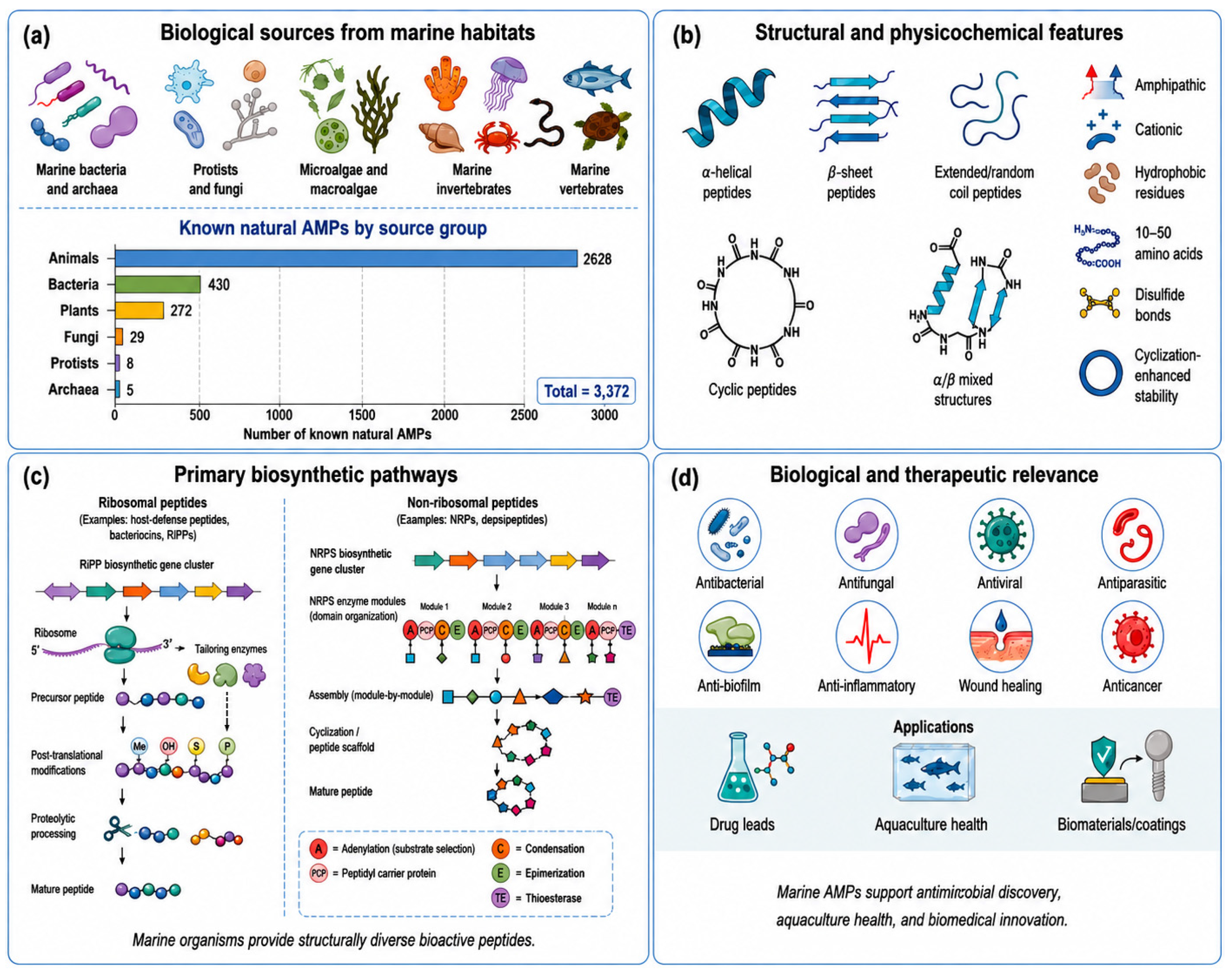
Figure 3.
Metagenomics-centered workflow for discovering novel antimicrobial peptides (AMPs) from marine particle-associated microbiomes. The figure summarizes a discovery-to-validation pipeline for mining marine microbial communities as reservoirs of novel AMP candidates. (1) Marine particle sampling: marine particles and particle-associated microbial assemblages are collected from the marine environment, capturing complex microhabitats enriched in taxonomically and metabolically diverse microorganisms. (2) Metagenomic sequencing and MAG reconstruction: environmental DNA is extracted and purified, followed by high-throughput metagenomic sequencing. Sequencing reads are assembled, binned, and reconstructed into metagenome-assembled genomes (MAGs), providing genome-resolved access to uncultured or poorly characterized marine microorganisms. (3) BGC and smORF mining with AI-assisted prioritization: MAGs are screened for biosynthetic gene clusters (BGCs), including ribosomally synthesized and post-translationally modified peptides (RiPPs) and nonribosomal peptides (NRPs), as well as short open reading frames (smORFs) encoding putative smORF-encoded peptides (SEPs). Candidate peptides are then ranked using AI-assisted novelty scoring and deep-learning-based prioritization to identify sequences with high predicted novelty and AMP potential. (4) Production of lead AMP candidates: prioritized candidates are generated using complementary production platforms, including heterologous expression, cell-free biosynthesis, and chemical synthesis. (5) Structure and bioactivity determination: purified lead compounds are subjected to structural characterization by mass spectrometry, nuclear magnetic resonance (NMR), and circular dichroism (CD) spectroscopy, followed by bioactivity evaluation. In vitro assays determine antimicrobial potency, minimum inhibitory concentration (MIC), activity spectrum, and killing kinetics, whereas in vivo assays provide further validation of efficacy and biological relevance. This integrated pipeline links marine particle microbiome exploration, genome-resolved mining, AI-guided candidate selection, scalable peptide production, and experimental validation to accelerate the discovery of novel marine-derived AMPs.
Figure 3.
Metagenomics-centered workflow for discovering novel antimicrobial peptides (AMPs) from marine particle-associated microbiomes. The figure summarizes a discovery-to-validation pipeline for mining marine microbial communities as reservoirs of novel AMP candidates. (1) Marine particle sampling: marine particles and particle-associated microbial assemblages are collected from the marine environment, capturing complex microhabitats enriched in taxonomically and metabolically diverse microorganisms. (2) Metagenomic sequencing and MAG reconstruction: environmental DNA is extracted and purified, followed by high-throughput metagenomic sequencing. Sequencing reads are assembled, binned, and reconstructed into metagenome-assembled genomes (MAGs), providing genome-resolved access to uncultured or poorly characterized marine microorganisms. (3) BGC and smORF mining with AI-assisted prioritization: MAGs are screened for biosynthetic gene clusters (BGCs), including ribosomally synthesized and post-translationally modified peptides (RiPPs) and nonribosomal peptides (NRPs), as well as short open reading frames (smORFs) encoding putative smORF-encoded peptides (SEPs). Candidate peptides are then ranked using AI-assisted novelty scoring and deep-learning-based prioritization to identify sequences with high predicted novelty and AMP potential. (4) Production of lead AMP candidates: prioritized candidates are generated using complementary production platforms, including heterologous expression, cell-free biosynthesis, and chemical synthesis. (5) Structure and bioactivity determination: purified lead compounds are subjected to structural characterization by mass spectrometry, nuclear magnetic resonance (NMR), and circular dichroism (CD) spectroscopy, followed by bioactivity evaluation. In vitro assays determine antimicrobial potency, minimum inhibitory concentration (MIC), activity spectrum, and killing kinetics, whereas in vivo assays provide further validation of efficacy and biological relevance. This integrated pipeline links marine particle microbiome exploration, genome-resolved mining, AI-guided candidate selection, scalable peptide production, and experimental validation to accelerate the discovery of novel marine-derived AMPs.
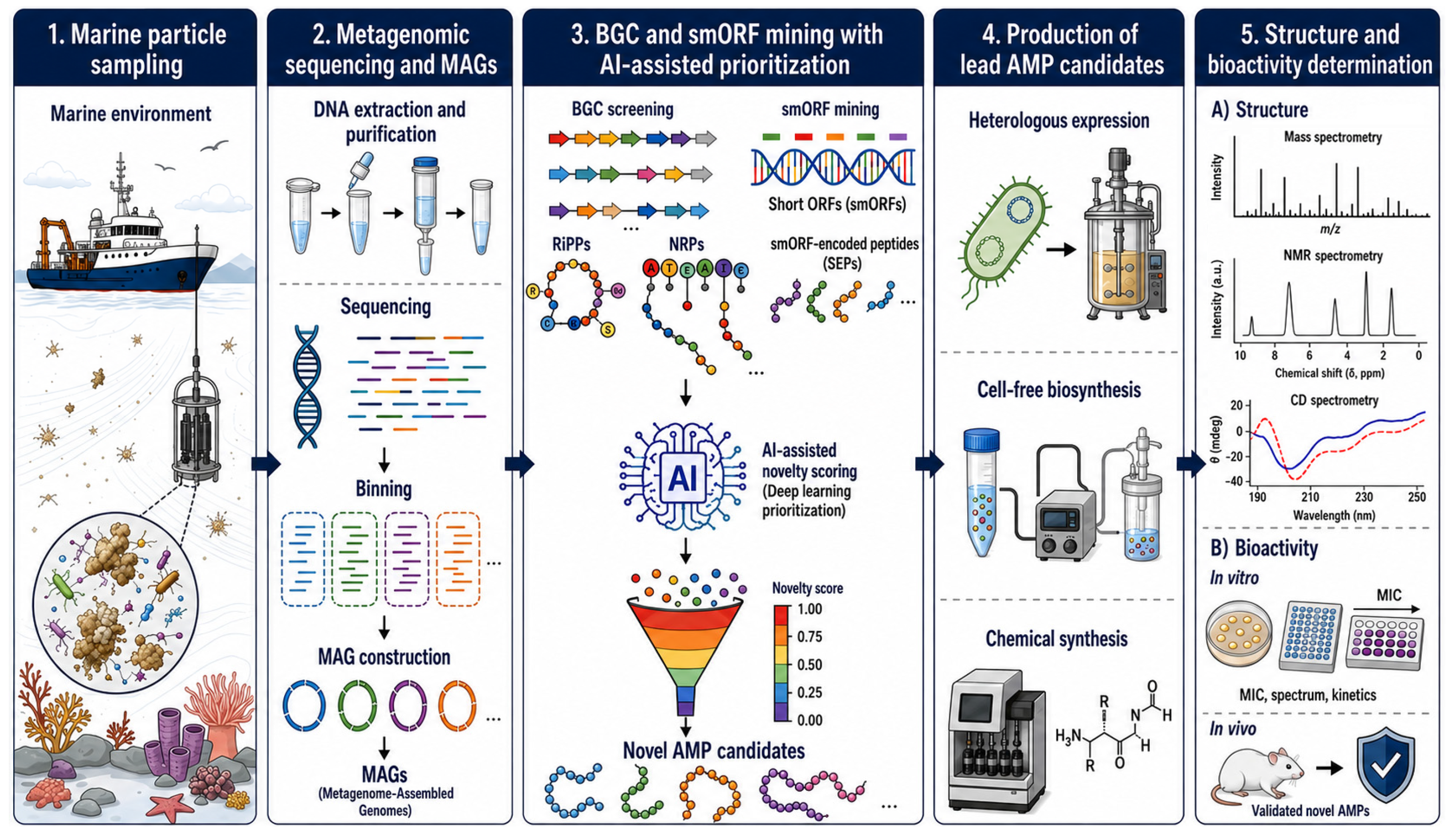
Disclaimer/Publisher’s Note: The statements, opinions and data contained in all publications are solely those of the individual author(s) and contributor(s) and not of MDPI and/or the editor(s). MDPI and/or the editor(s) disclaim responsibility for any injury to people or property resulting from any ideas, methods, instructions or products referred to in the content. |
© 2026 by the authors. Licensee MDPI, Basel, Switzerland. This article is an open access article distributed under the terms and conditions of the Creative Commons Attribution (CC BY) license (http://creativecommons.org/licenses/by/4.0/).
Copyright: This open access article is published under a Creative Commons CC BY 4.0 license, which permit the free download, distribution, and reuse, provided that the author and preprint are cited in any reuse.