

Submitted:
16 July 2026
Posted:
17 July 2026
You are already at the latest version
Abstract
Background/Objectives: Obesity is a chronic, multifactorial, and relapsing disease, and weight-loss outcomes should not be attributed solely to individual psychological characteristics. Psychological resilience has been proposed as a potential determinant of treatment adherence and weight-loss response, but prospective evidence in special-ized obesity care remains limited. This study investigated whether baseline psycholog-ical resilience predicts six-month weight loss among adults with obesity receiving spe-cialized outpatient care. Methods: We conducted a retrospective observational cohort study using real-world clinical data from the obesity outpatient service of a quaternary hospital in São Paulo, Brazil. The source cohort included 63 patients with six-month follow-up records. Baseline Resilience Scale for Adults (RSA) scores were available for 39 patients, of whom 35 had complete paired weight data and constituted the com-plete-case analytical cohort for the primary analysis. The primary outcome was six-month percent total body weight loss (%TBWL). Associations between baseline RSA score and %TBWL were evaluated using Spearman correlation and linear regression models, including adjustment for age, sex, and baseline body mass index. Results: In the complete-case analytical cohort, mean body weight decreased from 105.3 ± 23.0 kg at baseline to 102.4 ± 23.0 kg at six months. Mean absolute weight loss was 2.92 ± 5.72 kg, corresponding to 2.71 ± 5.64% TBWL. Weight reduction was statistically significant by paired t-test (95% CI 0.96 to 4.88 kg; p = 0.0048). Nine patients (25.7%) achieved ≥5% weight loss, and two patients (5.7%) achieved ≥10% weight loss. Baseline RSA score was not correlated with %TBWL (Spearman’s rho = −0.063; p = 0.718). In simple linear regression, each 10-point increase in RSA score was associated with a 0.03 per-centage-point change in %TBWL (95% CI −1.01 to 1.07; p = 0.953). Results remained non-significant after adjustment for age, sex, and baseline BMI (β = 0.14; 95% CI −1.01 to 1.30; p = 0.804). Conclusions: In this complete-case real-world cohort, baseline psy-chological resilience was not associated with six-month weight loss in adults with obe-sity receiving specialized outpatient care. These findings suggest that short-term weight-loss outcomes should not be attributed to baseline resilience or individual psy-chological characteristics alone. The substantial proportion of missing RSA data war-rants cautious interpretation and highlights the need for larger prospective studies evaluating resilience in relation to adherence, persistence, long-term maintenance, and weight regain.
Keywords:
obesity
; obesity treatment
; psychological resilience
; weight loss
; percent total body weight loss
1. Introduction
Obesity is a chronic, multifactorial, and relapsing disease and one of the most pressing public health challenges of the 21st century. It is defined by the World Health Organization (WHO) as a body mass index (BMI) ≥30 kg/m² and classified into three severity grades: class I (BMI 30.0–34.9 kg/m²), class II (BMI 35.0–39.9 kg/m²), and class III (BMI ≥40.0 kg/m²). Obesity is associated with increased risk of type 2 diabetes, cardiovascular disease, hypertension, and certain cancers [1,2].
In Brazil, obesity prevalence increased from 11.8% in 2006 to 20.3% in 2019, with projections estimating a prevalence of 29.6% by 2030 [3]. In the city of São Paulo, prevalence rose from 11.1% to 19.8% over the same period, reflecting a rapid nutritional transition [4].
Beyond metabolic determinants, psychological factors play an important role in obesity treatment outcomes, influencing adherence, coping capacity, and long-term self-regulation [5]. Stress has been shown to affect eating behaviours, physical activity patterns, hormonal regulation, and fat deposition, contributing to weight gain and impaired weight loss [6]. Psychological resilience, defined as the ability to adapt and recover from stress and adversity, has emerged as a potential prognostic factor in this context [7]. Higher resilience is associated with adaptive coping strategies, self-efficacy, and emotional regulation, which may support healthier dietary behaviours and greater adherence to treatment [7,8,9]. These mechanistic pathways are reflected in evidence suggesting that higher resilience is associated with improved psychological outcomes after bariatric surgery, better treatment adherence [9], and more favourable weight-related outcomes [10], whereas psychological distress is associated with poorer weight loss outcomes [11]. Low resilience has also been identified as a marker of adverse childhood experiences and current psychological disorders in individuals with severe obesity, reinforcing its clinical relevance in this population [12].
Psychological resilience is a multidimensional construct. In the present study, it was assessed using the Resilience Scale for Adults (RSA), a 33-item, six-factor self-report instrument originally developed by Friborg et al. [13]. The RSA provides a comprehensive assessment of both individual and interpersonal protective factors, encompassing Perception of self, Planned future, Social competence, Structured style, Family cohesion, and Social resources. The RSA has been cross-culturally validated for the Brazilian population, with confirmatory factor analysis supporting the original six-factor structure and adequate construct validity, including significant negative correlation with psychiatric symptom measures and positive correlation with sense of coherence [14].
Although resilience has been associated with psychological well-being and health behaviours, its prognostic value for clinically meaningful weight loss remains largely unknown. While some studies have reported an inverse association between resilience and BMI, others have observed positive or null associations, suggesting that the relationship may vary according to population characteristics and study context [15,16]. Existing studies have predominantly used cross-sectional designs, and prospective evidence evaluating baseline resilience as a predictor of weight loss in specialized obesity care remains scarce. To our knowledge, no prospective study has examined whether baseline resilience measured by the RSA predicts weight loss outcomes in patients undergoing specialized obesity outpatient care over six months. Addressing this gap is clinically relevant, as the identification of psychological prognostic factors at the time of the initial consultation may contribute to more individualized and effective treatment strategies.
Therefore, this study investigated whether baseline psychological resilience assessed by the RSA predicts six-month weight loss among adults with obesity receiving specialized outpatient care at a quaternary hospital in São Paulo, Brazil.
2. Materials and Methods
2.1. Study Design and Setting
This was a retrospective observational cohort study using real-world clinical data from the obesity outpatient service of the Discipline of Endocrinology, Santa Casa de Misericórdia de São Paulo, São Paulo, Brazil. Data were extracted from an institutional REDCap database.
2.2. Participants
Eligible patients were identified from the institutional REDCap database. Eligible patients were adults with obesity who had at least two clinical visits within a six-month follow-up window (baseline and six-month assessment), with the Resilience Scale for Adults (RSA) completed at the initial visit before follow-up. Obesity was defined according to the Brazilian Association for the Study of Obesity and Metabolic Syndrome (ABESO) criteria, as BMI ≥30 kg/m², or BMI ≥27 kg/m² in the presence of at least one obesity-related comorbidity eligible for pharmacological treatment [1].
No restrictions were imposed regarding anti-obesity medication class, diabetes status, or early weight-loss response.
Exclusion criteria were: age below 18 years; missing key identifiers preventing pairing of baseline and six-month data; secondary or syndromic causes of obesity (e.g., Cushing syndrome, insulinoma, lipodystrophy, Prader–Willi syndrome or Bardet-Biedel syndrome); pregnancy or lactation during follow-up; bariatric surgery or analogous surgical procedures during the observation window; and cognitive impairment precluding completion of the RSA.
The study protocol was approved by the Santa Casa de Misericórdia de São Paulo Ethics Committee, approval number 87515425.2.0000.5479, dated 12 April 2025. As this was a secondary analysis of routinely collected clinical data, informed consent was obtained in accordance with local regulations and the Declaration of Helsinki.
The analytical cohort comprised N = 63 patients with paired baseline and six-month assessments. Baseline Resilience Scale for Adults (RSA) scores were available for 39 patients (61.9%). Of these, 35 patients had complete baseline and six-month weight data and constituted the complete-case analytical cohort for the primary analysis evaluating the association between baseline RSA score and six-month percent total body weight loss (%TBWL).
As this was a retrospective analysis of routine clinical data, the type and intensity of concomitant obesity treatment (e.g., anti-obesity pharmacotherapy class, dietary intervention, or psychological support) were not systematically recorded and could not be adjusted for in the present analysis.
2.3. Sample Size
As this was a retrospective study based on an existing clinical database, no formal sample size calculation was performed. All eligible patients meeting the inclusion criteria during the study period were included.
2.4. Data Collection and Variables
Data were collected from medical records and entered into a REDCap database. For each patient, baseline variables extracted included sex, age, height, weight, waist circumference, and body mass index (BMI), together with the total score of the RSA, administered at the first clinical visit. At the six-month follow-up visit, weight, waist circumference, and BMI were re-assessed. Absolute weight loss (kg), change in BMI, and change in waist circumference were calculated as the difference between baseline and six-month values. Percent total body weight loss (%TBWL) was calculated as the percentage reduction from baseline body weight.
2.5. Instrument: Resilience Scale for Adults (RSA)
Psychological resilience was assessed using the Resilience Scale for Adults (RSA), a 33-item self-report instrument originally developed by Friborg et al. [13] to measure protective resilience factors across six dimensions: Perception of self, Planned future, Social competence, Structured style, Family cohesion, and Social resources. Each item is rated on a seven-point semantic differential scale, with half of the items reverse-scored to reduce acquiescence bias; higher scores indicate higher levels of protective resilience factors. The total score is derived from the sum of all 33 items, with a theoretical range of 33 to 231 points. The RSA has been cross-culturally validated for the Brazilian population, with confirmatory factor analysis supporting the original six-factor structure and adequate construct validity, including significant negative correlation with psychiatric symptom measures and positive correlation with sense of coherence [14]. For clinical interpretability in regression models, the continuous RSA score was additionally rescaled in 10-point units.
2.6. Statistical Analysis
Analyses were performed in RStudio V2024.12.1 Build 563 (Posit, Boston, MA, USA), with a two-sided significance threshold of α = 0.05. Continuous variables were summarized as mean ± standard deviation. Change in weight, BMI, and waist circumference from baseline to six months was assessed using paired t-tests, with paired Wilcoxon signed-rank tests performed as a sensitivity analysis.
Associations between baseline RSA score and %TBWL were initially explored using Spearman's rank correlation. Variables were subsequently modelled using simple linear regression model adjusting for age, sex, and baseline BMI. Missing data were handled by available-case analysis for each end point.
3. Results
Among the 63 patients in the source cohort, baseline RSA scores were available for 39 patients (61.9%). Four of these patients lacked complete paired weight data, resulting in a complete-case analytical cohort of 35 patients for the primary analysis.
In this complete-case cohort, mean baseline body weight was 105.3 ± 23.0 kg and mean six-month body weight was 102.4 ± 23.0 kg. Anti-obesity medications (AOM) were recorded as prescribed in the first meeting, and used accordingly to clinical decision, being them Semaglutide (9/35), Sibutramine + Topiramate (7/35), Topiramate (6/35), Orlistate (5/35), Sibutramine (4/35), Bupropion + Naltrexone (3/35) and Tirzepatide (1/35). In the second meeting, other AOM could be prescribed – thus, the obesity treatment received during follow-up was described here, but was not included as an adjustment variable because treatment allocation was not standardized and sample size did not permit adequately powered subgroup analyses.
Complete baseline data is seen in Table 1. Tables were generated using the complete-case analytical cohort, defined as patients with available baseline RSA score and paired baseline and six-month body weight measurements. For outcomes with additional missingness, the number of available paired observations is shown.
Mean absolute weight loss was 2.92 ± 5.72 kg, corresponding to a mean six-month %TBWL of 2.71 ± 5.64%. Weight reduction was statistically significant by paired t-test (mean difference 2.92 kg; 95% CI 0.96 to 4.88; p = 0.0048) and was confirmed by paired Wilcoxon signed-rank test (p = 0.0067).
Nine patients (25.7%) achieved ≥5% weight loss, and two patients (5.7%) achieved ≥10% weight loss. Mean BMI decreased by 0.82 kg/m², although this did not reach conventional statistical significance (p = 0.081). Waist circumference did not significantly decrease over six months (mean difference −3.31 cm; p = 0.299).
Baseline RSA score was not significantly correlated with six-month %TBWL (Spearman’s rho = −0.063; p = 0.718). In simple linear regression, each 10-point increase in baseline RSA score was associated with an estimated 0.03 percentage-point increase in %TBWL (95% CI −1.01 to 1.07; p = 0.953; R² = 0.0001). After adjustment for age, sex, and baseline BMI, the association remained non-significant (β = 0.14 percentage points per 10-point RSA increase; 95% CI −1.01 to 1.30; p = 0.804). In logistic regression, baseline RSA score was not associated with achieving ≥5% weight loss (OR 1.14 per 10-point increase; 95% CI 0.73 to 1.78; p = 0.567). Figure 1 presents a graphic of logistic regression and Table 2 presents the complete changes.
4. Discussion
In this retrospective cohort of patients with obesity followed at a specialized outpatient clinic, modest but statistically significant weight loss over six months was observed. However, baseline psychological resilience, assessed using the Resilience Scale for Adults (RSA), was not associated with six-month weight loss in either unadjusted or adjusted analyses.
The absence of association was consistent across analytic approaches, adjusting for age, sex, and BMI. This consistency suggests that, within this cohort, baseline RSA score did not demonstrate meaningful prognostic value for six-month weight loss. This finding does not necessarily indicate that psychological resilience is irrelevant to obesity management, rather, it suggests that its influence may not be expressed directly in the degree of weight change over a relatively short follow-up window.
It is plausible that six-month weight loss is influenced more directly by treatment-related and contextual factors, such as pharmacological class, dose titration, adherence, tolerability, medication access, follow-up frequency, and treatment interruptions, than by psychological traits alone. Resilience may instead be more relevant to longitudinal outcomes not captured in the present analysis, such as treatment persistence, ability to manage weight-loss plateaus, long-term adherence, or resistance to weight regain after the initial treatment phase.
These findings are consistent with the broader literature on resilience and weight-related outcomes, which remains inconsistent regarding the direction and strength of this association [15,16]. While resilience has been linked to improved psychological outcomes and treatment adherence following bariatric surgery [9] and to more favourable weight-related outcomes in other populations [10], and while psychological distress has been associated with poorer weight-loss outcomes [11], the present study did not find that resilience translated into greater six-month weight loss in a specialized obesity outpatient setting. This may reflect differences in population, treatment context, or outcome window across studies, as most prior evidence derives from cross-sectional designs, limiting direct comparison.
This study has several strengths. It employed a longitudinal follow-up design comparing baseline and six-month assessments, addressing a methodological limitation common to much of the existing literature on resilience and obesity, which is predominantly cross-sectional. Resilience was assessed using the RSA, a cross-culturally validated instrument for the Brazilian population, providing a multidimensional assessment of protective psychological factors. Data were derived from clinical practice at a quaternary referral centre, enhancing external validity for routine specialized obesity care.
Several limitations must be acknowledged. First, the effective analytic sample for the primary association (n = 35) was modest, limiting statistical power to detect small-to-moderate associations and increasing the risk of type II error. Second, missingness was substantial, particularly for the RSA, which was unavailable for a considerable proportion of the cohort; if incomplete scale administration was not random, this could introduce selection bias into the complete-case analysis. Third, as this was a retrospective analysis of routinely collected clinical data, information on concomitant treatment, including anti-obesity medication class, dietary intervention, and psychological or behavioural support, was not systematically recorded and could not be adjusted for, representing an important source of potential residual confounding. Fourth, the adjusted regression model included only age, sex, and BMI; other potentially relevant variables, such as treatment adherence, dose titration, and eating behaviour patterns, were not included. Finally, the relatively wide confidence intervals indicate limited precision in the estimated association between resilience and weight loss, and a single-centre design in a specialized quaternary-care outpatient setting may limit generalizability to primary care or community-based populations.
Future prospective studies with prospective analysis, larger samples, more complete data collection, and incorporation of treatment-related and behavioural variables are needed to clarify whether resilience is associated with clinically relevant longitudinal outcomes, such as treatment adherence, persistence, weight-loss maintenance, or resistance to weight regain. Although baseline RSA score did not demonstrate prognostic value for six-month weight loss in the present study, psychological assessment may remain clinically valuable for other aspects of obesity management, including treatment engagement and long-term follow-up.
5. Conclusions
In this real-world cohort of patients with obesity followed at a specialized outpatient clinic, statistically significant weight loss over six months was observed. However, baseline resilience, assessed using the RSA, was not associated with six-month weight loss, either in unadjusted or adjusted analyses. These findings suggest that baseline resilience, as assessed by the RSA, was not a predictor of six-month weight loss in this cohort. Its potential clinical relevance may instead lie in other longitudinal outcomes that were not evaluated in the present study.
These findings also support the view that short-term weight-loss outcomes cannot be explained by baseline psychological resilience alone, reinforcing the multifactorial nature of obesity and the need to avoid attributing treatment success or failure to individual psychological characteristics in isolation.
Rather than reflecting a simple expression of individual resilience or willpower, short-term weight-loss response appears to be more closely shaped by the therapeutic intervention itself and by the clinical conditions that support its implementation, continuity, and effectiveness.
Author Contributions
Conceptualization, R.G.P., R.J.P-W. and A.H.S..; methodology, R.G.P., R.J.P-W.; software, R.J.P-W.; validation, A.H.S.; formal analysis, R.J.P-W.; investigation, R.G.P and R.J.P-W.; data curation, R.J.P-W.; writing—original draft preparation, R.G.P.; writing—review and editing, R.J.P-W.; visualization, A.H.S.; supervision, N.M.S and J.E.N.S.; project administration, N.M.S and J.E.N.S. All authors have read and agreed to the published version of the manuscript.
Funding
This research received no external funding.
Institutional Review Board Statement
The study protocol was approved by the Santa Casa de Misericórdia de São Paulo Ethics Committee, approval number 87515425.2.0000.5479, Date 12 April 2025. As this was a secondary analysis of routinely collected clinical data, informed consent was obtained in accordance with local regulations and the Declaration of Helsinki.
Informed Consent Statement
Informed consent was obtained from all subjects involved in the study.
Data Availability Statement
Research data is stored in Santa Casa de Misericórdia de São Paulo REDCap server (https://redcap.fcmsantacasasp.edu.br/, accessed on 13 July 2026).
Acknowledgments
The authors acknowledge all Endocrinology residents from Santa Casa de Misericórdia de São Paulo for their tireless work and support, and all the patients who gladly accepted providing their information for science development.
Conflicts of Interest
The authors declare no conflicts of interest for this paper.
Abbreviations
The following abbreviations are used in this manuscript:
| RSA | Resilience Scale for Adults |
| %TBWL | Percent Total Body Weight Loss |
| BMI | Body Mass Index |
| AOM | Anti-obesity medication |
References
- Diretriz Brasileira de Tratamento Farmacológico da Obesidade—ABESO 2026. Available online: https://abeso.org.br/wp-content/uploads/2025/12/Diretriz-Brasileira-de-Tratamento-Farmacologico-da-Obesidade-ABESO-2026.pdf (accessed on 13 July 2026).
- Bessell, E.; Markovic, T.P.; Fuller, N.R. How to Provide a Structured Clinical Assessment of a Patient with Overweight or Obesity. Diabetes Obes. Metab. 2021, 23, 36–49. [Google Scholar] [CrossRef]
- Estivaleti, J.M.; Guzman-Habinger, J.; Lobos, J.; Azeredo, C.M.; Claro, R.; Ferrari, G.; Adami, F.; Rezende, L.F.M. Time Trends and Projected Obesity Epidemic in Brazilian Adults between 2006 and 2030. Sci. Rep. 2022, 12, 12699. [Google Scholar] [CrossRef]
- Lima, A.P.D.; Nunes, A.P.D.O.B.; Nicoletti, C.F.; Benatti, F.B. Trend in the Prevalence of Overweight and Obese Adults in São Paulo, Brazil: Analysis between the Years 2006 and 2019. Int. J. Environ. Res. Public. Health 2024, 21, 502. [Google Scholar] [CrossRef]
- Jiwanmall, S.A.; Kattula, D. The Psychological Dimension of Obesity – an Uncharted Territory. Curr. Opin. Endocrinol. Diabetes Obes. 2026, 33, 55–62. [Google Scholar] [CrossRef] [PubMed]
- Tomiyama, A.J. Stress and Obesity. Annu. Rev. Psychol. 2019, 70, 703–718. [Google Scholar] [CrossRef] [PubMed]
- Zhu, B.; Gostoli, S.; Benasi, G.; Patierno, C.; Petroni, M.L.; Nuccitelli, C.; Marchesini, G.; Fava, G.A.; Rafanelli, C. Promoting Weight Loss and Psychological Well-being in Patients with Obesity: A Sequential Combination of Behavioural Lifestyle Intervention and Well-being Therapy. Clin. Psychol. Psychother. 2023, 30, 422–435. [Google Scholar] [CrossRef] [PubMed]
- Annesi, J.J.; Powell, S.M. Psychosocial Predictors of Maintained Weight Loss in Women: Informing Behavioral Obesity Treatment Foci. Int. J. Behav. Med. 2025, 32, 541–549. [Google Scholar] [CrossRef] [PubMed]
- McGarrity, L.A.; Terrill, A.L.; Martinez, P.L.; Ibele, A.R.; Morrow, E.H.; Volckmann, E.T.; Smith, T.W. The Role of Resilience in Psychological Health Among Bariatric Surgery Patients. Obes. Surg. 2022, 32, 792–800. [Google Scholar] [CrossRef] [PubMed]
- Nishimi, K.M.; Koenen, K.C.; Coull, B.A.; Kubzansky, L.D. Association of Psychological Resilience With Healthy Lifestyle and Body Weight in Young Adulthood. J. Adolesc. Health 2022, 70, 258–266. [Google Scholar] [CrossRef] [PubMed]
- Vakharia, J.D.; Thaweethai, T.; Licht, P.; Wexler, D.J.; Delahanty, L.M. Psychological and Behavioral Predictors of Weight Loss in the Reach Ahead for Lifestyle and Health-Diabetes Lifestyle Intervention Cohort. J. Acad. Nutr. Diet. 2023, 123, 1033–1043.e1. [Google Scholar] [CrossRef] [PubMed]
- Mathieu, J.; Brunaud, L.; Reibel, N.; Moukah, D.; Witkowski, P.; Lighezzolo-Alnot, J.; Quilliot, D.; Ziegler, O. Low Resilience in Severe Obesity: Marker of Adverse Childhood Experiences and Current Psychological Disorders. Eat. Weight Disord.-Stud. Anorex. Bulim. Obes. 2022, 27, 3507–3519. [Google Scholar] [CrossRef] [PubMed]
- Friborg, O.; Hjemdal, O.; Rosenvinge, J.H.; Martinussen, M. A New Rating Scale for Adult Resilience: What Are the Central Protective Resources behind Healthy Adjustment? Int. J. Methods Psychiatr. Res. 2003, 12, 65–76. [Google Scholar] [CrossRef] [PubMed]
- Hjemdal, O.; Roazzi, A.; Dias, M.D.G.B.B.; Friborg, O. The Cross-Cultural Validity of the Resilience Scale for Adults: A Comparison between Norway and Brazil. BMC Psychol. 2015, 3, 18. [Google Scholar] [CrossRef] [PubMed]
- Zheng, N.; Zhuang, M.; Zhu, Y.; Wang, Y.; Ye, M.; Zhang, Y.; Zhan, Y. Association between Psychological Resilience and Body Mass Index in a Community-based Population: A Cross-sectional Study. Obes. Sci. Pract. 2024, 10, e761. [Google Scholar] [CrossRef] [PubMed]
- Stewart-Knox, B.; E Duffy, M.; Bunting, B.; Parr, H.; Vas De Almeida, M.D.; Gibney, M. Associations between Obesity (BMI and Waist Circumference) and Socio-Demographic Factors, Physical Activity, Dietary Habits, Life Events, Resilience, Mood, Perceived Stress and Hopelessness in Healthy Older Europeans. BMC Public Health 2012, 12, 424. [Google Scholar] [CrossRef] [PubMed]
- Pineda-Wieselberg, R.J.; Soares, A.H.; Napoli, T.F.; Scalissi, N.M.; Salles, J.E.N. Toward Precision Obesity Pharmacotherapy: Using the Eating Behavior Phenotype Scale (EFCA) in Real-World Clinical Practice. Nutrients 2026, 18, 1419. [Google Scholar] [CrossRef] [PubMed]
Figure 1.
Scatter plot showing the association between baseline Resilience Scale for Adults (RSA) score and six-month percent total body weight loss (%TBWL) in the complete-case analytical cohort. The solid line represents the fitted linear regression line and the shaded area its 95% confidence interval. No significant association was observed (Spearman’s rho = −0.063; p = 0.718).
Figure 1.
Scatter plot showing the association between baseline Resilience Scale for Adults (RSA) score and six-month percent total body weight loss (%TBWL) in the complete-case analytical cohort. The solid line represents the fitted linear regression line and the shaded area its 95% confidence interval. No significant association was observed (Spearman’s rho = −0.063; p = 0.718).
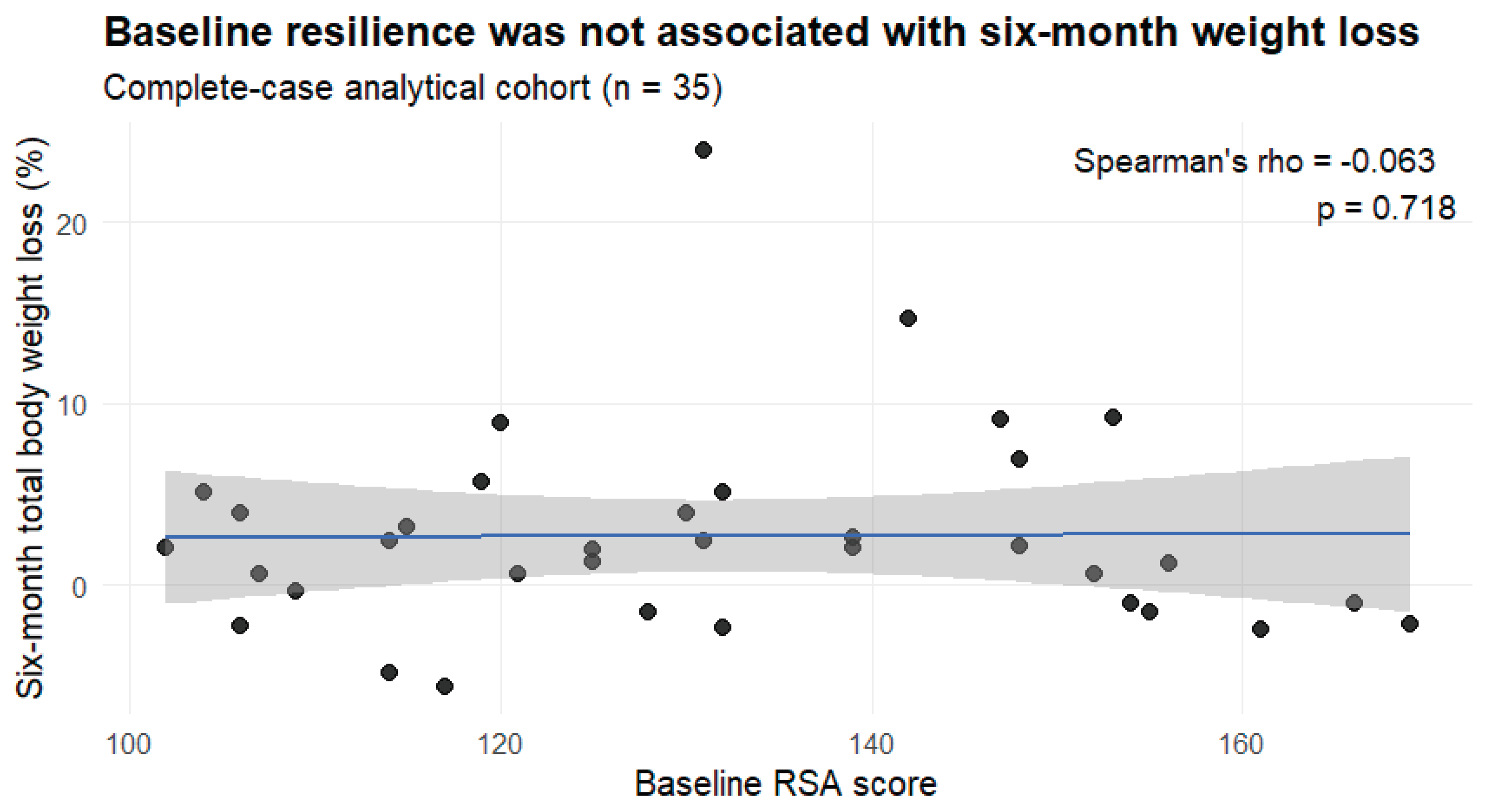

Table 1.
Baseline characteristics of the complete-case analytical cohort.
| Characteristic | n available | Complete case cohort |
| Participants, n | 35 | 35 |
| Age, years | 35 | 47.8 ± 15.2 |
| Male sex, n (%) | 35 | 4 (11.4%) |
| Height, cm | 35 | 163.5 ± 10.6 |
| Baseline body weight, kg | 35 | 105.3 ± 23.0 |
| Maximum lifetime body weight, kg | 35 | 115.1 ± 23.6 |
| Baseline BMI, kg/m² | 35 | 39.4 ± 7.5 |
| Baseline waist circumference, cm | 33 | 112.3 ± 14.5 |
| Baseline RSA score | 35 | 131.9 ± 19.3 |
Values are presented as mean ± SD unless otherwise indicated.
Table 2.
Six-month changes in anthropometric outcomes in the complete-case analytical cohort.
| Outcome | Baseline | 6 months | Mean change | p-value |
| Baseline body weight, kg | 105.3 ± 23.0 | 102.4 ± 23.0 | 2.92 | 0.005* |
| Baseline BMI, kg/m² | 39.4 ± 7.5 | 38.5 ± 7.3 | 0.82 | 0.081 |
| Baseline waist circumference, cm | 112.3 ± 14.5 | 116.1 ± 19.9 | -3.31 | 0.299 |
| Total body weight loss, % | - | 2.7 ± 5.6 | - | - |
| Patients with ≥5% weight loss, n (%) | - | 9 (25.7%) | - | - |
| Patients with ≥10% weight loss, n (%) | - | 2 (5.7%) | - | - |
Values are presented as mean ± SD unless otherwise indicated. Mean change represents baseline minus six-month value; therefore, positive values indicate reductions.
Disclaimer/Publisher’s Note: The statements, opinions and data contained in all publications are solely those of the individual author(s) and contributor(s) and not of MDPI and/or the editor(s). MDPI and/or the editor(s) disclaim responsibility for any injury to people or property resulting from any ideas, methods, instructions or products referred to in the content. |
© 2026 by the authors. Licensee MDPI, Basel, Switzerland. This article is an open access article distributed under the terms and conditions of the Creative Commons Attribution (CC BY) license (http://creativecommons.org/licenses/by/4.0/).
Copyright: This open access article is published under a Creative Commons CC BY 4.0 license, which permit the free download, distribution, and reuse, provided that the author and preprint are cited in any reuse.


