

Submitted:
15 July 2026
Posted:
16 July 2026
You are already at the latest version
Abstract
The article explores the evolution of research on the energy transition through a biblio-metric co-occurrence analysis of author keywords extracted from 146 scientific publica-tions. Rather than analysing publication content directly, the study examines the rela-tionships among keywords related to the energy transition and intelligent deci-sion-support technologies. Recent research (2022-2024) increasingly focuses on renewable energy, sustainable development, and intelligent systems, which reflects the shift towards the digitalization of energy systems and the growing importance of sustainable develop-ment. Between 2018 and 2021, research shifted toward a broader understanding of the en-ergy transition, emphasizing climate change, decarbonization, renewable energy, invest-ments, and energy policy within the context of sustainable development. In contrast, pre-vious studies (2014-2018) have mainly focused on the technical aspects of energy systems and traditional decision-support approaches. The study focuses on demonstrating the outcomes of such evolution and considers the decision-making process for building an methodological concept integrated with expert systems to optimize and manage car-bon-reduction strategies under dynamic energy transition conditions. In this study, the concept of a DT is considered as a methodological direction for extending the capabilities of modern expert systems rather than as a fully implemented digital twin. Accordingly, an algorithmic model of an expert system is proposed, in which the analytical core is based on engineering (η), economic (F), and optimization models that are consistent with the digital twin concept. Particular emphasis is placed on the economic module, which ena-bles the assessment of the economic value of CO₂ capture, break-even carbon price, mini-mum functional point, optimal operating conditions, and the sensitivity of results to key economic parameters. The proposed approach contributes to the development of intelli-gent tools to support decarbonization and the transition to sustainable energy supply.
Keywords:
energy
; transition
; digital twins
; decarbonization
; evaluation
; decision support
; expert systems
1. Introduction
The energy transition is one of the largest socio-economic and technological transformations of our time, aimed at achieving decarbonization of the economy, climate neutrality and sustainable development goals. Since the 1990s, the attention of researchers and politicians has been focused on increasing energy efficiency and developing renewable energy sources. In the following decades, the concept of energy transition has become more comprehensive, covering issues of reducing greenhouse gas emissions, developing low-carbon technologies, electrifying transport and ensuring energy security. Today, the energy transition is considered not only as a technological modernization of the energy sector, but as a multi-level process that combines economic, environmental, social and institutional aspects of development.
The complexity of the structure of modern economic systems, the integration of renewable energy sources, the development of distributed generation, energy storage, smart grids and demand management mechanisms significantly increase the requirements for the decision-making process. Managing such systems requires processing significant amounts of data, evaluating a large number of alternative scenarios, and taking into account a high level of uncertainty. Under these conditions, traditional approaches to analysis and planning are increasingly proving insufficient, which necessitates the use of intelligent decision-making support tools.
One of the first areas of intellectualization of management processes was expert systems, which are based on the use of knowledge bases and logical inference mechanisms to formalize expert experience and support decision-making. In the energy sector, expert systems have found application in increasing energy efficiency, managing energy consumption, assessing alternative energy sources, diagnosing the technical condition of equipment, and planning the development of energy systems. Growing attention to decarbonization issues and achieving climate neutrality has contributed to expanding the areas of use of expert systems as tools to support management decisions in the energy transition process.
Hence, it is important to study the evolution of expert systems in the context of solving energy transformation problems and determining the role of intelligent support tools in decision-making processes. Within the framework of this study, it is planned to characterize the features of energy transition evolution concept based on the analysis of literary sources and to highlight the characteristic features of the functioning of modern expert systems based on the use of intellectual support tools, their justification, economic assessment and prospects for future use.
2. Literatura Review
Evolution of the Energy Transition Concept
The concept of the energy transition emerged in response to the oil crises of the 1970s. During this period, the idea of a systematic transformation of energy systems gained international recognition, while the European concept of Energiewende originated in Germany in the late 1970s and was formally articulated in 1980 as a strategy for transitioning from fossil fuels and nuclear energy to energy efficiency and renewable energy sources [1].
Since the 1990s, the concept of the energy transition has evolved under the influence of sustainable development principles. During this period, research primarily focused on reducing the environmental impacts of energy production, improving energy efficiency, and expanding the use of renewable energy sources. Important milestones included the United Nations Conference on Environment and Development (Rio de Janeiro, 1992) and the Kyoto Protocol (1997), which established the foundation for environmentally oriented energy policies [2].
During the following decade, the energy transition evolved from isolated environmental initiatives into a comprehensive process of energy system decarbonization. The main priorities became greenhouse gas emission reduction, renewable energy integration, transport electrification, and the development of low-carbon technologies. This stage was strongly influenced by the implementation of the Paris Agreement [3] and the emergence of the global commitment to achieving climate neutrality and Net Zero targets [4].
The current stage of the energy transition is characterized by increasing digitalization and intelligentization of energy systems. Alongside decarbonization technologies, growing attention has been devoted to digital solutions, including expert systems, Decision Support Systems (DSS), Digital Twins (DT), Big Data, Artificial Intelligence (AI), and smart grids. These technologies enable the simulation of complex energy system scenarios, improve forecasting accuracy, optimize resource utilization, and support informed decision-making under conditions of high uncertainty and multiple interacting factors that characterize the energy transition [5].
Figure 1 illustrates the evolution of scientific research on the energy transition during the period 2014-2024, based on publications indexed in the Scopus database. To investigate the development of expert systems in the context of the energy transition, a dataset of 146 scientific publications was compiled using the keywords ‘energy transition’, ‘energy shift’, ‘energy transformation’, ‘renewable energy transition’, ‘sustainable energy transition’, ‘expert system’, ‘knowledge-based system’, ‘intelligent system’, and ‘decision support system’. A bibliometric co-occurrence analysis of publication keywords was subsequently conducted to identify the principal research themes and trace the evolution of scientific approaches to the application of expert systems in supporting the energy transition.
During the initial stage (2014-2017), represented by blue – green nodes, research primarily focused on energy efficiency, DSS, energy planning, energy policy, and uncertainty analysis. At this stage, the energy transition was predominantly perceived as a techno-economic challenge related to the optimization of energy systems.
Between 2018 and 2021, research gradually shifted toward a broader understanding of the energy transition, reflected by the growing prominence of topics such as climate change, sustainable development, decarbonization, renewable energy, investments, and energy policy. The energy transition increasingly came to be viewed as a complex socio-economic process associated with achieving sustainable development goals and reducing greenhouse gas emissions.
The most recent stage (2022-2024), represented by yellow nodes, is characterized by the rapid emergence of research themes related to intelligent systems, Monte Carlo methods, simulation, digital storage, supply chains, and carbon management. This evolution indicates a transition from conventional analytical approaches toward the application of intelligent systems, digital technologies, artificial intelligence, and advanced modelling techniques to support decision-making under the uncertainty inherent in the energy transition.
Thus, the evolution of research demonstrates a gradual shift from energy efficiency and energy planning issues to integrated energy transition management based on digital technologies, intelligent systems and forecasting methods that provide decision-making support in the process of decarbonization and sustainable energy development.
Expert Systems for Decision Support in the Field of Energy Transition
Considering that the energy transition is characterized by differences in operational efficiency and institutional support [6] , and also depends on many factors [7], considerable attention of researchers has been paid to the issue of the use of decision support systems. In particular, previous studies [8] consider DSS as a tool for integrating multi-criteria analysis, sustainable development indicators and scenario modeling to support strategic planning of the energy transition, enabling the simultaneous consideration of technical, environmental, social, and economic criteria when selecting optimal project locations [9]. At the same time, the analysis showed that most existing DSS are focused mainly on evaluating alternatives or forecasting the development of energy systems, while the issues of integrating technical models with economic optimization, sensitivity analysis and determining critical operating modes remain insufficiently studied [10]. Authors [11] have also proposed integrated performance assessment methodologies that combine multiple technological subsystems into a unified analytical framework, providing quantitative indicators to support operational and strategic decision-making in industrial systems.
Expert systems have become the next stage in the development of decision support systems, supplementing traditional analytical models with knowledge bases, inference mechanisms, and the ability to generate automated recommendations [12]. Analysis of current research confirms their effectiveness in increasing energy efficiency, primarily in energy-intensive industries, where they allow identifying energy-saving opportunities, compensating for the lack of expert knowledge, and supporting managerial decision-making. Based on a systematic review of 62 studies published between 1987 and 2024, expert systems have demonstrated their ability to identify energy-saving opportunities, support decision-making, and compensate for shortages of skilled personnel. Their growing adoption reflects the increasing importance of digital and knowledge-based solutions in achieving climate neutrality goals. However, challenges related to transferability, standardization, and the lack of universal development methodologies remain barriers to their broader implementation [13].
Recent studies also demonstrate the growing role of analytical modelling for improving the reliability and protection of electrical infrastructure, providing quantitative support for engineering decision-making under complex operating conditions [14], as well as that artificial intelligence-based control systems usage for applying to optimize decentralized bioenergy generation, enabling adaptive process control, improved operational resilience, and more efficient utilization of renewable biomass resources under uncertain operating conditions [15].
At the same time, a systematic review of publications shows that modern expert systems are still characterized by a number of limitations, including the lack of universal construction methodologies, insufficient model standardization, the difficulty of transferring between different industries, and limited integration with mathematical optimization models and digital representations of real production processes [16]. It is these limitations that determine the relevance of developing methodological approaches that combine the capabilities of expert systems, mathematical modeling, and the concept of a digital twin to support decision-making in the field of industrial decarbonization.
Intelligent Decision-Making Using the Digital Twin Concept for the Energy Transition
The current stage of the energy transition is characterized by the increasing complexity of decision-making processes resulting from the need to simultaneously consider technical, economic, environmental, and social factors as well as its digitalization and increasing intelligence [17]. Under such conditions, intelligent management tools, particularly expert systems and DSS, have become increasingly important because they enable the evaluation of alternatives, scenario analysis, and informed managerial decision-making [18]. Recent Industry 4.0 research further demonstrates that AI-driven information systems integrating neural networks, sensor data, and enterprise digital infrastructures provide adaptive process control and intelligent decision support, illustrating the ongoing convergence of digitalization and industrial energy management [19].
The continuous advancement of digital technologies has contributed to the emergence of the DT concept, which is widely regarded in the literature as a further development of DSSy through the integration of mathematical modelling, real-time monitoring, forecasting, and data analytics. Unlike conventional expert systems, DT enable continuous model updating based on real-time data and facilitate the analysis of alternative operating scenarios [20]. Consequently, the DT is increasingly considered a new generation of DSS that integrates modelling, monitoring, forecasting, and optimization within a unified digital environment [21].
Nevertheless, the analysis of recent studies indicates that most existing DT applications are primarily focused on modelling physical processes, monitoring the technical condition of systems, and predicting their operational performance. For example, the DT for Positive Energy Districts (DT4PED) integrates urban data, parametric modelling, EnergyPlus, and UrbanOpt simulations to support energy planning, scenario analysis, and visualization of results [22]. However, an integrated economic module incorporating investment appraisal, break-even analysis, identification of critical operating conditions, optimization of operating parameters, and sensitivity analysis is either limited or absent in most existing DT implementations [23].
The conducted literature review therefore suggests that the future development of DT depends not only on improvements in data acquisition and processing technologies but also on expanding their functionality through the integration of engineering, economic, and optimization models within a unified decision-support environment. This research gap provides the motivation for developing the methodological approach proposed in this study.
Accordingly, the objective of this paper is to substantiate the role of expert systems in supporting the energy transition, investigate the evolution of intelligent DSS, and justify the use of the DT concept as a methodological foundation for decision support in industrial decarbonization.
To achieve this objective, the following research questions were formulated:
RQ1: What is the role of expert systems and DSS in facilitating the energy transition?
RQ2: How can the DT concept expand the functional capabilities of modern intelligent Decision Support Systems in supporting the energy transition?
Addressing these research questions contributes to a better understanding of the evolution of intelligent decision-support technologies and identifies future directions for their application in addressing the contemporary challenges of the energy transition.
2. Materials and Methods
Based on the analysis of the scientific literature, it was found that the contemporary development of expert systems is characterized by a transition from rule-based decision-support tools to intelligent models capable of integrating simulation, forecasting, and scenario analysis. This trend highlights the need to develop a DT methodology as an analytical concept that integrates the technical, economic, and environmental characteristics of the monitored system and provides more comprehensive support for managerial decision-making [24].
To illustrate the practical implementation of this concept, a methodological concept based on the Digital Twin concept is proposed for the Carbon Capture and Storage (CCS) process [25]. The proposed concept demonstrates the architecture of a modern expert DSS and its capabilities for scenario analysis, economic assessment, and the identification of optimal management strategies.
To evaluate the economic feasibility of CCS implementation, the Techno-Economic Assessment (TEA) approach was adopted, which is widely applied in studies on the economics of carbon capture and storage [26]. The proposed methodology is based on estimating the economic value of CO₂ capture, determining the break-even carbon price, and performing sensitivity analysis with respect to technological, energy-related, and economic parameters. This approach enables the identification of the threshold conditions under which CCS technologies become economically feasible.
The proposed methodology for evaluating CCS performance according to the principles of the DT concept is based on a computational module that integrates technical, energy, economic, and investment-related parameters of plant operation. Its main advantage is that it enables not only the assessment of the current operating conditions of the CO₂ capture system but also the simulation of how system performance changes under different capture efficiencies, carbon prices, electricity prices, and operating cost scenarios.
At the first stage, the maximum annual amount of CO₂ available for capture (Qmax) is determined using plant-specific production data, including production capacity, specific CO₂ emissions, and technological process characteristics. Next, the capture efficiency coefficient (η) is defined to represent the proportion of total CO₂ emissions that can be effectively removed from the flue gas stream. Based on these parameters, the annual amount of captured CO₂ is calculated as follows:
This calculation constitutes the foundation of the proposed methodology, as the amount of captured CO₂ directly determines both the potential economic benefits and the operating costs of the CCS system.
The next stage involves estimating the energy consumption of the capture process. Since higher capture efficiency requires additional energy input, the model employs a nonlinear relationship between the specific energy consumption and the CO₂ capture efficiency:
This function reflects the fact that approaching very high capture rates is accompanied by a disproportionate increase in the energy required for CO₂ separation. The proposed equation represents an analytical energy penalty function used to model the nonlinear increase in energy consumption rather than a directly measured technical characteristic of a specific CCS installation. Consequently, the model provides a generalized representation of the energy-performance relationship that can be adapted to different capture technologies. This formulation also reduces the risk of overinterpreting technology-specific performance characteristics and enhances the methodological generality of the proposed analytical framework.
Accordingly, the analytical framework developed according to the DT concept is intended not only to estimate the maximum technically achievable capture rate but also to identify the economically optimal capture efficiency, taking into account the trade-off between increasing energy consumption and the economic benefits associated with CO₂ capture.
The next step is the calculation of the specific economic value of capturing one tonne of CO₂ (Φ). The economic benefit of CO₂ capture is interpreted as avoided EU ETS compliance costs rather than direct operating revenue. It represents the monetary value of emission allowances that the plant no longer needs to purchase because the captured CO₂ is not released into the atmosphere under the EU ETS framework [27]. Accordingly, Φ is defined as the difference between the economic benefit associated with captured CO₂ and the costs incurred for its capture:
In this equation, PCO2 represents the carbon price or the potential value of carbon credits, denotes the electricity cost required to capture one tonne of CO₂, whereas represents the share of fixed operating costs allocated to one tonne of captured CO₂. Consequently, this formulation enables the assessment of not only the technical performance but also the economic feasibility of CCS implementation.
The equation describes a market-based scenario without financial support. However, for a more realistic implementation of the DT concept, it is appropriate to incorporate a financial support parameter that reflects public subsidies or other investment support mechanisms:
where S is the specific equivalent of governmental investment support (or subsidy), expressed per tonne of captured CO₂ (€/t CO₂), representing the share of capital expenditure compensated through public funding.
A key stage of the proposed methodology is the formulation of the objective function, which can be expressed as follows:
or, in its expanded form:
This objective function represents the annual net operational economic value of the CO₂ capture system. Its application is justified because it simultaneously incorporates three key evaluation criteria: technical performance (η), the specific economic value per tonne of captured CO₂ (Φ), and the overall annual economic outcome (F). Considering these three criteria jointly avoids one-sided assessments in which a system may be technically efficient but economically unattractive.
The evaluation of CCS performance should not be limited to technical and operational indicators alone, since the implementation of CCS projects requires substantial capital investment. Therefore, the proposed analytical framework additionally incorporates an investment component that enables the assessment of project capital intensity and its potential investment attractiveness. For this purpose, the specific capital investment indicator is defined as:
where CAPEX denotes the total capital investment required for the CO₂ capture system (€), and Qcapt=Qmax×η is the annual amount of captured CO₂ (t/year).
The proposed indicator represents the amount of capital investment required to provide the capacity to capture one tonne of CO₂ annually. Its application enables comparisons among CCS projects of different scales and facilitates the assessment of economies of scale, which are particularly important for large industrial installations. Preliminary calculations indicate that an increase in the annual capture capacity is associated with lower specific capital investment costs, thereby improving the overall economic performance of the project [28].
Consequently, the proposed methodology, developed in accordance with the principles of the DT concept, is based on four interrelated evaluation criteria (Table 1).
An additional stage of the proposed methodology is the determination of the break-even point through the estimation of the break-even carbon price. By setting the objective function equal to zero (F=0) and solving for PCO2 , the break-even carbon price can be expressed as follows:
Operational Threshold:
Commercial Threshold:
Subsidized Threshold:
Where parametr σ denotes the proportion of capital expenditure (CAPEX) compensated through governmental support or grant funding, where:
σ=0 – no financial support is provided; the enterprise finances 100% of the investment costs;
σ=0.4 – 40% of CAPEX is covered by governmental support or grant funding, while the enterprise finances the remaining 60%;
σ=1 – the investment is fully financed through external support, and CAPEX is therefore not included in the enterprise's investment costs.
If the actual or projected carbon price exceeds , , the CO₂ capture system generates a positive economic value. Conversely, if the carbon price remains below the break-even level, the implementation or operation of the CCS system is economically unattractive.
To determine the threshold conditions for the economically feasible operation of the CCS system, the proposed methodological concept incorporates the Minimum Functional Point (MFP). Unlike the Optimal Operating Point (OOP), which corresponds to the maximum value of the objective function, the MFP represents the first economically feasible operating condition of the system, that is, the minimum carbon price at which a carbon capture project becomes economically viable.
Within the proposed analytical framework based on the DT concept, the MFP serves as a decision-support indicator by identifying the minimum market conditions required for CCS deployment and enabling the assessment of project feasibility under alternative carbon market scenarios.
The MFP is determined as follows:
where is the objective function representing the economic performance of the CCS system.
The determination of the MFP enables the analytical framework developed according to the DT concept not only to simulate system behaviour but also to identify the threshold of economic feasibility for CCS implementation. This provides a quantitative basis for assessing project attractiveness, performing scenario analysis, and supporting strategic decision-making.
To identify the optimal operating parameters, the proposed methodology employs the Maximum (Optimal) Point. This point represents the operating conditions under which the objective function reaches its maximum value, corresponding to the highest economic performance of the CO₂ capture process.
Within the proposed methodology, the OOP defines the optimal combination of capture efficiency and carbon price at which the economic value generated by CCS implementation is maximized. Accordingly, this operating regime is identified by the analytical framework as the most economically preferable option for system operation.
The OOP is determined as follows:
where economic performance function of the CCS system.
The determination of the OOP enables the analytical framework developed according to the DT concept not only to simulate system behaviour but also to support intelligent decision-making by identifying economically optimal operating conditions. This approach shows the capabilities of conventional expert systems by combining knowledge-based reasoning with modelling, optimization, forecasting, and scenario analysis, thereby providing a more comprehensive basis for decision-making regarding the implementation of industrial decarbonization technologies.
To evaluate the robustness of the proposed analytical framework, a Normalized Finite-Difference Sensitivity Index (NFDSI) was employed. Unlike local elasticity coefficients, which are based on analytical derivatives, the finite-difference approach evaluates the actual response of the objective function to finite perturbations of the input parameters. The use of a central finite-difference approximation provides second-order numerical accuracy, reduces approximation errors in nonlinear models, and yields more robust sensitivity estimates, particularly in the vicinity of the break-even point. Consequently, the resulting sensitivity indices provide a more realistic representation of the influence of technological and economic parameters on the economic performance of CCS projects.
The normalized sensitivity index was calculated based on the classical local elasticity coefficient as follows:
where F is the objective function of the analytical framework developed according to the DT concept, and xi denotes the input parameter under investigation. Since deriving the analytical derivative of this nonlinear objective function is impractical, it was approximated using a central finite-difference scheme:
After substitution, the normalized sensitivity index was obtained:
where:
is the normalized sensitivity index of the i-th parameter;
is the value of the objective function at the baseline value of the parameter;
is the value of the objective function after increasing the parameter;
is the value of the objective function after decreasing the parameter;
is the baseline value of the parameter under investigation;
is the absolute variation of the parameter (e.g., ±5% or ±10%).
The normalized sensitivity index makes it possible to evaluate the relative influence of each model parameter on the objective function independently of the units of measurement. Positive values of SIi>0 indicate a direct relationship between the parameter and the objective function, whereas negative values of SIi<0 indicate an inverse relationship. The index quantifies the percentage change in the annual economic performance of the CCS system resulting from a 1% change in the corresponding input parameter. This approach is particularly relevant for industrial facilities operating under volatile electricity prices, carbon prices, and other market conditions affecting CCS deployment.
Thus, the proposed methodology establishes a methodological foundation for developing an analytical algorythm based on the DT concept that can be employed as an intelligent decision-support tool for industrial decarbonization. Unlike conventional expert systems, which primarily rely on predefined rules and accumulated knowledge, the proposed concept integrates mathematical modelling, scenario analysis, and optimization techniques to support the assessment, forecasting, and identification of optimal operating conditions. The analytical framework enables the estimation of CO₂ capture volumes, energy consumption, economic performance, break-even carbon prices, sensitivity indices, and both the MFP and the OOP, while also supporting recommendations regarding the economic feasibility of CCS implementation. In this way, the DT concept is considered not merely as a modelling approach but as a methodological basis for extending the analytical capabilities of modern expert DSS in the context of the energy transition.
To demonstrate the practical applicability of the proposed methodology, the analytical framework was applied to real CCS projects, including Slite, Aalborg Portland, Brevik, and Górażdże. Given the methodological nature of this study, the emphasis was placed on verifying the ability of the proposed analytical framework to reproduce the techno-economic characteristics of CCS systems.
All calculations were implemented in Python using NumPy and Pandas for numerical computation and data processing. Graphical outputs were generated using Matplotlib.
3. Results
The cement industry is one of the largest industrial sources of greenhouse gas emissions, generating approximately 5-8% [29] of global anthropogenic CO₂ emissions. Moreover, it accounts for around 27% [30] of total direct industrial CO₂ emissions, making it one of the most challenging sectors to decarbonize because a substantial share of its emissions originates from the limestone calcination process rather than fuel combustion.
To demonstrate the applicability of the proposed methodology based on the DT concept, three leading cement plants – Slite, Aalborg Portland, Brevik, and Górażdże – were selected as case studies. These facilities were chosen because official technical and economic data describing their CCS projects are publicly available, making them suitable for demonstrating the proposed analytical framework.
Using the proposed methodology for evaluating the performance of CO₂ capture systems (Equations 1-7), the baseline scenario of the analytical framework was calculated. The corresponding input parameters and the results of the baseline scenario are presented in Table 2.
The proposed analytical framework, developed according to the DT concept, enables the integration of the proposed methodology for assessing the economic value of CO₂ capture into an expert DSS, whose objective is to identify economically preferable strategies for supporting the energy transition.
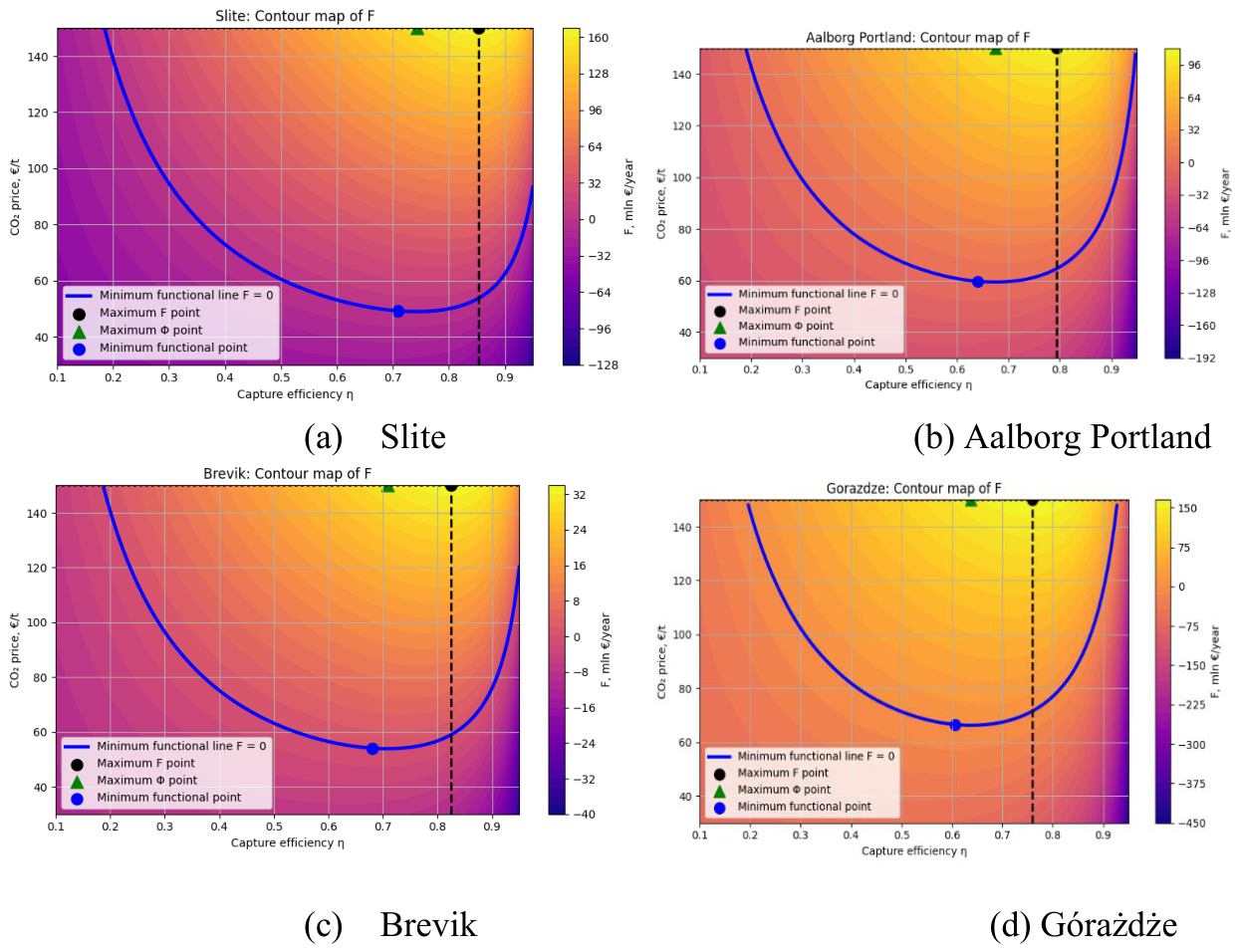
Based on the proposed optimization criteria, the analytical framework was applied to determine the economically feasible and optimal operating conditions of CO₂ capture systems at the selected cement plants. The simulation results are presented as contour maps of the objective function F(η,PCO2) , illustrating the MFP, the Maximum (Optimal) Point, and the region of economically feasible system operation (Figure 2).
As shown in Figure 2, the blue curve represents the Minimum Functional Line (F=0), which separates the economically feasible region (F>0) from the economically infeasible region (F<0). The MFP, determined according to Equation (10), represents the lowest carbon price at which the CCS project reaches the break-even condition. It therefore defines the threshold market conditions required for CCS implementation and can be used to assess the economic feasibility of investment decisions.
The OOP, determined according to Equation (11), corresponds to the global maximum of the objective function and identifies the combination of CO₂ capture efficiency and carbon price that provides the highest economic performance of the CCS system. The dashed line indicates the optimal capture efficiency η, while the colour gradient represents variations in the objective function across the analysed parameter space.
Figure 2.
Assessment of the Overall Economic Performance of CCS Based on the Proposed Performance Indicators and Capture Efficiency (η).
Figure 2.
Assessment of the Overall Economic Performance of CCS Based on the Proposed Performance Indicators and Capture Efficiency (η).
Authors' calculations based on the proposed analytical framework.
The figure demonstrates that the overall economic performance of CCS is determined not by maximizing the CO₂ capture efficiency itself but by identifying the optimal balance between the capture rate and the increasing energy requirements of the capture process. For the Slite project, this balance is achieved at a capture efficiency ranging from approximately 0.70 to 0.90, while the minimum break-even carbon price is about €50/t CO₂, which is below the current EU ETS carbon price. This indicates that the project is potentially economically viable even without further increases in carbon prices.
The results also indicate that the Aalborg Portland CCS project is economically feasible under current European carbon market conditions; however, its performance is considerably more sensitive to electricity prices than that of Slite. The minimum break-even carbon price is approximately €60/t CO₂, exceeding the corresponding value for the Swedish project. This finding highlights the greater dependence of the Danish project on market conditions and confirms the crucial role of electricity costs in determining the competitiveness of carbon capture technologies.
The Brevik project demonstrates a high degree of economic robustness and a well-balanced relationship between technological and economic parameters. Despite its smaller capture capacity compared with Slite and Aalborg Portland, the project reaches economic feasibility at a carbon price of approximately €55/t CO₂ and exhibits a relatively broad range of economically viable operating conditions. The optimal capture efficiency is approximately 84%, which is consistent with current industrial CCS practice [35]. These findings suggest that the combination of moderate energy costs, governmental support, and a stable regulatory framework creates favourable conditions for the commercial deployment of CCS technologies.
The results for Górażdże reveal a more complex economic situation. On the one hand, the project has the largest potential CO₂ capture capacity and is capable of generating one of the highest economic values under favourable market conditions. On the other hand, high electricity prices substantially increase the break-even carbon price and shift the economic optimum toward lower capture efficiencies. Consequently, the project is the most sensitive to changes in electricity prices, highlighting the importance of external support mechanisms, such as the EU Innovation Fund, governmental incentive schemes, or Carbon Contracts for Difference (CCfDs), to ensure its long-term economic viability.
Overall, the results reveal an important characteristic of CCS deployment. Under identical market conditions, large cement plants with high CO₂ capture capacities achieve the greatest overall economic performance. Slite generates the highest annual economic value (approximately €37.8 million/year) because its large capture volume allows fixed costs to be distributed over a greater amount of captured CO₂. Brevik generates a positive economic value, although its overall annual benefit remains lower because of the smaller project scale. In contrast, Aalborg Portland exhibits a significantly lower economic performance owing to its relatively high electricity costs, which substantially reduce the economic value of CO₂ capture. These findings demonstrate that the economic performance of CCS depends not only on the amount of captured CO₂ but also on national electricity price conditions.
Consequently, the simultaneous determination of the MFP and the OOP enables the proposed analytical framework developed according to the DT concept to provide not only system simulation but also intelligent decision support. This makes it possible to identify the economic feasibility limits of CCS implementation, determine the optimal operating conditions, and formulate recommendations for industrial decarbonization under alternative carbon market scenarios.
The next stage of the analysis involves evaluating the sensitivity of the variables describing CCS operation with respect to the objective function representing the overall economic performance (F) (Figure 3, Figure 4, Figure 5 and Figure 6).
Figure 3.
Results of the normalized sensitivity analysis of the analytical framework based on the DT concept for the Slite cement plant.
Figure 3.
Results of the normalized sensitivity analysis of the analytical framework based on the DT concept for the Slite cement plant.
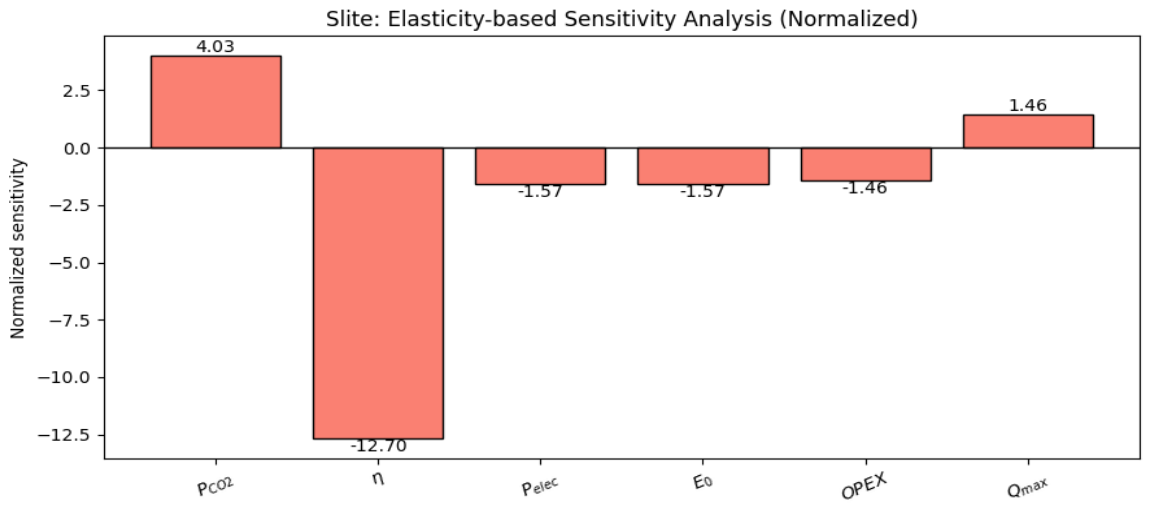
The results, demonstrated in Figure 3 indicate that CO₂ capture efficiency and the EU ETS carbon price are the primary factors determining the economic performance of the CCS project at the Slite cement plant. Unlike the other case studies, the project exhibits a stable positive baseline economic outcome. Consequently, the calculated sensitivity coefficients remain moderate and are not distorted by proximity to the break-even point. These findings suggest that the economic performance of CCS at this facility is driven primarily by carbon market conditions and the technological characteristics of the capture process, particularly the capture efficiency and the annual capture capacity, whereas the influence of energy-related and operating costs is comparatively less significant.
Figure 4.
Results of the normalized sensitivity analysis of the analytical framework based on the DT concept for the Aalborg Portland cement plant.
Figure 4.
Results of the normalized sensitivity analysis of the analytical framework based on the DT concept for the Aalborg Portland cement plant.
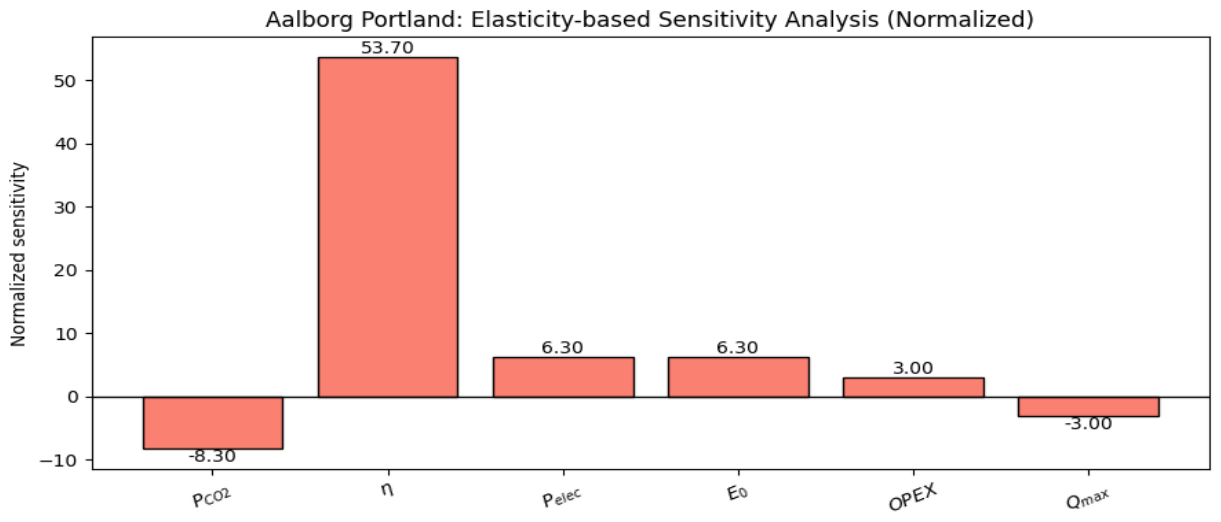
The results in Figure 4 demonstrate that CO₂ capture efficiency is the dominant factor affecting the economic performance of the Aalborg Portland CCS project, while the second most influential group of variables comprises the energy-related parameters, namely the electricity price and the specific energy consumption of the capture process. Operating costs and the capture capacity have a comparatively smaller influence on the overall economic performance.
However, the exceptionally high sensitivity coefficient associated with capture efficiency should not be interpreted as indicating that this parameter is inherently several times more important than the others. Instead, it primarily reflects the economic instability of the project under the baseline scenario. Since the baseline economic outcome is negative, even relatively small changes in the key input parameters produce substantial relative changes in the objective function. Consequently, the high sensitivity coefficient should be interpreted as an indicator of the project's proximity to the economic feasibility threshold rather than as evidence of the overwhelming importance of capture efficiency itself.
Figure 5.
Results of the normalized sensitivity analysis of the analytical framework based on the DT concept for the Brevik cement plant.
Figure 5.
Results of the normalized sensitivity analysis of the analytical framework based on the DT concept for the Brevik cement plant.
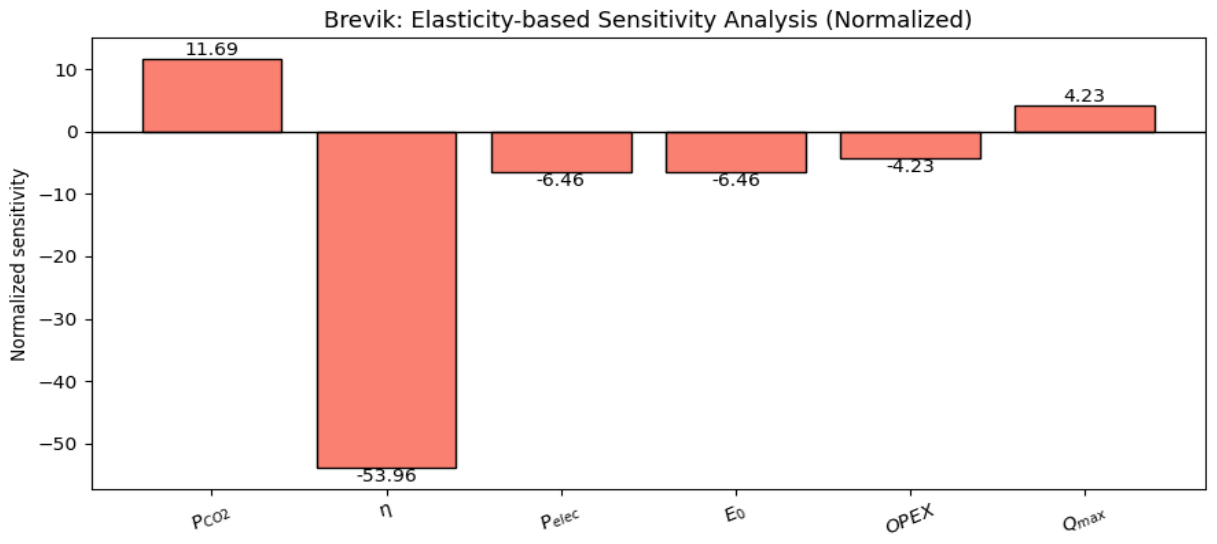
The results in Figure 5 indicate that the economic performance of the CCS project at the Brevik plant is primarily influenced by market conditions, particularly the EU ETS carbon price, and by the technological characteristics of the CO₂ capture system, whereas energy and operating costs constitute the main economic constraints affecting project performance. However, the exceptionally high sensitivity to capture efficiency is attributable to the fact that the project operates close to its break-even point. Under such conditions, even minor changes in key parameters result in substantial relative changes in the economic outcome. Therefore, the high sensitivity should be interpreted not as evidence of the dominance of a single factor, but rather as an indication of the project's high economic vulnerability to changes in both market conditions and technological parameters.
Figure 6.
Results of the normalized sensitivity analysis of the analytical framework based on the DT concept for the Górażdże cement plant.
Figure 6.
Results of the normalized sensitivity analysis of the analytical framework based on the DT concept for the Górażdże cement plant.
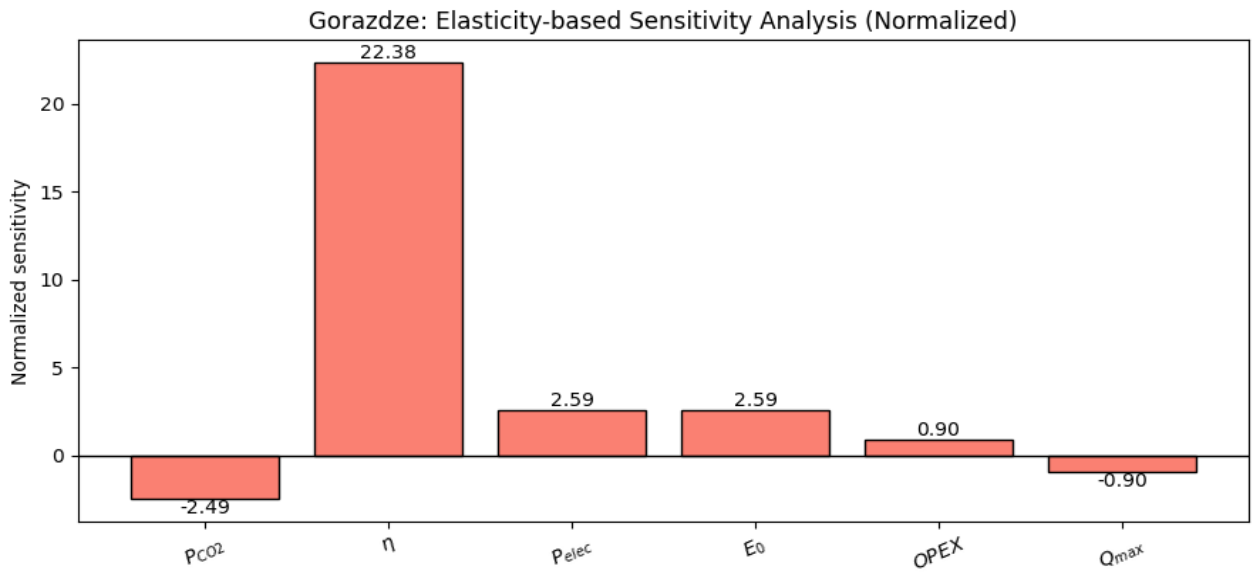
The sensitivity analysis for the Górażdże cement plant indicates that CO₂ capture efficiency is the dominant factor affecting the economic performance of the CCS project at the Górażdże cement plant, while energy-related parameters constitute the second most influential group of factors. However, it should be noted that the project operates under a negative baseline economic outcome. Consequently, the signs of some normalized sensitivity coefficients are determined by the mathematical properties of the normalization procedure rather than by the underlying economic relationships. Under such conditions, the sensitivity analysis should primarily be interpreted as a tool for ranking the relative importance of individual factors, whereas the interpretation of coefficient signs should be performed with reference to the baseline value of the objective function.
Overall, the results confirm that the economic performance of CCS is determined not by a single factor but by the combined effects of technological characteristics, energy costs, and market conditions. Moreover, each industrial facility is characterized by its own set of critical parameters that should be considered when developing decarbonization strategies and planning investments in CO₂ capture technologies.
The calculations performed using the baseline scenario demonstrate that the economic performance of CCS depends not only on the amount of captured CO₂ but also on the electricity market conditions in the country where the project is implemented. Slite achieves the best overall performance because it combines a large capture capacity with relatively low electricity prices. Under the same assumptions, Aalborg Portland becomes economically more vulnerable, as high electricity prices substantially reduce the economic value of CO₂ capture. Brevik maintains a positive economic outcome; however, its overall economic impact remains lower because of the smaller scale of the project.
It should also be emphasized that the implementation of CCS technologies is typically supported through public funding mechanisms. Aalborg Portland provides a particularly relevant example. The ACCSION project has received substantial financial support from both the Danish government and the European Union. In 2026, the Danish Energy Agency approved an operating subsidy of approximately €117 per tonne of captured CO₂, applicable to annual capture volumes of up to 1.25 million tonnes of CO₂. In addition, the project has received funding from the EU Innovation Fund and is recognized as one of the first initiatives aimed at producing carbon-neutral cement in Europe. More broadly, most large-scale CCS projects in the European cement industry are being implemented with the support of national governments or supranational funding mechanisms, as summarized in Table 3.
For Slite and Aalborg Portland, the final investment decisions have not yet been finalized. Consequently, the literature reports different investment estimates depending on the configuration of the CO₂ transport and storage infrastructure.
An important stage of the proposed analytical framework is the determination of the break-even carbon price, as it represents the minimum carbon price at which CCS becomes economically feasible. This indicator enables the assessment of the project's economic viability, the identification of the threshold conditions for its implementation, and supports managerial decision-making regarding the deployment of industrial decarbonization technologies.
The calculations performed using Equations (1-7) made it possible to construct Figure X.
Figure 7 compares the break-even carbon price required to ensure the economic feasibility of CCS projects in four countries under three financing scenarios: without investment support, with a 40% governmental grant, and under full commercial financing. The dashed horizontal line represents the current EU ETS carbon price (83 €/t CO₂).
The Slite (Sweden) project exhibits the lowest break-even threshold (approximately 62-70 €/t CO₂), indicating that the project is economically viable under current market conditions. Brevik (Norway) occupies an intermediate position: excluding investment costs, the project is economically feasible, whereas under full commercial financing the required carbon price slightly exceeds the current EU ETS level. For Aalborg Portland (Denmark), the estimated break-even carbon price ranges between 93 and 100 €/t CO₂, while for Górażdże (Poland) it reaches approximately 116-125 €/t CO₂, substantially exceeding the current market price of carbon allowances. These results indicate the necessity of additional support mechanisms, including investment grants, capital cost compensation, or further increases in EU ETS allowance prices to ensure the economic viability of such projects.
Overall, the results demonstrate that the economic viability of CCS depends on the combined effects of technological performance, financing structure, and carbon market conditions. Furthermore, governmental support has the potential to substantially reduce the break-even threshold and accelerate the deployment of industrial decarbonization technologies.
Summarizing the results obtained from applying the proposed methodology for the economic assessment of CO₂ capture technologies, Figure 8 presents the Architectural and Methodological Framework of an Expert System Based on the DT Concept for Intelligent Decarbonization Support.
Based on the literature review and the practical application of the proposed methodology for evaluating CO₂ capture performance, an architectural and methodological framework is proposed that illustrates how the DT concept can be incorporated into an expert DSS for managing industrial CO₂ emissions (Figure 8).
Figure 8.
Architectural and methodological framework of an expert system based on a digital twin for intelligent support of decarbonization. Sourse: formed by authors.
Figure 8.
Architectural and methodological framework of an expert system based on a digital twin for intelligent support of decarbonization. Sourse: formed by authors.
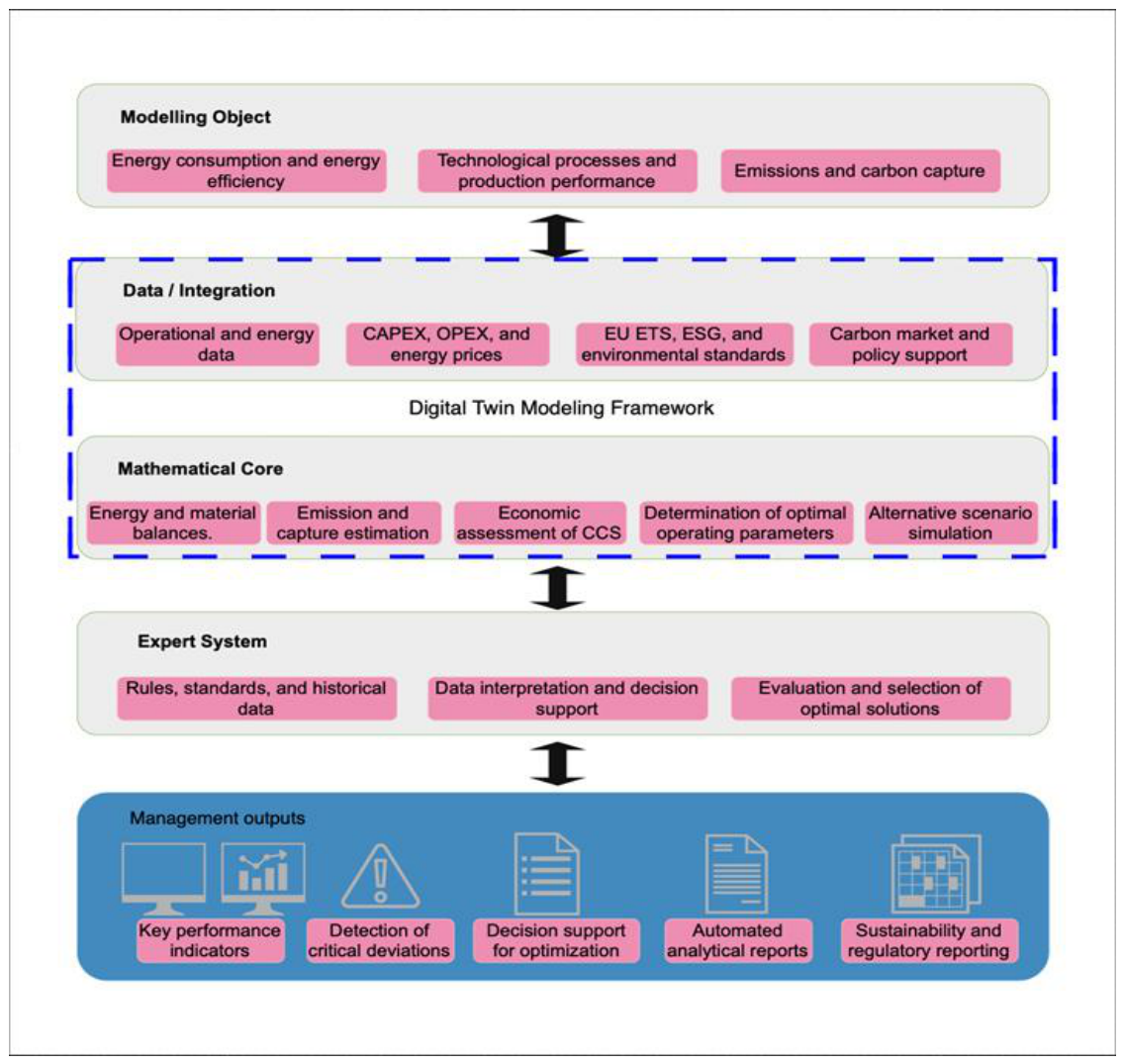
Figure 8 presents the proposed architectural and methodological framework of an expert system that integrates a digital twin into the decision-making process for industrial decarbonization. The architecture is organized into five interconnected layers that collectively transform heterogeneous operational data into intelligent management recommendations.
The first layer “Modeling Object” defines the physical system represented by the expert system and includes three interconnected domains: the energy profile, which characterizes energy consumption and generation processes; the production subsystem, describing technological operations; and the carbon subsystem, representing CO₂ emissions and capture processes. Together, these domains form the digital representation of the industrial facility.
The second “Data and Integration” and third “ Mathematical Core” layers jointly constitute the methodological foundation of the proposed digital twin. The Data and Integration layer provides continuous acquisition and integration of information from multiple sources, including process telemetry, operational and energy data, accounting systems, economic indicators, regulatory requirements, and external market conditions. This integrated information environment ensures that the analytical model operates using consistent and up-to-date technical, economic, and environmental information. The “Mathematical Core” transforms the collected data into a digital representation of the CCS process by integrating engineering, economic, and optimization models. It performs energy and material balance calculations, CO₂ capture estimation, economic assessment, carbon market evaluation, determination of optimal operating conditions, sensitivity analysis, and alternative scenario simulations. Together, these two layers form the digital twin, which provides a virtual analytical representation of the real CCS system and enables the evaluation of different operational and economic scenarios. The results generated by the digital twin are subsequently processed by the “Expert System” layer, where they are combined with expert knowledge, operational rules, historical experience, and decision criteria to support the selection of optimal management strategies. Thus, within the proposed architecture, the digital twin serves as the analytical engine of the expert system, while the expert system interprets the modelling results and generates recommendations for decision-makers.
Finally, the fifth layer “ Management Outputs” delivers decision-support products in the form of KPI dashboards, early warning notifications, optimization recommendations, analytical reports, and ESG/EU ETS reporting. These outputs support operational management, strategic planning, investment evaluation, and compliance with decarbonization policies.
Overall, the study confirms that expert systems constitute one of the key digital instruments supporting the energy transition. By integrating engineering models, economic evaluation, optimization procedures and scenario analysis into a unified decision-support environment, they enable more informed, transparent and adaptive management of industrial decarbonization processes. The proposed digital twin methodology reflects the ongoing evolution of expert systems towards more advanced decision-support solutions by integrating simulation, optimization and predictive analysis within a unified methodological framework.
4. Discussion
To verify the methodological validity of the proposed approach, its analytical framework was compared with the Techno-Economic Assessment (TEA) methodology presented in the IEAGHG Technical Report 2024-03. Both approaches employ common economic indicators for evaluating CCS projects, including CAPEX, OPEX, and the break-even carbon price, confirming the methodological consistency of the proposed concept with internationally recognized approaches to CCS techno-economic assessment.
Unlike the conventional TEA approach, which primarily focuses on the static evaluation of the economic feasibility of CCS projects, the proposed methodology integrates TEA principles into the DT concept. This enables scenario simulation, identification of optimal operating conditions, estimation of the break-even carbon price, sensitivity analysis, and support for managerial decision-making.
The obtained results provide a basis for discussing several important aspects of applying DT concepts to industrial decarbonization.
First, the literature review demonstrated that most existing studies consider DT primarily as tools for monitoring, visualization, and prediction of the technical performance of energy systems. The proposed methodology extends this perspective by incorporating economic assessment, break-even carbon price estimation, identification of the MFP and the OOP, together with sensitivity analysis. This creates methodological foundations for applying DT principles as a decision-support tool in the evaluation of CCS projects.
Second, the results confirm that the economic feasibility of CCS technologies is determined by more than the carbon price alone. The analysis shows that the break-even carbon price varies considerably depending on electricity prices (Pelec), capture efficiency, and both operating and capital expenditures. This indicates that emissions trading mechanisms alone are insufficient to ensure the economic viability of CCS and that successful large-scale deployment requires comprehensive public support mechanisms.
Third, an important finding of this study is that the maximum CO₂ capture efficiency does not necessarily correspond to the maximum economic performance. The proposed analytical framework makes it possible to identify the optimal capture efficiency at which the best balance is achieved between the economic benefits associated with avoided CO₂ emissions and the energy costs required for the capture process. This supplement the conventional approach to CCS assessment, which often focuses exclusively on maximizing the capture rate.
Fourth, the results demonstrate the necessity of adapting economic models to the characteristics of individual industrial facilities. Although a common mathematical framework was applied, the optimal operating conditions, break-even carbon prices, and parameter sensitivities differ substantially among the Slite, Aalborg Portland, Brevik, and Górażdże case studies. These findings highlight the importance of calibrating the DT analytical concept according to the technical and economic characteristics of each specific CCS installation.
Fifth, the study distinguishes between two complementary levels of economic assessment for CCS projects. The first is based on the break-even carbon price calculated for a fixed capture efficiency, reflecting the actual operating conditions of a specific facility and providing an assessment of its current economic feasibility. The second is based on analysing the objective function F, which describes how the break-even carbon price changes as a function of capture efficiency. The minimum of this function, referred to as the MFP, represents the lowest carbon price at which CCS can become economically feasible under optimal operating conditions. Consequently, the first approach evaluates the economic viability of the current operating regime, whereas the second identifies the operating conditions that maximize economic performance. Combining these two approaches significantly enhances the analytical capabilities of the proposed framework by enabling not only the assessment of current project feasibility but also the identification of opportunities for operational optimization and the selection of economically preferable operating scenarios.
Overall, the results suggest that the DT concept should be viewed as a promising direction for the evolution of intelligent DSS, combining mathematical modelling, economic assessment, optimization, and scenario analysis within an integrated analytical environment. The proposed methodology demonstrates how DT principles can support managerial decision-making related to industrial decarbonization and the economic evaluation of CCS projects.
Limitations
A limitation of the proposed framework is the use of a simplified analytical relationship describing the dependence of specific electricity consumption on CO₂ capture efficiency (Equation 2). This formulation ensures the generality of the model and enables its application to different CCS technologies and energy supply options through appropriate modification of the input parameters.
However, recent studies indicate that the actual specific energy consumption depends on the characteristics of the selected CCS technology and its operating conditions. Consequently, the relationship between capture efficiency and energy consumption may differ from the simplified function adopted in this study. Future research should therefore replace the current inverse relationship with an empirically calibrated function derived from operational data obtained from industrial CCS facilities. Such an improvement would increase the predictive accuracy of the analytical framework while preserving its overall methodological structure.
5. Conclusions
The bibliometric analysis revealed the evolution of research on the energy transition from predominantly technology-oriented approaches toward integrated concepts combining sustainability, digitalization, and the intelligent management of energy systems. While earlier studies primarily focused on the technical aspects of energy system operation and conventional DSS, contemporary research increasingly emphasizes digital platforms, AI, and DT concepts as advanced tools for supporting energy transition management.
The obtained results provide an answer to RQ1, demonstrating that expert systems and DSS play an essential role in facilitating the energy transition by integrating technical, economic, and environmental information, supporting the simulation of alternative development scenarios, evaluating the consequences of management decisions, and assisting decision-makers under conditions of high uncertainty.
The answer to RQ2 indicates that the DT concept supplement the functional capabilities of modern intelligent DSS by integrating mathematical modelling, economic assessment, optimization, scenario analysis, and sensitivity analysis within a unified analytical environment. Such integration enables not only the assessment of the current state of the system but also the prediction of alternative development scenarios, the identification of optimal operating conditions, and more informed decision-making in industrial decarbonization and energy transition processes.
The theoretical contribution of this study lies in substantiating an architectural and algorithmic module for an expert DSS that integrates the principles of the Digital Twin concept with the techno-economic assessment of CO₂ capture processes.
The practical application of the proposed framework to the Slite, Aalborg Portland, Brevik, and Górażdże CCS projects demonstrated that the economic performance of CCS is determined by the combined effects of capture efficiency, electricity prices, carbon prices, and financial support mechanisms. For each case study, the MFP, representing the threshold conditions for economic feasibility, and the OOP, corresponding to the maximum economic performance, were identified. The results indicate that the Slite project exhibits the lowest break-even carbon price, whereas the Górażdże project is the most sensitive to electricity prices and governmental support mechanisms.
A comparison between the estimated break-even carbon prices and the current EU ETS carbon price confirmed that, under present market conditions, all analysed projects are potentially economically viable, although their levels of financial resilience differ considerably. The findings demonstrate that governmental support, capital cost compensation, and stable carbon pricing policies are as important for successful CCS deployment as the technological characteristics of the capture process itself.
The practical significance of the study lies in the fact that the proposed architectural and algorithmic framework of the expert DSS, together with the methodological approach for developing its analytical core in accordance with the principles of the DT concept, can be applied to assess the economic feasibility of CCS implementation, identify optimal operating conditions, evaluate alternative governmental support scenarios, and support managerial decision-making in industrial decarbonization.
The limitations of this study are associated with the use of a simplified function describing the energy consumption of the CO₂ capture process and with the evaluation of the proposed methodology using the techno-economic characteristics of existing CCS projects. Future research should focus on calibrating the analytical core based on operational data from industrial CCS installations, expanding the scope and complexity of the model, integrating real-time streaming data, and incorporating machine learning techniques to enable adaptive prediction of system operating parameters.
Author Contributions
Conceptualization, D.S. and A.P.; methodology, D.S. and A.P.; software, V.P.; validation, A.P., D.S. and V.P.; formal analysis, D.S.; investigation, D.S.; resources, D.S.; data curation, V.P.; writing—original draft preparation, D.S.; writing—review and editing, A.P.; visualization, V.P.; supervision, A.P.; project administration, A.P.; funding acquisition, A.P. All authors have read and agreed to the published version of the manuscript.
Funding
The APC was funded by the Initiative of Excellence – Research University (IDUB) Programme at AGH University of Krakow.
Data Availability Statement
The original data used in this study are publicly available from the official websites and technical documentation of the investigated CCS projects. The processed data, calculations, and derived indicators are presented within the article.
Acknowledgments
The authors have reviewed and edited the output and take full responsibility for the content of this publication.
Conflicts of Interest
The authors declare no conflicts of interest.
Appendix A

Table A1.
Economic interpretation of the main parameters of the digital twin and their significance for the management of CCS projects.
Table A1.
Economic interpretation of the main parameters of the digital twin and their significance for the management of CCS projects.
| Parameters | Economic interpretation | Practical value for decision support |
| CO₂ capture efficiency (η) | Characterizes the fraction of CO₂ removed from the total flue gas flow. Determines the technical efficiency of the capture process and directly affects the amount of reduced emissions and the energy penalty. | Allows to determine the economically optimal level of CO₂ capture, at which the best ratio between emission reduction and additional energy costs is achieved. |
| Maximum capture potential (Qmax) | Determines the maximum possible annual amount of CO₂ that can be captured by the installation. | Used to assess the production potential of CCS and the scale of possible emission reductions. |
| CO₂ price (PCO2) | Reflects the market value of EU ETS quotas and determines the amount of avoided costs for purchasing emission permits. | One of the key external factors of the economic feasibility of CCS implementation and determining the break-even point. |
| Electricity price (Pelec) | Characterizes the cost of energy resources required for the operation of the CCS installation. | Allows to assess the impact of energy volatility on the economic efficiency of the project and justify the need to increase energy efficiency. |
| Baseline specific energy consumption (E0) | Characterizes the technological energy intensity of the CO₂ capture process under basic operating conditions. | Makes it possible to assess the potential for improving the technology by reducing specific energy costs. |
| Specific operating costs (OPEXspec) | Reflects the costs of operating the installation per 1 t of captured CO₂. | Used to assess operational efficiency and determine cost optimization reserves. |
| Specific capital costs (CAPEXspec) | Characterizes the investment capital intensity of the CO₂ capture system per unit of capacity. | Allows to compare the investment efficiency of different CCS projects and assess the need for financial support. |
| Specific economic effect (Φ) | Characterizes the net economic result of capturing 1 t of CO₂, taking into account the cost of quotas, energy and operating costs. | Allows to assess the economic feasibility of capturing each additional ton of CO₂ and determine the critical price of CO₂. |
| Integral economic effect (F) | Reflects the total annual economic result of the operation of the CCS installation, taking into account the technical and economic parameters of the model. | Used as a digital twin objective function to determine optimal operating modes, conduct sensitivity analysis and scenario modeling. |
| Critical CO₂ price (PBE CO2) | The minimum price of carbon quotas at which the implementation of CCS becomes economically feasible. | Allows you to assess the break-even point of the project, the need for government support and the investment attractiveness of the technology. |
References
- Solomon, B. D.; Krishna K. The coming sustainable energy transition: History, strategies, and outlook, Energy Policy 2011, Volume 39, Issue 11, 7422-7431. [CrossRef]
- United Nations. (1992). Report of the United Nations Conference on Environment and Development: Rio de Janeiro, Brazil, 3–14 June 1992 (A/CONF.151/26/Rev.1). United Nations. Available online: URL https://www.un.org/en/conferences/environment/rio1992 (accessed on 12 June 2026).
- United Nations Framework Convention on Climate Change. (2015). The Paris Agreement. United Nations. Available online: URL https://unfccc.int/process-and-meetings/the-paris-agreement (accessed on 12 June 2026).
- International Energy Agency. (2021). Net zero by 2050: A roadmap for the global energy sector. IEA. Available online: URL https://www.iea.org/reports/net-zero-by-2050 (accessed on 12 June 2026).
- International Energy Agency. (2017). Digitalisation and energy. IEA. Available online: URL https://www.iea.org/reports/net-zero-by-2050 (accessed on 12 June 2026).
- Polyanska, A.; Sala, D.; Psyuk, V.; Pazynich, Y. A. Multicriteria Approach to the Study of the Energy Transition Results for EU Countries. Energies 2025, 18, 5406. [CrossRef]
- Polyanska, A.; Sala, D.; Psyuk, V. Determinants of energy transition efficiency in the era of Industry 4.0. In Advances in Manufacturing V: Quality Engineering: Factory of the Future; Hamrol, A.; Grabowska, M.; Rewers, P.; Pavlenko, I.; Pop, G.M., Eds.; Lecture Notes in Mechanical Engineering; Springer: Cham, Switzerland, 2026, pp. 154–196. [CrossRef]
- Aasa, O.P.; Phoya, S.; Monko, R.J.; Musonda, I. A theory-based decision support framework for energy transition: pluralized perspective. Front. Sustain 2026, 6:1703098. [CrossRef]
- Chattham, N.; Thanh, N.V.; Jeenanunta, C. Renewable Energy from Solid Waste: A Spherical Fuzzy Multi-Criteria Decision-Making Model Addressing Solid Waste and Energy Challenges. Energies 2025, 18, 589. [CrossRef]
- Davidsdottir, B.; Ásgeirsson, E.I.; Fazeli, R.; Gunnarsdottir, I.; Leaver, J.; Shafiei, E.; Stefánsson, H. Integrated Energy Systems Modeling with Multi-Criteria Decision Analysis and Stakeholder Engagement for Identifying a Sustainable Energy Transition. Energies 2024, 17, 4266. [CrossRef]
- Vladyko, O.; Maltsev, D.; Gliwiński, Ł.; Dychkovskyi, R.; Stecuła, K.; Dyczko, A. Enhancing Mining Enterprise Energy Resource Extraction Efficiency Through Technology Synthesis and Performance Indicator Development. Energies 2025, 18(7), 1641. [CrossRef]
- Turban, E.; Watkins, P. R. Integrating Expert Systems and Decision Support Systems. MIS Quarterly 1986, 10(2), 121–136. [CrossRef]
- Ioshchikhes, B.; Frank, M.; Weigold, M. A Systematic Review of Expert Systems for Improving Energy Efficiency in the Manufacturing Industry. Energies 2024, 17, 4780. [CrossRef]
- Polyanska, A., Savchuk, S., Zapukhliak, I., Zaiachuk, Y., Stankovska, I. (2022). Digital Maturity of the Enterprise as an Assessment of its Ability to Function in Industry 4.0. In: Trojanowska, J., Kujawińska, A., Machado, J., Pavlenko, I. (eds) Advances in Manufacturing III. MANUFACTURING 2022. Lecture Notes in Mechanical Engineering. Springer, Cham. [CrossRef]
- Pivnyak, G.; Stepanenko, Y.; Stecuła, K.; Kyrychenko, M.; Lysenko, O.; Dychkovskyi, R. Management of Zero-Sequence Parameters for Earth Faults on the Power Receiver’s Side in IT-Type Networks. Energies 2025, 18(24), 6407. [CrossRef]
- Psyuk, V.; Polyanska, A. The usage of artificial intelligence in the activities of mining enterprises. E3S Web of Conferences 2024, 526, 01016. [CrossRef]
- Fedoreiko, V.; Kravchenko, O.; Sala, D.; Zahorodnii, R.; Pyzalski, M.; Dychkovskyi, R. Management and Optimization of Bio-Resource Decentralized Energy Generation Under Political Instability. Energies 2026, 19(3), 737. [CrossRef]
- Li, J.; Dai, J.; Issakhov, A.; Almojil, S.F.; Souri, A. Towards decision support systems for energy management in the smart industry and Internet of Things. Comput. Ind. Eng. 2022, 164, 107671. [CrossRef]
- Abdessadak, A.; Ghennioui H.; Thirion-Moreau N.; Elbhiri B.; Abraim M.; et al..Digital twin technology and artificial intelligence in energy transition: A comprehensive systematic review of applications. Energy Reports 2025, 13, 5196-5218. [CrossRef]
- Kabir, M.R.; Halder, D.; Ray, S. Digital Twins for IoT-Driven Energy Systems: A Survey. IEEE Access 2024, 12, 185154–185205. [CrossRef]
- Shubairi M. N.; Furtado P.; Carvalho R. F. Decision support systems for digital twins in aquaculture: A systematic literature review,Aquacultural Engineering 2026, 114,102728. [CrossRef]
- Malakhatka, E.; Abouebeid, S.; Eleftheriou, O.; Arvanitis, T.; Naserentin, V.A.; Thuvander, L. Digital Twin for Positive Energy Districts: A Web-Based Viewer for Scenario Simulation of the Mixed-Use Area Jättesten, Gothenburg. In Proceedings of the International Conference on Digital Frontiers in Buildings and Infrastructure (DFBI 2025), Delft, The Netherlands, 11–13 June 2025; 224–237. [CrossRef]
- Yu, W.; Patros, P.; Young, B.; Klinac, E.; Walmsley, T.G. Energy digital twin technology for industrial energy management: Classification, challenges and future. Renew. Sustain. Energy Rev. 2022, 161, 112407. [CrossRef]
- VanDerHorn, E.; Mahadevan, S. Digital twin: Generalization, characterization and implementation. Decis. Support Syst. 2021, 145, 113524. [CrossRef]
- Bui, M.; Adjiman, C.S.; Bardow, A.; Anthony, E.J.; Boston, A.; Brown, S.; Fennell, P.S.; Fuss, S.; Galindo, A.; Hackett, L.A.; Hallett, J.P.; Herzog, H.J.; Jackson, G.; Kemper, J.; Krevor, S.; Maitland, G.C.; Matuszewski, M.; Metcalfe, I.S.; Petit, C.; Puxty, G.; Reimer, J.; Reiner, D.M.; Rubin, E.S.; Scott, S.A.; Shah, N.; Smit, B.; Trusler, J.P.M.; Webley, P.; Wilcox, J.; Mac Dowell, N. Carbon capture and storage (CCS): The way forward. Energy Environ. Sci. 2018, 11, 1062–1176. [CrossRef]
- IEAGHG. Techno-Economic Assessment of Small-Scale Carbon Capture for Industrial and Power Systems; Technical Report 2024-03; IEAGHG: Cheltenham, UK, 2024. https://ieaghg.org/publications/2024-03%20Techno-Economic%20Assessment%20of%20Small-Scale%20Carbon%20Capture%20for%20Industrial%20and%20Power%20Systems.pdf (accessed on 28 June 2026).
- European Central Bank, Böning, J., Di Nino, V. and Folger, T., Benefits and costs of the ETS in the EU, a lesson learned for the CBAM design, European Central Bank, 2023. Available online: URL https://data.europa.eu/doi/10.2866/391458 (accessed on 28 June 2026).
- Itul, A ; Diaz Rincon, A ; Eulaerts, O.D ; Georgakaki, A ; Grabowska, M ; Kapetaki, Z ; Ince, E ; Letout, S ; Kuokkanen, A ; Mountraki, A ; Shtjefni, D ; Jaxa-Rozen, M. Clean Energy Technology Observatory, Carbon capture utilisation and storage in the European Union – Status report on technology development, trends, value chains and markets – 2023, Publications Office of the European Union 2023. https://data.europa.eu/doi/10.2760/882666.
- Cheng, D.; Reiner, D.M.; Yang, F.; Cui, C.; Meng, J.; Shan, Y.; Liu, Y.; Tao, S.; Guan, D. Projecting future carbon emissions from cement production in developing countries. Nat Commun 2023, 14, 8213. [CrossRef]
- IEA. Technology Roadmap Low-Carbon Transition in the Cement Industry. Available online: URL https://iea.blob.core.windows.net/assets/d982ca3b-837f-4176-8440-d964c2475671/Technology_Roadmap_LowCarbonTransitionintheCementIndustry_Foldout.pdf.
- n.d. Available online: https://www.sliteccs.se/en (accessed on 5 Jule 2026).
- Aalborg Portland Holding A/S. (n.d.). Carbon capture and storage. Available online: URL https://aalborgportlandholding.com/en/sustainability/our-commitment-environment/carbon-capture-and-storage (accessed on 5 Jule 2026).
- Heidelberg Materials. (n.d.). Carbon capture, utilization, and storage (CCUS). Available online: URL https://www.heidelbergmaterials.com/en/ccus-carbon-capture-utilisation-and-storage (accessed on 5 July 2026).
- Project ACCSESS. (n.d.). Heidelberg Materials. Available online: URL https://www.projectaccsess.eu/partners/heidelbergmaterials/ (accessed on 5 July 2026).
- International Energy Agency. (2020). CCUS technology innovation. In CCUS in clean energy transitions. IEA. vailable online: URL https://www.iea.org/reports/ccus-in-clean-energy-transitions/ccus-technology-innovation (accessed on 28 June 2026).
- Slite CCS. The EU and Swedish Authorities Support Slite CCS. Available online: Slite CCS Support Information. Available online: URL https://www.sliteccs.se/en (accessed on 20 June 2026).
- Cementir Holding N.V. Carbon Capture and Storage. Available online: Cementir Holding Carbon Capture and Storage Available online: URL https://www.cementirholding.com/en/sustainability/our-commitment-environment/carbon-capture-and-storage (accessed on 20 June 2026).
- Cementir Holding N.V. Carbon Capture and Storage. Available online: Cementir Holding Carbon Capture and Storage. Available online: URL https://www.airliquide.com/group/press-releases-news/2024-10-24/air-liquide-and-cementir-holding-group-receive-support-european-innovation-fund-carbon-capture-and(accessed on 20 June 2026).
- Brevik CCS. World's First Carbon-Capture Facility in the Cement Industry. Available online: URL https://www.brevikccs.com/en(accessed on 20 June 2026).
- Heidelberg Materials Polska. Cementownia Górażdże rozwija pilotażowy projekt wychwytywania dwutlenku węgla w Europie Wschodniej. Available online: URL https://www.heidelbergmaterials.pl/pl/cementownia-gorazdze-rozwija-pilotazowy-projekt-wychwytywania-dwutlenku-wegla-w-europie-wschodniej (accessed on 20 June 2026).
- Available online: https://www.globalcement.com/news/17048-gorazdze-cement-to-invest-euro261m-in-carbon-capture-and-waste-concrete-recycling-at-gorazdze-cement-plant (accessed on 20 June 2026).
Figure 1.
Evolution of Research across Key Conceptual Categories Related to Expert Systems. Source: generated by the authors using Vosviewer based on the Scopus database.
Figure 1.
Evolution of Research across Key Conceptual Categories Related to Expert Systems. Source: generated by the authors using Vosviewer based on the Scopus database.
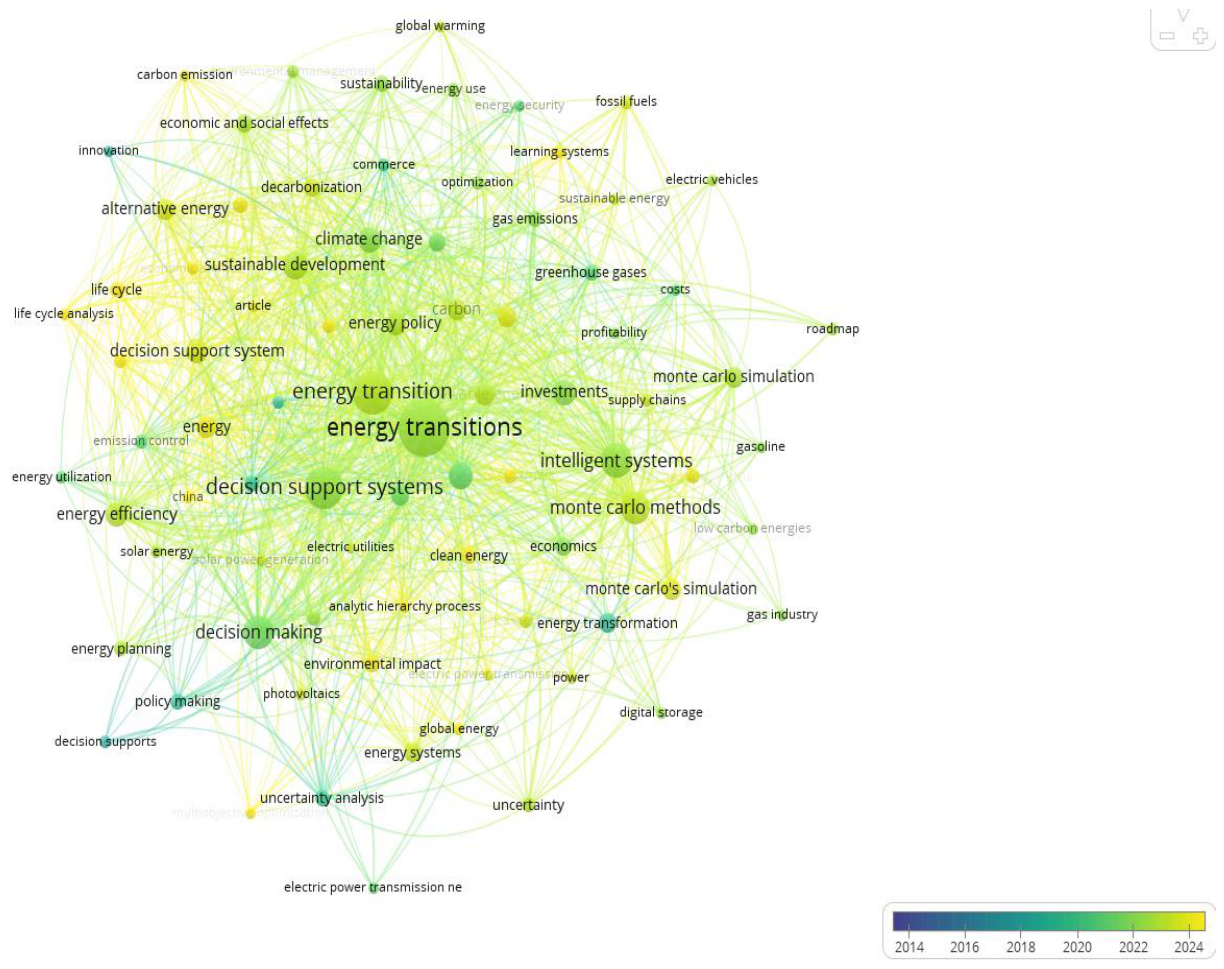
Figure 7.
Comparison of break-even carbon prices for CCS implementation under different investment support scenarios (η = 0.90).
Figure 7.
Comparison of break-even carbon prices for CCS implementation under different investment support scenarios (η = 0.90).
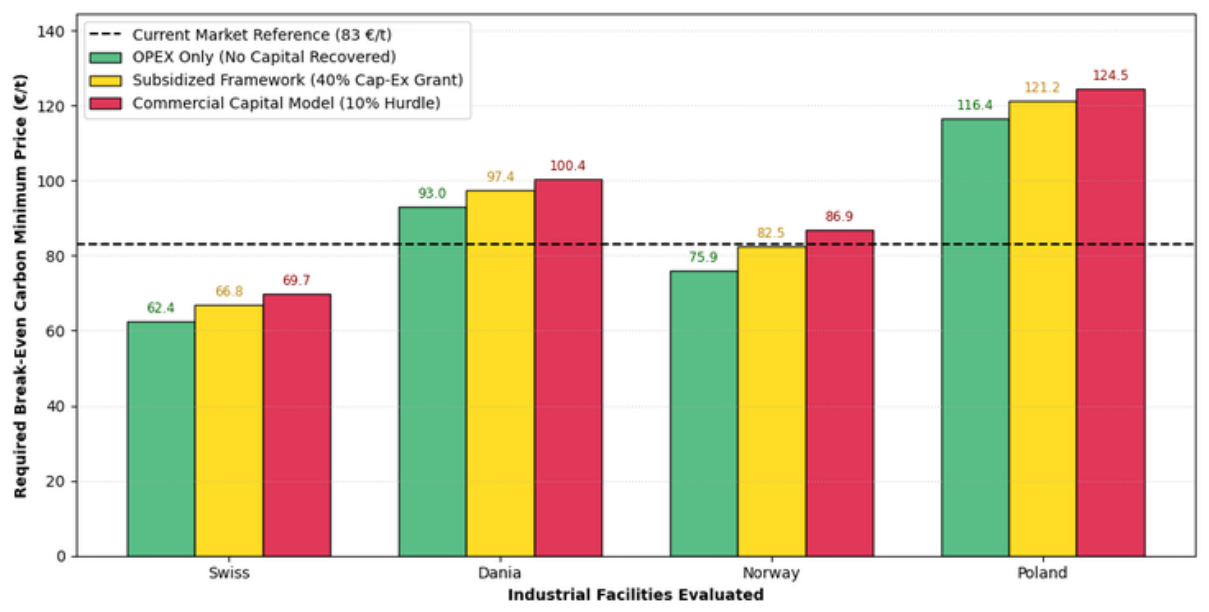
Table 1.
This is a table. Tables should be placed in the main text near to the first time they are cited.
Table 1.
This is a table. Tables should be placed in the main text near to the first time they are cited.
| Criterion | Designation | Interpretation |
|---|---|---|
| Technical efficiency | CO₂ capture rate | |
| Economic efficiency | Economic effect per 1 t CO₂ | |
| Integral effect | Total annual effect | |
| Investment efficiency | Investment per 1 t CCS capacity |
Table 2.
Input Parameters of the Analytical Framework for CCS Projects in the Cement Industry.
| Завoд | Країна | ,mln t/year | , €/MWh | , €/t | €/t | €/t | , €/t | , mln €/year |
CAPEX (S) Mln € |
€/t |
| К1 | К2 | К3 | К4 | |||||||
| Slite [31] | Sweden | 1.80 | 36 | 83 | 32.40 | 30 | 20.60 | 37.08 | 1100 | 611.11 |
| Aalborg Portland [32] | Dania | 1.42 | 70 | 83 | 63.00 | 30 | -10.00 | -14.20 | 900 | 600.00 |
| Brevik [33] | Noway | 0.40 | 51 | 83 | 45.90 | 30 | 7.10 | 2.84 | 400 | 1000.00 |
| Górażdże [34] | Poland | 2.457 | 96 | 83 | 86,4 | 30 | -33.40 | -82.06 | 261 | 106.23 |
Notes: A carbon price of €83/t CO₂ was adopted as the reference value corresponding to the current EU ETS market level. Average electricity prices for 2024 were used in the calculations: Sweden – €36/MWh, Denmark – €70/MWh, and Norway – €51/MWh. The annual CO₂ capture capacities were obtained from official CCS project documentation: Slite – up to 1.8 Mt/year, Aalborg Portland – 1.42 Mt/year, and Brevik – approximately 0.40 Mt/year. Capital investment data (CAPEX) were collected from the official websites and publicly available documentation of the respective CCS projects (Table 3).
Table 3.
Investment Support for CCS Projects.
| Enterprise | Country | Support type | Support size |
|---|---|---|---|
| Slite CCS (Heidelberg Materials) |
Sweden |
Swedish Industrial Leap (Industriklivet) and Just Transition Fund | SEK 301 million for Front-End Engineering Design (FEED) studies and CCS-related research, including approximately SEK 70 million from the EU Just Transition Fund (JTF) [36] |
| Aalborg Portland (ACCSION) |
Denmark |
EU Innovation Fund and government CCS-progrm of Denmark | €220 million Innovation Fund grant; additionally supported by Denmark's national CCS Fund (DKK 28.7 billion) for CCS and CDR projects [37,38] |
|
Brevik CCS |
Norway |
Norwegian Longship Programme | Implemented under Norway's Longship programme and co-financed by the Norwegian Government and Heidelberg Materials [39] |
| Górażdże Cemen |
Poland |
ACCSESS (Horizon 2020) HuCCSar, which was selected for the preparation of a grant agreement within the framework of the EU Innovation Fund |
€15 million [40] €261 million [41] |
Disclaimer/Publisher’s Note: The statements, opinions and data contained in all publications are solely those of the individual author(s) and contributor(s) and not of MDPI and/or the editor(s). MDPI and/or the editor(s) disclaim responsibility for any injury to people or property resulting from any ideas, methods, instructions or products referred to in the content. |
© 2026 by the authors. Licensee MDPI, Basel, Switzerland. This article is an open access article distributed under the terms and conditions of the Creative Commons Attribution (CC BY) license (http://creativecommons.org/licenses/by/4.0/).
Copyright: This open access article is published under a Creative Commons CC BY 4.0 license, which permit the free download, distribution, and reuse, provided that the author and preprint are cited in any reuse.


