

Submitted:
08 September 2026
Posted:
09 September 2026
You are already at the latest version
Abstract
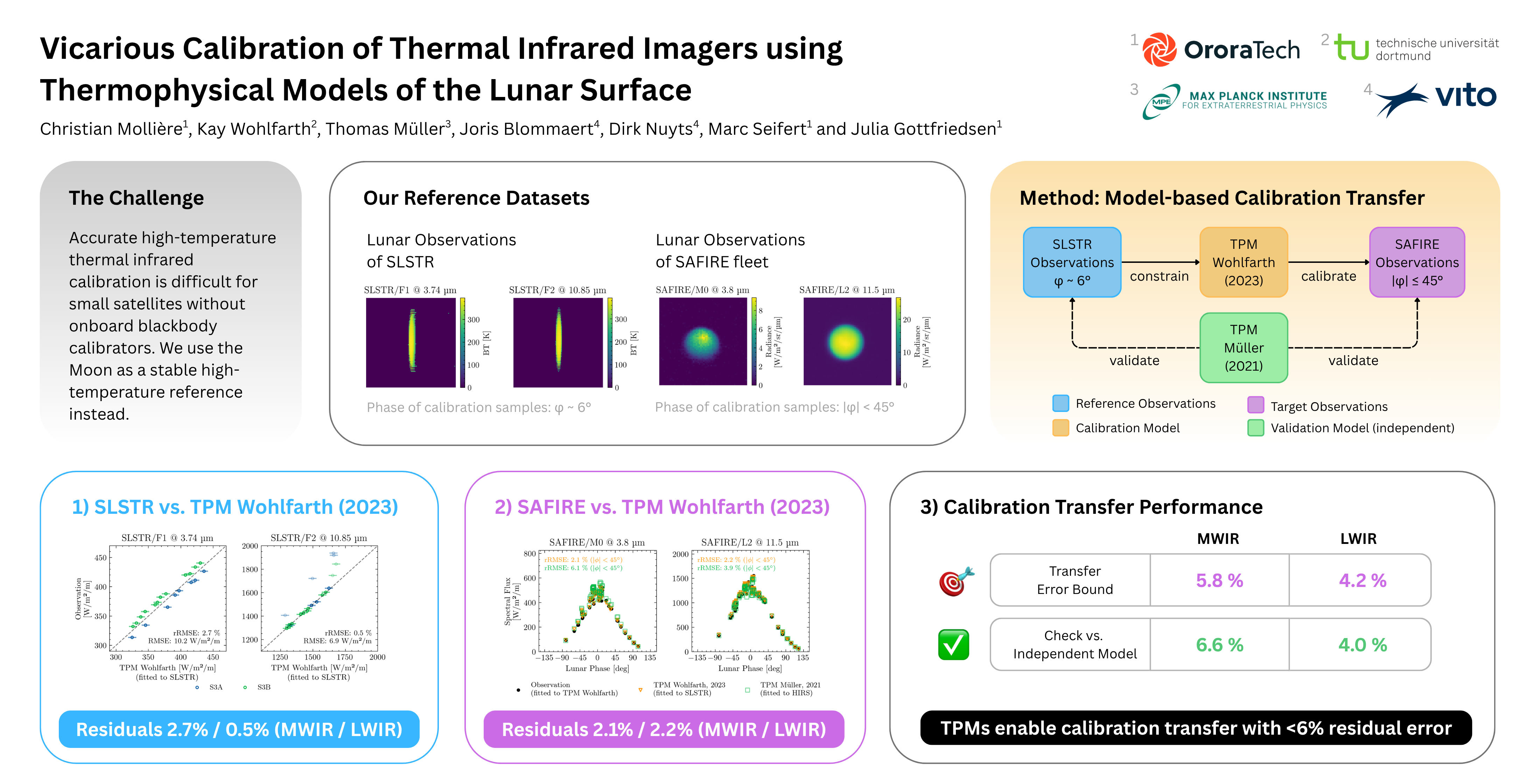
Wildfire detection and characterization from space critically depend on accurate thermal infrared measurements across a wide dynamic range. OroraTech’s SAFIRE payloads feature mid-wave infrared (MWIR) and long-wave infrared (LWIR) bands optimized for this purpose, yet the volume and power constraints of many CubeSat platforms preclude the use of onboard calibration sources. This reflects a broader limitation of current Earth observation systems: the absence of robust calibration and validation methodologies at high brightness temperatures relevant to active fires. We evaluate the potential of using thermophysical models (TPM) of the Moon as a vicarious calibration reference for calibration transfer between instruments. The Moon reaches surface temperatures of up to 400 K, offering a stable target in the thermal domain that is visible from many different orbits. Previous research has established the use of TPMs for Moon observations in the infrared; however, uncertainties in surface properties remain, particularly in the mid-wave infrared. We investigate these effects using SAFIRE observations of the lunar surface acquired over a wide range of lunar phase angles (from waxing -81.5° to waning +122.2°). We constrain the TPMs using observations from the Sentinel-3 Sea and Land Surface Temperature Radiometer (SLSTR) fire channels and uncover a 5.2 % inter-sensor disagreement in the MWIR between Sentinel-3A and Sentinel-3B at high brightness temperatures, corresponding to ~2.2 K at 400 K. Applying the same methodology to observations of our SAFIRE payloads bounds the calibration transfer error at 5.8 % in the MWIR and 4.2 % in the LWIR for lunar phase angles within ±45°. These results establish lunar vicarious calibration as a viable approach in the thermal domain for high-temperature applications, providing a pathway toward improved fire radiative power retrievals and enhanced global wildfire monitoring.
Keywords:
thermophysical model (TPM)
; lunar vicarious calibration
; radiometric calibration
; thermal infrared (TIR)
; mid-wave infrared (MWIR)
; wildfire monitoring
; fire radiative power (FRP)
; cross-calibration
Copyright: This open access article is published under a Creative Commons CC BY 4.0 license, which permit the free download, distribution, and reuse, provided that the author and preprint are cited in any reuse.