

Submitted:
15 July 2026
Posted:
16 July 2026
You are already at the latest version
Abstract
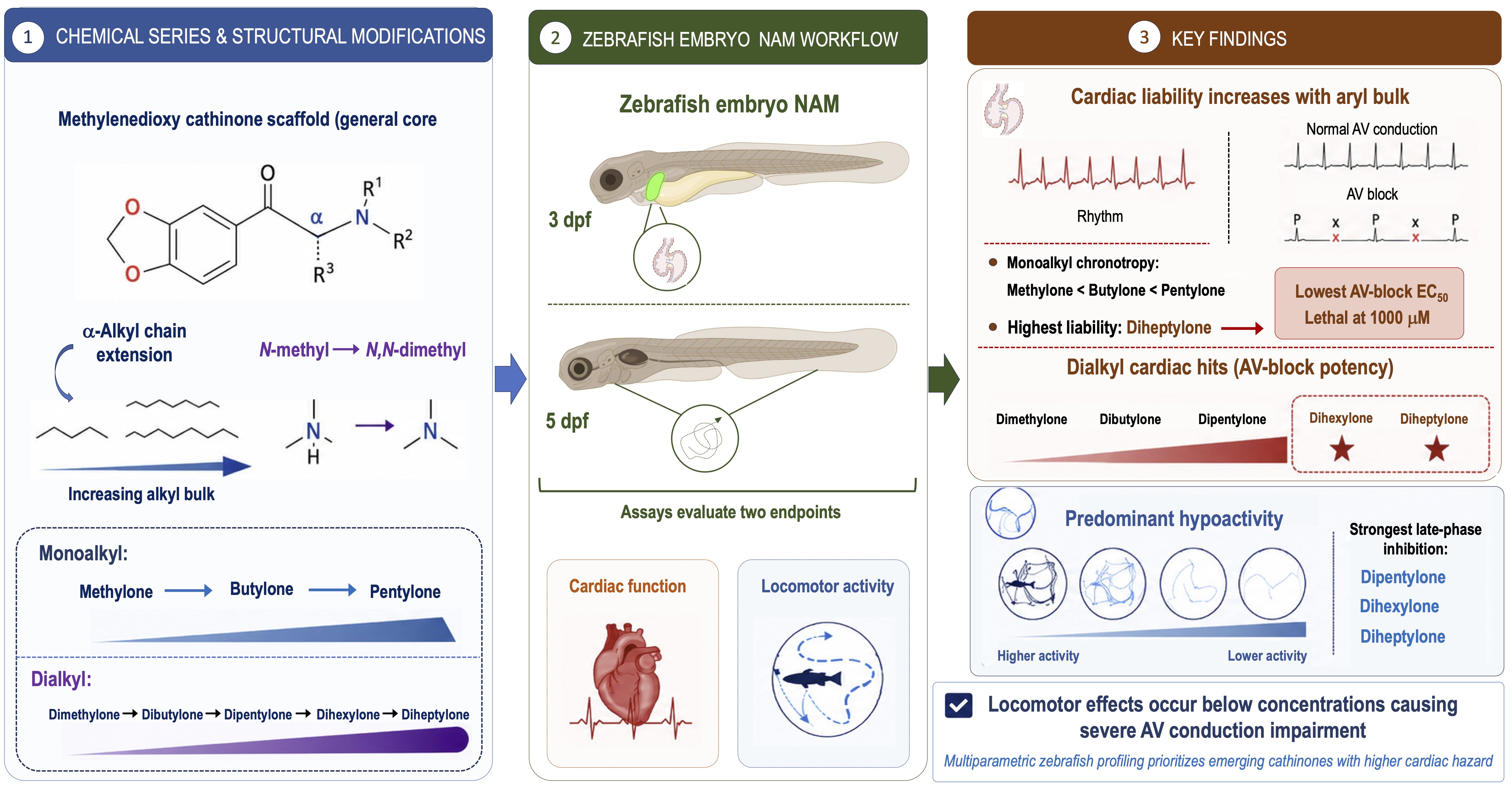
Synthetic cathinones are a class of new psychoactive substances (NPS) whose structural diversity and rapid evolution complicate toxicological risk assessment. Methylenedioxy cathinones, including methylone, butylone, pentylone and their N,N-dimethyl analogues, occupy a pharmacological space between MDMA-like entactogens and more dopaminergic stimulant cathinones. Although their monoamine transporter profiles and psychostimulant effects have been partially characterized, their direct cardiac liabilities remain poorly understood. Here, we used zebrafish embryos as a multiparametric New Approach Methodology to compare the cardiotoxic and neurobehavioral profiles of methylone, butylone, pentylone, dimethylone, dibutylone, dipentylone, dihexylone and diheptylone. Cardiac rhythmicity was assessed after acute exposure by high-speed video microscopy and dynamic pixel-based analysis, focusing on atrial chronotropy and atrioventricular (AV) conduction. Negative chronotropy increased with alkyl-chain extension, with the monoalkyl subset following the rank order methylone < butylone < pentylone. Among dialkyl analogues, dihexylone and especially diheptylone produced the strongest atrial rate inhibition. AV conduction impairment was more heterogeneous but became prominent among the higher-liability analogues, with diheptylone showing the lowest AV-block EC50 and complete lethality at 1000 µM. Time-resolved locomotor profiling revealed predominantly hypoactive phenotypes, with the most sustained late-phase inhibition observed for dipentylone, dihexylone and diheptylone. Integration of locomotor and cardiac endpoints showed that locomotor effects generally occurred below concentrations producing severe AV conduction impairment, although endpoint separation varied across analogues. Overall, this study provides a structure-oriented zebrafish framework for prioritizing emerging methylenedioxy cathinones with comparatively higher functional cardiac liability.
Keywords:
synthetic cathinones
; new psychoactive substances
; 3
; 4-methylenedioxy cathinones
; methylone
; pentylone
; dipentylone
; zebrafish embryo
; cardiotoxicity
; atrioventricular block
; structure-activity relationship
; New Approach Methodologies
1. Introduction
New psychoactive substances (NPS) remain a major challenge for public health, clinical toxicology and forensic surveillance because minor chemical modifications can generate new analogues with uncertain pharmacological and toxicological profiles [1,2,3]. Synthetic cathinones constitute one of the most prominent stimulant subclasses of NPS. These compounds are beta-keto analogues of amphetamine-like phenethylamines derived from cathinone, the psychoactive alkaloid of Catha edulis, and they are commonly designed to reproduce stimulant, empathogenic and/or rewarding and reinforcing effects associated with amphetamine, cocaine or MDMA-like drugs [1,2,3,4].
The primary pharmacology of synthetic cathinones is mediated by monoamine transporters, principally the dopamine transporter (DAT), norepinephrine transporter (NET) and serotonin transporter (SERT) [2,3,4,5]. Depending on their structural features, cathinones can behave as cocaine-like uptake inhibitors, amphetamine-like transporter substrates/releasers, or hybrid molecules combining transporter blockade and substrate activity [2,5,6,7]. Structure-activity relationship (SAR) studies have shown that substitutions on the aromatic ring, variation of the alpha-alkyl side chain and modification of the terminal amine strongly influence transporter potency, DAT/SERT selectivity, psychostimulant efficacy, abuse liability and toxicity [3,6,7,8,9].
Methylenedioxy cathinones represent a structurally coherent subgroup characterized by a 1,3-benzodioxol-5-yl aromatic ring and a non-cyclic aminoalkyl side chain. Methylone, butylone and pentylone are N-methyl analogues that differ primarily in alpha-alkyl chain length, whereas dimethylone, dibutylone, dipentylone and longer dialkyl analogues contain a tertiary N,N-dimethylamino group. This homologous organization makes the group especially suitable for SAR analysis, because two main determinants can be compared: progressive alpha-alkyl chain elongation and terminal amine substitution. The chemical structures and qualitative SAR organization of the tested compounds are shown in Figure 1.
Several methylenedioxy cathinones have been pharmacologically characterized. Methylone acts as a monoamine transporter substrate with an MDMA-like profile [4]. Butylone and pentylone have been described as stimulants that block DAT while retaining SERT substrate activity, with pentylone generally showing greater dopaminergic selectivity than butylone [5]. In vivo studies in rodents further show that methylone, pentylone and related cathinones increase locomotor activity and display reinforcing and/or discriminative-stimulus effects, with structural differences influencing the balance between MDMA-like and stimulant-like profiles [6,7]. A broader SAR analysis of second-generation cathinones has also shown that N-terminal substitution and ring substitution can modify DAT/SERT selectivity, psychostimulant effects and reward-related molecular markers [8].
The N,N-dimethyl-cathinone analogues have gained additional scientific interest and forensic relevance. For instance, dimethylone and dibutylone have been evaluated in rodent behavioral assays and shown to produce stimulant-like effects [9]. Importantly, N,N-dimethylpentylone, also known as dipentylone or dimethylpentylone, has been identified in postmortem casework, seized samples and counterfeit ecstasy or molly-type drug supplies [10,11]. These observations indicate that the tertiary amine members of this series are not only theoretical SAR comparators but also relevant emerging compounds in the illicit stimulant market which may pose a public health threat.
Cardiovascular toxicity is a recurrent concern in synthetic cathinone intoxication. Clinical and forensic reports have associated synthetic cathinones with tachycardia, hypertension, hyperthermia, chest pain, myocardial injury, cardiac arrest and arrhythmias [1,12,13]. However, human case interpretation is often complicated by uncertain dose, adulteration, polydrug exposure and limited analytical confirmation. Consequently, direct experimental data are needed to determine whether structural modifications that increase psychostimulant potency also increase cardiac liability, or whether neurobehavioral and cardiac domains can become dissociated across closely related analogues.
Zebrafish embryos provide a useful New Approach Methodology (NAM) for this question because they allow rapid, non-invasive and multiparametric functional assessment in vivo [14]. The transparency of embryos enables direct imaging of cardiac function, while their small size and external development support medium-throughput screening. Importantly, zebrafish express a hERG/KCNH2 orthologue and are sensitive to drugs that induce repolarization abnormalities, bradycardia and atrioventricular conduction phenotypes, supporting their utility for functional cardiotoxicity screening [15,16,17]. In parallel, at 5 dpf, zebrafish eleutheroembryos display robust spontaneous locomotor activity and pharmacologically responsive behavioral outputs, making them suitable for detecting drug-induced alterations in neurobehavioral function [18,19]. In the NPS field, first-generation cathinones, including methylone and MDPV, have been shown to produce arrhythmia-related phenotypes in zebrafish eleutheroembryos [20]. Our previous integrated study with pyrrolidine-containing cathinones further demonstrated that subtle structural modifications can produce distinct patterns of atrial chronotropy, AV conduction impairment and locomotor disruption [21].
In the present study, we evaluated the cardiotoxic and neurobehavioral effects of a panel of methylenedioxy cathinones spanning N-methyl and N,N-dimethyl analogues: methylone, butylone, pentylone, dimethylone, dibutylone, dipentylone, dihexylone and diheptylone. We hypothesized that alpha-alkyl chain extension and terminal amine substitution would shape cardiac rhythmicity, AV conduction and locomotor output in a structure-dependent manner. By combining concentration-response modeling of atrial chronotropy and AV block with time-resolved locomotor profiling, this work provides a comparative SAR framework for prioritizing emerging methylenedioxy cathinones with increased functional cardiac liability and for determining whether cardiac and neurofunctional effects scale in parallel across this homologous series.
2. Materials and Methods
2.1. Zebrafish Maintenance and Embryo Collection
Adult wild-type short-fin zebrafish (Danio rerio) used as breeders were maintained in a recirculating aquatic system under standard laboratory conditions (28 ± 1 °C; 12 h:12 h light/dark photoperiod). Breeding groups were placed in spawning tanks the day before each experiment. Spawning was induced at lights-on, and fertilized eggs were collected within 30 min.
Embryos were inspected under a stereomicroscope, and only morphologically normal embryos were selected. Embryos were maintained in embryo water (Milli-Q water supplemented with Instant Ocean salts and CaSO4·2H2O; pH 6.5–7.0; conductivity 750–900 µS/cm), in 48-wells microplates (one embryo per well; 1 mL per well) at 28 ± 1 °C, until the appropriate developmental stage. Cardiac assays were performed in 3 days post-fertilization (dpf) embryos, whereas locomotor assays were designed for 5 dpf eleutheroembryos. All procedures were approved by the Institutional Animal Care and Use Committees at CID-CSIC and conducted under local governmental authorization (agreement number 11336).
2.2. Compounds and Exposure Solutions
The compound panel consisted of methylenedioxy cathinones differing in alpha-alkyl chain length and terminal amine substitution: methylone, butylone, pentylone, dimethylone, dibutylone, dipentylone, dihexylone and diheptylone. The cathinone derivatives were synthesized in racemic form and characterized as described in the Supplementary Information. Stock solutions of 10 mM were freshly prepared in Milli-Q water on the same day of each experiment, and working solutions were prepared by diluting in embryo water. The pH of the solutions was adjusted, when necessary, with 1 M NaHCO₃ into an alkaline range suitable for the methylenedioxy cathinones.
2.3. Cardiac Functional Assessment
Cardiac function was assessed after acute exposure using the same overall zebrafish imaging workflow as in the previous pyrrolidine-containing cathinone study [21]. In concentration-response experiments, 3 dpf embryos were exposed for 2 h to nominal concentrations of 250, 500 and 1000 µM, together with matched controls. The 1000 µM diheptylone condition produced complete lethality and was therefore excluded from functional concentration-response fitting and interpreted as an overt embryotoxic condition. Each embryo was treated as an independent biological replicate for cardiac endpoint analysis.
After exposure, embryos were immediately processed for cardiac recordings. Embryos lacking a heartbeat were considered dead and excluded from functional endpoint analysis.
To reduce movement during imaging, embryos were briefly immobilized with tricaine methane-sulfonate (MS-222) and embedded in methylcellulose on depression slides. Cardiac activity was recorded laterally at 28 ± 1 °C using a stereomicroscope coupled to a high-speed camera. Atrial and ventricular beat frequencies were quantified from pixel-intensity fluctuations over time using DanioScope software (Noldus IT, Wageningen, the Netherlands).
The atrioventricular ratio (R) was calculated as atrial rate divided by ventricular rate (A/V). AV conduction impairment was expressed as percentage AV block using: AV block (%) = 100 x (1 - 1/R), which maps normal 1:1 conduction to 0% and complete ventricular failure toward 100%. Negative chronotropy was expressed as the percent inhibition of atrial rate relative to the matched control: Chronotropy (%) = 100 x (1 - A_treated/A_control). Chronotropy values were clipped to the 0-100% range for bounded concentration-response modeling.
2.4. Locomotor Activity
Basal locomotor activity (BLA) was assessed as the neurofunctional endpoint using the same general approach as the previous zebrafish cathinone study [21]. Briefly, 5 dpf zebrafish eleutheroembryos were exposed continuously to each compound at 50 nM, 500 nM or 5 µM, together with matched controls. Locomotor behavior was recorded over 120 min using DanioVision (Noldus IT, Wageningen, the Netherlands), an automated video tracking platform under controlled temperature and illumination conditions.
Activity was quantified using EthoVision XT software v16 (Noldus IT, Wageningen, the Netherlands), analyzing consecutive 15 min bins from 0-15 to 105-120 min. For each compound, concentration and time interval, BLA was expressed as percentage of the time-matched control median. The predefined reporting windows were 0-15, 45-60 and 105-120 min, representing early, intermediate and late exposure phases. Thirty-six eleutheroembryos were analyzed per condition. Cumulative immobility duration and the frequency of immobility bouts were also extracted over the full 120 min assay, and the relationship between both variables was used to interpret whether hypoactivity reflected more frequent pauses or longer immobility episodes.
2.5. Concentration-Response Modelling and Statistics
Cardiac concentration-response relationships were modeled in GraphPad Prism version 11.0.1 (GraphPad Software, Boston, MA, USA) using four-parameter logistic (4PL) functions constrained between 0 and 100%. EC50 and Hill slope values were estimated for atrial chronotropy and AV block. Parameter uncertainty was reported as 95% confidence intervals when estimated by the nonlinear regression procedure. Because only three nominal non-zero exposure levels were available, EC50 and Hill slope estimates should be interpreted as comparative descriptors rather than definitive pharmacodynamic constants.
Because BLA responses were time-dependent and did not consistently follow monotonic sigmoidal concentration-response relationships, conventional 4PL EC50 values were not fitted for locomotor activity. Instead, an assay-specific late-phase locomotor EC50-like descriptor was calculated from the 105-120 min interval by log-linear interpolation between the two concentrations bracketing 50% residual activity. When 50% inhibition was not reached within the tested range, the EC50-like value was treated as right-censored (>5 µM). The Functional Safety Index (FSI) was calculated as EC50 for AV block divided by the locomotor EC50-like value and interpreted only as an assay-specific comparative descriptor rather than a direct predictor of human safety.
For statistical comparisons, normality was assessed using the Shapiro-Wilk test. When normality was not met, group comparisons were performed using the Kruskal-Wallis test followed by Dunn-Bonferroni post hoc comparisons. Statistical significance was set at p < 0.05.
3. Results
3.1. Effects on Atrial Chronotropy
All tested compounds altered cardiac function in zebrafish embryos, but the intensity of the response differed substantially across the series. Atrial rate inhibition increased with concentration for all compounds except methylone, which remained comparatively weak across the tested range. Across both the monoalkyl and dialkyl subsets, progressive alkyl chain elongation was generally associated with stronger negative chronotropy.
Within the monoalkyl subgroup, mean atrial inhibition increased from 0.3%, 23.4% and 32.9% for methylone to 16.2%, 34.4% and 58.1% for butylone, and to 42.1%, 55.1% and 77.3% for pentylone at 250, 500 and 1000 µM, respectively. This pattern supports a rank order of methylone < butylone < pentylone for negative chronotropic activity.
A related trend was observed among the dialkyl analogues. Dimethylone and dibutylone induced modest-to-moderate atrial inhibition, whereas dipentylone and dihexylone produced stronger effects. Diheptylone showed the most severe atrial depression among the dialkyl analogues at the non-lethal concentrations tested, reaching mean inhibitions of 60.4% and 69.1% at 250 and 500 µM, respectively. Because diheptylone at 1000 µM produced complete lethality, that condition was excluded from functional curve fitting and interpreted separately as general embryotoxicity rather than a conventional cardiac endpoint.
Model-derived atrial chronotropy parameters are summarized in Table 1. Diheptylone had the lowest atrial EC50 estimate (118.3 µM), followed by dihexylone (332.5 µM) and pentylone (359.6 µM). Methylone, dimethylone and dibutylone were among the least potent negative chronotropic compounds in the series. The corresponding atrial concentration-response profiles are shown in Figure 2A.
3.2. Effects on Atrioventricular Conduction
AV conduction disturbances also increased with exposure concentration, but the relationship with chemical structure was more heterogeneous than for atrial rate. The shorter and less toxic analogues mainly produced rate depression with limited AV block, whereas the higher-liability members of the series increasingly induced conduction defects, particularly a 2:1 AV block phenotype.
Within the monoalkyl series, methylone produced little AV block at 250 and 500 µM, with a clearer effect only at 1000 µM. Butylone also showed minimal AV impairment at lower concentrations but reached 43.8% AV block at 1000 µM. Pentylone was more disruptive, culminating in 93.8% AV block at 1000 µM. These data suggest that chain elongation in the monoalkyl subset enhances not only negative chronotropy but also susceptibility to atrial-ventricular uncoupling.
Among the dialkyl derivatives, AV liability became more prominent. Dimethylone produced 68.8% AV block at 500 µM and 100.0% at 1000 µM, while dipentylone and dihexylone displayed strong conduction phenotypes at the upper concentrations. Diheptylone was the most severe compound in this endpoint as well, already producing 73.3% AV block at 250 µM and complete AV block among surviving embryos at 500 µM. As with the atrial endpoint, the 1000 µM diheptylone condition was excluded from functional analysis because no viable embryos remained.
Model-derived AV block parameters are summarized in Table 2. Diheptylone showed the lowest AV block EC50 estimate (237.3 µM), followed by dihexylone (370.8 µM), dimethylone (488.8 µM), dipentylone (593.7 µM) and pentylone (707.1 µM). Methylone and dibutylone displayed weaker or less stable concentration-response estimates, consistent with the broader or non-estimable confidence intervals observed in these compounds. The corresponding AV conduction concentration-response profiles are shown in Figure 2B. The normalized atrial and ventricular heart-rate values underlying the cardiac analyses are provided in Dataset S1.
3.3. Diheptylone Showed the Highest Overall Cardiac Liability
Diheptylone consistently emerged as the analogue with the highest overall cardiac liability in the current dataset. Unlike the rest of the series, it produced pronounced atrial depression and AV conduction failure already at the lowest tested concentration. This leftward functional shift was accompanied by complete lethality at 1000 µM, indicating that the toxic response exceeded a purely electrophysiological phenotype and progressed to overt systemic embryotoxicity.
From an interpretation standpoint, the diheptylone profile is important because it sets an upper limit to the apparent SAR trend: further alkyl extension was associated not only with stronger functional cardiac effects but also with a transition toward non-specific lethality within the tested range.
3.4. Effects on Locomotor Activity
Time-resolved basal locomotor activity (BLA) was assessed in 5 dpf zebrafish eleutheroembryos during continuous exposure to 50 nM, 500 nM and 5 µM of each compound over 120 min, using consecutive 15 min intervals (Figure 3). Overall, the series produced compound-, concentration- and time-dependent changes in locomotor output. The dominant phenotype was hypoactivity rather than sustained hyperlocomotion, although the magnitude and persistence of the effect differed markedly across analogues. The median normalized BLA values and corresponding log2 fold-change matrix used for Figure 3 are provided in Dataset S2.
During the initial 0-15 min window, the strongest suppression was already evident for the longer-chain compounds (Table 3). At 5 µM, median BLA was reduced to 37.6% of control for pentylone, 30.8% for dipentylone, 12.9% for dihexylone and 8.5% for diheptylone. By contrast, methylone and butylone produced weaker early effects at the same concentration, with median activities of 88.3% and 82.5% of control, respectively. Dimethylone and dibutylone showed intermediate early inhibition, reaching 62.4% and 53.4% of control at 5 µM.
The clearest inhibitory phase occurred during the intermediate 45-60 min window (Table 3). At this time point, all compounds showed reduced median activity at 5 µM, with values ranging from 11.2% of control for dipentylone and 12.4% for dihexylone to 42.1% for pentylone. Several compounds also showed marked effects at lower concentrations, particularly methylone, dipentylone, dihexylone and diheptylone. Kruskal-Wallis analyses of representative time windows confirmed significant treatment effects for all compounds at 45-60 min and for most compounds during the early and late windows. Complete Kruskal-Wallis and Dunn-Bonferroni post hoc results for the representative windows are provided in Supplementary Table S2.
During the late 105-120 min window, partial recovery was observed for several analogues, whereas dipentylone, dihexylone and diheptylone retained pronounced locomotor suppression; late-phase descriptive statistics for normalized BLA are provided in Supplementary Table S1. Because the BLA profiles were not consistently monotonic and could not be robustly fitted by conventional nonlinear regression, late-phase locomotor potency was summarized using an interpolated EC50-like descriptor. These EC50-like values could be estimated for methylone (4.38 µM), dipentylone (0.145 µM), dihexylone (0.121 µM) and diheptylone (1.32 µM). In contrast, dimethylone, butylone, dibutylone and pentylone did not reach 50% late-phase locomotor inhibition within the tested concentration range (EC50-like >5 µM). Pentylone showed a non-monotonic late-phase pattern, including increased median activity at 500 nM, indicating that late locomotor output did not scale linearly with concentration for all compounds. Analysis of raw immobility parameters over the full 120 min recording supported the hypoactive phenotype observed in BLA. At the highest concentration, most compounds showed increased cumulative immobility duration relative to controls. In several cases, this increase occurred together with a lower frequency of immobility bouts, indicating that locomotor suppression was driven at least in part by longer immobility episodes rather than by more frequent short pauses. However, this pattern was not uniform across the series, and some compounds showed increased immobility duration together with unchanged or higher bout frequency. The strongest increases in cumulative immobility duration were observed for the longer-chain analogues, particularly dipentylone, dihexylone and diheptylone (Dataset S3).
3.5. Integration of Locomotor and Cardiac Endpoints
To compare neurofunctional and cardiac potencies, late-phase locomotor EC50-like values were integrated with the EC50 values for atrial chronotropy and AV block. AV block was considered the primary severe cardiac endpoint. Across the series, locomotor effects generally occurred at concentrations substantially lower than those required to induce AV conduction impairment, indicating a broad functional separation between neurobehavioral modulation and severe cardiac conduction toxicity under the present assay conditions. This cross-system relationship is visualized in Figure 4.
Dipentylone and dihexylone were the most potent late-phase locomotor inhibitors, with EC50-like values in the submicromolar range, yet their AV-blocking EC50 values remained in the high-micromolar range. This produced large Functional Safety Index (FSI) values of 4094.5 and 3064.5, respectively. Methylone showed weaker locomotor potency (EC50-like = 4.38 µM) and a wide separation from AV block (FSI = 367.6). Diheptylone combined strong cardiac liability with sustained locomotor suppression, yielding a lower FSI of 179.8 among compounds with estimable locomotor EC50-like values. Integrated potency values and FSI estimates are summarized in Table 4.
For dimethylone, butylone, dibutylone and pentylone, 50% late-phase locomotor inhibition was not reached within the tested range, so FSI values could only be expressed as upper-bound estimates. Notably, dimethylone displayed prominent AV conduction liability while showing limited late-phase locomotor inhibition at concentrations up to 5 µM, suggesting that cardiac and neurofunctional endpoints do not necessarily scale in parallel across the series.
4. Discussion
4.1. Alkyl-Chain Extension Is Associated with Increased Cardiac Liability
The present cardiac dataset reveals a coherent SAR across methylenedioxy cathinones. The most robust pattern was the progressive increase in cardiac liability with increasing alkyl substitution, particularly in the monoalkyl series from methylone to butylone and pentylone, and in the longer dialkyl analogues culminating in dihexylone and diheptylone. This trend was especially evident for atrial chronotropy, where longer-chain compounds consistently produced stronger negative chronotropic effects.
This finding is consistent with the broader synthetic cathinone literature showing that alpha-alkyl chain length strongly influences biological potency, pharmacokinetics and in vivo effects [3,9]. SAR analyses indicate that side-chain extension can increase DAT inhibition potency over a defined range and can also modify locomotor activity, although additional chain extension may produce discrepancies between in vitro potency and in vivo behavioral output, possibly through changes in metabolism, tissue distribution or nonspecific toxicity [3,9,22,23]. Indeed, elongation of the α-carbon chain of different synthetic cathinones has been proposed to increase lipophilicity, thereby enhancing membrane permeability and contributing to greater cytotoxicity [22,23], even in compounds that are not the most potent DAT inhibitors [22]. The present zebrafish data extend this logic to cardiac function by showing that chain extension also modifies atrial rhythmicity and AV conduction liability.
4.2. Cardiac Phenotype Severity Shifts from Rate Depression to Conduction Failure
A second relevant observation is that the toxic phenotype became qualitatively more severe in the longer and more hydrophobic analogues. Shorter-chain compounds mainly reduced beat frequency, whereas the more potent compounds increasingly disrupted atrial-ventricular coupling. This suggests that structural modifications do not simply scale a single endpoint but may shift the system from negative chronotropy toward broader electrophysiological dysfunction.
The distinction between atrial rate inhibition and AV block is important because these endpoints are related but not equivalent. Negative chronotropy may reflect impaired pacemaker activity, altered autonomic-like modulation, general cardiodepression or effects on repolarization. In contrast, AV block reflects failure of atrial impulses to propagate effectively to the ventricle, a more severe conduction phenotype. Previous zebrafish work has shown that bradycardia and conduction abnormalities can be detected as separate functional signatures, and that cardiac rhythm and conduction liabilities may be uncoupled across closely related cathinone analogues [16,21,24].
In the present series, diheptylone sits at the extreme end of this toxicity continuum. Its marked effects at 250 and 500 µM, together with 100% lethality at 1000 µM, indicate that the highest concentration should not be interpreted as a routine point on a functional concentration-response curve. Rather, it represents a terminal toxic condition that constrains the upper end of the evaluable response range. This is relevant for SAR interpretation because further alkyl extension appears to shift the response from functional cardiotoxicity toward overt embryotoxicity within the tested concentration range. As discussed above, this observation is consistent with previous studies showing that α-carbon side-chain elongation is associated with increased in vitro toxicity in human aortic endothelial (HAE) cells as well as in NGF-differentiated PC12 cells [22,23].
4.3. Terminal Amine Substitution Shapes Endpoint-Specific Profiles
The comparison between N-methyl and N,N-dimethyl analogues suggests that terminal amine substitution does not produce a uniform increase in all cardiac endpoints. For atrial chronotropy, pentylone was more potent than dipentylone, and methylone was more potent than dimethylone by EC50 ranking. However, dimethylone displayed prominent AV conduction liability, producing high AV block at 500 and 1000 µM and yielding a lower AV block EC50 than methylone. Thus, terminal amine dimethylation may alter the balance between rate and conduction effects rather than simply increasing or decreasing overall toxicity.
This endpoint-specific behavior is consistent with the general principle that cathinone SAR depends on the interaction between multiple structural features, including aromatic substitution, side-chain length and amine substitution [3,9]. Previous studies demonstrate that changes in the terminal amine can modify transporter potency, DAT/SERT selectivity and behavioral efficacy [8,9]. The present results suggest that cardiac endpoints may be similarly sensitive to terminal amine substitution, but not necessarily in a way that parallels monoamine transporter SAR.
4.4. Locomotor Profiling Reveals Neurofunctional Effects That Only Partially Track Cardiac Liability
Time-resolved locomotor profiling added an important neurofunctional dimension to the cardiac SAR. Rather than producing sustained hyperlocomotion, the tested methylenedioxy cathinones predominantly reduced locomotor activity in zebrafish eleutheroembryos. This pattern was especially evident during the intermediate phase of exposure and at the highest concentration tested. As discussed in previous zebrafish studies with cathinones, hypoactivity in this assay should not be interpreted as absence of stimulant pharmacology, but rather as a functional neurobehavioral phenotype that may reflect behavioral shutdown, motor impairment, excessive monoaminergic stimulation or broader systemic toxicity at higher exposure levels [21,24].
Notably, the compounds showing the greatest late-phase locomotor potency were not necessarily those with the highest relative cardiac liability. Dipentylone and dihexylone produced submicromolar locomotor EC50-like values, whereas AV block required concentrations in the high-micromolar range, resulting in a marked separation between neurofunctional and severe cardiac effects, as reflected by their high FSI values. By contrast, diheptylone combined sustained locomotor suppression with the lowest AV-block EC50 in the series, yielding a comparatively narrower separation between endpoints. Methylone also showed a broad separation, although its locomotor potency was substantially lower. Overall, these compound-specific profiles indicate that increasing alkyl bulk can enhance both neurofunctional and cardiac effects, but does not determine a uniform relationship between the two domains.
4.5. Implications for Zebrafish-Based NAMs and Structure-Based Prioritization
The present findings support the value of zebrafish embryos as a multiparametric NAM for comparative hazard prioritization of emerging synthetic cathinones. Zebrafish cardiac physiology retains features relevant to drug-induced rhythm and conduction toxicity, including sensitivity to repolarization-disrupting compounds [16,17]. The model also allows rapid parallel assessment of lethality, atrial rhythm, ventricular rhythm and AV coupling, providing functional resolution beyond mortality or gross morphology alone [15,20,21].
For forensic and public health purposes, these data suggest that methylenedioxy cathinones should not be treated as a homogeneous toxicological class. Instead, small structural changes can shift the dominant phenotype and alter the margin between functional cardiac effects and overt embryotoxicity. The pronounced liability of diheptylone indicates that extension to longer alkyl chains may represent a structural alert for increased acute cardiac hazard in this zebrafish assay.
Several limitations should be acknowledged. First, functional modeling was based on a limited number of non-zero concentrations, so EC50 and Hill slope values should be interpreted as comparative descriptors. Second, diheptylone at 1000 µM produced lethality and could not be incorporated into functional endpoint modeling. Third, zebrafish exposure concentrations cannot be directly translated to human plasma concentrations because uptake, distribution, protein binding and metabolism differ across species and experimental systems. Fourth, locomotor EC50-like values were derived from only three non-zero concentrations and should therefore be interpreted as assay-specific comparative estimates rather than definitive behavioral potency constants. Finally, the mechanistic basis of the observed cardiac effects remains unresolved; targeted follow-up studies with cardiac ion-channel assays, calcium imaging or electrophysiological approaches would be needed to distinguish hERG/KCNH2, sodium-channel, calcium-channel, mitochondrial or membrane-disruptive mechanisms.
5. Conclusion
Increased alkyl bulk within methylenedioxy cathinones is associated with progressively greater cardiac hazard in zebrafish embryos. In the monoalkyl series, methylone < butylone < pentylone for negative chronotropy, whereas longer dialkyl analogues, especially diheptylone, shift the phenotype toward severe AV conduction failure and overt embryotoxicity. Locomotor profiling revealed predominantly hypoactive neurofunctional phenotypes, with dipentylone and dihexylone showing the strongest late-phase locomotor potency. Integration of both domains indicates that neurofunctional and cardiac endpoints are partially dissociated: locomotor alterations generally occur at much lower concentrations than AV block, but endpoint separation varies across analogues. These results support multiparametric zebrafish profiling as a useful SAR-oriented approach for prioritizing emerging methylenedioxy cathinones with increased cardiac liability.
Supplementary Materials
The following supporting information can be downloaded at the website of this paper posted on Preprints.org.
Author Contributions
Ouwais Aljabasini: Investigation, Data curation, Writing - original draft, Writing - review & editing; Niki Tagkalidou: Investigation, Writing - original draft, Writing - review & editing; Martalu D. Pazos: Visualization, Writing - original draft, Writing - review & editing; Guillermo García-Díez: Methodology, Writing - original draft, Writing - review & editing; Eva Prats: Data curation, Investigation, Writing - review & editing; Roger Seco: Supervision, Writing - original draft, Writing - review & editing; Xavier Berzosa: Data curation, Project administration, Supervision, Writing - original draft, Writing - review & editing; Raúl López-Arnau: Data curation, Formal analysis, Investigation, Funding acquisition, Project administration, Supervision, Writing - original draft, Writing - review & editing; Demetrio Raldúa: Conceptualization, Data curation, Formal analysis, Investigation, Funding acquisition, Project administration, Supervision, Writing - original draft, Writing - review & editing.
Funding
This work was funded by MICIU/AEI/10.13039/501100011033 (grant numbers PID2023-148502OB-C21 and PID2022-137541OB-I00), and Plan Nacional Sobre Drogas (2024I057). RLA belongs to 2021SGR0090 from Generalitat de Catalunya. O.A. and N.T. were supported by MICIU/AEI/10.13039/501100011033, co-financed by the Spanish Government and the European Social Fund (grant numbers PREP2022-104748 and PREP2023-001814, respectively). M.D.P. received a doctoral scholarship grant from Generalitat de Catalunya (AGAUR), 2023 FISDU 00182.
Institutional Review Board Statement
All procedures were approved by the Institutional Animal Care and Use Committees at the CID-CSIC and conducted in accordance with the institutional guidelines under a license from the local government (agreement number 11336).
Informed Consent Statement
Not applicable.
Data Availability Statement
The data supporting the findings of this study are available within the manuscript and its Supplementary Materials or will be made available from the corresponding author upon request.
Acknowledgments
During the preparation of this manuscript, the authors used ChatGPT v5 for the purpose of proofreading of English writing. The authors have reviewed and edited the output and take full responsibility for the content of this publication.
Conflicts of Interest
The authors declare no conflicts of interest.
References
- Zawilska, J.B.; Wojcieszak, J. Designer cathinones—An emerging class of novel recreational drugs. Forensic Sci. Int. 2013, 231, 42–53. [Google Scholar] [CrossRef] [PubMed]
- Baumann, M.H.; Walters, H.M.; Niello, M.; Sitte, H.H. Neuropharmacology of synthetic cathinones. Handb. Exp. Pharmacol. 2018, Vol. 252, 113–142. [Google Scholar] [CrossRef] [PubMed]
- Nadal-Gratacós, N.; Pazos, M.D.; Pubill, D.; Camarasa, J.; Escubedo, E.; Berzosa, X.; López-Arnau, R. Structure–Activity Relationship of Synthetic Cathinones: An Updated Review. ACS Pharmacol. Transl. Sci. 2024, 7, 2588–2603. [Google Scholar] [CrossRef] [PubMed]
- Baumann, M.H.; Ayestas, M.A.; Partilla, J.S.; Sink, J.R.; Shulgin, A.T.; Daley, P.F.; Brandt, S.D.; Rothman, R.B.; Ruoho, A.E.; Cozzi, N. V. The Designer Methcathinone Analogs, Mephedrone and Methylone, are Substrates for Monoamine Transporters in Brain Tissue. Neuropsychopharmacology 2012, 37, 1192–1203. [Google Scholar] [CrossRef] [PubMed]
- Saha, K.; Li, Y.; Holy, M.; Lehner, K.R.; Bukhari, M.O.; Partilla, J.S.; Sandtner, W.; Sitte, H.H.; Baumann, M.H. The synthetic cathinones, butylone and pentylone, are stimulants that act as dopamine transporter blockers but 5-HT transporter substrates. Psychopharmacology (Berl) . 2019, 236, 953–962. [Google Scholar] [CrossRef] [PubMed]
- Dolan, S.B.; Chen, Z.; Huang, R.; Gatch, M.B. “Ecstasy” to addiction: Mechanisms and reinforcing effects of three synthetic cathinone analogs of MDMA. Neuropharmacology 2018, 133, 171–180. [Google Scholar] [CrossRef] [PubMed]
- Javadi-Paydar, M.; Nguyen, J.D.; Vandewater, S.A.; Dickerson, T.J.; Taffe, M.A. Locomotor and reinforcing effects of pentedrone, pentylone and methylone in rats. Neuropharmacology 2018, 134, 57–64. [Google Scholar] [CrossRef] [PubMed]
- Nadal-Gratacós, N.; Alberto-Silva, A.S.; Rodríguez-Soler, M.; Urquizu, E.; Espinosa-Velasco, M.; Jäntsch, K.; Holy, M.; Batllori, X.; Berzosa, X.; Pubill, D.; et al. Structure–Activity Relationship of Novel Second-Generation Synthetic Cathinones: Mechanism of Action, Locomotion, Reward, and Immediate-Early Genes. Front. Pharmacol. 2021, 12, 749429. [Google Scholar] [CrossRef] [PubMed]
- Gatch, M.B.; Shetty, R.A.; Sumien, N.; Forster, M.J. Behavioral effects of four novel synthetic cathinone analogs in rodents. Addict. Biol. 2021, 26, e12987. [Google Scholar] [CrossRef] [PubMed]
- Fogarty, M.F.; Krotulski, A.J.; Papsun, D.M.; Walton, S.E.; Lamb, M.; Truver, M.T.; Chronister, C.W.; Goldberger, B.A.; Logan, B.K. N,N-Dimethylpentylone (dipentylone)—A new synthetic cathinone identified in a postmortem forensic toxicology case series. J. Anal. Toxicol. 2023, 47, 753–761. [Google Scholar] [CrossRef] [PubMed]
- Norman, C.; Schwelm, H.M.; Semenova, O.; Reid, R.; Marland, V.; Nic Daéid, N. Detection of the synthetic cathinone N,N-dimethylpentylone in seized samples from prisons. Forensic Sci. Int. 2024, 361, 112145. [Google Scholar] [CrossRef] [PubMed]
- Prosser, J.M.; Nelson, L.S. The Toxicology of Bath Salts: A Review of Synthetic Cathinones. J. Med. Toxicol. 2012, 8, 33–42. [Google Scholar] [CrossRef] [PubMed]
- Zaami, S.; Giorgetti, R.; Pichini, S.; Pantano, F.; Marinelli, E.; Busardò, F.P. Synthetic cathinones related fatalities: an update. Eur. Rev. Med. Pharmacol. Sci. 2018, 22, 268–274. [Google Scholar] [CrossRef] [PubMed]
- MacRae, C.A.; Peterson, R.T. Zebrafish as tools for drug discovery. Nat. Rev. Drug Discov. 2015, 14, 721–731. [Google Scholar] [CrossRef] [PubMed]
- Milan, D.J.; Peterson, T.A.; Ruskin, J.N.; Peterson, R.T.; MacRae, C.A. Drugs that induce repolarization abnormalities cause bradycardia in zebrafish. Circulation 2003, 107, 1355–1358. [Google Scholar] [CrossRef] [PubMed]
- Langheinrich, U.; Vacun, G.; Wagner, T. Zebrafish embryos express an orthologue of HERG and are sensitive toward a range of QT-prolonging drugs inducing severe arrhythmia. Toxicol. Appl. Pharmacol. 2003, 193, 370–382. [Google Scholar] [CrossRef] [PubMed]
- Maciag, M.; Wnorowski, A.; Mierzejewska, M.; Plazinska, A. Pharmacological assessment of zebrafish-based cardiotoxicity models. Biomed. Pharmacother. 2022, 148, 112695. [Google Scholar] [CrossRef] [PubMed]
- Basnet, R.M.; Zizioli, D.; Taweedet, S.; Finazzi, D.; Memo, M. Zebrafish Larvae as a Behavioral Model in Neuropharmacology. Biomedicines 2019, 7, 23. [Google Scholar] [CrossRef] [PubMed]
- Ingebretson, J.J.; Masino, M.A. Quantification of locomotor activity in larval zebrafish: considerations for the design of high-throughput behavioral studies. Front. Neural Circuits 2013, 7, 109. [Google Scholar] [CrossRef] [PubMed]
- Teixidó, E.; Riera-Colomer, C.; Raldúa, D.; Pubill, D.; Escubedo, E.; Barenys, M.; López-Arnau, R. First-Generation Synthetic Cathinones Produce Arrhythmia in Zebrafish Eleutheroembryos: A New Approach Methodology for New Psychoactive Substances Cardiotoxicity Evaluation. Int. J. Mol. Sci. 2023, 24, 13869. [Google Scholar] [CrossRef] [PubMed]
- Aljabasini, O.; Tagkalidou, N.; Pazos, M.D.; García-Díez, G.; Prats, E.; Seco, R.; Berzosa, X.; López-Arnau, R.; Raldua, D. Integrated Assessment of Neurobehavioral and Cardiotoxic Effects of Pyrrolidine-Containing Cathinones in Zebrafish: Structural Determinants of Functional Safety Profiles. Int. J. Mol. Sci. 2026, 27, 3141. [Google Scholar] [CrossRef] [PubMed]
- Nadal-Gratacós, N.; Ríos-Rodríguez, E.; Pubill, D.; Batllori, X.; Camarasa, J.; Escubedo, E.; Berzosa, X.; López-Arnau, R. Structure–Activity Relationship of N-Ethyl-Hexedrone Analogues: Role of the α-Carbon Side-Chain Length in the Mechanism of Action, Cytotoxicity, and Behavioral Effects in Mice. ACS Chem. Neurosci. 2023, 14, 787–799. [Google Scholar] [CrossRef] [PubMed]
- Matsunaga, T.; Morikawa, Y.; Tanigawa, M.; Kamata, K.; Shibata, A.; Sasajima, Y.; Suenami, K.; Sato, K.; Takekoshi, Y.; Endo, S.; et al. Structure-activity relationship for toxicity of α-pyrrolidinophenones in human aortic endothelial cells. Forensic Toxicol. 2017, 35, 309–316. [Google Scholar] [CrossRef]
- Aljabasini, O.; Tagkalidou, N.; Bedrossiantz, J.; Prats, E.; López-Arnau, R.; Raldúa, D. Integrated Assessment of the Cardiotoxic and Neurobehavioral Effects of 3,4-Methylenedioxypyrovalerone (MDPV) in Zebrafish Embryos. Int. J. Mol. Sci. 2026, 27(1), 59. [Google Scholar] [CrossRef] [PubMed]
Figure 1.
Chemical structures of the tested methylenedioxy cathinones and qualitative SAR organization.
Figure 1.
Chemical structures of the tested methylenedioxy cathinones and qualitative SAR organization.
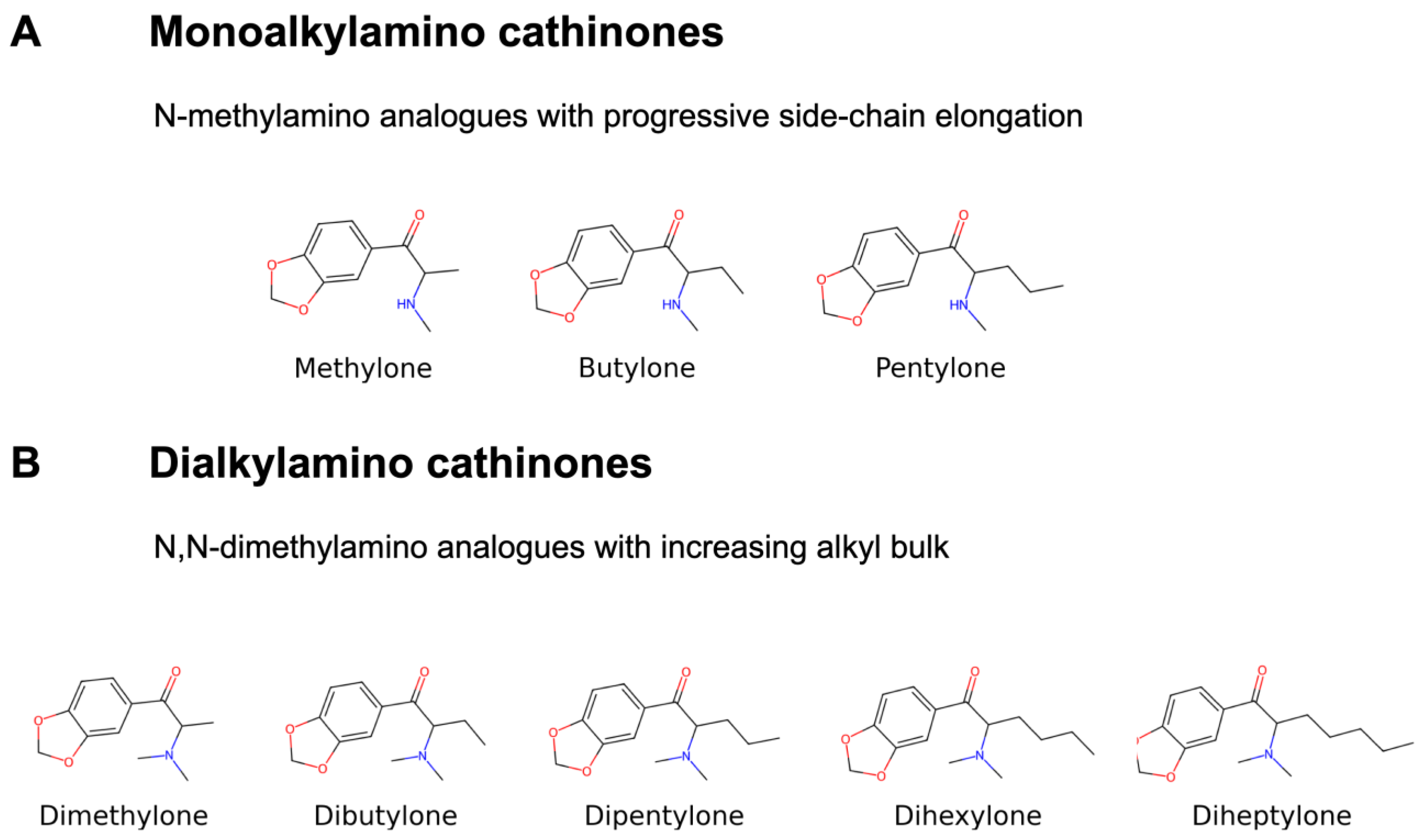
Figure 2.
Concentration-response profiles for cardiotoxicity across the methylenedioxy cathinone series. (A) Atrial rate inhibition; (B) Atrioventricular (AV) conduction impairment. Open circles indicate observed mean responses at the tested concentrations, and lines indicate 4PL fits.
Figure 2.
Concentration-response profiles for cardiotoxicity across the methylenedioxy cathinone series. (A) Atrial rate inhibition; (B) Atrioventricular (AV) conduction impairment. Open circles indicate observed mean responses at the tested concentrations, and lines indicate 4PL fits.
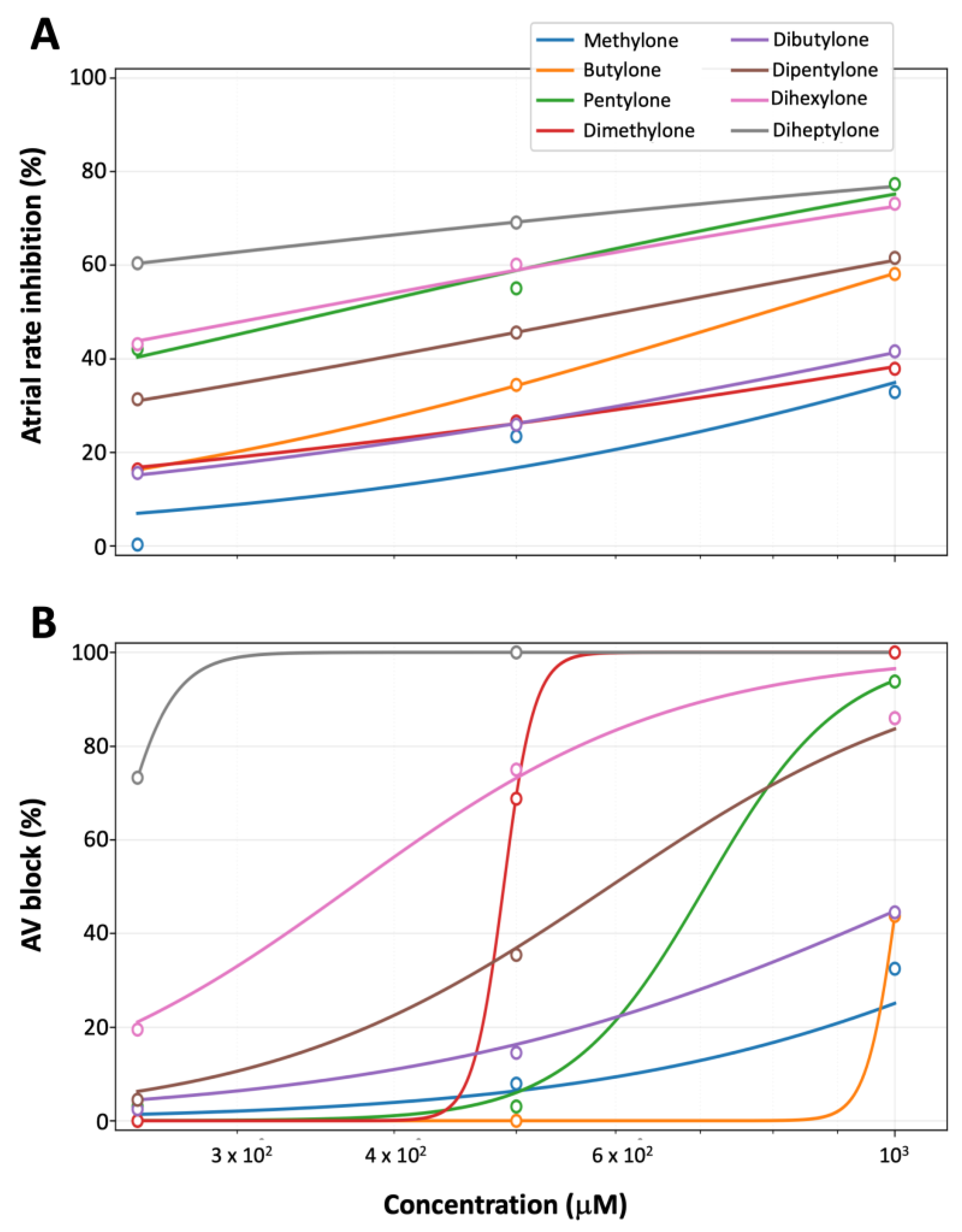
Figure 3.
Time-resolved effects of methylenedioxy cathinones on larval zebrafish locomotor activity. Heatmaps show log₂ fold-change values in locomotor activity relative to the corresponding control group across consecutive 15-min recording intervals. Larvae were exposed to each compound at 50 nM, 500 nM, or 5 µM. Rows indicate the tested compounds and columns indicate the recording intervals from 0 to 120 min. Negative values indicate reduced locomotor activity relative to controls, whereas positive values indicate increased activity. The same color scale was applied to all concentrations. Statistical significance was assessed independently for each concentration and recording interval using the Kruskal-Wallis test followed by post hoc multiple comparisons against the corresponding control group. Asterisks indicate significant differences versus the corresponding control group: *p < 0.05, **p < 0.01, and ***p < 0.001.
Figure 3.
Time-resolved effects of methylenedioxy cathinones on larval zebrafish locomotor activity. Heatmaps show log₂ fold-change values in locomotor activity relative to the corresponding control group across consecutive 15-min recording intervals. Larvae were exposed to each compound at 50 nM, 500 nM, or 5 µM. Rows indicate the tested compounds and columns indicate the recording intervals from 0 to 120 min. Negative values indicate reduced locomotor activity relative to controls, whereas positive values indicate increased activity. The same color scale was applied to all concentrations. Statistical significance was assessed independently for each concentration and recording interval using the Kruskal-Wallis test followed by post hoc multiple comparisons against the corresponding control group. Asterisks indicate significant differences versus the corresponding control group: *p < 0.05, **p < 0.01, and ***p < 0.001.
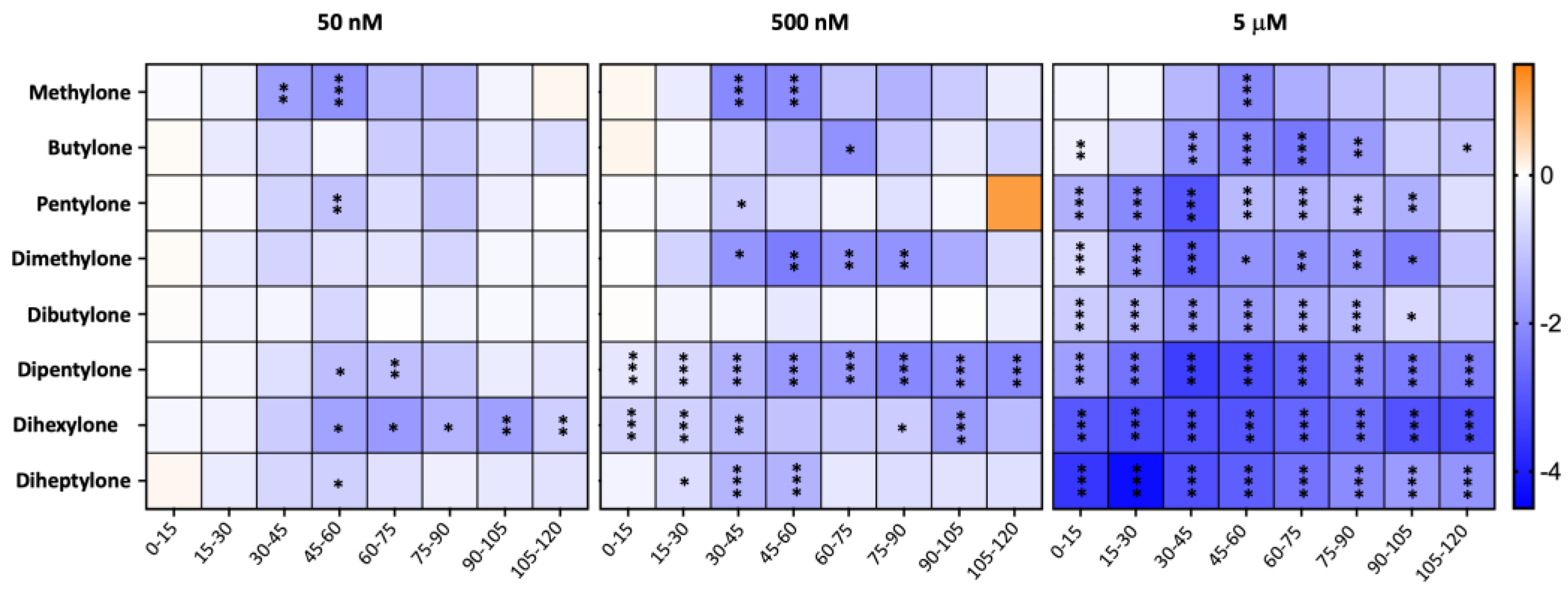
Figure 4.
Integrated potency comparison across neurobehavioral and cardiac endpoints. For each compound, interpolated late-phase locomotor EC50-like values, atrial chronotropy EC50 values and AV-block EC50 values are displayed on a shared log concentration axis. Right-pointing open triangles positioned at 5 µM indicate compounds for which 50% late-phase locomotor inhibition was not reached within the tested range (>5 µM). Horizontal segments connect locomotor EC50-like values with AV-block EC50 values within each compound, illustrating endpoint separation.
Figure 4.
Integrated potency comparison across neurobehavioral and cardiac endpoints. For each compound, interpolated late-phase locomotor EC50-like values, atrial chronotropy EC50 values and AV-block EC50 values are displayed on a shared log concentration axis. Right-pointing open triangles positioned at 5 µM indicate compounds for which 50% late-phase locomotor inhibition was not reached within the tested range (>5 µM). Horizontal segments connect locomotor EC50-like values with AV-block EC50 values within each compound, illustrating endpoint separation.
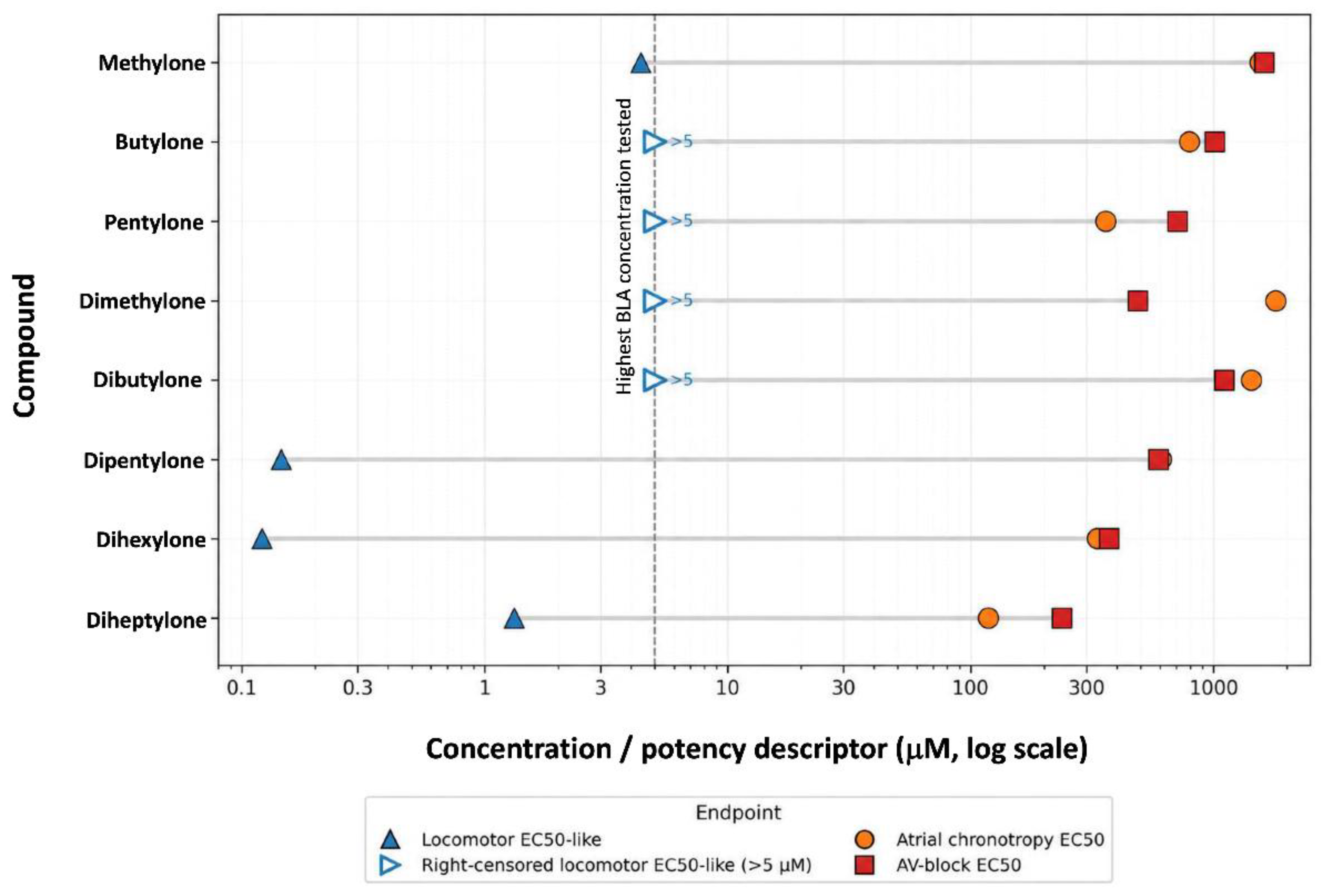

Table 1.
Atrial chronotropy parameters derived from 4PL concentration-response modeling.
| Compound | EC50 (µM) | 95% CI (EC50) | Hill slope | 95% CI (Hill) |
| Diheptylone | 118.3 | 45.6-168.5 | 0.56 | 0.30-0.83 |
| Dihexylone | 332.5 | 296.6-366.6 | 0.88 | 0.72-1.04 |
| Pentylone | 359.6 | 332.4-386.3 | 1.08 | 0.94-1.21 |
| Dipentylone | 608.5 | 551.8-676.8 | 0.90 | 0.74-1.06 |
| Butylone | 792.2 | 750.6-839.7 | 1.42 | 1.28-1.57 |
| Dibutylone | 1428.0 | 1247.0-1712.0 | 0.99 | 0.82-1.16 |
| Methylone | 1552.0 | 1342.0-1902.0 | 1.42 | 1.15-1.72 |
| Dimethylone | 1804.0 | 1537.0-2233.0 | 0.81 | 0.69-0.94 |
Note: EC50 and Hill slope values were estimated using a 4PL model constrained between 0 and 100%. Diheptylone at 1000 µM was excluded from fitting due to complete lethality. Hill slope values are reported as positive magnitudes because the endpoint is expressed as percent inhibition.
Table 2.
AV block parameters derived from 4PL concentration-response modeling.
| Compound | EC50 (µM) | 95% CI (EC50) | Hill slope | 95% CI (Hill) |
| Diheptylone | 237.3 | N.E. | 19.15 | N.E. |
| Dihexylone | 370.8 | 301.0-455.6 | 3.35 | 1.75-6.65 |
| Dimethylone | 488.8 | N.E. | 35.42 | N.E. |
| Dipentylone | 593.7 | 458.1-794.2 | 3.13 | N.E. |
| Pentylone | 707.1 | 706.2-708.0 | 7.94 | 7.91-7.97 |
| Butylone | 1007.0 | N.E. | 34.92 | N.E. |
| Dibutylone | 1107.0 | 846.9-2330.0 | 2.06 | 0.87-5.24 |
| Methylone | 1610.0 | 1301.0-2285.0 | 2.30 | 1.50-3.92 |
Note: AV block was defined as loss of 1:1 atrial-ventricular coupling. Model estimates should be interpreted cautiously because only three nominal exposure levels were available, and one diheptylone condition was removed due to lethality. N.E., not estimated by the nonlinear regression procedure. Hill slope values are reported as positive magnitudes because the endpoint is expressed as percent AV block.
Table 3.
Summary of locomotor activity in representative time windows. Values are medians expressed as a percentage of the time-matched control median and are shown for 50 nM / 500 nM / 5 µM. Because BLA responses were time-dependent and did not consistently follow monotonic sigmoidal concentration-response relationships, conventional nonlinear-regression EC50 values were not fitted for locomotor activity. Locomotor EC50-like values were instead estimated from the 105-120 min interval by log-linear interpolation when 50% residual activity was bracketed by the tested concentrations. When 50% inhibition was not reached at 5 µM, values are reported as >5 µM.
Table 3.
Summary of locomotor activity in representative time windows. Values are medians expressed as a percentage of the time-matched control median and are shown for 50 nM / 500 nM / 5 µM. Because BLA responses were time-dependent and did not consistently follow monotonic sigmoidal concentration-response relationships, conventional nonlinear-regression EC50 values were not fitted for locomotor activity. Locomotor EC50-like values were instead estimated from the 105-120 min interval by log-linear interpolation when 50% residual activity was bracketed by the tested concentrations. When 50% inhibition was not reached at 5 µM, values are reported as >5 µM.
| Compound | 0-15 min | 45-60 min | 105-120 min | Locomotor EC50-like (µM) |
| Methylone | 94.9 / 105.7 / 88.3 | 25.9 / 24.5 / 23.3 | 106.4 / 78.7 / 48.2 | 4.38 |
| Butylone | 103.1 / 107.6 / 82.5 | 88.8 / 45.4 / 22.8 | 65.8 / 57.3 / 50.4 | >5 |
| Pentylone | 101.0 / 93.1 / 37.6 | 47.1 / 67.0 / 42.1 | 93.8 / 221.4 / 66.2 | >5 |
| Dimethylone | 104.0 / 97.8 / 62.4 | 69.7 / 20.0 / 26.5 | 89.0 / 64.5 / 50.1 | >5 |
| Dibutylone | 102.0 / 100.9 / 53.4 | 60.8 / 74.2 / 28.8 | 88.9 / 79.1 / 54.7 | >5 |
| Dipentylone | 99.1 / 73.4 / 30.8 | 44.8 / 27.9 / 11.2 | 72.7 / 23.5 / 20.7 | 0.145 |
| Dihexylone | 88.9 / 59.0 / 12.9 | 31.8 / 47.3 / 12.4 | 54.3 / 43.1 / 11.9 | 0.121 |
| Diheptylone | 106.0 / 86.0 / 8.5 | 55.9 / 39.0 / 14.1 | 70.1 / 66.9 / 26.8 | 1.32 |
Table 4.
Integration of locomotor and cardiac potency parameters. Functional Safety Index (FSI) was calculated as EC50 for AV block divided by late-phase locomotor EC50-like. For compounds with locomotor EC50-like >5 µM, FSI is reported as an upper-bound estimate.
Table 4.
Integration of locomotor and cardiac potency parameters. Functional Safety Index (FSI) was calculated as EC50 for AV block divided by late-phase locomotor EC50-like. For compounds with locomotor EC50-like >5 µM, FSI is reported as an upper-bound estimate.
| Compound | Atrial EC50 (µM) | AV block EC50 (µM) | Locomotor EC50-like (µM) | FSI |
| Methylone | 1552.0 | 1610.0 | 4.38 | 367.6 |
| Butylone | 792.2 | 1007.0 | >5 | <201.4 |
| Pentylone | 359.6 | 707.1 | >5 | <141.4 |
| Dimethylone | 1804.0 | 488.8 | >5 | <97.8 |
| Dibutylone | 1428.0 | 1107.0 | >5 | <221.4 |
| Dipentylone | 608.5 | 593.7 | 0.145 | 4094.5 |
| Dihexylone | 332.5 | 370.8 | 0.121 | 3064.5 |
| Diheptylone | 118.3 | 237.3 | 1.32 | 179.8 |
Disclaimer/Publisher’s Note: The statements, opinions and data contained in all publications are solely those of the individual author(s) and contributor(s) and not of MDPI and/or the editor(s). MDPI and/or the editor(s) disclaim responsibility for any injury to people or property resulting from any ideas, methods, instructions or products referred to in the content. |
© 2026 by the authors. Licensee MDPI, Basel, Switzerland. This article is an open access article distributed under the terms and conditions of the Creative Commons Attribution (CC BY) license (http://creativecommons.org/licenses/by/4.0/).
Copyright: This open access article is published under a Creative Commons CC BY 4.0 license, which permit the free download, distribution, and reuse, provided that the author and preprint are cited in any reuse.