

Submitted:
10 July 2026
Posted:
16 July 2026
You are already at the latest version
Abstract
Sunday Schools provided access to books that would otherwise have not been available to rural children and teenagers in Australia. These books were largely written in the late nineteenth century by lower middle-class women, the daughters of clerks and grocers in England. The books produced by these writers were hardly sedate or regimented but laced with techniques deriving from the sensation novel, with unreliable narrators and unreliable figures of authority. An examination of one young woman’s reading choices reveals a world characterized by insecurity in identity, danger and uncertainty.
Keywords:
reading
; books
; female authors
; religious
; Australia
Introduction
Books form part of the making of a person. A list of reading choices tells us far more than simply the availability of books at a particular time. At the beginning of the new century, between September 1900 and January 1901 in the mountains just outside Sydney, Australia, in Dharug Country, Alice Douglas made her choice of twelve books from the Kurrajong Heights Sunday School Library at St David’s Presbyterian Church. The presence of these books for her use was the result of several cultural intersections – the philanthropy of the Dorcas Society in Sydney, the immense publications of the Religious Tract Society in England, the financial benefit gained by female authors who wrote specifically for it and the emergence of an upwardly mobile middle class in rural Australia disentangling itself from convict origins. This study of the books Alice chose is not a study of a compliant, feminine girl of the Presbyterian faith. Rather, Alice in her reading was buffeted and shaped by strands of violence, confusion and ugliness of the late Victorian period. This article explores the worlds and sensations experienced by Alice in her reading and her becoming in the early twentieth century in order to see what kind of influences she could glean from her reading and what that says about the wider reading culture of the period.
Tim Dolin, writing of Australia, has seen book borrowing from libraries as a key indicator of “ways of being”’ in a colonizing country (Dolin, 2006, 273). Book availability thus feeds into the construction of the self. Given that selves are fractured and contested entities, the representations provided in a borrowing register becomes central rather than a periphery in reconstructing colonial lives (Bal, 2006, 371). Harriet Jeans considers the way in which women represented their reading in their self-fashioning in the seventeenth century (Jeans, 2025, 1). Children’s or teenager’s reading is far less self-conscious in that books influence without an adult sense of management of consumption. This makes children’s reading ‘wild’ and an exciting field to investigate (Tatlock et al, 2018, 1). In Australian regions where there were limited books available, the bible was the often the only book to read (Lyons, 2010). Sunday School libraries opened a universe for children and teenagers in the late nineteenth century. There were wide choices available, and genres included adventure, travel, history, archaeology, and stories. While there was always a mention of morality and religion, the narrative tends to dominate in these books.
There has not been a great deal of investigation into the moral universe presented by the authors that Alice chose to read. Religious Tract Society publications are assumed to be moral or religious and vetted according to Christian principles and their texts have largely been left uninvestigated apart from significant studies of muscular Christianity and the adventure books produced mainly for boys in the 1880’s and 1890’s (Richards, 1989, 1). The books Alice read had been published from the 1860s to the 1890s, and they emerged out of differing popular views of masculinity and femininity, but they also produced notions of self and place in the world. Given their wide circulation and their popularity these religious books were more powerful than the attention that has been given to them suggests.
The Sunday School Library at Kurrajong Heights had been established in 1883, and the children in that year had a choice of 306 books. The catalogue shows that 45 further books were added by 1900 (Kurrajong Heights Sunday School Catalogue). The categories of books available are shown in Table 1 and Alice’s own choices within those categories in Table 2. She follows the libraries’ preference for book titles involving advice for life, but borrows no religious titles, the library’s second acquisition choice. In 1900 Alice was 16 years of age. Her Sunday School cohort consisted of twenty children. Of those that can be traced, the closest in age to Alice in 1900 was Stanley Douglas aged 15. Ada Davis, Alma Wilson, George Wilson and Henry Davis were 11; Maudie Smith, Linda Smith, Linda Walker and Gladys Wilson were 12; Hilda Sherwood and Gertrude Smith were 13 (Australian Cemeteries Index; Hawkesbury Geneology Project; Ancestry; The Tree of Us; Geni B; The Millstone, Nov -Dec 2009). In a caption to a family photograph the Douglas girls are described as becoming Sunday School teachers. (The Millstone, Vol 18, Issue 6, 2020,4). In 1901 in July Alice is described in the register of borrowings as ‘Miss Alice Douglas’ and the nature of her borrowing changes, as if she was choosing books that might interest boys. The classes in the register in 1901 are clearly divided between boys and girls, so there may have been separate classes in that year, and Alice borrowed books for a boy’s class. Early in 1901 she borrowed books for younger children. Earlier borrowings in 1900 give the clearest picture of Alice’s taste because of that teaching interference in 1901.
Alice Douglas was the descendant of Joseph Douglass, an ex-convict who built the first house at Kurrajong Heights, Ivy Lodge Inn, in 1832. Her father William Douglass developed an orchard on the family land and was successful, obtaining status in the community and becoming a magistrate in 1903 (Clan Douglas Association of Australia, Newsletter 43 March 1998). Alice married George Pitt in 1915, and she died in 1959. Her family’s story is one of upward mobility, ex-convicts making successful lives for themselves, one of the mainstays of colonial historiography (Robinson 1985; Anderson, 2022). Alice’s generation would weather the First World War, the Depression and the Second World War, but in 1900 this trauma was unforeseen in the glamour of empire and nationalism (Macintyre, 2020).
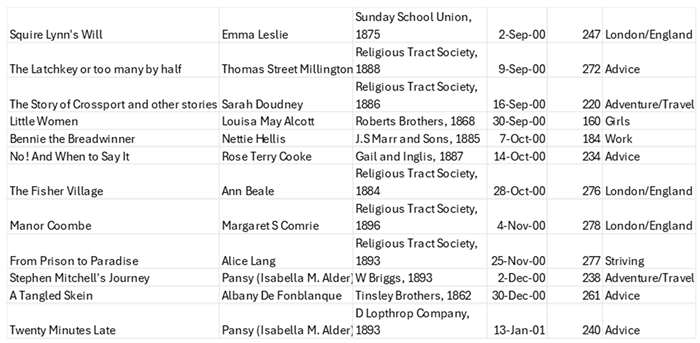
The books Alice borrowed in 1900 (Table 3) give an insight into the publishing policies of the Religious Tract Society, the tastes of a young woman in 1900 – 1901 and the various strands of literary history that influenced her choices. The imaginary worlds Alice was confronted with in her reading were often violent. Unreliable narrators disturb the child’s world and God and money merge. Through Alice we can comment on broader inputs into conceptions of self and gender in the early years of the twentieth century.
The books Alice borrowed may have been published in the 1880s or even the 1860’s, but they were borrowed in 1900, showing us the taste and perceptions of that year. Reading history diverges from the history of publishing, marketing, and printing. ‘Old’ books might still inspire and influence despite being battered after twenty years in the Sunday School library.
Sensation
The first novel Alice borrowed in 1900 was Squire Lynn’s Will (1875). In its first few pages, the novelist orients the reader to a world, and the narrator plays with the reader’s expectations. In the opening lines, the ‘shrieking’ ‘Juggernaut’ of a train is enhanced by the image of the likelihood of a man throwing himself in front of it. This, the reader is assured, was never going to happen. We are taken into danger and then out again, toyed with, by the third person narrator. Then we are confronted with a ‘soured, embittered man,’ ‘hard and cynical’ and the impoverished young woman who is the subject of his attention, despite her ‘shabby’ and ‘worn’ clothes. The man is not in charge of his emotions, we watch as ‘her clear voice seemed to thrill him.’ Worse, when he bribes a porter to give a room to the group so that the invalid man would be warm the porter thinks ‘the pretty girl close by had made a rapid conquest of this old middle-aged man.’ The reader has again to contemplate something that has not and will not happen, something quite awful, her emotions toyed with again. The character’s kind act is blotted by his cynicism. Darkness is apparent; the clear light voice of the young girl and her helpfulness is the only positive image we have. Its sound sustains the reader.
The author of Squire Lynn’s Will, Emma Leslie, wrote books for children, and Squire Lynn’s Will was one of a hundred books she published in the late nineteenth and early twentieth century. She was the daughter of a grocer and married a clerk. Her books were published by the Religious Tract Society and the Sunday School Union. Squire Lynn’s Will was published by the Sunday School Union. Her social position, which must have involved some financial struggle, is mirrored in other female writers writing for the religious press. These were women of the lower middle classes, clerks, governesses and shopkeepers. They gained a remarkably powerful and influential voice in the publications of the Religious Tract Society throughout the nineteenth century. They helped to shape the way the world was perceived in this period.
Squire Lynn’s Will was reviewed by The Bookseller and The General Baptist Repository and Missionary Observer. Neither of these reviews reference children, and the reviewers wrote of their own reactions. It was ‘a well written story of a lost will and the trials and tribulations that arose in consequence’ (The Bookseller, 206 -217). ‘A tale of high excellence – we have been quite cheered by it,’ wrote the Observer’s reviewer (The General Baptist Repository and Missionary Observer, May,1876). There was only one veiled criticism in The Bookseller, ‘in all respects, except sensational incidents, a perfect novel.’ The novel was approved by Christian readers yet its techniques and its toying with the reader’s emotions had much in common with the most popular literature of the period, the sensation novel. This kind of novel was characterized by its atmosphere derived from the new technologies of the mid-nineteenth century and the new urban workplaces that accompanied them (Mangham, 2013, 1). Rather than enthusiasm, these changes resulted in a thrill of uncertainty, of danger, and tortured psyches. Squire Lynn’s Will was not a popular book at Kurrajong Heights Sunday School. It was borrowed only eight times between 1895 and 1919. Two girls, whose age cannot be determined, two boys and an unidentifiable R.B. Smith borrowed the book. Two adults also borrowed it – these were Mrs Robinson in 1905 and Alice’s sister, Miss N Douglas. The novel perhaps interested older readers but, in her borrowing, Alice allows an understanding of her independence and taste. However, other books borrowed by Alice Douglas have elements in common with sensation novels. In Twenty Minutes Late (1893), engagement with technology results in confusion when Caroline Bryant gets on the wrong train and is taken 100 miles from home. In T.S. Millington’s The Latchkey or Too Many by Half (1888), the family, because of the misreading of a telegram, end up in totally the wrong holiday house. The Latchkey is set in an urban environment, London, and its opening paragraph has the cold march wind blowing March dust ‘into the eyes, throats and nostrils of morose pedestrians’ (1). The book’s protagonist John Henry Arrowsmith has half a mind to indulge himself ‘with a fourpenny worth of omnibus, a temptation that came every day’ (1). As in Squire Lynn’s Will, an urban environment is threatening, the conditions harsh and the main character an adult male who is immensely fallible, wanting to ‘indulge’ himself. This book was more popular with Sunday School readers - it was borrowed twenty-four times between 1896 and 1921. Of the children who can be traced, two girls, Hilda Davis, Janet Sherwood, were aged 14 years, and Ada Davis was 13. May Wilson was 18. This book was also popular with adult readers – Mrs Crane, Mrs Job Wilson and Miss McLeod also borrowed it.
The style of the sensation novel continues in Alice Douglas’ other book choices. Sarah Doudney’s main character in A Story of Crossport (1886) is a ‘pale and thoughtful’ girl of 14 standing in the street of a town ‘where there is nothing specially interesting.’ We are introduced to her life story, her missionary father, her mother, recently deceased, and her eldest sister. The reader is suddenly jarred by a ‘loud angry male voice...a volley of fierce oaths and hoarse threatenings.’ But then, we are assured ‘she knew well it was the fishermen’ (1). The same kind of play with our emotions as in Squire Lynn’s Will occurs. We are concerned about the 14-year-old, why is she pale? Then we are violently interrupted by an angry male voice, the narrative rent open with as much sleight of hand as Emma Leslie in Squire Lynn’s Will. Our fear for the welfare of the protagonist is a fear of violence. In The Fisher Village (1884) by Ann Beale, borrowed 12 times between 1893 and 1921 by the Sunday School children, there is a similar sense of threat, in this case from the ’voracious jaws’ of the waves and the ’perils of the sea.’ We are introduced to a young boy, who is merry, yet his three brothers are ’at the bottom of the sea’ (1). Again, the sense of being played with, the dull directness of the phrase contrasts strongly with the earlier use of adjectives to describe the boy, with his ’merry eyes.’ In A Tangled Skein (1862), borrowed five times by the Sunday School students between 1900 and 1920, we are assured of our protagonist ’Fate took up a thread of his life and tangled it, as we shall see, into a dark web in which all hope and happiness seemed at one time to be lost’ (1). This novel is described by the At the Circulating Library database as sensation fiction and is not specifically a book for children (victoriaresearch.org consulted 31 May 2026).
The harsh realities of day-to-day life were transferred to the sixteenth century and the reign of Bloody Mary in From Prison to Paradise (1895) by Alice Lang. This was by far the most popular book at the Sunday School, borrowed 31 times between 1896 and 1921 and is difficult to locate in libraries, just as Alice herself has eluded biographers. Rosemary O’Day has discussed the importance of books covering the reign of Mary to the formation of a protestant identity (O’Day, 2005). That theme of persecution, by the weather, by technology, by the conditions of living, including going hungry, was the major influence in books borrowed by Alice and produced by religious presses in the late nineteenth century. The ability of a person to withstand persecution was, however, in doubt.
Unreliable Narrators
Where narrators directly address the reader there is another kind of toying. In A Tangled Skein the narrator asks the reader if he should ‘take down from the shelves a dozen books...hash it up for you.’ No, he says, in describing India by this means ‘it would taste of the pot’ and he was sure to include something that would not be pleasing. No! ‘I will if you please describe that which I have seen and that only’ (1).’ In Stephen Mitchell ‘s Journey (1893) by Isabella McDonald Alden explains poverty to her reader:
the picture is much the same wherever found, though causes vary, oftentimes with shiftlessness, very often intemperance, occasionally ill health, sometimes a want of that mysterious quality well understood and distinctly felt but hard to describe named ‘gumption‘ and sometimes it might seem, even in this Christian land and under the banner of our Christian ideas, that the words ill-luck would best tell the story of some dismal failures (3).
Dismal failure stays with the reader and religion is sidestepped in favor of ‘ill-luck,’ a word that sharply sits with the reader and confuses a religious view of the world. If ‘ill-luck’ exists, does it come from an unchristian land? Where are we to find its origins?
In Twenty Minutes Late the news of a baby recovering causes his mother to faint. The narrator writes that the others present had to restrain their feelings and go to her aid ‘otherwise I do not know what might have happened.’ (155) The narrator and the reader are mere helpless participants in a story where at any point things might run out of control. The play with what is real results in a third person narrator who is themselves unsure of the world.
As well as unreliable and toying narrators, many characters who inhabit these books do not know themselves. In The Fisher Village, Ted was ‘by nature obtuse, and having been always much indulged was inclined to believe every circumstance must be in his favor and every person must be in his favor, and every person subservient to him’ (4). ’That fellow behind the counter is all watch-chain and fingernails. He thinks he knows everything there is to know in life and looks down on everyone that isn’t behind a counter selling tape’ thinks the hero in Twenty Minutes Late. In A Tangled Skein we find ‘it is a great pity that people will go about masquerading in manners that do not belong to them. But my hero is a mortal man.‘ (4) In Bennie the Breadwinner (1885), the story opens with the gasping last words of a dying woman in the presence of a man who has lost all interest in life. The uncertainty and sudden shocks of sensation fiction are accompanied by an instability of personality. In Twenty Minutes Late (1893), Caroline’s laugh at her younger sister is ’scornful’ and she becomes embroiled in an argument with her best friend, whose criticism of Caroline’s mother shows that the friendship is competitive and spiteful (14) There is no comfort to be found in any of the characters in the first pages of the book. Caroline wonders ’was she getting worse [tempered] as they said?’
The books discussed above were mainly directed at children and were published by the Religious Tract Society for a huge child market, spurred as Patrick Dunae tells us by the invention of the Hoe cylinder press (Dunae 1989, 12). Reading them in the twenty-first century it becomes striking how unsuitable for children such toying with the emotions, insecurity and graphic description is for what we consider to be a child today. Reviews of the period do not address the child as audience but seem to greedily consume the books in the manner of sensation literature. Both the reader and the narrator become uncertain in the hands of these authors and reviewers. It is the child reader that is confronted with this ugly and violent world. Alice Douglas entered this universe when she borrowed these books.
Being Male
Common to all of these texts is the uncertainty and fallibility of both adult, narrator and character, and child. If we are to identify with the characters after such a bruising introduction to their world, we are to find that they are not secure against dangers and in some cases, they are capable of being dangerous themselves. Adult males form significant characters in these novels, and we are to find no security in them, indeed many of them contain a simmering violence that will suddenly lash out, there is no constant control. Narrators do not help the reader but play a kind of trickery with emotions.
The novels produce a particular perspective of adult men, uncontained, prone to sudden violence, difficult. Uncertainty of knowing yourself and knowing your place in the world characterized the Victorian period. As Walter Houghton wrote in his important The Victorian Frame of Mind any idea of a sedate, conforming society must be tempered by the prevalence of religious doubt, the reduction of the world to reason resulting in a struggle to hold religious faith and the bafflement with such an effort resulting in ‘a blind rage breeding the most violent emotions’ (Houghton, 216). Victorian masculinity was informed by the muscular Christian – man was created to fight and such an image of fighting extended to the world of business - the fray of urban life (Houghton, 209). The idea of coiled violence as being part of masculinity was only made more dangerous by the feeling that one’s place in the world was uncertain. Males presented in the books that Alice read were often dangerous and passionate creatures. One could not trust them to not lose their temper. Unpredictability governed men. Even John Arrowsmith, in The Latchkey, father of numerous children and a clerk in the city was prone to hallucinations wishing that his servant Mrs Wrench in her faded widow’s ’weeds’ waited upon him in clothes ’like a rural or river deity,’ and his children's shoes reminded him of ’centipedes, instead of two -legged animals without feathers’ (125, 128). We see inside John Arrowsmith’s misgivings about his own judgement. He feels claustrophobic in the train carriage to the seaside with his family ’he had never been with all his family in so confined a space.’ (75) In Bennie the Breadwinner, Grandad is permanently vulnerable, anxious, wistful, appealing to Bennie for help. His wife described him as ’often gloomy and depressed, always looking at the dark side of things, anticipating troubles, or giving way to fits of melancholy.’ (8) After his accident he became a ’broken down cripple,’ depressed, sitting in silence for hours (13).
Money
Shabby clothes hide worthy characters. In The Latchkey, borrowed 13 times between 1896 and 1906, John Arrowsmith junior has to leave home to work for his wealthy uncle and his clothes are inadequate for his first dinner. Money has corrupted his cousins Tom and Augustus who live wild and exciting lives. Mrs Walrus, his aunt, is prone to aggressive snobbery and she keeps her daughter well away from John. The novel hinges on money and the lack of it. John’s steadiness of character and his wish to behave properly around money, to not seem to take advantage of his new position, provides the moral centre of the text, counterposed by the uncertainty of elder male characters. In a similar situation his sister Margaret provides the moral compass in the holiday house that is wrongly occupied by the family. At the end of the book Margaret is rewarded by marrying the wealthy owner of the house Mr Wintergrass and John will make a ‘capital’ marriage to Emily Walrus. Money rewards good character as it does in Squire Lynn’s Will where the shabbily dressed girl at the station is the wronged heiress of considerable fortune. The main protagonists in these novels all worry over money, how to make it and how to make do with little. In Twenty Minutes Late, a young woman, Caroline Bryant, has been invited to the exposition by Judge Dunmore and his wife, nothing was to be paid. But it is clothes that are the problem. Her wardrobe ‘quite respectable for home wear would not do to visit in a house like Judge Dunmore’s’ (13). Appearances were crucial.
Maids and the poor generally are dirty and wrongheaded in their interventions. Their ragged clothes do not hide innocence or nobility, or money. The Arrowsmith’s in The Latchkey have two servants, Sophia who travels with the family has to be sent down to ‘the lower regions’ of the house from whence she came up to give ‘the intruder [the owner of the house] a piece of her mind.’ She had to be ‘suppressed’ again and sent down to the lower regions ‘like the Genies of the Arabian Knights’ (105). Mrs Wrench the charwoman in the London house inhabits a kind of underworld herself – her faded and bedraggled widow’s weeds, her dingy apron and ’equally dingy fingers’ depressed Mr Arrowsmith.
The novels seem somewhat limited in their Christianity. Theirs is a world of the lower middle classes, fallen on hard times perhaps, and grappling with a morality that valued wealth. Money did corrupt but it also was a reward for the well-behaved. God and money intertwined. This sentiment derives from the authors themselves, mainly from the lower middle classes and writing fiction to support themselves. Sarah Doudney was the daughter of a soap and candle manufacturer and lived at home with her parents until their death when she moved to Oxford (Englishverse.com). Anne Beale was a governess in Wales and wrote to supplement her teaching wage. Details of Alice Lang’s life are unknown; she wrote eight books for the Religious Tract Society (At the Circulating Library). Margaret S Comrie was the daughter of a minister and lived with her family for most of her life. When her father died, she turned to writing novels for the Religious Tract Society. Nellie Hellis’ has no available biography but wrote ten books for religious presses. The well-known Louisa May Alcott was the daughter of a part time teacher in Philadelphia, and the family suffered financially. Her parents were part of the transcendentalist movement, and she was taught by Thoreau, Hawthorne, and Emerson (National Women’s History Museum).
The anxieties of extreme poverty are reflected in Bennie the Breadwinner (1885), by Nellie Hellis. The absence of food in the descent from comfort to penury is graphically portrayed in this novel of ‘true pathos’ according to The Publisher’s Circular and Bookseller’s Record of British and Foreign Literature in 1903, 79, 1903] ‘Grannie used to get some nice crumbly bread...and pour some hot milk over it and beat it together with a spoon. But we haven’t any milk you know grandad,’ says Benny when he and his grandad are trying to think of ways to feed his baby sister who ‘hasn’t had anything to eat for ever so long.’ (73).
Being Female
The main characters in the novels, however fallible, do provide some modelling of correct ways to behave, appropriate emotions and attitudes towards others. It is in identification with protagonists that most moral lessons will be learned. But again, there are conflicting messages, No! And where to say it (1887) was popular with the girls at Kurrajong Heights. It was borrowed 17 times between 1894 and 1921. As a title, it no doubt attracted readers subjected to the harsh discipline of school or perhaps family life. Published in 1887 by Rose Terry Cooke, it is the story of Rachel, a young woman who learns to say ‘No’ even when going against the norms of society. Her task is to remain true to herself, and it is a difficult task. Terry Cooke was opposed to public sphere feminism yet believed that certain rights that should be available to all women – the right to respect, a right to care and consideration on the score of their physical organization, a right to her own religious opinions and preferences, a right to share in the decisions of the father concerning her children’s education, a right to choose her own husband, to choose her own physician, a right to a house unless stringent circumstances present, a right to the use and control of her own money, whether she inherits or earns it. [i]This is the mentality of Rachel in No! And Where to say it, even if she does not overtly state it. Critics have pointed out the underlying carnality of Terry Cooke’s poetry and see her prose and poetry as a contradiction, her prose ‘regressive’ while her poetry is sensuous and revelatory. Such a division was not made by her contemporaries whose writing about her ‘it would seem as if a strain of pagan blood had, after all, a little enlarged the Puritan’ wrote Harriet Prescott Spofford in 1884 (our famous women).
As in Little Women’s Jo, there is a less compliant female presented by Terry Cooke. Terry Cooke’s Rachel is a model for girls who do not wish to conform to their expected role. Jo with her masculine name repudiated femininity with passion, and though she marries at the end of the novel and embraces domestic tasks. Little Women was borrowed 16 times between 1894 and 1911. Aoife Gillen was 10. Clare Bender has pointed out the low value given to house or women’s work in the novel, where such work is ‘ugly and degrading’ (Bender, 145) The character of Beth derides the house and household at the time of her death. She was, Beth says, never meant to get old, she was ‘stupid little Beth, trotting about the house, of no use anywhere but here.’ (Bender, 2017, 145) The home, then, the stereotypical place of women, is not safe, it can stifle or kill. In the same way as the sensation novel which makes the world dangerous, so is the home and household as dangerous.
Conclusion
By contrast with stereotypical views of today concerning late Victorian proper roles for men and women, the novels Alice chose showed a quite contrary situation. It was women who were practical and had commonsense, but they were also unhappy with their role being limited to the house. Anyone reading Beth in Little Women is not happy with being a boring little houseworker. Beth wanted to be ‘of use.’ By contrast the male characters in these novels are portrayed as uncertain, dangerous, prone to introspection which is essentially wrong. Masculinity is dangerous territory. There is modelling of correct ways to live and lessons learned by protagonists, but these are overshadowed by a pervasive insecurity.
Of course, Alice might have borrowed a book, read half a line, and never finished it. This does not mean that there was not a world presented in these twelve books, one that was utterly lower middle class where money and God were intertwined, where you could only trust yourself because anyone supposed to give guidance was immensely fallible.
References
- Anderson, C. Convicts A Global History; Cambridge University Press: Cambridge, 2022. [Google Scholar]
- Bal, M. A Mieke Bal Reader; U of Chicago Press: Chicago, 2006; p. 371. [Google Scholar]
- Bassil, V. The Artist at Home: The Domestication of Louisa May Alcott. Stud. Am. Fict. 1987, 15, 187–179. [Google Scholar] [CrossRef]
- Beale, A. The Fisher Village; Religious Tract Society: London, 1895; p. 1. [Google Scholar]
- Bender, C. Gender, Stereotyping in Little Women: ‘Let us be Elegant or Die! J. Undergrad. Res. 2017, 8, 140–153. [Google Scholar]
- Dolin, T. First Steps Toward a History of the Mid-Victorian Novel in Colonial Australia. Aust. Lit. Stud. 2006, 22.3, 273–293. [Google Scholar]
- Doudney, S. A Story of Crossport and Other Stories; The Religious Tract Society: London, 1886. [Google Scholar]
- Dunae, P. New Grub Street for Boys. Richards Imp. Juv. Lit. 12–33. [CrossRef]
- De Fonblaque, A. A Tangled Skein; T.O.H. P Burnham: New York, 1863; p. 1. [Google Scholar]
- Garland, B.R. Trapped in Bluebeard’s Chamber: Rose Terry Cooke and Nineteenth Century ‘Desperate Housewives’. Master’s Thesis, East Tennessee State University, 2005. [Google Scholar]
- Houghton, W. The Victorian Frame of Mind; Yale University Press: New York, 1957; p. 216. [Google Scholar]
- Jeans, H. Reading, Gender and Identity in Seventeenth Century England; University of London Press: London, 2025; p. 1. [Google Scholar]
- Lyons, M. A History of Reading and Writing in the Western World; Palgrave: London, 2010. [Google Scholar]
- Macintyre, S. Australia, A Concise History; Cambridge University Press: Cambridge, 2020. [Google Scholar]
- Pansy; Alden, I.M. Stephen Mitchell’s Journey; Religious Tract Society: London, 1893; p. 3. [Google Scholar]
- Mangham, A. (Ed.) The Cambridge Companion to Sensation Fiction; Cambridge University Press: Cambridge, 2013; p. 1. [Google Scholar]
- Millington, T.S. The Latchkey or Too Many by Half; Religious Tract Society: London, 1888; p. 1. [Google Scholar]
- Richards, J. Introduction’, in Imperialism and Juvenile Literature; Richards, J., Ed.; Manchester University Press: Manchester, 1989; p. 1. [Google Scholar]
- Robinson, P. The Hatch and Brood of Time; Oxford University Press: Melbourne, 1985. [Google Scholar]
- Tatlock; Lynne; et al. Crossing Over: Gendered Reading Formations at the Muncie Public Library. Cult. Anal. 2018, 22. [Google Scholar] [CrossRef] [PubMed]
- Tatlock, L. What Middletown Read. Available online: https://lib.bsu.edu/wmr/ (accessed on 15 March 2026).

Table 1.
caption.
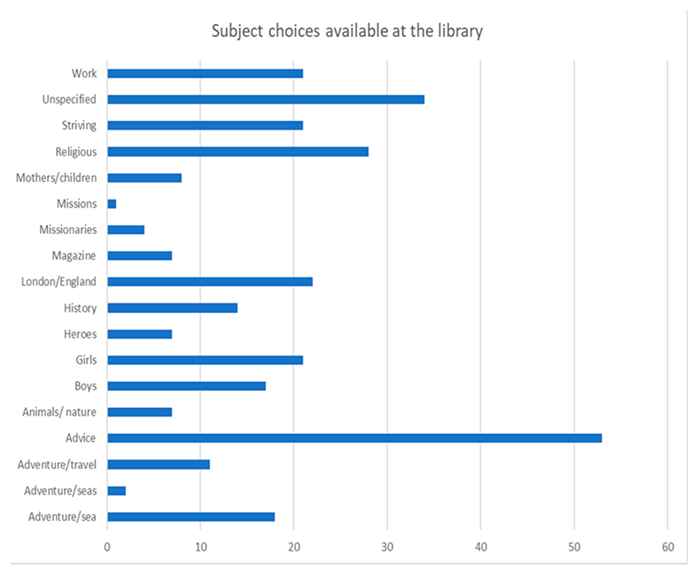
Table 2.
caption.
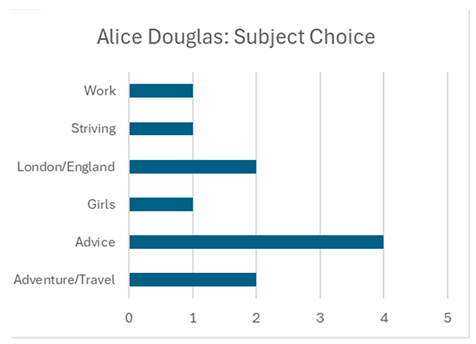
Table 3.
Alice Douglas’ Books borrowed 1900.
Disclaimer/Publisher’s Note: The statements, opinions and data contained in all publications are solely those of the individual author(s) and contributor(s) and not of MDPI and/or the editor(s). MDPI and/or the editor(s) disclaim responsibility for any injury to people or property resulting from any ideas, methods, instructions or products referred to in the content. |
|
Websites – all consulted 6 March 2026.
Ancestors of Robyn Bray
Ancestry | Genealogy, Family Trees & Family History Records
At the Circulating Library
Australian Cemeteries Index - Name/Cemetery Search
Clan Douglas Association of Australia (2026)
English Verse — Classic English poetry and poets
Family Tree - Geni
Hawkesbury Genealogy Project
Our famous women [electronic resource] : an authorized record of the lives and deeds of distinguished... | Catalogue | National Library of Australia
Primary Sources
The Bookseller, A Newspaper of British and Foreign Literature, Issues 206-217.
The General Baptist Repository and Missionary Observer, May 1876.
The Publisher’s Circular and Bookseller’s Record of British and Foreign Literature in 190, 3volume 79, 1903.
The Millstone Nov-December 2009.
Kurrajong Heights Sunday School Catalogue, Uniting Church Archives, Parramatta, 6053.
|
© 2026 by the authors. Licensee MDPI, Basel, Switzerland. This article is an open access article distributed under the terms and conditions of the Creative Commons Attribution (CC BY) license (http://creativecommons.org/licenses/by/4.0/).
Copyright: This open access article is published under a Creative Commons CC BY 4.0 license, which permit the free download, distribution, and reuse, provided that the author and preprint are cited in any reuse.