

Submitted:
15 July 2026
Posted:
16 July 2026
You are already at the latest version
Abstract
We give a certified finite verification of the literal vertex formulation currently displayed as Erd\H{o}s Problem \#580. Namely, for every $1\le n\le 19$, an \(n\)-vertex graph having at least \(\lceil n/2\rceil\) vertices of degree at least \(\lceil n/2\rceil\) contains every tree on at most \(\lfloor n/2\rfloor\) vertices. The only order requiring new computer-assisted analysis is \(n=18\). An edge-minimal counterexample is reduced to a host partition \(V(G)=L\sqcup S\) with $|L|=|S|=9$, degree exactly $9$ on \(L\), and \(S\) independent. Exact embedding theorems cover $42$ of the $47$ non-isomorphic trees on nine vertices. The five remaining trees reduce, by deleting their leaves, to four rooted cores. For each core we construct a Boolean formula whose models are precisely the reduced hosts avoiding that rooted core. All four formulas are unsatisfiable. The deposited data include complete CNF instances and DRUP refutations. The archived traces were validated by reverse unit propagation, all four formulas are independently solved as unsatisfiable by a second SAT solver, a standalone semantic audit reconstructs the complete formulas---including all $3735$ base clauses and every avoidance clause---without importing the production generator, the complete $47$-tree witness table is generated from the classifier, and regeneration from the published encoder reproduces all four CNFs byte for byte. This is a finite partial result concerning trees on at most \(n/2\) vertices; it does not settle the stronger classical formulation asking for trees with at most \(n/2\) edges.
Keywords:
tree embedding
; median-degree condition
; Loebl–Komlós–Sós conjecture
; Boolean satisfiability
; computer-assisted proof
MSC: Primary 05C05, 05C35; Secondary 03B35, 68Q25
1. Introduction and Precise Scope
Erdős, Füredi, Loebl and Sós introduced a median-degree tree-embedding problem in 1995 [1]. The formulation currently displayed as Erdős Problem #580 asks whether an n-vertex graph in which at least vertices have degree at least must contain every tree on at most vertices [2]. For odd n, throughout this paper the degree threshold and the required number of high-degree vertices are interpreted with ceilings, while the tree order is interpreted with a floor.
The classical Loebl–Komlós–Sós conjecture is normally stated in terms of the number of edges of the embedded tree: if at least half of the vertices of a graph have degree at least k, then the graph should contain every tree with at most k edges. Important exact cases were proved by Bazgan, Li and Woźniak [3] and by Piguet and Stein [4]. Zhao proved Loebl’s case for all sufficiently large n [5]. The website formulation differs by one vertex from this classical statement: at , it asks for trees on at most nine vertices, whereas the classical statement asks for trees with nine edges, which may have ten vertices.
Our main result is the following finite statement.
Theorem 1.
Let , and let G be an n-vertex graph such that at least vertices of G have degree at least . Then G contains every tree on at most vertices.
The public problem page records Zhao’s sufficiently-large-order theorem and labels the remaining task as a finite check, but it provides neither an explicit finite threshold nor a completed list of the remaining orders [2,5]. The present result does not complete that unspecified finite check. Its contribution is instead a fully explicit and independently auditable initial interval: every target tree through order 19 is covered, the unique nontrivial even host order 18 is reduced to four finite formulas, and the complete formulas and clausal refutations are deposited.
The significance of the computation is methodological as well as numerical. The tree classification is accompanied by generated witnesses for all 47 isomorphism types; the five exceptional trees are independently checked against their rooted cores; the SAT formulas are regenerated byte for byte; and a standalone audit reconstructs the base formula and every avoidance clause without importing the production generator. This provides a reusable certified workflow for extending the finite interval or attacking the stronger ten-vertex-tree case at . No claim is made that this finite interval reaches Zhao’s threshold, and no absolute literature-priority claim is required for the theorem proved here.
The proof has four layers. First, all orders below 18 follow from known exact classes. Second, edge minimality reduces a hypothetical 18-vertex counterexample to a sharply structured host. Third, a finite classification reduces the 47 nine-vertex trees to five exceptional types and then to four rooted cores. Finally, four certified SAT refutations exclude reduced hosts avoiding those cores. The full software, formulas and certificates are archived in Zenodo record 21348157, version 1.0.2 [6]. The current package includes a repository-wide SHA-256 manifest, the complete CNF and DRUP files, independent solver results, and semantic audits of both the exceptional-tree reduction and the generated avoidance clauses.
2. Preliminaries and the Orders Below Eighteen
All graphs are finite, simple and undirected. An embedding of a graph H into a graph G is an injective map that preserves edges. We write when such an embedding exists. The order of a graph is its number of vertices, and the length of a path is its number of edges.
We first record a simple monotonicity observation.
Lemma 1.
Every tree on at most q vertices is a subgraph of a tree on exactly q vertices.
Proof.
Starting from a tree T of order , attach a new leaf to an arbitrary vertex, and repeat until the order is q. The original tree remains a subgraph at every step. □
The exact results used below are the following.
- Piguet and Stein proved the Loebl–Komlós–Sós conjecture for every tree of diameter at most five [4].
- For , let be the class of trees with k edges obtained from a path of length by attaching two stars whose centres lie at distance c on the path. Piguet and Stein proved that, when , every embeds whenever c is even or [4].
Proposition 1.
The conclusion of 1 holds for .
Proof.
The one-vertex tree is contained in every nonempty host, so assume . Let T have vertices and hence edges. The host hypothesis is stronger than the Loebl–Komlós–Sós degree condition with parameter .
For , one has . Every tree on at most six vertices has diameter at most five. A seven-vertex tree of diameter six is the path . An eight-vertex tree of diameter seven is . Finally, an eight-vertex tree of diameter six consists of a seven-vertex diametral path and one additional leaf attached to an internal path vertex; hence it is a path-plus-star tree. The cited exact results cover all possibilities. □
3. Reduction of a Minimal Counterexample at Order Eighteen
Assume, for a contradiction, that an 18-vertex counterexample exists. By 1, it is enough to consider a missing tree of order exactly nine. Choose a counterexample G with the minimum possible number of edges, and define
Deleting edges cannot create a copy of the missing tree. Consequently, deleting any edge from G must destroy the degree hypothesis.
Lemma 2
(Reduced-host lemma). A minimal counterexample satisfies
In particular, each vertex of S has degree at most eight.
Proof.
If , deleting any edge lowers the degrees of at most two vertices. At least nine vertices would still have degree at least nine, contradicting edge minimality.
Suppose . Deleting an edge must lower the number of vertices of degree at least nine from ten to at most eight. Hence both endpoints of every edge must lie in L and have degree exactly nine. Thus every edge lies in L, every vertex of L has degree nine, and . The complete graph contains every tree on nine vertices, a contradiction. Therefore .
An edge inside S could be deleted without changing a degree in L, so S is independent. Finally, suppose has degree greater than nine. For every edge incident with x, deletion of must make at least one of the nine vertices of L fall below degree nine. Since x remains of degree at least nine, the other endpoint y must lie in L and have degree exactly nine. But there are only eight other vertices of L, contradicting . Hence every vertex of L has degree exactly nine. □
We call a graph satisfying the conclusion of 2 a reduced host.
4. Leaf Deletion and Rooted Cores
Let T be a tree on nine vertices. Denote its set of leaves by M, put , and let
be the set of parents of the deleted leaves. We regard as a rooted core, with the vertices in P marked.
Lemma 3
(Leaf-extension lemma). Let G be a reduced host. If F has an embedding φ into G satisfying , then φ extends to an embedding of T into G.
Proof.
Put . The embedded core occupies vertices. For a parent , the image has degree nine and has at most neighbours among the other embedded core vertices. Hence it has at least
unused neighbours.
For each deleted leaf m, let its candidate set be the unused neighbours of the image of its parent. Each candidate set has size at least . If is nonempty, the union of the candidate sets for the leaves in X contains at least one such candidate set and therefore has size at least . Hall’s theorem gives distinct representatives for all deleted leaves, completing the embedding. □
5. Finite Classification of the Nine-Vertex Trees
The program classify_trees9.py uses NetworkX [7] to generate the non-isomorphic trees of order nine and to compare them with the exact classes summarized above. The output contains 47 trees in total, 42 covered by the cited exact theorems and five exceptional isomorphism types. The full type-by-type audit appears in Appendix A.
Proposition 2
(Classification audit). Every tree on nine vertices is either covered by one of the exact results summarized above, or is isomorphic to one of the five trees in Table 2.
Proof.
The finite exhaustive procedure is given explicitly in Section 9. It enumerates all 47 non-isomorphic trees, applies graph-isomorphism tests to every member of the three exact classes, and produces the graph6 list in Appendix A. The three uniquely two-star cases have the explicit witnesses in Table 1, and the five unclassified graph6 strings are precisely those displayed in Table 2. Re-running the corrected classifier with NetworkX 3.6.1 reproduces the same counts, strings and witnesses. The Piguet–Stein alternative inequality is implemented as for the 18-vertex host; this correction leaves the classification unchanged because the three trees assigned uniquely to this route all have even c. □

Table 1.
Explicit witnesses for the three trees assigned uniquely to the two-star caterpillar route. The two entries in the star-leaf column are the numbers of pendant leaves attached at the two path centres.
Table 1.
Explicit witnesses for the three trees assigned uniquely to the two-star caterpillar route. The two entries in the star-leaf column are the numbers of pendant leaves attached at the two path centres.
| Graph6 | k | ℓ | c | Path length | Centres | Star leaves | Condition |
|---|---|---|---|---|---|---|---|
| HpH?GCA | 8 | 4 | 4 | 4 | (0,4) | (2,2) | c even |
| HpH?GD? | 8 | 2 | 2 | 6 | (1,3) | (1,1) | c even |
| Hp‘?GCC | 8 | 2 | 2 | 6 | (2,4) | (1,1) | c even |
Table 2.
The five exceptional trees and the rooted-core instances that cover them. A vector records the numbers of additional leaves attached along a five-vertex path, up to reversal.
Table 2.
The five exceptional trees and the rooted-core instances that cover them. A vector records the numbers of additional leaves attached along a five-vertex path, up to reversal.
| Graph6 | Structure | Rooted-core instance |
|---|---|---|
| HpIA?C@ | path multiplicities | path_support_014 |
| HpH?GCC | path multiplicities | path_support_014 |
| Hp_I?C@ | spider with arm lengths | spider_224_core |
| Hp‘?GD? | path multiplicities | path_support_0124 |
| HpOGI?@ | spider with arm lengths | spider_233_core |
Table 3.
Machine-auditable reduction of the five exceptional trees to four rooted cores. Vertex labels are obtained by decoding the graph6 strings with NetworkX 3.6.1.
Table 3.
Machine-auditable reduction of the five exceptional trees to four rooted cores. Vertex labels are obtained by decoding the graph6 strings with NetworkX 3.6.1.
| Graph6 | Deleted leaves | Marked parents | Rooted core |
|---|---|---|---|
| HpIA?C@ | path_support_014 | ||
| HpH?GCC | path_support_014 | ||
| Hp_I?C@ | spider_224_core | ||
| Hp‘?GD? | path_support_0124 | ||
| HpOGI?@ | spider_233_core |
Deleting all leaves from the five exceptional trees produces four rooted cores. They are shown in Figure 1; filled vertices are the marked parents required to lie in L.
6. SAT Encoding
Fix a reduced host with
For every potential edge inside L or between L and S, introduce a primary Boolean variable , interpreted as true when is present. There are
primary variables. Edges inside S are fixed absent.
For every , a totalizer cardinality encoding [8] imposes
For every , the single clause
imposes , because S is independent. The resulting base formula has 1377 variables after the introduction of cardinality auxiliaries and 3735 clauses.
Let be one of the four rooted cores. For every injective map satisfying , add the avoidance clause
If a core edge is mapped inside S, then the placement cannot be an embedding and no clause is needed. Duplicate clauses are removed. For the two spider cores, one automorphism exchanging equal arms is used only to suppress duplicate placements; it does not remove an isomorphism class of embeddings.
Denote the resulting formula by .
Proposition 3
(Encoding correctness). The formula is satisfiable if and only if there exists a reduced host avoiding every embedding of with the marked vertices mapped into L.
Proof.
Given a model of , use the primary variables to define the edge set. The base formula gives degree exactly nine on L, degree at most eight on S, and no edges inside S. Every possible rooted-core placement satisfies an avoidance clause of the form (1), so at least one required core edge is absent.
Conversely, let a reduced host avoid the rooted core. Assign its edge indicators to the primary variables. Correctness of the totalizer encoding provides values for the auxiliary variables satisfying the degree constraints. Since every rooted-core placement is missing at least one required edge, every clause (1) is satisfied. □
The four instance sizes are listed in Table 4.
7. Certified Unsatisfiability
The instances were generated with Python 3, NetworkX 3.6.1 and PySAT 1.9.dev5 [9]. Glucose 4.1 [10] produced a plain-text DRUP refutation for each formula. We recall the certificate principle.
Definition 1.
Let Γ be a CNF formula. A clause C has the reverse unit propagation property with respect to Γ if unit propagation on
produces a contradiction.
Every RUP clause is logically implied by the current formula. Therefore, a sequence of RUP additions ending in the empty clause certifies unsatisfiability. DRUP is a subset of the DRAT proof format; see [11].
The deposited checker reads every proof addition and tests the RUP condition using MiniSat 2.2 [12] only as a unit-propagation engine. Deletion lines are ignored. The resulting validation is still sound as a semantic refutation: inductively, every retained derived clause is a logical consequence of the original CNF, and a unit-propagation conflict after negating a proposed clause proves that clause to be another consequence of the original CNF. The archived validation reaches the empty clause in every instance and reports the additions shown in Table 5. As an independent cross-check, the four original CNFs were also solved as unsat by CaDiCaL 1.5.3; CaDiCaL is documented in [13].
A solver-free regeneration of the published encoder reproduced all four archived CNFs byte for byte. Their SHA-256 digests, together with the digests of the four DRUP files, appear in Appendix B. A separate standalone audit imports no constants, core specifications, variable map or placement routine from the production generator. It independently defines the host partition and four rooted cores, reconstructs the PySAT totalizer variable map and all 3735 base clauses, exhaustively enumerates all injective rooted placements, and compares the archived formula clause by clause in exact order. For every instance, the variable count, base prefix, avoidance tail and complete formula agree exactly, and no duplicate avoidance clause occurs. The avoidance counts are 48384, 34776, 343224 and 343224. A second audit decodes each exceptional graph6 tree, deletes all leaves, marks their parents, and verifies a unique rooted isomorphism with the stated core. These checks test the semantic link between the graph problem and the generated formulas rather than merely re-running the same encoder.
Thus the following is a certificate-backed computational theorem.
Proposition 4.
For each of the four rooted cores in Figure 1, the formula is unsatisfiable. Consequently, every reduced host contains an embedding of that rooted core with all marked vertices in L.
Proof.
The checked DRUP traces derive the empty clause from each formula. The semantic conclusion follows from 3. □
8. Completion of the Proof
Theorem 2.
Every 18-vertex graph with at least nine vertices of degree at least nine contains every tree on at most nine vertices.
Proof.
By 1, it is enough to embed every tree on nine vertices. Suppose a counterexample exists and reduce it using 2. By 2, 42 tree types are covered by known exact results. Each of the remaining five trees has one of the four rooted cores in Figure 1. By 4, the reduced host contains the appropriate rooted core with the marked leaf-parents in L. The leaf-extension lemma, 3, extends that embedding to the full exceptional tree. This contradicts the existence of a counterexample. □
Corollary 1.
Every 19-vertex graph with at least ten vertices of degree at least ten contains every tree on at most nine vertices.
Proof.
Delete an arbitrary vertex. At least nine of the original high-degree vertices remain, and each has degree at least nine in the resulting 18-vertex graph. Apply 2. □
Combining proves 1.
9. Reproducibility Details
The finite computation is intentionally small enough to audit at the mathematical-object level. The classification procedure is:
- Generate the 47 non-isomorphic trees on nine vertices using networkx.nonisomorphictrees(9).
- Mark every tree of diameter at most five as class D.
- Enumerate every tree obtained from a path of length p and a star with leaves by identifying the star centre with a path vertex; mark any isomorphic tree as class P.
- Enumerate every two-star caterpillar in with and with either c even or ; mark any isomorphic tree as class C.
- Record the remaining graph6 strings as class E.
The priority labels in Appendix A are assigned in the order D, P, C, E; some covered trees belong to more than one exact class. This priority gives 32 trees in D, 7 in P, 3 in Cand 5 in E.
For the proof-critical archived files, the principal verification commands are
python -m pip install -r requirements.txt
sha256sum -c SHA256SUMS
mkdir -p reproduced/verification
python src/classify_trees9.py \
--json reproduced/verification/classification.json \
--detailed-json \
reproduced/verification/classification_detailed.json \
--tex reproduced/verification/classification_audit.tex
python src/audit_rooted_cores.py \
--json reproduced/verification/rooted_core.json
python src/audit_cnf_semantics.py \
--cert-dir certificates \
--json reproduced/verification/cnf_semantics.json
python src/generate_and_solve.py \
--generate-only \
--out-dir reproduced/generated-cnfs \
--results-json \
reproduced/verification/cnf_regeneration.json \
--reference-dir certificates
python src/independent_solve.py \
--cert-dir certificates \
--json reproduced/verification/independent_solve.json
python src/check_drup.py \
--cert-dir certificates \
--json reproduced/verification/proof_check.json
A portable rooted-core audit is included in the journal source and may be run as
python supplement/code/audit_rooted_cores.py \
--json /tmp/rooted_core_recheck.json
The complete instances and traces are not duplicated in the journal source because they are approximately 56 MB in the public archive [6]. The journal source includes the corrected classifier, generator, certificate checker, independent-solver script, both semantic-audit scripts, machine-readable result summaries, and authoritative certificate hashes.
Remark 1
(Computational release). The cited Zenodo record contains version 1.0.2. Its repository-wide SHA256SUMS manifest verifies every archived file other than the manifest itself. The four proof-critical CNFs and four DRUP traces are unchanged from the initial deposit. Version 1.0.2 corrects the Piguet–Stein alternative to the published threshold (equal to 9 here), generates the complete classification JSON and LaTeX table directly from the classifier, replaces the partial semantic audit by a standalone exact reconstruction of each complete CNF, and adds solver-free byte-for-byte CNF regeneration. These corrections leave the classification, every CNF and every proof certificate unchanged.
10. Limitations
The result is a finite verification of the literal vertex wording of the website problem. It does not establish the classical statement for all trees with nine edges, does not provide a new asymptotic method, and does not show that the verified interval joins Zhao’s unspecified sufficiently-large-n interval. The finite classification depends on graph enumeration and isomorphism testing, while the final four cases depend on CNF generation and proof checking. These dependencies are exposed through complete source code, exact formulas, clausal refutations and file digests.
Author Contributions
Rafik Zeraoulia conceived the study, formulated and reviewed the mathematical reductions, curated the computational archive, checked the reported outputs, and prepared and approved the manuscript.
Funding
The author received no specific funding for this work.
Institutional Review Board Statement
This theoretical and computational study involved no human participants, personal data or animal experiments; ethical approval and informed consent are not applicable.
Data Availability Statement
The source code, classification output, four CNF instances, four DRUP certificates, validation logs and reproducibility instructions are available in Zenodo record 21348157, version 1.0.2, DOI 10.5281/zenodo.21348157 [6]. The smaller journal source package contains portable copies of the scripts and result summaries but does not duplicate the large CNF and DRUP files.
Conflicts of Interest
The author declares no competing interests.
Use of Artificial Intelligence
OpenAI’s ChatGPT assisted with computational exploration, preliminary code drafting, language editing, documentation organization and manuscript preparation. The AI system is not an author. The named author reviewed the mathematical claims and computational materials, takes responsibility for the final text and results, and is responsible for correcting any errors identified after dissemination.
Appendix A. Complete Classification Audit
The route labels are: D for diameter at most five; P for a path-plus-star tree; C for an applicable two-star caterpillar; and E for one of the five exceptional trees handled by SAT. Where several exact classes apply, the priority D>P>C is used. The entire table below is generated by classify_trees9.py from the same deterministic witnesses written to classification_detailed.json; it is not edited by hand.
Table A1.
Audit of all non-isomorphic trees on nine vertices. The witness parameters are generated by src/classify_trees9.py and are defined in Section 5 and Section 9.
| Index | Graph6 | d | Route | Generated witness |
| 0 | HpD?GC@ | 8 | P | |
| 1 | HpD?GCA | 7 | P | |
| 2 | HpD?GCC | 7 | P | |
| 3 | HpD?GD? | 7 | P | |
| 4 | HpGa?C@ | 6 | P | |
| 5 | HpIA?C@ | 6 | E | rooted core path_support_014 |
| 6 | HpH?GCA | 6 | C | ; c even |
| 7 | HpH?GCC | 6 | E | rooted core path_support_014 |
| 8 | HpH?GD? | 6 | C | ; c even |
| 9 | HpH?GGC | 5 | D | |
| 10 | HpH?GH? | 5 | D | |
| 11 | HpH?I?@ | 5 | D | |
| 12 | HpH?I@? | 5 | D | |
| 13 | Hp_I?C@ | 6 | E | rooted core spider_224_core |
| 14 | HpaA?C@ | 6 | P | |
| 15 | Hp‘?GCC | 6 | C | ; c even |
| 16 | Hp‘?GD? | 6 | E | rooted core path_support_0124 |
| 17 | Hp‘?GGC | 5 | D | |
| 18 | Hp‘?GH? | 5 | D | |
| 19 | Hp‘?I?@ | 5 | D | |
| 20 | Hp‘?I@? | 5 | D | |
| 21 | HpOGI?@ | 6 | E | rooted core spider_233_core |
| 22 | HpOGI@? | 6 | P | |
| 23 | HpOGOOG | 5 | D | |
| 24 | HpOGOP? | 5 | D | |
| 25 | HpOGQ?@ | 5 | D | |
| 26 | HpOGQ@? | 5 | D | |
| 27 | HpOI?D? | 5 | D | |
| 28 | HpOIA@? | 5 | D | |
| 29 | HsaCA?@ | 4 | D | |
| 30 | HsaA?CA | 4 | D | |
| 31 | HsaA?D? | 4 | D | |
| 32 | Hs‘?GGC | 4 | D | |
| 33 | Hs‘?GH? | 4 | D | |
| 34 | Hs‘?I?@ | 4 | D | |
| 35 | Hs‘?I@? | 4 | D | |
| 36 | Hs‘AA@? | 3 | D | |
| 37 | HsOGQ?@ | 4 | D | |
| 38 | HsOGQ@? | 4 | D | |
| 39 | HsOI?D? | 4 | D | |
| 40 | HsOIA@? | 4 | D | |
| 41 | HsPAA@? | 3 | D | |
| 42 | HqD?I?@ | 4 | D | |
| 43 | HqD?I@? | 4 | D | |
| 44 | HqDAA@? | 4 | D | |
| 45 | HqPAA@? | 3 | D | |
| 46 | HiPAA@? | 2 | D |
Appendix B. Certificate SHA-256 Digests
The following digests were recomputed directly from the eight certificate files in the deposited archive.
| File | SHA-256 |
| path_support_0124.cnf | 1d1ae9d5863955321f17b5e6ddd59ee2647d5561439da36a096cbc7277e0582b |
| path_support_0124.drup | 3a0652c363d722abb87390b607e43f41a57ec051fa13aa435947279d6c678943 |
| path_support_014.cnf | 0012f4050af70b08b6271205401bc2a77d1e455b8ec3a8e142584673a9cac1d7 |
| path_support_014.drup | bf01aa8bf4046a28153e3cddd794d81069c012dd285ca0a8b3afb9dd0a327c7f |
| spider_224_core.cnf | 8fbe00834651bed9f455ec4059d7912f7c5248886983ed9c1b99f3fb509aba46 |
| spider_224_core.drup | c7707232b34268e2d52c660ee73e922c601a4fb0bffb381112b5439de6cd1fb6 |
| spider_233_core.cnf | d00c9040dc0754ca70fbf2ea061a7c789d81870242b4e7e6ce890682dd88a5b3 |
| spider_233_core.drup | d88cd62a0930aed9e583d5319155635a5262a7ad29b87ca0a0de7ef7736faf81 |
References
- Erdős, P.; Füredi, Z.; Loebl, M.; Sós, V.T. Discrepancy of trees. Stud. Sci. Math. Hung. 1995, 30, 47–57. [Google Scholar]
- Bloom, T.F. Erdős Problem #580. Erdős Problems, 2026. Accessed 14 July 2026.
- Bazgan, C.; Li, H.; Woźniak, M. On the Loebl–Komlós–Sós conjecture. J. Graph Theory 2000, 34, 269–276. [Google Scholar] [CrossRef]
- Piguet, D.; Stein, M.J. The Loebl–Komlós–Sós conjecture for trees of diameter 5 and for certain caterpillars. Electron. J. Comb. 2008, 15, R106. [Google Scholar] [CrossRef] [PubMed]
- Zhao, Y. Proof of the (n/2 − n/2 − n/2) conjecture for large n. Electron. J. Comb. 2011, 18, P27. [Google Scholar] [CrossRef] [PubMed]
- Zeraoulia, R. Computer-assisted verification of the vertex formulation of Erdős Problem #580 through n=19. Zenodo software record 21348157, version 1.0.2, 2026. [CrossRef]
- Hagberg, A.A.; Schult, D.A.; Swart, P.J. Exploring network structure, dynamics, and function using NetworkX. In Proceedings of the Proceedings of the 7th Python in Science Conference; 2008; pp. 11–15. [Google Scholar] [CrossRef]
- Bailleux, O.; Boufkhad, Y. Efficient CNF encoding of Boolean cardinality constraints. In Proceedings of the Principles and Practice of Constraint Programming – CP 2003; Lecture Notes in Computer Science; Springer, 2003; Vol. 2833, pp. 108–122. [Google Scholar] [CrossRef]
- Ignatiev, A.; Morgado, A.; Marques-Silva, J. PySAT: A Python toolkit for prototyping with SAT oracles. In Proceedings of the Theory and Applications of Satisfiability Testing – SAT 2018; Lecture Notes in Computer Science; Springer, 2018; Vol. 10929, pp. 428–437. [Google Scholar] [CrossRef]
- Audemard, G.; Simon, L. Predicting learnt clauses quality in modern SAT solvers. In Proceedings of the Proceedings of the 21st International Joint Conference on Artificial Intelligence; 2009; pp. 399–404. [Google Scholar]
- Heule, M.J.H. The DRAT format and DRAT-trim checker. arXiv 2016, arXiv:cs.LO/1610.06229. [Google Scholar]
- Eén, N.; Sörensson, N. An extensible SAT-solver. In Proceedings of the Theory and Applications of Satisfiability Testing – SAT 2003; Lecture Notes in Computer Science; Springer, 2004; Vol. 2919, pp. 502–518. [Google Scholar] [CrossRef]
- Biere, A.; Faller, K.F.; Fleury, M.; Froleyks, N.; Pollitt, F. CaDiCaL 2.0. In Proceedings of the Computer Aided Verification – CAV 2024; Lecture Notes in Computer Science; Springer, 2024; Vol. 14681, pp. 133–152. [Google Scholar] [CrossRef]
Figure 1.
The four rooted cores. Filled vertices must be embedded in the high-degree class L.
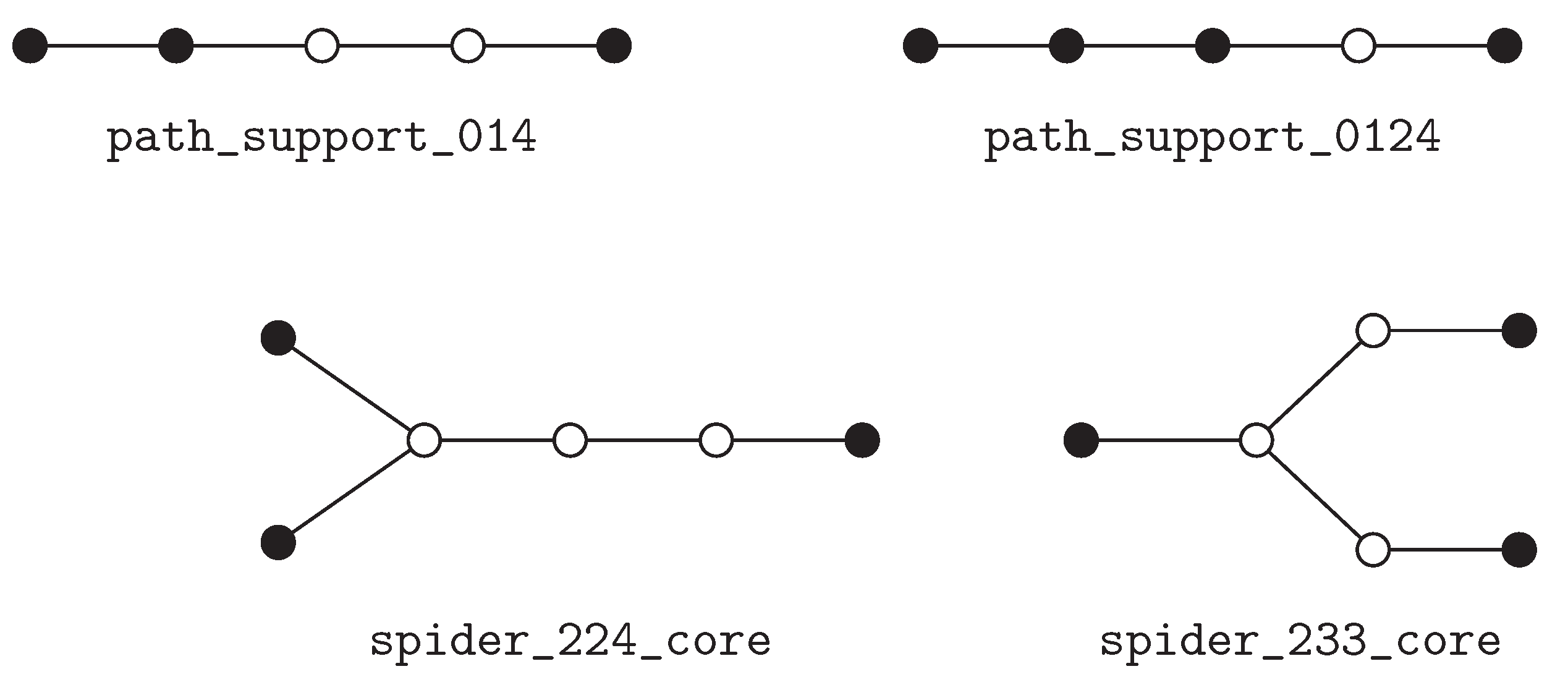
Table 4.
SAT instance sizes. The total clause count is 3735 base clauses plus the core-avoidance clauses.
Table 4.
SAT instance sizes. The total clause count is 3735 base clauses plus the core-avoidance clauses.
| Instance | Variables | Avoidance clauses | Total clauses |
|---|---|---|---|
| path_support_014 | 1377 | 48384 | 52119 |
| path_support_0124 | 1377 | 34776 | 38511 |
| spider_224_core | 1377 | 343224 | 346959 |
| spider_233_core | 1377 | 343224 | 346959 |
Table 5.
Certificate validation and independent solver cross-check.
| Instance | RUP additions checked | Deletions ignored | CaDiCaL |
|---|---|---|---|
| path_support_014 | 13044 | 15025 | unsat |
| path_support_0124 | 114453 | 107328 | unsat |
| spider_224_core | 50939 | 26219 | unsat |
| spider_233_core | 83274 | 80409 | unsat |
Disclaimer/Publisher’s Note: The statements, opinions and data contained in all publications are solely those of the individual author(s) and contributor(s) and not of MDPI and/or the editor(s). MDPI and/or the editor(s) disclaim responsibility for any injury to people or property resulting from any ideas, methods, instructions or products referred to in the content. |
© 2026 by the author. Licensee MDPI, Basel, Switzerland. This article is an open access article distributed under the terms and conditions of the Creative Commons Attribution (CC BY) license (http://creativecommons.org/licenses/by/4.0/).
Copyright: This open access article is published under a Creative Commons CC BY 4.0 license, which permit the free download, distribution, and reuse, provided that the author and preprint are cited in any reuse.