

Submitted:
14 July 2026
Posted:
15 July 2026
You are already at the latest version
Abstract
Simultaneous localization and mapping (SLAM) is a foundational capability for autonomous navigation in unknown environments. Its performance is strongly coupled to the type, quality, and reliability of available sensor data, limiting the portability of navigation systems across heterogeneous mobile robot platforms. This paper presents a cross-platform adaptive navigation framework that decouples localization providers from platform-specific sensing configurations. A sensor abstraction layer normalizes heterogeneous and low-fidelity sensor inputs into a unified representation, enabling structured operational modes constructed according to available sensing modalities, computational constraints, and environmental characteristics. A learning-based performance prediction module is further designed to estimate impending SLAM degradation and support proactive mode switching. Due to middleware constraints within the Pepper NAOqi stack, this predictive component was not deployed during experimental evaluation and remains part of the proposed architecture for future validation. Experimental results on real indoor navigation tasks demonstrate improved robustness and portability compared to fixed SLAM configurations without manual retuning.
Keywords:
navigation
; automatic control
; intelligent systems
1. Introduction
Simultaneous localization and mapping (SLAM) is a fundamental capability for mobile robots operating in unknown environments. By processing onboard sensor data, a robot incrementally constructs a map of its surroundings while simultaneously estimating its own pose within that map. This process typically involves repeated cycles of sensor acquisition, state estimation, map construction, and trajectory refinement as the robot explores and revisits its environment. As exploration progresses, localization and mapping are performed by a localization provider whose performance and applicability are strongly influenced by the type, quality, and configuration of available sensors. In practice, these modules may be implemented using filter-based odometry, visual odometry, visual-inertial SLAM, or re-localization techniques, but are typically tightly coupled to specific sensing assumptions.
SLAM has been extensively studied over the past two decades, resulting in a broad family of mature approaches, including filter-based methods such as extended Kalman filter (EKF) SLAM and particle filter SLAM, as well as graph-based optimization techniques [1,2].
These methods have been successfully deployed on a wide range of robotic platforms, particularly those equipped with high-quality sensing modalities such as LiDAR or high-resolution cameras. Graph-based SLAM formulations, in particular, have demonstrated strong performance and scalability in both research and real-world systems [3,4].
Despite this progress, applying existing SLAM techniques to robots with limited or nonstandard sensing capabilities remains a significant challenge. Most SLAM implementations implicitly assume specific sensor configurations and noise characteristics, and transferring a navigation system from one platform to another often requires extensive redesign, parameter tuning, or algorithmic modification. As a result, portability across heterogeneous robot platforms remains limited, even when the underlying navigation task is conceptually similar.
This challenge is especially evident in mobile robots designed for social interaction or cost efficiency rather than high-fidelity perception. For example, Pepper1, the social robot used as the primary development platform in this work, relies on a combination of inertial measurements, low-resolution laser triangulation, infrared sensors, sonar, and bumper-based contact sensing, rather than dense LiDAR or high-resolution visual input. Many localization providers either perform poorly under these sensing constraints or require substantial adaptation to operate reliably. Moreover, Pepper’s native SLAM solution, like those of many commercial mobile robots, provides limited documentation and restricted access, preventing meaningful customization or performance tuning. This scenario illustrates a broader limitation of existing SLAM systems: they are often tightly coupled to particular sensor assumptions, making cross-platform deployment costly and fragile.
To address this limitation, this paper proposes a cross-platform adaptive navigation framework (see Figure 1) explicitly designed for heterogeneous and constrained sensing configurations. The framework introduces a sensor abstraction layer that converts raw sensor inputs into a unified representation compatible with multiple localization providers, thereby decoupling estimation functionality from platform-specific sensing assumptions.
On top of this abstraction, an adaptive localization provider manager defines structured operational modes, Efficient, Robust, and Recovery, each representing a coherent bundle of estimation strategies selected according to available sensing modalities, computational capacity, and environmental characteristics. A supervisory monitoring module evaluates diagnostic metrics and triggers hierarchical mode transitions when degradation thresholds are detected.
A learning-based performance prediction module is included in the architectural design to enable proactive degradation detection and earlier mode escalation. Due to middleware constraints within the Pepper NAOqi stack, this predictive component was not deployed during experimental evaluation and remains part of the proposed framework for future validation. By combining sensor abstraction, curated operational modes, and adaptive supervision, the framework improves robustness and portability without requiring platform-specific redesign.
The proposed approach is evaluated through indoor navigation experiments conducted in structured environments such as laboratory classrooms. Performance is assessed using pose drift, tracking consistency (inlier ratio), task completion rate, and CPU utilization. While Pepper serves as a motivating and challenging development platform, the framework is designed to generalize to other mobile robots with similar sensing constraints.
The main contributions of this paper are as follows:
- A sensor abstraction layer that normalizes heterogeneous and low-fidelity sensor data into a unified representation compatible with multiple localization providers;
- A cross-platform localization provider selection framework that dynamically builds operational modes based on available sensing information, computational ability, and initial environmental assessment;
- The design of a learning-based performance prediction module is intended to estimate SLAM reliability and support proactive mode switching;
- A systematic experimental evaluation demonstrating improved robustness and portability across constrained sensing configurations in real indoor navigation tasks.
2. Related Work
2.1. Modern SLAM Systems and Navigation Pipelines
Recent years have seen significant advances in SLAM systems, particularly in robustness, scalability, and real-world deployment. Visual and visual–inertial SLAM methods such as ORB-SLAM3 [5] and VINS-Mono [6] demonstrate strong performance across monocular, stereo, and RGB-D sensing configurations by tightly coupling perception and optimization. LiDAR-based systems, including FAST-LIO2 [7] and LIO-SAM [8], further improve localization accuracy in large-scale environments through efficient factor graph formulations and tightly integrated inertial sensing. These approaches have enabled reliable navigation in structured and unstructured environments but typically assume access to high-quality sensing modalities.
In parallel, modern robotic navigation pipelines, particularly those built on ROS 2, have increasingly adopted modular designs that separate perception, localization, planning, and control. While these pipelines provide flexibility at the software level, they still rely on manually selected localization providers that are tightly coupled to specific sensor configurations. As a result, transferring a navigation system across heterogeneous robot platforms often requires substantial manual reconfiguration.
2.2. Sensor-Aware and Adaptive SLAM Methods
Several studies have explored adaptive SLAM techniques that respond to sensor degradation, environmental changes, or uncertainty. Learning-based approaches have been introduced to estimate localization confidence or predict SLAM failure modes. For example, Naveed et al. [9] propose a deep learning model to assess visual SLAM reliability under challenging lighting and motion conditions, enabling failure-aware navigation. Similarly, Xu et al. [10] introduce uncertainty-aware SLAM frameworks that leverage sensor confidence estimates to improve robustness in degraded sensing environments.
Other work focuses on dynamic sensor fusion and modality selection. Kimera [11] integrates metric-semantic perception to improve robustness in visually ambiguous scenes, while recent multi-modal SLAM systems combine vision, inertial, and LiDAR data to mitigate individual sensor weaknesses [12]. Although these methods improve robustness, they typically assume that all sensing modalities are available and do not explicitly address cross-platform portability when sensors differ significantly between robots.
2.3. Cross-Platform and Generalizable Navigation Frameworks
Cross-platform autonomy has recently gained attention as robots are increasingly deployed across diverse domains. Several studies have explored abstraction layers and unified representations for robot navigation. For example, Frota et al. [13] propose a platform-agnostic navigation architecture for service robots that standardizes perception and planning interfaces. Similarly, recent work on transferable navigation policies leverages reinforcement learning to generalize across environments and robot embodiments [14].
Despite these efforts, most cross-platform navigation solutions either rely on simulation-to-real transfer or assume comparable sensing capabilities across platforms. Few systems explicitly address the problem of adapting SLAM backends to robots with constrained or nonstandard sensor suites. In practice, robots with limited sensing, such as social or educational platforms, remain underserved by existing SLAM solutions, which often require extensive redesign or platform-specific tuning.
3. Methodology
3.1. Problem Formulation and Design Overview
Autonomous navigation in unknown environments requires a SLAM system capable of estimating the robot’s pose and constructing a map from noisy and heterogeneous sensor measurements. However, the sensing configuration of mobile robot platforms varies significantly across embodiments, particularly when considering cost-efficient or socially interactive robots with limited sensing capabilities. This variability complicates the direct transfer of SLAM pipelines between platforms. We define a robot platform as:
where S = {S1, S2, …, Sk} denotes the set of available sensing modalities (e.g., LiDAR, camera, IMU, odometry, sonar); C denotes available computational resources (CPU frequency, memory, real-time constraints); E represents environmental characteristics inferred during operation (e.g., feature density, illumination stability, geometric structure).
P = {S, C, E}
Given a candidate set of navigation providers:
where each provider represents a self-contained localization module (e.g., wheel-inertial odometry, visual odometry, visual-inertial SLAM, or visual re-localization). Providers may internally implement filter-based or graph-based estimation, but expose a common interface consisting of odometry output and diagnostic health signals. The framework, therefore, operates independently of internal SLAM implementations. The objective is to select a configuration that maximizes navigation reliability under sensing and computational constraints.
B = {B1, B2, ..., Bn}
The runtime monitoring vector at time t is defined as:
where mttrack denotes feature tracking quality; mtmatch denotes data association consistency; mtres denotes provider optimization residual magnitude; and mtdrift denotes estimated pose drift.
Mt = [mttrack, mtmatch, mtres, mtdrift]
We define navigation reliability at time t as a function:
where R(⋅) maps estimator diagnostics to a scalar reliability score.
Rt = R(Mt)
The framework selects an operational mode ot ∈ O by solving:
where O is the set of operational modes and Cost(o) denotes the computational load. In practice, this objective is approximated through structured monitoring and predictive supervision, rather than solving a global optimization problem at each time step.
ot∗ = arg maxo∈O E [Rt ∣ S, C, E, o], s.t. Cost(o) ≤ C
3.2. Sensor Abstraction and Cross-Platform Operational Modes
Sensor Abstraction Layer: To enable portability across heterogeneous platforms, the framework introduces a sensor abstraction layer that converts raw sensor measurements into a unified intermediate representation:
where ΔXt represents motion estimates with covariance; Zt represents geometric or landmark observations; and Σt represents uncertainty descriptors or confidence metrics.
At = {ΔXt, Zt, Σt}
By leveraging standardized ROS2 message interfaces, the abstraction decouples navigation providers from hardware-specific sensing configurations. Providers therefore operate on motion and observation representations rather than raw sensor streams, enabling cross-platform compatibility.
Operational Mode Construction: The proposed framework defines three discrete operational modes:
OM = {omeff, omrob, omrec}
Each mode is a structured configuration bundle:
where ϕ denotes the feature extraction configuration; ψ denotes the data association strategy; b∈B denotes the selected provider; Ω denotes optimization policies (e.g., smoothing scope, re-linearization frequency, robust loss functions).
om = {ϕ, ψ, b, Ω}
Efficient Tracking Mode (omeff): Efficient Tracking Mode is the default operational state and is activated when sensor data is stable, and feature tracking quality remains high. In this mode, the system prioritizes computational efficiency by employing lightweight feature extraction methods, simplified matching strategies, and limited, localized optimization. The objective of this mode is to maintain real-time performance while preserving acceptable localization accuracy in structured and well-observed environments.
Robust Mode (omrob): Mode is entered when monitoring metrics indicate degradation in tracking quality, increased residual error, or reduced feature reliability. This mode increases estimator resilience by employing more discriminative feature configurations, expanded optimization scope, and more conservative robustness settings. Robust Mode serves as an intermediate stabilization phase before catastrophic tracking failure occurs.
Recovery Mode (omrec): Recovery Mode is triggered when tracking is lost or estimator confidence falls below a predefined threshold. In this mode, the system prioritizes global consistency and re-localization. Strategies may include global matching, particle filtering, or full graph optimization to restore estimator stability. Once reliable localization is re-established, the system transitions back to Robust Mode and eventually returns to Efficient Tracking Mode under stable conditions.
3.3. Learning-Based Performance Prediction and Adaptive Switching
To support proactive adaptation, the proposed framework includes the design of a learning-based performance prediction module that augments threshold-based monitoring by estimating impending degradation in navigation reliability. The predictive component operates on the monitoring vector Mt defined in (3), which captures estimator health at each time step. A feature representation derived from recent monitoring history is provided to a lightweight predictive model.
where pt denotes the predicted probability that navigation reliability will degrade within a short future horizon.
pt = G(Mt−L:t)
The predictive model is intended to be trained offline using navigation sequences labeled with degradation events such as tracking loss or excessive drift. During runtime, if pt exceeds a predefined threshold, the framework would proactively escalate along the hierarchical operational mode structure:
omeff≺omrob≺omrec
Mode transitions are governed by hysteresis constraints to prevent oscillatory switching and are executed at synchronization points to preserve estimator consistency.
Due to middleware compatibility constraints within the Pepper NAOqi stack, the learning-based predictor was not deployed during the experimental evaluation reported in Section 4. In the current implementation, adaptive switching is governed by threshold-based monitoring of diagnostic metrics. The predictive module remains part of the proposed architecture and is reserved for future validation on platforms that permit full runtime integration.
By combining structured monitoring, hierarchical mode selection, and the architectural design of predictive supervision, the framework enables controlled and stable adaptation across heterogeneous sensing configurations.
4. Experiment
The proposed cross-platform navigation framework was evaluated through real-world indoor navigation experiments conducted on the Pepper mobile robot. The objective of these experiments is to assess adaptive provider selection, computational efficiency, and localization reliability under heterogeneous and constrained sensing conditions. Rather than optimizing a single SLAM implementation, the framework supervises multiple localization providers that expose a common odometry and diagnostic interface through ROS 2.
Although experiments were performed on a single physical platform, Pepper was intentionally selected because its sensing configuration, combining IMU, wheel odometry, low-resolution laser triangulation, sonar, infrared sensors, and RGB input, differs substantially from LiDAR-centric research platforms. This makes it a representative constrained platform for evaluating robustness under limited sensing.
4.1. Experimental Setup
All experiments were implemented in ROS 2 using the abstraction layer and operational modes defined in Section 3. Localization providers were implemented as modular ROS2 nodes satisfying a common provider contract. Each provider publishes (i) nav_msgs/Odometry, (ii) diagnostic health measurements, and (iii) declared sensor/topic dependencies. A selector node ingests the platform sensor profile and constructs operational modes from eligible providers.
Given Pepper’s configuration, the system instantiated:
- Efficient Mode: Depth-based visual odometry provider;
- Robust Mode: ORB-based visual SLAM provider;
- Recovery Mode: Global visual re-localization provider.
Navigation trials were conducted in indoor classroom and corridor environments along a predefined closed-loop trajectory, including turns and revisits.
Two experimental arrangements were evaluated:
- Nominal sensing conditions (all sensors operating normally);
- Degraded sensing conditions, including reduced visual texture and injected odometry noise.
Each configuration was evaluated over four repeated runs.
4.2. Baseline Configurations
The adaptive framework was compared against two fixed provider configurations:
- Fixed Efficient Mode (Fixed omeff): Efficient provider active for entire trajectory;
- Fixed Robust Mode (Fixed omrob): Robust provider active for the entire trajectory.
A fixed omrec baseline is not applicable, as the recovery provider performs re-localization rather than continuous navigation and is only invoked within the adaptive framework upon tracking failure.
4.3. Evaluation Metrics
Performance was evaluated using metrics derived from the monitoring vector Mt defined in (3):
- Pose drift (percentage of total path length),
- Tracking consistency (average inlier ratio),
- Task completion rate (percentage successful trajectory completions),
- Average CPU utilization (percentage of available computation).
These metrics reflect navigation reliability as defined in (4) and the computational constraint in (5).
4.4. Results
Occupancy maps generated during four independent navigation trials in the classroom environment are shown in Figure 2. The blue marker indicates the robot’s starting location in each run. While the overall spatial structure remains consistent, variations in boundary continuity, obstacle clarity, and interior free-space reconstruction are observed. These differences reflect the influence of sensing reliability and adaptive provider switching on mapping consistency. Runs exhibiting stronger structural coherence correspond to periods where the framework operated in Robust Mode under sensing degradation, demonstrating the benefit of adaptive supervision.
Nominal Sensing Conditions: Under nominal sensing, the adaptive framework remained predominantly in omeff, escalating only when minor degradation was detected. As expected, performance remained close to the fixed efficient configuration, while less than half the computational load of fixed robust operation (see Table 1).
While Fixed omrob achieved slightly lower drift and a higher inlier ratio, it required more than double the computational load of Fixed omeff. The adaptive framework preserved efficiency comparable to omeff while maintaining equivalent task completion.
Importantly, under purely nominal conditions, the adaptive framework is expected to behave similarly to omeff, since escalation is triggered only when degradation is detected.
Degraded Sensing Conditions: Under reduced feature density and injected odometry noise, Fixed omeff exhibited substantial degradation, with significant drift growth and reduced tracking consistency. In contrast, the adaptive framework transitioned from omeff to omrob prior to catastrophic failure, limiting drift accumulation (see Table 2).
Compared to Fixed omeff, the adaptive framework reduced drift from 12.8% to 4.9% (≈62% reduction) and increased task completion from 45% to 87%. Performance approached that of Fixed omrob while requiring lower average CPU utilization.
When aggregating across mixed nominal and degraded runs, the adaptive framework achieves lower overall drift than Fixed omeff because it prevents the large degradation-induced drift spikes observed in the fixed efficient configuration.
Figure 3 shows the transition from nominal to degraded sensing conditions for all configurations across drift, inlier ratio, task completion, and CPU usage. Under nominal sensing, the Adaptive framework performs similarly to Fixed omeff, reflecting its operation in Efficient Mode. Under degradation, Fixed omeff exhibits substantial drift increase and performance collapse, whereas the Adaptive framework escalates to a more robust mode, maintaining significantly lower drift and higher completion rate. Although CPU usage increases during degradation, the Adaptive approach achieves a balanced trade-off between robustness and efficiency compared to fixed configurations.
Recovery Behavior (Adaptive-only): During additional trials involving temporary visual degradation, Fixed omeff was unable to reliably restore tracking once significant drift accumulated. In contrast, when monitoring confidence fell below the predefined threshold, the adaptive framework escalated to omrec to initiate re-localization before transitioning back to omrob, and ultimately to omeff once estimator stability was recovered. This hierarchical escalation illustrates the advantage of structured mode switching in handling severe sensing disruptions.
5. Conclusions
This paper presented a cross-platform adaptive navigation framework aimed at improving localization portability across heterogeneous mobile robot platforms with constrained sensing configurations. The proposed architecture decouples localization providers from platform-specific sensor assumptions through (i) a ROS 2–based sensor abstraction layer and standardized provider interface that unify odometry and diagnostic outputs, and (ii) a structured operational mode framework that enables adaptive switching among Efficient, Robust, and Recovery behaviors based on runtime diagnostic monitoring.
Experimental validation on the Pepper mobile robot demonstrated that the adaptive framework preserves computational efficiency under nominal sensing conditions while significantly improving robustness under sensing degradation. In degraded trials, the adaptive approach reduced accumulated pose drift and increased task completion relative to a fixed Efficient baseline, while achieving reliability comparable to a fixed Robust configuration at lower computational cost. These results support the effectiveness of structured mode-based adaptation in constrained sensing environments.
The architectural design also includes a learning-based performance prediction module intended to enable proactive degradation detection and earlier mode escalation. Due to middleware constraints within the Pepper NAOqi stack, this predictive component was not deployed during the reported experiments and remains part of the framework for future integration and validation. Future work will extend evaluation to additional robot platforms and environments, incorporate richer diagnostic logging, and conduct ablation studies to quantify the individual contributions of predictive supervision and recovery behavior.
Funding
Research supported in part by the Appalachian State University Research Council Grants (URC). The funder had no role in study design, data collection and analysis, decision to publish, or preparation of the manuscript.
Institutional Review Board Statement
Not applicable.
Informed Consent Statement
Not applicable.
Data Availability Statement
The original contributions presented in the study are included in the article. Further inquiries can be directed to the corresponding author.
Conflicts of Interest
The authors declare no conflicts of interest. The funders had no role in the design of the study; in the collection, analyses, or interpretation of data; in the writing of the manuscript; or in the decision to publish the results.
Abbreviations
The following abbreviations are used in this manuscript:
| SLAM | Simultaneous localization and mapping |
| ROS | Robot Operating System |
| EKF | Kalman filter |
References
- Bailey, T.; Durrant-Whyte, H. Simultaneous localization and mapping (SLAM): Part II. IEEE Robot. Autom. Mag. 2006, 13, 108–117. [Google Scholar] [CrossRef]
- Durrant-Whyte, H.; Bailey, T. Simultaneous localization and mapping: part I. IEEE Robot. Autom. Mag. 2006, 13, 99–110. [Google Scholar] [CrossRef]
- Grisetti, G.; Kümmerle, R.; Stachniss, C.; Burgard, W. A tutorial on graph-based SLAM. IEEE Intell. Transp. Syst. Mag. 2011, 2, 31–43. [Google Scholar]
- Mur-Artal, R.; Tardós, J.D. Orb-slam2: An open-source slam system for monocular, stereo, and rgb-d cameras. IEEE Trans. Robot. 2017, 33, 1255–1262. [Google Scholar] [CrossRef]
- Campos, C.; Elvira, R.; Rodríguez, J.J.G.; Montiel, J.M.; Tardós, J.D. Orb-slam3: An accurate open-source library for visual, visual–inertial, and multimap slam. IEEE Trans. Robot. 2021, 37, 1874–1890. [Google Scholar] [CrossRef]
- Qin, T.; Li, P.; Shen, S. Vins-mono: A robust and versatile monocular visual-inertial state estimator. IEEE Trans. Robot. 2018, 34, 1004–1020. [Google Scholar] [CrossRef]
- Xu, W.; Cai, Y.; He, D.; Lin, J.; Zhang, F. Fast-lio2: Fast direct lidar-inertial odometry. IEEE Trans. Robot. 2022, 38, 2053–2073. [Google Scholar] [CrossRef]
- Shan, T.; Englot, B.; Meyers, D.; Wang, W.; Ratti, C.; Rus, D. Lio-sam: Tightly-coupled lidar inertial odometry via smoothing and mapping. In Proceedings of the 2020 IEEE/RSJ international conference on intelligent robots and systems (IROS), 2020; pp. 5135–5142. [Google Scholar]
- Naveed, K.; Anjum, M.L.; Hussain, W.; Lee, D. Deep introspective SLAM: Deep reinforcement learning based approach to avoid tracking failure in visual SLAM. Auton. Robot. 2022, 46, 705–724. [Google Scholar] [CrossRef]
- Xu, Y.; Zheng, R.; Zhang, S.; Liu, M.; Yu, J. Uncertainty-aware autonomous robot exploration using confidence-rich localization and mapping. IEEE Transactions on Automation Science and Engineering, 2024. [Google Scholar]
- Rosinol, A.; Abate, M.; Chang, Y.; Carlone, L. Kimera: an open-source library for real-time metric-semantic localization and mapping. In Proceedings of the 2020 IEEE International Conference on Robotics and Automation (ICRA), 2020; pp. 1689–1696. [Google Scholar]
- Khedekar, N.; Kulkarni, M.; Alexis, K. Mimosa: A multi-modal slam framework for resilient autonomy against sensor degradation. In Proceedings of the 2022 IEEE/RSJ International Conference on Intelligent Robots and Systems (IROS), 2022; pp. 7153–7159. [Google Scholar]
- Frota, L.; Rocha, R.P. A Semantic Mapping Framework for Service Robots. In Proceedings of the Proceedings of the 40th ACM/SIGAPP Symposium on Applied Computing, 2025; pp. 832–839. [Google Scholar]
- Zhu, Y.; Wan Hasan, W.Z.; Harun Ramli, H.R.; Norsahperi, N.M.H.; Mohd Kassim, M.S.; Yao, Y. Deep reinforcement learning of mobile robot navigation in dynamic environment: A review. Sensors 2025, 25, 3394. [Google Scholar] [CrossRef] [PubMed]
Figure 1.
Overview of the proposed model’s framework.
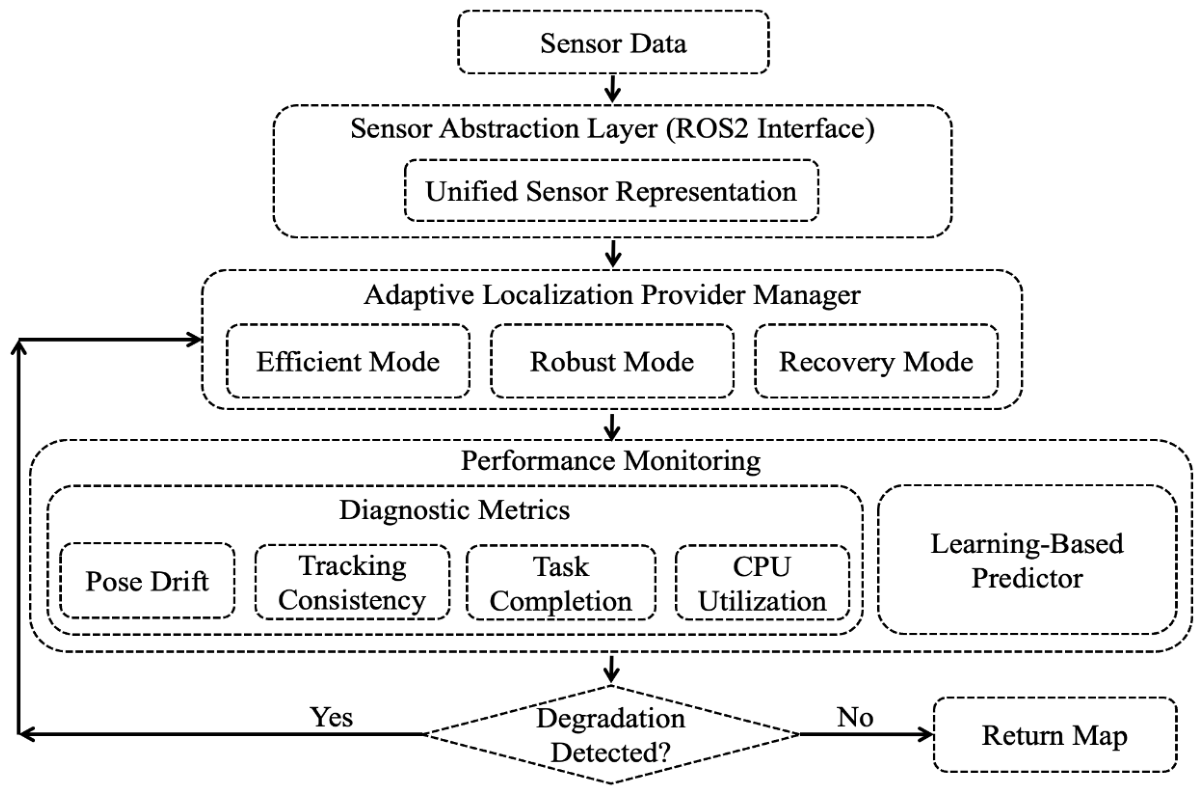
Figure 2.
Multi-run occupancy maps were generated during four independent navigation trials in the classroom environment.
Figure 2.
Multi-run occupancy maps were generated during four independent navigation trials in the classroom environment.
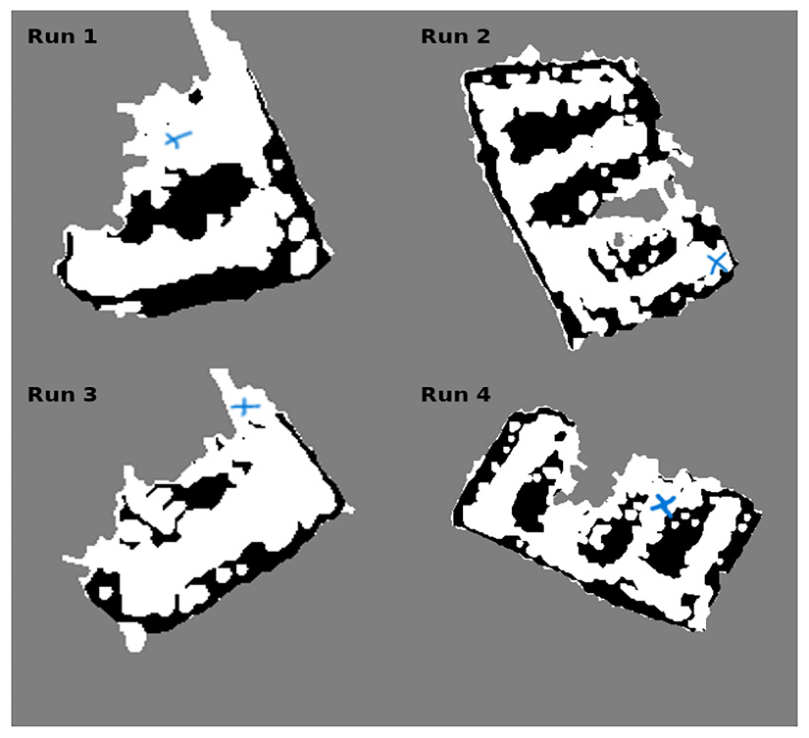
Figure 3.
Robustness shock plot comparing Fixed omeff, Fixed omrob, and our framework under nominal and degraded sensing conditions.
Figure 3.
Robustness shock plot comparing Fixed omeff, Fixed omrob, and our framework under nominal and degraded sensing conditions.
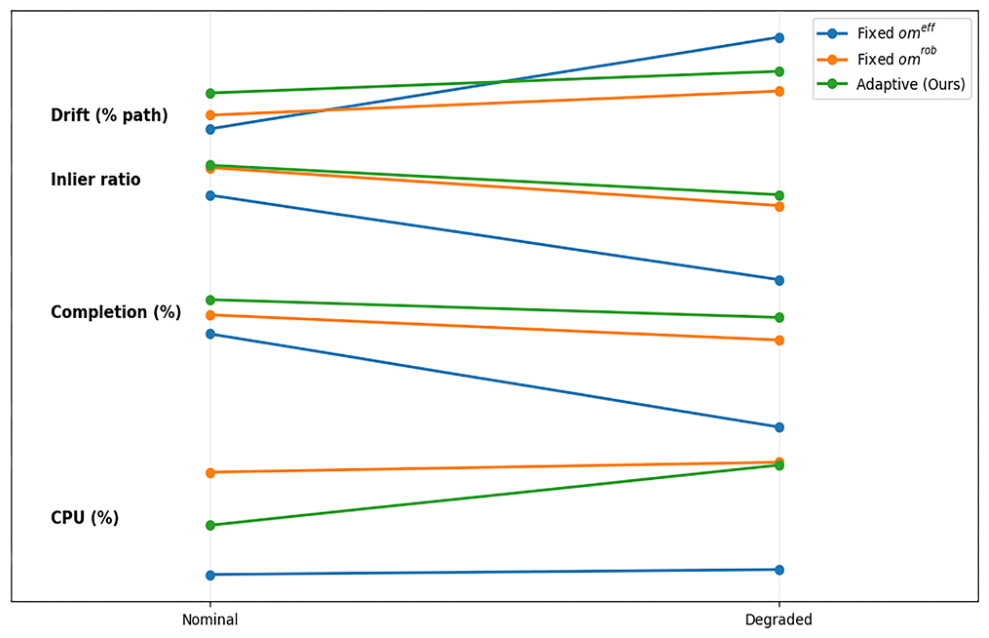

Table 1.
Performance under nominal sensing conditions.
| Configuration | Pose Drift | Average Inlier |
Task Completion |
CPU |
|---|---|---|---|---|
| Fixed omeff | 2.2% | 0.68 | 97% | 24% |
| Fixed omrob | 1.8% | 0.73 | 98% | 58% |
| Adaptive (Ours) | 2.4% | 0.66 | 97% | 30% |
Table 2.
Performance under nominal sensing conditions.
| Configuration | Pose Drift | Average Inlier |
Task Completion |
CPU |
|---|---|---|---|---|
| Fixed omeff | 12.8% | 0.28 | 45% | 26% |
| Fixed omrob | 4.6% | 0.55 | 84% | 62% |
| Adaptive (Ours) | 4.9% | 0.52 | 87% | 54% |
Disclaimer/Publisher’s Note: The statements, opinions and data contained in all publications are solely those of the individual author(s) and contributor(s) and not of MDPI and/or the editor(s). MDPI and/or the editor(s) disclaim responsibility for any injury to people or property resulting from any ideas, methods, instructions or products referred to in the content. |
© 2026 by the authors. Licensee MDPI, Basel, Switzerland. This article is an open access article distributed under the terms and conditions of the Creative Commons Attribution (CC BY) license (http://creativecommons.org/licenses/by/4.0/).
Copyright: This open access article is published under a Creative Commons CC BY 4.0 license, which permit the free download, distribution, and reuse, provided that the author and preprint are cited in any reuse.