
Submitted:
14 July 2026
Posted:
15 July 2026
You are already at the latest version
Abstract
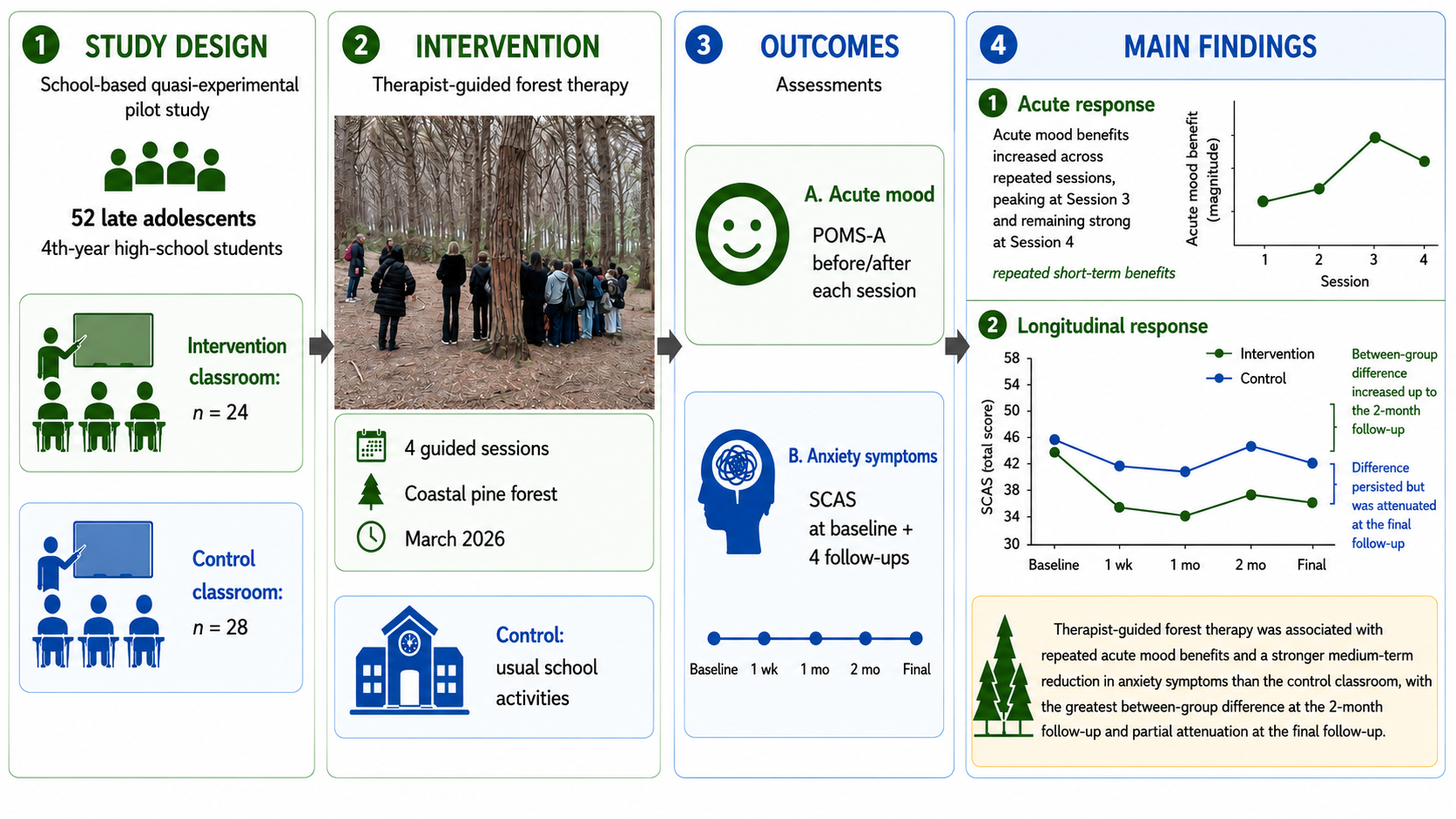
Adolescence is a sensitive period for anxiety symptoms, yet evidence on repeated forest therapy in secondary-school populations remains limited. This school-based quasi-experimental pilot study examined acute affective responses and follow-up anxiety-symptom trajectories after four therapist-guided forest therapy sessions in a coastal pine forest. The primary analytical sample comprised 24 intervention-classroom and 28 usual-activities control-classroom students aged 17–18 years. Anxiety symptoms were assessed with the Spence Children’s Anxiety Scale (SCAS) at baseline and four follow-ups over approximately eleven weeks; acute mood was assessed with the Profile of Mood States—Adolescents (POMS-A) before and after each session. SCAS reductions were directionally larger in the intervention classroom at every follow-up. The largest baseline-adjusted difference occurred at the eight-to-nine-week assessment (coefficient = −5.30 points, 95% confidence interval [−10.69, 0.09]; two-sided p = 0.054) and attenuated at the final follow-up. Acute total mood disturbance improved most clearly during the third scheduled session (mean improvement = 9.75, false-discovery-rate-adjusted q = 0.002, Cohen’s dz = 1.26). Exploratory analyses suggested larger differences at higher baseline anxiety, whereas school-performance and post-intervention nature-connectedness outcomes did not parallel the anxiety pattern. These preliminary findings support feasibility and justify preregistered, cluster-randomized studies with active comparators.
Keywords:
forest therapy
; adolescents
; anxiety symptoms
; acute mood
; school-based prevention
; nature-based intervention
Copyright: This open access article is published under a Creative Commons CC BY 4.0 license, which permit the free download, distribution, and reuse, provided that the author and preprint are cited in any reuse.


