

Submitted:
13 July 2026
Posted:
15 July 2026
You are already at the latest version
Abstract
Background: Artificial intelligence (AI) has expanded rapidly across orthopaedic practice, yet routine clinical adoption remains limited despite strong technical performance. This narrative review examines why a persistent gap separates technical maturity from clinical maturity across the orthopaedic patient care pathway. Methods: We performed a structured qualitative evidence synthesis of contemporary high-level evidence (systematic reviews, diagnostic test accuracy meta-analyses, and structured narrative reviews) retrieved from PubMed/MEDLINE and reference screening, covering January 2022 to June 2026. Twenty-one evidence syntheses were analysed thematically across six predefined domains and organised according to the orthopaedic patient pathway. Reporting followed the SANRA (Scale for the Assessment of Narrative Review Articles) criteria. Results: Musculoskeletal imaging and fracture detection represented the most mature domains, with several applications reaching early clinical adoption. Applications in arthroplasty planning, shoulder surgery, perioperative prediction, multimodal AI, and clinical decision support remained at developing or emerging stages. Recurrent barriers included limited external validation, dataset heterogeneity, poor workflow interoperability, limited explainability, regulatory and ethical uncertainty, and scarce patient-centred outcome evidence. Conclusion: The principal challenge facing orthopaedic AI is no longer algorithm development but clinical translation. We propose the ORION Clinical Readiness Framework, an evidence-informed model describing the transition from Technical Performance to Clinical Validation, Workflow Integration, Patient Benefit, and Routine Clinical Adoption, to guide implementation and future research.
Keywords:
artificial intelligence
; machine learning
; deep learning
; orthopaedics
; musculoskeletal imaging
; clinical decision support
; implementation science
INTRODUCTION
Musculoskeletal disorders represent one of the leading causes of disability worldwide, affecting more than 1.7 billion individuals and generating a substantial socioeconomic burden on healthcare systems. The increasing prevalence of osteoarthritis, fragility fractures, musculoskeletal trauma, spinal disorders, sports injuries, and age-related degenerative conditions has intensified the demand for more accurate diagnosis, personalized treatment strategies, and efficient resource allocation in orthopaedic practice. (1)
Against this background, artificial intelligence (AI) has emerged as one of the most transformative technologies in contemporary orthopaedics. Advances in machine learning, deep learning, computer vision, natural language processing, multimodal learning, and foundation models have enabled AI systems to analyse complex clinical and imaging datasets with unprecedented speed, consistency, and scalability. Over the past five years, AI applications have expanded rapidly across virtually every orthopaedic subspecialty, including musculoskeletal imaging, fracture detection, arthroplasty, spine surgery, trauma, sports medicine, rehabilitation, oncology, and clinical decision support.[2,3,4,5]
Among all current applications, musculoskeletal imaging represents the most mature domain of AI implementation. Multiple systematic reviews and diagnostic meta-analyses have consistently demonstrated that deep learning algorithms achieve diagnostic performance comparable to experienced musculoskeletal radiologists for fracture detection, image segmentation, implant recognition, osteoarthritis grading, and automated image interpretation. [6,7,8,9,10]
Beyond imaging, AI has progressively expanded into preoperative planning, patient selection, implant templating, robotic surgery, outcome prediction, postoperative surveillance, and rehabilitation. Although these technologies consistently demonstrate excellent technical performance, considerably fewer studies have evaluated their real-world effectiveness, external validation, workflow integration, or impact on patient-centred outcomes. [2,11,12,13,14,15,16,17]
Consequently, an important discrepancy has emerged between technical maturity and clinical maturity. While algorithms continue to improve rapidly, routine implementation into orthopaedic practice remains relatively limited because successful clinical translation depends on factors extending well beyond algorithmic performance, including interoperability, explainability, ethical governance, clinician acceptance, regulatory approval, and demonstration of meaningful patient benefit. [1,2,4,5,10,16,18]
Most contemporary reviews have focused on isolated AI applications or individual orthopaedic subspecialties. Reviews dedicated to imaging primarily emphasize diagnostic accuracy; arthroplasty reviews focus on implant planning and outcome prediction; trauma reviews evaluate fracture detection algorithms; and shoulder surgery reviews assess disease-specific applications. Although these studies provide valuable insights into individual technologies, few examine AI as a continuous translational process spanning the entire orthopaedic patient journey. [1,2,3,6,8,9,10,12,13,14,15,16,17]
Therefore, the present review adopts a broader translational perspective. Rather than asking whether AI algorithms achieve high diagnostic performance, we investigate why AI has not yet achieved widespread routine clinical implementation in orthopaedics despite remarkable technological progress. Through a structured qualitative evidence synthesis of contemporary high-level evidence, we organized current knowledge according to the orthopaedic patient pathway, identified the principal barriers limiting implementation, synthesized recommendations proposed across the literature, and developed the ORION Clinical Readiness Framework, an evidence-informed conceptual model describing the sequential transition from Technical Performance to Clinical Validation, Workflow Integration, Patient Benefit, and ultimately Routine Clinical Adoption. We propose that the principal challenge facing orthopaedic AI is no longer algorithm development but successful clinical translation into everyday patient care. [1,2,5,16,17]
Figure 1 illustrates the proposed translational pathway through which artificial intelligence evolves from technological innovation to routine orthopaedic practice. Rather than representing isolated technological milestones, each stage reflects progressively increasing levels of clinical maturity, beginning with algorithm development and culminating in demonstrable patient benefit and sustainable clinical adoption.
2. METHODS
Study Design
This study was conducted as a structured qualitative evidence synthesis designed to critically evaluate the current state of clinical translation of artificial intelligence (AI) in orthopaedics. Considering the substantial heterogeneity among AI technologies, orthopaedic subspecialties, study designs, outcome measures, and validation strategies, a conventional quantitative meta-analysis was considered inappropriate. Instead, an interpretative synthesis was performed to identify recurrent implementation patterns, evaluate the maturity of current evidence, and organize the literature according to clinically meaningful translational domains [1,2,4,16]
The conduct and reporting of this review were guided by the Scale for the Assessment of Narrative Review Articles (SANRA). Because this was a narrative synthesis rather than a systematic review, a formal risk-of-bias appraisal of the primary studies within each included evidence synthesis was not undertaken; this is acknowledged as a limitation.
Unlike traditional narrative reviews that primarily summarize isolated AI applications, the present review adopted a translational perspective, emphasizing the progression of AI from technological innovation toward routine implementation across the orthopaedic patient care pathway.[16,17]
Literature Search Strategy
A structured literature search was performed using PubMed/MEDLINE as the primary electronic database. Additional studies were identified through manual screening of the reference lists of highly relevant systematic reviews and narrative reviews to ensure comprehensive identification of contemporary evidence.[1]
The search strategy combined Medical Subject Headings (MeSH) and free-text terms related to:[1]
- Artificial intelligence;
- Machine learning;
- Deep learning;
- Orthopaedics;
- Musculoskeletal imaging;
- Fracture detection;
- Arthroplasty;
- Spine surgery;
- Surgical planning;
- Robotics;
- Rehabilitation;
- Clinical decision support.
The search focused on studies published between January 2022 and June 2026, representing the period of greatest expansion in clinically relevant AI applications within orthopaedics .
Eligibility Criteria
Studies were considered eligible when they fulfilled all predefined inclusion criteria.
Inclusion criteria
Eligible publications included:
- systematic reviews;
- systematic reviews with meta-analysis;
- diagnostic test accuracy meta-analyses;
- structured narrative reviews;
- comprehensive narrative reviews.
Studies were required to evaluate clinically applicable AI technologies in one or more orthopaedic domains, including:
- musculoskeletal imaging;
- fracture detection;
- arthroplasty;
- shoulder surgery;
- spine surgery;
- trauma;
- sports medicine;
- rehabilitation;
- robotic surgery;
- clinical decision support;
- prediction of surgical outcomes.
Exclusion criteria
The following publication types were excluded:
- conference abstracts;
- editorials;
- expert opinions;
- technical algorithm-development studies without clinical applicability;
- duplicate publications;
- studies unrelated to musculoskeletal medicine or orthopaedics.
Following eligibility assessment, 21 contemporary evidence syntheses constituted the final evidence base of the present review .
Data Extraction
Data extraction was performed using a standardized Evidence Extraction Matrix (EEM) specifically developed for this review.
For each included publication, the following variables were extracted:
- bibliographic information;
- publication year;
- evidence type;
- orthopaedic subspecialty;
- primary AI application;
- stage of the orthopaedic patient pathway;
- AI methodologies employed;
- principal findings;
- external validation status;
- workflow integration;
- evidence of patient benefit;
- barriers to implementation;
- recommendations for clinical translation.
The complete extraction matrix is summarized in Table 2, allowing direct comparison between studies despite considerable methodological heterogeneity.
Qualitative Evidence Synthesis
Rather than pooling diagnostic accuracy metrics, studies were analysed according to six predefined domains:[3,4,16]
- Characteristics of the evidence base;
- AI across the orthopaedic patient care pathway;
- Clinical readiness;
- Barriers to clinical translation;
- Recommendations for clinical implementation;
- Future research priorities.
This methodology enabled direct comparison between different AI technologies, imaging modalities, and orthopaedic applications while maintaining emphasis on implementation science rather than isolated algorithmic performance (6,10,16,23–25).
Development of the ORION Clinical Readiness Framework
During qualitative synthesis, a remarkably consistent translational pattern emerged across the included literature.[1,5,16,17]
Although the reviewed studies investigated different orthopaedic subspecialties and AI applications, nearly all described a progressive implementation pathway beginning with algorithm development and extending through technical validation, external clinical validation, workflow integration, demonstration of patient benefit, and ultimately routine clinical implementation .
These recurring implementation stages formed the conceptual basis for the development of the ORION Clinical Readiness Framework (Figure 3).
Rather than functioning as a quantitative scoring system, ORION is proposed as an evidence-informed conceptual framework designed to facilitate interpretation of implementation maturity and identify priorities for future translational research.
Methodological Considerations
Accordingly, emphasis was placed on identifying recurring implementation patterns, methodological strengths, translational barriers, and future priorities rather than estimating pooled diagnostic accuracy.
This approach was considered particularly appropriate because successful translation of AI into orthopaedic practice is inherently multidimensional, depending simultaneously on technological maturity, external validation, workflow integration, ethical governance, clinician acceptance, regulatory approval, and demonstration of meaningful patient-centred benefit . [1,3,4,5,11,16,17]
3. RESULTS
3.1. Characteristics of the Evidence Base
The literature search identified 21 contemporary evidence syntheses published between 2022 and 2026, including systematic reviews, systematic reviews with meta-analysis, diagnostic test accuracy meta-analyses, structured narrative reviews, and comprehensive narrative reviews evaluating clinically relevant applications of artificial intelligence (AI) in orthopaedics .
Collectively, these publications synthesized evidence from thousands of primary studies encompassing virtually every major orthopaedic subspecialty, including musculoskeletal imaging, fracture detection, trauma, arthroplasty, shoulder surgery, spine surgery, sports medicine, orthopaedic oncology, robotic surgery, rehabilitation, and clinical decision support.

Table 1.
Evidence Synthesis of Artificial Intelligence Applications in Orthopaedics.
| Study | Evidence Type | Clinical Domain | Primary AI Application | Patient Pathway | Key Findings | Main Barrier | ORION Stage |
|---|---|---|---|---|---|---|---|
| Kuo et al., 2022 | Systematic Review + Meta-analysis | Trauma | Fracture detection | Diagnosis | AI achieved diagnostic performance comparable to clinicians and improved fracture detection when used as a decision-support tool. | Limited external validation and prospective studies. | Early Clinical Adoption |
| Husarek et al., 2024 | Systematic Review + Meta-analysis | Trauma | Commercial fracture detection | Diagnosis | Commercial AI systems demonstrated high diagnostic accuracy, particularly when combined with clinician assessment. | Independent validation and heterogeneous datasets. | Early Clinical Adoption |
| Hansen et al., 2024 | Systematic Review + Meta-analysis | Wrist fractures | Automated fracture detection | Diagnosis | Deep learning reached expert-level diagnostic performance. | Limited multicentre validation. | Early Clinical Adoption |
| Gitto et al., 2024 | Narrative Review | Musculoskeletal Imaging | Image interpretation | Diagnosis | AI improved fracture detection, implant assessment, bone age estimation and OA grading while optimizing radiology workflow. | Limited external validation and prospective evidence. | Developing |
| Longo et al., 2025 | Systematic Review | Orthopaedic Imaging | Multimodal imaging | Diagnosis / Planning | High performance across MRI, CT, radiographs and ultrasound, particularly for segmentation and automated measurements. | Methodological heterogeneity and lack of randomized studies. | Developing |
| Oettl et al., 2025 | Narrative Review | Musculoskeletal Imaging | AI-assisted imaging | Diagnosis | AI improved workflow efficiency and diagnostic reproducibility across multiple imaging tasks. | Validation, explainability and workflow integration. | Developing |
| Gupta et al., 2023 | Systematic Review | Shoulder Surgery | Outcome prediction | Planning / Surgery | AI supported implant recognition, rotator cuff diagnosis and complication prediction. | Very limited external validation. | Developing |
| Tian et al., 2025 | Systematic Review + Meta-analysis | Arthroplasty | Surgical indication | Treatment Planning | Machine learning accurately identified candidates for total knee arthroplasty. | Database quality and prospective validation. | Developing |
| Schneller et al., 2025 | Systematic Review | Shoulder Arthroplasty | Predictive analytics | Planning / Surgery | Moderate-to-good predictive performance for arthroplasty outcomes. | Poor transparency and reproducibility. | Developing |
| Geda et al., 2024 | Systematic Review + Meta-analysis | General Orthopaedics | Surgical AI | Entire pathway | AI demonstrated broad applicability throughout orthopaedic surgery. | Limited evidence of improved patient outcomes. | Developing |
| Han et al., 2025 | Comprehensive Review | General Orthopaedics | Precision Orthopaedics | Entire pathway | AI supports diagnosis, robotics, rehabilitation and multimodal clinical decision-making. | Data fragmentation, interoperability and governance. | Emerging |
| Luo et al., 2026 | Narrative Review | Multimodal Imaging | Multimodal AI | Entire pathway | Integration of imaging, clinical data and AI represents the next stage of precision orthopaedics. | Generalizability and workflow integration. | Emerging |
| Dwajan et al., 2026 | Structured Narrative Review | General Orthopaedics | Clinical decision support | Entire pathway | AI expanded across diagnosis, planning, surgery and rehabilitation but implementation remains limited. | Validation gap, regulation and clinician trust. | Emerging |
| Georgiakakis et al., 2024 | Narrative Review | Planned Orthopaedic Care | Elective care pathway | Entire pathway | AI demonstrated potential throughout elective orthopaedic care, including planning, robotics and remote monitoring. | External validation and implementation infrastructure. | Developing |
| Mohammed et al., 2024 | Systematic Review | Disease Detection | Trustworthy AI | Diagnosis | AI demonstrated high diagnostic performance but emphasized explainability, fairness and trustworthy implementation. | Transparency, governance and ethical AI. | Emerging |
| Walters et al., 2026 | Narrative Review | Orthopaedic Trauma | Trauma ecosystem | Entire pathway | AI expanded from fracture detection to education, workflow optimization and postoperative monitoring. | Validation, governance and workflow integration. | Emerging |
| Sharma et al., 2025 | Structured Narrative Review | Orthopaedic Surgery | Postoperative prediction | Surgery / Follow-up | AI outperformed conventional statistical models in predicting complications. | Validation, calibration and explainability. | Developing |
| Banskota et al., 2025 | Systematic Review | Education | AI-assisted training | Education | AI improved simulation, objective skill assessment and personalized learning. | Lack of longitudinal validation and clinical transfer. | Emerging |
| Zhang et al., 2025 | Systematic Review | Knee Arthroplasty | X-ray analysis | Postoperative Imaging | AI accurately identified implants, alignment, loosening and prosthetic joint infection. | Need for larger multicentre datasets. | Developing |
Most of the included evidence consisted of systematic reviews and meta-analyses, reflecting the increasing methodological maturity of AI research within orthopaedics. Nevertheless, comprehensive narrative reviews remained particularly valuable for rapidly evolving topics such as multimodal AI, explainable AI (XAI), foundation models, robotics, digital twins, and implementation science, where prospective evidence remains limited.[2,3,4,16]
3.2. Artificial Intelligence Across the Orthopaedic Patient Care Pathway
Analysis of the included studies demonstrated that AI applications are no longer restricted to isolated diagnostic tasks but increasingly span the entire orthopaedic patient journey [16,17]
Table 2.
Artificial Intelligence Across the Orthopaedic Patient Care Pathway.
| Patient pathway stage | Representative studies | Main AI applications | Principal clinical contribution | Current implementation status* |
|---|---|---|---|---|
| Diagnosis | Kuo 2022; Husarek 2024; Hansen 2024; Gitto 2024; Longo 2025; Oettl 2025 | Fracture detection, image segmentation, osteoarthritis grading, implant recognition, image enhancement | High diagnostic accuracy, reduced missed fractures, improved workflow efficiency and diagnostic consistency | Early Clinical Adoption |
| Patient Selection & Risk Stratification | Tian 2025; Gupta 2023; Dijkstra 2024; Sharma 2025 | Surgical indication, complication prediction, outcome prediction, mortality prediction | Improved patient selection and perioperative risk assessment | Developing |
| Preoperative Planning | Tafat 2024; Han 2025; Geda 2024; Georgiakakis 2024 | 3D reconstruction, implant planning, surgical simulation, robotics planning | More personalized surgical planning and improved operative precision | Developing |
| Intraoperative Support | Han 2025; Geda 2024; Georgiakakis 2024; Dwajan 2026 | Robotic surgery, computer vision, navigation systems, augmented reality | Improved implant positioning, navigation and operative assistance | Developing |
| Postoperative Monitoring | Zhang 2025; Sharma 2025; Walters 2026; Georgiakakis 2024 | Implant surveillance, complication prediction, remote monitoring | Earlier complication detection and optimized postoperative surveillance | Developing |
| Rehabilitation & Long-term Follow-up | Luo 2026; Walters 2026; Dwajan 2026 | Wearable monitoring, multimodal AI, rehabilitation platforms, smart implants | Personalized rehabilitation and longitudinal outcome monitoring | Emerging |
| Education & Research | Banskota 2025 | Virtual reality, adaptive learning, AI-assisted simulation | Improved surgical training, objective skills assessment and personalized education | Emerging |
Abbreviation: AI, artificial intelligence.
*Implementation status classified according to the ORION Clinical Readiness Framework.
Current applications encompass:
- diagnostic imaging;
- fracture detection;
- patient selection;
- preoperative planning;
- implant templating;
- robotic-assisted surgery;
- intraoperative navigation;
- postoperative surveillance;
- rehabilitation;
- remote monitoring;
- prediction of clinical outcomes.
Among these domains, musculoskeletal imaging represented the largest concentration of evidence.[6,7,8,9,10]
Across multiple systematic reviews and diagnostic meta-analyses, AI consistently demonstrated high diagnostic performance for fracture detection, automated segmentation, implant recognition, osteoarthritis grading, and image interpretation .
Recent studies demonstrated growing application of AI for:
- automated three-dimensional reconstruction;
- patient-specific implant selection;
- surgical simulation;
- prediction of implant sizing;
- risk stratification.
These applications were particularly well represented in arthroplasty, trauma, and spine surgery.
During surgery, AI applications increasingly incorporated robotics, computer vision, navigation systems, augmented reality, and intelligent workflow optimization.[3,4,17]
Although these technologies consistently improved technical precision, relatively few studies demonstrated significant improvements in long-term patient outcomes .
Postoperatively, AI applications included:
- complication prediction;
- implant surveillance;
- wearable monitoring;
- gait analysis;
- personalized rehabilitation;
- remote follow-up.
Compared with imaging, however, these applications remain substantially less mature and continue to rely predominantly on retrospective observational evidence .
3.3. Evidence Landscape of Contemporary Orthopaedic AI
Mapping the current literature revealed a markedly asymmetric distribution of evidence across orthopaedic AI applications.
As illustrated in Figure 2, current evidence is predominantly concentrated in musculoskeletal imaging and fracture detection represented the highest concentration of mature evidence.[6,9,10]
These domains benefited from:
- standardized imaging protocols;
- objective reference standards;
- large annotated datasets;
- multiple systematic reviews;
- quantitative meta-analyses.
Consequently, imaging applications demonstrated the highest level of clinical maturity .
Applications involving arthroplasty planning, surgical navigation, robotics, and perioperative prediction demonstrated an intermediate degree of maturity.[12,14,15,16]
Although these technologies consistently achieved encouraging technical performance, the available evidence remained limited by heterogeneous study designs, relatively small datasets, and insufficient multicentre validation .
Conversely, rehabilitation, wearable monitoring, multimodal AI, foundation models, digital twins, and integrated clinical decision-support systems represented the least mature areas of contemporary research.[3,5,17]
Most available studies in these domains remain proof-of-concept investigations or early implementation reports with limited prospective validation .
Overall, the current evidence landscape indicates that orthopaedic AI remains heavily concentrated in image-based applications, whereas technologies requiring integration into complex multidisciplinary clinical workflows continue to evolve at a slower pace.
3.4. Clinical Readiness According to the ORION Framework
Application of the ORION Clinical Readiness Framework demonstrated considerable variation in implementation maturity across orthopaedic AI domains
As summarized in Table 3, fracture detection represents the most mature clinical application of artificial intelligence in orthopaedics, achieving Early Clinical Adoption owing to consistently excellent technical performance, external validation and workflow integration. Conversely, multimodal AI, orthopaedic trauma prediction models and education-related applications remain at earlier stages of clinical implementation.
Applications involving:
- fracture detection;
- musculoskeletal imaging;
- commercial radiological platforms;
consistently achieved the highest readiness level and were classified as Early Clinical Adoption. [6,7,9]
These technologies demonstrated:
- robust technical performance;
- external validation;
- workflow integration;
- clinically meaningful diagnostic benefit
- shoulder surgery;
- arthroplasty planning;
- perioperative prediction;
- trauma prognostication;
- multimodal imaging;
- clinical decision support;
were predominantly classified as Developing.
Although algorithmic performance was consistently excellent, these technologies frequently lacked:
- multicentre validation;
- standardized implementation strategies;
- prospective evaluation;
- patient-centred outcome evidence .
- digital twins;
- multimodal AI;
- wearable monitoring;
- integrated precision orthopaedics;
remained within the Emerging stage of the ORION framework.
Collectively, these findings demonstrate that technical excellence alone does not equate to clinical readiness, reinforcing the importance of external validation, workflow integration, and patient benefit before routine implementation can be recommended.
3.5. Barriers to Clinical Translation
Despite consistently encouraging technical performance, virtually every included review identified substantial barriers preventing widespread implementation of AI in routine orthopaedic practice [1,3,5,16]
Table 4.
Major Barriers to Clinical Translation of Artificial Intelligence in Orthopaedics.
| Barrier | Evidence from the Literature | Representative Studies | Impact on Clinical Implementation |
|---|---|---|---|
| Limited external validation | Most AI models remain internally validated, with few multicentre prospective studies. | Kuo, Husarek, Dijkstra, Gupta, Schneller, Sharma, Luo, Walters | Reduces confidence, generalizability and routine clinical adoption. |
| Methodological heterogeneity | Variation in datasets, AI architectures, outcome definitions and reporting standards limits comparison across studies. | Longo, Hansen, Zhang, Tian, Geda | Prevents reproducibility and robust evidence synthesis. |
| Workflow integration | Limited interoperability with PACS, electronic health records and hospital information systems. | Georgiakakis, Tafat, Sharma, Han, Luo | Restricts implementation in routine clinical workflows. |
| Limited patient-centred evidence | Most studies report diagnostic performance rather than functional outcomes, quality of life or cost-effectiveness. | Geda, Sharma, Longo, Schneller | Uncertainty regarding real clinical benefit. |
| Algorithm explainability (Black-box AI) | Poor transparency limits clinician confidence and regulatory acceptance. | Mohammed, Han, Tafat, Oettl | Delays clinician acceptance and regulatory approval. |
| Ethical and regulatory challenges | Privacy, data governance, legal responsibility and algorithmic bias remain unresolved. | Mohammed, Han, Walters, Tafat | Limits widespread implementation across healthcare systems. |
| Data quality and interoperability | Fragmented databases, inconsistent annotations and poor dataset diversity impair model robustness. | Luo, Han, Tian, Tafat | Restricts external validation and multimodal AI development. |
| Implementation gap | Excellent technical performance has not translated into routine clinical practice. | Dwajan, Luo, Georgiakakis, Han | Represents the principal challenge identified across the contemporary literature. |
Table 4. Major barriers limiting the translation of artificial intelligence from research to routine orthopaedic practice. Across contemporary evidence syntheses, limited external validation, methodological heterogeneity, workflow integration, insufficient patient-centred evidence, explainability, regulatory uncertainty, and fragmented healthcare data consistently emerged as the principal obstacles preventing widespread clinical implementation.
The most frequently reported limitation was the lack of external validation, particularly multicentre prospective evaluation across diverse healthcare settings. Additional recurrent barriers included methodological heterogeneity, fragmented datasets, inconsistent reporting standards, poor interoperability with hospital information systems, limited explainability of AI models, regulatory uncertainty, ethical concerns, algorithmic bias, and inadequate clinician trust.
Importantly, these barriers were remarkably consistent across orthopaedic subspecialties, suggesting that the principal challenge facing AI implementation is no longer technological capability but rather successful translation into complex real-world healthcare environments.
3.6. Recommendations for Clinical Implementation
Across the included literature, several implementation priorities emerged consistently (Table 5). [3,5,16,17]
First, AI should initially function as a clinical decision-support tool rather than an autonomous replacement for clinician judgment. Second, broader implementation requires robust external validation, standardized reporting, and prospective evaluation across multiple institutions.[5,16] Third, successful deployment depends on seamless integration into existing clinical workflows, electronic health records, radiology platforms, and surgical planning systems.[1,17] Finally, explainability, ethical governance, regulatory oversight, and continuous post-implementation monitoring were repeatedly identified as prerequisites for sustainable adoption.[1,3]
Taken together, these findings suggest that future progress in orthopaedic AI will depend less on incremental improvements in algorithmic performance and more on advances in implementation science, multidisciplinary collaboration, and demonstration of meaningful patient benefit.
4. DISCUSSION
4.1. The Translation Gap: Why Clinical Adoption Has Lagged Behind Technological Progress
The present review demonstrates that artificial intelligence has progressed from an experimental computational technology to a clinically relevant tool capable of supporting multiple stages of orthopaedic care. Across the 21 evidence syntheses included in this review, AI consistently demonstrated excellent performance in fracture detection, musculoskeletal image interpretation, automated segmentation, implant recognition, surgical planning, robotic assistance, and prediction of postoperative complications [2,3,4,16].
Nevertheless, a remarkably consistent observation emerged throughout the literature. Although algorithmic performance has improved substantially during the last decade, widespread implementation into routine orthopaedic practice remains limited. Most published studies continue to rely on retrospective datasets, internally validated algorithms, or proof-of-concept investigations, whereas prospective multicentre implementation studies remain scarce [1,5,17].
This discrepancy represents the translation gap, which emerged as the principal finding of the present review. Current orthopaedic AI research has largely overcome computational limitations; however, successful implementation now depends on factors extending well beyond diagnostic accuracy.[5,16,17]
Across virtually all orthopaedic domains, implementation remains constrained by insufficient external validation, fragmented datasets, heterogeneous reporting standards, limited interoperability with hospital information systems, regulatory uncertainty, ethical concerns, algorithmic opacity, and the absence of robust evidence demonstrating improvements in patient-centred outcomes [1,3,5,16].
Accordingly, the major challenge facing orthopaedic AI is no longer algorithm development but successful clinical translation into routine patient care.
4.2. Why Musculoskeletal Imaging Represents the Most Mature Domain of AI Implementation
Among all orthopaedic applications evaluated in this review, musculoskeletal imaging consistently represented the highest level of implementation maturity [8,9,10].
This observation was remarkably reproducible across systematic reviews evaluating fracture detection, implant recognition, osteoarthritis grading, image segmentation, and diagnostic radiology [6,7,9].
Several factors likely explain this predominance.
First, imaging benefits from highly standardized acquisition protocols, minimizing variability between institutions.
Second, radiological diagnosis relies on objective reference standards, facilitating supervised learning and quantitative validation.
Third, radiology already operates within fully digital clinical environments, allowing relatively seamless integration of AI into Picture Archiving and Communication Systems (PACS).
Finally, large annotated imaging repositories have enabled robust development of convolutional neural networks capable of expert-level diagnostic performance.
These characteristics collectively explain why imaging has become the first orthopaedic domain to transition from algorithm development toward routine clinical implementation.
4.3. Beyond Diagnostic Accuracy: The Need for Clinical Validation
Historically, orthopaedic AI research has emphasized algorithmic performance, with most studies reporting diagnostic accuracy, sensitivity, specificity, or area under the receiver operating characteristic curve as their principal outcomes.[2,3]
Although these metrics remain indispensable during algorithm development, they provide only limited evidence regarding clinical utility.
Successful implementation additionally requires demonstration of:
- reproducibility across institutions;
- prospective validation;
- calibration;
- workflow integration;
- clinician acceptance;
- patient safety;
- improvement in clinically meaningful outcomes.
Importantly, these implementation domains were consistently identified across virtually every contemporary review included in the present synthesis .[1,5,16]
Therefore, future orthopaedic AI research should progressively shift from optimizing computational performance toward generating implementation evidence capable of supporting widespread clinical adoption.
4.4. The ORION Clinical Readiness Framework
The principal conceptual contribution of the present review is the development of the ORION Clinical Readiness Framework.
Unlike previous reviews that primarily summarize isolated AI applications, ORION proposes an evidence-informed model describing the sequential stages required for successful translation of AI into routine orthopaedic practice.[16,17]
Figure 3.
The ORION Clinical Readiness Framework.
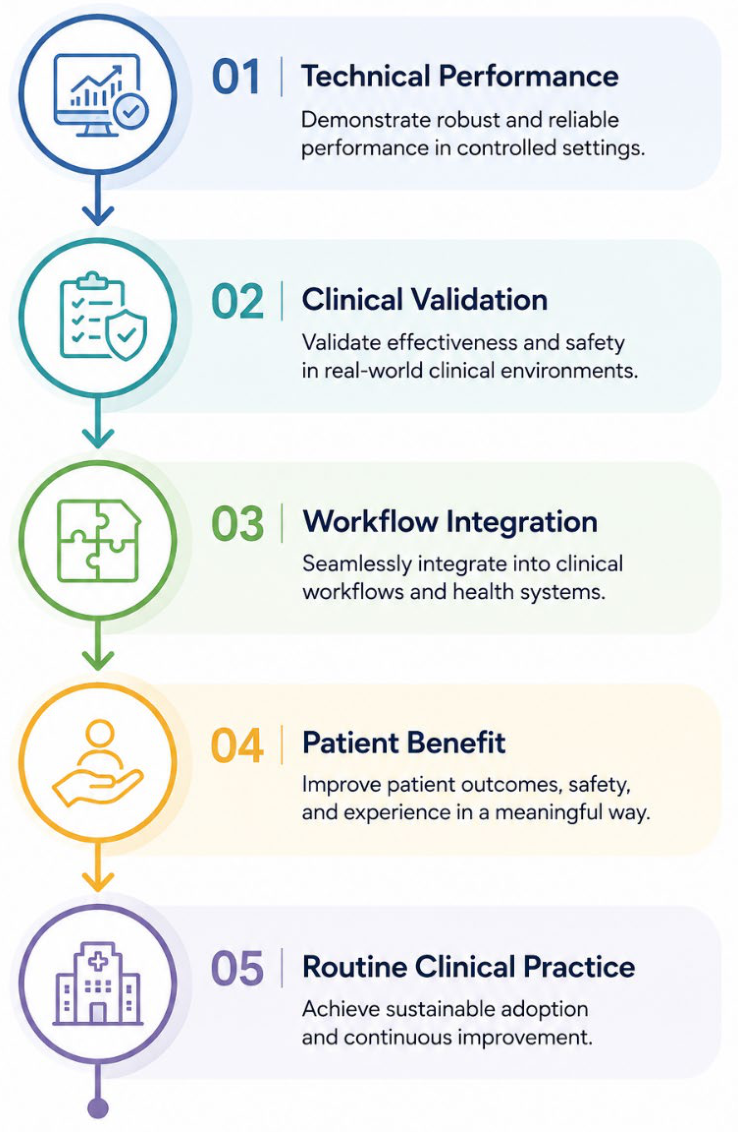
Evidence-informed conceptual framework describing the sequential transition of artificial intelligence from technological innovation to routine orthopaedic practice. The framework illustrates six progressive domains of clinical implementation: Innovation, Technical Performance, Clinical Validation, Workflow Integration, Patient Benefit, and Routine Orthopaedic Practice.
As illustrated in Figure 3, successful implementation of artificial intelligence extends far beyond algorithm development. High technical performance represents only the initial stage of translation, whereas sustainable clinical adoption requires external validation, integration into routine workflows, demonstration of patient benefit, and continuous quality improvement.
Across the included literature, AI technologies consistently progressed through five interconnected domains:
- Technical Performance
- Clinical Validation
- Workflow Integration
- Patient Benefit
- Routine Clinical Adoption
Importantly, these domains should not be interpreted as isolated milestones but as components of a continuous translational pathway.
Instead, successful adoption requires demonstration that AI systems:
- maintain performance across diverse populations;
- integrate efficiently into existing workflows;
- improve clinical decision-making;
- generate measurable patient benefit;
- satisfy ethical and regulatory requirements.
The ORION framework therefore provides a practical conceptual roadmap capable of assisting clinicians, researchers, healthcare organizations, regulatory agencies, and industry partners in evaluating implementation maturity and prioritizing future research.
Rather than functioning as a quantitative scoring system, ORION should be viewed as an evidence-informed translational framework describing how orthopaedic AI progresses from innovation toward routine clinical practice.
4.5. Toward Precision Orthopaedics
One of the most important observations emerging from this review is the progressive evolution of orthopaedic AI from isolated diagnostic algorithms toward integrated precision musculoskeletal care.[3,5]
Early AI applications were primarily designed to solve single clinical problems, such as fracture detection, osteoarthritis grading, implant recognition, or image segmentation. Contemporary studies, however, demonstrate a clear transition toward multimodal AI, integrating radiological imaging, electronic health records, laboratory investigations, biomechanical parameters, wearable sensor data, patient-reported outcome measures (PROMs), surgical navigation systems, and, increasingly, foundation models capable of synthesizing heterogeneous clinical information .[9,10]
This evolution reflects a broader paradigm shift within orthopaedics. Rather than supporting isolated diagnostic decisions, AI is progressively becoming part of a comprehensive digital ecosystem capable of assisting clinicians throughout the entire patient journey.[16,17]
In this context, the future of orthopaedic AI should not be viewed simply as “smarter algorithms,” but as the development of intelligent clinical ecosystems capable of integrating multiple sources of patient-specific information into individualized therapeutic strategies.[1,3,5]
Emerging technologies—including digital twins, federated learning, explainable AI (XAI), large multimodal foundation models, smart implants, wearable monitoring, and continuous-learning systems—may substantially accelerate this transition over the coming decade .
If successfully validated and responsibly implemented, these technologies may facilitate the transition from conventional evidence-based orthopaedics toward precision orthopaedics, where diagnostic, prognostic, and therapeutic decisions are increasingly individualized according to continuously updated patient-specific data.
4.6. Clinical Implications
The findings of the present review have several important implications for clinical practice.[2,3,16]
First, AI should currently be regarded as a clinical augmentation technology rather than an autonomous decision-maker.[6,9]
Across virtually every orthopaedic subspecialty, the literature consistently supports the role of AI in improving diagnostic consistency, reducing variability, increasing workflow efficiency, and assisting clinicians in complex decision-making. Nevertheless, none of the contemporary evidence supports replacing orthopaedic surgeons or musculoskeletal radiologists with autonomous AI systems .[1,5]
Second, the maturity of AI applications differs substantially between orthopaedic domains.
Applications involving fracture detection and musculoskeletal imaging have accumulated sufficient evidence to support carefully supervised clinical implementation, whereas applications involving multimodal decision support, rehabilitation, digital twins, predictive analytics, and autonomous surgical guidance should still be considered investigational.
Third, implementation strategies should emphasize clinician supervision, external validation, interoperability, explainability, regulatory compliance, and prospective evaluation of patient-centred outcomes before routine adoption.
These priorities were remarkably consistent across the included evidence syntheses and constitute the principal recommendations summarized in Table 6.
Finally, healthcare institutions considering implementation of AI technologies should recognize that successful adoption depends not only on algorithmic performance but also on organizational readiness, digital infrastructure, multidisciplinary collaboration, governance frameworks, and continuous quality monitoring.
4.7. Strengths
The present review possesses several important strengths.
Unlike previous reviews focusing on isolated AI applications or individual orthopaedic subspecialties, this study adopts a translational perspective, evaluating AI across the entire orthopaedic patient care pathway.
Second, the review synthesizes evidence derived from 21 contemporary high-level evidence syntheses, representing one of the most comprehensive overviews currently available regarding clinical implementation of AI in orthopaedics.
Third, evidence was systematically organized into complementary analytical domains, including:
- evidence characteristics;
- patient pathway;
- evidence landscape;
- clinical readiness;
- implementation barriers;
- implementation recommendations.
This structure enabled meaningful comparison between highly heterogeneous AI applications while maintaining emphasis on implementation rather than isolated algorithmic performance.
Finally, the principal contribution of this review is the development of the ORION Clinical Readiness Framework, which integrates recurring implementation themes identified across the contemporary literature into a single evidence-informed conceptual model.
4.8. Limitations
Several limitations should be acknowledged.
First, the present study represents a structured qualitative evidence synthesis rather than a quantitative meta-analysis. Consequently, pooled estimates of diagnostic accuracy were intentionally not calculated because of marked heterogeneity among AI methodologies, orthopaedic applications, validation strategies, and reported outcome measures.
Second, the available literature remains dominated by retrospective investigations and internally validated AI models, whereas prospective multicentre implementation studies remain relatively uncommon.
Third, considerable variability exists regarding reporting standards, external validation methodologies, AI architectures, and clinical outcome measures, limiting direct comparison between studies.
Finally, the ORION Clinical Readiness Framework represents an evidence-informed conceptual framework derived from recurring implementation patterns rather than a prospectively validated scoring instrument. Future studies should evaluate its reproducibility, interobserver reliability, and applicability across different healthcare systems and orthopaedic subspecialties.
4.9. Future Directions
The evidence synthesized in the present review consistently suggests that future orthopaedic AI research should progressively shift from improving algorithmic performance toward improving clinical implementation.[3,5]
Several priorities emerged repeatedly across the included literature.[1]
First, prospective multicentre validation should become the minimum standard before widespread clinical adoption.[16,17]
Second, future AI systems should incorporate explainable AI methodologies capable of improving clinician confidence, facilitating regulatory approval, and enhancing transparency. [3,5]
Third, interoperability between AI platforms and electronic health records, Picture Archiving and Communication Systems (PACS), robotic platforms, and wearable technologies should become a major research priority.
Fourth, future investigations should increasingly evaluate patient-centred outcomes, including functional recovery, quality of life, complication rates, healthcare utilization, patient satisfaction, and cost-effectiveness.
Finally, international collaboration will be essential for developing globally representative datasets capable of reducing algorithmic bias, improving external validity, and facilitating equitable implementation across diverse healthcare systems.[1]
5. CONCLUSION
Artificial intelligence has rapidly evolved from an experimental computational technology into a clinically relevant component of contemporary orthopaedic research, with applications extending across the entire patient care pathway, including diagnosis, surgical planning, intraoperative guidance, postoperative monitoring, rehabilitation, and long-term outcome prediction.[2,3,16]
Among all currently available applications, musculoskeletal imaging represents the most mature domain of implementation, supported by consistent evidence demonstrating high diagnostic accuracy and increasing integration into routine clinical workflows. In contrast, predictive analytics, multimodal decision-support systems, robotic platforms, rehabilitation technologies, and foundation models remain at earlier stages of clinical translation despite encouraging technical performance.[6,8,9,10]
The present review demonstrates that the principal challenge facing orthopaedic artificial intelligence is no longer algorithm development but successful translation into routine clinical practice. Across contemporary evidence syntheses, recurrent barriers—including limited external validation, heterogeneous datasets, workflow integration difficulties, algorithm interpretability, regulatory uncertainty, ethical governance, and insufficient prospective evidence demonstrating meaningful patient benefit—continue to delay widespread implementation.[1,5,17]
To address this translational gap, we propose the ORION Clinical Readiness Framework, an evidence-informed conceptual model describing the progressive transition from Technical Performance, Clinical Validation, Workflow Integration, Patient Benefit, and ultimately Routine Clinical Adoption. Rather than functioning as a quantitative scoring instrument, ORION provides a structured framework for interpreting implementation maturity, identifying translational barriers, and guiding future orthopaedic AI research.
Future advances in orthopaedic artificial intelligence will depend less on increasingly sophisticated algorithms and more on robust multicentre validation, standardized implementation strategies, explainable AI, responsible governance, interoperability with healthcare systems, and demonstration of measurable improvements in patient-centred outcomes.[1,3,5]
Ultimately, the future of orthopaedic artificial intelligence will be determined not by how accurately algorithms perform in experimental environments, but by how effectively they improve decision-making, patient outcomes, and healthcare delivery in everyday clinical practice.
Author Contributions
Conceptualization, R.D.N.G. and P.L.M.; methodology, R.D.N.G.; formal analysis, R.D.N.G. and P.L.M.; investigation, R.D.N.G.; data curation, R.D.N.G.; writing—original draft preparation, R.D.N.G.; writing—review and editing, R.D.N.G. and P.L.M.; supervision, P.L.M. All authors have read and agreed to the published version of the manuscript.
Funding
This research received no external funding.
Institutional Review Board Statement
Not applicable. This study is a narrative review of previously published literature and did not involve human participants or animals.
Data Availability Statement
No new data were created or analyzed in this study. Data sharing is not applicable to this article.
Acknowledgments
During the preparation of this manuscript, the authors used generative AI-based tools for language editing and formatting assistance. The authors have reviewed and edited the output and take full responsibility for the content of this publication. [Edit or replace with the specific tool(s) and purpose, or state that no GenAI tools were used.].
Conflicts of Interest
The authors declare no conflicts of interest.
References
- Mohammed, T.J.; Xinying, C.; Alnoor, A.; Khaw, K.W.; Albahri, A.S.; Teoh, W.L.; et al. A systematic review of artificial intelligence in orthopaedic disease detection: a taxonomy for analysis and trustworthiness evaluation. Int. J. Comput Intell. Syst. 2024, 17(1), 303. [Google Scholar] [CrossRef]
- Geda, M.W.; Tang, Y.M.; Lee, C.K.M. Applications of artificial intelligence in orthopaedic surgery: a systematic review and meta-analysis. Eng. Appl. Artif. Intell. 2024, 133, 108326. [Google Scholar] [CrossRef]
- Han, F.; Huang, X.; Wang, X.; Chen, Y.; Lu, C.; Li, S.; et al. Artificial intelligence in orthopedic surgery: current applications, challenges, and future directions. MedComm 2025, 6(7), e70260. [Google Scholar] [CrossRef] [PubMed]
- Tafat, W.; Budka, M.; McDonald, D.; Wainwright, T.W. Artificial intelligence in orthopaedic surgery: a comprehensive review of current innovations and future directions. Comput Struct. Biotechnol. Rep. 2024, 1, 100006. [Google Scholar] [CrossRef]
- Luo, G.; Tan, S.; Luo, L.; Hu, K. Artificial intelligence and multimodal imaging in orthopaedics: from technological advances to clinical translation. Front Med. 2026, 12, 1728248. [Google Scholar] [CrossRef] [PubMed]
- Husarek, J.; Hess, S.; Razaeian, S.; Ruder, T.D.; Sehmisch, S.; Muller, M.; et al. Artificial intelligence in commercial fracture detection products: a systematic review and meta-analysis of diagnostic test accuracy. Sci. Rep. 2024, 14(1), 23053. [Google Scholar] [CrossRef] [PubMed]
- Hansen, V.; Jensen, J.; Kusk, M.W.; Gerke, O.; Tromborg, H.B.; Lysdahlgaard, S. Deep learning performance compared to healthcare experts in detecting wrist fractures from radiographs: a systematic review and meta-analysis. Eur. J. Radiol. 2024, 174, 111399. [Google Scholar] [CrossRef] [PubMed]
- Gitto, S.; Serpi, F.; Albano, D.; Risoleo, G.; Fusco, S.; Messina, C.; et al. AI applications in musculoskeletal imaging: a narrative review. Eur. Radiol. Exp. 2024, 8(1), 22. [Google Scholar] [CrossRef] [PubMed]
- Longo, U.G.; Lalli, A.; Nicodemi, G.; Pisani, M.G.; De Sire, A.; D’Hooghe, P.; et al. Artificial intelligence demonstrates potential to enhance orthopaedic imaging across multiple modalities: a systematic review. J. Exp. Orthop. 2025, 12(2), e70259. [Google Scholar] [CrossRef] [PubMed]
- Oettl, F.C.; Zsidai, B.; Oeding, J.F.; Hirschmann, M.T.; Feldt, R.; Fendrich, D.; et al. Artificial intelligence-assisted analysis of musculoskeletal imaging: a narrative review of the current state of machine learning models. Knee Surg. Sports Traumatol. Arthrosc. 2025, 33(8), 3032–3038. [Google Scholar] [CrossRef] [PubMed]
- Sharma, A.C.; Azeem, A.; Omari, I.H.; Premkumar, A. Artificial intelligence for predicting postoperative complications in orthopedics: a review of clinical applications, challenges, and future directions. Cureus 2025, 17(12), e100254. [Google Scholar] [CrossRef] [PubMed]
- Schneller, T.; Kraus, M.; Schatz, J.; Moroder, P.; Scheibel, M.; Lazaridou, A. Machine learning in shoulder arthroplasty: a systematic review of predictive analytics applications. Bone Jt. Open. 2025, 6(2), 126–134. [Google Scholar] [CrossRef] [PubMed]
- Dijkstra, H.; Van De Kuit, A.; De Groot, T.; Canta, O.; Groot, O.Q.; Oosterhoff, J.H.; et al. Systematic review of machine-learning models in orthopaedic trauma: an overview and quality assessment of 45 studies. Bone Jt. Open. 2024, 5(1), 9–19. [Google Scholar] [CrossRef] [PubMed]
- Tian, C.; Chen, H.; Shao, W.; Zhang, R.; Yao, X.; Shu, J. Accuracy of machine learning in identifying candidates for total knee arthroplasty (TKA) surgery: a systematic review and meta-analysis. Eur. J. Med. Res. 2025, 30(1), 317. [Google Scholar] [CrossRef] [PubMed]
- Gupta, P.; Haeberle, H.S.; Zimmer, Z.R.; Levine, W.N.; Williams, R.J.; Ramkumar, P.N. Artificial intelligence-based applications in shoulder surgery leaves much to be desired: a systematic review. JSES Rev. Rep. Tech. 2023, 3(2), 189–200. [Google Scholar] [CrossRef] [PubMed]
- Dwajan, A.; Patro, D.R.; Agarwal, A.; Lalhmingmawii, M. Artificial intelligence in orthopaedics: clinical decision support, medical imaging, surgical planning, and outcome prediction. World J. Clin. Cases 2026, 14(17), 120192. [Google Scholar] [CrossRef]
- Georgiakakis, E.C.T.; Khan, A.M.; Logishetty, K.; Sarraf, K.M. Artificial intelligence in planned orthopaedic care. SICOT-J 2024, 10, 49. [Google Scholar] [CrossRef] [PubMed]
- Zhang, Z.; Hui, X.; Tao, H.; Fu, Z.; Cai, Z.; Zhou, S.; et al. Application of artificial intelligence in X-ray imaging analysis for knee arthroplasty: a systematic review. PLoS ONE 2025, 20(5), e0321104. [Google Scholar] [CrossRef] [PubMed]
- Kuo, R.Y.L.; Harrison, C.; Curran, T.A.; Jones, B.; Freethy, A.; Cussons, D.; et al. Artificial intelligence in fracture detection: a systematic review and meta-analysis. Radiology 2022, 304(1), 50–62. [Google Scholar] [CrossRef] [PubMed]
- Walters, S.H.; et al. Artificial intelligence in orthopedic trauma: a narrative review. Cureus 2026, 18(4), e107574. [Google Scholar] [CrossRef] [PubMed]
- Banskota, B.; Bhusal, R.; Yadav, P.K.; et al. Artificial intelligence in orthopaedic education, training and research: a systematic review. BMC Med. Educ. 2025, 25, 1594. [Google Scholar] [CrossRef] [PubMed]
Figure 1.
From Innovation to Patient Care: The Journey of Artificial Intelligence in Orthopaedics.
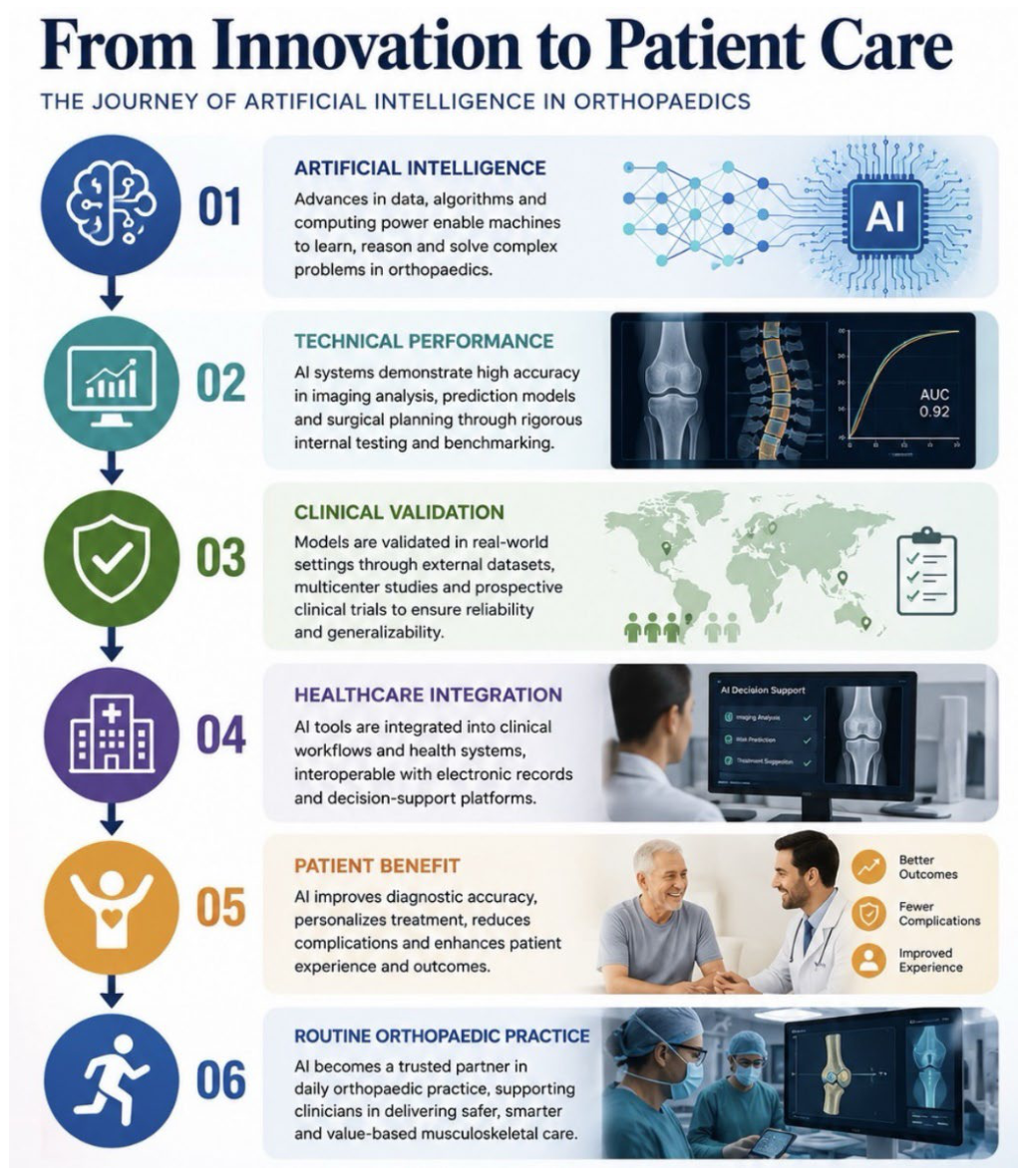
Figure 2.
Evidence Landscape of Artificial Intelligence Applications in Orthopaedics.
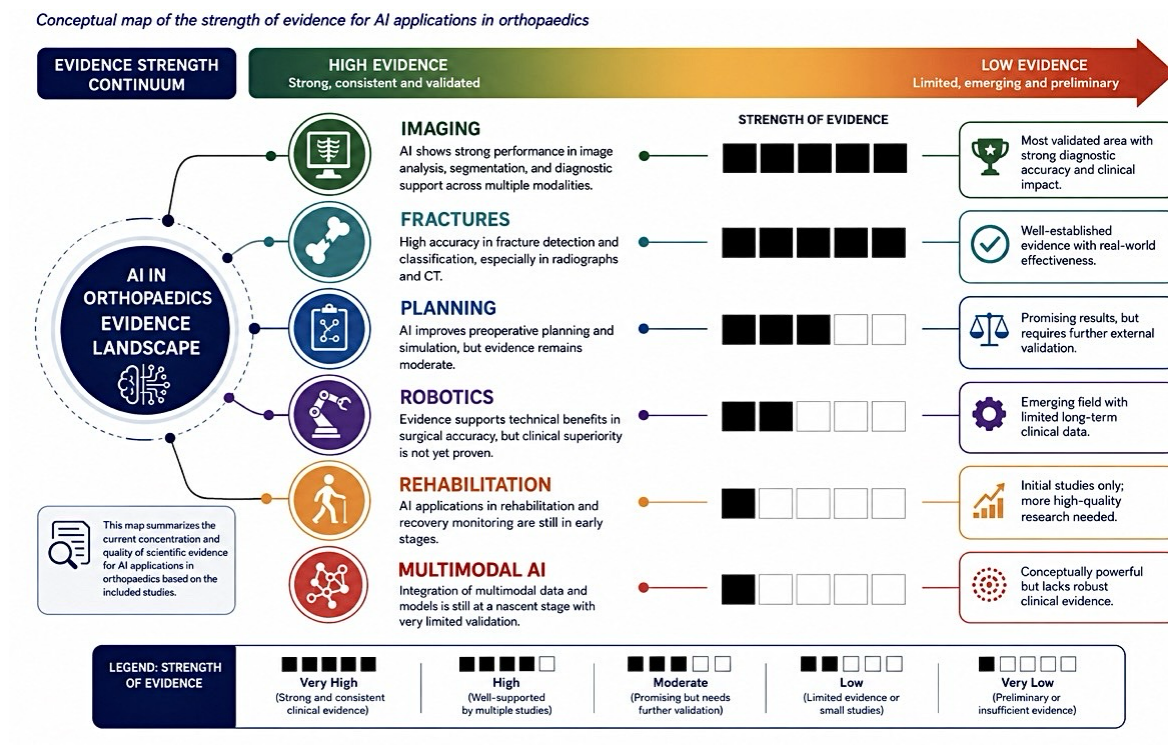
Table 3.
ORION Clinical Readiness Framework for Artificial Intelligence Applications in Orthopaedics.
Table 3.
ORION Clinical Readiness Framework for Artificial Intelligence Applications in Orthopaedics.
| Clinical Domain | Technical Performance | External Validation | Workflow Integration | Patient Outcome Evidence | Overall Clinical Readiness |
|---|---|---|---|---|---|
| Fracture Detection | Excellent | High | High | Moderate | Early Clinical Adoption |
| Musculoskeletal Imaging | Excellent | Moderate | High | Limited | Developing |
| Knee Arthroplasty Imaging | Excellent | Moderate | High | Limited | Early Clinical Adoption |
| Shoulder Arthroplasty | Good | Limited | Moderate | Moderate | Developing |
| Orthopaedic Trauma Prediction Models | Good | Limited | Limited | Limited | Emerging |
| Postoperative Complication Prediction | Excellent | Limited | Moderate | Moderate | Developing |
| General Orthopaedic Surgery | Excellent | Moderate | High | Moderate | Developing |
| Elective Orthopaedic Care | Good–Excellent | Limited | High | Moderate | Developing |
| Multimodal Imaging | Excellent | Limited | High | Moderate | Developing |
| Education & Surgical Training | Good–Excellent | Limited | Moderate | Indirect | Developing |
Table 5.
Evidence-Based Recommendations for Clinical Implementation of Artificial Intelligence in Orthopaedics.
Table 5.
Evidence-Based Recommendations for Clinical Implementation of Artificial Intelligence in Orthopaedics.
| Recommendation | Supporting Evidence | Expected Clinical Impact |
|---|---|---|
| Implement AI as a clinical decision-support tool rather than an autonomous system. | Husarek; Kuo; Han; Oettl; Sharma | Improves diagnostic accuracy while preserving clinician oversight and patient safety. |
| Require robust multicentre external validation before routine implementation. | Husarek; Dijkstra; Sharma; Walters; Gupta; Tian | Increases model generalizability and confidence across different healthcare settings. |
| **Integrate AI into existing |
Disclaimer/Publisher’s Note: The statements, opinions and data contained in all publications are solely those of the individual author(s) and contributor(s) and not of MDPI and/or the editor(s). MDPI and/or the editor(s) disclaim responsibility for any injury to people or property resulting from any ideas, methods, instructions or products referred to in the content. |
© 2026 by the authors. Licensee MDPI, Basel, Switzerland. This article is an open access article distributed under the terms and conditions of the Creative Commons Attribution (CC BY) license (http://creativecommons.org/licenses/by/4.0/).
Copyright: This open access article is published under a Creative Commons CC BY 4.0 license, which permit the free download, distribution, and reuse, provided that the author and preprint are cited in any reuse.