

Submitted:
13 July 2026
Posted:
15 July 2026
You are already at the latest version
Abstract
Gallai’s theorem states that whenever the Euclidean plane is colored with finitely many colors, every finite configuration of points admits a monochromatic homothetic copy. This paper presents a detailed exposition of a proof originally published by Ernst Witt in 1952 and subsequently expanded by Alexander Soifer. Additional intermediate steps are supplied throughout, yielding a self-contained and mechanically verifiable proof. The argument is formulated recursively through finite configurations associated with a double induction and thereby makes explicit the finite structures underlying the theorem.
Keywords:
Gallai’s theorem
; combinatorial geometry
; Euclidean Ramsey theory
; homothety
; finite colorings
MSC: 05D10; 52C10
1. Introduction
A theorem of Tibor Gallai (formerly Grünwald) states that if the points in the Euclidean plane are colored with finitely many colors, then for every finite subset of the plane there is a monochromatic homothetic copy of that set. A homothetic copy of a set is its image under first a dilation and then a translation. A monochromatic copy is one in which that every point receives the same color. Another way to state Gallai’s theorem is that for every finite subset X of the plane and every number k of colors, there is another finite subset Y of the plane, such that if Y is colored by k colors then Y contains a monochromatic homothetic image of X. (The two versions are equivalent by the compactness theorem for first-order logic.)
Gallai did not publish his result. (For an explanation and additional history, one should read both [1, Ch. 42] and [2, Ch. 46].) Gallai’s theorem was first mentioned in print by Richard Rado [3]. Reviewing Rado’s paper [3] for Mathematical Reviews, Erdos wrote, “the following result of T. Grünwald is used: given any configuration S consisting of a finite number of lattice points of Euclidean space, and given a distribution of all lattice points of this space into a finite number of classes, there is at least one class which contains a configuration of lattice points which is similar and parallel to S.”
I first heard about Gallai’s theorem in late 2012 from Jeremy Alm, who wrote and sent me a paper about extending Gallai’s theorem [4]. I became intrigued by the theorem, tried to prove it, and eventually consulted the reference in Jeremy’s paper, Alexander Soifer’s The Mathematical Coloring Book [1, §42.3]. Soifer presents an expanded account of the proof of Gallai’s theorem published by Ernst Witt in 1952 [5]. Reviewing Witt’s paper [5] for Mathematical Reviews, Erdos wrote, “The author was unaware of a paper by R. Rado in which it is stated that the result is due to T. Grünwald (Gallai).” Soifer thought Witt’s proof was incomprehensibly brief, so he added details but did not include the proof in the 2024 edition [2]. Soifer’s proof seemed incomprehensibly brief to me, so I added even more details, enough for a purely formal and mechanical confirmation of the proof.
The theorem and its proof are written for , but any power of can be substituted for . In fact, the proof applies with no changes to any ordered ring. The elements are called either points or vectors, depending on their use as either geometric or computational objects.
The theorem is proved in a slightly more precise formulation than the usual statement. From points , a number , and a number of colors a set is defined recursively in advance with the property that for any coloring of with k colors, contains a monochromatic homothetic copy of . The key idea, as in many combinatorial arguments, is to treat entire colorings as colors and to apply recursive coloring constructions within the inductive argument.
2. Definitions
Consider an arbitrary but fixed infinite sequence of distinct points in , where . For every integer let
For example, , , and . For every set X, is the number of elements of X, called the cardinality of X. The cardinality of is n, i.e., . For every positive integer k, a k-element set is a set X such that . A function from a set Y to a k-element set X is a k-coloring of Y. For any vector and any two sets , the sumset of v (or V) and W is the set (or ) of vectors obtained by adding v (or any vector from V) to any vector from W, that is,
Let H be the set of all functions such that, for some displacement vector and some positive dilation scalar , we have for every , where addition and scalar multiplication are performed componentwise. H is the set of homotheties from to , consisting of all compositions of translations and dilations, i.e.,
If and , then is the image of V under h, i.e.,
For any set and any , let be the union of the images of under those homotheties that map into V, i.e.,
For integers , , and , define sets by
For example, with , , and , we have by (3), so by (4),
There are three homotheties that map into , defined for all by and To check this, recall that . Hence since
If then
Since has 65 points by (3), there are homotheties mapping into , hence may contain as many as points, and may contain as many as .
For integers , , and , let be the statement that
for every k-coloring of , contains a monochromatic homothetic image of ,
and let be the statement that
for every k-coloring f of there are scalars and a vector such that
and if
whenever and , then
and
Theorem 1.
If , , and , then and .
- 1.
- ,
- 2.
- if then ,
- 3.
- if and then ,
- 4.
- if then .
To see that these statements are enough to establish the theorem, we lay out explicitly the initial inductive steps. By (1) we have
(a) for all .
- For any we get by (a) and (2) with . This proves
(b) for all .
- For any particular , we have by (b) not only but also , hence by (3) with . This proves
(c) for all .
- For any particular , we have by (c) and also by (b), hence by (3) with . This proves
(d) for all .
- The reasoning that leads from (c) to (d) can be repeated any finite number of times, leading (by induction) to the conclusion that
(e) for all and .
- As a set of particular cases of (e) we have for all . It follows by (iv) that
(f) for all .
- The deduction from (a) to (f) is just the first step (from to ) in an inductive proof that
(g) for all and all .
- Note that (g) is the usual statement of Gallai’s theorem, but the statement we have given above incorporates all the statements about that were mentioned in the exposition of the double induction.
3. Proof of for
Assume . Since , definition (3) implies that
Assume that f is a k-coloring of . We must show that contains a monochromatic homothetic image of . From it follows that the number of points in is , one more than the number of colors, so there are (at least) two points in that get the same color, say for some such that . Define h by for all . Then since and h maps to because
This homothetic image is monochromatic because .
4. Proof of from , , and
Assume , , and f is a k-coloring of . By the inductive assumption , contains a monochromatic homothetic image of , so there is some such that
From (7), the definition of , and definition (4), it follows that
To conclude that , we must find and such that , , and , where
whenever . It suffices to let and a be the dilation scalar and displacement vector associated with h, for then and the two desired equations are (8) and (9).
5. Proof of from and
Suppose f is a k-coloring of . By definition (5), f assigns a color to every vector obtained by adding a vector from to a vector in . Therefore, for every , we may let be the k-coloring of defined by
This gives us a new coloring that assigns each vector to an element of the set of k-colorings of , a set whose cardinality is . Thus is a -coloring of . From the inductive hypothesis , applied to the coloring , we know there are and such that and, defining by
we have
From the inductive hypothesis , applied to the k-coloring , we know there are and such that
and, assuming
we have
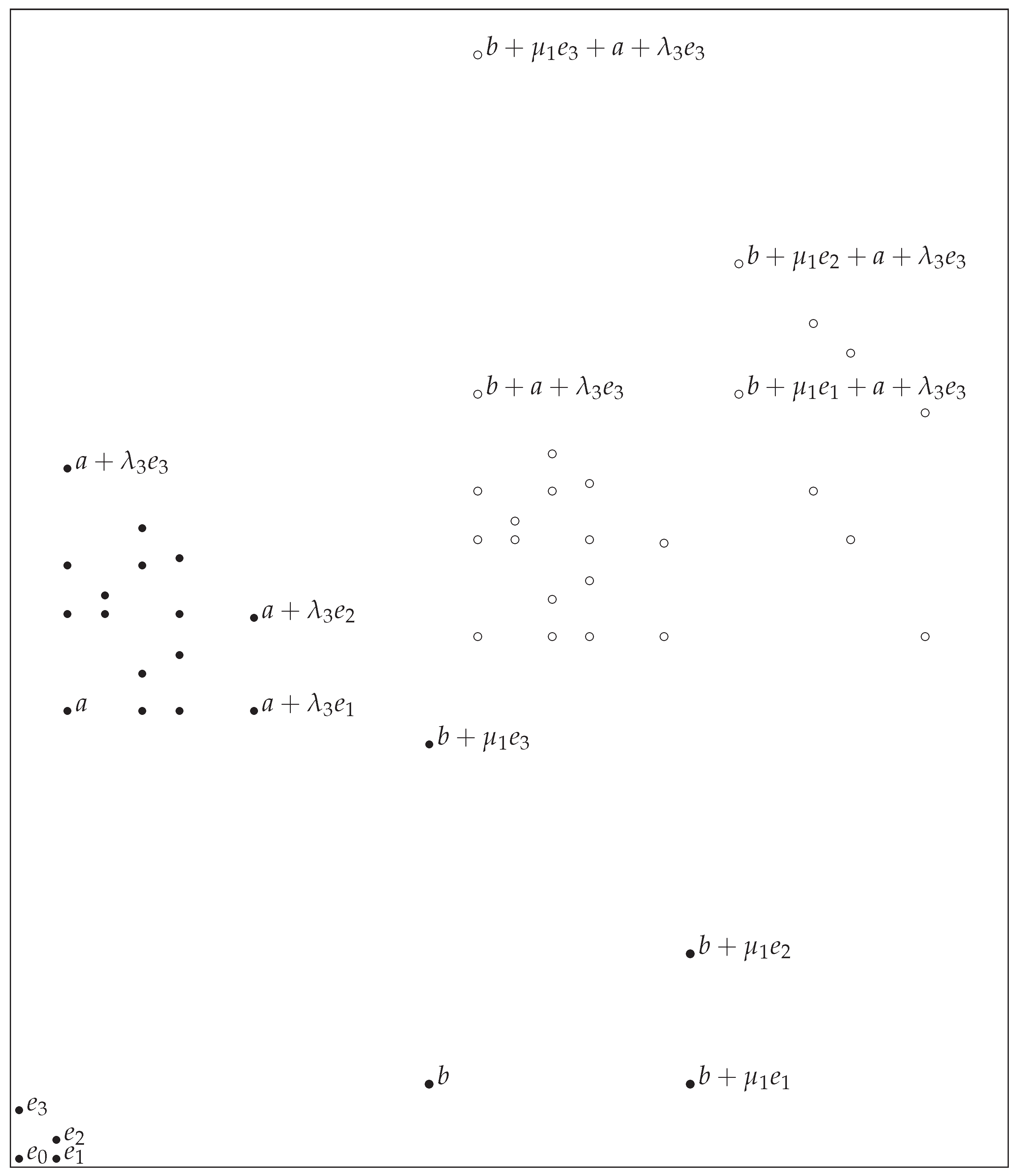
Figure 1 illustrates this construction for the case ; the values are chosen only to make the recursive geometry visible in a nondegenerate example.
Next we prove that if , , and , then
Proof of (18): If , then and, by (11), and , hence so from (13) we conclude that . This holds whenever , so by (10), we obtain (18).
Proof of (19): If and then and, by (15) applied with , we have
These two vectors are in by (16) and get the same color from by (17) with , i.e.,
Now (19) follows from this equation by (10) with .
6. Proof of from
Since , we need only show that contains a monochromatic homothetic image of , assuming f is a k-coloring of . From the inductive hypothesis , we know there are and such that and if
whenever and , then and . Let’s look at the images of and under all these homotheties with . We have
and, since ,
The set of images of is
The set of images of is
The union of these two sets, namely
is a -element set, to which are assigned only k colors. Two elements receive the same color, hence there are such that and
However, and , so
Of course, we already know , so this last equation tells us, since , that also receives the same color as all the other elements of . But , so in fact we have shown . We also know that , so we conclude that does indeed contain a monochromatic homothetic image of .
7. Concluding Remarks
Gallai’s theorem, a central result in Euclidean Ramsey theory, can be simply deduced as a consequence of the Hales-Jewett theorem, but the purpose here has been a detailed analysis of Witt’s proof, assuming nothing more than the properties of an ordered ring. The key steps and constructions have been isolated in the recursive definitions of the sets and and the statements and . These may make Gallai’s theorem more accessible and could form the basis of further formalization, generalization, or upper-bound estimates for the numbers of points required for monochromatic copies to occur.
Funding
This research received no external funding.
Conflicts of Interest
The author declares no conflicts of interest.
References
- Soifer, A. The mathematical coloring book; Springer, New York, 2009; pp. xxx+607. Mathematics of coloring and the colorful life of its creators, With forewords by Branko Grünbaum, Peter D. Johnson, Jr. and Cecil Rousseau.
- Soifer, A. The new mathematical coloring book—mathematics of coloring and the colorful life of its creators, second ed.; Springer, New York, 2024; pp. xlviii+841. With forewords by Peter D. Johnson Jr., Geoffrey Exoo, Branko Grünbaum and Cecil Rousseau, . [CrossRef]
- Rado, R. Note on combinatorial analysis. Proc. London Math. Soc. (2) 1943, 48, 122–160. [CrossRef]
- Alm, J.F. An infinite cardinal version of Gallai’s theorem for colorings of the plane. J. Comb. 2014, 5, 445–452. [CrossRef]
- Witt, E. Ein kombinatorischer Satz der Elementargeometrie. Math. Nachr. 1952, 6, 261–262. [CrossRef]
Figure 1.
Illustration of the construction used in the proof of for the case , with values chosen to get several levels in the same figure. Here , , , , , , , , , , and .
Figure 1.
Illustration of the construction used in the proof of for the case , with values chosen to get several levels in the same figure. Here , , , , , , , , , , and .
Disclaimer/Publisher’s Note: The statements, opinions and data contained in all publications are solely those of the individual author(s) and contributor(s) and not of MDPI and/or the editor(s). MDPI and/or the editor(s) disclaim responsibility for any injury to people or property resulting from any ideas, methods, instructions or products referred to in the content. |
© 2026 by the author. Licensee MDPI, Basel, Switzerland. This article is an open access article distributed under the terms and conditions of the Creative Commons Attribution (CC BY) license.
Copyright: This open access article is published under a Creative Commons CC BY 4.0 license, which permit the free download, distribution, and reuse, provided that the author and preprint are cited in any reuse.