

Submitted:
09 July 2026
Posted:
15 July 2026
You are already at the latest version
Abstract
A widely held assumption in cross-embodiment robot learning is that morphologically similar robots transfer behavior more easily, so a similarity measure, a learned transferability predictor, or a sufficiently diverse pretraining set should predict or improve transfer. We test this assumption under an enforced acceptance gate, requiring every claim to beat its strongest trivial baseline by a margin whose bootstrap 95% confidence interval excludes that baseline on independent units, and we refute it four ways. A morphology-distance predictor fails to beat a target-only prior, with Spearman rho = 0.283 versus 0.579 over 42 independent pairs. A transferability oracle trained on full morphology features, with rho = 0.762 over 29 robots, fails to beat a one-bit arm/not-arm indicator, which reaches 0.834; it predicts robot class, not morphology. On the 812-pair suite there is no transfer law; the mean gain is +0.8 percentage points, within-target variation across sources is under-dispersed relative to evaluation noise, with variance ratio 0.53, and every candidate pairwise predictor has a confidence interval spanning zero. The apparent benefit of pretraining diversity vanishes once total data volume is held fixed, with Delta = -0.026 and CI [-0.092, +0.034]; breadth never beats depth at any tested budget. A same-body control shows the assay detects transfer when present, with Delta = +0.067 and p = 0.0006, and a morphology-equivariant graph policy attains zero-shot transfer that distance still fails to grade. The outcome level is set by the target's own trainability and raw data volume; short of exact body identity, no measured relation between bodies moves it.
Keywords:
cross-embodiment policy transfer
; morphology-distance predictors
; transferability oracles
; target-only priors
; data-volume control
; embodiment diversity
; frozen-core transfer
; robot learning evaluation
1. Introduction
Reusing behavior across robots of different morphologies, commonly called cross-embodiment transfer, is a central goal of generalist robot learning [1,2,3,4]. The field’s working hypothesis is intuitive and nearly ubiquitous. Closer morphologies should transfer better, so a measure of morphological similarity ought to predict transfer success and tell a practitioner which source robot to transfer from. The same intuition motivates morphology-aware architectures that condition the policy on the body [5,6,7], transferability oracles that regress transfer gain from model-derived features, and diversity-maximizing data collection [8]. We set out to build such a predictor and did not find one. Under controlled evaluation, none of these levers survives once the obvious trivial baselines are reported and pseudo-replicated seeds are collapsed to independent units.
Every headline here is certified by an enforced acceptance gate. A claim passes if and only if it beats its strongest applicable baseline by a margin whose bootstrap 95% confidence interval excludes that baseline, on independent units, on a task for which morphology demonstrably matters. Four results are rows of the gate program itself; two are findings certified under the same interval discipline. A number that fails the gate is reported as the boundary the data supports. The paper makes four contributions.
- 1.
- We refute the similarity hypothesis four ways, showing that none of morphological distance, source-to-target alignment, or pretraining diversity predicts or improves frozen-core behavior-cloning transfer across distinct robots (Section 4.1 to Section 4.4). The outcome tracks the target’s own from-scratch trainability, and the only variable that moved the diversity curve was raw data volume.
- 2.
- We contribute a benchmark, a 29-morphology frozen-core pairwise transfer suite (812 ordered pairs) together with a morphology-dependent MuJoCo MJX locomotion task on which body demonstrably matters (Section 3).
- 3.
- We contribute a measurement protocol comprising the acceptance gate, a data-volume control for diversity claims, and a rule that collapses pseudo-replicated seeds to independent units before any interval is computed.
- 4.
- We contribute two controls, a same-body experiment showing the assay detects transfer when present (Section 4.6) and an equivariant graph-policy experiment showing the negative is not an artifact of a body-agnostic architecture (Section 4.7).
The benchmark, the gate program, the raw per-pair results, and the analysis code that regenerates every number reported here are released as a public repository.
The thesis, stated exactly, is this. Across distinct robots, cross-embodiment behavior-cloning transfer is not predicted by morphological similarity, source-to-target alignment, or pretraining diversity; the outcome is essentially a target property, the target’s own from-scratch trainability, which a different source barely improves, and the apparent diversity benefit is raw data volume rather than a source-to-target relation. A controlled negative is useful precisely where the assumption it refutes drives decisions, as the similarity assumption does when it selects source robots, motivates architectures, and justifies data collection. Companion papers develop the constructive direction. One shows that any sufficiently informative continuous task interface retains body-identifying structure, so an interface supporting cross-embodiment reuse must be coarse [9]; a second shows that a deliberative architecture built on a coarse symbolic progress state passes the same gate that every similarity-keyed lever fails [10]; a third develops the measurement standard [11].
2. Related Work
Generalist multi-robot learning treats a new embodiment as an engineering problem rather than a prediction problem. Open X-Embodiment and RT-X [1], CrossFormer [2], and [3,12], and GR00T N1 [4] all absorb a new robot by one recipe, mapping every body into a shared action space, attaching per-embodiment adapters, and fine-tuning on the target, and none of them predicts whether a given transfer will succeed. Visual transfer learning does have cheap estimators of fine-tuning benefit, such as LogME [13] and LEEP [14]; robotics has no counterpart, and the natural robotics analogue we construct in Section 4.2 turns out to measure a robot-class prior.
A long line of work instead builds the body into the policy, from modular and graph policies [15,16] through morphology-token transformers [5] and morphology-inferring encoders [6] to unified multi-embodiment locomotion architectures [7]. Recent benchmark evidence finds such agents near zero success on out-of-distribution morphologies, with high train-test similarity not helping [17], while morphology-structured attention has been reported to help a -class model [18]. We measure the complementary questions, whether morphology features carry any pairwise transfer signal under enforced baselines, whether input-feature conditioning helps at matched data, and whether an equivariant architecture makes distance predictive; within our protocol’s scope all three answers are negative.
Zero-shot cross-embodiment manipulation was reached in the first half of 2026 by several systems sharing one move. RDT2 trains on body-agnostic handheld-gripper data [19], LAP codes actions in language [20], Cloak masks the end-effector out of the observation [21], KITE decouples task reasoning from motor control through a contact-intent latent [22], and the earlier Mirage cross-painted the gripper visually [23], a narrow geometric proxy of the same idea. Each deletes body information from the interface between task reasoning and motor control, within gripper-class action spaces; none predicts transfer or grades it by similarity. Our negatives explain why similarity was not the route taken, and the companion theory paper gives the structural reason the successful interfaces are coarse [9].
Whether embodiment breadth or raw data volume drives multi-embodiment pretraining remains disputed. Embodiment-scaling work in locomotion reports breadth beating data [8], but its data-scaling arm does not hold total training volume constant; volume-matched studies in manipulation find embodiment diversity optional [24], and structured pairing beats raw diversity scaling [25]. Section 4.4 contributes the budget-matched grid for goal-directed transfer.
Our measurement protocol joins a broader movement toward statistically sound robot-policy evaluation [26,27,28,29,30] and draws on the shortcut-learning, reproducibility, pseudoreplication, and probing literatures [31,32,33,34,35,36,37]. That wave does not cover the confound set specific to cross-embodiment claims, class priors masquerading as morphology signal, diversity confounded with volume, and pair-seed pseudo-replication; those checks are operationalized here and developed fully in the companion standard [11].
3. Benchmark and Protocol
3.1. Morphologies and Features
The benchmark spans 29 heterogeneous robots from the MuJoCo Menagerie model set, in three classes. Table 1 lists the composition; fixed-base manipulators are the largest class with 14 robots, joined by seven quadrupeds and eight humanoids or bipeds, with robot names as in the benchmark’s feature registry, and the pairwise suite evaluates all ordered cross-morphology pairs among them. Each morphology is summarized by a 13-dimensional feature vector, nine scalar descriptors (degrees of freedom, total mass, maximum payload, action dimension, sensor-modality count, kinematic-chain depth, workspace volume, maximum joint velocity, actuation frequency) plus a four-way base-type one-hot. Morphology distance is the Euclidean distance between normalized feature vectors; the discrete, symbolic class-match is the indicator that source and target share a task-decomposition class.
3.2. Frozen-Core Transfer and the Transfer Gain
We study frozen-core behavior-cloning transfer. The architecture has a per-morphology encoder, a shared trunk with a skill embedding (the transfer-bearing parameters), and a per-morphology head. To transfer, the source’s trunk and embedding are loaded into the target actor and frozen, and the target’s encoder and head are fine-tuned on target demonstrations. The central quantity is the transfer gain
where the scratch baseline trains the same architecture on the same demonstrations with no source, isolating the shared core’s benefit from the target’s intrinsic difficulty. Unless noted, and success is evaluated over episodes; a conditioned variant concatenates the target’s feature vector into the trunk and is used with multi-source pretraining in Section 4.4. The similarity hypothesis then makes a sharp, falsifiable prediction, with a bootstrap confidence interval excluding zero.
3.3. The Acceptance Gate
The benchmark’s defining artifact is an enforced acceptance gate, an executable program with a fixed rule. A claim passes if and only if it beats its strongest applicable baseline by a margin whose bootstrap 95% confidence interval excludes that baseline, computed on independent units, on a morphology-varying task. The strongest baselines are the trivial alternatives the similarity hypothesis must beat, namely the target-only prior (predict from the target’s features alone), scratch-only (predict it from the target’s from-scratch difficulty), the class bit (a single arm/not-arm indicator), and the within-class test (does a signal survive removal of the coarse class split). For each headline the gate recomputes the metric, runs the baseline, bootstraps the difference of rank metrics by resampling units while holding the fitted models fixed, and emits a verdict. The gate evaluates nine claims, the four designed negatives of this paper, four positives belonging to the companion papers [9,10,11], and one interface contrast that is suggestive at arms but does not reach the exact sign-flip criterion the gate imposes at that sample size.
3.4. Statistical Protocol
Three rules govern every number reported here. Pseudo-replicated seeds are aggregated to independent units before any interval is computed, because treating three seeds of one pair as three observations understates every interval [34]. Any claim that more diverse pretraining helps must hold the total data budget fixed while varying diversity, because adding source bodies ordinarily adds episodes. And invariance claims about learned representations must be certified against the strongest probe an adversary could field [36,37]; this paper needs the third rule only indirectly, and the companion papers quantify it [9,11].
4. Results
Section 4.1 through Section 4.5 test the six claims in turn, Section 4.6 and Section 4.7 report the two controls, and Table 4 in Section 4.8 collects the verdicts.
4.1. Morphology Distance Does Not Beat the Trivial Target Prior
The natural first predictor is a similarity-aware transfer index (SATI), a regressor from the feature difference of a source-target pair to that pair’s measured transfer gain, evaluated leave-one-pair-out on a seven-morphology campaign spanning arms, quadrupeds, and a humanoid. The gate compares it against the target-only prior, an identically trained regressor that sees only the target’s features. The distance predictor reaches Spearman ; the prior reaches . The claim fails the gate. At the pair level the gap is with bootstrap 95% interval over independent pairs, and an independent bootstrap implementation gives .
That interval invites a stronger directional reading, namely that distance is significantly worse than the prior, and the design does not support it. Pairs sharing a target are correlated because the prior is fit per target, and the 42 ordered pairs cluster into seven targets and seven morphologies; under a target-cluster bootstrap the gap interval is , under a morphology-cluster bootstrap , both spanning zero. The supported conclusion is the weaker one. Distance fails to beat the target prior and is likely worse. The experiment also illustrates the independent-units rule; the campaign produced 126 pair-seed rows, and collapsing them to the 42 independent pairs widens the interval exactly as a correct interval should, leaving the verdict unchanged.
4.2. The Transferability Oracle Predicts Robot Class, NOT morphology
The practitioner’s dream tool is an oracle mapping a never-before-seen morphology’s features to the transfer gain it will obtain. For each of the 29 robots, a leave-one-morphology-out experiment trains the shared conditioned policy on the other 28 and measures the held-out robot’s few-shot success and from-scratch baseline over three seeds. A random-forest regressor from the 13 features to this transfer gain reaches , and Table 2 shows the nearby model classes scoring similarly (ridge 0.749, kNN 0.731, gradient boosting 0.741); this is the headline an evaluation without its baselines would report.

Table 2.
Leave-one-morphology-out prediction of transfer gain over the 29-robot suite.
| Predictor | Held-out Spearman | Notes |
|---|---|---|
| Full morphology features (RF) | 0.762 | ridge 0.749, kNN 0.731, GBR 0.741 |
| Scratch-only difficulty (RF) | 0.697 | same LOO protocol |
| Arm/not-arm class bit | 0.834 | strongest trivial baseline |
| Within-arm, full features | manipulators | |
| Within-arm, best of nine variants | CI | |
| Oracle minus class bit | 95% CI , fails the gate |
It does not survive its baselines. A single arm/not-arm bit reaches , and the gate’s bootstrap comparison against this strongest baseline, the final row of Table 2, puts the oracle-minus-baseline gap at with 95% CI , spanning zero; a scratch-only difficulty model reaches under the same protocol. Within the manipulator class the signal vanishes or reverses, as the two within-arm rows of Table 2 record; the full feature set scores across the 14 arms, and the best of nine regressor-feature combinations reaches only with CI . The mechanism is transparent. Transfer gain approximately equals the task ceiling minus scratch difficulty, and scratch difficulty is set by class; arms start near a 0.12 from-scratch floor and gain most from the shared core (mean ), while locomotors start near 0.62 and gain almost nothing (mean ). The oracle predicts which class a robot belongs to and how hard its task is, not how well a specific source’s morphology transfers.
4.3. There Is No Pairwise Transfer Law
The stronger question is whether any pairwise quantity could predict transfer on this substrate. On the full suite of 812 ordered pairs the answer is no, and Figure 1 carries the three parts of the argument, the magnitude of transfer (panel a), its variance structure (panel b), and the predictor tests (panel c).
First, transfer barely happens. Figure 1a shows the distribution of transfer gain across the ordered cross-morphology pairs. Mean transfer gain is percentage points (standard error 0.19), the median is exactly zero, only 5% of pairs exceed , and none exceeds ; mean success after transfer (0.354) is practically the mean success from scratch (0.346), and the mean gain is distinguishable from zero only because . Frozen-core single-source policies essentially do not port across bodies.
Second, within-target source variation is statistically zero. The design has one seed per pair, a scratch baseline shared across the 28 pairs of each target, and paired evaluation on the same 50 episodes, so the decisive test is a dispersion test comparing the variance of transfer success across each target’s 28 sources to the binomial noise expected at that target’s success rate. The pooled variance ratio is 0.53 (median 0.09), so the data are under-dispersed, and the test finds no overdispersion (, , ; two of 29 targets exceed a ratio of 1.5). No functional form, learned or otherwise, could predict pair-level transfer here. Consistently, the variance decomposition in Figure 1b shows that source and target identity together explain only 39% of transfer-gain variance (target main effect 35.4%, source 3.4%), the remaining 61.2% being the pair interaction conflated with single-seed measurement noise, which the dispersion test identifies as noise.
Third, nothing predicts the residual. Figure 1c plots every candidate pairwise predictor against raw transfer gain and against the pair-interaction residual, each with its bootstrap 95% interval. Against raw transfer gain, continuous morphology distance gives (CI ), the discrete symbolic class-match (CI ), and target learnability (CI ); against the pair-interaction residual, distance gives and class-match , both spanning zero. Because pairs share morphologies these intervals are if anything too narrow, which makes a null conclusion conservative.
4.4. Pretraining Diversity Is a Data-Volume Effect
A separate experiment produced what looked like a diversity scaling law. Few-shot transfer to a held-out morphology rises with the number of pretraining source morphologies k, for example from 0.57 to 0.94 on a held-out panda and from 0.75 to 0.94 on a held-out ur10e, shown as the solid curves of Figure 2a. But k sources supply k times the episodes, so the curve confounds diversity with volume. The control fixes the total source budget at episodes split across k morphologies (60×1 through 10×6), with a few-shot target budget of 20 episodes, seven held-out morphologies, and three seeds.
Once volume is controlled the diversity effect vanishes, shown as the dashed curves of Figure 2a. The mean change from to is with 95% CI , and the mean Spearman correlation between k and accuracy is . Per-morphology changes are small for the quadrupeds and the humanoid (go2 , anymal_c , spot , g1 ) and negative on average for the arms (ur5e , ur10e , panda ; mean ); no per-class interval is possible at arms, so the arms reading is descriptive. The gate also scores the uncontrolled curve itself as a scaling-law claim on the 30-morphology suite and fails it on flatness grounds, with four of seven held-out curves flat (range below 0.06), mostly a task ceiling (Table 4, row 5).
Because a single budget invites the objection that the result is budget-specific, we ran the full grid, crossed with . Table 3 reports mean few-shot success over the seven held-out morphologies and two seeds in each cell, together with the bootstrap 95% interval of the breadth-minus-depth difference over held-out morphologies, and Figure 2b plots the same grid. Breadth minus depth is , , and at , 60, and 120, never positive, and the deficit grows with the budget; the more total data, the more it pays to concentrate it. The uncontrolled comparison over the same grid rises by only on the heterogeneous average, and the per-class structure is the tell; for arms, budget-matched breadth minus depth is even though the uncontrolled curve rises mildly (), while quadrupeds () and the lone humanoid sit near a task ceiling. This is the budget-matched, goal-directed counterpart to locomotion embodiment-scaling comparisons whose data-scaling baseline does not hold total volume fixed [8], and it agrees with volume-matched manipulation findings [24].
Table 3.
Budget-matched breadth versus depth, with total source episodes T fixed and split across k source morphologies.
Table 3.
Budget-matched breadth versus depth, with total source episodes T fixed and split across k source morphologies.
| Budget | breadth − depth | 95% CI | |||
|---|---|---|---|---|---|
| 0.436 | 0.377 | 0.426 | |||
| 0.510 | 0.480 | 0.486 | |||
| 0.521 | 0.480 | 0.459 |
A companion 108-policy study comparing morphology-conditioned against morphology-blind training on procedurally generated quadruped families supports the same conclusion. A pooled paired reanalysis over 48 conditioned-versus-blind pairs finds no in-distribution benefit on the robust walking-fraction metric (held-out , ; full-range , ), together with a borderline positive difference on bodies scaled beyond the training range (, ; Wilcoxon ). Because that contrast was identified post hoc, we ran a pre-registered confirmation on a consistent-physics family, with design and primary endpoint frozen before the confirmatory seeds existed ( paired seeds). It did not replicate (primary , opposite in direction, ), so the conditioning null stands in every regime tested, strengthened by having survived a pre-registered attempt to overturn it. Mean-reward secondaries are nominally significant (full-range at , extrapolation at ) but are excluded by the frozen primary-endpoint rule, mean reward being confounded by the fall penalty on this substrate. The negative concerns input-feature conditioning at matched data on one topology family; architecture-level morphology embeddings [18] are outside its scope.
4.5. A Morphology-Dependent Locomotion Task Confirms the Pattern
A natural objection is that frozen-core behavior cloning might be the wrong substrate, or the tasks insufficiently morphology-dependent. We therefore re-ran the central test on a joint-space locomote-to-target task in MuJoCo MJX for which body demonstrably matters; from-scratch success spans 0.19 (go2), 0.26 (a1), 0.43 (go1), and 0.83 (anymal_c), so a morphology effect has room to appear. Figure 3a plots each pair’s three-seed mean transfer gain against morphology distance, with the fitted trend dashed; distance against transfer gain gives over independent pairs, with 95% CI . The interval includes zero, and the point estimate has the sign the similarity hypothesis forbids. Two qualifications bound what this experiment can say. A variance-components analysis (12 pairs, 3 seeds) gives at , so pair-level signal is neither established nor excluded, and at the minimum correlation detectable at 80% power is ; the load-bearing evidence for the no-law conclusion is therefore the 812-pair suite, with this experiment closing the task-dependence loophole. An analysis over the 36 pair-seed rows yields an interval that excludes zero; collapsed to the 12 independent pairs it does not, a second instance of the independent-units rule.
4.6. The Assay Detects Transfer When It Is There
A negative result carries weight only if the assay could have detected the effect, so a same-morphology control asks whether it does. On a fixed three-arm suite (ur5e, ur10e, panda) in a deliberately low-data regime (, 90 transfer runs), transferring a source trained on morphology X back to the same X is compared against transferring to a different morphology. Same-body transfer gain is against cross-body , and the per-seed paired test is decisive (, , , all ten seeds positive). Figure 3b draws one thin line per training seed from its mean cross-body gain to its mean same-body gain, with the mean over seeds in bold, and every line rises. The unit is the training seed on a fixed suite, a disclosed exception to the independent-units rule scoped to assay sensitivity; aggregated to morphology units the differences are ur5e , ur10e , panda , three of three positive with at , so the conclusion rests on seed-level replication. The pipeline is therefore sensitive; an exact body match produces a real, easily detected advantage. What it does not detect anywhere is a graded effect of proximity short of identity, and the same-body bonus is plausibly in part a same-task effect, since the source was trained on the identical target task.
4.7. An Equivariant Graph Policy Does Not Rescue Distance
A remaining loophole is architectural; the frozen-trunk architecture discards the source body by construction, so perhaps a policy in which morphology enters by design would recover graded transfer. A morphology-equivariant message-passing policy over the robot’s kinematic graph, one weight set shared across all bodies in the spirit of graph-based controllers [15,16], tests this on 13 fixed-base arms with three seeds under leave-one-morphology-out evaluation. The architecture adds a genuine capability, nonzero zero-shot success on held-out arms it never trained on, with three-seed mean 0.120 (per seed 0.142, 0.113, 0.104), where the per-morphology baseline gives exactly zero because no encoder exists for an unseen body. Figure 3c plots this zero-shot success against each held-out arm’s distance to the nearest training morphology, with marker shape distinguishing the three seeds.
Morphological distance still fails to grade that transfer. Across seeds, the correlation between zero-shot success and mean distance to the training set is , , and , and against nearest-neighbor distance , , and ; Figure 3d shows each per-seed estimate with its bootstrap 95% interval, and the estimates are sign-unstable with every interval spanning zero. At arms each per-seed test is powered only against large effects (), and the protocol differs from the frozen-core setting (a twelve-source pooled policy evaluated zero-shot, versus single-source transfer with adaptation). Within that scope, building the body into the policy changes what is possible, enabling zero-shot execution, without making distance predictive.
4.8. Summary of the Certified Claims
Table 4 collects the six tested claims, each with its metric, its strongest baseline, the bootstrap 95% interval of the claim-minus-baseline gap on independent units, and its verdict; four verdicts are rows of the gate program, and two are findings certified under the same interval discipline. Row 3 summarizes the three primary predictors of Section 4.3, and row 5 applies the gate’s flatness criterion, four of seven held-out curves flat against an allowance of one third. Six tests of the similarity, alignment, and diversity hypotheses produce six failures. Target trainability bounds the outcome level, since success after transfer approximately equals success from scratch, yet it does not predict the small percentage-point gain (, interval spanning zero), and the diversity gain is volume. There is no pull-able source-side lever in this design space.
Table 4.
The six tested claims of the similarity, alignment, and diversity hypotheses, each scored against its strongest baseline on independent units.
Table 4.
The six tested claims of the similarity, alignment, and diversity hypotheses, each scored against its strongest baseline on independent units.
| # | Tested claim | Metric | Strongest baseline | Gap 95% CI | n | Verdict |
|---|---|---|---|---|---|---|
| 1 | Distance predicts transfer | target prior, | 42 | fails (gate) | ||
| 2 | Features predict gain (oracle) | class bit, | 29 | fails (gate) | ||
| 3 | A pairwise transfer law exists | zero correlation | all | 812 | fails (CI finding) | |
| 4 | Diversity is a transfer lever | volume control, 0 | 7 | fails (CI finding) | ||
| 5 | Uncontrolled curve is a law | range | flat-ceiling test | 4/7 flat | 7 | fails (gate) |
| 6 | Distance predicts locomotion | zero correlation | 12 | fails (gate) |
5. Discussion
Two heuristics should be retired. Choosing a similar source robot buys nothing here; morphological proximity short of exact identity carries no transfer signal on either substrate, so the productive question is not which similar robot to transfer from but how trainable the target is and how much source data is available. Maximizing pretraining diversity as such also buys nothing at a fixed budget; depth beats breadth at every budget tested, so data should be allocated by per-source depth rather than by counting bodies (budget scope in Section 6).
Where, then, is the lever? The outcome is set by the target’s trainability and by data volume, which suggests that whatever crosses bodies successfully does not live at the layer these variables describe. The zero-shot systems of 2026 are consistent with this reading; they succeed by deleting body information from the interface between task reasoning and motor control, not by exploiting similarity [19,20,21,22]. The companion theory paper gives the structural form of the claim, that any continuous task interface sufficient for control retains body-identifying structure under strong probes, so an interface that transfers must be coarse, a discrete or symbolic code being one realization [9]; the companion systems paper supplies the constructive existence proof, a deliberative architecture whose cross-body interface is a coarse symbolic progress state and which passes the gate the similarity-keyed levers fail [10]. Portable symbolic abstraction has a long history [38]; the companion papers make the claim quantitative.
Measurement discipline is the enabling contribution. The strongest-baseline rule turns the oracle’s from a publishable headline into a class prior; the volume control dissolves the diversity law; the independent-units rule removes two intervals that wrongly excluded zero. Each component exists because its confound arises naturally in transfer pipelines and is easy to commit under ordinary review. The companion standard documents eleven such failure modes and ships the gate as its reference implementation [11]; the evaluation-rigor movement [26,27,29] hardens how many trials and which tests a claim needs, while our checks harden what the claim is about.
6. Limitations
The refutation covers behavior-cloning transfer with hand-designed morphology features on simulated robots; each negative carries the scope its design supports. The claims do not establish that no representation of embodiment could predict transfer; the equivariant control covers the strongest architecture-level representation we tested, under a pooled zero-shot protocol; reinforcement-learning or shared-encoder transfer may behave differently. The diversity result is established at budgets episodes; at much larger budgets breadth could add value once per-source depth is no longer binding, and the per-class readings for arms are descriptive at . The locomotion confirmation is powered only against large effects ( at pairs), so the 812-pair suite carries the statistical load. The conditioning null covers input-feature conditioning at matched data on one procedurally generated topology family and does not speak to architecture-level embodiment conditioning [18]. The same-body control uses training seeds as units on a fixed three-arm suite, so it certifies assay sensitivity rather than morphology-level generality. Hardware, larger budgets, and reinforcement-learned policies are the natural extensions, which the gate can score under the same rule.
7. Conclusions
Six tests of the hypothesis that relations between bodies govern policy transfer produced six failures, under an evaluation rule that gave the hypothesis every chance to pass. The distance predictor lost to a regressor that never sees the source; the full-feature oracle lost to a single bit of class membership; the 812-pair suite showed nothing a pairwise predictor could explain, with within-target variation across sources below evaluation noise; the diversity curve collapsed onto data volume the moment the total budget was held fixed; and the pattern repeated on a locomotion task where morphology demonstrably shapes from-scratch difficulty. The two controls close the natural exits, since the assay detects transfer where transfer exists and an architecture built around the body yields zero-shot transfer that distance still fails to grade. What remains predictive is mundane. The target’s own trainability sets the level a transferred policy reaches, and raw data volume is the only training-side variable that moved any curve.
For cross-embodiment practice the implications are direct. Selecting a source robot by similarity has no support on this substrate, so the effort spent computing similarity metrics or training transferability oracles is better spent measuring the target’s from-scratch difficulty, which is cheaper and carries more information. Collecting many bodies at a fixed data budget is dominated by collecting more data from fewer bodies at every budget we tested, so embodiment count is not a quantity worth maximizing for its own sake. And a claim that some quantity predicts or improves cross-embodiment transfer should arrive with the controls that dissolved ours, the target-only prior, the class bit, the volume-matched comparison, and intervals computed over independent units. Each control exists because the corresponding confound generated a publishable-looking number in this study; the oracle’s and the uncontrolled diversity curve were each one missing control away from a positive claim.
The negatives also point to where portable structure must live. If proximity between bodies carries no transfer signal while target trainability and data volume carry all of it, then whatever crosses bodies is not stored at the level morphology describes, and successful mechanisms should be ones that stop asking the body to carry the message. The zero-shot manipulation systems of 2026 behave exactly this way, deleting body information from the interface between task reasoning and motor control rather than seeking similar bodies [19,20,21,22]. The companion papers sharpen this reading into a program. One shows that any continuous task interface sufficient for control retains body-identifying structure, so an interface that transfers must be coarse [9]; one constructs a deliberative architecture whose coarse symbolic progress state passes the same gate every similarity-keyed lever failed [10]; one turns the failure modes encountered here into a measurement standard [11].
The benchmark and the gate now stand as a substrate on which such claims can compete. Hardware embodiments, reinforcement-learned policies, larger data budgets, and richer learned representations of embodiment can all be scored under the same fixed rule, and a predictor that beats the target-only prior on this suite would be a genuine discovery precisely because the suite is calibrated by everything that failed on it. Until such a predictor appears, the defensible position is the one the data support. Bodies do not explain transfer; targets and data do.
References
- Open X-Embodiment Collaboration.; et al. Open X-Embodiment: Robotic Learning Datasets and RT-X Models. arXiv 2023. 2024, arXiv:2310.08864.
- Doshi, R.; Walke, H.; Mees, O.; Dasari, S.; Levine, S. Scaling Cross-Embodied Learning: One Policy for Manipulation, Navigation, Locomotion and Aviation. arXiv 2024. 2024, arXiv:2408.11812. [Google Scholar]
- Black, K.; Brown, N.; Driess, D.; et al. π0: A Vision-Language-Action Flow Model for General Robot Control. arXiv RSS. 2025, arXiv:2410.24164. 2024. [Google Scholar]
- NVIDIA; Bjorck, J.; Castañeda, F.; et al. GR00T N1: An Open Foundation Model for Generalist Humanoid Robots. arXiv 2025, arXiv:2503.14734. [Google Scholar]
- Gupta, A.; Fan, L.; Ganguli, S.; Fei-Fei, L. MetaMorph: Learning Universal Controllers with Transformers. arXiv 2022. ICLR 2022. arXiv:2203.11931.
- Trabucco, B.; Phielipp, M.; Berseth, G. AnyMorph: Learning Transferable Polices by Inferring Agent Morphology. arXiv 2022. ICML 2022, arXiv:2206.12279. [Google Scholar]
- Bohlinger, N.; Czechmanowski, G.; Krupka, M.; et al. One Policy to Run Them All: An End-to-End Learning Approach to Multi-Embodiment Locomotion. arXiv 2024. 2024, arXiv:2409.06366. [Google Scholar]
- Ai, B.; Dai, L.; Bohlinger, N.; et al. Towards Embodiment Scaling Laws in Robot Locomotion. arXiv 2025. 2025, arXiv:2505.05753. [Google Scholar]
- Shojaei, A. Task Representations Sufficient for Control Cannot Hide the Robot Body. Companion Pap. arXiv 2026. [Google Scholar]
- Shojaei, A. A Morphology-Invariant Symbolic Interface Enables Multi-Step Policy Transfer Across Robot Bodies. Companion Pap. arXiv 2026. [Google Scholar]
- Shojaei, A. Measuring Cross-Embodiment Transfer Without Fooling Yourself. Companion Pap. arXiv 2026. [Google Scholar]
- Physical Intelligence; Black, K.; Brown, N.; et al. π0.5: A Vision-Language-Action Model with Open-World Generalization. arXiv 2025, arXiv:2504.16054. [Google Scholar]
- You, K.; Liu, Y.; Wang, J.; Long, M. LogME: Practical Assessment of Pre-trained Models for Transfer Learning. arXiv 2021. 2021, arXiv:2102.11005. [Google Scholar]
- Nguyen, C.V.; Hassner, T.; Seeger, M.; Archambeau, C. LEEP: A New Measure to Evaluate Transferability of Learned Representations. arXiv 2020. ICML 2020. arXiv:2002.12462.
- Huang, W.; Mordatch, I.; Pathak, D. One Policy to Control Them All: Shared Modular Policies for Agent-Agnostic Control. arXiv 2020. 2020, arXiv:2007.04976. [Google Scholar]
- Kurin, V.; Igl, M.; Rocktäschel, T.; et al. My Body is a Cage: The Role of Morphology in Graph-Based Incompatible Control. arXiv 2020. ICLR 2021. arXiv:2010.01856.
- Parakh, M.; Kirchmeyer, A.; Han, B.; Deng, J. AnyBody: A Benchmark Suite for Cross-Embodiment Manipulation. arXiv 2025, arXiv:2505.14986. [Google Scholar]
- Suzuki, K.; Liu, J.; Wang, Y.; et al. Embedding Morphology into Transformers for Cross-Robot Policy Learning. arXiv 2026, arXiv:2603.00182. [Google Scholar]
- Liu, S.; Li, B.; Ma, K.; et al. RDT2: Exploring the Scaling Limit of UMI Data Towards Zero-Shot Cross-Embodiment Generalization. arXiv 2026, arXiv:2602.03310. [Google Scholar]
- Zha, L.; Hancock, A.J.; Zhang, M.; et al. LAP: Language-Action Pre-Training Enables Zero-Shot Cross-Embodiment Transfer. arXiv 2026, arXiv:2602.10556. [Google Scholar]
- Piseno, M.; Tevet, G.; Liu, C.K. Cloak: Zero-Shot Cross-Embodiment Manipulation by Masking the End-Effector from the VLA. arXiv 2026, arXiv:2606.22836. [Google Scholar]
- Wang, Q.; Fang, K. KITE: Decoupling Kinematics and Interaction for Zero-Shot Cross-Embodiment Manipulation. arXiv 2026, arXiv:2606.22113. [Google Scholar]
- Chen, L.Y.; Hari, K.; Dharmarajan, K.; et al. Mirage: Cross-Embodiment Zero-Shot Policy Transfer with Cross-Painting. arXiv 2024. 2024, arXiv:2402.19249. [Google Scholar]
- Shi, M.; Chen, L.; Chen, J.; et al. Is Diversity All You Need for Scalable Robotic Manipulation? arXiv 2025, arXiv:2507.06219. [Google Scholar]
- Yang, J.; Finn, C.; Sadigh, D. Data Analogies Enable Efficient Cross-Embodiment Transfer. arXiv 2026, arXiv:2603.06450. [Google Scholar]
- TRI LBM Team; et al. A Careful Examination of Large Behavior Models for Multitask Dexterous Manipulation. arXiv 2025, arXiv:2507.05331. [Google Scholar]
- Atreya, P.; Pertsch, K.; Lee, T.; et al. RoboArena: Distributed Real-World Evaluation of Generalist Robot Policies. arXiv 2025, arXiv:2506.18123. [Google Scholar]
- Sedlacek, M.; Yefanov, P.; Ponimatkin, G.; et al. REALM: A Real-to-Sim Validated Benchmark for Generalization in Robotic Manipulation. arXiv 2025, arXiv:2512.19562. [Google Scholar]
- Arkhangelskiy, S. PhAIL: A Real-Robot VLA Benchmark and Distributional Methodology. arXiv 2026, arXiv:2605.29710. [Google Scholar]
- Huang, A.S.; Zhang, J.; Tang, S.; Xiang, Y. VLA-REPLICA: A Low-Cost, Reproducible Benchmark for Real-World Evaluation of Vision-Language-Action Models. arXiv 2026, arXiv:2605.20774. [Google Scholar]
- Geirhos, R.; Jacobsen, J.H.; Michaelis, C.; et al. Shortcut Learning in Deep Neural Networks. Nat. Mach. Intell. 2020, 2, 665–673. [Google Scholar] [CrossRef]
- Henderson, P.; Islam, R.; Bachman, P.; et al. Deep Reinforcement Learning that Matters. arXiv 2017. AAAI 2018. arXiv:1709.06560.
- Agarwal, R.; Schwarzer, M.; Castro, P.S.; et al. Deep Reinforcement Learning at the Edge of the Statistical Precipice. arXiv 2021, arXiv:2108.13264. [Google Scholar]
- Hurlbert, S.H. Pseudoreplication and the Design of Ecological Field Experiments. Ecol. Monogr. 1984, 54, 187–211. [Google Scholar] [CrossRef]
- Alain, G.; Bengio, Y. Understanding Intermediate Layers Using Linear Classifier Probes. ICLR 2017 Workshop arXiv, 2016. [Google Scholar]
- Hewitt, J.; Liang, P. Designing and Interpreting Probes with Control Tasks. arXiv 2019, arXiv:1909.03368, 2019. [Google Scholar]
- Belinkov, Y. Probing Classifiers: Promises, Shortcomings, and Advances. Comput. Linguist. 2022, 48, 207–219. [Google Scholar] [CrossRef]
- James, S.; Rosman, B.; Konidaris, G. Learning Portable Representations for High-Level Planning. arXiv 2019. 2020, arXiv:1905.12006. [Google Scholar]
Figure 1.
There is no pairwise transfer law on the 812-pair suite, where transfer gain is centered near zero (a), transfer-gain variance contains no usable source effect (b), and every candidate pairwise predictor has a bootstrap 95% interval spanning zero (c).
Figure 1.
There is no pairwise transfer law on the 812-pair suite, where transfer gain is centered near zero (a), transfer-gain variance contains no usable source effect (b), and every candidate pairwise predictor has a bootstrap 95% interval spanning zero (c).
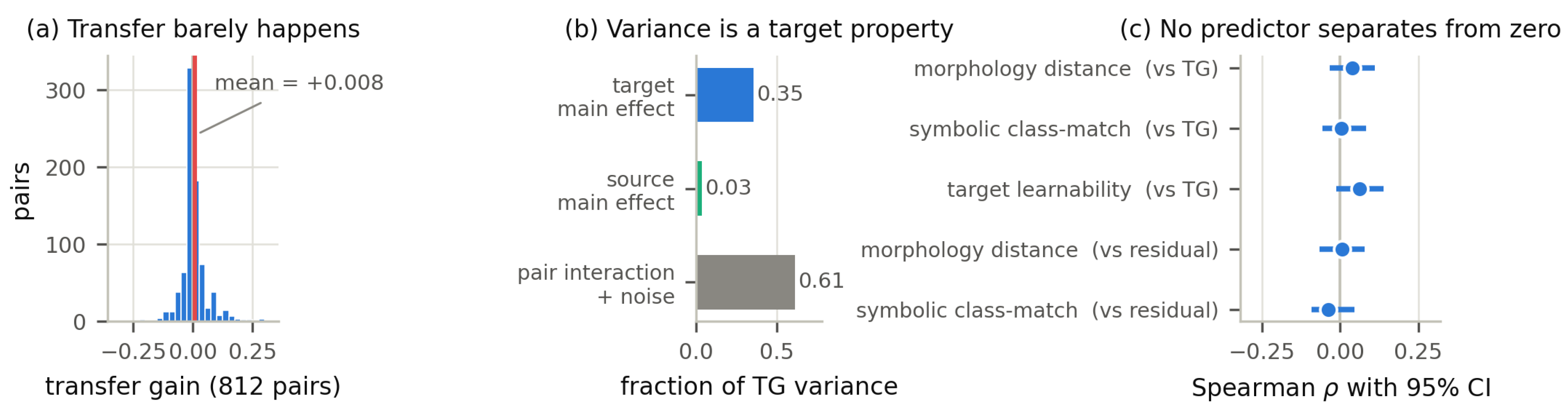
Figure 2.
Few-shot transfer to a held-out morphology rises with the number of pretraining source morphologies only while added sources add episodes, and under the fixed total-budget control the rise disappears (a) while budget-matched breadth never beats depth at any budget (b).
Figure 2.
Few-shot transfer to a held-out morphology rises with the number of pretraining source morphologies only while added sources add episodes, and under the fixed total-budget control the rise disappears (a) while budget-matched breadth never beats depth at any budget (b).
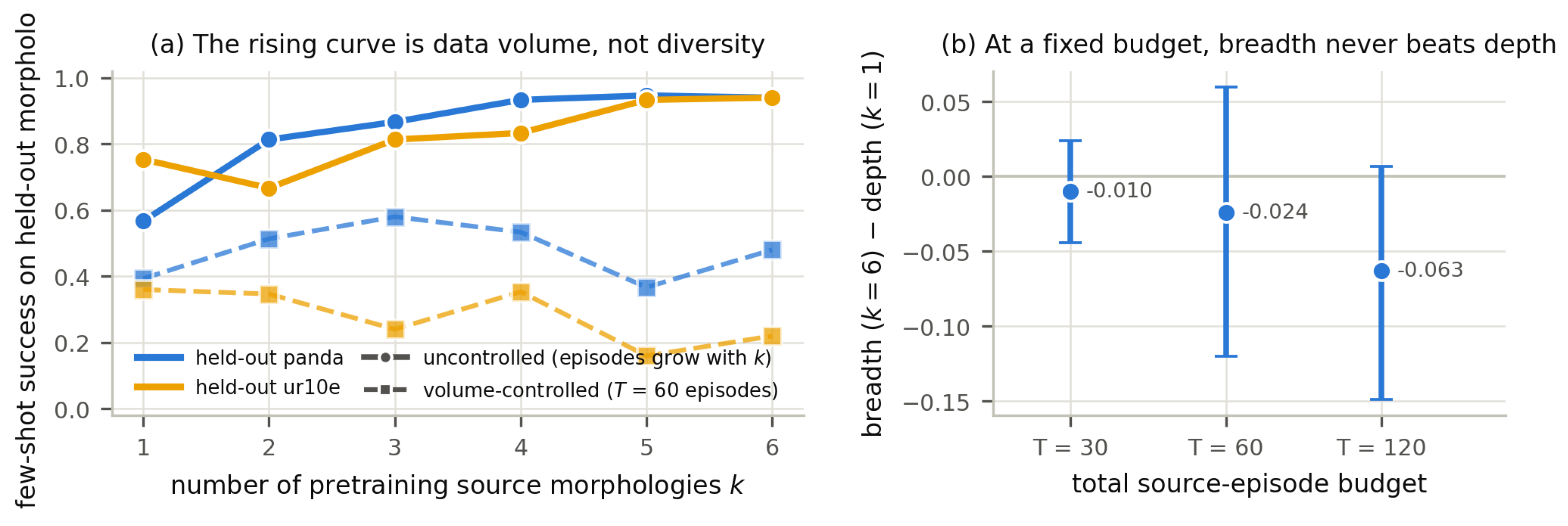
Figure 3.
Three controls bound the negative results, a morphology-dependent locomotion task on which distance still fails to predict transfer (a), a same-body control in which the assay detects real transfer (b), and an equivariant graph policy attaining zero-shot transfer (c) that distance fails to grade (d).
Figure 3.
Three controls bound the negative results, a morphology-dependent locomotion task on which distance still fails to predict transfer (a), a same-body control in which the assay detects real transfer (b), and an equivariant graph policy attaining zero-shot transfer (c) that distance fails to grade (d).
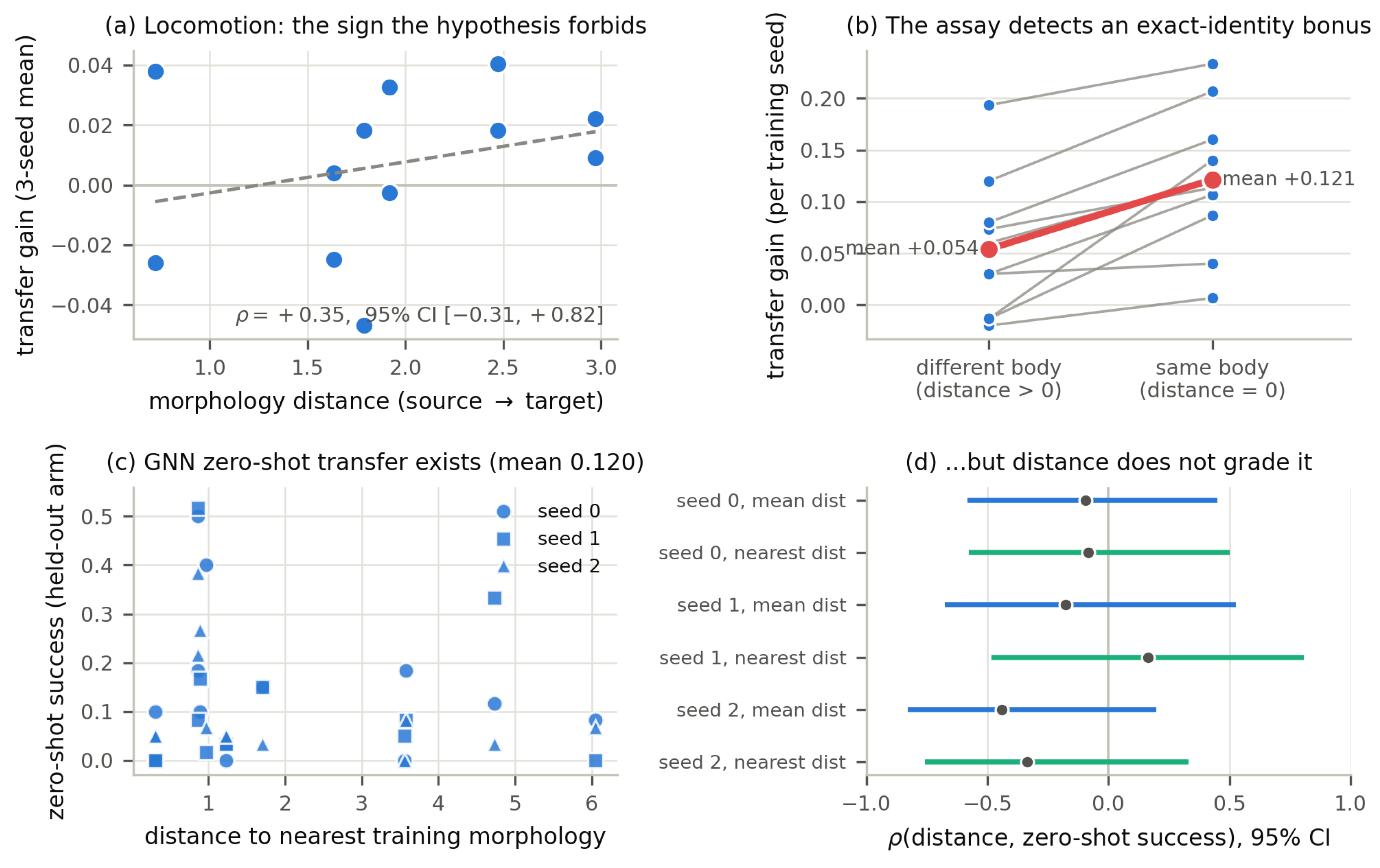
Table 1.
Composition of the 29-morphology benchmark suite.
| Class | n | Robots |
|---|---|---|
| Fixed-base manipulators | 14 | panda, ur5e, ur10e, kinova_gen3, kuka_iiwa_14, sawyer, franka_fr3, franka_fr3_v2, unitree_z1, ufactory_lite6, agilex_piper, i2rt_yam, stanford_tidybot, robotstudio_so101 |
| Quadrupeds | 7 | go2, unitree_a1, unitree_go1, anymal_b, anymal_c, spot, google_barkour_vb |
| Humanoids and bipeds | 8 | g1, unitree_h1, apptronik_apollo, booster_t1, robotis_op3, toddlerbot_2xc, toddlerbot_2xm, fourier_n1 |
Disclaimer/Publisher’s Note: The statements, opinions and data contained in all publications are solely those of the individual author(s) and contributor(s) and not of MDPI and/or the editor(s). MDPI and/or the editor(s) disclaim responsibility for any injury to people or property resulting from any ideas, methods, instructions or products referred to in the content. |
© 2026 by the authors. Licensee MDPI, Basel, Switzerland. This article is an open access article distributed under the terms and conditions of the Creative Commons Attribution (CC BY) license (http://creativecommons.org/licenses/by/4.0/).
Copyright: This open access article is published under a Creative Commons CC BY 4.0 license, which permit the free download, distribution, and reuse, provided that the author and preprint are cited in any reuse.