

Submitted:
14 July 2026
Posted:
14 July 2026
You are already at the latest version
Abstract
This critical narrative review and theoretical framework explains the conditional role of music in learning by shifting the focus from whether music directly improves academic achievement to how it regulates learning readiness. Learning readiness refers to the proximal psychological–neural conditions surrounding entry into a specific learning task, including emotional stability, attentional accessibility, motivational activation, cognitive-load fit, and interpersonal safety. Drawing on research on musical emotion, the reward system, cognitive load, learning engagement, and classroom interaction, the review proposes a path model linking musical features, emotion–reward–cognition mechanisms, learning readiness, and learning processes or outcomes. Music is more likely to facilitate low-load tasks, emotion-startup tasks, and collaborative-expression tasks, whereas it may interfere with tasks involving high language load or high executive-control demands. Educational applications should therefore be designed around the task, the learner’s state, individual differences, and the classroom context.
Keywords:
musical emotion
; learning readiness
; reward system
; cognitive load
; learning engagement
1. Introduction: From Music-Facilitated Learning to the Regulation of Learning Readiness
Music simultaneously serves multiple functions, including aesthetic experience, emotion regulation, and social interaction. Research on the neural mechanisms of music and emotion has converged on the view that music-evoked emotion is not a localized response in a single brain region but the product of coordinated activity across multiple systems. Koelsch (2014) noted that this process involves coordinated activity among the auditory cortex, limbic system, reward system, and prefrontal regulatory system. From a neuroaesthetic perspective, Zeng and Xia (2019) conceptualized musical aesthetic activity as comprising perceptual processing, cognitive interpretation, emotional response, and preference formation. Consistent with this account, research on the neural basis of basic emotions likewise indicates that emotional processing depends on networks composed of multiple brain regions rather than on a single isolated pathway (Liang et al., 2022). When music enters educational settings, its value should not be regarded merely as artistic appreciation or an embellishment of classroom atmosphere; instead, it should be examined within a learning process in which emotion, cognition, motivation, and social interaction are intertwined.
Emotion itself is an important mechanism through which learning occurs. Achievement emotions such as enjoyment, anxiety, and boredom, experienced in classrooms, assignments, examinations, and self-evaluation, influence learning outcomes through motivation, learning strategies, allocation of cognitive resources, and self-regulation (Pekrun, 2006). Fredrickson and Branigan (2005) argued that positive emotions broaden individuals’ scope of attention and thought–action repertoires and accumulate psychological resources for creative thinking, flexible problem solving, and sustained learning. Neural evidence also suggests that positive emotion may enhance cognitive flexibility by reducing activation in conflict-related brain regions (Wang et al., 2017). Qiao et al. (2025), in their review of video-based learning, further showed that teachers’ positive facial expressions can influence students’ learning performance, learning motivation, arousal, and positive emotion through emotional contagion, social cues, and cognitive load. Emotion is therefore not an external decoration of learning but an important psychological mechanism that participates in its construction.
Research on the “Mozart effect” once raised expectations that music could improve cognitive ability. Brief exposure to Mozart’s music was reported to produce an immediate improvement in spatial-reasoning performance (Rauscher et al., 1993). However, a subsequent meta-analysis of the generalized Mozart effect found that, although the effect of classical music on cognitive performance was statistically significant, the overall effect size was small and was moderated by age, cultural background, experimental design, task type, and hemispheric dominance (Chen et al., 2023). These findings indicate that there is no simple, stable, and universally applicable gain relationship between music and learning. Rather, music is more likely to exert a conditional influence by altering how students enter a learning task through emotional arousal, attentional regulation, reward anticipation, and task-preparation states.
Nevertheless, several connections among existing lines of research remain underdeveloped. First, studies of the neural mechanisms of music have largely focused on musical pleasure, the reward system, emotion induction, or the brain mechanisms of music training, whereas educational research has concentrated more on classroom applications and learning performance. A proximal mediating concept capable of connecting neural processes with classroom learning behavior is still lacking. Second, short-term music listening and long-term music training are often grouped together under the broad label of “music effects,” even though the mechanistic boundaries between immediate state regulation and long-term capacity development are not identical. Third, some classroom applications treat background music as a universally effective instructional tool while neglecting the moderating roles of task type, student state, musical structure, cultural experience, and individual preference.
Against this background, learning readiness can serve as a proximal mediating concept connecting musical emotion with student learning. The concept emphasizes emotional stability, attentional accessibility, motivational activation, cognitive-load fit, and interpersonal safety before and around students’ entry into a specific learning task. The influence of musical emotion on learning should therefore no longer be explained as a direct enhancement of intelligence or academic achievement but as regulation of the psychological–neural conditions at the entry point of a learning task. In other words, music does not directly determine whether students learn better. Instead, by altering their emotion, attention, motivation, and load state as they enter a task, music may subsequently affect learning engagement, cognitive processing, and classroom interaction.
2. Literature Inclusion and Analytical Approach
The literature analysis followed a narrative theoretical-review approach. Search topics were organized around four groups of keywords. The first group included musical emotion, musical pleasure, musical anticipation, beat structure, and music training; the second included the reward system, dopamine, hippocampus–amygdala interactions, prefrontal–limbic systems, and neural synchrony; the third included achievement emotions, learning engagement, learning motivation, cognitive load, and classroom climate; and the fourth included background music, learning tasks, music preference, classroom interaction, and educational application. Both Chinese- and English-language studies were included. The Chinese literature emphasized recent core-journal research published in Advances in Psychological Science, Acta Psychologica Sinica, Open Education Research, and related outlets, whereas the English literature emphasized influential studies in the cognitive neuroscience of music, educational psychology, and emotion regulation.
Literature selection followed four principles. First, under the principle of mechanistic relevance, priority was given to studies capable of explaining mechanisms involving musical emotion, reward, attention, memory, emotion regulation, and social synchrony. Second, under the principle of educational translatability, priority was given to studies that could illuminate learning engagement, achievement emotions, cognitive load, learning tasks, and classroom interaction. Third, under the principle of evidence hierarchy, priority was given to meta-analyses, systematic reviews, experimental studies, neuroimaging studies, and reviews with explicit theoretical contributions. Fourth, under the principle of temporal sensitivity, recent core-journal studies from the preceding five years were prioritized for topics such as the definition of core concepts, measurement of learning engagement, musical beat structure, music training and empathy, and emotional cues in video-based learning.
The literature was analyzed according to the sequence “conceptual boundaries–mechanistic evidence–model construction–proposition development.” The conceptual-boundary component distinguished learning readiness from learning engagement, achievement emotions, learning motivation, cognitive load, and classroom climate. The mechanistic-evidence component integrated the roles of musical emotion in the reward system, memory system, attentional networks, emotion-regulation systems, and social-synchrony systems. The model-construction component explained how musical features may influence learning readiness through emotion–reward–cognition mechanisms and then affect learning processes and outcomes. The proposition-development component translated theoretical judgments into falsifiable, operationalizable, and testable research hypotheses.
3. Conceptual Boundaries of Learning Readiness
Learning readiness is an integrative description of proximal conditions before and around the occurrence of a learning task. It lies between distal individual traits, classroom-context variables, and learning-outcome variables and focuses on whether students can enter the current task with relatively appropriate emotional, attentional, motivational, and cognitive-load states. More specifically, the concept has three characteristics: proximity, integration, and malleability. Proximity means that it directly concerns the initiation and continuation of a specific task. Integration means that it is not limited to a single psychological component but simultaneously involves emotion, attention, motivation, cognitive load, and interpersonal safety. Malleability means that the state can be regulated over relatively short periods through music, teacher support, task design, classroom pacing, and other factors.
At the conceptual level, learning readiness must first be distinguished from learning engagement. After systematically reviewing the international literature, Yang (2024) noted that definitions and dimensional structures of learning engagement are diverse. Commonly measured dimensions include behavioral, emotional, and cognitive engagement, yet the literature also contains confusion among indicators, influencing factors, and outcome variables. A cross-temporal meta-analysis of students in mainland China likewise found that learning engagement is strongly embedded in sociocultural conditions and is significantly influenced by macro-level factors such as economic development, allocation of educational resources, and internet penetration (Zhang et al., 2025). Learning engagement is therefore more concerned with the intensity and persistence of participation during learning, whereas learning readiness concerns whether students possess the entry conditions required before participation begins or when tasks are switched. Learning engagement is closer to a learning-process variable; learning readiness is closer to a proximal mediating variable at task initiation.
Learning readiness should not be equated simply with achievement emotions. Achievement emotions are defined as emotional experiences related to achievement activities and achievement outcomes and include enjoyment, hope, pride, anxiety, shame, and boredom (Pekrun, 2006). The concept emphasizes the type and valence of emotional experience and its control–value origins. By comparison, although learning readiness includes an emotional component, it extends beyond emotion itself to include whether attention can enter the task, whether motivation has been activated, whether cognitive load matches task demands, and whether students experience sufficient safety in classroom interaction. Emotional stability is therefore only one component within the broader spectrum of learning readiness and cannot represent its full meaning.
Learning readiness is also distinct from learning motivation. Research on neural mechanisms indicates that the mesolimbic dopamine system is associated not only with pleasure but also with effort investment, goal selection, and motivational regulation (Salamone & Correa, 2012). Learning motivation primarily addresses why individuals are willing to engage in learning and emphasizes the mechanisms through which goal value, expectations of success, and willingness to exert effort are formed. Learning readiness, in contrast, concerns whether motivation has been effectively activated when a specific task begins and whether it can combine with attention, emotion, and cognitive-load states to form an executable starting point for learning. Motivational activation is thus the energizing dimension of learning readiness, but it does not fully encompass learning readiness.
At the level of cognitive processing, learning readiness must also be distinguished from cognitive load. Lehmann and Seufert (2017) showed that the influence of background music on learning is constrained by working-memory capacity, musical complexity, the presence or absence of lyrics, and task type. Cognitive load theory primarily concerns the occupation of processing resources and its influence on learning efficiency. Cognitive-load fit within learning readiness, however, emphasizes whether the amount of musical information, task requirements, and students’ available cognitive resources are appropriately matched. Cognitive load is an important condition influencing learning readiness, but learning readiness is jointly shaped by emotion, attention, motivation, and social interaction as well.
In addition, learning readiness is not equivalent to classroom climate. Research on interpersonal emotion regulation indicates that emotion regulation occurs both within individuals and in social interaction, involving coordinated operation of mentalizing, emotional-response, and emotion-regulation systems (Dong et al., 2024). Classroom climate usually refers to the emotional tone, relationship quality, and normative environment at the class level and is distinctly collective and contextual. Learning readiness, by contrast, emphasizes the proximal state of an individual student or small group within a specific learning task. Classroom climate can influence learning readiness, for example, by changing students’ state of entry into a task through teacher–student relationships, peer interaction, and classroom safety, but it cannot replace learning readiness itself.
4. Neural Mechanisms Through Which Musical Emotion Regulates Learning Readiness
4.1. Reward System, Motivational Activation, and Perceived Task Value
Music first influences learning readiness by regulating students’ psychological state as they enter a learning task through the reward system. Research on this mechanism has revealed coordinated participation across multiple brain regions. Early neuroimaging studies showed that intense pleasurable responses to music are accompanied by coordinated activation of the nucleus accumbens, amygdala, hippocampus, prefrontal cortex, and other regions deeply involved in emotion regulation and reward processing (Blood & Zatorre, 2001). Menon and Levitin (2005) further found that listening to music activates the mesolimbic reward system and strengthens functional connectivity between the nucleus accumbens and the ventral tegmental area, hypothalamus, and orbitofrontal cortex. Zhou et al. (2021), in their review of musical pleasure, likewise emphasized that musical pleasure is not merely an auditory sensation but results from interaction between the reward system and auditory cortex, with dopaminergic transmission playing an important role. Taken together, music may influence learning not only because it produces pleasure but also because reward processing may alter students’ anticipation of, interest in, and action preparation for an upcoming task.
Musical reward also unfolds dynamically. Salimpoor et al. (2011) demonstrated that the anticipation and experience phases of peak musical emotion correspond to dopamine release in anatomically distinct regions of the striatum, indicating that musical reward contains continuous stages of anticipation, prediction, and satisfaction. The formation of this dynamic reward is closely related to the structural properties of music. Uncertainty and surprise jointly contribute to musical pleasure and are associated with neural activity in the amygdala, hippocampus, and auditory cortex (Cheung et al., 2019). Aesthetic pleasure and learning-related reward ultimately emerge from a balance between structural predictability and uncertainty (Gold et al., 2019). Music therefore does not influence students through stimulus intensity alone; rather, rhythm, melody, harmony, and structural anticipation can generate predictions about subsequent musical development and task progression.
In classroom contexts, music that is structurally clear, moderately stimulating, and coordinated with the rhythm of the task is more likely to increase perceived task value and willingness to initiate action through reward anticipation. By contrast, music that is overly complex, too loud, or mismatched with the cognitive demands of a learning task may occupy attentional resources, increase extraneous cognitive load, and weaken its positive effects. Students’ musical experience, cultural background, and personal preferences also affect whether musical reward can be translated into learning readiness. Only when the pleasure, anticipation, and arousal produced by music fit the demands of the current task is music more likely to foster emotional stability, attentional accessibility, and stronger motivational activation.
4.2. Hippocampus–Amygdala Interaction, Emotional Arousal, and Memory Conditions
Music may also influence memory encoding and retrieval conditions by regulating emotional arousal. Emotion alters the quality of learning and memory through attentional allocation, neuroendocrine responses, and hippocampus–amygdala interactions (Tyng et al., 2017). As an effective medium for regulating emotion, music can intervene in learning and memory through these pathways. More specifically, music-evoked emotional responses simultaneously regulate activity in the amygdala, hippocampus, nucleus accumbens, orbitofrontal cortex, anterior cingulate cortex, and other regions, thereby influencing subjective emotional experience, the strength of memory associations, and behavioral tendencies (Koelsch, 2014). A near-infrared spectroscopy study of verbal episodic memory supports this account: music modulated activity patterns in the prefrontal cortex during both encoding and retrieval and altered the allocation of cognitive-processing resources (Ferreri et al., 2015). Rickard et al. (2005) emphasized that the influence of music on cognitive performance is closely related to the autonomic nervous system, hormonal levels, and emotional arousal. Research conducted in stressful contexts further indicates that listening to music can regulate the human stress system and autonomic responses and that appropriately matched music can buffer cognitive interference caused by stress (Thoma et al., 2013).
Music cannot directly replace memory strategies, nor does it simply guarantee improved learning outcomes. Its role is more likely to consist in changing the psychological and physiological conditions under which students enter memory encoding and retrieval by regulating emotional arousal. When students experience mild anxiety, low motivation, or dispersed attention before class, well-matched music may help them return to a more moderate level of arousal and thereby enter the task more stably. However, music that produces excessive arousal, has highly salient emotional coloring, or evokes strong autobiographical memories may instead interfere with attentional concentration and encoding stability. The meta-analysis of the generalized Mozart effect by Chen et al. (2023) likewise suggests that the facilitative effect of music on cognitive performance does not occur consistently across all tasks and populations, further supporting a conditional interpretation of music effects.
The role of music in memory and learning should therefore also be examined within the framework of learning readiness. Moderate music may help students form a more suitable task-entry state by alleviating stress, stabilizing emotion, and regulating arousal. Mismatched music, by contrast, may increase emotional fluctuation or cognitive interference and make it difficult for students to enter a stable learning-processing state. From this perspective, the influence of music on learning does not run directly from musical stimulation to academic achievement. Rather, it depends on the dynamic fit among emotional arousal, attentional allocation, cognitive load, and memory conditions and thereby affects whether students can enter the current learning task with adequate readiness.
4.3. Attentional Networks, Beat-Based Prediction, and Cognitive-Load Fit
Music also affects learning readiness through attentional regulation and the allocation of cognitive load. Listening to polyphonic music recruits brain networks responsible for domain-general attention and working memory, indicating that music perception itself requires cognitive resources and is not a cost-free background stimulus (Janata et al., 2002). Event-related-potential research by Putkinen et al. (2017) further showed that positive emotion induced by music broadens the scope of auditory selective attention, making individuals more sensitive to sounds that should be ignored while also altering resource allocation to target sounds. As the temporal organizing framework of music, beat encourages listeners to form stable predictions about subsequent sounds on the basis of regularities and to update their understanding of the music through prediction error (Sun & Yang, 2024). Musical beat may therefore provide temporal-organizational cues for classroom transitions, movement-based learning, and collective activities. However, when rhythm is complex, changes frequently, or conflicts with the learning task, it may create additional cognitive load.
Whether background music helps learning depends substantially on the match between musical features and task demands. Research on background music and learning shows that its effects are constrained by working-memory capacity, musical complexity, the presence of lyrics, and task characteristics (Lehmann & Seufert, 2017). During language-heavy tasks such as reading, writing, foreign-language listening, and complex reasoning, music with salient lyrics, complex melodies, or prominent rhythms is more likely to compete for core processing resources and interfere with sustained attention and information processing. By comparison, during low-load review, drawing, handicrafts, rhythm training, and classroom transitions, music that is structurally stable, moderate in volume, and minimally distracting is more likely to help students maintain activity pacing and emotional stability.
The attentional and cognitive-load effects of music likewise need to be understood within the framework of learning readiness. Highly compatible music may help students enter the current task more smoothly by providing temporal structure, reducing task-switching costs, and stabilizing emotional arousal. Poorly compatible music may distract attention, occupy working-memory resources, and even generate resource competition between the learning task and music processing. Music is therefore not an inherently beneficial background condition for classroom learning. It is more likely to be transformed into positive learning readiness only when musical structure, task type, and students’ cognitive resources are mutually compatible.
4.4. Prefrontal–Limbic Systems, Interpersonal Emotion Regulation, and Classroom Stability
The influence of music on learning readiness is not confined to processes within the individual; it also unfolds through emotion regulation and social interaction. Regulation of negative emotion depends heavily on executive functions of the prefrontal cortex, which dynamically counterbalance limbic structures such as the amygdala. Classical strategies including cognitive reappraisal and expressive suppression rely on this neural circuit (Goldin et al., 2008). Within this circuit, the anterior cingulate cortex and medial prefrontal cortex serve more differentiated functions and play indispensable roles in emotional processing, conflict monitoring, and regulatory implementation (Etkin et al., 2011). Music can function as an effective emotion-regulation tool precisely because the neural networks that generate musical emotion overlap extensively with the brain’s endogenous emotion-regulation networks; this overlap constitutes a core neural basis for musical emotion regulation (Hou et al., 2017). However, music-regulation effects are not uniform across individuals. The strategies people select can be clearly adaptive or maladaptive (Carlson et al., 2015). Emotion regulation is also never a closed intrapersonal process; it is embedded in interpersonal contexts and requires coordinated operation of mentalizing, emotional-response, and emotion-regulation systems (Dong et al., 2024).
Extending the analysis from individual psychology to the classroom field, learning is likewise not an isolated cognitive process but is inherently characterized by emotional synchrony and social interaction. Hyperscanning EEG research in real classrooms has shown that the degree of neural synchrony among groups of students is closely associated with interactive states during shared viewing and learning (Poulsen et al., 2017). Students’ knowledge states and classroom-learning performance can also be predicted reliably from indices of brain activity (Zheng et al., 2018). Rizzolatti and Craighero’s (2004) review of the mirror-neuron system further suggests that action understanding, imitation, and social interaction have important sensorimotor foundations. Together, these findings indicate that the state in which students enter a learning task is shaped not only by their own emotion and cognitive resources but also by peer rhythms, teacher expression, modes of classroom interaction, and the group’s emotional atmosphere.
In this sense, musical activities—especially choral singing, ensemble performance, rhythmic call-and-response, and collective movement—are more likely to improve the emotional ecology of the classroom through shared attention, rhythmic synchrony, and interpersonal safety. A common musical rhythm can provide students with perceptible and followable interaction cues, making it easier to form synchronized experiences with peers and reducing tension and uncertainty in classroom participation to some extent. This effect should likewise not be understood as music directly determining learning outcomes. Rather, music may promote more appropriate learning readiness by improving emotion regulation, strengthening social connection, and enhancing classroom safety. When students experience emotional stability, a clear interaction rhythm, and greater safety in participation during musical activities, they are more likely to enter subsequent learning tasks in an open, focused, and willing state.
4.5. Music Training, Musical Sophistication, and Learning Adaptability
The influence of music on learning also requires a distinction between two pathways: immediate state regulation and long-term experiential development. The OPERA hypothesis provides a classic theoretical framework for this distinction. Music and language processing share some neural–cognitive networks, while music training places greater demands on fine-grained processing and is accompanied by repeated practice, emotional investment, and deep attentional engagement; consequently, it has the potential to transfer to language processing (Patel, 2014). Deng et al. (2023), in their review of the influence of musical experience on second-language processing, similarly noted that musical experience may promote language learning by improving the processing of shared acoustic cues, auditory attention, and working memory, although such transfer is constrained by age, task type, and other factors. Discussions of transfer from music training also caution that near and far transfer must be distinguished and that the broad enhancement of general cognitive ability through music training should not be overstated (Bigand & Tillmann, 2022). Musical experience may therefore provide long-term support for learning, but this support is not an unconditional, domain-general increase in ability; it depends on training content, task characteristics, and the individual’s developmental stage.
Long-term musical experience may also influence students’ learning states through emotional understanding and social cognition. Schellenberg and Mankarious (2012) found an association between music training and emotional-comprehension performance in children, although this association was also affected by general intelligence and other factors. Long-term musical experience can drive coordinated neural adaptation across sensory, motor, cognitive, and emotional networks, providing a physiological basis for multidimensional transfer (Zaatar et al., 2023). Hua et al. (2025) provided a more fine-grained account in Acta Psychologica Sinica: musicians showed advantages in tasks involving cognitive empathy and state empathy, but after controlling for personality, subjective socioeconomic status, and mental-health status, the direct effect of music training on empathy was not significant. By contrast, musical sophistication significantly predicted the imaginative dimension of cognitive empathy and mediated the pathway from music training to state empathy. These findings indicate that the key to long-term music education lies not merely in years of training but in the development of musical sophistication, emotional understanding, and the quality of social interaction.
This distinction can also be incorporated into the framework of learning readiness. Short-term background music primarily regulates emotion, attentional entry, and arousal before and around the current task. Long-term music education, by contrast, is more likely to alter the foundational conditions under which students enter learning tasks by enhancing auditory discrimination, rhythmic organization, sustained attention, emotional understanding, and coordinated interaction. Music training does not directly and universally improve achievement across all school subjects. Rather, by shaping perceptual processing, emotion regulation, and social cognition over time, it may make it easier for students to form stable, open, and sustainable learning readiness when confronting language learning, collaborative learning, and complex tasks.
5. Theoretical Path Model: Musical Features, Mechanisms, Learning Readiness, and Learning Outcomes
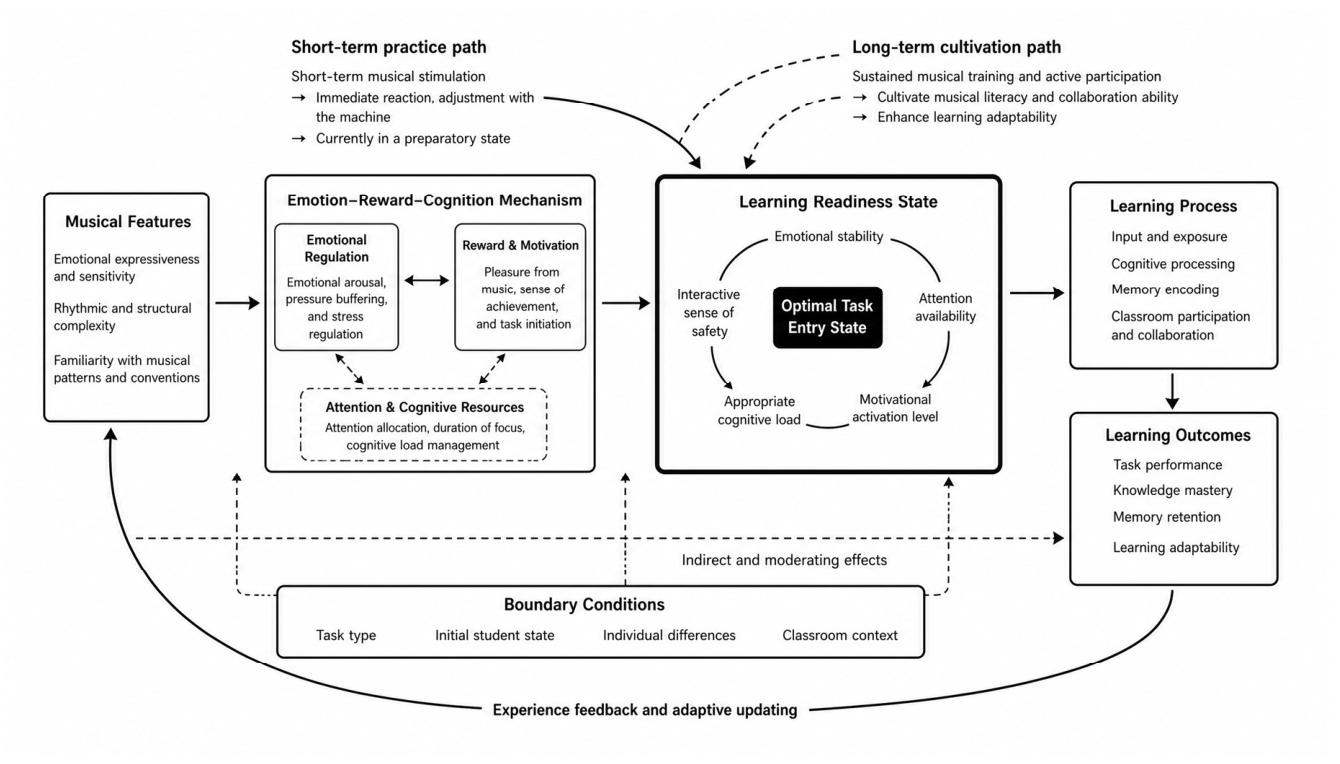
The theoretical pathway through which musical emotion regulates learning readiness can be summarized as “musical features–emotion–reward–cognition mechanisms–learning readiness–learning processes/outcomes” (Figure 1). Musical features include valence, arousal, rhythm, lyric salience, musical complexity, familiarity, and personal preference. Emotion–reward–cognition mechanisms include reward anticipation, emotional arousal, beat-based prediction, attentional shifting, and interpersonal emotion regulation. Learning readiness functions as a proximal mediator connecting musical stimulation with classroom learning behavior.
The model contains two pathways that operate on different timescales. The short-term listening pathway occurs primarily before class, during breaks, at task transitions, and in brief activities; it regulates immediate emotion, attentional entry, and motivational activation. The long-term training pathway occurs primarily through systematic music education and sustained musical participation; through fine-grained auditory processing, sensorimotor coupling, musical sophistication, and social synchrony, it shapes relatively stable learning adaptability. Both pathways imply that music affects learning processes by changing learning readiness.
Task, state, individual, and context constitute the moderating conditions of the model. Task type determines whether music competes with core processing resources. Students’ immediate state determines whether music functions as a restorative stimulus or an additional stimulus. Individual music preference, cultural experience, and working-memory capacity determine the subjective meaning and resource cost of musical stimulation. Classroom context determines whether music is aligned with instructional goals, activity structure, and modes of interaction.
6. Falsifiable Propositions and Research Designs
Proposition 1: Interference in high-language-load tasks. In high-language-load tasks such as reading comprehension, writing, and foreign-language listening, the influence of background music on learning performance is interactively moderated by lyric salience and working-memory capacity. Students with lower working-memory capacity are more likely to show reduced comprehension scores, longer response times, and higher subjective cognitive load when music with lyrics is present.
Proposition 2: Facilitation in low-load tasks. In low-language-load tasks such as drawing, handicrafts, rhythm-based review, and low-intensity repetitive practice, music that is structurally stable, moderate in volume, and highly preferred is more likely to improve learning readiness. As musical complexity increases or preference decreases, the facilitative effect will weaken or disappear.
Proposition 3: State restoration. Under mild anxiety or low arousal, low-complexity music with positive valence or calming qualities is more likely to improve emotional stability and attentional accessibility. Under high excitement or intense concentration, the incremental benefit of the same type of music will be substantially reduced and may even impair task performance by adding stimulation.
Proposition 4: Mediation. The effects of musical features on learning engagement and memory performance do not occur directly but are mediated by learning readiness. When emotional stability, attentional accessibility, motivational activation, and cognitive-load fit are controlled, the direct effect of music condition on learning outcomes should be substantially reduced.
Proposition 5: Social synchrony in collective musical activities. Compared with individual background music, choral singing, ensemble performance, and rhythmic-interaction activities are more likely to enhance shared attention, interpersonal safety, and the quality of classroom participation. This effect should be stronger in collaborative tasks than in individual written tasks.
Proposition 6: Long-term training pathway. The influence of years of music training on empathy, cooperation, and language processing is mediated by musical sophistication. After musical sophistication is controlled, the direct predictive effect of training duration on social–emotional outcomes should be reduced. This proposition is consistent with the logic of Hua et al. (2025) concerning the relationships among music training, musical sophistication, and empathy.
The propositions above can be tested through controlled laboratory studies, longitudinal tracking in authentic classrooms, randomized crossover designs, and multilevel linear models. Laboratory studies can manipulate lyric salience, musical complexity, rhythmic stability, and task load and measure reading comprehension, response time, eye movements, subjective load, and working-memory capacity. Classroom studies can combine emotion self-reports, learning-engagement scales, behavioral observation, teacher ratings, EEG, or functional near-infrared spectroscopy to test the mediating role of learning readiness between music conditions and learning outcomes. Longitudinal studies can track pathways among music training, musical sophistication, empathy, language processing, and the quality of classroom interaction.
7. Boundaries of Educational Application: From Playing Music to Designing Learning States
Pre-class music is better suited to emotional startup and classroom-transition functions. Musical pleasure is realized through neural interaction between the reward system and auditory cortex (Zhou et al., 2021), suggesting that the purpose of pre-class music is not to continuously elevate emotional arousal but to establish task boundaries and create a sense of classroom ritual through a clear auditory signal. Music used before class should therefore be brief, low in volume, sparse in lyrics, and structurally clear, using gentle emotional startup in place of high-intensity emotional stimulation.
Once formal learning begins, the use of background music should follow the principle of task-load fit. Lehmann and Seufert (2017) demonstrated that the effects of background music are constrained by working-memory capacity, task characteristics, and related factors. Accordingly, silence or only minimally distracting music should be prioritized during reading, writing, foreign-language listening, mathematical reasoning, and high-load problem solving to prevent competition between music processing and core cognitive resources. During review and organization, drawing and handicrafts, motor learning, and low-load repetitive training, rhythmically stable music at moderate volume that students prefer may be used appropriately to sustain classroom pacing, emotional stability, and task persistence.
Compared with simply playing music, musical activities have more evident educational potential. Hua et al. (2025) showed that the key pathways through which musical experience influences empathy involve musical sophistication and emotional understanding. Choral singing, ensemble performance, rhythmic call-and-response, musical-situation expression, and collaborative composition can therefore mobilize auditory attention, bodily rhythm, emotional understanding, and social interaction simultaneously. These activities can improve the classroom’s emotional atmosphere and help students develop stronger participation and interpersonal safety through shared rhythm and collaborative expression. They are thus more likely than passive background music to produce stable educational meaning.
Music selection must also fully consider differences among students. The mechanisms by which music induces emotion are highly diverse: brain-stem reflexes, rhythmic entrainment, evaluative conditioning, emotional contagion, visual imagery, episodic memory, and musical anticipation all contribute (Juslin & Västfjäll, 2008). The same piece of music may consequently evoke very different responses depending on students’ autobiographical memories, cultural experience, aesthetic preferences, and auditory sensitivity. Classroom music libraries can therefore be organized functionally into startup, restoration, rhythm, creation, and collaboration categories. Quiet alternatives should be retained for students who are auditorily sensitive, easily distracted, or uncomfortable with background music, making music use more inclusive and adjustable.
Music intervention should also maintain an appropriate distance from academic evaluation. The meta-analysis by Chen et al. (2023) showed that the facilitative effect of classical music on cognitive performance is small and moderated by multiple factors. Even neurologic music therapy, which has a more mature evidence base, differs fundamentally from ordinary classroom music applications in its goals, target populations, and application settings (Thaut & Hoemberg, 2014). Music should therefore not be promoted as a shortcut to higher scores or packaged as a universally effective instructional technology. A more prudent positioning is to regard music as a regulatory resource for improving learning readiness, the emotional ecology of the classroom, learning participation, and social interaction. Changes in academic achievement may be observed as possible indirect outcomes, but they should not be established as the sole goal or direct evaluation criterion of music application.
The key to classroom music application is therefore not whether music is used but how well music matches task goals, student states, and classroom pacing. Only when music serves the formation of emotional stability, attentional entry, motivational activation, load fit, and interpersonal safety can it be transformed into an educationally meaningful condition of learning readiness.
8. Conclusions
The theoretical value of musical emotion in facilitating student learning lies primarily in regulating learning readiness rather than directly enhancing intelligence or academic achievement. Learning readiness is the proximal psychological–neural condition before and around a specific learning task and comprises emotional stability, attentional accessibility, motivational activation, cognitive-load fit, and interpersonal safety. Distinct from learning engagement, achievement emotions, learning motivation, cognitive load, and classroom climate, this concept can explain more precisely why music effects are conditional and context dependent.
Musical features may influence learning readiness through emotion–reward–cognition mechanisms. The short-term listening pathway mainly regulates immediate states, whereas the long-term training pathway mainly shapes stable adaptability. Task type, students’ immediate state, individual preferences, and classroom context determine the direction and magnitude of music effects. Music may facilitate low-load tasks, emotional startup, collaborative expression, and rhythm-based learning, but it may also interfere with tasks involving high language load, high executive-control demands, and intense concentration.
Establishing falsifiable propositions around learning readiness can move music-education research beyond the broad question of “whether music is useful” toward a more fine-grained explanation of what kind of music is effective, for which students, in which tasks and contexts, and through which mechanisms. Educational applications of music should likewise shift from simply playing background music to designing learning states, with task matching, state matching, individual differences, and contextual integration as their basic principles.
Supplementary Materials
The following supporting information can be downloaded at the website of this paper posted on Preprints.org.
Author Contributions
Yan Hong was responsible for finalizing the manuscript. Li Guolong drafted the initial manuscript. Hou Jiancheng provided suggestions for revision.
Funding
This research was funded by the Heilongjiang Provincial Philosophy and Social Sciences Research Planning Project, “Practical Exploration and Innovative Application of ‘Artistic Context, Listening to the Heart’ Integrated Arts-Based Healing among Different Audience Groups” (grant number 24YSC012), and the Heilongjiang Provincial College Student Innovation and Entrepreneurship Training Program (grant number S202510220105).
Institutional Review Board Statement
Not applicable.
Informed Consent Statement
Not applicable.
Data Availability Statement
No new data were created or analyzed in this study. Data sharing is not applicable to this article.
Acknowledgments
Not applicable.
Conflicts of Interest
The authors declare no conflicts of interest.
References
- Bigand, E.; Tillmann, B. Near and far transfer: Is music special? Memory & Cognition 2022, 50(2), 339–347. [Google Scholar]
- Blood, A. J.; Zatorre, R. J. Intensely pleasurable responses to music correlate with activity in brain regions implicated in reward and emotion. Proceedings of the National Academy of Sciences of the United States of America 2001, 98(20), 11818–11823. [Google Scholar] [CrossRef] [PubMed]
- Carlson, E.; Saarikallio, S.; Toiviainen, P.; Bogert, B.; Kliuchko, M.; Brattico, E. Maladaptive and adaptive emotion regulation through music: A behavioral and neuroimaging study of males and females. Frontiers in Human Neuroscience 2015, 9, 466. [Google Scholar] [CrossRef] [PubMed]
- Chen, L. J.; Huang, M. L.; Jiang, X. L.; Wang, X. J. Does listening to classical music really make people smarter? A meta-analysis of the generalized Mozart effect. Advances in Psychological Science (in Chinese). 2023, 31(12), 2232–2262. [Google Scholar] [CrossRef]
- Cheung, V. K. M.; Harrison, P. M. C.; Meyer, L.; Pearce, M. T.; Haynes, J. D.; Koelsch, S. Uncertainty and surprise jointly predict musical pleasure and amygdala, hippocampus, and auditory cortex activity. Current Biology 2019, 29(23), 4084–4092. [Google Scholar] [CrossRef] [PubMed]
- Deng, S. W.; Feng, L. P.; Zhou, L. S.; Jiang, C. M. The influence of musical experience on second-language processing. Advances in Psychological Science (in Chinese). 2023, 31(11), 2040–2053. [Google Scholar]
- Dong, W. X.; Yu, W. W.; Xie, H.; Zhang, D. D. The cognitive neural basis of interpersonal emotion regulation. Advances in Psychological Science (in Chinese). 2024, 32(1), 131–137. [Google Scholar] [CrossRef]
- Etkin, A.; Egner, T.; Kalisch, R. Emotional processing in anterior cingulate and medial prefrontal cortex. Trends in Cognitive Sciences 2011, 15(2), 85–93. [Google Scholar] [CrossRef] [PubMed]
- Ferreri, L.; Bigand, E.; Bard, P.; Bugaiska, A. The influence of music on prefrontal cortex during episodic encoding and retrieval of verbal information: A multichannel fNIRS study. Behavioural Neurology 2015, 2015, 707625. [Google Scholar] [CrossRef] [PubMed]
- Fredrickson, B. L.; Branigan, C. Positive emotions broaden the scope of attention and thought–action repertoires. Cognition and Emotion 2005, 19(3), 313–332. [Google Scholar] [CrossRef] [PubMed]
- Gold, B. P.; Pearce, M. T.; Mas-Herrero, E.; Dagher, A.; Zatorre, R. J. Predictability and uncertainty in the pleasure of music: A reward for learning? Journal of Neuroscience 2019, 39(47), 9397–9409. [Google Scholar] [CrossRef] [PubMed]
- Goldin, P. R.; McRae, K.; Ramel, W.; Gross, J. J. The neural bases of emotion regulation: Reappraisal and suppression of negative emotion. Biological Psychiatry 2008, 63(6), 577–586. [Google Scholar] [CrossRef] [PubMed]
- Hou, J.; Song, B.; Chen, A. C. N.; Sun, C.; Zhou, J.; Zhu, H.; Beauchaine, T. P. Review on neural correlates of emotion regulation and music: Implications for emotion dysregulation. Frontiers in Psychology 2017, 8, 501. [Google Scholar] [CrossRef] [PubMed]
- Hua, S.; Jiang, X. T.; Gao, Y. Z. Y.; Mu, Y.; Du, Y. Effects of music training and musical sophistication on empathy. Acta Psychologica Sinica (in Chinese). 2025, 57(4), 544–558. [Google Scholar] [CrossRef]
- Janata, P.; Tillmann, B.; Bharucha, J. J. Listening to polyphonic music recruits domain-general attention and working memory circuits. Cognitive, Affective, & Behavioral Neuroscience 2002, 2(2), 121–140. [Google Scholar] [CrossRef]
- Juslin, P. N.; Västfjäll, D. Emotional responses to music: The need to consider underlying mechanisms. Behavioral and Brain Sciences 2008, 31(5), 559–575. [Google Scholar] [CrossRef] [PubMed]
- Koelsch, S. Brain correlates of music-evoked emotions. Nature Reviews Neuroscience 2014, 15(3), 170–180. [Google Scholar] [CrossRef] [PubMed]
- Lehmann, J. A. M.; Seufert, T. The influence of background music on learning in the light of different theoretical perspectives and the role of working memory capacity. Frontiers in Psychology 2017, 8, 1902. [Google Scholar] [CrossRef] [PubMed]
- Liang, F.; Jiang, Y.; Xiao, T. W.; Dong, J.; Wang, F. S. The neural basis of basic emotions: Evidence from fMRI and machine-vision research. Advances in Psychological Science (in Chinese). 2022, 30(8), 1832–1843. [Google Scholar] [CrossRef]
- Menon, V.; Levitin, D. J. The rewards of music listening: Response and physiological connectivity of the mesolimbic system. NeuroImage 2005, 28(1), 175–184. [Google Scholar] [CrossRef] [PubMed]
- Patel, A. D. Can nonlinguistic musical training change the way the brain processes speech? The expanded OPERA hypothesis. Hearing Research 2014, 308, 98–108. [Google Scholar] [CrossRef] [PubMed]
- Pekrun, R. The control-value theory of achievement emotions: Assumptions, corollaries, and implications for educational research and practice. Educational Psychology Review 2006, 18(4), 315–341. [Google Scholar] [CrossRef]
- Poulsen, A. T.; Kamronn, S.; Dmochowski, J.; Parra, L. C.; Hansen, L. K. EEG in the classroom: Synchronised neural recordings during video presentation. Scientific Reports 2017, 7, 43916. [Google Scholar] [CrossRef] [PubMed]
- Putkinen, V.; Makkonen, T.; Eerola, T. Music-induced positive mood broadens the scope of auditory attention. Social Cognitive and Affective Neuroscience 2017, 12(7), 1159–1168. [Google Scholar] [CrossRef] [PubMed]
- Qiao, P. H.; Kuang, Z. Y.; Wang, F. X. Promoting learning through emotion: The facilitative effect of teachers’ facial expressions on video-based learning. Advances in Psychological Science (in Chinese). 2025, 33(4), 690–703. [Google Scholar] [CrossRef]
- Rauscher, F. H.; Shaw, G. L.; Ky, K. N. Music and spatial task performance. Nature 1993, 365(6447), 611. [Google Scholar] [CrossRef] [PubMed]
- Rickard, N. S.; Toukhsati, S. R.; Field, S. E. The effect of music on cognitive performance: Insight from neurobiological and animal studies. Behavioral and Cognitive Neuroscience Reviews 2005, 4(4), 235–261. [Google Scholar] [CrossRef] [PubMed]
- Rizzolatti, G.; Craighero, L. The mirror-neuron system. Annual Review of Neuroscience 2004, 27, 169–192. [Google Scholar] [CrossRef] [PubMed]
- Salamone, J. D.; Correa, M. The mysterious motivational functions of mesolimbic dopamine. Neuron 2012, 76(3), 470–485. [Google Scholar] [CrossRef] [PubMed]
- Salimpoor, V. N.; Benovoy, M.; Larcher, K.; Dagher, A.; Zatorre, R. J. Anatomically distinct dopamine release during anticipation and experience of peak emotion to music. Nature Neuroscience 2011, 14(2), 257–262. [Google Scholar] [CrossRef] [PubMed]
- Schellenberg, E. G.; Mankarious, M. Music training and emotion comprehension in childhood. Emotion 2012, 12(5), 887–891. [Google Scholar] [CrossRef] [PubMed]
- Sun, L. J.; Yang, Y. F. Cognitive and neural mechanisms of musical beat structure from the perspective of prediction. Advances in Psychological Science (in Chinese). 2024, 32(10), 1567–1577. [Google Scholar] [CrossRef]
- Thaut, M. H.; Hoemberg, V. Handbook of neurologic music therapy; Oxford University Press, 2014. [Google Scholar]
- Thoma, M. V.; La Marca, R.; Brönnimann, R.; Finkel, L.; Ehlert, U.; Nater, U. M. The effect of music on the human stress response. PLoS ONE 2013, 8(5), e70156. [Google Scholar] [CrossRef] [PubMed]
- Tyng, C. M.; Amin, H. U.; Saad, M. N. M.; Malik, A. S. The influences of emotion on learning and memory. Frontiers in Psychology 2017, 8, 1454. [Google Scholar] [CrossRef] [PubMed]
- Wang, Y.; Chen, J.; Yue, Z. Positive emotion facilitates cognitive flexibility: An fMRI study. Frontiers in Psychology 2017, 8, 1832. [Google Scholar] [CrossRef] [PubMed]
- Yang, Z. H. Progress and reflections on international research on the measurement of learning engagement: A systematic review of the international literature. Open Education Research (in Chinese). 2024, 30(3), 109–119. [Google Scholar]
- Zaatar, M. T.; Alhakim, K.; Enayeh, M.; Tamer, R. The transformative power of music: Insights into neuroplasticity, health, and disease. Brain Sciences 2023, 13(12), 1631. [Google Scholar]
- Zeng, Y.; Xia, T. S. The neuroaesthetics of music: From aesthetic responses to neural foundations. Advances in Psychological Science (in Chinese). 2019, 27(9), 1596–1606. [Google Scholar]
- Zhang, Z. J.; Chen, J. W.; Peng, S.; Wu, J. H.; Wang, S. Q. Changes in learning engagement among students in mainland China (2006–2024). Advances in Psychological Science (in Chinese). 2025, 33(12), 2069–2082. [Google Scholar]
- Zheng, L.; Chen, C.; Liu, W.; Long, Y.; Zhao, H.; Bai, X.; Zhang, Z.; Han, Z.; Liu, L.; Guo, T.; et al. Enhancement of teaching outcome through neural prediction of the students’ knowledge state. Human Brain Mapping 2018, 39(7), 3046–3057. [Google Scholar] [CrossRef] [PubMed]
- Zhou, C.; Zhou, L. S.; Jiang, C. M. Neural mechanisms of musical pleasure. Advances in Psychological Science (in Chinese). 2021, 29(1), 123–130. [Google Scholar] [CrossRef]
Short Biography of Authors
Guolong Li is a research assistant at the Research Center for Chinese-Style Modernization, Northeast Petroleum University, and his research focuses on the localization of arts-based healing. Jiancheng Hou is a professor at the Collaborative Innovation Center for Cross-Strait Cultural Development, Fujian Normal University, and holds a PhD in psychology from Beijing Normal University. Hong Yan is an associate professor at the School of Arts, Northeast Petroleum University, and holds a doctorate in art therapy.
Figure 1.
The theoretical path model through which musical emotion regulates learning readiness.
Disclaimer/Publisher’s Note: The statements, opinions and data contained in all publications are solely those of the individual author(s) and contributor(s) and not of MDPI and/or the editor(s). MDPI and/or the editor(s) disclaim responsibility for any injury to people or property resulting from any ideas, methods, instructions or products referred to in the content. |
© 2026 by the authors. Licensee MDPI, Basel, Switzerland. This article is an open access article distributed under the terms and conditions of the Creative Commons Attribution (CC BY) license (http://creativecommons.org/licenses/by/4.0/).
Copyright: This open access article is published under a Creative Commons CC BY 4.0 license, which permit the free download, distribution, and reuse, provided that the author and preprint are cited in any reuse.