

Submitted:
09 July 2026
Posted:
14 July 2026
You are already at the latest version
Abstract
A central ambition of cross-embodiment robot learning is a single representation of the task that is invariant to the body, a shared task-state that means the same thing on a four-legged robot as on an eight-legged one, or on a Panda arm as on a UR10e. The dominant approach learns such a representation as a continuous latent, trained for control-sufficiency and scrubbed of body identity by an adversary. We prove this is impossible exactly when behavior is body-coupled. The central object is a sufficiency-invariance bound, which states that any continuous task-state \(z\) that is \(\varepsilon\)-sufficient to predict a body's realized outcome \(y\) leaks the body identity \(m\) at a floor set by how body-coupled the behavior is, \(I(z;m) \ge I(y;m) - \kappa(\varepsilon)\). The lower bound is constructive, obtained by composing the sufficiency decoder with a classifier of \(m\) from \(y\) to build a probe of \(m\) from \(z\), and its assumption-free content is the measured accuracy of that probe. Lifting it to the closed form requires a margin condition, \(\kappa(\varepsilon) \le \inf_t [\delta(t) + \varepsilon/t^2]\). A rate-distortion complement shows when a coarse task-state escapes the floor, namely when bodies reach the same coarse symbol through different fine realizations. We validate the bound on two non-commensurable substrates. On locomotion the floor is $0.90$ under a strong probe against a linear reading of $0.37$, every control-sufficient continuous latent leaks topology above $0.98$, and a coarse state reaches near chance while retaining most task signal. On manipulation the floor is $0.86$ against a linear $0.34$, the leak exceeds $0.80$, and the coarse state again sheds the body. The morphology-invariant interface between deliberation and control must therefore be coarse.
Keywords:
cross-embodiment robot learning
; morphology-invariant representations
; task-state abstraction
; sufficiency-invariance bound
; body-coupled behavior
; non-commensurable robot bodies
; coarse symbolic interfaces
; representation probing
1. Introduction
Cross-embodiment learning largely pursues one representation for many bodies, a learned continuous embedding of state that abstracts away morphology so that policies, plans, or value functions transfer across robots [1,2,3,4]. The implicit contract is that there exists a latent task-state which is at once sufficient, carrying enough information to drive control on each body, and invariant, not encoding which body is acting. A natural recipe follows, in which an encoder is trained for sufficiency while an adversary penalizes any residual body information, so that the latent is scrubbed of morphology while staying control-relevant. Learned morphology-invariant embeddings [5,6,7] and morphology-adversarial representation objectives are the standard instantiations of this contract.
We ask whether that contract can be honored across body plans whose observation spaces are non-commensurable, with different numbers of legs, joints, and sensors, so the states do not even live in the same space, and we answer with a theorem rather than a single negative experiment. The contribution is a sufficiency-invariance bound. A continuous task-state that is sufficient to read off a body’s realized behavior leaks the body identity at a floor set by how body-coupled that behavior is. That floor is , the recoverability of the body from the bare realized outcome, which is a property of the task crossed with the bodies rather than a property of any encoder. The bound has a constructive, assumption-free form, obtained by composing the sufficiency decoder with a classifier of body-from-outcome to obtain a classifier of body-from-latent, and an information-theoretic form, . Its corollary is an impossibility result. Where behavior is body-coupled and sufficiency is genuine, no continuous representation escapes the floor, because the floor belongs to the task and not to the representation.
To our knowledge this is the first impossibility result for morphology-invariant task-state on non-commensurable bodies. Existing invariant embeddings operate on commensurable bodies with a shared modular state and action factorization, and to the extent their learned spaces have been visualized they appear to organize by morphology class rather than collapse to a body-invariant state, which we read as consistent with the bound rather than as a re-derivation of their results. The bound explains why a control-sufficient continuous invariant embedding does not exist on non-commensurable bodies, predicts the failure floor in advance from a cheap measurement of that trains no encoder, and prescribes the fix, which is to quantize to the coarse outcome that bodies share, with a testable success condition.
We validate the theorem on two substrates with non-commensurable bodies, a locomotion substrate of three procedurally grown legged plans and a manipulation substrate of three robot arms. On both, the floor is high under a strong probe, every control-sufficient continuous latent leaks the body far above chance, and a coarse task-state recovers near-chance invariance with task signal retained. The bound is not a locomotion artifact. The structural conclusion is that the morphology-invariant interface between a high-level planner and a low-level, body-specific controller must be coarse, meaning lossy with respect to the fine body-discriminative structure of realized behavior, with a discrete or symbolic code being one realization a planner can compose over [8].
The paper makes four contributions.
- We state and prove the sufficiency-invariance bound (Section 3), a constructive lower bound that is assumption-free in its measured composed-probe form, strengthens to a closed form under a margin condition , admits an information-theoretic transcription , and carries an impossibility corollary.
- We give a rate-distortion complement (Section 3.4) that names the exact condition under which a coarse task-state escapes the floor, namely that the body-discriminative information in the outcome lives in the fine structure a coarse code discards.
- We validate the bound on locomotion (Section 4.2) across a capacity-by-adversary grid, with a strong-probe floor of , a leak above in every control-sufficient continuous latent, a monotone granularity curve, a coarse-continuous cell that passes the grid’s own certification criterion, and the constructive composed probe realized in code.
- We validate the bound on a second, non-commensurable substrate of three arms (Section 4.3), where the body-coupling is invisible to any single moment yet a strong probe recovers the arm at , so that the linear-probe false positive is starker still.
The result artifacts and the analysis code that regenerates every number, table, and figure are released as a public repository.
The thesis, stated exactly, is that any control-sufficient continuous task-state leaks body identity at a floor set by how body-coupled the realized behavior is, so continuous morphology-invariance is impossible precisely when behavior is body-coupled, while a coarse task-state escapes the floor when bodies reach the same symbol through different fine realizations. The methodological corollary is that an invariance claim must be certified with a strong nonlinear probe and an independent post-hoc probe rather than the in-loop training adversary.
2. Related Work
Generalist multi-robot learning treats a new embodiment as an engineering problem, absorbing a new body by mapping every robot into a shared action space, attaching per-embodiment adapters, and fine-tuning on the target [1,2,3,4]. A parallel line builds the body into the policy through shared modular controllers [9], graph-structured policies [10], morphology-token transformers [5], morphology-inferring encoders [7], and unified multi-embodiment locomotion architectures [6], with recent morphology-structured attention reported to help a large model [11]. Benchmark evidence nonetheless finds such agents near zero success on out-of-distribution morphologies, with high train-test similarity not helping [12], and a companion study shows that no measured relation between bodies predicts frozen-core transfer [13]. All of these operate at the level of a continuous representation, which is exactly the level our bound constrains, and each treats invariance as an engineering target rather than asking whether it is attainable.
Zero-shot cross-embodiment manipulation was reached in the first half of 2026 by several systems sharing one move. RDT2 trains on body-agnostic handheld-gripper data [14], LAP codes actions in language [15], Cloak masks the end-effector out of the observation [16], KITE routes task reasoning through a contact-intent latent [17], and the earlier Mirage cross-painted the gripper visually [18]. Each deletes body information from the interface between task reasoning and motor control rather than seeking similar bodies, and each commits to a single coarse coding without asking whether coarseness is necessary. Our bound supplies the structural reason these interfaces are coarse, and the companion architecture paper measures what such a coarse interface buys [19].
The idea that an invariant representation trades against task information has a precise history in domain adaptation and fair representation learning. Adversarial invariance was popularized by domain-adversarial training [20], and a line of theory then established that forcing a representation to be invariant to a domain label lower-bounds the joint error once the label distributions differ [21,22], complementing the classical divergence bounds for adaptation [23]. Our result is the cross-embodiment counterpart, and it differs in three ways that matter for robotics. The quantity that cannot be removed is body identity rather than a domain label, the floor is a directly measurable property of realized behavior rather than a divergence between fixed distributions, and the bodies are non-commensurable so the representations do not share an input space at all.
A methodological thread underlies the empirical half of the paper. Linear probes are a standard tool for reading structure out of representations [24], but they under-state recoverability, and control tasks and stronger probes are needed to make a probing claim meaningful [25,26]. The disentanglement literature made the same point when it showed that apparently clean representations hide structure that only a capable model recovers [27], and shortcut learning is the general phenomenon of a model exploiting exactly the structure an invariance objective tried to remove [28]. Our locomotion and manipulation results are concrete cross-embodiment instances, and they fold into a broader push toward statistically sound robot-policy evaluation [29,30,31] that the companion measurement standard develops in full [32].
3. The Sufficiency-Invariance Bound
3.1. Setup and Definitions
Let the body be , a finite set. A task command c is realized as an outcome , the achieved behavior, which is the achieved base velocity on the locomotion substrate and the achieved end-effector velocity on the manipulation substrate. The body-dependence of is the crux of the argument. Each body has a native observation o, which is non-commensurable across bodies, and a continuous task-state is a map with a decoder g that predicts the outcome from the task-state. Body identity is a -way label, so chance recoverability is , which equals on both substrates.
Definition 1
(Sufficiency). The task-state z is -sufficient if there exists a decoder g with . This is the operational meaning of control-sufficient, since z then carries enough to read off the realized outcome.
Definition 2
(Invariance). The task-state z is -invariant if the best classifier of m from z has balanced accuracy at most . Recoverability is always measured with a strong nonlinear probe, because a weak or linear probe under-states it, as the empirical sections make concrete.
Definition 3
(Body-coupling of behavior). The body-coupling of behavior is a, the best balanced accuracy of predicting m from the bare realized outcome y, equivalently the size of . This is a property of the task crossed with the bodies and involves no encoder.
3.2. The Constructive Lower Bound
The bound is easiest to see in a form that assumes nothing beyond sufficiency, because it is built by composition.
Lemma 1
(Composed probe). Let z be ε-sufficient through a decoder g, and let ψ be any classifier of m from y. Then is a classifier of m from z, and its balanced accuracy is a lower bound on the best-probe recoverability of m from z, because the best probe maximizes accuracy over all maps from z to m and is one such map. Empirically the bound is obtained by fitting ψ on pairs and evaluating on held-out task-states.
The value of the lemma is that it lower-bounds recoverability by the measured accuracy of on the perturbed input rather than by a, which is ’s accuracy on the true y. Closing the gap to a requires that lose little when its input moves from y to , which is the margin condition below. As the decoded outcome approaches y and the measured accuracy approaches a.
3.3. The Margin Condition and the Invariance Floor
Theorem 1
(Sufficiency-invariance lower bound). Suppose m is recoverable from the realized outcome y at balanced accuracy a. Then any ε-sufficient continuous task-state z has m-recoverability at least , where κ is controlled by a margin condition on the decision rule ψ that maps y to m. Concretely, suppose that with probability at least the outcome y lies at distance greater than t from the decision boundary of ψ. A flip then requires either that y lies within t of the boundary or that , and Markov’s inequality applied to bounds the probability of the second event by . Optimizing over the margin scale gives
Consequently z cannot be δ-invariant for any .
Proof sketch.
The decoded outcome is a function of z, so the composed classifier is a valid probe of m from z and Lemma 1 applies. Its accuracy differs from a only on inputs where . By the margin assumption the probability that y is within t of the boundary is at most , and by Markov’s inequality the probability that sufficiency noise carries across a margin of width t is at most , so the accuracy loss is at most for every t, which yields (1). The best probe on z dominates , so its accuracy is at least . □
The theorem uses a margin condition rather than Lipschitz continuity of , because a map into a finite set that is Lipschitz is locally constant, which makes a Lipschitz assumption degenerate for a decision rule. The margin form also makes transparent when the floor binds. It binds under a scale separation, in which there exists a margin scale t with small and t much larger than , so that the body fingerprint in y lives at a scale above the sufficiency noise and does not cross decision boundaries. The same scale separation coexists with the coarse escape of Section 3.4, which removes the fingerprint precisely when it lives below the size of a quantization cell. The regime in which both statements bite is a fingerprint scale in the window between and the cell size, large enough to survive sufficiency noise and fine enough for a coarse code to discard.
Remark.
The accuracy statement of Theorem 1 is the rigorous content of the bound. It transcribes into the information-theoretic display heuristically, because is a function of z so the data-processing inequality [33] gives , after which converting the accuracy margin into a mutual-information margin needs a Fano-type step we do not carry out. We use the accuracy form for every empirical claim and read the information-theoretic form only as intuition.
Corollary 1
(Impossibility). When realized behavior is body-coupled, so that a is far above chance, and sufficiency is genuine, so that ε is small, continuous invariance is unattainable. The invariance floor is , and it is independent of the encoder architecture, the adversary, and the bottleneck dimension, because it is a property of the task rather than of the representation. No continuous representation, whether a variational bottleneck [34] or a bottleneck trained against an adversary [20], escapes it.
3.4. Symbolic Achievability
The impossibility is not the end of the story, because coarsening the task-state can only remove body information, and there is a precise condition under which it removes all of it while keeping the task.
Proposition 1
(Coarse achievability). Let be a K-symbol quantization of the task-state, or equivalently a quantization of the outcome. The data-processing inequality gives and , so quantization can only remove body information. Writing for the task-relevant coarse outcome, the achievable invariance at a required sufficiency level R is the frontier
The coarse state is body-blind yet task-bearing, meaning while stays high, exactly when the body-discriminative information in y lives in the fine structure that q discards, so that bodies reach the same coarse symbol through different fine realizations.
This is the regime a symbolic progress predicate occupies. A predicate such as reached the target or moving at the commanded speed is satisfied by every body through body-specific fine behavior, so the coarse symbol is shared while the fine realization carries the body. The frontier (2) is the information-bottleneck objective [35] read against body identity, and Section 4.2 and Section 4.3 measure it directly on two substrates by sweeping the granularity K.
We state the scope of the theory plainly and once. The floor is defined against the realized, body-dependent outcome y; a control objective defined against a body-independent coarse outcome has a lower floor, which is the symbolic regime of Proposition 1 rather than a loophole. The composed-probe form of Lemma 1 is assumption-free, while the closed form of Theorem 1 and the information-theoretic display additionally use the margin condition, whose distribution we measure operationally rather than bound in closed form. Recoverability throughout is the strong-probe quantity of Definition 2.
4. Empirical Validation
4.1. Substrates and Probe Protocol
The two substrates share a protocol and differ only in the bodies and the task. The locomotion substrate has three procedurally grown legged plans, a four-leg, a six-leg, and an eight-leg body, with native observation dimensions 46, 64, and 82, each with its own trained gait policy. The manipulation substrate has three arms, panda, kuka_iiwa_14, and ur10e, with observation dimensions 27, 23, and 21 and action dimensions 8, 7, and 6. The bodies within each substrate share neither observation nor action space, so any invariance must be earned in a learned latent rather than read off a common input. Body identity is a three-way label on both, so chance is .
The realized outcome is the achieved base velocity on locomotion and the achieved end-effector velocity on manipulation, each a three-dimensional quantity that means the same thing on every body. A per-body encoder maps each native observation into a shared latent task-state, trained for sufficiency by predicting the outcome and optionally for invariance through a gradient-reversal adversary that is a strong minimax opponent with its own optimizer and inner steps. Sufficiency is reported as the reconstruction of the outcome and invariance as body recoverability. We certify invariance with two probes, a linear logistic-regression probe and a strong random-forest probe, and the certifier is always the strong probe applied fresh to the frozen latent, never the in-loop adversary, which can reach perfect training accuracy and yet certify nothing about the frozen representation. Because consecutive frames within a rollout are temporally correlated [36], we also re-measure the floor under blocked splits, group splits by rollout on locomotion and episode-blocked splits by episode on manipulation, and quote the blocked floor as primary.
4.2. Locomotion
The floor is the recoverability of the body from the bare three-dimensional outcome, with no learned encoder. A linear probe recovers topology from the achieved velocity at at the frame level and under blocked splits, both near chance, so the velocity outcome is linearly almost body-blind, which is exactly why a linear study would conclude the task is morphology-invariant. A strong random-forest probe recovers topology from the same bare outcome at at the frame level and under rollout-blocked splits, and we quote as the primary floor. This is the a of Theorem 1, and by Lemma 1 every -sufficient continuous task-state must inherit it. Figure 1 shows the two probes against chance on both substrates in its left panel, and its center panel shows why the outcome is body-coupled here, since the four-leg body wobbles with an achieved- standard deviation of while the eight-leg body holds steady at , with the six-leg body intermediate at , so the achieved-behavior distribution is itself a body fingerprint visible even in the marginal.
We then sweep the latent capacity against the adversary weight , one seed per grid cell, with the certified cell replicated across three seeds. Table 1 reports the nine cells, and Figure 2 plots the linear and strong probes against chance in its left panel. The in-loop adversary is strong, reaching accuracy at the higher-capacity latents and to at the tight bottleneck, in every case far above chance, yet it does not certify invariance, because the strong random-forest probe applied post hoc recovers topology at or above in every one of the nine cells. No cell achieves both a task above and a strong-probe accuracy below .
The linear column carries the methodological lesson. Reading only the linear probe, the most sufficient cell at and sits at , barely above chance, with a task of , and the , cell sits at with a task of , so a study that certified invariance with a linear probe alone would report these as clean positives that are both sufficient and invariant. The strong probe overturns that reading, recovering topology from the very same , latent at and from the , latent at . The body was never removed, only made linearly unreadable, which is Lemma 1 made concrete. The most sufficient and most invariant-looking point at , replicates across three seeds, with a task of (seed values , , ), a linear probe near (values , , ), and a strong probe of on average and at most, so the picture is not seed noise.
The grid rows on their own do not show that sufficiency forces the leak, because the non-sufficient cells leak as hard as the sufficient ones, for instance the , cell that leaks at with a task of only . Within the swept family the leak is dominated by the encoders’ native separation of the non-commensurable input spaces rather than by the sufficiency constraint. The load-bearing empirical evidence for the bound is therefore the measured bare-outcome floor, which involves no encoder, together with two controls that isolate what the grid does and does not show. A no-task-loss control, built from random frozen per-body encoders with zero task training, still leaks at under the strong probe and under the linear probe, which confirms that the grid’s uniform leak is encoder separation. A coarse-continuous cell, a smooth softmax-weighted centroid map over a shared eight-symbol codebook, passes the grid’s own certification criterion with a task of , a strong probe of , and a linear probe of , both below the bar, so what escapes the floor is coarseness rather than discreteness in particular. A temperature sweep of that cell scopes the finding, plotted in the right panel of Figure 3. The committed cell is numerically a hard quantizer, and certification survives only while the map stays effectively hard-assigned, for temperatures up to , whereas genuinely soft variants leak more, reaching a strong probe of at temperature 1 and at temperature 3 as the soft weights carry fine outcome information. A smooth map can therefore escape the floor, but every escape we measure is quantizer-like, so coarseness is the requirement the theorem names and quantization is how our substrates realize it.
The constructive bound of Lemma 1 is realized in code on the certified cell. Fitting on the true outcome gives a floor of , the composed probe achieves , which is a valid lower bound on recoverability realized exactly as the lemma constructs it, and it is dominated as expected by the direct strong probe on the latent at with a task of . The empirical basis for the bound is the direct probe together with the measured floor, and the composed probe instantiates the constructive form once for the record.
The constructive complement predicts that coarsening the task-state toward a symbolic state removes the fingerprint when bodies reach the same symbol through different fine realizations, and Table 2 tests this by discretizing the task-state at K symbols with a single shared codebook and measuring both strong-probe recoverability and retained task signal. Figure 3 plots the curve in its left panel. The strong-probe fingerprint falls monotonically from for the continuous latent toward at , with most of the fall in the first discretization step, while the task signal degrades gracefully. At the sweet spot the symbolic state is near invariant at while retaining 89 percent of task signal, which is exactly the regime no continuous cell in Table 1 reaches, since every continuous cell near chance had its sufficiency destroyed. Two points bound the reading. The continuous row at is recoverability from the continuous latent and sits just above the bare-outcome floor of , consistent with Lemma 1, and the two numbers are different objects rather than a restatement. At coarse K the probe is near chance rather than exactly at it, and like the floor it is a strong-probe quantity, so we claim the monotone fall and the existence of a high-signal, near-chance regime rather than perfect invariance.
4.3. Manipulation
The decisive question for a theorem is whether it survives a different task family and a different, non-commensurable body class, and it does. We reran the representation experiment unchanged on the three arms, and Figure 1 reports both substrates side by side.
The floor is again high under a strong probe and low under a linear one. From the bare achieved end-effector velocity a linear probe recovers the arm at at the frame level and under episode-blocked splits, essentially chance, while a strong random-forest probe recovers it at at the frame level and under episode-blocked splits, with per-fold values of , , and . We quote as the primary manipulation floor, and the frame-level re-collection reproduces the committed floor exactly, so the fingerprint is not a temporal-correlation artifact. Under the blocked primaries the manipulation floor sits slightly below locomotion’s, against , and both are far above chance, so the impossibility binds comparably on both substrates.
The manipulation floor carries a nuance that strengthens the theory. On locomotion the body-coupling was visible in the marginal, but on manipulation the marginal end-effector-velocity standard deviation is essentially identical across arms, for panda, for kuka, and for ur10e, as the right panel of Figure 1 shows. The strong probe nonetheless recovers the arm at , so the fingerprint does not live in any single moment but in the multivariate structure of the motion, invisible to a linear probe and plain to a strong one. This is the floor whatever moment the coupling hides in, and it makes the linear-probe false positive starker than on locomotion, a gap of against at the frame level compared with against .
Table 3 reports the capacity-by-adversary grid, one seed per cell, and the right panel of Figure 2 plots its probes. Every control-sufficient continuous latent leaks the arm at or above, the minimum among sufficient cells being at , , and far above that in the high-sufficiency cells. The , cell is the manipulation analogue of the locomotion false positive, reading invariant to a linear probe at yet fully recoverable nonlinearly at with near-perfect sufficiency at a task of . Pushing the adversary harder to , buys a small reduction only by destroying sufficiency, dropping the task to , and still leaves the arm recoverable at .
The symbolic complement reproduces as well. Table 4 shows the arm fingerprint falling monotonically from for the continuous latent to at , while the task signal degrades gracefully, holding a task of at and at . As on locomotion, a coarse state recovers near-chance invariance with task signal retained, exactly where the continuous state cannot, and Figure 3 overlays the two granularity curves so that the single bound is visible on both body classes at once.
4.4. Cross-Substrate Summary
Table 5 collects the two substrates. Both instantiate the same bound on non-commensurable bodies. The floor is high under a strong probe and near chance under a linear one, every control-sufficient continuous latent inherits it, and a coarse state escapes it with task signal retained. The body-coupling is marginal on locomotion and multivariate on manipulation, but the bound holds either way, because the floor is regardless of the moment the coupling occupies.
5. Discussion
The results reframe a familiar negative as a predictable consequence. Learned morphology-invariant observation embeddings trained with adversarial objectives have been observed to leave morphology highly recoverable, which was tempting to read as an artifact of padded observation spaces that better handling would fix. The bound shows the failure is deeper, because even a tight bottleneck with a converged adversary cannot remove the body from a continuous task-state when the fingerprint lives in the realized behavior itself, the floor . That negative was the first sighting of the floor the theorem names rather than an engineering defect.
The bound also predicts the behavior of existing invariant embeddings without re-running them. An embedding sufficient to drive control on body-coupled behavior must carry , so the best a learned continuous embedding can do is organize bodies by their realized-behavior signature, which is to cluster by class rather than to collapse to a body-invariant state. Reports that such embeddings organize by class are therefore consistent with the bound, and none of them certifies invariance with a strong probe on non-commensurable bodies, which is the regime where the impossibility bites. The companion benchmark makes the empirical counterpart precise, since no measured relation between bodies, including a learned morphology distance, predicts transfer better than a target-only prior [13], and the layer at which such a distance could be meaningful is the coarse abstract layer this paper identifies.
The strongest practical lesson is methodological, and it is not specific to robotics. Linear invariance probes give false positives. The tight latents on both substrates read as invariant to a linear probe, at on locomotion and on manipulation, and are fully recoverable nonlinearly, at and . An invariance or disentanglement claim certified with a linear probe can be silently wrong, and the failure is starker exactly where the fingerprint is multivariate rather than concentrated in one moment, as the manipulation substrate shows. Any such claim must be certified with a strong nonlinear probe, and the certifier must be an independent post-hoc probe rather than the in-loop training adversary, which reached perfect training accuracy on our grid yet certified nothing about the frozen latent. This is the same probing discipline the interpretability literature arrived at [25,26,27], applied to embodiment, and it is the discipline the companion measurement standard enforces [32].
Read constructively, the bound is a design principle for the interface between deliberation and control. The task-state that a high-level planner and a low-level, body-specific controller must agree on cannot be a learned continuous embedding if it is to be morphology-invariant across non-commensurable bodies, because any control-sufficient continuous realization carries the floor. It must be coarse, meaning lossy with respect to the fine body-discriminative structure of realized behavior, and the rate-distortion complement names the exact success condition, that bodies reach the same symbol through different fine realizations, which is precisely what a progress predicate such as reached the target guarantees. A discrete or symbolic code is the coarse state a planner can compose over, and the coarse escapes we measured are all quantizer-like, so the practical realization of coarseness on our substrates is quantization. The companion architecture paper builds exactly this interface and shows that a coarse symbolic progress state transfers across bodies where continuous policies do not [19], and the successful zero-shot systems of 2026 delete body information from the interface between task reasoning and motor control [14,15,16,17], which is coarseness by another name.
6. Limitations
The bound is validated on two non-commensurable body classes and task families, which is strong evidence that it is not an artifact of one substrate though not a proof over all embodiments, so we claim a bound conditional on rather than a universal law. The open case is a substrate with near chance, meaning body-blind behavior, where continuous invariance would be attainable; that case would characterize the regime rather than refute the bound, and neither substrate we test is such a case. Recoverability and the floor are defined against a strong random-forest probe, and a different strong probe could shift the exact numbers, so the structural claim that a linear probe under-states recoverability and that the floor tracks is what we assert rather than the third decimal. The information-theoretic form uses a margin-based constant whose distribution we measure operationally rather than bound in closed form, and the composed probe gives a loose gap, a floor of against a composed accuracy of , so we do not claim a tight constant. The coarse near-invariance is near rather than exact, landing between and , and it is a strong-probe quantity, so we claim the monotone fall and the high-signal, near-chance regime rather than perfect symbolic invariance; the certified coarse-continuous witnesses are all quantizer-like, so the empirical support is for coarseness realized by quantization rather than for a genuinely soft map.
7. Conclusion
We proved that a continuous task-state which is sufficient to read off a body’s realized behavior cannot hide which body produced it, and we measured that floor on two substrates whose bodies do not share an input space. The argument is constructive at its core. Composing the sufficiency decoder with a classifier of body-from-outcome builds a classifier of body-from-latent whose accuracy lower bounds recoverability, so the floor is the body-recoverability of the bare outcome, a quantity that trains no encoder and can be measured before any representation is learned. A margin condition turns the construction into a closed-form floor, and a rate-distortion complement identifies the one way out, which is to coarsen the state until the body-discriminative information falls below the resolution the code keeps.
The measurements make the theorem concrete and expose a trap. On locomotion the floor is under a strong probe while a linear probe reads , every control-sufficient continuous latent across a capacity-by-adversary grid leaks topology above , and a coarse state reaches near chance while keeping most of the task signal. On manipulation the floor is under a strong probe while a linear probe reads , the leak exceeds , and the coarse state again sheds the body, with the body-coupling hidden in the multivariate structure of the motion rather than in any single moment, which makes the linear-probe false positive starker still. The trap is that a linear invariance probe would have certified several of these latents as clean successes, both sufficient and invariant, when a strong probe recovers the body almost perfectly. An invariance claim is only as strong as the probe that tests it, and it must be tested by an independent probe rather than by the adversary that trained the representation.
For cross-embodiment learning the consequence is a change of target. A learned continuous state that is at once control-sufficient and body-invariant is a quantity the task forbids whenever behavior is body-coupled, which both substrates are. The productive object is the coarse task-state, lossy by design with respect to the fine behavior that fingerprints the body and rich enough to drive the task, and it is the formal contract between a planner and a controller that the companion architecture realizes as a symbolic progress state transferring where continuous policies fail. A floor that can be measured before training, a probe discipline that refuses to be fooled by linearity, and a coarse interface that provably admits invariance together mark the route that the continuous-invariance program cannot take and the coarse-interface program can.
References
- Open X-Embodiment Collaboration.; et al. Open X-Embodiment: Robotic Learning Datasets and RT-X Models. arXiv preprint arXiv:2310.08864 2023. ICRA 2024.
- Doshi, R.; Walke, H.; Mees, O.; Dasari, S.; Levine, S. Scaling Cross-Embodied Learning: One Policy for Manipulation, Navigation, Locomotion and Aviation. arXiv preprint arXiv:2408.11812 2024. CoRL 2024.
- Black, K.; Brown, N.; Driess, D.; et al. π0: A Vision-Language-Action Flow Model for General Robot Control. arXiv preprint arXiv:2410.24164 2024. RSS 2025.
- NVIDIA.; Bjorck, J.; Castañeda, F.; et al. GR00T N1: An Open Foundation Model for Generalist Humanoid Robots. arXiv preprint arXiv:2503.14734 2025.
- Gupta, A.; Fan, L.; Ganguli, S.; Fei-Fei, L. MetaMorph: Learning Universal Controllers with Transformers. arXiv preprint arXiv:2203.11931 2022. ICLR 2022.
- Bohlinger, N.; Czechmanowski, G.; Krupka, M.; et al. One Policy to Run Them All: An End-to-End Learning Approach to Multi-Embodiment Locomotion. arXiv preprint arXiv:2409.06366 2024. CoRL 2024.
- Trabucco, B.; Phielipp, M.; Berseth, G. AnyMorph: Learning Transferable Polices by Inferring Agent Morphology. arXiv preprint arXiv:2206.12279 2022. ICML 2022.
- James, S.; Rosman, B.; Konidaris, G. Learning Portable Representations for High-Level Planning. arXiv preprint arXiv:1905.12006 2019. ICML 2020.
- Huang, W.; Mordatch, I.; Pathak, D. One Policy to Control Them All: Shared Modular Policies for Agent-Agnostic Control. arXiv preprint arXiv:2007.04976 2020. ICML 2020.
- Kurin, V.; Igl, M.; Rocktäschel, T.; et al. My Body is a Cage: The Role of Morphology in Graph-Based Incompatible Control. arXiv preprint arXiv:2010.01856 2020. ICLR 2021.
- Suzuki, K.; Liu, J.; Wang, Y.; et al. Embedding Morphology into Transformers for Cross-Robot Policy Learning. arXiv preprint arXiv:2603.00182 2026.
- Parakh, M.; Kirchmeyer, A.; Han, B.; Deng, J. AnyBody: A Benchmark Suite for Cross-Embodiment Manipulation. arXiv preprint arXiv:2505.14986 2025.
- Shojaei, A. Neither Morphological Similarity nor Data Diversity Governs Policy Transfer Across Robot Bodies. Companion paper, arXiv, forthcoming 2026.
- Liu, S.; Li, B.; Ma, K.; et al. RDT2: Exploring the Scaling Limit of UMI Data Towards Zero-Shot Cross-Embodiment Generalization. arXiv preprint arXiv:2602.03310 2026.
- Zha, L.; Hancock, A.J.; Zhang, M.; et al. LAP: Language-Action Pre-Training Enables Zero-Shot Cross-Embodiment Transfer. arXiv preprint arXiv:2602.10556 2026.
- Piseno, M.; Tevet, G.; Liu, C.K. Cloak: Zero-Shot Cross-Embodiment Manipulation by Masking the End-Effector from the VLA. arXiv preprint arXiv:2606.22836 2026.
- Wang, Q.; Fang, K. KITE: Decoupling Kinematics and Interaction for Zero-Shot Cross-Embodiment Manipulation. arXiv preprint arXiv:2606.22113 2026.
- Chen, L.Y.; Hari, K.; Dharmarajan, K.; et al. Mirage: Cross-Embodiment Zero-Shot Policy Transfer with Cross-Painting. arXiv preprint arXiv:2402.19249 2024. RSS 2024.
- Shojaei, A. A Morphology-Invariant Symbolic Interface Enables Multi-Step Policy Transfer Across Robot Bodies. Companion paper, arXiv, forthcoming 2026.
- Ganin, Y.; Ustinova, E.; Ajakan, H.; Germain, P.; Larochelle, H.; Laviolette, F.; Marchand, M.; Lempitsky, V. Domain-Adversarial Training of Neural Networks. Journal of Machine Learning Research 2016, 17, 1–35.
- Zhao, H.; Tachet des Combes, R.; Zhang, K.; Gordon, G.J. On Learning Invariant Representations for Domain Adaptation. In Proceedings of the International Conference on Machine Learning (ICML), 2019. arXiv:1901.09453.
- Zhao, H.; Gordon, G.J. Inherent Tradeoffs in Learning Fair Representations. In Proceedings of the Advances in Neural Information Processing Systems (NeurIPS), 2019. arXiv:1906.08386.
- Ben-David, S.; Blitzer, J.; Crammer, K.; Kulesza, A.; Pereira, F.; Vaughan, J.W. A Theory of Learning from Different Domains. Machine Learning 2010, 79, 151–175.
- Alain, G.; Bengio, Y. Understanding Intermediate Layers Using Linear Classifier Probes. arXiv preprint arXiv:1610.01644 2016. ICLR 2017 Workshop.
- Hewitt, J.; Liang, P. Designing and Interpreting Probes with Control Tasks. arXiv preprint arXiv:1909.03368 2019. EMNLP 2019.
- Belinkov, Y. Probing Classifiers: Promises, Shortcomings, and Advances. Computational Linguistics 2022, 48, 207–219.
- Locatello, F.; Bauer, S.; Lucic, M.; Rätsch, G.; Gelly, S.; Schölkopf, B.; Bachem, O. Challenging Common Assumptions in the Unsupervised Learning of Disentangled Representations. In Proceedings of the International Conference on Machine Learning (ICML), 2019.
- Geirhos, R.; Jacobsen, J.H.; Michaelis, C.; et al. Shortcut Learning in Deep Neural Networks. Nature Machine Intelligence 2020, 2, 665–673.
- TRI LBM Team.; et al. A Careful Examination of Large Behavior Models for Multitask Dexterous Manipulation. arXiv preprint arXiv:2507.05331 2025.
- Atreya, P.; Pertsch, K.; Lee, T.; et al. RoboArena: Distributed Real-World Evaluation of Generalist Robot Policies. arXiv preprint arXiv:2506.18123 2025.
- Agarwal, R.; Schwarzer, M.; Castro, P.S.; et al. Deep Reinforcement Learning at the Edge of the Statistical Precipice. arXiv preprint arXiv:2108.13264 2021. NeurIPS 2021.
- Shojaei, A. Measuring Cross-Embodiment Transfer Without Fooling Yourself. Companion paper, arXiv, forthcoming 2026.
- Cover, T.M.; Thomas, J.A. Elements of Information Theory, 2nd ed.; Wiley-Interscience, 2006.
- Higgins, I.; Matthey, L.; Pal, A.; Burgess, C.; Glorot, X.; Botvinick, M.; Mohamed, S.; Lerchner, A. beta-VAE: Learning Basic Visual Concepts with a Constrained Variational Framework. In Proceedings of the International Conference on Learning Representations (ICLR), 2017.
- Tishby, N.; Pereira, F.C.; Bialek, W. The Information Bottleneck Method. arXiv preprint physics/0004057 2000.
- Hurlbert, S.H. Pseudoreplication and the Design of Ecological Field Experiments. Ecological Monographs 1984, 54, 187–211.
Figure 1.
The bare-outcome floor sits far above chance under a strong probe while a linear probe reads near chance, on both substrates and under both frame-level and blocked splits.
Figure 1.
The bare-outcome floor sits far above chance under a strong probe while a linear probe reads near chance, on both substrates and under both frame-level and blocked splits.
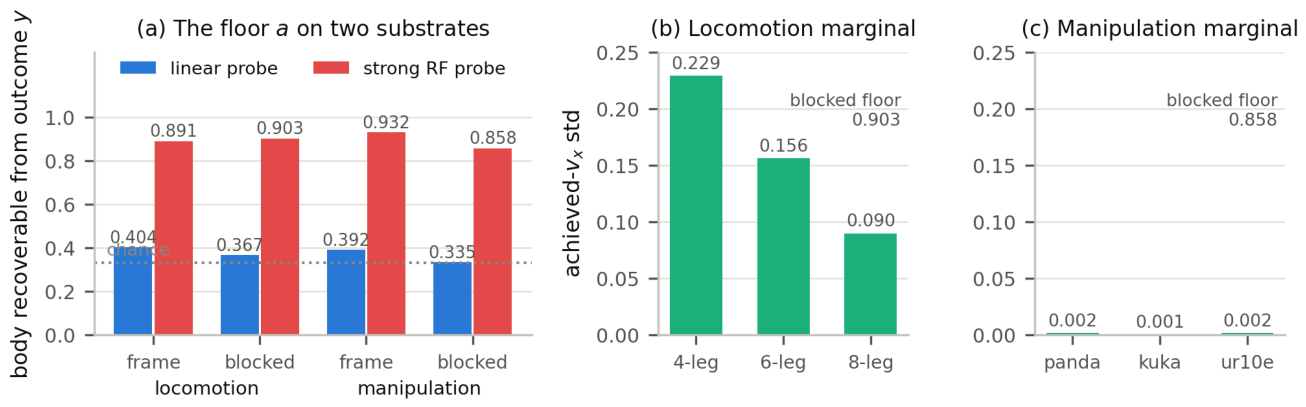
Figure 2.
Across the capacity-by-adversary grid on both substrates the linear probe dips toward chance in the invariant-looking cells while the strong probe stays pinned near .
Figure 2.
Across the capacity-by-adversary grid on both substrates the linear probe dips toward chance in the invariant-looking cells while the strong probe stays pinned near .
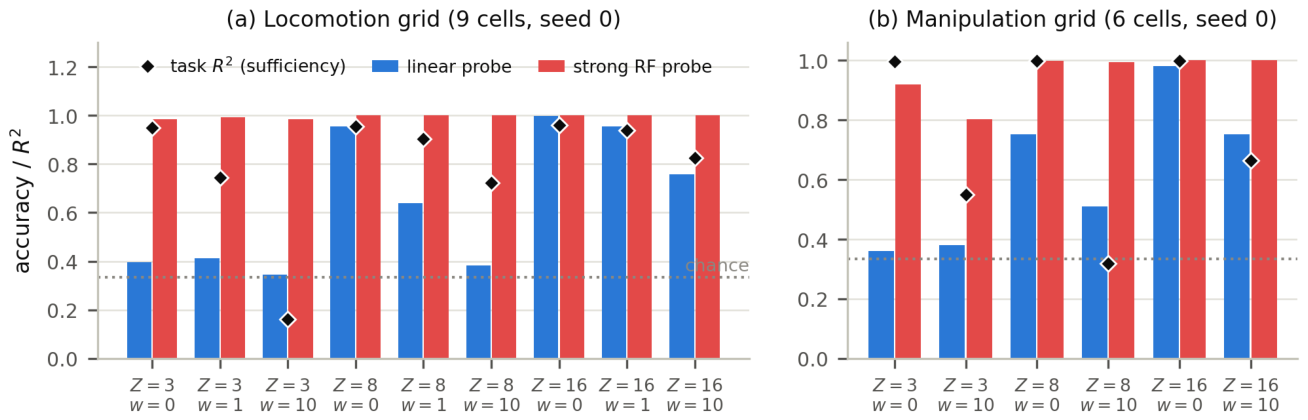
Figure 3.
Coarsening drives the strong-probe fingerprint monotonically toward chance on both substrates while task signal degrades gracefully, and every certified escape of the coarse-continuous cell is quantizer-like.
Figure 3.
Coarsening drives the strong-probe fingerprint monotonically toward chance on both substrates while task signal degrades gracefully, and every certified escape of the coarse-continuous cell is quantizer-like.
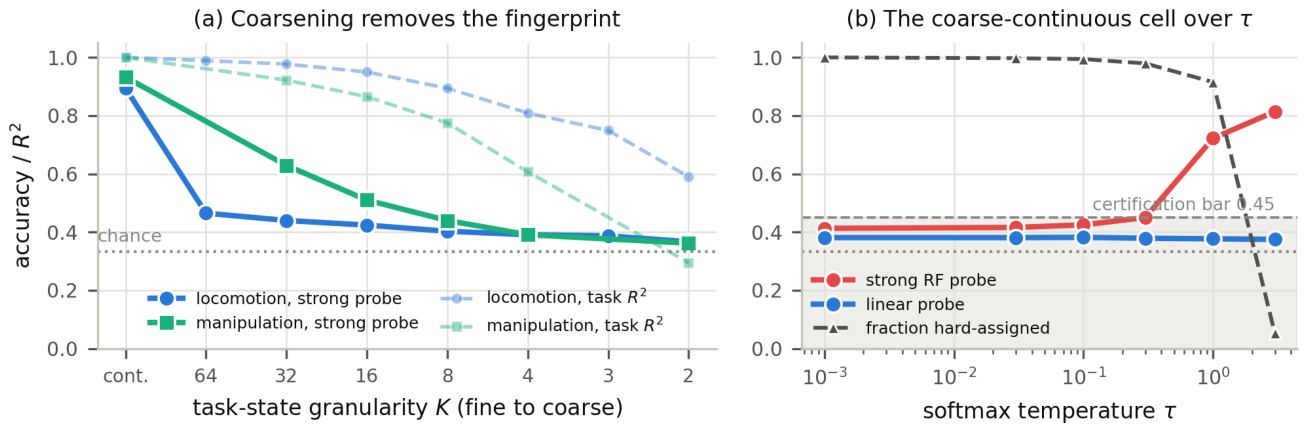

Table 1.
Locomotion capacity-by-adversary grid, one seed per cell, with topology recoverable at or above under the strong probe in every cell.
Table 1.
Locomotion capacity-by-adversary grid, one seed per cell, with topology recoverable at or above under the strong probe in every cell.
| Z | adv. w | task | linear probe | strong RF probe | adv. train acc. |
| 3 | 0 | 0.948 | 0.396 | 0.983 | 0.846 |
| 3 | 1 | 0.745 | 0.413 | 0.992 | 0.813 |
| 3 | 10 | 0.162 | 0.345 | 0.983 | 0.738 |
| 8 | 0 | 0.954 | 0.956 | 1.000 | 1.000 |
| 8 | 1 | 0.903 | 0.638 | 1.000 | 0.992 |
| 8 | 10 | 0.723 | 0.382 | 1.000 | 0.992 |
| 16 | 0 | 0.959 | 0.997 | 1.000 | 1.000 |
| 16 | 1 | 0.939 | 0.956 | 1.000 | 1.000 |
| 16 | 10 | 0.825 | 0.759 | 1.000 | 1.000 |
Table 2.
Locomotion granularity-to-invariance curve, where the strong-probe fingerprint falls monotonically toward chance as the task-state is coarsened while task signal degrades gracefully.
Table 2.
Locomotion granularity-to-invariance curve, where the strong-probe fingerprint falls monotonically toward chance as the task-state is coarsened while task signal degrades gracefully.
| task-state | strong RF topology probe | task signal |
| continuous | 0.894 | 1.000 |
| 0.465 | 0.989 | |
| 0.440 | 0.977 | |
| 0.424 | 0.950 | |
| 0.403 | 0.894 | |
| 0.391 | 0.809 | |
| 0.387 | 0.749 | |
| 0.367 | 0.590 |
Table 3.
Manipulation capacity-by-adversary grid, one seed per cell, where every control-sufficient continuous latent leaks the arm at or above.
Table 3.
Manipulation capacity-by-adversary grid, one seed per cell, where every control-sufficient continuous latent leaks the arm at or above.
| Z | adv. w | task | linear probe | strong RF probe | adv. train acc. |
| 3 | 0 | 0.997 | 0.360 | 0.920 | 0.917 |
| 3 | 10 | 0.549 | 0.380 | 0.803 | 0.406 |
| 8 | 0 | 0.998 | 0.751 | 0.998 | 1.000 |
| 8 | 10 | 0.319 | 0.511 | 0.994 | 0.868 |
| 16 | 0 | 0.998 | 0.980 | 1.000 | 1.000 |
| 16 | 10 | 0.665 | 0.753 | 1.000 | 0.996 |
Table 4.
Manipulation granularity-to-invariance curve, where the arm fingerprint again falls monotonically toward chance as the state is coarsened.
Table 4.
Manipulation granularity-to-invariance curve, where the arm fingerprint again falls monotonically toward chance as the state is coarsened.
| granularity K | strong RF arm probe | task signal |
| continuous | 0.932 | 1.000 |
| 0.629 | 0.922 | |
| 0.510 | 0.865 | |
| 0.440 | 0.775 | |
| 0.391 | 0.607 | |
| 0.362 | 0.295 |
Table 5.
The bound holds on two task families and body classes, with the strong-probe floor far above chance and the continuous leak inheriting it on both.
Table 5.
The bound holds on two task families and body classes, with the strong-probe floor far above chance and the continuous leak inheriting it on both.
| quantity | locomotion | manipulation |
| bodies (obs dims) | 4/6/8-leg (46/64/82) | panda/kuka/ur10e (27/23/21) |
| outcome y | achieved base velocity | achieved end-effector velocity |
| floor, linear / strong RF (blocked) | 0.37 / 0.90 | 0.34 / 0.86 |
| floor, linear / strong RF (frame) | 0.40 / 0.89 | 0.39 / 0.93 |
| continuous sufficient latent, strong-probe leak | ||
| coupling visible in marginal? | yes ( std 0.23 vs 0.09) | no (std ≈ 0.001–0.002) |
| coarse state (strong probe / task ) | : 0.40 / 0.89 | : 0.44 / 0.78 |
| chance | 0.333 | 0.333 |
Disclaimer/Publisher’s Note: The statements, opinions and data contained in all publications are solely those of the individual author(s) and contributor(s) and not of MDPI and/or the editor(s). MDPI and/or the editor(s) disclaim responsibility for any injury to people or property resulting from any ideas, methods, instructions or products referred to in the content. |
© 2026 by the authors. Licensee MDPI, Basel, Switzerland. This article is an open access article distributed under the terms and conditions of the Creative Commons Attribution (CC BY) license (http://creativecommons.org/licenses/by/4.0/).
Copyright: This open access article is published under a Creative Commons CC BY 4.0 license, which permit the free download, distribution, and reuse, provided that the author and preprint are cited in any reuse.