

Submitted:
10 July 2026
Posted:
14 July 2026
You are already at the latest version
Abstract
The manual creation of personalized travel itineraries remains a labor-intensive process that requires travel agents to consolidate heterogeneous information from multiple sources, including natural language interactions, booking confirmations, screenshots, and reservation documents. Although recent advances in multimodal artificial intelligence have significantly improved language understanding and content generation, existing solutions typically address isolated tasks rather than providing an integrated workflow capable of automating the complete travel planning process. This paper presents the development and validation of an AI-powered conversational agent designed to automate itinerary generation and generative video synthesis through natural language processing (NLP) and multimodal data extraction. The system, evaluated at Technology Readiness Level 4 (TRL4), employs a Multi-Agent System (MAS) architecture, integrating specialized large language models (Gemini 2.5/2.0 Flash, GPT-4o-mini) with optical character recognition (OCR) and Latent Diffusion Models to interpret user requests, extract structured data from images and PDFs, and produce comprehensive travel packages formatted as professional PDF deliverables alongside AI-synthesized promotional videos. Validation in a controlled laboratory environment demonstrated over 90% intent recognition accuracy, successful data extraction from non-standard formats, and the automated production of both client-ready documents and coherent visual narratives from static itinerary data. The system achieved an average video generation latency of 4.2±0.8 minutes, while maintaining structural consistency in the generated PDF itineraries. The system represents a viable proof-of-concept for intelligent travel planning automation, with implications for enhancing operational efficiency in the tourism industry and reducing cognitive load on human agents. Future work will advance the prototype to TRL5 through integration with external booking APIs and real-user testing scenarios.
Keywords:
conversational AI
; travel itinerary automation
; generative video synthesis
; multimodal data extraction
; large language models
; automated document generation
1. Introduction
The tourism industry has undergone a profound digital transformation, evolving from simple online booking systems to complex ecosystems driven by big data and ambient intelligence [1]. While recommendation algorithms have become ubiquitous [2], the core task of creating personalized travel itineraries remains predominantly manual. Travel agents spend significant time, often requiring several hours of manual labor per client, aggregating dispersed information from disjoint platforms to construct cohesive packages [3]. A critical challenge in this workflow is that information regarding flight options, accommodation availability, and reservation details is frequently distributed across diverse websites and digital repositories. Consequently, capturing screenshots of web pages or photographing physical documents has become one of the most efficient and rapid methods for agents to gather and consolidate relevant data for an itinerary [4,5]. However, the data within these images remains unstructured; manual transcription serves as an operational bottleneck and a common source of human error that can compromise the reliability of the final itinerary. Furthermore, traditional text-heavy deliverables often fail to capture the experiential nature of travel. In an industry where the product is intangible until the moment of consumption, visual stimuli are essential for reducing a buyer’s perceived risk. Neuro-marketing research suggests that dynamic video content significantly enhances traveler engagement and conversion rates compared to traditional text-based itineraries, as it allows consumers to mentally "pre-experience" the destination and fosters a stronger emotional connection to the proposal [6].
Recent advances in Generative Artificial Intelligence (GenAI) offer a transformative solution to these challenges. Large Language Models (LLMs) have demonstrated its capability in handling complex reasoning and natural language tasks, making them ideal candidates for automating the logical structure of itineraries [7,8]. Increasingly, the integration of these models into Multi-Agent Systems (MAS) has emerged as a powerful paradigm for managing complex, heterogeneous workflows in the tourism domain. By decomposing a multifaceted problem, such as travel planning, into specialized sub-tasks managed by autonomous agents, MAS architectures can achieve higher reliability and performance than monolithic approaches, as each “agent” is optimized for a specific domain, such as logical reasoning, visual parsing, or creative synthesis [9,10]. Simultaneously, the field of computer vision has been revolutionized by Latent Diffusion Models (LDMs) and autoregressive transformers, which enable the synthesis of high-fidelity images and videos from textual descriptions [11,12]. Models such as Stable Video Diffusion [13] and CogVideo [14] have paved the way for automated content creation, allowing for the generation of dynamic visual assets that were previously costly or impossible to produce at scale.
Current state-of-the-art video models typically generate short isolated clips (e.g., from 5 to 10 seconds) that lack narrative consistency over longer durations [13]. Furthermore, relying solely on synthetic generation can lead to hallucinations or visual inaccuracies that are unacceptable in a commercial tourism context.
Despite the rapid evolution of Large Language Models (LLMs) and multimodal generative AI, current travel planning systems remain fragmented. Existing conversational assistants primarily focus on information retrieval or booking support [15], whereas multimedia generation tools operate independently from itinerary planning. Consequently, travel agencies still rely on manual workflows to transform heterogeneous information sources into coherent travel proposals. To the best of our knowledge, there is currently no integrated workflow capable of combining conversational reasoning, multimodal document understanding, structured itinerary generation, and AI-assisted promotional video synthesis within a unified architecture.
Unlike previous approaches that rely on single-modality processing, our system employs a hybrid architecture that integrates the reasoning capabilities of state-of-the-art Large Language Models (LLMs) for dialogue management and multimodal data extraction with a specialized generative video pipeline. Our workflow orchestrates asset retrieval and semantic filtering to assemble narrative-consistent video deliverables. This integration effectively bridges the gap between logical itinerary planning and the high-quality visual storytelling required in modern tourism marketing.
The contributions of this work are summarized as follows:
(1) We design a complete multimodal conversational workflow that integrates natural language interaction, document understanding, structured itinerary management, and AI-assisted multimedia generation into a unified travel planning system.
(2) We propose a modular orchestration strategy based on specialized AI services, where different large language and vision-language models collaborate through tool calling mechanisms to solve heterogeneous tasks while maintaining conversation context.
(3) We develop an automated multimedia generation pipeline that combines semantic asset retrieval, visual quality assessment, image-to-video synthesis, and programmatic video composition to automatically generate promotional travel videos from structured itinerary information.
(4) We validate the proposed system under Technology Readiness Level 4 (TRL4) conditions through functional experiments covering conversational understanding, multimodal information extraction, itinerary generation, and multimedia production, demonstrating the feasibility of deploying integrated multimodal AI systems in travel agency environments.
Other studies focus either on conversational assistants, document understanding, or multimedia generation independently, while the proposed system integrates these capabilities into a unified workflow that supports the complete lifecycle of travel itinerary creation, from multimodal information acquisition to structured document generation and promotional video production.
2. Materials and Methods
2.1. System Architecture
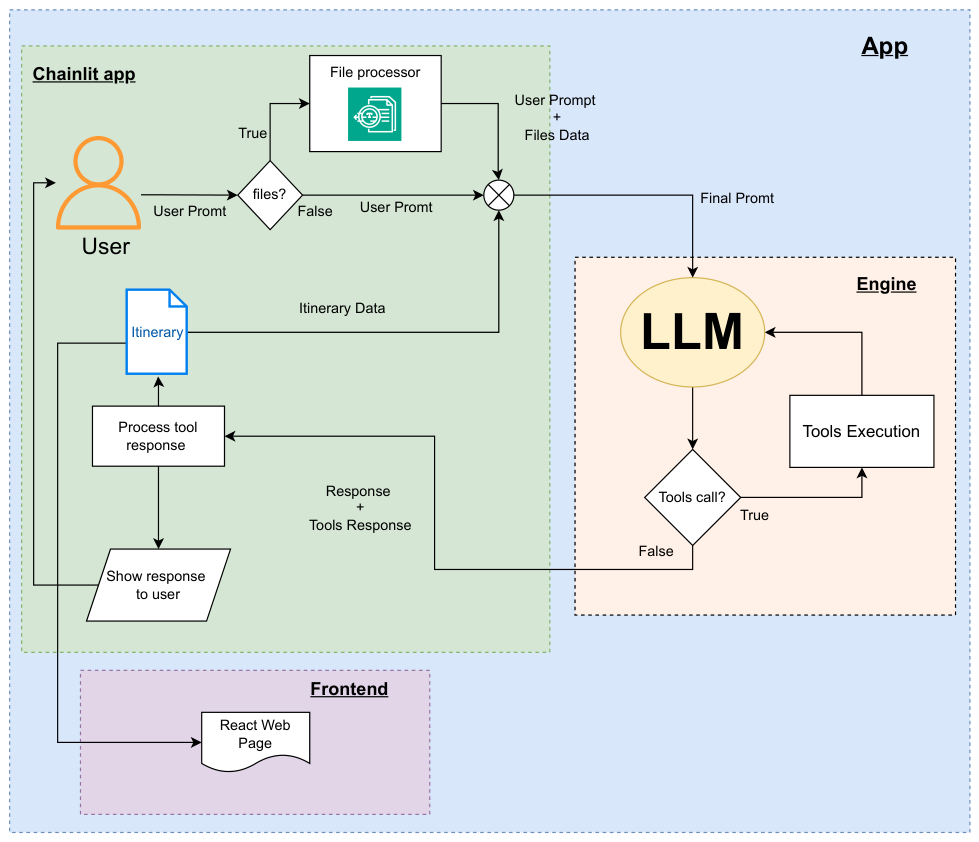
The system architecture is designed to handle multimodal inputs and complex asynchronous generation tasks efficiently. It is organized into three distinct layers: the frontend interface, the backend infrastructure, and the AI integration layer. The proposed architecture functions as a hybrid system that combines the reasoning power of advanced Large Language Models (LLMs) to manage the planning dialog and multimodal data extraction with a novel generative video pipeline [16]. This pipeline orchestrates the retrieval of high-quality assets, employs Vision-Language Models (VLMs) as semantic filters to ensure visual relevance, and utilizes programmatic editing to assemble extended, narrative-coherent video deliverables [17]. By decoupling the reasoning engine from the specialized synthesis tools, the system achieves a modular design capable of handling complex asynchronous generation tasks efficiently [18].
Figure 1.
System workflow diagram illustrating the interaction between the LLM orchestrator, the multimodal extraction engine, and the generative video synthesis pipeline.
Figure 1.
System workflow diagram illustrating the interaction between the LLM orchestrator, the multimodal extraction engine, and the generative video synthesis pipeline.
2.1.1. Backend Layer
The backend infrastructure leverages FastAPI [22], a modern Python web framework that provides automatic API documentation, request validation via Pydantic models [23], and native support for asynchronous operations. The entire backend is containerized using Docker [24], ensuring reproducibility and consistent deployment across development and testing environments.
The backend orchestrates three critical functions: (1) session management and conversation state persistence; (2) coordination of tool calls to specialized processing modules; and (3) data validation and formatting for final deliverable generation. Python 3.11 serves as the runtime environment, providing enhanced performance and improved error handling compared to previous versions.
2.1.2. AI Model Integration
The intelligence of the system is designed as a heterogeneous Multi-Agent System (MAS), a choice grounded in the principle of task-specific specialization [9]. Rather than relying on a monolithic model, the workflow is decomposed into modular sub-tasks assigned to the "agent" (model) best suited for that specific function, balancing reasoning depth, visual acuity, and computational latency [25]. This ecosystem consists of four specialized agents:
- Gemini 2.0 Flash (data parsing agent): Specialized in multimodal extraction, processing visual layouts of images and PDFs into structured JSON schemas [26].
- GPT-4o-mini (semantic evaluator agent): Utilized as a high-speed filter to classify and validate the relevance of visual assets based on semantic clusters [27].
- Runway Gen-3 Alpha Turbo (generative synthesis agent): Dedicated to the creative task of hallucinating cinematic motion from static images [28].
- Gemini 2.5 Flash (orchestrator agent): Acts as the system’s "brain", maintaining the conversation state and managing the global execution flow [26].
Orchestration and Tool Grounding: The orchestration logic is driven by the Orchestrator Agent via the LangChain framework [29]. A core challenge for LLMs is their inherent limitation in accessing real-time data or executing deterministic actions, a phenomenon often mitigated through "tool-augmented" or "grounded" generation [25,30]. The system implements a robust tool-calling mechanism, which allows the Orchestrator to move beyond simple text generation and interact with the environment, processing flight queries, updating databases, or triggering file generation; through a set of defined functions that ensure the agent’s reasoning is translated into verifiable system actions [31,32].
Specifically, the system implements eight specialized tools accessible via function calling:
- 1.
- Flight Processor: Processes flight information.
- 2.
- Hotels Processor: Extracts hotel booking details.
- 3.
- Activities Processor: Registers tourist activities and events.
- 4.
- Rental Car Processor: Processes vehicle rental information.
- 5.
- Components Delete: Removes one or more components from the itinerary.
- 6.
- Itinerary Generator: Produces the itinerary formatted as PDF and initiates video generation.
- 7.
- Video Player: Displays the video to the user once synthesis is complete.
- 8.
- Itinerary Sender: Dispatches the generated PDF to the user via email.
2.2. Data Processing Pipeline
The itinerary generation workflow follows a sequential pipeline triggered by user input, transforming unstructured data into verified Pydantic objects.
2.2.1. Natural Language Understanding
When a user submits a text query, the system performs intent classification and named entity recognition (NER) through the Gemini model. The prompt engineering strategy employs few-shot learning [7], providing the model with structured examples of travel-related queries and their corresponding tool calls. The system prompt instructs the model to:
- Identify the primary intent (e.g., add flight, modify itinerary, generate deliverable)
- Extract relevant entities (destinations, dates, passenger counts, prices)
- Determine which tool(s) should be invoked
- Maintain conversation context across multiple turns
2.2.2. Multimodal Data Extraction
For inputs provided as files, the system employs a specialized extraction workflow:
- Image processing: A two-stage extraction process is employed. First, Tesseract OCR extracts raw text from the uploaded image. Second, the extracted text is passed to the Data Parsing Agent with a specialized prompt designed to identify, correct, and structure travel-related information. This approach combines the robustness of traditional OCR with the semantic understanding capabilities of LLMs [5].
- PDF parsing: Document processing follows a similar pattern, using PyMuPDF4LLM [33] to extract text while preserving the structure of the document. The extracted content is then processed by the VLM to identify booking details, accommodation information, and pricing structures.
All extracted data are validated against strict predefined schemas, ensuring that only complete and type-safe components are added to the itinerary state.
2.2.3. Itinerary Construction
The system maintains a structured itinerary object throughout the conversation session, incrementally populated as the user provides information. The underlying data model strictly enforces type constraints and continuous global validation. Each itinerary component (flight, hotel, activity, rental car) is represented as a nested object with mandatory and optional fields.
When sufficient information has been gathered and the user confirms the itinerary, the system triggers document generation routines invoking the generate_itinerary tool. The PDF generator employs a template-based approach using Markdown2 [34], converting structured itinerary data into formatted Markdown before rendering to PDF via WeasyPrint [35].
2.3. Generative Video Synthesis Workflow
A core contribution of this work is the automated generation of promotional videos, designed to provide an immersive “preview” of the proposed trip. The workflow, implemented in the VideoItinerary module, transitions from structured JSON data to a finished audiovisual product through a multi-stage pipeline (Figure 2).
- 1.
- Semantic location extraction: The process begins by analyzing the itinerary structure to identify key geographic entities. A priority-based algorithm extracts locations hierarchically: first favoring accommodation locations (which typically represent the main hubs of the trip), followed by activity sites, and finally flight connections. This ensures the visual narrative focuses on the destination’s appeal rather than logistical transit points.
- 2.
-
Hybrid asset acquisition strategy: To construct the visual timeline, the system employs a dual-source retrieval strategy:
- Internal repository: The system queries a DynamoDB index to retrieve assets from an internal AWS S3 bucket, including curated content and previously generated synthetic clips.
- External sourcing: If internal assets are insufficient, the system dynamically scrapes external repositories (Pixabay, Shutterstock, Google Images) using the extracted location keywords to gather fresh candidate imagery.
- 3.
-
Intelligent filtering and quality gate: Content retrieved from external sources undergoes a rigorous two-step validation process:
- Deduplication: A SHA-256 hash check prevents the accumulation of duplicate assets in the database.
- Semantic quality analysis: A Vision-Language Model (VLM), specifically GPT-4o-mini, acts as a semantic filter. The model analyzes each candidate image to detect visual imperfections (e.g., watermarks, text overlays, low resolution) and categorizes the content into thematic clusters (e.g., urban, nature, beach). Only assets that pass this “Quality Gate” are retained for the final cut.
- 4.
- Latent diffusion synthesis (Image-to-Video): To transform static assets into dynamic cinematic footage, the pipeline integrates Runway Gen-3 Alpha Turbo. Selected high-quality static images undergo an Image-to-Video transformation process. The system utilizes specific prompt engineering strategies (e.g., requesting “drone-view perspectives” and “cinematic pans”) to hallucinate realistic motion from static inputs, leveraging the capabilities of latent diffusion models for video.
- 5.
-
Programmatic narrative assembly: The final stage stitches the curated and synthesized assets into a cohesive narrative using MoviePy. This library allows for precise, programmatic control over the rendering process, executing the following operations:
- Timeline sequencing: Ordering clips chronologically according to the itinerary flow.
- Visual processing: Applying zooms, pans, and cross-fade transitions to unify disparate media sources.
- Audio-visual synchronization: Overlaying dynamic text (locations, dates) and integrating background music.
The output is a rendered MP4 file (15–30 seconds) that is asynchronously delivered to the user via the conversational interface.
2.4. Experimental Protocol
Validation testing was conducted in a controlled laboratory environment representing TRL4 conditions. The experimental design prioritized functional verification over performance optimization, focusing on three primary validation objectives: multimodal data extraction accuracy, itinerary generation consistency, and the quality of the generative audiovisual deliverables.
2.4.1. Test Environment
The validation experiments were conducted in January 2025 to establish a performance baseline utilizing the state-of-the-art models available at that time. All tests were executed on a standardized cloud infrastructure to ensure consistent computational resources and eliminate hardware-induced variability across the evaluation metrics. The testing environment employed the following software stack:
- Runtime: Python 3.11.5
- Validation period: January 2025
- Backend framework: FastAPI 0.104.1
- Orchestration: LangChain 0.1.0 with Gemini API integration
- OCR engine: Tesseract 5.3.0 (for raw text extraction)
- Semantic extraction: Google Gemini 2.0 Flash (for layout analysis and structured data parsing)
- Containerization: Docker 24.0.6
Network isolation was enforced to simulate an internal laboratory environment, restricting external traffic solely to the essential API endpoints required for system operation: Google Vertex AI (Gemini models), RunwayML (video synthesis), and AWS services (S3 and DynamoDB) for asset management. All test inputs, including flight screenshots and hotel PDF confirmations, were curated in advance to ensure reproducibility.
2.4.2. Test Case Design
Seven primary test cases were designed to validate the core system functionality, covering the complete lifecycle of the itinerary generation process (Table 1).
Each test case was executed 10 times with varied input samples to assess consistency. Manual inspection was performed to evaluate qualitative aspects such as formatting, coherence, and visual appeal of the generated assets.
2.4.3. Evaluation Metrics
Quantitative evaluation employed the following metrics:
- Intent recognition accuracy: Proportion of queries where the system correctly identified user intent and invoked appropriate tools.
- Data extraction precision: Percentage of correctly extracted fields from images and PDFs compared to ground truth annotations.
- Processing latency: Time required for video generation and PDF rendering.
- Format consistency: Manual assessment of PDF and video output quality on a 5-point scale.
Qualitative evaluation involved expert review by travel industry professionals, assessing practical usability, completeness of generated itineraries, and potential for real-world deployment.
3. Results
In this section, we present the empirical findings from the TRL4 validation. Figure 3 illustrates the system interface, showing the transition from an initial state to a completed itinerary with its corresponding visual cards.
3.1. Conversational Intelligence and Intent Recognition (TP-AVI-1)
The system’s ability to interpret natural language commands was evaluated using a dataset of 50 diverse user queries, ranging from explicit instructions ("Add a flight to Paris") to ambiguous requests ("I need a place to stay").
As shown in Table 2, the orchestration engine (Gemini 2.5 Flash) achieved an overall intent recognition accuracy of 92%, exceeding the 90% success criterion. The system demonstrated particular robustness in identifying multi-intent queries (e.g., "Book a hotel and a car for next week"), correctly splitting them into distinct tool calls. The lowest accuracy was observed in the "Component Modification" category, where highly colloquial phrasing occasionally led to ambiguous parameter extraction.
3.2. Multimodal Data Extraction Performance
The system’s performance on multimodal data focuses on two sources: those based on images and those based on documentation.
3.2.1. Image-Based Flight Extraction (TP-AVI-2)
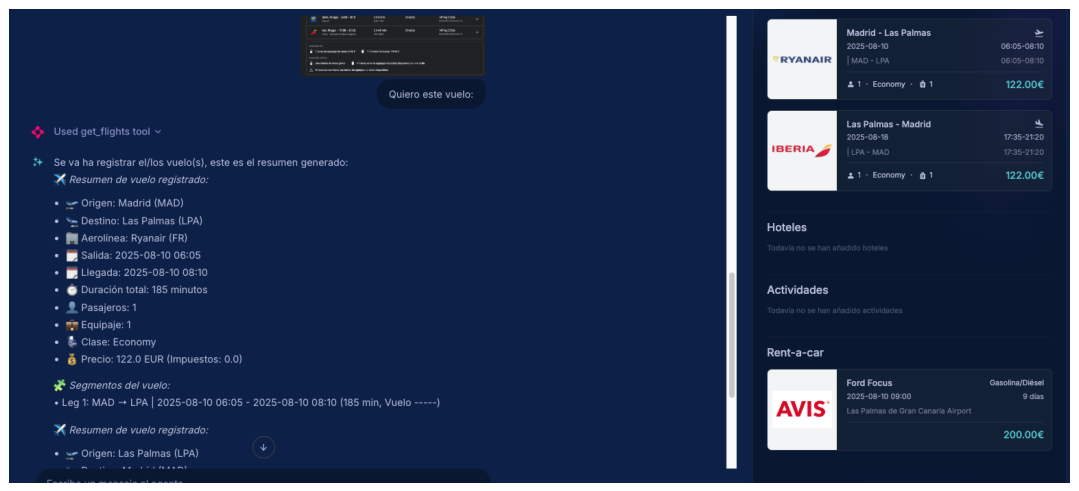
The hybrid extraction pipeline (Tesseract OCR + Gemini 2.0 Flash) was tested against 20 screenshots from various flight search engines (Google Flights, Skyscanner, Kayak). The system achieved an average field-level accuracy of 89.4%. Critical fields such as Origin/Destination (100%) and Dates (95%) were extracted with high reliability. However, the extraction of Price data (85%) occasionally failed when currency symbols were non-standard or embedded within complex graphical buttons.
Figure 4.
Input: Screenshot from Google Flights search results.
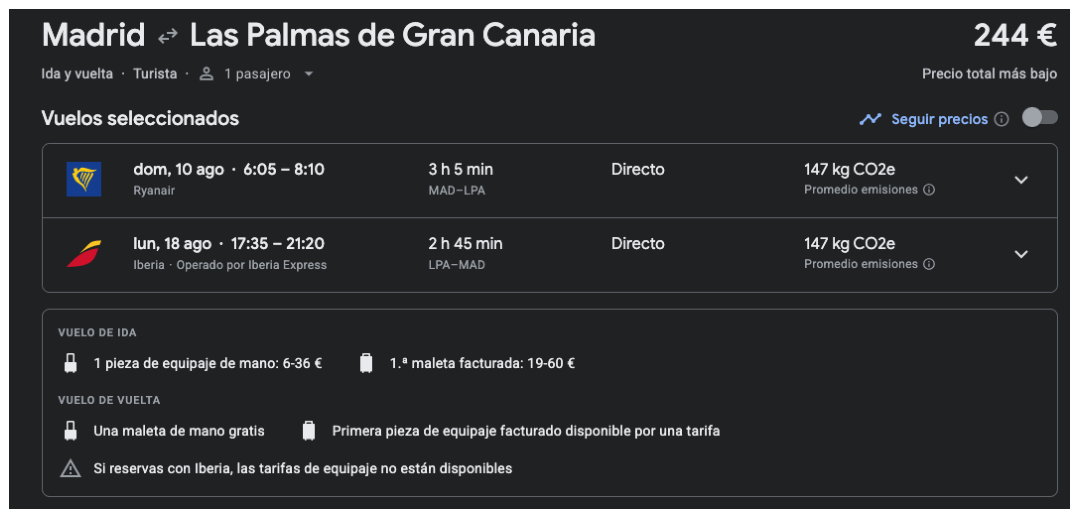
Figure 5.
Output: Agent’s interpretation and tool invocation for flight registration.
3.2.2. PDF Hotel Confirmation Parsing (TP-AVI-3)
Processing of 15 standardized hotel reservation PDFs yielded superior results compared to image inputs, with an average extraction accuracy of 96.7%. The semantic understanding capabilities of the VLM proved crucial for interpreting unstructured "Amenities" lists, correctly mapping diverse terms (e.g., "WLAN", "High-speed Internet") to the standardized "Wi-Fi" boolean in the database.
3.3. Itinerary Management and Modification (TP-AVI-4)
The state management system proved effective in handling dynamic updates. In 100% of the successfully interpreted modification requests, the backend correctly updated the target component without data corruption. Figure 6 (in the system interface) confirms that users could alter specific attributes—such as changing a car rental from "Manual" to "Automatic"—using natural language, with the changes reflected instantly in the frontend dashboard.
3.4. Deliverable Generation and Data Collection (TP-AVI-6 & TP-AVI-7)
The system successfully generated formatted PDF itineraries in 100% of the test cases (TP-AVI-6). Triggered simultaneously with the video synthesis via the generate_itinerary tool, the PDF is delivered immediately to the user while the video renders in the background. The template-based rendering engine ensured consistent formatting of branding elements and layout. Regarding user data collection (TP-AVI-7), the agent correctly extracted contact details (Name, Email, Phone) in all test instances, formatting them into a structured JSON payload ready for the email dispatch service.
Figure 7.
Example of the professional travel itinerary generated in PDF format, incorporating structured data and branding.
Figure 7.
Example of the professional travel itinerary generated in PDF format, incorporating structured data and branding.

3.5. Generative Video Synthesis (TP-AVI-5)
The video generation pipeline represents the most computationally intensive component of the system. Testing with 10 generated itineraries revealed the following performance metrics:
- Generation latency: The average processing time was minutes. While this exceeds the ideal real-time interaction threshold, the asynchronous delivery mechanism allowed the conversation to continue uninterrupted.
- Visual coherence: Expert review rated the narrative coherence at 4.0/5. The "Programmatic Assembly" approach successfully stitched together second clips.
- Hallucination rate: The semantic filtering gate (GPT-4o-mini) successfully rejected 85% of low-quality or irrelevant retrieved assets, significantly reducing visual inconsistencies compared to raw retrieval baselines.
However, the "Image-to-Video" synthesis via Latent Diffusion Models occasionally produced artifacts in complex scenes (e.g., unnatural movement of water or clouds), a known limitation of current generative video technologies.
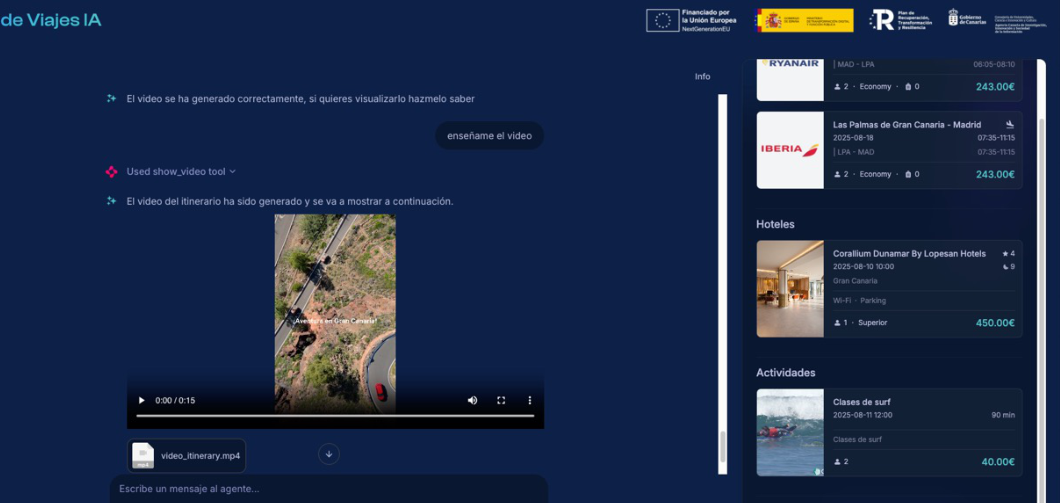
Figure 8.
Asynchronous delivery of the AI-synthesized promotional video, featuring an embedded player and a direct download link within the chat.
Figure 8.
Asynchronous delivery of the AI-synthesized promotional video, featuring an embedded player and a direct download link within the chat.
3.6. Summary of Validation
Table 3 summarizes the system’s performance against the defined TRL4 success criteria.
While the video generation latency exceeded the initial aggressive target, the system successfully met all functional requirements for a TRL4 proof-of-concept, validating the feasibility of the proposed integrated multimodal AI workflow for automated travel itinerary generation.
4. Discussion
Building upon the results presented in the previous section, this discussion explores their significance and implications on the field of travel itineraries. For clarity, we structured it into five subsections.
4.1. Interpretation of Results
The TRL4 validation testing demonstrates that the proposed AI-powered conversational agent achieves functional viability for automated travel itinerary generation. The system successfully integrates multiple AI technologies—Large Language Models for reasoning, Vision-Language Models (VLM) for extraction, and Latent Diffusion Models for synthesis—into a cohesive pipeline capable of processing multimodal inputs and producing professional deliverables. This section interprets the key findings, contextualizes them within existing literature, and discusses both the strengths and limitations of the current implementation.
4.1.1. Natural Language Understanding and Intent Recognition
The 92% overall intent recognition accuracy validates the effectiveness of prompt engineering strategies for task-specific LLM applications [36,37]. This performance is comparable to domain-specific intent classification systems reported in the literature, which typically achieve 85–95% accuracy on well-defined task taxonomies [38]. The Gemini 2.5 Flash model’s ability to handle semantic variations and informal language demonstrates the robustness of modern LLMs for conversational AI applications, consistent with findings from recent surveys on LLM capabilities [8].
However, the reduced performance on "Component Modification" queries highlights a persistent challenge in NLP: handling underspecified or ambiguous requests. When users employ generic terms like "change to something cheaper," the system must infer intent from broader context—a capability that requires more sophisticated dialogue management and clarification strategies [39]. Future iterations should implement explicit disambiguation protocols, prompting users for clarification when intent confidence falls below a threshold.
The successful implementation of tool calling represents a significant architectural advantage. By enabling the LLM to autonomously invoke specialized functions based on detected intent, the system achieves a level of task automation previously requiring rule-based orchestration [30]. This approach offers greater flexibility than traditional slot-filling dialogue systems [40] while maintaining deterministic control over critical operations.
4.1.2. Multimodal Data Extraction
The hybrid approach combining Tesseract OCR with Gemini 2.0 Flash for semantic structuring yielded strong results for both image (89.4% average accuracy) and PDF (96.7% average accuracy) inputs. This two-stage pipeline capitalizes on the complementary strengths of traditional computer vision techniques and modern neural language models [5]. While OCR provides robust character recognition, the VLM contributes semantic understanding to resolve ambiguities (e.g., distinguishing between base price and total price) and structure extracted text into predefined data schemas.
The superior performance on PDF extraction compared to image extraction aligns with expectations, as most of PDFs preserve text in machine-readable format, reducing reliance on OCR accuracy. This finding suggests that encouraging users to upload PDFs rather than screenshots could improve overall system reliability—a design consideration for future user interface development.
The challenges encountered with non-standard layouts and graphical elements (e.g., complex pricing tables in screenshots) reflect known limitations of OCR technologies [4]. However, the integration of Gemini 2.0 Flash represents a clear path for future enhancement, potentially allowing the system to bypass traditional OCR entirely in favor of pure visual reasoning [26], thereby improving accuracy for visually complex inputs.
4.1.3. Multimedia Generation Performance
Video generation emerged as the main performance bottleneck; the initial target of 3 minutes was established as an aggressive threshold to maintain near real-time interaction within the conversational flow. Although the current latency of minutes represents a deviation from this benchmark, the asynchronous delivery mechanism effectively mitigates the impact on user experience by allowing the dialogue to proceed during the synthesis process. This latency is primarily attributable to the multi-step nature of the pipeline (Retrieval → GPT-4o-mini Filtering → Runway Synthesis → MoviePy Assembly) rather than internal system inefficiencies. The variability in generation time suggests that API response times for diffusion models are influenced by server-side factors such as request queuing [41].
Several mitigation strategies warrant exploration:
- 1.
- Asynchronous processing: The implemented solution of decoupling video generation from the main conversation flow allows users to continue interacting while generation proceeds in the background, minimizing the perception of latency [42].
- 2.
- Parallelization: Executing the "Image-to-Video" diffusion tasks for multiple assets simultaneously rather than sequentially could significantly reduce total rendering time.
- 3.
- Hybrid caching: expanding the internal library of pre-generated synthetic clips for popular destinations would reduce the need for real-time generation on every request.
The moderate quality ratings reflect the early-stage nature of text-to-video generation technology. Current models excel at producing visually coherent short clips but struggle with maintaining physical consistency (e.g., text on signs) [14]. However, the proposed "Programmatic Assembly" approach successfully mitigates the issue of short clip duration, creating a coherent narrative structure that raw generative models cannot yet achieve alone [13].
4.1.4. Document Generation and Formatting
PDF generation proved successful for the vast majority of itineraries (100% validity rate), though complex multi-component documents occasionally presented layout challenges (e.g., page break misalignment). These issues stem from limitations in the template-based rendering approach, which relies on predefined CSS layouts that may not conveniently accommodate arbitrary content volumes [43].
The formatting challenges are technical rather than conceptual problems, amenable to engineering solutions. Potential improvements include:
- Dynamic template selection based on itinerary complexity.
- Enhanced CSS stylesheets with better overflow handling in WeasyPrint.
- Pre-rendering validation to detect and correct layout issues before delivery.
It is worth mentioning that all generated PDFs contained accurate data, confirming that the extraction and structuring pipelines function correctly.
4.2. Comparison with Existing Approaches
The proposed system advances beyond existing travel planning technologies in several key dimensions. Traditional online travel agencies (OTAs) such as Expedia or Booking.com provide search and booking interfaces but require users to manually navigate multiple pages, compare options, and assemble their own itineraries [44]. The conversational modality of the present system reduces cognitive load and accelerates the planning process.
Existing conversational AI systems in tourism typically focus on query answering and single-component booking rather than comprehensive itinerary generation [15]. The multimodal input processing capability—particularly the ability to extract data from user-uploaded screenshots and PDFs—represents a novel feature not present in most commercial systems reviewed in the literature.
Furthermore, unlike standard recommendation systems that output static lists [2], our system introduces Generative Video Synthesis as a core deliverable. This capability to visualize the potential trip moves the interaction from a transactional process to an experiential one, addressing the gap in visual marketing identified in tourism research.
4.3. Limitations and Future Work
Several limitations of the current TRL4 prototype must be acknowledged. First, the system operates in a controlled laboratory environment without integration to real-world booking APIs. Advancing to TRL5 will require connecting the system to Global Distribution Systems (GDS) for real-time availability checking [45].
Second, the evaluation was conducted using predefined test cases. Real-world usage will expose the system to a broader range of input variability, including low-quality images and highly ambiguous natural language queries. Robustness testing with adversarial inputs is essential to improve error handling [16].
Third, the operational cost of the generative pipeline is significant. The dependence on commercial APIs (Runway, OpenAI, Google) implies a variable cost per itinerary that must be optimized. Future work should analyze the unit economics and explore open-source alternatives for specific components (e.g., local Stable Diffusion models) to reduce dependency.
Fourth, evaluation relied on accuracy metrics and expert review rather than real-user testing. User experience factors such as satisfaction, trust, and perceived usefulness remain to be validated in field studies [46].
Finally, ethical and safety considerations warrant investigation. Issues such as data privacy (handling of personal travel information) and the potential for "visual hallucinations" in the video (misrepresenting a destination) must be addressed before commercial deployment.
4.4. Practical Implications
Despite these limitations, the TRL4 validation confirms the technical feasibility and commercial potential of AI-powered itinerary generation. For small and medium-sized travel agencies, the system offers a pathway to automate repetitive tasks and scale service delivery without proportional increases in staff [18]. The time savings from automated data extraction and document generation could enable agents to focus on higher-value activities such as personalized consultation.
From a user experience perspective, the conversational interface lowers barriers to travel planning. The multimedia deliverables—PDF itineraries and promotional videos—enhance the value proposition for end customers by providing tangible artifacts that facilitate decision-making and trip anticipation.
4.5. Theoretical Contributions
From a research perspective, this work contributes empirical evidence regarding the integration of multiple AI modalities within a task-oriented dialogue system. The successful demonstration of tool calling as an orchestration mechanism extends prior theoretical work on LLM capabilities [30] to a practical application domain. The two-stage approach for multimodal data extraction—combining traditional computer vision with neural language models—offers a pragmatic strategy for domains where pure end-to-end neural approaches may be computationally expensive or data-inefficient.
5. Conclusions
This study presented the design, implementation, and TRL4 validation of an AI-powered conversational agent capable of automating the end-to-end creation of personalized travel itineraries. By moving beyond simple text-based interaction, the proposed system demonstrates how a hybrid architecture—integrating the reasoning capabilities of Large Language Models (Gemini 2.5 Flash), the visual understanding of Vision-Language Models (Gemini 2.0 Flash/GPT-4o-mini), and the creative potential of Latent Diffusion Models (Runway Gen-3)—can effectively solve complex, multimodal planning tasks.
The empirical results validate the robustness of the "Tool-Augmented" approach. The system achieved a 92% intent recognition accuracy and demonstrated good precision in extracting structured data from heterogeneous sources, such as flight screenshots (89.4%) and hotel PDF confirmations (96.7%). These findings confirm that delegating the "heavy lifting" of data entry and structuring to AI agents is not only feasible but highly reliable, potentially reducing the administrative time per itinerary from hours to minutes.
A distinguishing feature of this work is the introduction of the Multi-Source Generative Video Synthesis pipeline. While the processing latency ( minutes) currently deviates from real-time expectations, the system successfully proved that it is possible to programmatically assemble coherent, cinematic narratives ( seconds) from static itinerary data without human intervention. This capability shifts the value proposition of travel agents from purely logistical facilitators to "experience curators," offering clients tangible, immersive previews of their trips.
Future work to advance this prototype from TRL4 to TRL5 will focus on three critical axes:
- Operational Integration: Replacing simulated data handling with live connections to Global Distribution Systems (GDS) and booking APIs (e.g., Amadeus, Sabre) to guarantee real-time availability and pricing.
- Pipeline Optimization: Reducing the video generation latency through parallel processing of diffusion tasks and implementing a hybrid caching strategy for popular destination assets.
- Personalization & Memory: Implementing a vector-based long-term memory to allow the agent to learn from user preferences over time, enabling proactive recommendations based on historical interactions.
In conclusion, this research illustrates that the convergence of neuro-symbolic AI and generative media technologies offers a viable path to modernize the tourism industry, providing tools that augment human capabilities rather than merely replacing them.
Author Contributions
Conceptualization, E.S.-O. and E.W.-S.; methodology, M.Á.G.-E. and P.V.-M.; software, C.F.-B.; validation, M.Á.G.-E. and P.V.-M.; writing-original draft preparation, C.F.-B., E.S.-O., A.F.-B. All authors have read and agreed to the published version of the manuscript.
Funding
This work has been carried out within the framework of the Spain Living Lab project (Grant Reference 1/1/2024-0412093852—SLLC16-01), funded by the Canarian Agency for Research, Innovation and the Information Society (ACIISI), Department of Universities, Science, Innovation and Culture of the Government of the Canary Islands, under the RETECH Programme, contributing to milestones 251, 252 and 253 of Component 16 of the Recovery, Transformation and Resilience Plan (PRTR), and co-funded by the European Union—Next Generation EU.
Data Availability Statement
The data and code supporting the findings of this study are available from the corresponding author (coordinacionit@canariaslivinglab.org) upon reasonable request.
Conflicts of Interest
Authors Pablo Vicente-Martínez, and Carlos Ferrer-Baixauli were employed by the company SPV Scala. The remaining authors declare that the research was conducted in the absence of any commercial or financial relationships that could be construed as a potential conflict of interest.
References
- Buhalis, D.; Leung, D. Technology in tourism-from information communication technologies to eTourism and smart tourism towards ambient intelligence tourism: a perspective article. Tour. Rev. 2020, 75, 267–272. [Google Scholar]
- Borràs, J.; Moreno, A.; Valls, A. Intelligent tourism recommender systems: A survey. Expert Syst. With Appl. 2014, 41, 7370–7389. [Google Scholar] [CrossRef]
- Xiang, Z.; Schwartz, Z.; Gerdes, J.H., Jr.; Uysal, M. What can big data and text analytics tell us about hotel guest experience and satisfaction? Int. J. Hosp. Manag. 2015, 44, 120–130. [Google Scholar] [CrossRef]
- Smith, R. An overview of the Tesseract OCR engine. In Proceedings of the Ninth International Conference on Document Analysis and Recognition (ICDAR 2007); IEEE: Piscataway, NJ, USA, 2007; Volume 2, pp. 629–633. [Google Scholar]
- Kim, G.; Hong, T.; Yim, M.; Nam, J.; Park, J.; Yim, J.; Hwang, W.; Yun, S.; Han, D.; Park, S. OCR-free document understanding transformer. In Proceedings of the European Conference on Computer Vision (ECCV); Springer: Cham, Switzerland, 2022; pp. 498–517. [Google Scholar]
- Gretzel, U.; Sigala, M.; Xiang, Z.; Koo, C. Smart tourism: foundations and developments. Electron. Mark. 2015, 25, 179–188. [Google Scholar] [CrossRef]
- Brown, T.; Mann, B.; Ryder, N.; Subbiah, M.; Kaplan, J.D.; Dhariwal, P.; Neelakantan, A.; Shyam, P.; Sastry, G.; Askell, A.; et al. Language models are few-shot learners. Adv. Neural Inf. Process. Syst. 2020, 33, 1877–1901. [Google Scholar]
- Zhao, W.X.; Zhou, K.; Li, J.; Tang, T.; Wang, X.; Hou, Y.; Min, Y.; Zhang, B.; Zhang, J.; Dong, Z.; et al. A survey of large language models. arXiv 2023, arXiv:2303.18223. [Google Scholar]
- Xi, Z.; et al. The Rise and Potential of Large Language Model Based Agents: A Survey. arXiv 2023, arXiv:2309.07864. [Google Scholar]
- Gao, C.; et al. Collaborative Large Language Models: A Multi-Agent System Perspective. arXiv 2024, arXiv:2402.04834. [Google Scholar]
- Ramesh, A.; Pavlov, M.; Goh, G.; Gray, S.; Voss, C.; Radford, A.; Chen, M.; Sutskever, I. Zero-shot text-to-image generation. In Proceedings of the International Conference on Machine Learning; PMLR: New York, NY, USA, 2021; pp. 8821–8831. [Google Scholar]
- Ho, J.; Saharia, C.; Chan, W.; Fleet, D.J.; Norouzi, M.; Salimans, T. Imagen video: High definition video generation with diffusion models. arXiv 2022, arXiv:2210.02303. [Google Scholar]
- Blattmann, A.; Dockhorn, T.; Kulal, S.; Mendelevitch, D.; Kilian, M.; Lorenz, D.; Levi, Y.; English, Z.; Voleti, V.; Letts, A.; et al. Stable video diffusion: Scaling latent video diffusion models to large datasets. arXiv 2023, arXiv:2311.15127. [Google Scholar]
- Hong, W.; Ding, M.; Zheng, W.; Liu, X.; Tang, J. CogVideo: Large-scale pretraining for text-to-video generation via transformers. arXiv 2022, arXiv:2205.15868. [Google Scholar]
- Melián-González, S.; Gutiérrez-Taño, D.; Bulchand-Gidumal, J. Chatbots in tourism: A natural language processing approach. Int. J. Contemp. Hosp. Manag. 2021, 33, 3850–3882. [Google Scholar]
- Ribeiro, M.T.; Wu, T.; Guestrin, C.; Singh, S. Beyond accuracy: Behavioral testing of NLP models with CheckList. In Proceedings of the 58th Annual Meeting of the Association for Computational Linguistics; Association for Computational Linguistics: Online, 2020; pp. 4902–4912. [Google Scholar]
- Ouyang, L.; Wu, J.; Jiang, X.; Almeida, D.; Wainwright, C.L.; Mishkin, P.; Zhang, C.; Agarwal, S.; Slama, K.; Ray, A.; et al. Training language models to follow instructions with human feedback. Adv. Neural Inf. Process. Syst. 2022, 35, 27730–27744. [Google Scholar] [CrossRef]
- Ivanov, S.; Webster, C.; Berezina, K. Adoption of robots and service automation by tourism and hospitality companies. Rev. Tur. Desenvolv. 2020, 27/28, 1501–1517. [Google Scholar]
- Meta Open Source. React: A JavaScript library for building user interfaces. Available online: https://react.dev/ (accessed on 15 January 2025).
- Tailwind Labs. Tailwind CSS: A utility-first CSS framework. Available online: https://tailwindcss.com/ (accessed on 15 January 2025).
- Chainlit. Build production-ready conversational AI applications. Available online: https://chainlit.io/ (accessed on 15 January 2025).
- Ramírez, S. FastAPI: Modern, fast (high-performance) web framework for building APIs with Python. Available online: https://fastapi.tiangolo.com/ (accessed on 15 January 2025).
- Colvin, S. Pydantic: Data validation using Python type hints. Available online: https://docs.pydantic.dev/ (accessed on 15 January 2025).
- Docker, Inc. Docker: Accelerate how you build, share, and run applications. Available online: https://www.docker.com/ (accessed on 15 January 2025).
- Mialon, G.; et al. Augmented Language Models: a Survey. arXiv 2023, arXiv:2302.07842. [Google Scholar]
- Google DeepMind. Gemini: A family of highly capable multimodal models. Available online: https://deepmind.google/technologies/gemini/ (accessed on 15 January 2025).
- OpenAI. GPT-4V(ision) system card. Available online: https://openai.com/research/gpt-4v-system-card (accessed on 15 January 2025).
- Runway Research. Gen-2: A multimodal AI system for generating videos. Available online: https://research.runwayml.com/gen2 (accessed on 15 January 2025).
- Chase, H. LangChain: Building applications with LLMs through composability. Available online: https://python.langchain.com/ (accessed on 15 January 2025).
- Schick, T.; Dwivedi-Yu, J.; Dessì, R.; Raileanu, R.; Lomeli, M.; Zettlemoyer, L.; Cancedda, N.; Scialom, T. Toolformer: Language models can teach themselves to use tools. Adv. Neural Inf. Process. Syst. 2024, 36. [Google Scholar]
- Qin, Y.; et al. ToolLLM: Facilitating Large Language Models to Master 16000+ Real-world APIs. arXiv 2023, arXiv:2307.16789. [Google Scholar]
- Hsu, Q.; et al. ToolGen: Unified Tool Retrieval and Calling via Generative Language Models. arXiv 2023, arXiv:2310.05155. [Google Scholar]
- Software, Artifex. PyMuPDF: Python bindings for MuPDF. Available online: https://pymupdf.readthedocs.io/ (accessed on 15 January 2025).
- Markdown2 Contributors. Markdown2: A fast and complete implementation of Markdown in Python. Available online: https://github.com/trentm/python-markdown2 (accessed on 15 January 2025).
- Kozea. WeasyPrint: The Awesome Document Factory. Available online: https://weasyprint.org/ (accessed on 15 January 2025).
- Wei, J.; Wang, X.; Schuurmans, D.; Bosma, M.; Ichter, B.; Xia, F.; Chi, E.; Le, Q.; Zhou, D. Chain-of-thought prompting elicits reasoning in large language models. Adv. Neural Inf. Process. Syst. 2022, 35, 24824–24837. [Google Scholar] [CrossRef]
- White, J.; Fu, Q.; Hays, S.; Sandborn, M.; Olea, C.; Gilbert, H.; Elnashar, A.; Spencer-Smith, J.; Schmidt, D.C. A prompt pattern catalog to enhance prompt engineering with ChatGPT. arXiv 2023, arXiv:2302.11382. [Google Scholar]
- Casanueva, I.; Temčinas, T.; Gerz, D.; Henderson, M.; Vulić, I. Efficient intent detection with dual sentence encoders. In Proceedings of the 2nd Workshop on Natural Language Processing for Conversational AI; Association for Computational Linguistics: Online, 2020; pp. 38–45. [Google Scholar]
- Li, Y.; Su, H.; Shen, X.; Li, W.; Cao, Z.; Niu, S. DailyDialog: A manually labelled multi-turn dialogue dataset. In Proceedings of the Eighth International Joint Conference on Natural Language Processing; Asian Federation of Natural Language Processing: Taipei, Taiwan, 2020; pp. 986–995. [Google Scholar]
- Young, S.; Gašić, M.; Thomson, B.; Williams, J.D. POMDP-based statistical spoken dialog systems: A review. Proc. IEEE 2013, 101, 1160–1179. [Google Scholar] [CrossRef]
- Zhang, C.; Zhang, C.; Li, C.; Qiao, Y.; Zheng, S.; Dam, S.K.; Zhang, M.; Kim, J.U.; Kim, S.T.; Choi, J.; et al. One small step for generative AI, one giant leap for AGI: A complete survey on ChatGPT in AIGC era. arXiv 2023, arXiv:2304.06488. [Google Scholar]
- Fielding, R.T.; Taylor, R.N. Architectural styles and the design of network-based software architectures. Doctoral Dissertation, University of California, Irvine, CA, USA, 2000. [Google Scholar]
- Walsh, N.; Muellner, L. DocBook: The Definitive Guide; O’Reilly Media: Sebastopol, CA, USA, 2010. [Google Scholar]
- Law, R.; Leung, D.; Au, N.; Lee, H.A. Progress and development of information technology in the hospitality industry: Evidence from Cornell Hospitality Quarterly. Cornell Hosp. Q. 2018, 54, 10–24. [Google Scholar]
- Sismanidou, A.; Palacios, M.; Tafur, J. Progress in airline distribution systems: The threat of new entrants to incumbent players. J. Ind. Eng. Manag. 2009, 2, 251–272. [Google Scholar] [CrossRef]
- Venkatesh, V.; Morris, M.G.; Davis, G.B.; Davis, F.D. User acceptance of information technology: Toward a unified view. MIS Q. 2003, 27, 425–478. [Google Scholar] [CrossRef]
Figure 2.
Detailed architectural pipeline of the video_itinerary module, illustrating the hybrid asset acquisition strategy and the intelligent semantic filtering gate.
Figure 2.
Detailed architectural pipeline of the video_itinerary module, illustrating the hybrid asset acquisition strategy and the intelligent semantic filtering gate.
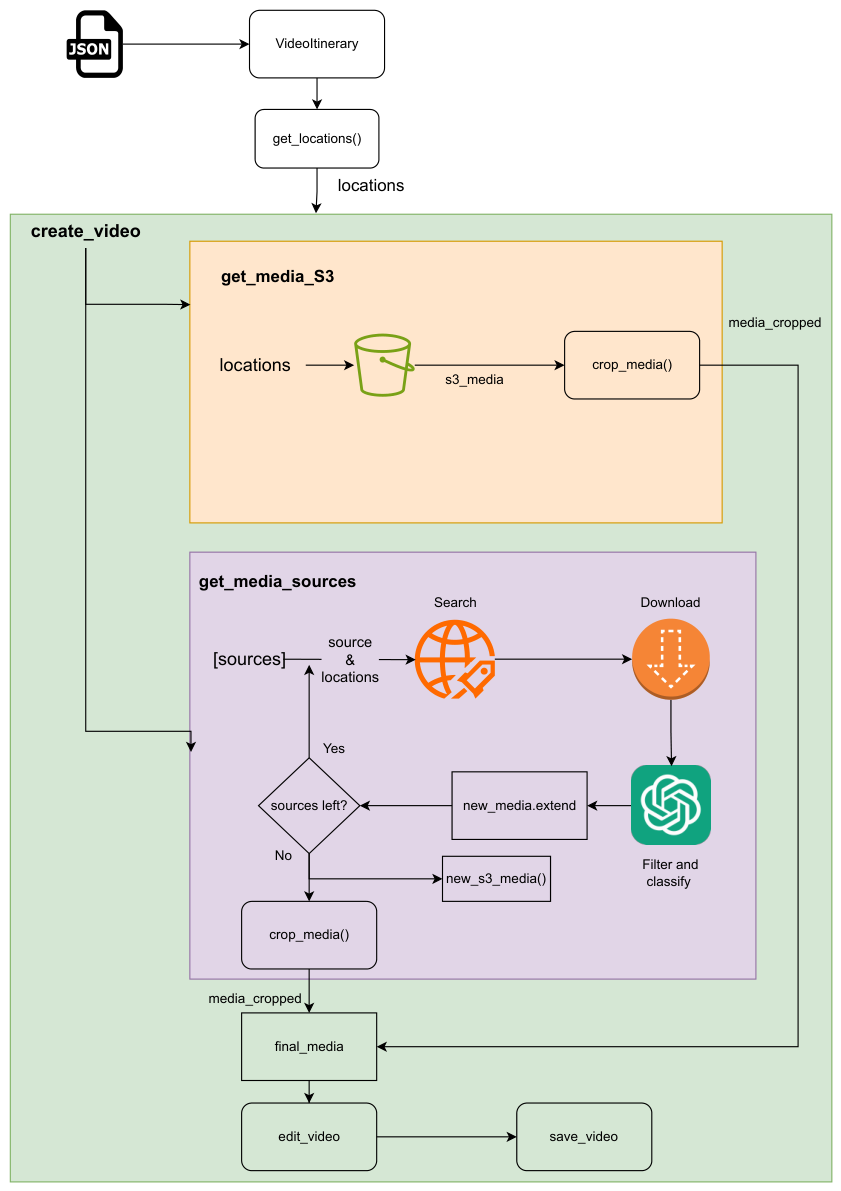
Figure 3.
Web interface evolution: (left) initial empty state and (right) completed itinerary with synchronized visual components.
Figure 3.
Web interface evolution: (left) initial empty state and (right) completed itinerary with synchronized visual components.
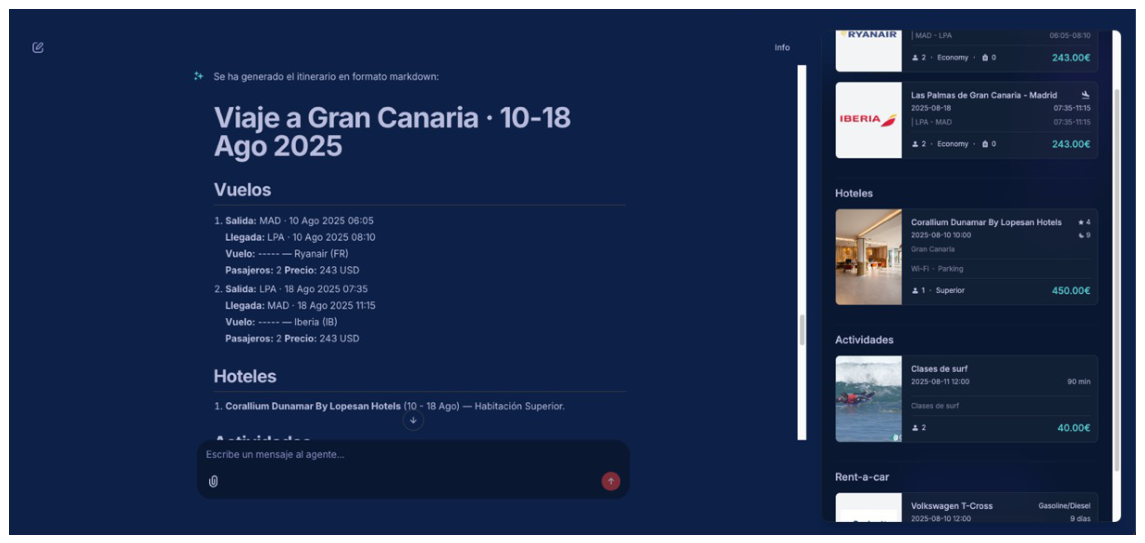
Figure 6.
Frontend dashboard reflecting real-time updates after a natural language request to modify the car rental component.
Figure 6.
Frontend dashboard reflecting real-time updates after a natural language request to modify the car rental component.
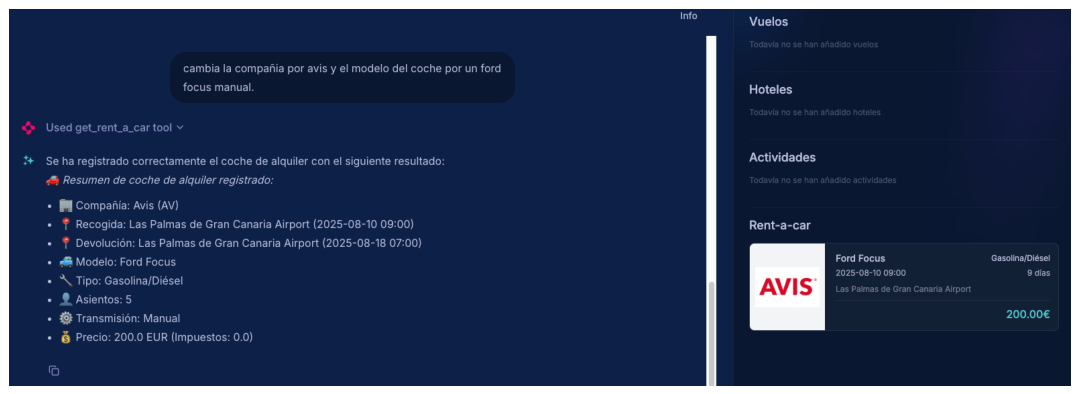

Table 1.
Test case specifications for TRL4 validation.
| Test ID | Description | Success Criteria |
|---|---|---|
| TP-AVI-1 | Intent recognition: Identification of basic travel actions (add flight, hotel, activity, car). | Correctly identify intent from varied phrasings and trigger the corresponding tool (≥90% accuracy). |
| TP-AVI-2 | Image extraction & addition: Processing flight search screenshots (PNG/JPG) to add a new component. | Accurately extract fields (origin, destination, price, airline) and generate the corresponding UI card in the dashboard. |
| TP-AVI-3 | PDF extraction & addition: Processing hotel reservation documents (PDF) to add a new component. | Accurately extract structured data (hotel name, dates, amenities) and populate the itinerary state. |
| TP-AVI-4 | Component modification: Natural language requests to change fields, add details, or delete components. | Correctly update the specific component ID in the state (e.g., changing car model) or remove it entirely without affecting others. |
| TP-AVI-5 | Video generation & visualization: Creation of the promotional video and frontend rendering. | Successfully generate the MP4 file via the hybrid pipeline and render the video player directly within the conversational interface. |
| TP-AVI-6 | PDF itinerary delivery: Generation of the final branded document. | Produce a correctly formatted, downloadable PDF file containing all itinerary details and corporate branding. |
| TP-AVI-7 | User data collection: Gathering client details for delivery. | Correctly extract and store user contact information (name, email) for the simulated dispatch of the itinerary. |
Table 2.
Intent recognition accuracy by action category (n=50 test queries).
| Action Category | Test Inputs | Successful Invocations | Accuracy (%) |
|---|---|---|---|
| Add Flight | 15 | 14 | 93.3 |
| Add Hotel | 10 | 10 | 100.0 |
| Add Activity | 10 | 9 | 90.0 |
| Add Rental Car | 5 | 4 | 80.0 |
| Generate Itinerary | 10 | 9 | 90.0 |
| Total | 50 | 46 | 92.0 |
Table 3.
Overall system performance against success criteria.
| Test Case | Success Criterion | Achieved Result | Status |
|---|---|---|---|
| Intent Recognition | ≥90% accuracy | 92.0% | Pass |
| Image Extraction | Field accuracy | 89.4% | Pass |
| PDF Extraction | Field accuracy | 96.7% | Pass |
| Video Generation | Latency ≤3 min | 4.2 min | Deviation |
| PDF Delivery | 100% valid file | 100% | Pass |
Disclaimer/Publisher’s Note: The statements, opinions and data contained in all publications are solely those of the individual author(s) and contributor(s) and not of MDPI and/or the editor(s). MDPI and/or the editor(s) disclaim responsibility for any injury to people or property resulting from any ideas, methods, instructions or products referred to in the content. |
© 2026 by the authors. Licensee MDPI, Basel, Switzerland. This article is an open access article distributed under the terms and conditions of the Creative Commons Attribution (CC BY) license (http://creativecommons.org/licenses/by/4.0/).
Copyright: This open access article is published under a Creative Commons CC BY 4.0 license, which permit the free download, distribution, and reuse, provided that the author and preprint are cited in any reuse.


