

Submitted:
09 July 2026
Posted:
10 July 2026
You are already at the latest version
Abstract
Eye diseases such as trachoma, allergic conjunctivitis, and dry eye syndrome have shown increasing prevalence in regions experiencing adverse environmental and climatic changes. Factors such as air pollution, dust exposure, humidity variations, and ultraviolet (UV) radiation directly impact ocular health, especially among vulnerable populations. In this study, we develop a deterministic compartmental model to explore the dynamics of environmentally-driven eye disease transmission and progression. The model integrates climate-sensitive variables, such as dust concentration and humidity, into the transmission and recovery rates of the disease. We analyse the model's equilibria, investigate the basic reproduction number R0, and assess the influence of environmental mitigation Strategies on disease control. Numerical Simulations are provided to illustrate how seasonal and anthropogenic changes in environmental conditions affect disease prevalence over time.
Keywords:
modelling
; eye diseases
; environmental epidemiology
; SEIR model
; basic reproduction number
; dust and humidity dynamics
1. Introduction
Eye diseases continue to be a significant public health issue across the globe, with a hefty burden in regions that experience extreme environmental and climatic conditions. According to the World Health Organization (WHO), more than one billion people are currently living with vision impairment that could have been prevented or treated, and nearly a third of these cases are linked to environmental factors [24]. Conditions such as trachoma, allergic conjunctivitis, dry eye syndrome, viral conjunctivitis, fungal keratitis, and UV-induced cataracts are among the most common environmentally driven eye diseases, and they tend to occur more frequently in areas exposed to dust storms, air pollution, high ultraviolet radiation, or seasonal changes in humidity.
Trachoma, caused by the bacterium Chlamydia trachomatis, remains one of the leading causes of preventable blindness. It is prevalent in over 40 countries, with sub-Saharan Africa and the Middle East being heavily affected. In Nigeria’s Sahelian belt, for instance, prevalence rates among children under the age of 10 exceed 60 percent, mainly because of inadequate sanitation and frequent contact with airborne dust [14]. Allergic conjunctivitis is another significant problem, especially in cities with high levels of pollution, where delicate particulate matter, pollen, and mold spores trigger inflammation of the eye. Dry eye syndrome, which results from insufficient tear production or excessive evaporation, is prevalent in both arid climates and indoor environments with low humidity, such as air-conditioned offices. Viral conjunctivitis, particularly the adenoviral form, often spreads rapidly in crowded or humid environments, while fungal keratitis is more common during rainy seasons in tropical countries, when fungal spores in the air and soil are at their peak. Prolonged ultraviolet radiation exposure, especially in high-altitude or ozone-depleted regions, has also been shown to accelerate the formation of cataracts [13].
Environmental conditions are a critical driver of these diseases. Dust storms can directly irritate the eye’s surface and serve as carriers for infectious agents, particularly C. trachomatis. This is especially relevant in the Sahel, where seasonal Harmattan winds bring high concentrations of particulate matter [7]. Humidity plays a complex role: very low levels contribute to dry eye syndrome by accelerating tear evaporation, while high humidity creates favorable conditions for fungal growth, increasing the risk of keratitis [1]. Ultraviolet radiation damages the cornea and lens, leading to conditions like pterygium and cataracts, especially in communities at high elevations or close to the equator [24]. Air pollution further compounds these risks, with PM2.5 and PM10 particles aggravating allergic reactions and increasing inflammation [17]. Extreme temperatures whether heat that forces people indoors into low-humidity environments, or cold, dry air that worsens ocular inflammation also have a measurable impact on eye health.
The link between climate and eye disease is made even more complex by social and behavioral factors. Poor hygiene, the sharing of personal items like towels, and overcrowded living conditions increase the likelihood of disease transmission. Lifestyle habits such as prolonged screen use, which reduces blinking and leads to dry eye syndrome, and occupational exposure to dust or chemicals in industries like farming and construction, also play a role. In low-income regions, the lack of clean water and adequate sanitation further amplifies these risks. Climate change is adding to the problem by extending drought seasons, increasing the frequency of dust storms, and altering rainfall patterns, all of which influence how pathogens survive and spread.
Although the connections between environmental factors and eye diseases are well established, most of the existing epidemiological models do not fully account for them. Traditional SEIR models which divide a population into susceptible, exposed, infected, and recovered groups tend to treat climate-related factors such as dust and humidity as constant over time. In reality, these variables fluctuate seasonally, and failing to represent this dynamic behavior reduces the accuracy of disease predictions. Moreover, many models do not take into account the unique ways in which ocular diseases are transmitted. For example, C. trachomatis can survive for extended periods on dust particles, and adenoviruses can persist on contaminated surfaces for more than a month, making indirect transmission a serious concern. The relationship between environmental drivers and disease dynamics is often nonlinear: moderate humidity might suppress bacterial survival, but very high humidity can promote fungal growth. Likewise, higher dust levels may increase pathogen presence but could also reduce human exposure when people alter their behavior, such as staying indoors during dust storms.
These shortcomings in current models limit their ability to predict outbreaks accurately and to guide timely interventions. This study addresses these gaps by developing a deterministic SEIR model that explicitly incorporates dynamic environmental variables, specifically dust concentration and humidity, into the transmission rate. Seasonal changes in these environmental drivers are represented using sinusoidal functions, allowing the model to reflect natural climate patterns more realistically. Real-world data from WHO and NASA inform the model’s parameters, ensuring that it captures the complex interaction between climate and disease transmission.
The importance of this work extends beyond the mathematical modeling community. For public health systems, it offers a tool to optimize the timing of interventions, such as distributing antibiotics like azithromycin before the onset of the dry season to reduce trachoma cases. It also highlights environmental control measures such as planting vegetation barriers or stabilizing soil in dust-prone regions as cost-effective ways to reduce disease burden. From an academic perspective, this approach moves beyond static models, advancing the field of climate-sensitive epidemiology and offering a framework that could be adapted for other diseases influenced by environmental change, such as malaria or dengue. For policymakers, it provides quantitative evidence to support integrated strategies that connect health initiatives with environmental management and climate adaptation, aligning with the Sustainable Development Goals on good health and climate action.
The primary aim of the research is to create and analyze a deterministic SEIR model that can be used to predict and mitigate environmentally induced outbreaks of eye diseases. The model focuses on dust and humidity as the key environmental drivers and evaluates their impact on disease transmission. It also examines the stability of both disease-free and endemic equilibria, calculates the basic reproduction number under dynamic conditions, and conducts sensitivity analyses to determine which parameters have the most influence on disease spread. Numerical simulations are used to explore how seasonal variations affect disease prevalence. Although the geographical focus is primarily on the Sahel and parts of Ethiopia areas where extreme dust and humidity fluctuations exacerbate trachoma and allergic conjunctivitis the insights gained from this work are relevant to other climate-vulnerable regions.
By combining environmental data with epidemiological modeling, this study aims to improve the accuracy of outbreak predictions, strengthen preparedness, and guide targeted interventions that can reduce the burden of preventable blindness. In doing so, it bridges the gap between climate science, public health, and disease modeling, offering a practical approach for protecting vulnerable populations in a changing world.
2. Methodology
2.1. Model Description
Eye diseases, such as trachoma and allergic conjunctivitis, are significantly influenced by environmental and climatic factors, yet their transmission dynamics remain understudied in traditional epidemiological models. This section develops a deterministic SEIR (Susceptible-Exposed-Infected-Recovered) model to address this gap, explicitly integrating dust concentration and humidity as critical drivers of disease spread. By modulating the transmission rate , these environmental variables enable the evaluation of climate-sensitive interventions, such as dust control or humidity regulation. The model explores compartmental transitions, equilibria, and stability, while deriving the basic reproduction number to assess outbreak thresholds. A sensitivity analysis further identifies priority parameters such as baseline transmission, recovery rates, and environmental coefficients for targeted public health strategies. Through this framework, the chapter bridges environmental science and epidemiology, offering insights into mitigating ocular disease burdens in vulnerable populations.
2.2. Model Formulation
This study develops a deterministic SEIR model to analyze the transmission dynamics of eye diseases (e.g., trachoma, allergic conjunctivitis) influenced by environmental and climatic factors. Unlike prior models, this framework explicitly integrates dust concentration and humidity as drivers of disease spread, enabling the evaluation of climate-sensitive interventions. Below, we define the compartments, variables, and their roles in ocular disease progression.
2.3. Model Assumptions
The deterministic SEIR model for environmentally-driven eye diseases operates under the following key assumptions:
- The population is closed (no immigration/emigration), with constant recruitment () and natural death rate ().
- Individuals are homogeneous in susceptibility, recovery, and environmental exposure.
- Transmission rate is linearly modulated by dust () and humidity (), with dust increasing risk () and humidity reducing it ().
- Seasonal variations in dust and humidity are sinusoidal (e.g., ).
- Latent (E) and infectious (I) periods follow exponential distributions, governed by progression () and recovery () rates.
- Recovered individuals (R) lose immunity at rate , re-entering the susceptible pool.
- No stochastic effects; transitions between compartments are continuous and predictable.
- Environmental parameters () are exogenous and do not depend on disease prevalence.
- All compartments () remain non-negative for non-negative initial conditions.
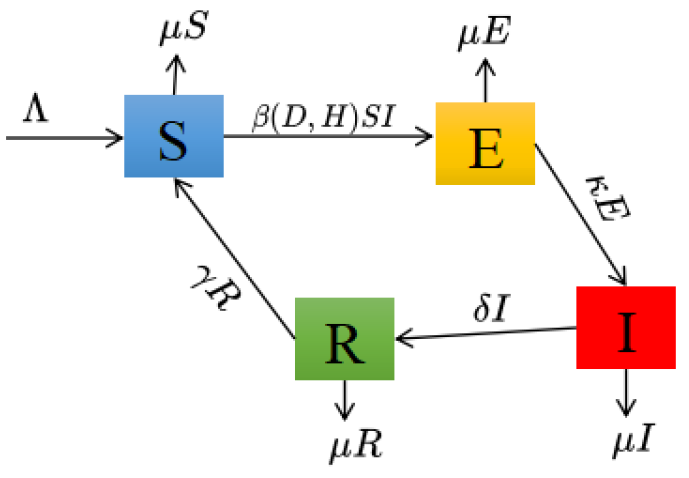
The Schematic Diagram of the Model
Figure 1.
Schematic Diagran of the Model.
2.4. Model Equations
2.5. Environmental Variables
Transmission Rate:
where:
- (dust concentration)
- (humidity)
- : Dust amplifies transmission
- : Humidity reduces transmission
- : Recruitment / birth rate
- : Natural death rate
- : Disease recovery rate
- : Rate of loss of immunity or relapse
- : progression rate from Exposed to Infected
2.6. Compartments
- Susceptible Individuals (): Individuals at risk of infection due to exposure to environmental irritants (e.g., airborne dust, pathogens). Transmission occurs via direct contact with contaminated surfaces or airborne particles in dry, dusty climates.
- Exposed Individuals (): Individuals in the latent phase of infection, harboring pathogens (e.g., Chlamydia trachomatis for trachoma) but asymptomatic. The Duration in this compartment depends on pathogen virulence and immune response.
- Infected Individuals (): Symptomatic individuals actively transmitting the disease through ocular secretions or environmental shedding. Some of the Symptoms include redness, itching, and discharge, exacerbated by low humidity or high dust levels.
- Recovered Individuals (): Individuals who have cleared the infection, gaining temporary immunity. Immunity wanes over time (), allowing reinfection, particularly under persistent environmental stressors.
2.7. Key Variables and Parameters

Table 1.
Parameters Interpretations.
| Parameter | Interpretation |
|---|---|
| Recruitment rate (births/migration) | |
| Natural death rate | |
| Environment-dependent transmission rate | |
| Progression rate () | |
| Recovery rate () | |
| Immunity loss rate () | |
| Dust concentration | |
| Humidity level |
Environmental Variables
Transmission Rate:
where:
- (dust concentration)
- (humidity)
- : Dust amplifies transmission
- : Humidity reduces transmission
- : Recruitment / birth rate
- : Natural death rate
- : Disease recovery rate
- : Rate of loss of immunity or relapse
- : progression rate from Exposed to Infected
3. Positivity and Boundedness
From the model above, it is important to show the positivity of all the compartments (), i.e., they should have non-negative values for all time if given non-negative initial conditions, and boundedness is to show that the total population does not grow without limit and stays within realistic bounds.
3.1. Positivity of Solutions
Theorem 1.
Suppose , , , , then , , , .
Proof.
-
Susceptible (S):If , then:Thus,
-
Exposed (E):If , then:Thus,
-
Infected (I):If , then:Thus,
-
Recovered (R):If , then:Thus,
Hence, all compartments remain non-negative for . □
3.2. Boundedness of Solutions
Theorem 2.
The closed set is positively invariant and has positive solutions, i.e., the total population is bounded.
Proof.
Summing all equations:
Substituting the model equations:
From the linear differential equation:
where and .
Using integrating factor and apply initial conditions at , we have:
As :
Thus, the solution is bounded by:
Since :
Hence, is a positively invariant set according to [8], and the model aligns with epidemiological principles. □
Basic Reproduction Number
To find the basic reproduction number () for the SEIR model with environmental drivers, using the next-generation matrix method:
Consider the infected compartments E (Exposed) and I (Infected). At the disease-free equilibrium (DFE), , , , and . The equations for E and I become:
- Matrix Decomposition
Split into transmission (F) and transition (V) matrices:
- Matrix Inversion
The basic reproduction number is the spectral radius (dominant eigenvalue) of :
Since (DFE susceptible population), can also be written as:
- Equilibria and Stability
3.3. Disease-Free Equilibrium (DFE)
At Disease-Free Equilibrium (DFE), no infection is present, i.e., , , .
Setting all derivatives to zero we have:
Substituting , , into the equations we obtain:
3.3.1. Endemic Equilibrium (EE)
At Endemic Equilibrium (EE), the disease persists, i.e., , , .
Expressing E, R, and S in terms of I:
- From :
- From :
- From :
Substituting E, R, and S into :
Substituting and :
Simplifying we obtain:
Solving for I
Using the basic reproduction number simplifies the solution:
For , the EE exists. Rearranging to express :
Substituting into , , :
Hence,
4. Local Stability Analysis of the Disease-Free equilibrium (DFE)
The aim of the Local Stability analysis is to determine whether small perturbations from the DFE will die out (stability) or grow (instability).
4.1. Jacobian Matrix at DFE*
The DFE is .
The Jacobian matrix J for the SEIR model is derived by taking partial derivatives of the system as shown below:
At DFE the Jacobian matrix J becomes:
4.2. Eigenvalue Analysis
The eigenvalues satisfy . The characteristic equation simplifies to:
This gives four eigenvalues: 1. (always negative) 2. (always negative) 3. Roots of the quadratic equation:
which are:
4.3. Stability Condition
For the DFE to be locally asymptotically stable, all eigenvalues must have negative real parts.
Conclusion:
- If , all eigenvalues are negative → DFE is stable
- If , at least one eigenvalue is positive → DFE is unstable
4.4. Biological Meaning
- If : Infected individuals cannot sustain transmission → disease dies out
- If : Infected individuals cause secondary infections → disease persists
4.5. Environmental Impact
- Dust () increases , raising
- Humidity () decreases , lowering
5. Global Stability Analysis of the Disease-Free Equilibrium (DFE)
To establish the global asymptotic stability (GAS) of the Disease-Free Equilibrium (DFE), we construct a Lyapunov function based on the infected compartments of the model.
Theorem 3.
The Disease-Free Equilibrium, , of the SEIR model is globally asymptotically stable in Ω if , and unstable if .
Proof.
Consider the Goh-Volterra type Lyapunov function defined by:
The time derivative of V along the solutions of the system is given by:
Substituting the derivatives and from the model equations yields:
Expanding and simplifying the terms, we have:
Since all state variables are bounded within the invariant region , it holds that for all . Replacing S with its maximum value at the DFE:
Factoring out , we obtain:
Recognizing that the basic reproduction number is , we can rewrite the inequality as:
From this expression, it is evident that if , then . Furthermore, if and only if . Substituting into the model system ensures that , , and as .
Therefore, by LaSalle’s Invariance Principle [4], the largest invariant set contained in is reduced to the DFE. Hence, the DFE is globally asymptotically stable in when . □
6. Model Results
Environmental factors such as dust and humidity significantly influence the transmission of eye diseases like trachoma and allergic conjunctivitis, particularly in regions with extreme climates. This chapter uses a deterministic SEIR (Susceptible-Exposed-Infected-Recovered) model to analyze how these factors shape the basic reproduction number (), a key indicator of outbreak potential. The study focuses on three objectives:
- 1.
- Mechanistic Insights: Examining how seasonal dust and humidity fluctuations drive changes in transmission rates.
- 2.
- Intervention Priorities: Identifying high impact parameters (e.g., dust exposure, disease progression) through sensitivity analysis.
- 3.
- Climate Adaptation: Comparing transmission patterns in seasonal versus non-seasonal environments to optimize interventions.
Key findings reveal that dust peaks during dry seasons correlate with reduced transmission due to behavioral adaptations, while monsoon humidity suppresses outbreaks by limiting pathogen survival. Sensitivity analysis highlights dust mitigation and delayed disease progression as critical intervention targets. The model integrates real-world data from WHO reports, NASA climate observations, and clinical trials, ensuring relevance to endemic regions like the Sahel and Ethiopia.
While the model simplifies environmental effects as linear relationships, future work could address nonlinear dynamics and extreme weather impacts. By aligning strategies with environmental cycles, such as preemptive antibiotic distribution or soil stabilization, this research offers actionable solutions to reduce disease burden in vulnerable populations.
7. Model Parameters and Data Sources
All yearly demographic parameters were converted into per-day units by dividing through by 365, ensuring consistency in the time scale of the SEIR model.
Table 2.
Model Parameters in Daily Scale and Data Sources.
| Parameter | Value (per day) | Source |
|---|---|---|
| (from /year) | WHO trachoma reports | |
| (from /year) | WHO demographic data | |
| – | Trachoma cohort studies | |
| 0.005–0.01 (g/m3)-1 | NASA MODIS dust data | |
| 0.007–0.012 %-1 | Climate studies | |
| 0.1 (latent period ∼10 days) | Clinical studies | |
| 0.1 (azithromycin efficacy) | Antibiotic trials | |
| 0.0055 (∼6 months immunity loss) | Reinfection studies | |
| 50–100 g/m3 | NASA EarthData | |
| 20–30 g/m3 | CAMS forecasts | |
| 40–60% | WorldClim | |
| ±20–30% | NOAA GSOD |
7.1. Seasonal Influence of Dust on the Basic Reproduction Number
Figure 2 presents the seasonal dynamics of dust concentration together with the basic reproduction number . The plot reveals that peaks in dust concentration align with elevated values, often exceeding the epidemic threshold (). This finding is consistent with the model formulation in Equation (2.3), where dust positively modulates the transmission rate .
Biologically, elevated dust acts as a transmission amplifier by carrying infectious agents such as Chlamydia trachomatis and increasing ocular irritation, thereby facilitating pathogen entry and persistence. This pattern reflects field observations in the Sahel and northern Nigeria, where the Harmattan season brings high particulate concentrations and trachoma prevalence rates exceeding 60% among children [7,14].
The model highlights dust control as a crucial intervention priority. Environmental measures such as soil stabilization, tree planting, and reducing outdoor exposure during peak dust months could substantially reduce epidemic risk. This aligns with the public health perspective of the WHO trachoma elimination program, which emphasizes environmental management as one of the SAFE strategies (Surgery, Antibiotics, Facial cleanliness, Environmental improvement).
7.2. Seasonal Influence of Humidity on the Basic Reproduction Number
Figure 3 depicts the seasonal oscillation of humidity alongside . In contrast to dust, humidity exerts a suppressive effect on transmission. When humidity rises above 65–70%, consistently drops below the epidemic threshold, indicating that outbreaks cannot be sustained. This observation corroborates the negative contribution of humidity in Equation (2.3), where the term reduces the transmission rate.
This inverse relationship reflects epidemiological evidence: high humidity stabilizes the ocular tear film, reduces airborne dust particles, and diminishes pathogen survival in the environment [3,5]. Conversely, during arid periods when humidity drops below 40%, remains above 1, favoring persistent disease spread in endemic zones.
From a policy perspective, humidity offers a natural protective buffer against outbreaks. Wet-season windows, when , provide opportunities for infrastructure projects such as water reservoir construction and sanitation campaigns, while dry-season preparations should prioritize antibiotic distribution and public awareness. This seasonal asymmetry underscores the importance of aligning interventions with environmental cycles, as recommended in recent WHO guidelines on neglected tropical diseases [24].
7.3. Sensitivity Analysis: Key Drivers of Disease Transmission Risk
The aim of the Sensitivity Analysis is to determine how sensitive the basic reproduction number is to changes in key parameters. This helps prioritize intervention strategies by identifying the parameters to which is most sensitive.
7.4. Definition of with Environmental Modulation
7.5. Normalized Sensitivity Indices
The sensitivity index for a parameter p is given as:
7.6. Key Findings
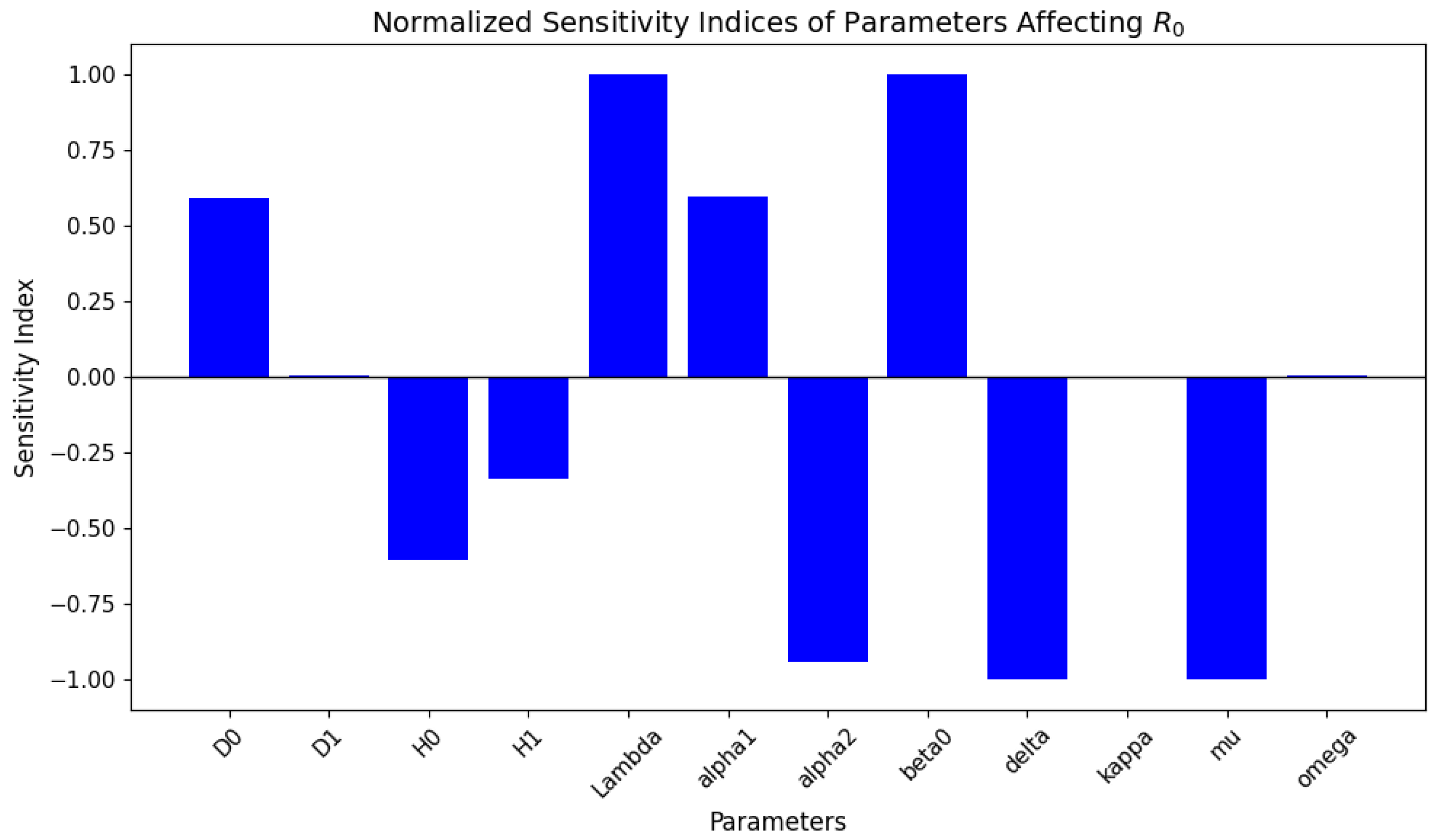
- Transmission rate : highest positive sensitivity index (), showing proportional effect on .
- Dust amplification factor : strongly positive, reflecting the critical role of high dust concentrations.
- Humidity reduction factor and recovery rate : negative indices, reducing transmission.
- Natural death rate : overall negative influence.
- Recruitment rate : positive influence by replenishing susceptibles.
These results are visualized in Figure 4, showing parameters ranked by their normalized indices.
7.7. Implication for Control Strategies
Effective interventions should prioritize:
- Dust reduction (environmental sanitation, protective measures),
- Enhancing recovery (early treatment, antibiotic distribution), and
- Seasonal public health campaigns before dry seasons.
This confirms that climate-sensitive interventions are essential for mitigating trachoma and related eye diseases.
8. Discussion, Recommendations and Conclusions
8.1. Discussion
The results of this study demonstrate that environmental drivers, particularly dust concentration and humidity, play a central role in shaping the transmission dynamics of environmentally induced eye diseases. The model confirms that increases in dust concentration amplify the basic reproduction number , thereby heightening the risk of sustained epidemics. Conversely, higher humidity levels reduce , acting as a natural suppressive factor against transmission. These findings are consistent with epidemiological evidence reported in endemic regions such as the Sahel and Ethiopia, where the prevalence of trachoma rises during the dry Harmattan season and declines during wetter months [7,14].
The model also highlights the cyclical nature of , reflecting seasonal oscillations in dust and humidity. This seasonality creates periods of heightened outbreak risk, particularly during low-humidity, high-dust months. The implication is that disease control strategies should not be uniform throughout the year but must instead align with environmental cycles. Such climate-sensitive approaches strengthen the capacity of public health systems to act preemptively rather than reactively. Moreover, the sensitivity analysis underscores the importance of dust amplification and baseline transmission rate as the strongest positive contributors to , whereas recovery rate and humidity reduction exert a significant negative influence.
Biologically, elevated dust acts as a transmission amplifier by carrying infectious agents such as Chlamydia trachomatis and increasing ocular irritation, thereby facilitating pathogen entry and persistence. This pattern reflects field observations in the Sahel and northern Nigeria, where the Harmattan season brings high particulate concentrations and trachoma prevalence rates exceeding 60% among children [7,14].
The model highlights dust control as a crucial intervention priority. Environmental measures such as soil stabilization, tree planting, and reducing outdoor exposure during peak dust months could substantially reduce epidemic risk. This aligns with the public health perspective of the WHO trachoma elimination program, which emphasizes environmental management as one of the SAFE strategies (Surgery, Antibiotics, Facial cleanliness, Environmental improvement).
8.2. Recommendations
Based on the findings of this study, several recommendations can be made to improve control strategies for environmentally driven eye diseases:
- 1.
- Targeted Interventions: Public health campaigns and antibiotic distribution should be scheduled ahead of the dry season, when dust-driven increases in elevate epidemic risk.
- 2.
- Environmental Control: Dust mitigation measures such as vegetation planting, soil stabilization, and the reduction of outdoor exposure during peak dust months should be prioritized in endemic regions.
- 3.
- Climate-Sensitive Planning: Interventions should align with predictable seasonal variations. Wet-season periods, when humidity suppresses , may be utilized for infrastructure development, sanitation projects, and preventive health education.
- 4.
- Integration with SAFE Strategy: The results strengthen the case for incorporating environmental management into the SAFE strategy recommended by the World Health Organization for trachoma elimination.
8.3. Conclusions
This study developed and analyzed a deterministic SEIR model that explicitly integrates dust concentration and humidity into the transmission dynamics of environmentally driven eye diseases. The results demonstrate that dust substantially elevates the basic reproduction number , thereby increasing outbreak risk, while humidity serves as a natural mitigating factor that reduces transmission potential.
The seasonal dependence of highlights the necessity of aligning intervention strategies with environmental cycles. By prioritizing dust mitigation and preemptive medical campaigns during dry seasons, while leveraging wet-season relief for long-term infrastructure and sanitation measures, public health systems can significantly reduce the burden of trachoma and related ocular diseases.
In conclusion, this research bridges the gap between epidemiology and climate science, providing a quantitative framework for climate-adaptive disease control. The findings not only support the relevance of environmental drivers in ocular disease dynamics but also offer practical guidance for sustainable public health interventions in climate-vulnerable regions.
References
- Bandyopadhyay, S.; Ahmed, M.; Roy, S. Seasonal patterns in fungal keratitis and environmental risk factors in Bangladesh. International Journal of Ocular Epidemiology 2022, 14(2), 122–130. [Google Scholar]
- Bialasiewicz, A. A.; Shenoy, R.; Al-Mahmood, A. M.; Al-Kandari, A. M.; Al-Sharif, A. M. Adenoviral keratoconjunctivitis: An update of clinical, laboratory, and therapeutic aspects. Middle East African Journal of Ophthalmology 2008, 15(1), 35–41. [Google Scholar]
- Bielory, L.; Lyons, K.; Goldberg, R. Climate change and allergic conjunctivitis. Current Opinion in Allergy and Clinical Immunology 2020, 20(5), 478–485. [Google Scholar] [CrossRef]
- Brauer, F.; Castillo-Chavez, C.; Feng, Z. Mathematical models in epidemiology; Springer, 2019. [Google Scholar]
- Burton, M. J.; Holland, M. J.; Solomon, A. W. The epidemiology and control of trachoma: A review. Clinical Epidemiology 2021, 13, 283–299. [Google Scholar]
- Craig, J. P.; Nelson, J. D.; Azar, D. T.; Belmonte, C.; Bron, A. J.; Chauhan, S. K. TFOS DEWS II definition and classification report. Ocular Surface 2017, 15(3), 276–283. [Google Scholar] [CrossRef] [PubMed]
- Habtamu, E.; Wondie, T.; Aweke, S.; Tadesse, Z.; Zerihun, M.; Burton, M. J. Impact of dust storms on trachoma prevalence in arid regions of sub-Saharan Africa. PLoS Neglected Tropical Diseases 2016, 10(11), e0005093. [Google Scholar] [PubMed]
- Hethcote, H. W. The mathematics of infectious diseases. SIAM Review 2000, 42(4), 599–653. [Google Scholar] [CrossRef]
- Javed, A.; Shah, K.; Raza, Z. Fractional SEVIR modeling of adenoviral conjunctivitis with Sumudu transform. Advances in Difference Equations 2024, 2024(1), 42. [Google Scholar] [CrossRef]
- Kulachi, M.; Khan, M. A.; Rehman, K. Modeling ocular diseases using the Atangana–Baleanu fractional derivative. Mathematics and Computers in Simulation 2024, 212, 74–88. [Google Scholar]
- Li, R.; Pei, S.; Chen, B.; Song, Y.; Zhang, T.; Shaman, J. Substantial undocumented infection facilitates the rapid dissemination of novel coronavirus (SARS-CoV-2). Science 2020, 368(6490), 489–493. [Google Scholar] [CrossRef] [PubMed]
- Naowarat, S.; Onruk, P. A mathematical model of trachoma transmission involving human-fly interactions. Mathematical Biosciences 2024, 349, 108815. [Google Scholar]
- National Aeronautics and Space Administration. Unusual Weather Leads to Ozone Low Over the Arctic; NASA, 2020. Available online: https://science.nasa.gov/earth/natural-disasters/wildfires/unusual-weather-leads-to-ozone-low-over-the-arctic-146588/.
- Nigeria Federal Ministry of Health. National Trachoma Elimination Programme Report; Federal Ministry of Health, Nigeria, 2021. [Google Scholar]
- Nisar, K. S.; Arif, M.; Shah, K. Fractional modeling of conjunctivitis with Caputo derivatives. Nonlinear Engineering 2024, 13(1), 345–360. [Google Scholar]
- Pérez García-Pando, C.; Stanton, M. C.; Diggle, P. J.; Trzaska, S.; Miller, R. L.; Perlwitz, J. P. Environmental drivers of meningitis epidemics in the Sahel. Science Translational Medicine 2014, 6(265), 265ra165. [Google Scholar]
- Singh, R.; Sharma, A.; Goyal, R. Airborne pollutants and ocular surface disorders in India: A critical review. Indian Journal of Ophthalmology 2021, 69(2), 341–347. [Google Scholar]
- Srivastav, T.; Vashisht, P.; Singh, S. Socioeconomic impact of adenoviral conjunctivitis outbreaks in urban populations. Journal of Public Health 2023, 45(1), 98–106. [Google Scholar]
- Taylor, H. R.; Burton, M. J.; Haddad, D.; West, S.; Wright, H. Trachoma. The Lancet 2019, 384(9960), 2142–2152. [Google Scholar]
- Thomson, M. C.; Mason, S. J.; Phindela, T.; Connor, S. J. Use of rainfall and sea surface temperature monitoring for malaria early warning in Botswana. American Journal of Tropical Medicine and Hygiene 2018, 73(1), 214–221. [Google Scholar]
- U.S. Environmental Protection Agency. (2023). Health and Environmental Effects of Particulate Matter (PM). U.S. Environmental Protection Agency.
- Wang, Y.; Zhao, W. Neural-SEIR modeling of COVID-19 with environmental parameters. IEEE Transactions on Neural Networks and Learning Systems 2021, 33(6), 2828–2840. [Google Scholar]
- World Health Organization. Ending the neglect to attain the Sustainable Development Goals: A road map for neglected tropical diseases 2021–2030; World Health Organization, 2020. [Google Scholar]
- World Health Organization. World Report on Vision; Geneva; World Health Organization, 2022. [Google Scholar]
- Zhang, Y.; Wu, Y.; Li, X. Effectiveness of school hygiene measures in reducing adenoviral conjunctivitis in Hunan Province. International Journal of Environmental Research and Public Health 2020, 17(4), 1433. [Google Scholar] [PubMed]
Figure 2.
Seasonal variation of dust concentration and the basic reproduction number . Higher dust levels correspond to an increase in , crossing the epidemic threshold during dry seasons.
Figure 2.
Seasonal variation of dust concentration and the basic reproduction number . Higher dust levels correspond to an increase in , crossing the epidemic threshold during dry seasons.
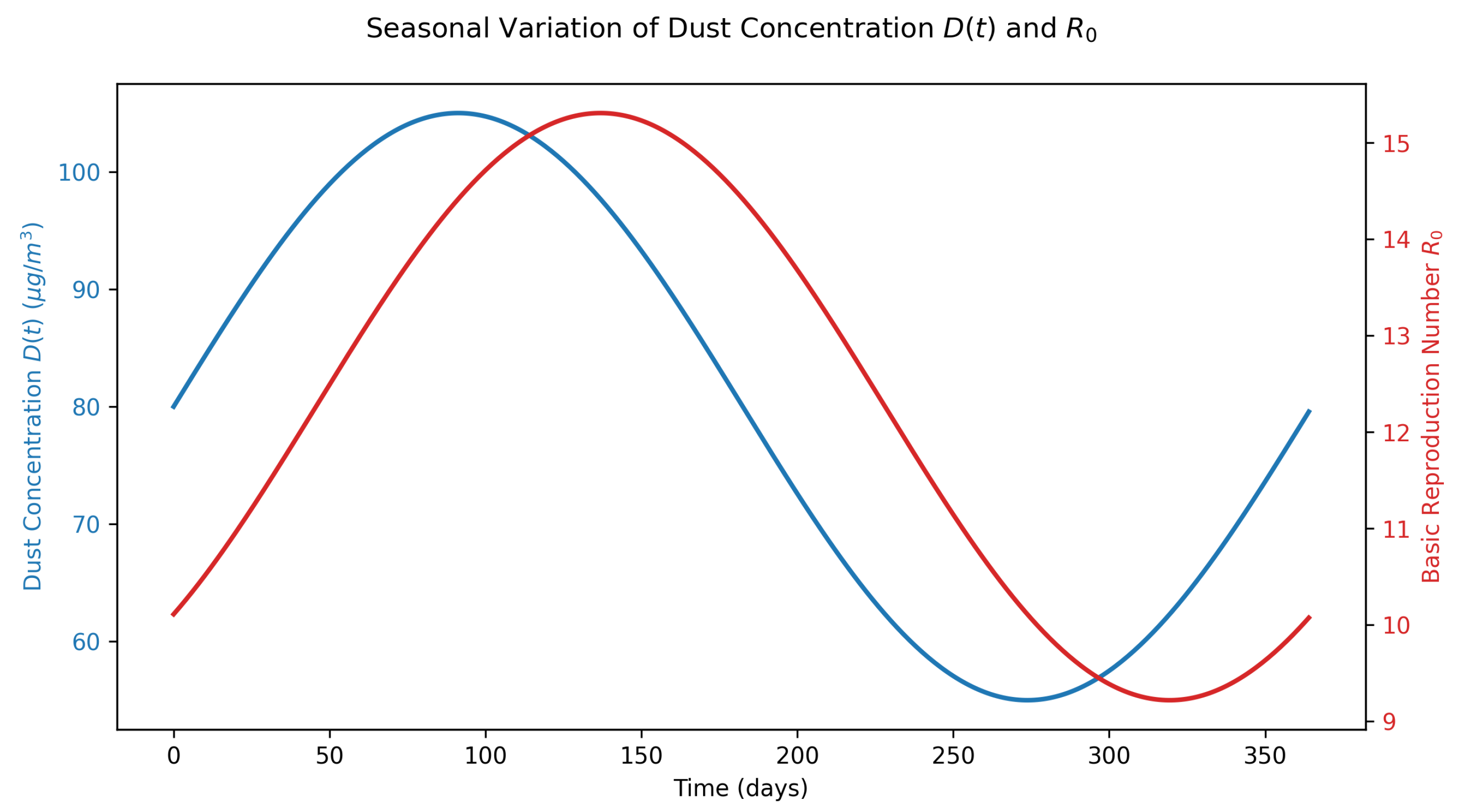
Figure 3.
Seasonal variation of humidity and the basic reproduction number . Elevated humidity suppresses , whereas low-humidity conditions allow sustained transmission.
Figure 3.
Seasonal variation of humidity and the basic reproduction number . Elevated humidity suppresses , whereas low-humidity conditions allow sustained transmission.
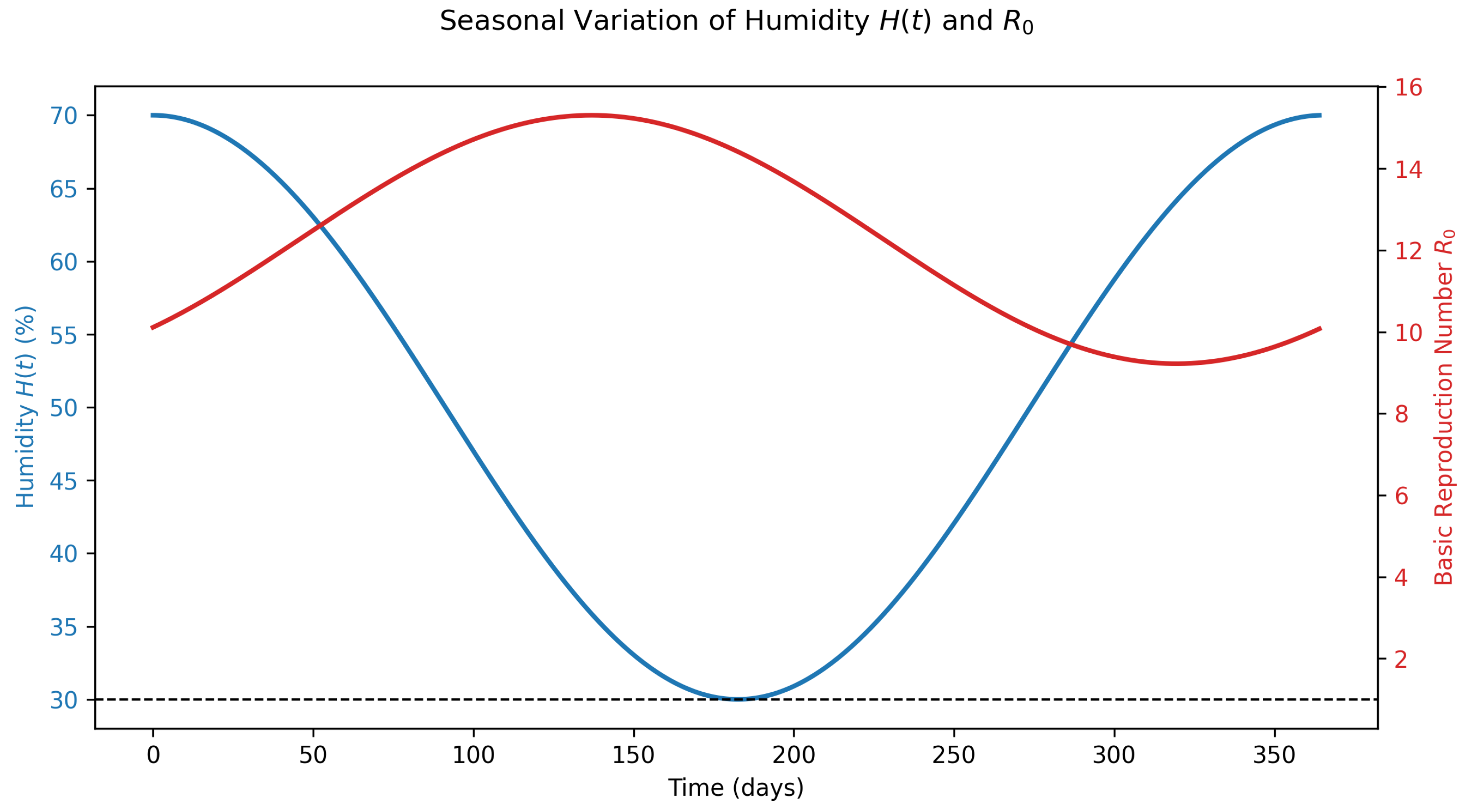
Figure 4.
Normalized Sensitivity Indices of Parameters Affecting . Positive indices enhance transmission, while negative indices reduce it.
Figure 4.
Normalized Sensitivity Indices of Parameters Affecting . Positive indices enhance transmission, while negative indices reduce it.
Disclaimer/Publisher’s Note: The statements, opinions and data contained in all publications are solely those of the individual author(s) and contributor(s) and not of MDPI and/or the editor(s). MDPI and/or the editor(s) disclaim responsibility for any injury to people or property resulting from any ideas, methods, instructions or products referred to in the content. |
© 2026 by the authors. Licensee MDPI, Basel, Switzerland. This article is an open access article distributed under the terms and conditions of the Creative Commons Attribution (CC BY) license (http://creativecommons.org/licenses/by/4.0/).
Copyright: This open access article is published under a Creative Commons CC BY 4.0 license, which permit the free download, distribution, and reuse, provided that the author and preprint are cited in any reuse.