
Submitted:
08 July 2026
Posted:
10 July 2026
You are already at the latest version
Abstract
Exposing foams stabilized by photoswitchable surfactants to UV light induces changes in surface surfactant concentration, leading to significant alterations in foam behaviour such as the generation of Marangoni flow and change in foam drainage patterns. The occurrence of Marangoni flow can be observed when either all elements of the foam or only their films are exposed to UV light. Conversely, changes in foam drainage occur when a macroscale portion of a foam column is exposed to UV light. To explore these phenomena, numerical models are developed and validated using experimental data. These models simulate the scale and profile of Marangoni flow from foam networks to films as well as the drainage flow within the foam network. Microscale findings demonstrate that Marangoni flow can be controlled by adjusting the intensity and duration of UV light exposure. Macroscopically, the drainage profile in exposed foam regions undergoes significant changes with varying UV intensity. Furthermore, beyond a certain threshold, the foam drainage reverses direction, contrary to gravity. The effect of foam interfacial mobility on the reversed drainage of both interior and exterior foams is analyzed. The findings provide a potential tool to control foam drainage behaviour without the need to modify other variables.
Keywords:
foam
; photo-surfactant
; UV
; film
; Marangoni flow
; plateau border
; bubble
; reverse foam drainage
1. Introduction
Aqueous foams have gained significant attention from scientists and researchers due to their widespread use in various industries such as the food industry [1,2,3,4]. Aqueous foams consist of gas and a small volume of liquid and are classified into two categories: wet and dry aqueous foams. Wet foams contain 10-20% liquid volume fraction, whereas dry foams contain less than 5% liquid [5].
Aqueous foams consist of liquid-gas bubbles that are enclosed by thin aqueous films and are interconnected through liquid channels known as Plateau borders (PBs). Four PBs combine to form a node [6,7]. Multiple factors can affect the drainage behaviour of the foams and the flow inside them such as surfactant materials, surfactant concentration, and Marangoni flow [8,9,10].
The Marangoni effect, which is attributed to Carlo Giuseppe Matteo Marangoni, was first observed during the preparation of his doctoral thesis in 1865 [11]. This phenomenon is mainly driven by the presence of gradients in surface surfactant concentrations [12]. Surfactants, which are soluble in water, are characterized by their complex molecular structure, which is responsible for determining the surface tension [13,14].
The surfactants are composed of hydrophilic heads and hydrophobic tails that reside at the free surface, thus reducing the surface tension effectively [15].
When a gradient of surface surfactant concentration or surface tension is present, a flow on the surface moves from regions of lower surface tension to those of higher surface tension. Marangoni flows can be observed in various processes and systems involving aqueous foams, including foam recirculation [5,16], foam fractionation [17,18,19,20], and light-induced photo-surfactant foams [21]. Recirculation of surface surfactant concentration induced by the branching of Plateau borders (PBs) in foam nodes can generate Marangoni flow from lower branches to upper branches. When bulk flow branches in a node, it splits into three PBs, while each surface flow branches into two surfaces. This branching alters the balance between bulk and surface flow, leading to the creation of a surface tension gradient between the two nodes and triggering Marangoni flow upward. To gain a deeper understanding of the recirculation Marangoni flow, consult the conducted research [16,22].
The process of foam fractionation is another system in which Marangoni flow can occur. Vitasari et al. [9] investigated Marangoni flow in the reflux column. This is a method of enriching the foam with more surfactant which initially creates a surface surfactant gradient between the PB and film.
In most of the mentioned studies including our previous study [22], the foam properties such as drainage, rheology, and stability are mainly explained by the physical properties of foam, such as liquid fraction, foam size, and surface rigidity. However, the chemical formulation of aqueous foam also plays an important role in the foam properties [23,24,25,26,27,28,29,30,31,32,33]. It has been observed that the presence of certain chemical elements in the foaming surfactant can alter its surface properties when exposed to light with a specific frequency and intensity. These surfactants are known as photosurfactants, and their shape and hydrophobicity can be tuned by blue or UV light stimulation [34,35]. By exposing a specific area of the foam to light and stimulating it, the surface surfactant concentration differs from the unexposed area. This difference in surface tension causes a Marangoni flow, which is considered a promising technique for controlling foam drainage and surface properties. Previous experimental studies [34,35] have measured the changes in surface surfactant concentration () by using light to manipulate the surface tension of interfaces and induce Marangoni flow. However, the measurement of Marangoni flow induced by light in foams and thin films has been limited, and it can only be measured in a specific range of foam sizes.
It is noteworthy that, despite a significant number of experimental studies [5,16,21,34,35], measuring the Marangoni velocity directly remains a challenge. Pitois et al. [16] for example describe this limitation in their experimental setup where they instead observed the upward movements of irregularities in the film surface. Thus, utilizing a numerical method to compute both Marangoni flow and drainage flow could be beneficial. There are a few numerical studies that have used three-dimensional microscale models to capture the flow characteristics of interior and exterior foams [7,36,37,38]. Exterior foams refer to the portion of the foam where the bubbles are attached to the container wall. Interior foams, on the other hand, refer to the bubbles inside the container without touching the wall. The present study has expanded the three-dimensional model of PB, node, and film to include the surface surfactant and the Marangoni flow as well as the effect of light on drainage. The reason we are using a three-dimensional model rather than a more simplified two-dimensional model is more accuracy of three-dimensional models. In a two-dimensional model, the effect of node element in the drainage is neglected which can alter the drainage velocities significantly especially for more mobile interfaces. The findings of our study suggest a new toolbox for investigating Marangoni flow and foam network flow caused by light stimulation.
2. Photoswitchable Surfactants
Photoswitchable surfactants have emerged in the last three decades as a way to control the interfacial properties of aqueous foams. In this section, the concept of photosurfactants is explained using the example of AzoTAB.
AzoTAB is one of the major photosurfactants used in the study of photoswitchable foams. It is considered a cationic surfactant with a trimethylammonium bromide head group.
The formula of AzoTAB is (4-butylphenyl)-2-(4-trimethylammoniumpropoxyphenyl) diazene and its formula is shown in Figure 1.a.
The conformation of AzoTAB that exhibits the highest thermodynamic stability, the trans conformation, can be photoconverted to a cis conformation upon illumination under UV, as shown in Figure 1.b. The process of photoisomerization is reversible, but complete conversion of the molecule into either the cis or trans conformation cannot be attained through exposure to light. As a result, the solutions always contain a mixture of both conformations. In a stationary state, when the foam is in the dark, the ratio of trans isomers to cis isomers is high at the interface, as trans isomers preferentially adsorb at the interface. By stimulating the foam with intense blue light or UV light, the trans isomers are converted to cis isomers at the interface. The cis isomers quickly desorb to the bulk, convert to trans in the bulk with a lower rate than that of photoconversion, and then adsorb to the interface in unexposed areas. In other words, the intense light immediately removes the surfactant from the exposed interface. By stimulating the foam, the light-exposed interface has a lower surface surfactant concentration and higher surface tension. This phenomenon causes the Marangoni flow from the unexposed area to the exposed area. This mechanism is shown schematically in Figure 1.b.
3. Numerical Model
3.1. Geometry and Simulation Setup
In this study, a three-dimensional structure comprising Plateau borders, nodes, and a symmetry cut of a film is utilized for numerical modelling, as shown in Figure 2. Depending on the context of the analysis, the geometry can be rotated in a vertical or horizontal position. In this study, considering the small-scale flow, the fluid flow is assumed to be laminar and incompressible. The Semi-Implicit Method for Pressure-Linked Equations (SIMPLE) is utilized to solve the Navier-Stokes equations.
3.2. Governing Equations
The governing equations for this study are the conservation of mass, momentum, and surface surfactant concentration which are shown below:
Mass conservation:
Momentum conservation:
Surface surfactant conservation:
In the Equation (2), represents convection and represents shear stress. The term is the pressure gradient, and represents the gravitational body force. In the simulation, the central differencing scheme with second-order accuracy was used for conservation equations.
3.3. Boundary Conditions
For the boundary conditions, static pressure was applied to the inlet and outlet boundaries of the geometry. The liquid-air interface of the geometry was modelled using the liquid-air interface equation coupled with Marangoni flow.
The liquid-air interface of the foam when there is no Marangoni flow follows the equation:
The bulk and surface viscosities are denoted as and , respectively. represents the surface velocity in the tangential direction of the air-liquid interface and n represents a normal vector of the air-liquid interface. The presented equation demonstrates the decoupling between the surface and bulk layers and its relation to the Boussinesq number (). This dimensionless parameter is used to measure surface mobility. As the value of decreases, the mobility of the liquid-air interface increases and generally the flow velocity in the foam increases. Commonly used surfactants like SDS, TTAB, and Tween20 are considered semi-mobile surfactants whereas surfactants like BSA are considered to have more rigid interfaces. is defined as the ratio of surface viscosity () to the bulk viscosity (), and it is given by
The symbol R represents the radius of curvature of the channel. When the effect of Marangoni flow in the interface is added, the equation becomes
The Marangoni stress resulting from the surface surfactant concentration gradient is given by the last term in the equation, as reported by Koehler et al. [5] and Marangoni fractionation studies [20]. The tangential surface surfactant concentration gradient is denoted by , and is related to Gibbs elasticity [14,39]. To include the effect of light stimulation on the photosurfactant foams, the above equation is used to apply the surface tension gradient in the boundary condition.
3.4. Simulation Parameters
In this study, the calculated results are scaled to their dimensionless values. The velocities are scaled by , where represents the gravity force in the system, and A and represent the cross-section area of PB and bulk viscosity, respectively.
To numerically simulate the flow, foam interface mobility is required which is represented by . For the calculation of the number, the surface viscosity measurement is required. One of the difficulties in measuring interfacial viscosity is that its effects are subtle, and distinguishing the influence of interfacial viscosity from other effects, such as Marangoni stresses, Gibbs elasticity, and bulk viscosity, can be complex. There is no literature about the exact interfacial viscosity of the AzoTAB surfactant. For this study, initially, a fixed bulk viscosity and surface viscosity are assumed to simplify the modelling. We initialize the flow modelling and calculation with = 0.1, similar to calculated semi-mobile interfaces like SDS, TTAB, and Tween 20 [5,16]. Later in this study, the effect of various on foam flow along with the effect of UV stimulation is investigated. Note that this study assumes the temperature increase in foam caused by UV radiation is insignificant.
4. Model Validation
In this section, the numerical models used in this study are validated against the experimentally measured Marangoni velocities in foams with photosurfactants. Chevallier et al. [35] conducted an experiment to study the effect of UV light on drainage in a vertical thin-liquid film with a radius of 1 cm. Initially, the thin film was subjected to gravitational drainage. However, upon stimulation with UV light, the film ceased thinning and a flow in the upward direction caused the film to thicken. To investigate the light-induced flows in the absence of gravitational effects, the set-up was rotated to position the film horizontally. Then the UV light is shone on both PB and film simultaneously. The study [35] couples and solves the surface surfactant equations in the stimulated PB and the stimulated film separately. The results show that the difference in surface surfactant of PB and film is in order of 1%. This difference is due to the different equilibrium of trans isomer under illumination in film and PB. Compared to the film, the PB has a quite large reservoir of trans isomers in the bulk to replenish the trans isomers in the surface. Therefore, the surface surfactant of PB is slightly higher than the film under UV illumination. This difference results in a radial flow directed from PB towards the centre of the film. They [35] measured the progress of the radial flow and made a graph of versus time in seconds for various foams with various radius of curvatures of PB () ranging from 400 to 1100 . The is the initial area of the experimented film and A represents the area of the film that the marangoni flow has reached. In this study, we reproduced the mentioned horizontal thin-liquid film experiment results with the same sizes and especially the same difference, for various . The geometry used is shown in Figure 2 with blue colour but it will be oriented horizontally. In Figure 3, the scaled Marangoni velocities due to stimulating the film and PB to the UV light are presented for both the experimental measurements [35] and simulation outputs for various sizes of .
It can be seen that by increasing the , the Marangoni velocity increases slightly. This is due to the higher difference in surface surfactant concentration () between PB and film in foams with larger PBs. The reason might be the fact that the larger the PB, the lower the interface/volume ratio would be. Therefore, for a fixed film thickness, in foam with larger PB, there is a bigger reservoir of in the bulk of to replenish the reduced in the interface. As a result, the difference between PB and film is more in foams with larger . The simulation outcomes exhibit a favourable correspondence with the experimental findings [35].
5. Results and Discussion
5.1. Effect of UV Exposure Time on Marangoni Flow from PB Towards Film
In another study, Chevallier et al. [34] prepared a macroscale bulk of AzoTAB photosurfactant in the dark and then investigated the effect of AzoTAB concentration on surface tension. They found out that by increasing the AzoTAB concentration, surface tension () decreases. This is mainly due to more coverage of the liquid-air interface by surfactants in the solutions with higher AzoTAB concentrations. Then, they [34] shone UV light with an intensity of on a specific region of the liquid-air interface in a film and showed the time evolution of on the interface for the range of 0 to 20 seconds. Their results show that trans isomer concentration in the bulk and surface decreases slightly until 0.01 second and after that decrease of is drastic until 1 second. After 1 second, the change in is negligible.
Their results allow us to numerically track the evolution of the Marangoni velocity with a time range similar to the mentioned experiment [34]. For this, the experimentally observed values are used to calculate the Marangoni velocities. In this section, the calculation of the changes in Marangoni velocity for different times of UV exposure is performed. For the modelling of this section, instead of using single time-transient simulation, a multiple time-steady simulations method is used for simplicity, analysing intermediate results at each observed time step[34], and easier convergence. This approach involves breaking up the transient simulation into several steady-state simulations that are run sequentially, with each steady-state solution used as the initial condition for the next time step. By this method, the Marangoni flow at each fixed point in time is calculated. The simulation geometry is shown in Figure 2 and is similar to the geometry used in model validation. In the model validation, both PB and film were exposed to UV with difference between PB and film on the order of 1%. For this section, however, the UV is shone only on the surface of the film and not on the PBs. By this setup which is in accordance with the experimental setup by Chevallier et al. [34], the difference between PB and film is in the range of 1-40%.
The evolution of Marangoni velocity and are shown in Figure 4. With the left-hand side axis, the scaled Marangoni velocity at different times of UV exposure on the film is shown in square points. An approximation line is fitted through the square points. With the right-hand side axis, the evolution of with time in a red dashed line is shown. This curve is reproduced from the study of Chevallier et al. [34]. The results show that until 0.01 seconds, the Marangoni velocity is almost negligible. However, from 0.01 to 1 second, the Marangoni velocity increases drastically due to the drastic change in during this time range. This is due to a sudden change in the surface surfactant concentration gradient between 0.01 to 1 second. This sudden change in causes a significant gradient of and Marangoni flow. After 1 second, the Marangoni velocity curve stays flat as no more change in is recorded. Note that the trans and cis isomers balance in film and PB gradually returns to the original unexposed state after stopping the UV exposure and the Marangoni driving force disappears.
5.2. Effect of Light Intensity on Marangoni Flow from PB to Film
In the mentioned study in the previous section, Chevallier et al. [34] prepared the macroscale bulk of AzoTAB photosurfactant in the dark and showed the change in over time. In the same study, Chevallier et al. [34] also investigated the effect of light intensity after 1-second radiation on the by varying the intensity level of light on the photosurfactant. Using the same simulation geometry of Figure 2 and assuming exposing only the film to UV, simulations of the flow in the foam with the range of light intensities used in the study of Chevallier et al. [34] are performed. The observed in the study of Chevallier et al. [34] are used to calculate the Marangoni flows. The results are shown in Figure 5. The scaled Marangoni velocity versus light intensity on the film in is presented with a solid blue line. The change of versus light intensity is shown in a dashed red line and is reproduced from the study performed by Chevallier et al. [34].
It is reported that stays almost the same in the range of 0.001-10 . After exposing the photosurfactant to higher light intensities, the value almost halves. Our results show that the scaled Marangoni velocity is negligible until the light intensity of . With higher light intensities, the Marangoni velocity increases significantly until .
The physical phenomenon behind these changes is called pumping out [34]. In the prepared equilibrium state before the stimulation, the surface is a combination of cis and trans isomers. A portion of trans in the surface is transformed to cis, the cis desorbs to the bulk, the cis in the bulk transform to trans again, and the trans re-adsorb to the surface. By exposing the surface to high-intensity light, the photoconversion from trans to cis on the surface accelerates and hence the cis /trans ratio increases rapidly on the surface. But since the cis isomers have a low affinity for the surface, they rapidly desorb to the bulk. As a result, the total in the surface decreases. With more intensity of the light, the trans to cis transformation accelerates and the surface becomes depleted in . This is called the pumping out of the surface with a high-intensity light. Figure 1.b can assist in understanding this phenomenon. The drop in causes a gradient of between stimulated and unexposed regions which generates the Marangoni flow shown as the blue curve in Figure 5
5.3. Effect of Light Intensity on Foam Drainage
As discussed in Section 4, light exposure to both film and PB generates difference between PB and film in the order of 1%. Then, in Section 5.1 and Section 5.2, only the film element is exposed to UV and the effect of time and intensity on the Marangoni flow from PB, as a reservoir, to films is measured. These are appropriate studies to understand the Marangoni effect caused by exposing different elements of foams to UV. However, in the real application of aqueous foams, it is necessary to understand the macroscopic effect of UV light on the foam column. In this section, we will address the effects of exposing a portion of a foam column to UV light and whether or not UV light can be utilized to enhance the stability of a foam column.
Chevallier et al. [35] inducted a series of experimental studies to measure the effect of the UV radiation on the foam column with of a few micrometres. They observed that the liquid fraction in the exposed area stopped decreasing and even the foam liquid fraction in the exposed area increased for roughly 200 seconds. The initial guess about this phenomenon was that the difference between film and PB is causing a Marangoni flow from PB towards film, film thickening, and an increase in the stability and liquid fraction of foam. However, this idea was incorrect from the foam size perspective. The foam in the experiment [35] had of a few micrometres which causes capillary pressures of hundreds of Pascals. High capillary pressure induces higher thickness in the film than the effect of Marangoni flow from PB to film. Then, the initial idea that Marangoni flow from PB towards film in the exposed portion of the foam column causes slow drainage or even foam swelling is discarded. Then, we focus our study in this section on only PBs and nodes in the foams as they are the main elements in the drainage process. According to Chevallier et al. [35], the alteration of the foam drainage pattern upon UV exposure appears to be associated with the capillary pressure gradient resulting from the variation of surface tension between the stimulated and unexposed regions of the foam network. In the stimulated network, the surface tension increases while the surface surfactant concentration of the foam network() decreases. As the surface tension of the network increases, the capillary pressure (gas-liquid) increases. Therefore, the liquid pressure decreases in the stimulated network. The flow in the foam network can be explained by Darcy’s law equation of . The gradient of surface tension prompts a capillary flow from the unexposed to the stimulated network where the liquid pressure is lower. This capillary flow can be strong enough to defy gravity and progress upward. The gradient of capillary pressure can be described by the Laplace equation.
For investigating the effect of UV light on the photoswitchable foam drainage behaviour, a specific approach is used in this numerical modelling method. A single set of foam network among many is selected to be the representative of the border of the stimulated and unexposed regions. It is assumed that the top half of a foam network, shown in Figure 6, is stimulated by UV and the bottom half of it is unexposed to UV. The geometry used for this section is shown in Figure 6. The stimulated top half is shown in dark blue colour.
The UV stimulation condition is incorporated as the gradient of pressure between the top and bottom of the node-PB network. The equation of 7 in our model can be written as
with as Gibbs elasticity of 0.01 N/m and assuming fixed . This equation will be added as a pressure gradient term in the equation 2. The modified momentum, mass, and surface surfactant conservation equations along with interface equation are used to simulate the flow and calculate the induced capillary flow in the network due to the UV stimulation on the top half of the network.
After the model setup, the simulations are run for different UV intensities for both interior and exterior foam networks. The interior foam networks are located inside the foam column whereas the exterior ones are attached to the container wall. The detailed difference between interior and exterior networks can be found in previous studies [5,7,22,37,38]. The different UV intensities cause different and different surface tensions on the exposed network surface. The results of scaled drainage velocities in the network versus various UV light intensities are shown in Figure 7. By applying UV light with low intensities, the scaled velocity changes slightly and its direction is still in the gravity direction. By increasing the UV intensity, the drainage decelerates and around UV intensity of 100 , the direction of flow reverses against gravity and at this point, the foam starts to swell. Figure 7 provides a toolbox to control the drainage behaviour of the photosurfactant foams by tuning the UV light intensity.
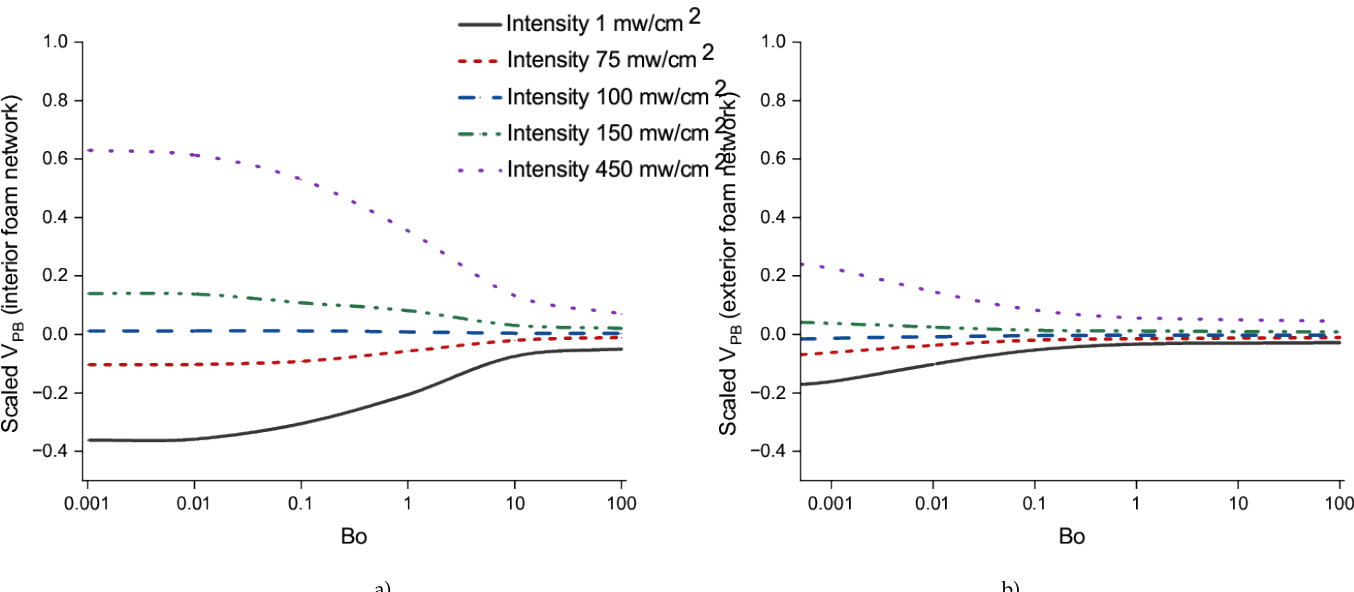
One of the assumptions in this study for modelling the foam drainage under UV exposure was setting a fixed semi-mobile interfacial mobility, =0.1. If the effect of the interfacial mobility, , is included in the analysis, the findings in Figure 7 can be generalized to account for foams containing photosurfactant with any interfacial mobilities. The generalized results of scaled velocity in the foam network in the border of stimulated and unexposed regions are shown in Figure 8. The negative velocities represent gravity direction flows and positive ones represent the opposite of the gravity direction flows. As it is shown, for very mobile interfaces or low number, we can expect a wide range of velocity changes as the capillary pressure difference has a significant effect on the drainage dynamic. For rigid interfaces or higher numbers, the overall velocity magnitude decreases due to the difficulty of flow movement in either gravity or upward directions. The effect of interfacial mobility is less pronounced in UV light intensities near 100 as the velocity magnitude is almost zero which represents the balance of and . For the exterior network, the overall velocity magnitude is lower than the interior network due to the presence of the wall which limits the range of foam drainage velocities.
Note that the experimental data about photoswitchable foams is very limited. For now, our numerical method can be used for only foams with similar photoisomerization rates of AzoTAB. However, our method can be used as a tool to infer the velocity in the border of stimulated and unexposed regions of those foams for any range of interfacial mobilities.
6. Conclusions
This study utilized a numerical approach to investigate the effect of UV light on foams containing photosurfactants. A previous study revealed that UV radiation can induce Marangoni flow and alter foam drainage patterns [34,35]. In this study, initially, the scaled Marangoni velocity for fully exposed foam was calculated, and the results were validated against experiments performed by Chevallier et al. [35]. Subsequently, the effects of UV stimulation time and UV light intensity on the Marangoni velocity were investigated, and the evolution of the scaled Marangoni flow from Plateau borders (PB) to the film was analyzed by using the recorded surface surfactant changes over time and UV intensity by Chevallier et al. [34]. These findings provide valuable insights into UV-induced Marangoni flow, as experimental measurements of such phenomena are challenging [5,16,21,34,35].
Furthermore, the study explored the application of UV radiation in controlling foam drainage by developing a numerical model based on the work of Anazadehsayed [7,36,37,38]. The simulations investigated the effects of UV exposure on a portion of a foam column, replicating the border between the exposed and unexposed regions. The model considered variations in surface tension, liquid pressure, and capillary flow for both interior and exterior foams. We discovered that the flow velocity within foam networks changes its direction beyond a specific UV intensity.
In conclusion, this study provides valuable insights into the mechanisms underlying UV-induced flow in foams containing photosurfactants. It also offers a toolbox for controlling foam drainage behaviour through adjustments in UV intensity. Future studies could focus on exploring Marangoni flow specifically at the border between the unexposed and stimulated regions, which would contribute further to our understanding of UV-induced foam dynamics.
References
- C, H.; J, E. Adv. Colloid Interface Sci. 2017, 247, 496–513. [CrossRef]
- RF, L.; W, Y.; SH, L.; GJ, H.; CA, M. SPE J. 2008, 15, 928–942.
- M, S.; Y, D.; A, A.; M, T.; PLJ, Z. Ind. Eng. Chem. Res. 2013, 52, 6221–6233, [https://doi.org/10.1021/ie300603v]. https://doi.org/10.1021/ie300603v..
- J, Y.; V, J.; S, R. Colloids Surf. A 2007, 309, 177–181. [CrossRef]
- SA, K.; S, H.; Stone. J. Colloid Interface Sci. 2004, 276, 420–438. [CrossRef]
- CJW, B.; PD, H. J. Fluid Mech. 2002, 458, 379–406.
- A, A.; J, N. Chem. Eng. Sci. 2017, 166, 11–18. [CrossRef]
- AV, N. J. Colloid Interface Sci. 2002, 249, 194–199. [CrossRef]
- D, V.; P, G.; P, M. Chem. Eng. Sci. 2013, 102, 405–423. [CrossRef]
- Z, W.; G, N. J. Colloid Interface Sci. 2006, 300, 327–337. [CrossRef]
- Fournier, J.; Cazabat, A. Tear of a Disjoining Marangoni Film. EPL (Europhysics Letters) 1992, 20, 517. [Google Scholar]
- TG, M. SIAM REV 1998, 40, 441–462, [https://doi.org/10.1137/S003614459529284X]. https://doi.org/10.1137/S003614459529284X..
- C, S. A Mathematical Analysis of Foam Films; Shaker Verlag GmbH, Germany, 2004; Vol. 1, p. chapter 1. [Google Scholar]
- P, G. Colloid and Interface Science; Prentice-Hall Of India Pvt. Limited, 2009; Vol. 1, p. chapter 2. [Google Scholar]
- A, B.; A, T.; N, K.; V, S. Adv. Colloid Interface Sci. 2015, 222, 670–677. [CrossRef]
- O, P.; N, L.; F, R. Eur. Phys. J. E 2009, 30, 27. [CrossRef] [PubMed]
- RA, L.; R, L. AIChE J. 1965, 11, 25–29. [CrossRef]
- PJ, M.; HM, D.; JB, W.; S, B.; AB, R. Chem. Eng. Sci. 2010, 65, 3825–3835. [CrossRef]
- P, S.; GJ, J. Chem. Eng. Process 2007, 46, 1286–1291. [CrossRef]
- P, G.; S, U.; MD, G.; D, V.; J, M.P. Chem. Eng. Sci. 2016, 143, 139–165. [CrossRef]
- E, C.; A, S.J.; I, C.; F, L.; C, M. Soft Matter 2013, 9, 7054–7060. [CrossRef]
- Rezaee, N.; Aunna, J.; Naser, J. Investigation of Recirculating Marangoni Flow in Three-Dimensional Geometry of Aqueous Micro-Foams. Fluids 2023, 8. [Google Scholar] [CrossRef]
- Saint-Jalmes, A. Rheological properties of simple fluids: experimental investigation and modeling. Soft Matter 2006, 2, 836–849. [Google Scholar] [CrossRef]
- Denkov, N.D.; Tcholakova, S.; Golemanov, K.; Subramanian, V.; Lips, A. Deformation and breakup of surfactant-covered drops in shear flow: Effect of the bulk viscosity. Colloids Surf. A Physicochem. Eng. Asp. 2006, 282, 329–336. [Google Scholar] [CrossRef]
- Marze, S.; Langevin, D.; Saint-Jalmes, A. Dynamics of droplet deformation and breakup in simple shear flow. J. Rheol. 2008, 52, 1091. [Google Scholar] [CrossRef]
- Denkov, N.D.; Tcholakova, S.; Golemanov, K.; Lips, A. Non-Newtonian drop deformation and breakup in shear flow: Effect of surfactants. Phys. Rev. Lett. 2009, 103, 118302. [Google Scholar] [CrossRef] [PubMed]
- Biance, A.L.; Cohen-Addad, S.; Hoehler, R. Shape of a meniscus and contact angle saturation in soft systems. Soft Matter 2009, 5, 4672–4679. [Google Scholar] [CrossRef]
- Colin, A.; Carrier, V. Rheology of Nonionic Micellar Solutions with and without Additives. Langmuir 2003, 19, 4535–4538. [Google Scholar] [CrossRef]
- Biance, A.L.; Delbos, A.; Pitois, O. Reversibility and irreversibility in the collapse of soft porous materials. Phys. Rev. Lett. 2011, 106, 068301. [Google Scholar] [CrossRef] [PubMed]
- Marze, S.; Saint-Jalmes, A.; Langevin, D. Droplet deformation and breakup in a simple shear flow. Colloids Surf. A Physicochem. Eng. Asp. 2005, 263, 121–129. [Google Scholar] [CrossRef]
- Emile, J.C.; Hardy, S.; Ropars, G.; Saint-Jalmes, A.; Delannay, R. Monolayers of gemini surfactants at the air-water interface. Colloids Surf. A Physicochem. Eng. Asp. 2007, 304, 72–76. [Google Scholar] [CrossRef]
- Cantat, I.; Dollet, B. Stress control of droplet breakup in microfluidic channels. Soft Matter 2012, 8, 7790–7796. [Google Scholar] [CrossRef]
- Pitois, O.; Fritz, C.; Vignes-Adler, M. Surfactant effects on yield stress in soft glassy materials. Colloids Surf. A Physicochem. Eng. Asp. 2005, 261, 109–115. [Google Scholar] [CrossRef]
- Chevallier, E.; Mamane, A.; Stone, H.; Tribet, C.; Lequeux, F.; Monteux, C. Pumping-out photo-surfactants from an air–water interface using light. Soft Matter 2011, 7, 7941–7949. [Google Scholar] [CrossRef]
- Chevallier, E.; Saint-Jalmes, A.; Cantat, I.; Lequeux, F.; Monteux, C. Light induced flows opposing drainage in foams and thin-films using photosurfactants. Soft Matter 2013, 9, 2678–2685. [Google Scholar] [CrossRef]
- Rezaee, N.; Naser, J.; Nguyen, A.V. A review of aqueous foam in microscale. Adv. Colloid Interface Sci. 256", pages = 203–229. Available online: http://www.sciencedirect.com/science/article/pii/S0001868617305286. [CrossRef] [PubMed]
- A, A.; N, R.; J, N. J. Colloid Interface Sci. 2017, 504, 485–491. [CrossRef]
- A, A.; N, R.; J, N. J. Colloid Interface Sci. 2018, 511, 440–446. [CrossRef]
- M, D.; D, L. Eur. Phys. J. E 2002, 7, 35–44. [CrossRef]
Figure 1.
a) Photo-conversion from the trans to the cis isomer of the AzoTAB surfactant under UV exposure. b) A diagram that illustrates how the Marangoni flow occurs in the interface, moving from the unexposed region towards the exposed region.
Figure 1.
a) Photo-conversion from the trans to the cis isomer of the AzoTAB surfactant under UV exposure. b) A diagram that illustrates how the Marangoni flow occurs in the interface, moving from the unexposed region towards the exposed region.
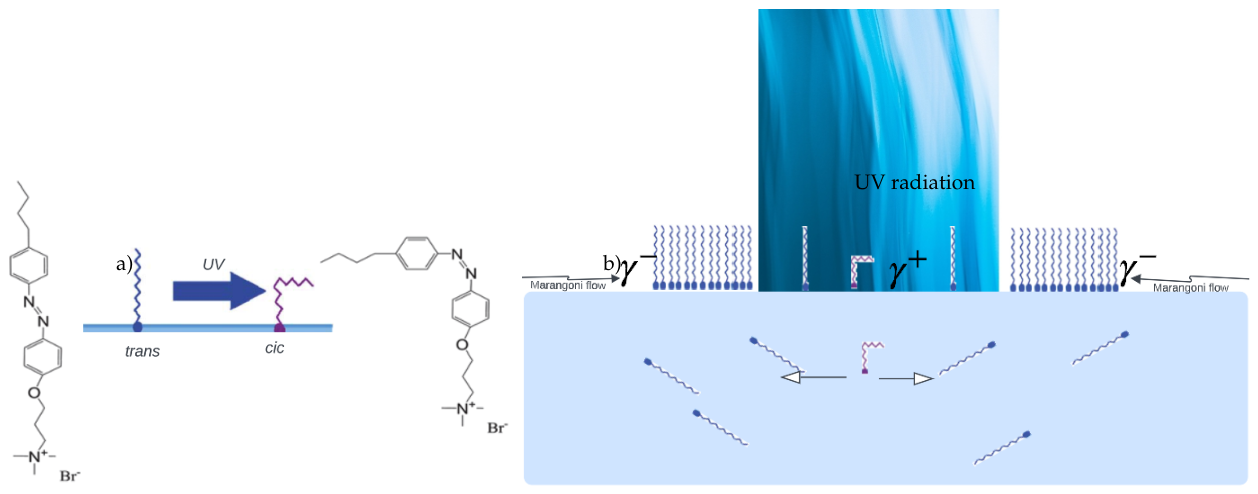
Figure 2.
The geometry of foam network containing multiple PBs and nodes is shown in green color. The blue color represents a one-sixth symmetric cut of a foam system which is used for simulation including thin film.
Figure 2.
The geometry of foam network containing multiple PBs and nodes is shown in green color. The blue color represents a one-sixth symmetric cut of a foam system which is used for simulation including thin film.
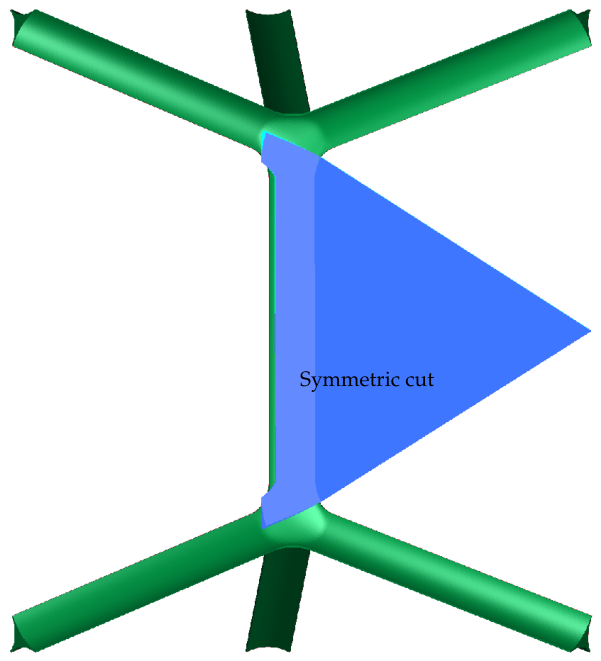
Figure 3.
The scaled Marangoni velocities from PB towards film for various foam sizes represented by various . The red colour graph is related to the experimentally measured Marangoni velocities [35] and the blue colour graph is related to the numerically calculated Marangoni velocities in this study.
Figure 3.
The scaled Marangoni velocities from PB towards film for various foam sizes represented by various . The red colour graph is related to the experimentally measured Marangoni velocities [35] and the blue colour graph is related to the numerically calculated Marangoni velocities in this study.
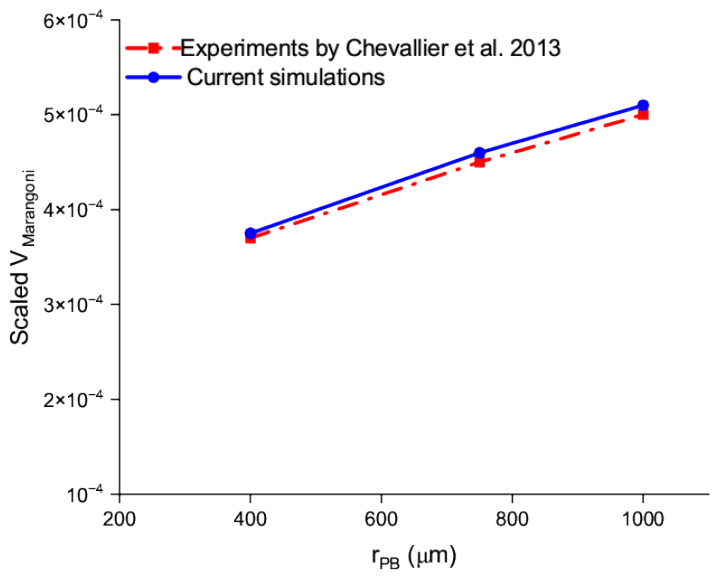
Figure 4.
The graph displays the scaled Marangoni velocities computed for various time intervals during the film’s exposure to UV light, indicated by squares. The corresponding fitted line is depicted in blue. The temporal progression of is represented by a dashed red line, as replicated from Chevallier et al.’s research [34].
Figure 4.
The graph displays the scaled Marangoni velocities computed for various time intervals during the film’s exposure to UV light, indicated by squares. The corresponding fitted line is depicted in blue. The temporal progression of is represented by a dashed red line, as replicated from Chevallier et al.’s research [34].
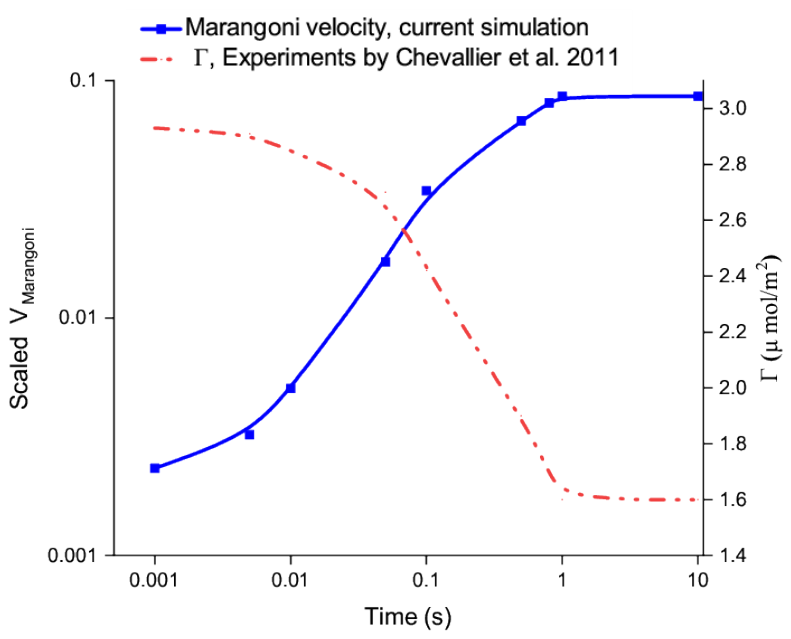
Figure 5.
Calculated scaled Marangoni velocities versus light intensity on the film are presented in the solid blue line. The profile in various light intensities is presented in a dashed red line and is reproduced from the study of Chevallier et al. [34].
Figure 5.
Calculated scaled Marangoni velocities versus light intensity on the film are presented in the solid blue line. The profile in various light intensities is presented in a dashed red line and is reproduced from the study of Chevallier et al. [34].
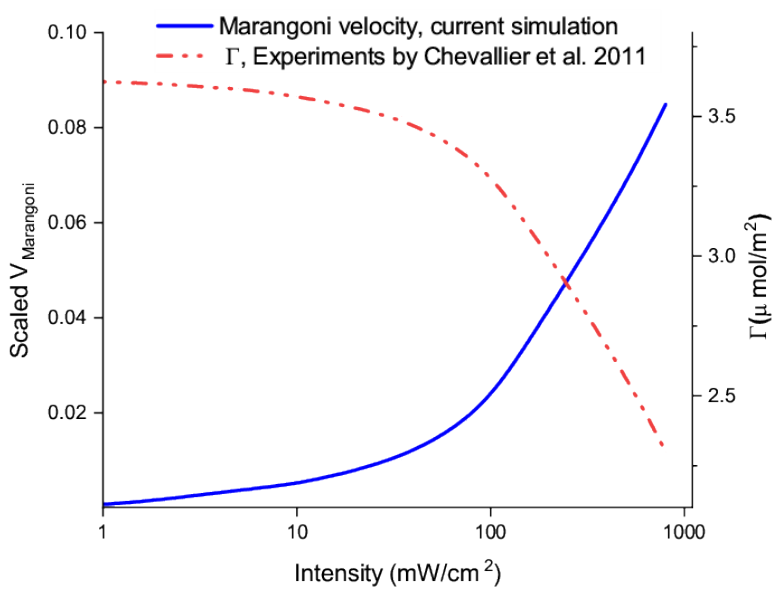
Figure 6.
Geometry of a single network of node-PB system. The top half of the geometry is stimulated by the UV and the bottom half is unexposed. This single network represents many networks on the border of UV-exposed and unexposed regions. Both interior and exterior foam networks are investigated and their symmetric cross-sections are shown.
Figure 6.
Geometry of a single network of node-PB system. The top half of the geometry is stimulated by the UV and the bottom half is unexposed. This single network represents many networks on the border of UV-exposed and unexposed regions. Both interior and exterior foam networks are investigated and their symmetric cross-sections are shown.
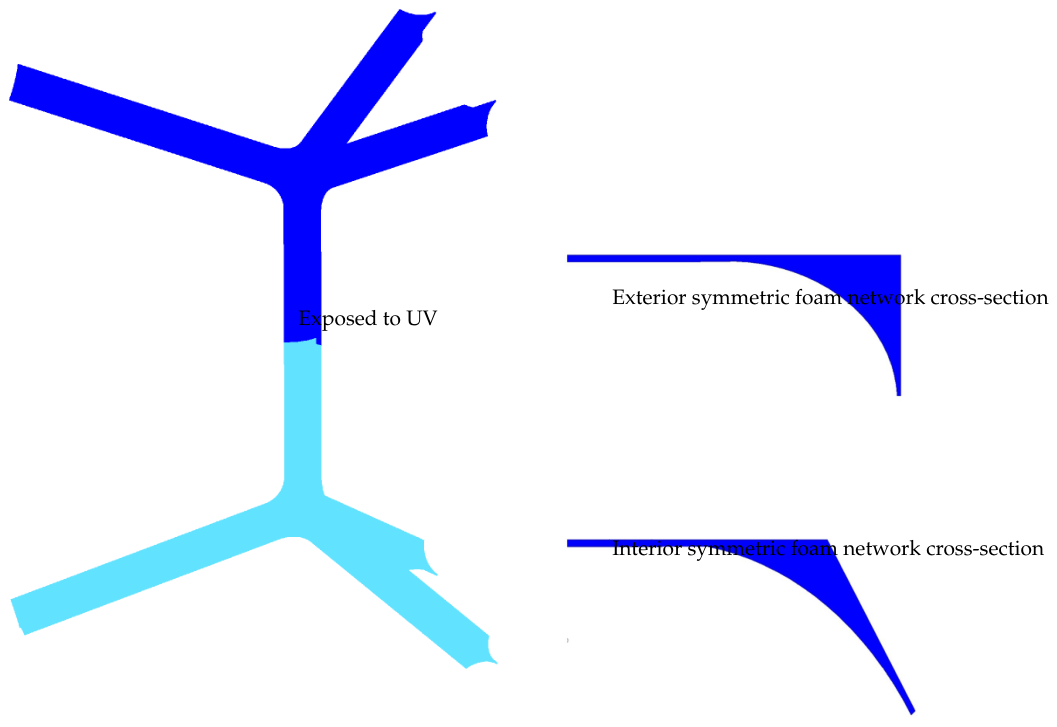
Figure 7.
The scaled average velocity in the network versus UV intensity in for semi-mobile interior and exterior foam networks. The negative velocity represents the flow in the gravity direction and the positive one represents the flow in the opposite of gravity direction.
Figure 7.
The scaled average velocity in the network versus UV intensity in for semi-mobile interior and exterior foam networks. The negative velocity represents the flow in the gravity direction and the positive one represents the flow in the opposite of gravity direction.
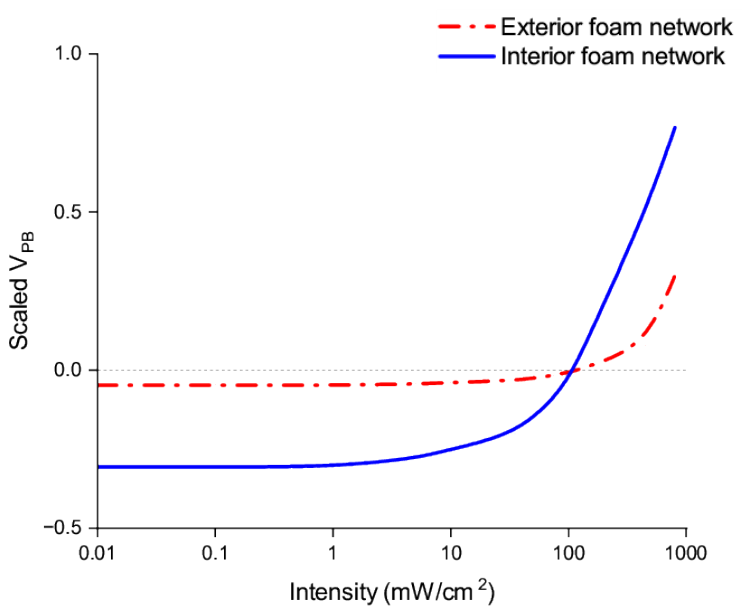
Figure 8.
The scaled average velocity in the foam network versus foam interfacial mobility, , for various UV intensities in a) interior and b) exterior foam networks. The negative velocity represents flow in the gravity direction and the positive one represents flow in the opposite of gravity direction.
Figure 8.
The scaled average velocity in the foam network versus foam interfacial mobility, , for various UV intensities in a) interior and b) exterior foam networks. The negative velocity represents flow in the gravity direction and the positive one represents flow in the opposite of gravity direction.
Disclaimer/Publisher’s Note: The statements, opinions and data contained in all publications are solely those of the individual author(s) and contributor(s) and not of MDPI and/or the editor(s). MDPI and/or the editor(s) disclaim responsibility for any injury to people or property resulting from any ideas, methods, instructions or products referred to in the content. |
© 2026 by the authors. Licensee MDPI, Basel, Switzerland. This article is an open access article distributed under the terms and conditions of the Creative Commons Attribution (CC BY) license.
Copyright: This open access article is published under a Creative Commons CC BY 4.0 license, which permit the free download, distribution, and reuse, provided that the author and preprint are cited in any reuse.