

Submitted:
09 July 2026
Posted:
10 July 2026
You are already at the latest version
Abstract
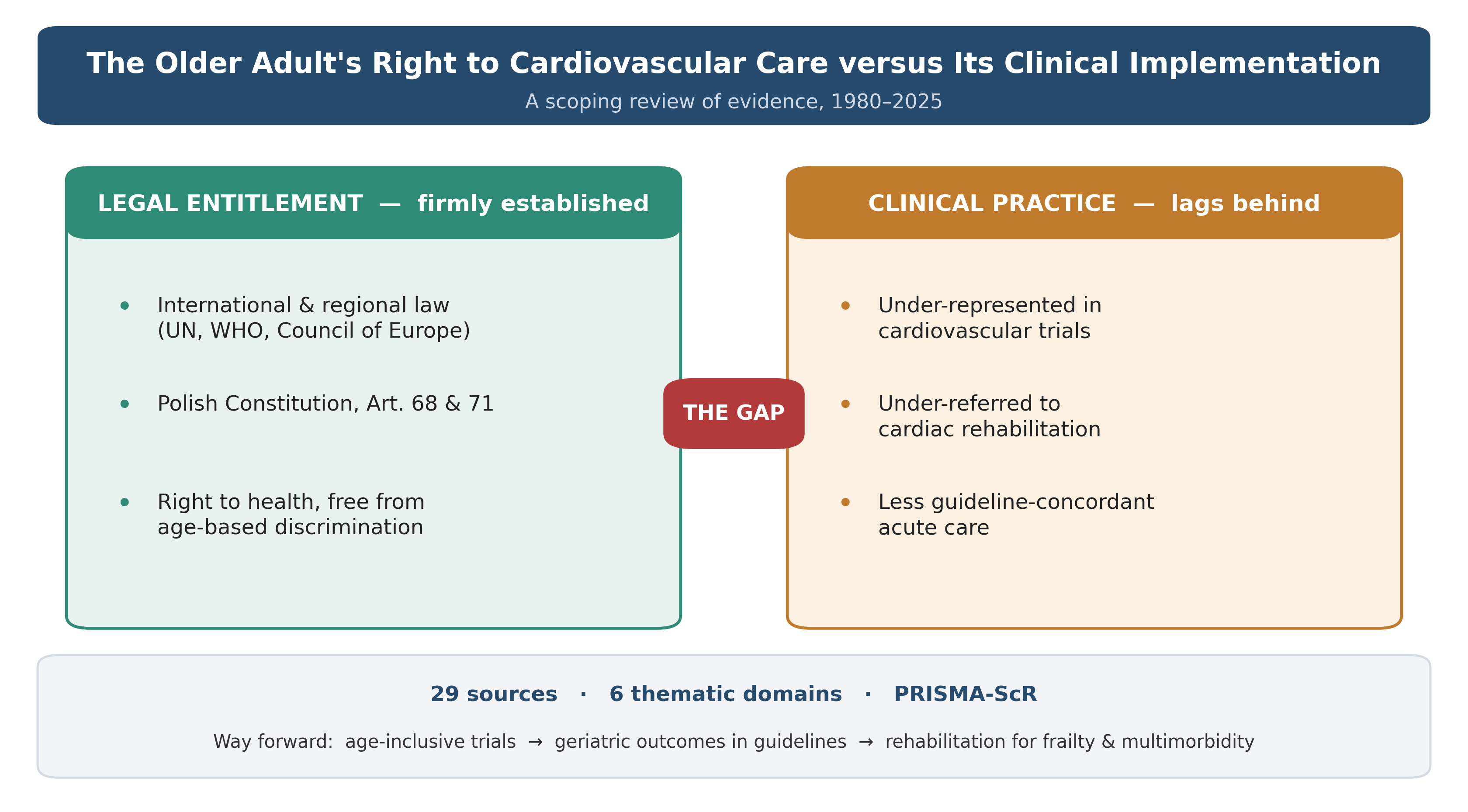
Background/Objectives: Cardiovascular disease is the leading cause of death in adults aged 65 years and over, yet older adults have long had the weakest claim on cardiology’s evidence base, even though international and constitutional law affirms their full right to health, free from age-based discrimination. We mapped the empirical and normative evidence on the gap between older adults’ legal entitlement to cardiovascular care and its clinical implementation, and identified thematic domains for future intervention research. Methods: Following the Arksey and O’Malley framework, refined by Levac and colleagues and by the Joanna Briggs Institute guidance and reported in line with PRISMA-ScR, we searched PubMed and Scopus for English-language sources published between 1980 and 2025 and retrieved institutional reports of the WHO, the UN and the Council of Europe from official repositories. Categories were derived inductively, and every source was checked against the Crossref record. Results: Twenty-nine sources met the inclusion criteria across six categories: history of legal protection, contemporary legal frameworks, ageism in cardiology, cardiac rehabilitation, bioethics, and institutional reports. Older patients were consistently under-represented in trials, referred less often to cardiac rehabilitation, and offered less guideline-concordant acute care; no source documented full closure of the gap. Conclusions: The entitlement is firmly established but is not matched by the evidence base, the guidelines or the rehabilitation infrastructure. Closing the gap calls for age-inclusive trials, geriatric outcomes in cardiovascular guidelines, and rehabilitation adapted to multimorbidity and frailty.
Keywords:
ageism
; cardiac rehabilitation
; healthcare disparities
; aged
; frailty
; geriatric cardiology
; right to health
; scoping review
1. Introduction
Cardiovascular disease is the leading cause of death in adults aged 65 years and over, and the population at greatest cardiovascular risk has historically had the weakest claim on cardiology’s own evidence base [14]. The mismatch between the demographic profile of cardiac patients and that of cardiac trials has been documented for more than two decades and has improved only modestly [6]. Over the same period, international human rights bodies, the WHO and the European Union have produced a dense body of instruments declaring that older persons hold a full right to health, free from age-based discrimination [1,26,27].
That entitlement is the outcome of a long normative evolution rather than a recent invention. Roman private law imposed duties of care and maintenance on adult descendants; the Elizabethan Poor Act of 1601 introduced statutory parish relief for the impotent poor; the Bismarckian reforms of the 1880s replaced charity with compulsory social insurance; and the post-war human rights instruments converted moral solidarity into a legally articulated right [3,4,5]. The present moment, in which the law is at its most developed while the cardiovascular evidence base remains structurally biased against older adults, repeats a familiar pattern in which each stage responded to a visible failure of the one before it to deliver concrete care.
The problem addressed here is the asymmetry between the legal architecture and the clinical practice of cardiology with respect to older adults. Two premises underlie the work. First, mapping the existing evidence is a prerequisite for designing interventions to close the gap. Second, age-based disparity in cardiac care is inadequately addressed by general anti-discrimination law and calls for specific clinical, methodological and regulatory instruments. This framing sits squarely within the concerns of healthy ageing and geriatric cardiology, where frailty, multimorbidity and access to rehabilitation increasingly shape outcomes in older cardiac patients [22].
The aim of the study was to map the empirical and normative evidence on the gap between the legal entitlement of older adults to cardiovascular care and its clinical implementation, and to identify thematic categories that can guide future intervention research. The specific objectives were threefold: to characterise the historical and contemporary legal sources that establish the right of older persons to healthcare; to identify the principal empirical findings on ageism in cardiology, the exclusion of older adults from cardiovascular trials, and the underuse of cardiac rehabilitation; and to locate emerging clinical and rehabilitation modalities, whole-body electromyostimulation (WB-EMS) included, that may help to narrow the implementation gap.
2. Materials and Methods
2.1. Study Design
The study was designed as a scoping review according to the framework of Arksey and O’Malley (2005), refined by Levac and colleagues (2010) and operationalised through the methodological guidance of the Joanna Briggs Institute. Reporting follows PRISMA-ScR. The protocol was not registered prospectively; the search strategy and inclusion criteria were documented before extraction and are available from the corresponding author. The work was carried out at the Institute of Health Sciences of the Pomeranian University in Słupsk, in collaboration with the Department of Cardiology and Electrotherapy of the Medical University of Gdańsk, between January and June 2026.
2.2. Information Sources and Search Strategy
Two bibliographic databases, PubMed (MEDLINE) and Scopus, were searched. Search strings combined controlled vocabulary (Medical Subject Headings for PubMed) with free-text terms in three concept blocks. The first block covered older adults (“aged”, “older adults”, “elderly”, “geriatric”, “frailty”); the second covered the legal and normative dimension (“right to health”, “human rights”, “ageism”, “age discrimination”); the third covered the clinical dimension (“cardiology”, “cardiovascular disease”, “cardiac rehabilitation”, “acute coronary syndrome”, “heart failure”, “electromyostimulation”). Concept blocks were combined with the Boolean operator AND, and terms within blocks with OR. The search was limited to English-language sources published between 1 January 1980 and 31 December 2025, and was last run on 17 June 2026. Institutional reports without journal indexation (WHO, UN, Council of Europe, European Society of Cardiology) were retrieved directly from the respective official repositories. Reference lists of the included sources were screened for further relevant items.
2.3. Eligibility Criteria
Sources were eligible if they addressed older adults aged 65 years and over, or used “elderly” as the defining age category; reported empirical findings, conceptual analyses or normative content relevant to the gap between legal entitlement and clinical implementation of cardiovascular care; and were published in English. Both peer-reviewed publications and authoritative grey literature were considered. Editorials and commentaries were included where they introduced or named a phenomenon central to the review, as with Bowling’s 1999 editorial on ageism in cardiology [10]. Sources were excluded if they addressed paediatric or middle-aged populations exclusively, reported only on non-cardiovascular conditions without normative content, or duplicated a more authoritative source already identified.
2.4. Data Extraction and Synthesis
Each included source was extracted into a standardised spreadsheet with the following fields: bibliographic reference, study type, population, geographical scope, primary outcome, direction of effect, and assigned thematic category. Thematic categories were derived inductively in two rounds, an initial open-coding round to identify candidate categories and a consolidation round to merge overlapping ones. Six final categories were retained. Synthesis was descriptive and thematic; no statistical pooling was performed, in keeping with scoping review methodology. The bibliographic accuracy of every included source was checked against the Crossref record: each digital object identifier was queried against the Crossref application programming interface, and the returned metadata (journal, volume, issue, page range, year, authors) were compared field by field with the working citation, and discrepancies were corrected against the authoritative record.
3. Results
3.1. Selection of Sources
The combined search retrieved 412 records from PubMed and 268 from Scopus. After removal of duplicates, 547 unique records remained. Titles and abstracts were screened against the eligibility criteria, and 89 records were retained for full-text assessment. After full-text review and methodological consolidation of overlapping evidence, 25 peer-reviewed sources were retained. Four institutional reports identified through targeted searching of the WHO, UN and Council of Europe repositories were added. The final corpus comprised 29 sources covering the period from 1984 to 2026. The selection process is summarised in the PRISMA-ScR flow diagram (Figure 1).
3.2. Thematic Distribution
The distribution of the 29 sources is summarised in Table 1. The largest category was cardiac rehabilitation in older adults (n = 8), followed by ageism in cardiology (n = 7), history of legal protection (n = 5), contemporary legal frameworks (n = 4), bioethics (n = 3) and institutional reports (n = 3).
3.3. Key Findings by Category
Category A traced the conceptual lineage of the right of older persons to healthcare from Roman duties of care and maintenance, through the Elizabethan Poor Act of 1601, to the Bismarckian social insurance reforms of the 1880s and the birth of geriatrics at the turn of the twentieth century [1,2,3,4,5]. Category B covered the work of the United Nations Open-Ended Working Group on Ageing and the wider debate on a dedicated convention on the rights of older persons, together with the approach of the European Union to ageism [7,8,13,15]. None of the identified sources documented a binding international convention specifically devoted to the rights of older persons; the framework remains a patchwork of thematic and regional instruments.
Category C was the largest empirical category. Every identified source documented a measurable form of age-based disparity: under-enrolment of older adults in cardiovascular trials [6], less frequent guideline-concordant management of acute coronary syndromes [10,11,12], sparse age-specific recommendations in the current European cardiology guidelines [9], and structural under-representation of geriatric outcomes [14]. No source documented the elimination of ageism in any specific health system; the Carta of Florence against ageism, published in 2024, was the most recent professional commitment to that end [15].
Category D was the second largest category. Every empirical source identified a positive effect of cardiac rehabilitation in older adults, with effect sizes at least equivalent to those observed in younger patients, alongside substantially lower referral and completion rates [16,17,18,19]. The evidence on WB-EMS as a modality compatible with the oldest old and with frail patients was specifically extracted [20,21], and the theoretical and clinical rationale for peripheral muscle electrostimulation in cardiac rehabilitation of the elderly has recently been systematised by the present authors [29]. The qualitative literature documented both structural and patient-level barriers to uptake [22].
Category E documented the shift from a paternalistic model of protection towards a model of autonomy and informed consent, with a focus on capacity, advance directives and end-of-life care [23,24,25]. Category I provided the policy framework. The WHO trilogy of the World Report on Ageing and Health (2015), the Global Report on Ageism (2021) and the Decade of Healthy Ageing 2021–2030 (2020), together with the Madrid International Plan of Action on Ageing (2002) and the Council of Europe Recommendation CM/Rec(2014)2, constitutes the operational structure for state action [26,27,28].
4. Discussion
The findings confirm and consolidate a pattern described separately in the literatures of legal history, geriatric cardiology and rehabilitation medicine. The right of older persons to healthcare is now more firmly established in international, regional and constitutional law than at any earlier time. The empirical evidence shows that in cardiology and cardiac rehabilitation this right is honoured systematically less well than the corresponding rights of younger patients. The contribution of the present synthesis is to show that the same gap appears in every empirical category examined, and that no identified source has documented its full closure.
The under-representation of older adults in cardiovascular trials, documented across more than three decades [6], is the structural origin of the gap. Guidelines that govern the management of acute coronary syndromes, heart failure and arrhythmias in older adults rest on evidence generated in populations from which those adults were excluded [9]. The analysis by Boerlage-van Dijk and colleagues of the current European Society of Cardiology guidelines confirms that age-specific recommendations remain sparse and that frailty is rarely operationalised as a clinical variable [9]. The 2016 European Guidelines on cardiovascular disease prevention acknowledge the importance of age in general terms but do not provide age-stratified targets for blood pressure, lipid control or antithrombotic therapy [9].
The under-treatment of older patients in acute cardiovascular care, first described by Bowling [10] and subsequently quantified by Bond and colleagues [11] and Alexander and colleagues [12], is the clinical expression of this structural bias. The Carta of Florence against ageism has formalised the professional commitment to eliminate age-based discrimination in medical decision-making [15]. Whether this commitment will be transposed into national professional standards, including in Poland, remains to be determined.
Cardiac rehabilitation, the category with the second largest evidence base in this review, is the clinical area in which the implementation gap is at its widest. The relative survival benefit of cardiac rehabilitation increases with age, and older patients who complete a programme achieve the largest improvements in peak oxygen uptake relative to baseline [16]. Referral rates above the age of 75 nevertheless remain well below those in younger patients, with completion rates lower still [17]. The barriers are both structural and individual [19,22]. Frailty compounds the problem, since frail older patients face the greatest access barriers even though they stand to gain the most from adapted programmes, a tension increasingly recognised in the healthy-ageing literature [22]. The evidence on WB-EMS indicates that this modality is feasible and safe in non-athletic and frail older adults, with effect sizes on muscular strength and body composition comparable to those of conventional resistance training [20,21]; the recent systematic review by the present authors situates peripheral muscle electrostimulation within the broader rationale for its use in cardiac rehabilitation of older patients [29]. Its place within future European cardiac rehabilitation guidelines will depend on dedicated trials in cardiac populations.
The bioethical literature reinforces the clinical conclusion. The contemporary model of consent and shared decision-making requires that the choice between invasive and conservative management, and between aggressive secondary prevention and a focus on quality of life, follow in every case from a structured conversation with the patient rather than from an extrapolation based on age [23,24]. A cardiologist who decides on behalf of a competent older patient, however benevolently, breaches the same ethical standards that apply to any other patient population.
4.1. Strengths and Limitations
The strengths of the review include the breadth of the search, which combined two databases with targeted retrieval of institutional documents; the explicit verification of every source against the Crossref record; and the inductive derivation of thematic categories. Its limitations are inherent in the scoping review design. Extraction was performed by a single reviewer; no formal quality appraisal of the included sources was undertaken, in keeping with scoping review methodology but at the cost of less granular grading; and the review was limited to English-language sources, which may have under-represented Central and Eastern European publications, including some Polish material. Formal certainty-of-evidence assessment using the GRADE framework was not undertaken, since GRADE is designed for comparative effects from analytic studies in support of clinical recommendations, whereas the present synthesis is exploratory and the corpus is heterogeneous. This choice is consistent with the Joanna Briggs Institute guidance for scoping reviews and should not be read as an omission.
5. Conclusions
Across the 29 sources mapped in this scoping review, the gap between the legal entitlement of older adults to cardiovascular care and the documented clinical implementation of that entitlement appeared in every empirical category examined. The mapping identified six interlocking domains in which intervention is required: age-inclusive cardiovascular trial design; the integration of geriatric outcomes into cardiovascular guidelines; the expansion and adaptation of cardiac rehabilitation to multimorbidity and frailty, including the controlled introduction of emerging modalities such as WB-EMS; the routine training of cardiologists in geriatric medicine; the systematic monitoring of access by age as a quality indicator; and the explicit incorporation of the older patient into the bioethical framework of consent and shared decision-making. These domains define a research agenda for geriatric cardiology and rehabilitation in Poland and in the wider European context. The review confirms that the gap between law and practice is structural, that it is amenable to intervention, and that the instruments needed to close it are already partly in place.
Supplementary Materials
The following supporting information can be downloaded at the website of this paper posted on Preprints.org. File S1: completed PRISMA-ScR checklist (Preferred Reporting Items for Systematic Reviews and Meta-Analyses extension for Scoping Reviews), mapping each checklist item to the corresponding section of the manuscript.
Author Contributions
Conceptualization, D.S. and D.K.; methodology, D.S.; validation, M.K.S. and A.S.-S.; formal analysis, D.S. and M.K.S.; investigation, D.S. and M.K.S.; data curation, D.S. and A.S.-S.; writing—original draft preparation, D.S.; writing—review and editing, M.K.S., A.S.-S. and D.K.; supervision, D.K. All authors have read and agreed to the published version of the manuscript.
Funding
This research received no external funding.
Institutional Review Board Statement
Ethical review and approval were waived for this study because it analysed published literature and publicly available institutional documents and did not involve human participants, their data, or biological material.
Informed Consent Statement
Not applicable.
Data Availability Statement
No new data were created in this study. All data analysed derive from the publicly accessible references listed in the bibliography. The data extraction spreadsheet is available from the corresponding author on reasonable request.
Conflicts of Interest
The authors declare no conflicts of interest.
References
- Ritch, A. History of Geriatric Medicine: From Hippocrates to Marjory Warren. J. R. Coll. Physicians Edinb. 2012, 42, 368–374. [CrossRef]
- Matthews, D.A. Dr. Marjory Warren and the Origin of British Geriatrics. J. Am. Geriatr. Soc. 1984, 32, 253–258. [CrossRef]
- Busse, R.; Blümel, M.; Knieps, F.; Bärnighausen, T. Statutory Health Insurance in Germany: A Health System Shaped by 135 Years of Solidarity, Self-Governance, and Competition. Lancet 2017, 390, 882–897. [CrossRef]
- Doron, I. Elder Law: Current Issues and Future Frontiers. Eur. J. Ageing 2006, 3, 60–66. [CrossRef]
- Karabatos, I.; Tsagkaris, C.; Kalachanis, K. All Roads Lead to Rome: Aspects of Public Health in Ancient Rome. Infez. Med. 2021, 29, 488–491.
- Bourgeois, F.T.; Orenstein, L.; Ballakur, S.; Mandl, K.D.; Ioannidis, J.P.A. Exclusion of Elderly People from Randomized Clinical Trials of Drugs for Ischemic Heart Disease. J. Am. Geriatr. Soc. 2017, 65, 2354–2361. [CrossRef]
- Hopf, S.; Previtali, F.; Georgantzi, N. Human Rights in Older Age: A Critical Reflection of the Debate around a UN Convention on the Rights of Older Persons. Innov. Aging 2020, 4 (Suppl. 1), 19–20. [CrossRef]
- Georgantzi, N. The European Union’s Approach towards Ageism. In Contemporary Perspectives on Ageism; Ayalon, L., Tesch-Römer, C., Eds.; International Perspectives on Aging, Vol. 19; Springer: Cham, Switzerland, 2018; pp. 341–368. [CrossRef]
- Piepoli, M.F.; Hoes, A.W.; Agewall, S.; Albus, C.; Brotons, C.; Catapano, A.L.; et al. 2016 European Guidelines on Cardiovascular Disease Prevention in Clinical Practice. Eur. J. Prev. Cardiol. 2016, 23, NP1–NP96. [CrossRef]
- Bowling, A. Ageism in Cardiology. BMJ 1999, 319, 1353–1355. [CrossRef]
- Bond, M.; Bowling, A.; McKee, D.; Kennelly, M.; Banning, A.P.; Dudley, N.; et al. Does Ageism Affect the Management of Ischaemic Heart Disease? J. Health Serv. Res. Policy 2003, 8, 40–47. [CrossRef]
- Alexander, K.P.; Newby, L.K.; Bhapkar, M.V.; White, H.D.; Hochman, J.S.; Pfisterer, M.E.; et al. International Variation in Invasive Care of the Elderly with Acute Coronary Syndromes. Eur. Heart J. 2006, 27, 1558–1564. [CrossRef]
- Mahler, C. What Is the Situation with Human Rights of the Elderly? UN Open-Ended Working Group on Ageing—Review and Prospects. Z. Gerontol. Geriatr. 2017, 50, 281–286. (In German) . [CrossRef]
- Rich, M.W.; Chyun, D.A.; Skolnick, A.H.; Alexander, K.P.; Forman, D.E.; Kitzman, D.W.; et al. Knowledge Gaps in Cardiovascular Care of the Older Adult Population. J. Am. Coll. Cardiol. 2016, 67, 2419–2440. [CrossRef]
- Ungar, A.; Cherubini, A.; Fratiglioni, L.; de la Fuente-Núñez, V.; Fried, L.P.; Krasovitsky, M.S.; et al. Carta of Florence against Ageism: No Place for Ageism in Health Care. Eur. Geriatr. Med. 2024, 15, 285–290. [CrossRef]
- Schopfer, D.W.; Forman, D.E. Cardiac Rehabilitation in Older Adults. Can. J. Cardiol. 2016, 32, 1088–1096. [CrossRef]
- Lutz, A.H.; Forman, D.E. Cardiac Rehabilitation in Older Adults: Apropos yet Significantly Underutilized. Prog. Cardiovasc. Dis. 2022, 70, 94–101. [CrossRef]
- Piepoli, M.F.; Corrà, U.; Benzer, W.; Bjarnason-Wehrens, B.; Dendale, P.; Gaita, D.; et al. Secondary Prevention through Cardiac Rehabilitation: From Knowledge to Implementation. A Position Paper from the Cardiac Rehabilitation Section of the European Association of Cardiovascular Prevention and Rehabilitation. Eur. J. Cardiovasc. Prev. Rehabil. 2010, 17, 1–17. [CrossRef]
- Menezes, A.R.; Lavie, C.J.; Arena, R.; Milani, R.V.; Church, T.S. Cardiac Rehabilitation and Exercise Therapy in the Elderly: Should We Invest in the Aged? J. Geriatr. Cardiol. 2012, 9, 68–75. [CrossRef]
- Kemmler, W.; Weissenfels, A.; Willert, S.; Shojaa, M.; von Stengel, S.; Filipovic, A.; et al. Efficacy and Safety of Low Frequency Whole-Body Electromyostimulation (WB-EMS) to Improve Health-Related Outcomes in Non-Athletic Adults. A Systematic Review. Front. Physiol. 2018, 9, 573. [CrossRef]
- Bloeckl, J.; Raps, S.; Weineck, M.; Kob, R.; Bertsch, T.; Kemmler, W.; et al. Feasibility and Safety of Whole-Body Electromyostimulation in Frail Older People: A Pilot Trial. Front. Physiol. 2022, 13, 856681. [CrossRef]
- Nichol, C.; Das, R.; Barry, G.; Kelly, M.; Vogiatzis, I.; Adams, N. A Qualitative Study of Barriers and Facilitators to the Uptake of Cardiac Rehabilitation in Octogenarians. Geriatrics 2024, 9, 161. [CrossRef]
- Pérez-Cárceles, M.D.; Lorenzo, M.D.; Luna, A.; Osuna, E. Elderly Patients Also Have Rights. J. Med. Ethics 2007, 33, 712–716. [CrossRef]
- Sherwin, S.; Winsby, M. A Relational Perspective on Autonomy for Older Adults Residing in Nursing Homes. Health Expect. 2011, 14, 182–190. [CrossRef]
- Kotzé, C.; Roos, J.L. Ageism, Human Rights and Ethical Aspects of End-of-Life Care for Older People with Serious Mental Illness. Front. Psychiatry 2022, 13, 906873. [CrossRef]
- World Health Organization. World Report on Ageing and Health; WHO: Geneva, Switzerland, 2015.
- United Nations. Political Declaration and Madrid International Plan of Action on Ageing; Second World Assembly on Ageing, Madrid, 8–12 April 2002; United Nations: New York, NY, USA, 2002.
- Sadana, R.; Soucat, A.; Beard, J.R. Universal Health Coverage Must Include Older People. Bull. World Health Organ. 2018, 96, 2–2A. [CrossRef]
- Sendrowski, D.; Polańska-Szczap, A.; Hus, B.; Vlaieva, A.; Markowski, S.; Carlé-Calo, A.; et al. Theoretical and Scientific Underpinnings of Peripheral Muscle Electrostimulation in Cardiac Rehabilitation of the Elderly: A Systematic Review. J. Clin. Med. 2026, 15, 3826. [CrossRef]
Figure 1.
PRISMA-ScR flow diagram of source identification, screening, and inclusion.
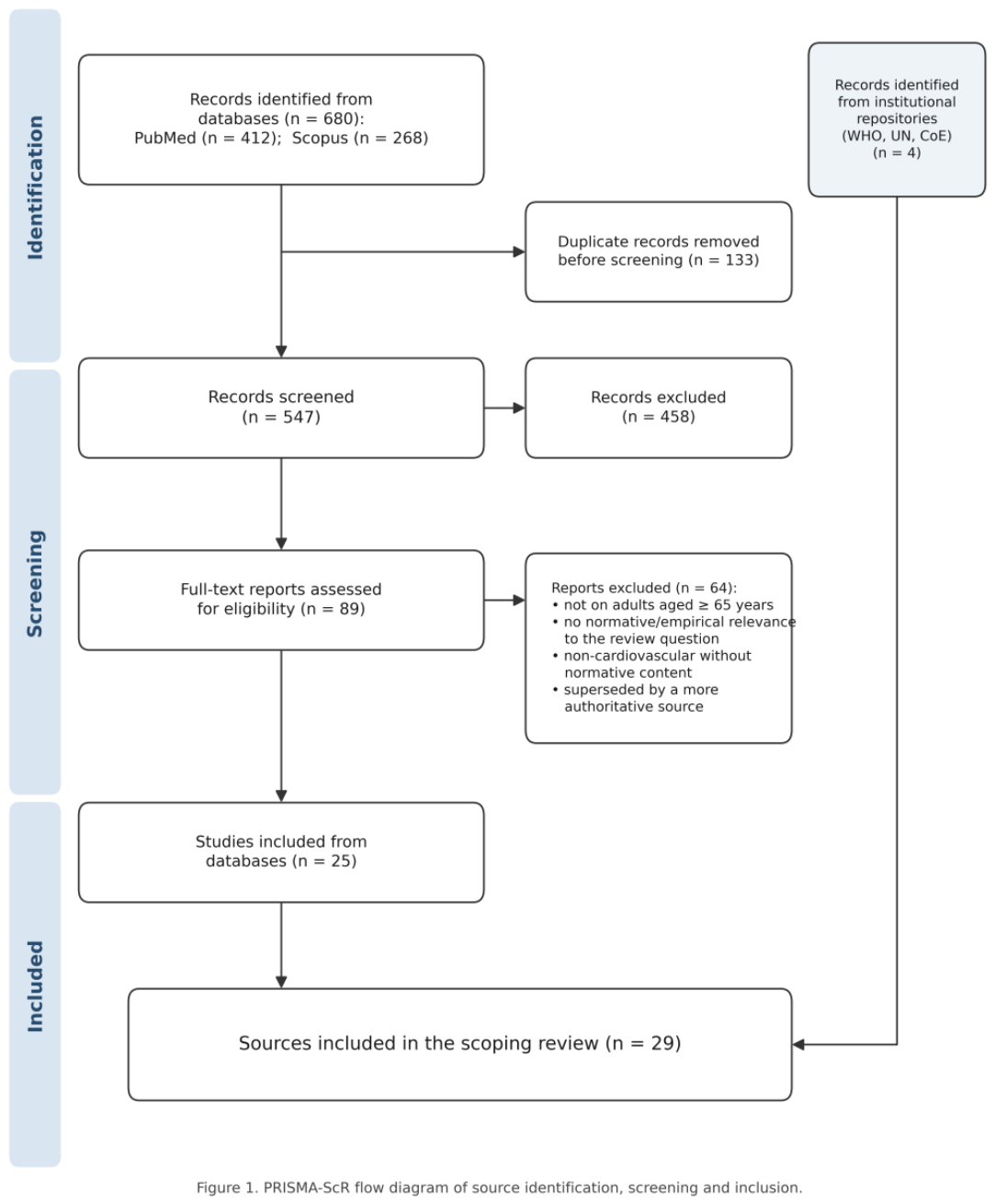

Table 1.
Thematic categorisation of the 29 sources included in the scoping review.
| Category | Theme | Sources (n) | Reference numbers |
| A | History of legal protection of older persons | 5 | 1, 2, 3, 4, 5 |
| B | Contemporary legal frameworks (UN, EU, CoE) | 4 | 7, 8, 13, 15 |
| C | Ageism in cardiology and in medicine | 7 | 6, 9, 10, 11, 12, 14, 15 |
| D | Cardiac rehabilitation in older adults | 8 | 16, 17, 18, 19, 20, 21, 22, 29 |
| E | Bioethics of the older patient | 3 | 23, 24, 25 |
| I | Institutional reports (WHO, UN, CoE) | 3 | 26, 27, 28 |
| Total | 29 |
Disclaimer/Publisher’s Note: The statements, opinions and data contained in all publications are solely those of the individual author(s) and contributor(s) and not of MDPI and/or the editor(s). MDPI and/or the editor(s) disclaim responsibility for any injury to people or property resulting from any ideas, methods, instructions or products referred to in the content. |
© 2026 by the authors. Licensee MDPI, Basel, Switzerland. This article is an open access article distributed under the terms and conditions of the Creative Commons Attribution (CC BY) license (http://creativecommons.org/licenses/by/4.0/).
Copyright: This open access article is published under a Creative Commons CC BY 4.0 license, which permit the free download, distribution, and reuse, provided that the author and preprint are cited in any reuse.


