

Submitted:
08 July 2026
Posted:
10 July 2026
You are already at the latest version
Abstract
Drug overdose contributes to a significant portion of adolescent deaths. Studies have established the relationship between drug overdose rates and drug type and adolescent population cohort size, but there has been little research investigating a correlation between geographic region (Northeast, Midwest, South, and West) and adolescent drug overdose mortality rates. We hypothesized regional differences exist, and that the South would have the highest adolescent drug overdose rates, as relates to lowest socioeconomic status (SES). We determined the correlation between adolescent drug overdose rates and United States census region to determine whether regional differences exist. In this study, publicly-available CDC Wonder adolescent (18-24) drug overdose data (2018-2024) was filtered by census region and analyzed. A chi-squared test contingency test was done to determine the significance in correlation between adolescent drug overdose mortality rates and census region. We found the West census region had the highest drug overdose rates per 100,000 adolescents (14.8%), while the Northeast had the lowest rate (12.1%). A chi-squared contingency test was performed to determine the correlation between adolescent drug overdose mortality rate and census region. A statistically-significant difference among the census regions was found (χ² = 175.2, p <0.00001). Despite having the highest median income, the West had the highest mortality rate; in contrast, despite having the lowest median income, the South had only the third-highest mortality rate. We conclude adolescent drug overdose mortality rates differed between census region, though the results contradicted the hypothesis that there would be a consistently-inverse relationship between such mortality rate and census region SES (median income).
Keywords:
drug
; overdose
; substance abuse
; adolescent
; mortality
; geography
; census region
Introduction
Drug overdose is the third-leading cause of adolescent deaths in the United States. [1] Drug overdose death rates for the population as a whole have increased substantially since 1999. Adolescents made up the minority of these deaths until 2019, when teen overdose deaths in the United States more than doubled in a year from below 2 to more than 5 per 100,000 adolescents. [1] Over 75% of adolescent overdose deaths involve the use of counterfeit pills containing synthetic opioids with potent levels of fentanyl known as illicitly manufactured fentanyls (IMFs). [2] These pills are made to mimic prescription drugs such as opioid painkillers or benzodiazepines, and are often used unknowingly by teenagers attempting to alleviate adverse effects of mental health issues, or occasionally, by adolescents suffering from opioid use disorder. [2]
Several studies have assessed the relationship between drug type and adolescent drug overdose deaths. For example, the aforementioned study on teenage drug overdose mortality from 1999 to 2015 also revealed trends in the type of drug involved in the overdose event. It was shown that adolescent drug overdose deaths due to opioids are significantly more common than deaths due to cocaine, benzodiazepines, and psychostimulants, with opioid-involved deaths increasing more than threefold between 1999 and 2007, then decreasing from 2012 to 2014, before increasing again from 2014 to 2015. Among opioid drugs, the rates of teen drug overdose deaths were highest for heroin in 2015, as opposed to methadone and other natural and semi-synthetic opioid drugs. [7] Furthermore, a study measuring youth mortality using years of life lost (YLL) considered the impact of illicitly manufactured fentanyls (IMFs) on the increase in drug overdose rates and revealed an increased risk for unintentional overdose deaths in adolescents during the Coronavirus pandemic, partially due to a steep rise in IMFs. Synthetic opioids such as IMFs were the greatest cause of unintentional overdose in adolescents, resulting in the most YLL compared to other drugs, including benzodiazepines, methamphetamines, cocaine, other opioids, methadone, and heroin. [8] Another study explored drug overdose deaths between 2019 and 2021 in adolescents aged 10 to 19 years in the United States. It was discovered that, though there was a decrease in drug misuse among secondary school students, the risk of drug-related mortality for this same demographic had increased due to a rise in IMF availability. The median monthly overdose deaths increased by 109%, with opioids being responsible for a majority of these deaths, and IMFs being the most-prominent opioid. Counterfeit pills were involved in approximately one quarter of adolescent overdose deaths. [3]
Our primary aim was to determine whether there were differences between the Northeast, Midwest, South, and West census regions in adolescent mortality rates (ages 15-24) from drug overdose in the United States. We hypothesized differences would exist, perhaps due to differences in socioeconomic status. Studies have shown a positive correlation between teen drug usage and low family income, low community income, unemployment, poverty, unstable housing, low parental or child education, and having blue-collar fathers. [4,5] Furthermore, research has shown that the Southern United States is generally poorer than other census regions. When comparing annual household income to individualized poverty thresholds, the South was found to have the highest rates of poverty among other U.S. census regions with almost half of all Southern census region states having poverty rates of 15% or higher. [6] It was also shown that neighborhood socioeconomic status (SES) was lower in the South than in other census regions, which encompasses several socioeconomic factors such as income, employment, housing, and education. [7] Thus, we hypothesized that there will be higher rates of adolescent drug overdose mortality in the Southern United States census region.
Material & Methods
Drug-induced deaths of young adults, aged 15-24, from 2018 to 2024 were obtained from the CDC Wonder database, a publicly-available, anonymized, aggregated mortality database. The data within Wonder was filtered by census region (Midwest, Northeast, South, and West). We captured all drug overdose death, regardless of whether it was coded as suicide, accidental, homicidal, or undetermined. These drug-induced codes were grouped together in our data. All demographic categories within the Wonder database were included in the analysis, including all races, sexes, education levels, and time or place of death.
Measures extracted from the database included total deaths, population size, and crude death rates of each census region. Rates were listed by both the total number of drug-induced deaths and drug-induced deaths per 100,000 of the population between 15 and 24 years old within a census region. Additionally, a 95% confidence interval for our data was obtained to assess the precision of the drug/alcohol-related mortality rate estimates. Only the drug-induced adolescent mortality data was used for this study.
Microsoft Excel (Redmond, WA; 2021) was utilized for data management. A chi-squared contingency test was done to determine the significance in correlation between census region and adolescent drug overdose mortality rates. [8] Statistical significance was set a priori at p <0.05.
This research was reviewed and deemed not to meet the definition of research by the Northwell Health Institutional Review Board’s (IRB’s) Human Research Protection Program, indicating that formal IRB approval was not necessary for this study. All observations were compiled in compliance with institutional guidelines for patient privacy and data security.
Results
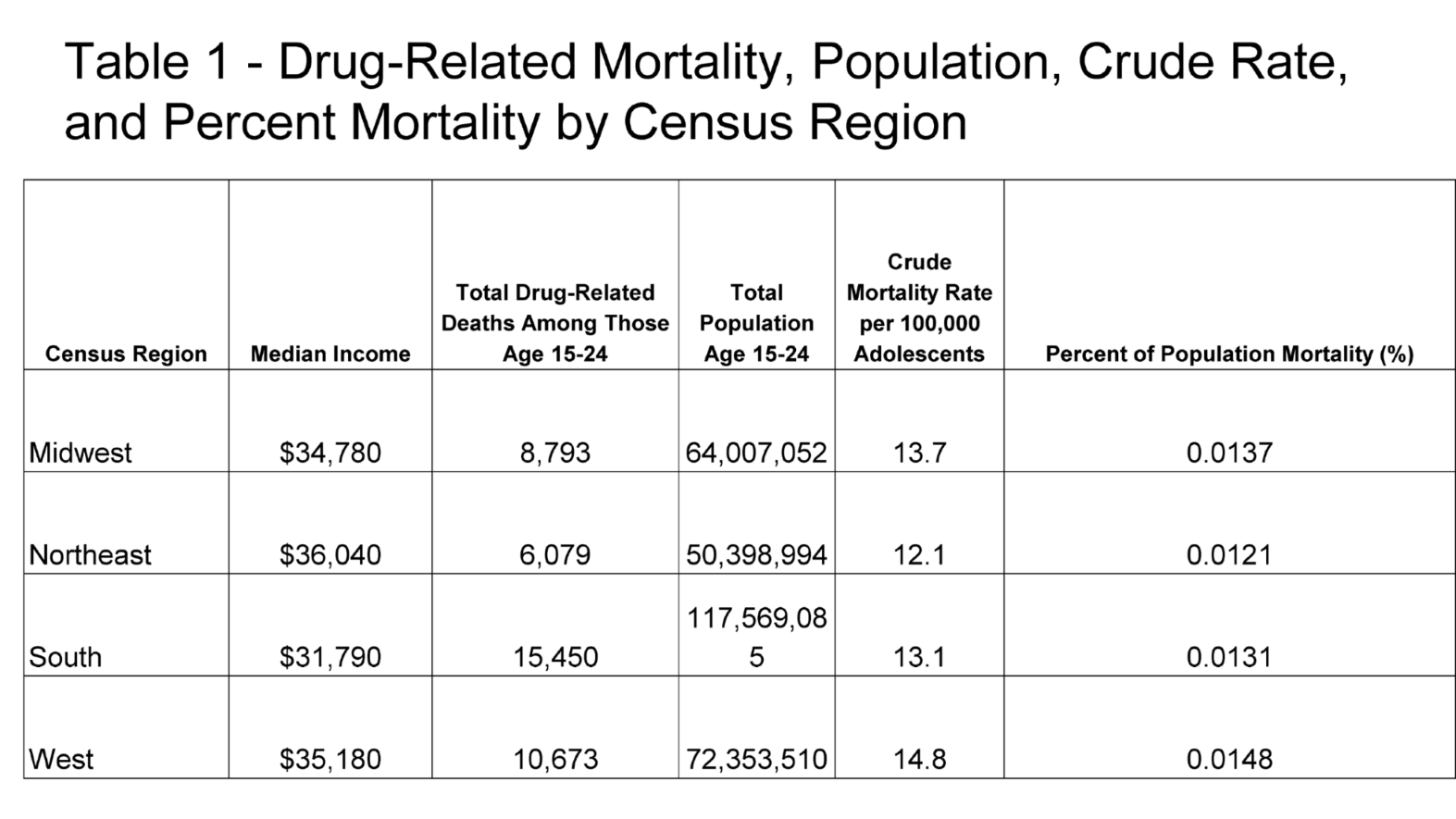
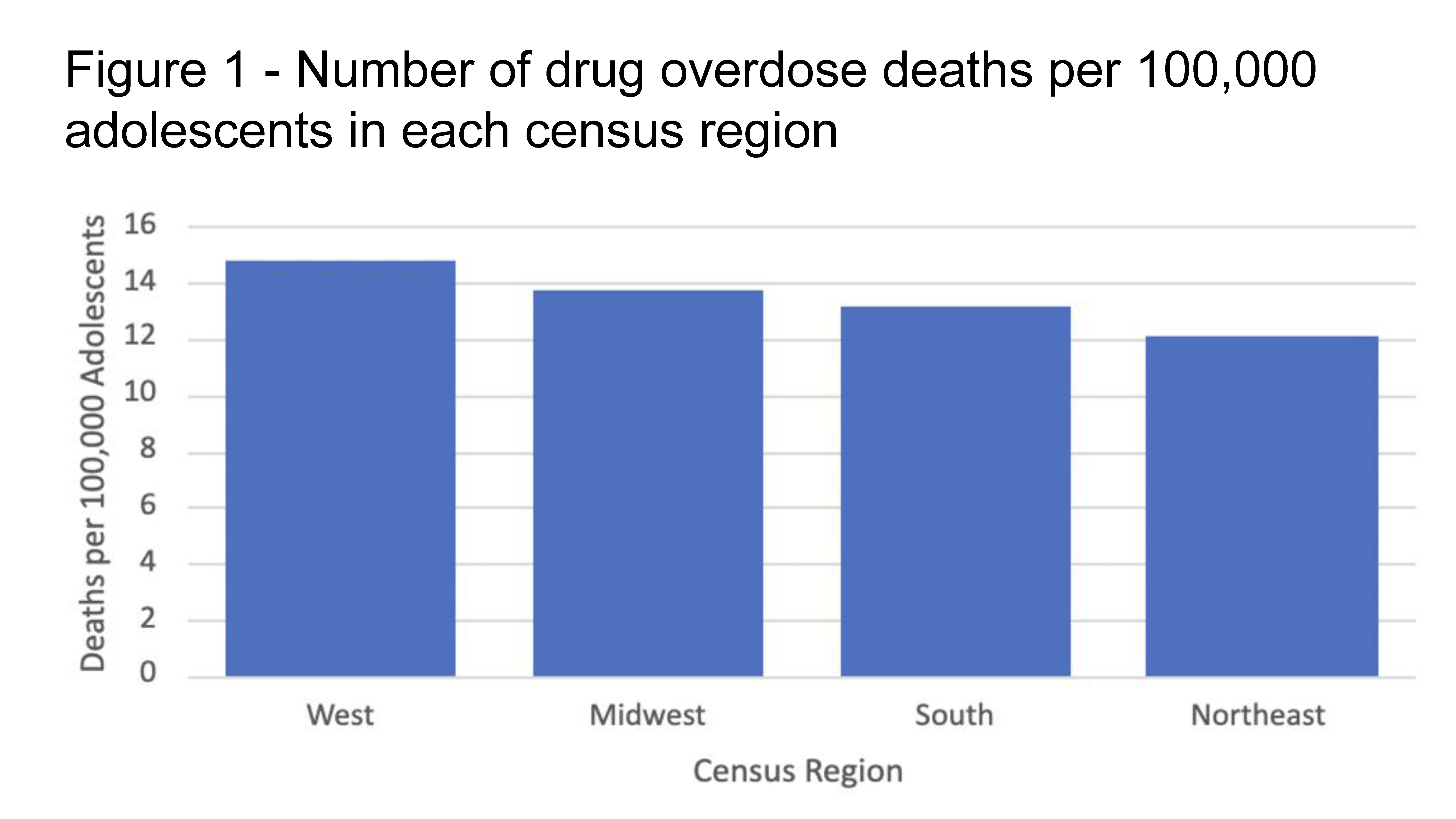
Table 1 and Figure 1 show the number of drug overdose deaths per 100,000 adolescents in each census region and the overdose mortality rate in the four census regions. The West census region was found to have the highest drug overdose rates per 100,000 adolescents (14.8%), while the Northeast census region had the lowest rate (12.1%). A chi-squared contingency test performed to determine the correlation between adolescent drug overdose mortality rate and census region found a statistically-significant difference among the census regions (χ2 = 175.2, p <0.00001). Contrary to our hypothesis, despite its lower SES, the South did not have the lowest mortality rate, while the West, despite having a higher SES, had the highest mortality rate.
Discussion
These findings supported that census region is statistically significant in relation to adolescent drug overdose rates. However, our data contradicted our hypothesis that the Southern census region would have the greatest drug overdose mortality rates. The South had the lowest median income, but the second-lowest adolescent drug overdose mortality rate. The West had the highest median income and the highest mortality rate. Among the three census regions other than the Northeast, higher socioeconomic status was associated with higher adolescent drug overdose rates. (Table 1)
Although the absolute drug death rates per 100,000 individuals or percent of the population are low, the comparison between census regions is statistically-significant based on the p-value obtained (p <0.00001) because the population sampled contained millions of observations.
A possible underlying factor causing the trend between census region and adolescent drug overdose could be differences in the prevalence of mental illness across the four census regions. A consistent connection between mental disorder and opioid overdose has been established in the general population, including adolescents. [9] In national estimates of the prevalence of past-year mental health issues, the Northeast census region reported the lowest reported past-year mental illness amongst adults (17.6%), as well as reported percentage of adults with serious mental illness (3.9%), while the West census region reported the highest prevalence of past-year mental illness (18.0%), and both the West and Midwest census regions reported the highest rates of serious mental illness (4.1%). [10] The trend in mental health issues among adults in the four major census regions matched the trend in drug mortality seen in our data (Figure 1).
Additionally, differences in drug availability may contribute to differences among the four census regions. Historically, methamphetamine was introduced to the U.S. via distribution points in the Western and Midwestern census regions. This resulted in widespread availability and affordability of the drug in these regions, with adolescents being one of the demographics particularly-impacted by this increase. Moreover, IMFs have been seized at a consistently-higher rate in the West than in other regions, with over 25,000 seizures between 2017 and 2023. The multitude of seizures in the West suggests a greater availability of IMFs in the region. It was also noted that the increase in rates of IMF seizures in the West corresponds to the rise in adolescent drug overdose deaths involving fentanyl. This is further supported by the fact that a large number of IMFs seized were in the form of pills, as drug deaths involving the use of counterfeit pills have been observed more in the younger demographic. [11] These findings are further supported by research investigating regional disparities in the prevalence of opioid prescribing, which found that opioids are prescribed at significantly-higher rates to patients in the Western and Southern census regions compared with patients in the Northeastern and Midwestern census regions. [12]
Many studies have been consistent with our results, finding a trend in drug prevalence in which availability is highest in the West and lowest in the Northeast, with the Midwest and South having intermediate availability. However, contrary to our results, the South has generally been found to have higher availability than the Midwest, though differences were often somewhat-marginal. This might be explained by intersectionality in which mental health, drug availability, and socioeconomic status all play a role in rates of adolescent drug overdose mortality. Adolescents with trauma or mental illnesses, such as depression, have been found to have higher rates of drug usage, often as a result of attempting to relieve symptoms. [1] While mental illness has been found to be more prevalent in the Midwest, studies have shown that teens with lower socioeconomic status are more likely to experience mental health issues and, in turn, engage in substance use, though research shows that low socioeconomic status itself is still associated with higher drug usage, even when depressive symptoms are treated. [13] That said, the fact that the South has only a moderate prevalence of mental health issues despite the lowest SES may explain the South’s lower rate of adolescent overdose mortality.
There are various limitations to this study. For example, the age group of adolescents who experienced drug-related mortality (ages 15-24), as well as the time range in which these deaths took place (2018-2024) represented by the data obtained from the CDC Wonder database did not directly align with the age groups and time ranges of data included in other research mentioned throughout this study. Furthermore, there are several confounding variables that may contribute to an increase in adolescent overdose rates other than those included in this analysis. Prior research has shown an association between cohort size and substance abuse. [14] Therefore, differences in cohort size across demographic ranges within the US, specifically between Gen Z (1997-2012), millennials (1981-1996), and Gen X (1965-1980) may be a confounding variable leading to an increase in adolescent drug overdose rates; however, the similarity in total U.S. births between millennials (~73.1 million) and Gen-Z (~72.2 million), [15] the two demographic ranges included in our data, makes an association between cohort size and our drug overdose rates unlikely. Other factors such as education level, public health policies, and the availability of medical and social resources also likely have a notable impact on drug overdose rates. This myriad of factors often have different regional trends, which introduces intersectionality as aforementioned, and in turn, adds complexity when attempting to identify the most-prominent cause of these drug mortality rates in adolescents.
References
- Friedman, J.; Hadland, S.E. The Overdose Crisis among U.S. Adolescents. N. Engl. J. Med. 2024, 390(2). [Google Scholar] [CrossRef] [PubMed]
- Hadland, S.E.; Schmill, D.M.; Bagley, S.M. Anticipatory Guidance to Prevent Adolescent Overdoses. Pediatrics 2024, 153(5). [Google Scholar] [CrossRef] [PubMed]
- Tanz, L.J.; Dinwiddie, A.T.; Mattson, C.L.; O’Donnell, J.; Davis, N.L. Drug Overdose Deaths among Persons Aged 10–19 Years — United States, July 2019–December 2021. MMWR Morb. Mortal. Wkly. Rep. 2022, 71(50). [Google Scholar] [CrossRef] [PubMed]
- Lyons, R.M.; Yule, A.M.; Schiff, D.; Bagley, S.M.; Wilens, T.E. Risk Factors for Drug Overdose in Young People: A Systematic Review of the Literature. J. Child Adolesc. Psychopharmacol. 2019, 29(7), 487–497. [Google Scholar] [CrossRef] [PubMed]
- Aschengrau, A.; Grippo, A.; Winter, M.R. Influence of Family and Community Socioeconomic Status on the Risk of Adolescent Drug Use. Subst. Use Misuse 2021, 56(5), 577–587. [Google Scholar] [CrossRef] [PubMed]
- Benson, C. Poverty in States and Metropolitan Areas: 2022 American Community Survey Briefs. U.S. Census Bureau. 2023. Available online: https://www.census.gov/content/dam/Census/library/publications/2023/acs/acsbr-016.pdf (accessed on 4 June 2026).
- De Silva, S.S.A.; Meeker, M.A.; Ryan, V.; et al. Comparing Global and Spatial Composite Measures of Neighborhood Socioeconomic Status Across US Counties. J. Urban Health 2022, 99(3), 457–468. [Google Scholar] [CrossRef] [PubMed]
- Stangroom, J. Social Science Statistics. Social Science Statistics. 2026. Available online: https://www.socscistatistics.com/tests/chisquare2/calculator/.
- van Draanen, J.; Tsang, C.; Mitra, S.; et al. Mental disorder and opioid overdose: A systematic review. Soc. Psychiatry Psychiatr. Epidemiol. 2021, 57(4). [Google Scholar] [CrossRef] [PubMed]
- Andrilla, C.H.A.; Patterson, D.G.; Garberson, L.A.; Coulthard, C.; Larson, E.H. Geographic Variation in the Supply of Selected Behavioral Health Providers. Am. J. Prev. Med. 2018, 54(6), S199–S207. [Google Scholar] [CrossRef] [PubMed]
- Palamar, J.J.; Fitzgerald, N.; Carr, T.H.; Cottler, L.B.; Ciccarone, D. National and regional trends in fentanyl seizures in the United States, 2017-2023. Int. J. Drug Policy 2025, 138, 104417. [Google Scholar] [CrossRef] [PubMed]
- McDonald, D.C.; Carlson, K.; Izrael, D. Geographic Variation in Opioid Prescribing in the U.S. J. Pain 2012, 13(10), 988–996. [Google Scholar] [CrossRef] [PubMed]
- Goodman, E.; Huang, B. Socioeconomic Status, Depressive Symptoms, and Adolescent Substance Use. Arch. Pediatr. Adolesc. Med. 2002, 156(5), 448. [Google Scholar] [CrossRef] [PubMed]
- Jacobson, M. Baby Booms and Drug Busts: Trends in Youth Drug Use in the United States, 19752000. Q. J. Econ. 2004, 119(4), 1481–1512. [Google Scholar] [CrossRef]
- Marketing Charts. So How Many Millennials Are There in the US, Anyway? (Updated). Available online: https://www.marketingcharts.com/featured-30401?__cf_chl_f_tk=TMa1xHCVq7I8qWQ2of9MOAehzD62ves4WNyc.xiLFGM-1783165424-1.0.1.1-j5h3hkSiiATr5INpsFFARQyigjseS8z78ny1wntb38w (accessed on 4 July 2026).
Figure 1.
Number of drug overdose deaths per 100,000 adolescents in each census region.
Disclaimer/Publisher’s Note: The statements, opinions and data contained in all publications are solely those of the individual author(s) and contributor(s) and not of MDPI and/or the editor(s). MDPI and/or the editor(s) disclaim responsibility for any injury to people or property resulting from any ideas, methods, instructions or products referred to in the content. |
© 2026 by the authors. Licensee MDPI, Basel, Switzerland. This article is an open access article distributed under the terms and conditions of the Creative Commons Attribution (CC BY) license.
Copyright: This open access article is published under a Creative Commons CC BY 4.0 license, which permit the free download, distribution, and reuse, provided that the author and preprint are cited in any reuse.


