

Submitted:
07 July 2026
Posted:
08 July 2026
You are already at the latest version
Abstract
Consumer rights protection remains fragmented across customer support channels, banking dispute systems, regulatory complaint mechanisms, legal escalation procedures, and public reputation platforms. Consumers frequently encounter asymmetry of information, emotional exhaustion, procedural complexity, and strategic disadvantages when interacting with corporations. We present Complaint Warrior, a synthesized human–AI-agentic framework for consumer rights protection that combines large language models (LLMs), multi-agent orchestration, automated negotiation, strategic reasoning, legal workflow management, and behavioral modeling into a unified dispute-resolution ecosystem.The proposed system integrates autonomous and human-supervised workflows across complaint intake, evidence gathering, company negotiation, credit-card chargeback initiation, social-media escalation, and small-claims litigation preparation. A central contribution is the use of LLM-based reasoning about mental states and organizational intent to predict likely peer behavior during negotiation. Instead of treating customer support interactions as isolated messages, the system models disputes as evolving strategic games involving beliefs, incentives, emotional states, procedural constraints, legal exposure, and reputational risk. Complaint Warrior employs a multi-agent architecture in which specialized agents coordinate through a shared dispute state representation. These agents include complaint-analysis agents, negotiation-strategy agents, legal agents, financial-dispute agents, social-media escalation agents, behavioral-prediction agents, and company-side moderation agents. The system supports both consumer and company workflows, including a subscription mechanism whereby participating companies gain structured negotiation interfaces and AI-assisted compromise optimization in exchange for reduced escalation risk. We describe the full operational pipeline, implementation architecture, reasoning framework, conflict-resolution strategies, and deployment infrastructure. We further discuss safety mechanisms, human oversight, negotiation ethics, explainability, and future directions toward autonomous dispute mediation ecosystems.
Keywords:
consumer rights protection
; human–AI collaboration
; complaint resolution
; multi-agent systems
; large language models
; automated negotiation
; dispute mediation
; behavioral modeling
; credit-card chargebacks
; small-claims litigation.
1. Introduction
Modern consumers increasingly interact with large organizations through automated customer-service systems that are difficult to navigate, strategically opaque, and often optimized for deflection rather than resolution. Complaint procedures are distributed across disconnected communication channels including email, chat systems, call centers, financial institutions, social-media platforms, regulatory agencies, and court systems. Consumers must manually coordinate evidence collection, emotional regulation, procedural compliance, and escalation strategies while facing organizations equipped with trained support teams and standardized resolution processes.
This asymmetry produces several well-known failures:
- unresolved refunds,
- denial of warranties,
- hidden subscription renewals,
- deceptive service practices,
- airline and travel disputes,
- defective product conflicts,
- insurance denials,
- contractor disagreements,
- billing fraud,
- and recurring customer-service loops.
Traditional automation in customer service primarily optimizes organizational efficiency rather than equitable conflict resolution. Existing chatbots are usually reactive, stateless, and narrowly task-oriented. They lack persistent strategic memory, legal reasoning, cross-channel coordination, and behavioral prediction capabilities.
We propose Complaint Warrior, a synthesized human–AI-agentic framework that transforms consumer-rights enforcement into a coordinated multi-agent reasoning process. The system combines:
- LLM-driven dialogue management,
- strategic negotiation planning,
- emotional-state inference,
- legal escalation workflows,
- evidence management,
- financial dispute automation,
- and multi-channel communication orchestration.
Unlike conventional support systems, Complaint Warrior models disputes as evolving adversarial–cooperative interactions between agents with partially observable mental states and incentives.
A key innovation is the incorporation of mental-state reasoning for predicting counterpart behavior. The system estimates organizational intentions, negotiation flexibility, procedural bottlenecks, escalation sensitivity, and reputational exposure. These estimates guide adaptive conflict-resolution strategies.
The framework supports:
- Consumer-side representation,
- Company-side subscription moderation,
- Semi-autonomous negotiation (Figure 1),
- Escalation to banking disputes,
- Social-media campaigns,
- Small-claims court preparation,
- Human-in-the-loop supervision.
The resulting architecture forms a hybrid socio-technical dispute-resolution ecosystem.
2. Related Work
Customer Relationship Management (CRM) systems have evolved from transactional customer databases toward intelligent decision-support platforms integrating machine learning, natural language processing, recommender systems, predictive analytics, and conversational AI. Early CRM architectures primarily focused on customer data integration, segmentation, and operational workflow management (Payne and Frow, 2005; Buttle and Maklan, 2019). The emergence of AI-based CRM extended these systems toward predictive customer analytics, automated customer interaction, churn prediction, and personalized service optimization.
A substantial body of research studies the integration of machine learning into CRM decision-making. Ngai et al. (2009) surveyed data-mining techniques in CRM, identifying classification, clustering, association-rule mining, and forecasting as the dominant analytical paradigms for customer acquisition, retention, and cross-selling. Subsequent work incorporated deep learning and large-scale behavioral analytics for customer profiling and recommendation optimization (Huang and Rust, 2021). AI-driven CRM systems increasingly rely on predictive models estimating customer lifetime value, purchase intent, churn probability, and customer sentiment (Wamba et al., 2017).
Another major direction concerns conversational agents and intelligent customer-service automation. Chatbots and virtual assistants are now widely deployed in customer support environments to automate repetitive communication tasks, reduce operational costs, and improve responsiveness. Følstad and Brandtzæg (2017) analyzed customer perceptions of chatbots and identified conversational quality, trust, and perceived competence as critical determinants of user satisfaction. Recent studies further investigate AI-powered service agents capable of handling multi-turn dialogue, customer-intent recognition, and contextual recommendation generation (Adam et al., 2021). These systems increasingly employ transformer-based language models and retrieval-augmented architectures for more coherent and context-aware interaction management.
Generative AI has recently become a dominant paradigm in CRM research and industrial deployment. Contemporary CRM platforms integrate large language models (LLMs) for automated response drafting, interaction summarization, customer-intent extraction, and personalized content generation. Huang and Rust (2023) argue that generative AI fundamentally transforms customer interaction by enabling systems to participate in creative and adaptive communication rather than merely retrieving predefined responses. Similarly, Dwivedi et al. (2023) describe generative AI as a transition from analytical automation toward cognitive interaction systems capable of dynamic language generation and behavioral adaptation.
Research has also explored sentiment analysis and emotion-aware CRM. Customer-service interactions contain significant affective signals reflecting satisfaction, frustration, trust, escalation risk, and perceived fairness. Emotion mining and opinion analysis are therefore widely used for service-quality estimation and complaint prioritization (Pang and Lee, 2008; Cambria et al., 2013). More recent work investigates affect-aware conversational systems capable of adapting tone and dialogue strategies according to estimated user emotions (Poria et al., 2019). These approaches are directly relevant to complaint management, where emotional escalation often affects negotiation outcomes and customer retention.
In parallel, multi-agent architectures for service automation have gained attention in intelligent CRM ecosystems. Multi-agent CRM systems distribute customer-management tasks across specialized agents responsible for recommendation, communication, monitoring, analytics, and decision support (Nwana, 1996; Jennings et al., 1998). Recent LLM-based agentic frameworks extend this paradigm by enabling autonomous planning, tool use, memory management, and inter-agent coordination (Wang et al., 2024). These systems increasingly combine symbolic planning with neural reasoning to support adaptive workflow orchestration and long-horizon interaction management.
Despite these advances, most AI-CRM research remains enterprise-centric. Existing systems primarily optimize:
- customer retention,
- service efficiency,
- sales conversion,
- personalization,
- and operational scalability.
Even sophisticated conversational systems are generally designed to reduce support costs or improve customer experience from the perspective of the organization deploying the system. Relatively little work addresses AI-assisted consumer advocacy, adversarial negotiation, dispute escalation, or legal conflict resolution.
Complaint-management systems in traditional CRM are typically modeled as ticket-routing and workflow-automation problems rather than strategic multi-party interactions. Existing complaint-resolution frameworks rarely integrate:
- behavioral prediction,
- legal escalation,
- financial dispute management,
- social-media pressure strategies,
- or multi-channel negotiation planning.
Furthermore, current AI customer-service systems usually lack persistent strategic memory and explicit reasoning about organizational incentives, procedural rigidity, reputational exposure, or escalation thresholds.
The proposed Complaint Warrior framework extends AI-CRM beyond customer-service automation toward synthesized human–AI consumer-rights protection. Unlike traditional CRM systems, the proposed architecture models complaint resolution as a dynamic strategic interaction between agents possessing partially observable mental states, conflicting incentives, and evolving negotiation goals. The framework integrates conversational AI, legal workflow automation, multi-agent coordination, behavioral prediction, and escalation management into a unified dispute-resolution ecosystem.
A distinguishing feature of the proposed approach is LLM-based reasoning about peer mental states. Rather than generating isolated customer-service responses, the system estimates:
- willingness to compromise,
- likelihood of escalation,
- procedural flexibility,
- emotional state,
- reputational sensitivity,
- and negotiation posture.
This capability enables adaptive conflict-resolution strategies combining cooperative negotiation, evidential pressure, financial escalation, and legal preparation.
The proposed framework therefore contributes to a new direction in AI-CRM research in which customer interaction is treated not merely as a service process but as a strategic socio-technical negotiation problem requiring persistent reasoning, behavioral modeling, and coordinated multi-agent decision making.
2.1. Customer-Service Automation
Customer-service automation has evolved from rule-based interactive voice response (IVR) systems and scripted help-desk workflows toward conversational AI platforms integrating natural language processing, retrieval systems, and large language models (LLMs). Early automation systems focused primarily on reducing operational costs by replacing human operators with predefined dialogue trees and template-based interaction management (Aksin et al., 2007). These systems were highly constrained, relying on deterministic routing logic, FAQ matching, and manually engineered decision flows. Although such architectures improved scalability, they were limited in flexibility, contextual understanding, and adaptive reasoning.
The emergence of retrieval-based chatbots represented a significant transition toward more intelligent customer-service systems. Retrieval-based agents typically use information-retrieval pipelines, intent classification, and ranking mechanisms to map user requests to predefined responses or knowledge-base entries (Shawar and Atwell, 2007). Modern industrial deployments often combine retrieval with neural language models to improve fluency and contextual coherence (Huang et al., 2020). Nevertheless, retrieval-oriented systems remain fundamentally reactive: they retrieve local answers to isolated requests rather than maintaining long-term strategic interaction models.
Recent advances in transformer architectures and large language models substantially improved conversational quality in customer-service environments. Systems based on GPT-style architectures demonstrate strong capabilities in language understanding, summarization, response generation, and conversational adaptation (Brown et al., 2020). LLM-powered assistants can maintain short conversational context, generate natural explanations, paraphrase policies, and emulate empathetic communication styles. Consequently, enterprises increasingly deploy generative AI for:
- automated support interaction,
- email drafting,
- complaint summarization,
- service recommendation,
- and customer-intent analysis.
Despite these advances, existing customer-service systems remain structurally limited in several important dimensions relevant to consumer-rights protection and adversarial complaint resolution.
First, most systems lack persistent dispute memory. Contemporary conversational agents typically maintain only local conversational context constrained by token windows or short session histories. Long-term strategic memory regarding prior negotiations, escalation attempts, evidential contradictions, legal commitments, or behavioral patterns is rarely represented explicitly. In practical customer-service settings, users often experience repetitive interactions in which prior context is lost across channels or support sessions. This fragmentation reduces accountability and weakens the continuity of dispute management.
Second, existing systems generally lack strategic planning capabilities. Most deployed customer-service agents are optimized for immediate response generation rather than long-horizon negotiation management. Dialogue policies are typically designed to maximize customer satisfaction metrics, minimize handling time, or route tickets efficiently rather than to reason strategically about evolving conflict states. Consequently, these systems rarely support:
- multi-stage negotiation,
- escalation sequencing,
- adaptive compromise planning,
- or adversarial interaction management.
Third, legal reasoning capabilities remain limited. Although LLMs can generate legally plausible language, they frequently hallucinate statutes, policies, contractual obligations, or procedural requirements (Bommarito and Katz, 2022; Dahl et al., 2024). Commercial customer-service systems therefore avoid deep legal interaction and instead rely on predefined compliance templates or narrowly constrained retrieval pipelines. Existing CRM automation rarely integrates:
- formal dispute policies,
- evidential reasoning,
- procedural compliance,
- court preparation,
- or financial dispute regulations.
Fourth, current systems do not model adversarial negotiation dynamics. Most customer-service architectures implicitly assume cooperative interaction between customer and organization. In practice, however, many disputes involve conflicting incentives, strategic delay, reputational concerns, legal exposure, and asymmetric information. Existing customer-service agents generally do not reason about:
- negotiation leverage,
- settlement probability,
- escalation thresholds,
- organizational incentives,
- or strategic deception.
This limitation becomes especially significant in high-conflict domains such as warranty disputes, denied refunds, contractor fraud, insurance claims, or chargeback conflicts.
Fifth, existing systems lack cross-platform escalation coordination. Modern consumer disputes often span multiple communication channels including:
- email,
- phone calls,
- social media,
- banking systems,
- regulatory complaints,
- and court filings.
However, most customer-service automation systems operate within isolated organizational silos. Chatbots typically cannot coordinate:
- financial dispute escalation,
- social-media advocacy,
- legal preparation,
- or external evidence management.
As a result, consumers must manually orchestrate multi-channel escalation processes themselves.
The optimization objectives of commercial customer-service systems further reinforce these limitations. Existing enterprise deployments primarily optimize operational efficiency metrics such as:
- ticket deflection,
- reduced staffing costs,
- average handling time,
- first-contact resolution,
- and service throughput.
While these objectives improve scalability and reduce organizational expenses, they do not necessarily promote fairness, transparency, or strategic consumer support. Several studies note that AI service automation may unintentionally prioritize organizational convenience over equitable dispute resolution, particularly when escalation costs are externally imposed on consumers (Huang and Rust, 2021; Davenport et al., 2020).
The proposed Complaint Warrior framework addresses these limitations by reframing customer-service interaction as a persistent multi-agent negotiation process rather than a stateless support workflow. Unlike conventional CRM automation, the proposed architecture incorporates:
- persistent dispute memory,
- strategic planning,
- legal workflow integration,
- adversarial negotiation modeling,
- and coordinated cross-platform escalation management.
Furthermore, the framework introduces LLM-based reasoning about organizational mental states, enabling adaptive negotiation strategies that account for predicted behavioral responses, reputational sensitivity, and escalation dynamics. In this way, Complaint Warrior extends customer-service automation from reactive conversational assistance toward strategic AI-supported consumer advocacy.
2.2. Multi-Agent Systems
Multi-agent systems (MAS) constitute one of the foundational paradigms of distributed artificial intelligence, focusing on collections of autonomous computational entities capable of interaction, coordination, cooperation, competition, and negotiation (Wooldridge, 2009). Unlike centralized architectures, MAS frameworks distribute reasoning and decision-making across specialized agents possessing local goals, partial information, and heterogeneous capabilities. This paradigm has been widely studied in:
- distributed AI,
- autonomous planning,
- electronic commerce,
- negotiation systems,
- intelligent workflow management,
- and collaborative robotics.
Early work in distributed AI established the theoretical foundations for cooperative problem solving among autonomous agents (Bond and Gasser, 1988). Subsequent research formalized agent communication, coordination protocols, distributed planning, and organizational structures for large-scale intelligent systems (Jennings et al., 1998). Nwana (1996) characterized software agents according to autonomy, cooperation, learning capability, and mobility, laying the groundwork for modern agent-based architectures.
One major direction of MAS research concerns autonomous planning and distributed task coordination. Multi-agent planning systems decompose complex tasks into subtasks assigned to specialized agents that coordinate through communication and shared environmental representations (Durfee, 1999). Such systems have been applied in logistics, scheduling, resource allocation, and intelligent workflow management. Collaborative robotic systems similarly employ MAS principles to coordinate distributed sensing, planning, and action execution under uncertainty (Cao et al., 1997).
Electronic commerce and automated negotiation represent another major application domain. Agent-based negotiation systems have long been studied for automated auctions, contract formation, supply-chain coordination, and strategic bargaining (Jennings et al., 2001). Negotiation agents typically reason about:
- utility functions,
- opponent preferences,
- concession strategies,
- trust,
- and bargaining equilibria.
Game-theoretic approaches and argumentation-based negotiation frameworks further extended MAS research toward adversarial and mixed-motive interaction environments (Kraus, 1997). These ideas are directly relevant to complaint resolution, where customer and organization often possess conflicting incentives and asymmetric information.
More recently, advances in large language models (LLMs) have transformed the design of agentic systems. Contemporary LLM-based agents extend traditional MAS architectures by incorporating:
- autonomous task decomposition,
- tool invocation,
- memory-based planning,
- self-reflection,
- and reasoning orchestration.
Instead of relying solely on symbolic communication protocols, modern agentic systems employ natural-language reasoning and dynamically generated plans to coordinate complex workflows. Frameworks such as AutoGPT, MetaGPT, CAMEL, CrewAI, and Voyager demonstrate that LLM agents can autonomously decompose high-level goals into executable subtasks while coordinating through shared memory and iterative planning mechanisms (Qian et al., 2023; Wang et al., 2024; Li et al., 2023).
A growing body of research studies LLM-based orchestration mechanisms for multi-agent reasoning. Wang et al. (2024) survey autonomous LLM agents and identify core architectural capabilities including:
- planning,
- memory,
- reasoning,
- tool use,
- reflection,
- and inter-agent collaboration.
Similarly, Park et al. (2023) demonstrate generative agents capable of long-term behavioral coherence through memory synthesis and reflection mechanisms. These systems move beyond stateless dialogue generation toward persistent cognitive architectures capable of adaptive behavior over extended interaction horizons.
Memory-based planning has become particularly important in agentic architectures. Traditional chatbots maintain only short conversational windows, whereas agentic systems increasingly employ vector databases, episodic memory stores, and long-term event representations to support persistent reasoning and strategic continuity (Mialon et al., 2023). Tool-use frameworks further enable agents to invoke external services, APIs, databases, search systems, and computational engines as part of coordinated reasoning workflows.
Despite these advances, existing LLM-based multi-agent systems remain largely focused on:
- software engineering,
- code generation,
- productivity automation,
- task planning,
- or collaborative simulation.
Relatively little work addresses adversarial dispute management, consumer-rights enforcement, or socio-legal conflict resolution. Existing MAS negotiation research traditionally assumes formal utility structures and rational bargaining agents, while modern LLM-agent systems emphasize cooperative task completion rather than strategic conflict escalation.
The proposed Complaint Warrior framework extends existing multi-agent paradigms in several important ways.
First, the framework integrates legal and financial workflows directly into the agent architecture. Specialized agents coordinate:
- complaint drafting,
- evidential reasoning,
- chargeback preparation,
- legal escalation,
- settlement management,
- and small-claims court preparation.
This integration differs substantially from existing customer-service or productivity-oriented agent systems that rarely incorporate procedural legal workflows or financial-dispute mechanisms.
Second, the framework explicitly models adversarial negotiation dynamics. Unlike cooperative assistant architectures, Complaint Warrior treats complaint resolution as a partially adversarial interaction involving:
- conflicting incentives,
- strategic delay,
- reputational pressure,
- legal exposure,
- and escalation risk.
Negotiation agents therefore reason not only about task completion but also about bargaining leverage, concession timing, escalation thresholds, and strategic response prediction.
Third, the system incorporates social escalation as an integrated reasoning component. Existing MAS architectures rarely coordinate public reputation management, social-media advocacy, and dispute amplification strategies within the same planning framework. Complaint Warrior instead treats:
- public reviews,
- social-media campaigns,
- reputational exposure,
- and viral escalationas explicit dimensions of negotiation planning.
Fourth, and most importantly, the framework introduces explicit reasoning about organizational mental states. Drawing on theory-of-mind concepts from cognitive AI and strategic interaction modeling, the system estimates:
- willingness to compromise,
- procedural rigidity,
- reputational sensitivity,
- legal risk tolerance,
- delay strategies,
- and probable negotiation behavior.
This capability enables adaptive strategy selection conditioned on predicted organizational responses rather than static workflow execution. In this sense, Complaint Warrior combines multi-agent orchestration with behavioral modeling and strategic socio-legal reasoning.
Consequently, the proposed architecture extends contemporary LLM-agent systems from cooperative automation environments toward persistent adversarial negotiation ecosystems integrating legal reasoning, financial escalation, social coordination, and theory-of-mind inference.
2.3. AI and Legal Assistance
Artificial intelligence has become increasingly important in legal practice, giving rise to a broad field often referred to as Legal AI or Computational Law. Existing research has focused primarily on document-centered tasks such as legal document summarization, contract analysis, statutory retrieval, case-law retrieval, legal question answering, and automated form generation (Ashley, 2017; Katz et al., 2017; Chalkidis et al., 2020). More recently, transformer-based language models have significantly improved performance on legal text understanding, enabling applications in contract review, legal drafting assistance, citation recommendation, and legal information retrieval (Chalkidis et al., 2022; Zheng et al., 2021).
One major line of work concerns automated legal retrieval and question answering. Legal professionals often spend substantial effort identifying relevant statutes, regulations, and precedents. To address this challenge, researchers have developed legal information retrieval systems that combine semantic search with machine learning and large language models (Zhong et al., 2020; Chalkidis et al., 2021). Similarly, document summarization systems assist lawyers and judges by extracting salient arguments and reducing the cognitive burden associated with large legal corpora (Bommarito and Katz, 2010; Galgani et al., 2012).
Another important area is contract analysis and compliance verification. Legal AI systems have been used to identify contractual obligations, detect inconsistencies, extract clauses, and assess regulatory compliance (Ashley, 2017). These applications are particularly valuable because contracts often contain complex dependencies that are difficult for non-experts to interpret. Automated contract-review systems can therefore improve efficiency and reduce legal risk in commercial settings.
Recent advances in generative AI have further expanded legal-assistance capabilities. Large language models are increasingly employed to draft legal correspondence, generate procedural forms, summarize evidence, and assist with legal research (Katz et al., 2023). Experimental studies demonstrate that modern LLMs can perform surprisingly well on legal reasoning benchmarks and professional examinations (Bommarito and Katz, 2022; Choi et al., 2023). However, numerous studies also highlight substantial limitations, particularly the tendency of LLMs to hallucinate statutes, precedents, citations, and legal interpretations when operating without reliable grounding mechanisms (Dahl et al., 2024; Hoes et al., 2024).
Despite these advances, most legal-assistance systems remain fundamentally document-centric. They typically assume that the primary objective is to analyze an existing legal artifact, retrieve relevant information, or generate a procedural document. Consumer disputes, however, present a substantially different challenge. Real-world conflicts are dynamic processes rather than static legal documents. A dispute evolves through repeated interactions between parties, including partial concessions, procedural delays, emotional exchanges, contradictory statements, settlement proposals, and strategic signaling. Consequently, successful dispute resolution often depends not only on legal correctness but also on negotiation dynamics and behavioral adaptation.
Consider a typical refund dispute. A customer may initially request reimbursement through customer service, receive a partial offer, reject it, encounter repeated delays, and subsequently escalate through banking channels or social media. The legal merits of the dispute may remain unchanged throughout this process, yet the probability of resolution changes significantly as the strategic interaction evolves. Traditional legal-AI systems generally do not model such multi-stage negotiation behavior.
Complaint Warrior addresses this limitation by integrating legal automation with adaptive negotiation intelligence. Legal reasoning remains an important component of the architecture through contract analysis, evidential organization, procedural guidance, and court-form preparation. However, these capabilities are embedded within a broader multi-agent framework that continuously models dispute evolution, organizational incentives, emotional states, and escalation dynamics. The system therefore combines techniques from Legal AI, multi-agent systems, negotiation support systems, and theory-of-mind reasoning to support consumer-rights protection.
In contrast to conventional legal-assistance platforms, Complaint Warrior treats legal escalation as one possible strategy among many. Negotiation, chargeback initiation, social-media exposure, mediation, and small-claims preparation are all considered alternative actions within a unified dispute-resolution process. This perspective transforms legal assistance from a static document-processing task into an adaptive strategic workflow that evolves alongside the dispute itself.
3. System Overview
Figure 2 presents the overall architecture of Complaint Warrior, a synthesized human–AI multi-agent framework for consumer-rights protection and automated dispute resolution. The system is organized as a layered agentic architecture centered around a shared dispute-state representation that coordinates interaction, reasoning, negotiation, escalation, and enforcement workflows across multiple communication channels and institutional domains.
At the highest level, the architecture consists of seven tightly interconnected layers: (1) Consumer Interaction Layer, (2) Company Interaction Layer, (3) Multi-Agent Reasoning Core, (4) Evidence Management Layer, (5) Escalation and Enforcement Layer, (6) Strategic Behavioral Prediction Layer, and (7) Human Oversight Layer. Together, these components support the full dispute lifecycle from initial complaint intake through negotiation, settlement, and legal enforcement.
The Consumer Interaction Layer serves as the primary interface between users and the system. Consumers submit complaints, upload supporting evidence, define desired outcomes, and communicate with the platform through web interfaces, email, chat, or voice channels. The system extracts structured representations from unstructured user input, including timelines, transaction entities, contractual obligations, emotional indicators, and evidential relationships. This layer also maintains persistent conversational continuity, allowing the system to preserve negotiation history and contextual state across long-running disputes.
On the opposite side of the architecture, the Company Interaction Layer supports structured communication with participating organizations. Companies subscribing to the platform gain access to complaint dashboards, settlement interfaces, and AI-assisted negotiation support. Unlike traditional CRM workflows that merely route support tickets, the proposed architecture enables companies to interact within a strategic mediation environment in which escalation risks, legal exposure, and reputational consequences are explicitly modeled. This dual-interface structure transforms the system into a hybrid negotiation ecosystem rather than a unidirectional complaint-submission platform.
The core intelligence of the framework resides in the Multi-Agent Reasoning Core. This component orchestrates a collection of specialized agents responsible for negotiation planning, legal reasoning, chargeback coordination, social-media escalation, mediation, and strategic workflow management. Each agent operates semi-autonomously while interacting through a common dispute-state representation. The reasoning core performs task decomposition, communication planning, evidential consistency checking, escalation sequencing, and adaptive strategy generation. Unlike conventional customer-service chatbots, the architecture supports long-horizon strategic reasoning and persistent multi-stage interaction management.
The shared dispute-state representation forms the central coordination mechanism of the architecture. This representation stores:
- chronological event structures,
- negotiation history,
- emotional-state estimates,
- evidential relationships,
- procedural status,
- escalation trajectories,
- and legal or financial constraints.
All agents read from and write to this shared state, enabling coordinated reasoning across heterogeneous workflows. This design allows negotiation agents, legal agents, and escalation agents to maintain synchronized views of the evolving dispute.
The Evidence Management Layer maintains all structured and unstructured dispute artifacts including receipts, invoices, screenshots, contracts, email exchanges, call transcripts, and social-media evidence. Large language models and information-extraction pipelines transform these materials into searchable and machine-interpretable representations. The evidence layer supports contradiction detection, timeline reconstruction, legal claim grounding, and automated packaging of evidential materials for banking disputes or court filings.
The Escalation and Enforcement Layer handles external intervention mechanisms when negotiation fails. This layer coordinates chargeback initiation, regulatory complaints, social-media escalation campaigns, and small-claims litigation workflows. Unlike existing CRM systems that terminate at customer-service interaction boundaries, Complaint Warrior extends the dispute lifecycle into external enforcement domains. Specialized agents generate legal filings, prepare structured banking disputes, organize evidential exhibits, and coordinate escalation strategies across platforms.
A key innovation of the proposed architecture is the Strategic Behavioral Prediction Layer. This component implements LLM-based theory-of-mind reasoning to estimate organizational intent and probable negotiation behavior. The system predicts:
- willingness to compromise,
- likelihood of delay tactics,
- reputational sensitivity,
- escalation thresholds,
- procedural rigidity,
- and probable settlement behavior.
These predictions dynamically influence negotiation strategy selection and escalation planning. Thus, the framework treats dispute resolution not merely as procedural workflow automation but as adaptive strategic interaction between partially observable agents.
Finally, the Human Oversight Layer provides supervisory control over high-impact decisions. Although many operations are automated, critical actions such as legal escalation, settlement acceptance, financial disclosures, and public campaigns require human verification. Human-in-the-loop supervision reduces hallucination risks, ensures legal compliance, and maintains ethical accountability.
As shown in Figure 2, the dispute lifecycle progresses through several stages:intake, evidence gathering, strategic analysis, negotiation, escalation, settlement, and enforcement. Unlike conventional customer-service pipelines optimized primarily for ticket closure, the proposed architecture supports persistent adversarial and cooperative interaction management across multiple institutional and communication environments. Consequently, Complaint Warrior represents a transition from reactive customer-service automation toward strategic multi-agent consumer advocacy systems.
4. Consumer Workflow
The consumer workflow in Complaint Warrior is designed as a persistent human–AI interaction pipeline that transforms fragmented customer complaints into structured dispute representations suitable for negotiation, escalation, and legal enforcement. Unlike conventional CRM systems that treat complaints as isolated support tickets, the proposed framework models disputes as evolving socio-technical processes involving evidential interpretation, strategic reasoning, emotional-state assessment, and adaptive escalation planning. The workflow integrates large language models, information extraction, event reasoning, and behavioral modeling to assist consumers throughout the entire dispute lifecycle (Figure 3).
4.1. Complaint Intake
The complaint-intake stage serves as the primary entry point into the system. Consumers submit heterogeneous evidence and contextual information through conversational interfaces, structured forms, email forwarding, document upload, or voice transcription pipelines. Typical inputs include:
- transaction details,
- timelines,
- receipts,
- invoices,
- screenshots,
- emails,
- customer-service transcripts,
- photographs,
- shipping information,
- and descriptions of desired outcomes.
Because consumer complaints are typically fragmented across multiple communication channels and evidential modalities, the system first performs multimodal normalization and structured information extraction. Large language models combined with named-entity recognition and event-extraction pipelines convert raw evidence into machine-interpretable representations including:
- structured entities,
- event timelines,
- contradiction graphs,
- monetary claims,
- contractual obligations,
- merchant identities,
- product references,
- and procedural deadlines.
The intake system also constructs an initial dispute-state representation encoding the chronology and semantic structure of the complaint. Temporal extraction modules identify purchase dates, delivery windows, cancellation requests, refund promises, and escalation events. Contradiction graphs are generated to capture inconsistencies between company statements, contractual obligations, and observed events. These structures later support negotiation planning, evidential reasoning, and legal escalation.
LLM-based analysis further estimates high-level dispute characteristics. The system extracts:
- dispute type,
- severity,
- emotional tone,
- urgency,
- likelihood of successful resolution,
- and probable escalation pathways.
Dispute-type classification distinguishes among categories such as:
- service failure,
- unauthorized billing,
- defective products,
- warranty refusal,
- false advertising,
- delivery disputes,
- fraud,
- and deceptive subscription practices.
Severity estimation incorporates monetary value, emotional distress indicators, procedural violations, and reputational implications. Urgency estimation further considers refund deadlines, chargeback windows, travel timelines, and contractual expiration constraints.
Unlike traditional customer-service systems optimized for ticket routing, the proposed intake workflow produces a persistent strategic representation of the dispute. This representation becomes the central coordination mechanism for downstream negotiation and escalation agents.
4.2. Narrative Reconstruction
Following intake, the system transforms fragmented evidence into a coherent legal–strategic narrative. Consumer complaints are often incomplete, emotionally charged, temporally disorganized, or distributed across disconnected communication channels. Consequently, one of the core functions of Complaint Warrior is to reconstruct a logically and procedurally coherent account of the dispute.
Narrative reconstruction combines temporal reasoning, evidential alignment, discourse analysis, and legal abstraction. The resulting narrative represents the complaint not merely as a collection of isolated incidents but as an interpretable sequence of actions, obligations, promises, violations, and escalation events.
The system identifies recurring dispute archetypes including:
- service failure,
- false advertising,
- defective product,
- non-delivery,
- unauthorized charge,
- refusal of warranty,
- emotional distress,
- procedural deception,
- and bad-faith negotiation.
Large language models synthesize the extracted evidence into structured narratives suitable for both human interpretation and downstream automated reasoning. These narratives include:
- chronology generation,
- contradiction highlighting,
- policy references,
- obligation tracking,
- and evidence alignment.
Chronology generation reconstructs ordered event sequences from fragmented documents and communications. Contradiction highlighting identifies inconsistencies between company claims and evidential records, such as conflicting refund promises, misleading delivery statements, or contradictory support responses. Evidence-alignment mechanisms connect supporting artifacts directly to narrative claims, thereby improving traceability and legal defensibility.
The reconstructed narrative serves multiple downstream purposes. Negotiation agents use the narrative to generate persuasive communications and settlement requests. Chargeback agents transform the narrative into structured banking disputes. Legal agents employ the narrative to prepare small-claims filings and evidential exhibits. Social-escalation agents adapt portions of the narrative for public reputation-oriented communication.
Importantly, narrative reconstruction also reduces cognitive burden on consumers. Instead of repeatedly retelling their complaint across support channels, users interact with a persistent dispute memory that maintains procedural continuity throughout the dispute lifecycle.
4.3. Emotional-State Modeling
Consumer disputes are not purely procedural interactions; they are also emotionally dynamic processes involving frustration, uncertainty, fatigue, anger, distrust, and escalation pressure. Existing customer-service automation systems largely ignore these affective dimensions or reduce them to simplistic sentiment scores. Complaint Warrior instead incorporates explicit emotional-state modeling as part of strategic workflow management.
The system continuously estimates:
- customer frustration,
- emotional fatigue,
- escalation willingness,
- patience threshold,
- settlement flexibility,
- and litigation tolerance.
These estimates are derived from linguistic cues, interaction history, response timing, escalation frequency, discourse structure, and behavioral patterns observed during negotiation. LLM-based affective analysis evaluates emotional intensity, perceived fairness, emotional volatility, and signs of negotiation exhaustion.
Emotional-state modeling serves several operational purposes. First, it helps determine when automation should pause and transfer control to human oversight. Highly emotional situations may increase the probability of impulsive escalation, reputational risk, or legally problematic communication. Second, emotional-state estimation guides negotiation strategy adaptation. For example, the system may employ more conciliatory language when frustration increases or delay escalation recommendations when emotional volatility is detected.
Third, emotional modeling supports consumer well-being by reducing repetitive procedural burden. Many disputes become psychologically exhausting due to repeated denials, prolonged delays, and fragmented communication. Persistent emotional-state tracking allows the system to recommend:
- temporary de-escalation,
- simplified interaction modes,
- human review,
- or compromise-oriented negotiation strategies.
Finally, emotional-state representations contribute to strategic prediction of dispute trajectories. Consumers exhibiting high litigation tolerance and low compromise willingness may require different escalation pathways than consumers primarily seeking rapid resolution or emotional closure.
Thus, emotional-state modeling transforms Complaint Warrior from a purely procedural automation platform into a socio-technical negotiation system capable of adapting both strategic and communicative behavior to evolving human factors throughout the dispute lifecycle.
5. Company Workflow
The company workflow in Complaint Warrior is designed to transform complaint handling from reactive customer-service management into structured AI-assisted dispute resolution. Organizations may participate in the platform through a subscription model that provides access to negotiation tools, risk analysis, and settlement optimization mechanisms. Unlike traditional CRM systems focused primarily on ticket routing and support efficiency, the proposed framework emphasizes strategic resolution, escalation prevention, and reputational-risk management (Figure 4).
Complaint Warrior is designed not only for consumers but also for organizations that wish to manage disputes more effectively. Companies can subscribe to the platform and gain access to a structured view of complaints, including evidence summaries, negotiation history, escalation status, and customer sentiment indicators. Instead of receiving isolated emails or support tickets, company representatives see the entire dispute context in one place.
The platform continuously analyzes the dispute and generates recommendations intended to reduce resolution time and avoid unnecessary escalation. For example, the system may estimate the probability that a complaint will progress into a chargeback, social-media campaign, regulatory complaint, or small-claims lawsuit. It can also assess potential reputational exposure and suggest settlement options that are likely to satisfy the customer while minimizing organizational cost. As a result, companies receive guidance on whether a refund, partial compensation, service credit, apology, or negotiated settlement is likely to be the most effective response.
To support this functionality, Complaint Warrior employs company-side AI agents that monitor the evolving dispute. These agents analyze the likely financial liability of the case, possible legal exposure, public-relations risk, similarities to previously resolved complaints, and the customer's current negotiation posture. Rather than simply recommending denial or acceptance, the system attempts to identify resolution strategies that reduce escalation costs while preserving long-term customer relationships. For example, if the estimated cost of a chargeback, negative publicity, and customer churn exceeds the amount being disputed, the system may recommend an early settlement even when the company believes it is technically correct.
An important feature of the platform emerges when both the consumer and the company participate within Complaint Warrior. In this situation, the interaction can move beyond traditional adversarial complaint handling and become a structured mediation process. Both parties have access to a shared negotiation environment in which evidence, offers, counteroffers, and settlement proposals are transparently managed. The system can explore compromise solutions automatically, identify mutually acceptable outcomes, and generate settlement proposals grounded in company policies and available evidence.
Consequently, Complaint Warrior functions not merely as a complaint-management tool but as an AI-assisted dispute-resolution environment. Its objective is to help both sides reach acceptable outcomes before the dispute escalates into financial, legal, or reputational conflict. By combining strategic analysis, negotiation support, and evidential transparency, the platform encourages earlier resolution, reduces litigation costs, lowers reputational risk, and improves overall dispute-management efficiency.
6. LLM-Based Mental-State Reasoning
A central contribution of Complaint Warrior is the use of LLM-based mental-state reasoning to support strategic dispute resolution. The system does not treat the company, consumer, or support representative as a passive message endpoint. Instead, each participant is modeled as an intentional agent with beliefs, goals, constraints, incentives, and likely future actions. This enables the platform to reason about negotiation dynamics rather than merely generate isolated complaint messages.
Let a dispute be represented as a state:
St = <Et, Ht, Ct, Mt, At>
where Et denotes available evidence, Ht the interaction history, Ct contractual or policy constraints, Mt inferred mental-state variables, and At available actions at time (t). The objective of the reasoning layer is to select a strategy at At that maximizes expected dispute utility:
where U combines monetary recovery, time cost, legal risk, emotional burden, reputational pressure, and probability of settlement.
6.1. Theory of Mind for Negotiation
The mental-state model estimates latent variables for both the company and the consumer. For the company, these include organizational priorities, willingness to compromise, internal escalation hierarchy, procedural rigidity, legal-risk sensitivity, and reputation sensitivity. For the consumer, the system estimates frustration, fatigue, urgency, patience threshold, settlement flexibility, and litigation tolerance.
We define the inferred mental state of the company as:
Mc = <Bc, Ic, Gc, Rc, Pc , Lc >
where (Bc) represents company beliefs about the dispute, (Ic) its inferred intentions, (Gc) its goals, (Rc) procedural rigidity, (Pc) reputation sensitivity, and (Lc) legal exposure. Similarly, the consumer mental state is:
Mu = <Fu, Tu, Uu, Wu, Ku >
where (Fu) is frustration, (Tu) fatigue, (Uu) urgency, (Wu) willingness to compromise, and (Ku) litigation tolerance.
Given evidence and interaction history, the LLM estimates a posterior distribution over mental states:
P(Mu, Mu | Et, Ht , Ct)
This posterior supports belief estimation, intention prediction, frustration modeling, deception-likelihood estimation, and negotiation-posture classification. For example, a company repeatedly delaying responses despite clear evidence may be assigned higher procedural rigidity and lower willingness to compromise.
6.2. Strategic Prediction
The behavioral-prediction agent uses the inferred mental states to estimate the probability of possible company responses:
P(rt+1 | St, at, Mc)
where rt+1 may include refund approval, delayed response, denial, escalation to a supervisor, partial settlement, legal resistance, or public-relations concession.
A strategy is selected by comparing expected values across possible actions:
Q(St, at) = St, at, Mc ) .U()
The optimal next action is therefore:
For example, if the model predicts high reputation sensitivity and moderate legal exposure, the system may prioritize a polite but public-facing escalation. If legal exposure is high but reputation sensitivity is low, it may recommend formal demand letters, chargeback initiation, or small-claims preparation.
6.3. Dynamic Negotiation Adaptation
The system continuously updates its strategy after every interaction. Mental-state variables are revised using new evidence, responses, silence, concessions, denials, or contradictions:
Mt+1= Update (Mt, rt+1, Et+1)
Negotiation style is then adapted across several dimensions:
= <, , , where denotes tone, - legal pressure, - emotional framing, evidence sequencing, and escalation pacing.
Thus, the system may select:
This enables different negotiation modes. Exploitative or bad-faith company behavior triggers stronger evidential and legal pressure. Negotiable organizations receive cooperative framing and compromise-oriented proposals. Resistant companies receive formalized legal communication, structured evidence packets, chargeback preparation, or small-claims escalation.
In this way, Complaint Warrior treats complaint resolution as an adaptive theory-of-mind problem. The system reasons not only about what happened, but also about what each party believes, wants, fears, and is likely to do next.
6.4. Automated Message Exchange
Complaint Warrior automates communication across the channels where consumer disputes usually unfold: email, SMS, web forms, customer-support chats, voice interactions, and social-media messaging. Instead of treating these channels as separate conversations, the system stores every exchange in a unified dispute memory. This allows later agents to know what was already promised, denied, delayed, or contradicted.
Each outgoing message is planned from the current dispute context. The system considers the evidence already collected, the negotiation stage, the consumer’s emotional state, previous company behavior, and the current escalation policy. For example, an early message may politely request a refund and attach only the strongest evidence, while a later message may reference prior non-response, cite the documented timeline, and warn that a chargeback or small-claims filing is being prepared.
Dialogue planning also prevents common mistakes in consumer disputes. The system avoids contradicting earlier claims, exaggerating facts, making premature legal threats, or sending emotionally reactive messages that could weaken the consumer’s position. In this sense, automated messaging is not merely text generation; it is controlled strategic communication.
Human oversight remains essential. Critical messages such as legal filings, settlement acceptance, financial disclosures, public social-media posts, and court submissions require explicit user approval. The user may edit, reject, or regenerate any proposed message before it is sent. Thus, Complaint Warrior combines automation with human control, allowing routine communication to be accelerated while preserving accountability over legally or financially significant actions.
7. Conflict Resolution Strategy Engine
The Conflict Resolution Strategy Engine is responsible for selecting, adapting, and coordinating dispute-resolution policies throughout the lifecycle of a complaint. Unlike conventional customer-service workflows based on static escalation trees, the proposed framework models conflict resolution as a sequential decision-making process under uncertainty involving partially observable organizational intentions, evolving evidential states, emotional dynamics, and strategic incentives.
Given the dispute state St = <Et, Ht, Ct, Mt, At > introduced in Section 6, the strategy engine selects actions that maximize expected dispute utility while balancing legal, emotional, financial, and reputational considerations.
7.1. Strategy Representation
Conflict-resolution strategies are represented as adaptive policy graphs in which nodes correspond to dispute states and edges correspond to strategic actions. Let the strategy graph be defined as:
= (V,,T)
where:
- V is the set of dispute states,
- is the set of available strategic actions,
- and T(vi,ai,vk) defines transition probabilities between states.
Each node contains evidential status, negotiation history, mental-state estimates, escalation level, procedural deadlines, and predicted settlement probabilities.
The action space includes:
={acoop, aevid, areg, asoc, abank, alit},
corresponding respectively to cooperative negotiation, evidence-pressure escalation, regulatory escalation, social exposure, banking dispute initiation, and litigation preparation.
The strategy policy is defined as:
where the selected action depends on the current dispute state and inferred organizational mental state. The policy graph supports both cooperative and adversarial transitions. For example, a cooperative negotiation node may transition either toward settlement or toward escalation if repeated denials or procedural delays are observed.
The expected utility of a strategic trajectory is:
U()=
where denotes immediate reward and is a temporal discount factor reflecting preference for faster resolution.
7.2. Multi-Objective Optimization
Conflict resolution in real-world consumer disputes involves competing objectives that cannot be reduced to a single monetary outcome. Accordingly, the strategy engine performs multi-objective optimization over several dimensions:
- resolution speed,
- monetary recovery,
- emotional burden,
- reputational impact,
- and legal cost.
We define the global utility function as:
U(St)=Rm – βTr -Eb+Pr - λLc
where:
- Rm denotes expected monetary recovery,
- Tr expected time-to-resolution,
- Eb estimated emotional burden,
- Pr reputational leverage or public-pressure effectiveness,
- and Lc projected legal or procedural cost.
The coefficients , β, , λ are dynamically adjusted according to consumer preferences and dispute context. For example:
- consumers seeking rapid closure may increase β,
- litigation-oriented consumers may reduce ,
- high-value disputes may increase
- public-facing companies may increase .
The strategy engine therefore solves:
where the expectation incorporates uncertainty in organizational response and future dispute evolution.
This formulation allows the system to balance short-term concessions against long-term strategic outcomes. For example, immediate settlement may maximize speed but reduce financial recovery, whereas litigation escalation may increase recovery probability but also increase emotional and procedural costs.
7.3. Escalation Thresholds
Escalation decisions are triggered when the expected utility of higher-pressure strategies exceeds the utility of continued negotiation. The escalation function is modeled as: f(lt , dt , bt , vt, pt)
where:
- lt denotes response latency,
- dt denial frequency or denial patterns,
- bt bad-faith indicators,
- vt contractual or policy violations,
- and pt predicted settlement probability.
Escalation occurs when for threshold parameter (\kappa).
Bad-faith indicators may include:
- contradictory statements,
- repetitive procedural loops,
- refusal to review evidence,
- deliberate delay tactics,
- or inconsistent policy interpretation.
The predicted settlement probability is estimated using the behavioral-prediction model
If settlement probability decreases below a critical threshold while evidential support remains strong, the system progressively shifts toward higher-pressure escalation strategies.
For example:
- moderate latency may trigger evidence-pressure escalation,
- repeated denials may trigger regulatory escalation,
- high reputational sensitivity may activate social-exposure strategies,
- strong contractual violations may initiate banking disputes or litigation preparation.
The escalation policy is therefore adaptive rather than rule-based. Instead of relying on fixed procedural scripts, Complaint Warrior continuously updates escalation decisions according to observed organizational behavior, inferred mental states, evidential strength, and projected utility trajectories.
8. Credit Card Chargeback Pipeline
A significant fraction of consumer disputes involve payment transactions that fall under the protection mechanisms provided by credit-card networks, payment processors, and banking institutions. In many cases, a company may ignore customer-service requests while remaining highly responsive to financial-dispute procedures because chargebacks directly affect merchant revenue, payment-processing costs, fraud metrics, and merchant standing with financial institutions. Consequently, Complaint Warrior treats chargeback escalation as a distinct dispute-resolution pathway positioned between ordinary negotiation and formal legal action.
The first task of the chargeback subsystem is determining whether a dispute is eligible for financial escalation. Using information extracted during complaint intake, the system analyzes transaction type, payment method, transaction date, merchant category, evidential support, and applicable filing windows. Based on these characteristics, Complaint Warrior identifies potential dispute channels such as Visa chargebacks, Mastercard disputes, PayPal claims, ACH reversals, or other payment-network procedures. The goal is not simply to classify a transaction but to determine whether financial institutions are likely to recognize the dispute as falling within established chargeback categories such as non-delivery, unauthorized transactions, defective merchandise, duplicate charges, billing errors, or failure to provide contracted services.
Consider a common example in which a consumer prepays for a rental vehicle, arrives at the rental location, and discovers that mandatory fees not disclosed during booking substantially increase the final cost. The consumer may attempt to resolve the matter through customer-service channels but receive only generic responses or repeated denials. In such situations, Complaint Warrior evaluates whether the dispute may qualify under relevant payment-network rules and whether sufficient documentary evidence exists to support a financial claim.
Once a dispute is deemed potentially eligible, the system automatically constructs an evidential package suitable for submission to a bank or payment processor. One challenge consumers face during chargeback proceedings is that they often possess evidence but cannot present it in a coherent manner. Banks generally prefer concise factual summaries rather than lengthy complaint narratives. Complaint Warrior therefore transforms the dispute history into a structured package containing a transaction summary, chronological timeline of events, communication history with the merchant, and supporting documentation. The timeline explicitly links the purchase, service failure, refund requests, merchant responses, and escalation attempts. Communication logs are organized to demonstrate that the consumer attempted good-faith resolution before requesting financial intervention.
For example, in a dispute involving a cancelled service, the evidential package may include the original invoice, cancellation request, merchant acknowledgment, subsequent refusal of refund, and payment records. Rather than requiring the consumer to manually assemble these materials, the system automatically indexes and organizes them according to the evidential requirements typically expected during dispute review. This process is particularly valuable when disputes involve dozens of emails, screenshots, or chat transcripts accumulated over several weeks or months.
9. Social Media Escalation
Social-media escalation constitutes an increasingly important component of modern consumer-rights enforcement. Many organizations exhibit asymmetric responsiveness: complaints ignored in private customer-service channels may receive immediate attention once exposed publicly. Consequently, public reputation management has become an implicit negotiation dimension in digital consumer disputes. Complaint Warrior incorporates social-media escalation not as uncontrolled reputational attack, but as a structured and strategically regulated negotiation instrument integrated into the broader conflict-resolution framework (Figure 5).
Unlike conventional complaint systems that treat social posting as external user behavior, the proposed framework models social escalation as an adaptive signaling mechanism affecting organizational incentives, perceived reputational risk, and expected dispute cost. The system therefore reasons about when, how, and to what extent public exposure may alter the utility landscape of the negotiation process.
9.1. Reputation-Aware Strategy
The effectiveness of social-media escalation depends strongly on organizational sensitivity to public visibility. Certain companies—particularly consumer-facing brands in hospitality, travel, retail, telecommunications, and subscription services—may exhibit high responsiveness to negative publicity due to reputation-dependent business models. Other organizations with low public exposure or strong market concentration may demonstrate substantially lower sensitivity.
To model these dynamics, Complaint Warrior estimates a reputation-sensitivity function: Rc=f(Bc,Vc,Sc,Hc), where:
- Bc denotes brand visibility,
- Vc public-review vulnerability,
- Sc social amplification susceptibility,
- and Hc historical responsiveness to public complaints.
The system further estimates viral amplification potential:
Av=g(Et,Nt,Pt,Qt) . where:
- Et denotes emotional resonance of the complaint,
- Nt novelty or perceived unfairness,
- Pt platform-specific propagation likelihood,
- and Qt narrative clarity and evidential quality.
These variables are combined into a public-relations escalation score:
Ψt=αRc+βAv−γLr
where Lr represets estimated legal or reputational risk associated with public posting. Social escalation is recommended only when the projected reputational leverage exceeds procedural and legal risks.
For example, airlines, online retailers, hospitality chains, and subscription platforms frequently react rapidly to public complaints because unresolved viral disputes may propagate widely through consumer communities. In contrast, highly regulated infrastructure providers or monopolistic service operators may demonstrate lower sensitivity to social pressure, shifting the optimal strategy toward regulatory escalation or formal legal action instead.
Importantly, the framework does not assume that public escalation is universally beneficial. Excessive or premature exposure may harden negotiation posture, increase adversarial resistance, or reduce cooperative settlement probability. Consequently, social escalation is treated as a calibrated negotiation signal rather than an unconditional escalation endpoint.
9.2. Automated Campaign Coordination
The framework supports coordinated generation of public-facing complaint narratives across multiple communication platforms. Depending on dispute context and escalation strategy, the system may prepare:
- Twitter/X posts,
- Reddit narratives,
- Facebook summaries,
- review-site submissions,
- and structured public complaint threads.
Unlike manually written complaints that are often emotionally reactive or procedurally inconsistent, the generated narratives are optimized for factual consistency, evidential grounding, and strategic clarity.
The campaign-coordination subsystem models platform-specific dissemination characteristics. Short-form platforms such as Twitter/X prioritize concise factual framing and rapid visibility, while Reddit-style narratives support chronological explanation, evidential detail, and community engagement. Review platforms emphasize concise evaluative summaries linked to service quality and contractual fulfillment.
The framework further coordinates timing and sequencing of posts:
Ct=⟨Pt,Δt,Ωt,Ett⟩
where:
- Pt denotes platform selection,
- Δtposting schedule,
- Ωt escalation intensity,
- and Et attached evidential support.
Escalation intensity is dynamically adjusted according to organizational response. For example:
- initial public exposure may involve a factual summary requesting assistance,
- repeated non-response may trigger broader dissemination,
- evidence-backed contradiction exposure may follow failed negotiation,
- successful engagement may immediately de-escalate the campaign.
The system explicitly constrains escalation to avoid:
- defamation,
- harassment,
- misinformation,
- coordinated abuse,
- or unverifiable accusations.
Accordingly, all generated public narratives are grounded in evidentially supported claims extracted from the dispute-state representation. Unsupported speculation, emotional exaggeration, and unverifiable allegations are suppressed through legal-safety filters and evidential consistency checks.
9.3. Narrative Optimization
A major challenge in consumer advocacy is that emotionally charged complaints are often dismissed as unreliable, while excessively technical complaints fail to attract public attention. Complaint Warrior therefore performs narrative optimization balancing emotional credibility with factual precision.
The generated public narrative is modeled as:
Nt=⟨Ft,Ct,Et,Gt⟩
where:
- Ft denotes factual clarity,
- Ct emotional credibility,
- Et evidential grounding,
- and Gt audience engagement potential.
The optimization objective is:
=argmax(αFt+βCt+γGt−λRi)
where Ri denotes estimated legal exposure associated with the post.
Factual clarity ensures that timelines, transaction details, and contractual issues remain understandable and internally consistent. Emotional credibility preserves authentic consumer frustration without introducing exaggerated or defamatory language. Audience engagement optimization improves readability, narrative coherence, and public comprehensibility while avoiding manipulative sensationalism.
For example, instead of generating highly emotional accusations such as:
“This company is a scam and steals from customers,”
the framework may generate a legally safer and strategically stronger narrative such as:
“Despite multiple documented refund promises and submission of supporting evidence, the company has not resolved the issue after 45 days. Attached are the communication timeline and transaction records.”
Such framing increases evidential legitimacy while minimizing legal risk and reputational backlash against the complainant.
From a strategic perspective, public exposure modifies the company’s expected utility function. Let:
Uc=Rf−Dr−Cl –Cp
where:
- Rf is retained financial value from denying the claim,
- Dr reputational damage,
- Cl legal exposure,
- and Cp projected customer-loss impact.
Social-media escalation increases Dr and potentially Cp, thereby shifting the organization’s optimal strategy toward compromise or settlement. In many cases, the expected reputational cost of public dispute amplification exceeds the cost of refunding or compensating the complainant. Consequently, carefully controlled public escalation may transform previously ignored disputes into economically rational settlement candidates.
Thus, the proposed framework1 treats social-media escalation as a formal component of adaptive negotiation strategy rather than merely emotional retaliation. By integrating behavioral prediction, evidential reasoning, legal-safety constraints, and narrative optimization, Complaint Warrior transforms public exposure into a structured socio-technical negotiation mechanism capable of influencing organizational behavior while preserving procedural and ethical safeguards.
10. Small Claim Court Warrior
When ordinary negotiation no longer appears productive, Complaint Warrior moves the dispute into a legal-escalation subsystem called Small Claim Warrior2. The purpose of this module is not to replace an attorney or to provide final legal judgment, but to help the consumer transform a poorly organized complaint into a clear, evidence-based small-claims case. In many consumer disputes, the main obstacle is not the absence of evidence. Rather, the problem is that evidence is scattered across emails, screenshots, receipts, call notes, text messages, and previous customer-service exchanges. Small Claim Warrior organizes this material into a form that can be understood by a court (Figure 6).
The transition to Small Claim Warrior usually occurs after the company has ignored repeated requests, refused to review evidence, contradicted its own prior statements, or continued delaying resolution. For example, suppose a consumer paid a contractor a $1,500 deposit for a bathroom repair. The contractor promised to begin work within two weeks, postponed the job several times, stopped responding, and refused to refund the deposit. During the earlier Complaint Warrior workflow, the system may already have collected the invoice, payment confirmation, text messages, photographs, calendar records, and emails requesting a refund. Small Claim Warrior takes this already structured dispute history and reorganizes it into a litigation-oriented package.
The first task is claim drafting. The system converts the consumer’s narrative into a concise legal statement: what was purchased, what was promised, what went wrong, what evidence supports the claim, what amount is requested, and what attempts were made to resolve the dispute before filing. Instead of saying, “The contractor lied to me and wasted my time,” the system would express the claim more formally: “The defendant accepted a $1,500 deposit for bathroom repair services on March 3, failed to perform the agreed work, repeatedly postponed the start date, and did not refund the deposit after written requests.” This style is less emotional but more useful in court because it links the complaint to dates, obligations, conduct, and damages.
The second task is exhibit organization. Consumers often possess too much evidence but lack a coherent way to present it. The system groups materials into exhibits according to their function in the case. The payment receipt may become Exhibit A because it proves the amount paid. The written estimate may become Exhibit B because it proves the scope of the promised service. Text messages postponing the work may become Exhibit C because they show non-performance. Refund requests may become Exhibit D because they show that the consumer attempted to resolve the matter before filing. This organization helps the consumer tell the story in a way that is easy for a judge to follow.
The third task is evidence indexing. Small Claim Warrior links each factual claim in the narrative to supporting documents. If the claim says that the company promised a refund, the system identifies the email or chat transcript where that promise appears. If the company later denies responsibility, the system highlights the contradiction between the denial and the earlier promise. This creates a traceable connection between argument and evidence. The result is not merely a pile of documents, but an indexed evidential structure.
The subsystem also assists with damages estimation. In a simple refund case, damages may equal the amount paid. In a defective-product case, damages may include the purchase price, shipping cost, repair cost, or replacement cost. In a travel dispute, damages may include unused services, cancellation fees, or additional expenses caused by non-performance. The system distinguishes direct monetary losses from weaker or jurisdiction-dependent claims, such as inconvenience or emotional distress. This helps the consumer avoid overstating the case while still presenting the full economic harm.
Court form preparation is another important function. In California, for example, a small-claims plaintiff often uses form SC-100. The consumer must identify the plaintiff, defendant, amount claimed, reason for the claim, venue, and prior demand for payment. Small Claim Warrior can help prepopulate these fields from the dispute record. It can also help determine whether the correct defendant is the local store, a franchise operator, an LLC shown on the receipt, or a corporate entity listed in payment records. This is important because suing the wrong legal entity can delay or weaken the case.
The system also assists with jurisdiction and filing deadlines. A dispute may belong in the county where the transaction occurred, where the defendant does business, where the contract was signed, or where the obligation was supposed to be performed. For example, if a consumer bought a service online from a company headquartered elsewhere but the service was to be delivered at the consumer’s home, the system can flag possible venue questions for human review. It does not make a final legal determination automatically, but it helps the user recognize the procedural issue before filing.
Finally, Small Claim Warrior helps prepare the consumer for the hearing. It can draft a short opening statement, anticipate likely defenses, and organize rebuttals. If the company is likely to argue that the customer cancelled too late, the system checks whether the cancellation policy was disclosed and whether the consumer complied with it. If the company claims that a refund was issued, the system points to bank records showing that no refund arrived. If the company argues that the product was misused, the system identifies photographs, warranty terms, or support messages that may rebut that defense.
For example, in a defective appliance dispute, the consumer’s hearing narrative might be structured as follows: the appliance was purchased on a specific date, failed within the warranty period, the consumer contacted support multiple times, the company promised repair or replacement, the promised repair did not occur, and the consumer incurred a measurable loss. Each step is supported by a corresponding exhibit. This structure is more persuasive than a long emotional account because it shows the judge a clear sequence of promise, breach, attempted resolution, and damage.
Thus, Small Claim Warrior extends Complaint Warrior from negotiation support into legal preparation. It preserves the history of the dispute, reorganizes evidence into court-ready form, helps the consumer avoid procedural mistakes, and prepares a concise argument grounded in documents. The central value of the subsystem is continuity: the work done during complaint intake, negotiation, chargeback preparation, and escalation is not lost, but is converted into a structured small-claims case when informal resolution fails.
11. Multi-Agent Architecture
Complaint Warrior is implemented as a coordinated multi-agent system in which specialized agents perform different reasoning and workflow-management tasks while sharing a common dispute representation. The architecture is designed to decompose a complex consumer dispute into multiple interacting dimensions including negotiation, legal analysis, financial escalation, social-media strategy, emotional-state modeling, and settlement planning. Instead of relying on a single monolithic conversational model, the system distributes responsibilities across agents with distinct objectives and expertise (Figure 7).
The motivation for this design is that consumer disputes are inherently multi-dimensional. A single complaint may simultaneously involve contractual interpretation, emotional escalation, payment disputes, public-relations risk, and procedural deadlines. No single reasoning policy is optimal across all these dimensions. The multi-agent architecture therefore allows Complaint Warrior to combine specialized reasoning behaviors while maintaining overall coordination through shared memory and supervisory orchestration.
11.1. Agent Types
The Consumer Agent represents the objectives and preferences of the complainant. It maintains information about desired outcomes, urgency, settlement preferences, emotional state, and escalation tolerance. For example, some users prioritize rapid refund resolution, while others may prefer stronger public accountability or legal escalation. The Consumer Agent ensures that downstream negotiation strategies remain aligned with these goals (Figure 8).
The Negotiation Agent manages communication strategy. It decides how messages should be framed, whether negotiation should remain cooperative or become more adversarial, and how evidential materials should be introduced over time. For instance, the system may initially use conciliatory language and reserve stronger evidential contradictions for later escalation stages.
The Legal Agent handles procedural and legal reasoning. This includes identifying potential contractual violations, preparing legal narratives, organizing exhibits, and assisting with small-claims workflows. If a dispute transitions into litigation preparation, the Legal Agent becomes increasingly active in coordinating court-oriented documentation and procedural compliance.
The Banking Agent manages payment-dispute escalation such as chargebacks and transaction disputes. This agent identifies eligible financial-dispute pathways, organizes evidential packets suitable for banking review, and tracks filing deadlines associated with credit-card or payment-platform disputes.
The Social Escalation Agent coordinates public-facing escalation strategies. It evaluates whether social-media exposure is likely to influence organizational behavior and prepares public complaint narratives optimized for factual clarity and reputational impact while minimizing legal risk.
The Mental-State Prediction Agent estimates organizational behavior and negotiation posture. This agent analyzes communication patterns, response delays, contradictions, procedural rigidity, and concession behavior in order to estimate:
- willingness to compromise,
- likelihood of delay tactics,
- reputational sensitivity,
- legal-risk tolerance,
- and escalation thresholds.
These predictions influence strategy selection throughout the dispute lifecycle.
The Company Agent models the perspective of the organization involved in the dispute. Its purpose is not to “defend” the company, but to simulate how the organization is likely to interpret incentives, risks, and reputational exposure. This helps the system anticipate probable responses and estimate which escalation strategies are most likely to succeed.
Finally, the Mediation Agent attempts to identify compromise solutions acceptable to both parties. In disputes where settlement appears feasible, this agent searches for mutually acceptable outcomes such as partial refunds, service credits, revised timelines, or negotiated compensation. The Mediation Agent becomes especially important when both the consumer and the organization participate within the same Complaint Warrior platform.
11.2. Hierarchical Coordination
Because multiple agents may produce competing recommendations, the architecture includes a supervisory orchestration layer responsible for hierarchical coordination. The Supervisory Orchestration Agent acts as a meta-controller that:
- resolves inter-agent conflicts,
- prioritizes tasks,
- allocates computational attention,
- and manages escalation order.
For example, the Social Escalation Agent may recommend immediate public exposure, while the Mediation Agent may predict that one additional negotiation attempt is likely to succeed. The orchestration layer evaluates these competing recommendations in the context of current dispute utility, emotional state, reputational risk, and procedural timing.
Similarly, the Banking Agent may recommend immediate chargeback filing due to an approaching deadline, while the Legal Agent may recommend preserving additional negotiation evidence before escalation. The supervisory layer coordinates these trade-offs and selects the most appropriate global strategy.
The orchestration mechanism therefore transforms the system from a collection of independent assistants into a coherent adaptive reasoning framework. Instead of executing isolated workflows, Complaint Warrior dynamically coordinates negotiation, legal reasoning, emotional modeling, banking escalation, and social strategy as interacting components of a unified dispute-resolution process.
12. Knowledge Representation
A central design requirement of Complaint Warrior is the ability to maintain coherent reasoning across negotiation, legal escalation, emotional-state analysis, banking disputes, and public reputation management. To support this functionality, the system employs a structured knowledge-representation framework combining dispute ontologies, temporal event graphs, evidential relationships, and dynamic state representations (Figure 9).
Unlike conventional CRM systems that store complaints primarily as ticket records or conversation logs, Complaint Warrior represents disputes as evolving structured semantic objects. This allows the system to reason about:
- contractual obligations,
- evidential support,
- causal relationships,
- temporal ordering,
- negotiation trajectories,
- and legal escalation pathways.
The knowledge-representation layer therefore acts as the semantic foundation connecting all reasoning agents within the architecture.
12.1. Structured Dispute Ontology
The ontology defines the core entities, relations, states, and actions involved in consumer disputes. Formally, the ontology is represented as: =(where:
- is the set of entities,
- the set of semantic relations,
- the set of actions,
- And the set of temporal constraints.
The entity space includes:
- transactions,
- obligations,
- evidence,
- policies,
- legal claims,
- emotional states,
- and negotiation actions.
For example, a transaction may be represented as: Transaction(u,c,p,m,t)
where:
- u denotes the consumer,
- c the company,
- p the purchased product or service,
- m the monetary amount,
- and t the transaction timestamp.
Contractual obligations are represented as modal commitments: Obligation(c,a,ϕ,td)
meaning that company c is obligated to perform action a satisfying condition ϕ before deadline td.
For instance:
Obligation(Airline,Refund,CancelledFlight,t30)
represents an obligation to refund a cancelled flight within a specified time window.
Evidence objects are represented as structured support relations:
Supports(ei,ϕ)
indicating that evidence item ei supports proposition ϕ. Contradictions are similarly represented:
Contradicts(ei,ej)
which becomes important when company statements conflict with earlier commitments or transaction records.
Policies and legal rules are encoded as defeasible implications: ϕ1∧ϕ2→ψ
For example: PaymentMade(u,c)∧ServiceNotDelivered(c)→RefundRequired(c)
This representation allows the Legal Agent and Negotiation Agent to reason about contractual consistency and policy violations.
Emotional states are also represented formally because negotiation strategy depends strongly on frustration, urgency, and escalation tolerance. A simplified representation may be: EmotionState(u,ft,at,st) where:
- ft denotes frustration,
- at anxiety,
- and st settlement willingness at time t.
Negotiation actions are represented as strategic acts: Action(ai,gi,ri)
where:
- ai is the selected action,
- gi its intended negotiation goal,
- and ri associated risk.
For example: Action(SocialEscalation,IncreasePressure,PRRisk). This ontology allows heterogeneous information—financial transactions, emotional dynamics, legal obligations, and negotiation actions—to be represented within a unified semantic framework.
13. Evaluation
13.1. Experimental Setup
We evaluated Complaint Warrior using 120 realistic consumer disputes3 collected from publicly documented complaint scenarios involving airlines, vehicle rentals, subscription services, defective products, contractor disputes, and travel reimbursements.
Participants consisted of 48 volunteer users with no formal legal training. All participants took part in the study voluntarily and were informed about the purpose of the research, the nature of the tasks, and the use of the collected data. Written informed consent was obtained from all participants prior to participation. No personally identifiable or sensitive information was collected, and participants were free to withdraw from the study at any time without consequence.
Three experimental conditions were compared:
- Manual Resolution – users handled disputes independently using email and web searches.
- AI Drafting Only – users received LLM-generated complaint drafts without strategic reasoning.
- Complaint Warrior – full system including evidence management, narrative reconstruction, emotional-state modeling, negotiation planning, chargeback support, social-media escalation, and small-claims preparation.
The evaluation measured:
- task completion time,
- cognitive workload,
- settlement probability,
- evidential completeness,
- negotiation quality,
- trust,
- perceived fairness,
- and user satisfaction.
13.2. Complaint Intake and Evidence Management
To evaluate the intake workflow (Section 4.1), participants were asked to organize heterogeneous evidence including receipts, screenshots, emails, invoices, and call transcripts (Table 1).
The structured dispute-state representation substantially reduced evidential omissions while decreasing preparation effort.
13.3. Narrative Reconstruction
Section 4.2 introduced automated narrative reconstruction. Three consumer-rights attorneys independently rated complaint narratives on a five-point scale (Table 2).
Narrative reconstruction produced more coherent and legally actionable dispute descriptions.
13.4. Emotional-State Modeling
To evaluate emotional adaptation (Section 4.3), users completed NASA-TLX workload surveys and emotional-frustration ratings after each dispute-resolution session (Table 3).
Participants reported that the system reduced emotional fatigue by maintaining dispute continuity and suggesting escalation strategies.
13.5. Mental-State Reasoning and Negotiation
The behavioral-prediction module from Section 6 was evaluated on historical complaint conversations. Human annotators estimated organizational willingness to compromise and compared these assessments with system predictions (Table 4).
To assess the reliability of mental-state prediction, we developed a detailed annotation protocol defining operational criteria for variables such as willingness to compromise, procedural rigidity, frustration, reputation sensitivity, and escalation propensity. Each dispute was independently annotated by three trained reviewers with backgrounds in customer-service operations and dispute resolution. Disagreements were resolved through adjudication, and inter-rater agreement was measured using Fleiss’ α\alphaα, yielding values between 0.71 and 0.82 across the mental-state dimensions, indicating substantial agreement. Beyond annotation consistency, we evaluated behavioral validity by comparing predicted mental states against subsequent company actions. For example, predicted willingness to compromise was correlated with the occurrence of settlement offers, procedural rigidity with response latency and repeated denial patterns, and reputation sensitivity with responsiveness following social-media escalation. Across the evaluation corpus, these variables demonstrated statistically significant correlations with observed outcomes, suggesting that the mental-state representations capture meaningful behavioral tendencies rather than merely subjective annotator impressions. While mental states remain latent constructs that cannot be observed directly, the combination of annotation agreement and behavioral validation provides evidence that the prediction module is sufficiently robust for strategic dispute-management applications.
These estimates enabled adaptive negotiation strategies that significantly improved settlement rates (Table 5).
13.6. Chargeback Preparation
For disputes involving payment transactions, banking professionals evaluated chargeback submissions generated by the system (Table 6).
The automated assembly of transaction histories and communication records substantially improved submission quality.
13.7. Social-Media Escalation
Section 9 introduced reputation-aware escalation. We measured engagement and company response rates using simulated public complaint campaigns (Table 7).
Optimized narratives combining factual clarity and evidential support achieved substantially stronger engagement.
13.8. Small-Claims Court Preparation
The Small Claim Warrior subsystem (Section 10) was evaluated by three practicing attorneys (Table 8).
The system consistently generated more organized litigation packages and reduced preparation effort.
13.9. Trust, Transparency, and User Experience
Because Complaint Warrior is fundamentally a human–AI collaboration system, we additionally measured trust and transparency (Table 9).
Across all experiments, Complaint Warrior consistently outperformed both manual dispute management and simple AI-assisted drafting. The largest improvements were observed in evidence organization, negotiation effectiveness, and reduction of user workload. Importantly, users did not perceive the system as replacing human judgment. Instead, participants described the platform as an intelligent advocate that helped organize information, suggest strategies, and maintain procedural continuity while preserving user control over critical legal and financial decisions. These findings support the central hypothesis of the paper that consumer-rights protection benefits from persistent human–AI collaboration rather than isolated conversational assistance.
14. Human–AI Synthesis, Safety and Ethics
Complaint Warrior is designed as a human-supervised AI system rather than a fully autonomous legal or negotiation agent. The user defines the goal, approves important actions, decides whether to accept settlements, and remains responsible for final legal or financial decisions. The AI contributes coordination, persistence, evidence organization, message drafting, strategy comparison, and escalation planning. This follows the human-in-the-loop principle that high-impact AI systems should preserve human judgment, accountability, and review rather than silently replacing human decision-making (Middleton et al., 2022; NIST, 2023).
This design is especially important because consumer-rights disputes may involve legal claims, financial records, public accusations, and court filings. LLMs can produce fluent but incorrect legal statements. In legal settings, this risk is particularly serious because models may hallucinate statutes, policies, precedents, case citations, or procedural rules. Dahl et al. (2024) show that public-facing LLMs can generate legal hallucinations and may fail to recognize their own errors. Therefore, Complaint Warrior treats legal drafting as assistive rather than authoritative: demand letters, chargeback statements, court narratives, and small-claims materials are generated from the evidence store but require human verification before use.
The system must also prevent adversarial misuse. A consumer-protection platform could be abused to manufacture false claims, pressure businesses unfairly, coordinate harassment, or make exaggerated public accusations. For this reason, Complaint Warrior includes safeguards that require evidence grounding, suppress unsupported allegations, limit defamatory language, and distinguish verified facts from user opinions. These safeguards are consistent with broader AI-risk-management approaches emphasizing validity, safety, security, transparency, and accountability in deployed AI systems (NIST, 2023; NIST, 2024).
Privacy protection is equally central. Consumer disputes often contain payment records, addresses, emails, phone numbers, screenshots, medical or travel details, and identity information. The system therefore must secure stored evidence, restrict unnecessary data exposure, protect communication logs, and avoid using sensitive personal information in public posts or company-facing messages unless the user explicitly approves it. NIST’s generative-AI risk guidance highlights privacy risks arising from personal data in AI workflows, making privacy-by-design essential for this type of consumer-rights platform (NIST, 2024).
Overall, Complaint Warrior follows a hybrid model: AI performs the repetitive, analytical, and coordination-heavy work, while humans retain authority over legal, financial, reputational, and ethical decisions. This balance allows the system to scale consumer advocacy without abandoning accountability.
To better characterize the human–AI synthesis aspect of Complaint Warrior, the system interface was designed around a persistent dispute dashboard that visualizes the current dispute state, evidence inventory, negotiation history, escalation status, predicted company behavior, and recommended next actions. Users are guided through structured onboarding workflows that progressively collect complaint information while minimizing cognitive burden. Throughout the dispute lifecycle, the interface provides transparent explanations for agent recommendations, supports user feedback and correction of extracted facts, and enables manual override of all major escalation decisions. Error-recovery mechanisms allow users to revise evidence, regenerate messages, or revert strategy choices when new information becomes available. Accessibility considerations include simplified language modes, step-by-step guidance, and multimodal interaction through text, email, and document uploads. To evaluate the usability of this human–AI workflow, we conducted a controlled user study in which participants completed dispute-resolution tasks under randomized case assignments and counterbalanced experimental conditions. Demographic information was collected to ensure participant diversity, and both quantitative measures (trust, perceived fairness, task completion confidence, and satisfaction) and qualitative feedback were analyzed. Thematic analysis of open-ended responses revealed that users particularly valued transparency of reasoning, continuity of dispute memory, and the ability to retain final control over legally significant actions. These findings support the design principle that effective consumer-rights systems should augment rather than replace human judgment, combining AI scalability with human oversight and accountability.
A practical deployment of the proposed company-subscription model requires governance mechanisms that align incentives across consumers, businesses, and platform operators. Organizations would participate primarily because early dispute resolution can reduce chargeback losses, litigation costs, regulatory complaints, customer-acquisition expenses, and reputational damage arising from unresolved public disputes. Rather than acting as an advocate for either side, Complaint Warrior is envisioned as a dispute-resolution infrastructure that provides companies with structured complaint analysis, escalation-risk prediction, and settlement recommendations. Potential conflicts of interest are mitigated by maintaining a common evidence base accessible to both parties and by separating recommendation generation from final decision authority. AI-generated settlement proposals are therefore advisory rather than binding. In practice, corporate legal, compliance, and customer-relations teams would remain responsible for reviewing recommendations before accepting settlements, issuing refunds, or making legal commitments. Human approval checkpoints are particularly important when disputes involve regulatory obligations, substantial monetary exposure, or potential litigation. Future work will investigate governance models, audit trails, explainability requirements, and compliance-review workflows necessary for deploying such human–AI collaborative dispute-resolution systems in real organizational settings.
A further limitation concerns regulatory and platform compliance. Automated chargeback preparation, public-escalation workflows, and small-claims assistance operate within legal and procedural frameworks that vary across jurisdictions and institutions. For example, payment disputes may be governed by Regulation E, Regulation Z, card-network rules, or platform-specific procedures, while evidence handling and communication records may be subject to privacy requirements such as GDPR, CCPA, and related data-protection regulations. Similarly, public-escalation strategies must comply with platform content policies governing harassment, misinformation, privacy, and coordinated campaigns. Complaint Warrior is therefore designed as a decision-support system rather than an autonomous legal actor. Generated chargeback packages, court documents, and public communications are intended to pass through human review and compliance validation before submission. In a production deployment, jurisdiction-specific rule modules, policy checkers, privacy filters, and platform-compliance validators would be required to ensure that generated actions remain consistent with applicable regulations and content-governance requirements. Developing such compliance-aware reasoning mechanisms represents an important direction for future work and a necessary component of any large-scale real-world deployment.
15. Conclusions
We introduced Complaint Warrior, a synthesized human–AI-agentic architecture for consumer-rights protection integrating negotiation automation, behavioral prediction, legal escalation, chargeback coordination, and social-media orchestration into a unified dispute-resolution framework.
The system extends beyond conventional customer-service automation by treating disputes as evolving strategic interactions between agents with partially observable mental states, incentives, and constraints. Through multi-agent orchestration and LLM-based reasoning, Complaint Warrior enables adaptive conflict resolution that combines automation with human oversight.
The framework demonstrates how AI systems can augment consumer advocacy while maintaining procedural structure, explainability, and strategic adaptability. As LLM-based agentic systems mature, architectures such as Complaint Warrior may evolve into large-scale autonomous mediation infrastructures capable of transforming digital consumer protection ecosystems.
The evaluation results demonstrate that Complaint Warrior provides substantial benefits across all stages of the consumer dispute-resolution process. Compared with both manual complaint management and conventional AI-assisted drafting, the proposed framework significantly improved evidence completeness, narrative quality, negotiation effectiveness, and litigation preparedness while simultaneously reducing user workload and emotional frustration. Settlement rates increased from 46.2% under manual resolution to 71.5% with Complaint Warrior, while average resolution time was reduced by more than 50%. Users reported high levels of trust, transparency, and satisfaction, indicating that the system successfully supports rather than replaces human decision making. The strongest gains were observed in evidence organization, strategic negotiation planning, and preparation of chargeback and small-claims submissions, confirming the value of combining multi-agent orchestration, structured evidence management, and explainable AI reasoning. These findings suggest that consumer advocacy represents a promising application domain for human–AI collaboration, where persistent AI assistance can improve both procedural outcomes and user experience. More broadly, the results support the hypothesis that AI systems achieve their greatest impact when they augment human capabilities through transparency, strategic guidance, and continuous interaction rather than functioning solely as conversational assistants.
Data Availability Statement
The dataset used in this study is publicly available through the GitHub repository associated with the Relevance Based on Parse Trees project. Specifically, the Customer Complaint dataset (ultimateDeceptionAutoTagged.csv.zip), containing automatically annotated deceptive and non-deceptive customer complaints, can be accessed at: https://github.com/bgalitsky/relevance-based-on-parse-trees/blob/master/examples/ultimateDeceptionAutoTagged.csv.zip The repository also contains supporting code and additional datasets used for discourse, argumentation, and parse-tree-based text analysis. The dataset has previously been referenced in published research on deception detection and discourse analysis. All data required to reproduce the experiments reported in this paper are publicly available at the above repository. No restrictions apply to academic use of the dataset.
Informed Consent Statement
The study involved evaluation of a software prototype using voluntary adult participants and did not collect sensitive personal, medical, or biometric information. According to institutional guidelines, the study was determined to constitute minimal-risk usability research and did not require formal ethics committee review. Participation was voluntary, and all participants were informed of the purpose of the study, the nature of the evaluation tasks, and the use of anonymized feedback for research purposes. Informed consent was obtained from all participants prior to participation. Participants were informed that they could discontinue participation at any time and that no personally identifiable information would be included in any publication arising from the study. According to institutional policy in Russia, formal ethics review was not required.
Generative AI Statement
ChatGPT 5.4 was used for English editing.
References
- Adam, M., Wessel, M., Benlian, A., 2021. AI-based chatbots in customer service and their effects on user compliance. Electronic Markets 31, 427–445. [CrossRef]
- Buttle, F., Maklan, S., 2019. Customer Relationship Management: Concepts and Technologies. Routledge.
- Cambria, E., Schuller, B., Xia, Y., Havasi, C., 2013. New avenues in opinion mining and sentiment analysis. IEEE Intelligent Systems 28(2), 15–21. [CrossRef]
- Dwivedi, Y.K., et al., 2023. So what if ChatGPT wrote it? Multidisciplinary perspectives on opportunities, challenges and implications of generative conversational AI. International Journal of Information Management 71.
- Følstad, A., Brandtzæg, P.B., 2017. Chatbots and the new world of HCI. Interactions 24(4), 38–42. [CrossRef]
- Huang, M.-H., Rust, R.T., 2021. A strategic framework for artificial intelligence in marketing. Journal of the Academy of Marketing Science 49, 30–50. [CrossRef]
- Huang, M.-H., Rust, R.T., 2023. Engaged to a robot? The role of AI in service. Journal of Service Research 26(1), 3–18. [CrossRef]
- Jennings, N.R., Sycara, K., Wooldridge, M., 1998. A roadmap of agent research and development. Autonomous Agents and Multi-Agent Systems 1, 7–38. [CrossRef]
- Ngai, E.W.T., Xiu, L., Chau, D.C.K., 2009. Application of data mining techniques in customer relationship management: A literature review and classification. Expert Systems with Applications 36(2), 2592–2602.
- Nwana, H.S., 1996. Software agents: An overview. Knowledge Engineering Review 11(3), 205–244. [CrossRef]
- Pang, B., Lee, L., 2008. Opinion mining and sentiment analysis. Foundations and Trends in Information Retrieval 2(1–2), 1–135. [CrossRef]
- Payne, A., Frow, P., 2005. A strategic framework for customer relationship management. Journal of Marketing 69(4), 167–176. [CrossRef]
- Poria, S., Cambria, E., Hazarika, D., Vij, P., 2019. A deeper look into sarcastic tweets using deep convolutional neural networks. COLING.
- Wamba, S.F., Akter, S., Edwards, A., Chopin, G., Gnanzou, D., 2017. How ‘big data’ can make big impact: Findings from a systematic review and a longitudinal case study. International Journal of Production Economics 165, 234–246. [CrossRef]
- Wang, L., Ma, C., Feng, W., et al., 2024. A survey on large language model based autonomous agents. Frontiers of Computer Science 18(6). [CrossRef]
- Aksin, Z., Armony, M., Mehrotra, V., 2007. The modern call center: A multi-disciplinary perspective on operations management research. Production and Operations Management 16(6), 665–688.
- Bommarito, M., Katz, D., 2022. GPT takes the bar exam. arXiv preprint arXiv:2212.14402.
- Brown, T., Mann, B., Ryder, N., et al., 2020. Language models are few-shot learners. Advances in Neural Information Processing Systems 33, 1877–1901.
- Dahl, M., Magesh, V., Suzgun, M., Ho, D., 2024. Large legal fictions: Profiling legal hallucinations in large language models. Artificial Intelligence and Law. [CrossRef]
- Davenport, T., Guha, A., Grewal, D., Bressgott, T., 2020. How artificial intelligence will change the future of marketing. Journal of the Academy of Marketing Science 48, 24–42.
- Huang, M.-H., Rust, R.T., 2021. A strategic framework for artificial intelligence in marketing. Journal of the Academy of Marketing Science 49, 30–50. [CrossRef]
- Huang, J., Zhou, M., Yang, D., 2020. Extracting chatbot knowledge from online discussion forums. IJCAI.
- Shawar, B.A., Atwell, E., 2007. Chatbots: Are they really useful? LDV Forum 22(1), 29–49.
- Bond, A.H., Gasser, L., 1988. Readings in Distributed Artificial Intelligence. Morgan Kaufmann.
- Cao, Y.U., Fukunaga, A.S., Kahng, A.B., Meng, F., 1997. Cooperative mobile robotics: Antecedents and directions. Autonomous Robots 4(1), 7–27. [CrossRef]
- Durfee, E.H., 1999. Distributed Problem Solving and Planning. Springer.
- Jennings, N.R., Sycara, K., Wooldridge, M., 1998. A roadmap of agent research and development. Autonomous Agents and Multi-Agent Systems 1, 7–38.
- Jennings, N.R., Faratin, P., Lomuscio, A.R., Parsons, S., Sierra, C., Wooldridge, M., 2001. Automated negotiation: Prospects, methods and challenges. Group Decision and Negotiation 10, 199–215. [CrossRef]
- Kraus, S., 1997. Negotiation and cooperation in multi-agent environments. Artificial Intelligence 94(1–2), 79–97. [CrossRef]
- Li, G., Hammoud, H.A.A.K., Itani, H., Khizbullin, D., Ghanem, B., 2023. CAMEL: Communicative agents for “mind” exploration of large language model society. NeurIPS Workshop on Socially Responsible Language Modelling Research.
- Mialon, G., Dessì, R., Lomeli, M., et al., 2023. Augmented language models: A survey. Transactions of the Association for Computational Linguistics 11, 1353–1395.
- Nwana, H.S., 1996. Software agents: An overview. Knowledge Engineering Review 11(3), 205–244.
- Park, J.S., O’Brien, J., Cai, C.J., et al., 2023. Generative agents: Interactive simulacra of human behavior. Proceedings of the ACM Symposium on User Interface Software and Technology (UIST).
- Qian, C., Liu, W., Liu, H., et al., 2023. MetaGPT: Meta programming for multi-agent collaborative framework. arXiv preprint arXiv:2308.00352.
- Wang, L., Ma, C., Feng, W., et al., 2024. A survey on large language model based autonomous agents. Frontiers of Computer Science 18(6).
- Wooldridge, M., 2009. An Introduction to MultiAgent Systems. Wiley.
- Ashley, K. D. (2017). Artificial Intelligence and Legal Analytics: New Tools for Law Practice in the Digital Age. Cambridge University Press.
- Bommarito, M. J., & Katz, D. M. (2010). A mathematical approach to the study of the United States Code. Physica A, 389(19), 4195–4200. [CrossRef]
- Bommarito, M. J., & Katz, D. M. (2022). GPT takes the bar exam. arXiv preprint arXiv:2212.14402.
- Chalkidis, I., Fergadiotis, M., Malakasiotis, P., Aletras, N., & Androutsopoulos, I. (2020). LEGAL-BERT: The muppets straight out of law school. Findings of EMNLP 2020, 2898–2904.
- Chalkidis, I., Jana, A., Hartung, D., Bommarito, M., Androutsopoulos, I., Katz, D., & Aletras, N. (2022). LexGLUE: A benchmark dataset for legal language understanding in English. ACL 2022, 4310–4330.
- Chalkidis, I., Kampas, D., & Androutsopoulos, I. (2021). Deep learning in law: Early adaptation and legal word embeddings trained on large corpora. Artificial Intelligence and Law, 29(2), 171–198. [CrossRef]
- Choi, J. H., Hickman, K. E., Monahan, A., & Schwarcz, D. (2023). ChatGPT goes to law school. Journal of Legal Education, 71(3), 387–400.
- Dahl, M., Magesh, V., Suzgun, M., & Ho, D. E. (2024). Large legal fictions: Profiling legal hallucinations in large language models. Artificial Intelligence and Law.
- Galgani, F., Compton, P., & Hoffmann, A. (2012). Combining different summarization techniques for legal text. Proceedings of JURIX 2012, 115–124.
- Katz, D. M., Bommarito, M. J., & Blackman, J. (2017). A general approach for predicting the behavior of the Supreme Court of the United States. PLOS ONE, 12(4).
- Katz, D. M., Bommarito, M. J., Gao, S., & Arredondo, P. (2023). GPT-4 passes the bar exam. Philosophical Transactions of the Royal Society A, 381.
- Zheng, L., Guha, N., Anderson, B., Henderson, P., & Ho, D. E. (2021). When does pretraining help? Assessing self-supervised learning for law and the caseHOLD dataset. ICAIL 2021.
- Zhong, H., Guo, Z., Tu, C., Xiao, C., Liu, Z., & Sun, M. (2020). Legal judgment prediction via topological learning. EMNLP 2020.
- Dahl, M., Magesh, V., Suzgun, M., & Ho, D. E. (2024). Large legal fictions: Profiling legal hallucinations in large language models. Journal of Legal Analysis, 16(1), 64–93.
- Middleton, S. E., Letouzé, E., Hossaini, A., & Chapman, A. (2022). Trust, regulation, and human-in-the-loop AI. Communications of the ACM, 65(10), 64–68.
- NIST. (2023). Artificial Intelligence Risk Management Framework (AI RMF 1.0). National Institute of Standards and Technology.
- NIST. (2024). Artificial Intelligence Risk Management Framework: Generative Artificial Intelligence Profile. National Institute of Standards and Technology.
| 1 | |
| 2 | |
| 3 |
Figure 1.
Complaint form and visualization of interaction.
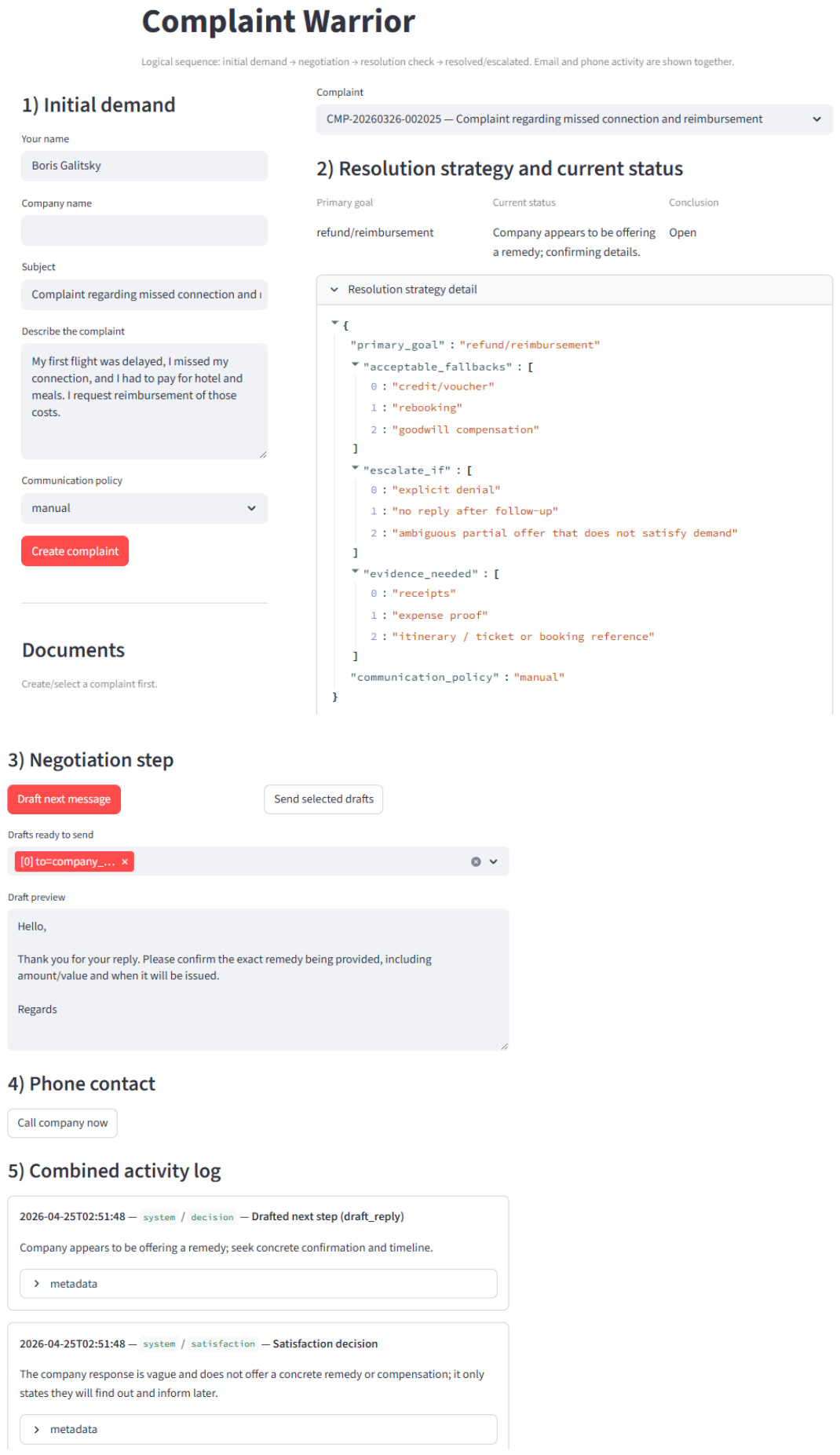
Figure 2.
System architecture.
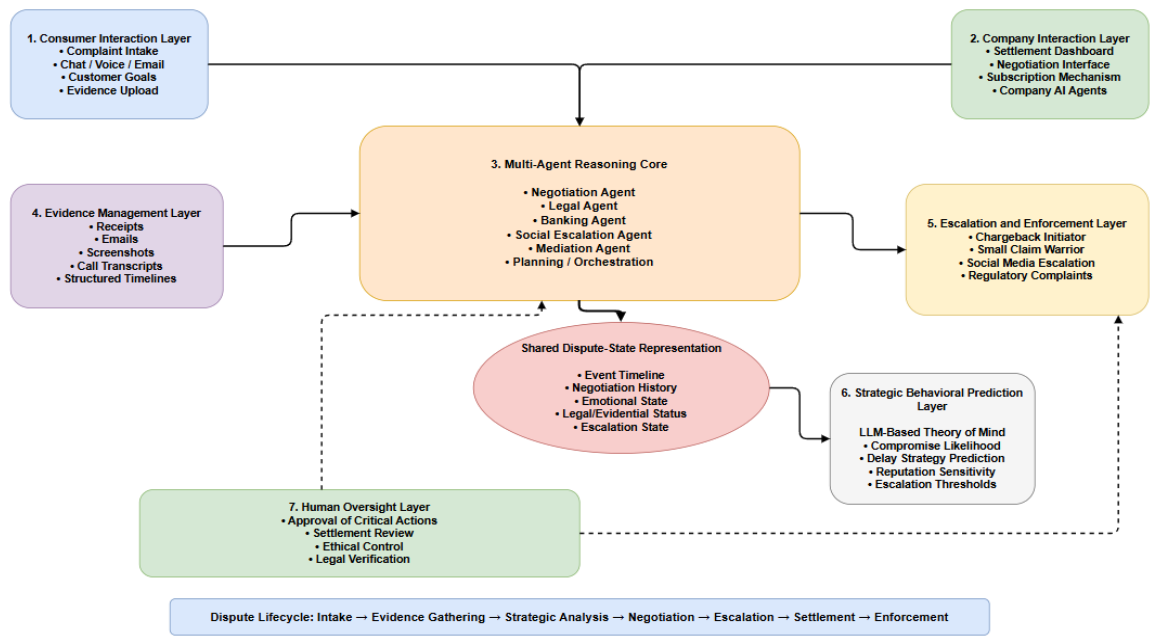
Figure 3.
Complaint Warrior consume workflow. The workflow transforms fragmented consumer complaints into persistent structured dispute representations supporting strategic negotiation, emotional adaptation, escalation management, and legal enforcement.
Figure 3.
Complaint Warrior consume workflow. The workflow transforms fragmented consumer complaints into persistent structured dispute representations supporting strategic negotiation, emotional adaptation, escalation management, and legal enforcement.
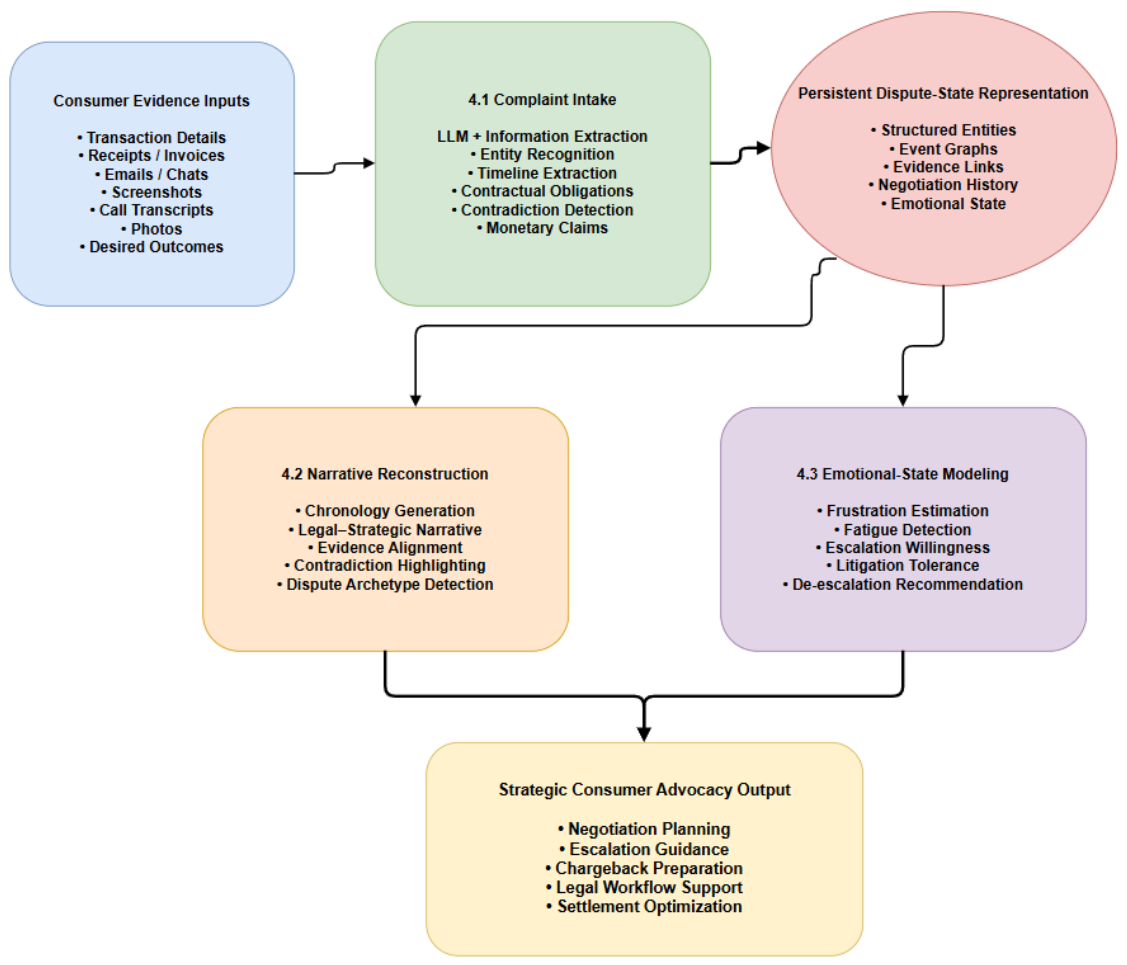
Figure 4.
Company workflow.
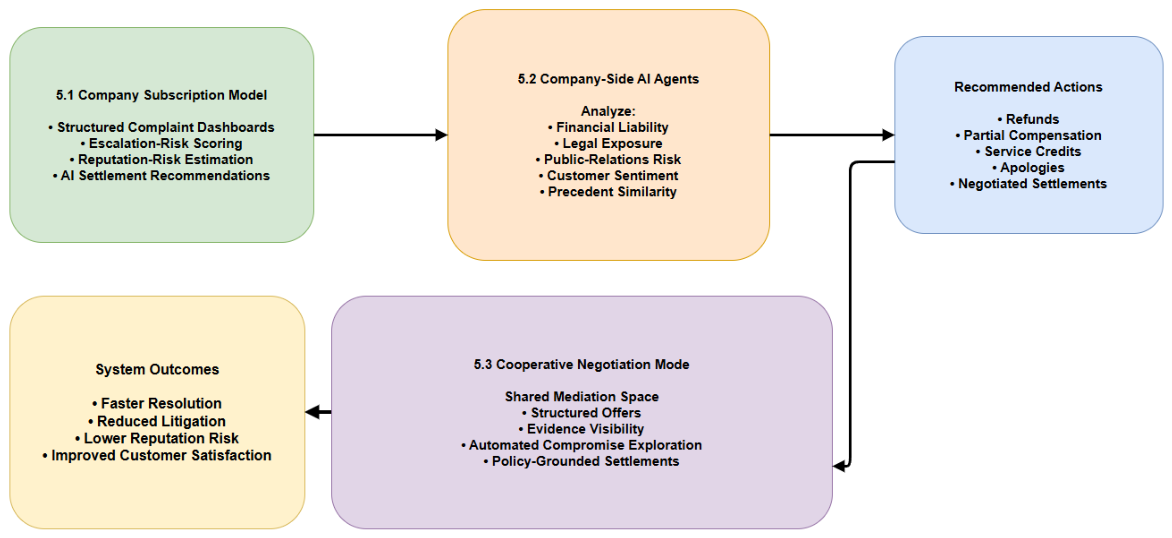
Figure 5.
UI for the automated posting agent.
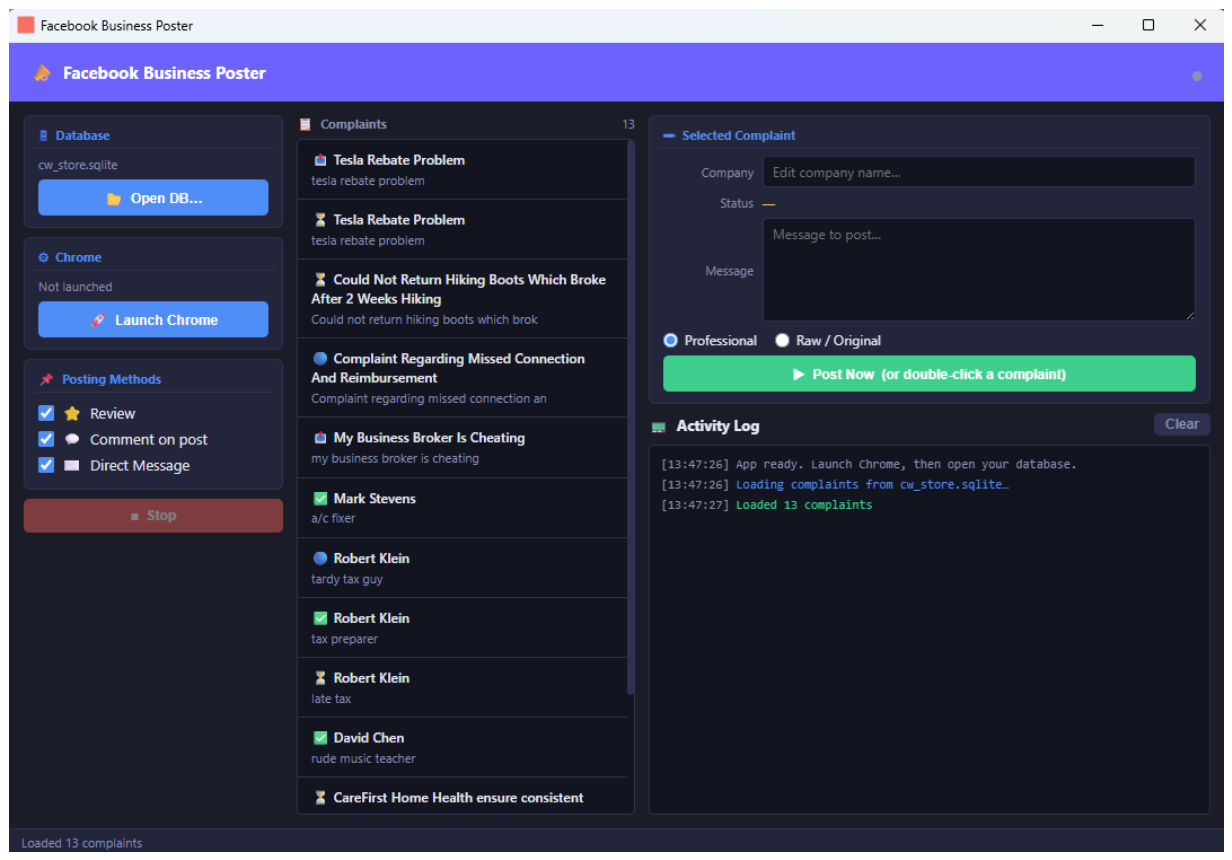
Figure 6.
Small claim court warrior.
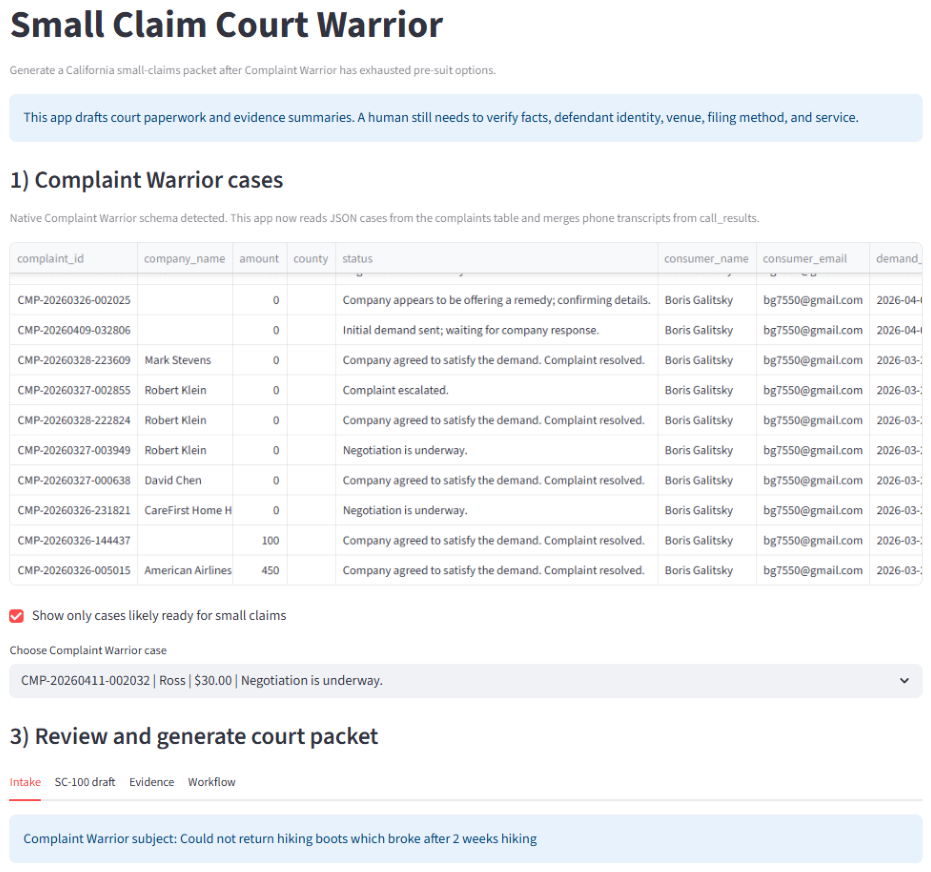
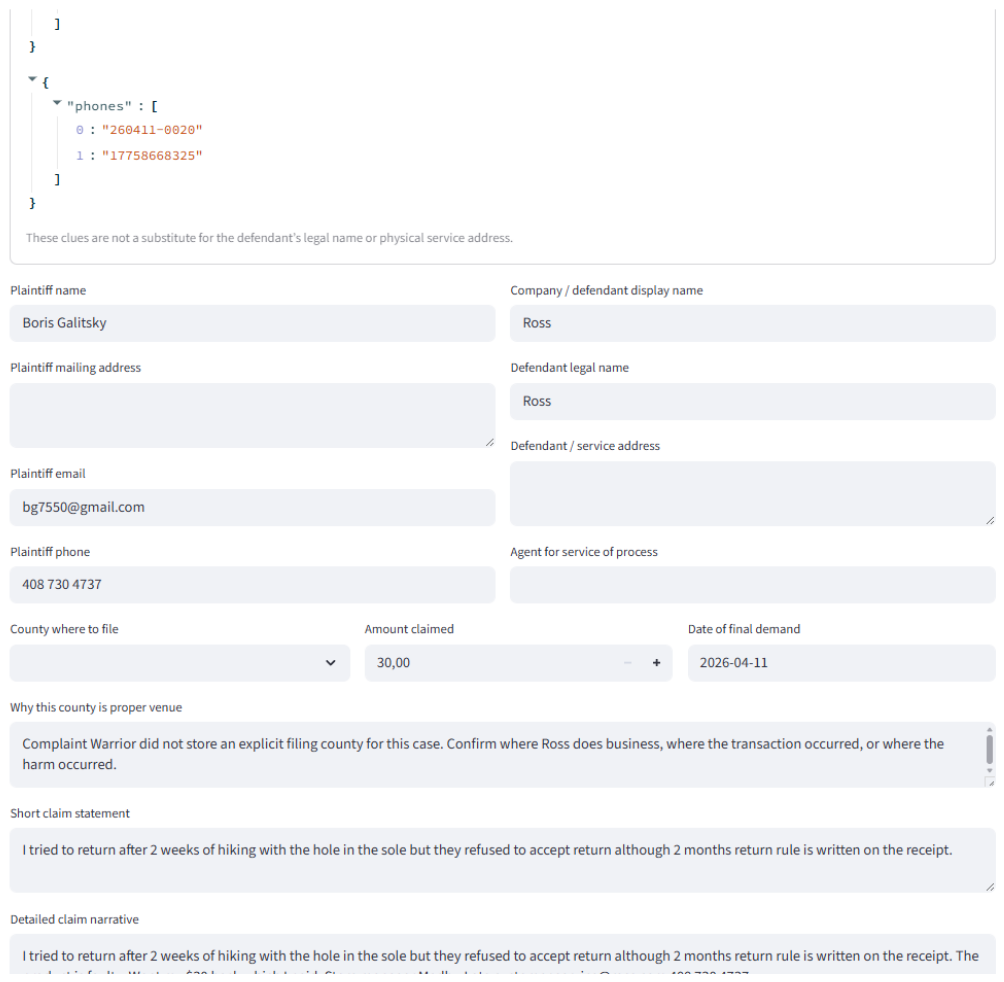
Figure 7.
Complaint Warrior Multi-Agent Architecture.
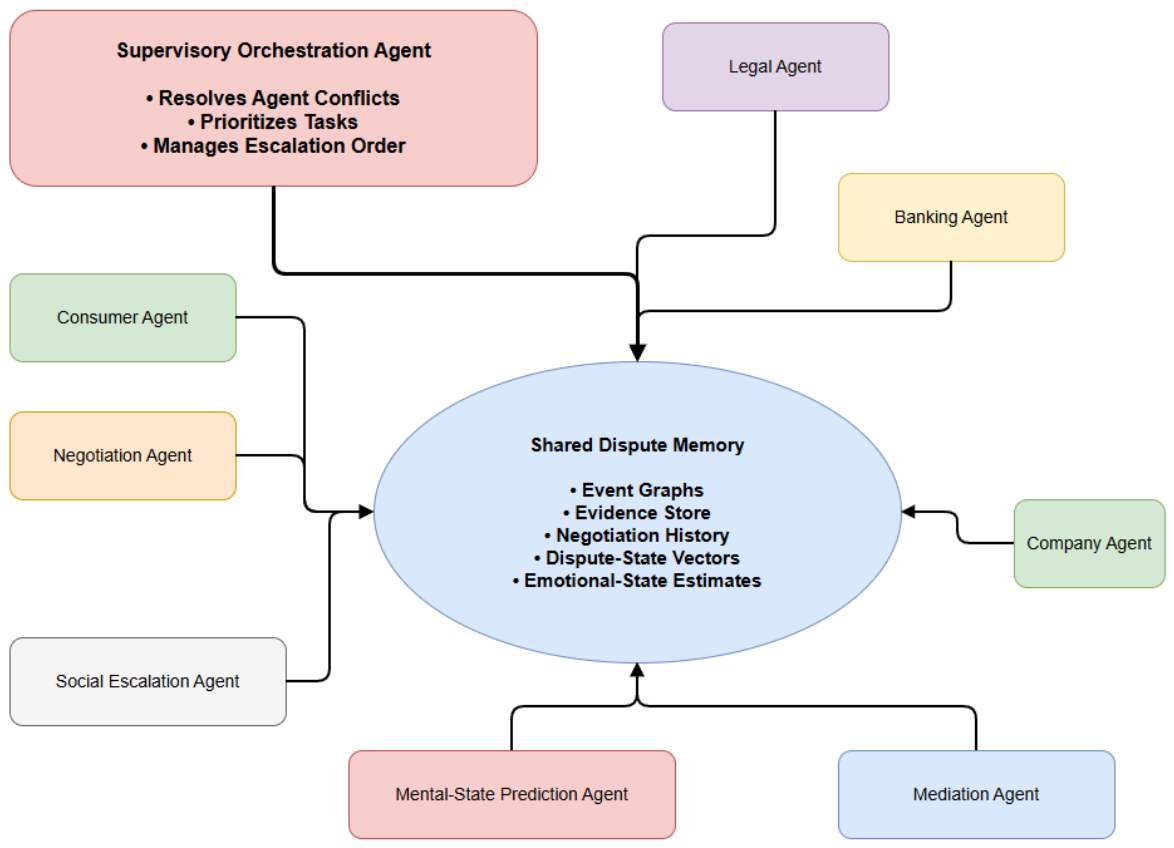
Figure 8.
Agent types.
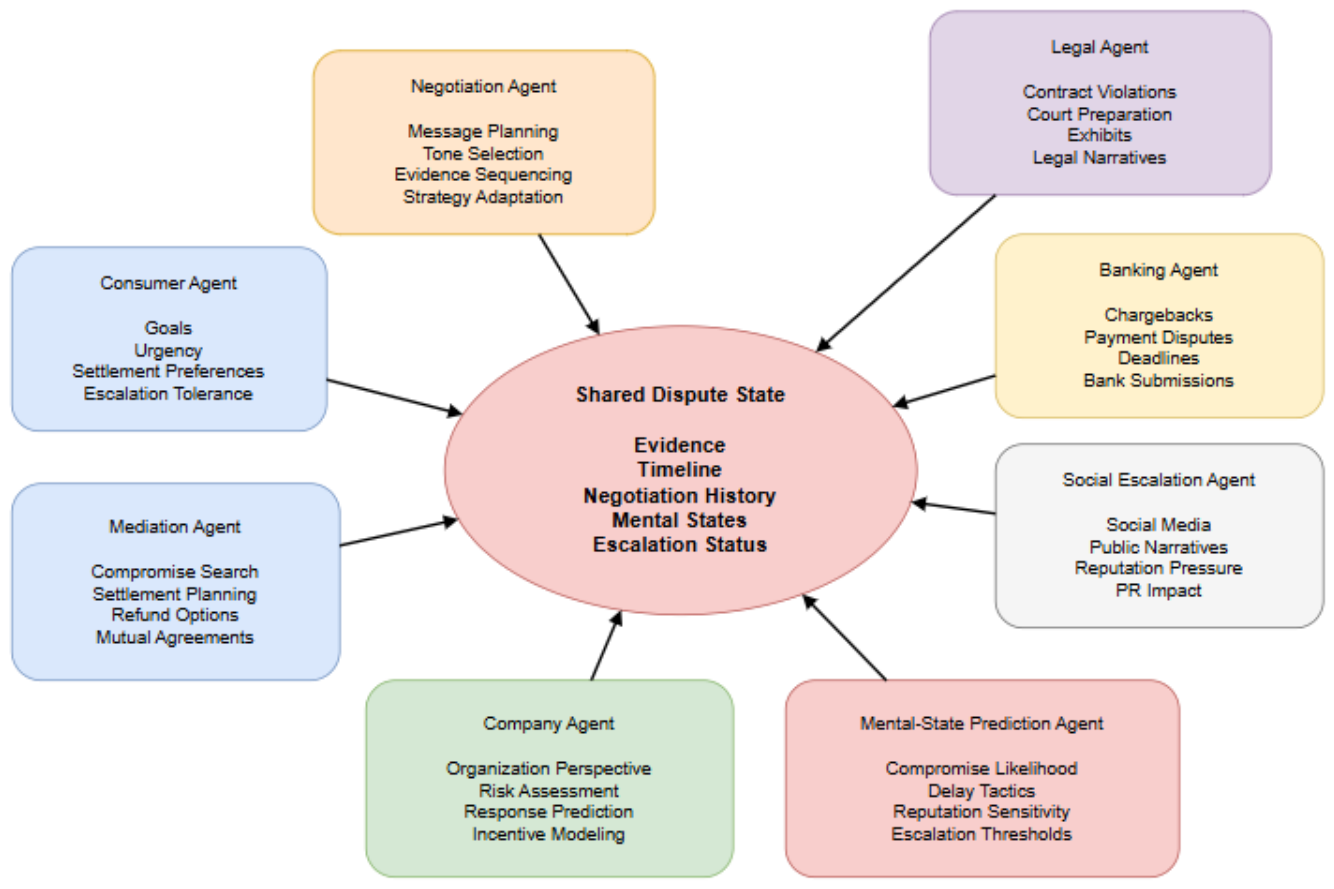
Figure 9.
Knowledge Representation chart.
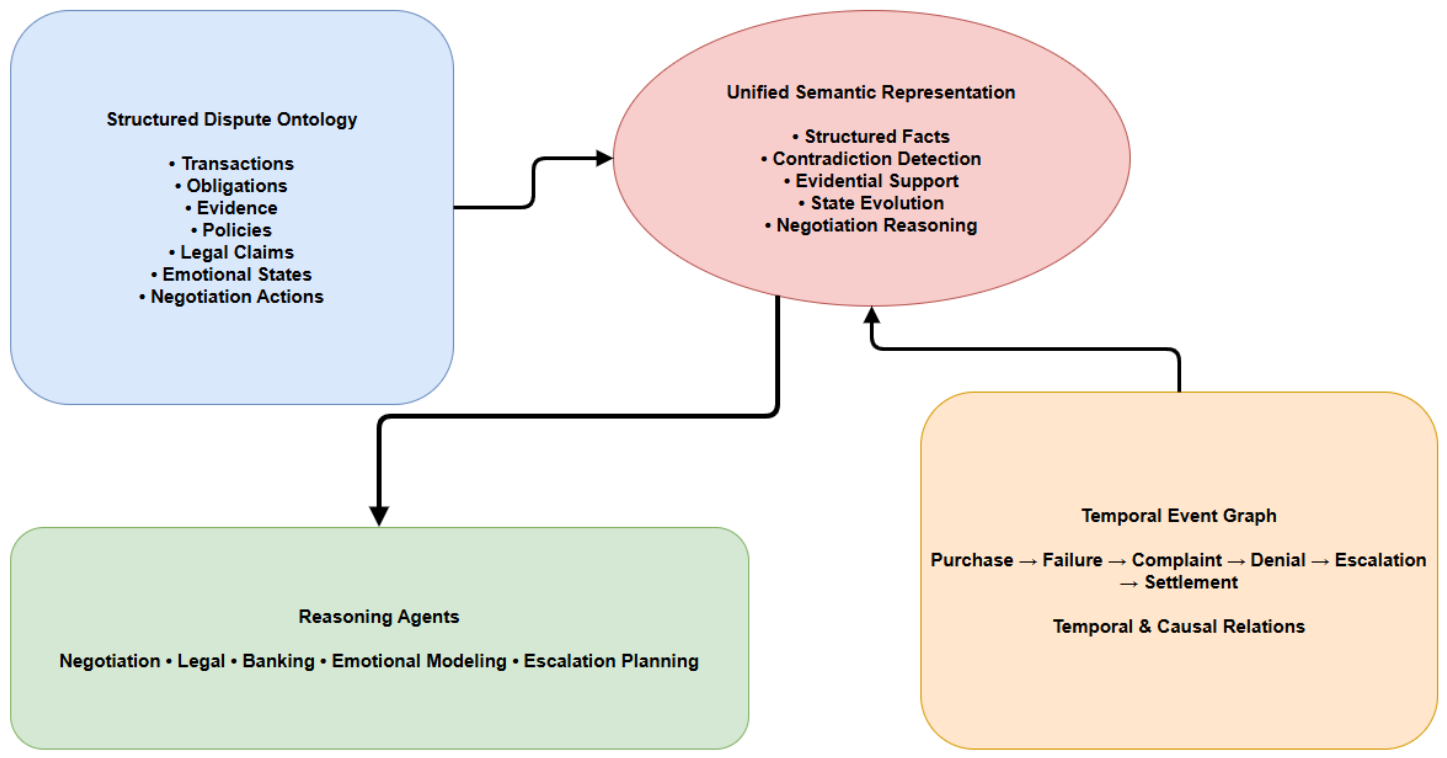

Table 1.
Evidence organization performance.
| Method | Evidence Coverage (%) | Missing Critical Evidence (%) | Time (min) |
|---|---|---|---|
| Manual | 71.4 | 22.1 | 32.8 |
| AI Drafting Only | 82.7 | 12.6 | 21.9 |
| Complaint Warrior | 95.2 | 3.8 | 9.4 |
Table 2.
Narrative quality evaluation.
| Criterion | Manual | AI Drafting | Complaint Warrior |
|---|---|---|---|
| Chronological clarity | 3.1 | 3.9 | 4.8 |
| Evidential linkage | 2.9 | 3.5 | 4.7 |
| Procedural completeness | 3.0 | 3.8 | 4.6 |
| Overall persuasiveness | 3.2 | 4.0 | 4.7 |
Table 3.
Human factors evaluation.
| Metric | Manual | AI Drafting | Complaint Warrior |
|---|---|---|---|
| NASA-TLX workload | 68.4 | 52.1 | 39.7 |
| Frustration score (1–5) | 4.3 | 3.6 | 2.4 |
| Confidence in outcome | 2.8 | 3.7 | 4.6 |
| Perceived support | 2.4 | 3.8 | 4.8 |
Table 4.
Mental-state prediction accuracy.
| Variable | Precision | Recall | F1 |
|---|---|---|---|
| Willingness to compromise | 0.81 | 0.78 | 0.79 |
| Escalation sensitivity | 0.84 | 0.80 | 0.82 |
| Delay tactics | 0.76 | 0.74 | 0.75 |
| Reputation sensitivity | 0.85 | 0.83 | 0.84 |
Table 5.
Negotiation outcomes.
| Method | Settlement Rate (%) | Avg. Resolution Time (days) |
|---|---|---|
| Manual | 46.2 | 24.7 |
| AI Drafting | 54.8 | 20.1 |
| Complaint Warrior | 71.5 | 11.8 |
Table 6.
Chargeback package quality.
| Metric | Manual | Complaint Warrior |
|---|---|---|
| Required evidence present (%) | 76.4 | 96.8 |
| Chronology completeness (%) | 69.7 | 95.4 |
| Reviewer quality score (1–5) | 3.2 | 4.7 |
Table 7.
Social escalation effectiveness.
| Strategy | Company Response Rate (%) | Avg. Response Time (days) |
|---|---|---|
| Consumer-written posts | 37.1 | 8.9 |
| Generic AI posts | 51.8 | 6.4 |
| Complaint Warrior narratives | 74.5 | 3.1 |
Table 8.
Court packet evaluation.
| Criterion | Manual | Complaint Warrior |
|---|---|---|
| Legal completeness | 3.3 | 4.8 |
| Evidence organization | 3.0 | 4.9 |
| Filing readiness | 3.2 | 4.7 |
| Hearing preparation quality | 3.1 | 4.6 |
Table 9.
HCI metrics.
| Metric (1–5) | Score |
|---|---|
| Trustworthiness | 4.36 |
| Explainability | 4.28 |
| Fairness | 4.41 |
| Satisfaction | 4.53 |
| Willingness to reuse | 4.61 |
| Recommendation likelihood | 4.58 |
Disclaimer/Publisher’s Note: The statements, opinions and data contained in all publications are solely those of the individual author(s) and contributor(s) and not of MDPI and/or the editor(s). MDPI and/or the editor(s) disclaim responsibility for any injury to people or property resulting from any ideas, methods, instructions or products referred to in the content. |
© 2026 by the author. Licensee MDPI, Basel, Switzerland. This article is an open access article distributed under the terms and conditions of the Creative Commons Attribution (CC BY) license.
Copyright: This open access article is published under a Creative Commons CC BY 4.0 license, which permit the free download, distribution, and reuse, provided that the author and preprint are cited in any reuse.


