
Submitted:
07 July 2026
Posted:
08 July 2026
You are already at the latest version
Abstract
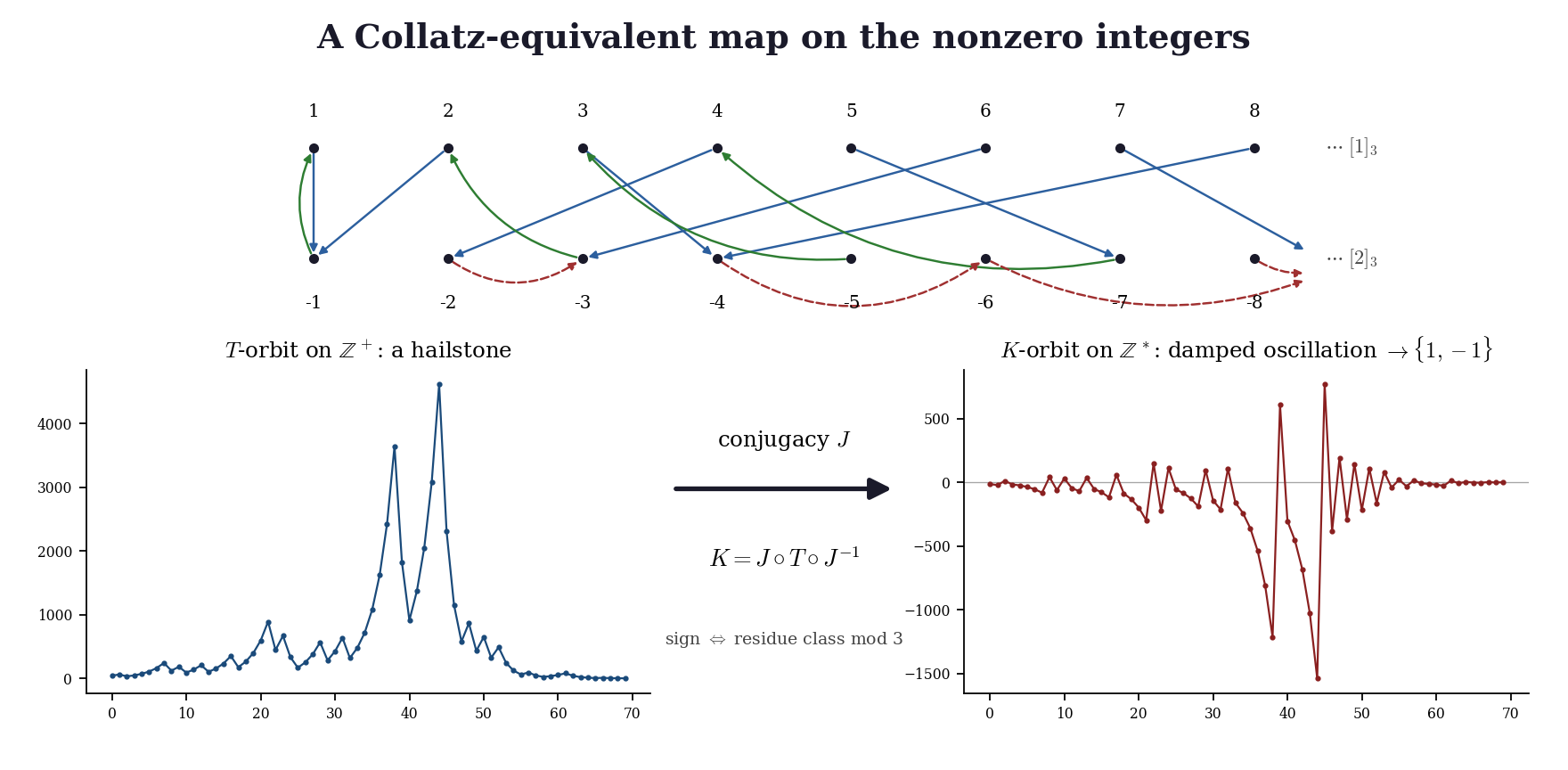
The graph of the accelerated Collatz map \( T \) carries structure that is irrelevant to the Collatz conjecture: one third of its vertices are multiples of three, which no orbit can revisit, and the negative integers cannot be used at all because \( T \) admits non-trivial cycles on them. We construct an explicit conjugacy \( J \) between the conjecture-relevant vertices \( {[}{1}{]}_{3}\cup{[}{2}{]}_{3} \) and the nonzero integers \( \mathbb{Z}{*} \), yielding a map \( {K}{\colon}\ \mathbb{Z}{*}\to \mathbb{Z}{*} \) whose graph is isomorphic to the pruned Collatz graph. The Collatz conjecture becomes the statement that every \( K \)-orbit reaches the two-cycle \( \{1,-1\} \); in these coordinates the sign of an iterate records its residue class modulo \( 3 \), so every nonzero integer indexes a conjecture-relevant vertex and no non-trivial cycles are introduced. We analyze the edge structure of the new graph, identify a spanning acyclic subgraph that is bipartite under the sign \( 2 \)-coloring, and introduce an accelerated map \( \hat{K} \) whose graph is bipartite outright and whose in-degree sequence is governed by the \( 3 \)-adic valuation \( {\nu} 3(2k-1) \), recovering OEIS A254046 with mean in-degree \( 3/2 \). Finally, we observe that \( K \)-orbits, plotted as signed time series, behave like damped seismic signals: they oscillate across zero with limiting sign-change frequency \( 2/3 \) while their envelope decays at the heuristic rate \( \lambda=\tfrac12\ln\tfrac43 \) per step, suggesting dynamical and spectral tools as instruments for studying Collatz dynamics. No proof of the conjecture is claimed; the aim is a coordinate system in which its dynamics are easier to see.
Keywords:
Collatz conjecture
; graph theory
; seismic graphs
; number theory
1. Introduction
Let denote the positive integers. The Collatz function is
Conjecture 1
(Collatz). For every the orbit eventually enters the cycle .
Since is even whenever n is odd, Terras [1] combined the odd step with the division that necessarily follows it, producing the accelerated (or reduced) map
for which the trivial cycle becomes . The conjecture for T is equivalent to Conjecture 1, and we work with T throughout. We write for the functional graph of T on : the directed graph with vertex set and an edge for every n. For the extensive literature on the problem see Lagarias [2,3].
Two features of limit how faithfully it represents the conjecture it encodes.
First, a third of its vertices are inert. No orbit can enter the multiples of three: as recalled in Section 3, an orbit that starts in leaves that residue class after finitely many steps and never returns, while an orbit that starts outside never visits it. Consequently the multiples of three are irrelevant to the existence of cycles or divergent orbits, yet they occupy one third of the vertex set of .
Second, the negative integers are unusable. Extending C or T to produces well-known non-trivial cycles, for instance
and the length-18 cycle through (equivalently, these are the known cycles of the problem on ; see [2]). The negative half of therefore cannot serve as extra room for encoding Collatz dynamics—at least not for the maps C and T themselves.
This paper addresses both limitations at once. We exhibit an explicit bijection J from the conjecture-relevant residue classes onto the nonzero integers , and we conjugate T by J to obtain a map ,
whose functional graph is isomorphic to the graph obtained from by pruning the multiples of three. Under this conjugacy:
- every nonzero integer indexes a conjecture-relevant vertex — the graph has no inert third;
- the sign of an iterate records its residue class: positive integers correspond to and negative integers to ;
- no new cycles appear — the Collatz conjecture is equivalent to the statement that every K-orbit reaches the two-cycle (Theorem 6).
The map K thus realizes, by construction, the property one might wish T had: a single map on all nonzero integers with (conjecturally) a single cycle.
The paper is organized as follows. Section 2 fixes notation and records how T permutes residue classes modulo 3. Section 3 formalizes the pruning of and proves that the pruned conjecture is equivalent to the original. Section 4 constructs J and K and proves the conjugacy. Section 5 decomposes the edges of , exhibits a spanning acyclic subgraph that is bipartite under the sign 2-coloring, and explains both why a rule-based 2-coloring of the full graph appears out of reach and why bipartiteness alone could not settle the conjecture. Section 6 introduces an accelerated map that contracts runs through negative even integers; its graph is bipartite outright, and its in-degree arithmetic connects to the OEIS sequences A254046, A191450, A087289 and A036561. Section 7 develops the dynamical reading that motivated the construction: K-orbits, plotted as signed time series, are damped irregular oscillations, quantitatively comparable to the decaying coda of a seismogram, and we propose this as a framework for importing tools from the theory of random dynamical systems and signal processing. Section 8 concludes. Closed forms and reference implementations of K appear in Appendix A.
We emphasize the scope of the contribution: no progress on the truth of Conjecture 1 is claimed. The contribution is a pair of equivalent reformulations—one on , one back on via acceleration—together with structural results about their graphs, intended as a more transparent coordinate system for future investigations.
2. Preliminaries: The Action of T on Residue Classes Mod 3
Notation 2.
, , and . For integers with we write ; thus partition . We write for the p-adic valuation of (the exponent of the prime p in n), and for the t-fold iterate of a map f. Theorbitof n under f is the sequence .
Splitting each residue class modulo 3 by parity gives the six classes modulo 6, on which the action of T is completely described by the following computation.
Lemma 1
(Residue transitions). Writing each class of modulo 6 as (omitting when , the map T acts as follows:
In particular if and only if , and .
| class | parity | image of | image class |
| even | |||
| odd | |||
| even | (onto) | ||
| odd | |||
| even | (onto) | ||
| odd |
Proof.
Direct computation from (2). For example, if then n is odd and ; the other five cases are identical in kind. □
Figure 1.
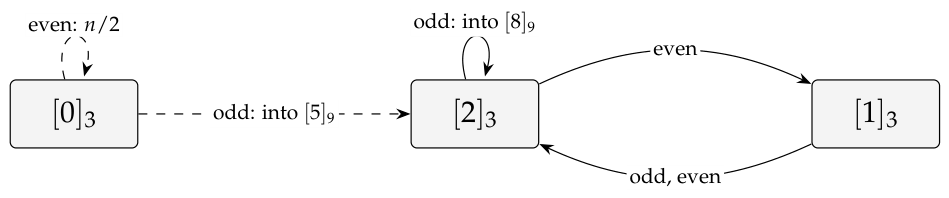
The action of T on residue classes modulo 3 (Lemma 1). Dashed arrows involve , which no orbit can enter from outside; solid arrows form the conjecture-relevant part of the dynamics.
Figure 1.
The action of T on residue classes modulo 3 (Lemma 1). Dashed arrows involve , which no orbit can enter from outside; solid arrows form the conjecture-relevant part of the dynamics.
3. Pruning the Multiples of Three
That multiples of three form a transient, inert part of the Collatz graph is folklore; we record the statements we need in a form suited to the conjugacy of Section 4.
Lemma 2.
Let and consider the T-orbit of n.
- 1.
- If , the orbit never visits .
- 2.
- If , the orbit consists of an initial segment inside of finite length at most , after which it enters and remains there forever.
Proof. (1) By Lemma 1, the only class mapping into is . (2) While the orbit stays in , each element is either even—in which case T halves it, strictly decreasing its 2-adic valuation—or odd, in which case Lemma 1 sends it into . An odd multiple of 3 is reached after at most halvings, so the orbit leaves after at most steps, and by (1) it never returns. □
Definition 1.
For a directed graph G with vertex set , let be the graph obtained by deleting the vertices in together with all incident edges. Write . Equivalently, is the functional graph of the restriction , which is well defined by Lemma 1.
Conjecture 3.
For every , the T-orbit of n reaches the cycle .
Theorem 4.
Conjecture 3 is equivalent to the Collatz conjecture.
Proof.
Conjecture 1 (for T) trivially implies Conjecture 3. Conversely, assume Conjecture 3 and let . If we are done. If , then by Lemma 2 its orbit reaches some in finitely many steps, and the orbit of m reaches by assumption. Hence every T-orbit reaches ; cycles and divergent orbits of T, if any, must therefore live entirely inside . □
Thus is exactly the part of the Collatz graph in which cycles or divergent orbits can reside: it retains all of the difficulty of the conjecture while shedding one third of the vertex set.
4. The Conjugated Map K on the Nonzero Integers
The two classes and are each countable, and we now put them in explicit bijection with and respectively.
Definition 2.
Define and its inverse by
Thus J sends to and to ; it is a bijection with the stated inverse by direct computation.
Theorem 5
(Conjugacy). Let be defined by (3). Then
Consequently the functional graph of K on is isomorphic to , via the vertex bijection J.
Proof.
We verify the four cases of (3).
Case odd. Write . Then is odd, so by Lemma 1, and .
Case even. Write . Then is even, , and .
Case odd. Write , . Then is even, , and .
Case even. Write , . Then is odd, , and .
In each case agrees with (3). Since J is a bijection intertwining the two maps, it carries edges of to edges of bijectively. □
Remark 1.
Restricted to positive inputs, (3) reads , where for m odd and for m even is the accelerated map. This is consistent with the classical observation that the problem on is the problem on [2]: in K-coordinates the sign flip that accompanies each application of U is precisely what prevents the known cycles from closing up, threading positive and negative integers into a single system with (conjecturally) one cycle.
Theorem 6
(Equivalent conjecture). The following statement is equivalent to the Collatz conjecture: for every , the K-orbit of n reaches the two-cycle .
Proof.
By Theorem 5, J conjugates T on with K on , and . Hence every K-orbit reaches if and only if every T-orbit in reaches , which is Conjecture 3, which is equivalent to the Collatz conjecture by Theorem 4. □
Figure 2.
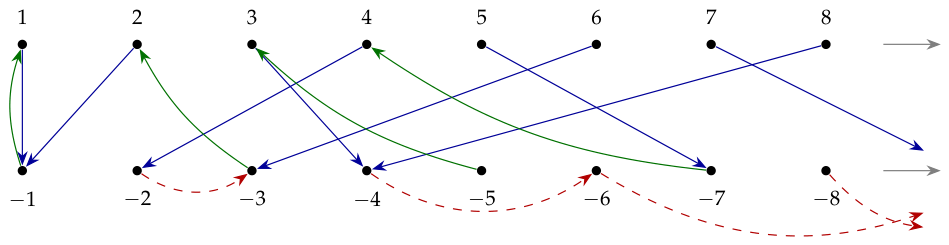
The graph for , drawn on two parallel rays. Blue edges (): every positive integer maps to a negative one. Green edges (): odd negative integers map back to positive ones. Dashed red edges (): even negative integers map to negative multiples of 3. If the two rays are pictured as the eyelets of a shoe, the Collatz conjecture states that a lace threaded forward from any eyelet reaches the eyelet labeled 1.
Figure 2.
The graph for , drawn on two parallel rays. Blue edges (): every positive integer maps to a negative one. Green edges (): odd negative integers map back to positive ones. Dashed red edges (): even negative integers map to negative multiples of 3. If the two rays are pictured as the eyelets of a shoe, the Collatz conjecture states that a lace threaded forward from any eyelet reaches the eyelet labeled 1.
Example 7.
Iterating K from 20:
Applying termwise recovers the T-orbit of :
Example 8.
Remark 2.
The apparent complexity of (3)—four branches instead of two—is the price of folding two residue classes into one signed line. What is bought: has the same vertex set as the conjecture-relevant subgraph of , but that vertex set is now all of , with the residue-class information carried by the sign rather than hidden in the vertex labels. Membership of an iterate in or —invisible in a plot of a T-orbit—is immediately legible in a plot of a K-orbit.
Figure 3.
The graph for . The red intra-negative edges of Figure 2 are replaced by dashed violet edges from negative even integers directly to positive integers (e.g. ; every edge now crosses between the rays, so the sign coloring is proper.
Figure 3.
The graph for . The red intra-negative edges of Figure 2 are replaced by dashed violet edges from negative even integers directly to positive integers (e.g. ; every edge now crosses between the rays, so the sign coloring is proper.
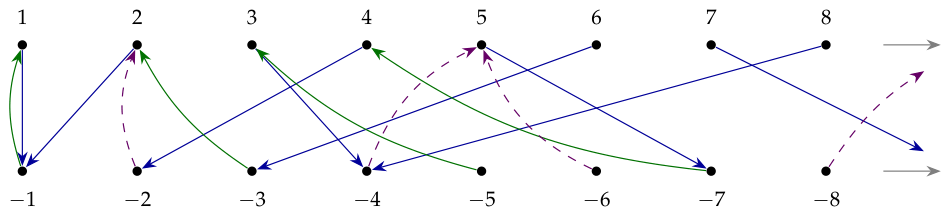
Figure 4.
The T-orbit of 41: the classical hailstone picture. Residue-class information is invisible.
Figure 4.
The T-orbit of 41: the classical hailstone picture. Residue-class information is invisible.
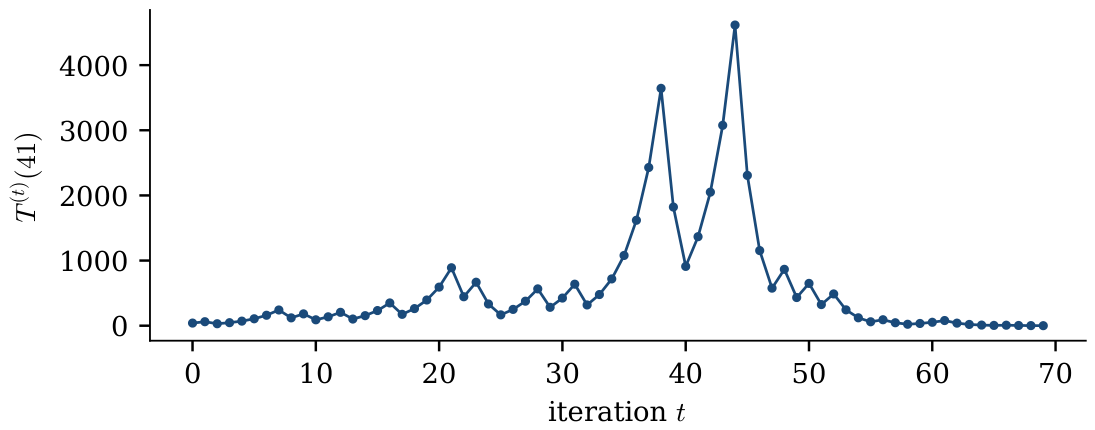
Figure 5.
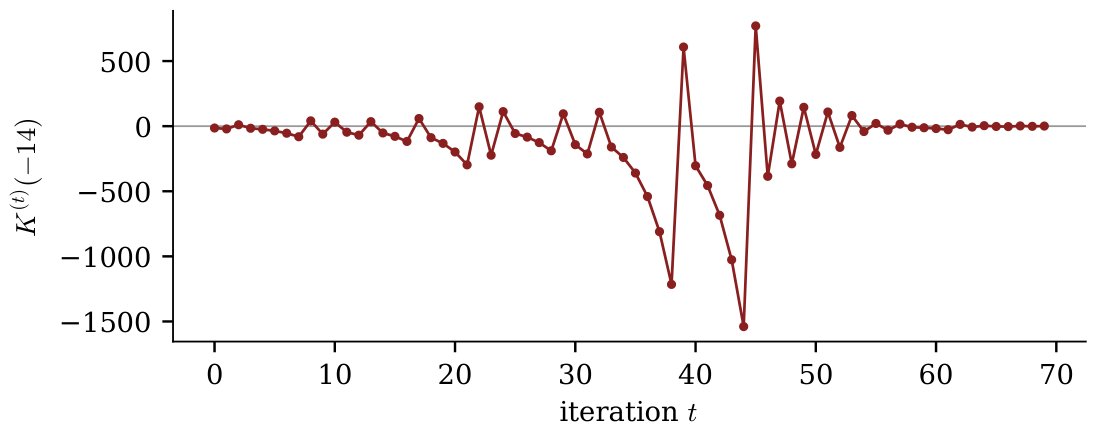
The same orbit in K-coordinates (the K-orbit of ). Sign changes mark transitions between (positive) and (negative); the orbit is a damped irregular oscillation terminating in the ambient two-cycle .
Figure 5.
The same orbit in K-coordinates (the K-orbit of ). Sign changes mark transitions between (positive) and (negative); the orbit is a damped irregular oscillation terminating in the ambient two-cycle .
5. Edge Decomposition and Two-Colorings
Definition 3.
Proposition 1.
is bipartite: the 2-coloring (“blue if positive, red if negative”) is proper. In particular contains no odd cycle.
Proof.
Every edge of goes from a positive to a negative vertex and every edge of from a negative to a positive vertex, so no edge joins two vertices of the same sign. A cycle in a bipartite graph alternates sides and hence has even length. □
The subgraph is not merely bipartite; removing destroys every potential non-trivial cycle and divergent orbit. The proof uses a classical style of minimum-element argument, phrased here in T-coordinates where magnitudes are natural. Note first that under J, the odd elements of —that is, —correspond exactly to the negative even integers, so is the image of the edges of emanating from .
Lemma 3.
Suppose the T-orbit of some is a non-trivial cycle or is divergent, and let , since orbits meeting enter the trivial cycle). Then n is odd, is odd, and ; moreover if we may take the element of to be n itself. In particular visits within two steps of its minimum.
Proof.
If n were even, would contradict minimality; so n is odd and . If m were even, then , again contradicting minimality; so m is odd. Since n is odd and not a multiple of 3, either (and we are done), or . In the latter case write ; then , and m odd forces x odd, say , giving . □
Theorem 9.
In every negative even vertex is a sink, every orbit either terminates at a negative even vertex or reaches the cycle , and is the unique cycle. In particular has no divergent orbits and no non-trivial cycles.
Proof.
Negative even vertices lose their unique outgoing edge (which belonged to ), so they are sinks. Suppose some orbit of were a non-trivial cycle or divergent. Then it would avoid all sinks, hence avoid negative even vertices entirely, hence be a non-trivial cycle or divergent orbit of K itself avoiding the negative evens. Its image under would be a non-trivial cycle or divergent T-orbit avoiding . But by Lemma 3 any such orbit visits —a contradiction. □
Remark 3
(Why a rule-based 2-coloring of is elusive, and what it would be worth). Restoring breaks the sign coloring: joins negative vertices to negative vertices. Assuming the Collatz conjecture, is a tree together with the 2-cycle attached at its root, and trees are bipartite; so conjecturally a proper 2-coloring of exists. The natural way to produce one is to walk the tree from the root, alternating colors level by level—but the levels of the Collatz tree are precisely the orbit lengths whose behavior is the content of the conjecture, so this is circular. A closed-form coloring rule (one computable from the residue data of n alone, without iterating) would be a structural statement about all of at once. We record the modest and the honest version of this observation:
- 1.
- Bipartiteness of would rule out non-trivial cycles of odd length only; bipartite graphs admit even cycles, so a 2-coloring cannot by itself prove the conjecture.
- 2.
- Conversely, exhibiting an odd cycle in would disprove the Collatz conjecture.
Conjecture 10.
is bipartite. (Implied by, and strictly weaker than, the Collatz conjecture.)
6. The Accelerated Map and the Arithmetic of Parents
The obstruction to the sign coloring is the edge set : runs of the orbit through negative even integers. These runs are completely understood, and contracting them yields a map whose graph is bipartite outright.
Lemma 4.
Let be even and let . Then
which is a negative odd multiple of 3 with , and
Proof.
For negative even m, satisfies and . Iterating times multiplies by and exhausts the 2-adic valuation, leaving a negative odd number with . One further application of the negative-odd branch gives . □
The intermediate quantity is not injective in n (for example both and reach ) nor monotone (compare with ); the runs through negative evens carry genuine arithmetic, which the following map contracts.
Definition 4.
Define by
i.e. agrees with K except that from a negative even integer it jumps directly to the positive integer that K reaches after steps (Lemma 4). Write for its functional graph.
Proposition 2.
contains a non-trivial cycle if and only if does, and a divergent orbit if and only if does. Consequently the Collatz conjecture is also equivalent to: every -orbit reaches .
Proof.
Every -orbit is obtained from the corresponding K-orbit by deleting the interior of each maximal run through negative even integers; each such run is finite (of length , Lemma 4). Deleting finitely many consecutive elements between fixed endpoints neither creates nor destroys eventual periodicity or divergence, and the trivial cycles correspond. □
Theorem 11.
Consecutive -iterates have opposite signs. Hence is bipartite under the sign coloring, and every cycle of has even length.
Proof.
By (3), maps positive integers to negative ones and odd negative integers to positive ones; by Definition 4 it maps even negative integers to positive ones. So every step changes sign. □
Corollary 1.
In any hypothetical non-trivial cycle of T (within , the number of elements congruent to 5 modulo 6 has the same parity as the length of the cycle.
Proof.
Transport the cycle to by J; elements of correspond to negative even integers. Contracting the negative-even runs yields a cycle of , whose length—the original length minus the number of negative even elements—is even by Theorem 11. □
6.1. Parents and In-degrees
Because is a function, the preimage sets , , partition ; the arithmetic of these sets turns out to be governed by the 3-adic valuation of .
Proposition 3
(Parent formula). Let . The preimages of k under are:
- 1.
- the odd negative integer , always; and
- 2.
-
the even negative integerswhich is nonempty precisely when .
Hence the in-degree of k in is .
Proof.
A negative odd m satisfies iff . A negative even n with satisfies iff , i.e. . This is an integer of 2-adic valuation exactly iff (the cofactor is automatically odd), giving one parent for each . Finally iff iff . □
Example 12.
(since ; (since ; (since . Adding the odd parents , , respectively gives in-degrees 3, 4, 6.
Proposition 4
Proof.
, so by Proposition 3. For the second equality, the lifting the exponent lemma applies to since and is odd: . The first 41 values, , match A254046. □
Proposition 5
(Mean number of even parents). The average of over exists and equals
Proof.
, and for each j the set is an arithmetic progression of density . Summing the (dominated) series gives . (Numerically, the average over is .) □
Remark 4.
The extremal vertices are transparent: has and hence in-degree , the maximum possible for its size. Its even parents , read together with the odd parent , form a row of the Nicomachus triangle (A036561 [10]) up to sign: the contracted negative-even runs interpolate geometrically between a power of 2 and a power of 3. For example has parents .
Remark 5
(Growth bound). Lemma 4 bounds the single-step growth of : for negative even n, , so large jumps require large 2-adic valuation—e.g. jumps to . All other branches contract or grow by a factor at most . In the “hailstone” surges of the classical map are thus exactly indexed by the 2-adic valuations along the orbit.
7. K-Orbits as Damped Oscillations: A Seismic Reading
We now develop the dynamical picture that motivated the construction. Everything in this section is either elementary, empirical, or explicitly heuristic; its purpose is to make precise an analogy that we believe is a productive lens, and to state the questions it suggests.
7.1. What a K-Orbit Looks Like
A T-orbit, plotted against iteration count, is the familiar “hailstone” picture: an erratic positive series of surges and crashes (Figure 4). The same orbit transported to K-coordinates (Figure 5) is qualitatively different: it oscillates across zero—because, by Theorem 5, crossing zero is exactly transitioning between the residue classes and —while its amplitude decays, in fits and starts, toward the sustained terminal oscillation .
Three quantitative statements attach to this picture.
Proposition 6
(Oscillation frequency). Along any K-orbit, a step preserves the sign if and only if n is negative and even. Under the standard stochastic heuristic [4], in which each iterate is odd or even with probability independently of its sign, the three branch types—positive input, negative odd input, negative even input—form a Markov chain with transition rule
whose stationary distribution is uniform, . The heuristic limiting frequency of sign-changing steps is therefore . Empirically, over orbits started from uniform random seeds below , of steps changed sign. Under the frequency is exactly 1: every step changes sign (Theorem 11).
Justification.
The first sentence is immediate from (3): the branches for positive input have negative values, the negative-odd branch has positive value, and only the negative-even branch preserves the sign. Solving for the displayed chain gives , and sign-preserving steps occur exactly in state . □
Remark 6
(Amplitude drift). The magnitude multipliers of the four branches of (3) are asymptotically (top to bottom). Under the classical stochastic model of Collatz dynamics [4], in which halving and tripling-halving steps occur independently with probability , the expected increment of per step is
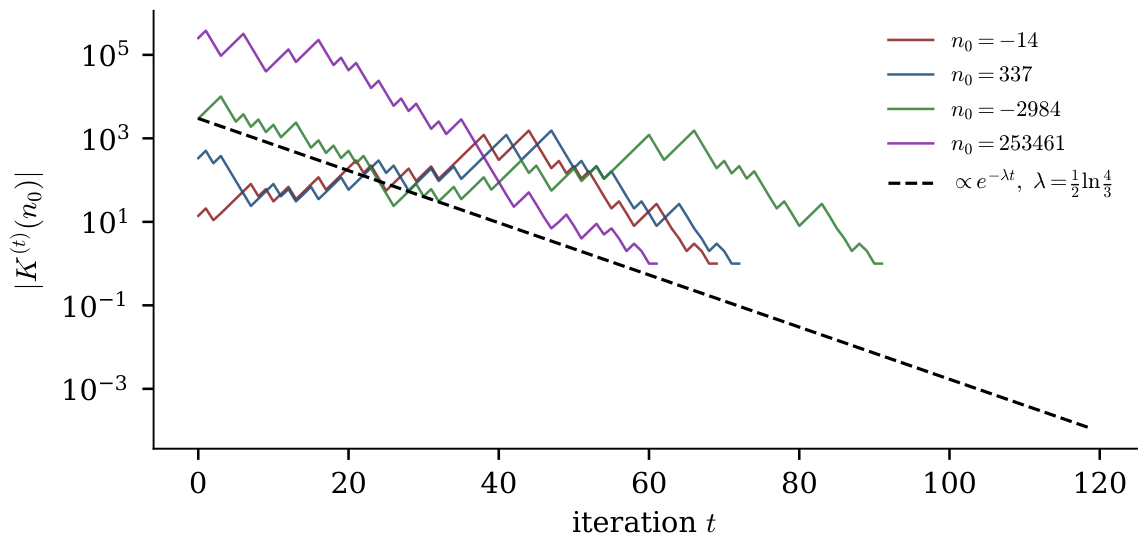
the same drift as for T (conjugation by J distorts magnitudes only by the bounded factor ). Empirically, over the same random orbits, the mean increment of per K-step was , in reasonable agreement (the discrepancy reflects conditioning on orbits that terminate and the non-equilibrium initial segment). Figure 6 shows on a logarithmic scale for several seeds against the envelope .
7.2. The Seismic Analogy, Stated Carefully
A seismogram of a large earthquake shows a sudden excitation followed by an oscillatory coda whose envelope decays essentially exponentially, , where Q is the coda quality factor [6], until the trace subsides into ambient microseismic oscillation. A K-orbit exhibits the same morphology, with a dictionary:
| seismogram | -orbit |
| excitation (event) | choice of seed |
| oscillation about equilibrium | sign changes = transitions |
| coda envelope | envelope , (heuristic) |
| irregular waveform | 2-adic surges (Remark 5) |
| ambient noise floor | trivial cycle |
| a trace that never subsides | a divergent orbit (conjecturally none) |
| a self-sustaining resonance | a non-trivial cycle (conjecturally none) |
In this language the Collatz conjecture reads: every excitation decays to the ambient oscillation—the system is universally damped, admitting neither resonances (non-trivial cycles) nor unbounded responses (divergent orbits). We stress that this is an analogy, not a mechanism: nothing physical underlies it, and by itself it proves nothing. Its value is that it is quantitatively faithful—the oscillation is real (Proposition 6), the exponential envelope is real in the almost-everywhere sense made rigorous by Tao’s result that almost all orbits attain almost bounded values [5]—and that it suggests importing the analytical apparatus attached to damped oscillatory signals. The hailstone metaphor, by contrast, suggests no apparatus at all: hailstones fall once.
7.3. Questions This Framing Makes Natural
- 1.
- Spectral statistics. The sign sequence is a deterministic binary signal with empirical switch rate . Do its autocorrelations, or the power spectrum of the normalized signal , distinguish Collatz dynamics from the i.i.d. branch model of [4]? Any provable spectral gap statement would constrain cycle structure.
- 2.
- Decay-rate concentration. Tao [5] gives almost-everywhere decay along T-orbits. In K-coordinates decay is envelope decay of an oscillation; can one prove concentration of the empirical decay rate around on a set of seeds of full density, sharpening the qualitative a.e. statement into a “coda Q” with error bars?
- 3.
- Resonance exclusion. In signal terms a non-trivial cycle is a periodic orbit whose geometric mean branch multiplier is exactly 1. The cycle-parity constraint of Corollary 1 and the in-degree arithmetic of Proposition 3 are constraints on how such a resonance could thread the two rays of Figure 2; systematic study of which even-length sign patterns admit integer solutions may be tractable precisely because the sign pattern is now part of the data.
- 4.
- Random dynamical systems. alternates deterministically between the rays (Theorem 11), so its second iterate is a self-map of whose fluctuations are governed by the pair bookkeeping of Lemma 4. Modeling as a random dynamical system with explicit multiplier distribution (Proposition 5 supplies the parent-side law) is, we suggest, the natural home for the damping heuristic.
8. Conclusion
We have constructed an explicit conjugacy carrying the conjecture-relevant part of the Collatz graph onto the full set of nonzero integers, and shown that the resulting map K—and its bipartite acceleration —satisfy Collatz-equivalent conjectures (Theorem 6, Proposition 2) while eliminating the two representational defects of the classical formulations: the inert third of the vertex set, and the unusable negative integers. The reformulation is conservative—every theorem about transports to a theorem about and conversely—but not cosmetic: residue transitions become sign changes, hailstone surges become 2-adic excursions with an explicit growth law, parent multiplicities become the 3-adic valuation with mean , and the conjecture itself becomes a damping statement about an oscillatory signal, with a heuristic decay rate that measured orbits track closely. We do not expect these coordinates to make the conjecture easy; we do suggest they make some of its structure—particularly the interplay between the 2-adic and 3-adic bookkeeping and the two-ray geometry of Figure 2—easier to see, and we offer the questions of Section 7 as concrete starting points.
Appendix A Closed Forms and Reference Implementations
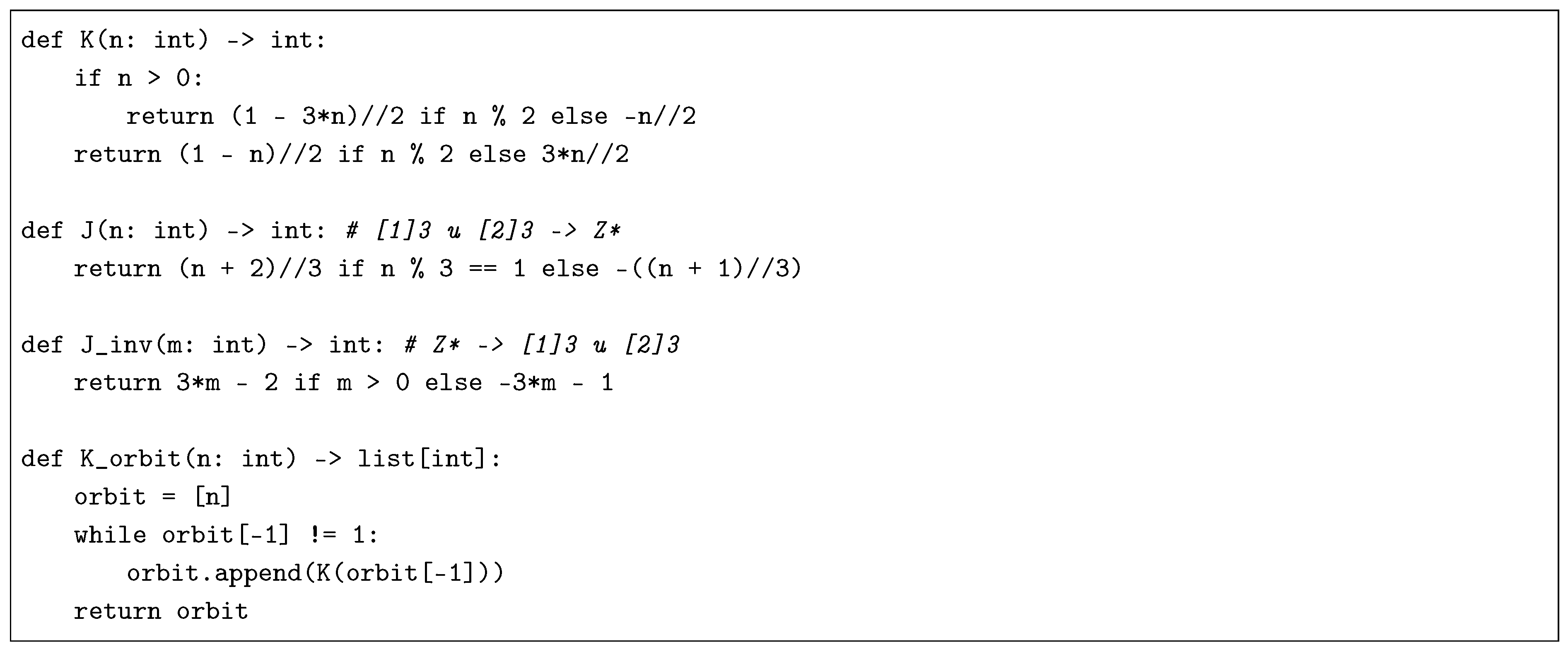
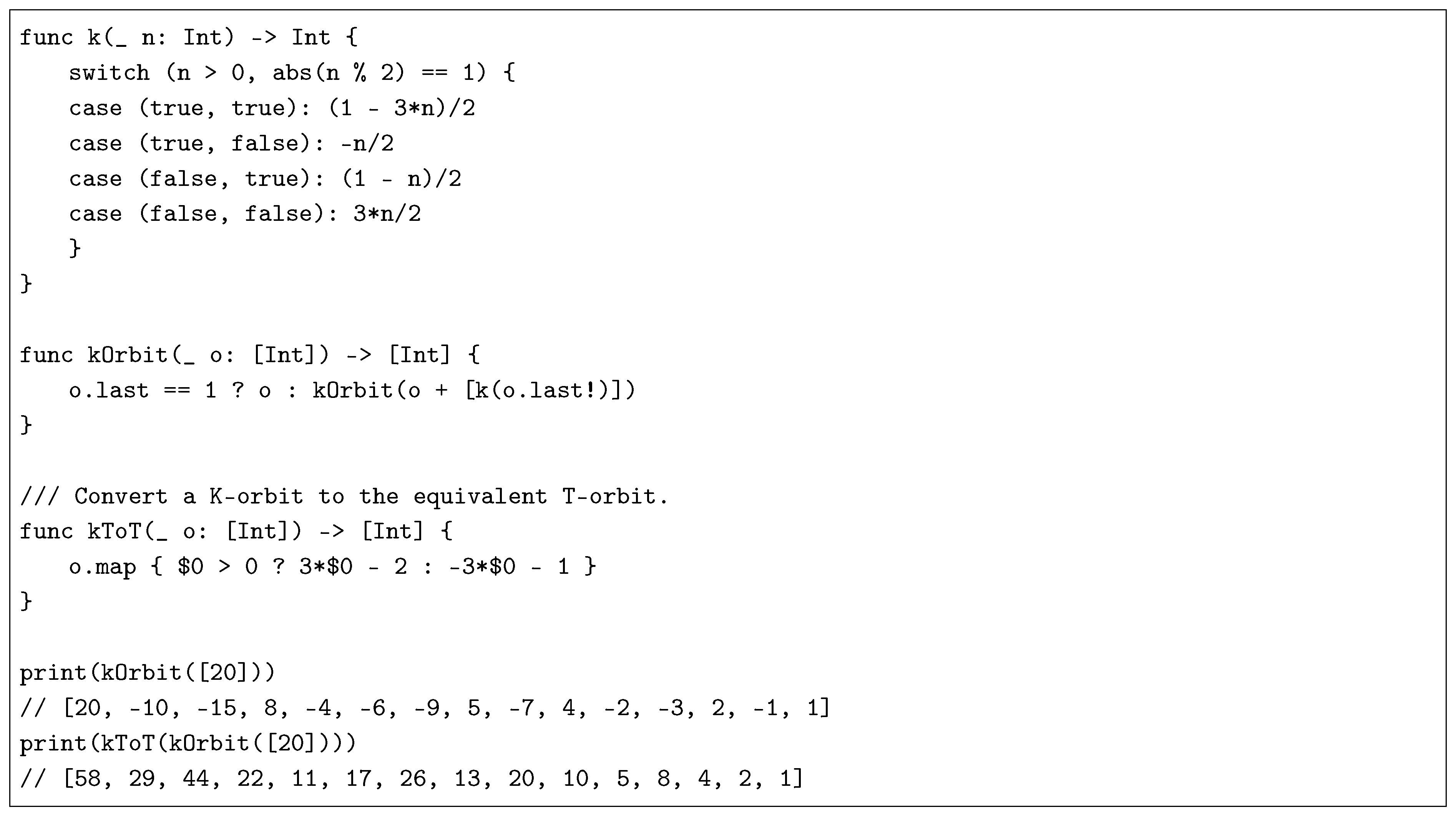
The four-branch definition (3) can be written as the single expression
where is the parity indicator.
Python
Mathematica

Swift
References
- Terras, R. A stopping time problem on the positive integers. Acta Arith. 1976, 30, 241–252. [Google Scholar] [CrossRef]
- Lagarias, J. C. The 3x+1 problem and its generalizations. Amer. Math. Mon. 1985, 92, 3–23. [Google Scholar] [CrossRef]
- Lagarias, J. C. (Ed.) The Ultimate Challenge: The 3x+1 Problem; American Mathematical Society: Providence, RI, 2010. [Google Scholar]
- Kontorovich, A. V.; Lagarias, J. C. Stochastic models for the 3x+1 and 5x+1 problems and related problems. In The Ultimate Challenge: The 3x+1 Problem; Lagarias, J. C., Ed.; AMS, 2010; pp. 131–188. [Google Scholar]
- Tao, T. Almost all orbits of the Collatz map attain almost bounded values. Forum Math. Pi 2022, 10, e12. [Google Scholar] [CrossRef]
- Aki, K.; Richards, P. G. Quantitative Seismology, 2nd ed.; University Science Books: Sausalito, CA, 2002. [Google Scholar]
- OEIS Foundation Inc. Sequence A254046, The On-Line Encyclopedia of Integer Sequences. Available online: https://oeis.org/A254046.
- OEIS Foundation Inc. Sequence A191450: dispersion of (3n−1). Available online: https://oeis.org/A191450.
- OEIS Foundation Inc. Sequence A087289: a(n)=22n+1+1. Available online: https://oeis.org/A087289.
- OEIS Foundation Inc. Sequence A036561: Nicomachus triangle. Available online: https://oeis.org/A036561.
Figure 6.
Envelope decay of K-orbits. on a log scale for several seeds, against the heuristic envelope with (dashed). Local surges (Remark 5) ride on a reliable exponential decay trend.
Figure 6.
Envelope decay of K-orbits. on a log scale for several seeds, against the heuristic envelope with (dashed). Local surges (Remark 5) ride on a reliable exponential decay trend.
Disclaimer/Publisher’s Note: The statements, opinions and data contained in all publications are solely those of the individual author(s) and contributor(s) and not of MDPI and/or the editor(s). MDPI and/or the editor(s) disclaim responsibility for any injury to people or property resulting from any ideas, methods, instructions or products referred to in the content. |
© 2026 by the authors. Licensee MDPI, Basel, Switzerland. This article is an open access article distributed under the terms and conditions of the Creative Commons Attribution (CC BY) license (http://creativecommons.org/licenses/by/4.0/).
Copyright: This open access article is published under a Creative Commons CC BY 4.0 license, which permit the free download, distribution, and reuse, provided that the author and preprint are cited in any reuse.