

Submitted:
04 July 2026
Posted:
08 July 2026
You are already at the latest version
Abstract
Oral targeted therapies now constitute a substantial and growing share of the anticancer armamentarium, shifting drug administration from the controlled intravenous setting to the patient’s home, where systemic exposure becomes contingent on factors that parenteral therapy largely bypasses. Absorption variability, food effects, gastric pH, first-pass metabolism, transporter activity, organ function, concomitant medications, and adherence each contribute to interpatient and intrapatient variability in exposure, and many oral anticancer agents possess narrow therapeutic indices in which modest exposure changes carry clinical consequence. This review synthesizes the pharmacokinetic determinants of oral anticancer drug exposure across twenty-seven exemplar agents spanning the major mechanistic classes—tyrosine kinase, cyclin-dependent kinase 4/6, poly(ADP-ribose) polymerase, Bruton tyrosine kinase, B-cell lymphoma 2, BRAF/MEK, ALK, mTOR, and androgen-axis inhibitors—and translates them into actionable pharmacy practice. We examine the physicochemical and physiological basis of food effects, distinguishing agents that require fasting administration from those that should be taken with food and those with flexible dosing. We address the often underappreciated interaction between acid-suppressive therapy and pH-dependent agents, the dominant role of cytochrome P450 3A4 and the efflux transporters P-glycoprotein and breast cancer resistance protein in mediating drug–drug interactions, and the exposure–response and exposure–toxicity relationships that motivate emerging therapeutic drug monitoring. We highlight several agents whose pharmacokinetic profile diverges sharply from class expectations—including the contrasting acid-suppression sensitivity of acalabrutinib versus ibrutinib, and the perpetrator role of enzalutamide and apalutamide as strong CYP3A4 inducers—and we consider special populations in whom altered pharmacokinetics necessitate individualized management. Synthesizing this evidence, we propose a structured framework through which oncology pharmacists can operationalize pharmacokinetic principles—encompassing interaction screening, meal-timing counseling, acid-suppression review, organ-function assessment, and toxicity monitoring—to optimize the safety and effectiveness of oral anticancer therapy within a precision medicine paradigm.
Keywords:
oral anticancer agents
; pharmacokinetics
; food effect
; drug–drug interactions
; CYP3A4
; P-glycoprotein
; acid-suppressive therapy
; oncology pharmacy
; precision medicine
1. Introduction
The therapeutic landscape of oncology has changed markedly with the proliferation of orally administered targeted agents. Tyrosine kinase inhibitors, cyclin-dependent kinase 4/6 inhibitors, poly(ADP-ribose) polymerase inhibitors, Bruton tyrosine kinase inhibitors, and B-cell lymphoma 2 inhibitors, among others, have moved a meaningful proportion of cancer treatment out of the infusion suite. Oral administration confers obvious advantages in convenience, autonomy, and resource utilization, but it transfers responsibility for correct dosing and timing to the patient and introduces a set of pharmacokinetic vulnerabilities that intravenous therapy does not face.
Intravenous administration delivers a known quantity of drug directly to the systemic circulation, bypassing the absorptive and presystemic processes that govern oral bioavailability. By contrast, an orally administered agent must dissolve in gastrointestinal fluid, remain in solution across a fluctuating luminal pH, permeate the intestinal epithelium against the activity of efflux transporters, and survive first-pass extraction in the gut wall and liver before reaching the systemic circulation. With the shift from intravenous to oral administration, absorption becomes a newly introduced and often decisive factor in drug disposition [1,2]. Many oral anticancer agents are poorly water-soluble weak bases whose dissolution depends on gastric acidity; many are substrates of cytochrome P450 3A4 and of the efflux transporters P-glycoprotein and breast cancer resistance protein; and many display steep relationships between systemic exposure and either antitumor effect or dose-limiting toxicity.
These properties make oral anticancer therapy uniquely susceptible to clinically meaningful perturbation. A meal can alter bioavailability several-fold for some agents. Concurrent acid-suppressive therapy—frequently prescribed and often initiated without reference to the oncology regimen—can substantially reduce the absorption of pH-dependent drugs [3]. Co-administration of a strong CYP3A4 inhibitor or inducer can shift exposure to a degree that warrants dose modification or avoidance. Hepatic impairment, advanced age, polypharmacy, and imperfect adherence further widen the range of achievable exposures. Because the consequences of these perturbations fall on a narrow therapeutic margin, the difference between optimal and suboptimal management is often pharmacokinetic rather than pharmacodynamic.
The purpose of this review is to consolidate the pharmacokinetic principles most relevant to oral anticancer agents and to render them clinically actionable for the oncology pharmacist. We focus deliberately on absorption and disposition phenomena—food effects, gastric pH and acid suppression, CYP- and transporter-mediated interactions, exposure–toxicity relationships, and special-population considerations—and we conclude with a practical framework for pharmacokinetic optimization in routine practice. The review is scoped to oral targeted and hormonal agents in which pharmacokinetics drive clinical decisions about dose, scheduling, and concomitant therapy, rather than as a comprehensive survey of oncology pharmacology.
2. Methodological Approach and Literature Identification
This is a narrative review. We searched PubMed/MEDLINE, Scopus, and Web of Science for English-language literature, supplemented by Embase where accessible, from database inception without end-date restriction. Search terms combined drug-class and individual-agent names with pharmacokinetic descriptors, including “oral anticancer agents,” “tyrosine kinase inhibitor,” “food effect,” “pharmacokinetics,” “bioavailability,” “AUC,” “Cmax,” “CYP3A4,” “P-glycoprotein,” “BCRP,” “drug interaction,” “acid-reducing agents,” “proton pump inhibitors,” “gastric pH,” “hepatic impairment,” and “therapeutic drug monitoring.”
Primary regulatory sources were consulted directly: United States Food and Drug Administration (FDA) prescribing information, and European Medicines Agency (EMA) summaries of product characteristics where they added clinically relevant nuance. Where a pharmacokinetic value or administration recommendation is reported, the originating label or primary study was retrieved and read rather than relied upon secondarily. Priority was given to primary clinical pharmacokinetic studies, dedicated food-effect and drug-interaction studies, official labeling, and authoritative clinical pharmacology reviews; systematic reviews and meta-analyses were incorporated where available. We did not perform a formal systematic review with a registered protocol, predefined inclusion and exclusion criteria, and reproducible screening; this work should not be interpreted as such.
This work profiles twenty-seven oral targeted and hormonal anticancer agents. The set was deliberately chosen as a mechanistic illustration rather than as a population sample: the more than one hundred currently approved oral anticancer agents include numerous within-class analogues whose pharmacokinetic profiles closely parallel those already represented here. The twenty-seven profiled span the major mechanistic classes in clinical use, and several were retained specifically because they diverge from class expectations and so embody the within-class contrasts that proved most instructive—notably acalabrutinib versus ibrutinib for acid suppression, and apalutamide versus enzalutamide for pH dependence; both contrasts are discussed in the relevant sections. Agent-by-agent food-effect, drug-interaction, and organ-impairment data are provided in Table 1, Table 2 and Table 3, and Section 4, Section 5, Section 6 and Section 7 illustrate each pharmacokinetic phenomenon with the agents that exemplify it. The boundaries of this sample and the principal post-2023 exclusions are discussed in Section 10.
3. Pharmacokinetic Determinants of Oral Anticancer Drug Exposure
The systemic exposure achieved by an oral anticancer agent is the product of a sequence of processes, each governed by drug-specific and patient-specific factors [2]. The clinical workflow that operationalizes these determinants in practice is presented as Figure 1 (Section 9). Figure 2 schematizes these processes along the absorption journey and indicates where common interventions perturb each step. Understanding where a given agent is vulnerable within this sequence is the basis for anticipating and managing variability.
Solubility and Dissolution
Oral bioavailability begins with dissolution of the solid dosage form in gastrointestinal fluid. Many small-molecule oncology agents are lipophilic, poorly soluble compounds, and a substantial fraction behave as Biopharmaceutics Classification System (BCS) class II or class IV drugs in which dissolution rather than permeability limits absorption; notably, the BCS does not reliably predict the direction or magnitude of food effects for class II compounds [1]. For weakly basic compounds, solubility is pH-dependent and highest in the acidic environment of the fasted stomach, so loss of gastric acidity can reduce the fraction dissolved and available for absorption [4,5]. Formulation strategies—salt selection, amorphous solid dispersions, particle-size reduction, and wetting agents—are deployed to mitigate dissolution-limited absorption [6,7].
Gastric pH and Intestinal Transit
Luminal pH varies along the gastrointestinal tract and with prandial state and concomitant medication. For pH-sensitive agents, this variability translates directly into variable dissolution and absorption. Gastric emptying and intestinal transit time determine the window during which a drug is presented to its absorptive sites; delayed emptying, as occurs after a meal, can alter both the rate and, for some agents, the extent of absorption.
Permeability and Intestinal Transporters
Once dissolved, a drug must cross the intestinal epithelium. Passive permeability is modulated by apically expressed efflux transporters—principally P-glycoprotein (P-gp, ABCB1) and breast cancer resistance protein (BCRP, ABCG2)—which return substrate to the lumen and limit net absorption. Uptake transporters of the organic anion transporting polypeptide (OATP) family contribute to the hepatic uptake of certain substrates. Because many oral anticancer agents are substrates of these transporters, transporter-mediated interactions are a recurring mechanism of altered exposure.
First-Pass and Systemic Metabolism
Drug surviving the intestinal lumen is subject to metabolism in the enterocyte and, after portal absorption, in the liver. Cytochrome P450 3A4 (CYP3A4) is the dominant enzyme in the metabolism of oral anticancer agents, and CYP3A-mediated presystemic extraction is a principal determinant of bioavailability for many of them [2]. Additional pathways—including other CYP isoforms and, for some agents, uridine diphosphate glucuronosyltransferase (UGT)–mediated glucuronidation—contribute for specific drugs. The prominence of CYP3A4 explains why this enzyme is the single most important locus of pharmacokinetic drug–drug interactions in this therapeutic area.
Protein Binding, Hepatic Function, and Renal Contribution
Most oral anticancer agents are highly protein-bound, and only the unbound fraction is pharmacologically active and available for distribution, metabolism, and elimination. Because hepatic metabolism dominates the clearance of most of these agents, hepatic impairment is a frequent determinant of altered exposure and a common basis for dose adjustment. Renal elimination of unchanged drug is comparatively minor for many oral targeted agents, though renal contribution and the disposition of active metabolites are agent-specific.
Figure 3 summarizes how these determinants translate into agent-specific vulnerabilities across the twelve exemplar drugs profiled in this review, with the colour gradient indicating the magnitude of the label-documented effect at each of four key axes: food, acid suppression, CYP3A interaction, and hepatic impairment.
4. Food Effects on Oral Anticancer Agents
Food can alter the bioavailability of an oral anticancer agent substantially, and the direction and magnitude of the effect are agent-specific [1,8]. A meal changes the gastrointestinal environment in several ways that bear on drug absorption: it delays gastric emptying, stimulates biliary and pancreatic secretion, raises gastric pH transiently, increases splanchnic blood flow, and—particularly for a high-fat meal—provides lipid that can solubilize poorly water-soluble compounds and recruit them into mixed micelles. The net effect on a given drug depends on which of these mechanisms predominates.
For lipophilic, poorly soluble agents, the solubilizing effect of dietary fat frequently increases the fraction absorbed, sometimes markedly. The most striking example among the agents reviewed here is abiraterone acetate, for which the FDA label reports that a high-fat meal increased Cmax and AUC up to approximately 17-fold and 10-fold, respectively, relative to the fasted state [9]; because such an effect would render fed dosing both excessive and unpredictable, the label mandates administration on an empty stomach. Lapatinib shows the same logic at smaller magnitude: a low-fat breakfast increased lapatinib AUC by 167% and a high-fat breakfast by 325% versus fasting [10], and vemurafenib, although administered without regard to food in clinical trials, has an even larger labeled food effect (high-fat meal: AUC ↑~5-fold, Cmax ↑~2.5-fold) [11]. Pazopanib doubles its exposure when taken with a meal and is dosed fasting [1,12]; erlotinib’s absolute bioavailability rises from roughly 60% fasted toward 100% with food, and it is taken fasting to standardize exposure [13]. Cabozantinib and dabrafenib are likewise dosed on an empty stomach (at least one hour before and at least two hours after a meal) to avoid food-driven over-exposure [14,15], as is trametinib, for which a high-fat meal reduced Cmax by 70% (the only labeled food effect in this set in which fasting increases rather than decreases exposure) [16].
Not all food effects argue for fasting. Several agents are taken with food precisely because food improves or stabilizes absorption: venetoclax is administered with a meal and water, with low- and high-fat meals increasing exposure relative to the fasted state [17,18], and alectinib is taken with food, showing an approximately 3.1-fold increase in combined alectinib-plus-active-metabolite exposure with a high-fat meal and improved gastrointestinal tolerability [19,20]. Regorafenib occupies a unique position—it must be taken with a specifically low-fat meal (less than 600 calories and less than 30% fat), because both high-fat meals and the fasted state yield lower exposure of the active metabolites than a low-fat meal [21]. Still other agents are essentially unaffected: abemaciclib, sunitinib, osimertinib, ribociclib, niraparib, enzalutamide, and apalutamide may all be taken without regard to meals [22,23,24,25,26,27,28,29]; dasatinib likewise has no clinically significant food effect; and olaparib—although food slows its absorption without changing total AUC—is given without regard to food [30,31]. Imatinib is conventionally taken with food and water to reduce gastrointestinal upset rather than to alter exposure (its bioavailability is 98% regardless of food) [32]. Everolimus shows a noteworthy nuance: food modestly decreases its exposure (high-fat meal ↓AUC 22%, light-fat ↓AUC 32%), but the practical recommendation is consistency—either always with food or always without [33]. Formulation can determine the instruction independent of the molecule: the palbociclib capsule must be taken with food, whereas the reformulated palbociclib tablet may be taken with or without food [34,35], and a reformulated nilotinib product (approved in 2024) carries no mealtime restriction in contrast to the fasting requirement of the original capsule [36].
Table 37. The clinical hazard is not only the food effect itself but the gap between labeled instruction and real-world behavior; a retrospective cohort found that overnight fasting before lapatinib reduced toxicity relative to nighttime dosing [38]. Where a large positive food effect exists, deliberate administration with food has been proposed to permit dose (and cost) reduction—the so-called “value meal” concept [39,40]—although the accompanying increase in variability tempers enthusiasm for the approach outside of trials. Table 1 summarizes the food-effect profile and administration recommendation for each agent reviewed.
5. Gastric pH, Acid-Suppressive Therapy, and Absorption
A majority of orally administered, molecularly targeted anticancer agents are weak bases that exhibit pH-dependent solubility, such that suppression of gastric acidity can impair their absorption—a vulnerability that has been described as a potential “Achilles heel” of targeted therapy [4,5]. The clinical relevance of this mechanism is amplified by epidemiology: acid-reducing agents—proton pump inhibitors (PPIs), histamine H2-receptor antagonists (H2RAs), and antacids—are among the most commonly used medications in the oncology population, and they are frequently taken without the prescriber’s or patient’s awareness of an interaction with cancer therapy [3,41].
The three classes differ in the magnitude, duration, and timing of their effect on gastric pH, and these differences shape management [1]. PPIs produce profound and sustained acid suppression that persists across the dosing interval; because their effect is prolonged, temporal separation from the anticancer agent is generally ineffective. The dasatinib label illustrates the hierarchy clearly: famotidine reduced dasatinib AUC by approximately 61% and omeprazole by approximately 43%, leading the label to advise against concomitant H2RAs and PPIs while permitting antacids if separated by at least two hours [30,42]. Erlotinib shows a comparably large PPI effect (omeprazole reduced AUC 46% and Cmax 61%), and its label advises avoiding PPIs where possible [13]. Nilotinib (esomeprazole reduced AUC approximately 34%) and pazopanib (esomeprazole reduced exposure approximately 40%) follow the same pattern [12,36,43].
Two contrasts are instructive. First, an agent may be pH-dependent in vitro yet show little clinically meaningful interaction in vivo: the palbociclib label reports that rabeprazole, under fed conditions, reduced Cmax by 41% but AUC by only 13% [35]. Second, regulatory agencies may reach different conclusions on the same agent: the US lapatinib label states that esomeprazole did not produce a clinically meaningful reduction in steady-state exposure, whereas the European summary of product characteristics reports an average 27% reduction (range 6–49%) that diminishes with increasing age [44,45]. Alectinib, by contrast, shows no clinically meaningful effect of esomeprazole on combined alectinib-plus-metabolite exposure, exemplifying an agent whose disposition is relatively insensitive to gastric pH [20,46]. A pharmacologically grounded mitigation has also been studied: co-administration of erlotinib with the acidic beverage cola increased erlotinib AUC by 39% in patients receiving esomeprazole [47].
A particularly illustrative contrast within a single class is acalabrutinib versus ibrutinib. Ibrutinib has no clinically significant acid-suppression interaction in its label, reflecting absorption that is not gated by gastric pH [48]. Acalabrutinib—a structurally distinct second-generation BTK inhibitor approved for similar indications—has solubility that decreases with rising pH, with the result that the PPI omeprazole reduces acalabrutinib AUC by 43%, calcium-carbonate antacid reduces AUC by 53%, and the label recommends avoiding concomitant PPIs entirely while staggering H2RAs and antacids by at least two hours [49]. Two drugs against the same target, in the same diseases, with categorically different acid-suppression instructions—an instructive lesson in why class membership does not predict pharmacokinetic behavior and why agent-level review is necessary at every initiation. Dabrafenib similarly recommends avoiding PPIs, H2RAs, and antacids because of pH-dependent solubility, despite belonging to a class (BRAF inhibitors) not traditionally associated with acid-suppression interactions [15]. By contrast, apalutamide is not ionizable across the physiologic pH range, so acid-reducing agents are not expected to affect its absorption [29]—another example of a within-class divergence (between apalutamide and enzalutamide, both AR-axis antagonists, neither pH-sensitive) that requires reading the agent rather than the class. Management strategies follow a hierarchy of avoidance or substitution, temporal separation (effective for antacids and sometimes H2RAs, generally not for PPIs), and monitoring. Table 2 summarizes the acid-suppression profile for each agent.
6. CYP-Mediated and Transporter-Mediated Drug–Drug Interactions
The disposition of most oral anticancer agents is dominated by CYP3A4, and this single fact accounts for the majority of clinically important pharmacokinetic drug–drug interactions in the class [2]. Because CYP3A4 is expressed in both the intestinal wall and the liver (Figure 2, sites 4 and 5), inhibition or induction affects presystemic extraction as well as systemic clearance, and the magnitude of the resulting exposure change can be large for agents with high first-pass metabolism.
CYP3A4 Inhibition
Strong CYP3A4 inhibitors—azole antifungals such as ketoconazole and itraconazole, macrolides such as clarithromycin, and several protease inhibitors—reduce clearance and increase exposure of substrate agents, sometimes dramatically. The abemaciclib label notes that ketoconazole is predicted to increase abemaciclib AUC up to 16-fold [22,50]. A dedicated study of ibrutinib found that ketoconazole increased ibrutinib Cmax and AUC by approximately 29-fold and 24-fold, respectively [48,51]. The magnitude can convert into an outright contraindication: for venetoclax in chronic lymphocytic leukemia, concomitant strong CYP3A4 inhibitors are contraindicated at initiation and during the dose ramp-up because increased exposure raises the risk of tumor lysis syndrome, with ritonavir shown to increase venetoclax AUC 7.9-fold [17,52]. Where co-administration is unavoidable, labels specify defined reductions: pazopanib to 400 mg with a strong inhibitor, olaparib to 100 mg twice daily, palbociclib to 75 mg daily, and venetoclax by at least 75% after ramp-up [12,31,35]. Everolimus shows a similarly large effect, with ketoconazole increasing exposure approximately 15-fold—one of the largest victim interactions in this set [33].
CYP3A4 Induction
Strong inducers—rifampin, carbamazepine, phenytoin, and St. John’s wort—accelerate clearance and reduce exposure. The effect is frequently large: rifampin reduced exposure by approximately 80% for nilotinib, 85% for palbociclib, 87% for olaparib, and roughly 10-fold for ibrutinib; carbamazepine reduced lapatinib AUC by approximately 72% [31,35,36,44]. Because the ability to compensate by dose escalation is agent-dependent and not always supported, avoidance is generally recommended. A subset of inducers warrants particular attention because of their dose: cobimetinib exposure falls by approximately 83% with a strong CYP3A inducer and 73% with a moderate one [53], while rifampin lowers everolimus AUC by 64% [33].
Perpetrator Role of Androgen-Axis Antagonists
Two of the agents reviewed here are themselves strong CYP3A4 inducers, and this perpetrator role is at least as clinically important as their victim profile. Enzalutamide, at steady state in patients, behaved as a strong CYP3A4 inducer in a phenotypic cocktail study, reducing midazolam exposure substantially [28], and apalutamide produced even more dramatic effects in a dedicated drug-interaction study: midazolam AUC fell by 92%, omeprazole AUC by 85%, and S-warfarin AUC by 46% [29]. The implication is that patients on enzalutamide or apalutamide require active management not only of the AR antagonist’s own pharmacokinetics but, more importantly, of the wide range of co-medications they will render less effective—statins, anticoagulants, anticonvulsants, immunosuppressants, opioids, and many others metabolized by CYP3A4 or CYP2C19. This pattern—the cancer drug as DDI source rather than target—is easily missed by interaction-screening tools focused on the cancer drug’s clearance.
Transporter-Mediated Interactions
Beyond metabolism, the efflux transporters P-gp and BCRP and the uptake transporter family OATP mediate interactions for agents that are their substrates or inhibitors [54,55]. Several agents reviewed here are not only substrates but inhibitors: lapatinib increased the AUC of oral digoxin approximately 2.8-fold; ibrutinib inhibits P-gp and BCRP; venetoclax is both a substrate and an inhibitor of P-gp and BCRP, with the label advising separation of narrow-index P-gp substrates by at least six hours; and pazopanib inhibits UGT1A1 and OATP1B1 [12,17,44,48]. A distinct transporter phenomenon deserves mention because it is easily mistaken for toxicity: inhibition of the renal transporters OCT2 and MATE can raise serum creatinine without a true fall in glomerular filtration, as characterized for tucatinib [56]; niraparib, which also inhibits MATE1 and MATE2K, may produce analogous transporter-mediated apparent creatinine elevations [27]. An isolated creatinine rise on either agent should prompt consideration of a transporter effect rather than automatic dose reduction. Because transporter and CYP3A4 substrate specificities frequently overlap, a single interacting drug may act through more than one mechanism [57]. Table 3 summarizes the principal interactions for each agent.
7. Exposure–Response, Exposure–Toxicity, and Therapeutic Drug Monitoring
The clinical importance of the pharmacokinetic perturbations described above derives from the fact that, for many oral anticancer agents, systemic exposure is related to outcome. Where an exposure–response relationship exists, reduced exposure risks diminished antitumor effect; where an exposure–toxicity relationship exists, increased exposure risks dose-limiting adverse effects. For several agents both relationships have been described.
Some exposure-related toxicities are characteristic of the class and inform monitoring. Tyrosine kinase inhibitors have been associated with metabolic and endocrine complications and with elevations in serum creatine kinase [58,59]. These relationships are also the rationale for interest in therapeutic drug monitoring (TDM). For a subset of oral anticancer agents, plasma concentration targets associated with efficacy or with acceptable toxicity have been proposed, and structured protocols for routine TDM have been developed [60]. A particularly concrete example is everolimus in subependymal giant cell astrocytoma associated with tuberous sclerosis complex, where the label specifies a whole-blood trough target of 5–10 ng/mL and titrates the dose accordingly [33]—a labeled, prospective use of TDM that stands somewhat apart from the more variable evidence base for other agents. Candidate scenarios in which TDM is most plausibly useful include suspected non-adherence, unexplained toxicity or lack of response, known or suspected drug interactions, organ impairment, and populations underrepresented in registration trials; venetoclax and pazopanib are among the agents for which TDM has been specifically explored [61,62].
The evidence base for TDM in oral oncology is uneven and should not be overstated. For a small number of agents the supporting data are relatively strong; for others they are emerging; and for many the relationship between concentration and outcome is insufficiently defined to support routine monitoring. Honest communication of this gradient is part of the responsible application of TDM, and overstatement of its readiness for routine use is not warranted by current evidence.
8. Special Populations and Patient-Level Factors
The exposure achieved by a standard dose varies systematically across patient subgroups, several of which are common in the oncology population. Because hepatic metabolism dominates the clearance of most oral anticancer agents, impaired hepatic function frequently increases exposure: ibrutinib AUC rises approximately 2.7-, 8.2-, and 9.8-fold in mild, moderate, and severe hepatic impairment respectively, and the agent is not recommended in moderate-to-severe impairment [48]; venetoclax AUC is approximately 2.7-fold higher in severe impairment, prompting a labeled dose reduction [17,63]; and palbociclib is reduced to 75 mg daily in severe (Child-Pugh C) impairment [35]. Renal elimination of unchanged drug is minor for many oral targeted agents but is not universally so—olaparib, for example, carries a labeled dose reduction in moderate renal impairment and has not been formally evaluated in severe impairment [31].
Advanced age aggregates reduced organ-function reserve, higher prevalence of polypharmacy, and altered body composition; the probability of a clinically significant interaction rises with the number of concomitant medications, and altered gastrointestinal anatomy after resective surgery or in malabsorptive states can change the surface area, pH, transit, and transporter expression on which absorption depends [64]. Heritable variation in metabolizing enzymes and transporters contributes to exposure variability for selected agents—the lapatinib label, for instance, links the HLA alleles DQA1*02:01 and DRB1*07:01 to an elevated risk of hepatotoxicity [44]—though pharmacogenomic dosing guidance is not established for most oral anticancer agents. The determinant unique to oral therapy is adherence: imperfect adherence reduces effective exposure independently of every pharmacokinetic property discussed above.
9. Implications for Precision Oncology Pharmacy Practice
The pharmacokinetic principles assembled above acquire clinical value only when they are operationalized at the point of care, and the oncology pharmacist is positioned to do precisely this [64]. Pharmacokinetic optimization is not a single intervention but a sequence of linked assessments performed at initiation and revisited at each clinically relevant change.
At initiation, medication reconciliation establishes the complete medication list against which interaction screening is performed. Screening should explicitly include the recurring CYP3A4 and transporter culprits and, critically, acid-suppressive therapy, which patients frequently omit from a medication history [3]. Meal-timing counseling translates the agent’s food-effect profile into concrete instruction—including the interval relative to meals [37]—with verification that the instruction is understood. Assessment of hepatic and renal function identifies the need for dose adjustment before the first dose. During therapy, the pharmacist monitors for toxicity, supports dose modification, reassesses adherence, and re-screens for interactions whenever a medication is added or stopped.
Figure 1 presents this work as a structured framework. The framework proceeds through eight steps: confirm the agent and dosing schedule; assess meal requirements; screen for acid-suppressive therapy; screen for CYP/transporter interactions; assess organ function and special-population factors; evaluate toxicity and exposure-related concerns; provide patient-specific counseling and a monitoring plan; and reassess after any medication change, episode of toxicity, or change in disease status. The eighth step returns to the first, rendering the framework cyclical rather than linear.
10. Knowledge Gaps and Future Directions
The twenty-seven agents profiled in detail represent a deliberate mechanistic sample, as Section 2 explains, drawn from a larger and rapidly growing armamentarium that now exceeds one hundred FDA-approved oral oncology molecules. The boundary of the present sample is drawn most sharply at recency: a substantial cohort of oral targeted therapies has been approved since 2023 that does not appear in the tables, including the menin inhibitor revumenib for NPM1-mutant acute myeloid leukemia; the MEK1/2 inhibitor mirdametinib for NF1-associated plexiform neurofibromas; the avutometinib–defactinib co-pack for KRAS-mutated low-grade serous ovarian cancer (the first FDA-approved combination of a RAF/MEK inhibitor with a focal adhesion kinase inhibitor); the oral selective estrogen receptor degrader imlunestrant for ESR1-mutated breast cancer; and three new HER2- or EGFR-directed kinase inhibitors for non-small-cell lung cancer—zongertinib (HER2 TKD), sevabertinib (HER2/EGFR), and sunvozertinib (EGFR exon 20 insertion) [65,66,67]. These agents and others approved in the same window were considered for inclusion but were excluded for two reasons: their labeled pharmacokinetic profiles in most cases either parallel an included agent of the same class (so they would expand the table without exposing a new mechanistic lesson) or are still maturing in the post-marketing literature. They are nonetheless clinically important, and the present review should be interpreted as illustrating principles whose application extends to these and to subsequent approvals, not as cataloguing every oral anticancer agent in current use.
Several limitations in the current evidence constrain the precision with which oral anticancer therapy can be individualized. Food-effect studies are heterogeneous in design [1,8], which complicates cross-agent comparison and the translation of registration-study conditions to ordinary eating behavior. Real-world pharmacokinetic data remain limited, so the exposure variability actually experienced in practice is incompletely characterized. Special populations are underrepresented in the trials that establish dosing, leaving their management dependent on extrapolation. The integration of pharmacogenomics into oral oncology dosing remains partial. Therapeutic drug monitoring, despite a sound rationale for selected agents, is constrained by incomplete exposure–response characterization and limited assay infrastructure [60]. Finally, pharmacist-led pharmacokinetic optimization is itself under-studied as an intervention; prospective evaluation of its effect on exposure, toxicity, adherence, and outcome would strengthen the evidentiary basis for the practice model proposed here.
11. Conclusions
Oral anticancer agents have expanded the reach and convenience of cancer treatment, but they have done so by making systemic exposure dependent on a chain of absorption and disposition processes that intravenous therapy bypasses. Food intake, gastric pH and acid-suppressive therapy, CYP3A4- and transporter-mediated drug interactions, hepatic and renal function, and adherence can each shift exposure to a clinically meaningful degree, and the narrow therapeutic margins of many of these agents convert such shifts into differences in toxicity and effect. Individualized pharmacokinetic assessment is therefore not an academic refinement but a practical requirement of safe and effective oral anticancer therapy. The oncology pharmacist, applying a structured and repeated framework of reconciliation, interaction and acid-suppression screening, meal-timing counseling, organ-function assessment, and toxicity monitoring, is well placed to deliver this assessment and to realize the promise of precision in everyday oncology practice.
Author Contributions
Conceptualization, A.A.A.; methodology, A.A.A.; investigation, A.A.A.; writing—original draft preparation, A.A.A.; writing—review and editing, A.A.A.; visualization, A.A.A.; supervision, A.A.A.; project administration, A.A.A. The author has read and agreed to the published version of the manuscript.
Funding
Deanship of Research and Graduate Studies at King Khalid University for funding this work through Large Research Groups Program under grant number RGP2/99/47.
Institutional Review Board Statement
Not applicable.
Informed Consent Statement
Not applicable.
Data Availability Statement
No new data were created or analyzed in this study. All data referenced are available in the cited publications and product labels.
Acknowledgments
The author extends sincere appreciation to the Deanship of Research and Graduate Studies at King Khalid University for funding this work through the Large Research Groups Program under grant number RGP2/99/47. During the preparation of this manuscript, the author used Claude (Anthropic) for the purposes of language editing and for assistance with figure and table formatting. The author has reviewed and edited the output and takes full responsibility for the content of this publication.
Conflicts of Interest
The author declares no conflicts of interest.
Abbreviations
The following abbreviations are used in this manuscript:
| ALK | anaplastic lymphoma kinase |
| ARA | acid-reducing agent |
| AUC | area under the concentration–time curve |
| BCL-2 | B-cell lymphoma 2 |
| BCRP | breast cancer resistance protein (ABCG2) |
| BCS | Biopharmaceutics Classification System |
| BID | twice daily |
| BTK | Bruton tyrosine kinase |
| CDK | cyclin-dependent kinase |
| CLL | chronic lymphocytic leukemia |
| Cmax | maximum plasma concentration |
| CYP | cytochrome P450 |
| DDI | drug–drug interaction |
| EGFR | epidermal growth factor receptor |
| EMA | European Medicines Agency |
| F | oral bioavailability |
| FDA | Food and Drug Administration |
| GI | gastrointestinal |
| H2RA | histamine H2-receptor antagonist |
| HER2 | human epidermal growth factor receptor 2 |
| HLA | human leukocyte antigen |
| MATE | multidrug and toxin extrusion |
| OATP | organic anion transporting polypeptide |
| OCT | organic cation transporter |
| PARP | poly(ADP-ribose) polymerase |
| P-gp | P-glycoprotein (ABCB1) |
| PK | pharmacokinetics |
| PPI | proton pump inhibitor |
| SmPC | summary of product characteristics |
| TDM | therapeutic drug monitoring |
| TKI | tyrosine kinase inhibitor |
| TLS | tumor lysis syndrome |
| UGT | uridine diphosphate glucuronosyltransferase |
| VEGFR | vascular endothelial growth factor receptor |
References
- Willemsen, A.E.C.A.B.; Lubberman, F.J.E.; Tol, J.; Gerritsen, W.R.; van Herpen, C.M.L.; van Erp, N.P. Effect of food and acid-reducing agents on the absorption of oral targeted therapies in solid tumors. Drug Discov. Today 2016, 21, 962–976. [Google Scholar] [CrossRef]
- Le Louedec, F.; Puisset, F.; Chatelut, E.; Tod, M. Considering the oral bioavailability of protein kinase inhibitors: Essential in assessing the extent of drug-drug interaction and improving clinical practice. Clin. Pharmacokinet. 2023, 62, 55–66. [Google Scholar] [CrossRef] [PubMed]
- Smelick, G.S.; Heffron, T.P.; Chu, L.; Dean, B.; West, D.A.; Duvall, S.L.; et al. Prevalence of acid-reducing agents (ARA) in cancer populations and ARA drug-drug interaction potential for molecular targeted agents in clinical development. Mol. Pharm. 2013, 10, 4055–4062. [Google Scholar] [CrossRef] [PubMed]
- Budha, N.R.; Frymoyer, A.; Smelick, G.S.; Jin, J.Y.; Yago, M.R.; Dresser, M.J.; Holden, S.N.; Benet, L.Z.; Ware, J.A. Drug absorption interactions between oral targeted anticancer agents and PPIs: Is pH-dependent solubility the Achilles heel of targeted therapy? Clin. Pharmacol. Ther. 2012, 92, 203–213. [Google Scholar] [CrossRef] [PubMed]
- Zhang, L.; Wu, F.; Lee, S.C.; Zhao, H.; Zhang, L. pH-dependent drug-drug interactions for weak base drugs: Potential implications for new drug development. Clin. Pharmacol. Ther. 2014, 96, 266–277. [Google Scholar] [CrossRef] [PubMed]
- Wagner, C.; Adams, V.; Overley, C. Alternate dosage formulations of oral targeted anticancer agents. J. Oncol. Pharm. Pract. 2021, 27, 1963–1981. [Google Scholar] [CrossRef] [PubMed]
- Morcos, P.N.; Parrott, N.; Banken, L.; Timpe, C.; Lindenberg, M.; Guerini, E.; et al. Effect of the wetting agent sodium lauryl sulfate on the pharmacokinetics of alectinib: Results from a bioequivalence study in healthy subjects. Clin. Pharmacol. Drug Dev. 2017, 6, 266–279. [Google Scholar] [CrossRef] [PubMed]
- Parsad, S.; Ratain, M.J. Food effect studies for oncology drug products. Clin. Pharmacol. Ther. 2017, 101, 606–612. [Google Scholar] [CrossRef] [PubMed]
- Zytiga (abiraterone acetate) tablets. Prescribing information. Janssen Biotech: Horsham, PA, USA, 2021. Available online: https://www.accessdata.fda.gov/drugsatfda_docs/label/2021/202379s035lbl.pdf (accessed on 1 June 2026).
- Koch, K.M.; Reddy, N.J.; Cohen, R.B.; Lewis, N.L.; Whitehead, B.; Mackay, K.; Stead, A.; Beelen, A.P.; Lewis, L.D. Effects of food on the relative bioavailability of lapatinib in cancer patients. J. Clin. Oncol. 2009, 27, 1191–1196. [Google Scholar] [CrossRef] [PubMed]
- Zelboraf (vemurafenib) tablets. Prescribing information. Genentech: South San Francisco, CA, USA, 2020. Available online: https://www.accessdata.fda.gov/drugsatfda_docs/label/2020/202429s019lbl.pdf (accessed on 1 June 2026).
- Votrient (pazopanib) tablets. Prescribing information. Novartis Pharmaceuticals: East Hanover, NJ, USA, 2020. Available online: https://www.accessdata.fda.gov/drugsatfda_docs/label/2020/022465s028lbl.pdf (accessed on 1 June 2026).
- Tarceva (erlotinib) tablets. Prescribing information. Genentech: South San Francisco, CA, USA, 2016. Available online: https://www.accessdata.fda.gov/drugsatfda_docs/label/2016/021743s025lbl.pdf (accessed on 1 June 2026).
- Cabometyx (cabozantinib) tablets. Prescribing information; Exelixis: Alameda, CA, USA, 2025. Available online: https://www.accessdata.fda.gov/drugsatfda_docs/label/2025/208692s016lbl.pdf (accessed on 1 June 2026).
- Tafinlar (dabrafenib) capsules. Prescribing information. Novartis Pharmaceuticals: East Hanover, NJ, USA, 2017. Available online: https://www.accessdata.fda.gov/drugsatfda_docs/label/2017/202806s006lbl.pdf (accessed on 1 June 2026).
- Mekinist (trametinib) tablets. Prescribing information. Novartis Pharmaceuticals: East Hanover, NJ, USA, 2017. Available online: https://www.accessdata.fda.gov/drugsatfda_docs/label/2017/204114s009lbl.pdf (accessed on 1 June 2026).
- Venclexta (venetoclax) tablets. Prescribing information; AbbVie: North Chicago, IL, USA, 2026 (Reference ID 208573s031). Available online: https://www.accessdata.fda.gov/drugsatfda_docs/label/2026/208573s031lbl.pdf (accessed on 1 June 2026).
- Salem, A.H.; Agarwal, S.K.; Dunbar, M.; Nuthalapati, S.; Chien, D.; Freise, K.J.; Wong, S.L. Effect of low- and high-fat meals on the pharmacokinetics of venetoclax, a selective first-in-class BCL-2 inhibitor. J. Clin. Pharmacol. 2016, 56, 1355–1361. [Google Scholar] [CrossRef] [PubMed]
- Alecensa (alectinib) capsules. Prescribing information. Genentech: South San Francisco, CA, USA, 2024. Available online: https://www.accessdata.fda.gov/drugsatfda_docs/label/2024/208434s015lbl.pdf (accessed on 1 June 2026).
- Morcos, P.N.; Guerini, E.; Parrott, N.; Dall, G.; Blotner, S.; Bogman, K.; Sturm, C.; Balas, B.; Martin-Facklam, M.; Phipps, A. Effect of food and esomeprazole on the pharmacokinetics of alectinib, a highly selective ALK inhibitor, in healthy subjects. Clin. Pharmacol. Drug Dev. 2017, 6, 388–397. [Google Scholar] [CrossRef] [PubMed]
- Stivarga (regorafenib) tablets. Prescribing information. Bayer HealthCare Pharmaceuticals: Whippany, NJ, USA, 2020. Available online: https://www.accessdata.fda.gov/drugsatfda_docs/label/2020/203085s011lbl.pdf (accessed on 1 June 2026).
- Verzenio (abemaciclib) tablets. Prescribing information; Eli Lilly: Indianapolis, IN, USA, 2023. Available online: https://www.accessdata.fda.gov/drugsatfda_docs/label/2023/208716s010s011lbl.pdf (accessed on 1 June 2026).
- Lim, E.; Boyle, F.; Okera, M.; Loi, S.; Goksu, S.S.; van Hal, G.; et al. An open label, randomized phase 2 trial assessing the impact of food on the tolerability of abemaciclib in patients with advanced breast cancer. Breast Cancer Res. Treat. 2022, 195, 275–287. [Google Scholar] [CrossRef] [PubMed]
- Sutent (sunitinib malate) capsules. Prescribing information. Pfizer: New York, NY, USA, 2019. Available online: https://www.accessdata.fda.gov/drugsatfda_docs/label/2019/021938s036lbl.pdf (accessed on 1 June 2026).
- Tagrisso (osimertinib) tablets. Prescribing information. AstraZeneca: Wilmington, DE, USA, 2024. Available online: https://www.accessdata.fda.gov/drugsatfda_docs/label/2024/208065s030lbl.pdf (accessed on 1 June 2026).
- Kisqali (ribociclib) tablets. Prescribing information. Novartis Pharmaceuticals: East Hanover, NJ, USA, 2025. Available online: https://www.accessdata.fda.gov/drugsatfda_docs/label/2025/209935s030lbl.pdf (accessed on 1 June 2026).
- Zejula (niraparib) capsules/tablets. Prescribing information. GlaxoSmithKline: Research Triangle Park, NC, USA, 2025. Available online: https://www.accessdata.fda.gov/drugsatfda_docs/label/2025/214876s003s004lbl.pdf (accessed on 1 June 2026).
- Xtandi (enzalutamide) capsules. Prescribing information. Astellas Pharma US: Northbrook, IL, USA, 2022. Available online: https://www.accessdata.fda.gov/drugsatfda_docs/label/2022/203415s018,213674s005lbl.pdf (accessed on 1 June 2026).
- Erleada (apalutamide) tablets. Prescribing information. Janssen Products: Horsham, PA, USA, 2024. Available online: https://www.accessdata.fda.gov/drugsatfda_docs/label/2024/210951s016lbl.pdf (accessed on 1 June 2026).
- Sprycel (dasatinib) tablets. Prescribing information; Bristol-Myers Squibb: Princeton, NJ, USA, 2021. Available online: https://www.accessdata.fda.gov/drugsatfda_docs/label/2021/021986s025lbl.pdf (accessed on 1 June 2026).
- Lynparza (olaparib) tablets. Prescribing information; AstraZeneca: Wilmington, DE, USA, 2020. Available online: https://www.accessdata.fda.gov/drugsatfda_docs/label/2020/208558s014lbl.pdf (accessed on 1 June 2026).
- Gleevec (imatinib mesylate) tablets. Prescribing information. Novartis Pharmaceuticals: East Hanover, NJ, USA, 2012. Available online: https://www.accessdata.fda.gov/drugsatfda_docs/label/2012/021588s035lbl.pdf (accessed on 1 June 2026).
- Afinitor (everolimus) tablets. Prescribing information. Novartis Pharmaceuticals: East Hanover, NJ, USA, 2012. Available online: https://www.accessdata.fda.gov/drugsatfda_docs/label/2012/022334s016lbl.pdf (accessed on 1 June 2026).
- Ruiz-Garcia, A.; Plotka, A.; O’Gorman, M.; Wang, D.D. Effect of food on the bioavailability of palbociclib. Cancer Chemother. Pharmacol. 2017, 79, 527–533. [Google Scholar] [CrossRef] [PubMed]
- Ibrance (palbociclib) tablets and capsules. Prescribing information; Pfizer: New York, NY, USA, 2025. Available online: https://www.accessdata.fda.gov/drugsatfda_docs/label/2025/207103s023lbl.pdf (accessed on 1 June 2026).
- Tasigna (nilotinib) capsules. Prescribing information; Novartis Pharmaceuticals: East Hanover, NJ, USA, revised September 2021 (Reference ID 4861669). Available online: https://www.accessdata.fda.gov/drugsatfda_docs/label/2021/022068s035s036lbl.pdf (accessed on 1 June 2026).
- Yu, G.; Wu, D.N.; Yu, Y.; Li, G.F.; Zhou, H.H. Impact of dosage timing on the bioavailability of oral anticancer medications: Is pre-prandial dosing equivalent to post-prandial dosing. J. Oncol. Pharm. Pract. 2019, 25, 404–408. [Google Scholar] [CrossRef] [PubMed]
- Tsuda, M.; Ishiguro, H.; Toriguchi, N.; Masuda, N.; Bando, H.; Ohgami, M.; et al. Overnight fasting before lapatinib administration to breast cancer patients leads to reduced toxicity compared with nighttime dosing: A retrospective cohort study from a randomized clinical trial. Cancer Med. 2020, 9, 9246–9255. [Google Scholar] [CrossRef] [PubMed]
- Ratain, M.J.; Cohen, E.E. The value meal: How to save $1,700 per month or more on lapatinib. J. Clin. Oncol. 2007, 25, 3397–3398. [Google Scholar] [CrossRef] [PubMed]
- Xu, F.; Lee, K.; Xia, W.; Liao, H.; Lu, Q.; Zhang, J.; et al. Administration of lapatinib with food increases its plasma concentration in Chinese patients with metastatic breast cancer: A prospective phase II study. Oncologist 2020, 25, e1286–e1291. [Google Scholar] [CrossRef] [PubMed]
- Rychlíčková, J. Consequences of hypoacidity induced by proton pump inhibitors—a practical approach. Klin. Onkol. 2018, 31, 409–413. [Google Scholar] [CrossRef] [PubMed]
- Levêque, D.; Becker, G.; Bilger, K.; Natarajan-Amé, S. Clinical pharmacokinetics and pharmacodynamics of dasatinib. Clin. Pharmacokinet. 2020, 59, 849–856. [Google Scholar] [CrossRef] [PubMed]
- Tian, X.; Zhang, H.; Heimbach, T.; He, H.; Buchbinder, A.; Aghoghovbia, M.; Hourcade-Potelleret, F. Clinical pharmacokinetic and pharmacodynamic overview of nilotinib, a selective tyrosine kinase inhibitor. J. Clin. Pharmacol. 2018, 58, 1533–1540. [Google Scholar] [CrossRef] [PubMed]
- Tykerb (lapatinib) tablets. Prescribing information. Novartis Pharmaceuticals: East Hanover, NJ, USA, 2018. Available online: https://www.accessdata.fda.gov/drugsatfda_docs/label/2018/022059s023lbl.pdf (accessed on 1 June 2026).
- Tyverb (lapatinib) summary of product characteristics; European Medicines Agency: Amsterdam, The Netherlands; Available online: https://www.ema.europa.eu/en/documents/product-information/tyverb-epar-product-information_en.pdf (accessed on 1 June 2026).
- Parrott, N.J.; Yu, L.J.; Takano, R.; Nakamura, M.; Morcos, P.N. Physiologically based absorption modeling to explore the impact of food and gastric pH changes on the pharmacokinetics of alectinib. AAPS J. 2016, 18, 1464–1474. [Google Scholar] [CrossRef] [PubMed]
- van Leeuwen, R.W.F.; Peric, R.; Hussaarts, K.G.A.M.; Kienhuis, E.; IJzerman, N.S.; de Bruijn, P.; et al. Influence of the acidic beverage cola on the absorption of erlotinib in patients with non-small-cell lung cancer. J. Clin. Oncol. 2016, 34, 1309–1314. [Google Scholar] [CrossRef] [PubMed]
- Imbruvica (ibrutinib) capsules. Prescribing information. Pharmacyclics: Sunnyvale, CA, USA, 2017. Available online: https://www.accessdata.fda.gov/drugsatfda_docs/label/2017/205552s016lbl.pdf (accessed on 1 June 2026).
- Calquence (acalabrutinib) capsules. Prescribing information. AstraZeneca Pharmaceuticals: Wilmington, DE, USA, 2022. Available online: https://www.accessdata.fda.gov/drugsatfda_docs/label/2022/210259s009lbl.pdf (accessed on 1 June 2026).
- Robert, M.; Frenel, J.S.; Bourbouloux, E.; Berton Rigaud, D.; Patsouris, A.; Augereau, P.; et al. Pharmacokinetic drug evaluation of abemaciclib for advanced breast cancer. Expert Opin. Drug Metab. Toxicol. 2019, 15, 85–91. [Google Scholar] [CrossRef] [PubMed]
- de Jong, J.; Skee, D.; Murphy, J.; Sukbuntherng, J.; Hellemans, P.; Smit, J.; et al. Effect of CYP3A perpetrators on ibrutinib exposure in healthy participants. Pharmacol. Res. Perspect. 2015, 3, e00156. [Google Scholar] [CrossRef] [PubMed]
- Salem, A.H.; Menon, R.M. Clinical pharmacokinetics and pharmacodynamics of venetoclax, a selective B-cell lymphoma-2 inhibitor. Clin. Transl. Sci. 2024, 17, e13807. [Google Scholar] [CrossRef] [PubMed]
- Cotellic (cobimetinib) tablets. Prescribing information. Genentech: South San Francisco, CA, USA, 2022. Available online: https://www.accessdata.fda.gov/drugsatfda_docs/label/2022/206192s005lbl.pdf (accessed on 1 June 2026).
- Bruin, M.A.C.; Sonke, G.S.; Beijnen, J.H.; Huitema, A.D.R. Pharmacokinetics and pharmacodynamics of PARP inhibitors in oncology. Clin. Pharmacokinet. 2022, 61, 1649–1675. [Google Scholar] [CrossRef] [PubMed]
- Zhao, D.; Chen, J.; Chu, M.; Long, X.; Wang, J. Pharmacokinetic-based drug-drug interactions with anaplastic lymphoma kinase inhibitors: A review. Drug Des. Devel. Ther. 2020, 14, 1663–1681. [Google Scholar] [CrossRef] [PubMed]
- Topletz-Erickson, A.R.; Lee, A.J.; Mayor, J.G.; Rustia, E.L.; Abdulrasool, L.I.; Wise, A.L.; et al. Tucatinib inhibits renal transporters OCT2 and MATE without impacting renal function in healthy subjects. J. Clin. Pharmacol. 2021, 61, 461–471. [Google Scholar] [CrossRef] [PubMed]
- Zhao, D.; Long, X.; Wang, J. Metabolism-related pharmacokinetic drug-drug interactions with poly(ADP-ribose) polymerase inhibitors (Review). Oncol. Rep. 2022, 47, 20. [Google Scholar] [CrossRef] [PubMed]
- Buffier, P.; Bouillet, B.; Smati, S.; Archambeaud, F.; Cariou, B.; Verges, B. Expert opinion on the metabolic complications of new anticancer therapies: Tyrosine kinase inhibitors. Ann. Endocrinol. 2018, 79, 574–582. [Google Scholar] [CrossRef] [PubMed]
- Zhang, H.; To, K.K.W. Serum creatine kinase elevation following tyrosine kinase inhibitor treatment in cancer patients: Symptoms, mechanism, and clinical management. Clin. Transl. Sci. 2024, 17, e70053. [Google Scholar] [CrossRef] [PubMed]
- Groenland, S.L.; van Eerden, R.A.G.; Verheijen, R.B.; Koolen, S.L.W.; Moes, D.J.A.R.; Desar, I.M.E.; et al. Therapeutic drug monitoring of oral anticancer drugs: The Dutch Pharmacology Oncology Group–Therapeutic Drug Monitoring protocol for a prospective study. Ther. Drug Monit. 2019, 41, 561–567. [Google Scholar] [CrossRef] [PubMed]
- Tang, Y.; Li, S.; Rao, P.; Yu, W.; Jiang, X.; Liu, J. Therapeutic drug monitoring: A new hope for individualised treatment with venetoclax. Curr. Drug Targets 2025, 26, 867–878. [Google Scholar] [CrossRef] [PubMed]
- Kyriacou, N.M.; Gross, A.S.; McLachlan, A.J. Pharmacokinetics of pazopanib: A review of the determinants, influencing factors and the clinical importance of therapeutic drug monitoring. J. Pharm. Pharmacol. 2026, 78, rgaf095. [Google Scholar] [CrossRef] [PubMed]
- Salem, A.H.; Dave, N.; Marbury, T.; Hu, B.; Miles, D.; Agarwal, S.K.; Bueno, O.F.; Menon, R.M. Pharmacokinetics of the BCL-2 inhibitor venetoclax in subjects with hepatic impairment. Clin. Pharmacokinet. 2019, 58, 1091–1100. [Google Scholar] [CrossRef] [PubMed]
- Kollipara, S.; Chougule, M.; Boddu, R.; Bhatia, A.; Ahmed, T. Playing hide-and-seek with tyrosine kinase inhibitors: Can we overcome administration challenges? AAPS J. 2024, 26, 66. [Google Scholar] [CrossRef] [PubMed]
- American Association for Cancer Research. FDA approvals in oncology: July–September 2025. AACR Cancer Research Catalyst Blog 2025. Available online: https://www.aacr.org/blog/2025/10/02/fda-approvals-in-oncology-july-september-2025/ (accessed on 1 June 2026).
- The ASCO Post Staff. New FDA-approved oncology drugs and label updates between December 1, 2024, and November 19, 2025. The ASCO Post 2025, December 10. Available online: https://ascopost.com/issues/december-10-2025/new-fda-approved-oncology-drugs-and-label-updates-between-december-1-2024-and-november-19-2025/ (accessed on 1 June 2026).
- Parexel. FDA novel oncology drug approvals in 2025: Trends and strategic insights for developers. Parexel Insights Blog. 31 March 2026. Available online: https://www.parexel.com/insights/blog/fda-novel-oncology-drug-approvals-in-2025-trends-and-strategic-insights-for-developers (accessed on 1 June 2026).
- Alecensa (alectinib) summary of product characteristics; European Medicines Agency: Amsterdam, The Netherlands; Available online: https://www.ema.europa.eu/en/documents/product-information/alecensa-epar-product-information_en.pdf (accessed on 1 June 2026).
Figure 1.
Clinical pharmacokinetic optimization framework for oral anticancer agents. The eight-step cyclical workflow is applied at initiation and revisited at each clinically relevant change. The dashed arrow indicates continuous reassessment.
Figure 1.
Clinical pharmacokinetic optimization framework for oral anticancer agents. The eight-step cyclical workflow is applied at initiation and revisited at each clinically relevant change. The dashed arrow indicates continuous reassessment.
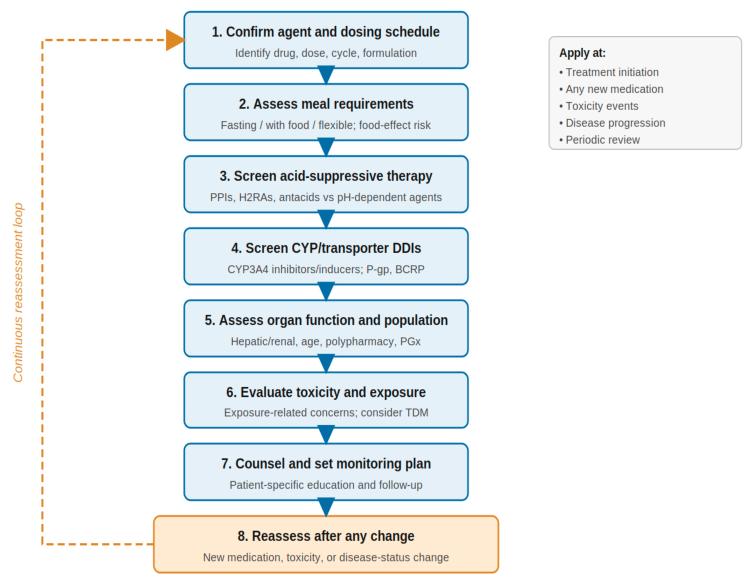
Figure 2.
The absorption journey of an oral anticancer agent and where each barrier acts. Six numbered sites along the gastrointestinal–hepatic–systemic axis correspond to the principal points at which exposure can be perturbed: (1) gastric dissolution and pH; (2) food effect on emptying, bile secretion, and solubilization; (3) intestinal efflux by P-glycoprotein and BCRP; (4) enterocyte CYP3A4 first-pass; (5) hepatic CYP3A4 and UGT metabolism; and (6) the resulting systemic exposure (AUC, Cmax). Common interventions and their loci are annotated.
Figure 2.
The absorption journey of an oral anticancer agent and where each barrier acts. Six numbered sites along the gastrointestinal–hepatic–systemic axis correspond to the principal points at which exposure can be perturbed: (1) gastric dissolution and pH; (2) food effect on emptying, bile secretion, and solubilization; (3) intestinal efflux by P-glycoprotein and BCRP; (4) enterocyte CYP3A4 first-pass; (5) hepatic CYP3A4 and UGT metabolism; and (6) the resulting systemic exposure (AUC, Cmax). Common interventions and their loci are annotated.
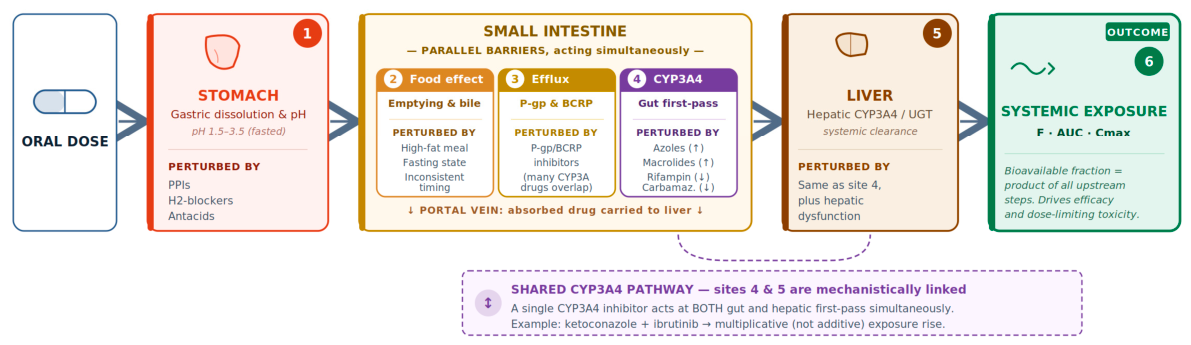
Figure 3.
Pharmacokinetic vulnerability matrix for the twenty-seven exemplar oral anticancer agents, grouped by mechanistic class. Colour intensity reflects the magnitude of label-documented vulnerability or clinical impact across four axes: food effect, acid suppression, CYP3A interaction, and hepatic impairment. The matrix pulls together the agent-level evidence detailed in Table 1, Table 2 and Table 3 and Section 4, Section 5 and Section 6 and reveals patterns that prose alone obscures — multikinase TKIs and BRAF agents clustering on the food-effect axis, BCR-ABL TKIs and acalabrutinib on acid suppression, and ibrutinib, cobimetinib, and everolimus as the CYP3A extremes. Enzalutamide and apalutamide are flagged separately because their clinically dominant role is as CYP3A4 perpetrators (inducers) rather than victims.
Figure 3.
Pharmacokinetic vulnerability matrix for the twenty-seven exemplar oral anticancer agents, grouped by mechanistic class. Colour intensity reflects the magnitude of label-documented vulnerability or clinical impact across four axes: food effect, acid suppression, CYP3A interaction, and hepatic impairment. The matrix pulls together the agent-level evidence detailed in Table 1, Table 2 and Table 3 and Section 4, Section 5 and Section 6 and reveals patterns that prose alone obscures — multikinase TKIs and BRAF agents clustering on the food-effect axis, BCR-ABL TKIs and acalabrutinib on acid suppression, and ibrutinib, cobimetinib, and everolimus as the CYP3A extremes. Enzalutamide and apalutamide are flagged separately because their clinically dominant role is as CYP3A4 perpetrators (inducers) rather than victims.
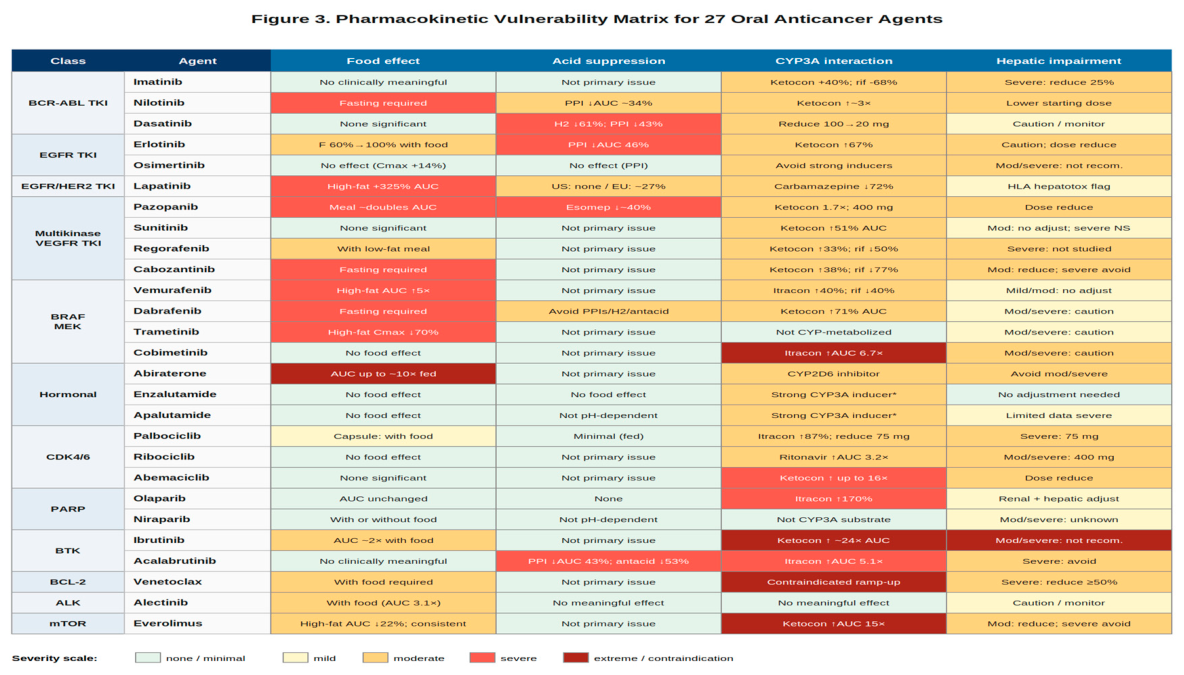

Table 1.
Food-Effect Recommendations for the Twenty-Seven Oral Anticancer Agents.
| Drug | Class/target | Effect of food on exposure | Recommended administration | Counseling point | Refs |
| Imatinib | BCR-ABL TKI | No clinically significant effect (F = 98%) | With food and water | Food taken to reduce GI upset, not to alter PK | [32] |
| Nilotinib | BCR-ABL TKI | Food raises exposure and QT risk | Empty stomach: no food 2 h before, 1 h after | Fasting is in boxed warning; reformulated product (2024) has no meal restriction | [36,43] |
| Dasatinib | BCR-ABL TKI | No clinically significant effect | With or without food | Food timing not critical; acid suppression is the key issue | [30,42] |
| Erlotinib | EGFR TKI | F ~60% fasted to ~100% with food | Empty stomach: ≥1 h before/2 h after | Fasting standardizes exposure; smoking lowers it | [13] |
| Osimertinib | EGFR TKI | Minimal (Cmax +14%, AUC +19%) | With or without food | Flexible; PPIs also have no effect on exposure | [25] |
| Lapatinib | EGFR/HER2 TKI | Low-fat +167%; high-fat +325% AUC | Empty stomach: ≥1 h before/≥1 h after | Large, variable food effect; overnight fasting reduced toxicity in one cohort | [10,38,44] |
| Pazopanib | VEGFR/multikinase TKI | Meal ~doubles AUC and Cmax | Empty stomach: ≥1 h before/2 h after | Fasting avoids food-driven over-exposure; do not crush | [1,12] |
| Sunitinib | Multikinase TKI | No effect | With or without food | Flexible timing | [24] |
| Regorafenib | Multikinase TKI | Low-fat > high-fat > fasted (active metabolites) | With a low-fat meal (<600 cal, <30% fat) | Unique low-fat-meal requirement among oral oncology agents | [21] |
| Cabozantinib | Multikinase TKI | Food raises exposure | Empty stomach: ≥1 h before/2 h after | Strict fasting; tablets and capsules not interchangeable | [14] |
| Vemurafenib | BRAF inhibitor | High-fat meal: AUC ↑5×, Cmax ↑2.5× | With or without food, consistently | Large positive food effect; consistency > fasting/fed choice | [11] |
| Dabrafenib | BRAF inhibitor | Food reduces absorption | Empty stomach: ≥1 h before/2 h after | Also avoid PPIs/H2RAs/antacids (pH-sensitive) | [15] |
| Trametinib | MEK inhibitor | High-fat: Cmax ↓70%, AUC ↓24% | Empty stomach: ≥1 h before/2 h after | Largest fasting-vs-fed Cmax effect in the set | [16] |
| Cobimetinib | MEK inhibitor | No clinically meaningful effect | With or without food | Flexible; CYP3A is the key axis | [53] |
| Abiraterone | CYP17 inhibitor (hormonal) | High-fat: Cmax/AUC up to ~17×/10× | Empty stomach: no food 2 h before, 1 h after | Largest labeled positive food effect | [9] |
| Enzalutamide | AR antagonist | No effect | With or without food | Concern is its perpetrator role on CYP3A substrates | [28] |
| Apalutamide | AR antagonist | No effect | With or without food | Like enzalutamide, a strong CYP3A inducer of co-meds | [29] |
| Palbociclib | CDK4/6 inhibitor | Tablet: none. Capsule: food-dependent | Tablet: any timing. Capsule: with food | Counsel by formulation | [34,35] |
| Ribociclib | CDK4/6 inhibitor | No effect | With or without food | Flexible; QT monitoring required | [26] |
| Abemaciclib | CDK4/6 inhibitor | No clinically significant effect | With or without food | Flexible timing; continuous dosing | [22,23] |
| Olaparib | PARP inhibitor | Food slows abs. (Cmax ↓21%); AUC unchanged | With or without food | Tablets and capsules not interchangeable | [31] |
| Niraparib | PARP inhibitor | No clinically significant effect | With or without food | Bedtime dosing may improve nausea tolerability | [27] |
| Ibrutinib | BTK inhibitor | Food: Cmax ~2–4×; AUC ~2× | With water, same time daily | Avoid grapefruit/Seville orange | [48] |
| Acalabrutinib | BTK inhibitor | No clinically meaningful effect | With or without food | Food flexible; acid suppression is the major issue | [49] |
| Venetoclax | BCL-2 inhibitor | Food improves absorption | With a meal and water | Always with food; pair with TLS ramp-up | [17,18] |
| Alectinib | ALK inhibitor | High-fat: alectinib+M4 AUC 3.1× | With food | For bioavailability and GI tolerability | [19,20] |
| Everolimus | mTOR inhibitor | High-fat ↓AUC 22%/Cmax 54% | Consistently with or without food | TDM target 5–10 ng/mL (SEGA, modeled in oncology) | [33] |
AUC, area under the concentration–time curve; Cmax, maximum concentration; F, oral bioavailability; TKI, tyrosine kinase inhibitor; TLS, tumor lysis syndrome; PPI, proton pump inhibitor; H2RA, histamine H2-receptor antagonist; AR, androgen receptor; TDM, therapeutic drug monitoring; SEGA, subependymal giant cell astrocytoma.
Table 2.
Acid-Suppressive Therapy Interactions with the Twenty-Seven Oral Anticancer Agents.
| Drug | pH-dependent | Interaction with PPIs/H2RAs/antacids | Recommended management | Practical implication | Refs |
| Imatinib | No (not primary) | No major labeled interaction | None specific | CYP3A is the relevant axis | [32] |
| Nilotinib | Yes | Esomeprazole (PPI) ↓ AUC ~34% | Short-acting antacids or H2RAs instead of PPIs | PPI use materially lowers exposure | [36] |
| Dasatinib | Yes | Famotidine ↓ AUC ~61%; omeprazole ↓ ~43%; antacid ↓ ~55% | H2RAs/PPIs not recommended; antacids staggered ≥2 h | Strongest acid-suppression interaction in this set | [30,42] |
| Erlotinib | Yes | Omeprazole ↓ AUC 46%/Cmax 61%; ranitidine ↓ AUC 15–33% | Avoid PPIs; if H2RA needed, take erlotinib 10 h after/≥2 h before | Cola raised AUC 39% during esomeprazole | [13,47] |
| Osimertinib | No | Omeprazole had no effect on exposure | None specific | Insensitive to gastric pH | [25] |
| Lapatinib | Yes | US: no clinically meaningful ↓; EU: ~27% ↓ (range 6–49%) | Caution with acid-reducing agents | US/EU labeling divergence | [44,45] |
| Pazopanib | Yes | Esomeprazole ↓ exposure ~40% | Avoid concomitant PPIs where possible | Common co-prescription that lowers exposure | [12] |
| Sunitinib | No | No clinically significant interaction | None specific | CYP3A is the relevant axis | [24] |
| Regorafenib | No (not primary) | No major labeled interaction | None specific | Food-effect (low-fat) is the key axis | [21] |
| Cabozantinib | No (not primary) | No major labeled interaction | None specific | CYP3A and fasting are the key axes | [14] |
| Vemurafenib | No (not primary) | No major labeled interaction | None specific | Food effect dominates | [11] |
| Dabrafenib | Yes | Avoid PPIs, H2RAs, antacids | Avoid concomitant acid-reducing agents | Within-class divergence from other BRAF inhibitors | [15] |
| Trametinib | No | Not metabolized via gastric pH-dependent pathways | None specific | Hydrolytic esterase metabolism; pH-insensitive | [16] |
| Cobimetinib | No | Rabeprazole had no clinically significant effect | None specific | CYP3A is the dominant axis | [53] |
| Abiraterone | No (not primary) | No major labeled interaction | None specific | Food, not acid suppression, dominates | [9] |
| Enzalutamide | No | No major labeled interaction | None specific | Not pH-dependent | [28] |
| Apalutamide | No | Not ionizable across physiological pH | None specific | Within-class divergence — vs other AR drugs, none are pH-sensitive | [29] |
| Palbociclib | Minimal (fed) | Rabeprazole (fed): Cmax ↓41% but AUC only ↓13% | No dose change; take tablet per label | Contrast to pH-sensitive TKIs | [35] |
| Ribociclib | No | No major labeled interaction | None specific | Not a primary concern | [26] |
| Abemaciclib | No | No major labeled interaction | None specific | Not a primary concern | [22] |
| Olaparib | No major | No major labeled interaction | None specific | CYP3A interactions dominate | [31] |
| Niraparib | No | Not ionizable; no labeled interaction | None specific | Carboxylesterase metabolism; pH-insensitive | [27] |
| Ibrutinib | No (not primary) | No major labeled dose change | None specific | CYP3A is the dominant axis | [48] |
| Acalabrutinib | Yes | Omeprazole ↓ AUC 43%; antacid ↓ AUC 53% | Avoid PPIs; stagger H2RAs and antacids ≥2 h | Within-class divergence from ibrutinib — textbook contrast | [49] |
| Venetoclax | No (not primary) | No major labeled interaction | None specific | CYP3A/P-gp dominate | [17] |
| Alectinib | Insensitive to pH | No clinically meaningful effect of esomeprazole | No dose change | Counterexample: no significant ARA interaction | [19,20] |
| Everolimus | No (not primary) | No major labeled interaction | None specific | CYP3A and P-gp are the dominant axes | [33] |
PPI, proton pump inhibitor; H2RA, histamine H2-receptor antagonist; ARA, acid-reducing agent; SmPC, summary of product characteristics; AR, androgen receptor.
Table 3.
Clinically Important Pharmacokinetic Drug–Drug Interactions of the Twenty-Seven Oral Anticancer Agents.
Table 3.
Clinically Important Pharmacokinetic Drug–Drug Interactions of the Twenty-Seven Oral Anticancer Agents.
| Drug | Major pathway | Interacting drug/class | Expected exposure change | Clinical recommendation | Refs |
| Imatinib | CYP3A4 sub; CYP3A4 inh | Ketocon/rif; simvastatin | Ketocon ↑ Cmax/AUC 26%/40%; rif ↓ AUC 68%; simvastatin AUC ↑3.5× | Caution with strong inh; ↑ dose ≥50% with strong ind | [32] |
| Nilotinib | CYP3A4; P-gp sub/inh | Ketoconazole/rifampin | Ketocon ↑ AUC ~3×; rif ↓ ~80% | Avoid strong inh (QT) and ind; reduce dose if unavoidable | [36] |
| Dasatinib | CYP3A4 sub | Strong CYP3A4 inh/ind | Inh ↑; ind ↓ | Strong inh: reduce dose (100→20 mg; 140→40 mg); avoid St John’s wort | [30,42] |
| Erlotinib | CYP3A4 (and CYP1A2) | Ketocon/rif/ciprofloxacin | Ketocon ↑ ~67%; rif ↓ 58–80%; cipro ↑ 39% | Avoid strong inh/ind; note smoking ↓ exposure | [13] |
| Osimertinib | CYP3A4 sub; weak BCRP/P-gp inh | Rifampin | Strong CYP3A inducer ↓ exposure | Avoid strong inducers; if unavoidable ↑ to 160 mg | [25] |
| Lapatinib | CYP3A4/5; inh CYP3A4, CYP2C8, P-gp | Ketocon/carbamazepine; digoxin | Carbamazepine ↓ AUC ~72%; digoxin AUC ↑ ~2.8× | Avoid strong inh/ind; monitor digoxin | [44] |
| Pazopanib | CYP3A4; P-gp/BCRP sub; UGT1A1/OATP1B1 inh | Ketocon/rif | Ketocon 1.7× ↑ AUC | Avoid strong inh; if unavoidable reduce to 400 mg | [12] |
| Sunitinib | CYP3A4 sub | Ketoconazole/rifampin | Ketocon ↑ AUC 51%; rif ↓ AUC 46% | Reduce dose with strong inh (37.5 mg GIST/RCC; 25 mg pNET) | [24] |
| Regorafenib | CYP3A4 + UGT1A9 | Ketocon/rif | Ketocon ↑ AUC 33%; rif ↓ AUC 50% (M-5 ↑264%) | Avoid strong inh/ind; striking metabolite shift | [21] |
| Cabozantinib | CYP3A4 sub; P-gp inh | Ketocon/rifampin | Ketocon ↑ AUC 38%; rif ↓ AUC 77% | Avoid strong inh/ind; if unavoidable reduce by 20 mg | [14] |
| Vemurafenib | CYP3A4 sub; inh CYP1A2/3A4 | Itracon/rif; tizanidine | Itracon ↑ AUC 40%; rif ↓ AUC 40%; tizanidine AUC ↑4.7× | Avoid strong inh/ind; CYP1A2 substrate exposures rise | [11] |
| Dabrafenib | CYP2C8/CYP3A4 sub; CYP3A4/2C9 inducer | Ketocon/gemfibrozil/rif; midazolam | Ketocon ↑ AUC 71%; gemfibrozil ↑ 47%; rif ↓ 34%; midazolam ↓ 74% | Avoid strong CYP3A/2C8 inh and inducers; warn re: CYP3A substrates | [15] |
| Trametinib | Hydrolytic esterases (not CYP) | No major drug interactions | Not significantly affected by CYP inh/ind | No PK-based dose adjustments | [16] |
| Cobimetinib | CYP3A sub | Itraconazole/rifampin | Itracon ↑ AUC 6.7×; strong ind ↓ 83% | Avoid strong/mod inh; if mod-CYP3A short-term unavoidable reduce to 20 mg | [53] |
| Abiraterone | CYP3A4 sub; strong CYP2D6 inh | Dextromethorphan | DEX AUC ↑ ~2.9× | Avoid narrow-TI CYP2D6 substrates | [9] |
| Enzalutamide | CYP2C8 sub; strong CYP3A4 inducer | Gemfibrozil/rif; CYP3A substrates | Gemfibrozil ↑ AUC 2.2×; rif ↓ AUC 37%; substantial ↓ of co-meds | Avoid strong CYP2C8 inh; warn re: CYP3A/2C9/2C19 substrates | [28] |
| Apalutamide | CYP3A/2C8 sub; STRONG CYP3A4/CYP2C19 inducer | Ketocon; midazolam, omeprazole, S-warfarin | Ketocon ↑ SS AUC 51%; midazolam ↓ AUC 92%; omeprazole ↓ 85%; S-warfarin ↓ 46% | Major perpetrator on CYP3A/2C19/UGT substrates | [29] |
| Palbociclib | CYP3A + SULT2A1; weak CYP3A inh | Itracon/rif; midazolam | Itracon ↑ ~87%; rif ↓ ~85%; midazolam ↑ 61% | Avoid strong inh (reduce 75 mg); avoid inducers | [35] |
| Ribociclib | CYP3A4 sub; moderate CYP3A inh | Ritonavir/rifampin | Ritonavir ↑ AUC 3.2× | Avoid strong inh/ind; if unavoidable reduce to 400 mg | [26] |
| Abemaciclib | CYP3A4 (active metabolites) | Ketocon/clarithromycin/rif | Ketocon predicted ↑ up to 16×; rif ↓ 67% | Avoid ketocon; other strong inh: reduce to 100 mg BID | [22,50] |
| Olaparib | CYP3A | Itracon/fluconaz/rif | Itracon ↑ 170%; fluconaz ↑ 121%; rif ↓ 87% | Avoid strong/mod inh; if unavoidable reduce (strong→100 BID) | [31,54] |
| Niraparib | Carboxylesterases + UGT (not CYP3A) | No significant CYP DDIs | Not affected by CYP3A inh/ind | No CYP-based dose adjustment; inhibits MATE1/2K (creatinine ↑ possible) | [27] |
| Ibrutinib | CYP3A sub; P-gp/BCRP inh | Ketocon/rif; grapefruit | Ketocon ↑ Cmax/AUC ~29×/24×; rif ↓ ~10× | Avoid strong inh; mod→140 mg; avoid grapefruit/inducers | [48,51] |
| Acalabrutinib | CYP3A sub; weak CYP3A4 inducer | Itracon/rifampin | Itracon ↑ Cmax/AUC 3.9×/5.1×; rif ↓ Cmax/AUC 68%/77% | Avoid strong inh and inducers; severe hepatic: avoid | [49] |
| Venetoclax | CYP3A4/5; P-gp & BCRP sub/inh | Strong CYP3A inh; ritonavir; P-gp sub | Ritonavir ↑ AUC 7.9× | Contraindicated with strong inh at ramp-up (CLL/SLL); after ramp-up reduce ≥75% | [17,52] |
| Alectinib | CYP3A4 to active metabolite M4 | Posaconazole/rif | No clinically meaningful effect on alectinib+M4 | No FDA adjustment; EMA recommends monitoring with strong ind | [19,68] |
| Everolimus | CYP3A4 sub; P-gp sub/inh | Ketocon/erythromycin/rif | Ketocon ↑ AUC 15×; erythromycin ↑ 4.4×; rif ↓ AUC 64% | Avoid strong inh; reduce with mod inh; one of largest victim DDIs | [33] |
BID, twice daily; TI, therapeutic index; CLL/SLL, chronic lymphocytic leukemia/small lymphocytic lymphoma; SS, steady state; inh, inhibitor; ind, inducer; sub, substrate; ketocon, ketoconazole; rif, rifampin; itracon, itraconazole; fluconaz, fluconazole; DEX, dextromethorphan; midaz, midazolam; GIST, gastrointestinal stromal tumor; RCC, renal cell carcinoma; pNET, pancreatic neuroendocrine tumor.
Disclaimer/Publisher’s Note: The statements, opinions and data contained in all publications are solely those of the individual author(s) and contributor(s) and not of MDPI and/or the editor(s). MDPI and/or the editor(s) disclaim responsibility for any injury to people or property resulting from any ideas, methods, instructions or products referred to in the content. |
© 2026 by the author. Licensee MDPI, Basel, Switzerland. This article is an open access article distributed under the terms and conditions of the Creative Commons Attribution (CC BY) license.
Copyright: This open access article is published under a Creative Commons CC BY 4.0 license, which permit the free download, distribution, and reuse, provided that the author and preprint are cited in any reuse.