

Submitted:
03 July 2026
Posted:
06 July 2026
You are already at the latest version
Abstract
Let X be a complex algebraic variety with a two-stratum decomposition X = U ⊔ S, where j : U ,→ X is open and i : S ,→ X is closed. MacPherson and Vilonen associate this configuration with a zig-zag category Z(X, S) and a functor μ : P(X) → Z(X, S) from the category of perverse sheaves on X, P(X). The construction packages a perverse sheaf Q∗ by its open restriction j∗ Q∗, the two closed terms H−d(i! Q∗) and H−d(i∗ Q∗), and the exact sequence H−d−1(i∗ Rj∗ j∗ Q∗) → H−d(i! Q∗) → H−d(i∗ Q∗) →H−d(i∗ Rj∗ j∗ Q∗). In this note we construct the corresponding zig-zag category ZNori(X, S) and zig-zag functor μNori : PNM(X) → ZNori(X, S) in the setting of perverse Nori motives. The construction uses the same object, morphism, and exact-sequence data, with the terms interpreted in the perverse Nori motivic formalism. We prove that realization sends ZNori(X, S) to the classical zig-zag category and that the square relating μNori to the classical MacPherson–Vilonen functor μ commutes up to natural isomorphism. The purpose of the paper is to make the zig-zag construction available as a reusable tool in perverse Nori motivic categories.
Keywords:
perverse Nori motives
; MacPherson–Vilonen zig-zag category
; perverse sheaves
; realization functors
; six functors
; motivic sheaves
; stratified spaces
MSC: 14F08; 14F42; 18F10; 18G80; 32S60
1. Introduction
Let X be a complex algebraic variety with a two-stratum decomposition
where
are respectively the open immersion and the complementary closed immersion. The purpose of this paper is to make the zig-zag construction from [1] available inside the category of perverse Nori motives.
Recall from [1], associated with a stratification is a category
of zig-zag data and a functor
from the category of perverse sheaves on X. This construction is concrete and diagrammatic. It packages a perverse sheaf by its open restriction, two closed-stratum terms, and the exact sequence connecting them. For , an object of is , together with an exact sequence on the closed stratum
A morphism is a morphism of the open terms together with maps between the middle terms K and C, making the corresponding exact-sequence diagram commute. For , the zig-zag functor sends to , equipped with the exact sequence
The aim here is to reproduce this exact construction in the perverse Nori motivic category in the case of a two-stratum configuration. We write
for the heart-level category of perverse Nori motives on X, and similarly for U and S. We construct a category
whose objects have the same form as the zig-zag objects, but with all terms interpreted inside , and we construct a functor
defined by the same exact sequence. The main result is compatible with realization:
Thus the motivic zig-zag data of a perverse Nori motive realize to the classical zig-zag data of its perverse sheaf realization. This zig-zag construction is a reusable perverse-sheaf tool: it lets one read off open data, closed costalk data, closed stalk data, boundary maps, and commutative diagrams forced by functoriality and exactness. This note makes that same tool available in the perverse Nori motivic category.
1.1. The Classical Zig-Zag Construction
Let be a closed stratum of complex dimension d, and write and . The construction of [1] associates to this pair a zig-zag category . An object of is an object
together with an exact sequence
A morphism
is a morphism , together with maps and , such that the induced diagram of exact sequences commutes.
In of [1], the zig-zag functor
is obtained from the standard open–closed triangle. For , one sets
together with the exact sequence
This is the classical construction lifted in this paper.
Remark 1.1 (Relation with the isolated singularity notation).
In the isolated singularity case, the same construction is often written with an object
and exact sequence
This is the form used in applications to simple stratified spaces with one isolated singularity (see [2] as an example). The notation in this paper follows formalism developed in [1] for a general two-stratum construction. The isolated singularity notation is recovered by the corresponding shift convention for the middle degree.
1.2. Why a Nori Motivic Version Is Needed
A practical reason for using perverse sheaves is that they make local-to-global structure visible. In a two-stratum configuration, the construction of [1] does not merely assign an invariant to a perverse sheaf; it extracts a diagrammatic package from which one can read the open term, the closed costalk term, the closed stalk term, and the boundary maps connecting them. Thus the zig-zag functor is a way of seeing where a perverse sheaf lives, how it is attached across a stratum, and which commutative diagrams are forced by functoriality and exactness.
For
this package is
with exact sequence
The maps in this sequence are not auxiliary decorations. They are the structural maps that record how the open and closed pieces interact.
The same kind of package is needed in motivic arguments. Perverse Nori motives provide an abelian motivic category whose realization is perverse-sheaf-theoretic, but many standard perverse-sheaf tools have not yet been explicitly written in this language. As the category becomes more useful, it is important to have direct motivic versions of constructions that, in the classical category, allow one to read off objects, maps, exact sequences, and commutative diagrams before passing to realization.
This paper supplies one such tool. We construct a motivic zig-zag category
and a functor
by using the same objects, maps, exact sequences, and morphism diagrams as in [1], interpreted inside the perverse Nori motivic category. The resulting motivic zig-zag object records not only the terms
but also the boundary sequence and the commutative diagrams induced by morphisms. This gives a controlled way to package motivic open data, motivic closed data, and the maps between them in a form that can later be transported, compared, or used as input for residual-channel constructions.
The construction is intentionally direct. We do not introduce a different gluing formalism, and we do not replace the exact sequence above by an auxiliary presentation. The point is to erect the zig-zag category and zig-zag functor inside PNM, and then prove that realization recovers the classical construction:
The nontrivial point is not the formal act of naming a diagram category. The point is that the maps in the zig-zag sequence are produced motivically. Starting from , the open–closed triangle in the perverse Nori derived formalism gives the boundary sequence after applying and taking the relevant heart-level cohomology objects. Thus the maps and the commutative diagrams induced by morphisms are not lifted after realization; they are formed first in , and realization identifies them with their classical counterparts.
1.3. Perverse Nori Infrastructure Used Here
We use the recent perverse Nori motivic literature as structural input. Ivorra and Morel construct categories of perverse Nori motives and develop the basic functorial formalism for perverse motives [3,4]. Their work supplies the motivic perverse categories and operations needed to speak about perverse Nori analogues of classical perverse-sheaf constructions.
Tubach proves derived-category comparison results for perverse Nori motives and mixed Hodge modules and constructs operation-compatible realization functors from Voevodsky motives to derived categories of perverse Nori motives and mixed Hodge modules [5]. This provides the realization-compatible background used here to compare the Nori zig-zag construction with the classical one.
Terenzi develops tensor and internal-Hom structures for perverse Nori motives and gives further evidence that the perverse Nori framework supports a robust functorial formalism [6]. These monoidal structures are not used directly in the construction below; the zig-zag functor only requires the four operations appearing in the open–closed sequence and their compatibility with realization.
Recent work of Pham uses perverse Nori motives in the construction of a Nori-motivic Satake equivalence [7]. This illustrates that perverse Nori motives are now being used as a serious working category in geometric representation theory. The present paper is more elementary: it isolates the zig-zag construction [1] and makes it available in this same motivic environment.
We use this literature only to the extent needed to justify the following operations and compatibilities:
the corresponding cohomology objects
and the compatibility of these constructions with realization.
1.4. The Nori Zig-Zag Category
The motivic zig-zag category constructed in this paper is denoted
It is defined by the same pattern as . An object is a triple
where
together with an exact sequence in
A morphism is a morphism of the open terms together with maps between the two middle closed terms, making the induced exact-sequence diagram commute. Thus is not an abstract substitute for ; it is the same zig-zag category formed inside the perverse Nori motivic category.
1.5. The Nori Zig-Zag Functor
For , define to be the object of whose open term is and whose closed terms are
The maps are those appearing in the exact sequence
This sequence is the Nori motivic analogue of the classical zig-zag sequence defining . On morphisms, is defined by applying , , , and to the given morphism in . Functoriality follows from the functoriality of the open–closed triangle and of the associated long exact sequence in the perverse Nori setting.
1.6. Realization Compatibility
The realization functors
and
induce a realization functor on zig-zag categories
This functor sends the motivic object
and its exact sequence to the realized classical object
with the realized exact sequence. The main compatibility statement is the commutative square
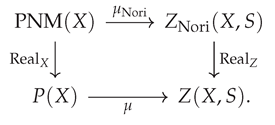
More precisely, there is a natural isomorphism
This is the central result of the paper.
1.7. Main Theorem
The main theorem can be stated as follows.
Theorem 1.2
(Zig-zag functor for perverse Nori motives). Let be a two-stratum complex algebraic variety with open and closed, in the perverse Nori setting of Proposition 4.6. Then there is a zig-zag category
and a functor
defined by the exact sequence modeled in of [1]
Moreover, realization induces a functor
and there is a natural isomorphism
The theorem says that the zig-zag construction is available in the perverse Nori motivic category and is compatible with classical realization.
1.8. Scope and Limitations
This paper relies on the availability of the operations , , , , the relevant heart-level cohomology objects, and realization compatibility for these constructions. These are supplied by the perverse Nori four-operation formalism of Ivorra–Morel and the realization/comparison results of Tubach. Terenzi and Pham are used as contextual evidence for the broader development of the perverse Nori framework.
The paper does not assert essential surjectivity of realization, canonical perverse Nori lifts of classical perverse sheaves, or any Chow-theoretic, Hodge-theoretic, or rational Hodge conjecture consequence.
1.9. Organization
Section 2 fixes notation. Section 3 recalls the zig-zag category , its objects, its morphisms, and the functor . Section 4 records the perverse Nori operations and realization compatibilities used in the construction. Section 5 defines . Section 6 constructs . Section 7 proves the realization compatibility square. Section 8 records filtered iteration and explains the limits of the construction. Section 9 collects the main statements, and Section 10 concludes.
2. Notation and Conventions
2.1. Spaces, Strata, and Inclusions
All varieties are complex algebraic varieties unless otherwise stated. A two-stratum decomposition means
where is Zariski open and is closed. We write
for the open and closed immersions.
When a finite stratification is used, it is denoted
The stratification is finite and algebraic. When constructibility or analytic arguments are involved, we work with a compatible Whitney stratification [8,9,10].
The main construction is two-stratum. A finite-stratification version is obtained only by choosing a filtration by closed unions of strata and iterating the two-stratum construction. No independence from the chosen filtration is asserted.
Remark 2.1 (Base field convention).
For readability, the paper is written over . One may also work over a characteristic-zero field k equipped with an embedding , as in the perverse Nori literature. In that setting, denotes the perverse category after passage to the associated complex analytic space. No arithmetic descent statement is used.
2.2. Classical Perverse Categories
We write
for the abelian category of rational perverse sheaves on the complex analytic space associated with X, constructible with respect to the chosen stratification. Similarly,
The standard functors associated with
are denoted
When no confusion can arise, we write for and for . Cohomology objects are denoted , following the convention used in the zig-zag construction of [1]. Thus the terms
are the two boundary terms appearing in the zig-zag sequence.
2.3. The Zig-Zag Convention
The phrase zig-zag construction refers throughout to the construction of Section 2 of [1]. Let be a closed stratum of complex dimension d, with
The classical zig-zag category is denoted
An object is written
where
and
is exact in .
A morphism
is a morphism in , together with morphisms and , such that the induced diagram of exact sequences commutes.
The classical zig-zag functor is denoted
For ,
where
is the exact sequence associated with the open–closed triangle.
Remark 2.2 (No auxiliary presentation).
This paper uses the zig-zag category , its objects, its morphisms, and the functor in the form above. It does not formulate the construction through an auxiliary presentation, a kernel–cokernel presentation, or a nearby–vanishing-cycle presentation.
2.4. Isolated Singularity Notation
In the isolated singularity case, as in [2], the same construction is often written
where L is a local system on the nonsingular part , with exact sequence
This is the one-point version of the two-stratum notation used here. The passage between the two conventions is a shift and middle-degree normalization.
2.5. Perverse Nori notation
We write
for the heart-level category of perverse Nori motives on X. This notation corresponds to the categories denoted in the literature by variants such as
Similarly, denotes the bounded derived category of .
We use the notation
for the corresponding categories on the open and closed strata. The realization functors are denoted
When no ambiguity is possible, the subscript is omitted.
The formal input comes primarily from the perverse Nori motive framework of Ivorra–Morel and the realization and derived-category comparison results of Tubach. Terenzi’s tensor and internal-Hom structures, and Pham’s stratified applications, provide surrounding context for the current development of the perverse Nori framework [3,4,5,6,7]. We use this literature only to form the functors and cohomology objects appearing in the zig-zag sequence and to compare them with classical realization.
2.6. Derived and Cohomological Notation
The construction is heart-level, but some terms are obtained by applying derived functors and then taking cohomology. For an object , we write
for the corresponding heart-level cohomology object. Thus, for , the expressions
are objects of , whenever the two-stratum pair is admissible in the sense used below. For , the expressions
are the two closed terms appearing in the motivic zig-zag functor.
Realization is assumed to commute with the operations used in the construction:
and with the relevant cohomology objects. This compatibility is the formal input which allows the motivic zig-zag sequence to realize to the classical one.
2.7. The Nori Zig-Zag Category and Functor
The perverse Nori analogue of is denoted
An object is written
where
and
is exact in . Morphisms are defined by the same commutative exact-sequence diagrams as in .
The motivic zig-zag functor is denoted
For ,
where the maps are those of the exact sequence
2.8. Realization of Zig-Zag Data
Realization induces a functor
For
one sets
using the natural identifications
and
The main compatibility proved in the paper is
2.9. Conventions on Claims
All statements in this paper concern the construction of the zig-zag category and zig-zag functor in the perverse Nori motivic setting, together with realization compatibility.
The paper does not assert that every classical perverse sheaf has a canonical perverse Nori lift. It does not prove that every object of lifts to an object of . It does not prove a Chow-theoretic, Hodge-theoretic, or rational Hodge conjecture statement. Such applications require additional input beyond the present note.
3. Classical Zig-Zag Construction
We use the notation of Section 2. This section recalls the classical zig-zag category and zig-zag functor of [1] in the form used throughout the paper. The construction is used only in its concrete form: objects, morphisms, and the functor
No auxiliary , kernel–cokernel, or nearby-cycle presentation is used.
3.1. The Category
Let
be a two-stratum complex algebraic variety, with
Let . The category records open-stratum data, two closed-stratum terms, and the exact sequence connecting them.
Definition 3.1 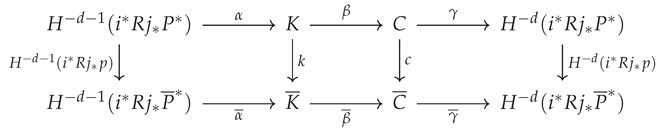
(Classical zig-zag category). An object of is a sextuple
where
and
is exact in .
A morphism
from
to
is a morphism
in , together with morphisms
in , such that the diagram
commutes.
Lemma 3.2.
The objects and morphisms of Definition 3.1 form a category.
Proof.
Composition is componentwise. The outer terms are functorial in , and therefore the commutativity of the defining diagrams is preserved under composition. Identity morphisms are the identity maps on , K, and C. Associativity follows from associativity in and . □
3.2. The Zig-Zag Functor
The classical zig-zag functor is
For , it is defined by
where
are the maps in the exact sequence
This sequence is obtained from the open–closed distinguished triangle
after applying and taking the indicated cohomology objects.
On morphisms, is defined by applying
to a morphism in . Naturality of the open–closed triangle and of the associated long exact sequence gives the required commutative diagram of zig-zag sequences.
Theorem 3.3
is the zig-zag functor of [1]. It has the reconstruction properties proved there: the zig-zag datum records enough information to recover the corresponding perverse-sheaf object in the sense of that theorem.
Remark 3.4 (Use of the classical theorem).
The present paper does not reprove the classical theorem. It uses the explicit category , its morphism diagrams, and the functor as the model to be internalized in perverse Nori motives.
3.3. Isolated Singularity Form
In the case of a simple stratified space
the same construction is commonly written as
where and
is exact. The corresponding functor sends to
with exact sequence
This is the one-point notation used in isolated singularity applications, including [2]. The present paper uses the general two-stratum notation, and the Nori construction below specializes to this isolated singularity form.
4. Perverse Nori Input
This section records the motivic input needed to form the zig-zag category
and the functor
We do not reconstruct Nori motives or perverse Nori motives from first principles. We use the existing perverse Nori formalism only to the extent needed to form the terms, maps, exact sequences, and realization comparisons appearing in the zig-zag construction.
4.1. Perverse Nori Motivic Categories
For a complex algebraic variety X, we write
for the heart-level category of perverse Nori motives on X. The realization functor is denoted
For a two-stratum decomposition , we similarly write
The categories and their functorial operations are used in the sense of the perverse Nori motivic formalism. The required input comes primarily from Ivorra–Morel and Tubach; Terenzi and Pham provide surrounding context.
Remark 4.1 (No automatic lifting statement).
The paper does not assert that every classical perverse sheaf has a canonical perverse Nori lift. The construction begins with an object of , forms its motivic zig-zag data, and compares that data with the classical zig-zag data of its realization.
4.2. Operations Used
Let
The zig-zag construction uses the operations
In the perverse Nori setting, we require the corresponding operations to exist on the relevant derived categories and the cohomology objects appearing below to lie in the perverse Nori hearts.
For
the boundary terms
are required to be objects of . For
the closed terms
are required to be objects of , and the sequence
is required to be exact in .
Definition 4.2
(MV-admissible perverse Nori two-stratum pair). A two-stratum pair
is called MV-admissible in perverse Nori motives if the perverse Nori formalism supplies the operations, heart-level cohomology objects, and exact sequence listed above.
Remark 4.3 (Meaning of admissibility).
The admissibility condition is not a gluing or reconstruction theorem. It is the minimal condition needed to write down the zig-zag object in the perverse Nori heart. In the applications considered here, this condition is supplied by the available perverse Nori six-functor and realization formalism.
4.3. Realization Compatibility
The realization functors are required to commute with the operations used in the construction. Thus we use natural isomorphisms
and
After applying and taking the relevant cohomology objects, these give identifications
and
Similarly, for , realization identifies the motivic exact sequence
with the classical zig-zag sequence associated to .
Definition 4.4
(Realization-compatible MV-admissibility). An MV-admissible perverse Nori two-stratum pair is realization-compatible if realization commutes with , , , , the relevant cohomology objects, and the exact sequence defining the zig-zag functor.
Remark 4.5 (Use of the modern Nori literature).
The role of the modern perverse Nori literature is to provide the functorial and realization-compatible environment in which Definitions 4.2 and 4.4 can be verified. The paper uses only the specific operations that occur in the zig-zag sequence.
Proposition 4.6
(Availability of the Nori zig-zag input). For the two-stratum algebraic pairs considered in this paper, the perverse Nori formalism supplies the operations
the heart-level cohomology objects appearing in the zig-zag sequence, and the realization compatibilities required in Definitions 4.2 and 4.4. Consequently, the pair is MV-admissible and realization-compatible in the sense used below.
Proof.
The four operations on perverse Nori motives and the relevant perverse heart formalism are supplied by Ivorra–Morel [4]. The operation-compatible realization and comparison with the classical constructible and Hodge-theoretic formalisms are supplied by Tubach [5]. Applying these results to the open immersion j and closed immersion i gives the operations in the perverse Nori setting and identifies their realizations with the corresponding classical functors. Taking the indicated heart-level cohomology objects gives the terms appearing in the zig-zag sequence, and exactness of the resulting sequence is the heart-level long exact sequence associated with the open–closed triangle. The realization compatibilities identify this sequence with the classical sequence used to define . □
4.4. Exactness
The category is an abelian heart-level construction. Exactness is therefore always exactness in
In particular, an object of contains an exact sequence
and the sequence defining is also required to be exact in .
The realization functor is exact on the relevant hearts. Hence exact sequences in realize to exact sequences in .
Remark 4.7 (Role of exactness).
Exactness is the abelian input that makes the zig-zag category and its morphism diagrams meaningful. No Chow groups, cycle-class maps, Hodge classes, or rational Hodge conjecture statements enter this construction.
5. The Nori Zig-Zag Category
We now define the perverse Nori motivic analogue of the zig-zag category . The definition is obtained by replacing the classical perverse categories
with
and by using the same exact-sequence data as in [1].
5.1. Objects and Morphisms
Definition 5.1 
(Nori zig-zag category). Let be a realization-compatible MV-admissible perverse Nori two-stratum pair. The category
is defined as follows.
An object is a sextuple
where
and
is exact in .
A morphism
from
to
is a triple
where
and
such that the diagram
commutes.
Proposition 5.2
(Category structure). The objects and morphisms of Definition 5.1 form a category.
Proof.
Composition is defined componentwise. Given morphisms
and
their composite is
The outer terms in the exact-sequence diagram are functorial in the open term , so the commutativity of the two defining diagrams implies the commutativity of the composite diagram. Identity morphisms are the identities on , K, and C, and associativity follows from associativity in and . □
5.2. Realization of Nori Zig-Zag Objects
The realization functors induce a functor
For an object
define
using the natural identifications
and
Proposition 5.3
(Realization of zig-zag data). The assignment above defines a functor
Proof.
Let
be an object of . Its defining sequence is exact in . Since realization is exact on the relevant heart and commutes with the operations used to form the boundary terms, the realized sequence is exact in . Hence is an object of .
Now let
be a morphism. Applying realization to gives morphisms
By realization compatibility, the outer vertical maps in the defining diagram realize to the corresponding classical maps induced by . Since the motivic diagram commutes, the realized diagram commutes. Thus realization sends morphisms of Nori zig-zag objects to morphisms of classical zig-zag objects. Preservation of identities and composition follows from functoriality of realization. □
Remark 5.4 (Faithfulness to the classical construction).
The category is not a new auxiliary diagram category. It is the zig-zag category of [1] formed inside the perverse Nori motivic category: the objects, morphisms, and exact-sequence diagrams are the same, while the ambient abelian categories are replaced by and .
6. The Nori Zig-Zag Functor
We use the notation and conventions of Section 2. Let
be a realization-compatible MV-admissible perverse Nori two-stratum pair. In Section 5 we defined the category
We now construct the motivic zig-zag functor
6.1. Definition on Objects
Let
The open–closed triangle
induces, after applying and taking the relevant cohomology objects, an exact sequence in :
Define
Proposition 6.1
(Well-definedness on objects). For every
the datum
is an object of .
Proof.
By MV-admissibility in the perverse Nori setting, the objects
belong to the required hearts, the boundary terms
belong to , and the displayed sequence is exact in . Hence the datum satisfies the defining condition for an object of . □
6.2. Definition on Morphisms
Let
be a morphism in . Applying
to f, and then taking the relevant cohomology objects, gives morphisms between the corresponding terms of the zig-zag sequence. Naturality of the open–closed triangle and of the associated long exact sequence gives a commutative diagram

Together with the open-term morphism
this defines a morphism
in .
Theorem 6.2
(The Nori zig-zag functor). The assignments above define a functor
Proof.
The assignment on objects is defined above. The assignment on morphisms is induced by functoriality of the operations
and by naturality of the long exact cohomology sequence. Identity morphisms and compositions are preserved because all operations used in the construction are functorial. Hence is a functor. □
6.3. Isolated Singularity Form
In the isolated singularity normalization, the same functor is written
with exact sequence
This is the one-point simple-stratification form of the construction; the paper otherwise uses the general two-stratum notation.
7. Realization Compatibility
We now prove that the Nori zig-zag functor realizes to the classical zig-zag functor. Throughout this section, is a realization-compatible MV-admissible perverse Nori two-stratum pair.
7.1. Realization of the Defining Sequence
Let
The defining sequence of is
By realization compatibility, applying identifies this sequence with
This is precisely the exact sequence defining the classical zig-zag object
Lemma 7.1
(Realization of Nori zig-zag objects). For every
there is a natural isomorphism in
Proof.
The open term realizes as
The two closed middle terms realize as
and
The two boundary terms realize as
and
Under these identifications, the realized maps
are the maps in the classical zig-zag sequence for . Hence the realized Nori zig-zag object is naturally isomorphic to the classical one. □
7.2. The Realization Square
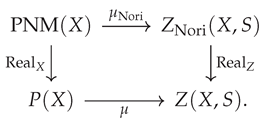
The compatibility is expressed by the square
Theorem 7.2
(Realization compatibility of the Nori zig-zag functor). There is a natural isomorphism of functors
Proof.
On objects, the required isomorphism is Lemma 7.1. It remains to check naturality.
Let
be a morphism in . The morphism
is obtained by applying
to f, followed by the relevant cohomology functors. Since realization commutes with these operations, the realized morphism
is identified with the classical morphism of zig-zag data induced by
This is precisely
Thus the objectwise isomorphisms are natural, and the two composite functors are naturally isomorphic. □
Corollary 7.3
(Realization preserves the zig-zag diagram). For every morphism
in , the commutative diagram of exact sequences defining
realizes to the commutative diagram of exact sequences defining
Proof.
This is the morphism-level content of Theorem 7.2. □
8. Filtered Iteration and Failure Modes
We use the notation and conventions of Section 2. The preceding sections construct the zig-zag category and zig-zag functor for a two-stratum decomposition
This section records how the construction may be reused along a chosen finite filtration and clarifies the limits of the construction.
8.1. Filtered Iteration
Let
be a finite algebraic stratification. A closed filtration compatible with the stratification is a chain of closed subvarieties
such that each is a union of strata. Setting
we obtain a sequence of two-stratum decompositions
Definition 8.1
(Filtered MV-admissible Nori datum). A filtration
by closed unions of strata is called filtered MV-admissible in perverse Nori motives if each two-stratum pair
is MV-admissible and realization-compatible in the sense of Definitions 4.2 and 4.4.
For each such step, the two-stratum construction gives a category
and a functor
For , the functor records the exact sequence
where denotes the degree normalization for the r-th two-stratum step.
Definition 8.2
(Filtered Nori zig-zag extraction). For a filtered MV-admissible Nori datum , the filtered Nori zig-zag extraction of an object
is the filtration-dependent diagrammatic package obtained by applying the two-stratum functors
successively along the chosen filtration.
This construction is not a new stratified theory. It is the repeated use of the two-stratum zig-zag tool along a chosen filtration. At each stage it extracts the open term, the two closed terms, and the boundary exact sequence for that step.
8.2. Realization of Filtered Extraction
For every r, the two-stratum realization theorem gives a natural isomorphism
where
is the classical zig-zag functor for the pair .
Theorem 8.3
(Realization compatibility for filtered extraction). Let be a filtered MV-admissible Nori datum. Then the filtered Nori zig-zag extraction realizes to the corresponding filtered classical zig-zag extraction along the same filtration.
Proof.
Apply Theorem 7.2 at each two-stratum step. The filtered extraction is obtained by composing these stepwise constructions along the chosen filtration, and the realization isomorphisms are natural at each stage. Hence their composite identifies the filtered Nori extraction with the filtered classical extraction. □
Remark 8.4 (Filtered rather than canonical).
The filtered statement is relative to a chosen filtration . It does not assert that different filtrations produce canonically equivalent iterated zig-zag packages. Such a statement would require additional comparison data and is not part of this note.
8.3. Failure Modes
The construction in this paper is small but specific. It requires exactly the data needed to write the zig-zag exact sequence in the perverse Nori heart and to compare that sequence with classical realization. Several nearby-looking constructions do not suffice.
Classical zig-zag theory alone does not construct Nori data. It constructs
inside the category of perverse sheaves. To construct
one must know that the terms
exist in the relevant perverse Nori hearts and that the defining exact sequence exists in .
Derived functoriality alone is also not enough. The zig-zag category is an abelian heart-level category of exact sequences. A derived functorial formalism supplies objects in derived categories, but the construction also requires the relevant cohomology objects to lie in and to form an exact sequence there.
Likewise, the categories
do not by themselves determine . An object of is not merely a triple
it is such a triple together with the exact sequence
Without the boundary terms and exactness condition, one has only an arbitrary diagram category.
Finally, realization is not an essential-surjectivity statement. The functor
sends motivic zig-zag objects to classical zig-zag objects, but this paper does not prove that every object of lifts to .
Remark 8.5 (Structural principle).
The construction requires the zig-zag exact sequence in the perverse Nori heart and realization compatibility for that sequence. Omitting either ingredient gives only a partial or unrelated construction.
9. Main Theorem Package
We collect the main statements proved above. Throughout, is a realization-compatible MV-admissible perverse Nori two-stratum pair.
Theorem 9.1
(Nori zig-zag category). There is a category
whose objects are sextuples
where
and
is exact in . Morphisms are morphisms of open terms together with maps between the two closed middle terms making the corresponding exact-sequence diagram commute.
Proof.
This is Definition 5.1 and Proposition 5.2. □
Theorem 9.2
(Nori zig-zag functor). There is a functor
For , it is given by
where
is exact in .
Proof.
This is Theorem 6.2. □
Theorem 9.3 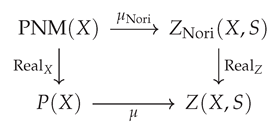
(Realization compatibility). Realization induces a functor
and there is a natural isomorphism
Equivalently, the square
commutes up to natural isomorphism.
Proof.
The functor is constructed in Proposition 5.3. The natural isomorphism is Theorem 7.2. □
Corollary 9.4
(Filtered iteration). Let
be a filtered MV-admissible Nori datum. Then the two-stratum construction can be applied successively to the pairs
The resulting filtered Nori zig-zag extraction realizes to the corresponding filtered classical zig-zag extraction along the same filtration.
Proof.
This is Theorem 8.3. □
Remark 9.5 (Summary and nonclaims).
The paper proves the construction of
and the realization comparison
It does not prove that every classical perverse sheaf has a canonical perverse Nori lift, that every object of lifts to , or that there is a new reconstruction equivalence in perverse Nori motives. It also does not prove any statement about Chow groups, algebraic cycles, Hodge classes, or the rational Hodge conjecture.
10. Conclusion
The zig-zag construction of [1] provides a compact way to package open perverse-sheaf data, closed costalk data, closed stalk data, and the boundary maps connecting them. This paper constructs the same package in the perverse Nori motivic category.
For a two-stratum decomposition
we define the category
of perverse Nori zig-zag objects and the functor
For , this functor records the package
with exact sequence
The construction is functorial in : a morphism of perverse Nori motives induces a morphism of zig-zag objects, equivalently a commutative diagram of exact sequences on the closed stratum. The main theorem proves that this construction is compatible with realization:
Thus the motivic zig-zag data of a perverse Nori motive realize to the classical zig-zag data of the corresponding perverse sheaf.
References
- MacPherson, R.; Vilonen, K. Elementary construction of perverse sheaves. Inventiones Mathematicae 1986, 84, 403–435. [CrossRef]
- Rahman, A. A Perverse Sheaf Approach Toward a Cohomology Theory for String Theory. Advances in Theoretical and Mathematical Physics 2009, 13, 667–693, [arXiv:math.AT/0704.3298].
- Ivorra, F. Perverse Nori motives, 2014. Preprint.
- Ivorra, F.; Morel, S. The four operations on perverse motives. Journal of the European Mathematical Society 2024, 26, 4191–4272, [arXiv:math.AG/1901.02096]. [CrossRef]
- Tubach, S. On the Nori and Hodge realisations of Voevodsky motives. Compositio Mathematica 2025, 161, 2155–2201, [arXiv:math.AG/2309.11999]. [CrossRef]
- Terenzi, L. Tensor structure on perverse Nori motives. Annals of K-Theory 2026, 11, 47–170, [arXiv:math.AG/2401.13547]. [CrossRef]
- Pham, K.B. The Motivic Satake Equivalence Using Perverse Nori Motives, 2026, [arXiv:math.AG/2601.02004]. arXiv:2601.02004v2.
- Whitney, H. Tangents to an analytic variety. Annals of Mathematics 1965, 81, 496–549. [CrossRef]
- Goresky, M.; MacPherson, R. Stratified Morse Theory; Vol. 14, Ergebnisse der Mathematik und ihrer Grenzgebiete. 3. Folge, Springer-Verlag: Berlin, 1988. [CrossRef]
- Beilinson, A.A.; Bernstein, J.; Deligne, P. Faisceaux pervers. Astérisque 1982, 100, 5–171. Analyse et topologie sur les espaces singuliers, I.
Disclaimer/Publisher’s Note: The statements, opinions and data contained in all publications are solely those of the individual author(s) and contributor(s) and not of MDPI and/or the editor(s). MDPI and/or the editor(s) disclaim responsibility for any injury to people or property resulting from any ideas, methods, instructions or products referred to in the content. |
© 2026 by the authors. Licensee MDPI, Basel, Switzerland. This article is an open access article distributed under the terms and conditions of the Creative Commons Attribution (CC BY) license (http://creativecommons.org/licenses/by/4.0/).
Copyright: This open access article is published under a Creative Commons CC BY 4.0 license, which permit the free download, distribution, and reuse, provided that the author and preprint are cited in any reuse.


