
Submitted:
03 July 2026
Posted:
03 July 2026
You are already at the latest version
Abstract
The rapid development of pharmacotherapy has progressed from using single GLP-1 receptor agonists, such as semaglutide, to more complex options like dual incretin agonism with GLP-1/GIP (tirzepatide) and GLP-1/glucagon co-agonism (survodutide). Other combinations include GLP-1/amylin (CagriSema) and triple agonism (retatrutide). This evolution highlights that metabolic disease is not a uniform biological condition, and we are observing distinct clinical metabolic outcomes associated with each specific agonist. Yet the choice of therapy is still primarily influenced by the amount of weight loss rather than by understanding the primary physiological defect driving each patient's disease. We propose a “liver-centred network” failure model in which obesity and metabolic liver disease arise from dysregulation of coordinated hormonal signalling networks governing energy intake, hepatic lipid handling, oxidative metabolism, and adipose tissue function. Within this framework, patients can be classified into five clinically distinguishable metabolic phenotypes, each characterised by a dominant biological defect and a corresponding preferred multi-agonist therapeutic strategy: hyperphagic obesity with preserved metabolic flexibility, hepatic insulin resistance and MASLD/MASH-dominant disease, the energy-conservation phenotype, sarcopenic obesity, and the cardio-renal-metabolic vulnerability phenotype. If validated by prospective outcome studies, treatment selection based on phenotype and suitable biomarkers of dominant pathophysiology, rather than BMI alone, may signify a shift from obesity pharmacotherapy to genuine precision metabolic medicine.
Keywords:
GLP-1 receptor agonists
; phenotype-directed therapy
; multihormonal dysregulation
; MASLD
; MASH
; tirzepatide
; survodutide
; retatrutide
; CagriSema
; precision metabolic medicine
1. Introduction
The emergence of effective, receptor-targeted anti-obesity medications over the past decade marks one of the fastest advancements in medical therapy. Semaglutide, a selective GLP-1 receptor agonist administered once a week via subcutaneous injection, evolved from previous GLP-1 therapies that were taken either twice daily or once daily. In the landmark STEP 1 trial, semaglutide demonstrated an average weight loss of 14.9% after 68 weeks [1], establishing GLP-1 receptor agonists as the new standard for pharmacological obesity management. Tirzepatide, a dual GLP-1/GIP receptor agonist, subsequently exceeded this benchmark in the SURMOUNT programme, with 86% of participants achieving at least 5% weight reduction and mean losses approaching 20% at 72 weeks [2]. CagriSema, the fixed-ratio combination of cagrilintide (an amylin analogue) and semaglutide, has now achieved a mean weight reduction of 20.4%, rising to 22.7% under full adherence, in the recently published REDEFINE 1 phase 3 trial [3]. The triple GLP-1/GIP/glucagon receptor agonist retatrutide produced placebo-adjusted weight loss of 22% at 48 weeks in its phase 2 trial and recently achieved 28.7% reduction at 68 weeks in the phase 3 TRIUMPH-4 programme [4].
Despite these extraordinary advances, the field has primarily evaluated these agents based on weight loss, HbA1c reduction, and changes in mean hepatic fat [5]. Systematic reviews of GLP-1 receptor agonist trials confirm that weight reduction and glycaemic control have served as the primary endpoints across this entire generation of trials, with metabolic heterogeneity among participants rarely explored [6].
A more fundamental question that has often been overlooked is: which physiological defect is dominant in a given patient? Through my 35 years of experience as a practising diabetologist, I have observed that patients with identical Body Mass Index (BMI) and HbA1c levels can exhibit profoundly different metabolic phenotypes. Some of these phenotypes are driven by uncontrolled hyperphagia, while others are influenced by severe hepatic insulin resistance and steatohepatitis. Additionally, some patients may experience effects from adaptive thermogenesis, sarcopenic muscle loss, or the convergence of cardio-renal-metabolic (CRM) risks. These diverse phenotypes can display significantly different levels of dysregulation in their incretin hormone profiles, which may be affected by a combination of genetic, epigenetic, and environmental factors.
We propose here that the differential receptor targets, their modulation, and tissue-level mechanisms of these agents — GLP-1, GIP, glucagon, and amylin receptor agonism — are not interchangeable, and that each preferentially addresses distinct components of the metabolic network. If this is correct, therapeutic selection guided by the dominant biological defect in each patient, rather than by weight or BMI alone, would represent a transition from obesity pharmacotherapy to precision metabolic medicine.
2. The Liver-Centred Metabolic Network Failure Model
Classical pathophysiology of type 2 diabetes and obesity has focused on individual nodes of dysfunction: pancreatic beta-cell failure, islet dysregulation, peripheral insulin resistance, and hypothalamic satiety impairment. We propose a complementary conceptual framework in which metabolic disease represents a failure of coordinated signalling within a liver-centred network that regulates energy intake, hepatic lipid storage and oxidation, adipose tissue buffering capacity, skeletal muscle metabolic flexibility, and systemic energy expenditure, including resting energy expenditure (REE).
This network operates, as we appreciate today, through at least four distinct hormonal axes:
- The GLP-1/amylin axis governing hypothalamic and area postrema satiety{{cite:9}};
- The GIP-adipose axis governing peripheral lipid buffering, adipose tissue remodelling, and subcutaneous lipotoxicity protection{{cite:10}};
- The glucagon-hepatic axis governing intrahepatic lipid oxidation, beta-oxidation gene transcription, and mitochondrial energy generation{{cite:7,8}}; and
- A systemic energy expenditure axis integrating brown adipose thermogenesis, skeletal muscle substrate utilisation, and adaptive thermogenesis{{cite:11}}.
When one or more components of this network fail preferentially, a clinically recognisable metabolic phenotype emerges.
The concept of context-dependent agonism is central to this model. Glucagon, historically classified as diabetogenic due to its role in hyperglucagonaemia-driven hepatic glucose output, demonstrates markedly different biological effects when co-administered with GLP-1 receptor agonism. Within a GLP-1-stabilised metabolic environment, where insulin secretion is appropriately supported and glucose excursions are controlled, glucagon receptor activation drives hepatic PPARα phosphorylation, stimulates CPT-1 and CPT-2 transcription, enhances mitochondrial beta-oxidation, and promotes hepatic lipid clearance [7,8]. This principle — that the same molecule may be pathogenic in one context and therapeutically beneficial in another — recurs across the pharmacological evolution from insulin to GLP-1 to triple agonism, and forms the basis of the phenotype-directed framework described below.
3. A Five-Phenotype Clinical Taxonomy
We propose five metabolic phenotypes characterised by their dominant biological defect, associated diagnostic biomarkers, mechanistic rationale, and corresponding preferred therapeutic strategy. These are not mutually exclusive; many patients exhibit overlapping phenotypes, but in most cases, one defect is sufficiently dominant to guide initial therapeutic selection.
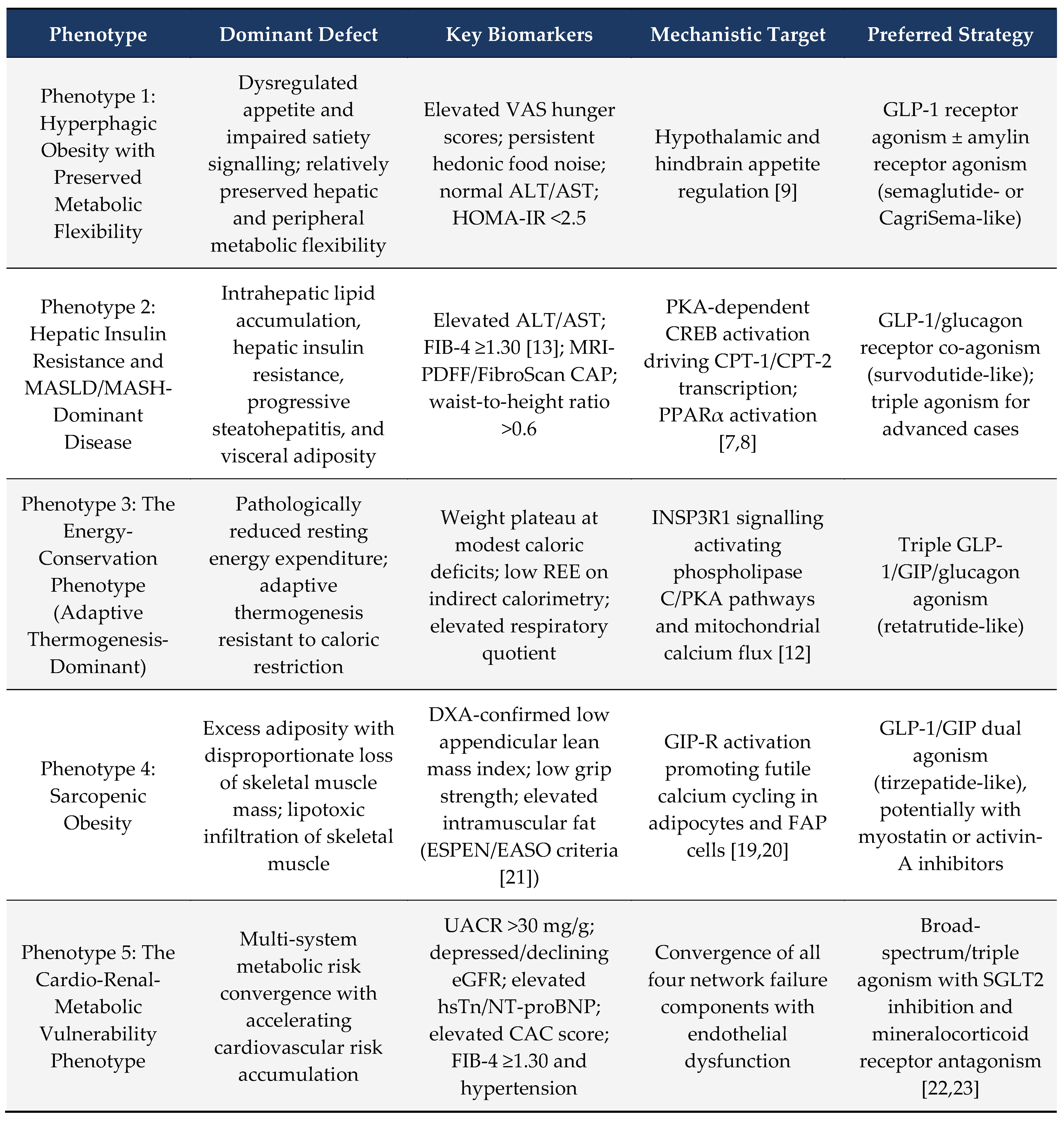
The five phenotypes, their dominant defects, key biomarkers, mechanistic targets, and preferred therapeutic strategies are summarised in Figure 1.
3.1. Phenotype 1: Hyperphagic Obesity with Preserved Metabolic Flexibility
- Dominant Defect: Dysregulated appetite and impaired satiety signalling; relatively preserved hepatic and peripheral metabolic flexibility.
- Diagnostic Biomarkers: Elevated visual analogue scale (VAS) hunger scores; clinical reporting of persistent hedonic food noise; normal or near-normal fasting liver enzymes (ALT, AST); absence of significant hepatic steatosis on imaging; preserved insulin sensitivity indices (HOMA-IR <2.5).
- Preferred Therapeutic Strategy: GLP-1 receptor agonism ± amylin receptor agonism (semaglutide- or CagriSema-like approaches).
Mechanistic Rationale: The dominant physiological abnormality in this phenotype resides at the level of hypothalamic and hindbrain appetite regulation. GLP-1 receptor agonism suppresses homeostatic hunger through the arcuate nucleus while simultaneously reducing hedonic food-seeking behaviour through mesolimbic circuits [9]. Amylin analogue (cagrilintide), acting principally through the area postrema, provides complementary satiety signalling and delays gastric emptying, creating synergistic appetite suppression across both homeostatic and hedonic pathways [3]. The REDEFINE 1 trial demonstrated that CagriSema produced substantially greater weight loss than either component alone (20.4% vs 14.9% with semaglutide and 11.5% with cagrilintide monotherapy), confirming the additive value of dual-pathway satiety targeting [3]. In patients without hepatic insulin resistance or severe adipose dysfunction, engagement of glucagon or GIP pathways adds mechanistic redundancy rather than therapeutic advantage.
3.2. Phenotype 2: Hepatic Insulin Resistance and MASLD/MASH-Dominant Disease
- Dominant Defect: Intrahepatic lipid accumulation, hepatic insulin resistance, progressive steatohepatitis, and visceral adiposity with relative sparing of appetite dysregulation.
- Diagnostic Biomarkers: Elevated ALT/AST; high FIB-4 index (≥1.30) [13]; elevated fasting triglycerides; direct hepatic fat quantification by MRI-PDFF or FibroScan CAP score; waist-to-height ratio >0.6; presence of metabolic syndrome components disproportionate to global BMI. This biomarker cluster is particularly characteristic of the South Asian metabolic phenotype, where visceral adiposity and hepatic insulin resistance are disproportionate to global BMI [14,15].
- Preferred Therapeutic Strategy: GLP-1/glucagon receptor co-agonism (survodutide-like approaches); or GLP-1/GIP/glucagon triple agonism (retatrutide-like) for more advanced cases.
Mechanistic Rationale: Glucagon receptor agonism exerts direct hepatic effects through multiple transcriptional pathways. Via PKA-dependent phosphorylation, glucagon activates CREB (cAMP response element-binding protein), which drives transcription of carnitine palmitoyltransferases CPT-1 and CPT-2, the key enzymes governing mitochondrial fatty acid entry and beta-oxidation [7]. Glucagon also mediates longer-term effects through PPARα activation, enhancing the cascades of peroxisomal and mitochondrial fatty acid oxidation genes [8]. These direct hepatic lipid-clearance mechanisms are distinct from and additive to the indirect hepatic benefits of weight loss. In the phase 2 MASH trial by Sanyal et al., survodutide achieved MASH histological improvement without worsening fibrosis in 62% of participants in the 4.8 mg group versus 14% on placebo at 48 weeks [16]. Parallel data from the SYNERGY-NASH trial demonstrated that tirzepatide, through its GIP component’s enhancement of adipose tissue lipid buffering, reduces hepatic lipid overflow and achieves MASH resolution without fibrosis worsening in 44–62% of participants across doses versus 10% on placebo [17]. Retatrutide further amplified hepatic fat reduction to approximately 86% in phase 2 MASLD substudy data [4], consistent with the additive hepatic benefit of triple receptor agonism.
3.3. Phenotype 3: The Energy-Conservation Phenotype (Adaptive Thermogenesis-Dominant)
- Dominant Defect: Pathologically reduced resting energy expenditure (REE); severe adaptive thermogenesis resistant to caloric restriction; repeated weight regain despite dietary adherence.
- Diagnostic Biomarkers: Documented weight plateau at modest caloric deficits; disproportionate metabolic slowing confirmed by indirect calorimetry; elevated respiratory quotient (RQ) indicating carbohydrate-predominant fuel oxidation; history of multiple weight-regain cycles.
- Preferred Therapeutic Strategy: Triple GLP-1/GIP/glucagon agonism (retatrutide-like approaches).
Mechanistic Rationale: Glucagon receptor agonism is uniquely capable of addressing the physiological mechanisms underlying adaptive thermogenesis, a well-documented phenomenon whereby prolonged caloric restriction produces a disproportionate and persistent reduction in resting energy expenditure that impedes sustained weight loss [18]. Through inositol 1,4,5-trisphosphate receptor type 1 (INSP3R1) signalling, glucagon activates phospholipase C/PKA pathways that enhance mitochondrial calcium flux and activate multiple tricarboxylic acid cycle dehydrogenases, thereby increasing mitochondrial energy expenditure and reducing ectopic lipid accumulation [12]. Glucagon receptor agonism has been shown to increase energy expenditure in humans through augmented mitochondrial oxidation. When a patient undergoes significant and disproportionate declines in resting metabolic rate while on a caloric restriction diet, this phenotype is characterised by glucagon activating oxidative uncoupling pathways. These pathways counteract the typical adaptive response, which helps prevent the metabolic slowdown that usually hinders sustained weight loss. In the retatrutide phase 2 trial, the 12 mg dose produced a placebo-adjusted mean weight reduction of 22% at 48 weeks [4], substantially exceeding dual-agonist benchmarks, consistent with the energetic contribution of the glucagon component in patients where thermogenesis is the limiting factor.
3.4. Phenotype 4: Sarcopenic Obesity
- Dominant Defect: Excess adiposity with disproportionate loss of skeletal muscle mass; declining physical performance; lipotoxic infiltration of skeletal muscle (intramuscular adipose tissue accumulation); aging-associated adipokine dysregulation.
- Diagnostic Biomarkers: DXA-confirmed low appendicular lean mass index, and reduced skeletal muscle index on bioelectrical impedance, as defined by the ESPEN/EASO consensus diagnostic criteria for sarcopenic obesity [21]; grip strength below normative thresholds; elevated intramuscular fat by imaging.
- Preferred Therapeutic Strategy: GLP-1/GIP dual agonism (tirzepatide-like approaches), potentially combined with myostatin or activin-A inhibitors as the evidence base matures.
Mechanistic Rationale: GIP receptor signalling in adipose tissue is now recognised to govern adipose remodelling, distinct from GLP-1 agonism. GIP-R activation in adipocytes promotes futile calcium cycling through SERCA-mediated pathways, increasing local energy expenditure and reducing adipocyte lipid storage [19]. GIP-R expression in adipose tissue, and especially in fibro-adipogenic progenitor (FAP) cells within skeletal muscle, has been recognised as a critical factor for intramuscular adipose tissue (IMAT) formation, the unique hallmark of sarcopenic obesity [20]. Independently, GIP signalling increases adipose tissue blood flow and whole-body lipid oxidation [10], reducing the lipotoxic overflow that impairs skeletal muscle insulin sensitivity and contributes to muscle dysfunction. DXA body composition analyses from the SURMOUNT-1 substudy demonstrated that tirzepatide achieved weight loss with a preserved lean mass fraction relative to pure intake-suppression strategies [2]; however, this hypothesis requires prospective validation in sarcopenic cohorts. In older patients, structural muscle preservation is a primary clinical imperative; pairing multi-agonist therapy with myostatin or activin-A inhibition may become a complementary strategy.
3.5. Phenotype 5: The Cardio-Renal-Metabolic Vulnerability Phenotype
- Dominant Defect: Multi-system metabolic risk convergence: visceral obesity, systemic hypertension, MASLD, prediabetes or early diabetes, chronic kidney disease risk, and accelerating cardiovascular risk accumulation occurring simultaneously in the same patient.
- Diagnostic Biomarkers: Elevated urine albumin-to-creatinine ratio (UACR >30 mg/g); depressed or declining eGFR; elevated high-sensitivity troponin or NT-proBNP; elevated coronary artery calcium (CAC) score; HbA1c ≥5.7%; FIB-4 ≥1.30 and hypertension.
- Preferred Therapeutic Strategy: Broad-spectrum multi-agonism, likely triple agonism, with ongoing combination with SGLT2 inhibition and mineralocorticoid receptor antagonism appearing to be the most suitable approach; definitive outcome evidence is pending [22].
Mechanistic Rationale: The pathophysiology of this phenotype reflects the convergence of all four network failure components simultaneously — dysregulated appetite, hepatic lipid overflow, energy conservation, and adipose remodelling failure — compounded by end-organ vulnerability in the cardiovascular and renal systems, with dominant markers of endothelial dysfunction. The therapeutic objective is not merely weight reduction but comprehensive restoration of metabolic flexibility, organ resilience, and cardio-renal-metabolic reserve. Accumulating evidence supports the additive benefit of combining GLP-1 receptor agonists, SGLT2 inhibitors, and non-steroidal mineralocorticoid receptor antagonists across the cardiovascular-renal-metabolic risk spectrum [22,23]. Whether triple agonism and/or combination multi-agonist/SGLT2i/MRA protocols prove optimal in this phenotype awaits dedicated outcome trials; however, the mechanistic basis for broad hormonal intervention is compelling.
4. The Sequential and Phase-Based Therapy Paradigm
The five-phenotype model has an important temporal dimension.
A given patient’s dominant metabolic defect may shift as treatment progresses. A patient beginning therapy in Phenotype 1 (hyperphagia-dominant) may, after achieving initial weight reduction with CagriSema, reveal an underlying Phenotype 2 pattern as hepatic insulin resistance becomes relatively more prominent. The subsequent transition to a GLP-1/glucagon co-agonist for sustained MASH management, followed by de-escalation to a GIP/GLP-1 agent for metabolic maintenance and lean mass preservation, represents a coherent induction-consolidation-maintenance paradigm analogous to those well established in haematology, cardiology, and oncology. It is crucial to emphasise how genetic, epigenetic, and environmental factors contribute to the creation of diverse bio-physiological profiles and innovative therapeutic strategies, as these factors continue to play a role during therapy.
Abrupt substitution risks include acute gastrointestinal adverse events from unaccustomed receptor activation or a rebound hedonic food-noise when appetite-dominant agents are withdrawn without appropriate cross-titration [5]. Standardised transition protocols, analogous to medication conversion guidelines in neurology or anaesthesiology, will be necessary as this therapeutic paradigm matures.
5. The Glucagon Paradox Revisited: Context-Dependent Agonism
For decades, elevated glucagon levels have been viewed as harmful in the context of type 2 diabetes. This is primarily because high levels of glucagon, especially when combined with excess glucose in the portal circulation, stimulate the liver to produce glucose through glycogenolysis and gluconeogenesis, without sufficient insulin action to counterbalance this process [7]. However, the success of GLP-1/glucagon co-agonism in treating metabolic dysfunction-associated steatohepatitis (MASH) [16] and the significant reductions in liver fat observed with retatrutide [4] challenge this simplistic view.
The mechanistic resolution to this paradox lies in the principle of nutrient-status contextuality. When glucagon acts within a metabolically stabilised environment, in the presence of GLP-1 agonism appropriately supporting insulin secretion and controlled glucose excursions, it reduces caloric flux; in this milieu, glucagon’s therapeutic capabilities are liberated, allowing direct hepatic lipid oxidation via PPARα-CPT1/2 axis activation [7,8], mitochondrial energy generation via INSP3R1 calcium signalling [12], and reductions in ectopic fat deposition.
The same molecule that contributes to hyperglycaemia in untreated insulin-resistant states becomes a powerful hepatoprotective and metabolic agent in the appropriate pharmacological context. A similarly counterintuitive reversal applies to the GIP receptor pathway. GIP was long considered obesogenic, a hormone that promoted fat storage. Yet within the pharmacological context of GLP-1 co-agonism, GIP receptor activation drives adipose tissue remodelling and futile energy cycling rather than lipid accumulation [10,19]. Context, again, determines biology.
This principle forces a re-evaluation of simplistic hormonal classifications as uniformly beneficial or uniformly harmful, and argues for defining therapeutic potential in terms of physiological context rather than molecular identity alone. It also underscores why reductionist, restricted single-receptor strategies have ceiling effects that polypharmacological approaches are now systematically surpassing.
6. Towards Phenotype-Directed Precision Metabolic Medicine: Diagnostic Requirements
Translation of this framework into clinical practice requires a parallel diagnostic architecture.
Current obesity management relies predominantly on anthropometric measures (BMI, waist circumference) and glycaemic parameters (HbA1c, fasting glucose). Phenotype-directed prescribing would require systematic characterisation of the dominant biological defect through a broader biomarker panel:
- **Appetite and satiety phenotyping:** standardised VAS hunger scores, dietary recall patterns, hedonic eating behaviour inventories
- **Hepatic phenotyping:** FibroScan CAP score and liver stiffness measurement, MRI-PDFF, FIB-4 index{{cite:13}}, ALT/AST, fasting triglycerides
- **Energetic phenotyping:** indirect calorimetry (resting metabolic rate){{cite:18}}, respiratory quotient, weight-regain history
- **Musculoskeletal phenotyping:** DXA appendicular lean mass index, skeletal muscle index by bioelectrical impedance, grip strength, as per ESPEN/EASO consensus criteria{{cite:21}}
- **Cardio-renal phenotyping:** UACR, eGFR trajectory, NT-proBNP, high-sensitivity troponin, CAC score, hypertension, and a thorough cardiovascular examination for related target-organ damage{{cite:22}}
Such a clinical biomarker-guided approach to therapeutic selection would align with the broader trajectory of precision medicine in metabolic and inflammatory disease, where pathway-based diagnosis now routinely informs drug choice. The escalating specificity of metabolic pharmacotherapy, with distinct receptor targets producing distinct tissue-level effects, makes this convergence both scientifically coherent and practically achievable.
7. Discussion
The therapeutic evolution from semaglutide to tirzepatide, CagriSema, survodutide, and retatrutide reveals a consistent and important pattern: each additional receptor target addresses a distinct component of the metabolic network, and agents previously considered ineffective or even pathogenic — glucagon, GIP, amylin — become therapeutically powerful when introduced within an appropriate physiological context. This is not a pharmacological coincidence. It reflects the fundamental biology of a coordinated hormonal network governing energy balance, hepatic lipid partitioning, and adipose tissue function.
The framework proposed here — five metabolic phenotypes, each characterised by a dominant biological defect and a corresponding preferred multi-agonist strategy, linked by a sequential induction-consolidation-maintenance paradigm — offers a clinically actionable structure for precision metabolic medicine. A sequential or need-based cross-over between agents represents a further application of this precision medicine framework. As the landscape of available therapies rapidly expands, so does the imperative to move beyond weight loss as the primary selection criterion and towards a deeper understanding of the biological heterogeneity of metabolic disease.
Several limitations of this framework must be acknowledged. First, the five phenotypes described here are proposed on the basis of clinical observation and mechanistic inference; prospective validation through adequately powered, biomarker-stratified clinical trials is essential before this taxonomy can be considered evidence-based. Second, phenotypic overlap is the rule rather than the exception — most patients will exhibit elements of more than one phenotype, and the identification of a “dominant” defect will require careful clinical judgement alongside the biomarker panel proposed. Third, several of the mechanistic links described, particularly the role of GIP receptor signalling in intramuscular adipose tissue formation and the clinical applicability of indirect calorimetry for energetic phenotyping, remain areas of active investigation with incomplete human evidence. Fourth, the sequential therapy paradigm, while conceptually coherent, lacks standardised transition protocols; the development of such protocols will require dedicated pharmacokinetic and clinical safety studies. These limitations do not diminish the conceptual value of the framework but define the research agenda that must follow.
“Treat the network. Not the node.”
Author Contributions
RKL: Conceptualisation, original clinical framework development, writing — original draft, writing — review and editing. The author has read and approved the final manuscript.
Funding
No external funding was received for this work.
Institutional Review Board Statement
Not applicable. This manuscript presents a hypothesis-generating conceptual framework based on synthesis of published clinical trial data and the author’s clinical observations. No new studies involving human participants or animals were conducted.
Informed Consent Statement
Not applicable. No new human data were collected as part of this work.
Data Availability Statement
No new datasets were generated or analysed as part of this work. All data cited are from previously published studies referenced in the manuscript.
AI Use Disclosure: The author used AI-assisted tools (Claude, Anthropic) for literature search support, reference formatting, editorial refinement, and figure preparation assistance during manuscript preparation. The conceptual framework, clinical observations, all intellectual content, and final manuscript text are the author’s own. The author takes full responsibility for the accuracy and integrity of this work.
Conflicts of Interest
The author declares no conflicts of interest, no pharmaceutical company affiliations, speaker bureau memberships, or advisory relationships relevant to the content of this manuscript.
References
- Wilding, J.P.H.; Batterham, R.L.; Calanna, S.; et al. STEP 1 Study Group. Once-Weekly Semaglutide in Adults with Overweight or Obesity. N Engl. J. Med. 2021, 384(11), 989–1002. [Google Scholar] [CrossRef] [PubMed]
- Look, M.; Dunn, J.P.; Kushner, R.F.; et al. Body composition changes during weight reduction with tirzepatide in the SURMOUNT-1 study of adults with obesity or overweight. Diabetes Obes. Metab. 2025, 27(5). [Google Scholar] [CrossRef] [PubMed]
- REDEFINE 1 Study Group. Coadministered Cagrilintide and Semaglutide in Adults with Overweight or Obesity. N Engl. J. Med. 2025, 393(7), 635–636. [Google Scholar] [CrossRef] [PubMed]
- Jastreboff, A.M.; Kaplan, L.M.; Frías, J.P.; et al. Triple-Hormone-Receptor Agonist Retatrutide for Obesity — A Phase 2 Trial. N Engl. J. Med. 2023, 389(6), 514–526. [Google Scholar] [CrossRef] [PubMed]
- Bettge, K.; Kahle, M.; Abd El Aziz, M.S.; Meier, J.J.; Nauck, M.A. Occurrence of nausea, vomiting and diarrhoea reported as adverse events in clinical trials studying glucagon-like peptide-1 receptor agonists: a systematic analysis of published clinical trials. Diabetes Obes. Metab. 2017, 19(3), 336–347. [Google Scholar] [CrossRef] [PubMed]
- Khera, R.; Murad, M.H.; Chandar, A.K.; et al. Association of pharmacological treatments for obesity with weight loss and adverse events: a systematic review and meta-analysis. JAMA 2016, 315(22), 2424–2434. [Google Scholar] [CrossRef] [PubMed]
- Wewer Albrechtsen, N.J.; Kuhre, R.E.; Pedersen, J.; et al. Hepatic glucagon action: beyond glucose mobilisation. Physiol. Rev. 2024. [Google Scholar] [CrossRef] [PubMed]
- Montagner, A.; Polizzi, A.; Fouché, E.; et al. Molecular mechanism of PPARα action and its impact on lipid metabolism, inflammation and fibrosis in non-alcoholic fatty liver disease. J. Hepatol. 2016, 64(6), 1388–1407. [Google Scholar] [CrossRef] [PubMed]
- Gabery, S.; Salinas, C.G.; Paulsen, S.J.; et al. Semaglutide lowers body weight in rodents via distributed neural pathways. JCI Insight 2020, 5(6), e133429. [Google Scholar] [CrossRef] [PubMed]
- Hammoud, R.; Drucker, D.J. The interplay of glucose-dependent insulinotropic polypeptide in adipose tissue. J. Endocrinol. 2024, 261(3), e240029. [Google Scholar] [CrossRef] [PubMed]
- Rosenbaum, M.; Leibel, R.L. Adaptive thermogenesis in humans. Int. J. Obes. (Lond) 2010, 34 (Suppl 1), S47–55. [Google Scholar] [CrossRef] [PubMed]
- Abulizi, A.; Vatner, D.F.; Ye, Z.; et al. Regulation of Hepatic Lipid and Glucose Metabolism by INSP3R1. Cell Metab. 2022, 35(8). [Google Scholar] [CrossRef] [PubMed]
- EASL-EASD-EASO Clinical Practice Guidelines on the management of metabolic dysfunction-associated steatotic liver disease (MASLD). J. Hepatol. 2024, 81(1), 492–542. [CrossRef] [PubMed]
- Gujral, U.P.; Vittinghoff, E.; Mongraw-Chaffin, M.; et al. Diabetes in South Asians: Uncovering Novel Risk Factors with Longitudinal Epidemiologic Data. Diabetes Care 2024, 47(1), 7–16. [Google Scholar] [CrossRef] [PubMed]
- Iliodromiti, S.; McLaren, J.; Ghouri, N.; et al. Liver, visceral and subcutaneous fat in men and women of South Asian and white European descent: a systematic review and meta-analysis. Diabetologia 2023, 66(1), 44–56. [Google Scholar] [CrossRef]
- Sanyal, A.J.; Bedossa, P.; Fraessdorf, M.; et al. 1404-0043 Trial Investigators. A Phase 2 Randomized Trial of Survodutide in MASH and Fibrosis. N Engl. J. Med. 2024, 391(4), 311–319. [Google Scholar] [CrossRef] [PubMed]
- Loomba, R.; Hartman, M.L.; Lawitz, E.J.; et al. SYNERGY-NASH Investigators. Tirzepatide for Metabolic Dysfunction-Associated Steatohepatitis with Liver Fibrosis. N Engl. J. Med. 2024, 391(4), 299–310. [Google Scholar] [CrossRef] [PubMed]
- Camps, S.G.; Verhoef, S.P.; Westerterp, K.R. Weight loss, weight maintenance, and adaptive thermogenesis. Am. J. Clin. Nutr. 2013, 97(5), 990–994. [Google Scholar] [CrossRef] [PubMed]
- Yu, S.; Li, C.; Xue, R.; et al. The GIP receptor activates futile calcium cycling in white adipose tissue to increase energy expenditure and drive weight loss in mice. Cell Metab. 2024, 36, 1534–1549.e7. [Google Scholar] [CrossRef] [PubMed]
- Takahashi, A.; Asakura, M.; Ito, S.; et al. Gastric inhibitory polypeptide receptor antagonism suppresses intramuscular adipose tissue accumulation and ameliorates sarcopenia. J. Cachexia Sarcopenia Muscle 2023, 14(6), 2775–2789. [Google Scholar] [CrossRef] [PubMed]
- Donini, L.M.; Busetto, L.; Bischoff, S.C.; et al. Definition and Diagnostic Criteria for Sarcopenic Obesity: ESPEN and EASO Consensus Statement. Obes. Facts 2022, 15(3), 321–335. [Google Scholar] [CrossRef] [PubMed]
- Mc Causland, F.R.; Claggett, B.; Vaduganathan, M.; et al. Cardio-Renal Metabolic Syndrome: An Integrated Approach to Prevention and Management. Eur. Heart J. 2024. [Google Scholar] [CrossRef] [PubMed]
- Filippatos, G.; Farmakis, D.; Papadopoulos, C.; et al. SGLT2 Inhibitors in the Management of Cardio-Renal-Metabolic Syndrome: A New Therapeutic Era. Medicina 2025, 61(11), 1903. [Google Scholar] [CrossRef] [PubMed]
Figure 1.
Five-Phenotype Clinical Taxonomy for Precision Multi-Agonist Therapeutics. Each phenotype is defined by its dominant biological defect, key diagnostic biomarkers, principal mechanistic pathway targeted, and preferred therapeutic strategy. Phenotypes are not mutually exclusive; in clinical practice, the dominant defect guides initial agent selection. Abbreviations: ALMI, appendicular lean mass index; BIA, bioelectrical impedance analysis; CAC, coronary artery calcium score; CPT, carnitine palmitoyltransferase; CKD, chronic kidney disease; CREB, cAMP response element-binding protein; DXA, dual-energy X-ray absorptiometry; eGFR, estimated glomerular filtration rate; FAP, fibro-adipogenic progenitor; FIB-4, fibrosis-4 index; HOMA-IR, homeostatic model assessment of insulin resistance; HTN, hypertension; hsTnI, high-sensitivity troponin I; IMAT, intramuscular adipose tissue; INSP3R1, inositol 1,4,5-trisphosphate receptor type 1; IR, insulin resistance; MASLD, metabolic dysfunction-associated steatotic liver disease; MASH, metabolic dysfunction-associated steatohepatitis; MRA, mineralocorticoid receptor antagonist; MRI-PDFF, MRI proton density fat fraction; PKA, protein kinase A; PPARα, peroxisome proliferator-activated receptor alpha; REE, resting energy expenditure; RQ, respiratory quotient; SERCA, sarco/endoplasmic reticulum Ca2+-ATPase; SGLT2i, sodium-glucose cotransporter-2 inhibitor; SMI, skeletal muscle index; T2DM, type 2 diabetes mellitus; TCA, tricarboxylic acid cycle; TG, triglycerides; UACR, urine albumin-to-creatinine ratio; VAS, visual analogue scale; WHtR, waist-toheight ratio.
Figure 1.
Five-Phenotype Clinical Taxonomy for Precision Multi-Agonist Therapeutics. Each phenotype is defined by its dominant biological defect, key diagnostic biomarkers, principal mechanistic pathway targeted, and preferred therapeutic strategy. Phenotypes are not mutually exclusive; in clinical practice, the dominant defect guides initial agent selection. Abbreviations: ALMI, appendicular lean mass index; BIA, bioelectrical impedance analysis; CAC, coronary artery calcium score; CPT, carnitine palmitoyltransferase; CKD, chronic kidney disease; CREB, cAMP response element-binding protein; DXA, dual-energy X-ray absorptiometry; eGFR, estimated glomerular filtration rate; FAP, fibro-adipogenic progenitor; FIB-4, fibrosis-4 index; HOMA-IR, homeostatic model assessment of insulin resistance; HTN, hypertension; hsTnI, high-sensitivity troponin I; IMAT, intramuscular adipose tissue; INSP3R1, inositol 1,4,5-trisphosphate receptor type 1; IR, insulin resistance; MASLD, metabolic dysfunction-associated steatotic liver disease; MASH, metabolic dysfunction-associated steatohepatitis; MRA, mineralocorticoid receptor antagonist; MRI-PDFF, MRI proton density fat fraction; PKA, protein kinase A; PPARα, peroxisome proliferator-activated receptor alpha; REE, resting energy expenditure; RQ, respiratory quotient; SERCA, sarco/endoplasmic reticulum Ca2+-ATPase; SGLT2i, sodium-glucose cotransporter-2 inhibitor; SMI, skeletal muscle index; T2DM, type 2 diabetes mellitus; TCA, tricarboxylic acid cycle; TG, triglycerides; UACR, urine albumin-to-creatinine ratio; VAS, visual analogue scale; WHtR, waist-toheight ratio.
Disclaimer/Publisher’s Note: The statements, opinions and data contained in all publications are solely those of the individual author(s) and contributor(s) and not of MDPI and/or the editor(s). MDPI and/or the editor(s) disclaim responsibility for any injury to people or property resulting from any ideas, methods, instructions or products referred to in the content. |
© 2026 by the authors. Licensee MDPI, Basel, Switzerland. This article is an open access article distributed under the terms and conditions of the Creative Commons Attribution (CC BY) license (http://creativecommons.org/licenses/by/4.0/).
Copyright: This open access article is published under a Creative Commons CC BY 4.0 license, which permit the free download, distribution, and reuse, provided that the author and preprint are cited in any reuse.


