

Submitted:
02 July 2026
Posted:
03 July 2026
You are already at the latest version
Abstract
Allergen-specific IgE multiplex serology enables the molecular characterization of sensitizations in large populations. This study analyzed results from 21,121 canine sera collected in the USA during 2024–2025 using the Pet Allergy Xplorer (PAX) 238-allergen platform to determine sensitization prevalence and profiles. Sensitization to at least one allergen and to at least one environmental allergen was detected in 90.7% and 86.2% of dogs, respectively. House dust mites (HDM) were the predominant allergens (79.5%), followed by Hymenoptera venoms (39.8%), meats (21.9%), weeds (21.5%), and tree pollens (18.6%). Sensitization to the Dermatophagoides farinae HDM was the most prevalent (76.7%). Unsupervised clustering of 16,366 sensitized dogs identified six biologically coherent profiles centered on flea saliva, mammalian serum albumins/IgGs, honeybee venom, HDM group-2 allergens, storage mites, and PR-10-family allergens. A second, pollen/plant-food-focused analysis found clusters associated with Parietaria Par j 2, ragweed, granule-bound starch synthases, and PR-10 allergens, as well as a minor Phl p 6-associated grass pollen profile. Altogether, these results define the molecular sensitization repertoire of allergic dogs in the US and provide the background for interpreting IgE serological results and optimizing allergen selection for immunotherapy.
Keywords:
allergens
; allergy
; dogs
; IgE
; molecular allergology
; serology
; USA
1. Introduction
In preparation for allergen immunotherapy, veterinarians will perform intradermal (IDT) and/or IgE serological tests (IST) to identify allergen sensitizations believed to trigger allergic symptoms in companion animals [1]. Aggregating test results from the same testing method into large-scale datasets uniquely permits the characterization of allergen sensitization at the population level. Such analyses can identify the most prevalent allergen categories and pinpoint common sensitization patterns. Furthermore, as shown recently in human allergic patients [2], unsupervised machine-learning approaches can identify molecular sensitization profiles that may not be apparent from conventional prevalence analyses.
The interpretation of historical sensitization surveys is complicated by substantial methodological heterogeneity. As highlighted in a recent systematic review [3], most studies included relatively small numbers of dogs and relied on different testing platforms using allergen extracts that vary considerably in composition [4]; consequently, direct comparison of sensitization profiles among studies is often difficult.
To date, only a handful of large surveys involving more than 1,000 allergic dogs have been reported, including studies from Australia, Norway, France, Scandinavia, and Europe-wide populations [5,6,7,8,9].
Despite the large canine population and widespread use of IDT and IST in the United States, we identified only two surveys reporting allergen-specific sensitization data determined by IDT in more than 100 American dogs: Hillier et al. 2000 (mite extracts only; 115 dogs) [10] and Mueller et al. 2002 (268 dogs) [11].
Herein, we report the sensitization profiles of 21,121 American dogs tested in 2024 and 2025 using the Pet Allergy Xplorer (PAX) multiplex molecular allergen microarray (Nextmune, Stockholm, Sweden). We evaluated seropositivity rates for individual and grouped allergens and conducted the first unsupervised clustering analysis of allergen sensitization patterns in a large canine population. Because the PAX uses identical allergens, reagents, and automated procedures across laboratories, sensitization profiles can be directly compared between American and European dogs tested on the same platform [9]. By combining large-scale prevalence analyses with machine-learning-based clustering of molecular sensitization profiles, this study delivers a comprehensive characterization of allergen sensitization patterns in American dogs.
2. Materials and Methods
2.1. PAX Test Results
We retrieved allergen-specific IgE levels from 32,710 PAX tests conducted by the Nextmune US laboratory (Phoenix, AZ) between January 1, 2024, and December 31, 2025. We then removed 5,146 dogs with detectable IgE against cross-reactive carbohydrate determinants (CCDs) (i.e., specific IgE [sIgE] levels of 28 ng/mL or higher against one or both “CCD detectors”) after the PAX’s routine CCD-IgE blocking [9]. This step was important because CCD-IgE can lead to false-positive detection of polysensitization to pollen and plant food extracts, as well as to native plant components, in serological assays [12]. From the remaining 27,564 dogs, we removed results for 6,443 dogs from other countries, leaving a dataset of 21,121 dogs (2024: 10,261 dogs; 2025: 10,860) living in the USA.
The PAX cartridges are used with different secondary monoclonal antibodies for dogs, cats, and horses, and some allergens are reported in one species but not another [9]. The 24.1 version of PAX cassettes contains 274 spotted allergens: 82 extracts and 192 components. For dogs in the USA, specific IgE levels are reported for 238 allergens from 17 biological categories; there are 75 extracts, 2 extract mixes (Jun a_Jun v; Rum a_Rum c), 160 components, and one component mix (Gad m 2+3) (Supplementary Table S1); altogether, components represent 67.6% of this allergen macroarray.
2.2. Data Extraction
2.2.1. Sensitization Prevalence
To report the prevalence of sensitizations, we classified a sample as positive for a given allergen when its measured sIgE concentration was at least 28 ng/mL, consistent with the validated positivity threshold for the PAX. [9]. We then determined the seropositivity rates across all 17 categories of environmental and food allergens, considering a dog sensitized if sIgE for at least one allergen in that category met or exceeded the threshold.
2.2.2. Unsupervised clustering of sensitizations
2.2.2.1. Clustering of Sensitizations to the Full Allergen Panel
Because most American dogs were sensitized to the Dermatophagoides farinae (Der f) house dust mite (HDM) extract (76.7%), this allergen was excluded to prevent this highly prevalent sensitization from dominating and preventing the formation of relevant clusters. Although sensitization to Dermatophagoides pteronyssinus (Der p) was less common, its molecular components largely recapitulated the extract signal, providing limited additional discriminatory information and warranting its exclusion. Sensitization data for both Der f and Der p were nevertheless shown in the heatmap as a reference.
Raw allergen-specific IgE (sIgE) values (ng/mL) were normalized within each dog by dividing each allergen value by the total sIgE signal across the allergen panel, scaling by 1,000, and applying a log1p transformation. The 80 most variable allergens among sensitized dogs were selected for downstream analysis to retain the principal sources of variance while limiting the inclusion of low-information features. These variables were standardized (z-score), and principal component analysis (PCA) was performed. The first 15 principal components were used for clustering and uniform manifold approximation and projection (UMAP) visualization.
K-means clustering was initially explored with positivity thresholds of 28, 30, 32, and 35 ng/mL and cluster numbers from k = 2 to 20. Silhouette scores, Davies–Bouldin indices, and inertia curves were computed for each combination. Because the indices were broadly similar across k = 8–14, k = 10 at 30 ng/mL was selected as the smallest value at which rare biologically distinct sensitization profiles were consistently resolved as separate clusters across repeated runs. While the 28 ng/mL threshold used for prevalence analyses reflects the validated clinical positivity cutoff for the diagnostic platform, the 30 ng/mL threshold used herein was chosen based on cluster stability metrics.
Clusters were labeled C1–C10 in descending order of size. For each allergen within each cluster, fold enrichment was calculated as the ratio of the cluster mean of log10(sIgE + 1) to the corresponding mean across all other clusters. Allergens with an arbitrary fold enrichment of 1.20 or higher were designated major cluster markers, whereas those with fold enrichment between 1.10 and 1.19 were considered supporting markers. These thresholds served as effect-size filters appropriate for this large sample size; post hoc Mann-Whitney U testing with Benjamini-Hochberg correction confirmed that all classified markers were statistically significant (FDR < 0.05; data not shown).
Heatmaps were generated using log10-transformed raw sIgE values, whereas normalized values were used exclusively for clustering analyses. UMAP visualization was performed on the same 15-PC subspace.
All analyses were conducted in Python 3.11 using scikit-learn, NumPy, and Matplotlib.
Additional details on the computational method used are provided in Supplementary document S2.
2.2.2.2. Clustering of Sensitizations to Plant Allergens
In a second phase, to better detect subtler plant-sensitization clusters that would not be apparent with all allergens in the PAX, we repeated the k-means analysis, restricted to all the 109 pollen and plant-food (PPF) allergen extracts and components. For this sub-analysis, a dog was considered PPF-sensitized if at least one of its PPF-allergen sIgE values was 30 ng/mL or higher, as done in the full-panel clustering.
All PPF sIgE results from 6,025 sensitized dogs that met the threshold were normalized per dog using the same pipeline as the full-panel analysis. Clusters were tested for k values from 5 to 15. For k = 9 to 14, a plateau was observed (scores 0.163–0.175), with no statistically meaningful optimum in this range. Accordingly, k = 10 was retained for biological comparability with the full-panel analysis and to identify rare sensitization patterns.
A post-hoc analysis showed that two of the ten clusters were influenced solely by Par j 2 sIgE, differing only in their moderate versus high sIgE concentrations. Because these subclusters were qualitatively similar and merging them slightly improved the mean silhouette coefficient, they were combined into a single cluster, resulting in an effective k = 9.
Cluster characterization, allergen marker designation based on fold changes, and UMAP and heatmap visualizations were otherwise performed as described for the full-panel analysis.
3. Results
3.1. Sensitization Prevalence
Altogether, 19,151/21,121 dogs (90.7%) had at least one positive allergen in the PAX. For dogs with at least one positive test to environmental (non-insect venom) and food allergens, the numbers were 18,201 (86.2%) and 8,006 (37.9%), respectively.
The sensitization prevalence (i.e., seropositivity rates) for all individual allergens tested in the PAX is reported in Supplementary Table S3, with the 20 most prevalent sensitizations listed in Table 1; the prevalence of sensitization by allergen category is shown in Table 2.
Altogether, sensitization to mites (storage and house dust mites combined) was the most prevalent category, with nearly four of five dogs sensitized to at least one mite allergen extract or component (n = 16,780/21,121; 79.5%). Among individual mite allergens, sensitization to the whole extract of Dermatophagoides farinae (Der f) was by far the most prevalent, with a seropositivity rate of over 3 out of 4 dogs (76.7%).
Sensitizations to insect venoms ranked second overall at 39.8%, driven primarily by those to the main allergenic venom components of honeybee (Apis mellifera; Api m 1, 15.6%) and wasp (Vespula vulgaris; Ves v 5, 13.8%). Altogether, 24.4% of dogs were sensitized to at least one honeybee allergen, 18.4% to at least one wasp allergen, and 35.4% to one or more of the Api m and Ves v allergens.
Among other environmental allergen categories, sensitizations to weed (21.5%) and tree pollens (18.6%) exceeded those to the major flea saliva allergen (Cte f 1, 7.4%), grass pollens (6.9%), animal epithelia (6.7%), molds (6.5%), Malassezia yeast (6.2%), and cockroaches (4.8%).
The most common sensitization to a single pollen molecular allergen was to Par j 2, the primary marker of Parietaria allergy in humans (10.0%), whereas the most reactive mite component was Tyr p 2 (7.2%).
Sensitization to meats was the most common food allergen category, accounting for 21.9% of dogs, mainly because of bovine serum albumin (Bos d 6; 13.2%). Less frequent sensitizations involved allergens from legumes (11.5%), eggs and milk (6.5%), cereals and grains (6.2%), fruits (6.2%), and fish (5.4%). Tubers had the lowest sensitization rate at 1.4%.
3.2. Unsupervised Clustering of IgE Profiles – All Allergens
3.2.1. Overview of Sensitization Clusters
Among 21,121 US dogs tested over two calendar years, 16,366 (77.5%) were sensitized to at least one allergen at the 30 ng/mL sIgE threshold. K-means clustering with k = 10, selected based on clustering metrics and biological interpretability, identified four large, heterogeneous clusters (C1–C4; together comprising 86.4% of sensitized dogs) and six biologically relevant yet smaller clusters (C5–C10; together comprising 13.6%). The UMAP embedding (Supplementary Figure S4A) showed that the biologically defined clusters formed discrete islands at the centers of the four large, polysensitized groups.
3.2.2. Characteristic features of individual clusters
3.2.2.1. Heterogeneous clusters (C1–C4)
Clusters C1 (33.2%), C2 (29.6%), C3 (13.5%), and C4 (10.1%) had no allergens that reached the main fold threshold of 1.20 or higher (Supplementary Table S5; Figure 1), except for C4, which showed only a borderline enrichment for Ory_meat (fold 1.21×). Most sensitized dogs thus exhibited complex polysensitization patterns that did not segregate into a single dominant molecular signature. They were added to the heatmap as background context (Figure 1).
3.2.2.2. Flea cluster (C5)
Cluster C5 comprised 666 dogs (4.1%) and was defined by strong enrichment of Cte f 1, the major salivary allergen of the cat flea Ctenocephalides felis (1.37×; Supplementary Table S5; Figure 1). There was also a minor borderline co-enrichment for Par j 2 (1.20×), which did not warrant its own cluster.
3.2.2.3. Serum albumin / IgG cross-reactive cluster (C6)
Cluster C6 (356 dogs, 2.2%) was defined by co-enrichment of bovine serum albumin (Bos d 6, fold 1.51×; Supplementary Table S5; Figure 1), bovine IgG (Bos d 7, 1.36×), ovine IgG (Ovi a_IgG, 1.25×), and beef meat (Bos d_meat, 1.24×), with additional support from rabbit meat (Ory_meat, 1.12×) and porcine serum albumin (Sus d 1, 1.10×). This pattern is consistent with sensitization to mammalian serum albumins and IgGs, which are known to cross-react broadly across species.
3.2.2.4. Honeybee venom cluster (C7)
Cluster C7 (548 dogs, 3.3%) showed selective enrichment for the bee venom phospholipase A2 (Api m 1, 1.65×; Supplementary Table S5; Figure 1), the whole-venom extract (Api m, 1.41×), and two additional venom components (Api m 10, 1.35×; Api m 2, 1.34×). This cluster likely reflects sensitization following prior honeybee stings.
3.2.2.5. House dust mite group 2 cluster (C8)
Cluster C8 (266 dogs, 1.6%) was dominated by group 2 allergens from both Dermatophagoides species: Der p 2 (1.98×; Supplementary Table S5; Figure 1) and Der f 2 (1.96×). There was also co-enrichment of components from HDM group 1 (Der f 1, 1.38×; Der p 1, 1.36×) and group 5/21 (Der p 5, 1.27×; Der p 21, 1.32×). Although the Der f and Der p extracts were not used in this unsupervised clustering, dogs in C8 exhibited high sIgE levels against these two extracts (Figure 1), levels surpassed only by those of dogs in the next cluster, C9. Cluster C8, centered on the main Dermatophagoides allergens in humans, represents a subpopulation of dogs with distinctive sensitization to HDM molecular components.
3.2.2.6. Storage mite cluster (C9)
Cluster C9 (339 dogs, 2.1%) was co-enriched with extracts from Tyrophagus putrescentiae (Tyr p, 1.54×), Blomia tropicalis (Blo t, 1.38×), and Acarus siro (Aca s, 1.37×) (Supplementary Table S5; Figure 1). This triad shows a storage-mite sensitization pattern distinct from that to Dermatophagoides allergens and is consistent with exposure to stored food products or rural environments.
3.2.2.7. PR-10 / polcalcin cluster (C10)
Cluster C10 was the smallest cluster (53 dogs, 0.3%) and showed broad enrichment across the PR-10/Bet v 1 protein family: Bet v 1 (1.71×), Aln g 1 (1.42×), Cor a 1.0103 (1.39×), Fag s 1 (1.38×), Mal d 1 (1.31×), and the whole extract of birch pollen (Bet v, 1.29×) (Supplementary Table S5; Figure 1). At this k value, canonical PR-10 allergens co-clustered with two polcalcins (Aln g 4, 1.47×; Phl p 7, 1.42×). This cluster likely represents dogs with genuine Fagales (birch-type) pollen sensitization, which is rarer in the US population than in European cohorts (data not shown). Importantly, PR-10 allergens from pollen co-clustered with the corresponding allergen from apples, consistent with the molecular sensitization patterns underlying the main pollen-food allergy syndrome in humans.
3.3. Unsupervised Clustering of IgE Profiles – Pollen and Plant-Food Allergens
3.3.1. Overview of Sensitization Clusters
Of the 21,121 American dogs in the combined 2024–2025 dataset, 6,025 (28.5%) were sensitized to at least one PPF allergen at the 30 ng/mL threshold. Following k-means clustering with k = 10 and post hoc merging of two quantitatively distinct Par j 2-dominated subclusters that differed only in their sIgE levels to that allergen, nine groups with distinct sIgE profiles remained (Supplementary Figure S4B; Supplementary Table S6; Figure 2). Four clusters (C1–C4, collectively accounting for 83.5% of PPF-sensitized dogs) lacked a dominant allergen (fold ≥ 1.20 across all features) and were classified as heterogeneous. The remaining five clusters (C5–C9; collectively 16.5%) each comprised between 0.4% and 12.9% of sensitized dogs and displayed well-defined allergen enrichment patterns allowing biological labels to be assigned. These clusters were centered on the Par j 2 nsLTP (C5), a grass pollen component (C6), ragweed pollen (C7), GBSSI starch synthases (C8), and the PR-10 allergen family (C9).
3.3.2. Characteristic Features of Individual Clusters C1-C9.
3.3.2.1. Heterogeneous Clusters (C1-C4)
Clusters C1 (38.4%; 2,313 dogs), C2 (38.0%; 2,289), C3 (3.6%; 217), and C4 (3.5%; 212) together accounted for 83.5% of PPF-sensitized dogs. None of these four clusters harbored allergens with a fold enrichment greater than 1.20. The only supporting allergens in C1 were Gly m 8 (soybean 2S albumin, 1.11×) and Ole e_pollen (olive tree pollen extract, 1.10×), both below the main threshold. Collectively, as seen in unsupervised clustering of the entire panel, most dogs appear polysensitized to multiple allergens, without a dominant shared molecular recognition pattern.
3.3.2.2. Par j 2 cluster (C5)
Cluster C5 (776 dogs, 12.9%) was the largest biologically defined group, characterized by elevated sIgE against Par j 2 (1.56×), a defensin-like lipid transfer protein (LTP) from Parietaria judaica (wall pellitory) (Supplementary Table S6; Figure 2). This cluster resulted from the post hoc merging of two raw k-means clusters (raw k-means folds for Par j 2: 1.94× and 1.40×, respectively), denoting a biological continuum of Par j 2 sIgE (moderate vs high levels) within a single underlying sensitization pattern. Because these subclusters were qualitatively indistinguishable and merging them improved the overall silhouette coefficient, they were combined into a single biological entity.
3.3.2.3. Phl p 6 grass sensitization cluster (C6)
Cluster 6 (83 dogs, 1.4%) showed a single supporting-level enrichment for Phl p 6 (Timothy grass minor allergen; 1.15×), below the main threshold (≥ 1.20) (Supplementary Table S6; Figure 2). Because no allergen met the main enrichment criterion and the sole signal was a minor grass allergen component, C6 was not assigned a definitive biological label. This cluster may reflect a subpopulation with moderate, broad grass pollen sensitization, lacking a dominant molecular driver distinct from the background clusters. Alternatively, it may reflect a subpopulation of dogs sensitized only to this minor grass allergen.
3.3.2.4. Ragweed cluster (C7)
Cluster 7 (65 dogs; 1.1%) showed IgE enrichment for several allergens from short, common ragweed (Ambrosia artemisiifolia): Amb a 4 (defensin; 1.76×), Amb a 1 (pectate lyase; 1.62×), and the Amb a whole extract (1.43×). The mugwort whole extract (Artemisia vulgaris, Art v; 1.13×) served as a minor supporting marker (Supplementary Table S6; Figure 2). Notably, Amb a 4 had the highest fold enrichment and prevalence in this cluster, exceeding those of Amb a 1. The Art v supporting signal is consistent with known Ambrosia–Artemisia cross-reactivity mediated by common pectate lyases and defensins, as well as by plant panallergens (profilins, polcalcins, and nsLTPs).
3.3.2.5. GBSSI starch-synthase cluster (C8)
Cluster 8 (44 dogs; 0.7%) is a small cluster characterized by IgE enrichment for granule-bound starch synthases (GBSSI) from two phylogenetically distant plant families: Zea m_GBSSI (corn, Poaceae; 1.92×) and Sol t_GBSSI (potato, Solanaceae; 1.39×). The wheat alpha-amylase trypsin inhibitor (Tri a aA_TI; 1.11×) serves as a supporting marker (Supplementary Table S6; Figure 2). Among the main allergens in the PPF sub-analysis, Zea m_GBSSI showed the highest fold enrichment, highlighting the biological coherence of this cluster despite its small size. This cross-reactive sensitization pattern, spanning dicot tubers and monocot cereals, reflects the structural conservation of GBSSI across vascular plant lineages, a finding we reported previously [13].
3.3.2.6. PR-10 cluster (C9)
Cluster 9 (26 dogs; 0.4%) was the smallest cluster, defined by broad IgE reactivity spanning the PR-10 homolog axis: Bet v 1 (birch; 2.12×), Aln g 1 (alder; 1.74×), Cor a 1.0103 (hazel; 1.68×), Bet v whole extract (1.51×), Fag s 1 (beech; 1.50×), Mal d 1 (apple; 1.50×), Ara h 8 (peanut; 1.28×), and the Timothy grass allergen Phl p 5.0101 (1.28×). Supporting markers included the PR-10 family allergen Dau c 1 from carrots (1.17×) and extracts from alder, rye, and orchard grass pollens (Supplementary Table S6; Figure 2). Dogs sensitized to PR-10 family allergens were already identified in the entire allergen panel clustering (cluster C10; see section 3.2.2.7 above), with polcalcins also identified as main allergens of that cluster. When restricting the clustering to PPF allergens, however, polcalcins were no longer classified as main or supporting allergens; instead, extracts from alder and several grass pollen extracts or components were recognized. Altogether, these clusters highlight the common co-sensitization to PR-10 family and other pollen allergens.
4. Discussion
This paper reports the prevalence and profiling of sensitizations among dogs tested for allergies in the US in 2024 and 2025. The nearly five million individual sIgE concentrations from more than 20,000 dogs analyzed herein largely surpass the largest sensitization survey previously published in that country [11]. Moreover, the use of datasets obtained on the same platform (PAX multiplex microarray) allows, for the first time, comparison of large sensitization results from dogs across two continents (the US and Europe) [9].
Because the latest international guidelines recommend determining allergen sensitization only after the diagnosis of AD—or another allergic disease—is confirmed, it is reasonable to assume that most dogs tested with the PAX had an allergic disease [1]. Consequently, it is not surprising that 9 of 10 dogs with allergies tested in this study had detectable sIgE against one or more allergens. It is worth noting that the prevalence of dogs with a positive PAX to at least one environmental allergen (excluding insect venoms), at 86.2%, is nearly identical to that reported by Botoni et al. (85.4%) for American dogs testing positive to any allergen by IDT and IST [14]. That about 15% of allergic dogs have a negative IgE sensitization PAX could be due to multiple factors, including interference from long-term administration of anti-allergic drugs with immunosuppressive effects, the seasonality of testing, the presence of low levels but high-affinity sIgE, or the dog suffering from the so-called “atopic-like dermatitis,” an entity corresponding to “intrinsic AD” in humans, in whom sIgE are largely undetectable in the skin or serum of patients [15].
While sensitization rates to most allergens in the PAX merit discussion, space limitations restrict our comments to a few notable allergens or allergen groups: mites, Hymenoptera venoms, Par j 2, and Bos d 6/Bos d 7.
Nearly 80% of allergic dogs in the US were sensitized to mites, with the Dermatophagoides farinae HDM (Der f; 76.7%) the most common, and the storage mite Tyrophagus putrescentiae (Tyr p; 12.8%) a distant second. These frequencies are similar to those reported previously in European dogs tested with PAX [9]. As observed in Europe, there was a marked discrepancy between sensitization to the Der f extract and to its major molecular allergen, Der f 2 (4.2%), whereas the difference between sensitization to the D. pteronyssinus HDM extract (Der p; 5.6%) and to Der p 2 (3.9%) was much smaller. These observations suggest either that relevant Der f allergens are absent from the PAX or that a substantial proportion of reactivity to the Der f extract results from glycan-mediated cross-reactivity between high-molecular-weight Der f allergens (e.g., Der f 15, Der f 18, Zen-1) and complex carbohydrates on mucins secreted by larvae of the ubiquitous nematode Toxocara canis, a phenomenon which we reported recently [16]. Supporting this hypothesis is the very low prevalence of reactivity to the recombinant Der f 15 and Der f 18 allergens included in the PAX (both <1%), which lack their natural glycans. The clinical relevance of isolated sensitization to the Der f extract in the absence of component reactivity remains unknown.
The second most prevalent category of sensitizations in American dogs was insect venoms, with approximately 40% of dogs exhibiting IgE to one or more Hymenoptera allergens. Sensitization rates to Api m 1 and Ves v 5 exceeded those observed with the corresponding whole-venom extracts, underscoring the value of molecular allergens in detecting venom sensitization [17]. To our knowledge, this is the first report of sensitization rates to bee, wasp, and other insect venoms in dogs in the US. Although somewhat lower than those reported in European dogs [9], these frequencies indicate that exposure and sensitization to Hymenoptera venoms are common in dogs. As in humans, sensitization likely reflects prior insect stings, whereas clinical reactions probably occur only in a subset of sensitized individuals [18]. In dogs with systemic reactions following bee or wasp stings, component-resolved testing with the PAX has shown an excellent ability in identifying the culprit insect [19].
In the US, as in Europe [9], the most prevalent pollen sensitizations were directed against short ragweed (Ambrosia artemisiifolia) and the Parietaria judaica nonspecific lipid-transfer protein (nsLTP) Par j 2. While ragweed sensitization has been recognized in American dogs since the earliest IgE serological surveys [20], reports of Parietaria sensitization in dogs have so far been largely confined to Europe [9,21,22]. Because P. judaica is restricted mainly to parts of the US West Coast, the unexpectedly high prevalence of Par j 2 sensitization in our cohort (10%) is unlikely to be explained solely by exposure to this species. Instead, it more plausibly reflects sensitization to native North American Parietaria species, including P. pensylvanica, P. floridana, P. hespera, and P. praetermissa [23]. This interpretation is supported by the broad geographic overlap between Par j 2-positive samples and the reported distributions of several of these species (Supplementary Figure S7). Furthermore, unlike many other nsLTPs, Par j 2 shows limited cross-reactivity with homologous allergens [24] and is considered a marker of genuine Parietaria sensitization in humans [25]. Collectively, these observations suggest that exposure to North American Parietaria species is an underrecognized source of allergen sensitization in dogs in this country and support the inclusion of Parietaria allergens in intradermal and IgE serological testing panels.
In this broad dataset, a little over one-third of dogs had detectable IgE against at least one food allergen, with meat allergens the most common category. Among these, bovine serum albumin (Bos d 6; 13.2%) and bovine IgG (Bos d 7; 5.0%) were particularly prevalent. Although these two allergens are primarily considered serum proteins, they are commonly found in beef preparations due to residual blood and tissue fluids and are therefore relevant as beef meat allergens. Interestingly, these two proteins were the first allergens identified in dogs with food allergy reacting to beef, milk, and lamb [26,27]. In 2002, HogenEsch et al. demonstrated that vaccination, particularly with rabies vaccines, induced IgE against Bos d 6 and bovine fibronectin in laboratory dogs, with antibody levels remaining detectable for several months [28]. These proteins were presumed to originate from tissue culture media used during vaccine production and/or from stabilizers present in vaccines. Subsequent studies implicated Bos d 6 as a potential allergen involved in immediate vaccine reactions in dogs in Japan [29,30]. Because bovine IgG is also a constituent of fetal bovine serum used in cell culture systems, vaccination could, at least theoretically, also induce sensitization to Bos d 7, although direct evidence for this mechanism is currently lacking. Future studies should investigate how dietary exposure and vaccination history each contribute to sensitization against bovine serum proteins, and whether these sensitizations are associated with clinically relevant reactions to vaccines, cow’s milk, beef, and other cross-reactive mammalian meats.
This is the first report of unsupervised clustering of allergen sensitization in a very large canine population. The most striking finding was that approximately 85% of sensitized dogs did not cluster into a well-defined molecular endotype but instead fell into four large clusters characterized by broad polysensitization and heterogeneous sensitization profiles. In contrast, the remaining 15% of dogs formed biologically coherent clusters dominated by sensitizations to flea saliva (C5), serum albumins and IgG (C6), honeybee venom (C7), HDM components (C8), storage mites (C9), and PR-10 proteins/polcalcins (C10). The emergence of these recognizable allergen groupings, many of which correspond to established allergen families or exposure sources, supports the biological validity of the molecular sensitization profiles generated by the PAX test.
One interesting feature of the clustering heatmap was the ubiquitous sensitization to the Der f extract, with low positive sIgE levels detected across all clusters, and higher concentrations in the HDM (C8) and storage mite (C9) clusters. In contrast, strong sensitization to Der p was largely restricted to these two mite-dominated clusters. This widespread distribution of Der f sensitization is consistent with our recent hypothesis that a substantial proportion of reactivity to the Der f extract reflects glycan-mediated cross-reactivity with Toxocara canis larvae, rather than “true primary” HDM sensitization [16]. If confirmed, this observation would further call into question the clinical relevance of isolated sensitization to the Der f extract in the absence of reactivity to Dermatophagoides molecular allergens.
Our results contrast with those of a recent clustering analysis of 1,462 Luxembourg patients with physician-diagnosed allergies [2]. In that study, sensitized individuals segregated into seven well-defined molecular clusters, with only one cluster (C0; 24.4% of patients) showing sensitization to multiple allergen families. By comparison, our data suggest that polysensitization is substantially more common in allergic dogs. Whether this difference reflects biological distinctions between canine and human allergy, greater environmental heterogeneity within the American canine population, or a greater contribution of cross-reactive sensitizations remains unknown. Nevertheless, some similarities were apparent between the two species. Both humans and dogs exhibited clusters enriched for HDM molecular components, particularly group 2 allergens and PR-10 proteins, corresponding to the human C3 and C0 clusters and the canine C8 and C10 clusters, respectively. In contrast, the distinctive clusters of grass pollen, animal dander, and wasp venom observed in humans were not identified in this canine population.
Among the canine clusters, the serum albumin/IgG protein cluster (C6) and the PR-10/polcalcin cluster (C10) are of particular interest. The former supports the existence of a coherent sensitization pattern directed against cross-reactive mammalian serum proteins, including Bos d 6, Bos d 7, and related allergens. The latter replicates the PR-10 sensitizations observed in humans and suggests that similar pollen-associated sensitization pathways likely occur in dogs as well. Whether these molecular patterns correspond to clinically distinct phenotypes remains to be determined. In particular, it will be important to assess whether the PR-10 cluster is associated with clinical manifestations analogous to those of pollen-food allergy syndrome in humans [31].
To identify additional pollen-associated sensitization clusters, which were more apparent in human sensitization profiles [2], we repeated the clustering using only the 109 pollen and plant food allergens. This second analysis confirmed that approximately four of five dogs were polysensitized and lacked a dominant pollen-associated molecular profile. The remaining dogs were grouped into four biologically relevant sensitization clusters to Parietaria (C5), ragweed (C7), granule-bound starch synthases (C8), and PR-10 family allergens (C9); one very small cluster was enriched in the Timothy grass Phl p 6 as a supporting allergen (C6).
Beyond the PR-10 allergen sensitization cluster identified in the previous analysis and its possible clinical implications, this second clustering confirmed the uniqueness of sensitization to Par j 2, further supporting the inclusion of Parietaria extracts in sensitization test panels in the US. The ragweed cluster is expected, given the ubiquitous distribution of this weed in North America and the strong allergenicity of its allergens [25]. The small cluster centered on the GBSSI protein family shows strong cross-reactivity among homologs across several plant species, as we previously suggested [13]. Whether this molecular sensitization pattern has clinical relevance remains unknown. If these sensitizations were to prove clinically meaningful, they could complicate the selection of starch-containing ingredients for elimination diets used during the diagnostic evaluation of food allergy.
This second analysis showed that restricting clustering to pollen and plant-food allergens revealed sensitization patterns that were not apparent in the full-allergen analysis, suggesting that dominant sensitizations to mites and other allergen sources may mask more subtle pollen-associated molecular profiles.
Together, our results indicate that distinct molecular profiles of pollen-associated sensitization can still be identified within more common polysensitization repertoires. The recurrence of a PR-10 cluster across both clustering approaches further supports the existence of a coherent pollen-associated sensitization pathway in dogs.
Taken together, the predominance of heterogeneous clusters across both clustering approaches suggests that, in contrast to human allergy, where clearly defined molecular endotypes are often observed, allergen sensitization in dogs may be driven more by cumulative environmental exposure and broad cross-reactivity than by a small number of dominant molecular sensitization pathways.
This study has several limitations. First, the signalment (age, breed, sex) and clinical information for the tested dogs were not analyzed because these parameters are not always provided at the time of sample submission. Second, and importantly, sensitization cannot be equated with clinical allergy. Finally, the cross-sectional nature of the dataset precludes assessment of temporal changes in sensitization within individual dogs, as in a recent small-cohort study [32].
5. Conclusions
This study offers a thorough characterization of allergen sensitization patterns in American dogs, based on PAX testing of more than 21,000 pets suspected of allergic diseases. As in Europe, sensitization to the house dust mite Dermatophagoides farinae was by far the most prevalent. However, the marked discrepancy between reactivity to the Der f extract and to its molecular allergens raises questions about the clinical significance of isolated Der f sensitization. In addition, sensitization to Hymenoptera venoms was unexpectedly common, affecting approximately 40% of tested dogs and highlighting an underappreciated source of allergen exposure in companion animals.
Among pollen allergens, the frequent detection of IgE against Par j 2 revealed a previously underrecognized Parietaria-associated sensitization signal in North American dogs and supports the inclusion of Parietaria extracts in sensitization testing panels. Finally, unsupervised clustering analyses showed that although most allergic dogs exhibit broad polysensitization rather than well-defined molecular endotypes, biologically coherent sensitization profiles can still be identified. Together, our results provide new knowledge about the molecular organization of allergen sensitizations in dogs and establish a foundation for future studies exploring the clinical relevance, geographic distribution, and longitudinal evolution of these sensitization patterns.
Supplementary Materials
The following supporting information can be downloaded at: https://www.mdpi.com/article/doi/s1. Table S1: list of allergens included in the PAX for dogs version 24.1 in the US in 2024-2025; Document S2: supplementary computational methods for clustering analyses; Table S3: Sensitization prevalence to individual allergens in 21,121 dogs in the US in 2024-2025; Figure S4: Uniform manifold approximation and projection (UMAP) representation of clusters of sensitized dogs in the US in 2024 and 2025; Table S5: Full-panel IgE sensitization clusters in 16,366 dogs in the US in 2024-2025; Table S6: Pollen-plant food panel IgE sensitization clusters in 6,025 dogs in the US in 2024-2025; Figure S7: Overlap between clinics reporting dogs with Par j 2 sensitization and the geographical distribution of the main North American Parietaria species.
Author Contributions
Conceptualization, T.O.; methodology, T.O.; validation, T.O. and A.M.F; formal analysis, T.O.; investigation, T.O.; resources, T.O.; data curation, T.O.; writing—original draft preparation, T.O.; writing—critical review and editing, A.M.F.; visualization, T.O.; supervision, T.O.; project administration, T.O. Both authors have read and agreed to the published version of the manuscript.
Funding
This research received no external funding.
Institutional Review Board and Informed Consent Statements
As this study used only de-identified, routinely collected serological data, institutional ethics review was not required.
Data Availability Statement
All individual datasets are retained by Nextmune due to privacy restrictions. Requests for access to de-identified results may be directed to the corresponding author.
Acknowledgments
Data extraction, analyses, as well as table and figure generation, were assisted by Claude Sonnet 4.6 (Anthropic, 2026); all analyses and their interpretation were verified by the lead author prior to inclusion; both authors take full responsibility for the content of this publication.
Conflicts of Interest
T.O. and A.M.-F. are employees of Nextmune, which commercializes the Pet Allergy Xplorer (PAX), the results of which are used in this study.
Abbreviations
The following abbreviations are used in this manuscript:
| BH-FDR | Benjamini-Hochberg false discovery rate |
| CCDs | Cross-reactive carbohydrate determinants |
| IDT | Intradermal test |
| IST | IgE serological test |
| nsLTP | Nonspecific lipid transfer protein |
| PCA | Principal component analysis |
| PPF | Pollen-plant food |
| PR-10 | Pathogenesis-related protein 10 |
| sIgE | Specific IgE |
| UMAP | Uniform manifold approximation and projection |
References
- Hensel, P.; Santoro, D.; Favrot, C.; Hill, P.; Griffin, C. Canine Atopic Dermatitis: Detailed Guidelines for Diagnosis and Allergen Identification. BMC Vet. Res. 2015, 11, 196–5. [Google Scholar] [CrossRef] [PubMed]
- Czolk, R.; Ruiz-Castell, M.; Hunewald, O.; Wanniang, N.; Le Coroller, G.; Hilger, C.; Vaillant, M.; Fagherazzi, G.; Morel-Codreanu, F.; Ollert, M.; et al. Novel, Computational IgE-clustering in a Population-based Cross-sectional Study: Mapping the Allergy Burden. Clin. Transl. Allergy 2023, 13, e12292. [Google Scholar] [CrossRef] [PubMed]
- Morales-Romero, R.; Gonzalez-Dominguez, M.S.; Sánchez, J.; Correa-Valencia, N.M.; Maldonado-Estrada, J.G. Efficacy of Diagnostic Testing for Allergen Sensitization in Canine Atopic Dermatitis: A Systematic Review. Front. Vet. Sci. 2025, 12, 1551207. [Google Scholar] [CrossRef] [PubMed]
- Welters, M.; Mas-Fontao, A.; Auxilia, S.T.; Olivry, T. Composition Heterogeneity and Low-Molecular-Weight Allergen Content of Dermatophagoides farinae House Dust Mite Allergen Extracts Used in Veterinary Medicine. Vet. Sci. 2025, 12, 824. [Google Scholar] [CrossRef] [PubMed]
- Mueller, R.S.; Bettenay, S.V.; Tideman, L. Aero-Allergens in Canine Atopic Dermatitis in Southeastern Australia Based on 1000 Intradermal Skin Tests. Aust. Vet. J. 2000, 78, 392–399. [Google Scholar] [PubMed]
- Bjelland, A.A.; Dolva, F.L.; Nødtvedt, A.; Sævik, B.K. Prevalence of and Risk Factors for Increased Serum Levels of Allergen-Specific IgE in a Population of Norwegian Dogs. Acta Vet. Scand. 2014, 56, 81. [Google Scholar] [CrossRef] [PubMed]
- Drouet, L.; Bonati, S.; Cozar, A.; Petit, N.; Prélaud, P. Prevalence of Immunoglobulin E Sensitisation to Mites and Pollens in 25,451 French Dogs from 2016 to 2022. Vet. Dermatol. 2025, 36, 52–63. [Google Scholar] [CrossRef] [PubMed]
- Börjesson, T.; Streets, J.; Olivry, T. Seasonality of Serum Allergen-Specific IgE Levels in Scandinavian Dogs Suspected of Allergy. Vet. Sci. 2026, 13, 522. [Google Scholar] [CrossRef] [PubMed]
- Olivry, T.; Fontao, A.M.; Aumayr, M.; Ivanovova, N.P.; Mitterer, G.; Harwanegg, C. Validation of a Multiplex Molecular Macroarray for the Determination of Allergen-Specific IgE Sensitizations in Dogs. Vet. Sci. 2024, 11, 482. [Google Scholar] [CrossRef] [PubMed]
- Hillier, A.; Kwochka, K.W.; Pinchbeck, L.R. Reactivity to Intradermal Injection of Extracts of Dermatophagoides farinae, Dermatophagoides pteronyssinus, House Dust Mite Mix, and House Dust in Dogs Suspected to Have Atopic Dermatitis: 115 Cases (1996-1998). J. Am. Vet. Med. Assoc. 2000, 217, 536–540. [Google Scholar] [PubMed]
- Mueller, R.S.; Chapman, P.L.; Rosychuk, R.E.W.; Bettenay, S.V.; Fieseler, K.V. Evaluation of Cross-Reactivity of Allergens by Use of Intradermal Testing in Atopic Dogs. Am. J. Vet. Res. 2002, 63, 874–879. [Google Scholar] [CrossRef] [PubMed]
- Olivry, T.; Mas Fontao, A.; Widorn, L.; Mueller, R.S. Evaluating the Pathogenic Potential of IgE Targeting Cross-Reactive Carbohydrate Determinants in Dogs. Animals 2024, 14, 3275. [Google Scholar] [CrossRef] [PubMed]
- Olivry, T.; O’Malley, A.; Chruszcz, M. Evaluation of the Theoretical Risk of Cross-Reactivity among Recently Identified Food Allergens for Dogs. Vet. Dermatol. 2022, 33, 523–526. [Google Scholar] [CrossRef] [PubMed]
- Botoni, L.S.; Torres, S.M.F.; Koch, S.N.; Heinemann, M.B.; Costa-Val, A.P. Comparison of Demographic Data, Disease Severity and Response to Treatment, between Dogs with Atopic Dermatitis and Atopic-like Dermatitis: A Retrospective Study. Vet. Dermatol. 2019, 30, 10–e4. [Google Scholar] [CrossRef] [PubMed]
- Fyhrquist, N.; Yang, Y.; Karisola, P.; Alenius, H. Endotypes of Atopic Dermatitis. J. Allergy Clin. Immunol. 2025, 156, 24–40.e4. [Google Scholar] [CrossRef] [PubMed]
- Olivry, T.; Fontao, A.M.; Jacquenet, S.; Aumayr, M.; Tsukui, T.; Gomord, V.; Faye, L.; Favrot, C. Identification of Cross-Reactive Allergens between the Dermatophagoides farinae House Dust Mite and the Toxocara canis Nematode in Dogs with Suspected Allergies. Vet. Dermatol. 2024, 35, 662–671. [Google Scholar] [PubMed]
- Matysiak, J.; Matuszewska, E.; Packi, K.; Klupczyńska-Gabryszak, A. Diagnosis of Hymenoptera Venom Allergy: State of the Art, Challenges, and Perspectives. Biomedicines 2022, 10, 2170. [Google Scholar] [CrossRef] [PubMed]
- Ruëff, F.; Bauer, A.; Becker, S.; Brehler, R.; Brockow, K.; Chaker, A.M.; Darsow, U.; Fischer, J.; Fuchs, T.; Gerstlauer, M.; et al. Diagnosis and Treatment of Hymenoptera Venom Allergy: S2k Guideline of the German Society of Allergology and Clinical Immunology (DGAKI) in Collaboration with the Arbeitsgemeinschaft Für Berufs- Und Umweltdermatologie e.V. (ABD), the Medical Association of German Allergologists (AeDA), the German Society of Dermatology (DDG), the German Society of Oto-Rhino-Laryngology, Head and Neck Surgery (DGHNOKC), the German Society of Pediatrics and Adolescent Medicine (DGKJ), the Society for Pediatric Allergy and Environmental Medicine (GPA), German Respiratory Society (DGP), and the Austrian Society for Allergy and Immunology (ÖGAI). Allergol. Sel. 2023, 7, 154–190. [Google Scholar] [CrossRef] [PubMed]
- Rostaher, A.; Fischer, N.M.; Vigani, A.; Steblaj, B.; Martini, F.; Brem, S.; Favrot, C.; Kosnik, M. Hymenoptera Venom Immunotherapy in Dogs: Safety and Clinical Efficacy. Animals 2023, 13, 3002. [Google Scholar] [CrossRef]
- Halliwell, R.E.; Kunkle, G.A. The Radioallergosorbent Test in the Diagnosis of Canine Atopic Disease. J. Allergy Clin. Immunol. 1978, 62, 236–242. [Google Scholar] [CrossRef] [PubMed]
- Furiani, N.; Scarampella, F.; Noli, C.; Ordeix, L. Studio Retrospettivo Di 486 Test Intradermici Effettuati Su Cani Atopici Nel Nord Italia. Veterinaria 2009, 23, 41–46. [Google Scholar]
- Di Tommaso, M.; Luciani, A.; Crisi, P.E.; Beschi, M.; Rosi, P.; Rocconi, F.; Miglio, A. Detection of Serum Allergen-Specific IgE in Atopic Dogs Tested in Northern Italy: Preliminary Study. Animals 2021, 11, 358. [Google Scholar] [CrossRef] [PubMed]
- Weber, R.W. Allergen of the Month-Pellitory. Ann. Allergy Asthma Immunol. Off. Publ. Am. Coll. Allergy Asthma Immunol. 2013, 111, A17. [Google Scholar] [CrossRef] [PubMed]
- Chruszcz, M.; Kapingidza, A.B.; Dolamore, C.; Kowal, K. A Robust Method for the Estimation and Visualization of IgE Cross-Reactivity Likelihood between Allergens Belonging to the Same Protein Family. PLoS ONE 2018, 13, e0208276. [Google Scholar] [CrossRef] [PubMed]
- Dramburg, S.; Hilger, C.; Santos, A.F.; Vecillas, L. de L.; Aalberse, R.C.; Acevedo, N.; Aglas, L.; Altmann, F.; Arruda, K.L.; Asero, R.; et al. EAACI Molecular Allergology User’s Guide 2.0. Pediatr. Allergy Immunol. Off. Publ. Eur. Soc. Pediatr. Allergy Immunol. 2023, 34 Suppl 28, e13854. [Google Scholar] [CrossRef] [PubMed]
- Martin, A.; Sierra, M.P.; Gonzalez, J.L.; Arevalo, M.A. Identification of Allergens Responsible for Canine Cutaneous Adverse Food Reactions to Lamb, Beef and Cow’s Milk. Vet. Dermatol. 2004, 15, 349–356. [Google Scholar] [CrossRef] [PubMed]
- Ohmori, K.; Masuda, K.; Kawarai, S.; Yasuda, N.; Sakaguchi, M.; Tsujimoto, H. Identification of Bovine Serum Albumin as an IgE-Reactive Beef Component in a Dog with Food Hypersensitivity against Beef. J. Vet. Med. Sci. 2007, 69, 865–867. [Google Scholar] [PubMed]
- HogenEsch, H.; Dunham, A.D.; Scott-Moncrieff, C.; Glickman, L.T.; DeBoer, D.J. Effect of Vaccination on Serum Concentrations of Total and Antigen-Specific Immunoglobulin E in Dogs. Am. J. Vet. Res. 2002, 63, 611–616. [Google Scholar] [CrossRef] [PubMed]
- Ohmori, K.; Masuda, K.; Maeda, S.; Kaburagi, Y.; Kurata, K.; Ohno, K.; Deboer, D.J.; Tsujimoto, H.; Sakaguchi, M. IgE Reactivity to Vaccine Components in Dogs That Developed Immediate-Type Allergic Reactions after Vaccination. Vet. Immunol. Immunopathol. 2005, 104, 249–256. [Google Scholar] [PubMed]
- Ohmori, K.; Masuda, K.; DeBoer, D.J.; Sakaguchi, M.; Tsujimoto, H. Immunoblot Analysis for IgE-Reactive Components of Fetal Calf Serum in Dogs That Developed Allergic Reactions after Non-Rabies Vaccination. Vet. Immunol. Immunopathol. 2007, 115, 166–171. [Google Scholar] [CrossRef] [PubMed]
- Haidar, L.; Bănărescu, C.F.; Uța, C.; Moldovan, S.I.; Zimbru, E.-L.; Zimbru, R.-I.; Ciurariu, E.; Georgescu, M.; Panaitescu, C. Pollen–Food Allergy Syndrome: Allergens, Clinical Insights, Diagnostic and Therapeutic Challenges. Appl. Sci. 2024, 15, 66. [Google Scholar] [CrossRef]
- Faucher, J.; Love, K.R.; Quinn, A.R.; Bizikova, P. Longitudinal Analysis of Seasonal Variations in Intradermal Test Reactivity and Serum Allergen-Specific Immunoglobulin E in Dogs With Atopic Dermatitis. Vet. Dermatol. 2026. [Google Scholar] [CrossRef] [PubMed]
Figure 1.
Heatmap of 16,366 sensitized dogs to all PAX allergens in the US in 2024 and 2025. Up to 350 dogs per cluster are shown, highlighting the most representative sensitization patterns. K-means clustering with k = 10 separated sensitized dogs into four large, heterogeneous (i.e., polysensitized) clusters (C1-C4) and six smaller yet biologically relevant clusters (C5-C10). Italicized allergens are supporting allergens. The cross-reactive allergen extracts of Der f and Der p (in bold italics in the heatmap) were not included in the clustering analysis due to the high prevalence of sensitization to these mites (especially Der f), but they were included in this heatmap for biological relevance.
Figure 1.
Heatmap of 16,366 sensitized dogs to all PAX allergens in the US in 2024 and 2025. Up to 350 dogs per cluster are shown, highlighting the most representative sensitization patterns. K-means clustering with k = 10 separated sensitized dogs into four large, heterogeneous (i.e., polysensitized) clusters (C1-C4) and six smaller yet biologically relevant clusters (C5-C10). Italicized allergens are supporting allergens. The cross-reactive allergen extracts of Der f and Der p (in bold italics in the heatmap) were not included in the clustering analysis due to the high prevalence of sensitization to these mites (especially Der f), but they were included in this heatmap for biological relevance.
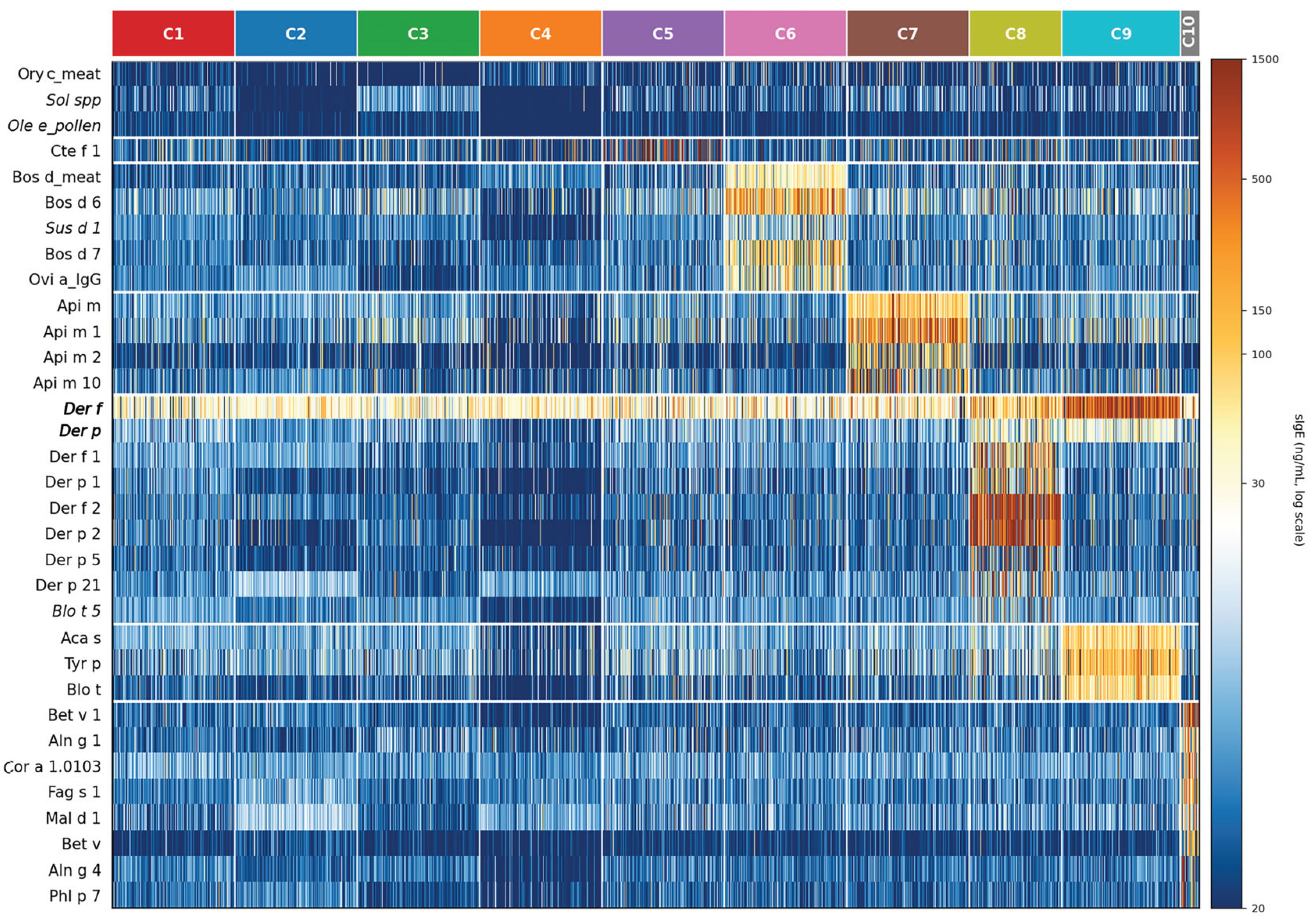
Figure 2.
Heatmap of 6,025 sensitized dogs to pollen and plant-food (PPF) allergens in the US in 2024 and 2025. Up to 350 dogs per cluster are shown, highlighting the most representative sensitization patterns. K-means clustering with k = 10, later reduced to 9 after merging two Par j 2-dominated clusters, separated sensitized dogs into four large, heterogeneous (i.e., polysensitized) clusters (C1-C4) and five smaller, biologically relevant clusters (C5-C9). Italicized allergens are supporting allergens.
Figure 2.
Heatmap of 6,025 sensitized dogs to pollen and plant-food (PPF) allergens in the US in 2024 and 2025. Up to 350 dogs per cluster are shown, highlighting the most representative sensitization patterns. K-means clustering with k = 10, later reduced to 9 after merging two Par j 2-dominated clusters, separated sensitized dogs into four large, heterogeneous (i.e., polysensitized) clusters (C1-C4) and five smaller, biologically relevant clusters (C5-C9). Italicized allergens are supporting allergens.
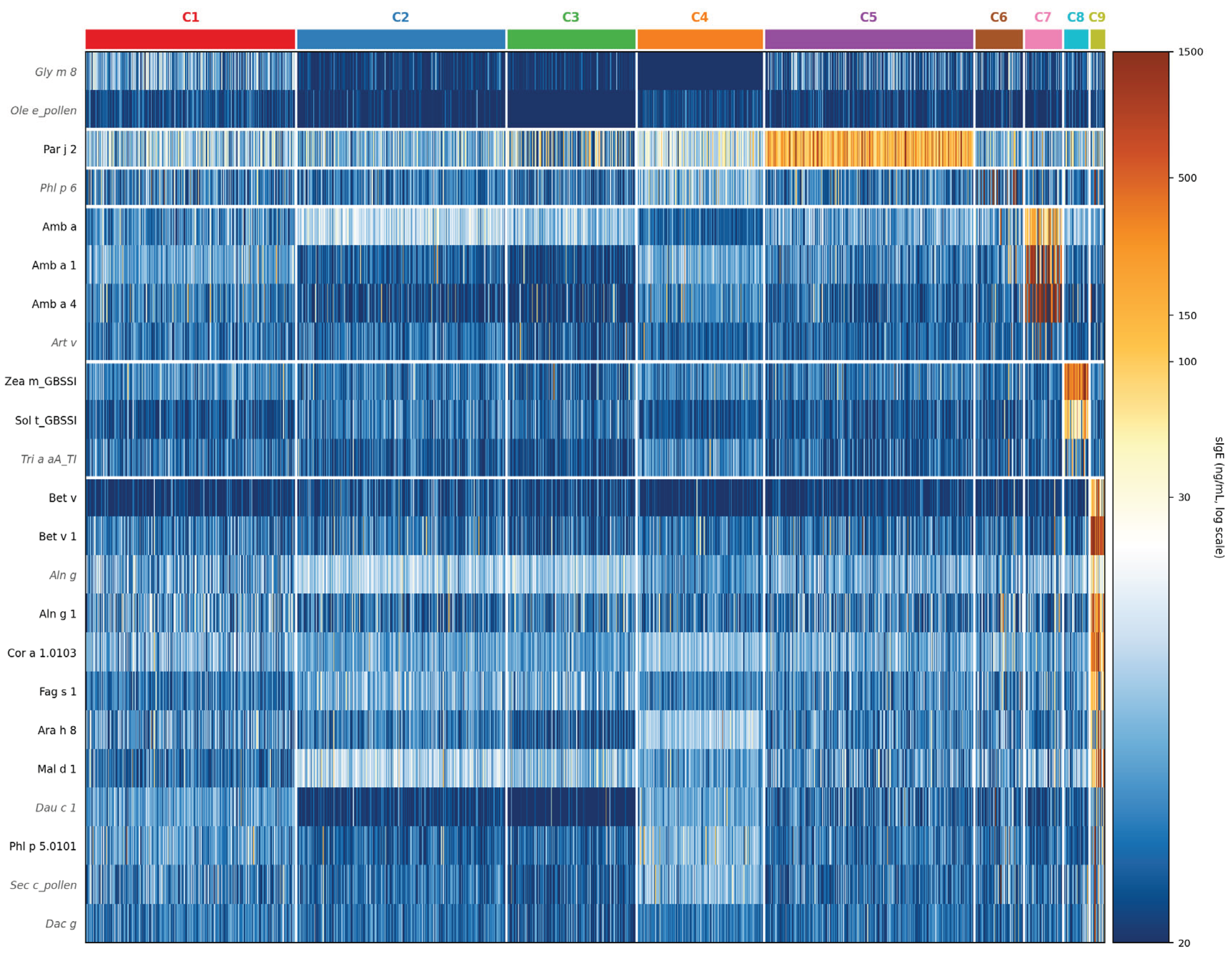

Table 1.
Top 20 sensitizations to individual allergens in dogs in the US in 2024–2025; n Positives: number of dogs sensitized to the allergen (threshold: 28 ng/mL); N Total: total number of dogs tested; % Prevalence: percentage of positive dogs over the combined 2024–2025 period.
Table 1.
Top 20 sensitizations to individual allergens in dogs in the US in 2024–2025; n Positives: number of dogs sensitized to the allergen (threshold: 28 ng/mL); N Total: total number of dogs tested; % Prevalence: percentage of positive dogs over the combined 2024–2025 period.
| Allergen | Allergen Group | n Positives (2024–2025) |
N Total (2024–2025) |
% Prevalence (2024–2025) |
|
|---|---|---|---|---|---|
| 1 | Der f | Mites | 16,202 | 21,121 | 76.7% |
| 2 | Api m 1 | Insect venoms | 3,302 | 21,121 | 15.6% |
| 3 | Ves v 5 | Insect venoms | 2,919 | 21,121 | 13.8% |
| 4 | Bos d 6 | Meats | 2,792 | 21,121 | 13.2% |
| 5 | Tyr p | Mites | 2,710 | 21,121 | 12.8% |
| 6 | Pol d 5 | Insect venoms | 2,312 | 21,121 | 11.0% |
| 7 | Api m | Insect venoms | 2,231 | 21,121 | 10.6% |
| 8 | Par j 2 | Weed pollens | 2,109 | 21,121 | 10.0% |
| 9 | Api m 3 | Insect Venoms | 1,798 | 21,121 | 8.5% |
| 10 | Aca s | Mites | 1,757 | 21,121 | 8.3% |
| 11 | Cte f 1 | Fleas | 1,567 | 21,121 | 7.4% |
| 12 | Ves v 1 | Insect venoms | 1,547 | 21,121 | 7.3% |
| 13 | Tyr p 2 | Mites | 1,514 | 21,121 | 7.2% |
| 14 | Api m 10 | Insect venoms | 1,323 | 21,121 | 6.3% |
| 15 | Amb a | Weed pollens | 1,300 | 21,121 | 6.2% |
| 16 | Ovi a_meat | Meats | 1,296 | 21,121 | 6.1% |
| 17 | Api m 2 | Insect venoms | 1,243 | 21,121 | 5.9% |
| 18 | Der p | Mites | 1,188 | 21,121 | 5.6% |
| 19 | Pis s | Legumes | 1,106 | 21,121 | 5.2% |
| 20 | Blo t | Mites | 1,067 | 21,121 | 5.1% |
Table 2.
Prevalence of sensitization to allergen categories in dogs in the US in 2024–2025; n Allergens: number of allergens in the category; n Positives: number of dogs sensitized to the allergen(threshold: 28 ng/mL); N Total: total number of dogs tested; % Prevalence: percentage of positive dogs over the combined 2024–2025 period.
Table 2.
Prevalence of sensitization to allergen categories in dogs in the US in 2024–2025; n Allergens: number of allergens in the category; n Positives: number of dogs sensitized to the allergen(threshold: 28 ng/mL); N Total: total number of dogs tested; % Prevalence: percentage of positive dogs over the combined 2024–2025 period.
| Rank | Allergen | n Allergens | n Positives (2024–2025) |
N Total (2024–2025) |
% Prevalence (2024–2025) |
|---|---|---|---|---|---|
| 1 | Mites | 25 | 16,780 | 21,121 | 79.5% |
| 2 | Insect Venoms | 13 | 8,415 | 21,121 | 39.8% |
| 3 | Meats | 22 | 4,626 | 21,121 | 21.9% |
| 4 | Weed pollens | 18 | 4,533 | 21,121 | 21.5% |
| 5 | Tree pollens | 29 | 3,934 | 21,121 | 18.6% |
| 6 | Legumes | 21 | 2,433 | 21,121 | 11.5% |
| 7 | Fleas | 1 | 1,567 | 21,121 | 7.4% |
| 8 | Grass pollens | 15 | 1,464 | 21,121 | 6.9% |
| 9 | Animal epithelia | 13 | 1,416 | 21,121 | 6.7% |
| 10 | Molds | 12 | 1,378 | 21,121 | 6.5% |
| 11 | Eggs & milk | 11 | 1,376 | 21,121 | 6.5% |
| 12 | Malassezia yeast | 6 | 1,319 | 21,121 | 6.2% |
| 13 | Cereals & grains | 16 | 1,304 | 21,121 | 6.2% |
| 14 | Fruits | 5 | 1,301 | 21,121 | 6.2% |
| 15 | Fish | 18 | 1,129 | 21,121 | 5.4% |
| 16 | Cockroaches | 8 | 1,016 | 21,121 | 4.8% |
| 17 | Tubers | 5 | 287 | 21,121 | 1.4% |
Disclaimer/Publisher’s Note: The statements, opinions and data contained in all publications are solely those of the individual author(s) and contributor(s) and not of MDPI and/or the editor(s). MDPI and/or the editor(s) disclaim responsibility for any injury to people or property resulting from any ideas, methods, instructions or products referred to in the content. |
© 2026 by the authors. Licensee MDPI, Basel, Switzerland. This article is an open access article distributed under the terms and conditions of the Creative Commons Attribution (CC BY) license (http://creativecommons.org/licenses/by/4.0/).
Copyright: This open access article is published under a Creative Commons CC BY 4.0 license, which permit the free download, distribution, and reuse, provided that the author and preprint are cited in any reuse.