
Submitted:
27 June 2026
Posted:
01 July 2026
You are already at the latest version
Abstract
Background: Antibiotic resistance is becoming a serious problem in chicken production globally due to use of antibiotics. Despite the use of antibiotics in Mzimba is well known, the Multiple antibiotic resistance index (MARI) pattern in chicken meat is not known and not documented. Objective: To assess the prevalence of antibiotic-resistant E. coli, Salmonella, and Enterobacter species in broiler chicken meat sold in informal markets in Mzimba district, Malawi. Materials and method: A cross-sectional study was conducted between March and May 2025. A total of 100 meat samples were collected from the informal markets across the district. Stratified sampling technique was used to select chicken meat samples fromm various markets. Descriptive statistics and inferential statistics were performed using R version 4.5.3. Results: E. coli (69%) and Enterobacter (12%) species were the most frequently isolated pathogens. The highest prevalence of antibiotic resistance was observed in E. coli against ampicillin (91.3%), meropenem (82.6%), and tetracycline (71%). Similarly, the Enterobacter spp. showed substantial resistance to ampicillin ( 83.3%), meropenem (75%), and tetracycline (71%). MAR Index values were considerably high, which ranged from 0.1 to 0.75. Ninety-seven percent of the isolates had MAR index values of over 0.2. Twenty-eight isolates (29%) had extreme MAR Index values of 0.5 or higher. Location was the most significant predictor of the MAR index (p = 6.096e-05, η² = 0.372). Conclusions and recommendations: High levels of MAR Index revealed in this study. MAR index reflect high-risk contaminating sources with antibiotic treatment failure in both animal and human infections, and might be shared with the environment. As such, combating MDR requires coordinated multisectoral approaches through One Health programs that integrate surveillance, policy, and innovation in clinical and non-clinical settings.
Keywords:
antibiotic resistance
; antimicrobial use
; awareness
; chicken meat
; informal markets
; Mzimba
; Malawi
Introduction
Antimicrobial resistance is a pressing global health challenge with significant implications for the environment, animal, and human health [1,2]. According to the WHO, the ecosystem, animal, and human health are interlinked, and antibiotic-resistant pathogens may be shared among them [3]. Furthermore, imbalances in these relationships can lead to new infections which can be difficult-to-treat both in humans and animals leading to an increase morbidity, mortality, and healthcare costs[4]. A significant proportion of human diseases originates from agricultural practices, such as poultry farming, which are associated with the development of antibiotic-resistant foodborne pathogens [5,6]. These pathogens are passed on to the ecosystem and humans[7]
There is high use of antimicrobials in both humans and animals globally [8,9,10]. Such use can lead to antimicrobial resistance [11,12,13,14,15]. Several antibiotic-resistant food-borne pathogens have been isolated from human samples in developing countries, like Zambia, Mozambique, Tanzania, and Malawi, which are linked to increased hospitalizations and deaths [16,17,18]. The worst scenario is that it is estimated that AMR will be responsible for 10 million deaths per year globally by 2050 if appropriate interventions are not implemented to combat its spread [19,20]. This necessitates the estimation of the levels of antimicrobial resistance in foodborne pathogens in developing countries like Malawi to inform appropriate policies and interventions. Unfortunately, most studies have been targeting human samples; however, animals play a big role in antibiotic resistance[21]. To accurately combat AMR, there is a need to tackle the source of infections, more especially farm animals, as evidence has shown that 60% of human infections originate from animals [3,5,22,23]. As such, estimating the burden of AMR in chickens, especially carcasses, could be one of the first steps in tackling AMR.
In Malawi, antibiotics are used as growth promoters, for disease prevention, and treatment of infections associated with unhygienic conditions and lack of biosecurity [24,25]. Although antibiotics are commonly used in Malawi in chicken production, efforts to enforce their regulation have had limited impact. There have been several attempts by the Malawi government in combating AMR by deploying extension workers and veterinarians in all the districts to assist in prescribing antibiotics to the animals and providing necessary information[26].
The government also developed treatment guidelines for poultry diseases in Malawi [27]. But all these efforts have had limited impact due to inadequate funding, insufficient personnel, and a lack of socio-economic incentives[28]. Additionally, farmers purchase most of the antibiotics from informal market channels or unregistered veterinary shops whose owners are not qualified veterinarians or who don’t know the phamacokinetucs and phamacodynamics of antibiotics, while others use antibiotics they receive from hospitals for human infections [25,26,29,30]). Lack of awareness and knowledge on AMR usage, improper prescriptions, and the use of antibiotics used in human medicine could lead to increased concentrations and sometimes sub-therapeutic dosing, facilitating the development of AMR in bacteria that cause chicken infections [24,25,31,32,33]. For instance, antibiotic residues have been reported in meat residues [34]. Exposure to low doses of antibiotics facilitates the development of AMR in bacteria that cause infections in chickens [35,36]. Recent studies in Malawi have reported the presence of antibiotic-resistant pathogens in broilers [36,37,38]. These resistant pathogens with resistance genes are passed on to humans directly via contact with animals, feces, food of animal origin, and the environment [3,39]
The improper use of antibiotics in chicken farming is driven by the growing demand for poultry products in Malawi as a source of animal-based proteins[40,41]. As such, farmers have resulted in non-prudent antimicrobial use on farms, with the intent to optimise growth, prevent, and treat poultry diseases for profit maximization [24,25,33]. These practices are more common among small-scale chicken farmers. Mzimba District is one of the districts in Malawi where this practice presents a growing challenge due to high demand for chicken meat, because it is less costly compared to other meat types. In this area, chicken meat is sold as a whole or cut into pieces, and consumers buy the parts they prefer. Mostly, chicken meat is sold in informal or formal markets where enforcement of food safety standards and microbial testing facilities are lacking. The informal markets in this area are also characterized by unhygienic conditions that can lead to further contamination of the meat by different foodborne pathogens such as E. coli, Salmonella, and Enterobacter species.
It was therefore the rationale of the study to assess the prevalence of antibiotic resistance of E. coli, Salmonella, and Enterobacter species in chicken meat sold in informal markets using the Multiple Antibiotic Resistance Index (MAR Index) tool. This could help in providing evidence-based interventions such as the development of food safety policies, enforcing guidelines for prudent antimicrobial use in food animals, protecting vulnerable populations from hard-to-treat infections, and understanding one health dynamics to prevent the spread of antibiotic resistance.
2. Results
2.1. Prevalence of E. coli, Salmonella spp, and Enterobacter spp
The results of the overall prevalence of E. coli, Salmonella, and Enterobacter species are presented in Figure 1. Out of the collected 100 samples, the prevalence of E.coli was high followed by Enterobacter spp then Salmonella spp.
When the results were segregated by sample collection points (location), E. coli was observed to be the most prevalent pathogen across locations, ranging from 60% in Mchengautuwa (n= 3) and Kafukule (n=6) to 100% in Luwinga (n=8), Nkholongo (n=4), and Zolozolo (n=6), followed by Enterobacter species with the highest prevalence of 40% (n=2) in Mchengautuwa (Figure 1). The least prevalent pathogen by location was Salmonella species, which was isolated from two sites only, with the prevalence of 10%(n = 1) in both sites (Area 1b and Kafukule). Of all the locations, it was only in Kafukule where all the pathogens were isolate(Figure 2).
2.2. Prevalence of Antibiotic-Resistance in E. coli, Salmonella, and Enterobacter Species
The E. coli, Salmonella, and Enterobacter species isolated from broiler chicken meat samples showed substantial resistance against the tested antibiotics (Figure 2). The highest occurrence of resistance was observed in E. coli against ampicillin (91.3%, n=63) followed by Enterobacter species against ampicillin (83.3%, n=10) and tetracycline (83.3%, n=10). Other substantial resistance was seen in E. coli against meropenem (82.6%, n=57) and tetracycline (71%, n=49). For Salmonella species, the highest levels of resistance of 50% (n=1) were recorded against ampicillin, gentamicin, and meropenem antibiotics(Figure 3).
2.2.3. Prevalence of Antibiotic Resistance by Location
The results of the prevalence of antibiotic resistance by location are presented in Table 1. It was observed that the majority of the isolates from nearly all the study sites were resistant to ampicillin(AM), meropenem(MEM), and tetracycline(TCY). Across all study sites, ampicillin ranged from 73 to 100%, meropenem ranged from 33 to 100% except at Kafukule, and tetracycline ranged from 33% to 100%. However, some isolates across the study sites demonstrated substantial susceptibility to chloramphenicol, gentamicin(GEN), ciprofloxacin(CIP), ceftriaxone(CRO), and cefepime(FEP)(Table 1).
2.2.4. Multiple Antibiotic Resistance Index of E. coli, Salmonella, and Enterobacter Species
The multiple antibiotic resistance index (MAR Index) was determined by dividing the number of antibiotic-resistant isolates by the total number of antibiotics tested, and the results are presented in Figure 4 and supplementary material Table S1 and Table S2 [42]. A very high multiple antibiotic resistance index of 0.75 was observed in 5% on E. coli and 1% of Enterobacter species. The study revealed that the highest occurrence of multiple antibiotic resistance was 33% observed in the MAR index of 0.38, followed by 20% for the MAR index of 0.50 and 18% for 0.25 MAR index in E. coli pathogen. While the most common occurrence of multiple antibiotic resistance (8%) for Enterobacter species was observed in the MAR index of 0.38. Overall, 98.6% (n=83) of the isolates had a MAR Index of above 0.2, while the least MAR index was 0.1. When the MAR indices were compared across study sites, it was observed that the indices were significantly different (p = 0.001).
2.2.5. Effect of Organism Type and Location on MAR Index
To determine wheather organism influence on MAR index, the kruskal-Wallis test revelaed that organism type had no significant effect on MAR Index (p = 0.1376)(Table 2). The Location where the samples were collected was the dominant predictor that significantly influenced the MAR Index (p ˂0.0001), with a large effect size (η² = 0.372).
To identify individual significant locations and organisms, Beta regression was performed, and the results revealed that Enukweni, Kafukule, Kaviwale, Luwinga, and Mchengautuwa had significantly lower MAR Index compared to the reference location Area 1B. Although overall organism type did not significantly influence MAR Index in the Kruskal-Wallis test, beta regression demonstrated that Salmonella species had significantly lower MAR Index compared to the reference Enterobacter species(Table 3).
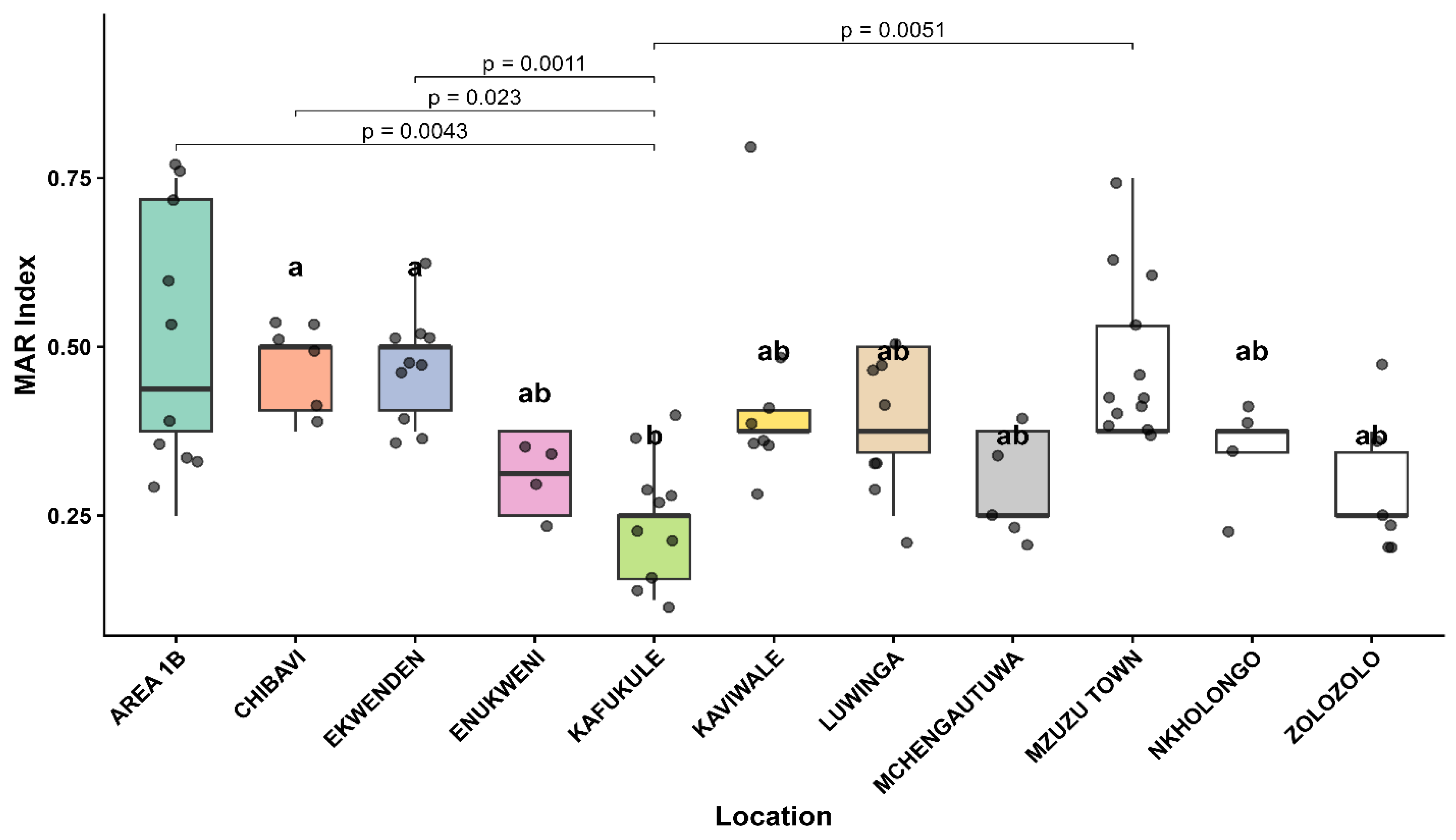
S Post-hoc Dunn’s test with Bonferroni correction was performed for pairwise comparison of locations since location was nos significant, the results revealed that Kafukule’s MAR index differed significantly from Area 1B (0.0043), Chibavi (p = 0.023), Mzuzu Town (p = 0.0051), and Ekwendeni (p = 0.0011). It was also observed that locations such as Chibavi and Ekwendeni had similar MAR index (p > 0.05). Similarly, Enukwenu, Kaviwale, Luwinga, Mchengautuwa, Nkhorongo, and Zolozolo had similar MAR index (p > 0.05).(Figure 6; Table S3).
Figure 5.
Pairwise comparisons of Multiple Antibiotic Resistance Index by Location. Locations with similar Dunn letters (e.g a or ab) do not have statistically different MAR Index.
Figure 5.
Pairwise comparisons of Multiple Antibiotic Resistance Index by Location. Locations with similar Dunn letters (e.g a or ab) do not have statistically different MAR Index.
3. Discussion
3.1. Prevalence of E. coli, Salmonella, and Enterobacter Species
According to the authors' knowledge, this is the first study to assess the prevalence of E. coli, Salmonella, and Enterobacter species in broiler chicken meat sold in informal markets in Malawi while coupling the Multiple Antibiotic Resistance (MAR) Index. The study revealed a high occurrence of Multiple Antibiotic-Resistant Index and antibiotic-resistant E. coli, Enterobacter, and Salmonella spp in the meat, which is a serious public concern. These bacteria are Extended-spectrum beta-lactamase (ESBL), which are capable of breaking antibiotics such as penicillin and cephalosporin [43].
The observed high prevalence of E. coli could be associated with fecal contamination of meat [44]. Furthermore, as a result of environmental contamination, the organism may also be present in a contaminated environment, especially fecally contaminated water used in washing the meat. The high prevalence might also be due to contamination by vendors during the slaughtering process. The ruptured digestive tract causes E. coli, which were initially present in the digestive tract, to contaminate chicken meat [45]. It was clearly shown that meat vendors were not maintaining adequate levels of hand washing when slaughtering chickens. A majority of the meat handlers were not using gloves when delivering meat to the customers. Moreover, they were using their bare hands to process the meat, and were wiping their hands with a dirty piece of cloth. These findings support the study done by Tressein France, who reported that chicken meat is easily contaminated by meat handlers during handling and processing [46] . When the results were compared with the literature, it was evident that the prevalence data can be affected by numerous factors beyond hygienic practices, for instance, lack of biosecurity in chicken production, environmental exposure, and contaminated feed [47,48,49,50,51,52]. However, the high rates observed in this study imply that hygienic practices were not optimal in these areas, necessitating further enforcement. These findings are very concerning compared to the levels reported elsewhere, such as in Indonesia (57% ) and South Africa ( 66.8%) [53,54]. These variations depict the high levels of unhygienic practices in the informal markets in Malawi that require further improvements and strict regulations, such as standardized slaughtering, hygiene, and storage practices. But similar findings were reported in Germany[55], implying that meat contamination by pathogens is a wider problem affecting different countries.
On the contrary, it was surprising to note that the occurrence of Enterobacter species in broiler chicken meat was low (12 %) compared to E. coli. These organisms are predominantly associated with gut colonization and unhygienic environments [56,57]. These low levels of Enterobacter species suggest that, despite unhygienic practices, the organism may not be ecologically dominant in the study area, or survival and growth characteristics do not favor it, and processing factors such as drying. These levels of Enterobacter species concur with the findings reported by Amer and Schwaiger in Egypt and Germany[44,58], who reported a prevalence of 20.8% and 22%, respectively, higher than the findings of 6.9% in Turkey[59]. Although the occurrence is low, these pathogens have public health significance, especially in immunocompromised individuals, particularly in Sub-Saharan Africa, where the rates of diabetes and HIV infections are high. In Malawi, the prevalence of diabetes is 5.7%, and HIV is 7%, respectively [60,61], indicating that the majority of people can be adversely affected by these organisms through the food chain. Other than Enterobacter species, the occurrence of Salmonella species was very low (0.02%), suggesting that it is also not ecologically predominant in this area. Similarly, low levels (0.005%) were reported in Zambia, indicating a regional occurrence of Salmonella in broiler chicken meat[62].
3.2. Prevalence of Antibiotic Resistance
The antibiotics that were used in this study are the ones that are used in the treatment of human infections and are commonly prescribed in public hospitals in Malawi. The high levels of antibiotic resistance observed in this study are worrisome. These high levels have public health implications as antibiotic-resistant pathogens are commonly passed on to humans through the food chain. These levels may be associated with improper overuse of antibiotics in poultry farming [63,64,65,66]. Furthermore, previous study in this area showed that the farmers in this area use antibiotics for growth promotion and treating chicken infections by using antibiotics receive from public hospitals [25]. Usually, these antibiotics are given to chickens in low dosages due to over-dilution and lack of standard dosages, leading to the development of resistance. Additionally, people in this area lack knowledge of antimicrobial resistance (AMR) and antibiotic usage, which leads to improper dosage and duration of antibiotics in chicken, which is associated with a natural imbalance of microflora, leading to a decrease in bacterial sensitivity to antibiotics [67].
The current findings show that a significant amount of resistant bacteria are present in chicken meat. Among the antibiotics tested, the pathogens were highly resistant to ampicillin (91.3%), suggesting the use of this antibiotic in chicken farming in Malawi. This concurs with a study done in India and Bangladesh, but the rates in India and Bangladesh were much higher, 100 and 94%, respectively [68,69]. On the contrary, Seo and Lee reported high levels of ampicillin resistance of 75% in E. coli in Korea, signifying that antibiotic resistance in chicken is a global problem [70]. Like E. coli and Enterobacter species isolates also demonstrated substantial ampicillin resistance. This could be just the tip of the iceberg; there could be several pathogens resistant to ampicillin or antibiotics in the penicillin group. Further research is needed to comprehensively assess the susceptibility of different foodborne pathogens to ampicillin in this area.
The prevalence rates of E. coli resistance to meropenem was 82.6%, and Enterobacter spp resistance to meropenem was 75%, thus lower than E. coli resistance. Apart from treating chickens with meropenem or using it as a growth promoter, this resistance can be attributed to cross-contamination with meat or horizontal gene transfer from E. coli infection in humans and or can be due to the cages they are kept during sale, and its common usage in chicken farming [25]. This resistance could also be caused by the fact that most farmers keep their chickens inside the main house, where people. Sleep .This is a common practice in Malawi where people keep chicken in houses to protect chickens from thieves; such poor biosecurity could lead to meropenem resistance in E. coli and Enterobacter species through exchange of pathogens between people and chickens [25]. Additionally, co-selection could be another reason for the development of resistance in E. coli and Enterobacter spp to meropenem due to chemicals farmers use as disinfectant, which contain metals, and such resistant metals can coexist with E. coli and Enterobacter spp., leading to meropenem resistance [71,72,73,74].
Hhigh levels of resistance observed in gentamicin, chloramphenicol, ceftriaxone, and cefepime can be associated with improper use of these antibiotics in this are or can be due to the lack of proper ways of discarding these expired antibiotics in this area which can contributes to E.coli, Enterobacter and Salmonella spp resistance [33,75,76]. In this area farmers either use expired drugs or, those who discard expired drugs, they bury them in the ground, others throw them in a waste bin (dug on the ground), polluting the environment, consequently, contributing to the development of resistance genes [74]. This speculate that one health is a serious problem in this region. The authorities, specifically regulators, must ensure that the cross-transfer of these pathogens is broken through a strict one-health approach that integrates surveillance, policy, and innovation [77]
Although study acknowledge the lack of oversight in informal markets and the role that these markets play in the rural economy, it is particularly very important to incorporate sustainable approaches that are acceptable to local people to ensure that AMR is defeated. Although the current study has successfully identified meropenem resistance in poultry, future studies should consider triangulating the assessment of AMR and antibiotic use in humans, animals, and the ecosystem in this area. Otherwise, meropenem resistance is a serious public health issue, because this antibiotic belongs to the carbapenem group, which is used in the treatment of human skin and stomach infections in adults and children as a last resort to fight bacterial infections [78,79]. According to the WHO, meropenem is classified as one of the high-priority antibiotics, and studies in developed and developing countries have reported the emergence of E. coli and Salmonella species resistance to meropenem in the food chain, consistent with our findings [80]. However, resistance in this study was identified phenotypically; future studies should focus on the detection of carbapenemase production or other resistance pathways.
It is concerning that resistant pathogens are difficult to treat and they pose serious risks of disease transmission, serious illness, disability, and death. The improper use of selected antibiotics also has the potential to make antibiotics in the same class, or that have similar mechanisms of action, ineffective, thereby limiting the selection of antibiotics in human treatment[48]. For instance, Egocin is widely used in Malawi for treatment and as a growth promoter in poultry; it contains oxytetracycline, which promotes resistance to similar drugs like tetracycline. High levels of tetracycline of 83.3% in Enterobacter species could be attributed to the use of Egocin and tetracycline.
Ciprofloxacin and gentamicin resistance was low and could be due to the increased use of quinolones and neomycin, respectively, in poultry farms. Neomycin is also one of the commonly used growth promoters and antibiotics used in Malawi [12]. It has a structure similar to gentamicin and contributes to gentamicin resistance. Similar levels of antibiotic resistance were reported by others in Malawi, Korea, and India, with levels ranging from 69 to 90%, highlighting a global problem and the need for multinational collaborations [37,81,82]. This global issue becomes more complex when these pathogens gain resistance to multiple antibiotics. Others across the world have reported that some strains of bacteria isolated from chickens displayed multidrug resistance, which is associated with improper use of antibiotics in the poultry industry [83,84,85,86].
To understand antibiotic resistance better, one of the recommended surveillance methods, the multiple antibiotic resistance (MAR) index, was employed. In this study, 98.6% of the isolates' locations had a MAR index of above 0.2, which is very concerning. An index above 0.2 suggests that almost all the samples were collected from high-risk areas. This MAR index threshold indicates that pathogens in chickens in these areas are exposed to selective pressure, which promotes multiple antibiotic resistance [87]. Other pathogens, particularly E. coli, revealed extreme MAR indices of 0.63 and 0.75. Therefore, the selection of antibiotics for the treatment of animal and human pathogens in this area may not be easy, as indicated by MAR index values. To combat E. coli or Enterobacter infections in this area, evidence-based treatment should be a priority both in animal and human beings. Antibiotic susceptibility testing should be a priority before prescribing antibiotics due to the recorded high levels of MAR Index and Multidrug Resistance (MDR). It should be routinely and comprehensively done to assess the levels of resistance in other pathogens targeting all the antibiotics used in human treatment, as people in this area use antibiotics aimed at treating human infections in poultry[25]. Furthermore, coordinated or multi-sectoral surveillance programs such as integrated One Health surveillance need to be instituted; if present, they should be strengthened in public health and agriculture to halt the rising incidence of multidrug resistance.
This study demonstrated that sampling location is the most important predictor of the MAR index, unlike the bacterial species, with a Pseudo R-squared of 0.43. For environmental or biological data, this strongly suggests that location and organism explain a substantial portion of the variance in resistance. Area 1B exhibited a significantly higher MAR index compared to Kafukule, Enukweni, Ekwenden, and Mzuzu Town. While the Kafukule study site showed the lowest index. This implies that the profiles of antibiotic resistance are driven by external factors such as the environment and farm management practices rather than heterogeneity across species. In this study, some locations showed significantly higher MAR index (p < 0.05) compared to others, signifying the power of variation due to practices associated with farming and markets, such as antimicrobial use, marketing channels, and hygienic practices, among others. Studies have documented that unregulated antibiotic use is associated with increased MAR Indices [88]. This notion supports this study that some locations are reservoirs of multidrug-resistant bacteria.
Through previous study done in this area, identified unregulated and improper use of antibiotics in broiler chickens in these areas [25]. These findings suggest that co-exposure of bacteria to a similar environment leads to similar patterns of antibiotic resistance. As such, to combat antibiotic resistance, interventions must not be bacteria-specific but rather focus on environmental controls, mostly in high-risk locations. These findings align with the One Health framework that recognizes the role of human, animal, and environmental interactions in the spread of antibiotic-resistant bacteria [89]. For instance, the reported high levels of multiple antibiotic resistance in the current study are associated with poultry; the resistant bacteria can be shared with humans through contact or the food chain, and the waste from animals and humans carrying resistant strains can be shared with the environment. Similar patterns of MAR index have been reported in multiple types of bacterial isolates from the environment, poultry farms, chicken droppings, and meat for various antibiotics in different countries, indicating a serious global One Health problem [90,91,92,93,94,95].
Although the study was well executed, it has limitations, especially those that are associated with the generalization of the findings. For instance, the study was conducted in one district, and it was limited to broiler chickens. As such, generalizations arising from this study should be taken with caution. However, the results of this study may offer a baseline comparison with other districts in Malawi and chicken breeds. The study did not assess meat quality and one health approach of integrating meat, environmental, and human samples (vendors' hands) in assessing the relationship in terms of levels of bacteria and AMR. Similarly, the study did not attempt to assess the presence of antibiotic residues in broiler chicken meat and resistance genes, which could help in explaining the reasons for the high MAR index values. The absence of molecular confirmation of isolated pathogens and the lack of appropriate quality control strains for Salmonella and Enterobacter might also significantly affect the reliability of the results. Additionally, the use of existing laboratory protocols for sample analysis and ISO standards for analysis of Enterobacter spp and Salmonella spp are also limitations of this study due . Therefore, future studies should aim at assessing the prevalence of antibiotic residues and antibiotic resistance genes such as carbapenemase-producing genes (e.g., blaNDM, blaKPC) in bacteria isolated from chicken meat, as the current study lacks genotypic data. Future studies should also consider correlating both bacterial count to check quality and antibiotic resistance. Furthermore, comparing the antibiotic resistance profile among the environment, animals, and human beings should be a future focus.
4. Material and Method
4.1. Study Area and Period
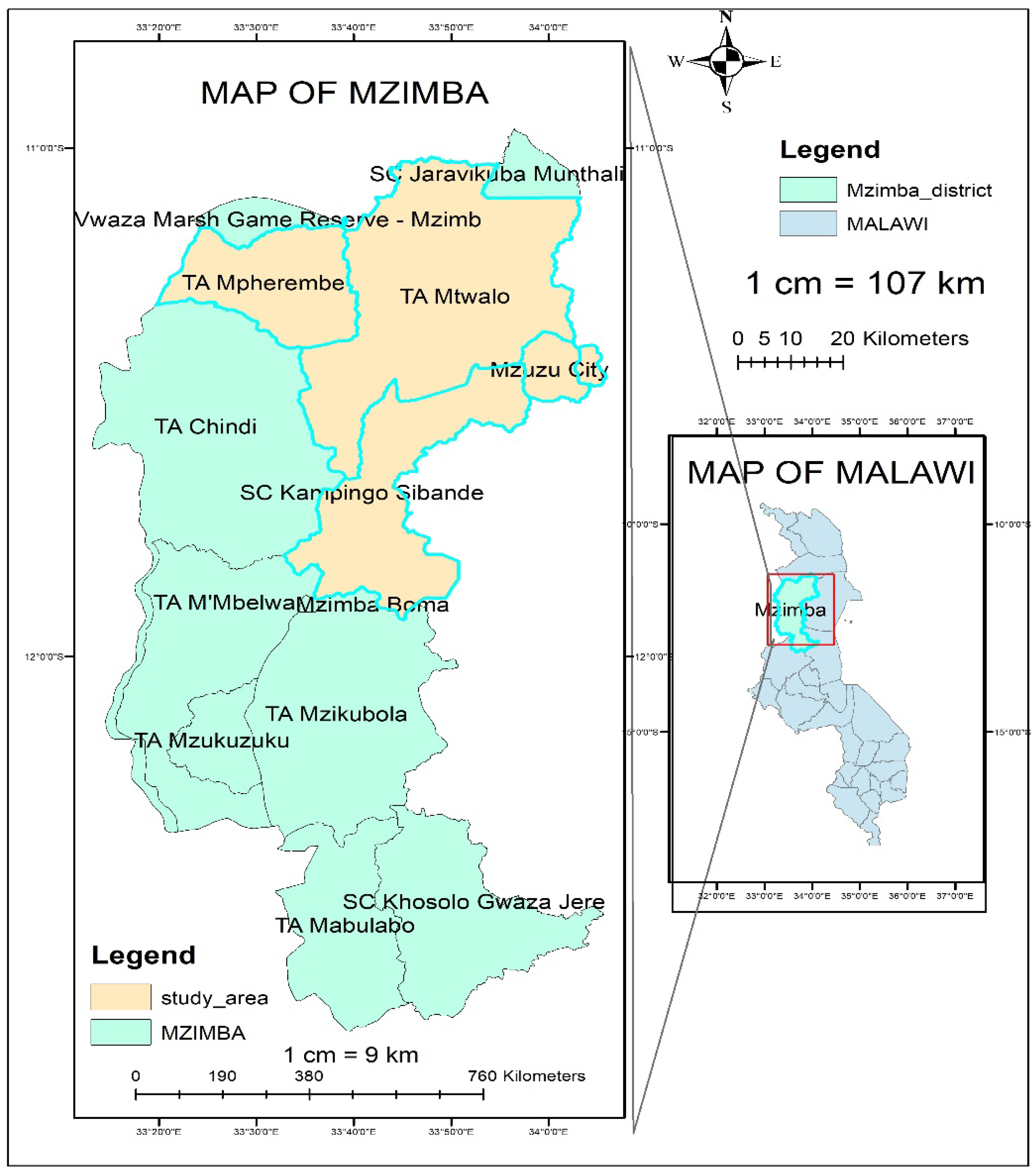
The study was conducted in the northern region of Malawi, Mzimba District, targeting informal markets from March 4, 2025, to 21 May 2025. Mzimba District is located at a latitude of 11° 54’ 0" S and longitude: 33° 36’ 0" E. The study was conducted from March to May during the rainy season, the rainy season promote bacteria multiplication and survival in meat samples. This district covers an area of 10,430 km² and has a population of approximately 610,944. The study was conducted in the following informal markets: Enukweni, Ekwendeni, Kafukule, Mzuzu town, Chibavi, Mchengautuwa, Zolozolo, Area 11B, Nkholongo, Luwinga, and Kavibale. These areas have a notably large population of small-scale chicken farmers and vendors who sell chicken meat. Most people come to these areas to buy chicken meat as a source of protein, because meat is less costly. At the same time, these areas act as trade centers where people can buy things in bulk, suggesting a suitable catchment area for sample collection.
Figure 6.
Map of Malawi showing the location of Mzimba district in green (on the right), and study areas are in yellow . The map was drawn using ArcGIS Version 15 Software (Esris California, USA).
Figure 6.
Map of Malawi showing the location of Mzimba district in green (on the right), and study areas are in yellow . The map was drawn using ArcGIS Version 15 Software (Esris California, USA).
4.2. Study Design, Study Participants, Sampling Method, and Sample Size
A cross-sectional survey was conducted in the informal markets of Mzimba Districts. The sample size was calculated using OpenEpi, version 3 (www.openEPI.com), a tool designed for epidemiologic statistics. It was calculated using the formula below:
n = [DEFF x Np (1-p)]/ [(d2/Z21-α/2 x (N-1) +p x (1-p)]
Where:
n: sample size
DEFF: Design effect: 1.0
N: population size: (the total number of vendors selling/slaughtering chicken in Mzimba North)
d: confidence limits as % of 100 (absolute +/-%: 5%)
p hypothesized % frequency outcome in a population: 50%+/-5
α (alpha): 0.05
Z= 1.96
OpenEpi was used to ensure that each chicken meat collected from each vendor had an equal chance of being selected, and ensure generalization of the results to the population. Using OpenEpi, the total sample size calculated for the study was 97 while the study population (total number of chicken vendors) was 124 according to the sampling frame of vendors known to sell chicken; however, 100 samples were collected instead of 97 samples to increase the sample size power. Potential participants were identified with the help of the market chair in each market. The markets were purposively selected based on the number of vendors who sell chicken meat. The stratified sampling technique was used to select the vendors from which the meat samples were obtained. In this technique, each market was considered an individual stratum comprising the accessible population of vendors, and individuals were selected from each stratum using simple random sampling. In simple random sampling, a lottery method was used to select the vendors by giving them number codes, and then a person was masked (blind folded) to pick a paper by chance until the required number was reached. Finally, the meat samples were randomly collected from these vendors. From each vendor, only one chicken sample collected. Since the vendors could sell chicken spefic from one farmer, the sample collected could replesent all chickens which are supposed to be slaughtered during particular time, and could replesent the flock/farmer from where were obtained.
4.3. Inclusion and Exclusion Criteria
4.3.1. Inclusion Criteria
The sampling frame comprised all the fresh broiler chicken meat samples collected immediately after slaughter in the informal markets. All fresh broiler chicken meat collected during slaughtering was included in the sample.
4.3.2. Exclusion Criteria
All chicken meat sold in shops in bulk or retail were not included in the sample. Local breed meat of chickens and layers were also excluded from the study.
4.4. Sample Collection
Sample collection was conducted in accordance with ISO standard 17604:2015 [96]. Aseptic techniques were used through the use of gloves to collect two grams of chicken meat using forceps and a sterile surgical knife while ensuring that the blade was replaced between samples to prevent cross-contamination. Additionally, a sterile swab was used to collect samples by swabbing all internal parts and neck regions of the carcass following slaughter[96] . Both meat and sterile swabed samples were kept in a 30 mls of peptone water container as a pool sample. The use of 30 ml peptone water was based on the laboratory protocol. Then they were transported to the Mzuzu Veterinary Laboratory in an isothermal box with ice packs, maintaining a temperature of less than 4 degrees. The temperature was monitored by a thermometer throughout sampling, transpoting, and laboaratory sample processing stages. In the laboratory, the samples were left in peptone water for 24 hrs in incubator, and processed after 24 hours [97].
4.5. Sample Processing, Bacterial Isolation, and Identification
4.5.1. Quality Control
Quality control for the incubator, fridge, and biosafety cabinet was checked in terms of temperature before, during, and after the experiments. Positive and negative quality controls (QCs) of all the culture media used in the study were performed during media preparation and incubation to check media performance and sterility (contamination). This included documenting the culture medium name, brand, color, gross appearance, texture, and quantity of the weighed powdered media. Then, the appropriate amount of water was measured, and the pH of the broth was assessed. After media preparation, QCs were performed to verify the physical appearance, including the absence of wrinkles and precipitates, and to confirm sterility. For quality assurance of E. coli, the strain E. coli ATCC 25922 was used as a QC reference organism, while for Salmonella and Enterobacter species, previously isolated organisms were used as reference organisms but were not fully assigned a code. All internal QC procedures were conducted in accordance with the CLSI 2022 guidelines [98].
4.5.2. Sample Preparation
Each meat sample, along with a carcass swab, was placed in 30 mL peptone water (BPW) in a Falcon tube and incubated overnight at 37°C.
4.5.3. Isolation of E. coli
Isolation and identification were performed according to ISO 7251:2005 [99]. Aseptic techniques were followed while isolating E. coli. Each enriched sample was inoculated on mankokey agar using steriled roop and incubated at 37°C for 24 hours. Positive colonies, indentified by their pink and yellow coloration, were sub cultured onto MacConkey agar and incubated under the same temperature for an additional 24 hours. For identification, pick-red coloration on MacConkey agar a underwent microscopic characterization via Gram's stain [100]. This was followed by seven biochemical tests, which include the Triple Sugar Iron (TSI) test, catalase, indole, oxidase, lysine, growth in urea, and Simon citrate test. Colonies exhibited gram negative rods with red color, acid slant/acid butt in TSI with gas production (+) and no hydrogen sulphate production, indole positive, catalase positive, urease negative, oxidase negative, lysine decarboxylation positive and Simon Simmons citrate negative were regarded to be E.coli spp.
4.5.4. Isolation of Salmonella spp
The preparation and isolation of meat samples were conducted using some methology from ISO 6579-1:2017 (ISO, 2017). Aseptic techniques were followed during the isolation of Salmonella spp. Each enriched sample was inoculated on Xylose lysine tergitol 4 (XLT4) using steriled roop and incubated at 37°C for 24 hours. Positive colonies, indentified by blue-green to blue with black centers coloration, were sub cultured onto XLT4) and incubated under the same temperature for an additional 24 hours. For identification, pick-red coloration on MacConkey agar a underwent microscopic characterization via Gram's stain.. After the microscopic examination, a series of biochemical tests were performed, including the Triple Sugar Iron (TSI) test, motility, indole, oxidase, lysine, growth in urea, Simon citrate test, and catalase tests. Colonies exhibited gram negative rods, alkaline slant/acid butt in TSI with hydrogen sulphate production, urease test negative, indole negative, catalase positive, urease negative, oxidase negative, lysine decarboxylation positive and Simon citrate positive were regarded to be Salmonella spp.
4.5.5. Isolation of Enterobacter Species
All samples for Enterobacter spp. were handled in accordance with ISO 21528-1:2017 . Aseptic techniques were followed during the isolation process. Each enriched sample was inoculated on mankokey agar and Xylose lysine tergitol 4 (XLT4) agar using steriled roop and incubated at 37°C for 24 hours. Positive colonies, indentified by pink-colored and yellow on MacConkey agar and (XLT4) agar, respectively, were subcultured onto MacConkey agar and Xylose lysine tergitol 4 (XLT4) agar . For identification, colonies exhibiting round pink on MaConkey agar and round yellow colonies on XLT4 underwent microscopic characterization via Gram's stain [100]. This was followed by biochemical tests, which include the Triple Sugar Iron (TSI) test, urea test, indole, oxidase, lysine, growth in urea, Simon citrate test, and catalase tests. Colonies exhibited gram negative rods with red color, acid slant/acid butt in TSI with gas production (+) and no hydrogen sulphate production, indole positive, catalase positive, urease negative, oxidase negative, lysine decarboxylation positive and Simon Simmons citrate positive were regarded to be Enterobacter spp.
4.5.6. Antibiotic Susceptibility Testing (AST)
The Kirby–Bauer disk diffusion method is recommended for antimicrobial testing [98]. This method was used for the antimicrobial susceptibility testing of E. coli, Salmonella spp., and Enterobacter spp. The AST was conducted on Mueller-Hinton agar according to the guidelines of Clinical and Laboratory Standards 20222 [98]. All isolates were evaluated for antimicrobial susceptibility using the following antibiotics: Ampicillin (10 µg), Ceftriaxone (30 µg), Chloramphenicol (10 µg), Cefepime (30 µg), Meropenem (10 µg), Gentamicin (10 µg), Tetracycline (5µg and 10 µg). The selection of these antibiotics was based on their priority classification, considering their importance for humans and animals [102], as well as their significance in animal production [103]. Additionally, the availability of these antibiotic types in the Mzuzu testing laboratory of was considered.
A single colony was picked from a pure culture of E. coli, Salmonella spp., and Enterobacter spp. agar plates, and suspended in 0.9% saline water, adjusting the solution to match a 0.5 McFarland turbidity standard. A volume of 0.1 mL from the 0.5 McFarland suspension was then swabbed evenly in at least three directions on Mueller-Hinton agar plates. After allowing each plate to dry, antimicrobial discs were placed at a specific location on the agar plates for further testing. The discs were placed 24mm apart by using discs’ dispenser and gently pressed down onto the agar surface to ensure uniform contact. The inoculated plates were then incubated at 37 ºC for 18 to 20 hrs. After incubation, each plate was examined, and the diameter of the zone of inhibition was measured to the nearest whole millimeter with a measuring clipper ruler against a nonreflecting background. For E.coli, and Enterobacter spp The results were interpreted and categorized as Sensitive (S), Intermediate (I), and Resistant (R) according to the CLSI interpretation table[104] (Table 4).
4.5.7. Data Management and Analysis
Data from the Laboratory study were initiallyentered into WHONET software version 2020 (World Health Organization, Geneva, Switzerland), a tool globally recognised for management, quality control, and surveillance of antimicrobial resistance. Then, the data from WHONET were extracted as an Excel file, cleaned, and analyzed using R statistical software, version 4.5.3 (R Core Team). Descriptive statistics were used to summarize data on the prevalence and resistance patterns among the tested microorganisms (E. coli, Salmonella, and Enterobacter species) in the form of frequencies and percentages. Inferential statistics were performed to compute pairwise comparisons and the effect of location and organism on the MAR index. Before analyzing the MAR index, the data were assessed for normality assumption using the Shapiro-Wilk test and visual inspection of Q-Q plot (Table S4; Figure S1). Then, the Kruskal-Wallis test was performed to determine the overall effect of location and organism type. Pairwise comparisons of the MAR index across study sites were performed using post-hoc Dunn’s test with Bonferroni correction to adjust for multiple testing. Eta-squared ((η²) was used to calculate effect sizes and were interpreted as small (<0.06), moderate (0.06–0.14), or large (>0.14).
A beta regression model was fitted to assess the relationship between the MAR index (dependent variable) and location and organism (independent variables/predictors). The analyzed parameters were estimated using the logit link function. Beta regression was selected because the assessed dependent variable was a continuous variable bounded between 0 and 1. However, there was no MAR index equal to 0 or 1; as such, boundary adjustment transformation was not considered in this study. Additionally, the Beta regression model was preferred over generalized linear models (GLMs), because it is suitable for modelling proportional data with heteroscedasticity and asymmetry, like MAR index data[105,106].
The multiple antibiotic resistance (MAR) index was determined for each isolate by using the formula MAR = a/b, where “a” represents the number of antibiotics to which the test isolate showed resistance, and “b” represents the total number of antibiotics used against that specific isolate in susceptibility testing [42]. All analyses were conducted at an alpha level of ≤0.05 with adjustment for multiple testing as mentioned above. Sensitivity analysis was performed to assess the robustness of MAR index results by using the MAR index, organism type, location, total antibiotic resistance, and resistance profiles variables (Table S5). In sensitivity analysis, data were stratified by organism type and location to assess if resistance patterns are driven by these parameters. To assess whether extreme cases of the MAR index drive the results, indices ≥0.75 were removed from the analyses, and the full dataset MAR index median was compared with the median of the dataset without extreme MAR indices. Finally, a leave-one-species-out analysis was performed to assess whether a particular organism type disproportionally influenced the results.
4.5.8. Ethical Approval
Ethical approval was obtained from the Department of Animal Health and Livestock (DAHLD) in Malawi (Ref: NO DAHLD/AHS/01/2025/02). Informed oral consent was obtained from every chicken vendor before sample collection. The researcher ensured that the vendors had fully understood the study objectives, the sample collection process, their role during sample collection, and the usage of the data before obtaining the consent.
5. Conclusion and Recommendation
The study has demonstrated a high contamination of broiler chicken meat samples with E. coli in Mzimba district, Malawi, while Enterobacter and Salmonella species contaminations were low. E. coli and Enterobacter species were the most resistant pathogens to ampicillin, tetracycline, and meropenem. High MAR Index and MDR revealed in this study means that there is a need to train the farmers on proper usage of antibiotics in chicken production, including good management practices. Similarly, vendors must also be educated on proper hygiene practices when handling chicken meat. Finally, a high MAR Index indicates necessitates that there is need further identification of the resistance genes and their sources by incorporating One Health approaches on MDR by integrating surveillance, policy, and innovation.
Supplementary Materials
The following supporting information can be downloaded at the website of this paper posted on Preprints.org.
Authorship Contribution
All authors provided meaningful contributions to the overall framework and overall final version of the manuscript. Conceptualization, A.C.C, J.M, N.M.B and B.M; Methodology, AK,NK, MLI,MM,G.E.Z, P.M., S.M, J.M, A.C.C, M.H.K, N.M.B and B.M; software, A.C.C; validation, N.M.B, J.M and BM; formal analysis, W.A.F., A.C.C,MM, A.P, P.M and N.M.B; field work and investigation, A.C.C, S.M , K.C and J.M; resources, S.M, KC, A.C and P.M; data curation, A.C.C, J.M, N.M.B, and A.P; writing original draft preparation, T.M.,P.M, M.H.K, A.C.C, B.M, M.M, K.C,A.K,N.F, N.M.B; writing review and editing,P.M,R.M,K.C J.M, N.M.B and B.M; visualization, T.M., A.C.C, J.M,M.H.K, N.M.B, G.E.Z, and B.M; supervision, J.M, N.M.B and B.M; project administration, A.C.C, N.M.B,B.M; funding acquisition, A.C. All authors have read and agreed to the published version of the manuscript.
Funding
Supported by the Centre of Excellence in Agri-Food Systems and Nutrition (CE-AFSN) in Mozambique.
Institutional Review Board Statement
Authority to conduct research in Malawi was granted by the Department of Animal Health and Livestock Development (DAHLD) (Reference No. DAHLD/AHC/01/2025/02), dated 28 January, 2025.
Informed Consent Statement
Before the collection of broiler chicken meat samples from informal markets,a verbal informed consent statement was obtained from the sellers after thoroughly explaining the study details, and the roles of the vendors. All participants voluntarily agreed to participate in this research by allowing the collection of samples.
Data Availability Statement
The majority of the data generated in this study are presented in the results section through tables, figures and supplementary files. Additional data can be obtained from the corresponding authors upon reasonable request.
Acknowledgments
Sincere gratitude is expressed by the authors to the Centre of Excellence in Agri-Food Systems and Nutrition (CE-AFSN) in Mozambique, and gratitude to the Department of Animal Health and Livestock Development (DAHLD) of Malawi, Mzuzu Veterinary Laboratory staffs. Gratitude also goes to all of the broiler chicken vendors for their contribution during sample collection.
Conflicts of Interest
Declare no conflicts of interest in this study.
References
- Scott, H.M.; Acuff, G.; Bergeron, G.; Bourassa, M.W.; Gill, J.; Graham, D.W.; Kahn, L.H.; Morley, P.S.; Salois, M.J.; Simjee, S.; et al. Critically Important Antibiotics : Criteria and Approaches for Measuring and Reducing Their Use in Food Animal Agriculture. 2019, 1441, 8–16. [CrossRef]
- Hagos, Y.; Gugsa, G.; Awol, N.; Ahmed, M.; Tsegaye, Y.; Abebe, N.; Bsrat, A. Isolation, Identification, and Antimicrobial Susceptibility Pattern of Campylobacter Jejuni and Campylobacter Coli from Cattle, Goat, and Chicken Meats in Mekelle. journals.plos.org 2021, 16. [CrossRef]
- FAO, UNEP, WHO, and W. One Health Joint Plan of Action, 2022–2026. Working Together for the Health of Humans, Animals, Plants and the Environment; 2022; ISBN 9789251369579.
- Alewy Almashhadany, D.; I. Mohammed, H.; Abdulwahid M. Muslat, T.; F. Rashid, R.; R. Hassan, R.; O. Hassan, A. Antimicrobial Residues in Meat and Meat Products. Heal. Risks Food Addit. - Recent Dev. Trends Food Sect. 2024. [CrossRef]
- Aworh, M.K.; Kwaga, J.K.P.; Hendriksen, R.S.; Okolocha, E.C.; Thakur, S. Genetic Relatedness of Multidrug Resistant Escherichia Coli Isolated from Humans, Chickens and Poultry Environments. Antimicrob. Resist. Infect. Control 2021, 10. [CrossRef]
- Ge, H.; Xu, Y.; Hu, M.; Zhang, K.; Zhang, S.; Jiao, X.; Chen, X. Isolation, Characterization, and Application in Poultry Products of a Salmonella-Specific Bacteriophage, S55. J. Food Prot. 2021, 84, 1202–1212. [CrossRef]
- Gothwal, R.; Shashidhar, T. Antibiotic Pollution in the Environment: A Review. Clean - Soil, Air, Water 2015, 43, 479–489. [CrossRef]
- Mulchandani, R.; Wang, Y.; Marius, G.; Boeckel, T. PLOS GLOBAL PUBLIC HEALTH Global Trends in Antimicrobial Use in Food- Producing Animals : 2020 to 2030. 2023, 1–11. [CrossRef]
- Van, T.T.H.; Yidana, Z.; Smooker, P.M.; Coloe, P.J. Antibiotic Use in Food Animals Worldwide, with a Focus on Africa: Pluses and Minuses. J. Glob. Antimicrob. Resist. 2020, 20, 170–177. [CrossRef]
- Kimera, Z.I.; Mshana, S.E.; Rweyemamu, M.M.; Mboera, L.E.G.; Matee, M.I.N. Antimicrobial Use and Resistance in Food-Producing Animals and the Environment: An African Perspective. Springer 2020, 9. [CrossRef]
- Adebowale, O.; Abubakar, R.H.; Fasanmi, O.G.; ... Antimicrobial Usage in Pig Production : Effects on Escherichia Coli Virulence Profiles and Antimicrobial Resistance. … J. Vet. … 2019. [CrossRef]
- Mankhomwa, J.; Tolhurst, R.; M’biya, E.; Chikowe, I.; Banda, P.; Mussa, J.; Mwasikakata, H.; Simpson, V.; Feasey, N.; MacPherson, E.E. A Qualitative Study of Antibiotic Use Practices in Intensive Small-Scale Farming in Urban and Peri-Urban Blantyre, Malawi: Implications for Antimicrobial Resistance. Front. Vet. Sci. 2022, 9, 1–16. [CrossRef]
- Mousavi Khaneghah, A.; Abhari, K.; Eş, I.; Soares, M.B.; Oliveira, R.B.A.; Hosseini, H.; Rezaei, M.; Balthazar, C.F.; Silva, R.; Cruz, A.G.; et al. Interactions between Probiotics and Pathogenic Microorganisms in Hosts and Foods: A Review. Trends Food Sci. Technol. 2020, 95, 205–218. [CrossRef]
- Geta, K.; Kibret, M. Knowledge , Attitudes and Practices of Animal Farm Owners / Workers on Antibiotic Use and Resistance in Amhara Region , North Western. Sci. Rep. 2021, 1–13. [CrossRef]
- Dyar, O.J.; Zhang, T.; Peng, Y.; Sun, M.; Sun, C.; Yin, J.; Ding, L.; Sun, C.; Wang, Y.; Sun, Q.; et al. Knowledge , Attitudes and Practices Relating to Antibiotic Use and Antibiotic Resistance among Backyard Pig Farmers in Rural Shandong Province , China. Prev. Vet. Med. 2020, 175, 104858. [CrossRef]
- IHME The Burden of Antimicrobial Resistance ( AMR ) in Malawi. 2019, 1–4.
- Mshana, S.E.; Matee, M.; Rweyemamu, M. Antimicrobial Resistance in Human and Animal Pathogens in Zambia, Democratic Republic of Congo, Mozambique and Tanzania: An Urgent Need of a Sustainable Surveillance System. Ann. Clin. Microbiol. Antimicrob. 2013, 12. [CrossRef]
- Shawa, M.; Furuta, Y.; Paudel, A.; Kabunda, O.; Mulenga, E.; Mubanga, M.; Kamboyi, H.; Zorigt, T.; Chambaro, H.; Simbotwe, M.; et al. Clonal Relationship between Multidrug-Resistant Escherichia Coli ST69 from Poultry and Humans in Lusaka, Zambia. FEMS Microbiol. Lett. 2022, 368. [CrossRef]
- Otaigbe, I.I.; Elikwu, C.J. Drivers of Inappropriate Antibiotic Use in Low- and Middle-Income Countries. JAC-antimicrobial Resist. 2023, 5, dlad062. [CrossRef]
- Neill, J. TACKLING DRUG-RESISTANT INFECTIONS GLOBALLY : FINAL REPORT AND RECOMMENDATIONS THE REVIEW ON. 2016.
- Hernando-Amado, S.; Coque, T.M.; Baquero, F.; Martínez, J.L. Defining and Combating Antibiotic Resistance from One Health and Global Health Perspectives. Nat. Microbiol. 2019, 4, 1432–1442. [CrossRef]
- Uchil, R.R.; Kohli, G.S.; Katekhaye, V.M.; Swami, O.C. Strategies to Combat Antimicrobial Resistance. J. Clin. Diagnostic Res. 2014, 8, 8–11. [CrossRef]
- Hernando-amado, S.; Coque, T.M.; Baquero, F.; Martínez, J.L. One Health and Global Health Perspectives. Nat. Microbiol. 2019, 4. [CrossRef]
- Mtila, S.; Moodley, A.; Msefula, C.; Mkakosya, R. Patterns and Drivers of Antibiotic Use in Small-Scale Broiler Production Systems in Lilongwe District , Malawi. Prev. Vet. Med. 2024, 230, 106263. [CrossRef]
- Chipembo, A.C.; Zulu, G.E.; Mastala, P.I.; Mvula, S.; Malinki, T.S.G.; Friday, W.; Kalumbi, M.; Pondja, A.; Musaya, J.; Moiane, B.; et al. Antimicrobial Use and Resistance : Knowledge , Attitudes , and Practices of Broiler Farmers in Mzimba , Malawi. Antibiotics 2026, 15, 1–21, doi:https://www.mdpi.com/2079-6382/15/3/239.
- Kainga, H.; Phonera, M.; Kallu, S.A.; Chatanga, E.; Mwenifumbo, M. Knowledge, Attitudes and Practices of Veterinarians and Para-Veterinarians towards Antimicrobial Stewardship in Malawi: Underutilized Strength in the Fight against Antimicrobial Resistance. 2025.
- DAHLD National Livestock Development Policy: Department of Animal Health and Livestock Development. Natl. Policy 2021, 2, 1–28.
- WHO Malawi National Action Plan on Antimicrobial Resistance; 2022; ISBN 9789240056848.
- MacPherson, E.E.; Reynolds, J.; Sanudi, E.; Nkaombe, A.; Mankhomwa, J.; Dixon, J.; Chandler, C.I.R. Understanding Antimicrobial Use in Subsistence Farmers in Chikwawa District Malawi, Implications for Public Awareness Campaigns. PLOS Glob. Public Heal. 2022, 2, 1–17. [CrossRef]
- Mhone, A.L.; Muloi, D.M.; Moodley, A. Understanding the Veterinary Antibiotic Flow in Malawi: Complexities, Gaps and Needs. Front. Vet. Sci. 2024, 11, 1–10. [CrossRef]
- Chilawa, S.; Mudenda, S.; Daka, V.; Chileshe, M. Knowledge , Attitudes , and Practices of Poultry Farmers on Antimicrobial Use and Resistance in Kitwe , Zambia : Implications on Antimicrobial Stewardship. 2023. [CrossRef]
- Kimera, Z.I.; Mshana, S.E.; Rweyemamu, M.M.; Mboera, L.E.G.; Matee, M.I.N. Antimicrobial Use and Resistance in Food-Producing Animals and the Environment: An African Perspective. Springer 2020, 9. [CrossRef]
- Abraham, A.; Mtewa, A.G.; Chiutula, C.; Mvula, R.L.S.; Maluwa, A.; Eregno, F.E.; Njalam’mano, J. Antimicrobial Use and Manure Management Among Pig and Poultry Farmers in Malawi. Antibiot. (Basel, Switzerland) 2025, 14. [CrossRef]
- Zulu, G.E.; Bila, N.M.; Chipembo, A.C. Antibiotic Residues in Animal-Food Matrices in the Southern Africa Development Community : A. J. Food Prot. 2026, 100764. [CrossRef]
- Phiri, N.; Mainda, G.; Mukuma, M.; Sinyangwe, N.N.; John, L.; Kwenda, G.; Muligisa-Muonga, E.; Nsoni Flavien, B.; Mwansa, M.; Yamba, K.; et al. Antibiotic-Resistant Salmonella Species and Escherichia Coli in Broiler Chickens from Farms, Abattoirs and Open Markets in Selected Districts of Zambia. biorxiv.org 2022. [CrossRef]
- Deleza, M.; Chigwechokha, P.; Mwale, P.; Mthirakuwiri, L.; Mwantoma, W.; Nkunika, B.; Batani, S.; Redson, C.; Njalam’mano, J.; Taulo, J.; et al. Antimicrobial Susceptibility of Escherichia Coli, Klebsiella Pneumoniae, and Enterococcus Species and the Associated Risk Factors in Poultry Farms in Blantyre City: A Wake-up Call to the One Health Approach. BMC Vet. Res. 2025. [CrossRef]
- Chisembe, P.; Suzuki, M.; Dao, D.T.; Njunga, G.; Nkhoma, J.; Mthilakuwili, L.; Kinoshita-Daitoku, R.; Kuroda, E.; Kimura, K.; Shibayama, K. A Nationwide Survey of Antimicrobial Resistance of Escherichia Coli Isolated from Broiler Chickens in Malawi. JAC-Antimicrobial Resist. 2024, 6, 1–11. [CrossRef]
- Kalumbi, M.H.; Moyo, D.; Kamwendo, C.; Chagwa, P.; Mlozen, M.; Bonya, E.; Nyanda, A.M.; Majamanda, J.; Taika, W.; Linje, L. The Burden of Antibiotic Resistance Bacterial Isolates from Chickens, Goats, Cattle and Pigs in Bvumbwe, Malawi. 2022, 1–7.
- Mtonga, S.; Nyirenda, S.S.; Mulemba, S.S.; Ziba, M.W.; Muuka, G.M.; Fandamu, P. Epidemiology and Antimicrobial Resistance of Pathogenic E. Coli in Chickens from Selected Poultry Farms in Zambia. J. Zoonotic Dis. 2021, 5, 18–28. [CrossRef]
- Nyondo, C.; Davids, T.; Gouse, M.; Chiwaula, L. Malawi’s Poultry Value Chain Can Unlock Widespread Economic Benefits with Appropriate Policies and Investments. World’s Larg. Open Access Agric. Appl. Econ. Digit. Libr. This 2024.
- CASA Poultry Sector Strategy – Malawi. 2020.
- Sandhu, R.; Dahiya, S.; Sayal, P. Evaluation of Multiple Antibiotic Resistance ( MAR ) Index and Doxycycline Susceptibility of Acinetobacter Species among Inpatients. 2016, 299–304. [CrossRef]
- Husna, A.; Islam, M.; Rahman, T.; Alam, J.; Ashour, H. Extended-Spectrum β-Lactamases (ESBL): Challenges and Opportunities. 2023, 1–22.
- Schwaiger, K.; Huther, S.; Hölzel, C.; Kämpf, P.; Bauer, J. International Journal of Food Microbiology Prevalence of Antibiotic-Resistant Enterobacteriaceae Isolated from Chicken and Pork Meat Purchased at the Slaughterhouse and at Retail in Bavaria , Germany. Int. J. Food Microbiol. 2012, 154, 206–211. [CrossRef]
- Dugassa, G. Current Status of Poultry Meat Production , Processing and Marketing in Ethiopia : A Review. 2022, 6, 6–11.
- Tresse, O. Bacterial Contaminants of Poultry Meat : Sources , Species , and Dynamics. 2017. [CrossRef]
- Lichtner, E.; Cetin, Y.E.; Kriegel, M. Poultry Evisceration and Cross-Contamination - Effectiveness of Local Air Extraction and Mechanical Barriers Poultry Evisceration and Cross-Contamination – Effectiveness of Local Air Extraction and Mechanical Barriers. J. Food Eng. 2024, 381, 112164. [CrossRef]
- WHO Antimicrobial Resistance: Accelerating National and Global Responses. World Heal. Organ. 2023.
- Mazengia, E.; Fisk, C.; Liao, G.; H, H.; Meschke, J. Direct Observational Study of the Risk of Cross-Contamination during Raw Poultry Handling : Practices in Private Homes. 2015, 35, 8–23.
- Sajid, M.; Akram, A.; Fatima Sajjad, S.; Siddique, T.; Arshad, M. Biological Waste Management. Adv. Challenges Hazard. Waste Manag. 2023. [CrossRef]
- Sinhamahapatra, M. Environmental Issues in Meat Industry and Their Solutions- A Review. 2022, 61, 55–66.
- Munther, D.; Sun, X.; Xiao, Y.; Tang, S.; Shimozako, H.; Wu, J.; Smith, B.A.; Fazil, A. Modeling Cross-Contamination during Poultry Processing : Dynamics in the Chiller Tank. Food Control 2016, 59, 271–281. [CrossRef]
- Emiliana, N.; Khairani, N.; Prayoga, R.; Nurbiyanti, N.; Naipospos, T.S.P. Antibiotic Resistance Patterns of Escherichia Coli Isolates in Broiler Chickens at Slaughterhouse and Retails. 2024, 117–123.
- Ramatla, T.; Tawana, M.; Mphuthi, M.B.N.; Onyiche, T.G.E.; Lekota, K.E.; Monyama, M.C.; Ndou, R.; Bezuidenhout, C.; Thekisoe, O. Prevalence and Antimicrobial Resistance Profiles of Campylobacter Species in South Africa: A “One Health” Approach Using Systematic Review and Meta-Analysis. Int. J. Infect. Dis. 2022, 125, 294–304. [CrossRef]
- Saliu, E.; Vahjen, W.; Zentek, J. Types and Prevalence of Extended – Spectrum Beta – Lactamase Producing Enterobacteriaceae in Poultry. 2017, 18, 46–57. [CrossRef]
- Tambekar, D.; Kulkarni, R.; Shirsat, S.; DG, B. Bacteriological Quality of Street Vended Food Panipuri: A Case Study of Amravati City (Ms) India. Biosci. Discov. 2011, 2, 350–354.
- Xu, D.; Chen, L.; Lu, Z.; Wu, X. Prevalence and Serotyping of Salmonella in Retail Food in Huzhou China. J. Food Prot. 2024, 87, 100219. [CrossRef]
- Amer, M.M.; Dahshan, A.H.M.; Hassan, H.S.; Mohamed, A.A. Studies on the Prevalence of Enterobacteriaceae in Chickens and Chicken Eggs. 2011, 136–144.
- Tekiner, I.; Özpınar, H. Occurrence and Characteristics of Extended Spectrum Beta-Lactamases-Producing Enterobacteriaceae from Foods of Animal Origin. 2016, 7, 444–451. [CrossRef]
- IDF IDF Diabetes Atlas. In IDF Diabetes Atlas; 2025; Vol. 11th editi; ISBN 9782930229966.
- National AIDS Commission (Malawi) Malawi National Strategic Plan for HIV and AIDS 2023–2027. 2023.
- Muligisa-Muonga, E.; Mainda, G.; Mukuma, M.; ... Antimicrobial Resistance of Escherichia Coli and Salmonella Isolated from Retail Broiler Chicken Carcasses in Zambia. J Epidemiol … 2021.
- Agyare, C.; Etsiapa Boamah, V.; Ngofi Zumbi, C.; Boateng Osei, F. Antibiotic Use in Poultry Production and Its Effects on Bacterial Resistance. Antimicrob. Resist. - A Glob. Threat 2019. [CrossRef]
- Kumwenda, P.; Adukwu, E.C.; Tabe, E.S.; Ujor, V.C.; Kamudumuli, P.S.; Ngwira, M.; Tsung, J.; Wu, S.; Chisale, M.R.O. Prevalence , Distribution and Antimicrobial Susceptibility Pattern of Bacterial Isolates from a Tertiary Hospital in Malawi. 2021, 1–10.
- Osaili, T.M.; Al-Nabulsi, A.A.; Al-Jaberi, T.M. Food Safety Knowledge, Attitudes, and Practices among Female Food Handlers Engaged in Home-Based Online Food Businesses in Jordan during the COVID-19 Pandemic. Heliyon 2022, 8, e10427. [CrossRef]
- Kimera, Z.I.; Frumence, G.; Mboera, L.E.G.; Rweyemamu, M.; Mshana, S.E.; Matee, M.I.N. Assessment of Drivers of Antimicrobial Use and Resistance in Poultry and Domestic Pig Farming in the Msimbazi River Basin in Tanzania. Antibiotics 2020, 9, 1–20. [CrossRef]
- Manyi-Loh, C.E.; Lues, R. A South African Perspective on the Microbiological and Chemical Quality of Meat: Plausible Public Health Implications; 2023; Vol. 11; ISBN 2773832426.
- Munim, A.; Das, S.C.; Hossain, M.; Hami, I.; Topu, G.; Das, S.; Id, G. Multi-Drug Resistant ( MDR ) Gram-Negative Pathogenic Bacteria Isolated from Poultry in the Noakhali Region of Bangladesh. 2024, 1–27. [CrossRef]
- Reddy, P.; Phanindranath Reddy, T.; Harika, D.; Ramya, P. Screening of Raw Meat Samples for E. Coli and Salmonella Spp. and Their Antibiotic Resistant Patterns. Pharma Innov. J. 2021, 10, 159–161.
- Seo, K.W.; Lee, Y.J. Prevalence of Antimicrobial Resistance in Escherichia Coli Isolated from Poultry in Korea. J. Prev. Vet. Med. 2018, 42, 120–123. [CrossRef]
- Silva, I.; Tacão, M.; Henriques, I. Selection of Antibiotic Resistance by Metals in a Riverine Bacterial Community. Chemosphere 2021, 263. [CrossRef]
- Wales, A.D.; Davies, R.H. Co-Selection of Resistance to Antibiotics, Biocides and Heavy Metals, and Its Relevance to Foodborne Pathogens. Antibiotics 2015, 4, 567–604. [CrossRef]
- Huo, M.; Xu, X.; Mi, K.; Ma, W.; Zhou, Q.; Lin, X.; Cheng, G.; Huang, L. Co-Selection Mechanism for Bacterial Resistance to Major Chemical Pollutants in the Environment. Sci. Total Environ. 2024, 912, 169223. [CrossRef]
- Murray, L.M.; Hayes, A.; Snape, J.; Kasprzyk-Hordern, B.; Gaze, W.H.; Murray, A.K. Co-Selection for Antibiotic Resistance by Environmental Contaminants. npj Antimicrob. Resist. 2024, 2, 1–13. [CrossRef]
- Kimera, Z.I.; Mshana, S.E.; Rweyemamu, M.M.; Mboera, L.E.G.; Matee, M.I.N. Antimicrobial Use and Resistance in Food-Producing Animals and the Environment: An African Perspective. Antimicrob. Resist. Infect. Control 2020, 9. [CrossRef]
- Azabo, R.; Dulle, F.; Mshana, S.E.; Matee, M.; Kimera, S. Antimicrobial Use in Cattle and Poultry Production on Occurrence of Multidrug Resistant Escherichia Coli. A Systematic Review with Focus on Sub-Saharan Africa. Front. Vet. Sci. 2022, 9, 1000457. [CrossRef]
- Ohia, C.M.D.; Falodun, O.I.; Adebudo, L.I.; Bakarey, A.S. A One Health Perspective on Multidrug-Resistant Bacterial Infections: Integrated Approaches for Surveillance, Policy and Innovation. Front. Cell. Infect. Microbiol. 2025, 15, 1–10. [CrossRef]
- Armstrong, T.; Fenn, S.J.; Hardie, K.R. JMM Profile: Carbapenems: A Broad-Spectrum Antibiotic. J. Med. Microbiol. 2021, 70, 0–4. [CrossRef]
- Zanichelli, V.; Bartoszko, J.; Huttner, B.; Loeb, M.; Magrini, N.; Mendelson, M.; Sharland, M.; Tong, D.; Ombajo, L.A.; Moja, L. WHO Definitions for Reserve Antibiotics. Bull. World Health Organ. 2026, 104, 47–49. [CrossRef]
- WHO WHO List of Critically Important Antimicrobials (CIA); 2019; ISBN 9789241515528.
- Lee, H.J.; Cho, S.H.; Shin, D.; Kang, H.S. Prevalence of Antibiotic Residues and Antibiotic Resistance in Isolates of Chicken Meat in Korea. Korean J. Food Sci. Anim. Resour. 2018, 38, 1055–1063. [CrossRef]
- Jaiswal, A.; Khan, A.; Yogi, A.; Singh, S.; Pal, A.K.; Soni, R.; Tripathi, P.; Lal, J.A.; Tripathi, V. Isolation and Molecular Characterization of Multidrug-resistant Escherichia Coli from Chicken Meat. 3 Biotech 2024, 14, 1–8. [CrossRef]
- Mgaya, F.X.; Matee, M.I.; Muhairwa, A.P.; Hoza, A.S. Occurrence of Multidrug Resistant Escherichia Coli in Raw Meat and Cloaca Swabs in Poultry Processed in Slaughter Slabs in Dar Es Salaam, Tanzania. Antibiotics 2021, 10. [CrossRef]
- Baah, D.A.; Kotey, F.C.N.; Dayie, N.T.K.D.; Codjoe, F.S.; Tetteh-quarcoo, P.B.; Donkor, E.S. Multidrug-Resistant Gram-Negative Bacteria Contaminating Raw Meat Sold in Accra , Ghana. 2022, 1–11.
- Li, Y.; Pei, X.; Zhang, X.; Wu, L.; Liu, Y.; Zhou, H.; Ma, G.; Chen, Q.; Liang, H.; Yang, D. A Surveillance of Microbiological Contamination on Raw Poultry Meat at Retail Markets in China. Food Control 2019, 104, 99–104, doi:https://doi.org/10.1016/j.foodcont.2019.04.037. [CrossRef]
- Abdelkarim, E.A.; Hafez, A.E.E.; Hussein, M.A.; Elsamahy, T.S. Prevalence of Escherichia Coli in Marked Poultry Carcasses in Egypt. Adv. Anim. Vet. Sci. 2020, 8, 55–61. [CrossRef]
- Tama, S.C.; Ngwai, Y.B.; Pennap, G.R.I.; Nkene, I.H.; Abimiku, R.H.; Jodi, S.M. Antimicrobial Resistance Profile and Extended Spectrum Beta-Lactamase Resistance Genes in Escherichia Coli from Poultry Droppings in Nasarawa, Nigeria. Asian J. Biochem. Genet. Mol. Biol. 2021, 47–56. [CrossRef]
- Isaiah, D.O.; Otokunefor, K.; Agbagwa, O.E. Multiple Antibiotic Resistance Indexing and Molecular Identification of Escherichia Coli Isolated from Clinical and Nonclinical Sources in Port Harcourt Metropolis, Nigeria. Pan African Med. J. 2025, 51, 1–12. [CrossRef]
- Davies, J. Antibiotic Resistance in and from Nature. Microbiol. Spectr. 2014, 1. [CrossRef]
- Afunwa, R.A.; Ezeanyinka, J.; Afunwa, E.C.; Udeh, A.S.; Oli, A.N.; Unachukwu, M. Multiple Antibiotic Resistant Index of Gram-Negative Bacteria from Bird Droppings in Two Commercial Poultries in Enugu, Nigeria. Open J. Med. Microbiol. 2020, 10, 171–181. [CrossRef]
- Fatoba, D.O.; Amoako, D.G.; Abia, A.L.K.; Essack, S.Y. Transmission of Antibiotic-Resistant Escherichia Coli from Chicken Litter to Agricultural Soil. Front. Environ. Sci. 2022, 9, 1–10. [CrossRef]
- Bhattarai, R.K.; Basnet, H.B.; Dhakal, I.P.; Devkota, B. Antimicrobial Resistance of Avian Pathogenic Escherichia Coli Isolated from Broiler, Layer, and Breeder Chickens. Vet. World 2024, 17, 480–499. [CrossRef]
- Tilahun, H.E.; Efa, D.A. Antimicrobial Resistance Profiling of Salmonella and Escherichia Coli Isolates from Conventional Poultry Farms in Hossana Town, Central Ethiopia. BMC Vet. Res. 2025, 22. [CrossRef]
- Siddique, A.; Azim, S.; Ali, A.; Andleeb, S.; Ahsan, A.; Imran, M.; Rahman, A. Antimicrobial Resistance Profiling of Biofilm Forming Non Typhoidal Salmonella Enterica Isolates from Poultry and Its Associated Food Products from Pakistan. Antibiotics 2021, 10. [CrossRef]
- Mir, R.; Salari, S.; Najimi, M.; Rashki, A. Determination of Frequency, Multiple Antibiotic Resistance Index and Resistotype of Salmonella Spp. in Chicken Meat Collected from Southeast of Iran. Vet. Med. Sci. 2022, 8, 229–236. [CrossRef]
- ISO INTERNATIONAL STANDARD Microbiology of the Food Chain — Carcass Sampling for Microbiological Analysis ITeh STANDARD PREVIEW ITeh STANDARD PREVIEW. 2015, 2015, 1–5.
- Saha, R. Sampling for Microbiological Analysis : Collection , Storage and Handling. 2018.
- CLSI M100 Performance Standards for Antimicrobial; 2022; ISBN 9781684401345.
- ISO Microbiology of Food and Animal Feeding Presumptive Escherichia Coli — Most Detection and Enumeration of Stuffs — Horizontal Method for the Probable Number Technique ITeh. Int. Stand. 2005, 2005, 11.
- Smith, A.C.; Hussey, M.A. Gram Stain Protocols. 2016, 1–9.
- ISO (Annex D) Microbiology of the Food Chain, Horizontal Method for the Detection, Enumeration and Serotyping of Salmonella Spp. Part 1 Detect. Salmonella spp. 2017, 2017, 2022–2023.
- WHO WHO List of Medically Important Antimicrobials; 2024; ISBN 9789240084612.
- WOAH Criteria Used for Categorisation List of Antimicrobial Agents. 2021, 33, 1–9.
- CLSI CLSI M100 TM Performance Standards for Antimicrobial; 34th ed.; 2024; ISBN 9781684402205.
- Ferrari, S.L.P.; Cribari-Neto, F. Beta Regression for Modelling Rates and Proportions. J. Appl. Stat. 2004, 31, 799–815. [CrossRef]
- Janicki, R. Properties of the Beta Regression Model for Small Area Estimation of Proportions and Application to Estimation of Poverty Rates. Commun. Stat. - Theory Methods 2020, 49, 2264–2284. [CrossRef]
Figure 1.
Prevalence of E.coli, Enterobacter pp, and Salmonella spp in chicken meat.
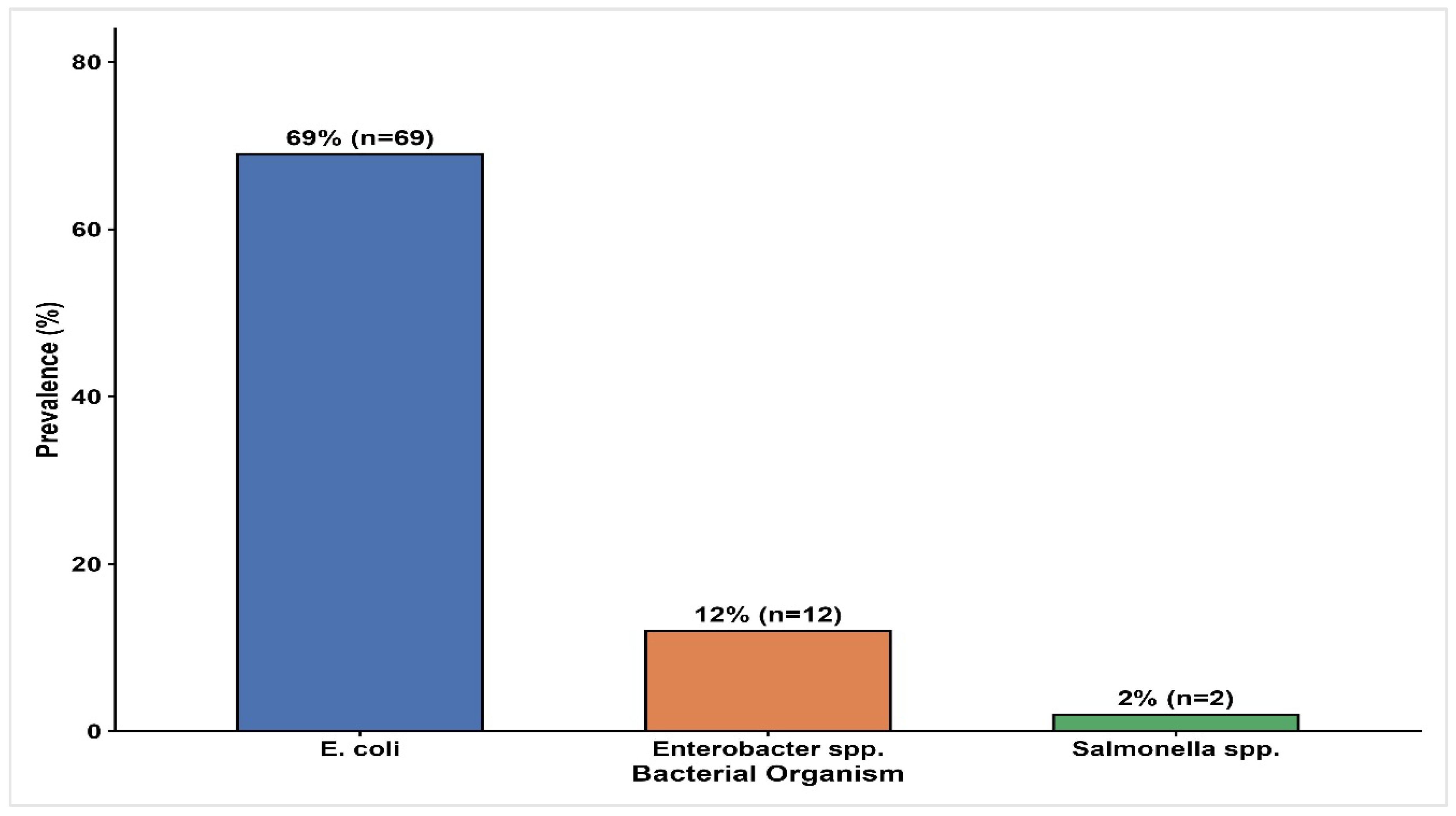
Figure 2.
Prevalence of E. coli, Salmonella, and Enterobacter species by location.
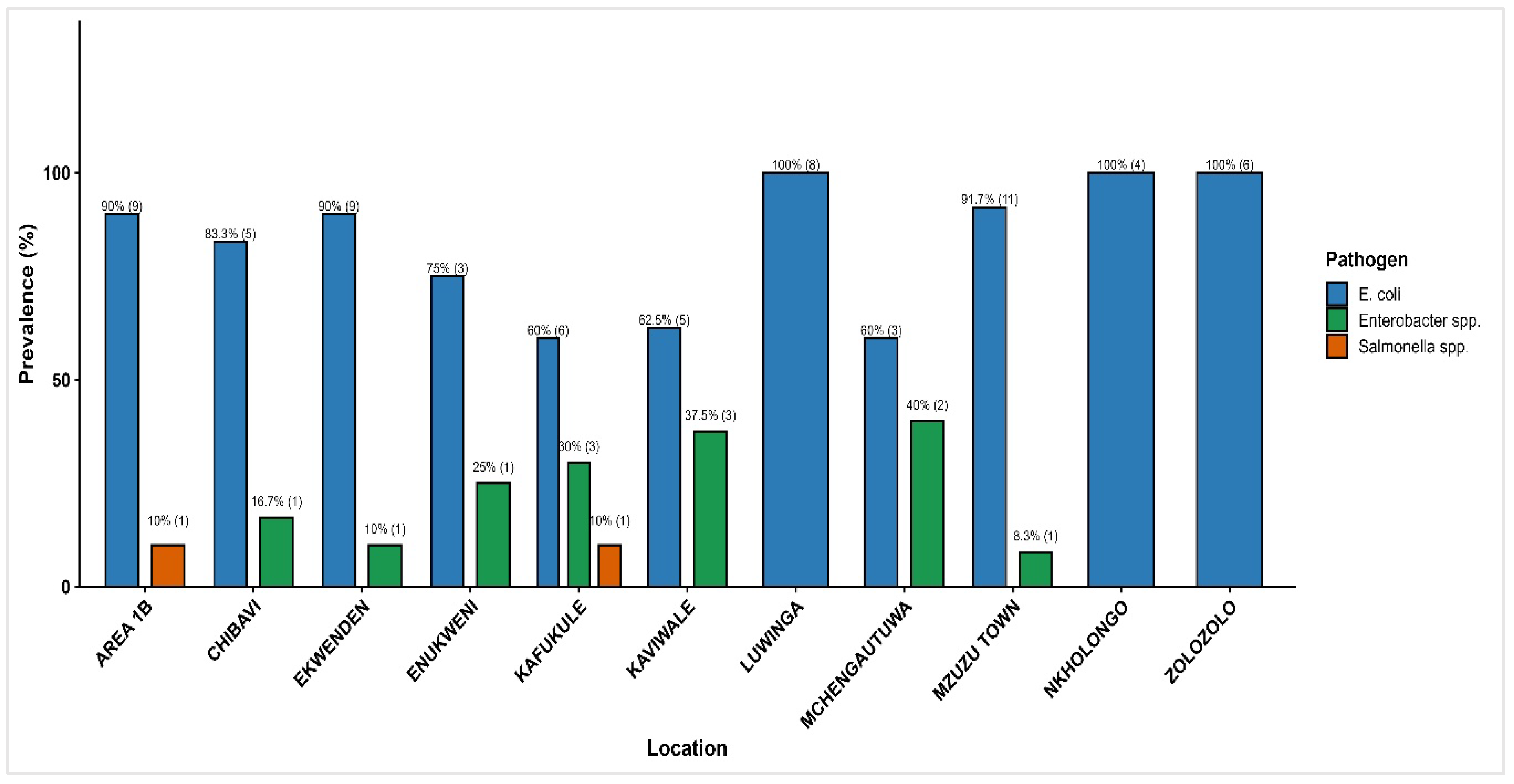
Figure 1.
Prevalence of antibiotic-resistance in E. coli, Salmonella, and Enterobacter species against selected antibiotics. Key: Percentage (counts/n).
Figure 1.
Prevalence of antibiotic-resistance in E. coli, Salmonella, and Enterobacter species against selected antibiotics. Key: Percentage (counts/n).
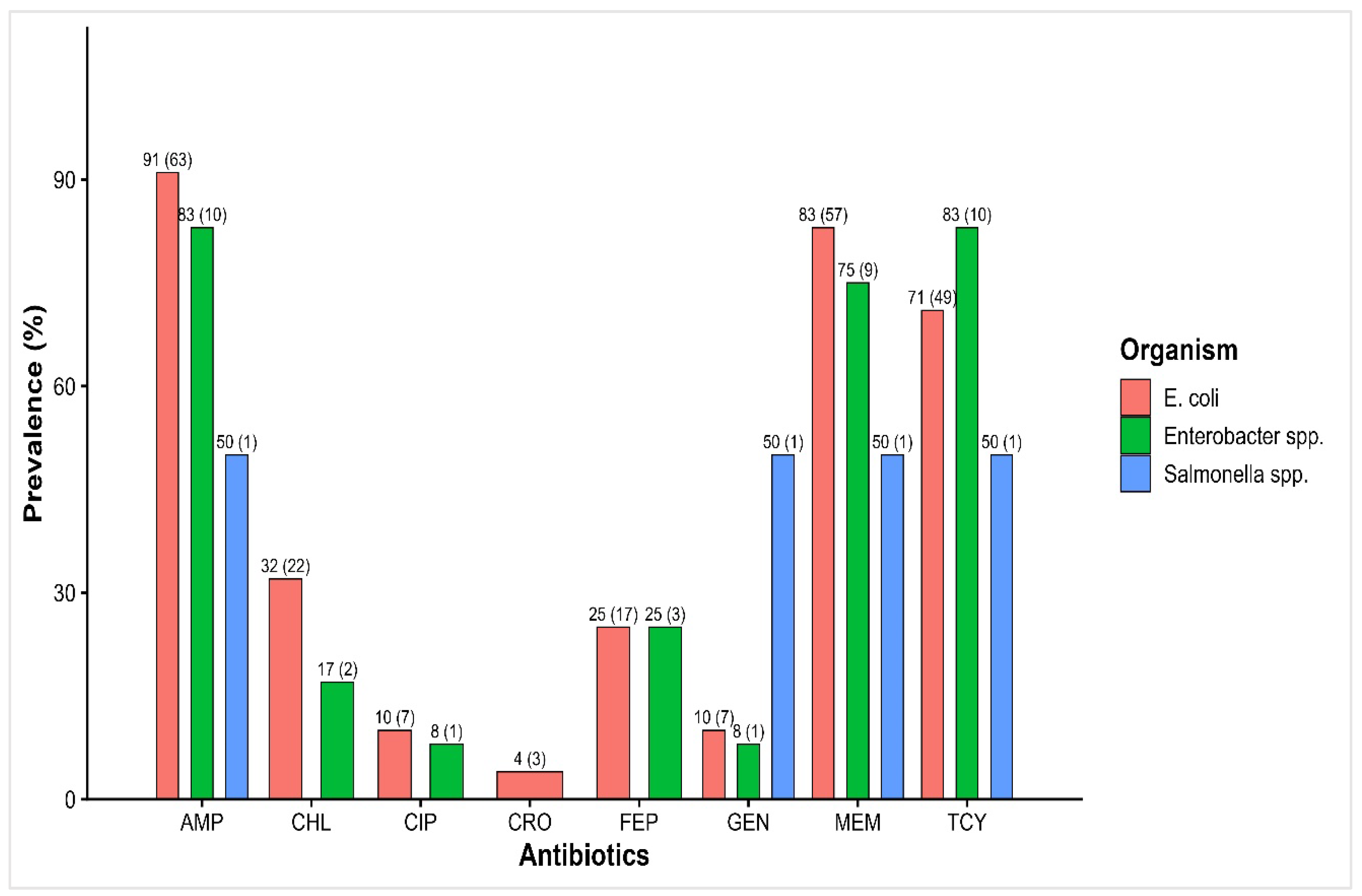
Figure 4.
The occurrence of multiple antibiotic resistance across organisms.
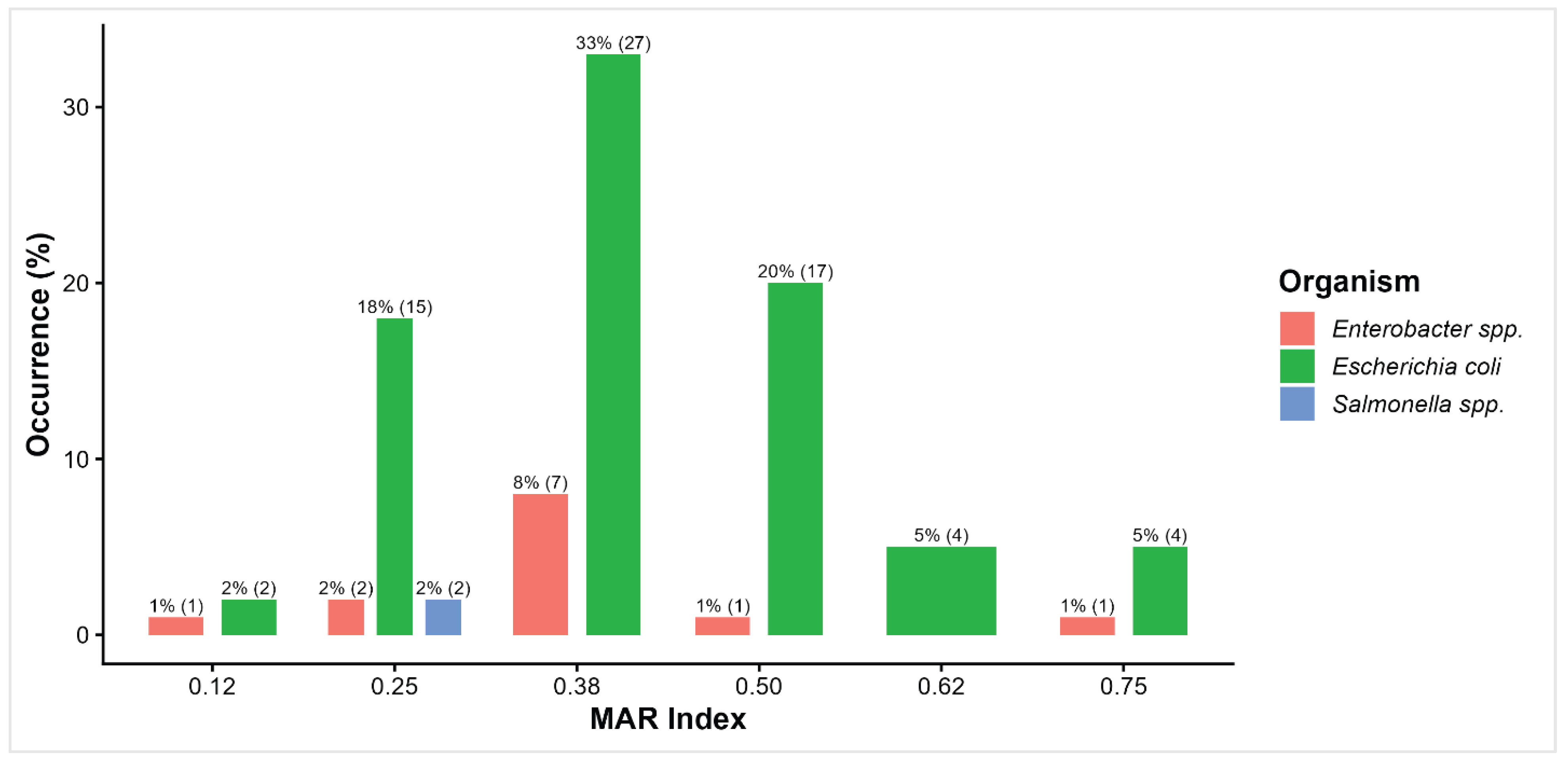

Table 1.
E.coli, Salmonella, and Enterobacter species isolates' resistance rates to antibiotics by location.
Table 1.
E.coli, Salmonella, and Enterobacter species isolates' resistance rates to antibiotics by location.
| Location | Organism | CIP | AM | MEM | TCY | FEP | CRO | GEN | CHL |
|---|---|---|---|---|---|---|---|---|---|
| Area 1B | E.coli | 33 | 100 | 100 | 100 | 0 | 11 | 55 | 33 |
| Salmonella spp | 0 | 0 | 100 | 0 | 0 | 0 | 100 | 0 | |
| Chibavi | Enterobacter spp | 0 | 100 | 100 | 100 | 100 | 0 | 0 | 0 |
| E.coli | 0 | 100 | 100 | 80 | 60 | 0 | 0 | 20 | |
| Ekwendeni | E.coli | 11 | 89 | 89 | 66.7 | 89 | 0 | 0 | 44 |
| Enukweni | Enterobacter spp | 0 | 100 | 100 | 100 | 0 | 0 | 0 | 0 |
| E.coli | 0 | 100 | 33 | 66.7 | 0 | 33 | 0 | 0 | |
| Kafukule |
Enterobacter spp | 0 | 100 | 0 | 66.7 | 0 | 0 | 0 | 33 |
| E.coli | 0 | 100 | 0 | 66.7 | 0 | 0 | 0 | 16.7 | |
| Salmonella | 0 | 100 | 0 | 100 | 0 | 0 | 0 | 0 | |
| Kavibale | Enterobacter spp | 0 | 100 | 100 | 100 | 0 | 0 | 0 | 0 |
| E.coli | 20 | 100 | 80 | 100 | 20 | 0 | 20 | 20 | |
| Luwinga | E.coli | 0 | 87.5 | 87.5 | 63 | 13 | 13 | 0 | 50 |
| Mchengautuwa | Enterobacter spp | 0 | 50 | 100 | 50 | 0 | 0 | 0 | 50 |
| E.coli | 0 | 100 | 100 | 0 | 0 | 0 | 0 | 33 | |
| Mzuzu town | Enterobacter spp | 100 | 100 | 100 | 100 | 100 | 0 | 100 | 0 |
| E.coli | 9 | 73 | 100 | 81 | 36 | 0 | 9 | 45 | |
| Nkholongo | E.coli | 0 | 100 | 100 | 75 | 0 | 0 | 0 | 0 |
| Zolozolo | E.coli | 16.7 | 83 | 83 | 33 | 0 | 0 | 0 | 33 |
Table 2.
Overall effect of organism type and location on MAR Index.
| Factor (Predictor) | Kruskal-Wallis chi-squared | df |
p-value | Effect size Eta2[η²] (magnitude) |
|---|---|---|---|---|
| MAR by organism |
3.967 | 2 | 0.1376 | 0.0246 (small) |
| MAR by location | 36.813 | 10 | ˂0.0001*** |
0.372 (large) |
Table 3.
Beta regression analysis of selected predictors of the MAR Index in broiler chicken samples.
Table 3.
Beta regression analysis of selected predictors of the MAR Index in broiler chicken samples.
| Predictor | Category | Estimate | Std. Error | z value | Pr(>|z|) |
| (Intercept) | 0.23023 | 0.20932 | 1.100 | 0.271377 | |
| Location | Chibavi | -0.31244 | 0.22906 | -1.364 | 0.172569 |
| Ekwenden | -0.24249 | 0.19841 | -1.222 | 0.221646 | |
| Enukweni | -0.90987 | 0.27389 | -3.322 | 0.000894 *** | |
| Kafukule | -1.26340 | 0.21610 | -5.846 | 5.02e-09 *** | |
| Kaviwale | -0.47288 | 0.21811 | -2.168 | 0.030157 * | |
| Luwinga | -0.57380 | 0.21186 | -2.708 | 0.006762 ** | |
| Mchengautuwa | -0.97962 | 0.25982 | -3.770 | 0.000163 *** | |
| Mzuzu Town | -0.25864 | 0.19018 | -1.360 | 0.173843 | |
| Nkholongo | -0.75244 | 0.26744 | -2.814 | 0.004900 ** | |
| Zolozolo | -0.89979 | 0.23661 | -3.803 | 0.000143 *** | |
| Organism | E. coli | -0.09315 | 0.15520 | -0.600 | 0.54838 |
| Salmonella spp. | -0.80853 | 0.39959 | -2.023 | 0.043033 * |
Type of estimator: ML (maximum likelihood). Log-likelihood: 70.34 on 14 Df. Pseudo R-squared: 0.4351. Number of iterations: 23 (BFGS) + 2 (Fisher scoring). Number of iterations: 23 (BFGS) + 2 (Fisher scoring).
Table 4.
Disk diffusion breakpoints of E.coli and Enterobacter species.
| Antibiotic agent | Disk content | Break points for E. coli and Enterobacter spp( zone of inhibition in mm) | ||
| Susceptible | Intermediate | Resistance | ||
| Ampicillin | 10 μg | ≥17 | 14-16 | ≤13 |
| Tetracycline | 30 μg | ≥15 | 12-14 | ≤11 |
| Chloramphenicol | 10 μg | ≥18 | 15-17 | ≤14 |
| Ciprofloxacin | 5 μg | ≥19 | 22-25 | ≤21 |
| Ceftriaxone | 30 μg | ≥23 | 20-22 | ≤19 |
| Gentamicin | 10 μg | ≥18 | 15-17 | ≤14 |
| Meropenem | 10 μg | ≥23 | 20-22 | ≤19 |
| Cefepime | 30 μg | ≥25 | 19-24 | ≤18 |
Table 5.
Disk diffusion breakpoints of E.coli, Salmonella spp.
| Antibiotic agent | Disk content | Breakpoints (zone of inhibition in mm) | ||
| Susceptible | Intermediate | Resistance | ||
| Ampicillin | 10 μg | ≥17 | 14-16 | ≤13 |
| Tetracycline | 30 μg | ≥15 | 12-14 | ≤11 |
| Chloramphenicol | 10 μg | ≥18 | 13-17 | ≤12 |
| Ciprofloxacin | 5 μg | ≥30 | 24-29 | ≤23 |
| Ceftriaxone | 30 μg | ≥26 | 23-35 | ≤22 |
| Gentamicin | 10 μg | ≥15 | 13-14 | ≤12 |
| Meropenem | 10 μg | ≥23 | 20-22 | ≤19 |
| Cefepime | 30 μg | ≥26 | 22-25 | ≤21 |
Disclaimer/Publisher’s Note: The statements, opinions and data contained in all publications are solely those of the individual author(s) and contributor(s) and not of MDPI and/or the editor(s). MDPI and/or the editor(s) disclaim responsibility for any injury to people or property resulting from any ideas, methods, instructions or products referred to in the content. |
© 2026 by the authors. Licensee MDPI, Basel, Switzerland. This article is an open access article distributed under the terms and conditions of the Creative Commons Attribution (CC BY) license (http://creativecommons.org/licenses/by/4.0/).
Copyright: This open access article is published under a Creative Commons CC BY 4.0 license, which permit the free download, distribution, and reuse, provided that the author and preprint are cited in any reuse.


