
Submitted:
22 July 2026
Posted:
23 July 2026
You are already at the latest version
Abstract
Amid shifting urban renewal approaches and industrial restructuring in China, small and medium-sized cities face the challenge of conserving industrial heritage through adaptive reuse. Drawing on gazetteers, planning documents, and interviews, this paper examines the transformation of the Anqing Baiqitun Cement Plant into a cultural and creative park across environmental, social, economic, and governance dimensions. The case is significant as typical heavy industrial heritage in a smaller city, while the enterprise's restructuring and relocation have produced a rupture in collective memory and identity. The study finds that minimal intervention in the heavy industrial remains achieved carbon sequestration and emission reduction, succeeded in ecological restoration, and attained financial viability by leveraging local markets and intangible assets. However, the industrial past has been selectively reconstructed, creating a divide between the former industrial community and the present one, partly due to an over-reliance on Authorised Heritage Discourse logic and insufficient collaboration with the existing enterprise. Participatory governance, driven mainly by government coordination and market capital, proved efficient but lacked public engagement. The paper argues that regenerating industrial heritage in small and medium-sized cities requires not only physical upgrading but also social mechanisms that enable public participation in conservation.
Keywords:
industrial heritage
; adaptive reuse
; heavy industry
; small and medium-sized cities
; collective memory
; brownfield remediation
1. Introduction
Anqing is located in the southwestern part of Anhui Province, at the confluence of Anhui, Jiangxi, and Hubei provinces, and at the lower end of the Yangtze River’s golden waterway. Historically, it served as the provincial capital and was a prominent industrial and commercial city. Anqing’s industrialisation began remarkably early: as early as 1861, Zeng Guofan, a distinguished statesman of the late Qing dynasty, founded the Anqing Arsenal in the Nanzhuangling area, one of China’s earliest government-run industries. However, Anqing was repeatedly ravaged by war during modern Chinese history and subsequently lost its provincial capital status after the founding of the People’s Republic. Despite its early start, the city’s overall industrial level stagnated over a prolonged period, eventually relegating it from an industrial powerhouse once comparable to Shanghai and Wuhan to an ordinary small to medium-sized riverside city.
During the planned economy era, Anqing’s urban status dictated that the state was unlikely to allocate many industries requiring high added value or advanced technology to the city. Given its proximity to the Yangtze River, which facilitated waterborne transport and waste discharge, Anqing was instead assigned a number of heavy industries characterised by high pollution and high carbon emissions. At that time, heavy industry was almost universally regarded as an advanced productive force, and scant attention was paid to the negative consequences of industrial development. However, as uncontrolled industrial pollution and rising global carbon emissions drove a substantial increase in the frequency of extreme weather events, socioeconomic development was severely impacted[1]. The disasters triggered by extreme weather prompted a period of reflection, which in turn catalysed the emergence of environmental protection theories and urban regeneration theories. After decades of evolution, contemporary urban regeneration research centres on sustainable development in both theory and methodology, alongside the integration of information technology and other exploratory directions. At the level of theoretical frameworks and methodologies, the core of urban regeneration lies in fostering comprehensive, long-term transformations across environmental, social, and economic dimensions to address the challenges confronting cities[2]. Many experts have argued that applying sustainable development principles in urban regeneration is essential for the future of cities[3,4]. The rise of such research has directly driven shifts in urban development thinking across nations, and China is no exception. As the profitability of heavy industry declined and China adjusted its development strategy, Anqing underwent industrial restructuring. A large number of heavy industrial enterprises were phased out as obsolete capacity, leaving behind vacant factory buildings and equipment that were subsequently transformed into industrial heritage. As the Intergovernmental Panel on Climate Change has noted, traditional industrial sectors account for an enormous share of global carbon emissions owing to their dependence on high-temperature heat sources and specialised chemical processes[5]. Although these heavy industries have now been shut down, their massive physical remains and the associated challenges of brownfield remediation remain closely tied to carbon emissions, particularly in the case of traditional high-energy-consumption, high-pollution, and high-carbon-emission heavy industrial plants such as cement works and steel mills[6,7].
Existing research on urban regeneration and the adaptive reuse of industrial heritage exhibits a pronounced metropolitan centrism, with insufficient attention devoted to the micro-level regeneration of industrial remains in small and medium-sized cities, particularly those with a legacy of heavy pollution[8,9]. The majority of case studies concentrate on central cities in developed countries or regions. Such cities, with their abundant economic and cultural resources and large consumer markets, can readily transform local industrial heritage into high-value creative quarters[10,11,12]. The replicability of these high-input, high-return experiences is highly constrained for the vast number of small and medium-sized cities in less developed countries or regions[13,14]. Nevertheless, industrial heritage in small and medium-sized cities possesses its own distinctive value and merits due attention[15].
The former site of the Baiqitun Cement Plant is a representative case of Anqing’s heavy industrial heritage. Recent research has indicated that industrial heritage constitutes the physical remnants of urban industrial transformation, and the manner in which it is regenerated directly bears upon the quality of a city’s sustainable development[16,17,18]. Spanning over half a century and deeply interwoven with early industrial technologies and the ecological memory of the riverside, the complex heavy industrial remains of the Anqing Baiqitun Cement Plant can be regarded as a representative example of cultural heritage in a small to medium-sized city and warrants in-depth investigation as a paradigmatic case. Moreover, the regeneration of industrial heritage is not merely a physical renovation; rather, it entails a process of ‘redefinition’ that converts industrial landscapes into urban capital—a process that is essentially a reconfiguration of power among administrative discourse, market logic, and community memory[19,20]. In this sense, although the former site of the Baiqitun Cement Plant has already become industrial heritage, Anqing Jigang Baiqitun Cement Co., Ltd., which formerly operated there, remains a healthy going concern, having relocated its operations to a new site. This circumstance renders the sociocultural inheritance of the Baiqitun Cement Plant considerably more complex. Therefore, examining the regeneration project of the former Baiqitun Cement Plant can not only illuminate the low-carbon transition pathway for small and medium-sized cities but also provide a valuable empirical case for the subject of ‘changes in collective memory and identity in the original locality following enterprise relocation’.
Drawing on the above, this study takes the regeneration project of the former Anqing Baiqitun Cement Plant site as its research object and addresses four research questions:
(1) How small and medium-sized cities in less developed regions can reduce carbon emissions through in-situ renovation during adaptive reuse, while integrating this with ecological restoration;
(2) How these regeneration efforts facilitate the integration of the transformed site into a new urban community and what problems have emerged in the transmission of collective memory;
(3) What operational strategies have been adopted in asset management to achieve financial self-sufficiency without over-commercialisation;
(4) How the project has influenced local governance thinking and approaches, particularly regarding public participation.
The study concludes by evaluating the sustainability of these transformations from ecological, social, economic, and governance perspectives.
2. Literature Review
As a distinct category of cultural heritage, industrial heritage has drawn growing scholarly attention, yet its conceptual boundaries and conservation principles continue to be refined. The foundational document for the adaptive reuse of industrial heritage is the Nizhny Tagil Charter for the Industrial Heritage, adopted at the 12th International Conference of the International Committee for the Conservation of the Industrial Heritage (TICCIH) held in Nizhny Tagil, Russia, in July 2003. This charter provides the authoritative definition of industrial heritage: industrial remains of historical, technological, social, architectural, or scientific value. These remains encompass buildings and machinery, workshops, mills and factories, mines and sites for processing and refining, warehouses, facilities for energy production and use, transport infrastructure and all its associated infrastructure, as well as places used for social activities related to industry such as housing, religious sites, and educational facilities. It further identifies the significant social value of industrial heritage in recording the lives and identity of ordinary people, alongside its historical, technological, and scientific value in relation to production, engineering, and architecture[21,22,23,24,25]. Subsequently, the Dublin Principles, jointly adopted by the International Council on Monuments and Sites (ICOMOS) and TICCIH in 2011, further expanded the scope of industrial heritage to encompass a comprehensive concept including sites, structures, areas, landscapes, as well as machinery, objects, and associated documentary archives[26]. The 2013 Resolution 1924 of the Council of Europe emphasised the transnational shared history and common identity dimension of industrial heritage, arguing that industrial heritage is profoundly tied to local memory and resident identity and should be regarded as part of a broader social landscape. These documents collectively constitute the foundation for international cooperation in industrial heritage conservation and research, and have played a significant role.
Beyond these foundational charters, recent scholarship has endeavoured to synthesise the multiple methodological pathways of adaptive reuse. In a comprehensive methodological review, Ma et al. (2025) examined 57 core English-language publications and categorised adaptive reuse methodologies into five types—decision-making tools, design and planning methods, analytical methods, case study methods, and evaluation methods—while identifying persistent limitations, including a lack of cross-scale integration frameworks and insufficient incorporation of climate change perspectives[27]. Zheng et al. (2025) further proposed a framework based on Fuzzy Comprehensive Evaluation (FCE) for assessing user satisfaction in reused industrial heritage projects, arguing that post-occupancy evaluation is crucial to avoiding the “short-term success, long-term decline” trap into which many regeneration projects fall[28].
This review employs the analytical framework proposed by Yang and Chan, which conceptualises the sustainability of industrial heritage development as a dynamic system constituted by environmental, socio-cultural, economic, and institutional and governance factors[29]. The four subsections that follow examine each dimension in turn, synthesising established findings while identifying persistent research gaps—gaps to which the present study directly responds.
The environmental dimension of adaptive reuse of industrial heritage has drawn increasing attention, particularly with respect to two interrelated issues: the conservation of embodied carbon and brownfield remediation. Conventional demolition and reconstruction generate substantial carbon emissions and produce construction waste that is difficult to manage[30]. Adaptive reuse, by contrast, is increasingly recognised as a carbon mitigation strategy, extending the life cycle of buildings and avoiding emissions associated with the production of new materials. Huang et al. (2025) systematically reviewed retrofit practices across the Global North and South, noting that embodied carbon is often overshadowed by operational carbon in retrofit decision-making, and conducted a quantitative comparison using standard Life Cycle Assessment (LCA) tools (ISO 14040 and 14044), thereby demonstrating the carbon savings achievable through the retention of industrial structures[31]. Taking the Changchun Tractor Factory as a case, Yang et al. (2025) employed the DesignBuilder energy simulation software to show that implementing comprehensive retrofit strategies could reduce heating energy consumption during the heating season by approximately 11,648 kWh/m², cut total primary energy by roughly 4 million kgce, and lower total energy consumption by about 95%[32]. From a circular economy perspective, Nocca and Remoy (2026) proposed a comprehensive assessment framework based on the EU Level(s) tool, encompassing six thematic areas, nine macro-objectives, and a system of over 100 indicators across 48 criteria, designed to evaluate the multi-dimensional impacts (environmental, economic/financial, and socio-cultural) of adaptive reuse projects at the ex-ante, ongoing, and ex-post stages[33]. This framework explicitly positions the transformation of industrial heritage as moving “from waste to a valuable resource,” aligning with circular economy principles; however, its applicability in the small and medium-sized cities of less developed regions—where technical and financial capacities are considerably more constrained—remains to be empirically tested.
The sociocultural dimension of industrial heritage regeneration has become a particularly contested terrain, as the process of heritagisation inevitably entails negotiations over whose memories are preserved, whose identities are recognised, and which narratives are authorised. As industrial restructuring proceeds, communities that are dependent on factories inevitably fall into decline. The acquaintance society that once heavily relied on state-owned enterprises will inevitably experience spatial decay and functional dislocation[34]. How this urban memory is transmitted is directly relevant to the social sustainability of urban communities[35]. Recent scholarship has critically examined how industrial heritage narratives are mobilised to legitimise particular urban development trajectories. Taking the former mining town of Trbovlje in Slovenia as a case, Goluža and Bole (2025) identified a cognitive spectrum ranging “from nostalgia to contempt,” arguing that industrial heritage constitutes a “dynamic and contested resource” for urban development, particularly in smaller post-industrial contexts[36]. Similarly, drawing on semi-structured interviews with representatives of local and regional authorities, traditional industrial enterprises, NGOs, and cultural institutions in an old industrial region of Czechia, Hruska et al. (2026) identified three distinct narratives associated with industrial heritage—pragmatic, problematising, and revivalist—and found that “a lack of coherence prevents the emergence of systematic agency at the regional level,” thereby precluding the integration of industrial heritage into a coherent development strategy[37].
A growing body of research has also documented significant divergences between expert and community perceptions of industrial heritage value. Employing a hybrid methodology of Fuzzy Delphi survey and principal component analysis, Mukherjee and Banerji (2025) identified 19 consensus indicators encompassing six heritage values in West Bengal, India, and found significant expert–community disagreement on 12 indicators, with direct implications for urban well-being across five dimensions[38]. In a quantitative study of the Eastern Suburb Memory in Chengdu, Xia et al. (2025) utilised structural equation modelling and importance–performance analysis, finding that “social impact exerts the strongest influence on user satisfaction,” thereby underscoring the role of community interaction and public participation over cultural identity or spatial layout [39]. These findings signal the risks associated with top-down heritage interventions that fail to resonate with local communities.
The concept of the “Authorised Heritage Discourse” (AHD), advanced by Smith (2006)[40], provides a critical lens for understanding how selective memory production serves specific political and economic interests—namely, actors who benefit from privileging dominant cultural narratives over grassroots industrial memory. More recently, Yang et al. (2025) employed large language models and multimodal data to quantify the “perceptual gap” between official positioning and public perception across five creative industrial parks adapted from industrial heritage, revealing that “the official perspective emphasises the cultural value of heritage, while the public pays more attention to service experience perception”[41]. This perceptual gap directly echoes the AHD critique and points to the necessity of adopting more inclusive heritage interpretation strategies.
The economic sustainability of industrial heritage regeneration demands a balance between financial viability and heritage authenticity—a tension that is particularly pronounced in small and medium-sized cities, where cultural consumption markets remain limited. Prior research has indicated that successful urban conservation and adaptive reuse should be capable of both maintaining the economic viability of heritage places and realising economic benefits. In developing the economic value of industrial heritage, a successful project must sustain the economic vitality of the heritage regeneration initiative, while also guarding against the alienation of historic space through over-commercialisation, given the distinctive characteristics that distinguish such sites from other commercial venues[42,43]. Attention must be paid to balancing commercial profit with the objective of carbon emission reduction[44,45,46]. Chiodi et al. (2025) analysed three cases in northwest Italy, finding that heritage valorisation “contributes to the creation of complex collective identities and regional regeneration, but also generates managerial contradictions and challenges, such as the lack of integrated and participatory approaches”[47]. Meng and Xiao (2025) developed a two-dimensional conservation–reuse evaluation model for Beijing’s industrial heritage, finding that “added-value sustainability fluctuated between 53.3% and 86.7%, while conservation sustainability dropped to a minimum of 50%,” highlighting the systematic neglect of conservation values in the pursuit of economic returns[48]. These findings call attention to the phenomenon of “heritage washing” identified by Zukin (2009) and Smith (2006), whereby commercial logic progressively erodes the socio-cultural significance of heritage.
In terms of governance, participatory governance has been widely recognised as an indispensable element for achieving institutional sustainability. The conservation of urban industrial heritage can promote the refinement of participatory governance. The role of participatory governance in achieving sustainable development has been widely recognised[49]. Community participation can ensure that the interests of all parties are fully considered in the decision-making process. It can also reduce conflicts between decision-makers and residents as well as social opposition, as reflected in the satisfaction levels of people within conservation areas[50]. However, as demonstrated by Chen and Ma (2026) through dynamic simulations of multi-stakeholder strategies, effective collaborative governance requires careful policy design to align the divergent incentives of government, developers, and community groups[51]. Ilovan et al. (2026) further examined a case of “failed heritagisation” in Cluj-Napoca, Romania, where commercially oriented real estate development ultimately overrode community demands for the conservation of socialist industrial heritage, underscoring the need to “democratise the definition of heritage and management decisions” and to strengthen heritage activism that secures the right to the city[52].
A growing range of digital technologies—including digital twins, LiDAR point clouds, machine learning-based damage detection, and Bayesian network-based structural health monitoring—is being applied to industrial heritage, opening up new possibilities for both technical assessment and participatory engagement[53,54]. Zhao et al. (2025) developed a digital twin-based simulation and decision-making framework for the Xi’an Old Steel Plant Industrial Park that integrates BIM, GIS, and parametric modelling with ENVI-met, EnergyPlus, and AnyLogic, enabling cross-scale environmental and behavioural simulation[55]. Zhang (2025) proposed an AlexNet HSD + CBAM + SVM model that achieved 95.7% accuracy in detecting damage to industrial heritage, an approach that holds potential for prioritising conservation interventions[56]. These technological advances, nonetheless, remain concentrated in large-city contexts; their applicability to resource-constrained small and medium-sized cities therefore remains an open question.
In sum, the existing literature provides sufficient conceptual and methodological tools for evaluating industrial heritage regeneration across the environmental, sociocultural, economic, and governance dimensions. Yet three gaps remain: (1) the predominance of metropolitan case studies limits the generalisability of findings to small and medium-sized cities; (2) few studies have systematically examined how the continued operation of an original enterprise on site affects the transmission of collective memory; and (3) research that integrates environmental carbon accounting with sociocultural and governance analysis within a single case remains scarce. The present study addresses these gaps through a multidimensional assessment of the regeneration project at the Anqing Baiqitun Cement Plant.
3. Materials and Methods
This study employs a qualitative single-case study design to investigate the adaptive reuse of the former Anqing Baiqitun Cement Plant. The case was selected for its representativeness as a heavy industrial heritage site in a small-to-medium-sized Chinese city, an underexplored context compared to metropolitan cases. This methodology involved multiple data collection stages, with the researcher extensively gathering information from various sources. The study first conducted a detailed analysis of the collected government documents and historical archives, which encompass: local gazetteers compiled by the government recording local changes from 1978 to 2000; government-disclosed project information, including project approval announcements and the Phase I site-level detailed plan; internal government documents obtained by the researcher through private channels, such as the factory gazetteer internally compiled in 1985, the enterprise asset appraisal report, notarisation documents, and the employee resettlement plan from the 2003 ownership transformation period; and local news reports published since the project’s inception. The internal documents—including the 1985 factory gazetteer, the 2003 asset appraisal report, notarisation documents, and the employee resettlement plan—were accessed through an institutional contact at the department responsible for retaining these archives. Access followed a formal procedure: the researcher submitted an official letter of introduction from Anhui University, which was reviewed and approved by the authorised departmental leadership. All documents were consulted on-site and used exclusively for academic purposes; identifying information has been anonymised. In terms of reliability, these are internal working records produced contemporaneously with the events they describe. They thus possess a high degree of authenticity, though they may reflect the institutional standpoints of their originators. To address this potential bias, systematic cross-verification was conducted against publicly available planning schemes, local gazetteers, and news reports. Discrepancies were interpreted as evidence of institutional framing rather than factual errors. These texts can be broadly divided into historical archives and contemporary documents. In examining the historical texts, the analysis centred on the case’s historical spatial expansion process and functional zoning, its local economic influence, and its social functions. With regard to the contemporary narrative texts, the analysis focused on the interaction between the local government and the social forces introduced, the transformation of the case’s social function, and the transmission of collective memory. In addition, a recent empirical study also focusing on this case was drawn upon to supplement textual information the researcher was unable to gather.
To complement the textual analysis, the researcher also conducted 13 open-ended and semi-structured interviews. Participants were recruited through purposive sampling to ensure diversity across stakeholder groups, ages, and genders. Park operators were approached via institutional contact; former and current employees were identified through local community referrals, as the enterprise did not formally respond to requests for cooperation; nearby residents and visitors were recruited on-site during fieldwork. Each interview lasted 10–20 minutes,was conducted in Mandarin Chinese, and was documented through written notes rather than audio-recording. The semi-structured guide covered three core areas: (1) perceptions of the site’s historical value; (2) experiences of the physical and functional transformation; and (3) views on public participation and memory transmission, with questions tailored to each participant’s role. To enable systematic comparison across groups, interview data were coded and analysed both within and across stakeholder categories. The participant group can be primarily divided into park operators, citizen visitors, and surrounding residents; the focus of the interviews was adjusted according to the participants’ identities. Interviews with park operators centred on the park’s regeneration approach and commercial operations, while those with citizen visitors and surrounding residents placed greater emphasis on the perception of industrial heritage and the transmission of social memory, offering unique insights into the cultural, historical, and symbolic significance of the case. All participants were anonymised and provided written informed consent prior to the interviews.
The study was informed by the logic of grounded theory, allowing themes to emerge inductively; the analytical procedure, however, followed a systematic thematic analysis approach[57], which is better suited to identifying patterns across multiple stakeholder groups within a single case. The coding process comprised three stages: open coding, which generated initial concepts from the raw data; axial coding, which grouped these concepts into categories; and selective coding, which distilled core themes aligned with the four sustainability dimensions. The coding framework was developed iteratively. Saturation was assessed after the 12th interview, at which point no new substantive codes had emerged, and the 13th interview confirmed the stability of the themes. Potential biases—including participant self-selection and interviewer effects—were mitigated by triangulating interview data with documentary evidence and maintaining analytic memos throughout the analysis. Because a single researcher conducted all coding, a formal assessment of inter-coder reliability was not applicable. Analytical rigour was instead ensured through systematic triangulation with documentary evidence, repeated re-reading of transcripts, and the continuous writing of reflective memos.
By integrating multiple information sources for analysis, this study is able to provide a comprehensive account of the regeneration process of the selected heritage site from multiple perspectives. The methodological design strives to balance official narratives and vernacular memory, thereby ensuring a more holistic understanding of the heritage’s history and current regeneration status. This approach is consistent with the contemporary heritage research proposition that sustainability studies of industrial heritage should integrate both “top-down” and “bottom-up” perspectives to more fully grasp the complexity of cultural conservation and value enhancement[58,59].
To ensure analytical transparency and to demonstrate how findings were derived from raw data, a systematic coding framework was developed. Table 3 presents representative interview excerpts mapped to initial codes, axial categories, and selective themes. For example, the theme “rupture between old and new industrial communities” was generated from multiple codes—including “divergent naming practices,” “former employees‘ sense of helplessness,” and “new employees’ disconnection from past”—that recurred across interviews with both retired and current employees. This framework directly informed the thematic organisation of the results section.

Table 1.
Data Corpus Sources. Source: elaboration by the authors.
| Data Type | Text Source | Analytical Function in this Paper |
| Official files | Anqing City Chronicles, History of Anqing Cement Plant, etc. | Establishing the spatial evolution, historical production efficiency, and social background of the case plant site |
| Institutional and Legal Documents | Internal official archives, public disclosure information, etc. | Analyzing the interaction process among local government, social capital, and the employee group |
| Contemporary Narrative Texts | Field interview records, exhibition hall display texts, relevant news reports, and published empirical research, etc. | Analyzing the contemporary reconstruction of collective memory and spatial activation of industrial symbols |
Table 2.
Basic Information and Coding Table of Semi-structured Interview Participants. Source: elaboration by the authors.
Table 2.
Basic Information and Coding Table of Semi-structured Interview Participants. Source: elaboration by the authors.
| Interview Code | Participant Category | Gender/Age Group | Interview Format, Duration & Recording Method | Analysis Focus |
| OP-01 | Onsite Space Guide | Female / 20–30 | Face-to-face, May 2026, 10–20 min, written notes | Park renovation and commercial practice |
| OP-02 | Onsite Space Guide | Female / 20–30 | Face-to-face, May 2026, 10–20 min, written notes | Park renovation and commercial practice |
| OP-03 | Onsite Space Guide | Female / 20–30 | Face-to-face, May 2026, 10–20 min, written notes | Park renovation and commercial practice |
| RE-01 | Nearby Resident | Male / 30–40 | Face-to-face, May 2026, 10–20 min, written notes | Perception of industrial heritage and daily use of public space |
| RE-02 | Employee of the Cement Plant | Male / 30–40 | Face-to-face, May 2026, 10–20 min, written notes | Company operations and thoughts on the cultural and creative park |
| RE-03 | Retired Employee of the Cement Plant | Male / 50–60 | Face-to-face, May 2026, 10–20 min, written notes | Preservation of industrial memory |
| RE-04 | Local Citizen | Female / 30–40 | Face-to-face, May 2026, 10–20 min, written notes | Perception of industrial heritage and daily use of public space |
| RE-05 | Retired Employee of the Cement Plant | Male / 40–50 | Face-to-face, May 2026, 10–20 min, written notes | Preservation of industrial memory |
| RE-06 | Nearby Resident | Male / 40–50 | Face-to-face, May 2026, 10–20 min, written notes | Perception of industrial heritage and daily use of public space |
| RE-07 | Local Citizen | Female / 20–30 | Face-to-face, May 2026, 10–20 min, written notes | Perception of industrial heritage and daily use of public space |
| RE-08 | Local Citizen | Male / 30–40 | Face-to-face, May 2026, 10–20 min, written notes | Perception of industrial heritage and daily use of public space |
| RE-09 | Local Citizen | Female / 30–40 | Face-to-face, May 2026, 10–20 min, written notes | Perception of industrial heritage and daily use of public space |
| RE-10 | Employee of the Cement Plant | Male / 30–40 | Face-to-face, May 2026, 10–20 min, written notes | Company operations and thoughts on the cultural and creative park |
Table 3.
Coding Framework and Thematic Development Derived from Interview Data. Source: elaborated by the authors.
Table 3.
Coding Framework and Thematic Development Derived from Interview Data. Source: elaborated by the authors.
| Interview Code | Exemplary Quote | Initial Code | Category | Core Theme |
| OP-01 | “Most old buildings had damaged roofs, with only their massive gravity load-bearing walls standing.” | Physical remains incomplete | Material integrity of heritage | Embodied carbon conservation through minimal intervention |
| OP-03 | “The designers reshaped the original columns into the form of bamboo shoots.” | Creative reuse of industrial remains | Landscape adaptation strategies | Spatial revitalisation and aesthetic transformation |
| OP-03 | “There are plans to convert the tanks into cultural and creative vending points.” | Commercial reuse of industrial structures | Adaptive commercial strategies | financial viability through asset revitalisation |
| OP-03 | “A merchant proposed a live-action CS project, but the operator rejected it for conflicting with the park‘s theme.” | Selective commercial curation | Controlled commercialisation | Balancing commercial profit with heritage authenticity |
| OP-03 | “The large animal sculptures ... even the guides cannot offer a reasonable explanation.” | Incoherent design narrative | Disjointed spatial storytelling | Fragmentation of heritage interpretation |
| OP-03 | “The guide was unaware of the succession relationship between Baiqitun and the Anqing Cement Plant.” | Limited staff historical knowledge | Shallow heritage interpretation | Dilution of industrial memory |
| RE-02 | “The visitor cohort did not display much discomfort with this situation, revealing a lack of familiarity with industrial heritage.” | Public indifference to industrial history | Low heritage awareness | Collective memory gap |
| RE-07 | “They [adaptive reuse measures] have preserved the character of the old industrial site and constituted an important reason for their visit.” | Visitor appreciation of industrial aesthetic | Positive perception of regeneration | Spatial appeal over historical learning |
| RE-03 | “They are aware of these phenomena but feel powerless to do anything about them.” | Former employees‘ sense of helplessness | Identity displacement | Rupture between old and new industrial communities |
| RE-05 | “They are aware of these phenomena but feel powerless to do anything about them.” | Former employees’ sense of helplessness | Identity displacement | Rupture between old and new industrial communities |
| RE-10 | “The renovated factory buildings are rather novel and intriguing.” | New employees‘ disconnection from past | Generational perception gap | Fragmentation of workplace identity |
| RE-02 | “The former employees refer to the plant as the ’municipal cement plant‘ ... new employees never do so.” | Divergent naming practices | Linguistic marker of identity | Symbolic boundary between old and new communities |
| OP-03 | “The interior spaces have been converted into the Art Community Cultural and Creative Centre ... exhibits predominantly feature locally distinctive handicrafts, with themes centred on traditional Chinese culture.” | Emphasis on traditional culture over industrial history | Narrative prioritisation | AHD-led selective reconstruction |
3.1. Spatial Morphology and Industrial Remains Characteristics of the Baiqitun Cement Plant
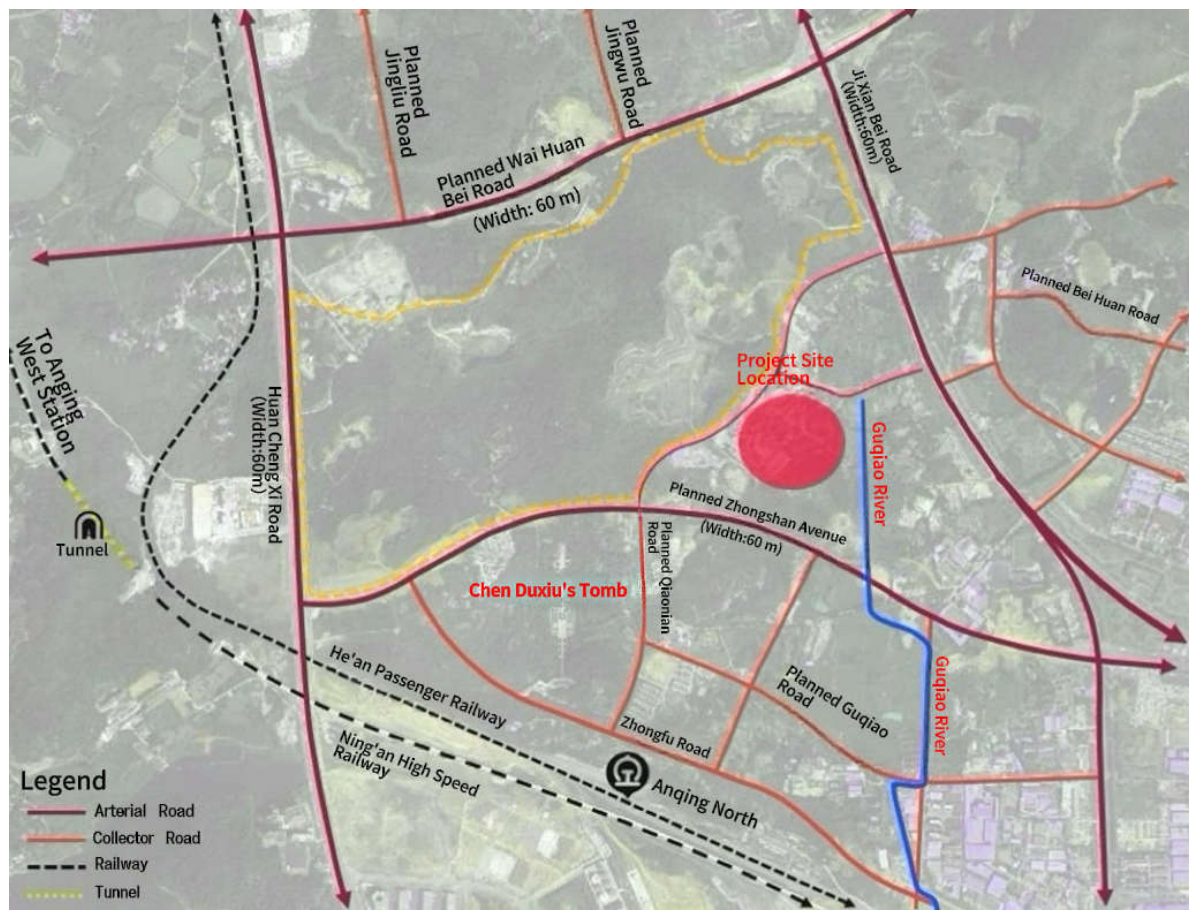
The Anqing Baiqitun Cement Plant, formerly known as the Anqing Cement Plant, long served as the sole state-owned cement enterprise in Anqing, tasked with supplying the building materials market for the entire Anqing region and even southwestern Anhui Province. The plant site is located on the west side of Jixian North Road in Daguan District, bordered by the civil aviation airport to the east, the foothills of Dalong Mountain to the north, adjacent to Chen Duxiu’s Tomb to the west, and merely ten kilometres south of the Yangtze River[60]. The principal raw materials for production, such as limestone, clay, and water, were largely sourced locally[61]. The cement plant occupies approximately 170 mu (roughly 11.3 hectares), with the site divided into two main parts: the eastern section serving as the living area and the western section as the production area[62].
The Anqing Baiqitun Cement Plant is a typical composite industrial heritage site, with clearly demarcated functional zones. At present, only Phase I (out of a total of four phases) of the regeneration project has been completed; the undeveloped areas are not yet open to the public for safety reasons, making specific surveying data unavailable. Owing to the loss of historical drawings and the absence of surveying data during the ownership transformation period, this study can only provide a rudimentary classification of the industrial remains in the western production area based on the Phase I Constructive Detailed Planning and Design Scheme publicly disclosed in 2024. The plan retains 102 old buildings, which primarily fall into the following three categories of heavy industrial remains:
High-energy-consumption process structures: These include the four large funnel-shaped tanks at the core of the production area, the quadruple tank cluster, the second-generation twin brick kilns, the large finished cement silo, as well as the high-reinforcement-ratio concrete vertical kiln and the clinker tower frame. These remains are characterised by their heavy-duty construction, openwork design, and massive scale.
Multi-storey workshops and auxiliary factory buildings: These primarily comprise the four-storey core workshop with a retained and retrofitted floor area of 2,671.63 square metres, along with originally hollow equipment storage workshops without floor slabs and scattered “stone houses.”
Pipeline networks and underground infrastructure: These include the underground and semi-underground concrete column foundations left from the original clinker silo, as well as the criss-crossing heavy industrial water pipe network reaching up to 22 metres in height.
The total planned land area of the regeneration project is 43,112.16 square metres, with the retained and retrofitted floor area amounting to 9,677.21 square metres, accounting for over 96.7 per cent of the total regenerated area. The project exhibits the characteristics of a low floor area ratio (0.23) and low building density (16.16%). These heavy industrial structures, accumulated over half a century, constitute both the medium for adaptive reuse and the boundary within which embodied carbon is locked in.
3.2. Historical Evolution and Enterprise Transformation of the Anqing Baiqitun Cement Plant
The Anqing Cement Plant was established in 1972, with an initial workforce of approximately 180 employees, sourced primarily through recruitment and transfer from other units. The land, housing, and living facilities were directly inherited from the former Jixianguan Coal Mine, which had already entered its decommissioning phase. These factors provided highly favourable conditions for the plant’s establishment; however, due to the generally low skill levels of the workforce and the time required for renovation, the plant did not formally commence production until 1974[63]. Affected by factors such as the irrational design of production lines dating from the campaign-style construction period, the cement plant remained in a state of chronic loss-making through to 1978. Although the production line was upgraded in 1978, which improved production efficiency, major safety hazards persisted[64].
In 1979, the Anqing Cement Plant abolished its Revolutionary Committee and was formally constituted as an enterprise. This year witnessed significant changes: on the one hand, the plant organised technical personnel to upgrade the production process; on the other, it adopted a series of measures to incentivise worker motivation, swiftly improving the plant’s economic performance and turning losses into profits[65]. Entering the 1980s, the Anqing Cement Plant actively implemented economic responsibility system reforms and continuously optimised its production processes, earning repeated recognition as an advanced municipal enterprise and attracting coverage from provincial media and study visits from peer units. In 1987, the plant entered the Jiangsu and Zhejiang markets, shipping its products beyond the province. By 1988, the Anqing Cement Plant had become the highest-output cement producer among the seven mechanised vertical kiln cement plants in the municipality, producing 68,000 tonnes of cement with an output value of 3.48 million yuan.
In 1990, the plant’s products were exported to the Philippines and South Korea, ending Anqing’s history of having no cement exports[66]. During the Eighth Five-Year Plan period (1991–1995), the Anqing Cement Plant’s project for the daily production of 600 tonnes of clinker became the first project in Anhui’s building materials industry to be included in the national “Double Plus” Project (a key technological upgrading initiative during the Eighth Five-Year Plan). In 1992, the plant successfully adopted seed crystal cement technology, increasing annual cement output by 12,600 tonnes, saving one tonne of standard coal and 43.2 kilowatt-hours of electricity per hundred tonnes of cement, and yielding an annual economic benefit of 875,000 yuan[67]. In 1995, the plant was named one of “Anhui Province’s 100 Best Enterprises for Economic Returns” and, in the same year, received the titles of “National Advanced Enterprise for Environmental Protection” and “Anhui Province Model Site Management Enterprise”[68]. In 1997, the Anqing Cement Plant was restructured into Anqing Baiqitun Cement Co., Ltd., becoming the largest building materials company in the municipality[69]. In 2000, the plant converted the former Taihu County Cement Plant into a branch; by the end of 2000, the Anqing Cement Plant held original fixed assets valued at 184 million yuan and employed over 700 workers, constituting a large-scale building materials production entity in southwestern Anhui[70].
Despite still performing well economically at the turn of the century, the cement plant was nonetheless acquired in 2003 by Fuzhou Jigang Building Materials Co., Ltd., for a total price exceeding 80 million yuan. The acquired plant was renamed Anqing Jigang Baiqitun Cement Co., Ltd.; the vast majority of its assets—land, buildings, equipment, and trademarks—were sold to Jigang. Jigang rehired most of the original workforce under the principles of accepting work assignments and competing for positions[71]. Following the acquisition, constrained by regional resource extraction limitations and changes in external macro-level market access mechanisms, the enterprise entered a phase of production scale contraction and efficiency decline, with its workforce shrinking to approximately 150 employees. By 2017, driven by the needs of urban development, the former Anqing Baiqitun Cement Plant was relocated in its entirety.
Following the relocation, the “Baiqitun” brand and production line continued to be operated by Anqing Jigang Baiji Dolphin Cement Co., Ltd. at a new site in Huaining County, while the old plant site entered the urban renewal process as an independent plot of industrial remains. As thinking on urban renewal shifted, the old site has, in recent years, undergone a reconfiguration of asset ownership and urban function. In June 2023, the Anqing municipal government signed an agreement with Anqing Jixian Shikong Cultural Tourism Development Co., Ltd., planning to regenerate the industrial remains of the former Baiqitun Cement Plant in three phases and develop it into a distinctive cultural and creative park. On 1 May 2024, Phase I of Jixian Shikong Cultural and Creative Park officially opened to the public, attracting a large number of visitors; by the end of that year, cumulative visitor numbers had reached approximately 730,000[72].
Figure 1.
Satellite view of the Jixian Shikong Cultural and Creative Park and surrounding planning. Source: Phase I Detailed Construction Planning and Design Scheme of the Anqing Baiqitun Cement Plant Cultural and Creative Renovation Project.
Figure 1.
Satellite view of the Jixian Shikong Cultural and Creative Park and surrounding planning. Source: Phase I Detailed Construction Planning and Design Scheme of the Anqing Baiqitun Cement Plant Cultural and Creative Renovation Project.
4. Results
4.1. Carbon Emission Reduction and Brownfield Remediation
From a sustainable development perspective, treating industrial heritage in accordance with the principles of green development can effectively contribute to tackling climate change[73,74]. The ecological benefits demonstrated by the regeneration project of the Anqing Baiqitun Cement Plant are manifested primarily in two respects: carbon emission reduction through embodied carbon conservation, and brownfield remediation. With regard to carbon sequestration and emission reduction, although heavy industrial plants of this kind were typically characterised by high energy consumption and high carbon emissions during their operational period, now that production has ceased, the physical remains they have left behind have in effect been transformed into an enormous repository of embodied carbon within the built environment[75]. When assessing the ecological feasibility of industrial heritage adaptive reuse, conventional planning decisions often overlook this component of carbon assets[76,77,78]. From the standpoint of brownfield remediation, the cement plant’s decades of production activities inflicted severe damage on the surrounding ecological environment, and the fact that the plant is situated only ten kilometres from the Yangtze River waterway makes effective brownfield remediation all the more urgent.
For the regeneration of urban industrial heritage, there are typically two planning pathways: complete demolition and reconstruction, versus adaptive reuse. Given that the historical drawings are no longer retrievable and precise surveying data could not be obtained for a variety of reasons, the qualitative analysis of this study incorporates the scenario analysis method, which is widely used in international environmental assessments, to compare the magnitude of carbon emission increases under complete demolition and reconstruction (Scenario A) and adaptive reuse (Scenario B).
The Baiqitun Cement Plant is a typical case of heavy industrial heritage. Its physical remains are massive in scale, occupying an extensive site area, and largely consist of reinforced concrete structures with paved and hardened ground surfaces—features that require particular attention in the regeneration process. Under Scenario A, the demolition of the large-scale remaining structures, such as the existing concrete vertical kiln and the clinker tower frame, would consume enormous amounts of energy and generate substantial additional carbon emissions, which would further increase during the transportation and processing stages of construction waste[79,80]. During the subsequent reconstruction phase, erecting new buildings would consume vast quantities of high-carbon materials such as steel and cement. To supply this demand, the relevant industries would release immense amounts of new embodied greenhouse gases into the atmosphere across multiple stages, from production to transport[81]. Under Scenario B, by subjecting the primary structures of the industrial heritage to minimal intervention, the Baiqitun Cement Plant regeneration project is able to avoid the enormous additional carbon emissions associated with extensive demolition. Although renovation would still generate construction waste and energy consumption, the ecological costs involved are undoubtedly far smaller than those of completely demolishing the old structures; during the rebuilding phase, the demand for construction materials would also be greatly reduced, thereby achieving a dual emission reduction benefit[82]. Strictly as a heuristic exercise rather than a measured result, for a provisional quantitative illustration, this study draws on the material production emission factors specified in China’s national standard GB/T 51366-2019 (Clause 6.2.1: Csc=∑Mi×FiCsc=∑Mi×Fi), and adopts a conservative reference value of 1,200 kg CO₂e/m² for scenario comparison based on the embodied carbon coefficients provided in Appendix D of the standard and the typical structural characteristics of reinforced-concrete industrial buildings in China[83]. Applying this value yields the following estimate: complete demolition and reconstruction (9,677.21 m²) would generate on the order of 11,613 t CO₂e from material production and construction activities, whereas adaptive reuse (retaining all existing structures with only 334.4 m² of new construction) reduces this to on the order of 401 t CO₂e—suggesting a net avoidance of roughly 11,212 t CO₂e—a difference of more than one order of magnitude when compared with the new-build scenario. These figures are intended solely for scenario-based comparison and should not be interpreted as a full Life Cycle Assessment (LCA) result; they are conservative estimates based on industry-average parameters and simplified assumptions. Notably, they exclude demolition machinery, on-site energy, and waste transport emissions, which, if accounted for, would likely further widen the gap between the two pathways. Thus, the scenario comparison suggests that adaptive reuse of heavy industrial heritage is likely to offer substantial carbon savings over demolition and reconstruction, conferring a directional advantage in terms of carbon emission reduction and pointing toward closer alignment with the requirements of sustainable development—provided that the embodied carbon in existing structures is retained.
The Baiqitun Cement Plant regeneration project precisely followed the adaptive reuse pathway. The project largely preserved the cement plant’s foundations and heavy-duty structures. According to the planning scheme disclosed in 2024, the total planned land area of the project is 43,112.16 square metres, of which the retained and retrofitted floor area amounts to as much as 9,677.21 square metres, while the newly built floor area is merely 334.4 square metres, with the retained buildings accounting for over 96.7 per cent of the total regenerated floor area[84].
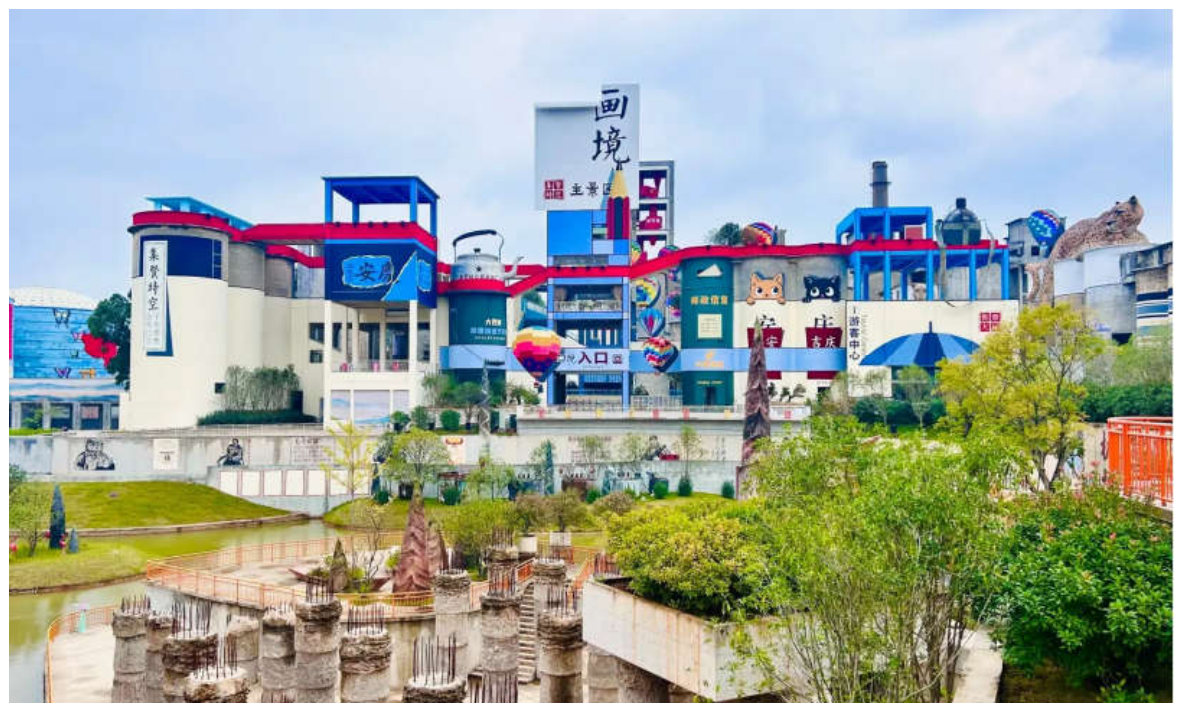
In the actual regeneration practice, given that the plant site had suffered partial forcible demolition during the relocation and ownership transformation period, leaving most old buildings with damaged roofs and only their massive gravity load-bearing walls standing (Interview record: OP-01), the planners adopted the approach of installing connecting corridors and staircases to achieve spatial connectivity, thereby substantially reducing the procurement and use of large quantities of high-carbon raw materials. Core production facilities such as the four large funnel-shaped tanks, the quadruple tank cluster, the second-generation twin brick kilns, and the large finished cement silo in the raw material proportioning workshop were all preserved in situ, and were transformed into tourist toilets, a cultural and creative supermarket, and roadside vending points by cutting and opening windows into the cement silo walls and retaining the proportioning funnels. This minimal intervention approach effectively extended the lifecycle of the buildings and reduced carbon emissions during the process of adapting them to new functions.
In terms of landscape design, the park’s landscape elements largely adhered to the principles of the circular economy. Many of the public benches were transformed from old industrial paint cans left over from the original plant, while some rest chairs were locally sourced from the aged timber of abandoned wooden boats from the port, and the dead trees featured in the site’s landscape were transplanted, dried, and debarked plant remnants brought in from elsewhere. Furthermore, the operator plans to cover the building facades with ivy to decorate the exposed exterior walls (Interview record: OP-03). Substituting such low-carbon materials for traditional high-carbon materials can undoubtedly further reduce carbon emissions during the regeneration process.
With regard to brownfield remediation, the planners also made considerable efforts. According to the planning scheme, the building density of the Baiqitun Cement Plant regeneration project is only 16.16 per cent, while the green coverage ratio reaches as high as 37.70 per cent, which even exceeds the minimum 35 per cent required by the regulatory plan, with a green space area totalling 16,244.49 square metres[85]. In response to the complexity of the ecological environment adjacent to the Yangtze River, the regeneration scheme was also specifically optimised. In the 2024 plan, concerning the design of the stormwater and sewage pipeline network, the drainage system adopted an approach of “following the terrain and separating water flows” according to the topographical elevations, discharging rainwater near water bodies into the adjacent water bodies in close proximity, and explicitly stipulating that the existing water bodies should undergo regular desilting and dredging to maintain clean and hygienic conditions. At the same time, sewage is conveyed through high-density polyethylene (HDPE) pipes laid in direct burial, and connected to the municipal sewage network for centralised treatment, thereby severing pollution discharge into the river[86]. The restoration of ground vegetation also received significant attention from the planners; solely for the issue of heavy metal exceedance in the soil during the mountain regreening of the park’s Wangxiang area, the operator allocated an additional special remediation fund of three million yuan, which testifies to the importance attached to ecological restoration[87].
The ecological restoration practices at the Baiqitun Cement Plant have been highly commended by the local government and extensively publicised as an exemplary case responding to the central government’s call for ecological civilisation construction. A considerable number of news reports have extolled the ecological benefits of the cement plant regeneration project, and the majority of visiting tourists have also expressed appreciation, observing that these adaptive reuse measures have preserved the character of the old industrial site and even constituted an important reason for their visit (Interview record: RE-07). However, it must also be noted that adaptive renovation and ecological restoration come with a price. The Baiqitun Cement Plant renovation employed a large quantity of new materials and required sustained capital investment, reflecting the fact that the adaptive reuse of industrial heritage demands substantial technological and financial inputs. In response to this situation, the local government has provided a degree of support through the establishment of special funds[88].
Figure 2.
Before the renovation of the Baiqitun Cement Plant. Source: Official exhibition materials of the park.
Figure 2.
Before the renovation of the Baiqitun Cement Plant. Source: Official exhibition materials of the park.
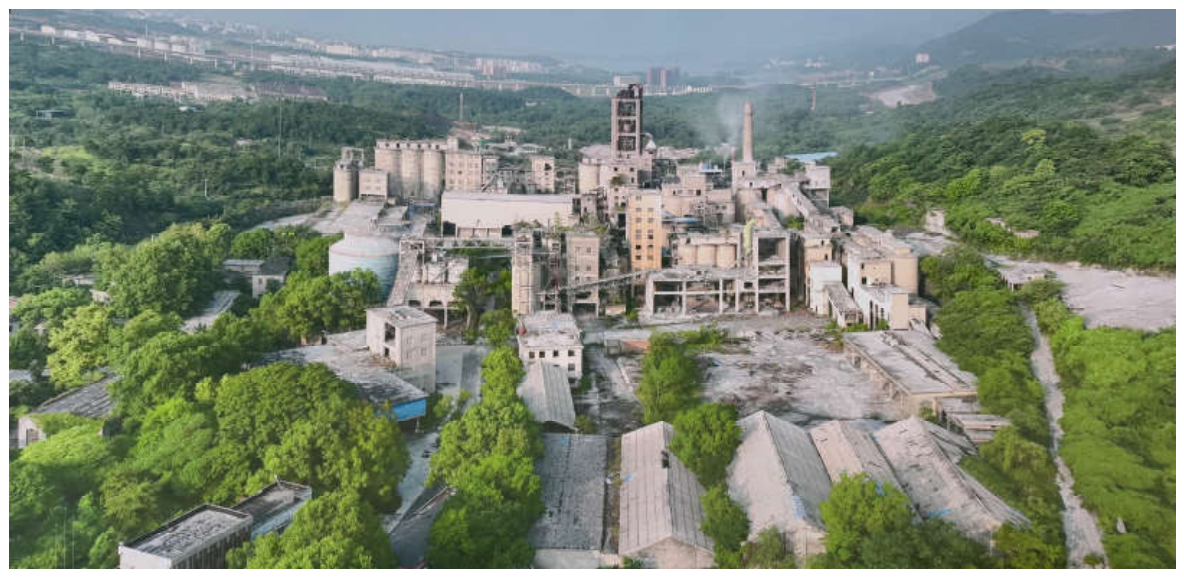
Figure 3.
After the renovation of the Baiqitun Cement Plant. Source: Official exhibition materials of the park.
Figure 3.
After the renovation of the Baiqitun Cement Plant. Source: Official exhibition materials of the park.
4.2. Urban Functional Transformation and the Transmission of Collective Memory
Three principal pathways currently dominate the regeneration of industrial heritage: transformation into urban landmarks, commercial venues, and tourist destinations. These three pathways entail the transformation of differing social functions. Regeneration into landmarks places greater emphasis on the connection between industrial memory and contemporary society and is generally suited to small-scale heritage sites with a low degree of preservation in city centres; regeneration into commercial venues or tourist destinations, by contrast, emphasises the spatial revitalisation of heritage and the transformation of its social functions—the former gravitating towards the exploitation of the heritage’s economic value, the latter towards its cultural value[89,90,91]. With its massive physical remains, well-preserved primary structures, and location at some distance from the main urban area, the Baiqitun Cement Plant was naturally unsuited to being turned into a mere urban landmark. Faced with the choice between transforming the former cement plant site into a commercial street or a cultural and creative park, the project planners ultimately opted to preserve the plant’s original appearance to the greatest possible extent, converting it into what is now the Jixian Shikong Cultural and Creative Park.
As a former production base, the original architectural design of the cement plant did not meet the requirements of a cultural and artistic complex, and the planners thus undertook renovations of the original buildings. The planners positioned the park explicitly as an urban “living room” for citizens and a “nostalgic scenic area” for tourists, while also accommodating the function of study tours[92]. The following provides a detailed account of the park’s renovation.
The eastern living quarters have survived in a far less complete state than the western production zone, and correspondingly fewer buildings have been adapted. One notable intervention is the “Pigsty Café,” a former auxiliary farm building whose unusual origins have drawn considerable visitor interest.
Upon entering the park, one is first greeted by a sunken artistic landscape. This intervention incorporates the column footings originally cast for a planned clinker silo—a structure abandoned at the foundation stage due to unstable ground conditions. Repurposed as landscape elements, these remnants now define a space that serves as a performance venue for festive events (Interview record: OP-03). One of the most striking transformations has taken place in the area that once formed the plant’s main production zone. Formerly occupied by storage tanks, equipment rooms, and workshops, this space has been converted into an open plaza—named “Thought Square”—which now serves as the principal venue for festive events. The plaza is punctuated by several oversized animal sculptures placed on surrounding buildings. During major holidays such as the Spring Festival and the Mid-Autumn Festival, martial arts and acrobatic performances are staged here, drawing large crowds of local residents (Interview record: OP-03).
From the earliest stone kilns to the second-generation brick kilns and onward to the third-generation mechanised rotary kilns, the plant’s core production kilns have all been preserved and adapted through artistic interventions. The interiors of the largest remaining industrial structures—the multi-storey workshops and silos—have been transformed into an art museum, organised into five thematic “art complexes.” The exhibits consist primarily of distinctive local handcrafts, with a thematic focus on traditional Chinese culture. For the third-phase development, the operator intends to position the site around the theme of “red education” and to improve transport connections linking the cultural and creative park with nearby red tourism destinations, thereby establishing an integrated base for industry, academia, and research.
Beyond the presentation of traditional Chinese culture and red education, the park has also set aside dedicated sections for collective memory. Although this is an adaptive reuse project targeting industrial heritage, the planners did not confine themselves to merely reproducing memories of past industrial production, but likewise considered the affinity many visitors have for rural culture. China is a quintessential late-industrialising country that long operated under a planned economy, with a pronounced divide between urban and rural life. Many of today’s urban citizens entered the cities during the large-scale urbanisation from the 1990s to the early 2000s, and most have rich experience of rural life. For the majority of visitors, rural memory is far more familiar and intimate than urban memory. The planners therefore not only arranged a dedicated industrial memory exhibition area, but also reserved a space for rural memory.
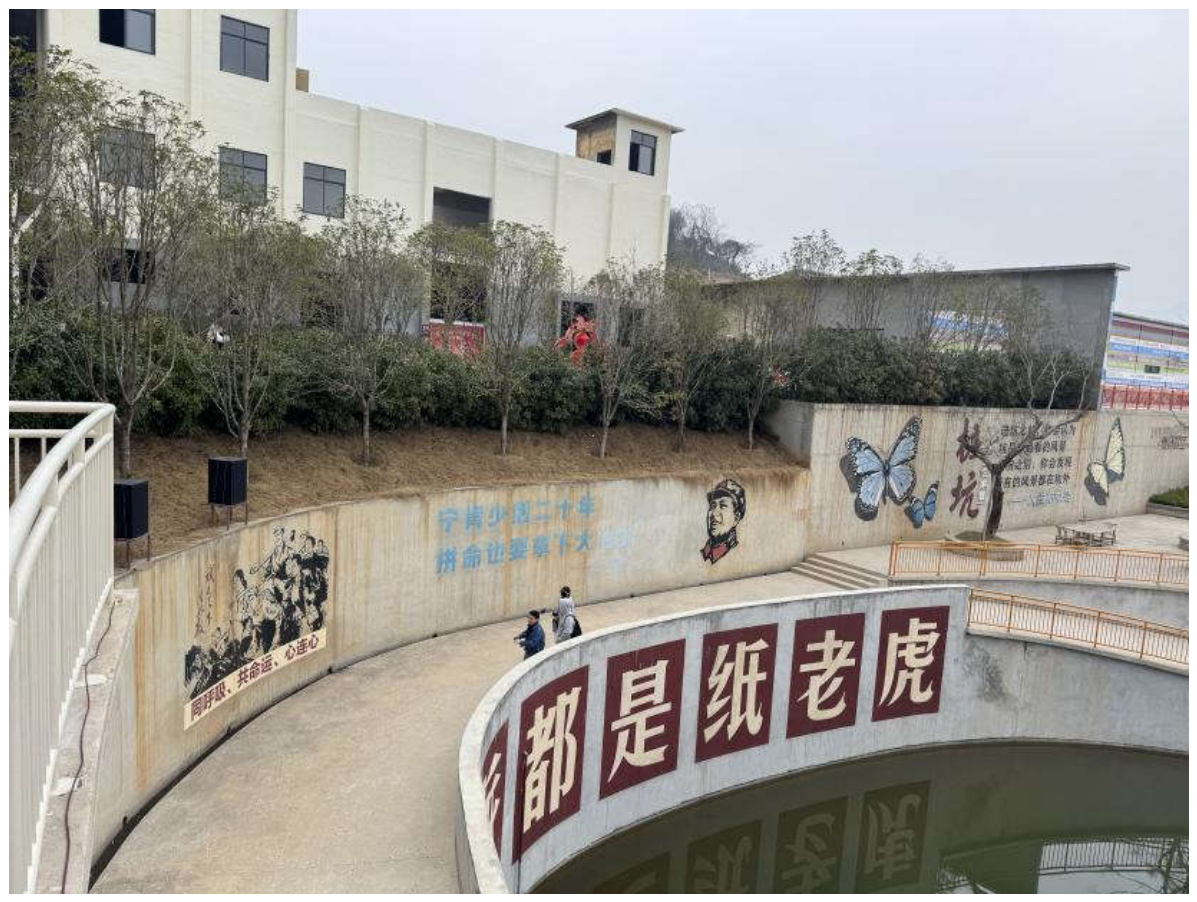
The planners have placed a large number of production slogans and propaganda posters characteristic of various eras in every corner of the park, and have simultaneously positioned the Baiqitun cement trademark at the park entrance and at prominent architectural landscapes to remind visitors of the park’s close connection to the Baiqitun Cement Plant. In addition, in collaboration with the art school of a local university, the planners have creatively repainted many old film posters and produced a large body of paintings inspired by old photographs, which, after post-processing and printing, have been displayed in designated areas. The park operator has also deliberately renamed one shop with the suffix “Supply and Marketing Cooperative” and replicated within it the scene of rationed purchasing from the planned economy era, thereby reconnecting visitors with memories of times past.
The above offers an overview of the park’s renovation and cultural presentation. On the whole, the park’s regeneration has been quite successful, transforming its formerly dilapidated and run-down appearance into a new venue that attracts citizens seeking rest and relaxation through thoughtful spatial arrangement and renovation; the transformation and spatial revitalisation of the site’s urban function have achieved readily apparent success. However, the project also presents a number of evident problems.
First, there is a disjunction in the design styles of different areas of the park, which may be partly attributable to the fact that only the first two phases are open to the public; nonetheless, as matters currently stand, the themes have been combined in an excessively forced manner, to the point of appearing disjointed. This problem is particularly acute in the Thought Square section, where even the guide staff are unable to offer a reasonable explanation as to why the planners abruptly inserted giant animal sculptures in such a conspicuous location—interpreting them as part of an ecological theme is too strained to be convincing.
Second, the operator’s efforts in the transmission of industrial memory are notably deficient. The presentation of industrial memory remains superficial; the various industrial symbols on display lack the specificity of the old plant and are instead replete with later imaginings of the past. A considerable portion of the park’s slogans and signage bear the distinct imprint of the 1970s or even the 1960s, such as oversized portraits of political leaders and production slogans of an overtly political tenor. Yet for most of the 1970s, the cement plant was unable to carry out normal production activities, nor did it achieve profitability; the genuinely prosperous 1980s and 1990s have been overlooked. The only elements connecting the park to the 1980s and 1990s are the repainted old film posters, but these symbols belong more to the domain of popular culture than to industrial memory and, moreover, bear little relation to the memory constructed around the cement plant. Although a large number of production buildings have been preserved, the park contains virtually no written or visual material describing the history and production scenes of the old cement plant, only presenting photographs of the site before and during renovation at the concluding part of the art gallery section. Even less is there any account of detailed production systems or specific production processes. Visitors can only learn about the renovations of the various architectural elements through the oral accounts of tour guides, whose knowledge of this industrial heritage is rather limited; one guide, for instance, was unaware of the succession relationship between the Baiqitun Cement Plant and the Anqing Cement Plant (Interview record: OP-03).
Table 4.
Comparative Analysis of Park Narratives vs. Historical Records. Source: elaboration by the authors.
Table 4.
Comparative Analysis of Park Narratives vs. Historical Records. Source: elaboration by the authors.
| Thematic Domain | Park Presentation | Historical Facts | Tendency |
| Epochal Focus | Emphasises 1960s–70s political symbols | Peak performance in 1980s–90s | Epochal displacement |
| Production System | Kilns preserved, lacking operational explanation | Detailed records of production lines and technological upgrades | Suspension of production knowledge |
| Collective Identity | Displays generic worker memories | Comprehensive danwei system (housing, clinic, school) | De-contextualisation of community |
| Ownership Change | Guides unaware of historical succession | Restructured as Baiqitun in 1997; state-to-private transition in 2003 | Narrative rupture amid privatisation |
Notably, the visitor cohort did not display much discomfort with this situation, while revealing a lack of familiarity with the concept of industrial heritage (Interview record: RE-02) (Interview record: RE-07). During the semi-structured interviews, participants were asked open-ended questions concerning the plant’s operational period, production scale, and its relationship of succession with its institutional predecessor, the Anqing Cement Plant. The responses revealed the following tendencies. Regarding the operational period, only two older participants correctly identified the plant’s peak performance as occurring in the 1980s and 1990s, whereas the majority of younger respondents tended, on the basis of the park’s visual décor, to associate the plant with the pre-reform era. With respect to scale and the line of succession, most participants were unable to gauge accurately the plant’s influence during its heyday. A substantial number were also unaware of the succession relationship between the Baiqitun Cement Plant and the Anqing Cement Plant, and some were inclined to regard the plant as a small or medium-sized local enterprise rather than a regional building materials producer. As for sources of information, among the few participants who possessed relevant knowledge, that knowledge was derived primarily from family members who had once been part of the cement plant community, rather than from the park’s interpretative content. Although drawn from a small sample, these findings carry indicative value. They lend considerable support to the earlier observation that a certain distance may exist between the park’s interpretative strategy and public historical awareness. Preliminary indications suggest that an interpretative approach dominated by aesthetic landscaping and traditional cultural motifs may have limited effectiveness in conveying knowledge of the industrial era to visitors, and this limitation may well be associated with a discernible attenuation of local industrial memory.
It must be noted that there exists a significant distinction between old and new employees in terms of identity and collective memory. A rather interesting divergence in the identities of former and current employees is reflected in the way they refer to the plant. For former employees who experienced the enterprise restructuring, the cement plant was, for most of their lives, the Anqing Cement Plant under state ownership; accordingly, many of them directly refer to the Baiqitun Cement Plant as the “municipal cement plant” and call the plant their “work unit” (danwei), whereas new employees never do so (Interview record: RE-02) (Interview record: RE-10). This difference directly leads to contrasting attitudes between the two groups towards the cultural and creative park. From interviews with former employees of the cement plant, the researcher learned that, although they are aware of these phenomena, they feel powerless to do anything about them (Interview record: RE-03) (Interview record: RE-05). As for the employees of the post-restructuring enterprise, many of them were never familiar with the plant of the previous century in the first place, and thus harbour no resentment; on the contrary, they find the renovated factory buildings rather novel and intriguing (Interview record: RE-10).
Figure 4.
Plaza beside the “Fountain of Thought” with citizens watching performances. The derelict production area has transformed into a rejuvenated public space. Source: Photo taken by Yuan Huang on February 9, 2026.
Figure 4.
Plaza beside the “Fountain of Thought” with citizens watching performances. The derelict production area has transformed into a rejuvenated public space. Source: Photo taken by Yuan Huang on February 9, 2026.
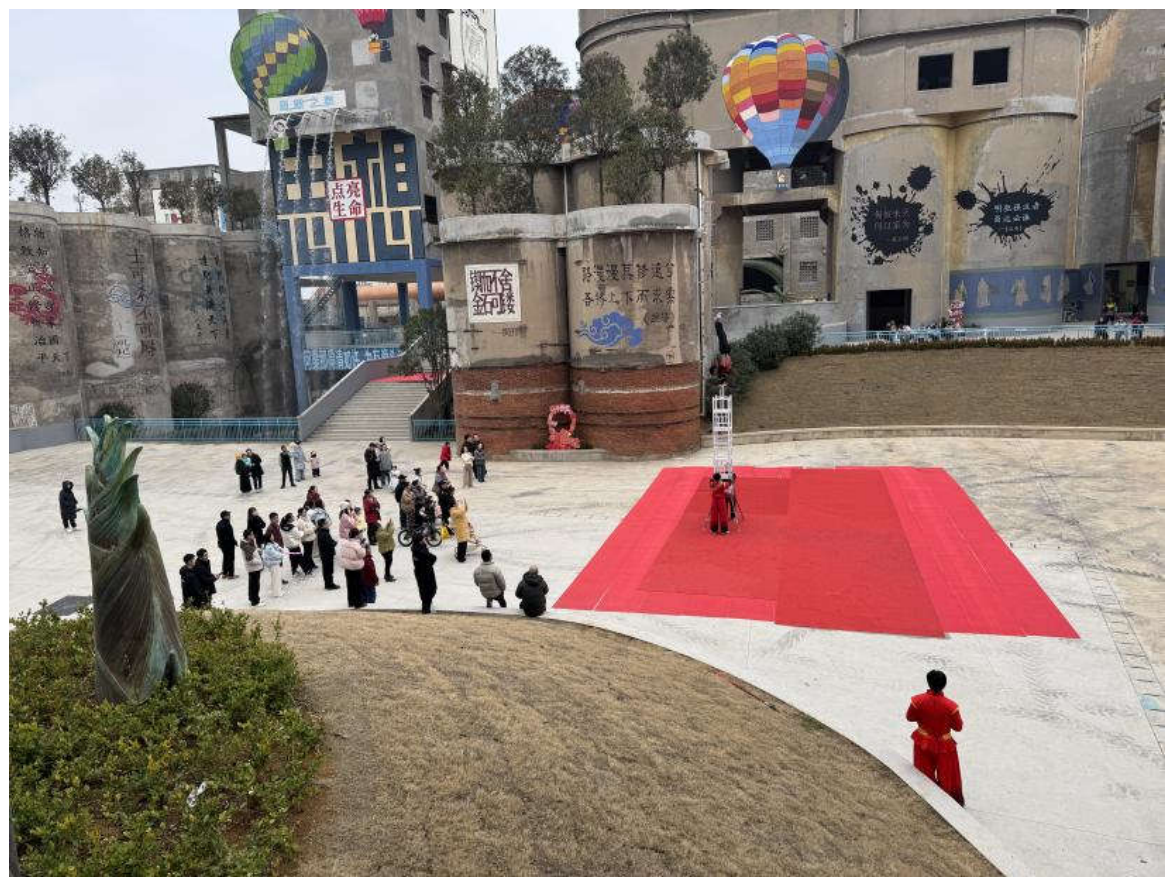
Figure 5.
Replicated production slogans and propaganda posters in the park. Source: Photo taken by Yuan Huang on February 9, 2026.
Figure 5.
Replicated production slogans and propaganda posters in the park. Source: Photo taken by Yuan Huang on February 9, 2026.
4.3. Asset Revitalisation Strategies of the Baiqitun Cement Plant Regeneration Project
To analyse the asset revitalisation of the Anqing Baiqitun Cement Plant, one must first examine the 2003 acquisition of Anqing Baiqitun Cement Co., Ltd. by Fuzhou Jigang Building Materials Co., Ltd. According to archival records, although the Baiqitun Cement Plant was claimed to still possess total assets of 170 million yuan prior to the acquisition, a professional appraisal assessed its actual total value at approximately 53% of the book value, while its liabilities stood at a substantial level—a circumstance that may have been one of the key factors prompting Jigang’s acquisition of the plant[93,94]. The specific details can no longer be verified; however, based on the materials currently available, it is reasonable to infer that the Anqing municipal government at the time likely hoped to revitalise the cement plant’s assets by introducing private capital while simultaneously relieving the local fiscal burden. In the 2003 acquisition, in response to the plant’s accumulated debts and the discrepancy between asset appraisal and book value, the Anqing municipal government and Jigang Company, after multiple rounds of negotiation, ultimately reached an acquisition agreement. According to the 2003 notarisation documents, Jigang paid the full amount in a lump sum, while the Anqing municipal government first extended preferential terms and subsequently reduced the transaction to a level below the appraised value, concurrently completing the transfer and settlement of the bank mortgage debts[95]. Following the acquisition, the ownership of the vast majority of the Baiqitun plant’s tangible and intangible assets was transferred to Jigang Baiqitun Cement Co., Ltd. Although the original intent was not industrial heritage conservation, this move not only enabled the local government to successfully shed its fiscal burden but also objectively safeguarded the integrity of the cement plant’s physical heritage and intangible assets. During the transformation into a cultural and creative park, this unified property rights structure greatly facilitated administrative coordination.
The operational strategy of the Jixian Shikong Cultural and Creative Park, formed after regeneration, can be summarised in three points: first, achieving moving towards operational sustainability on the basis of controlled commercialisation; second, developing its own cultural IP to enhance industrial added value; and third, actively exploring external markets while remaining firmly grounded in the local context.
At the outset of the planning process, in addition to retaining the existing buildings, the project team designed a number of small-scale commercial and ancillary service units with a view to controlled commercialisation, such as the “Courtyard No. 6 Ancillary Building,” a single-storey structure with supporting retail space covering a total area of 120.8 m², and the “Vernacular Dwelling Scene Gallery Ancillary Building,” likewise a single-storey structure with retail space totalling 19.5 m². The design statement emphasised that the layout would fulfil commercial support and service functions while satisfying evacuation requirements. The scattering of such small retail units throughout the park indicates that the project team had, from the very beginning, been considering generating ongoing revenue through commercialisation to sustain the project[96]. However, the planners remained vigilant against over-commercialisation, a stance also reflected in the planning scheme. The scheme shows that the floor area ratio (FAR) designed for Phase I is extremely low: at a mere 0.23 against a maximum control indicator of 20, indicating that from the outset the project team rejected the aggressive model of pursuing short-term gains through raising the FAR and engaging in large-scale real estate development, and instead adopted a cultural-creative eco-investment model characterised by low FAR and low building density[97]. This vigilance against over-commercialisation is, in essence, a safeguard against the mechanism of “heritage washing,” ensuring that the objectives of economic capitalisation do not entirely consume the socio-cultural meaning of the heritage, and that by maintaining the site’s social engagement, it becomes not merely a point of economic growth but also a “social glue” sustaining collective identity[98,99]. Furthermore, the project team required that incoming businesses strike a balance between commercial profit and the park’s theme. According to a guide, a merchant once proposed setting up a live-action CS (combat simulation) project in an undeveloped area of the park, but the operator rejected the proposal on the grounds that the activity’s overall style diverged too sharply from the park’s theme (Interview record: OP-03). Admittedly, the project team also made missteps in commercial planning: during the early stages of the Baiqitun Cement Plant regeneration project, insufficient synergy among the various functional zones led to a disconnect between the historical exhibitions in the Time Park section and the commercial offerings in the Heritage Showcase Park section—a warning for commercial practice in small and medium-sized cities[100].
How to achieve sustained profitability has long been a core concern for operators of industrial heritage in small and medium-sized cities. As the site transformed into a cultural and creative park, the project team did not confine itself to the traditional strategy of relying solely on ticket sales or commercial leasing; instead, it actively explored a path of asset revitalisation centred on the development of intangible assets. The project’s principal investor, himself an artist, led the team in integrating his own modern artworks and concepts into the art exhibition areas, striving to build a brand and aiming to establish the park as the “Industrial Memory of the City’s West” IP[101].
In contrast to the situation facing industrial heritage in central cities, where the cultural consumption market is vast and artistic forms tend towards the avant-garde, small and medium-sized cities generally have a narrow cultural consumption market, thus necessitating locally tailored strategies. The park opted for exhibition content that is close to the everyday lives of local residents, effectively lowering the threshold of appreciation for visitors, and through collaboration with various sectors of society, successfully organised a number of well-received public events within the park. At the same time, the project team actively participated in local intangible cultural heritage transmission, repeatedly inviting local Huangmei opera troupes to perform in the park during festivals, which attracted large numbers of visitors[102,103,104].
Operational data suggest that this strategy has begun to yield early results. The first phase of Jixian Shikong Cultural and Creative Park commenced trial operations on 1 May 2024 and officially opened on 1 October of the same year[105]. By the end of 2024, the park had received approximately 730,000 visitors and generated a total operating revenue of RMB 4.5 million[106]. Over the seven-month period from May to November 2024 alone, revenue exceeded RMB 2.51 million[107]. The park’s popularity continued to grow in 2025: during the May Day holiday, it welcomed 80,200 visitors and recorded tourism revenue of RMB 499,500[108]; by the end of 2025, cumulative visitor numbers had surpassed 800,000, driving tourism revenue beyond RMB 4.5 million[109]. During the 2026 Spring Festival, the park launched a themed event entitled “Anqing Has Drama, Jixian Brings Joy,” attracting 105,000 visitors and generating total revenue of RMB 4.9 million as of 25 February[110]. Although precise cost-side data remain proprietary and are not publicly available,this revenue structure indicates that the park has preliminarily established a sustainable business model. Income is derived from diverse sources, including sales of cultural and creative products, tenant rentals, event planning, and market fairs. Although the park is still in its early operational phase, with commercial facilities still being improved and some spaces remaining available for lease, the data above suggest that it has attained an initial degree of financial viability.
With the support of the local government, the park operator began actively exploring external markets, the most important step of which was its inclusion in the Great Huangshan Initiative. The full name of the initiative is the Great Huangshan World-class Leisure, Wellness and Tourism Destination Development Initiative, jointly launched by the Anhui Provincial Party Committee and the Provincial Government in 2024. It covers 28 counties (cities and districts) across four municipalities—Anqing, Huangshan, Chizhou, and Xuancheng—spanning an area of 44,000 square kilometres with a permanent resident population exceeding 9.3 million. Grounded in the distinctive advantages of the southern Anhui region in terms of landscape, culture, and ecology, the initiative aims to integrate the area’s premium tourism resources, with the target of raising the region’s GDP to 1,400 billion yuan by 2033, receiving over 670 million domestic tourist visits and generating tourism revenue exceeding 790 billion yuan. At the 2024 World Brand Moganshan Conference, the Anhui provincial government stated that the Great Huangshan Initiative would aim for world-class standards, adhere to international benchmarks, promote the standardisation of leisure, wellness and tourism services, bring the quality of tourism services fully in line with international standards, elevate tourism services to a high-end level through internationalisation, and strive to create a quality, warm-hearted brand of leisure, wellness and tourism[111].
On 13 June 2024, to advance the development of the Great Huangshan World-class Leisure, Wellness and Tourism Destination, the Daguan District Government of Anqing convened a promotion conference on Great Huangshan construction, at which the Jixian Shikong Cultural and Creative Park was incorporated into a 2.844 billion yuan investment plan for high-end key service industry projects, and the park’s transformation achievements were highly commended[112].
After being incorporated into the Great Huangshan Initiative, Jixian Shikong Cultural and Creative Park gained access to certain promotional resources targeting external markets. On 14 September 2024, a delegation of 12 outstanding social media influencers from Caribbean countries, organised by the Department of Latin American and Caribbean Affairs of China’s Ministry of Foreign Affairs, visited the park to observe a “revitalised” exemplar of mining and industrial remains transformed into a cultural and creative industry[113]. On 23 November 2024, the Anqing Foreign Affairs Office, in collaboration with the Daguan District Government Office, held the third “Yiqikan Shijie” (Seeing the World Together) translation talent exchange event. The event was attended by over 50 participants, primarily from various organisations with government backgrounds, including 13 foreign experts and international students. The programme included a site visit to Jixian Shikong Cultural and Creative Park, showcasing Anqing’s economic development achievements and historical and cultural heritage to foreign guests[114]. The park operator actively cooperated in these activities, making considerable efforts to raise its profile in international markets. However, it must also be noted that a disjuncture exists between the internationalised image of the cultural and creative park emphasised in official narratives and the everyday needs of the local community; these internationalised narratives have had virtually no connection with the local public, reflecting a tendency towards tokenism in the globalisation process of small and medium-sized cities.
4.4. The Interactive Process of Local Participatory Governance
In the adaptive reuse of industrial heritage, participatory governance constitutes an indispensable element in achieving institutional and governance sustainability[115]. The conventional top-down, administration-led model often struggles to resolve various historically accumulated problems, whereas participatory governance, by incorporating the government, enterprises, former employees, and surrounding community residents into the decision-making and operational processes, has successfully constructed a governance community characterised by shared responsibilities and shared benefits, thereby facilitating the project’s long-term effective operation after enterprise restructuring[116]. In the case of the Baiqitun Cement Plant regeneration, participatory governance is manifested primarily in two respects: the interaction between government and private capital, and government transparency.
During the cement plant’s enterprise restructuring, interest negotiation among various stakeholders ensured stability during the property rights transfer, safeguarded the integrity of the industrial heritage, and facilitated the smooth dissolution of the old industrial community. Looking back to the period of enterprise restructuring in 2003, at the critical juncture of the Baiqitun Cement Plant’s transformation, the plant did not confine itself to a simple transfer of property rights; rather, through administrative coordination and contractual agreements, it brought relevant departments, creditor banks, the acquirer, and employee representatives together to participate in the decision-making on the disposal plan. This participatory mechanism effectively mitigated the information asymmetry in property rights confirmation, and consensus was reached through negotiation on matters concerning asset restructuring, employee reassignment, and debt assumption[117]. This governance approach grounded in participatory consultation not only provided a legitimate legal basis for the subsequent construction of the cultural park, but also substantially cushioned the impact of the old industrial community’s disintegration. Although the former employee cohort felt considerable reluctance, they nonetheless accepted the resettlement measures set out in the plan (Interview record: RE-03). It should be acknowledged, however, that this was in essence a closed-door, elite-dominated negotiation that excluded the broader public. While effective in defusing the immediate crisis, this approach also entrenched a path-dependent governance style—one that prioritises administrative coordination over community empowerment. Moreover, the worker representatives who participated in the 2003 consultations were never reconvened in subsequent stages.
During the years following the plant’s complete relocation in 2017, the governance of the site appeared to enter a period of relative hiatus. A cross-departmental coordination mechanism had yet to be fully established, and the integrated management of the idle factory grounds remained at an exploratory stage. Formal procedures for soliciting public input on the future orientation and use of the old plant were virtually absent. For the former workforce—already dispersed in the wake of the 2003 restructuring—institutional ties to the old site had grown increasingly attenuated, and effective channels through which they might voice their concerns about workplace memory remained notably limited. This relative absence of a governance framework during the transitional period eroded, to some degree, the continuity of collective identity between a dissolving industrial community and the now-silent physical fabric of the plant.
Following the signing of the regeneration agreement in 2023 and the subsequent introduction of private capital alongside the project’s launch, the governance model shifted markedly. It must be noted, however, that the continuous refinement of participatory governance is a dynamic process. In the subsequent phase of introducing new capital for the adaptive reuse of the industrial heritage, the division of responsibilities and rights among the local government planning department, the land reserve agency, and the external cultural tourism investment entity became temporarily ambiguous during the legal transition period, which at one point brought project progress to a standstill. This bottleneck in governance coordination directly resulted in Phase II of the park, originally scheduled for full opening on 1 May 2024, being forced to be postponed to 2025[118].
Another manifestation of participatory governance is the transparency of government information. Prior to formal development, the local government and planning authorities publicly disclosed information such as the project registration form and the Phase I site-level detailed plan, openly displaying the project’s technical indicators, functional zoning, traffic circulation and visitor flow analysis, and even infrastructure plans for stormwater and sewage networks and electrical and telecommunications systems. After the park opened, the government also regularly made public, through work plans and other means, its support measures for the park and the park’s development status. This strategy safeguarded the rights of multiple stakeholders to be informed, to express their views, and to exercise oversight. The government and the project team also established open channels to broadly solicit and incorporate opinions from all sectors of society, the principal among them being proposals submitted by members of the Municipal Committee of the Chinese People’s Political Consultative Conference (CPPCC) and deputies to the Municipal People’s Congress. The proposals submitted, concentrated in 2025, covered a wide range of topics: some urged the government to establish a robust industrial heritage conservation mechanism as soon as possible, some offered suggestions for optimising visitor flows at the cultural and creative park, some proposed the installation of electric vehicle charging piles near the park, and the most numerous were proposals for promoting integrated cultural and tourism development[119,120,121,122,123,124]. Although these elite channels exhibited a form of representation, they cannot be equated with substantive community-level participation. The voices of ordinary residents—and, more importantly, those of the former workforce, whose ties to the plant’s industrial past were most direct—have remained institutionally marginalised.
As for the general public, in addition to offline channels, the cultural and creative park launched a WeChat mini-programme to receive online feedback from visitors, while the government mainly collected relevant opinions through the 12345 government service hotline. Throughout 2025, there was only one public suggestion submitted by citizens to the government regarding improvements to the cultural and creative park, made in October 2025, which recommended barrier-free access renovations and internal circulation optimisation. The Daguan District Government issued an official reply, stating that the relevant suggestions had been forwarded to the park operator[125]. The extremely low volume of grassroots input is in itself telling: it signals not public satisfaction but rather that the existing consultation channels are passive, reactive, and designed principally for complaint handling rather than collaborative decision-making.
Table 5.
Phased Evolution of Governance Dynamics in the Baiqitun Cement Plant Regeneration Project. Source: elaboration by the authors.
Table 5.
Phased Evolution of Governance Dynamics in the Baiqitun Cement Plant Regeneration Project. Source: elaboration by the authors.
| Time Phase | Governance Mode | Key Actors | Main Outcomes and Issues |
| 2003 Restructuring | Elite negotiation | Government, acquirer, employee reps | Property rights transferred; public excluded |
| 2003–2017 Post-restructuring | Enterprise self-operation | Jigang Baiqitun Cement Co. | Production declined; industrial community dissolved |
| 2017 Relocation | Governance hiatus | — | Site left idle; no public participation |
| 2023 Agreement Signed | Government-led | Government, tourism company | Project launched; role ambiguity during transition |
| 2024 Phase I Opening | Government + market | Government, operator | 730,000 visitors; Phase II delayed due to coordination bottlenecks |
| 2025 Peak of Proposals | Elite representation | CPPCC, Congress deputies | Multiple issues raised; ordinary voices marginalised |
| 2025 Public Feedback | Passive complaint response | Citizens, district government | Only one suggestion; reflects weak participation channels |
5. Discussion
As a heavy industrial remains site in a small to medium-sized riverside city, the transformation of the former Anqing Baiqitun Cement Plant differs both from the nationally-driven, unified planning characteristic of Germany’s Ruhr region, and from the regeneration model reliant on the high-end consumer market of a mega-city, as exemplified by the Tate Modern in London. This is jointly determined by Anqing’s urban scale and the inherent characteristics of the industrial heritage itself.
The analytical results present a complex picture, encompassing both successes and shortcomings. On the whole, the project has successfully achieved the urban spatial transformation and asset revitalisation of a derelict industrial site. These areas, after regeneration, have been thoroughly renewed and now attract large numbers of visitors for leisure and consumption, generating new economic and employment opportunities for the locality. The planners preserved the great majority of the building structures and, through the adaptive reuse of the heritage’s physical remains, achieved the effect of carbon sequestration and emission reduction. Considerable technical and financial investment also yielded success in ecological restoration, which has been highly commended by both the local government and residents. This strategy of reducing carbon emissions by retaining physical remains has objectively contributed to the conservation of the industrial heritage, while simultaneously providing a material medium for the continuity of the city’s industrial memory[126].
With regard to the transmission of social memory, particularly industrial memory, however, the situation becomes complex. Although the planners retained a large quantity of industrial remains and industrial symbols, they did not treat these as the park’s principal cultural content; instead, they relegated them to a relatively marginalised position. The park devotes considerable space to promoting themes of traditional Chinese culture and red culture, yet accords little importance to the history of the cement plant itself. Within the park, without the guidance of a tour guide, visitors can obtain virtually no information about the plant’s active years, and the guides’ own understanding of the cement plant is not deep; their commentary centres on the architectural renovation concepts and the content of the various art sections. Although a dedicated industrial memory exhibition area exists, the content displayed is overly generic, lacking the distinctive imprint of the cement plant’s active era—an era that belonged uniquely to the plant and its workers’ community. The honours and influence the cement plant once attained, its trajectory of technological development, its workers’ community, and other core elements constituting the intangible value of the industrial heritage have all been inadequately developed and utilised by the planners. An important reason for this arrangement lies in the park operator’s positioning of its own educational function. In recent years, China’s top leadership has issued the call for the “Two Integrations,” which stresses combining traditional Chinese culture with Marxism; the operator, wishing to respond to this call and establish an educational base, was bound to follow this principle. This selective reconstruction adheres to the top-down production logic of the “Authorised Heritage Discourse” (AHD): in order to construct an urban identity that aligns with the current political narrative, management entities often marginalise heterogeneous grassroots labour memories through the cleansing and substitution of cultural symbols, bringing the industrial heritage into symbolic subordination to grander official imperatives[127]. The old industrial culture, whose community has long since vanished and whose audience is small, could naturally only be relegated to a subordinate position.
Such selective reconstruction is not merely a design oversight but a systemic logic of narrative prioritisation: heritage is redefined to serve present-day political and economic objectives. In the Baiqitun case, privileging traditional culture and “red education” over industrial memory has yielded distinct gains for the various actors involved: the local government gained a showcase for ecological and economic achievements; the operator secured official recognition and visitor traffic; and the branding of the site as part of the “Great Huangshan” tourism destination subordinated its distinctive industrial past to broader regional development imperatives. What has been suppressed, by contrast, are the lived experiences of the work-unit community—the rhythms of production, collective pride, and the everyday life that wove the social fabric of the factory. This is precisely how the “Authorised Heritage Discourse” (AHD) operates: not as a neutral curatorial choice, but as a politics of recognition—in which certain pasts are authorised for presentation while others are systematically marginalised.
Moreover, field interviews indicate that the majority of visitors and local residents are unable to connect the regenerated site with their collective identity and shared memory; most of them know little about the cement plant’s history. As for the cohort of former employees who worked at the plant before the enterprise restructuring, their old community ties had already gradually dissolved over a decade ago. Although their identification with the cement plant persists, it has become blurred. For the cohort of new employees who emerged after the restructuring, the factory relocation did not affect them substantially; for them, life has not changed dramatically. This confronts the project with enormous challenges in the transmission of urban memory. It also suggests that the project attaches greater importance to spatial revitalisation and the exploitation of economic value than to achieving genuine cultural heritage conservation.
Nevertheless, one should not be overly critical of the cultural and creative park’s operator. The current operational status of Jigang Baiqitun Cement Co., Ltd. has affected the park’s capacity to develop and utilise the “Baiqitun” trademark and other related materials of the cement plant, objectively contributing to a hollowing-out tendency in the park’s deployment of industrial symbols. Unlike enterprises that have completely gone bankrupt and ceased to exist, the Baiqitun Cement Plant, although much diminished in strength, still holds complete ownership of all its key assets, including its trademark. This means that the park operator must negotiate with the cement plant whenever it wishes to utilise the classic “Baiqitun” industrial emblem and other associated assets, raising the costs involved and making the operator inclined, in practice, to rely on original content of its own creation. This directly results in a situation where, in reconstructing collective memory, the planners can only borrow the external shell of the brand but are unable to establish a substantive connection between it and the ongoing practices of production and workers’ lives.
On the other hand, although the government, as the leading party, has made numerous efforts to advance participatory governance in this project, there remains considerable room for improvement. The heritage regeneration process exhibited top-down characteristics, with the local government taking the lead in introducing private capital, while the degree of community participation remained limited throughout. This is attributable both to local residents’ lack of awareness of industrial heritage conservation and to the inadequacy of the institutional mechanisms for public participation in decision-making. Industrial heritage conservation that lacks a bottom-up mechanism finds it difficult to mobilise the initiative of local residents, which is detrimental to the construction of a new connection between industrial heritage and collective identity. Furthermore, there are deficiencies in the relevant legislation and administrative bodies. To date, Anqing has neither enacted specific provisions for industrial heritage conservation nor established a dedicated industrial heritage management agency; the relevant work is dispersed across multiple departments. This situation readily leads to low administrative efficiency and may slow the progress of work related to industrial heritage conservation.
A distinction must be drawn, however, between information transparency, formal consultation, and genuine community participation. In the Baiqitun case, the government’s proactive publication of planning documents and the establishment of online feedback channels are commendable in terms of transparency. Yet these mechanisms remain essentially reactive: they invite public comment on predetermined proposals rather than empowering stakeholders to co-decide from the outset. The responses to CPPCC proposals, while demonstrating a degree of elite responsiveness, do not amount to substantive public participation. Genuine participation would require institutionalised channels that enable former workers, surrounding residents, and other stakeholders to engage in heritage reinterpretation and governance decisions from the earliest stages—conditions that are conspicuously absent in the present case. This imbalance in the governance structure corroborates the view that industrial heritage conservation is, to a considerable extent, a negotiation of power over the right to use urban space and the right to discourse. In the absence of substantive public participation, administration-led area development is often difficult to translate into deep social consensus, thereby impeding the process through which heritage projects are transformed into public memory[128].
The generalisability of the above experience warrants examination through comparison with analogous cases. A case in point is the Huangshi Huaxin Cement Plant, which, like Baiqitun, represents cement industrial heritage in a small to medium-sized riverside city. Established in 1907 as one of the birthplaces of China’s modern cement industry, the plant preserves the world’s only complete wet-process rotary kiln production line and has been designated a Major Historical and Cultural Site Protected at the National Level—a historical status and degree of institutional protection far beyond that of Baiqitun[129]. The value structure of Huaxin displays a distinctive profile: its historical value overwhelmingly dominates public perception, with social media data analysis indicating that historical value accounts for as much as 33.6% of all discourse[130]. In contrast, the historical value of Baiqitun has been overlaid and diluted by the narrative frameworks of “red culture” and “traditional culture.” In terms of regeneration outcomes, Huaxin has been transformed into a free-admission, non-profit urban park, achieving a commendable integration of historical value and public benefit. Baiqitun, meanwhile, has completed the first phase of its opening and attracted 730,000 visitors, yet notable shortcomings persist in memory transmission and public participation.
Of particular note is the divergent fate of the original enterprises behind the two plants. The Huaxin Group remains a powerhouse today, ranking among China’s top 500 listed companies; its brand continuity and societal influence endow the heritage with sustained cultural vitality. Baiqitun’s original enterprise, by contrast, fell into gradual decline following restructuring and acquisition. An underdeveloped cooperative mechanism has led to numerous restrictions on the park’s use of the “Baiqitun” trademark and associated industrial archives, objectively exacerbating the disruption and hollowing out of industrial memory. In this comparative light, the Baiqitun experience is better suited to industrial heritage in small and medium-sized cities characterised by relatively simple historical layering, a low level of protection, and the decline or exit of the original enterprise. For heavy industrial remains such as Huaxin—which enjoy nationally protected heritage status and a still-thriving original enterprise—the successful non-profit public space transformation provides an entirely different reference pathway, one that should not be conflated with Baiqitun’s cultural and creative park model.
A further comparative case is a cement plant built in the early twentieth century in Opole, Poland. After its production facilities were damaged during the war, the structure was hastily converted into a grain silo in 1948, which compromised the building fabric and led to its rapid abandonment. It was subsequently purchased by a private investor, gradually transformed into a commercial exhibition centre, and finally acquired jointly by the Silesian Museum and the University of Opole in 2025, becoming a heritage and arts centre[131,132]. The two cases were set in motion by different initial drivers: Anqing’s relocation was a proactive urban renewal measure, whereas Opole’s transformation was a reactive response to wartime destruction. This, in turn, shaped the implementing agents—master-planned by the local government in Anqing, incrementally developed by a private investor in Opole—as well as the temporal scale: Baiqitun underwent a single functional shift in under a decade, while Opole experienced three successive functional conversions over nearly eighty years. Both plants, however, are located in small and medium-sized cities lacking high-end consumer markets and have been constrained by limited market capacity and capital supply. Two insights can be drawn from this comparison. The first concerns the temporal dimension: industrial heritage in smaller cities may require prolonged functional recalibration before a stable public-cultural role can be secured, which calls for dynamic rather than static modes of evaluation. The second concerns the relationship between commercial and cultural functions: the Opole case suggests that incremental functional iteration is more realistic than a singular grand plan, and that commercial and cultural uses do not simply replace one another in a linear fashion but require a dynamic equilibrium that adapts to shifting conditions—a principle likewise borne out by the Baiqitun case.
6. Conclusions
The Anqing Baiqitun Cement Plant, which achieved notable success in the 1980s and 1990s, has been consigned to history amid the recent shift in urban development thinking and the wave of industrial restructuring. Its original industrial community gradually disintegrated and vanished, leaving behind an extensive complex of architectural remains after the complete relocation of production. The disappearance of the Baiqitun Cement Plant created a significant void in Anqing’s ecological governance and urban functional planning, prompting the municipal government to put the development and utilisation of the resulting industrial heritage on the agenda.
This study presents three principal findings. To begin with, for heavy industrial heritage with substantial physical remains, adaptive reuse with minimal intervention delivers a directional advantage in carbon sequestration and emission reduction over demolition and reconstruction—an advantage that remains robust even in the absence of complete life-cycle assessment data. Furthermore, a business strategy anchored in the local market and the development of proprietary cultural IP can achieve financial sustainability in the context of small and medium-sized cities, as evidenced by the park’s 730,000 visitors and RMB 4.5 million in operating revenue in its first year. Finally, while the project’s governance model has proved relatively efficient in coordinating government and market forces, it has essentially excluded grassroots participation, producing a pronounced disjuncture between the regenerated site and the collective memory of the former industrial community.These findings, however, must be qualified. The observation that industrial memory has been attenuated draws on a small sample of qualitative interviews and awaits corroboration through a structured visitor survey. The carbon saving estimates, while indicative, require verification via a full Life Cycle Assessment (LCA). The claim of replicability should also be circumscribed: Anqing’s particular industrial history, governance capacity, and regional policy context have together shaped the findings reported here, and their generalisability needs to be tested through multi-case comparison.
This study makes three principal contributions. First, it provides one of the relatively few empirical case studies of adaptive reuse in a Chinese small or medium-sized city, where resource constraints and a limited cultural consumption market pose distinctive challenges. Second, it reveals how the continued operation of the original enterprise at a separate location can fracture the transmission of collective memory—a dynamic frequently overlooked in research on plants that have been shuttered or declared bankrupt. Third, it advances a pragmatic critique of governance: participatory mechanisms cannot be reduced to transparency or elite consultation; rather, institutionalised channels that empower local communities must be embedded from the very outset of a project. For planners, these findings suggest that sustainable adaptive reuse is as much an undertaking in social governance as it is a physical and economic enterprise.
In light of the issues identified above, this study advances two policy recommendations for the adaptive reuse of industrial heritage in small and medium-sized cities. First, a community consultation platform should be established. Such a platform would be set up during the project preparation phase, bringing former employees, surrounding residents, and local cultural groups into the decision-making process rather than merely soliciting their views after plans have been finalised. It is precisely this sequencing that determines whether participation is substantive or merely symbolic. Second, a multi-party archival access agreement should be formalised. In cases where the original enterprise continues to operate elsewhere, the local government ought to take the lead in brokering a formal agreement between the developer and the original enterprise covering factory archives, trademark use, and the recording of veteran workers’ memories. Such an institutionalised arrangement would safeguard both the material carriers and the spiritual core of industrial memory from being severed. Neither mechanism demands substantial fiscal outlay, yet both directly address the structural shortcomings that pervade current practice, and would enable the revitalisation of industrial heritage to encompass social repair alongside physical renewal.
It must be acknowledged that this study has the following limitations. First, due to the partial loss of historical drawings from the 1970s and the absence of survey data, the comparison of carbon sequestration and emission reduction effects primarily relied on the scenario analysis method within qualitative analysis. Future research should attempt to introduce quantitative digital modelling tools such as Life Cycle Assessment (LCA) to precisely calculate the in-situ carbon sequestration and emission reduction contributions of the 102 old buildings at the Baiqitun Cement Plant. Second, the research object of this study is a traditional heavy industrial remains site with a deep historical background of ‘enterprise-run society’ (corporate welfarism) in the Yangtze River basin. To what extent this experience can be generalised and applied to inland arid regions or to small and medium-sized cities in other industrial sectors remains to be further verified through multi-case comparative studies by future scholars. Third, the study did not conduct a structured visitor survey, which limits the generalisability of the findings on memory transmission; this remains a priority for future research.
Author Contributions
Conceptualization, Y.H.; methodology, Y.H.; formal analysis, Y.H.; investigation, Y.H.; data curation, Y.H.; writing—original draft preparation, Y.H.; writing—review and editing, Y.H. and J.Y.; visualization, Y.H.; supervision, J.Y.; project administration, J.Y. All authors have read and agreed to the published version of the manuscript.
Funding
This work was supported by the National Social Science Fund of China (General Project) under Grant No. 21BSS022 (“A Study on the Rise and Fall of Entrepreneurs and Free Trade in Britain, 1770–1932”), awarded to Professor Jianlong Yin at Anhui University, and by the Anhui University Education Foundation Special Fund for Humanities and Social Sciences.
Institutional Review Board Statement
Ethical review and approval were waived for this study by Anhui University, as per Article 32 of the Measures for Ethical Review of Life Sciences and Medical Research Involving Human Beings (National Health Commission Document No. 4 [2023]). The study involved only non-experimental, non-invasive, anonymous semi-structured interviews with 13 adult participants. All participants were fully informed about the study’s objectives; their participation was voluntary, and they were assured of their right to withdraw at any time. Informed consent was obtained from all participants prior to the interviews. The study was conducted in full compliance with the Declaration of Helsinki and the Personal Information Protection Law of the People’s Republic of China. The authors declare that no breach of ethical rules has occurred during the preparation and publication of this study.
Informed Consent Statement
Informed consent for participation was obtained from all subjects involved in the study.
Data Availability Statement
Restrictions apply to the datasets: The datasets presented in this article are not readily available because the interview transcripts contain personal information and are not publicly available due to participant consent restrictions; internal archival documents are proprietary and cannot be disclosed; all other data are derived from published sources that are cited and publicly accessible. Requests to access the datasets should be directed to the corresponding author.
Acknowledgments
The authors would like to express their sincere gratitude to the Jixian Shikong Cultural and Creative Park and the Anqing Municipal Bureau of Industry and Information Technology for their invaluable assistance and support in facilitating the fieldwork and providing access to relevant archival materials for this study.
Conflicts of Interest
The authors declare no conflicts of interest.
References
- Intergovernmental Panel on Climate Change. Climate Change 2001: Impacts, Adaptation, and Vulnerability: Contribution of Working Group II to the Third Assessment Report of the Intergovernmental Panel on Climate Change; Cambridge University Press: Cambridge, UK, 2001. Available online: https://www.ipcc.ch/site/assets/uploads/2001/04/doc3d.pdf (accessed on 3 June 2026).
- Hoursan, F.; Mofidi, M. Revitalizing Golshan and Sharifieh caravanserais: A study in adaptive reuse and urban preservation. Discover Geoscience 2024, 2, 48. [CrossRef]
- Dash, D. Adaptive Reuse of Industrial Spaces in Urban Revitalization. Available online: https://osf.io/preprints/osf/6e43b_v1 (accessed on 3 June 2026).
- Hu, M.; Świerzawski, J. Assessing the environmental benefits of adaptive reuse in historical buildings. A case study of a life cycle assessment approach. Sustainable Environment 2024, 10, 2375439. [CrossRef]
- Intergovernmental Panel on Climate Change. Mitigation of Climate Change: Contribution of Working Group III to the Fifth Assessment Report of the Intergovernmental Panel on Climate Change; Cambridge University Press: Cambridge, UK, 2014; p. 147. Available online: https://keneamazon.net/Documents/Publications/Virtual-Library/Impacto/157.pdf (accessed on 3 June 2026).
- Davis, S.J.; Lewis, N.S.; Shaner, M.; et al. Net-zero emissions energy systems. Science 2018, 360, eaas9793. [CrossRef]
- Walczak, B.M.; Kepczynska-Walczak, A. Adaptive re-use of industrial heritage in Lodz, Poland. International Journal of Conservation Science 2024, 15, 955–966. [CrossRef]
- Zhang, J.; Cenci, J.; Becue, V.; et al. Recent evolution of research on industrial heritage in Western Europe and China based on bibliometric analysis. Sustainability 2020, 12, 5348. [CrossRef]
- Goluža, M.; Bole, D. From nostalgia to disdain: The contested role of industrial heritage narratives in legitimising post-industrial urban transformation. Urban Research & Practice 2025, 19, 291–313. [CrossRef]
- Florida, R. Cities and the Creative Class; Routledge: New York, NY, USA, 2005.
- Harvey, D. Spaces of Capital: Towards a Critical Geography; Routledge: New York, NY, USA, 2002.
- Mumford, L. The Culture of Cities; Open Road Media: New York, NY, USA, 2016.
- Chiodi, C.A.M.; De Lucia, R.; Giunchi, C.; et al. Looking for a Balance Between Memories, Patrimonialization, and Tourism: Sustainable Approaches to Industrial Heritage Regeneration in Northwestern Italy. Sustainability 2025, 17, 905. [CrossRef]
- Zhang, J.; Jiang, N.; Du, Y.; Chung, T. Unlocking multiple potentials: A data-driven framework for adaptive reuse of industrial heritage in Changzhou, China. Journal of Asian Architecture and Building Engineering 2025, 1–23. [CrossRef]
- Wu, J.; Ouyang, G.; Wang, Y.; He, F.; He, R. Adaptive reuse of industrial heritage in mining towns based on scene theory: A case study of Meitanba Town, China. Buildings 2026, 16, 1317. [CrossRef]
- Xia, J.; Wang, S.; Cheng, A. Industrial heritage and urban renewal: A quantitative study and optimization strategies for Chengdu East Suburb Memory. Frontiers in Environmental Science 2025, 13, 1537211. [CrossRef]
- Szopińska-Mularz, M.; Prokop, A.; Wikiera, M.; Bukowy, W.; Forsman, F.; Vikström, S. Adaptive reuse of urban structures as a driver of Sustainable Development Goals: A systematic literature review. Sustainability 2025, 17, 4963. [CrossRef]
- Meng, F.; Zhi, Y.; Pang, Y. Assessment of the adaptive reuse potentiality of industrial heritage based on improved entropy TOPSIS method from the perspective of urban regeneration. Sustainability 2023, 15, 7735. [CrossRef]
- Guo, B.; Huang, W. From workers’ movement space to red revolutionary heritage: Anyuan Coal Mine in historical memory and policy practice. The Historic Environment: Policy & Practice 2026, in press. [CrossRef]
- Goluža, M.; Bole, D. From nostalgia to disdain: The contested role of industrial heritage narratives in legitimising post-industrial urban transformation. Urban Research & Practice 2025, 19, 291–313. [CrossRef]
- TICCIH. The Nizhny Tagil Charter for the industrial heritage. In Proceedings of the TICCIH XII International Congress, Nizhny Tagil, Russia, 10–17 July 2003; pp. 169–175.
- Council of Europe. Convention for the Protection of the Architectural Heritage of Europe; Council of Europe: Strasbourg, France, 1985.
- Council of Europe, Parliamentary Assembly. Industrial Heritage in Europe. Available online: http://assembly.coe.int/nw/xml/XRef/Xref-XML2HTML-en.asp?fileid=19512&lang=EN (accessed on 3 June 2026).
- International Council on Monuments and Sites. Venice Charter for the Conservation and Restoration of Monuments and Sites; International Council on Monuments and Sites: Paris, France, 1964.
- United Nations Educational, Scientific and Cultural Organization. Convention for the Safeguarding of the Intangible Cultural Heritage; United Nations Educational, Scientific and Cultural Organization: Paris, France, 2003. Available online: https://ich.unesco.org/doc/src/71407-EN.pdf (accessed on 3 June 2026).
- ICOMOS; TICCIH. The “Dublin Principles”. Joint ICOMOS–TICCIH Principles for the Conservation of Industrial Heritage Sites, Structures, Areas and Landscapes. Adopted by the 17th ICOMOS General Assembly on 28 November 2011. Available online: https://ticcih.org/wp-content/uploads/2013/10/GA2011_ICOMOS_TICCIH_joint_principles_EN_FR_final_20120110.pdf (accessed on 30 June 2026).
- Ma, Y.; Roosli, R.; Cao, Z.; Zhang, X.; Gai, Y.; Ma, Z. From isolation to integration: A methodological review of adaptive reuse in industrial heritage buildings. Energy Build. 2025, *348*, 116474. [CrossRef]
- Zheng, X., Guo, S., & Heath, T. (2025). Beyond Short-Term Success: Developing an FCE-Based Framework for User Satisfaction in China’s Industrial Heritage Regeneration. Buildings, 15(16), 2831. [CrossRef]
- Yung, E.H.K.; Chan, E.H.W. Implementation challenges to the adaptive reuse of heritage buildings: Towards the goals of sustainable, low carbon cities. Habitat International 2012, 36, 352–361. [CrossRef]
- U.S. Department of Housing and Urban Development. A Report on the Feasibility of Deconstruction: An Investigation of Deconstruction Activities in Four Cities; U.S. Department of Housing and Urban Development: Washington, DC, USA, 2003.
- Huang, Y.; Wang, F.; Hiscock, A.V.; Satyarthi, J.; Smith, H. Including Embodied Carbon in Assessing Renovation Options for Industrial Heritage Buildings: A Review and Case Studies. Sustainability 2025, *17*, 72. [CrossRef]
- Yang, S.; Ma, H.; Li, N.; Xu, S.; Guo, F. Energy-Saving Design Strategies for Industrial Heritage in Northeast China Under the Concept of Ultra-Low Energy Consumption. Energies 2025, *18*, 1289. [CrossRef]
- Nocca, F.; Remøy, H. Abandoned industrial heritage: From waste to resource. Which evaluation tools to evaluate this circular process? J. Cult. Herit. 2026, *77*, 207–222. [CrossRef]
- Walley, C. Linkon, Sherry (2018) The half-life of deindustrialization: Working-class writing about economic restructuring, University of Michigan Press, Ann Arbor, MI. Journal of Working-Class Studies 2018, 3, 146–148. [CrossRef]
- Tweed, C.; Sutherland, M. Built cultural heritage and sustainable urban development. Landscape and Urban Planning 2007, 83, 62–69. [CrossRef]
- Goluža, M.; Bole, D. From nostalgia to disdain: The contested role of industrial heritage narratives in legitimising post-industrial urban transformation. Urban Research & Practice 2025, *19*, 291–313. [CrossRef]
- Hruška, V.; Merciu, C.; Raška, P.; Píša, J.; Smutná, Z.; Sýkora, T.; Štěbetáková, M.; Hlaváček, P.; Kučerová, S. R.; Nedorostová, E. Industrial legacy, contemporary views: narratives on industrial heritage and its development in Czechia. European Planning Studies 2025, *34*, 584–602. [CrossRef]
- Mukherjee, A.; Banerji, H. Disparities in expert and community perceptions of industrial heritage and implications for urban well-being in West Bengal, India. npj Heritage Science 2025, *13*, 1. [CrossRef]
- Xia, J.; Wang, S.; Cheng, A. Industrial heritage and urban renewal: A quantitative study and optimization strategies for Chengdu East Suburb Memory. Front. Environ. Sci. 2025, *13*, 1537211. [CrossRef]
- Smith, L. Uses of Heritage; Routledge: London, UK, 2006.
- Yang, X.; Hu, B.; Zhao, J. Official Projection vs. Public Perception: Measuring the Perceptual Discrepancy of Creative Industry Parks in the Industrial Heritage Category Using Large Language Models. Land 2025, *14*, 2371. [CrossRef]
- Meng, S.; Zhang, J.; Xiong, L. Economic feasibility assessment of industrial heritage reuse under multi-attribute decision-based urban renewal design. Urban Science 2025, 9, 456. [CrossRef]
- AdrianaTisca, I.; Istrat, N.; Dumitrescu, C.D.; Cornu, G. Management of sustainable development in ecotourism. Case study Romania. Procedia Economics and Finance 2016, 39, 427–432. [CrossRef]
- Huang, Y.; Wang, F.; Hiscock, A.V.; Satyarthi, J.; Smith, H. Including embodied carbon in assessing renovation options for industrial heritage buildings: A review and case studies. Sustainability 2024, 17, 72. [CrossRef]
- Xia, J.; Wang, S.; Cheng, A. Industrial heritage and urban renewal: A quantitative study and optimization strategies for Chengdu East Suburb Memory. Frontiers in Environmental Science 2025, 13, 1537211. [CrossRef]
- Gürsoy, M. Examining the sustainability of converting selected old industrial structures into educational/cultural functions from a circular economy perspective: Cibali Tobacco Factory, Hasanpaşa Gasworks, Santralİstanbul. Design Nexus: Interdisciplinary Journal of Design Studies 2025, 1, 59–79. https://izlik.org/JA92JC29HY.
- Chiodi, C.A.M.; De Lucia, R.; Giunchi, C.; Molinari, P. Looking for a Balance Between Memories, Patrimonialization, and Tourism: Sustainable Approaches to Industrial Heritage Regeneration in Northwestern Italy. Sustainability 2025, *17*, 905. [CrossRef]
- Meng, F.; Xiao, X. Spatiotemporal Distribution and Adaptive Reuse Results Assessment of Beijing Industrial Heritage Based on the Sustainable Renewal Perspective. Land 2025, *14*, 384. [CrossRef]
- UN-Habitat. Urban Indicator Guidelines; UN-Habitat: Nairobi, Kenya, 2004.
- Shipley, R.; Jonas, K.; Kovacs, J.F. Heritage conservation districts work. Urban Affairs Review 2011, 47, 611–641. [CrossRef]
- Chen, Z.; Ma, M. Driving Collaborative Governance: Simulating the Dynamic Evolution of Multi-Stakeholder Strategies in Industrial Heritage Renewal Through Policy Levers. Sustainability 2026, *18*, 1981. [CrossRef]
- Ilovan, O.-R.; Măgeruşan, A.; Mutică, P.; Todoran, S. Activism for Socialist Industrial Heritage in Romania: The Carbochim Project Controversy. Area 2025, *58*, 70069. [CrossRef]
- Wang, Q.-A.; Huang, X.-Y.; Ni, Y.-Q.; Feng, W.-S.; Wang, J.-F.; Qiu, S.; Zhou, P.; Li, J.-P.; Luo, Y. Uncertainty-aware, high-precision multi-step prediction of structural health monitoring sensor streams under extreme typhoon events: An enhanced Bayesian dynamic linear model leveraging the kernel regression basis function for severe environmental adaptation. Measurement 2026, *262*, 120050. [CrossRef]
- Wang, Q.-A.; Lu, A.-W.; Ni, Y.-Q.; Wang, J.-F.; Ma, Z.-G. Bayesian Network in Structural Health Monitoring: Theoretical Background and Applications Review. Sensors 2025, *25*, 3577. [CrossRef]
- Zhao, Y.; Li, K.; Zhang, W. Digital Twin–Based Simulation and Decision-Making Framework for the Renewal Design of Urban Industrial Heritage Buildings and Environments: A Case Study of the Xi’an Old Steel Plant Industrial Park. Buildings 2025, *15*, 4367. [CrossRef]
- Zhang, H. The AlexNet HSD model for industrial heritage damage detection and adaptive reuse under artificial intelligence. Sci. Rep. 2025, *15*, 12257. [CrossRef]
- Braun, V.; Clarke, V. Using thematic analysis in psychology. Qual. Res. Psychol. 2006, 3, 77–101. [CrossRef]
- Muzaini, H.; Minca, C., Eds. After Heritage; Edward Elgar Publishing: Cheltenham, UK, 2018. [CrossRef]
- Bujdosó, Z.; Dávid, L.; Tőzsér, A.; Kovács, G.; Major-Kathi, V.; Uakhitova, G.; Katona, P.; Vasvári, M. Basis of heritagization and cultural tourism development. Procedia – Social and Behavioral Sciences 2015, 188, 307–315. [CrossRef]
- Anqing Municipal Bureau of Natural Resources and Planning. Constructive Detailed Planning and Design Scheme for the Phase I Cultural and Creative Renovation Project of Anqing Baiqitun Cement Plant: Planning Publicity; Anqing Municipal People’s Government: Anqing, China, 2024. Available online: https://www.anqing.gov.cn/public/4018386/2007015941.html (accessed on 3 June 2026).
- Anqing Cement Factory. History of Anqing Cement Factory (1972–1985): Draft for Comments; Archival Document, Archive No. 1; Anqing Baiqitun Cement Co., Ltd. Archives: Anqing, China, 1985; p. 4.
- Anqing Municipal Bureau of Natural Resources and Planning. Constructive Detailed Planning and Design Scheme for the Phase I Cultural and Creative Renovation Project of Anqing Baiqitun Cement Plant: Planning Publicity; Anqing Municipal People’s Government: Anqing, China, 2024. Available online: https://www.anqing.gov.cn/public/4018386/2007015941.html (accessed on 3 June 2026).
- Anqing Cement Factory. History of Anqing Cement Factory (1972–1985): Draft for Comments; Archival Document, Archive No. 1; Anqing Baiqitun Cement Co., Ltd. Archives: Anqing, China, 1985; p. 4.
- Anqing Cement Factory. History of Anqing Cement Factory (1972–1985): Draft for Comments; Archival Document, Archive No. 1; Anqing Baiqitun Cement Co., Ltd. Archives: Anqing, China, 1985; p. 5.
- Anqing Cement Factory. History of Anqing Cement Factory (1972–1985): Draft for Comments; Archival Document, Archive No. 1; Anqing Baiqitun Cement Co., Ltd. Archives: Anqing, China, 1985; p. 6.
- Anqing City Local Chronicles Compilation Committee. Anqing Shi Difangzhi [Anqing City Chronicles]; Huangshan Publishing House: Huangshan, China, 2008; p. 509.
- Anqing City Local Chronicles Compilation Committee. Anqing Shi Difangzhi [Anqing City Chronicles]; Huangshan Publishing House: Huangshan, China, 2008; p.512.
- Anqing City Local Chronicles Compilation Committee. Anqing Shi Difangzhi [Anqing City Chronicles]; Huangshan Publishing House: Huangshan, China, 2008; p.515.
- Anqing City Local Chronicles Compilation Committee. Anqing Shi Difangzhi [Anqing City Chronicles]; Huangshan Publishing House: Huangshan, China, 2008; p.514.
- Anqing City Local Chronicles Compilation Committee. Anqing Shi Difangzhi [Anqing City Chronicles]; Huangshan Publishing House: Huangshan, China, 2008; p.515.
- Anqing Notary Public Office. Notarial Certificate of Property Rights Acquisition Contract for Anqing Baiqitun Cement Plant Co., Ltd., No. [2003] AQGZ-014; Unpublished Notarized Legal Document; Archives of Anqing Office for Wall Material Innovation, Building Energy Conservation, and Bulk Cement Development: Anqing, China, 2003.
- Gao, F.Y. Anqing City Daguan District: Industrial old factory buildings “metamorphose” into new cultural landmarks. People’s Daily Online, 29 April 2025. Available online: http://ah.people.com.cn/n2/2025/0429/c227131-41213682.html (accessed on 3 June 2026).
- Lützkendorf, T.; Foliente, G.; Balouktsi, M.; Wiberg, A.H. Net-zero buildings: Incorporating embodied impacts. Building Research & Information 2014, 43, 62–81. [CrossRef]
- Röck, M.; Saade, M.R.M.; Balouktsi, M.; Rasmussen, F.N.; Birgisdottir, H.; Frischknecht, R.; Habert, G.; Lützkendorf, T.; Passer, A. Embodied GHG emissions of buildings – The hidden challenge for effective climate change mitigation. Applied Energy 2020, 258, 114107. [CrossRef]
- Blengini, G.A.; Di Carlo, T. The changing role of life cycle phases, subsystems and materials in the LCA of low energy buildings. Energy and Buildings 2010, 42, 869–880. [CrossRef]
- Lidelöw, S.; Örn, T.; Luciani, A.; Rizzo, A. Energy-efficiency measures for heritage buildings: A literature review. Sustainable Cities and Society 2019, 45, 231–242. [CrossRef]
- Hashempour, N.; Taherkhani, R.; Mahdikhani, M. Energy performance optimization of existing buildings: A literature review. Sustainable Cities and Society 2020, 54, 101967. [CrossRef]
- Amini Toosi, H.; Lavagna, M.; Leonforte, F.; Del Pero, C.; Aste, N. Life cycle sustainability assessment in building energy retrofitting: A review. Sustainable Cities and Society 2020, 60, 102248. [CrossRef]
- Zabalza Bribián, I.; Valero Capilla, A.; Aranda Usón, A. Life cycle assessment of building materials: Comparative analysis of energy and environmental impacts and evaluation of the eco-efficiency improvement potential. Building and Environment 2011, 46, 1133–1140. [CrossRef]
- Dahlbo, H.; Bachér, J.; Lähtinen, K.; Jouttijärvi, T.; Suoheimo, P.; Mattila, T.; Sironen, S.; Myllymaa, T.; Saramäki, K. Construction and demolition waste management – a holistic evaluation of environmental performance. Journal of Cleaner Production 2015, 107, 333–341. [CrossRef]
- Asdrubali, F.; Baldassarri, C.; Fthenakis, V. Life cycle analysis in the construction sector: Guiding the optimization of conventional Italian buildings. Energy and Buildings 2013, 64, 73–89. [CrossRef]
- Foster, G. Circular economy strategies for adaptive reuse of cultural heritage buildings to reduce environmental impacts. Resources, Conservation and Recycling 2020, 152, 104507. [CrossRef]
- Standardization Administration of China. Standard for Building Carbon Emission Calculation (GB/T 51366-2019); China Architecture & Building Press: Beijing, China, 2019. https://www.caec-china.org.cn/upload/html/2019/08/21/wangkai01391a2fe8f243908d56d1cfd28b4555.pdf.
- Anqing Municipal Bureau of Natural Resources and Planning. Constructive Detailed Planning and Design Scheme for the Phase I Cultural and Creative Renovation Project of Anqing Baiqitun Cement Plant: Planning Publicity; Anqing Municipal People’s Government: Anqing, China, 2024. Available online: https://www.anqing.gov.cn/public/4018386/2007015941.html (accessed on 3 June 2026).
- Anqing Municipal Bureau of Natural Resources and Planning. Constructive Detailed Planning and Design Scheme for the Phase I Cultural and Creative Renovation Project of Anqing Baiqitun Cement Plant: Planning Publicity; Anqing Municipal People’s Government: Anqing, China, 2024. Available online: https://www.anqing.gov.cn/public/4018386/2007015941.html (accessed on 3 June 2026).
- Anqing Municipal Bureau of Natural Resources and Planning. Constructive Detailed Planning and Design Scheme for the Phase I Cultural and Creative Renovation Project of Anqing Baiqitun Cement Plant: Planning Publicity; Anqing Municipal People’s Government: Anqing, China, 2024. Available online: https://www.anqing.gov.cn/public/4018386/2007015941.html (accessed on 3 June 2026).
- Xie, H. Protection and inheritance of industrial cultural heritage from the perspective of urban renewal: A case study of Anqing Baiqitun Cement Plant. Central China Cult. Tour. 2025, (11), 4–6.
- Anqing Municipal Bureau of Industry and Information Technology. Reply of the Municipal Bureau of Industry and Information Technology to Proposal No. 144 of the Fourth Session of the 16th CPPCC Municipal Committee; Anqing Municipal People’s Government: Anqing, China, 2025. Available online: https://www.anqing.gov.cn/public/4018597/2007252716.html (accessed on 3 June 2026).
- Fu, Y.; Yang, M. The rebirth of industrial heritage: How the regeneration of historical spaces impacts people’s mental and physical health through restorative perception. Buildings 2026, 16, 290. [CrossRef]
- Fu, Y.; Dong, W. How perceived value, environmental awareness, and social identity shape public support for industrial heritage: The mediating role of place attachment. Front. Psychol. 2025, 16, 1645646. [CrossRef]
- Meng, S.; Zhang, J.; Xiong, L. Economic feasibility assessment of industrial heritage reuse under multi-attribute decision-based urban renewal design. Urban Sci. 2025, 9, 456. [CrossRef]
- Anqing Municipal People’s Government. The “metamorphosis” of an abandoned cement plant. Available online: https://www.anqing.gov.cn/xwxx/zwyw/2007201076.html (accessed on 3 June 2026).
- Man, S.; Lu, N. Heritage exclusivism of the colonial past: The dilemma of choosing what to recall or bury in the context of Qingdao’s urban regeneration. Built Herit. 2025, 9, 1. [CrossRef]
- Chiodi, C.A.M.; De Lucia, R.; Giunchi, C.; Molinari, P. Looking for a balance between memories, patrimonialization, and tourism: Sustainable approaches to industrial heritage regeneration in northwestern Italy. Sustainability 2025, 17, 905. [CrossRef]
- Anqing Baiqitun Cement Co., Ltd.; Fuzhou Jigang Building Materials Co., Ltd. Asset Purchase Contract; Unpublished Archival Document; Historical Archives of Anqing Baiqitun Cement Co., Ltd.: Anqing, China, 2003.
- Anqing Municipal Bureau of Natural Resources and Planning. Constructive detailed planning and design scheme for the phase I cultural and creative renovation project of Anqing Baiqitun Cement Plant: Planning publicity. Available online: https://www.anqing.gov.cn/public/4018386/2007015941.html (accessed on 3 June 2026).
- Anqing Municipal Bureau of Natural Resources and Planning. Constructive Detailed Planning and Design Scheme for the Phase I Cultural and Creative Renovation Project of Anqing Baiqitun Cement Plant: Planning Publicity; Anqing Municipal People’s Government: Anqing, China, 2024. Available online: https://www.anqing.gov.cn/public/4018386/2007015941.html (accessed on 3 June 2026).
- Zukin, S. Naked City: The Death and Life of Authentic Urban Places; Oxford University Press: New York, NY, USA, 2009.
- Smith, L. Uses of Heritage; Routledge: London, UK, 2006.
- Xie, H. Protection and inheritance of industrial cultural heritage from the perspective of urban renewal: A case study of Anqing Baiqitun Cement Plant. Central China Cult. Tour. 2025, (11), 4–6.
- Jiang, L. “Bearing in mind the entrustment and striving forward—Anhui is moving ahead”: The “activation” model of Anqing Jixian Space Cultural and Creative Park transforming industrial and mining remains into cultural and creative industries. Dawan News, 7 April 2025. Available online: https://www.ahwang.cn/anhui/2025/0407/2831846.html (accessed on 3 June 2026).
- CCTV. Central media looks at Anqing | “Anqing has opera” celebrates the Chinese New Year, cultural tourism integration creates a strong festive atmosphere. Available online: http://www.huangmei.gov.cn/ysjxw/2004179774.html (accessed on 3 June 2026).
- Anqing Municipal Bureau of Culture and Tourism. Daguan District: Embarking on a red study tour, welcoming the 75th anniversary of National Day. Available online: https://ct.anqing.gov.cn/wlxx/2003874461.html (accessed on 3 June 2026).
- Anqing Municipal Federation of Supply and Marketing Cooperatives. Anqing Municipal Supply and Marketing Cooperative organized activities for retired cadres for the Double Ninth Festival. Available online: https://gxs.anqing.gov.cn/gxxw/jrtt/2003909281.html (accessed on 3 June 2026).
- Huang, Y.; Hu, Q. “Transformation” of an abandoned cement plant. Available online: https://www.anqing.gov.cn/xwxx/zwyw/2007201076.html (accessed on 10 July 2026).
- Zhong, H. Anqing, Anhui: Old factory buildings transformed into a “city living room”. Available online: https://app.xinhuanet.com/news/article.html?articleId=ee5534d161388b07c5762a10a608b037 (accessed on 10 July 2026).
- Gao, F. Y. Anqing: Industrial heritage becomes “trendy”. Available online: https://szb.ahjjw.com.cn/paper_3357_4668.do (accessed on 10 July 2026).
- Ling, Z. Market Situation of the 2025 “May Day” Cultural and Tourism Market. Available online: https://ct.anqing.gov.cn/wlxx/2004048846.html (accessed on 10 July 2026).
- Liu, H. Looking forward to the “15th Five-Year Plan” and striving for a new Anqing: Yicheng’s charm welcomes guests. Available online: https://www.cnr.cn/ah/jhfc/20260122/t20260122_527502814.shtml (accessed on 10 July 2026).
- Xu, J. Strong festive atmosphere, high popularity, and booming consumption: Vitality of the commercial market in Daguan District during the Spring Festival. Available online: https://www.aqdgq.gov.cn/zwdt/zwdt/2024513182.html (accessed on 10 July 2026).
- Anhui Provincial Department of Culture and Tourism. “Da Huangshan” debuted at the 2024 World Brand Moganshan Summit. Available online: https://ct.ah.gov.cn/ztzl/dhssjjxxdjkylymddjs/80586456.html (accessed on 3 June 2026).
- Jiang, L. Anqing City: Deep integration of culture and tourism striding forward to embrace “Great Huangshan”. Available online: http://www.anhuinews.com/xczx/xcyb/202406/t20240624_7644849.html (accessed on 3 June 2026).
- Anqing Municipal People’s Government. Delegation of outstanding new media professionals from Caribbean countries visited Anqing: A “check-in” across mountains and seas. Available online: https://www.anqing.gov.cn/xwxx/zwyw/2007247817.html (accessed on 30 June 2026).
- Anqing Foreign Affairs Office. Anqing City held the third “Seeing the World Together” translation talent exchange event. Available online: https://ahfao.ah.gov.cn/xwzx/wsdt/122612051.html (accessed on 30 June 2026).
- Arbab, P.; Alborzi, G. Toward developing a sustainable regeneration framework for urban industrial heritage. J. Cult. Herit. Manag. Sustain. Dev. 2021, 12, 263–274. [CrossRef]
- Chen, Z.; Ma, M. Driving collaborative governance: Simulating the dynamic evolution of multi-stakeholder strategies in industrial heritage renewal through policy levers. Sustainability 2026, 18, 1981. [CrossRef]
- Anqing Baiqitun Cement Co., Ltd. Request Concerning the “Employee Resettlement Implementation Plan for Anqing Baifitun Cement Co., Ltd.” (File No. Sizhengzi [2003] 42); Internal Document; Archives of the Anqing Building Materials Industry Association: Anqing, China, 2 July 2003.
- Xie, H. Protection and inheritance of industrial cultural heritage from the perspective of urban renewal: A case study of Anqing Baiqitun Cement Plant. Central China Cult. Tour. 2025, (11), 4–6.
- Anqing Municipal Bureau of Industry and Information Technology. Reply of the Municipal Bureau of Industry and Information Technology to Proposal No. 144 of the Fourth Session of the 16th CPPCC Municipal Committee. Available online: https://www.anqing.gov.cn/public/4018597/2007252716.html (accessed on 30 June 2026).
- Daguan District People’s Government of Anqing City. Letter of Reply to Proposal No. 162 of the Fourth Session of the Ninth District CPPCC Committee. Available online: https://www.aqdgq.gov.cn/public/2000004061/2024484255.html (accessed on 30 June 2026).
- Anqing Municipal People’s Government. Reply Letter to Proposal No. 2 of the Fourth Session of the 16th CPPCC Municipal Committee. Available online: https://www.anqing.gov.cn/public/4018437/2007244193.html (accessed on 30 June 2026).
- Daguan District People’s Government of Anqing City. [Municipal People’s Congress] Reply Letter to the Proposal on Installing New Energy Vehicle Charging Piles in Old Residential Communities. Available online: https://www.aqdgq.gov.cn/public/2000009281/2024400514.html (accessed on 30 June 2026).
- Anqing Municipal People’s Government. Reply Letter to Proposal No. 79 of the Fourth Session of the 16th CPPCC Municipal Committee. Available online: https://www.anqing.gov.cn/public/4018437/2007239888.html (accessed on 30 June 2026).
- Daguan District People’s Government of Anqing City. [Municipal CPPCC] Reply Letter to Proposal No. 385 of the Fourth Session of the 16th CPPCC Municipal Committee. Available online: https://www.aqdgq.gov.cn/public/2000009281/2024400562.html (accessed on 30 June 2026).
- Anqing Municipal People’s Government. Proposals Regarding Anqing Jixian Shikong. Available online: https://www.anqing.gov.cn/site/tpl/2000001371?id=27476984 (accessed on 30 June 2026).
- Maus, G. Review of Geography and Memory. Explorations in Identity, Place and Becoming, edited by Owain Jones and Joanne Garde-Hansen. Geogr. Z. 2014, 102, 122–124. [CrossRef]
- Newisar, M. Heritage, power and policy in Liverpool’s post-industrial transformation (2004–2021). Archnet-IJAR 2025, 19, 1–33. [CrossRef]
- Wang, Y.; Wu, F.; Zhang, F. Participatory micro-regeneration: Governing urban redevelopment in Qinghe, Beijing. Urban Geogr. 2024, 46, 21–42. [CrossRef]
- Changjiang Network. National Online Media Editors-in-Chief “Explore” Huaxin 1907: How Does a Century-Old Factory “Attract” the New Era? 2025. Available online: https://www.wuhan.gov.cn/ztzl/qjzx/202508/t20250818_2634921.shtml (accessed on 12 July 2026).
- Xiong, Y.; Wang, Z.; Chen, Y. Industrial Heritage Value Perception and Spatial Activation: A Case Study of the Huaxin Cement Plant Based on Social Media Data and the Four-Quadrant Model. Buildings 2026, 16, 519. [CrossRef]
- Rawska-Skotniczny, A.; Tylek, I.; Nalepka, M. The architectural and structural revitalization of an old cement plant in the south of Poland. In Proceedings of the IABSE Congress: Challenges in Design and Construction of an Innovative and Sustainable Built Environment, Stockholm, Sweden, 21–23 September 2016; pp. 904–911. [CrossRef]
- Urząd Miasta Opola. Nowa przestrzeń na działania artystyczne [New Space for Artistic Activities]. Available online: https://www.opole.pl/ (accessed on 13 July 2026).
Disclaimer/Publisher’s Note: The statements, opinions and data contained in all publications are solely those of the individual author(s) and contributor(s) and not of MDPI and/or the editor(s). MDPI and/or the editor(s) disclaim responsibility for any injury to people or property resulting from any ideas, methods, instructions or products referred to in the content. |
© 2026 by the authors. Licensee MDPI, Basel, Switzerland. This article is an open access article distributed under the terms and conditions of the Creative Commons Attribution (CC BY) license (http://creativecommons.org/licenses/by/4.0/).
Copyright: This open access article is published under a Creative Commons CC BY 4.0 license, which permit the free download, distribution, and reuse, provided that the author and preprint are cited in any reuse.