

Submitted:
30 June 2026
Posted:
01 July 2026
You are already at the latest version
Abstract
Background/Objectives: Oxidative stress is a major contributor to the pathogenesis of cardiovascular diseases including hypertension, ischemic cardiomyopathy, heart failure. MicroRNAs (miRNAs) have been extensively investigated in various contexts, and some of them have been identified to play a role in cardiovascular disease. This review focuses on miR-103 and miR-155, two miRNAs implicated in the modulation of oxidative stress and cardiovascular remodeling. Methods: The following queries were used in PubMed since inception until May 2026: (("miR-155" OR "microRNA-155" OR miR155) AND ("oxidative stress" OR ROS OR "reactive oxygen species") AND ("cardiovascular disease" OR cardiovascular OR cardiac OR heart OR vascular)); (("miR-103" OR "microRNA-103" OR miR103) AND ("oxidative stress" OR ROS OR "reactive oxygen species") AND ("cardiovascular disease" OR cardiovascular OR cardiac OR heart OR vascular)). Results: A total of 7 citations for miR-103 and 79 citations for miR-155 were identified. Reviews and papers about diseases other than those on cardiac/vascular involvement were excluded. miR-155 emerges as a potential regulator of inflammatory-redox signaling, whereas miR-103 appears more closely linked to cell fate and metabolic pathways. In both cases, available evidence supports a context-dependent role that challenges simplistic classification as pro- or anti-oxidant miRNAs. Conclusions: Available evidence suggests that both miR-103 and miR-155 are important regulators of oxidative stress-related pathways in cardiovascular disease. Nevertheless, the context-dependent effects observed across different cardiovascular disorders raise concerns regarding the safety of systemic miRNA modulation-based therapeutical strategies. Future studies should clarify the determinants of this context-dependent behavior and identify the specific conditions under which these miRNAs exert protective or harmful effects, which might pave the way for the development of miRNA-based therapeutic strategies targeting oxidative stress and cardiovascular remodeling.
Keywords:
miR-155
; miR-103
; oxidative stress
; cardiovascular disease
; hypertension
; Gitelman’s syndrome
1. Introduction
Oxidative stress is defined as the imbalance between the production and accumulation of pro-oxidant and anti-oxidant species [1,2]. Among reactive oxygen species (ROS), superoxide (O₂⁻) is generated by several enzymatic sources, including NADPH oxidases, uncoupled nitric oxide synthase, xanthine oxidase, cytochrome P450, lipoxygenases and cyclooxygenases. Due to its short half-life, O₂⁻ is rapidly converted into hydrogen peroxide (H₂O₂) by superoxide dismutase 1 and 2 (SOD1/2), a more stable and membrane-permeable ROS, which can further generate highly reactive hydroxyl radicals. Besides acting as signaling molecules, ROS can react with nitric oxide to form toxic reactive species such as peroxynitrite. To counterbalance oxidative stress, cells rely on antioxidant defenses, including enzymatic scavengers, such as superoxide dismutase and glutathione peroxidase, as well as adaptive mechanisms such as autophagy, whose effects may be either protective or harmful depending on the intensity and duration of oxidative stress [2,3,4]. While oxidants are essential for pathogen killing, their excessive production induces tissue damage. Failure of the antioxidant armamentarium to successfully moderate prooxidant species, results in detrimental effects that contribute to multiple pathophysiological processes, such as aging, cancer, cardiovascular disease, kidney disease, and autoimmune diseases [1,5,6,7,8,9]. Given the high oxygen and metabolic demands of the heart, the cardiovascular system is particularly susceptible to oxidative stress. Oxidative stress plays a critical role in the pathogenesis of multiple cardiovascular diseases, such as hypertension, fibrotic and ischemic cardiomyopathy, diabetes, and pre-eclampsia and is interconnected with inflammation and senescence [10,11,12].
MicroRNAs (miRNAs) are short non-coding RNA molecules, typically 18–22 nucleotides in length, that regulate gene expression by interacting with the 3′ untranslated region (3′UTR) of target mRNAs. Through this interaction, they can suppress protein synthesis or promote mRNA degradation, thereby modulating multiple cellular processes [13,14,15]. An individual miRNA can bind to multiple transcripts, and a single transcript can be bound by various miRNAs, determining an articulate and dynamic posttranscriptional regulation [16]. Recent literature has shown that miRNAs can play a multifaceted role in the interplay between oxidative stress and cardiovascular disease [8,9].
Among these, miR-103 (also reported as miR-103-3p) belongs to the miR-103/107 family and is located on human chromosome 5 [17]. It is expressed in various cell types and has been described as an oncogenic miRNA because of its ability to enhance cellular proliferation in several cancers, including non-small cell lung cancer, breast cancer, colon cancer, and squamous cell carcinoma. Beyond its role in tumor biology, the miR-103/107 family has also been associated with hypertensive nephropathy, cardiovascular remodeling, oxidative stress, and metabolic disorders [17,18,19].
miR-155 (also reported as mir-155-5p) is a highly conserved single-stranded non-coding RNA transcribed from the B-cell integration cluster (BIC) gene located on chromosome 21. miR-155-5p derives from the 5’ arm of the precursor miRNA hairpin and is the more biologically active. Although it is predominantly expressed in hematopoietic cells, its expression has also been detected in fibroblasts, epithelial and reproductive tissues, as well as in the central nervous system [13]. This miRNA participates in a wide range of biological functions, such as immune and inflammatory responses, regulation of apoptosis and cell proliferation, maintenance of vascular homeostasis, hypertension, cardiovascular remodeling, and cancer [13,20]. Owing to its pleiotropic functions, miR-155 has emerged as a particularly complex regulator in cardiovascular pathophysiology [13,20,21].
This review aims to summarize the available evidence from in vivo/in vitro and human-based studies of the role played by miR-103 and miR-155 in oxidative stress in cardiovascular disease.
2. Search Strategy
The following queries were used in PubMed since inception until May 2026: (("miR-155" OR "microRNA-155" OR miR155) AND ("oxidative stress" OR ROS OR "reactive oxygen species") AND ("cardiovascular disease" OR cardiovascular OR cardiac OR heart OR vascular)); (("miR-103" OR "microRNA-103" OR miR103) AND ("oxidative stress" OR ROS OR "reactive oxygen species") AND ("cardiovascular disease" OR cardiovascular OR cardiac OR heart OR vascular)). The search produced a total of 7 citations for miR-103 and 79 citations for miR-155, one of which was recently retracted. After duplicates removal, reviews and papers about diseases other than those on cardiac or vascular involvement were excluded. Only articles in English were fully read (Table 1 and Table 2).
3. Discussion
miR-103
MiR-103 has been particularly studied in the context of cardiac damage and function. Current evidence suggests a context-dependent role of miR-103 in cardiovascular oxidative stress, with both protective and detrimental effects being reported depending on the disease model and downstream molecular targets (Table 1).
In vitro models of induced oxidative stress, H2O2 downregulated the expression of miR-103 in a time-dependent manner. Nevertheless, cells transfected with miR-103 showed increased viability and lower intracellular ROS formation in an H2O2-induced oxidative stress environment, by targeting BNIP 3 (Bcl2/adenovirus E1B 19 kDa interacting protein 3), a mitochondrial pro-apoptotic protein involved in mitochondrial dysfunction, oxidative stress and cell death [19,23]. In endothelial coronary artery cells, the same pathway demonstrated that miR-103 inhibition aggravates pyroptosis through NLRP3 inflammasome, and was associated with higher levels of IL-1β expression. Conversely, in vitro models (cardiomyocytes) of induced oxidative stress have shown that exposure to high levels of H2O2 (500 μM) significantly increases miR-103/107 levels, which target FADD (Fas-associated death domain protein) thereby decreasing its protein expression and impairing its protective effect on necroptosis by preventing the formation of the complex RIPK1/RIPK3.
Interestingly, the protective effects observed in endothelial oxidative injury contrast with findings from ischemia/reperfusion (I/R) models, where miR-103/107 appear to promote inflammatory cell death pathways. Wang et al observed that miR-103/107 was increased in murine models of I/R and was associated with higher levels of TNF-α and IL-1β and with a worsening cardiac function. Finally, miR103/107 antagomir administration significantly reduced the necrosis area induced by H2O2 in murine models of ischemia/reperfusion (I/R) [22].
In cardiomyocytes from diabetic mice, high glucose increased miR-103-3p levels together with ROS species, and reduced SOD. H19, a long non-coding RNA worked as a sponge for miR-103-3p, thereby preventing the inhibition of ALDH2 (Aldehyde dehydrogenase 2), thus activating the PI3K/Akt protective pathway, ultimately resulting in reduced oxidative stress and apoptosis [25]. By reducing miR-103-3p, orientin, a flavonoid, exerted anti-oxidant effects [25]. Within the same pathway, in heart failure cardiomyocytes, miR-103 suppresses PTEN (phosphatase and tensin homologue), an inhibitor of AKT signaling [24], increasing ROS production and cardiac hypertrophy [24]. Interestingly, although miR-103-3p modulates different downstream targets across cardiovascular disorders, both studies converge on dysregulation of the PI3K/AKT signaling axis and oxidative stress pathways. In diabetic cardiomyopathy, miR-103-3p suppresses the antioxidant enzyme ALDH2, leading to impaired AKT-mediated cardioprotective signaling [25], whereas in pressure overload-induced heart failure it targets PTEN, resulting in excessive AKT activation and maladaptive hypertrophic remodeling [24] (Figure 1).
Human-based studies evaluating miR-103 in cardiovascular diseases are sporadic. Mir-103 levels were found to be lower in heart failure patients compared to healthy volunteers [26], but oxidative stress parameters were not assessed. Additionally, in a cohort of patients with Gitelman syndrome, a model of reduced oxidative stress, plasmatic miR-103 levels were higher than in controls [27].
Beyond cardiovascular disease, miR-103/107 have also emerged as key regulators of metabolic homeostasis through modulation of insulin sensitivity, adipocyte differentiation and fatty acid β-oxidation via Caveolin-1-dependent pathways. These findings lead to the development of anti-miR-103/107-based treatment strategies for type 2 diabetes mellitus with Non-alcoholic Fatty Liver Disease (NAFLD) - dosed in a first-in-human phase I study by Regulus’s collaboration partner AstraZeneca - and non-alcoholic steatohepatitis (NASH) [28,29,30].
Nevertheless, whether modulation of miR-103 may represent a viable therapeutic strategy in cardiovascular diseases remains uncertain, given the context-dependent effects reported across different models of oxidative stress and cardiac injury.
miR-155
Current findings do not support a univocal role for miR-155 in cardiovascular oxidative stress. Rather, its effects appear to vary according to the disease context, cellular environment and downstream molecular targets involved (Table 2).
Several studies suggest a reciprocal relationship between oxidative stress and miR-155: on one hand redox conditions seem to trigger miR-155 accumulation, while on the other hand miR-155 can promote oxidative stress. For example, in atherogenesis, miR-155 expression was found to be induced by oxLDL (but not native LDL) in macrophages, by worsening oxidative stress conditions. Moreover, miR-155 promoted ROS production in oxLDL-induced Raw264.7 cells [38]. These findings were also supported by studies conducted in endothelial cells, where antimiR-155 attenuated oxidative stress and increased NO production, thereby contrasting endothelial dysfunction [48,53].
One of the main pathways linking miR-155 and oxidative stress in cardiovascular disease is that of NFκB. In fact, miR-155 biogenesis can be induced by NFκB, but miR-155 targets can also lead to NFκB activation, thereby contributing to oxidative stress and inflammation (Figure 2).
In vitro direct and indirect evidence support this relationship. In endothelial cells from aortas derived from gestational hypoxia offspring rats, a model of pre-eclampsia, miR-155-5p levels were elevated and associated with increased expression of NADPH oxidase 2 and ROS generation, as well as impaired NO synthesis, suggesting a causal role in pre-eclampsia pathogenesis [76]. Aspirin is a preventative strategy in pre-eclampsia. In HUVECs, aspirin was reported to inhibit the TNF-α induced miR-155 biogenesis by suppressing NFκB activation, thereby reducing endothelial dysfunction, vasoconstriction and inflammation [46]. In HUVECs, Korean red ginseng extract delayed senescence, reduced oxidative stress, and blocked NFκB-dependent miR-155 biogenesis, resulting in increased eNOS expression [56], and the same pathway was confirmed in hypertensive rats [64]. In indoxyl sulfate-treated human aortic cells mimicking uremic vascular calcifications, NFκB activation induced miR-155-5p biogenesis along with an increase in Matrix Gla Protein and an increase in ROS production, both reversed by NFκB inhibition [55]. Finally, miR-155-5p was elevated in hypertensive mice’ renal arteries and endothelial cells and was accompanied by increased ROS, NFκB activation and decreased eNOS [64].
Oxidative stress can also be initiated by the inflammasome pathway, which may trigger miR-155. In mouse microglial cells, miR-155 inhibition reverted resveratrol's protective effects on oxidative stress by affecting NLRP3 inflammasome [62]. In line with this, inhibition of miR-155 suppressed NLRP3 inflammasome activation also in renal tubular cells, by targeting FOXO3a, thus reducing oxidative stress and apoptosis [47].
miR-155 was broadly studied in atherogenesis [14]. In human VSMCs miR-155 played a proatherogenic role: miR-155 inhibition abolished the effects of salusin-β on inflammation, monocyte adhesion, and ROS production in VSMCs [43]. Also in cultured human endothelial brain cells, miR-155 inhibition reduced ROS expression and increased NO production [39]. MiR-155 was demonstrated to promote vascular smooth muscle cells proliferation by inhibiting MST-2, thus favoring inflammation and oxidative stress [42]. In ApoE-/- mice, treatment with Shexiang Tongxin dropping pill (STDP) – a traditional Chinese medicine treatment for angina pectoris - was associated with a reduction in oxidative stress and inflammation and accompanied by a decrease in miR-155 levels [41].
Regarding cardiomyopathies, in mice models of fibrotic cardiomyopathy, miR-155-5p levels were associated with oxidative stress and activation of the HIF-1-α and TGF-β signaling pathways; while treatment with apigenin, an antioxidant flavonoid molecule, decreased miR-155-5p levels [63]. In cardiomyocytes transferred with extracellular vesicles derived from an ischemia-reperfusion (IR) environment, the expression of miR-155-5p was significantly increased and contributed to ferroptosis by targeting and inhibiting Nfe2l2 pathway, which regulates the expression of cytoprotective and antioxidative genes [78]. Addition of miR-155-5p mimics also facilitated oxidative stress with a reduction in NADPH levels and an increase in MDA production [78]. Ferroptosis and oxidative stress are pathological mechanism involved in cardiac damage in Sars-CoV2 infection and miR-155 was reported to play a role too [74].
Oxidative stress triggered by hyperglycemia, insulin resistance and hyperlipidemia is a pivotal contributor to the endothelial dysfunction which ultimately leads to high-mortality-burdened macro- and micro-vascular complications in diabetes [11]. In ovariectomized diabetic mice, miR-155 expression was enhanced in the macrophages along with an increase in ROS, cell apoptosis, cardiac hypertrophy and fibrosis in the heart [45]. The administration of antagomiR-155 covalently conjugated with gold nanoparticle (AuNP) successfully delivered the nucleic acids into the macrophages, increasing M2 macrophages over M1 proliferation and reducing inflammation and cardiac damage, making it a promising strategy for improving cardiac function [45]. Further research by Zhang et al observed that in HUVECs exposed to a high glucose environment, miR-155 promoted ROS generation by targeting the SIRT1/Nrf2/HO-1 pathway and induced epithelial-mesenchymal transition, suggesting a role of this miRNA in the difficult wound-healing process in diabetes [75].
miR-155 was also identified to intervene in the SOCS1 signaling pathway within the context of diabetic damage and ageing. Prieto et al showed that miR-155-5p inhibitor decreases the JAK/STAT1 signaling pathway responsible for inflammation and oxidative stress in ApoE -/-diabetic mice by upregulating SOCS1 [67]. Accordingly, SOCS1 was confirmed to be a target of miR-155 also in endothelial cells, leading to cell cycle arrest (by increasing p21) and ROS production, ultimately resulting in a pro-senescence effect [77].
On the other hand, an opposite role of miR-155 in the RAAS axis and Ang II-induced oxidative stress and cardiovascular remodeling in hypertension was proposed (Figure 3). A robust proof comes from the paper by Dupont et al who pointed out miR-155 as the most down-regulated miRNA with vascular aging in mice’ smooth muscle cells with intact mineralocorticoid receptors [44].
In mice mesenteric vessels, decrease in miR-155 was associated with a concomitant increase in MR mRNA with aging. Restoration of miR-155 in smooth muscle cells of aged MR-intact mice reduced Cav1.2, the pore-forming L-type Calcium Channel (LTCC), and Agtr1 mRNA and attenuated AT II induced vasoconstriction and oxidative stress [44]. Wu et al observed that in VSMCs cells of spontaneously hypertensive rats, miR-155-5p mimic inhibited ACE expression and reduced ROS production along with IL-1β and TNF-α expression, thereby impairing VSMCs migration and oxidative stress which contribute to maladaptive vascular remodeling in hypertension and related organ damage. However, the same effect was not detected after exogenous Ang II administration, suggesting ACE could be a direct target of miR-155-5p [52]. Tong et al confirmed the inhibitory role of miR-155-5p in VSMCs migration and oxidative stress by reporting that miR-155-5p exogenous administration reduced NOX2 and NOX4 protein expression and activity in VSMCs from spontaneously hypertensive rats by knocking down BACH1 expression, a transcriptional repressor of the cytoprotective enzyme heme oxygenase-1 (HO-1) [68]. Conversely, BACH1, which is also expressed on chromosome 21, was not identified as a target of miR-155 in the process of senescence in endothelial cells deriving from mouse aortas in the study of He et al [77]. Bernard-Harrison et al reported that in Dahl salt sensitive mice under high salt diet, miR-155 serum and aortic levels were lower than in Dahl salt-sensitive mice under low salt diet, while AT1R levels were higher, together with p-MYPT1/MYPT-1 and proteinuria, suggesting a deleterious role of low levels of miR-155 [73]. In spontaneously hypertensive rats, miR-155 was instead elevated, while AT1R levels and proteinuria were decreased, suggesting that miR-155 might contribute to keeping AT1R levels low, thereby limiting Ang II-oxidative stress mediated kidney damage despite hypertension [73]. Song et al observed that treatment with a soy-bean derived antihypertensive (LSW) reduced oxidative stress and inflammation while increasing miR-155-5p compared to Ang-II- and control- treated HUVECs cells [61]. Moreover, in the context of myocardium injury, miR-155 was increased and played a regulatory role in oxidative stress-induced necrosis in cardiomyocyte progenitor cells by targeting receptor-interacting protein 1 (RIP1) [31]. Finally, in HUVECs and PBMCs, miR-155-5p was up-regulated along with antioxidant genes’ expression as a result of hydroxyurea, an antioxidant agent prescribed in sickle-cell anemia [57].
miR-155 was also evaluated in a broad number of small patient cohorts, and the relationship with oxidative stress is mostly of associative nature. For example, miR-155 was observed to be up-regulated in placentas from pre-eclamptic women vs controls and affects cysteine-rich protein 61 (CYR61), a significant premature angiogenesis component in gestation [79]. Another example are Friedrich’s ataxia patients, where a polymorphic miR-155 binding site in AGTR1 was associated with cardiac hypertrophy, while in CD14+ monocytes from patients affected by coronary disease, miR-155 expression was up-regulated [38]. Additionally, a decrease in miR-155 expression was detected with aging [80]. Serum miR-155 predicted the BP treatment response to MR antagonists in elderly humans [44]. Oxidative stress development is also associated with cigarette smoking. Interestingly, miR-155 levels were statistically increased right after smoking in a cohort of smokers [53]. Duisenbeck et al reported that in diabetic patients, miR-155 level was higher than in healthy subjects and positively correlated with HbA1c and glycaemia. However, no significant difference was detected with diabetic patients with macrovascular complications. Intriguingly, the same authors proposed a predictive model for the diagnosis of diabetes in obese subjects, based on the combination of miR-210, miR-155, glutathione peroxidase, lipid peroxidation and BMI [70], suggesting a close relationship between obesity, diabetes and oxidative stress. The relationship between miR-155, glucose levels and oxidative stress parameters was confirmed in a study conducted in metabolic syndrome patients [71]. Moawad et al. compared coronary heart disease patients with healthy subjects and showed higher levels of miR-155 along with higher MDA and lower SOD levels in the first group [72]. Furthermore, in a cohort of patients with Gitelman syndrome, plasma miR-155 levels were higher than in controls, proposing a role of this miRNA in their well-established protection against Ang II-induced cardiovascular remodeling [27]. Finally, given the location of miR-155 gene on chromosome 21, multiple studies in Down syndrome (DS) – a population burdened by a higher prevalence of cardiovascular disease and higher risk for chemotherapy cardiotoxicity - have been conducted [20]. However, miR-155 expression was not different in ex vivo studies conducted on heart samples from DS heart donors vs non-DS heart donors. However, in non-DS donors, there was a positive association between BACH1 mRNA levels and miR-155 expression. This suggested that in the myocardium of euploid subjects, increasing levels of the inhibitor miR-155 would be necessary to target increasing levels of the BACH1 mRNA transcript. In contrast, the lack of a significant association between BACH1 mRNA and miR-155 levels in samples from donors with-DS was proposed to be indicative of a disruption in this layer of control against oxidative stress in DS [36].
Overall, evidence on the role of miR-155 in oxidative stress in cardiovascular disease is broad and controversial, suggesting that miR-155 may function as a redox rheostat rather than as a purely pro- or anti-oxidant mediator.
So far, only therapeutics based on miR-155 antagonists have been developed and mostly in cancer fields [14]. One example is cobomarsen, which was moved into phase II for T-cell leukemia/lymphoma [81]. Moreover, MRG-107 is an antagomir of miR-155 aimed to inhibit the activity of miR-155 in immune mechanisms and inflammation in amyotrophic lateral sclerosis (ALS) with promising results in preclinical models [30]. In fibrosis research, local injection of antagomiR-155 was demonstrated to inhibit the Wnt/β catenin and AKT signaling pathways, thereby reducing fibrosis [82]. Regarding cardiovascular research, knocking out miR-155 in atherogenic apolipoprotein E knockout (ApoE KO, or ApoE-/-) mice resulted in the establishment of the first metabolically healthy obesity (MHO) mouse model with decreased aortic atherosclerosis, increased obesity, white adipose tissue hypertrophy and non-alcoholic fatty liver disease but without insulin resistance [83]. On the other hand, promoting the expression of miR-155 was proposed as an effective strategy to regulate blood pressure in hypertensive disorders [14].
4. Conclusions and Future Directions
Although miR-103 and miR-155 are both involved in oxidative stress pathways, miR-155 emerges as a potential regulator of inflammatory-redox signaling, whereas miR-103 appears more closely linked to cell fate and metabolic pathways. In both cases, available evidence supports a context-dependent role that challenges a simplistic classification as pro- or anti-oxidant miRNAs.
One of the major unresolved issues is the context-dependent behavior of miR-155 and miR-103 across different cardiovascular disorders. Future studies should clarify whether the divergent pro- and anti-oxidant effects depend primarily on cell type, disease stage, inflammatory milieu or compensatory adaptive responses. For example, most of the reported effects related to oxidative stress have been demonstrated in acute settings, and studies on long-standing mimic/inhibition of specific miRNAs are lacking. A substantial proportion of the available literature remains associative, with limited mechanistic validation through gain- and loss-of-function approaches. In addition, only few targets of miR-155 and miR-103 within the context of oxidative stress were identified. The in vitro models of oxidative stress were mostly artificially induced via H2O2 exposure and therefore only partially mimic the real oxidative conditions of cells. Importantly, studies based on humans are the minority, are characterized by low standardization, and predominantly yielded indirect evidence linking miR-155 to oxidative stress. Clinical studies investigating miR-103 relationship with oxidative stress are not available yet. Moreover, most human-based studies are based on small cohorts of patients, and longitudinal clinical investigations are currently lacking. While anti-miR-103 strategies have already entered clinical development for metabolic diseases, miR-155-based therapies have mainly been investigated in cancer and inflammatory disorders.
Collectively, available evidence suggests that both miR-103 and miR-155 are important regulators of oxidative stress-related pathways in cardiovascular disease. Nevertheless, the context-dependent effects observed across different cardiovascular disorders raise concerns regarding the safety of systemic miRNA modulation-based therapeutical strategies. Therefore, future studies should be aimed at clarifying the determinants of this context-dependent behavior and at identifying the specific conditions under which these miRNAs exert protective or harmful effects. Such knowledge will not only improve our understanding of the pathophysiological role of miR-103 and miR-155 in cardiovascular disease but may also pave the way for the development of novel miRNA-based therapeutic strategies targeting oxidative stress and cardiovascular remodeling.
Author Contributions
Conceptualization, M.C. and L.A.C; methodology, M.C.; investigation, M.C., L.F.S.; I.C., G.D., M.Ce., G.P., L.A.C.; resources, F.N. and L.A.C.; writing—original draft preparation, M.C. and L.A.C.; writing—review and editing, M.C. and L.A.C..; supervision, L.A.C. All authors have read and agreed to the published version of the manuscript.
Funding
This study was funded in part by the Department of Medicine (DIMED), University of Padua Research Grant, Decreto Rep. n. 269/2025, Prot 11128 29/10/2025 to GD.
Institutional Review Board Statement
Not applicable.
Informed Consent Statement
Not applicable.
Data Availability Statement
No new data were created or analyzed in this study. Data sharing is not applicable to this article.
Conflicts of Interest
authors declare no conflicts of interest.
References
- Pizzino, G.; Irrera, N.; Cucinotta, M.; Pallio, G.; Mannino, F.; Arcoraci, V.; Squadrito, F.; Altavilla, D.; Bitto, A. Oxidative Stress: Harms and Benefits for Human Health. Oxid. Med. Cell. Longev. 2017, 2017, 8416763. [Google Scholar] [CrossRef] [PubMed]
- Ravarotto, V.; Bertoldi, G.; Innico, G.; Gobbi, L.; Calò, L.A. The Pivotal Role of Oxidative Stress in the Pathophysiology of Cardiovascular-Renal Remodeling in Kidney Disease. Antioxidants 2021, 10, 1041. [Google Scholar] [CrossRef] [PubMed]
- Basso, A.; Baldini, P.; Bertoldi, G.; Driussi, G.; Caputo, I.; Bettin, E.; Cacciapuoti, M.; Calò, L.A. Oxidative stress reduction by icodextrin-based glucose-free solutions in peritoneal dialysis: Support for new promising approaches. Artif. Organs 2024, 48, 1031–1037. [Google Scholar] [CrossRef] [PubMed]
- Basso, A.; Cacciapuoti, M.; Stefanelli, L.F.; Nalesso, F.; Calò, L.A. Glucose-Free Solutions Mediated Inhibition of Oxidative Stress and Oxidative Stress-Related Damages in Peritoneal Dialysis: A Promising Solution. Life 2024, 14, 1173. [Google Scholar] [CrossRef] [PubMed]
- Sugamura, K.; Keaney, J.F., Jr. Reactive oxygen species in cardiovascular disease. Free. Radic. Biol. Med. 2011, 51, 978–992. [Google Scholar] [CrossRef] [PubMed]
- Pietrangelo, D.; Lopa, C.; Litterio, M.; Cotugno, M.; Rubattu, S.; Lombardi, A. Metabolic Disturbances Involved in Cardiovascular Diseases: The Role of Mitochondrial Dysfunction, Altered Bioenergetics and Oxidative Stress. Int. J. Mol. Sci. 2025, 26, 6791. [Google Scholar] [CrossRef] [PubMed]
- Sgarabotto, L.; Ravarotto, V.; Stefanelli, L.F.; Cacciapuoti, M.; Davis, P.A.; Nalesso, F.; Calò, L.A. Oxidants and Cardiorenal Vascular Remodeling—Insights from Rare Genetic Tubulopathies: Bartter’s and Gitelman’s Syndromes. Antioxidants 2023, 12, 811. [Google Scholar] [CrossRef] [PubMed]
- Lee, Y.; Im, E. Regulation of miRNAs by Natural Antioxidants in Cardiovascular Diseases: Focus on SIRT1 and eNOS. Antioxidants 2021, 10, 377. [Google Scholar] [CrossRef] [PubMed]
- Abolhasani, S.; Ahmadi, Y.; Fattahi, D.; Rostami, Y.; Chollou, K.M. microRNA-Mediated Regulation of Oxidative Stress in Cardiovascular Diseases. J. Clin. Lab. Anal. 2025, 39, e70017. [Google Scholar] [CrossRef] [PubMed]
- Ma, J.; Chen, X. Advances in pathogenesis and treatment of essential hypertension. Front. Cardiovasc. Med. 2022, 9, 1003852. [Google Scholar] [CrossRef] [PubMed]
- An, Y.; Xu, B.-T.; Wan, S.-R.; Ma, X.-M.; Long, Y.; Xu, Y.; Jiang, Z.-Z. The role of oxidative stress in diabetes mellitus-induced vascular endothelial dysfunction. Cardiovasc. Diabetol. 2023, 22, 1–17. [Google Scholar] [CrossRef] [PubMed]
- Yun, H.R.; Singh, M.K.; Han, S.; Ranbhise, J.S.; Ha, J.; Kim, S.S.; Kang, I. Integrating Senescence and Oxidative Stress in Cardiac Disease. Int. J. Mol. Sci. 2025, 26, 11917. [Google Scholar] [CrossRef] [PubMed]
- Peters, L.J.F.; Floege, J.; Biessen, E.A.L.; Jankowski, J.; van der Vorst, E.P.C. MicroRNAs in Chronic Kidney Disease: Four Candidates for Clinical Application. Int. J. Mol. Sci. 2020, 21, 6547. [Google Scholar] [CrossRef] [PubMed]
- Zhao, X.; Wang, P. Interpretation of the molecular mechanism and therapeutic potential of microRNA-155 in cardiovascular and cerebrovascular diseases (Review). Int. J. Mol. Med. 2025, 57, 1–22. [Google Scholar] [CrossRef] [PubMed]
- Bátkai, S.; Thum, T. MicroRNAs in Hypertension: Mechanisms and Therapeutic Targets. Curr. Hypertens. Rep. 2011, 14, 79–87. [Google Scholar] [CrossRef] [PubMed]
- Logan, S.M.; Gupta, A.; Wang, A.; Levy, R.J.; Storey, K.B. Isoflurane and low-level carbon monoxide exposures increase expression of pro-survival miRNA in neonatal mouse heart. Cell Stress Chaperon- 2021, 26, 541–548. [Google Scholar] [CrossRef] [PubMed]
- Qi, H.; Ren, J.; E, M.; Zhang, Q.; Cao, Y.; Ba, L.; Song, C.; Shi, P.; Fu, B.; Sun, H. MiR-103 inhibiting cardiac hypertrophy through inactivation of myocardial cell autophagy via targeting TRPV3 channel in rat hearts. J. Cell. Mol. Med. 2019, 23, 1926–1939. [Google Scholar] [CrossRef] [PubMed]
- Lu, Q.; Ma, Z.; Ding, Y.; Bedarida, T.; Chen, L.; Xie, Z.; Song, P.; Zou, M.-H. Circulating miR-103a-3p contributes to angiotensin II-induced renal inflammation and fibrosis via a SNRK/NF-κB/p65 regulatory axis. Nat. Commun. 2019, 10, 1–14. [Google Scholar] [CrossRef] [PubMed]
- Xu, M.-C.; Gao, X.-F.; Ruan, C.; Ge, Z.-R.; Lu, J.-D.; Zhang, J.-J.; Zhang, Y.; Wang, L.; Shi, H.-M. miR-103 Regulates Oxidative Stress by Targeting the BCL2/Adenovirus E1B 19 kDa Interacting Protein 3 in HUVECs. Oxidative Med. Cell. Longev. 2015, 2015, 1–11. [Google Scholar] [CrossRef] [PubMed]
- Papadopoulos, K.I.; Papadopoulou, A.; Aw, T.C. Beauty and the beast: host microRNA-155 versus SARS-CoV-2. Hum. Cell 2023, 36, 908–922. [Google Scholar] [CrossRef] [PubMed]
- Nemecz, M.; Alexandru, N.; Tanko, G.; Georgescu, A. Role of MicroRNA in Endothelial Dysfunction and Hypertension. Curr. Hypertens. Rep. 2016, 18, 1–21. [Google Scholar] [CrossRef] [PubMed]
- Wang, J.-X.; Zhang, X.-J.; Li, Q.; Wang, K.; Wang, Y.; Jiao, J.-Q.; Feng, C.; Teng, S.; Zhou, L.-Y.; Gong, Y.; et al. MicroRNA-103/107 Regulate Programmed Necrosis and Myocardial Ischemia/Reperfusion Injury Through Targeting FADD. Circ. Res. 2015, 117, 352–363. [Google Scholar] [CrossRef] [PubMed]
- Wang, Y.; Song, X.; Li, Z.; Liu, N.; Yan, Y.; Li, T.; Sun, W.; Guan, Y.; Li, M.; Yang, Y.; et al. MicroRNA-103 Protects Coronary Artery Endothelial Cells against H2O2-Induced Oxidative Stress via BNIP3-Mediated End-Stage Autophagy and Antipyroptosis Pathways. Oxidative Med. Cell. Longev. 2020, 2020, 1–15. [Google Scholar] [CrossRef] [PubMed]
- Zhang, X.; Yuan, S.; Liu, J.; Tang, Y.; Wang, Y.; Zhan, J.; Fan, J.; Nie, X.; Zhao, Y.; Wen, Z.; et al. Overexpression of cytosolic long noncoding RNA cytb protects against pressure-overload-induced heart failure via sponging microRNA-103-3p. Mol. Ther.-Nucleic Acids 2022, 27, 1127–1145. [Google Scholar] [CrossRef] [PubMed]
- Wang, X.; Xiong, X.; Jiang, W.; Xu, S.; Li, J. A Orientina Alivia o Estresse Oxidativo e a Apoptose na Cardiomiopatia Diabética por Meio do Eixo Lncrna H19/Mir-103-3p/ALDH2/PI3K/AKT. Arq. Bras. De Cardiol. 2025, 122, e20240885. [Google Scholar] [CrossRef] [PubMed]
- Ellis, K.L.; Cameron, V.A.; Troughton, R.W.; Frampton, C.M.; Ellmers, L.J.; Richards, A.M. Circulating microRNAs as Candidate Markers to Distinguish Heart Failure in Breathless Patients. Eur. J. Hear. Fail. 2013, 15, 1138–1147. [Google Scholar] [CrossRef] [PubMed]
- Cacciapuoti, M.; Caputo, I.; Driussi, G.; Davis, P.A.; Nalesso, F.; Calò, L.A. Higher expression of miR-155 and miR-103 in patients with Gitelman’s syndrome: potential implications for Angiotensin II-induced cardiovascular remodeling in hypertension. Kidney Blood Press. Res. 2026, 1–14. [Google Scholar] [CrossRef] [PubMed]
- Zhang, M.; Tang, Y.; Tang, E.; Lu, W. MicroRNA-103 represses hepatic de novo lipogenesis and alleviates NAFLD via targeting FASN and SCD1. Biochem. Biophys. Res. Commun. 2020, 524, 716–722. [Google Scholar] [CrossRef] [PubMed]
- Huang, Y. Preclinical and Clinical Advances of GalNAc-Decorated Nucleic Acid Therapeutics. Mol. Ther.-Nucleic Acids 2017, 6, 116–132. [Google Scholar] [CrossRef] [PubMed]
- Seyhan, A.A. Trials and Tribulations of MicroRNA Therapeutics. Int. J. Mol. Sci. 2024, 25, 1469. [Google Scholar] [CrossRef] [PubMed]
- Liu, J.; van Mil, A.; Vrijsen, K.; Zhao, J.; Gao, L.; Metz, C.H.G.; Goumans, M.-J.; Doevendans, P.A.; Sluijter, J.P.G. MicroRNA-155 prevents necrotic cell death in human cardiomyocyte progenitor cells via targeting RIP1. J. Cell. Mol. Med. 2010, 15, 1474–1482. [Google Scholar] [CrossRef] [PubMed]
- Kelly, M.; Bagnall, R.D.; Peverill, R.E.; Donelan, L.; Corben, L.; Delatycki, M.B.; Semsarian, C. A polymorphic miR-155 binding site in AGTR1 is associated with cardiac hypertrophy in Friedreich ataxia. J. Mol. Cell. Cardiol. 2011, 51, 848–854. [Google Scholar] [CrossRef] [PubMed]
- Muñoz-Pacheco, P.; Ortega-Hernández, A.; Miana, M.; Cachofeiro, V.; Fernández-Cruz, A.; Gómez-Garre, D. Ezetimibe inhibits PMA-induced monocyte/macrophage differentiation by altering microRNA expression: A novel anti-atherosclerotic mechanism. Pharmacol. Res. 2012, 66, 536–543. [Google Scholar] [CrossRef] [PubMed]
- Jia, C.; Xiong, M.; Wang, P.; Cui, J.; Du, X.; Yang, Q.; Wang, W.; Chen, Y.; Zhang, T. Notoginsenoside R1 Attenuates Atherosclerotic Lesions in ApoE Deficient Mouse Model. PLoS ONE 2014, 9, e99849. [Google Scholar] [CrossRef] [PubMed]
- Liu, D.; Han, L.; Wu, X.; Yang, X.; Zhang, Q.; Jiang, F. Genome-wide microRNA changes in human intracranial aneurysms. BMC Neurol. 2014, 14, 188–188. [Google Scholar] [CrossRef] [PubMed]
- Hefti, E.; Quiñones-Lombraña, A.; Redzematovic, A.; Hui, J.; Blanco, J.G. Analysis of mtDNA, miR-155 and BACH1 expression in hearts from donors with and without Down syndrome. Mitochondrial DNA Part A 2014, 27, 896–903. [Google Scholar] [CrossRef] [PubMed]
- Costantino, S.; Paneni, F.; Lüscher, T.F.; Cosentino, F. MicroRNA profiling unveils hyperglycaemic memory in the diabetic heart. Eur. Hear. J. 2015, 37, 572–576. [Google Scholar] [CrossRef] [PubMed]
- Tian, F.-J.; An, L.-N.; Wang, G.-K.; Zhu, J.-Q.; Li, Q.; Zhang, Y.-Y.; Zeng, A.; Zou, J.; Zhu, R.-F.; Han, X.-S.; et al. Elevated microRNA-155 promotes foam cell formation by targeting HBP1 in atherogenesis. Cardiovasc. Res. 2014, 103, 100–110. [Google Scholar] [CrossRef] [PubMed]
- Liu, Y.; Pan, Q.; Zhao, Y.; He, C.; Bi, K.; Chen, Y.; Zhao, B.; Chen, Y.; Ma, X. MicroRNA-155 Regulates ROS Production, NO Generation, Apoptosis and Multiple Functions of Human Brain Microvessel Endothelial Cells Under Physiological and Pathological Conditions. J. Cell. Biochem. 2015, 116, 2870–2881. [Google Scholar] [CrossRef] [PubMed]
- Kim, S.-M.; Lim, S.-M.; Yoo, J.-A.; Woo, M.-J.; Cho, K.-H. Consumption of high-dose vitamin C (1250 mg per day) enhances functional and structural properties of serum lipoprotein to improve anti-oxidant, anti-atherosclerotic, and anti-aging effects via regulation of anti-inflammatory microRNA. Food Funct. 2015, 6, 3604–3612. [Google Scholar] [CrossRef] [PubMed]
- Xiong, M.; Jia, C.; Cui, J.; Wang, P.; Du, X.; Yang, Q.; Zhu, Y.; Wang, W.; Zhang, T.; Chen, Y. Shexiang Tongxin dropping pill attenuates atherosclerotic lesions in ApoE deficient mouse model. J. Ethnopharmacol. 2015, 159, 84–92. [Google Scholar] [CrossRef] [PubMed]
- Yang, Z.; Zheng, B.; Zhang, Y.; He, M.; Zhang, X.-H.; Ma, D.; Zhang, R.-N.; Wu, X.-L.; Wen, J.-K. miR-155-dependent regulation of mammalian sterile 20-like kinase 2 (MST2) coordinates inflammation, oxidative stress and proliferation in vascular smooth muscle cells. Biochim. Et. Biophys. Acta (BBA) -Mol. Basis Dis. 2015, 1852, 1477–1489. [Google Scholar] [CrossRef] [PubMed]
- Sun, H.-J.; Zhao, M.-X.; Liu, T.-Y.; Ren, X.-S.; Chen, Q.; Li, Y.-H.; Kang, Y.-M.; Zhu, G.-Q. Salusin-β induces foam cell formation and monocyte adhesion in human vascular smooth muscle cells via miR155/NOX2/NFκB pathway. Sci. Rep. 2016, 6, 23596. [Google Scholar] [CrossRef] [PubMed]
- DuPont, J.J.; McCurley, A.; Davel, A.P.; McCarthy, J.; Bender, S.B.; Hong, K.; Yang, Y.; Yoo, J.-K.; Aronovitz, M.; Baur, W.E.; et al. Vascular mineralocorticoid receptor regulates microRNA-155 to promote vasoconstriction and rising blood pressure with aging. J. Clin. Investig. 2016, 1, e88942. [Google Scholar] [CrossRef] [PubMed]
- Jia, C.; Chen, H.; Wei, M.; Chen, X.; Zhang, Y.; Cao, L.; Yuan, P.; Wang, F.; Yang, G.; Ma, J. Gold nanoparticle-based miR155 antagonist macrophage delivery restores the cardiac function in ovariectomized diabetic mouse model. Int. J. Nanomed. 2017, 12, 4963–4979. [Google Scholar] [CrossRef] [PubMed]
- Kim, J.; Lee, K.-S.; Kim, J.-H.; Lee, D.-K.; Park, M.; Choi, S.; Park, W.; Kim, S.; Choi, Y.K.; Hwang, J.Y.; et al. Aspirin prevents TNF-α-induced endothelial cell dysfunction by regulating the NF-κB-dependent miR-155/eNOS pathway: Role of a miR-155/eNOS axis in preeclampsia. Free. Radic. Biol. Med. 2017, 104, 185–198. [Google Scholar] [CrossRef] [PubMed]
- Wu, X.; Chang, S.C.; Jin, J.; Gu, W.; Li, S. NLRP3 inflammasome mediates chronic intermittent hypoxia-induced renal injury implication of the microRNA-155/FOXO3a signaling pathway. J. Cell. Physiol. 2018, 233, 9404–9415. [Google Scholar] [CrossRef] [PubMed]
- Chen, H.; Gao, M.Y.L.; Zhang, L.; He, F.L.; Shi, Y.K.; Pan, X.H.; Wang, H. MicroRNA-155 affects oxidative damage through regulating autophagy in endothelial cells. Oncol. Lett. 2018, 17, 2237–2243. [Google Scholar] [CrossRef] [PubMed]
- Marzano, M.; Bejoy, J.; Cheerathodi, M.R.; Sun, L.; York, S.B.; Zhao, J.; Kanekiyo, T.; Bu, G.; Meckes, D.G.; Li, Y. Differential Effects of Extracellular Vesicles of Lineage-Specific Human Pluripotent Stem Cells on the Cellular Behaviors of Isogenic Cortical Spheroids. Cells 2019, 8, 993. [Google Scholar] [CrossRef] [PubMed]
- Scoditti, E.; Carpi, S.; Massaro, M.; Pellegrino, M.; Polini, B.; Carluccio, M.A.; Wabitsch, M.; Verri, T.; Nieri, P.; De Caterina, R. Hydroxytyrosol Modulates Adipocyte Gene and miRNA Expression Under Inflammatory Condition. Nutrients 2019, 11, 2493. [Google Scholar] [CrossRef] [PubMed]
- Zhang, H.; Chen, G.; Qiu, W.; Pan, Q.; Chen, Y.; Chen, Y.; Ma, X. Plasma endothelial microvesicles and their carrying miRNA-155 serve as biomarkers for ischemic stroke. J. Neurosci. Res. 2020, 98, 2290–2301. [Google Scholar] [CrossRef] [PubMed]
- Wu, N.; Ye, C.; Zheng, F.; Wan, G.-W.; Wu, L.-L.; Chen, Q.; Li, Y.-H.; Kang, Y.-M.; Zhu, G.-Q. MiR155-5p Inhibits Cell Migration and Oxidative Stress in Vascular Smooth Muscle Cells of Spontaneously Hypertensive Rats. Antioxidants 2020, 9, 204. [Google Scholar] [CrossRef] [PubMed]
- Frati, G.; Forte, M.; di Nonno, F.; Bordin, A.; Chimenti, I.; Picchio, V.; Cavarretta, E.; Stanzione, R.; Bianchi, F.; Carnevale, R.; et al. Inhibition of miR-155 Attenuates Detrimental Vascular Effects of Tobacco Cigarette Smoking. J. Am. Hear. Assoc. 2020, 9, e017000. [Google Scholar] [CrossRef] [PubMed]
- Cai, R.; Hao, Y.; Liu, Y.-Y.; Huang, L.; Yao, Y.; Zhou, M.-S. Tumor Necrosis Factor Alpha Deficiency Improves Endothelial Function and Cardiovascular Injury in Deoxycorticosterone Acetate/Salt-Hypertensive Mice. BioMed Res. Int. 2020, 2020, 3921074. [Google Scholar] [CrossRef] [PubMed]
- He, X.; Wang, Z.; Wei, L.; Cheng, X.; Chen, L.; Gao, F.; Jiang, H. Indoxyl sulfate promotes osteogenic differentiation of vascular smooth muscle cells by miR-155-5p-dependent downregulation of matrix Gla protein via ROS/NF-κB signaling. Exp. Cell Res. 2020, 397, 112301. [Google Scholar] [CrossRef] [PubMed]
- Kim, T.-H.; Kim, J.-Y.; Bae, J.; Kim, Y.-M.; Won, M.-H.; Ha, K.-S.; Kwon, Y.-G.; Kim, Y.-M. Korean Red ginseng prevents endothelial senescence by downregulating the HO-1/NF-κB/miRNA-155-5p/eNOS pathway. J. Ginseng Res. 2021, 45, 344–353. [Google Scholar] [CrossRef] [PubMed]
- Santana, S.S.; Pitanga, T.N.; de Santana, J.M.; Zanette, D.L.; Vieira, J.d.J.; Yahouédéhou, S.C.M.A.; Adanho, C.S.A.; Viana, S.d.M.; Luz, N.F.; Borges, V.M.; et al. Hydroxyurea Scavenges Free Radicals and Induces the Expression of Antioxidant Genes in Human Cell Cultures Treated With Hemin. Front. Immunol. 2020, 11, 1488. [Google Scholar] [CrossRef] [PubMed]
- Norouzi, M.; Yathindranath, V.; Thliveris, J.A.; Kopec, B.M.; Siahaan, T.J.; Miller, D.W. Doxorubicin-loaded iron oxide nanoparticles for glioblastoma therapy: a combinational approach for enhanced delivery of nanoparticles. Sci. Rep. 2020, 10, 1–18. [Google Scholar] [CrossRef] [PubMed]
- Witvrouwen, I.; Mannaerts, D.; Ratajczak, J.; Boeren, E.; Faes, E.; Van Craenenbroeck, A.H.; Jacquemyn, Y.; Van Craenenbroeck, E.M. MicroRNAs targeting VEGF are related to vascular dysfunction in preeclampsia. Biosci. Rep. 2021, 41. [Google Scholar] [CrossRef] [PubMed]
- Nguyen, D.D.N.; Zain, S.M.; Kamarulzaman, M.H.; Low, T.Y.; Chilian, W.M.; Pan, Y.; Ting, K.N.; Hamid, A.; Kadir, A.A.; Pung, Y.-F. Intracellular and exosomal microRNAome profiling of human vascular smooth muscle cells during replicative senescence. Am. J. Physiol. Circ. Physiol. 2021, 321, H770–H783. [Google Scholar] [CrossRef] [PubMed]
- Song, T.; Lv, M.; Zhou, M.; Huang, M.; Zheng, L.; Zhao, M. Soybean-Derived Antihypertensive Peptide LSW (Leu–Ser–Trp) Antagonizes the Damage of Angiotensin II to Vascular Endothelial Cells through the Trans-vesicular Pathway. J. Agric. Food Chem. 2021, 69, 10536–10549. [Google Scholar] [CrossRef] [PubMed]
- Tufekci, K.U.; Eltutan, B.I.; Isci, K.B.; Genc, S. Resveratrol Inhibits NLRP3 Inflammasome-Induced Pyroptosis and miR-155 Expression in Microglia Through Sirt1/AMPK Pathway. Neurotox. Res. 2021, 39, 1812–1829. [Google Scholar] [CrossRef] [PubMed]
- Wang, F.; Zhang, J.; Niu, G.; Weng, J.; Zhang, Q.; Xie, M.; Li, C.; Sun, K. Apigenin inhibits isoproterenol-induced myocardial fibrosis and Smad pathway in mice by regulating oxidative stress and miR-122-5p/155-5p expressions. Drug Dev. Res. 2022, 83, 1003–1015. [Google Scholar] [CrossRef] [PubMed]
- Wang, X.; Han, W.; Zhang, Y.; Zong, Y.; Tan, N.; Zhang, Y.; Li, L.; Liu, C.; Liu, L. Soluble Epoxide Hydrolase Inhibitor t-AUCB Ameliorates Vascular Endothelial Dysfunction by Influencing the NF-κB/miR-155-5p/eNOS/NO/IκB Cycle in Hypertensive Rats. Antioxidants 2022, 11, 1372. [Google Scholar] [CrossRef] [PubMed]
- Aykutlu, M.Ş.; Güçlü, H.; Doğanlar, Z.B.; Kurtdere, A.K.; Doğanlar, O. MicroRNA-184 attenuates hypoxia and oxidative stress-related injury via suppressing apoptosis, DNA damage and angiogenesis in an in vitro age-related macular degeneration model. Toxicol. Vitr. 2022, 83, 105413. [Google Scholar] [CrossRef] [PubMed]
- Constantin, A.; Comarița, I.K.; Alexandru, N.; Filippi, A.; Bojin, F.; Gherghiceanu, M.; Vîlcu, A.; Nemecz, M.; Niculescu, L.S.; Păunescu, V.; et al. Stem cell-derived extracellular vesicles reduce the expression of molecules involved in cardiac hypertrophy—In a model of human-induced pluripotent stem cell-derived cardiomyocytes. Front. Pharmacol. 2022, 13, 1003684. [Google Scholar] [CrossRef] [PubMed]
- Prieto, I.; Kavanagh, M.; Jimenez-Castilla, L.; Pardines, M.; Lazaro, I.; del Real, I.H.; Flores-Muñoz, M.; Egido, J.; Lopez-Franco, O.; Gomez-Guerrero, C. A mutual regulatory loop between miR-155 and SOCS1 influences renal inflammation and diabetic kidney disease. Mol. Ther.-Nucleic Acids 2023, 34, 102041. [Google Scholar] [CrossRef] [PubMed]
- Tong, Y.; Zhou, M.-H.; Li, S.-P.; Zhao, H.-M.; Zhang, Y.-R.; Chen, D.; Wu, Y.-X.; Pang, Q.-F. MiR-155-5p Attenuates Vascular Smooth Muscle Cell Oxidative Stress and Migration via Inhibiting BACH1 Expression. Biomedicines 2023, 11, 1679. [Google Scholar] [CrossRef] [PubMed]
- Beltramo, E.; Mazzeo, A.; Porta, M. Release of Pro-Inflammatory/Angiogenic Factors by Retinal Microvascular Cells Is Mediated by Extracellular Vesicles Derived from M1-Activated Microglia. Int. J. Mol. Sci. 2023, 25, 15. [Google Scholar] [CrossRef] [PubMed]
- Duisenbek, A.; Pérez, M.D.A.; Pérez, M.; Benitez, J.M.A.; Pérez, V.R.P.; Ortega, J.G.; Ussipbek, B.; Yessenbekova, A.; López-Armas, G.C.; Ablaikhanova, N.; et al. Unveiling the Predictive Model for Macrovascular Complications in Type 2 Diabetes Mellitus: microRNAs Expression, Lipid Profile, and Oxidative Stress Markers. Int. J. Mol. Sci. 2024, 25, 11763. [Google Scholar] [CrossRef] [PubMed]
- Khedr, N.F.; Zahran, E.S.; Ebeid, A.M.; Melek, S.T.; Werida, R.H. Effect of green coffee on miR-133a, miR-155 and inflammatory biomarkers in obese individuals. Diabetol. Metab. Syndr. 2024, 16, 1–16. [Google Scholar] [CrossRef] [PubMed]
- Moawad, A.M.; Awady, S.; Ali, A.A.E.R.; Abdelgwad, M.; Belal, S.; Taha, S.H.N.; Mohamed, M.I.; Hassan, F.M. Phthalate Exposure and Coronary Heart Disease: Possible Implications of Oxidative Stress and Altered miRNA Expression. Chem. Res. Toxicol. 2024, 37, 723–730. [Google Scholar] [CrossRef] [PubMed]
- Harrison-Bernard, L.M.; Raij, L.; Tian, R.X.; Jaimes, E.A. Genetically conditioned interaction among microRNA-155, alpha-klotho, and intra-renal RAS in male rats: Link to CKD progression. Physiol. Rep. 2024, 12, e16172. [Google Scholar] [CrossRef] [PubMed]
- Saghati, A.A.; Sharifi, Z.; Hatamikhah, M.; Salimi, M.; Talkhabi, M. Unraveling the relevance of SARS-Cov-2 infection and ferroptosis within the heart of COVID-19 patients. Heliyon 2024, 10, e36567. [Google Scholar] [CrossRef] [PubMed]
- Zhang, Y.; Hei, F.; Xiao, Y.; Liu, Y.; Han, J.; Hu, D.; Wang, H. Acidic fibroblast growth factor inhibits reactive oxygen species-induced epithelial–mesenchymal transdifferentiation in vascular endothelial cells via the miR-155-5p/SIRT1/Nrf2/HO-1 pathway to promote wound healing in diabetic mice. Burn. Trauma 2024, 12, tkae010. [Google Scholar] [CrossRef] [PubMed]
- Zhao, M.; Lei, J.; Deng, F.; Zhao, C.; Xu, T.; Ji, B.; Fu, M.; Wang, X.; Sun, M.; Zhang, M.; et al. Gestational Hypoxia Impaired Endothelial Nitric Oxide Synthesis Via miR-155-5p/NADPH Oxidase/Reactive Oxygen Species Axis in Male Offspring Vessels. J. Am. Hear. Assoc. 2024, 13, e032079. [Google Scholar] [CrossRef] [PubMed]
- He, J.; Zhang, B.; Zhang, H.; Tu, Q.; Chen, X.; Qiu, Y.; Liu, Z.; Xia, W.; Wu, X.; Tao, J. M1 Macrophage is a Novel Potential Trigger for Endothelial Senescence: Role of Exosomal miR-155 Targeting SOCS1 Signal. Hum. Mutat. 2025, 2025, 6771390. [Google Scholar] [CrossRef] [PubMed]
- Ge, X.; Meng, Q.; Liu, J.; Wang, E.; Liu, X.; Shi, S.; Gong, X.; Liu, Z.; Han, W.; Zhou, X. Cardiac extracellular vesicles aggravate cardiomyocyte ferroptosis in myocardial ischemia-reperfusion injury via miR-155-5p-Nfe2l2 signaling. Biochim. Et. Biophys. Acta (BBA) -Gen. Subj. 2026, 1870, 130912. [Google Scholar] [CrossRef] [PubMed]
- Zhang, Y.; Diao, Z.; Su, L.; Sun, H.; Li, R.; Cui, H.; Hu, Y. MicroRNA-155 contributes to preeclampsia by down-regulating CYR61. Am. J. Obstet. Gynecol. 2010, 202, 466.e1–466.e7. [Google Scholar] [CrossRef] [PubMed]
- Hooten, N.N.; Abdelmohsen, K.; Gorospe, M.; Ejiogu, N.; Zonderman, A.B.; Evans, M.K. microRNA Expression Patterns Reveal Differential Expression of Target Genes with Age. PLoS ONE 2010, 5, e10724. [Google Scholar] [CrossRef] [PubMed]
- Anastasiadou, E.; Seto, A.G.; Beatty, X.; Hermreck, M.; Gilles, M.-E.; Stroopinsky, D.; Pinter-Brown, L.C.; Pestano, L.; Marchese, C.; Avigan, D.; et al. Cobomarsen, an Oligonucleotide Inhibitor of miR-155, Slows DLBCL Tumor Cell Growth In Vitro and In Vivo. Clin. Cancer Res. 2021, 27, 1139–1149. [Google Scholar] [CrossRef] [PubMed]
- Yan, Q.; Chen, J.; Li, W.; Bao, C.; Fu, Q. Targeting miR-155 to Treat Experimental Scleroderma. Sci. Rep. 2016, 6, 20314. [Google Scholar] [CrossRef] [PubMed]
- Virtue, A.; Johnson, C.; Lopez-Pastraña, J.; Shao, Y.; Fu, H.; Li, X.; Li, Y.-F.; Yin, Y.; Mai, J.; Rizzo, V.; et al. MicroRNA-155 Deficiency Leads to Decreased Atherosclerosis, Increased White Adipose Tissue Obesity, and Non-alcoholic Fatty Liver Disease: A Novel Mouse Model of Obesity Paradox. J. Biol. Chem. 2017, 292, 1267–1287. [Google Scholar] [CrossRef] [PubMed]
Figure 1.
Context-dependent effects of miR-103 on cardiovascular oxidative stress. In endothelial cells exposed to oxidative stress, reduced miR-103 expression contributes to mitochondrial dysfunction and inflammasome activation through BNIP3 and NLRP3 signaling, whereas restoration of miR-103 attenuates ROS production, IL-1β release and cell injury. Conversely, in pathological settings such as ischemia/reperfusion (I/R) injury, diabetic cardiomyopathy and pressure overload-induced heart failure, increased miR-103/107 expression promotes inflammatory cell death, oxidative stress and maladaptive remodeling by targeting FADD, ALDH2 and PTEN-dependent pathways. Collectively, current evidence indicates that miR-103 acts as a context-dependent regulator of oxidative stress and cell fate decisions in cardiovascular disease.
Figure 1.
Context-dependent effects of miR-103 on cardiovascular oxidative stress. In endothelial cells exposed to oxidative stress, reduced miR-103 expression contributes to mitochondrial dysfunction and inflammasome activation through BNIP3 and NLRP3 signaling, whereas restoration of miR-103 attenuates ROS production, IL-1β release and cell injury. Conversely, in pathological settings such as ischemia/reperfusion (I/R) injury, diabetic cardiomyopathy and pressure overload-induced heart failure, increased miR-103/107 expression promotes inflammatory cell death, oxidative stress and maladaptive remodeling by targeting FADD, ALDH2 and PTEN-dependent pathways. Collectively, current evidence indicates that miR-103 acts as a context-dependent regulator of oxidative stress and cell fate decisions in cardiovascular disease.
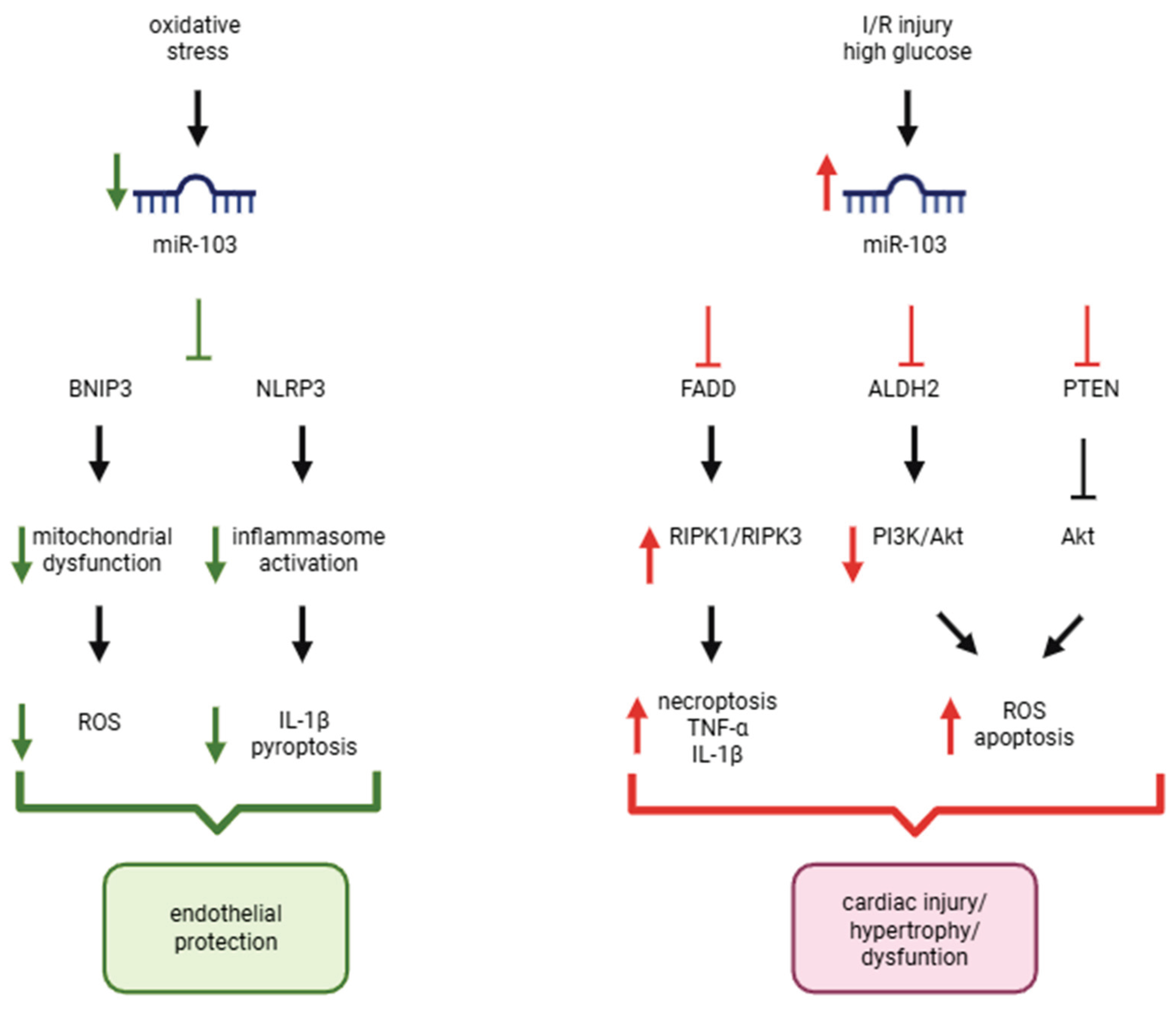
Figure 2.
Proposed NFκB-dependent pro-oxidant signaling mediated by miR-155 in cardiovascular disease. Oxidative and inflammatory stimuli, including ROS, TNF-α and Ang II, activate NFκB, which promotes miR-155 expression. Increased miR-155 contributes to oxidative stress and vascular injury through multiple mechanisms, including suppression of SOCS1 with subsequent activation of JAK/STAT signaling, stimulation of the NLRP3 inflammasome pathway, and inhibition of eNOS resulting in reduced nitric oxide bioavailability. Collectively, these pathways promote inflammation, endothelial dysfunction, cellular senescence and ROS generation, ultimately contributing to hypertension, vascular remodeling and atherosclerosis.
Figure 2.
Proposed NFκB-dependent pro-oxidant signaling mediated by miR-155 in cardiovascular disease. Oxidative and inflammatory stimuli, including ROS, TNF-α and Ang II, activate NFκB, which promotes miR-155 expression. Increased miR-155 contributes to oxidative stress and vascular injury through multiple mechanisms, including suppression of SOCS1 with subsequent activation of JAK/STAT signaling, stimulation of the NLRP3 inflammasome pathway, and inhibition of eNOS resulting in reduced nitric oxide bioavailability. Collectively, these pathways promote inflammation, endothelial dysfunction, cellular senescence and ROS generation, ultimately contributing to hypertension, vascular remodeling and atherosclerosis.
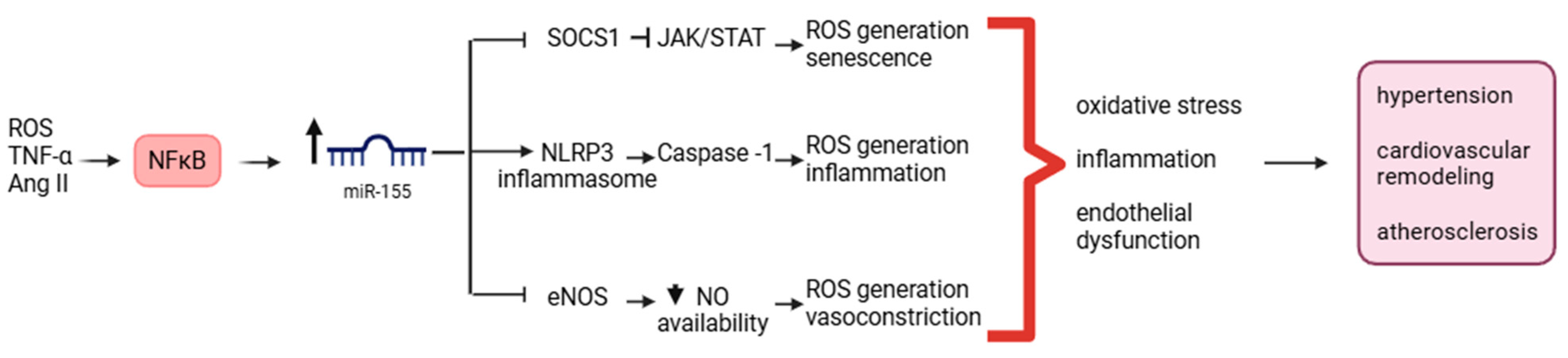
Figure 3.
Proposed ntioxidant and vasculoprotective effects of miR-155 through modulation of the renin–angiotensin system and BACH1 signaling. Increased miR-155 expression promotes the degradation of AT1R, ACE and BACH1 mRNAs. Downregulation of AT1R attenuates Ang II-mediated signaling, reducing NOX2/4 activation, ROS generation and downstream vascular inflammation, oxidative stress and remodeling. In parallel, repression of BACH1 relieves its inhibitory effect on heme oxygenase-1 (HO-1), enhancing antioxidant defenses and further limiting ROS accumulation. Collectively, these mechanisms contribute to the protective role of miR-155 against oxidative stress-induced cardiovascular damage.
Figure 3.
Proposed ntioxidant and vasculoprotective effects of miR-155 through modulation of the renin–angiotensin system and BACH1 signaling. Increased miR-155 expression promotes the degradation of AT1R, ACE and BACH1 mRNAs. Downregulation of AT1R attenuates Ang II-mediated signaling, reducing NOX2/4 activation, ROS generation and downstream vascular inflammation, oxidative stress and remodeling. In parallel, repression of BACH1 relieves its inhibitory effect on heme oxygenase-1 (HO-1), enhancing antioxidant defenses and further limiting ROS accumulation. Collectively, these mechanisms contribute to the protective role of miR-155 against oxidative stress-induced cardiovascular damage.
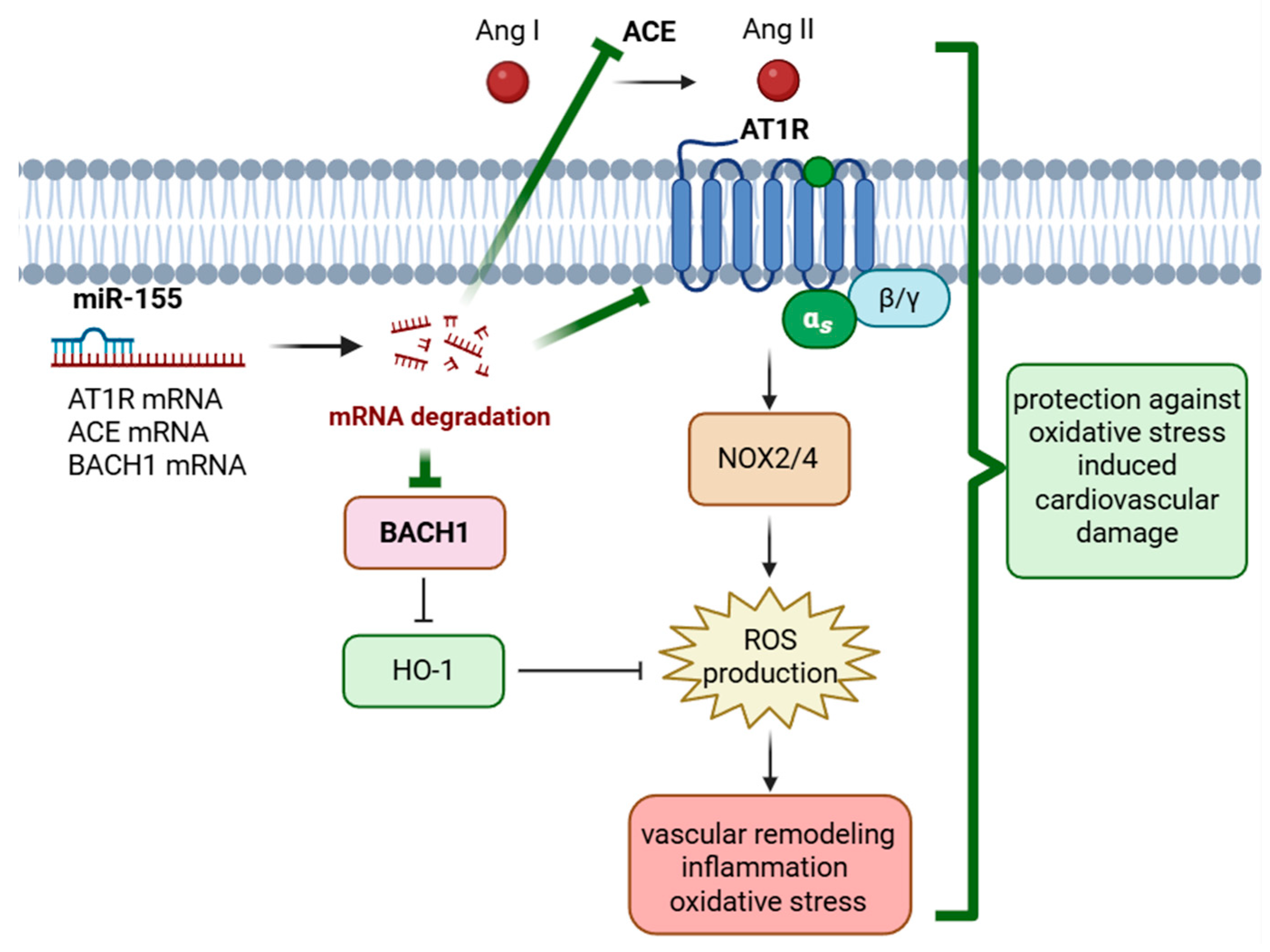

Table 1.
Summary of evidence about miR-103 role in oxidative stress in cardiovascular disease.
| Author | Year | In vitro/in vivo model | Pathway | Final effect |
|---|---|---|---|---|
| Wang J. et al [22] | 2015 | H9c2 CELLS | high levels of H2O2 (500 mM) significantly increase the expression of miR-103/107 miR-103/107 are involved in H2O2-induced necrosis by targeting FADD |
pro-oxidant and pro-necrotizing |
| mice model of I/R (ischemia/reperfusion) | knockdown of miR103/107 decreases the expression levels of inflammatory cytokines TNF alfa and interleukin b in the I/R mice models, miR-103/107 antagomir administration resulted in a reduction in the myocardial necrosis, reduced myocardial infarct sizes and reduced plasma levels of cardiac necrosis biomarker troponin T, without affecting myocardial apoptosis; reduced cardiac fibrosis; ameliorated cardiac function |
|||
| Xu et al [19] | 2015 | Human umbilical vein endothelial cells (HUVECs) | H2O2 (5,10,25,50,100 and 100 mM) downregulated the expression of miR-103 in a time- and dose-dependent manner cells transfected with miR-103 showed increased viability and lower intracellular ROS formation in an H2O2-induced oxidative stress environment, by targeting BNIP3 miR-103 was upregulated following pretreatment with salidroside (an antioxidant agent) in an H2O2-induced oxidative stress |
anti-oxidant and anti-apoptotic |
| Wang Y. et al [23] | 2020 | human coronary artery endothelial cells (HCAECs) | H2O2-induced oxidative stress downregulates miR-103 in a time-dependent manner pre-103 reduced the accumulation of autophagic ubiquitin-like p62 and LC3II proteins miR-103 inhibitor reduces cell survival rate in H202 induced oxidative stress reducing p-mTOR/mTOR expression, thus inhibiting end-stage autophagy miR-103 inhibition increased the expression of BNIP3 miR-103 inhibition aggravates pyroptosis through NLRP3 inflammasome, and was associated with higher levels of IL-1β |
anti-oxidant |
| Logan et al [16] | 2021 | neonatal mice | isoflurane and CO increase miR-103 levels vs air | anti-apoptotic |
| Zhang et al [24] | 2022 | cardiomyocytes from transverse aortic constriction (TAC) mice | in TAC mice miR-103-3p increases significantly and is associated with higher ROS levels, cardiac hypertrophy, increase of ANP and beta MHC, worsening of cardiac function | pro-oxidant, pro-hypertrophic |
| primary neonatal mouse cardiomyocytes | lnccytb acted as a competitive endogenous RNA via sponging miR-103-3p | |||
| HEK293T cells | miR-103-3p targets PTEN to promote isoprenaline-induced hypertrophy and ROS generation cardiac stress → ↓ lnccytb → ↑ miR-103-3p → ↓ PTEN → ↑ AKT → ↑ ROS , hypertrophy, heart failure |
|||
| Wang X. et al [25] | 2025 | HL-1 mouse cardiomyocytes | the myocardium of diabetic mice showed upregulation of miR-103-3p high glucose enhanced ROS and MDA levels, decreased SOD and increased miR-103-3p , which were reversed by orientin (an antioxidant agent) H19 overexpression inhibited high glucose-triggered ROS production in HL-1 cells, but miR-103-3p overexpression or ALDH2 depletion negated the effects of H19 overexpression High glucose → ↑ miR-103-3p → ↓ ALDH2 → ↓ PI3K/AKT → ↑ ROS |
pro-apoptotic and pro-oxidant |
Table 2.
Summary of evidence about miR-155 role in oxidative stress in cardiovascular disease.
| Author | Year | in vitro/in vivo/human-based studies | Pathway | Final effect |
|---|---|---|---|---|
| Liu et al [31] | 2011 | cardiomyocyte progenitor cells | miR-155 inhibits oxidative-stress-induced necrosis by targeting RIP-1 | anti-necrotic |
| Kelly et al [32] | 2011 | Friedrich's ataxia patients | polymorphism rs5186 - which increases expression of AGTR1 by altering the binding site for miR-155 - is associated with cardiac hypertrophy (to which oxidative stress contributes) | anti-hypertrophic (indirectly) |
| Munoz-Pacheco et al [33] | 2012 | THP-1 cells (human monocytic cell line) | phorbol-12-myristate-13-acetate (PMA) treated THP-1 cells showed increased levels of ROS and of miR-155; ezetimibe-induced inhibition of THP-1 cell differentiation was associated with the down-regulation of the expression of mir-155, mir-222, mir-424 and mir-503; MAP Kinase and NF-B pathways, as well as oxidative stress, are involved in this effect | pro-oxidant (indirectly) |
| Jia et al [34] | 2014 | ApoE-/- mice | NR1 treatment in ApoE-/- mice induced higher expression of SOD, GSH, reduced ROS, and pro-inflammatory cytokines, along with the reduction of miR-155 (not statistically significant) | not statistically significant |
| Liu D et al [35] | 2014 | patients with intracranial aneurysms | miRNA profile differed in intracranial aneurysms vs superficial temporal arteries (miR-155 not significantly) | not statistically significant |
| Hefti et al [36] | 2014 | hearts from Down syndrome and non-Down Syndrome donors | Difference in expression of miR-155 and BACH1 | pro-oxidant (indirectly) |
| Costantino et al [37] | 2016 | diabetic mice | miR-155 (among those involved in oxidative stress) was REDUCED in diabetic mice, and the impairment persisted despite normalization of blood glucose levels | pro-oxidant (indirectly) |
| Tian et al [38] | 2014 | ApoE-/- mice |
the level of miR-155 in the plasma of atherosclerotic mice is increased and oxLDL effectively induces the expression of miR-155 in macrophages. miR-155 mediates oxLDL-induced lipid uptake and reactive oxygen species (ROS) production of macrophages, by targeting HBP1. Repression of HBP1 by miR-155 transforms macrophages into foam cells |
pro-oxidant; pro-atherosclerotic |
| patients with coronary heart disease | miR-155 expression is up-regulated in CD14+ monocytes from patients with coronary heart disease miR-155 inhibition decreases lipid-loading in macrophages and reduces atherosclerotic plaques in ApoE-/- mice and is associated with a reduction in TNF-alfa and IL-6 expression |
|||
| Liu Y. et al [39] | 2015 | human brain micro vessel endothelial cells HBMECs | silencing of miR-155 decreases apoptosis and ROS production, while promoting NO generation in both vehicle and ox-LDL treated cells via the PI3K/Akt signaling | pro-oxidant and pro-apoptotic |
| Seong-Min et al [40] | 2015 | Smokers vs non-smokers | male smokers showed 3 fold higher levels of miR-155 in HDL; 8 weeks of vitamin C reduced miR-155 levels in HDL in smokers and non-smokers male | pro-oxidant (indirectly) |
| Xiong et al [41] | 2015 | ApoE -/- mice | Shexiang Tongxin dropping pill (STDP) treatment is associated with a significant reduction in MDA, ox-LDL, increased SOD, reduced ROS, and pro-inflammatory cytokines and with a significant reduction in miR-155 expression in ApoE -/- mice aorta | pro-oxidant and pro-inflammatory (indirectly) |
| Yang et al [42] | 2015 | mice femoral arteries | injured vessels in miR-155-/- mice showed decreased proliferation; injured arteries showed higher expression of miR-155 vs uninjured arteries miR-155 down-regulates MST2 which competes with MEK for RAF-1 binding, resulting in ERK1/2 activation and ultimately NFκB and p47phox activation |
pro-inflammatory and pro-oxidant |
| Sun et al [43] | 2016 | Human aortic VSMCs | salusin-beta (a stimulator of the progression of atherosclerosis) increased miR155 expression; miR-155 inhibition prevented salusin-beta effects on ACAT-1 and VCAM-1 expressions, p65-NFkB nuclear translocation, lipid accumulation, monocytes adhesion and ROS production in VSMCs | pro-oxidant and pro-atherogenic |
| DuPont et al [44] | 2016 | smooth muscle cells-MR-KO mice | miR-155 was downregulated with aging and associated with an increase in MR (mineralcorticoid receptor) expression miR-155 restoration reduced Cav1.2 and Agtr1 expression, attenuating AT2-induced vasoconstriction and oxidative stress |
anti-oxidant, anti-hypertensive |
| HEK293 cells | MR repressed miR-155 promoter in a ligand-independent way | |||
| Jia et al [45] | 2017 | hearts from ovariectomized diabetic mice | MIr-155 expression was higher in diabetic ovariectomized mice than diabetic mice not ovariectomized, together with an increased M1 polarization | pro-inflammatory, pro-oxidant |
| RAW264.7 cells | AuNP-mediated miR155 antagonist delivery promotes M2 polarization with a reduction in IL-1β and increase in IL-10 and a restoration of the cardiac function and an increase in the vascular density | |||
| Kim et al [46] | 2017 | HUVECs | Aspirin inhibits ROS-mediated vasoconstriction, inflammation and endothelial dysfunction by down-regulating miR-155 in pre-eclampsia | pro-oxidant and pro-inflammatory |
| Wu et al [47] | 2018 | NLRP3-/- and wild type male mice | miR-155 was up-regulated in renal tissue and HK-2 cells exposed to chronic intermittent hypoxia | pro-oxidant and pro-inflammatory |
| HK-2 cells | inhibition of miR-155 suppressed NLRP3 inflammasome activation in renal tubular cells, by targeting FOXO3a, thereby reducing oxidative stress and apoptosis overexpression of miR-155 promoted oxidation and NLRP3 pathway |
pro-oxidant and pro-apoptotic | ||
| Chen et al [48] | 2019 | endothelial cells | miR-155 inhibition promotes endothelial cells proliferation and reduces SOD expression; miR-155 regulates autophagy via decreasing the expression of ATG5 | pro-oxidant and anti-proliferative |
| Marzano et al [49] | 2019 | iPSK3 and Alzheimer’s-associated SY-UBH lines | differential expression of miR-155 in extracellular vesicles among different cells groups | potentially association with anti-oxidant and neuroprotective effects |
| Scoditti et al [50] | 2019 | human Simpson–Golabi–Behmel Syndrome (SGBS) adipocytes | olive oil polyphenol hydroxytyrosol counteracts miR-155-5p expression and prevents NF-kB activation and production of ROS | pro-oxidant (indirectly) |
| Zhang W et al [51] | 2020 | rats | within 24 hours from intracranial hemorrhage, miR-155 increases along with IL-1β, IL-6, TNF-α and oxidative stress products in the parietal and hippocampus. MiR-155 inhibitor attenuates this elevation, increases VEGF expression and improves neurological function | pro-oxidant and pro-inflammatory |
| Wu N et al [52] | 2020 | spontaneous hypertensive rats (SHR) and Wistar-Kyoto rats (WKY) | miR-155-5p mimic inhibited ACE, NOX2, IL-1β, TNF-α expression in VSMCs of spontaneous hypertensive rats exogenous Ang II increased miR-155-5p expression in WKY rats but not in SHR |
anti-oxidant, anti-inflammatory |
| Frati et al [53] | 2020 | smokers | plasmatic miR-155 is significantly increased shortly after smoking | pro-oxidant and vasoconstrictive |
| HUVECs | miR-155 accumulates in medium after exposure to cigarette smoke condensate anti-miR-155 attenuated condensate smoke-induced angiogenesis, oxidative stress and NO production miR-155 mimic decreased cell viability, impaired capillary network formation and impaired capillary network, reduced VEGF and eNOS |
pro-oxidant | ||
| Cai et al [54] | 2020 | TNF-α -/- mice | TNF-α KO DOCA/Salt-hypertensive mice showed reduced oxidative stress, increased eNOS expression and inhibited miR-155 expression in the aorta | pro-oxidant and pro-inflammatory (indirectly) |
| He et al [55] | 2020 | human aortic smooth muscle cells HASMCs | indoxyl-sulfate (uremic toxin) increases miR-155-5p expression with a corresponding increase in ROS and decline in Matrix Gla protein (MGP), which is reversed by NFκB inhibition | pro-oxidant and pro-inflammatory |
| Kim et al [56] | 2020 | HUVECs | Korean Red ginseng extract (KRGE) induced HO-1 and inhibited NFkB-dependent miR-155-5p biogenesis with the downregulation of eNOS miR-155-5p levels were increased in senescent HUVECs vs young cells; and the increase was recovered by KRGE or NFκB inhibitor |
pro-oxidant and pro-inflammatory |
| Santana et al [57] | 2020 | HUVECs and PBMCs | hydroxyurea reduces intracellular ROS and increases antioxidant enzymes (SOD1, GSR, GPX1), contemporarily up-regulating miR-155-5p expression | anti-oxidant (indirectly) |
| Norouzi et al [58] | 2020 | mouse brain derived microvessel endothelial, bEnd.3 and human U251 GBM cells |
doxorubicin increases oxidative stress and apoptosis, concomitantly with a decrease in miR-155 | anti-oxidant (indirectly) |
| Witvrouwen et al [59] | 2021 | pre-eclampsia and healthy pregnant women | miR-155 was not significantly different between groups | not statistically significant |
| Nguyen et al [60] | 2021 | human VSMCs | miR-155-5p (both intracellular and exosomal) decreases in senescent cells and is associated with elevated oxidative stress | pro-oxidant (indirectly) |
| Song et al [61] | 2021 | HUVECs and VSMCs | miR-155 expression decreased in extra vesicles from HUVECs treated with AT II, compared to the control and LSW treatment and was associated with increase in oxidative stress and inflammatory cytokines; LSW treatment reduces oxidative stress and increases miR-155-5p | anti-oxidant (indirectly) |
| Tufekci et al [62] | 2021 | N9 mouse microglial cells | Resveratrol down-regulates inflammasome-induced miR-155 expression, inhibits NFκB translocation, activates AMPK/Sirt1 pathways and ameliorates intracellular and mitochondrial ROS production miR-155 inhibition reverses protective role of resveratrol by affecting NLRP3, IL-1b and IL-18 AMPK and Sirt1 pathways inhibition reverses the protective effect of resveratrol on miR-155 expression |
pro-oxidant |
| Wang F. et al [63] | 2022 | mouse model of myocardial fibrosis | Apigenin reduces oxidative stress and miR-155-5p expression in isoproterenol-induced myocardial fibrotic mice | pro-oxidant and profibrotic |
| CFs cell line | miR-155-5p inhibitor reduces the TGF-β1/smad miR-155-5p mimic significantly reduces HIF-1α |
|||
| Wang X. et al [64] | 2022 | Endothelial cells from two kidneys one clip, hypertensive rats | miR-155-5p expression was higher in hypertensive rats vs control rats and accompanied by a decrease in eNOS and an increase in oxidative stress and was reversed by t-AUB treatment; results were confirmed by miR-155-5p inhibitor and mimics. | pro-oxidant |
| Aykutlu et al [65] | 2022 | human retinal pigmented epithelium cell line | age related macular degeneration showed a higher expression of miR-155, which is inversely related with miR-184, oxidative stress and apoptosis | pro-oxidant (indirectly) |
| Constantin et al [66] | 2022 | Human-induced pluripotent stem cell-derived cardiomyocytes hiPSC-CMs and bone marrow derived stem cells BMMSC | no difference in miR-155 expression in the extra vesicles of the two types of cells nor vs treatment with ATII and TGF-β | not statistically significant |
| Prieto et al [67] | 2023 | mouse mesangial cells | miR-155-5p promotes the proliferation and migration of mesangial cells under inflammatory and hyperglycemic conditions; increases SOCS1 and impairs STAT1/3 phosphorylation | pro-oxidant |
| ApoE-DM mice and WT | mir-155-5p inhibitor upregulates SOCS1 expression and decreases STAT1/3 mIr-155-5p is positively associated with NOX2 and NOX4 levels and negatively with SOD1 and catalase |
|||
| Tong et al [68] | 2023 | Wistar Kyoto rats (WKY) and spontaneously hypertensive rats (SHR) | miR-155-5p is lower in primary VSMCs from spontaneously hypertensive rats than WKY rats miR-155-5p exogenous administration mitigates oxidative stress (NOX2 and NOX4 protein expression and activity and decrease in ROS levels) in VSMCs from SHR miR-155-5p overexpression inhibited BACH1 in VSMCs from both SHR and WKY rats, with a reduction in oxidative stress and cell migration; with an inverse pattern with mIR-155-5p inhibitor |
anti- oxidant |
| Beltramo et al [69] | 2023 | immortalized human microglial cells and human retinal endothelial cells | miR-155 expression was higher in cells exposed to M1 cytokines | pro-oxidant |
| Duisenbek et al [70] | 2024 | human-based study (diabetic patients) | miR-155 levels is higher in diabetic patients than in controls and is positively associated with HbA1c and glucose levels; predicts diabetes in obese subjects along with glutathione peroxidase and lipid peroxidation levels | pro-oxidant |
| Khedr et al [71] | 2024 | human-based studies (metabolic syndrome patients) | miR-155 levels decreased after 6 months of green coffee treatment together with inflammation and oxidative stress parameters; miR-155 positively correlates with HbA1c, glucose levels and HOMA-IR (Homeostatic Model Assessment for Insulin Resistance) | |
| Moawad et al [72] | 2024 | human-based study (coronary heart disease patients) | coronary heart disease patients showed higher levels of miR-155 together with higher MDA and lower SOD | |
| Harrison- Bernard et al [73] | 2024 | Dahl salt-sensitive (DS) and spontaneously hypertensive rats (SHR) | DS-high salt rats showed significantly higher levels of aortic and kidney AT1R, p-JAK/JAK2, p-MYPT1/MYPT1, Arhgef and proteinuria, lower kidney and serum klotho and lower serum and aorta miR-155 vs DS-low salt rats. SHR showed higher levels of miR-155 with no higher levels of AT1R. | anti-oxidant |
| Alizadeh Saghati et al [74] | 2024 | human cardiac tissue | hearts of patients with COVID-19 present increased activation of ferroptosis and oxidative stress; miR-155 is involved in this pathway | pro-oxidant |
| Zhang Y. et al [75] | 2024 | HUVECs and HEK293 cells | miR-155 mimic increases ROS levels and decreases a-SMA and Vim; miR-155-5p inhibitor increases SIRT1, Nrf2 and HO-1 expression. | pro-oxidant |
| Zhao M. et al [76] | 2024 | ex vivo primary vascular endothelial cells from thoracic aortas of rats offspring | hypoxia offspring-derived endothelial cells showed higher levels of miR-155-5p; miR-155-5p mimic increased miR-155-5p expression; miR-155-5p inhibitor reduces ROS production in offspring endothelial cells and reduces NO synthesis | pro-oxidant |
| He J et al [77] | 2025 | bone marrow derived cells M1 polarized; endothelial cells from mouse aorta | endothelial cells co-culture with M1 exosomes carrying high levels of miR-155 had a pro-senescence effect by targeting SOCS1 activating JAK2/STAT3 and increasing ROS production in endothelial cells miR-155 mimic decreases SOCS1 but does not target BACH1 or IKBKE |
pro-oxidant and pro apoptotic and pro-senescent |
| Ge et al [78] | 2026 | cardiomyocytes from mice | miR-155-5p is associated with ferroptosis and is increased in cells after incubation with H2O2; miR-155-5p targets NFE2L2, thereby inhibiting the promotion of expression of protective and antioxidative genes | pro-oxidant and pro-ferroptotic |
Disclaimer/Publisher’s Note: The statements, opinions and data contained in all publications are solely those of the individual author(s) and contributor(s) and not of MDPI and/or the editor(s). MDPI and/or the editor(s) disclaim responsibility for any injury to people or property resulting from any ideas, methods, instructions or products referred to in the content. |
© 2026 by the authors. Licensee MDPI, Basel, Switzerland. This article is an open access article distributed under the terms and conditions of the Creative Commons Attribution (CC BY) license (http://creativecommons.org/licenses/by/4.0/).
Copyright: This open access article is published under a Creative Commons CC BY 4.0 license, which permit the free download, distribution, and reuse, provided that the author and preprint are cited in any reuse.


