

Submitted:
29 June 2026
Posted:
30 June 2026
You are already at the latest version
Abstract
The Post Office Horizon scandal represents one of the most severe miscarriages of justice in modern British legal history, rooted in the deployment of a defective IT system and the institutional suppression of evidence that exposed its unreliability. This paper provides a systematic analysis of the scandal through the combined lenses of cyber security, digital forensics, and IT governance, drawing directly on the Post Office Horizon Public Inquiry dataset—including witness testimony, technical documentation, audit records, and internal communications spanning more than two decades. While many of the technical and procedural failures discussed have been documented in prior scholarship, the paper’s principal contribution is the systematic mapping of those failures against recognised governance frameworks, and the Legally-Accountable Digital Systems (LADS) proposal this mapping motivates. We identify and analyse five interconnected failure categories: software defects and poor system design; deficient patch governance; inadequate audit logging and compromised evidence integrity; investigative failures and prosecutorial conflict of interest; and a systemic absence of technical expertise and independent oversight. Each category is mapped against nine governance framework documents, including ISO/IEC 27001, NIST SP 800-53 Rev. 5, NIST SP 800-218 (SSDF), COBIT 2019, ISO/IEC 27035, NIST SP 800-61, and ISO/IEC 27036, with ISO/IEC 27037 applied additionally to evidential handling failures and NIST SP 800-92 to log management failures. A counterfactual analysis indicates that compliance with these frameworks could plausibly have detected, exposed, or substantially reduced most of the documented failures, though this claim is necessarily inferential and conditional on good-faith implementation. The scandal was therefore not caused primarily by the absence of adequate frameworks, but by their wholesale non-application and by institutional incentives, examined later in the paper, that can undermine even fully compliant controls. However, the analysis also surfaces a governance gap that no existing framework addresses: the institutional failure mode in which the organisation responsible for system integrity holds active incentives to suppress evidence of failure rather than remediate it. To address this gap, we propose the concept of Legally-Accountable Digital Systems (LADS) — a governance category for systems whose outputs are used as evidence in legal proceedings — and outline three supplementary pillars: technical independence, institutional independence, and forensic admissibility governance. We draw a parallel with the Sarbanes-Oxley Act of 2002, arguing that the Horizon Inquiry dataset provides an equivalent empirical foundation for statutory reform of digital evidence governance. Finally, we outline the substantial research opportunities the Inquiry dataset presents across IT systems analysis, cyber security, forensic accounting, social network analysis, and legal informatics — a resource comparable in significance to the Enron materials that shaped a generation of corporate governance reform.
Keywords:
Post Office Horizon scandal
; cyber security failures
; digital forensics
; IT governance
; forensic accounting
; patch management
; software development
1. Introduction
The Post Office Horizon scandal stands as one of the most devastating miscarriages of justice in British history. Between 1999 and 2015, more than 700 sub-postmasters (SPM) were wrongfully accused of fraud, theft, and false accounting—many convicted and imprisoned—based on errors generated by the Horizon computer system, developed by ICL (later Fujitsu). The fallout shook public confidence in digital systems, corporate governance, and the UK’s justice institutions. Between May 2024 and early 2025, all convictions were quashed either through legal proceedings, or through “the Post Office (Horizon System) Offences Act”. There have been a few similar scandals including the Volkswagen Emission Scandal, the Barclays Whistle-blowing Scandal, and the TalkTalk Cyber security Breach.
At its core, the scandal reflects a profound breakdown in cyber security principles. Key failures can be categorised into: software errors, patch failures, failure in effective log management, and investigative failures. These were not isolated lapses, but systemic issues exacerbated by a culture of denial and institutional complacency. A brief timeline of the scandal is provided in Figure 1.
The response from UK authorities, while ultimately far-reaching, was initially marked by delay and denial. The Post Office–playing the part of victim, investigator, and prosecutor–consistently defended its prosecutions, and early concerns were dismissed or obscured. However, mounting legal challenges, sustained investigative journalism, and parliamentary scrutiny began to shift the public narrative. A turning point came in early 2024 with the broadcast of the ITV drama Mr Bates vs The Post Office, which powerfully dramatised the human cost of the scandal and prompted a wave of public outrage. In its wake, the UK government accelerated compensation schemes, committed to full exoneration of victims, and intensified the statutory inquiry into what went wrong.
This paper highlights the failures by examining the technical, organisational, and governance failures that contributed to the crisis, drawing out lessons for secure system design, forensic assurance, and institutional accountability in the management of critical national IT infrastructure. The paper organises the failures into five categories: software errors, patch failures, failure in effective log management, investigative failures, other failures. These are examined in turn, before we frame these failures in the context of cyber security risk management frameworks to understand how the application of these could have not only mitigated cyber security failures, but general IT failures as well.
A key strength of our work lies in its direct analysis of original witness statements and documents from the Post Office Horizon IT Inquiry. While some prior scholarship on the scandal has engaged with court judgments and other primary legal materials, our research draws extensively and directly on first-hand testimonies and internal technical records publicly available at the official inquiry website [1], an evidence base that has only become available in this depth since the Inquiry’s publication schedule. This grounding in primary inquiry material strengthens the empirical basis of our findings. Key events in the Post Office scandal are outlined in Figure 1.
The rest of this paper is organised as follows. We begin in Section 2 by reviewing previous research into the scandal outlining that this is focused on technological, legal, and ethical failures. We proceed in the same Section to describe some of the key sources of evidence in the Post Office Scandal (Section 2.5)
We proceed to address each category of failure in turn beginning with software errors (Section 3). At this juncture we highlight failures within early pilots of the Horizon IT system, defects and bugs within the system, third party integration problems, SLA failings, and the problem of inadequate error feedback. Following this, we proceed to describe problems in patch management (Section 4). These problems can be categorised into two areas: technical failures in the update and patch deployment process, and failures in the oversight and governance of patches.
Section 5 highlights a range of log management problems which include errors in the ARQ, PEAK and KEL systems, the problem with log formats, and the problem of remote access wherein engineers could log into systems remotely, make changes, and logs would not record this effectively.
Investigative failures and the failure to manage a fundamental conflict of interests in the Post Office being the victim, investigator, and prosecutor is highlighted in Section 6. This is followed by an analysis of expertise failures, specifically the expertise of developers, the culture of ignoring expert advice, and fundamental failings in training and awareness in Section 7.
Finally, we provide a summary of the issues described – framing them within a cyber security context – as well as recommendations that might have alleviated the issues highlighted (Section 9). In the same Section, we emphasise the importance of the publication of the Post Office Horizon Inquiry dataset and the unparalleled research opportunities this creates for researchers.
2. Review
The Post Office Horizon scandal has attracted substantial academic attention, yet existing literature remains fragmented across disciplinary boundaries. Legal scholars have examined the collapse of evidential presumptions [2,3]; ethicists have analysed institutional accountability failures [4,5]; harm theorists have documented the human cost [6]. What is absent is a systematic treatment of the scandal through the lenses of cyber security and digital forensics — the disciplines most directly implicated by failures in software integrity, patch governance, audit logging, and investigative practice. This paper addresses that gap directly, and the review that follows is organised to show precisely where prior work illuminates the failure categories this paper analyses, and where it does not.
2.1. Software Errors and System Reliability
The most technically grounded treatment of Horizon’s software failures comes from [7], who argues that the common law presumption of computer dependability is not merely legally questionable but, from an IT audit perspective, intellectually indefensible. Christie draws a precise distinction between hardware — broadly reliable — and application software, which is notoriously unreliable by nature. Applying a presumption of mechanical reliability to complex, layered, networked software is therefore a category error. Christie further identifies what they terms User Error Bias (UEB): the institutional tendency of the Post Office and Fujitsu to attribute all system discrepancies to individual users rather than the system itself. However, Christie’s paper is explicitly a practitioner response rather than a peer-reviewed study; its conclusions, while technically compelling, lack the systematic empirical base expected of scholarly work, and it does not apply any formal cyber security framework to the failures it identifies.
[8] extends this analysis by situating Horizon within broader cultural failures in software engineering: poor programming practice, unregulated developer competence, and the absence of any professional accountability analogous to that required in medicine or law. Thimbleby’s argument that legislative reform is necessary to prevent recurrence is persuasive, but like Christie they do not map the failures against existing governance frameworks, and neither author draws on the primary Inquiry dataset. [9] corroborate the software reliability concerns through a STEEPLED framework analysis, noting specifically that there was no examination of Horizon data for bugs or defects and no demonstration of actual financial loss as distinct from a system-generated shortfall — observations that directly anticipate the forensic analysis this paper undertakes, though Georgiadou et al. stop short of pursuing them technically.
2.2. Patch Management and Log Governance
No existing peer-reviewed literature addresses patch management or log governance in the Horizon system with any technical rigour. [7] identifies the absence of proper audit trails and uncontrolled superuser access privileges as significant failures, and [3] demonstrates that the Known Error Log existed and was systematically withheld — establishing that the evidence necessary for forensic audit was present but suppressed. However, both authors operate at the level of legal advocacy and practitioner observation rather than technical forensic examination. Neither analyses the patch lifecycle, the ARQ and PEAK logging infrastructure, or the remote access capability in terms of compliance with recognised information assurance standards. This is a substantive gap: the failures documented in Section 4 and Section 5.2 of this paper — including silent patch deployment, audit log corruption, and unlogged remote data alteration — have not previously been subjected to systematic cyber security analysis.
2.3. Investigative Failures and Conflict of Interest
The structural conflict of interest arising from the Post Office acting simultaneously as victim, investigator, and prosecutor is identified across multiple contributions, though none analyses it as a cyber security governance failure. [2] observes that the post-1999 repeal of s.69 PACE 1984 left defendants unable to challenge system-generated evidence, and that Post Office investigators withheld known reliability issues in direct breach of disclosure obligations — a finding grounded in the Court of Appeal’s judgment in Hamilton v Post Office Ltd [2021] EWCA Crim 577. [6] corroborate this, noting that because only the Post Office controlled access to system evidence, the burden placed on defendants to demonstrate malfunction was in practice impossible to discharge.
[3] provides the most detailed account of the investigative failures from a legal standpoint, identifying three interlocking mechanisms: the contractual reversal of the burden of proof before any prosecution commenced; the three-stage concealment strategy deployed against disclosure of the Known Error Log; and the suppression of the Clarke Advice from 2013, which established that the Post Office’s principal expert witness had repeatedly misled the courts. Taken together, Marshall argues these constitute sustained institutional mendacity rather than structural failure alone. The critical limitation of Marshall’s contribution must be acknowledged: it is the edited text of lectures delivered to legal audiences by an advocate personally invested in the outcome, and its most serious claims regarding government complicity are advanced as inference rather than established fact. [10] provides corroborating procedural detail, documenting that disclosure was refused on four separate occasions in the Misra case alone — evidence of deliberate litigation strategy rather than inadvertence.
What none of this literature does is analyse these investigative failures against the incident response and digital evidence standards — ISO/IEC 27035 [11] and ISO/IEC 27037 [12] — that governed the handling of exactly this class of system-generated evidence. That analysis is undertaken in Section 8 of this paper.
2.4. Expertise, Governance and Institutional Failures
The governance and leadership dimensions of the scandal have attracted growing attention. [5] argues that the scandal exposes the bankruptcy of the `tone at the top’ governance paradigm: senior Post Office leaders were sufficiently distanced from operational reality that they either could not or chose not to engage with the risks being generated below them. Moon’s analysis of Paula Vennells’s testimony is pointed, but the paper is a conference working paper drawing primarily on journalistic sources; its value lies in synthesising governance lessons rather than generating new evidence. [4] approaches accountability through four ethical frameworks — Foucauldian ethics, Utilitarianism, Deontology, and Sartrean Existentialism — arguing that transparency and oversight failures were as much ethical as structural. These contributions are valuable in framing the institutional context but do not connect governance failures to technical standards or assurance frameworks.
The human consequences of these failures are documented by [6], whose zemiological analysis classifies harms into direct impacts on sub-postmasters — psychological, financial, and social — and indirect impacts on institutional trust. [3] renders the compensation failures concrete: his former client Tracy Felstead received £17,000 from the £57 million group litigation settlement, approximately 80 per cent of which was consumed by legal costs — a consequence, Marshall argues, of the Post Office deploying a deliberate attrition strategy made possible by asymmetric state funding. These impacts are noted here as context for the scale of harm produced by the technical and governance failures this paper analyses; they are not its primary focus.
2.5. Sources of Evidence
There is a growing body of evidence relating to the Post Office scandal. The primary sources drawn upon in this paper are:
- The Post Office Horizon IT Inquiry website [1].
- A searchable database of all evidence PDFs presented to the inquiry, available from [13].
- The Deloitte report published as evidence to the inquiry [14]. Although labelled a draft throughout, the October 2017 version represents the final format following the completion of Phases 0–4 of the engagement.
- The `list of issues’ published by the Inquiry [15], which provides the most comprehensive catalogue of identified issues published by the Inquiry.
There are currently 218 issues listed in [15]. For the purposes of this study, a technical issue was defined as one relating directly to the design, implementation, operation, maintenance, testing, support, security, auditing, reliability, or evidential use of the Horizon system. Issues concerned solely with governance, policy, accountability, legal strategy, compensation, or other non-technical matters were excluded. Each issue was reviewed against these criteria, resulting in the identification of 39 technical issues that form the core of our analysis (Table 1). The selected issues were compared against the Deloitte report and supporting evidence contained within the Dracos repository to identify documentary evidence relating to each issue. The 39 issues were subsequently grouped into five higher-level themes based on recurring technical characteristics and common failure mechanisms, to facilitate analysis and discussion.
Source hierarchy and triangulation
Given the nature of the Post Office Horizon case, this study draws upon multiple forms of documentary evidence. Primary evidential sources comprise Inquiry transcripts, witness statements, technical reports, internal organisational records, audit documentation, court judgments, and official Inquiry publications. These sources form the principal evidential basis for the analysis.
Peer-reviewed literature is used to provide theoretical context and support interpretation of findings. Media reports and other grey literature are used primarily for contextualisation and to identify relevant events, individuals, and themes. Where such sources inform the analysis, they are corroborated against primary Inquiry evidence, legal judgments, or official documentation wherever possible.
This approach follows established documentary analysis and data triangulation principles, whereby conclusions are derived through the convergence of multiple independent sources rather than reliance on any single source type.
2.6. Synthesis: The Gap This Paper Addresses
The literature reviewed above makes three things clear. First, the technical failures of the Horizon system — software defects, patch governance failures, log management weaknesses, and remote access abuses — have not been analysed systematically against the cyber security and IT governance frameworks that were available throughout the system’s operational lifetime. Second, the investigative failures — non-disclosure of PEAKs and KELs, alteration of expert testimony, suppression of the Known Error Log — have been documented from legal and ethical standpoints but not subjected to digital forensics analysis. Third, the Inquiry dataset, which contains the primary evidence necessary for both forms of analysis, has not previously been drawn upon directly in this context.
This paper addresses all three gaps. It applies six recognised governance frameworks — ISO/IEC 27001, NIST SP 800-53, NIST SP 800-218 (SSDF), COBIT 2019, ISO/IEC 27035, and ISO/IEC 27036 — to each of the five failure categories identified in Table 1, drawing on first-hand Inquiry evidence throughout. In doing so, it moves beyond the practitioner observation and legal advocacy that characterise the most technically detailed prior contributions, and offers a systematic forensic and governance analysis of a failure whose scale and consequences remain without precedent in British computing history.
3. Software Errors
This section outlines the technical foundations of the Horizon system and the failures that emerged from its inception to full deployment. From pilot project flaws and software defects to third-party integration issues and poor oversight, both technological and governance failings were deeply embedded.
3.1. Pilot Failures
The Post Office piloted the Horizon IT system—developed by ICL (later Fujitsu)—in selected branches in 1996 to digitise accounting and benefits processing. The pilot-known as Legacy Horizon-exposed critical flaws, including software bugs, unexplained shortfalls, and user interface issues that branch staff could not resolve. Despite these warnings, the Post Office proceeded with a national rollout. During development, Horizon’s remit expanded beyond benefits payments to include full branch accounting, point-of-sale functions, order book control, and automated payments, increasing complexity and technical risk.
Legacy Horizon operated as a decentralised system with data processed locally at branch level. Following a migration and pilot phase, Horizon began its transition to Horizon Online (HNG-X) from 2010, a centralised, internet-connected model with real-time processing via remote servers [16].
3.2. Software Defects
A combination of unchecked scope creep and unaddressed design flaws resulted in a wide array of software faults. These included critical bugs such as synchronisation failures, transaction isolation issues, and silent crashes in key modules like CABSProcess. Other faults—such as the Dalmellington and Callendar Square bugs—generated phantom or duplicate transactions, while audit functions frequently failed to record complete end-of-day activity. Further problems stemmed from individual software components within the system. EPOSScore.DLL and the Escher Riposte platform, both central to transaction and cash handling, introduced inconsistencies in data storage and reporting.
These weaknesses–coupled with the remote access problems (Section 5.3), and the failure to heed expert advice (Section 7)–violated core accounting principles and left sub-postmasters unable to detect or reconcile errors.
Table 2 outlines the most significant of these technical failures and their documented consequences.
Some bugs seemed to affect a small number of the nearly 18,000 post offices. For example, bug 14 was so called because it affected 14 post offices; bug 68 was named by analogy, though the basis for that name was not confirmed at the time [17]
Out of hours transactions were being generated by the Horizon system–not directly input by sub-postmasters at branch terminals [18].
3.3. Third Party Integration Failures
The Post Office sought to modernise branch operations by integrating services such as ATM transactions and National Lottery processing. However, these integrations introduced serious synchronisation failures that worsened system reliability.
ATM integration caused transaction mismatches where dispensed amounts could become inconsistent with Horizon records, particularly through reconciliation and synchronisation failures involving Bank of Ireland ATM processes [24].
Similarly, the complexity of Horizon’s distributed architecture meant that even routine operations such as counter replacement could cause log replication failures, where a replacement counter came out of recovery mode before replication was complete, overwriting missing messages and causing receipts and payments mismatches [27]. More fundamentally, the system failed to preserve consistency between the counter and back-end accounting systems, with discrepancies disappearing at the counter but persisting in branch accounts — meaning sub-postmasters were unaware that a shortfall existed [27]. These failures raised serious concerns about data integrity and the reliability of Horizon as an evidential system.
3.4. SLA Failings
Although the Post Office had Service Level Agreements (SLAs) in place with Fujitsu, for instance, to maintain 99.45% performance across the network [28], SLAs were enforced to varied effect. Moreover, the reference data used to measure the performance of some SLAs was incorrectly calculated leading to distorted SLAs.
A key failure in SLA enforcement relates to the handling of software updates and bug fixes described in Section 4. Another contractual shortcoming was an agreement limiting the Post Office to request a `limited number’ of ARQs (Audit Request Query) each month at no cost. Extra requests and requests for an `XML report’ which contained more detail than the ARQ, came at a cost [18].
3.5. Inadequate Error Feedback
The Horizon IT system suffered from inadequate error feedback, meaning it frequently failed to provide sub-postmasters (SPMs) with clear, timely alerts regarding faults, inconsistencies, or data discrepancies. This lack of visibility left branch staff unaware of system-generated errors that directly impacted their accounts.
A prominent example involved silent failures in core processes. The CABSProcess module, responsible for compiling daily transaction summaries, could fail without generating any visible warning or error message to the user.
Another recurring issue concerned invisible suspense account discrepancies. In certain cases, failures in the write process caused amounts to bypass posting to the local suspense account entirely. A well-documented instance occurred in PEAK PC0152376, where a CABSProcess lock timeout prevented a £465.73 gain from being recorded. When the suspense account was later cleared, the amount was simply absent, leaving the branch with an unexplained trading discrepancy. Sub-postmasters had no indication of the error at the time. Although the issue was recorded in the audit log and would have been detectable through detailed post-hoc analysis [21,29], it remained invisible to the affected sub-postmaster during normal operations.
These design deficiencies meant that system errors could materially affect branch accounts while remaining undetectable to the individuals held legally and financially responsible for them.
4. Patch Failures
4.1. Technical Failures in Patch Deployment
Patch and update deployment across the Horizon system was inconsistent, poorly tested, and inadequately governed. Updates intended to improve functionality frequently introduced new defects, increased system fragility, or reversed earlier fixes, leading to regressions that compounded existing problems [22,30].
Sub-postmasters were rarely informed of updates, had no access to meaningful changelogs, and received no guidance on how to distinguish between user errors and system-induced discrepancies. This lack of transparency eroded trust and left branch staff unable to understand the source of emerging shortfalls. Particularly problematic were updates that triggered silent failures in core modules such as CABSProcess, corrupted audit logs, or caused transaction duplication due to timing issues during report generation [19,21,29]. Hardware compatibility problems with EPOS terminals and printers further degraded reliability [31].
Table 3 summarises the main technical failings and their operational consequences. Such defects, often invisible to users at the time, were routinely interpreted by the system (and by Post Office investigators) as evidence of sub-postmaster misconduct.
4.2. Governance and Oversight Failures in Patch Management
The technical issues described above stemmed from fundamental weaknesses in patch lifecycle governance. No coherent framework existed for pre-deployment validation, risk assessment, or post-deployment monitoring. Patches were frequently deployed with minimal real-world testing, no formal rollback procedures, and little or no communication to end users.
There was no independent audit process to evaluate patch quality or downstream effects. Developers and support teams lacked systematic visibility into post-deployment impacts, and no effective feedback loop existed to capture and act upon user-reported anomalies [20]. As a result, known problems recurred and new ones proliferated unchecked across the estate.
A robust patch management regime, aligned with standards such as ISO/IEC 27036-3 and NIST SP 800-218 (SSDF), would have required regression testing, compatibility verification, structured changelogs, and clear end-user notification. Such controls could have prevented many silent failures and enabled early detection of cascading issues. Instead, the absence of proper governance transformed technical problems into persistent operational and evidential failures, ultimately contributing to wrongful prosecutions based on corrupted or misleading system data.
5. Log Management Problems
Prior to 2009, logs were minimal, and key actions in the system, such as transaction entries or system errors, were not adequately tracked. This absence of detailed logs made it difficult to trace and verify actions within the system, which allowed discrepancies to go unnoticed for extended periods [19]. In 2009, as part of a broader attempt to address the increasing scrutiny over the system’s reliability, better logging facilities were introduced into Horizon.
5.1. ARQs, PEAKs and KELs
Audit Record Queries (ARQs) were requests made by Post Office to Fujitsu for detailed transaction log data from specific SPM branch terminals. XML logs were more detailed logs containing information not found within the ARQs. These were crucial audit logs that could have demonstrated systemic issues within the Horizon system. ARQs were requests submitted by the Post Office’s Security Team to Fujitsu for transaction and event log data from specific branch terminals, subject to a contractual annual quota; they were used primarily in support of prosecution proceedings rather than as a mechanism for independently investigating system faults [33].
PEAKs (Problem Evaluation and Assessment Kits) and KELs (Known Error Logs) were internal fault management tools used by Fujitsu to track and manage problems within the Horizon system [34]. PEAKs functioned as internal incident tickets, raised by technical support staff when issues such as crashes, data discrepancies, or system errors occurred. Each PEAK included a description of the problem, the affected branch, and any actions taken to diagnose or escalate the issue. They were primarily used to manage and monitor unresolved faults. KELs, by contrast, recorded known or recurring issues. These logs included details about the nature of the fault, the conditions under which it occurred, any available workarounds, and its current resolution status. KELs often originated from PEAKs once a problem had been formally analysed and confirmed.
During the Horizon scandal, neither PEAKs nor KELs were disclosed to affected sub-postmasters or the courts. KEL dsed5628Q provides a concrete illustration: raised in January 2008 following a CABSProcess timeout that caused an undetected £465.73 trading discrepancy at branch FAD005948, the call was closed without a fix on grounds of rarity, with Fujitsu’s own developer noting that the underlying error-handling problem was “endemic” to the EPOSS codebase [29]. Neither the KEL nor the existence of the defect was disclosed to the affected branch or to the courts. This omission withheld critical evidence that could have demonstrated that errors in the system were known and recurring, and not the fault of the individuals being prosecuted [35].
5.2. Problems with Logs
However, even at this point, it was clear that the system needed more comprehensive measures to ensure data integrity, transparency, and accountability [36]. The logging infrastructure had several limitations. The data was often not centralised, and logs were not always reviewed regularly, which allowed systemic errors and user mistakes to continue undetected for years. Furthermore, the design of the Horizon system did not incorporate proper exception handling or transparent error reporting mechanisms, which meant that when errors occurred, they were often not recorded in a way that made them easy to investigate or correct. The logs were typically stored in a format that was difficult for non-technical staff to interpret, which meant that sub-postmasters and other personnel lacked the tools to easily detect or correct errors in real time [20]. Furthermore, the logs did not always provide sufficient detail, erroneous transactions, or missed events and/or transactions, making it challenging to fully reconstruct the chain of events leading to discrepancies.
Table 4 outlines critical issues in log management that severely impacted transparency and accountability within the system. The highlights how suppressed logs withheld error records from courts, Audit trail access denial prevented sub-postmasters from verifying transaction discrepancies, while poor error logging made system investigations challenging. Unlogged remote alterations allowed Fujitsu to modify data without traceable entries. Furthermore, inconsistent logging resulted in unreliable record-keeping, and opaque log formats hindered effective interpretation by auditors. Additionally, log mechanisms were not updated with patches, creating data gaps post-system changes, while delayed log retrieval obstructed investigations and prolonged legal disputes.
5.3. Remote Access
Fujitsu engineers possessed the capability to remotely access and alter branch transaction records without the knowledge of sub-postmasters; Second Sight concluded that the evidence supported the view that Fujitsu and the Post Office “did have, and may still have, the ability to directly alter branch records without the knowledge of the relevant Subpostmaster” [24,30]. A 2011 internal audit revealed the widespread and uncontrolled use of the APPSUP privilege which granted administrative access to Fujitsu IT support staff. This role allowed users to make critical changes to branch data with minimal logging and no requirement for external authorisation.
These alterations were not always logged effectively or communicated. Where they existed, logs typically captured login/logout events but not the specific actions undertaken—particularly when done using privileged accounts [35,37]. Nevertheless, the ARQ, PEAK and other logs revealed that this was happening [34].
Despite evidence that Fujitsu and Post Office personnel possessed the capability to access and modify branch data remotely, public and legal representations frequently understated or disputed the extent of these capabilities [35,38]. Meaningful restrictions and transparency mechanisms were not implemented until much later [37].
Key actions that were logged included User Transactions, which recorded every financial transaction entered into the system, detailing the type of transaction, the amount, and the user responsible. System Errors were also logged, capturing failures, crashes, or abnormal terminations, though these error logs were often too generic to identify the root causes. Additionally, System Modifications documented changes to the system, including updates and configurations made by technical staff, such as software patches or firmware changes. Login and Logout Events were recorded, tracking both successful and unsuccessful authentication attempts to monitor user activity and prevent unauthorized access. Lastly, Audit Logs created specific audit trails to track the actions of sub-postmasters and other users handling financial records or discrepancies.
6. Investigation
Table 5 highlights the range of investigation shortcomings in the Post Office scandal. These shortcomings referred to the handling, disclosure, and presentation of evidence, particularly during the prosecution of SPMs and included the alteration of testimony, suppression of faults, the use of coercive tactics, the failure to disclose system bugs, and the failure to disclose audit logs and other exculpatory evidence.
6.1. Conflict of Interests
The Post Office had a significant conflict of interest in its role as investigator, prosecutor, and alleged victim in the Horizon scandal. The Post Office investigated the alleged shortfalls at branches based on data from the Horizon system—data that was later shown to be unreliable. Since it had a vested interest in defending the integrity of Horizon (a system it commissioned and promoted), there was an incentive to blame sub-postmasters rather than question the software.
The Post Office retained the power to prosecute criminal cases privately, without involving the Crown Prosecution Service (CPS). This meant that the same organisation that claimed to be defrauded also pursued criminal convictions against sub-postmasters—without external oversight, increasing the risk of bias and miscarriages of justice.
The Post Office presented itself as the financial victim of theft or fraud when discrepancies occurred. But since it relied on Horizon data to define what “losses” occurred, it was essentially judging its own case.
This conflict of interests likely led to the Post Office being able to block escalation channels [42]. Sub-postmasters who reported issues with the Horizon system faced systemic failures in investigation and accountability. Failure to Investigate led to complaints being dismissed or escalated to individuals with vested interests in protecting the Post Office’s reputation rather than addressing the underlying issues. Obstruction of Evidence occurred when whistleblower concerns were ignored or suppressed, preventing exoneration. Additionally, sub-postmasters encountered Inadequate Legal Support, as they lacked proper representation to challenge wrongful accusations, with the legal system failing to acknowledge Horizon’s flaws. The Lack of Independent Oversight further compounded these issues, as the Post Office, acting as both investigator and accused party, created a conflict of interest that obstructed impartial resolution. Senior Post Office personnel simultaneously chaired internal litigation steering groups tasked with deterring challenges to Horizon, while acting as the organisation’s primary subject matter experts on Horizon integrity [43]. Sub-postmasters who did attempt to report discrepancies through official helpline channels were actively directed to suppress them rather than investigate them, with branch closure used as an implicit threat to ensure compliance [44].
7. Technical Expertise
The Horizon system failures stemmed from critical deficiencies in technical expertise, ignored expert advice, and inadequate training across the Post Office. The development team lacked the necessary qualifications, resulting in fragile and poorly maintained software. Expert warnings about system flaws were dismissed, further entrenching operational risks. Additionally, sub-postmasters and senior officials received little to no training on system discrepancies, leaving them ill-equipped to navigate the flawed platform. These failures collectively contributed to systemic governance and accountability issues, exacerbating the scandal.
7.1. Expertise of developers
One of the foundational issues behind the Horizon system’s failures was the lack of technical competence within its development team. David McDonnell, a former Horizon software developer, testified that only two out of eight core developers were suitably qualified for the work, and that several of their colleagues “should never have been hired” [20].
The lack of internal expertise at the Post Office itself further compounded the problem, as it left the organisation unable to independently verify or challenge Fujitsu’s assurances about Horizon’s reliability. The resulting reliance on an underqualified team building a system of such evidentiary and financial importance proved to be a critical governance and risk management failure.
7.2. Ignoring Advice
Numerous experts raised serious concerns about the reliability of the Horizon IT system, but their warnings were repeatedly ignored or suppressed by both the Post Office and Fujitsu. In 2003, digital forensic investigator Jason Coyne was engaged to analyse data from the Cleveleys branch. His report concluded that hardware, software, and interface failures were responsible for the errors, and that the majority could not be attributed to the sub-postmaster. However, rather than act on his findings, the Post Office dismissed his analysis, sacked him, and attempted to discredit his report internally [45]. Similar concerns were voiced internally at Fujitsu during the early development of Horizon. A lead developer described the system as lacking formal design documents and test coverage, and stated that bugs were being reported in the thousands. He recommended that key elements of the system be rebuilt, but his advice was ignored [46].
Earlier still, in 1998, a Downing Street adviser warned Prime Minister Tony Blair that the Horizon project was “possibly unreliable” and posed substantial technical and financial risks. Despite this, the system rollout proceeded [47]. Later, in the 2010s, Second Sight investigators hired by the Post Office—Ian Henderson and Ron Warmington—reported evidence of serious misconduct by the Post Office, including what Henderson described as probable criminal conduct in the handling of prosecutions [48]. They were obstructed throughout the investigation, denied access to key documents through claims of legal professional privilege, and eventually dismissed in March 2015, with Henderson concluding they had been terminated because they were getting too close to the truth [48]. Even the Post Office board’s non-executive directors were not informed about a review by an independent barrister that cast doubt on the reliability of Gareth Jenkins as a prosecution witness [49]. These patterns of ignoring or concealing expert evaluations contributed directly to the scale and duration of the scandal.
7.3. Lack of Training
The Post Office Horizon scandal revealed deficiencies in training across all levels of the organisation, including SPMs, operational staff, and executives. Among subpostmasters giving evidence to the Inquiry, 93% reported inadequate training, with many receiving no instruction on balancing discrepancies and some having training requests refused [50]. For instance, Sharon Bennett, a sub-postmistress, was not offered training upon taking over a branch, and when discrepancies arose and she requested urgent assistance, she was subsequently suspended and her contract terminated [51].
Executives and senior managers at the Post Office were also found to be inadequately trained, particularly in understanding the technical aspects of the Horizon system.
8. Framework
This analysis serves two purposes. First, it establishes exactly which framework controls would have prevented specific failures. Second, it identifies failures lying entirely beyond the reach of existing frameworks—a gap with significant implications for the governance of high-stakes digital systems.
8.1. Mapping Failures to Framework Controls
Table 6 and Figure 2 presents a systematic mapping of the five failure categories identified in this paper against specific controls within seven frameworks: ISO/IEC 27001 [52], NIST SP 800-53 Rev. 5 [53], NIST SP 800-218 (SSDF) [54], COBIT 2019 [55], ISO/IEC 27035 [11], NIST SP 800-61 [56], and ISO/IEC 27036 [57,58]. ISO/IEC 27037 [12]—the standard governing digital evidence handling—is additionally applied given its direct relevance to the investigative failures documented in Section 6. NIST SP 800-92 [59] is applied to log management failures. Remote access controls and supplier management obligations are treated within the log management and other failures categories, respectively, consistent with their classification in Table 4.
Method and criteria. The mapping in Table 6 was produced through directed content analysis [60]: the full control set of each of the nine framework documents applied in this study was read in its entirety and recorded systematically in a spreadsheet against the documented Horizon failure descriptions catalogued earlier in this paper. A control was judged to match a failure where its stated requirement directly addressed the specific technical or procedural deficiency documented for that failure—for example, a control mandating pre-deployment testing was matched to a failure involving an undetected pre-deployment defect. The matched requirement is quoted alongside each failure category in Table 6, allowing the basis for every mapping to be inspected directly rather than taken on trust.
Limitations. The mapping reflects expert judgement rather than a formally validated coding protocol. Every control within each framework’s published control set was reviewed systematically, rather than only those controls already anticipated to be relevant, but no second, independent review of the resulting mappings was conducted, and no inter-rater reliability statistic is therefore reported. The mapping should accordingly be read as a transparent, criterion-based single-pass analysis rather than as a consensus-validated systematic review.
The mapping reveals consistent and substantial coverage of every failure category across multiple frameworks. The absence of these controls from Horizon’s governance was not a consequence of inadequate frameworks but of their wholesale non-application.
8.2. Counterfactual Analysis: The Conditional Preventive Value of Framework Compliance
The framework mapping presented in Table 6 demonstrates that every major failure category identified in the Horizon scandal was addressed by controls that existed within recognised cyber security, software assurance, incident response, and supplier governance frameworks during the relevant period. No category of failure identified in this study lacked an applicable governance mechanism.
This finding is significant because it challenges interpretations of the scandal that attribute the failures primarily to the absence of suitable standards or governance frameworks. Controls addressing software quality, change management, audit logging, incident investigation, evidential integrity, and supplier oversight were already established and widely recognised throughout much of Horizon’s operational lifetime. The issue was therefore not the absence of good practice, but the failure to implement, enforce, and act upon it.
The mapping further demonstrates that these controls were not isolated requirements contained within a single framework. Rather, the principal failure categories identified in this study were addressed repeatedly across multiple frameworks. Software defects were subject to testing, defect-management, and change-control requirements; audit logging failures were addressed through controls governing privileged access, audit record generation, and log review; investigative failures were covered by incident response and evidential integrity standards; and supplier governance weaknesses were addressed through vendor oversight and independent assurance requirements. This degree of overlap strengthens confidence that the failures identified were not governance blind spots but recognised risks for which established controls already existed.
The counterfactual conclusion must nevertheless be carefully bounded, and its method, assumptions, scope, and limitations are made explicit here.
Method and assumptions. The reasoning applied is a necessary-condition test [61]: each control is treated as a barrier that, where genuinely implemented and permitted to operate as designed [62], would have constituted a necessary obstacle to the documented failure pathway. This is a substantially weaker claim than sufficiency, and rests on the assumption that the relevant control was implemented in good faith and acted upon—an assumption Section 8.3 shows did not hold in several instances. The analysis is also conducted at the level of the documented incident rather than a full system simulation, and frameworks published after the Horizon-era events in question (notably NIST SP 800-218, 2022, and ISO/IEC 27036-3, 2021) are treated as articulating retrospectively-recognised good practice rather than instruments available for contemporaneous adoption.
Scope and limitations. The claims are confined to the technical and procedural categories in Table 6 and do not extend to the institutional and incentive-based failures examined in Section 8.3. They are also necessarily retrospective, cannot be verified through a controlled counterfactual test, and are susceptible to hindsight bias [63]. The claim advanced here is therefore narrower: the frameworks available during Horizon’s operational lifetime contained controls capable of preventing, exposing, or substantially mitigating many of the failures identified in this study, provided those controls were implemented in good faith and permitted to perform their intended corrective function. This qualification exposes a deeper question. If recognised frameworks already contained controls capable of addressing the principal technical and procedural failures, why did those controls fail to constrain organisational behaviour? The answer lies not in the frameworks themselves, but in the institutional environment within which they operated. Horizon therefore points towards a failure that extends beyond the scope of conventional cyber security and IT governance frameworks, leading directly to the governance gap examined in the following section.
8.3. The Governance Gap: Institutional Failures Beyond Framework Reach
The preceding analysis reveals a more significant finding. Existing cyber security, software assurance, and IT governance frameworks provide substantial coverage of technical failure modes, including software quality, change management, audit logging, supplier oversight, incident response, and evidential integrity. However, they are considerably less effective in addressing institutional failures arising from conflicts of interest, organisational incentives, and deliberate suppression of adverse information.
The Horizon scandal illustrates a failure mode in which the Post Office simultaneously occupied the roles of system operator, investigator, prosecutor, and alleged victim. In such circumstances, organisational incentives may actively favour the minimisation of defects, resistance to scrutiny, and suppression of contradictory evidence. Existing frameworks provide only limited protection against this scenario because they govern the mechanics of assurance and compliance rather than the incentive structures within which those mechanisms operate.
This limitation is evident in several of the most consequential aspects of the scandal. The suppression of expert concerns raised by Second Sight, Jason Coyne, and Fujitsu personnel; the withholding of PEAKs and KELs from defence teams; the continued reliance upon system-generated evidence despite known reliability concerns; and the use of private prosecutions without independent oversight are not failures readily addressed through conventional security controls. Rather, they reflect organisational decisions taken despite the existence of information indicating that serious problems existed.
This distinction is important. The Horizon scandal was not caused primarily by the absence of suitable governance frameworks. Nor does the evidence suggest that the frameworks themselves were technically inadequate. Instead, the scandal demonstrates that governance frameworks generally assume organisations possess a genuine interest in identifying, disclosing, and correcting failures. Where institutional incentives favour denial, reputational protection, financial preservation, or prosecutorial success, those assumptions may no longer hold.
This gap is not a complete absence of legal constraint. Section 3 of the Criminal Procedure and Investigations Act 1996 imposes a clear statutory duty on prosecutors, including private prosecutors acting under section 6(1) of the Prosecution of Offences Act 1985, to disclose any material that might reasonably be considered capable of undermining the prosecution case or assisting the defence. The Post Office was advised of this obligation in explicit terms by external counsel during the relevant prosecution period, yet the Court of Appeal in Hamilton and others v Post Office Limited [64] later found that the Post Office had failed to discharge this duty so comprehensively that the prosecution of the Horizon cases amounted to an abuse of process, quashing thirty-nine convictions on that basis. The relevant legal mechanism therefore existed, and its existence was known to the Post Office at the time; what failed was its enforcement in real time. Compliance depended on the same organisation that held the institutional incentive to suppress the material choosing to identify and disclose it voluntarily, and correction was available only retrospectively, through appeal, years after the prosecutions had concluded and the harm had occurred. This finding motivates the Institutional Independence pillar of the LADS proposal set out in Section 8.4: rather than relying on a self-policed disclosure duty enforced only after the fact, a structural separation between the entity controlling system-generated evidence and the entity prosecuting on the basis of it would remove the dependency on voluntary compliance that failed here.
The consequences of this limitation are particularly acute when digital systems generate evidence used within legal proceedings. In such contexts, the failure to disclose defects, logs, warnings, or investigative findings can produce wrongful convictions rather than merely operational disruption. Horizon therefore exposes a governance gap that extends beyond software assurance and cyber security: even where, as here, a relevant legal disclosure duty exists, its dependence on voluntary compliance and retrospective correction proved insufficient to prevent wrongful conviction on this scale.
Accordingly, the principal lesson arising from this analysis is not that additional technical controls are required, but that future governance models for evidential systems must incorporate stronger forms of independent oversight, transparency, and challenge. Without such safeguards, even organisations operating within formally compliant governance environments may be capable of neutralising the corrective functions those frameworks were designed to provide.
8.4. Legally-Accountable Digital Systems: A Proposed Governance Extension
We propose that systems whose outputs are used directly as evidence in criminal or civil legal proceedings constitute a distinct governance category warranting supplementary requirements beyond those of existing cyber security frameworks. We term these Legally-Accountable Digital Systems (LADS). While Horizon is the foundational example, this category applies to any platform where automated outputs serve as legal evidence of individual culpability. Examples include automated fraud detection, financial monitoring, benefits management, and AI-assisted public administration systems.
LADS is intended as a supplementary governance category, not a replacement for the technical and legal mechanisms already discussed in this paper, and its relationship to each is worth making explicit. The cyber security and software assurance frameworks mapped in Section 8.1 (ISO/IEC 27001, NIST SP 800-53, the SSDF, COBIT 2019, and related standards) govern the technical and procedural quality of a system; they do not address the institutional incentive structures examined in Section 8.3, and LADS does not seek to duplicate them. ISO/IEC 27037 [12], applied as a minimum condition under the Technical Independence pillar below, specifies how digital evidence should be handled once it has been identified as relevant, including chain-of-custody documentation; it does not require that the verifying party be independent of the system operator, which is the gap the Technical Independence pillar is intended to close. The disclosure duty under section 3 of the Criminal Procedure and Investigations Act 1996, discussed in Section 8.3, already requires prosecutors to disclose material capable of undermining their case; the Institutional Independence pillar differs from this existing duty by removing the dependency on voluntary self-assessment, requiring structural separation between the entity controlling the evidence and the entity prosecuting on the basis of it, rather than relying on that entity to identify and disclose adverse material itself. The common law presumption that computer evidence is reliable absent a positive challenge, which Lloyd [2] argues is poorly suited to complex networked software, is addressed directly by the Forensic Admissibility Governance pillar, which proposes replacing this presumption with a requirement for positive, independently issued certification. LADS is therefore best understood as drawing together gaps left at the boundaries of three existing regimes—technical assurance frameworks, criminal disclosure law, and the evidential presumption of reliability—rather than as a wholly new field of regulation.
We propose three supplementary governance pillars for LADS, each targeting a dimension of failure that existing frameworks do not address.
Technical Independence. All audit trails, logging mechanisms, and patch deployment records in a LADS must be verified by an independent technical body with no contractual relationship to either the system operator or any prosecuting authority. Compliance with ISO/IEC 27037 [12] should be a minimum condition for the admissibility of system-generated evidence, but independent verification—analogous to statutory financial audit requirements—should be mandated in law rather than left to organisational discretion. This addresses the Horizon failure in which the same organisation that operated the system also controlled access to its audit records.
Institutional Independence. The organisation operating a LADS must be structurally separated from the investigatory and prosecutorial functions in any proceeding where system-generated data is used as evidence. This separation should be a legal prerequisite for private prosecution, and should include mandatory disclosure to defence teams of all known system faults, error logs, and expert assessments—regardless of whether the operating organisation considers them material to the proceedings. The Horizon case demonstrates conclusively that self-assessment of materiality by an interested party cannot be relied upon as a safeguard against wrongful conviction.
Forensic Admissibility Governance. System-generated data should not be admissible as evidence of individual culpability without prior software reliability certification, issued independently of the system operator and renewed after each significant software update. Such certification should require documented evidence of full regression testing, patch governance compliance, and audit trail integrity verification. The existing legal presumption of computer reliability—which Lloyd [2] identifies as more applicable to hardware than to complex networked software systems—should be replaced with a rebuttable standard requiring positive certification of reliability, rather than the current absence of challenge.
Implementation, funding, and enforcement. The three pillars set out above establish the governance principle that should apply to a LADS; they do not, by themselves, specify a fully designed regulatory architecture, since the appropriate institutional model is a policy question requiring dedicated research beyond the scope of this paper. At least three institutional models are plausible. The first is a newly created statutory regulator with defined powers, a defined scope, and the capacity to impose penalties, analogous to the Public Company Accounting Oversight Board established under the Sarbanes-Oxley Act discussed below. The second is an extension of an existing body’s remit; the Forensic Science Regulator, which already accredits forensic science methods and providers in England and Wales, is one plausible candidate, since system-generated digital evidence verification is conceptually close to its existing function. The third is a funding model analogous to statutory financial audit, in which the audited organisation pays for independent verification but has no control over the verifier’s appointment, findings, or professional obligations. Each model would also need to confront a genuine structural difficulty that existing oversight regimes for less complex systems do not face to the same degree: for a proprietary, decades-old system such as Horizon, the pool of people with sufficient technical understanding to verify it may overlap substantially with those who built or maintained it. Mitigating this would likely require, at minimum, mandatory technical documentation and handover requirements imposed on system operators at the point of deployment, so that independent verification does not depend on the original development team, together with an accreditation scheme for technical experts that excludes current commercial relationships with the system operator. Which of these institutional models is most appropriate, how compliance would be funded in practice, and what specific powers and penalties an enforcement body should hold are questions this paper leaves open for future policy research; the contribution made here is the governance principle that independent verification should be structurally mandated, not the detailed architecture of the body that would carry it out.
The closest historical parallel for the kind of statutory intervention these pillars require is the Sarbanes-Oxley Act of 2002 [65], enacted in the United States in direct response to the Enron and WorldCom accounting scandals. Sarbanes-Oxley mandated independent financial auditing, created the Public Company Accounting Oversight Board as a dedicated statutory regulator with a defined scope and enforcement powers, and introduced enhanced criminal penalties for obstruction of justice—all legislative responses to failures of institutional incentive rather than failures of technical process. The parallel with Horizon is instructive rather than exact. Both cases share the same underlying mechanism, in which institutional incentives to suppress adverse information amplified the harm caused by an initial technical or accounting failure, and in both cases the resulting harm fell on parties who lacked the power to independently verify the system or process used against them. Sarbanes-Oxley, however, resolved the question of institutional design at the point of legislation, establishing a single purpose-built regulator with a defined scope and statutory penalties from the outset; LADS, as proposed here, does not yet have an equivalent settled architecture, and the discussion above leaves open whether a comparable new regulator should be created or whether an existing body’s remit should be extended. The analogy is therefore offered to demonstrate that legislative intervention of this scale, in response to institutional incentive failure rather than mere technical inadequacy, has a precedent and a track record, not to claim that LADS should replicate Sarbanes-Oxley’s institutional design without further work.
The Post Office Horizon Public Inquiry dataset provides an empirical foundation for equivalent legislative progress in the governance of legally-accountable digital systems. The breadth and granularity of the inquiry materials—witness testimony, technical documents, internal communications, and audit records spanning more than two decades—offer researchers and policymakers a resource comparable in significance to the Enron materials that informed a generation of corporate governance reform. The inquiry’s final report represents a legislative opportunity that, if taken, could do for digital evidence governance what Sarbanes-Oxley did for financial reporting: establish independent oversight, mandatory disclosure, and enforceable accountability as structural requirements rather than organisational aspirations. The LADS governance pillars proposed above provide a starting framework for what that statutory intervention should require, grounded in systematic analysis of a case that is, in its combination of technical, institutional, and legal failures, without precedent in the history of British computing.
9. Conclusions
We now conclude and review the failings in the Post Office Scandal from a cyber security and digital forensics viewpoint. Table 7 maps the principal failures identified in this paper to their corresponding Post Office Horizon Inquiry question numbers across five overarching categories: governance and oversight, technical and architectural flaws, software lifecycle management, legal and evidential reliability, and user support and communication. Each category highlights systemic weaknesses that contributed to the Horizon scandal; the remediation pathways these weaknesses suggest, grounded in cyber security and IT governance best practices, are discussed below.
Having become aware of the numerous failings within the IT system, the Post Office should have demonstrated exemplary leadership and accountability. This should have begun with a thorough forensic investigation into the system’s architecture. A detailed review of the source code, transaction histories, and system logs would reconstruct how discrepancies emerged and identify why errors went undetected for years. Such analysis would clarify the underlying causes of failures, allowing for appropriate remediation strategies.
Two areas are highlighted here as informed suggestions arising from the analysis in this paper, rather than as claims demonstrated against any single documented failure. The first concerns data segregation. Horizon’s architecture combined branch accounting, point-of-sale processing, benefits payments, and third-party integrations such as ATM and National Lottery terminals within a single, increasingly complex system, a design choice this paper has documented as contributing to scope creep and elevated technical risk. Segregating these functions into more clearly bounded data domains could plausibly have reduced the risk that a single process failure, such as the CABSProcess lock timeout discussed earlier in this paper, propagated discrepancies across otherwise unrelated branch functions; this is offered as a design principle suggested by the documented failures, not as a counterfactual claim tested against that specific incident. The second concerns access control. A more robust access control policy, of the kind required by NIST SP 800-53 [53] controls AC-6 and AC-17 (see Table 6), could plausibly have constrained the scope of the APPSUP privilege and the unmonitored remote modifications to branch data it enabled, though this too is presented as a suggested mitigation rather than a demonstrated outcome for any single documented incident. Role-based access controls of this kind would, at minimum, have required remote modifications to be monitored and subject to multi-party authorisation, which was not the case in practice.
The Post Office needed to establish a robust and independently audited patch management framework. This would include rigorous pre-deployment testing, real-time integration checks, and effective provisions for error reporting and management to ensure stability between the front-end and back-end systems.
A review of training and awareness needed to be undertaken to ensure that all SPMs and all staff involved with managing all aspects of the Horizon system were fully trained and competent in its usage.
A whistleblower protection policy would help surface problems early, while mandatory root cause analyses for all significant errors would foster institutional learning and resilience. These actions, collectively, would have helped transform the Post Office’s reactive and opaque approach into one built on prevention, transparency, and continuous improvement. These technical steps complement the ethical reform agenda proposed by [4]. Analysing the scandal through Utilitarian, Deontological, and Foucauldian lenses, they conclude that recovery requires improved oversight, transparency, ethical training, and compensation for those wronged. These reforms align directly with the governance and accountability failures identified in this paper. Investigations needed to comply with evidence management best practices such as the UK’s ACPO Good Practice Guide for Digital Evidence, which stresses that all actions affecting data must be auditable [66].
9.1. Further Research
The publication of the Inquiry dataset provides tremendous opportunities for further research from an IT analysis, cyber security and e-forensics viewpoint.
The dataset comprises a comprehensive body of evidence including witness statements, hearing transcripts, internal communications, expert reports, and legal documents. These materials provide insight into how the Horizon system functioned, the known technical flaws, and how decision-makers responded to reports of errors. It also includes records of legal proceedings and documents related to compensation schemes for affected individuals, highlighting the scale and impact of institutional failure.
From an IT systems analysis perspective, researchers can explore architectural decisions, flawed system lifecycles, and poor module integration (e.g., with ATMs and lottery terminals). The dataset also exposes the severe consequences of inadequate testing and documentation. The dataset reveals evidence of the risks of scope creep, decentralised vs. centralised systems, and failure to include feedback loops in complex socio-technical environments.
The dataset provides evidence into the failure of access control mechanisms, how remote access and audit trail manipulation undermined integrity, and the lack of logging protocols pre-2009. It enables researchers to assess compliance gaps against standards like ISO/IEC 27001 and NIST frameworks, while also analysing the consequences of poor incident response and patch governance. The dataset evidences how unreliable logging and inaccessible audit trails impair investigations and contribute to miscarriages of justice.
Forensic accounting researchers can analyse how poor reconciliation, corrupted transaction records, and hidden discrepancies undermined financial transparency. The dataset allows tracing of phantom transactions, suspense account behaviours, and the lack of financial audit trails. It also provides insight into how sub-postmasters were wrongly held accountable for system-generated anomalies.
Researchers can use social network analysis to map emails, decision-making trails, and role attributions. This mapping visualises information flow, gatekeeping behaviour, and institutional silos. This can reveal how critical warnings failed to escalate or were suppressed, and how hierarchical decision structures may have amplified groupthink or compliance bias.
Beyond these, opportunities also exist in policy analysis, legal informatics, and organisational psychology, such as examining the effects of blame culture, the ethical responsibilities of IT contractors, and the governance mechanisms (or lack thereof) that allowed such widespread harm. Overall, the dataset enables a rare longitudinal analysis of failure—technical, institutional, and ethical—on a national scale.
Funding
This research received no external funding.
Data Availability Statement
The original contributions presented in this study are included in the article. Further inquiries can be directed to the corresponding author.
Conflicts of Interest
The authors declare no conflicts of interest.
References
- Post Office Horizon IT Inquiry. Post Office Horizon IT Inquiry, 2021. Available online: https://www.postofficehorizoninquiry.org.uk/ (accessed on 15 May 2025).
- Lloyd, I. UK: Post Office Scandal on Horizon. Comput. Law. Rev. Int. 2024, 25, 31–32. [Google Scholar] [CrossRef]
- Marshall, P. Scandal at the Post Office: The intersection of law, ethics and politics. Digit. Evid. Electron. Signat. Law. Rev. 2022, 19, 12–28. Available online: https://journals.sas.ac.uk/deeslr/article/view/5395 (accessed on 15 May 2025).
- Pendlebury, B.; James, K. Ethical conduct of the UK Post Office in relation to the Horizon Scandal. Frontline Soc. Sci. Hist. J. 2025, 5(2), 7–14. [Google Scholar] [CrossRef]
- Moon, C.J. The Post Office Scandal: Implications for management, leadership, and governance. Eur. Conf. Manag. Leadersh. Gov. 2024, 20, 727–730. [Google Scholar] [CrossRef]
- McGuire, M.R.; Renaud, K. Harm, injustice & technology: Reflections on the UK’s subpostmasters’ case. Howard J. Crime. Justice 2023, 62, 441–461. [Google Scholar]
- Christie, J. The Post Office Horizon IT scandal and the presumption of the dependability of computer evidence. Digit. Evid. Electron. Signat. Law. Rev. 2020, 17, 49–70. [Google Scholar] [CrossRef]
- Thimbleby, H. Seeing Beyond the Post Office Horizon. In Safe AI Systems, Proceedings of the 32nd Safety-Critical Systems Symposium; Parsons, M., Ed.; 2024; Volume SCSC-188, pp. 243–252. [Google Scholar]
- Georgiadou, E. (Ed.) A multidimensional perspective of IT systems failures and their human consequences – the case of the UK Post-office IT Horizon system failure and the most widespread miscarriage of justice. In European Conference on Software Process Improvement; 2024; pp. 325–344. [Google Scholar]
- Mason, S. The Post Office Horizon Scandal: A brief chronology. Digit. Evid. Electron. Signat. Law. Rev. 2021, 18, 1–5. [Google Scholar]
- International Organization for Standardization. ISO/IEC 27035:2016 – Information security incident management; International Organization for Standardization. Geneva, Switzerland, 2016.
- International Organization for Standardization. ISO/IEC 27037: Information technology – Security techniques – Guidelines for identification, collection, acquisition and preservation of digital evidence; International Organization for Standardization. Geneva, Switzerland, 2012.
- Dracos. Post Office Inquiry Dataset, 2024. Available online: https://postofficeinquiry.dracos.co.uk (accessed on 15 May 2025).
- Deloitte, L.L.P. Bramble’ – Draft Report; Post Office Ltd: London, UK, 2017; Available online: https://www.postofficehorizoninquiry.org.uk/evidence/pol00028070-deloittes-bramble-draft-report (accessed on 15 May 2025).
- Post Office Horizon IT Inquiry. Completed List of Issues, 2021. Available online: https://www.postofficehorizoninquiry.org.uk/publications/completed-list-issues (accessed on 15 May 2025).
- Bounds, G. FUJ00174290 – Email chain between Gavin Bounds and Duncan Tait (with reply from David Roberts) re: HNGX Programme Delays and Operational Issues. Fujitsu internal correspondence. 6–7 April 2010. Available online: https://www.postofficehorizoninquiry.org.uk/file/4158/download?token=NNLK3fSY (accessed on 15 May 2025).
- Clarke, S. POL00172804 – Hearing Note Prepared by Senior Counsel in R v Samra. Birmingham Crown Court, 1 July 2013. Available online: https://www.postofficehorizoninquiry.org.uk/file/3263/download?token=Nh1f-GPf (accessed on 15 May 2025).
- Henderson, I. WITN00420100 – Ian Henderson - Witness Statement, 2024. Available online: https://www.postofficehorizoninquiry.org.uk/file/3633/download?token=vUbm2VBl (accessed on 15 May 2025).
- Fraser. Bates v Post Office Ltd. EWHC 3408 (QB) – Technical Appendix to Judgment (No.6): Horizon Issues. 16 December 2019. Available online: https://www.judiciary.uk/wp-content/uploads/2019/12/bates-v-post-office-appendix-1.pdf (accessed on 15 May 2025).
- Hern, A. How the Post Office’s Horizon system failed: a technical breakdown. The Guardian. 2024. Available online: https://www.theguardian.com/uk-news/2024/jan/09/how-the-post-office-horizon-system-failed-a-technical-breakdown (accessed on 15 May 2025).
- Barnes, G. WITN09870100 Gerald Barnes - First Witness Statement, 2023. Available online: https://www.postofficehorizoninquiry.org.uk/file/2397/download?token=djZPoIx1 (accessed on 15 May 2025).
- Flinders, K. Botched software update to blame for Horizon crash. Computer Weekly. 2020. Available online: https://www.computerweekly.com/news/252492186/Botched-software-update-to-blame-for-Horizon-crash (accessed on 15 May 2025).
- Sky News. Post Office scandal ’extends greatly beyond Horizon victims’ - lawyer, 2024. Available online: https://news.sky.com/story/post-office-scandal-extends-greatly-beyond-horizon-victims-lawyer-13121659 (accessed on 15 May 2025).
- Sight, Second. Initial Complaint Review and Mediation Scheme: Briefing Report Part Two; Second Sight Support Services Ltd.: United Kingdom, 9 April 2015; Available online: https://postofficeinquiry.dracos.co.uk/projects/evidence/POL00041076/ (accessed on 15 May 2025).
- BBC. The Post Office Horizon scandal and the failure of oversight. BBC News. 2024. Available online: https://www.bbc.com/post-office (accessed on 15 May 2025).
- Hillman, J. The Post Office Scandal: The Horizon IT System Failure; Oxford University Press: Oxford, UK, 2020. [Google Scholar]
- Anderson, R. What went wrong with Horizon: learning from the Post Office Trial. Benthams Gaze. 2021. Available online: https://www.benthamsgaze.org/2021/07/15/what-went-wrong-with-horizon-learning-from-the-post-office-trial/ (accessed on 15 May 2025).
- Marshall, T. POL00294728 – Email from Tracy Marshall to Kevin Gilliland and Angela Van-Den-Bogerd, cc Helen Rose, re: Horizon system issues. 5 January 2011. Available online: https://www.postofficehorizoninquiry.org.uk/file/4910/download?token=243a7qE7 (accessed on 15 May 2025).
- Fujitsu. FUJ00154684 - Peak Incident Management System Log PC0152376 - FAD 005948 BM Stock unit was rolled over it was forced to clear the local suspense account, 2008. Available online: https://www.postofficehorizoninquiry.org.uk/file/2594/download?token=qqxpvBB9 (accessed on 15 May 2025).
- Roll, R. WITN00780100 – First Witness Statement of Richard William Roll, Post Office Horizon Inquiry. 2 February 2023. Available online: https://www.postofficehorizoninquiry.org.uk/file/1231/download?token=JPyVuKhn (accessed on 15 May 2025).
- Flinders, K. Post Office races to solve IT error under gaze of public and banks. Computer Weekly. 2019. Available online: https://www.computerweekly.com/news/252490580/Post-Office-races-to-solve-IT-error-under-gaze-of-public-and-banks (accessed on 15 May 2025).
- Halper, M. How Software Bugs led to "One of the Greatest Miscarriages of Justice" in British History. Commun. ACM 2025, 68, 12–14. [Google Scholar]
- Posnett, D. WITN08340100 – David Posnett - First Witness Statement. 4 October 2023. Available online: https://www.postofficehorizoninquiry.org.uk/file/2202/download?token=Jlwmxtm6 (accessed on 15 May 2025).
- Post Office Horizon IT Inquiry. Oral Evidence of Andrew Dunks, Phase 3, 8 March 2023. Available online: https://postofficeinquiry.dracos.co.uk/phase-3/2023-03-08/ (accessed on 15 May 2025).
- Syal, R. Post Office inquiry hears Fujitsu logs could have prevented prosecutions. The Guardian. 2024. Available online: https://www.theguardian.com/uk-news/2024/apr/25/post-office-inquiry-hears-fujitsu-logs-could-have-prevented-prosecutions (accessed on 15 May 2025).
- Race, M. Capture software caused losses before Horizon, inquiry told. BBC News. 2024. Available online: https://www.bbc.co.uk/news/articles/cx24pzpgy0eo (accessed on 15 May 2025).
- Honey, S. Email regarding APPSUP access procedures (Document ID: FUJ00087220), 2016. Available online: https://www.postofficehorizoninquiry.org.uk/sites/default/files/2024-02/fuj00087220_0.pdf (accessed on 15 May 2025).
- Fraser, P. Bates v Post Office Ltd (No. 6: Horizon Issues) . EWHC 3408 (QB). Available online: https://www.judiciary.uk/wp-content/uploads/2019/12/bates-v-post-office-judgment.pdf (accessed on 15 May 2025).
- Barnes, G. WITN09870200 – Gerald Barnes – Second Witness Statement, 2023. Available online: https://www.postofficehorizoninquiry.org.uk/file/2398/download?token=koNFnq6H (accessed on 15 May 2025).
- Patterson, W.P. WITN08340100 – FUJ00126035 – Second Witness Statement of William Paul Patterson on behalf of Fujitsu Services Limited, 29 December 2022. Available online: https://www.postofficehorizoninquiry.org.uk/file/2416/download?token=M1-JxYp1 (accessed on 15 May 2025).
- Sweney, M. Post Office chiefs changed Horizon data in branches last year without telling operators, inquiry hears. The Guardian. 2024. Available online: https://www.theguardian.com/uk-news/2024/oct/16/post-office-exec-stripped-of-some-duties-over-remote-access-scandal-inquiry-hears (accessed on 15 May 2025).
- Van-Den-Bogerd, A. POL00162068 - Email chain re: POST OFFICE READ THIS, including correspondence from Alan Bates to Paula Vennells and senior Post Office executives, forwarded internally by Angela Van-Den-Bogerd to Susan Crichton and Mark Davies, 23 September 2013. Available online: https://postofficeinquiry.dracos.co.uk/projects/evidence/POL00162068 (accessed on 15 May 2025).
- Post Office Horizon IT Inquiry. 10 May 2024 – Roderick Ismay, Oral Evidence Transcript, Phase 5/6, 2024. Available online: https://postofficeinquiry.dracos.co.uk/phases-5-6/2024-05-10 (accessed on 15 May 2025).
- Gayle, D. ’Turned our lives upside down’: the day the Post Office investigators came. The Guardian. 2024. Available online: https://www.theguardian.com/uk-news/2024/feb/05/turned-lives-upside-down-day-post-office-investigators-called (accessed on 15 May 2025).
- Hirst, L. I told Post Office the truth about Horizon in 2003, IT expert says. BBC News. 2024. Available online: https://www.bbc.co.uk/news/uk-england-lancashire-67921974 (accessed on 15 May 2025).
- Flinders, K. Fujitsu bosses knew about Post Office Horizon IT flaws, says insider. Computer Weekly. 2024. Available online: https://www.computerweekly.com/news/252496560/Fujitsu-bosses-knew-about-Post-Office-Horizon-IT-flaws-says-insider (accessed on 15 May 2025).
- Brown, F. Tony Blair was warned Horizon system could be flawed when he was Prime Minister. Sky News. 2024. Available online: https://news.sky.com/story/post-office-horizon-scandal-tony-blair-was-warned-system-could-be-flawed-when-he-was-prime-minsiter-13047150 (accessed on 15 May 2025).
- The Guardian. Post Office Horizon scandal inquiry: investigator testifies about cover-up. The Guardian. 2024. Available online: https://www.theguardian.com/uk-news/article/2024/jun/18/post-office-horizon-scandal-inquiry-investigator-evidence (accessed on 15 May 2025).
- Croft, J. Post Office board felt blindsided by rushed-out, highly critical 2013 report. The Guardian. 2024. Available online: https://www.theguardian.com/uk-news/article/2024/jul/30/post-office-board-felt-blindsided-by-rushed-out-highly-critical-2013-report (accessed on 15 May 2025).
- Post Office Horizon IT Inquiry. Phase 3 Hearing: Christopher Gilding and Kathryn Parker. 13 January 2023. Available online: https://postofficeinquiry.dracos.co.uk/phase-3/2023-01-13 (accessed on 15 May 2025).
- Post Office Horizon IT Inquiry. Human Impact Hearing. 16 March 2022. Available online: https://postofficeinquiry.dracos.co.uk/human-impact-hearing/2022-03-16/ (accessed on 15 May 2025).
- International Organization for Standardization. ISO/IEC 27001: Information technology – Security techniques – Information security management systems – Requirements; International Organization for Standardization. Geneva, Switzerland, 2013.
- Joint Task Force Transformation Initiative. NIST SP 800-53 Rev. 5; Security and Privacy Controls for Information Systems and Organizations. National Institute of Standards and Technology: Gaithersburg, MD, USA, 2020.
- National Institute of Standards and Technology. NIST SP 800-218; Secure Software Development Framework (SSDF): Recommendations for Mitigating the Risk of Software Vulnerabilities. National Institute of Standards and Technology: Gaithersburg, MD, USA, 2022.
- ISACA. COBIT 2019 Framework: Governance and Management Objectives; ISACA: Schaumburg, IL, USA, 2018. [Google Scholar]
- Scarfone, K.; Grance, T. Computer Security Incident Handling Guide. In NIST SP 800-61 Rev. 2; National Institute of Standards and Technology: Gaithersburg, MD, USA, 2012. [Google Scholar]
- International Organization for Standardization. ISO/IEC 27036-1:2021 – Information security for supplier relationships — Part 1: Overview and concepts; International Organization for Standardization. Geneva, Switzerland, 2021.
- International Organization for Standardization. ISO/IEC 27036-3:2021; Information technology — Security techniques — Supplier relationships — Part 3: Guidelines for secure software development. International Organization for Standardization: Geneva, Switzerland, 2021.
- Kent, K.; Souppaya, M.; others. SP 800-92: Guide to Computer Security Log Management; National Institute of Standards and Technology: Gaithersburg, MD, USA, 2006. [Google Scholar]
- Hsieh, H.-F.; Shannon, S.E. Three Approaches to Qualitative Content Analysis. Qual. Health Res. 2005, 15, 1277–1288. [Google Scholar] [CrossRef] [PubMed]
- Dul, J. Necessary Condition Analysis (NCA): Logic and Methodology of “Necessary but Not Sufficient” Causality. Organ. Res. Methods 2016, 19, 10–52. [Google Scholar]
- Reason, J. Managing the Risks of Organizational Accidents; Ashgate: Aldershot, UK, 1997. [Google Scholar]
- Fischhoff, B. Hindsight is not equal to foresight: The effect of outcome knowledge on judgment under uncertainty. J. Exp. Psychol. Hum. Percept. Perform. 1975, 1, 288–299. [Google Scholar] [CrossRef]
- Court of Appeal (Criminal Division). Hamilton and others v Post Office Limited . EWCA Crim 577. 23 April 2021. Available online: https://www.judiciary.uk/wp-content/uploads/2022/07/Hamilton-Others-v-Post-Office-judgment-230421.pdf (accessed on 17 May 2025).
- United States Congress. Sarbanes-Oxley Act of 2002; Public Law 107-204, 116 Stat. 745; U.S. Government Publishing Office: Washington, DC, USA, 2002; Available online: https://www.congress.gov/107/plaws/publ204/PLAW-107publ204.pdf (accessed on 15 May 2025).
- Association of Chief Police Officers (ACPO). Good Practice Guide for Digital Evidence, Version 5, 2014. Available online: https://assets.publishing.service.gov.uk/government/uploads/system/uploads/attachment_data/file/482144/ACPO_Good_Practice_Guide_for_Digital_Evidence.pdf (accessed on 15 May 2025).
- International Organization for Standardization. ISO 22301:2019 – Security and resilience – Business continuity management systems – Requirements; International Organization for Standardization. Geneva, Switzerland, 2019.
- International Organization for Standardization. ISO/IEC 27002: Information technology – Security techniques – Code of practice for information security controls; International Organization for Standardization. Geneva, Switzerland, 2022.
- International Organization for Standardization. ISO/IEC 27005:2022 – Information security, cybersecurity and privacy protection — Guidance on managing information security risks; International Organization for Standardization. Geneva, Switzerland, 2022.
- International Organization for Standardization. ISO/IEC 38500: Information technology – Governance of IT for the organization; International Organization for Standardization. Geneva, Switzerland, 2015.
- Cooper, M. The Post Office Horizon IT Scandal. ITNOW 2025, 67, 65–65. [Google Scholar] [CrossRef]
- Ismay, R. Ismay Report: Horizon-Response to Challenges regarding Systems Integrity. In Digital Evidence and Electronic Signature Law Review; Post Office Limited, 2 August 2010; Volume 19, p. 1. [Google Scholar]
- Ladkin, P.B.; Mason, S.; Thimbleby, H. Misunderstanding Digital Computer Technology in Court: A Commentary on a Case Involving the Post Office Horizon System. Digit. Evid. Electron. Signat. Law. Rev. 2024, 1–13. [Google Scholar]
- McCormack, T. The Post Office Horizon System and Seema Misra. Digit. Evid. Electron. Signat. Law. Rev. 2016, 13, 133. [Google Scholar] [CrossRef]
- Solon, Bond. Contradictory expert evidence identified by Horizon Inquiry, 2024. Available online: https://www.bondsolon.com/insight/contradictory-expert-evidence-identified-by-horizon-inquiry/ (accessed on 15 May 2025).
- Bowyer, H. WITN10990100 - Harry Bowyer Witness Statement, 2024. Available online: https://www.postofficehorizoninquiry.org.uk/file/3019/download?token=mxij2-zi (accessed on 15 May 2025).
- Flinders, K. Police told in 2016 that Post Office prosecutor withheld evidence of Horizon errors from court. Computer Weekly. 2024. Available online: https://www.computerweekly.com/news/366583303/Police-told-in-2016-that-Post-Office-prosecutor-withheld-evidence-of-Horizon-errors-from-court (accessed on 15 May 2025).
- Jolly, J. Ex-Fujitsu engineer admits changing court testimony at request of Post Office. The Guardian. 2024. Available online: https://www.theguardian.com/uk-news/article/2024/jun/25/ex-fujitsu-engineer-post-office-inquiry-horizon-gareth-jenkins (accessed on 15 May 2025).
- ITV News. Post Office ignored expert’s warning of software faults 20 years ago, 2024. Available online: https://www.itv.com/news/granada/2024-01-10/post-office-ignored-experts-warning-of-software-faults-20-years-ago (accessed on 15 May 2025).
- Post Office Horizon IT Inquiry; Jenkins, Gareth. Phase 5/6 Transcript, 2024. 26 June 2024. Available online: https://postofficeinquiry.dracos.co.uk/phases-5-6/2024-06-26 (accessed on 15 May 2025).
- Muchow, S. WITN04590100 - Witness Statement, 2024. Available online: https://www.postofficehorizoninquiry.org.uk/file/1046/download?token=apYPViTO (accessed on 15 May 2025).
- POI. Human Impact Hearing - 21 February 2022, 2022. Available online: https://postofficeinquiry.dracos.co.uk/human-impact-hearing/2022-02-21/ (accessed on 15 May 2025).
- Myers, M. Could the UK’s Post Office Scandal Have Been Prevented with Quality Engineering? Qualitest Blog. 11 January 2024. Available online: https://www.qualitestgroup.com/insights/blogs/could-the-uks-post-office-scandal-have-been-prevented-with-quality-engineering/ (accessed on 15 May 2025).
- Thomas, G. WITN09160100 Gary Thomas - Witness Statement, 2023. Available online: https://www.postofficehorizoninquiry.org.uk/file/2223/download?token=SBqY0TfD (accessed on 15 May 2025).
- The Times. Campaigning peer breaks down at Post Office scandal tapes. The Times. 2024. Available online: https://www.thetimes.co.uk/article/campaigning-peer-lord-arbuthnot-breaks-down-post-office-horizon-scandal-tapes-scmj6kqss (accessed on 15 May 2025).
Figure 1.
The Post Office Scandal Timeline.
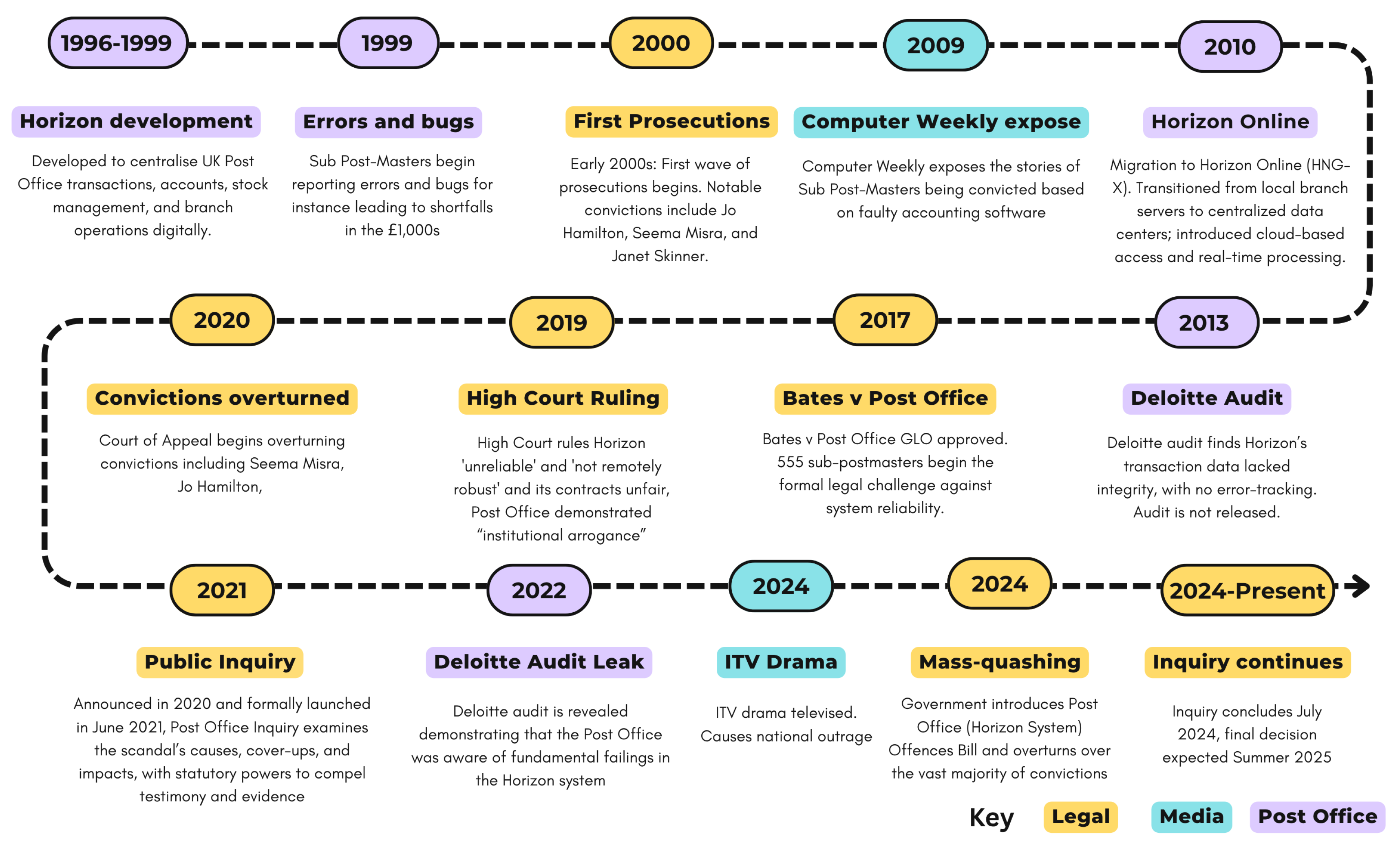
Figure 2.
Failures vs Controls.
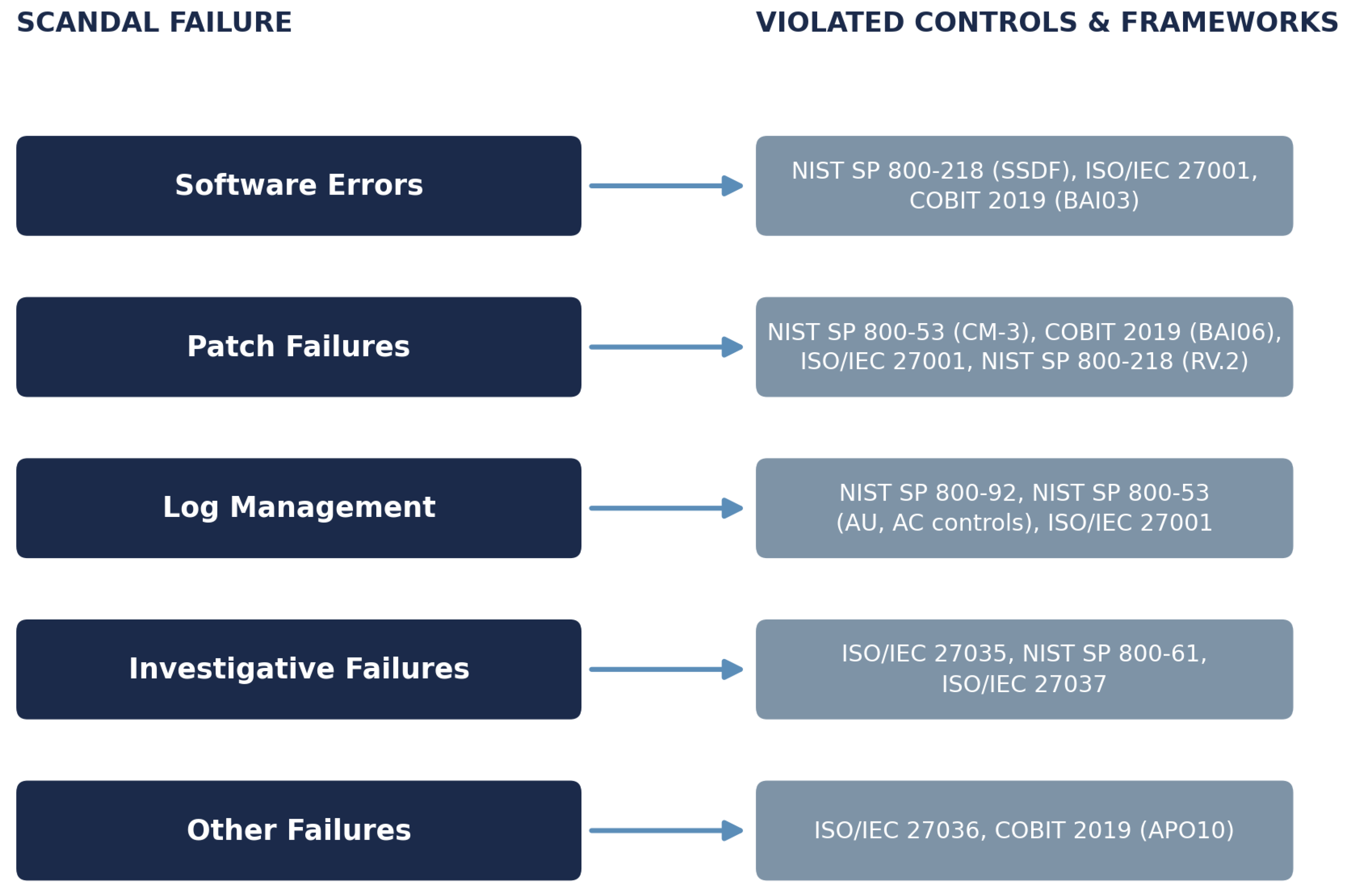

Table 1.
Technical and IT Issues Identified in the Horizon IT System.
| Inquiry Q# | Issue | Description and Examples |
|---|---|---|
| Software Errors | ||
| 6, 16 Section 3.1 | Pilot and Rollout Failures | Early pilots revealed reconciliation failures and unresolved discrepancies. Known bugs were downplayed, and rollout proceeded despite red flags. Example: Legacy shortfalls from Capture system persisted in Horizon. |
| 18, 25 Section 3.1 | Transition to Horizon Online | Online system enabled centralised control but introduced sync errors and remote access risks. Example: Server outages led to real-time data loss. |
| 49A Section 3.2 | Known Software Defects | Recurring bugs included duplicate transactions, broken reports, and hidden discrepancies. Example: Dalmellington and Callendar Square bugs. |
| 49B Section 3.3 | Third-Party Integration Failures | external devices like ATMs and lottery terminals caused data mismatches. example: synchronisation failures and transaction correction issues documented in ATM and Lottery systems [24]. |
| Patch Failures | ||
| 25, 204 Section 4 | Faulty System Updates | System updates weren’t tracked or communicated, introducing new bugs. Example: Firmware conflicts with EPOS terminals. |
| 191–196 Section 4 | Defective Patch Management | Patches were poorly validated, undocumented, and often introduced critical bugs. Example: 2009 patch caused corruption and sync issues. |
| Log Management | ||
| 49C, 41 Section 5.1/Section 5.2 | Audit and Log Failures | Missing logs during shutdowns, incomplete audit trails, and invisible remote actions compromised traceability. Example: Audit Query Shutdown; unlogged remote support. |
| 49C, 204 Section 3.5 | Inadequate Error Feedback | End users received no diagnostics or clear explanations of discrepancies. Example: PEAKs and KELs withheld from sub-postmasters. |
| Investigation | ||
| 49F, 145 Section 6.1 | Improper Use of Evidence | Horizon data treated as infallible despite integrity concerns. Example: Prosecutions relied on altered or incomplete logs. |
| 150–157 Section 6.1 | Disclosure Breaches | Defence teams weren’t told about bugs, doubts, or audit gaps during trials. Example: PEAK logs withheld from legal disclosure. |
| 202–205 Section 4.2Section 6.1 | Blocked Escalation Channels | Sub-postmasters’ reports of bugs and losses were ignored or blocked. Example: Complaints dismissed without investigation. |
| Other | ||
| 49D Section 5.3 | Remote Data Modification | Fujitsu staff altered branch data without informing sub-postmasters or legal oversight. Example: Use of APPSUP tool and elevated Global User access. |
| 185, 186 Section 3.4 | Monitoring and Contract Oversight | Post Office failed to enforce SLAs or vet Fujitsu’s software changes. Example: No penalties for persistent system faults. |
| 198–201 Section 7 | Lack of Technical Expertise | Both staff and executives lacked training in the use of appropriate systems. |
Table 2.
Software Errors.
| Error Name | Description | Impact and Reference |
|---|---|---|
| Transaction Isolation Failure | Simultaneous transactions and reports caused missing items in outputs. | Caused inaccurate or incomplete branch reports, though financial impact on accounts varied by incident [19]. |
| CABSProcess Silent Failure | Daily summaries failed silently when errors occurred. | Undetected balance errors; sub-postmasters unaware. See Section 3.5 for full detail [20]. |
| Duplicate Spreadsheet Entries | A glitch caused repeated recording of the same transaction. | Up to one-third of entries duplicated in evidence [20,21]. |
| Audit Query Shutdown Bug | Queries run during shutdown failed to log transactions. | Incomplete audit trails, undermined integrity [20]. |
| Dalmellington Bug | System freeze caused repeated keystroke inputs to register as multiple cash-acceptance events, each creating an additional liability attributed to the user. | Sub-postmasters wrongly held liable for system-generated duplicate cash entries; financial shortfalls attributed to user error rather than system fault [7]. |
| Callendar Square Bug | Database/communication faults caused duplicate transactions. | Sub-postmasters wrongly blamed for system errors [7]. |
| Firmware Update Crash | Faulty update caused system-wide crash. | Outage across branches; service disruption [22]. |
| Third-Party Integration Failures | Interface issues with ATMs and lottery terminals caused transaction mismatches and synchronisation failures; dispensed ATM amounts could become inconsistent with Horizon records. | Errors not caused by sub-postmasters; financial discrepancies attributed to branch staff rather than system fault [23,24]. |
| Capture System Shortfalls | Pre-Horizon system (Capture) had loss-causing bugs. | Dozens wrongly accused before Horizon’s rollout [25]. |
| EPOSScore.DLL | DLL responsible for cash records caused corrupted data. | False accusations from discrepancies in till data [26]. |
| Escher Riposte | Retail platform caused cross-terminal sync errors. | Mismatched records led to false charges [26]. |
Table 3.
Update and Patch Problems.
| Problem | Description | Proposed Solution |
|---|---|---|
| New bugs introduced by patches | Several updates introduced new bugs, exacerbated existing ones, or caused outright data corruption [30]. | Require pre-deployment testing, rollback options, and clear documentation of each patch. |
| Hardware compatibility failures | Some updates created compatibility issues with hardware such as EPOS terminals and printers, leading to failures in transaction processing and inaccurate financial reports [32]. | Ensure compatibility testing with all hardware types and provide installation guides to sub-postmasters. |
| 2009 update introduced new defects | A major 2009 update, intended to fix reconciliation and synchronisation bugs, disrupted data reporting and storage [20]. | Require full regression testing before large-scale updates. Include rollback plans. |
| No independent patch audit or monitoring | No audit process existed to evaluate patch quality or its downstream impact; developers lacked systematic visibility into post-deployment effects and no feedback loop existed to capture user-reported anomalies [20]. | Enforce independent patch audits; require branch-level feedback loops post-deployment. |
| Lack of change control and user communication | Patches were applied with minimal coordination, no formal rollback procedures, and no communication to sub-postmasters, who had no channels to report anomalies [30]. | Implement formal change control governance, user notifications, and structured anomaly reporting. |
Table 4.
Log Management Problems.
| Issue | Description | Impact |
|---|---|---|
| Suppressed Logs | Known error logs and internal fault records (e.g., KELs and PEAKs) were withheld from courts and the accused. | Prevented fair legal defence; contributed to wrongful prosecutions [35]. |
| Missing Data | 13 girocheque transactions were absent from ARQ reports due to a known ARQ extraction flaw, identified through PEAKs and KELs, and subsequently recovered by rerunning the ARQ query with an extended retrieval range [39]. | SPMs held responsible for transactions missing in the logs. |
| Audit Trail Access Denied | Sub-postmasters had no access to transaction-level audit data. | Obstructed independent verification of discrepancies [34]. |
| Poor Error Logging | Many system faults and exceptions were either not logged or recorded vaguely. | Made technical investigations and system audits difficult [34]. |
| Unlogged Remote Alterations | Fujitsu engineers had the capability to remotely access and alter data within the Horizon system; such alterations were not always captured in audit logs. | Undermined the credibility of branch accounts and audit trails [40,41]. |
| Log Quality and Consistency Issues | Logs were inconsistently recorded across transaction types, formatted in ways difficult to interpret, and not consistently updated when system changes were made. | Made record-keeping unreliable, hindered auditor interpretation, and created data gaps following updates [34]. |
| Delayed Log Retrieval | Internal delays in retrieving requested logs for investigations. | Obstructed appeals and prolonged legal disputes [34]. |
Table 5.
Summary of Issues in the Post Office Horizon IT Inquiry.
| Issue | Description |
|---|---|
| Alteration of Expert Testimony | A Fujitsu engineer admitted that his statements were edited at the request of Post Office lawyers. These edits removed references to known flaws in the Horizon system and portrayed the system as reliable. Engineer also claimed to be unaware of his obligations as an expert witness at the time [75,78,80]. |
| Failure to Reveal Remote Access Capability | Evidence later demonstrated that Fujitsu and Post Office personnel possessed the capability to access and alter branch data remotely, despite earlier representations that Horizon data could not be altered externally [18,35,38,43]. |
| Failure to Disclose Audit Logs | Audit logs and other material showing system discrepancies were not disclosed to sub-postmasters [84] or to the defence teams [76]. |
| PEAKs and KELs Non-Disclosure | Internal fault management tools (PEAKs and KELs) that documented recurring issues with Horizon were not disclosed to defense teams or sub-postmasters, withholding critical evidence (Section 5.1). |
| Use of Coercive Legal Tactics | The Post Office used coercive tactics, including taking confessions without legal representation (such as in the cases of Teju Adedayo [44] and Siobhan Sayer [42,82]) and failing to fulfil legal obligations in prosecuting sub-postmasters. |
| Failure to Disclose Horizon System Bugs | Internal reports identifying system defects were suppressed, and evidence of software bugs in Horizon was not disclosed to investigators or defence teams [76]. A former Post Office Security Manager stated he was entirely unaware that any Horizon bugs, errors or defects existed during his 32-year career, and expressed anger at learning this had been concealed [84]. In 2016, police were informed that a Post Office prosecutor had suppressed evidence of known bugs [77]. |
Table 6.
Mapping of Horizon Failure Categories to Cyber Security Framework Controls.
| Failure Category | Framework | Control | Requirement | Counterfactual: Could Compliance Have Helped Detect or Reduce the Failure? |
| Software Errors | NIST SP 800-218 (SSDF) [54] | PW.8 | Test executable code to identify vulnerabilities before deployment. | Could have helped detect or reduce—testing under PW.8 could plausibly have exposed the Dalmellington, Callendar Square, and CABSProcess defects prior to operational release, subject to the scope and rigour of the testing actually performed. |
| Software Errors | NIST SP 800-218 (SSDF) [54] | RV.1, RV.3 | Identify and confirm vulnerabilities on an ongoing basis; analyse root causes of all identified vulnerabilities. | Could have helped detect or reduce—ongoing vulnerability confirmation and root cause analysis would have made administrative dismissal of known defects harder to sustain undocumented, and more likely to surface in legal proceedings. |
| Software Errors | ISO/IEC 27001 [52] | A.14.2.8, A.14.2.9 | Security testing and system acceptance testing prior to deployment. | Could have helped detect or reduce—formal acceptance testing could plausibly have identified unresolved bugs prior to release, though this depends on the adequacy of the acceptance criteria applied. |
| Software Errors | COBIT 2019 [55] | BAI03 | Managed solutions identification and build: formal governance of system scope and design changes. | Could have helped detect or reduce—formal governance of system scope could plausibly have flagged the expanding system remit before additional risk was embedded, though this depends on whether governance findings were acted upon. |
| Patch Failures | NIST SP 800-53 Rev. 5 [53] | CM-3 | Configuration change control: documented approval, impact analysis, and mandatory rollback capability for all changes. | Could have helped detect or reduce—documented change control and mandatory rollback capability could plausibly have constrained uncoordinated patch deployment, though enforcement depended on the control being genuinely applied rather than merely specified. |
| Patch Failures | COBIT 2019 [55] | BAI06 | Managed IT Changes: formal change requests, authorised testing before deployment, and post-deployment review. | Could have helped detect or reduce—formal change requests and impact assessment could plausibly have surfaced patches introducing new bugs before redeployment, and silent deployment without user communication would have been visibly non-compliant. |
| Patch Failures | ISO/IEC 27001 [52] | A.14.2.2 | System change control procedures: all changes to systems must follow a formal documented procedure. | Could have helped detect or reduce—a documented change control procedure would have made patches applied without changelogs or sub-postmaster notification visibly non-compliant, and structured change records would have made deployment decisions traceable. |
| Patch Failures | NIST SP 800-218 (SSDF) [54] | RV.2 | Assess, prioritise, and remediate vulnerabilities on an ongoing basis. | Could have helped detect or reduce—ongoing vulnerability assessment could plausibly have flagged regression bugs introduced by patches before redeployment, and would have required documented assessment of disruptions such as those following the 2009 update. |
| Log Management | NIST SP 800-92 [59] | §3–5 | Log generation, protection, retention, and regular review requirements across all system components. | Could have helped detect or reduce—compliant log generation, format, and review requirements would have made incomplete logs, opaque formats, and infrequent review visibly non-compliant, and would have produced reviewable records for all defined events. |
| Log Management | NIST SP 800-53 Rev. 5 [53] | AU-2, AU-3, AU-9, AU-12 | Event logging; audit record content; protection of audit information from unauthorised access or deletion; audit record generation for all defined events, including privileged account actions. | Could have helped detect or reduce—comprehensive audit record generation for privileged accounts could plausibly have made unlogged remote access via the APPSUP privilege considerably harder to sustain, since compliant logging would capture actions taken, not merely login and logout events. |
| Log Management | NIST SP 800-53 Rev. 5 [53] | AC-6, AC-17 | Least privilege: access restricted to functions necessary for each role; remote access managed, monitored, and controlled. | Could have helped detect or reduce—enforcement of least privilege and monitored, multi-party authorisation for remote access could plausibly have constrained the scope of the APPSUP privilege and made unmonitored remote modifications to branch data harder to sustain. |
| Log Management | ISO/IEC 27001 [52] | A.9.1, A.9.4, A.12.4 | Access control policy; system and application access control; event logs must be produced, protected, and regularly reviewed. | Could have helped detect or reduce—access control and log review obligations applied together could plausibly have constrained uncontrolled privileged remote access and made withholding of logs from sub-postmasters visibly non-compliant. |
| Investigative Failures | ISO/IEC 27035 [11] | Phases 1–5 | Structured incident detection, assessment, response, and lessons learned process for all reported system events. | Could have helped detect or reduce—a structured incident management process could plausibly have made dismissal of sub-postmaster complaints without investigation visibly non-compliant, since all reported incidents would require formal assessment and documented resolution. |
| Investigative Failures | NIST SP 800-61 [56] | §3 | Incident handling procedures: preparation, detection, containment, eradication, recovery, and post-incident review. | Could have helped detect or reduce—a compliant incident handling process could plausibly have subjected recurring bugs to structured management, escalation, and post-incident analysis, reducing the scope for institutional suppression rather than eliminating it outright. |
| Investigative Failures | ISO/IEC 27037 [12] | §7.1 | All actions affecting potential digital evidence must be documented; evidence must be handled to preserve integrity and admissibility. | Could have helped detect or reduce—a documented chain of custody under a compliant evidence management regime could plausibly have rendered the withholding of PEAKs and KELs from defence teams, and the alteration of expert testimony, discoverable, though disclosure ultimately depended on the regime being followed rather than circumvented. |
| Other Failures | ISO/IEC 27036 [57,58] | Parts 1 & 3 | Security requirements in supplier contracts; ongoing monitoring of supplier performance; acquiring organisation retains capacity to independently verify supplier claims. | Could have helped detect or reduce—a requirement to maintain technical audit capacity could plausibly have improved the Post Office’s ability to verify Fujitsu’s assurances and would have made SLA non-enforcement visibly non-compliant. |
| Other Failures | COBIT 2019 [55] | APO10 | Managed vendors: governance of third-party relationships, performance monitoring, and contract compliance. | Could have helped detect or reduce—formal vendor governance with independent SLA monitoring could plausibly have surfaced persistent defects and mandated documented performance review and escalation, though enforcement still depended on the resulting findings being acted upon. |
Table 7.
Horizon Failures Mapped to Post Office Horizon Inquiry Question Numbers.
| Inquiry Q# | Failure Summary |
|---|---|
| 6, 16 | Inadequate pilot review allowed serious bugs to be missed or dismissed before full rollout. |
| 18, 25 | Horizon Online inherited legacy bugs and introduced new synchronisation, remote access, and network dependency problems. |
| 49A | Known software defects (Callendar Square, Dalmellington) caused data corruption; prosecutions continued regardless. |
| 49C, 41 | Audit logs were incomplete or failed during shutdown; many actions were unrecorded, breaching forensic principles. |
| 49D | Fujitsu staff could modify branch data remotely without user knowledge, breaching integrity and traceability. |
| 191–196 | Patches frequently introduced new bugs or failed silently; rollout lacked testing, documentation, and user notification. |
| 185, 186 | No independent monitoring of Fujitsu SLA compliance; failures were underreported and unpenalised. |
| 49C, 204 | Sub-postmasters received error messages without context or escalation path; known bugs were not disclosed to branch users. |
| 198–201 | The Post Office lacked in-house technical expertise to evaluate system reliability or verify contractor claims. |
| 49F, 145 | Evidence presented in court relied on software with known faults; data integrity was not independently verified. |
| 150–157 | Disclosure failures meant exculpatory evidence (audit trails, bug records) was withheld from defence teams. |
| 25, 204 | System updates applied without post-deployment validation led to misreporting and transaction corruption. |
| 49B | Poor interface management between Horizon and external systems (ATMs, lottery terminals) introduced unattributed errors. |
| 202–205 | User complaints and error reports were routinely ignored; no effective whistleblowing or grievance escalation procedures existed. |
Disclaimer/Publisher’s Note: The statements, opinions and data contained in all publications are solely those of the individual author(s) and contributor(s) and not of MDPI and/or the editor(s). MDPI and/or the editor(s) disclaim responsibility for any injury to people or property resulting from any ideas, methods, instructions or products referred to in the content. |
© 2026 by the authors. Licensee MDPI, Basel, Switzerland. This article is an open access article distributed under the terms and conditions of the Creative Commons Attribution (CC BY) license (http://creativecommons.org/licenses/by/4.0/).
Copyright: This open access article is published under a Creative Commons CC BY 4.0 license, which permit the free download, distribution, and reuse, provided that the author and preprint are cited in any reuse.


