

Submitted:
29 June 2026
Posted:
30 June 2026
You are already at the latest version
Abstract
The Markets in Crypto-Assets Regulation (MiCA) harmonizes market rules across the European Union, but it does not by itself determine how entities should classify, measure, document, and tax crypto-asset transactions. This study examines whether recent Slovak implementation measures have translated formal harmonization into operational accounting clarity. An anonymous online survey of 34 accounting, tax, finance, and business professionals was analyzed using descriptive statistics, Wilson confidence intervals, a Fisher–Freeman–Halton exact test, Cramér’s V, and thematic coding of open responses. Although 52.9% of respondents viewed legislative development positively, 72.7% of valid respondents considered current valuation rules inadequate, 60.6% reported that reforms had not increased accounting clarity, and 60.6% perceived greater uncertainty. Tax obligations (50.0%) and record-keeping and documentation (35.3%) were affected more often than bookkeeping mechanics (14.7%). Practical experience was strongly associated with monitoring legislative change (exact p < 0.001; Cramér’s V = 0.62). The findings reveal a regulatory–operational clarity gap: legal taxonomy and market supervision have advanced faster than implementable valuation and documentation guidance. A valuation hierarchy, standardized audit-trail requirements, transaction-specific examples, coordinated accounting–tax guidance, and proportionate support for smaller entities are recommended.
Keywords:
crypto-assets
; MiCA
; accounting
; fair value
; valuation
; regulatory clarity
; cryptocurrency taxation
; Slovakia
1. Introduction
Crypto-assets have moved from a technologically specialized phenomenon into investment, payment, financing, and treasury practices. Their economic functions are heterogeneous: some tokens are used primarily for exchange or speculation, some reference assets or official currencies, and others grant access to goods, services, governance rights, or digitally represented claims. MiCA responds to that heterogeneity by establishing a directly applicable European Union framework for the issuance, public offering, admission to trading, and servicing of crypto-assets [1]. The regulation is a major step toward a common legal vocabulary and a supervised single market, but market regulation and financial reporting solve different problems. MiCA determines who may issue or service crypto-assets and under what disclosure and conduct rules; accounting must still determine what the reporting entity controls, how the item should be classified, how its value should be established, and when gains, losses, revenue, and tax consequences arise.
Legal scholarship generally expects MiCA to increase formal legal certainty by replacing fragmented national approaches with a uniform framework [2]. Early empirical work with crypto-industry experts likewise identifies benefits from regulatory legitimacy, passporting, investor protection, and market consolidation, while also reporting compliance costs and residual ambiguity [3]. From an accounting perspective, however, the diversity of token rights and business models prevents a single label from producing a single recognition or measurement outcome. A MiCA-compliant crypto-asset may still require a distinct accounting analysis based on the holder’s purpose, the issuer’s obligations, the existence and liquidity of markets, and the quality of price evidence [4].
The international accounting architecture remains incomplete. For the limited subset of cryptocurrencies considered by the IFRS Interpretations Committee, IAS 2 applies when holdings are kept for sale in the ordinary course of business; otherwise, IAS 38 applies [5]. This interpretation supplies a minimum route through existing standards, yet the intangible-asset model has been criticized for failing to represent the economic characteristics and market volatility of many holdings [6,7,8]. Evidence from global corporate reporting documents inconsistent classification, measurement, presentation, and cash-flow treatment [9]. Interviews with standard-setters, practitioners, academics, and professional bodies similarly show demand for clarification, while recognizing that rapid innovation complicates prescriptive standard setting [10,11]. Stakeholder outreach in Australia identifies valuation, active-market assessment, custody, issuer accounting, and disclosure as continuing practical problems [12]. The contrast with the United States is notable: FASB Accounting Standards Update 2023-08 requires in-scope crypto-assets to be measured at fair value through earnings, accompanied by specific presentation and disclosure rules [13]. In 2025, the IASB again listed crypto-assets and related transactions among potential projects and recorded continuing concerns about the usefulness of IAS 38 and the need to address a broader range of holdings, issuances, and custody arrangements [14].
Slovakia offers an informative post-MiCA setting because it had already treated virtual currency as short-term financial assets under national accounting rules, a model that differs from the usual IFRS route [15]. Act No. 248/2024 Coll. implemented national elements of MiCA and amended accounting and income-tax legislation with effect from 1 January 2025 [16]. The reforms replaced the narrower term “virtual currency” with “crypto-asset”, introduced explicit treatment for e-money tokens, expanded issuer accounting, required analytical records by individual crypto-asset, and aligned non-fiat exchanges with tax valuation rules [17,18,19,20,21,22]. The transition to licensed crypto-asset service providers was completed in Slovakia on 30 December 2025 [23]. These changes create a useful natural policy context: the formal framework became more detailed, but its operational effect on accountants, tax advisers, finance staff, and businesses had not been empirically evaluated.
This article develops the concept of a regulatory–operational clarity gap: the distance between a legally defined and supervised market on the one hand and practitioners’ ability to apply consistent, auditable classification, valuation, documentation, and tax procedures on the other. The concept does not imply that MiCA was designed as an accounting standard. Rather, it asks whether accompanying national rules and guidance convert regulatory categories into workable reporting decisions. The study addresses four research questions: (RQ1) How do practitioners assess the direction and practical impact of recent crypto-asset legislation? (RQ2) Do they regard current valuation and accounting rules as adequate, clear, and uncertainty-reducing? (RQ3) Is practical crypto-asset accounting experience associated with more frequent monitoring of legislative change? (RQ4) Which operational areas do practitioners identify as priorities for further guidance?
The contribution is threefold. First, the article provides rare post-implementation evidence from a Central European jurisdiction in which MiCA-related market, accounting, and tax changes arrived in a concentrated period. Second, it combines descriptive uncertainty estimates with an exact test of the link between practical exposure and regulatory engagement. Third, it converts practitioner responses into a targeted implementation framework for valuation evidence, transaction documentation, and accounting–tax coordination. The findings show cautiously positive views of legislative direction but persistent dissatisfaction with valuation rules and a net perception of reduced, rather than increased, operational certainty.
2. Regulatory and Accounting Context
2.1. MiCA Harmonization and the Limits of Legal Taxonomy
MiCA defines a crypto-asset broadly as a digital representation of value or of a right that may be transferred and stored electronically using distributed-ledger or similar technology [1]. Its architecture distinguishes asset-referenced tokens, e-money tokens, and other crypto-assets, with utility tokens included within the latter category when they are intended to provide access to a good or service supplied by the issuer. It also establishes obligations for white papers, marketing communications, authorization, governance, custody, client protection, market integrity, and supervision. Titles governing asset-referenced and e-money tokens became applicable before the remainder of the regime, and the framework became generally applicable at the end of 2024, subject to national transitional arrangements.
This taxonomy improves the legal identification of products and the allocation of regulatory responsibilities. Van der Linden and Shirazi argue that a uniform, directly applicable framework should reduce the uncertainty generated by divergent national regimes [2]. Yet legal certainty is not a binary condition. Expert interviews conducted around MiCA implementation identify organizational benefits alongside ambiguous boundaries, substantial compliance work, and the need for interpretation in novel business models [3]. The same distinction is central to accounting: a legal category can narrow the range of plausible treatments without determining the reporting outcome in every holder, issuer, or intermediary context.
For financial reporting, the unit of analysis is the economic substance of the right or obligation and the reporting entity’s relationship to it. A token described in a white paper as providing access to a future service may create deferred revenue or another performance obligation for the issuer; the same token may be a prepayment, an investment, an inventory item, or another asset for the holder. An e-money token linked to one official currency is economically different from an unbacked payment token. Similarly, tokenization does not automatically convert an underlying non-financial right into cash or a financial instrument. Consequently, accounting guidance must connect token rights, control, business purpose, market evidence, and transaction lifecycle rather than relying solely on technological form [4].
2.2. Recognition and Valuation Under an Incomplete International Framework
The IFRS Interpretations Committee’s June 2019 agenda decision addressed holdings of a narrowly defined cryptocurrency: a digital or virtual currency recorded on a distributed ledger, not issued by a jurisdictional authority or another party, and not giving rise to a contract between the holder and another party. The Committee concluded that such a holding is an identifiable non-monetary asset without physical substance. IAS 2 applies when it is held for sale in the ordinary course of business, including the broker-trader exception where appropriate; otherwise IAS 38 applies [5]. The decision does not establish a comprehensive model for stablecoins, utility tokens, security-like tokens, NFTs, tokenized claims, custody arrangements, mining, staking, decentralized finance, or issuer obligations.
Several weaknesses follow. Under the IAS 38 cost model, upward market movements may not be recognized while impairment losses are recognized, producing an asymmetric carrying amount that can diverge materially from current economic value. The revaluation model depends on an active market, a condition that can be difficult to establish for heterogeneous or thinly traded tokens. Procházka compared competing IFRS models and emphasized that the choice among intangible assets, inventory, cash-like treatment, and fair value has substantial consequences for relevance and comparability [6]. EFRAG’s discussion paper documented gaps for both holders and issuers, including classification, valuation, mining, utility and hybrid tokens, custody, and initial coin offerings [7]. Its subsequent recommendations favored clarification or amendment of existing standards, including a route to fair value through profit or loss for relevant crypto-assets and more complete issuer disclosures [8].
Empirical reporting evidence supports these concerns. Luo and Yu’s analysis of 40 global companies exposed to cryptocurrencies found inconsistent application of U.S. GAAP and IFRS and distortions affecting asset value, liquidity, profitability, and cash-generation assessments [9]. Chou, Agrawal, and Birt found that stakeholder groups viewed current principles as potentially capable of addressing many transactions but still wanted clarification and continuous monitoring as crypto-assets evolve [10]. Ramassa and Leoni showed that accounting for cryptocurrency holdings illustrates the difficulty of standard setting under rapid technological change, where agenda decisions, lobbying, and institutional boundaries influence the timing and form of guidance [11]. AASB outreach similarly identified valuation and the active-market test as critical practical issues and called for educational guidance for preparers and auditors [12].
FASB’s response provides a useful counterpoint. ASU 2023-08 requires qualifying fungible crypto-assets to be subsequently measured at fair value, with changes in net income and separate presentation and disclosure [13]. The scoped model does not solve all digital-asset accounting questions, but it demonstrates that targeted rules can prioritize current value and comparability. The IASB’s 2025 agenda material confirms that stakeholder concern remains live: possible work includes crypto-assets within the intangible-assets project, expansion of financial-instrument scope, or a broader project covering direct holdings, custodial holdings, stablecoins, security tokens, and issuer transactions [14]. The international debate therefore remains open precisely where national practitioners must already prepare accounts and tax evidence.
2.3. Slovak Implementation: From “Virtual Currency” to Crypto-Asset Procedures
Slovak legal literature had long noted that the terminology and tax treatment of digital currencies developed incrementally and did not map neatly onto traditional monetary categories [24,25]. Before MiCA implementation, Slovak national accounting already differed from IFRS by treating relevant virtual-currency holdings as short-term financial assets rather than applying the general intangible-asset model [15]. The 2024–2025 reforms retained the national financial-asset orientation but broadened terminology and introduced distinctions that mirror MiCA’s token taxonomy.
Act No. 248/2024 Coll. amended the Accounting Act and Income Tax Act from 1 January 2025 [16,17,21]. The Accounting Act now uses “crypto-asset” in place of “virtual currency” and explicitly addresses e-money tokens. Such tokens are measured at nominal value and excluded from the relevant fair-value provisions [19]. The implementing accounting measure places them among bank-account-type short-term financial assets, for example in account 222, because MiCA treats them as electronic money [18,20]. Other crypto-assets are recorded within short-term financial assets using an entity-created account, for example account 258, with analytical accounts differentiated by individual crypto-asset. The same measure adds issuer accounting for utility tokens and other crypto-assets, linking revenue recognition to the issuer’s obligations in the white paper; if no obligation exists for an “other crypto-asset”, revenue is recognized when consideration is received [18,20].
The tax amendments increase the evidentiary importance of valuation. For income-tax purposes, a sale of a crypto-asset includes an exchange for property, another crypto-asset, a service, or an onerous transfer. An exchange is included in the tax base in the period in which it occurs using the fair value of the exchanged crypto-asset on the exchange date [21,22]. This means that a crypto-to-crypto transaction can require a defensible euro valuation even when no fiat currency is received. The record-keeping burden therefore extends beyond the accounting entry to timestamps, quantities, fees, exchange rates, wallet or exchange records, and the method used to establish fair value.
Table 1 summarizes the translation from regulatory change to operational accounting demands. It shows why formal specificity can coexist with implementation uncertainty: the reforms identify categories and accounts, but practitioners still need repeatable methods for selecting market data, handling low liquidity, documenting non-fiat exchanges, and interpreting new token structures.
Valuation is especially difficult because crypto-asset trading is fragmented across venues, quoted pairs, jurisdictions, and liquidity conditions. Identifying the principal or most advantageous market may require more than selecting the most familiar exchange. Beigman et al. propose a dynamic approach to principal-market determination and show why venue fragmentation challenges conventional fair-value assumptions [26]. Their later work addresses assets that do not trade directly against the functional currency or lack sufficient direct volume, illustrating the need for documented pricing paths and liquidity assessments [27]. These issues make the provenance of a price—venue, timestamp, pair, volume, fees, and exchange-rate conversion—part of the accounting evidence, not merely an operational detail.
3. Materials and Methods
3.1. Research Design and Instrument
The study used a cross-sectional, quantitative survey designed to capture professional perceptions during the post-reform period. An online questionnaire was selected because the target population was geographically dispersed and included accountants, tax advisers, finance staff, and business operators. Participation was voluntary and anonymous. The opening page explained the research purpose, indicated that responses would be analyzed only in aggregate, and estimated a completion time of three to five minutes.
The instrument contained 14 questions (Appendix A). Three questions characterized respondents by occupational role, length of professional practice, and practical experience with crypto-asset accounting. The remaining questions measured: frequency of monitoring legislative change; evaluation of the direction of legislation; perceived impact on work; operational areas affected; whether accounting procedures had been changed; perceived impact on valuation; adequacy of valuation rules; clarity after reform; certainty versus uncertainty; and open-ended descriptions of changes and desired improvements. Most items used ordered categorical responses, while one multiple-response item identified affected areas.
Data were collected through an anonymous online questionnaire targeting accounting professionals, tax advisors, financial specialists, and business practitioners. The study applied purposive and convenience sampling techniques to reach respondents with varying degrees of exposure to digital asset accounting. The resulting sample comprised 34 respondents, of whom 67.65% reported at least occasional experience with accounting for digital assets. Consequently, the study provides exploratory evidence on practitioner perceptions regarding the impact of recent crypto-asset regulation on accounting and valuation practices in Slovakia.
3.2. Sample and Data Preparation
A total of 34 responses were retained. No identifying or sensitive personal data were requested. One respondent omitted several later items, leaving 33 valid responses for the questions on procedural change, valuation impact, valuation adequacy, accounting clarity, and certainty. Percentages for those items are therefore calculated on the valid-case denominator (n = 33), not on the full sample. For the multiple-response question, percentages use n = 34 and do not sum to 100% because respondents could select more than one area.
Ordered responses were collapsed only where the substantive analysis required a directional indicator. “Improves” and “rather improves” formed the positive legislative-trend category. “Significantly” and “rather yes” formed material work impact. “Yes, significantly” and “rather yes” formed valuation affected. “Rather no” and “no” formed inadequate valuation rules and no added clarity. “Rather more uncertainty” and “more uncertainty” formed greater uncertainty. The original category counts remain reported so that readers can inspect the underlying distributions.
Open responses were categorized by recurring operational topic. A single response could contribute to more than one theme. The thematic counts are descriptive and are used to identify implementation priorities; no inferential conclusion is based on them. Because the study’s analytical file is aggregate, quotations are not presented and inter-coder reliability is not claimed.
3.3. Statistical Analysis
Analysis was conducted using absolute and relative frequencies. For key binary directional indicators, 95% Wilson score confidence intervals are reported because they have better small-sample coverage than conventional normal-approximation intervals. The relationship between practical accounting experience (regular, occasional, none) and monitoring of legislation (regularly, sometimes, never) was evaluated using the Fisher–Freeman–Halton exact test for a 3 × 3 table. An exact test was selected because several expected cell counts were below five. Effect size is reported as Cramér’s V, calculated from the Pearson chi-square statistic and the smaller table dimension. The exact two-sided p-value was obtained by enumerating all contingency tables with the observed margins.
The analysis is exploratory and descriptive. No weighting was applied, no causal effect of legislation is claimed, and confidence intervals quantify sampling uncertainty for the observed non-probability sample rather than correcting selection bias. All calculations are reproducible from the counts reported in Table 2, Table 3, Table 4 and Table 5.
4. Results
4.1. Sample Characteristics
The sample included 10 accountants (29.4%), eight entrepreneurs (23.5%), seven tax advisers (20.6%), four finance workers (11.8%), four respondents in other occupations (11.8%), and one respondent who did not report an occupational category. Twenty-two respondents (64.7%) had at least four years of professional practice. Twenty-three respondents (67.6%; 95% CI: 50.8–80.9%) reported regular or occasional practical experience with crypto-asset accounting. Thus, the sample combined direct practitioners with economically informed respondents who had not yet processed such transactions.
4.2. Regulatory Engagement and Perceived Direction
Twenty-seven respondents (79.4%; 95% CI: 63.2–89.7%) monitored Slovak or EU legislative changes regularly or sometimes. Regular monitoring was reported by nine respondents, occasional monitoring by 18, and no monitoring by seven. The overall direction of legislation was viewed cautiously positively: five respondents selected “improves” and 13 “rather improves”, yielding 52.9% positive responses (95% CI: 36.7–68.5%). Nine perceived no marked change, while seven viewed the direction as rather or clearly worsening.
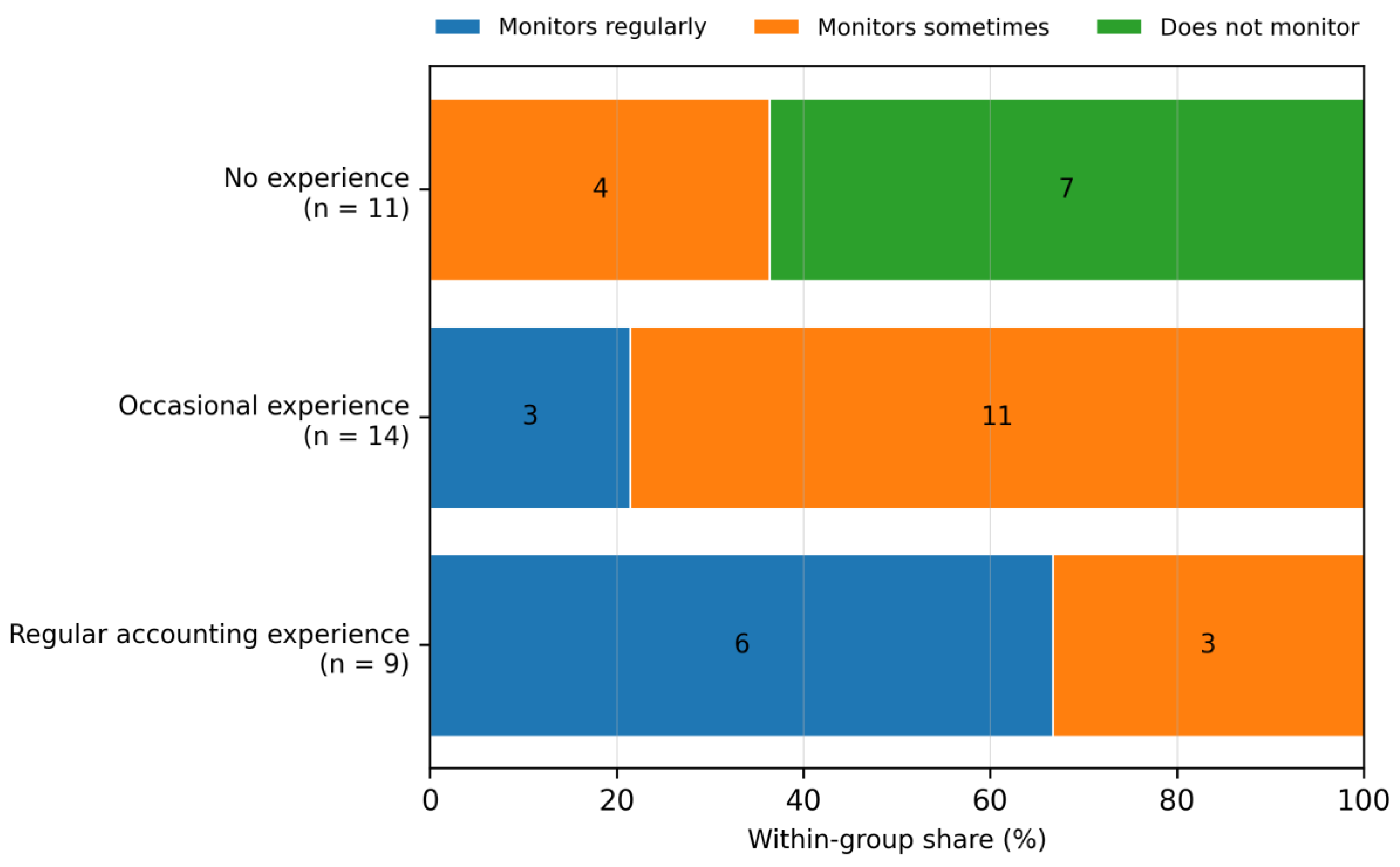
Practical experience and regulatory monitoring were closely related. Among nine respondents with regular accounting experience, six monitored legislation regularly and three sometimes; none reported no monitoring. Among 14 respondents with occasional experience, three monitored regularly and 11 sometimes. By contrast, seven of the 11 respondents without experience did not monitor legislation. The Fisher–Freeman–Halton exact test rejected independence (two-sided exact p = 0.000028; Cramér’s V = 0.620), indicating a strong association in this sample. Figure 2 shows that the relationship is monotonic in practical terms: complete disengagement from legislative monitoring appears only among respondents without direct accounting experience.
Figure 1.
Selected post-reform survey outcomes. Points show sample proportions and whiskers show Wilson 95% confidence intervals. Denominators are 34 except for valuation, clarity, and uncertainty items (n = 33).
Figure 1.
Selected post-reform survey outcomes. Points show sample proportions and whiskers show Wilson 95% confidence intervals. Denominators are 34 except for valuation, clarity, and uncertainty items (n = 33).
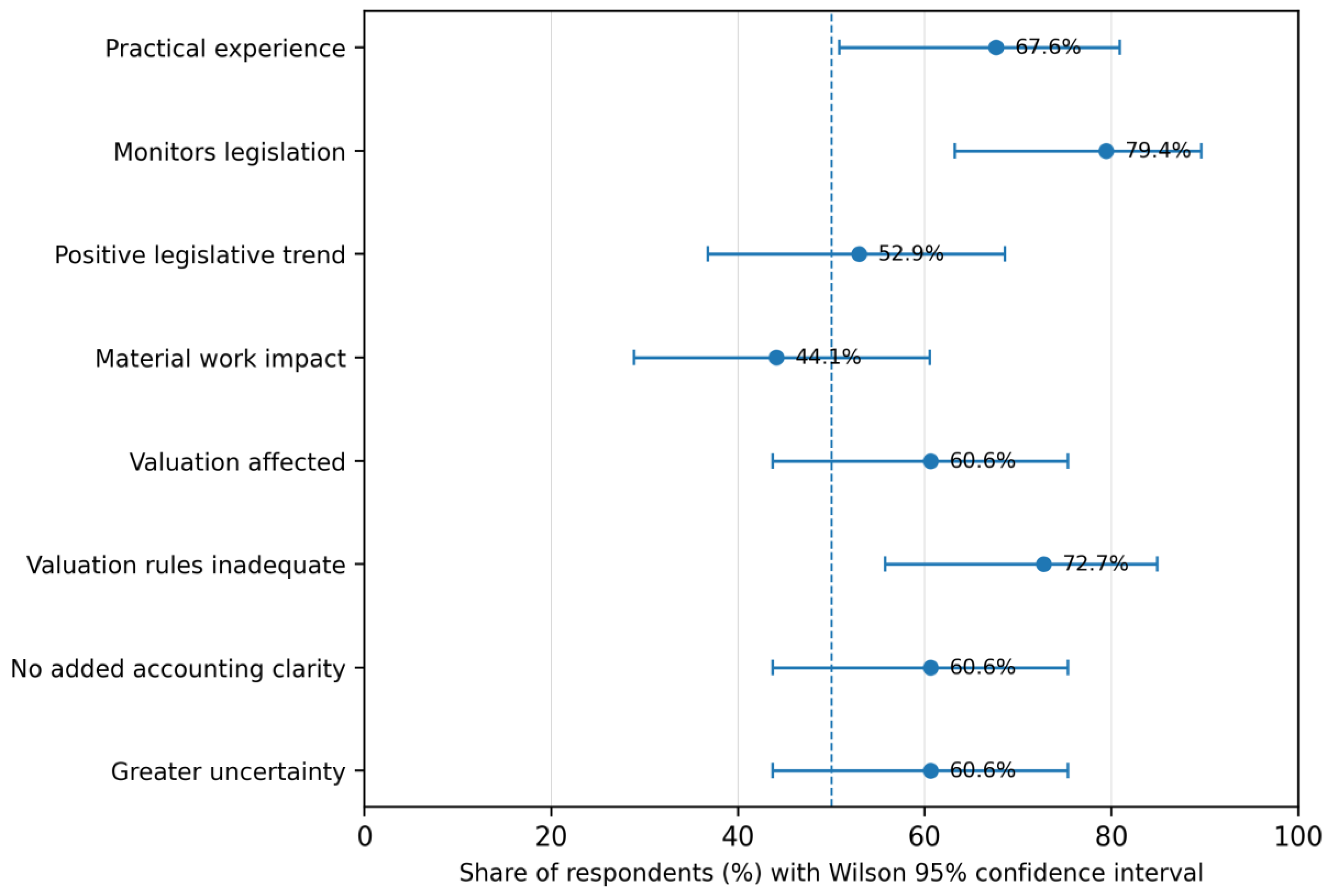
Figure 2.
Legislative monitoring within practical-experience groups. Numbers inside segments are respondent counts.
Figure 2.
Legislative monitoring within practical-experience groups. Numbers inside segments are respondent counts.
4.3. Operational Impact of the Reforms
Fifteen respondents (44.1%; 95% CI: 28.9–60.5%) stated that legislative changes had significantly or rather affected their work, 14 reported minimal impact, and five reported none. The pattern is consistent with uneven exposure: the reforms are consequential for those processing crypto-asset transactions, while many organizations still encounter such transactions only intermittently.
The multiple-response item clarifies where the burden was felt. Tax obligations were selected by 17 respondents (50.0%), record-keeping and documentation by 12 (35.3%), valuation by 10 (29.4%), and accounting mechanics by five (14.7%); seven respondents selected no impact. Fourteen of 33 valid respondents (42.4%; 95% CI: 27.2–59.2%) had changed their accounting procedure, eight had not, and 11 regarded the question as not applicable.
The open responses show that procedural adaptation was concentrated in evidence and control systems rather than wholesale replacement of the accounting model. Record-keeping and documentation appeared in nine coded responses, including analytical records by token, exchange statements, fees, price histories, and supporting documents. Valuation and currency conversion appeared five times, internal procedures and methodology four times, and classification twice. This distribution helps explain why respondents selected documentation and tax more frequently than “accounting” in the narrower sense: the most visible change was the infrastructure needed to support the entry and tax position.
4.4. Valuation Adequacy, Clarity, and Uncertainty
Valuation was the clearest point of dissatisfaction. Twenty of 33 valid respondents (60.6%; 95% CI: 43.7–75.3%) believed that legislative changes had affected valuation significantly or to some extent. At the same time, only nine regarded current valuation rules as adequate or rather adequate, while 24 (72.7%; 95% CI: 55.8–84.9%) selected rather inadequate or inadequate.
The reforms also did not produce a net gain in perceived clarity. Thirteen respondents considered accounting clearer or rather clearer, compared with 20 (60.6%; 95% CI: 43.7–75.3%) who selected rather not or not. The same split appeared for certainty: 13 perceived more or rather more certainty, whereas 20 (60.6%; 95% CI: 43.7–75.3%) perceived rather more or more uncertainty. These results are not contradictory to the positive view of legislative direction. Respondents can recognize that a framework is developing while still finding its operational instructions insufficient.
Experience did not eliminate criticism. The research records indicate that respondents with direct accounting experience were more critical of valuation sufficiency than those without experience. This is substantively plausible: practical exposure reveals the difficulty of choosing an exchange, timestamp, conversion pair, treatment of fees, and evidence for illiquid or non-standard tokens. Given the aggregate dataset, this subgroup pattern is reported descriptively and is not subjected to an additional significance test.
4.5. Priorities Identified in Open Responses
The most frequent recommendation was clearer methodological guidance with worked examples (seven coded responses). Six requested explicit treatment of special assets or transactions, including staking, NFTs, crypto-to-crypto exchanges, losses, and cross-border operations. Five focused on the tax regime, four on harmonized accounting and reporting procedures, three on valuation, and two on support tailored to small firms. The responses therefore call less for abstract expansion of regulation than for a bridge from legal rules to transaction-level implementation.
5. Discussion
5.1. Formal Harmonization Has Not Yet Produced Operational Clarity
The central finding is a two-level assessment. At the level of direction, a small majority viewed legislation as improving. At the level of day-to-day application, large majorities of valid respondents found valuation rules inadequate and reported no increase in clarity and greater uncertainty. This is the regulatory–operational clarity gap proposed in the Introduction. MiCA and Slovak implementation have made the legal environment more legible by defining crypto-assets, distinguishing e-money tokens, specifying regulated service providers, and adding accounting and tax provisions. Yet the same reforms expose practitioners to more explicit decisions—classification, price selection, revenue timing, and taxable exchange valuation—without always supplying a sufficiently detailed decision protocol.
The finding complements rather than contradicts studies that credit MiCA with legal certainty. A directly applicable framework can reduce uncertainty about authorization, disclosure, and market conduct [2], while organizations still experience ambiguity and compliance burden in specific applications [3]. The survey adds an accounting layer to that debate. Practitioners are not principally disputing the need for regulation; they are asking how to prove and consistently reproduce an accounting or tax result for a particular transaction.
5.2. Valuation Is the Main Transmission Mechanism of Uncertainty
The 72.7% negative assessment of valuation adequacy is the strongest substantive result. It aligns with international research showing that current accounting outcomes can misrepresent economic value or differ across firms [6,7,8,9]. It also echoes stakeholder research in which valuation, active markets, custody, and token heterogeneity repeatedly emerge as unresolved topics [10,11,12]. The IASB’s continuing consideration of crypto-assets and the FASB’s move to a scoped fair-value model demonstrate that the policy debate is not settled [13,14].
In Slovakia, the issue is sharpened by the interaction of national accounting and tax rules. E-money tokens have a nominal-value rule, while other crypto-assets may require cost tracking, fair-value determination at specified events, and currency conversion. A crypto-to-crypto exchange can create a tax consequence based on fair value even though no euros enter the transaction [21,22]. If a token trades on multiple venues or only through another token, the reporting entity must select and document a price path. Research on dynamic principal markets and inactive crypto-asset markets shows that this is a real measurement problem, not merely a lack of practitioner familiarity [26,27,28].
A workable valuation protocol should therefore specify at least: the unit of account; the market or venue-selection hierarchy; criteria for an active market and observable price; the valuation timestamp and time zone; bid, ask, or executed-price convention; treatment of exchange and network fees; conversion from quoted currency to the functional currency; fallback methods for low-liquidity or indirect pairs; controls over related-party or manipulated markets; and evidence retained for audit and tax review. Without such a protocol, two entities can apply the same high-level legal rule and produce different, weakly documented amounts.
5.3. Tax and Documentation Effects Exceed Bookkeeping Effects
Respondents selected tax obligations and documentation more often than accounting mechanics. The result is consistent with the design of the reforms. Replacing terminology or introducing an account number may not radically change double-entry mechanics; by contrast, treating exchanges for another crypto-asset, property, or services as sales creates repeated valuation and evidence requirements [22,29]. The operational burden is amplified by data fragmentation: transaction records may be distributed across centralized exchanges, self-hosted wallets, blockchain explorers, bank statements, and internal systems.
This distinction matters for policy. Additional statutory text alone may have diminishing returns if it is not accompanied by examples, data standards, and record-retention rules. A minimum audit trail could require transaction hash or platform identifier, wallet or account, date and coordinated time, token and quantity, counter-asset, euro valuation, price source, exchange rate, fees, business purpose, and accounting/tax treatment. Standardizing these fields would improve consistency, facilitate software integration, and reduce the cost of review for both taxpayers and authorities.
5.4. Experience Drives Regulatory Engagement but Not Automatic Confidence
The strong association between practical experience and legislative monitoring is intuitive but policy-relevant. Professionals who process crypto-assets regularly cannot rely on static knowledge because accounting, tax, licensing, and product structures are changing simultaneously. Conversely, those without direct exposure may not monitor the rules until a transaction appears. The result supports targeted, event-triggered education: guidance should be available at the point when a firm first receives, buys, issues, exchanges, stakes, or holds a crypto-asset, rather than assuming continuous specialist monitoring by every accountant or small business.
Experience did not produce uniformly greater confidence. Practitioners with exposure were often more critical of valuation sufficiency, which is consistent with prior stakeholder studies: familiarity reveals edge cases and evidence problems that are invisible in a purely conceptual reading [10,12]. Training is therefore necessary but cannot substitute for institutional guidance. Better education and better rules are complements.
5.5. Implementation Framework
Table 6 translates the results into a proportionate implementation framework. The proposals are intentionally operational. They do not require a single accounting model for all tokens; instead, they create a disciplined sequence for determining substance, valuation, documentation, and tax treatment. This approach is compatible with the heterogeneity emphasized in the international literature and with MiCA’s distinction among token categories [1,4,7,8].
5.6. Limitations and Research Agenda
The study has important limitations. The sample is small (n = 34), non-probability, and confined to one national context. Results should not be interpreted as representative of all Slovak accountants, tax advisers, financial professionals, or firms. Occupational groups are heterogeneous, and 11 respondents had no direct crypto-asset accounting experience. Several outcomes rely on self-reported perceptions rather than observed reporting decisions. One respondent omitted later items, and the aggregate analytical file does not permit multivariable modeling, item-level replication, or systematic re-coding of verbatim open responses.
The exact association test is statistically strong within the sample, but selection mechanisms may influence both experience and monitoring. The cross-sectional design also cannot separate uncertainty caused by the novelty of the reforms from uncertainty that would persist under a mature regime. Finally, the study focuses on national accounting and tax implementation rather than IFRS-reporting issuers or regulated crypto-asset service providers as distinct populations.
Future research should use a larger stratified sample and distinguish national-GAAP preparers, IFRS preparers, auditors, tax advisers, service providers, token issuers, and SMEs. Interviews and case-based experiments could test whether practitioners reach the same classification and valuation result when given identical transaction evidence. A longitudinal design could determine whether uncertainty declines as guidance, software, and market practice mature. Comparative studies across EU Member States would reveal whether the operational gap reflects MiCA-wide issues or differences in national accounting and tax implementation.
6. Conclusions
MiCA and the related Slovak reforms have materially improved the formal architecture for crypto-assets. The market now operates with a common EU taxonomy, supervised service-provider regime, explicit national accounting treatment for e-money tokens and issuers, analytical-record requirements, and updated tax rules for non-fiat exchanges. The practitioner evidence nevertheless shows that formal harmonization has not yet become operational clarity.
A cautious majority of respondents recognized positive legislative direction, but nearly three quarters of valid respondents considered valuation rules inadequate. Three fifths reported that the reforms had not made accounting clearer and that uncertainty had increased. Tax and documentation effects were more frequently perceived than narrow bookkeeping effects. Practical experience was strongly associated with monitoring legislative change, confirming that regulatory engagement grows with exposure but does not guarantee confidence in the available guidance.
The policy implication is not simply to regulate more. The priority is to operationalize existing rules through a documented valuation hierarchy, transaction-specific examples, a standard minimum audit trail, coordinated accounting–tax explanations, and proportionate tools for small entities. Such measures would respect token heterogeneity while making judgments more consistent, reviewable, and defensible. Closing this regulatory–operational clarity gap is essential if legal harmonization is to support high-quality financial reporting and trustworthy digital-asset markets.
Author Contributions
Conceptualization, M.Š. and [V.G.]; methodology, M.Š. and [V.G.]; formal analysis, M.Š.; investigation, [V.G.]; data curation, [V.G.]; writing—original draft preparation, M.Š.; writing—review and editing, M.Š., [V.G.]; visualization, M.Š; supervision, M.Š.; project administration, M.Š. All authors have read and agreed to the published version of the manuscript.
Funding
This research received no external funding.
Institutional Review Board Statement
According to institutional guidelines applicable to anonymous questionnaire-based research involving adult participants and no collection of sensitive personal data, formal ethical review was not required for this study. Participation was voluntary, anonymous, and based on informed consent.
Informed Consent Statement
Participants received information about the study on the opening page of the anonymous questionnaire. Informed consent was indicated by voluntary submission of the completed questionnaire.
Data Availability Statement
All aggregate counts used in the analysis are reported in Table 2, Table 3, Table 4 and Table 5. The data supporting the findings of this study are available from the corresponding author upon reasonable request. To protect participant anonymity and confidentiality, raw survey responses are not publicly available.
Acknowledgments
The authors thank all professionals who voluntarily participated in the survey. During preparation of this manuscript, the authors used OpenAI ChatGPT (accessed June 2026) to support language editing, manuscript organization, and formatting. The authors reviewed and edited all outputs, independently checked the analyses and references, and take full responsibility for the content of the publication.
Conflicts of Interest
The authors declare no conflicts of interest.
Abbreviations
The following abbreviations are used in this manuscript:
| Abbreviation | Meaning |
| AASB | Australian Accounting Standards Board |
| CASP | Crypto-asset service provider |
| DLT | Distributed-ledger technology |
| EFRAG | European Financial Reporting Advisory Group |
| FASB | Financial Accounting Standards Board |
| FVPL | Fair value through profit or loss |
| IAS | International Accounting Standard |
| IASB | International Accounting Standards Board |
| IFRS | International Financial Reporting Standards |
| MiCA | Markets in Crypto-Assets Regulation |
| NFT | Non-fungible token |
| SME | Small and medium-sized enterprise |
Appendix A
Questionnaire
Introductory text presented to participants: This anonymous questionnaire examines accounting for digital assets and the effects of legislative changes on their accounting and valuation in practice. Responses are used only for research purposes and reported in aggregate. Completion takes approximately three to five minutes.
1. What is your occupational role?
Accountant; Tax adviser; Entrepreneur; Finance worker; Other (please specify).
2. How long is your professional practice?
Less than 1 year; 1–3 years; 4–7 years; More than 7 years.
3. Do you have practical experience with accounting for digital assets (e.g., cryptocurrencies)?
Yes, regularly; Yes, occasionally; No.
4. Do you monitor legislative changes concerning digital assets in Slovakia or the European Union?
Yes, regularly; Sometimes; Never.
5. How do you assess the development of digital-asset legislation in recent years?
Improves; Rather improves; No marked change; Rather worsens; Worsens.
6. To what extent have legislative changes affected your work in accounting?
Significantly; Rather yes; Minimally; Not at all.
7. In which areas do you perceive the greatest impact of legislative changes? (Multiple selections permitted.)
Accounting for digital assets; Valuation of digital assets; Tax obligations; Records and documentation; No perceived impact; Other (please specify).
8. Have legislative changes brought greater clarity to accounting for digital assets?
Yes; Rather yes; Rather no; No.
9. Have you had to change the method of accounting for digital assets because of legislative changes?
Yes; No; Not applicable to me.
10. If yes, what changed?
Open response.
11. Have legislative changes affected the method used to value digital assets?
Yes, significantly; Rather yes; Rather no; No.
12. Do you consider the current rules for valuing digital assets sufficient?
Yes; Rather yes; Rather no; No.
13. Have legislative changes brought more certainty or uncertainty into practice?
More certainty; Rather more certainty; Rather more uncertainty; More uncertainty.
14. What should legislation improve in the area of digital assets?
Open response.
References
- European Parliament; Council of the European Union. Regulation (EU) 2023/1114 of 31 May 2023 on Markets in Crypto-Assets and Amending Regulations (EU) No 1093/2010 and (EU) No 1095/2010 and Directives 2013/36/EU and (EU) 2019/1937. Off. J. Eur. Union 2023, L150, 40–205. Available online: https://eur-lex.europa.eu/eli/reg/2023/1114/oj (accessed on 22 June 2026).
- van der Linden, T.; Shirazi, T. Markets in crypto-assets regulation: Does it provide legal certainty and increase adoption of crypto-assets? Financ. Innov. 2023, 9, 22. [Google Scholar] [CrossRef] [PubMed]
- Mkrtchyan, G.; Treiblmaier, H. Business implications and theoretical integration of the Markets in Crypto-Assets (MiCA) Regulation. FinTech 2025, 4, 11. [Google Scholar] [CrossRef]
- Dragomir, V.D.; Dumitru, V.F. Recognition and measurement of crypto-assets from the perspective of retail holders. FinTech 2023, 2, 543–559. [Google Scholar] [CrossRef]
- IFRS Interpretations Committee. Holdings of Cryptocurrencies—June 2019. Available online: https://www.ifrs.org/content/dam/ifrs/supporting-implementation/agenda-decisions/2019/holdings-of-cryptocurrencies-june-2019.pdf (accessed on 22 June 2026).
- Procházka, D. Accounting for Bitcoin and other cryptocurrencies under IFRS: A comparison and assessment of competing models. Int. J. Digit. Account. Res. 2018, 18, 161–188. [Google Scholar] [CrossRef] [PubMed]
- European Financial Reporting Advisory Group. Accounting for Crypto-Assets (Liabilities): Holder and Issuer Perspective; EFRAG: Brussels, Belgium, 2020; Available online: https://www.efrag.org/sites/default/files/2023-11/EFRAG%20Discussion%20Paper-Accounting%20for%20Crypto-Assets%20%28Liabilities%29-%20July%202020.pdf (accessed on 22 June 2026).
- European Financial Reporting Advisory Group. Accounting for Crypto-Assets (Liabilities): Recommendations and Feedback Statement; EFRAG: Brussels, Belgium, 2022; Available online: https://www.efrag.org/sites/default/files/sites/webpublishing/SiteAssets/Recommendations%20and%20Feedback%20Statement%20on%20EFRAG%27s%20DP%20Crypto-Assets%20final.pdf (accessed on 22 June 2026).
- Luo, M.; Yu, S. Financial reporting for cryptocurrency. Rev. Account. Stud. 2024, 29, 1707–1740. [Google Scholar] [CrossRef]
- Chou, J.H.; Agrawal, P.; Birt, J. Accounting for crypto-assets: Stakeholders’ perceptions. Stud. Econ. Financ. 2022, 39, 471–489. [Google Scholar] [CrossRef]
- Konvit, M.; Jasecková, G.; Vartiak, L. A Contemporary View of the Planetary Oikos through the Prism of Technology and Management. Meta-Res. Hermeneut. Phenomenol. Pract. Philos. 2023, 15, 367–386. [Google Scholar]
- Lee, E.; Subramanian, R.; Jackson, A. Crypto Assets—Australian Stakeholders’ Perspectives; Australian Accounting Standards Board: Melbourne, Australia, 2023; Available online: https://www.cpaaustralia.com.au/-/media/project/cpa/corporate/documents/tools-and-resources/financial-reporting/reporting-research-initiatives/aasb-research-report-20.pdf (accessed on 22 June 2026).
- Financial Accounting Standards Board. Accounting Standards Update 2023-08—Intangibles—Goodwill and Other—Crypto Assets (Subtopic 350-60): Accounting for and Disclosure of Crypto Assets; FASB: Norwalk, CT, USA, 2023; Available online: https://www.fasb.org/page/Document?pdf=ASU%202023-08.pdf (accessed on 22 June 2026).
- International Accounting Standards Board. IASB’s Fourth Agenda Consultation: Description of Potential IASB Projects to Be Included in the Request for Information; IFRS Foundation: London, UK, 2025; Available online: https://www.ifrs.org/content/dam/ifrs/meetings/2025/june/cmac-gpf/ap6b-potential-iasb-projects-request-for-information.pdf (accessed on 22 June 2026).
- Blahušiaková, M. Accounting for holdings of cryptocurrencies in the Slovak Republic: Comparative analysis. Contemp. Econ. 2022, 16, 16–31. [Google Scholar] [CrossRef]
- Slovak Republic. Act No. 248/2024 Coll. on Certain Obligations and Authorizations in the Area of Crypto-Assets and on Amendments to Certain Acts. Available online: https://www.slov-lex.sk/pravne-predpisy/SK/ZZ/2024/248/ (accessed on 22 June 2026).
- Slovak Republic. Act No. 431/2002 Coll. on Accounting, as Amended. Available online: https://www.slov-lex.sk/pravne-predpisy/SK/ZZ/2002/431/ (accessed on 22 June 2026).
- Ministry of Finance of the Slovak Republic. Measure No. MF/014948/2024-74 Amending the Accounting Procedures and Framework Chart of Accounts for Entrepreneurs Using Double-Entry Bookkeeping (22/2024 R.o.). 11 December 2024. Available online: https://www.slov-lex.sk/ezbierky/chronologicky-register-opatreni/SK/OP/2024/22/ (accessed on 22 June 2026).
- Financial Directorate of the Slovak Republic. Information 25/DZPaU/2024/I on the Amendment to Act No. 431/2002 Coll. on Accounting, 2024. Available online: https://www.financnasprava.sk/_img/pfsedit/Dokumenty_PFS/Zverejnovanie_dok/Dane/Novinky_leg/Priame_dane_uct/2024/2024.10.08_025_DZPaU_2024_I_Info_431_2002_uctov.pdf (accessed on 22 June 2026).
- Financial Directorate of the Slovak Republic. Information 1/DZPaU/2025/I on the Amendment to the Accounting Procedures for Entrepreneurs Using Double-Entry Bookkeeping, 2025. Available online: https://www.financnasprava.sk/_img/pfsedit/Dokumenty_PFS/Zverejnovanie_dok/Dane/Novinky_leg/Priame_dane_uct/2025/2025.01.10_001_DZPaU_2025_I.pdf (accessed on 22 June 2026).
- Slovak Republic. Act No. 595/2003 Coll. on Income Tax, as Amended. Available online: https://www.slov-lex.sk/pravne-predpisy/SK/ZZ/2003/595/ (accessed on 22 June 2026).
- Financial Directorate of the Slovak Republic. Information 24/DZPaU/2024/I on the Amendment to Act No. 595/2003 Coll. on Income Tax, 2024. Available online: https://www.financnasprava.sk/_img/pfsedit/Dokumenty_PFS/Zverejnovanie_dok/Dane/Novinky_leg/Priame_dane_uct/2024/2024.10.08_024_DZPaU_2024_I.pdf (accessed on 22 June 2026).
- National Bank of Slovakia. Crypto-Assets—End of the Transitional Period and New Rules from 30 December 2025. Available online: https://nbs.sk/aktuality/kryptoaktiva-koniec-prechodneho-obdobia-a-nove-pravidla-od-30-12-2025/ (accessed on 22 June 2026).
- Štrkolec, M.; Hrabčák, L. Digital currency in broader sense, status, regulation and development trends. Financ. Law. Rev. 2021, 21, 62–79. [Google Scholar] [CrossRef]
- Putera, M. Concept of crypto-assets taxation in the Slovak Republic. Stud. Iurid. Cassov. 2022, 10, 84–100. [Google Scholar] [CrossRef]
- Beigman, E.; Brennan, G.; Hsieh, S.-F.; Sannella, A.J. Dynamic principal market determination: Fair value measurement of cryptocurrency. J. Account. Audit. Financ. 2023, 38, 731–748. [Google Scholar] [CrossRef]
- Beigman, E.; Brennan, G.; Hsieh, S.-F.; Sannella, A.J. Fair value measurement in inactive crypto asset markets. J. Account. Audit. Financ. 2025, 40, 241–269. [Google Scholar] [CrossRef]
- Fabuš, J.; Garbarová, M.; Kremeňová, I.; Vartiak, L. Analysis of the Possibilities of Implementing Bitcoin and Other Cryptocurrency Payments at the University. In Advances in Digital Marketing and eCommerce, DMEC 2023;Springer Proceedings in Business and Economics; Martínez-López, F.J., Ed.; Springer: Cham, Switzerland, 2023; pp. 91–96. [Google Scholar] [CrossRef]
- Ramassa, P.; Leoni, G. Standard setting in times of technological change: Accounting for cryptocurrency holdings. Account. Audit. Account. J. 2022, 35, 1598–1624. [Google Scholar] [CrossRef]

Table 1.
Regulatory-to-operational translation of recent Slovak crypto-asset reforms.
| Reform element | Legal/accounting treatment | Effective date | Operational consequence |
| Terminology | “Virtual currency” replaced by the broader MiCA-aligned term “crypto-asset”. | 1 January 2025 | Policies, charts of accounts, contracts, and tax documentation must use a broader classification logic. |
| E-money tokens | Measured at nominal value; excluded from specified fair-value treatment; recorded as bank-account-type short-term financial assets (e.g., account 222). | 1 January 2025 | E-money tokens must be separated from unbacked or other crypto-assets at recognition and closing. |
| Other crypto-assets | Recorded in short-term financial assets using an entity-created account (e.g., account 258); analytical records are maintained by individual crypto-asset. | 1 January 2025 | Entity-level policies must define asset-by-asset records, acquisition cost, price source, fees, and disposal tracking. |
| Issuer accounting | Utility-token and other-token proceeds are linked to obligations described in the crypto-asset white paper; revenue timing depends on performance or the absence of an obligation. | 1 January 2025 | Accounting analysis must connect token terms to performance obligations and revenue recognition. |
| Income-tax realization | Exchange for property, services, or another crypto-asset is treated as a sale; fair value on the exchange date enters the tax base. | 1 January 2025 | Every non-fiat exchange may require a supportable euro valuation and a complete audit trail. |
| Crypto-asset services | Only MiCA-authorized providers may provide crypto-asset services in Slovakia after the national transition. | 30 December 2025 | Counterparty due diligence and documentation should identify the licensed service provider and source records. |
Table 2.
Characteristics of the survey sample (n = 34).
| Characteristic | Category | n | % |
| Occupational role | Accountant | 10 | 29.4 |
| Tax adviser | 7 | 20.6 | |
| Entrepreneur | 8 | 23.5 | |
| Finance worker | 4 | 11.8 | |
| Other | 4 | 11.8 | |
| Not reported | 1 | 2.9 | |
| Professional practice | < 1 year | 3 | 8.8 |
| 1–3 years | 9 | 26.5 | |
| 4–7 years | 14 | 41.2 | |
| > 7 years | 8 | 23.5 | |
| Crypto-asset accounting experience | Regular | 9 | 26.5 |
| Occasional | 14 | 41.2 | |
| None | 11 | 32.4 |
Percentages may differ from 100% by 0.1 percentage point because of rounding.
Table 3.
Key directional outcomes with Wilson 95% confidence intervals.
| Outcome (combined categories) | x/n | % | 95% CI | Interpretive direction |
| Practical experience | 23/34 | 67.6 | 50.8–80.9 | Exposure/engagement |
| Monitors legislation | 27/34 | 79.4 | 63.2–89.7 | Exposure/engagement |
| Positive legislative trend | 18/34 | 52.9 | 36.7–68.5 | Positive assessment |
| Material work impact | 15/34 | 44.1 | 28.9–60.5 | Positive assessment |
| Valuation affected | 20/33 | 60.6 | 43.7–75.3 | Positive assessment |
| Valuation rules inadequate | 24/33 | 72.7 | 55.8–84.9 | Residual implementation problem |
| No added accounting clarity | 20/33 | 60.6 | 43.7–75.3 | Residual implementation problem |
| Greater uncertainty | 20/33 | 60.6 | 43.7–75.3 | Residual implementation problem |
“Material work impact” combines significant and rather yes. “Valuation rules inadequate” and “No added accounting clarity” combine rather no and no. “Greater uncertainty” combines rather more and more uncertainty.
Table 4.
Practical crypto-asset accounting experience by frequency of monitoring legislative change.
Table 4.
Practical crypto-asset accounting experience by frequency of monitoring legislative change.
| Accounting experience | Monitors regularly | Monitors sometimes | Does not monitor | Row total |
| Regular | 6 | 3 | 0 | 9 |
| Occasional | 3 | 11 | 0 | 14 |
| None | 0 | 4 | 7 | 11 |
| Column total | 9 | 18 | 7 | 34 |
Fisher–Freeman–Halton exact test: two-sided p = 0.000028; Pearson χ²(4) = 26.138; Cramér’s V = 0.620. Inferential results are exploratory because the sample is non-probability.
Table 5.
Themes identified in open responses.
| Open-response item | Theme | Occurrences |
| Changes made | Record-keeping and documentation | 9 |
| Valuation and value conversion | 5 | |
| Accounting procedure and internal methodology | 4 | |
| Classification and account structure | 2 | |
| No change | 1 | |
| Desired improvements | Clearer guidance and worked examples | 7 |
| Specific situations and asset types | 6 | |
| Tax regime and tax treatment | 5 | |
| Unified accounting and reporting | 4 | |
| Valuation rules | 3 | |
| Support for entrepreneurs and small firms | 2 |
One response could contain more than one theme; counts therefore do not represent mutually exclusive respondents.
Table 6.
Proposed framework for closing the regulatory–operational clarity gap.
| Priority | Recommended instrument | Minimum content | Expected benefit |
| 1. Classification | Decision tree linked to token rights and entity role | Holder/issuer/intermediary; token rights; redemption; underlying claim; business purpose; expected holding period | Reduces label-driven classification and improves consistency. |
| 2. Valuation | Official valuation hierarchy and evidence protocol | Principal market, active-market indicators, timestamp, price convention, liquidity, fees, FX conversion, fallback method | Makes fair value and exchange-date values reproducible and auditable. |
| 3. Transactions | Worked examples and standard journal-entry maps | Purchase, sale, crypto-to-crypto exchange, payment, issuance, redemption, staking, mining/validation, airdrops, NFTs, lost access | Converts general rules into transaction-level practice. |
| 4. Documentation | Minimum digital audit-trail specification | Transaction identifier, wallet/platform, quantity, counterpart asset, euro value, source record, fees, purpose, approval | Improves tax proof, auditability, and software interoperability. |
| 5. Accounting–tax alignment | Joint methodological guidance from accounting and tax authorities | Reconciliations between carrying amount, realized event, taxable value, deductible cost, and timing | Reduces inconsistent interpretation across two compliance systems. |
| 6. Proportionality and updating | SME templates, examples, and scheduled update cycle | Simplified policy template, record checklist, frequently asked questions, change log, consultation channel | Lowers compliance cost and keeps guidance current as products evolve. |
Disclaimer/Publisher’s Note: The statements, opinions and data contained in all publications are solely those of the individual author(s) and contributor(s) and not of MDPI and/or the editor(s). MDPI and/or the editor(s) disclaim responsibility for any injury to people or property resulting from any ideas, methods, instructions or products referred to in the content. |
© 2026 by the authors. Licensee MDPI, Basel, Switzerland. This article is an open access article distributed under the terms and conditions of the Creative Commons Attribution (CC BY) license.
Copyright: This open access article is published under a Creative Commons CC BY 4.0 license, which permit the free download, distribution, and reuse, provided that the author and preprint are cited in any reuse.