

Submitted:
24 June 2026
Posted:
25 June 2026
You are already at the latest version
Abstract
Background. Endometriosis is a chronic gynecological disorder affecting a substantial proportion of women of reproductive age and is associated with impaired quality of life, absenteeism, presenteeism, and reduced work participation. Despite its potential occupational implications, evidence on how occupational physicians (OPs) manage workers affected by endometriosis remains scarce. This study aimed to assess knowledge, attitudes, and practices (KAP) regarding endometriosis among Italian OPs. Methods: A cross-sectional web-based survey was conducted between 1 and 18 April 2026 among members of an Italian discussion group restricted to occupational physicians. The questionnaire investigated demographic characteristics, knowledge of endometriosis, risk perception, perceived barriers to workplace management, and previous experience in issuing conditioned fitness-for-work appraisals. Multivariable logistic regression was performed to identify factors independently associated with having previously issued work restrictions because of endometriosis. Results: A total of 155 occupational physicians participated in the survey. Most respondents considered themselves adequately informed about endometriosis (78.1%) and reported previous professional experience with affected workers (81.3%). However, objective knowledge revealed important gaps, particularly regarding disease prevalence (26.5% correct responses), familial predisposition (34.8%), and diagnostic pathways (31.6%). The mean General Knowledge Score was 64.1% (95%CI 62.2–66.1), while only 11.0% of respondents reported awareness of occupational recommendations specifically addressing endometriosis. Overall, 65.8% of participants reported having previously issued conditioned fitness-for-work appraisals, most frequently recommending increased work breaks, avoidance of night shifts, or limitation of shift work. In multivariable analysis, male gender (aOR 5.69, 95%CI 1.84–17.58), participation in continuing medical education activities (aOR 85.72, 95%CI 6.60–1114.21), information obtained from colleagues (aOR 4.67, 95%CI 1.23–17.77), and employment in healthcare settings (aOR 5.91, 95%CI 1.92–18.16) were independently associated with previous issuance of restricted fitness-for-work judgments, whereas relying exclusively on undergraduate medical education was negatively associated with this outcome (aOR 0.07, 95%CI 0.01–0.39). Conclusions: Italian occupational physicians generally recognized endometriosis as a clinically relevant condition and frequently encountered affected workers in daily practice. Nevertheless, important deficiencies persist regarding epidemiological knowledge, diagnostic issues, and awareness of occupational management strategies. Continuous professional education, interdisciplinary exchange, and practical experience appear to contribute more substantially to occupational decision-making than undergraduate training alone. These findings support the development of targeted educational interventions and shared occupational recommendations aimed at improving workplace management and promoting the inclusion and retention of women affected by endometriosis in the workforce.
Keywords:
endometriosis
; occupational medicine
; occupational physicians
; knowledge attitudes and practices
; workplace accommodations
; fitness for work
; women's health
; occupational health
1. Introduction
Endometriosis is a chronic inflammatory and estrogen-dependent condition defined by the presence of endometrial-like epithelial and/or stroma cells outside the endometrium and myometrium [1]. Extra-uterine endometrial-like tissue shows secretory activity and reacts to the hormonal changes that occur during the menstrual cycle, leading to inflammatory processes, locally referred to as endometriosis lesions [2,3], which cause substantial systemic clinical manifestations [1,4], ultimately resulting in increased healthcare utilization.
Approximately 7% to 15% of women of reproductive age are affected by endometriosis [1,4,5], with substantially higher proportions reported in specific subgroups. Around 90% of women diagnosed with endometriosis have chronic pelvic pain with and without substantial gastrointestinal and urinary symptoms, 50% report moderate to severe fatigue, and 26% experience dysmenorrhea and/or dyspareunia with eventual infertility [1,2,6]. Consequently, endometriosis represents one of the leading causes of chronic pelvic pain, dysmenorrhea, and infertility among women of reproductive age [1,2,5,6,7,8]. Given its symptoms and potential complications, endometriosis not only affects patients’ physical health but also has a substantial negative impact on psychological well-being and social functioning [9,10]. The psychological burden of endometriosis is well documented and encompasses elevated rates of anxiety, depression, and psychological distress, all of which contribute to limitations in educational attainment, achievement of life goals, career development, and professional advancement. Consequently, the impact of endometriosis on quality of life is considerable [3,9,11], particularly during reproductive and late reproductive age [12].
While recent decades have been associated with substantial advances in the understanding of the epidemiology of endometriosis in the general population [1,2,4,5,6], its socioeconomic impact remains largely understudied [13], with limited high-quality longitudinal studies [13,14]. For example, in a recent study on 34,490 patients from Denmark, women with endometriosis lost on average 0.26 (95%CI 0.17 to 0.37) years of working life compared to the general female population, mainly because of sick leave and disability pension [15]. In addition to absenteeism, endometriosis is associated with substantial presenteeism, whereby affected women remain at work despite symptoms, often experiencing marked reductions in productivity [1,14,16,17]. On the other hand, endometriosis, particularly when associated with severe symptoms, usually emerges and worsens during adolescence and early adulthood, thereby affecting critical periods of personal, educational, and occupational development [14]. Not coincidentally, women with surgically confirmed endometriosis have been reported to be more likely to work in less demanding or part-time occupations (Odds Ratio [OR] 1.26, 95%CI 0.94 to 1.68), and to be unemployed (OR 1.85, 95%CI 1.16 to 2.96) compared with their occupational status before diagnosis [18]. Moreover, women affected by endometriosis are less likely to achieve higher levels of education and more likely to occupy lower-level occupational positions [13,18,19], possibly because of the long-term consequences of disabling symptoms and chronic pain [14].
Despite the growing body of evidence and increasing attention to the broader societal consequences of endometriosis, the occupational implications of chronic gynecological conditions have only recently been acknowledged as an important public health issue [12,13,14,15,18,19,20]. Nevertheless, occupational health aspects of endometriosis remain poorly investigated. While several international scientific societies have developed recommendations regarding diagnosis and clinical management, specific guidance addressing workplace accommodations, fitness-for-work evaluations, and occupational management strategies remains scarce [16,21,22,23]. As a consequence, occupational physicians (OPs), the medical professionals responsible for occupational health surveillance and health promotion in the workplace [24,25], are increasingly required to manage workers affected by endometriosis while relying on a limited evidence base. Moreover, as several studies report delays of many years between symptom onset and definitive diagnosis of endometriosis, OPs may be often requested to manage symptomatic workers without a formal diagnosis of the underlying condition [15,20,22,26,27].
In countries where OPs are implemented by the local Occupational Health and Safety Legislation (e.g., Italy, France, Belgium, and Germany), they are routinely involved in workplace adaptation processes and in advising both employers and workers regarding the benefits and limitations of proposed interventions [25,28]. Through fitness-for-work assessments, workplace adaptations, health surveillance activities, and collaboration with employers and treating specialists, they may therefore contribute to reducing disease-related disability and improving workforce participation among women affected by endometriosis. In the absence of shared guidelines, knowledge gaps and inadequate understanding of endometriosis among OPs may lead to inappropriate requests for workplace modifications, unjustified restrictions, and inconsistent occupational recommendations, paradoxically worsening both occupational inclusion and health outcomes among affected workers.
The main objective of this study was therefore to characterize the understanding and management of endometriosis among Italian OPs by investigating their knowledge (awareness of the disease and relevant recommendations), attitudes (propensity toward specific management approaches), and practices (implementation of interventions directed at workers or workplaces), according to the Knowledge, Attitudes and Practices (KAP) framework. Knowledge, Attitudes and Practices (KAP) studies have been extensively employed to investigate how healthcare professionals approach emerging or insufficiently addressed health conditions [24,29,30,31,32,33,34,35]. By exploring knowledge gaps, risk perception, professional attitudes, and real-world practices, KAP studies may identify educational needs and inform future interventions. Ultimately, our findings may support the development of targeted educational and training initiatives for OPs, potentially improving occupational management and workplace inclusion of women affected by endometriosis.
2. Materials and Methods
2.1. Study Design
We designed the present study as a cross-sectional survey (see the Strengthening the reporting of observational studies in epidemiology, STROBE, checklist as Supplementary File S1) [36]. To reduce turnaround time, a web-based questionnaire was specifically developed (Google Forms; Google LLC; Menlo Park, CA, USA) and shared between 1 April 2026 and 18 April 2026 through a closed discussion group whose application was officially limited to OP [29]. The authorization for sharing the study invitation and the appropriate link to the questionnaire was preliminarily requested from and granted by the principal investigator (MR). At the time of the survey, the group had 2213 unique members, but no information could be obtained regarding the number of members who were active participants.
The first page of the module included the full informed consent (Supplementary File S2), and participants were asked to provide consent for study participation through a mandatory dichotomous question (Yes/No). All participants agreeing with the informed consent were then requested whether they were or not a medical professional (Yes vs. No). In both cases, a negative answer led to the end of the questionnaire, with no further options for reviewing the remaining items, while a positive answer led to the full questionnaire.
2.2. Sample size Calculation
As no preventive estimates on the previous professional experience of Italian medical workforce with endometriosis were available at the time of the study, we assumed as a reference the study from Roullier et al. [37] on French General Practitioners, suggesting an a priori probability that around 25% of potential participants had any proper knowledge of endometriosis. Assuming a confidence level of 95% and a margin of error of 5%, the minimum sample size was calculated as follows:
N = 1.962 × 0.25 × (1 − 0.25)/0.052 = 3.8416 × 0.25 × 0.75/0.0025 = 288
2.3. Questionnaire
The questionnaire was designed as an anonymous one. Therefore, neither personal data (e.g., name, IP address, email address) nor any personal information not strictly related to the survey, and particularly clinical ones, were either requested, saved, or tracked. Even when dealing with demographic data, such information was requested in generic terms. No monetary compensation was offered to the participants, but they were guaranteed that at the end of the questionnaire a full explanation of all items would be provided, representing an educational opportunity on endometriosis.
As no specific questionnaire for endometriosis in occupational settings has been previously validated, the present instrument was specifically designed for this study following the blueprint of previous questionnaires employed in KAP studies on medical professionals [24,29,31,38,39]. The test–retest reliability of the questionnaire was preliminarily assessed through a survey on 15 healthcare workers (HCWs). Testers were asked to complete the questionnaire at two different points in time (T1 = 1 July 2025; T2 = 15 July 2025), and the paired comparison of all items was performed by calculation of Spearman’s rank test correlation coefficient (rho). Items having a rho > 0.800 were considered sufficiently consistent and were included in the final questionnaire. Beta testing questionnaires were not included in this study.
The final questionnaire included the following sections:
- Main demographic data: age, gender, seniority, kind of medical background; the Italian region where the professional mainly worked and lived.
- Knowledge Test. According to the medical applications of Health Belief Model (HBM) [24,40,41,42,43], knowledge status of a certain professional about a specific topic is key determinant of attitudes and behaviors. Therefore, a better knowledge status of endometriosis should be associated with more appropriate management of endometriosis cases. The knowledge section included 12 items, comprising 9 dichotomous questions and 3 multiple-choice questions (e.g., “Endometriosis is frequently associated with infertility”; TRUE) and 3 polytomous ones (e.g., “Endometriosis is usually diagnosed …” a) between 12 and 14 years of age; b) between 15 and 24 years of age; c) between 25 and 34 years of age; d) between 35 and 45 years of age; correct answer = c). The items were developed through an extensive review of the available literature on endometriosis. In order to ascertain whether the items of the knowledge were able to properly discriminate between participants with “strong” and “weak” understanding of endometriosis, the approach suggested by Möltner and Jünger was applied [44,45]. Briefly, correlation of each item of the knowledge test with the sum of all corrected answers was assessed through Spearman’s rank test; all questions with a rho ≥ 0.4 were included in a summary score (simplified Knowledge Score; GKS), which was calculated by assigning one point for each correct answer, while incorrect, missing, or “don’t know” responses received zero points. Moreover, consistently with the questionnaire from Roullier et al. [37], a series of conditions associated with endometriosis were presented, and participants were asked to rate their perceived occurrence among individuals affected by this condition (i.e., “Intense dysmenorrhea”, “Severe dyspareunia”, “Catamenial painful defecation”, “Chronic pelvic pain”, “Acute pelvic pain”, “Catamenial digestive disorders”, “Catamenial urinary function disorders”, “Menstrual cycle disorders”, “Fertility disorders”). Each item was rated in a 4-point Likert scale ranging from never, sometimes, often, to always.
- Risk perception. According to the original report from Yates [49], perceived risk can be defined by the perceived probability of a certain event (F) and the expected consequences of that event (C). Participants were therefore requested to rate the perceived severity (CEND) and the perceived frequency (FEND) of endometriosis in Italian population by means of a fully labeled 5-point Likert scale (range: from “not significant”, score 1; to “very significant”, score 5). A cumulative Risk Perception Score (RPS) was therefore calculated as follows:
- CEND x FEND = RPS (2)
- Respondents were then asked to rate how difficult they perceived the management of endometriosis in Italian occupational settings compared to other chronic conditions, including: diabetes, allergic asthma, chronic dorsal pain, upper limb disease, heart disease, fibromyalgia, depression, epilepsy and migraine. All of the aforementioned statements were rated 1 (not difficult) to 10 (very difficult).
- Attitudes. For the purposes of the present study, the attitude was defined as the tendency to evaluate a particular issue with some degree of favor or disfavor [46], and therefore reporting a certain attitude involved the expression of an evaluative judgment about a certain item. Respondents were therefore requested to rate through a full Likert scale 1 (very simple) to 5 (very complex) how they perceived the management of endometriosis due to a series of conditions (i.e., “Ergonomics of the workstation”, “Working hours”, “Workload”, “Work environment”, “Psychosocial factors”, “Interface between family and workplace”.
- Practices. Participants were requested to report whether they had previously issued a restricted fitness-for-work appraisal (yes vs. no).
2.4. Ethical Considerations
The informed consent guaranteed participants anonymity and confidentiality. Participation was voluntary, and the questionnaire was completed only by subjects who provided informed consent. As individual participants could not be identified from the collected data or the presented results, the study posed no foreseeable risk of harm or stigmatization to participants. Given its anonymous and observational design, the absence of patient-related clinical data, and the fact that it did not constitute a clinical trial, preliminary evaluation by an Ethics Committee was not required under Italian law (Gazzetta Ufficiale no. 76, dated 31/03/ 2008) [29].
2.5. Data Analysis
As a preliminary step, retrieved questionnaires were assessed for their completeness. Missing data were not expected, as all questionnaire items were mandatory within the Google Forms platform. Anyway, no imputation procedure was applied, and missing responses were handled through complete-case analysis. All continuous variables were reported as means with corresponding 95% confidence intervals (95%CIs), while categorical ones were reported as percent values. As a preliminary step, GKS, simplified GKS and RPS were normalized as percent values, and subsequently dichotomized according to the median value as high (> median) vs. low estimates (≤ median). For analytical purposes, Likert-scale responses were dichotomized into lower to neutral and higher agreement categories.
Distribution of continuous variables was tested through the D’Agostino and Pearson K2 test. Normality distribution was rejected for all p-values < 0.10, and variables were therefore compared through Mann–Whitney or Kruskal–Wallis tests for multiple independent samples, while their correlation was assessed through calculation of the Spearman’s rank correlation coefficient. On the other hand, a p-value ≥ 0.10 identified a normal distribution, and the variable were compared through the Student’s t-test for unpaired data or ANOVA, where appropriate, and their association was assessed by means of Pearson’s correlation test.
In univariate analysis, all variables were reported by the outcome variable of having or not previously issued any restricted fitness-to-work appraisal due to endometriosis, and the distribution was analyzed through chi-squared test with continuity correction. Internal consistency of the knowledge sections and its reliability were measured through calculation of the Cronbach’s alpha. Cronbach’s alpha (also known as rho-equivalent reliability) is a measure of how closely related a set of items are as a group. Although no universally accepted cut-off values do exist, a score ≥ 0.7 is considered for the acceptable reliability of the questionnaire.
A multivariable analysis was then performed by means of binary logistic regression, with calculation of adjusted odds ratio (aOR) and their respective 95%CI. Similarly to univariate analysis, the outcome variable was represented by having or not previously issued any restricted fitness-to-work appraisal due to endometriosis. Explanatory variables were all categorical variables that at univariate analysis were significantly associated (i.e., p < 0.05) with outcome variables.
Statistical analyses were performed by means of IBM SPSS Statistics 31.0 for Macintosh (IBM Corp. Armonk, NY, USA), GraphPad Prism version 11.0.0 for Macintosh, (GraphPad Software, Boston, Massachusetts USA), R (version 4.5.0) [19] and Rstudio (version 2026.04.0 Build 256; Rstudio, PBC; Boston, USA) software by means of the packages epiR (version 2.0.62) and fmsb (version 0.7.5).
3. Results
3.1. Characteristics of the Study Population
As shown in Table 1, a total of 155 occupational physicians participated in the survey: based on the total number of members of the discussion group, a response rate of could be calculated 7.00%. However, as the number of active users at the time of the survey was unavailable, calculation of the response rate should be cautiously appraised. Still, as the achieved sample size was lower than the a priori estimate, the study should be regarded as an exploratory one.
The mean age of respondents was 43.8 years (95%CI 42.3–45.2), with a mean seniority of 17.1 years (95%CI 15.5–18.6). Male participants accounted for 58.7% (n=91) of the sample. Most respondents were from Northern Italy (66.5%), followed by Southern (20.6%) and Central Italy (12.9%).
The vast majority of participants had completed a residency in Occupational Medicine (87.7%), whereas smaller proportions reported training in Hygiene and Public Health (11.6%) or Legal Medicine (0.6%). Overall, 67.1% worked as occupational physicians for healthcare providers, and 74.8% reported working as free practitioners. Most respondents considered themselves adequately informed about endometriosis (78.1%). However, when focusing on the main source of medical information on endometriosis, most of participants reported that medical school still represented their main source of information (67.7%), followed by internet-based resources (31.6%), gynecologist colleagues (30.3%), and continuing medical education activities (18.7%). Notably, only 11.0% of respondents reported knowledge of any guideline specifically addressing the occupational management of endometriosis. As no official Italian guidelines currently exist for the occupational management of endometriosis, this finding may be interpreted as suggesting a satisfactory awareness of the clinical and operational context among participating OPs.
Previous professional experience with women affected by endometriosis was reported by 81.3% of participants. The majority of participants did previously formulate any conditioned fitness to work including restriction to specific risk factors (65.8%), and more precisely increasing the number of breaks during the shift (50.3%), followed by removal of night shifts (30.3%), and more in general of the shift work (23.2%). Participating occupational physicians also reported to recommend the avoidance of exposures to front office duties (11.6%), and extreme temperatures (9.7%), while only 1.9% recommended the avoidance of exposure to chemical agents.
3.2. Knowledge of Endometriosis
Full details of knowledge tests are reported in Table 2. Briefly, the internal consistency of the knowledge questionnaire was high, with a Cronbach’s alpha of 0.900: this finding supports the internal coherence of the knowledge construct and suggests that the included items adequately captured a common underlying domain.
Despite the high proportion of participants self-reporting adequate knowledge of endometriosis (78.1%), substantial deficiencies emerged in epidemiological and diagnostic domains, suggesting a discrepancy between perceived and objective knowledge. Moreover the proportion of correct answers varied substantially across individual items. Nearly all participants correctly recognized endometriosis as the presence of endometrium-like tissue outside the uterus (100.0%), and most were aware of its association with infertility (83.2%), psychiatric comorbidities such as depression (91.0%), and the aims of treatment (81.9%).
Conversely, substantial knowledge gaps emerged regarding epidemiology and diagnosis. Only 26.5% correctly identified the prevalence of endometriosis among women of reproductive age, while 31.6% correctly recognized that transvaginal ultrasound is not the diagnostic gold standard. Similarly, only 34.8% acknowledged the strong familial predisposition associated with endometriosis.
General Knowledge Score (GKS) was eventually estimated to 64.1% (95%CI 62.2–66.1). Among sampled items, following ones were significantly associated with the cumulative tests, and more precisely: considering early menarche as a risk factor (rho=0.338, p<0.001), acknowledging infertility issues (rho=0.312, p<0.001), the role of the abnormalities of pelvic musculature (rho=0.172, p=0.033), and diagnostic issues related to transvaginal ultrasound (rho=0.166, p=0.040). Aforementioned items were therefore included into the simplified GKS, estimated to 58.7% (95%CI 55.3–62.2). The simplified score was intended to identify the subset of items showing the strongest discriminatory capacity across respondents.
Participants were asked about the clinical manifestations of endometriosis. The whole of respondents identified acute pelvic pain as either always or often reported by women with endometriosis (100%), followed by intense dysmenorrhea, and catamenial painful defecation (both conditions, 94.2%), chronic pelvic pain (93.6%), disorders of menstrual cycles and fertility disorders (both conditions, 92.9%), catamenial disorders affecting digestive (89.0%) and urinary function (74.8%), while severe dyspareunia was reported by 70.4% of participants.
3.4. Risk Perception
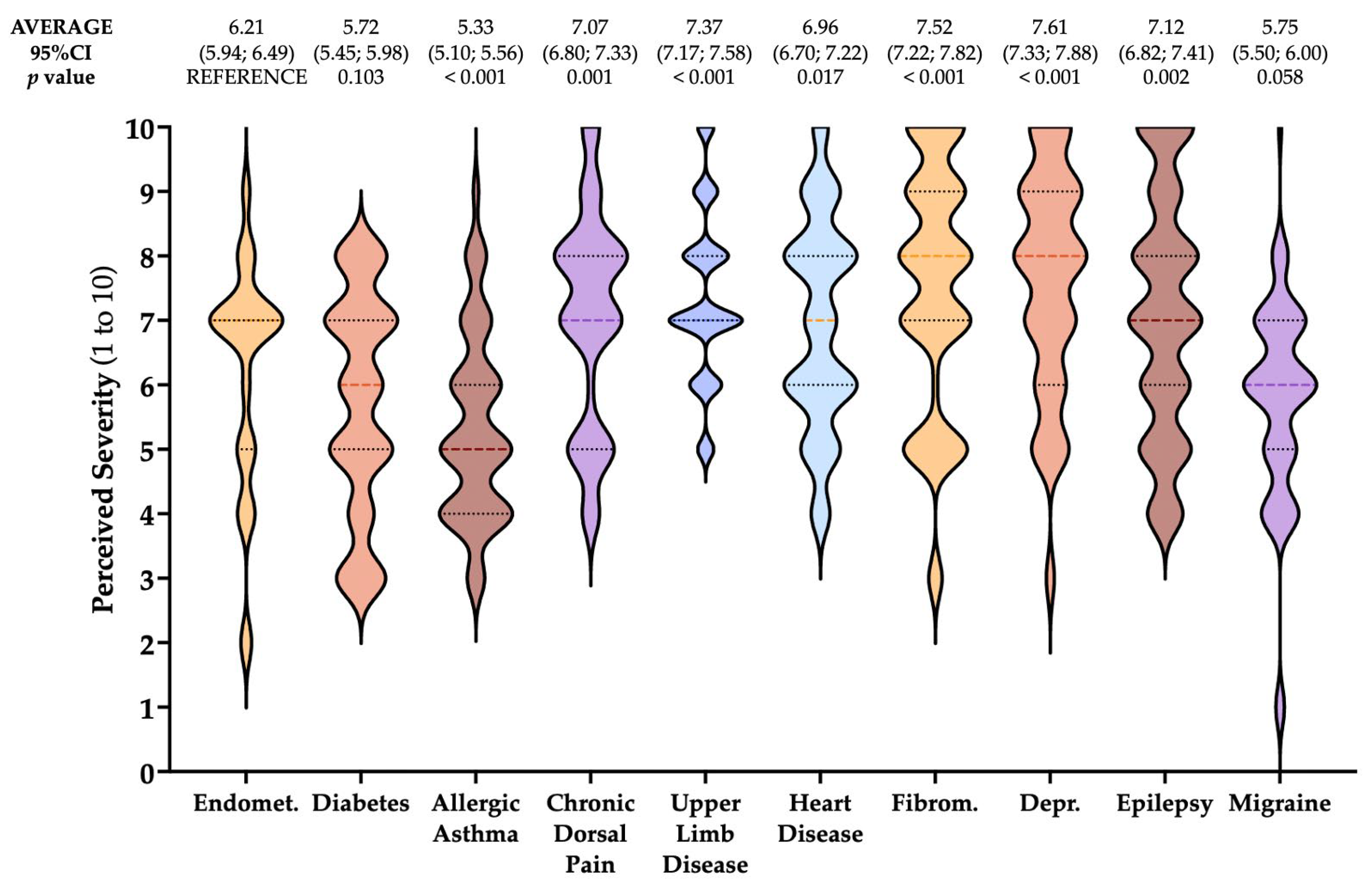
Focusing on the factors participating in the definition of perceived risk of endometriosis, 71.0% of participants acknowledged this condition as severely impacting on the health of affected individuals, and 55.5% as relatively frequent, for an eventual Risk Perception Score (RPS) equal to 52.5% (95%CI 50.6–54.4). As shown in Figure 1, participants generally perceived endometriosis as a clinically relevant condition, assigning it an average severity score of 6.21/10 (95%CI 5.94–6.49). However, several chronic disorders were perceived as significantly more severe, including chronic dorsal pain (7.07), upper limb disorders (7.37), ischemic heart disease (6.96), fibromyalgia (7.52), depression (7.61), and epilepsy (7.12), whereas diabetes and migraine received similar severity ratings.
Figure 2.
Perceived severity of endometriosis, compared to other chronic conditions (i.e., diabetes, allergic asthma, chronic dorsal pain, upper limb disease, heart disease, fibromyalgia, depression, epilepsy and migraine), regarding their impact on daily activities of occupational physicians. In the analyses, perceived impact on daily activity of endometriosis was the reference group; comparisons were performed by means of Kruskal-Wallis test (note: 95%CI = 95% confidence interval).
Figure 2.
Perceived severity of endometriosis, compared to other chronic conditions (i.e., diabetes, allergic asthma, chronic dorsal pain, upper limb disease, heart disease, fibromyalgia, depression, epilepsy and migraine), regarding their impact on daily activities of occupational physicians. In the analyses, perceived impact on daily activity of endometriosis was the reference group; comparisons were performed by means of Kruskal-Wallis test (note: 95%CI = 95% confidence interval).
3.5. Perceived Barriers to Workplace Management
Barriers to workplace management of patients affected by endometriosis are reported in Figure 3.
More precisely, managing of psychosocial factors (i.e., work-related stress resulting from poor work design, organization and management) was considered the most significant barrier, being acknowledged as either complex or very complex by 60.6% of participants, followed by workload and interface between family and workplace (56.8%), managing of working hours (29.1%), ergonomics of the workstation (23.9%), and more generally by characteristics of the work environment (21.9%).
3.6. Factors Associated with Conditional Fitness-to-Work
In univariate analyses (Table 3), physicians issuing conditioned fitness-for-work judgments were more frequently male (74.5% vs. 28.3%; p < 0.001), older (44.9 vs. 41.6 years, p = 0.036), and had longer professional seniority (18.4 vs. 14.5 years, p=0.022). They also more frequently achieved a simplified GKS above the median (41.2% vs. 15.1%; p = 0.002).
Having benefited of continuous medical education on endometriosis, having acquired information on this condition from colleagues, and having benefited of internet-based resources were also more frequently reported by participants having previous issued work restrictions than by participants having not (27.5% vs. 1.9%, p < 0.001; 40.2% vs. 11.3%, p < 0.001; and 38.2% vs. 18.9%, p = 0.023, respectively). On the contrary, reliance on medical school training was less frequently reported among participants having issued restricted fitness-to-work due to the endometriosis (53.9% vs. 94.3%, p < 0.001).
Regarding occupational features of participants, not only background education (i.e., gynecology, psychiatry, and internal medicine) but also qualification after a full residency in occupational medicine and working as free practitioners were not associated with significant different proportions in the issuance of conditioned fitness to work. On the contrary, professionals working in healthcare settings had more frequently issued conditioned fitness-to-work appraisals of workers affected by endometriosis (83.3% vs. 35.8%; p < 0.001).
3.7. Multivariable Analysis
Multivariable analysis included as outcome variable having issued any restricted fitness-to-work appraisal of women affected by endometriosis. The multivariable model included as explanatory variables the following ones: being of male gender, age, seniority, being from Northern Italy, reporting a simplified GKS above median value, having as a source of information medical school, continuous medical education, colleagues, internet, and working as occupational physician in healthcare settings. As reported in Figure 4, male gender (aOR 5.685, 95%CI 1.839 to 17.579), having as a source of information on endometriosis continuous medical education activities (aOR 85.720, 95%CI 6.595, 1114.208), colleagues (aOR 4.669, 95%CI 1.226 to 17.774), and working as occupational physician for any healthcare provider (aOR 5.909, 95%CI 1.923 to 18.162) were positively associated with having issued any previous restricted to work appraisal due to endometriosis.
On the contrary, having medical school as the sole source of information on endometriosis was negatively associated with the outcome variable (aOR 0.073, 95%CI 0.014 to 0.388).
4. Discussion
4.1. Summary of Main Results
Through the present cross-sectional study, we provide some insights into how Italian OPs perceive and manage endometriosis in workplace settings. Overall, a total of 155 professional participated into the survey, that is nearly half of the targeted sample size (n = 288, 53.81%). As a consequence, our study should be regarded as a preliminary assessment of the present topic, rather representing an opportunity for selecting potential participants, assessing their enrolment, recording the required data, questionnaire delivery and collection, supervision and quality control, and data processing [47]. Overall, participants reported a relatively high degree of familiarity with endometriosis, as 78.1% of respondents considered themselves adequately informed about the disease, and 81.3% of them did previously manage any patient affected by endometriosis. Objective knowledge appeared less robust, as only 26.5% correctly estimated disease prevalence, 34.8% correctly identified its familial aggregation, and 31.6% recognized laparoscopy with histological confirmation as the diagnostic gold standard. However, as only 11% of participants reported the existence of occupational guidelines for endometriosis, a finding that is consistent with the current lack of official recommendations, it may be inferred that most respondents were at least aware of the limited availability of structured guidance for the occupational management of this condition. Endometriosis was generally perceived as a relevant occupational health issue, with a median risk perception score of 52.5%. Finally, previous participation in continuing medical education activities, information acquired from colleagues, and working in healthcare settings were independently associated with having previously issued restricted fitness-for-work appraisals due to endometriosis.
4.2. Generalizability of Main Data and Implication for Daily Practice
Endometriosis is a common condition among women of reproductive age [1,4,5], with documented impact on personal [1,2,5,6,7,8] and social life of affected individuals [9,10], with a considerable impact on the quality of life [3,9,11,12]. Although reproductive age largely overlaps with working age, the engagement of OPs in the management of affected individuals appears both necessary and unevenly documented in the international scientific literature [16,21,22,23]. While respondents demonstrated a moderate level of knowledge regarding the condition and a generally high awareness of its clinical relevance, substantial gaps emerged regarding epidemiological aspects, diagnostic pathways, and familiarity with occupational management guidelines. More precisely, one of the most relevant findings was the discrepancy between self-perceived knowledge and objective knowledge indicators. Even though most participants considered themselves adequately informed about endometriosis, performance on several knowledge items revealed important limitations.
While, at our knowledge no similar studies have been performed among OPs, present results can be considered as consistent with previous surveys conducted among other categories of healthcare professionals [37,48,49], suggesting that endometriosis remains insufficiently covered during undergraduate and postgraduate medical training, urging for a global call to action [50]. For example, Roullier et al. [37] following the publication of updated French guidelines on endometriosis (2017), performed a KAP study on 102 General Practitioners (GPs) from the Picardie region of France, documenting a substantial lack of self-assessed understanding of this condition. Not only less than 20% of participants were aware of national guidelines, but self-assessed understanding of endometriosis for daily routine clinical practice was considered as sufficient by no more than 25% of enrolled GPs. Moreover, most participants exhibited significant knowledge gaps on signs of symptoms and their diagnostic value. In this regard, it should be borne in mind that endometriosis is often diagnosed several years after symptom onset, with definitive diagnosis frequently occurring during the third or fourth decade of life. Resulting diagnostic delay may place OPs in a strategic position for the eventual recognition of affected workers, eventually improving their quality of life [15,20,22,26,27]. These results were quite consistent with a similarly designed study on 185 GPs from New Zealand, as only 52% of them considered themselves to know enough about endometriosis for daily practice, and the eventual awareness of this condition was eventually rated as quite unsatisfying [49,50]. Eventually, a KAP study from Saudi Arabia on 215 nurses from Al-Jouf region documented a large proportion of low knowledge, with only 6% of participants achieving high scores, particularly among professionals with high educational attainment, greater seniority, and direct exposure to patient care [48].
That being said, it is important to acknowledge that the above-mentioned studies are only partially comparable with a survey conducted among OPs. In countries where this professional figure is fully integrated into the occupational health regulatory framework [25,28], occupational physicians are inherently required to address a specific issue, namely the maintenance of workers’ health within the context of continued employment and job retention [51,52,53]. Conversely, studies conducted among GPs, and to some extent the survey by Elsharkawy et al. [48] involving nursing personnel, primarily focused on diagnostic and therapeutic aspects of endometriosis rather than its occupational implications. Therefore, OPs may provide a unique perspective on endometriosis, as they are expected to balance disease-related limitations, workers’ well-being, and the feasibility of workplace accommodations aimed at preserving participation in the active workforce. In this regard, the lack of specific guidelines for occupational management of endometriosis is more than noteworthy. Most of international guidelines on endometriosis focus on aspects such as diagnosis and clinical management [54,55,56,57]. On the contrary, available documents only provide scarce recommendations on workplace adjustments or avoidance of occupational exposures that may aggravate symptom burden. In the absence of standardized approaches, management decisions are likely influenced by individual experience and professional judgment, eventually providing some explanations on reported prescription. While the increased number of work breaks (50.3%) may guarantee some sort of relief to patients affected by chronic pain and fatigue, the importance of avoiding night and shift work (30.3% and 23.2%, respectively), as well as the avoidance of the exposure to office duties (11.6%) and extreme temperatures (9.7%) may be of limited significance. Knowledge gaps were likely due to the lack of specific post-graduate formation on this specific topic, mostly associated with university courses during the medical school (67.7%), with a large share of respondents relying on personal interaction with colleagues of other specialties, and particularly gynecologists. The very low proportion of respondents claiming to have received a specific formation during the post-graduation formation in Occupational Medicine may be of particular interest, as it stresses that participants were likely inclined to frame endometriosis management according to a model more akin to general practice than to the occupational health paradigm.
Despite the substantial knowledge gaps, participants extensively acknowledged endometriosis as a potentially significant condition. Nonetheless, participating OPs considered its management on the workplaces less complicated than that of several other chronic disorders, including depression, fibromyalgia, epilepsy, and cardiovascular disease. This result may be considered somewhat surprising, given that, unlike endometriosis, many of the aforementioned conditions benefit from validated preventive interventions and consolidated occupational management strategies, which usually permit continued employment and the maintenance of safe working conditions [29,58,59,60]. In particular, the increasingly aging workforce did lead to several guidelines on the accommodations for cardiovascular conditions [61,62,63]. This may reflect the persistent under-recognition of the broader functional and psychosocial burden associated with endometriosis, despite growing evidence documenting its substantial impact on daily activities and work productivity. As recently stressed by Ellis et al. [50], significant gaps remain in the proper understanding of this condition, disproportionately low when compared to the pain of patients, discomfort due to the long delays in diagnosis, the ineffectiveness of common treatment options, and the substantial economic burden borne by individual patients. Although this issue is inherently difficult (if not impossible) to address through an evidence-based perspective, it cannot be excluded that underlying knowledge gaps lead competent OPs to improperly perceive workers affected by endometriosis as “complex” or intrinsically problematic individuals, with insufficient attention being paid to the impact of their underlying condition on work ability and occupational functioning [37,48,50].
Another potential explanation for the widespread tendency to underestimate the burden of endometriosis is hinted by the significant role acknowledged by participating OPs to psychosocial factors and particularly to the interaction between family and occupational responsibilities. Alongside workload, these factors were perceived as the most challenging aspects of workplace management for individuals affected by endometriosis. As stressed by EU OSHA, psychosocial risks factors arise from poor work design, organization and management, as well as from poor social context of work [64]: resulting in negative psychological, physical and social outcomes, their interplay with an underlying condition such as endometriosis may be significant even in settings that could be considered at relatively low risk for the large majority of workers [6,11,14]. Even though managing work-related psychosocial risks is not just a moral obligation and a good investment for employers but also represents a legal imperative in several legal framework (e.g., Framework Directive 89/391/EEC for EU countries), stressing the pivotal role of OPs [65,66,67], both employers and OPs usually perceive these conditions as particularly complicated to be properly managed [65,67]. Within the specific context of Italian occupational medicine, it cannot be excluded that some OPs may improperly perceive the management of these issues as partially exceeding their professional remit [66,67], considering them to fall primarily within the legal and moral responsibilities of employers [66,68].
The interplay of knowledge gaps and the acknowledgement of psychosocial risk factors among the main determinants of barriers for the proper occupational management of endometriosis provides a likely explanation for the very high proportion of conditioned fitness to work statements reported by study participants. Fitness for work is usually defined as the determination of whether an individual is fit to perform his/her tasks without risk to self or other [69]. The issuance of a conditioned fitness-for-work appraisal may occasionally represent an alternative to broader organizational or structural interventions, although the latter would generally be preferable whenever feasible, as they are more likely to ensure an inclusive and effective management of workers’ health and safety [69]. This is of particular significance when dealing with an underlying condition (such as endometriosis) that, while compromising the overall quality of life of affected individuals, not consistently requests the implementation of specific occupational restrictions. From this perspective, the factors that were independently associated, either positively or negatively, with the issuance of conditioned fitness-for-work appraisals in the multivariable analysis may be interpreted in light of both the Italian occupational health framework and more general considerations. Undergraduate medical education on endometriosis, which is typically focused on diagnostic and therapeutic aspects, may not necessarily lead physicians to perceive this condition as a complex occupational issue requiring specific workplace management strategies. Conversely, previous attendance at dedicated educational initiatives on endometriosis, within a discipline where this topic remains comparatively underrecognized, may reflect a certain degree of self-selection, potentially resulting in an oversampling of professionals who are particularly sensitive to this issue and therefore more inclined to adopt precautionary approaches, including the issuance of conditioned fitness-for-work appraisals. Likewise, the independent association observed among OPs working in healthcare settings may plausibly be explained by the predominantly female composition of the healthcare workforce, increasing the likelihood of encountering workers affected by endometriosis, but also by the generally more developed occupational health policies and greater availability of workplace accommodations that characterize healthcare institutions, particularly within the Italian public sector.
4.3. Limits
The present study has several limitations. First, the cross-sectional design prevents causal inference [70,71]. Second, the present study shares the whole of implicit limits of similarly designed Internet-based surveys [31,72], and particularly the extensive “self-selection” of participants, leading to the oversampling of certain sub-groups. The extensive proportion of subjects familiar in sharing personal information through internet and social media as well as of individuals exhibiting a proactive attitude or greater knowledge about the assessed topic may lead to the overestimation of the actual understanding of the targeted population. Even though, the potential self-selection of the participants has been somewhat mitigated by targeting a very specific and therefore quite homogenous subgroup of medical professionals, i.e., OPs, generalization of main results should be only cautiously considered. On the other hand, having our study relied on a closed discussion group, whose participation was strictly limited to licensed OPs, we can rule out that some of the respondents did not fully adhere to our selection criteria.
Second, our sample was based on a small sample of 155 OP, i.e., 7.0% of participants from the targeted discussion group, but also 1.8% of all officially registered Italian OP (n = 8,663 by 20/06/2026). As the study failed to reach the targeted sample size, our study could be hardly considered fully representative of the national level, particularly in a country, such as Italy, characterized by distinctive regional patterns, also considering school-distinctive training during the residency program in occupational medicine [73,74]. On the contrary, the present study should be only acknowledged as a preliminary one, otherwise stressing the need for future iterations and research on this specific topic [47].
Third, we cannot rule out a significant social desirability bias, particularly when dealing with knowledge test. Social desirability bias is a quite common in KAP studies and can be defined as a systematic response bias whereby participants tend to overreport socially desirable attitudes and practices, and underreport behaviors or opinions perceived as undesirable, leading to a potential overestimation of favorable knowledge, attitudes, or behaviors [24,33]. Therefore, we cannot rule out that also our results could have ultimately overstated the share of individuals having an effective understanding of endometriosis, as well as the proportion of respondents actually having issued any conditioned fitness to work appraisal.
Despite these limitations, our findings provide one of the first systematic assessments of occupational physicians’ knowledge, attitudes, and practices regarding endometriosis. Future research should focus on larger and more representative samples, evaluate the effectiveness of educational interventions, and support the development of evidence-based occupational recommendations aimed at improving workplace inclusion and health outcomes among women affected by endometriosis.
5. Conclusions
Italian OPs generally perceived endometriosis as a clinically relevant condition and reported substantial previous experience in managing affected workers. However, despite a relatively high degree of self-perceived familiarity, important gaps emerged regarding epidemiology, diagnostic pathways, and awareness of occupational recommendations. The issuance of conditioned fitness-for-work appraisals appeared to be influenced by factors associated with continuous professional exposure to the topic, including continuing medical education, exchanges with colleagues, and practice in healthcare settings, suggesting that undergraduate medical training alone may be insufficient to support evidence-informed occupational management. Taken together, these findings support the need for targeted educational initiatives and the development of shared recommendations aimed at improving the occupational management of women affected by endometriosis and promoting their full participation in working life.
Supplementary Materials
The following supporting information can be downloaded at the website of this paper posted on Preprints.org, Table S1: STROBE Checklist.
Author Contributions
Conceptualization, MR and NM; methodology, MR.; software, MR.; validation, NM., MB. and SS.; formal analysis, MR.; investigation, MR and SS.; resources, MR; data curation, MR and MB; writing—original draft preparation, MR and MB; writing—review and editing, MR and SS; visualization, MR; supervision, MR.; project administration, MR and NM; funding acquisition, MR. All authors have read and agreed to the published version of the manuscript.
Funding
This research received no external funding.
Institutional Review Board Statement
The informed consent guaranteed participants anonymity and confidentiality. Participation was voluntary, and the questionnaire was completed only by subjects who provided informed consent. As individual participants could not be identified from the collected data or the presented results, the study posed no foreseeable risk of harm or stigmatization to participants. Given its anonymous and observational design, the ab-sence of patient-related clinical data, and the fact that it did not constitute a clinical trial, preliminary evaluation by an Ethics Committee was not required under Italian law (Gazzetta Ufficiale no. 76, dated 31/03/ 2008) [29].
Informed Consent Statement
Informed consent was obtained from all subjects involved in the study.
Data Availability Statement
Raw data are available upon request to the principal investigator.
Acknowledgments
During the preparation of this manuscript, the authors used OpenAI / ChatGPT, version 5.5 for the purposes of refining the English text after its initial definition. No original content was AI-generated. In any case, the authors have reviewed and edited the output and take full responsibility for the content of this publication.
Conflicts of Interest
The authors declare no conflicts of interest.
Abbreviations
The following abbreviations are used in this manuscript:
| 95%CI | 95% Confidence Interval |
| aOR | Adjusted Odds Ratio |
| ANOVA | Analysis of Variance |
| CME | Continuing Medical Education |
| GKS | General Knowledge Score (sGKS, simplified GKS) |
| HBM | Health Belief Model |
| KAP | Knowledge, Attitudes and Practices |
| OP | Occupational Physician |
| OR | Odds Ratio |
| RPS | Risk Perception Score |
| STROBE | Strengthening the Reporting of Observational Studies in Epidemiology |
References
- As-Sanie, S.; Mackenzie, S.C.; Morrison, L.; Schrepf, A.; Zondervan, K.T.; Horne, A.W.; Missmer, S.A. Endometriosis A Review. JAMA 2025, 334, 64–78. [Google Scholar] [CrossRef] [PubMed]
- Tomassetti, C.; Johnson, N.P.; Petrozza, J.; Abrao, M.S.; Einarsson, J.I.; Horne, A.W.; Lee, T.T.M.; Missmer, S.; Vermeulen, N.; Zondervan, K.T.; et al. An International Terminology for Endometriosis, 2021. Hum. Reprod. Open 2021, 2021. [Google Scholar] [CrossRef] [PubMed]
- Bień, A.; Rzońca, E.; Zarajczyk, M.; Wilkosz, K.; Wdowiak, A.; Iwanowicz-Palus, G. Quality of Life in Women with Endometriosis: A Cross-Sectional Survey. Qual. Life Res. 2020, 29, 2669–2677. [Google Scholar] [CrossRef] [PubMed]
- Wang, M.H.; Chen, J.H.; Qi, X.Y.; Li, Z.X.; Huang, Y. Global Prevalence of Adenomyosis and Endometriosis: A Systematic Review and Meta-Analysis. Reprod. Biol. Endocrinol. 2025, 23. [Google Scholar] [CrossRef] [PubMed]
- Chen, Y.; Waseem, S.; Luo, L. Advances in the Diagnosis and Management of Endometriosis: A Comprehensive Review. Pathol. Res. Pract. 2025, 266, 155813. [Google Scholar] [CrossRef] [PubMed]
- Czubak, P.; Herda, K.; Niewiadomska, I.; Putowski, L.; Łańcut, M.; Masłyk, M. Understanding Endometriosis: A Broad Review of Its Causes, Management, and Impact. Int. J. Mol. Sci. 2025, 26. [Google Scholar] [CrossRef] [PubMed]
- Ramin-Wright, A.; Schwartz, A.S.K.; Geraedts, K.; Rauchfuss, M.; Wölfler, M.M.; Haeberlin, F.; Von Orelli, S.; Eberhard, M.; Imthurn, B.; Imesch, P.; et al. Fatigue - A Symptom in Endometriosis. Hum. Reprod. 2018, 33, 1459–1465. [Google Scholar] [CrossRef] [PubMed]
- Sinaii, N.; Plumb, K.; Cotton, L.; Lambert, A.; Kennedy, S.; Zondervan, K.; Stratton, P. Differences in Characteristics among 1,000 Women with Endometriosis Based on Extent of Disease. Fertil. Steril. 2008, 89, 538–545. [Google Scholar] [CrossRef] [PubMed]
- Manu, A.; Poenaru, E.; Duica, F.; Bausic, A.I.G.; Coroleuca, B.C.; Coroleuca, C.A.; Iacob, C.; Rosca, I.; Bratila, E. Quality of Life Assessment and Clinical Implications for Women with Endometriosis Through Validated Tools: A Narrative Review. Medicina 2025, 61. [Google Scholar] [CrossRef] [PubMed]
- De Graaff, A.A.; Van Lankveld, J.; Smits, L.J.; Van Beek, J.J.; Dunselman, G.A.J. Dyspareunia and Depressive Symptoms Are Associated with Impaired Sexual Functioning in Women with Endometriosis, Whereas Sexual Functioning in Their Male Partners Is Not Affected. Hum. Reprod. 2016, 31, 2577–2586. [Google Scholar] [CrossRef] [PubMed]
- Gete, D.G.; Doust, J.; Mortlock, S.; Montgomery, G.; Mishra, G.D. Impact of Endometriosis on Women’s Health-Related Quality of Life: A National Prospective Cohort Study. Maturitas 2023, 174, 1–7. [Google Scholar] [CrossRef] [PubMed]
- Vuontisjärvi, S.; Rossi, H.R.; Nordström, T.; Karjula, S.; Terho, A.; Morin-Papunen, L.; Koivurova, S.; Piltonen, T.T. Women with Endometriosis Have Decreased Health-Related Quality of Life until Late Fertile Age: A Population-Based Cohort Analysis at Ages 31 and 46 Years. Hum. Reprod. 2025, 40, 1909–1918. [Google Scholar] [CrossRef] [PubMed]
- Rasp, E.; Saavalainen, L.; Rönö, K.; Gissler, M.; Härkki, P.; But, A.; Heikinheimo, O. Educational and Occupational Outcomes during Early Adulthood Following Surgically Verified Endometriosis at a Young Age—A Register-Based Study. Acta Obstet. Gynecol. Scand. 2025, 104, 1958–1971. [Google Scholar] [CrossRef] [PubMed]
- Facchin, F.; Vercellini, P.; Somigliana, E. The Impact of Endometriosis on Educational and Professional Pathways: A Cross-Sectional Online Study. BMC Psychol. 2026, 14. [Google Scholar] [CrossRef] [PubMed]
- Røssell, E.L.; Plana-Ripoll, O.; Josiasen, M.; Hansen, K.E.; Bech, B.H.; Rytter, D. Association between Endometriosis and Working Life among Danish Women. Hum. Reprod. 2025, 40, 461–468. [Google Scholar] [CrossRef] [PubMed]
- Howe, D.; O’Shea, M.; Duffy, S.; Armour, M. From Insight into Action: Understanding How Employer Perspectives Shape Endometriosis-Inclusive Workplace Policies. Healthc. (Switz. ) 2025, 13. [Google Scholar] [CrossRef] [PubMed]
- Soliman, A.M.; Coyne, K.S.; Gries, K.S.; Castelli-Haley, J.; Snabes, M.C.; Surrey, E.S. The Effect of Endometriosis Symptoms on Absenteeism and Presenteeism in the Workplace and at Home; 2017; Vol. 23.
- Rowlands, I.; Hockey, R.; Abbott, J.; Montgomery, G.; Mishra, G. Longitudinal Changes in Employment Following a Diagnosis of Endometriosis: Findings from an Australian Cohort Study. Ann. Epidemiol. 2022, 69, 1–8. [Google Scholar] [CrossRef] [PubMed]
- Mühlrad, H.; Olovsson, M.; Linnros, E.; Haraldson, P.; Bohm-Starke, N. Health and Socioeconomic Well-Being of Women with Endometriosis and Provoked Vestibulodynia: Longitudinal Insights from Swedish Registry Data. PLoS ONE 2024, 19. [Google Scholar] [CrossRef] [PubMed]
- Andysz, A.; Jacukowicz, A.; Merecz-Kot, D.; Najder, A. Endometriosis—The Challenge for Occupational Life of Diagnosed Women: A Review of Quantitative Studies. Med. Pr. 2018, 69, 663–671. [Google Scholar] [PubMed]
- Employers-Guide.
- Petraglia, F.; Vannuccini, S.; Santulli, P.; Marcellin, L.; Chapron, C. An Update for Endometriosis Management: A Position Statement. J. Endometr. Uterine Disord. 2024, 6. [Google Scholar] [CrossRef]
- INFORMATION SHEET | Supporting Workers with Endometriosis in the Workplace.
- Betsch, C.; Wicker, S. Personal Attitudes and Misconceptions, Not Official Recommendations Guide Occupational Physicians’ Vaccination Decisions. Vaccine 2014, 32, 4478–4484. [Google Scholar] [CrossRef] [PubMed]
- Riccò, M.; Cattani, S.; Casagranda, F.; Gualerzi, G.; Signorelli, C. Knowledge, Attitudes, Beliefs and Practices of Occupational Physicians towards Vaccinations of Health Care Workers: A Cross Sectional Pilot Study in North-Eastern Italy. Int. J. Occup. Med. Environ. Health 2017, 30, 775–790. [Google Scholar] [CrossRef] [PubMed]
- Karavadra, B.; Thorpe, G.; Morris, E.; Semlyen, J. Exploring Delay to Diagnosis of Endometriosis, a Healthcare Professional Perspective. BMC Health Serv. Res. 2025, 25. [Google Scholar] [CrossRef] [PubMed]
- De Corte, P.; Klinghardt, M.; von Stockum, S.; Heinemann, K. Time to Diagnose Endometriosis: Current Status, Challenges and Regional Characteristics—A Systematic Literature Review. BJOG 2025, 132, 118–130. [Google Scholar] [CrossRef] [PubMed]
- Riccò, M.; Gualerzi, G.; Ranzieri, S.; Ferraro, P.; Bragazzi, N.L. Knowledge, Attitudes, Practices (KAP) of Italian Occupational Physicians towards Tick Borne Encephalitis. Trop. Med. Infect. Dis. 2020, 5, 1–14. [Google Scholar] [CrossRef] [PubMed]
- Riccò, M.; Ferraro, P.; Camisa, V.; Di Palma, P.; Minutolo, G.; Ranzieri, S.; Zaffina, S.; Baldassarre, A.; Restivo, V. Managing of Migraine in the Workplaces: Knowledge, Attitudes and Practices of Italian Occupational Physicians. Med. (B. Aires) 2022, 58, 686. [Google Scholar] [CrossRef] [PubMed]
- Riccò, M.; Zaniboni, A.; Satta, E.; Baldassarre, A.; Cerviere, M.P.; Marchesi, F.; Peruzzi, S. Management and Prevention of Traveler’s Diarrhea: A Cross-Sectional Study on Knowledge, Attitudes, and Practices in Italian Occupational Physicians (2019 and 2022). Trop. Med. Infect. Dis. 2022, 7, 370. [Google Scholar] [CrossRef] [PubMed]
- Riccò, M.; Gualerzi, G.; Ranzieri, S.; Ferraro, P.; Bragazzi, N.L. Knowledge, Attitudes, Practices (KAP) of Italian Occupational Physicians towards Tick Borne Encephalitis. Trop. Med. Infect. Dis. 2020, 5, 117. [Google Scholar] [CrossRef] [PubMed]
- Riccò, M.; Cattani, S.; Casagranda, F.; Gualerzi, G.; Signorelli, C. Knowledge, Attitudes, Beliefs and Practices of Occupational Physicians towards Seasonal Influenza Vaccination: A Cross-Sectional Study from North-Eastern Italy. J. Prev. Med. Hyg. 2017, 58, E141–E154. [Google Scholar] [PubMed]
- Riccò, M.; Ferraro, P.; Peruzzi, S.; Balzarini, F.; Ranzieri, S. Mandate or Not Mandate: Knowledge, Attitudes, and Practices of Italian Occupational Physicians towards SARS-CoV-2 Immunization at the Beginning of Vaccination Campaign. Vaccines 2021, 9, 889. [Google Scholar] [CrossRef] [PubMed]
- Arghittu, A.; Dettori, M.; Azara, A.; Gentili, D.; Serra, A.; Contu, B.; Castiglia, P. Flu Vaccination Attitudes, Behaviours, and Knowledge among Health Workers. Int. J. Environ. Res. Public Health 2020, 17. [Google Scholar] [CrossRef] [PubMed]
- Wenzel, R.G.; Lipton, R.B.; Diamond, M.L.; Cady, R. Migraine Therapy: A Survey of Pharmacists’ Knowledge, Attitudes, and Practice Patterns. Headache 2005, 45, 47–52. [Google Scholar] [PubMed]
- von Elm, E.; Altman, D.G.; Egger, M.; Pocock, S.J.; Gøtsche, P.C.; Vandenbroucke, J.P. STROBE Initiative Strengthening the Reporting of Observational Studies in Epidemiology (StroBE) Statement: Guidelines for Reporting Observational Studies. BMJ 2007, 335, 806–808. [Google Scholar] [PubMed]
- Roullier, C.; Sanguin, S.; Parent, C.; Lombart, M.; Sergent, F.; Foulon, A. General Practitioners and Endometriosis: Level of Knowledge and the Impact of Training. J. Gynecol. Obstet. Hum. Reprod. 2021, 50. [Google Scholar] [CrossRef] [PubMed]
- Riccò, M.; Ferraro, P.; Camisa, V.; Satta, E.; Zaniboni, A.; Ranzieri, S.; Baldassarre, A.; Zaffina, S.; Marchesi, F. When a Neglected Tropical Disease Goes Global: Knowledge, Attitudes and Practices of Italian Physicians towards Monkeypox, Preliminary Results. Trop. Med. Infect. Dis. 2022, 7. [Google Scholar] [CrossRef] [PubMed]
- Zingg, A.; Siegrist, M. Measuring People’s Knowledge about Vaccination: Developing a One-Dimensional Scale. Vaccine 2012, 30, 3771–3777. [Google Scholar] [CrossRef] [PubMed]
- Rosenstock, I.M. Historical Origins of the Health Belief Model. Health Educ. Monogr. 1974, 2, 328–335. [Google Scholar] [CrossRef]
- Janz, N.K.; Becker, M.H. The Health Belief Model: A Decade Later. Health Educ. Q. 1984, 11, 1–47. [Google Scholar] [CrossRef] [PubMed]
- Carpenter, C.J. A Meta-Analysis of the Effectiveness of Health Belief Model Variables in Predicting Behavior. Health Commun. 2010, 25, 661–669. [Google Scholar] [CrossRef] [PubMed]
- Mo, P.K.H.; Lau, J.T.F. Influenza Vaccination Uptake and Associated Factors among Elderly Population in Hong Kong: The Application of the Health Belief Model. Health Educ. Res. 2015, 30, 706–718. [Google Scholar] [CrossRef] [PubMed]
- Imorde, L.; Möltner, A.; Runschke, M.; Weberschock, T.; Rüttermann, S.; Gerhardt-Szép, S. Adaptation and Validation of the Berlin Questionnaire of Competence in Evidence-Based Dentistry for Dental Students: A Pilot Study. BMC Med. Educ. 2020, 20. [Google Scholar] [CrossRef] [PubMed]
- Riccò, M.; Ferraro, P.; Ranzieri, S.; Boldini, G.; Zanella, I.; Marchesi, F. Legionnaires’ Disease in Occupational Settings: A Cross-Sectional Study from Northeastern Italy (2019). Trop. Med. Infect. Dis. 2023, 8. [Google Scholar] [CrossRef] [PubMed]
- Haddock, G.; Maio, G.R. 6 Attitudes: Content, Structure and Functions. In An Introduction to Social Psychology; Miles, Hewstone, Wolfgang, Stroebe, Klaus, Jonas, Eds.; BPS Blackwell: Chichester (UK), 2012; pp. 112–133. [Google Scholar]
- Smith, P.G.; Morrow, R.H.; Ross, D.A. Field Trials of Health Interventions: A Toolbox. In Field Trials of Health Interventions: A Toolbox; Smith, P.G., Morrow, R.H., Ross, D.A., Eds.; Oxford University Press: Oxford (UK), 2015; pp. 216–222. [Google Scholar]
- Elsharkawy, N.B.; Alshammari, A.M.; Ramadan, O.M.E.; Abdelaziz, E.M.; Elzeky, M.E.H.; Hafiz, A.H.; Alrowily, M.F.; Alruwaili, S.M.; Abo-Seif, L.M.E.S. Assessment of Endometriosis Knowledge and Its Determinants Among Nurses in Al-Jouf Region, Saudi Arabia. Healthc. (Switz. ) 2025, 13. [Google Scholar] [CrossRef] [PubMed]
- Ellis, K.; Meador, A.; Ponnampalam, A.; Wood, R. Survey of General Practitioner Perspectives on Endometriosis Diagnosis, Referrals, Management and Guidelines in New Zealand. Health Expect. 2024, 27. [Google Scholar] [CrossRef] [PubMed]
- Ellis, K.; Munro, D.; Clarke, J. Endometriosis Is Undervalued: A Call to Action. Front. Glob. Womens Health 2022, 3. [Google Scholar] [CrossRef] [PubMed]
- Cioffi, A.; Rinaldi, R. Does an Occupational Physician Have a Duty to Carry out General Clinical Assessments? Med. -Leg. J. 2021, 89, 178–179. [Google Scholar] [CrossRef] [PubMed]
- Facci, R. The Role of the Occupational Physician in Primary Health Care. Rev. Bras. Med. Trab. 2021, 19, 119–121. [Google Scholar] [CrossRef]
- Eisch, E.; Kuper, P.; Lindert, L.; Choi, K.E. Working Conditions of Occupational Physicians—A Scoping Review. Int. J. Environ. Res. Public Health 2022, 19. [Google Scholar] [CrossRef] [PubMed]
- Rajesh, S.; Mehmeti, A.; Smith-Walker, T.; Kendall, B. Diagnosis and Management of Endometriosis: Summary of Updated NICE Guidance. BMJ 2025. [Google Scholar] [CrossRef] [PubMed]
- Becker, C.M.; Bokor, A.; Heikinheimo, O.; Horne, A.; Jansen, F.; Kiesel, L.; King, K.; Kvaskoff, M.; Nap, A.; Petersen, K.; et al. ESHRE Guideline: Endometriosis. Hum. Reprod. Open 2022, 2022. [Google Scholar] [CrossRef] [PubMed]
- Burghaus, S.; Schäfer, S.D.; Bär, K.J.; Bartley, J.; Beckmann, M.W.; Behrens, A.; Beyer, K.; Bianchi, N.; Brandes, I.; Brünahl, C.; et al. Diagnosis and Therapy of EndometriosisGuideline of the DGGG, OEGGG and SGGG (S2k-Level, AWMF Registry No. 015/045, April 2025). Geburtshilfe Frauenheilkd. 2026, 86, 133–188. [Google Scholar] [CrossRef] [PubMed]
- Lee, T.; Abrao, M.; Christianson, M.; Cohn, S.; Dionisi, H.; Flyckt, R.; Khazali, S.; King, C.R.; King, L.; Lemos, N.; et al. Optimizing Patient Experiences and Outcomes: Proposal to Develop an Endometriosis Care Quality Collaborative in the United States. J. Minim. Invasive Gynecol. 2025. [Google Scholar] [CrossRef] [PubMed]
- Jacoby, A.; Gorry, J.; Baker, G.A. Employers’ Attitudes to Employment of People with Epilepsy: Still the Same Old Story?; 2005; Vol. 46.
- Hossain, S.; Moll, S.; Tompa, E.; Gewurtz, R. The Interactive Process of Negotiating Workplace Accommodations for Employees with Mental Health Conditions. Work 2021, 69, 75–90. [Google Scholar] [CrossRef] [PubMed]
- Jogie, J.A.; Mohammed, Z.; Bobb, T.; Suite-Stewart, Z.; Ali, S. Roles of Psychiatry, Dietary, and Oncology Services in Occupational Medicine: A Comprehensive Review. Cureus 2025. [Google Scholar] [CrossRef] [PubMed]
- Sansone, D.; Cherubini, A.; Barbiero, F.; Bollini, M.; Mauro, M.; Di Lenarda, A.; Rui, F.; Cegolon, L.; Larese Filon, F. Optimising Return to Work for Cardiovascular Patients: An Interdisciplinary Approach in Occupational Medicine and Cardiology. 2025, 16, 19. [Google Scholar] [CrossRef] [PubMed]
- Milia, S.; Candura, S.M. Return to Work and Cardiovascular Disease: Functional Capacity Assessment, Evidence and Limits of Applicability and the Role of Cardio-Rehabilitation in Occupational Medicine. Monaldi Arch. Chest Dis. 2025. [Google Scholar] [CrossRef] [PubMed]
- Rodríguez Artalejo, F.; Banegas, J.R.; Rodríguez Artalejo, F. Contribution of Occupational Medicine to Cardiovascular Medicine; 2006. [Google Scholar]
- EU OSHA Psychosocial Risks and Mental Health at Work. Available online: https://osha.europa.eu/en/themes/psychosocial-risks-and-mental-health.
- Pößnecker, T.; Baxendale, M.; Braun, S.; Schwarz, E.; Hölzer, M.; Angerer, P.; Gündel, H.; Balint, E.; Rothermund, E. Occupational Physicians Dealing with Mental Health: Between Employee and Company Interests: A Qualitative Study. BMC Psychol. 2022, 10. [Google Scholar] [CrossRef] [PubMed]
- Iavicoli, S.; Di Tecco, C. The Management of Psychosocial Risks at Work: State of the Art and Future Perspectives. Med. Del. Lav. 2020, 111, 335–344. [Google Scholar] [CrossRef] [PubMed]
- Chirico, F.; Giorgi, G.; Magnavita, N. Addressing All the Psychosocial Risk Factors in the Workplace Requires a Comprehensive and Interdisciplinary Strategy and Specific Tools. J. Health Soc. Sci. 2023, 8, 170–174. [Google Scholar] [CrossRef]
- Di Tecco, C.; Persechino, B.; Iavicoli, S. Psychosocial Risks in the Changing World of Work: Moving from the Risk Assessment Culture to the Management of Opportunities. Med. Lav. 2023, 114. [Google Scholar] [CrossRef]
- Serra, C.; Rodriguez, M.C.; Delclos, G.L.; Plana, M.; Gómez López, L.I.; Benavides, F.G. Criteria and Methods Used for the Assessment of Fitness for Work: A Systematic Review. Occup. Environ. Med. 2007, 64, 304–312. [Google Scholar] [PubMed]
- Figueiredo, R.G.; Patino, C.M.; Ferreira, J.C. Cross-Sectional Studies: Understanding Applications, Methodological Issues, and Valuable Insights. J. Bras. Pneumol. 2025, 51. [Google Scholar] [CrossRef]
- Wang, X.; Cheng, Z. Cross-Sectional Studies: Strengths, Weaknesses, and Recommendations. Chest 2020, 158, S65–S71. [Google Scholar] [CrossRef] [PubMed]
- Heiervang, E.; Goodman, R. Advantages and Limitations of Web-Based Surveys: Evidence from a Child Mental Health Survey. Soc. Psychiat Epidemiol. 2011, 69–76. [Google Scholar] [CrossRef] [PubMed]
- Manzoli, L.; Sotgiu, G.; Magnavita, N.; Durando, P.; Barchitta, M.; Carducci, A.; Conversano, M.; De Pasquale, G.; Dini, G.; Firenze, A.; et al. Evidence-Based Approach for Continuous Improvement of Occupational Health. Epidemiol. Prev. 2015, 39, 81–85. [Google Scholar] [PubMed]
- Riccò, M.; Cattani, S.; Veronesi, L.; Colucci, M.E. Knowledge, Attitudes, Beliefs and Practices of Construction Workers towards Tetanus Vaccine in Northern Italy. Ind. Health 2016, 54, 554–563. [Google Scholar] [CrossRef] [PubMed]
Figure 1.
Perceived frequency of main issue experienced by patients affected by endometriosis.
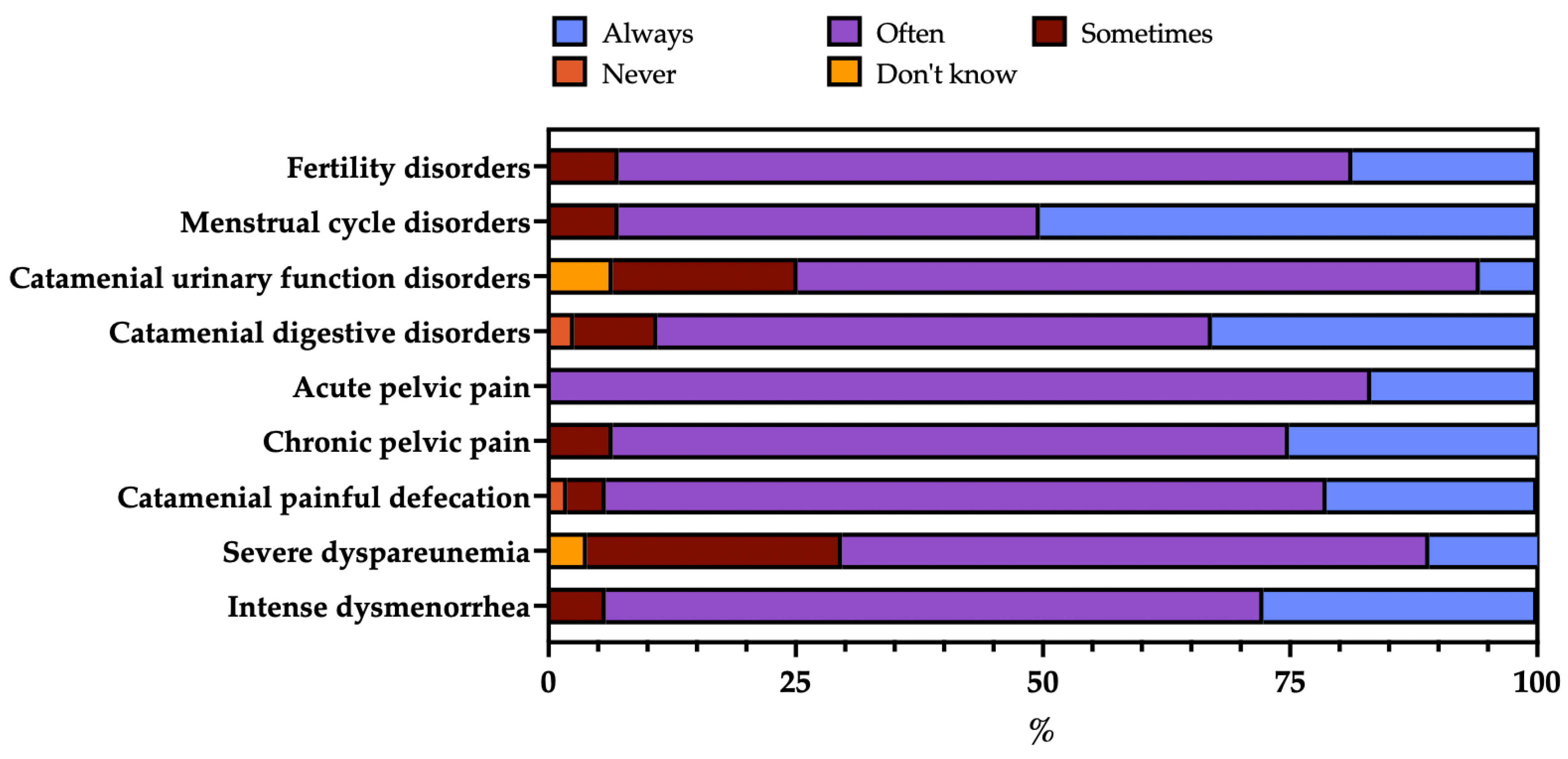
Figure 3.
Perceived barriers in the managing of endometriosis on the workplaces.
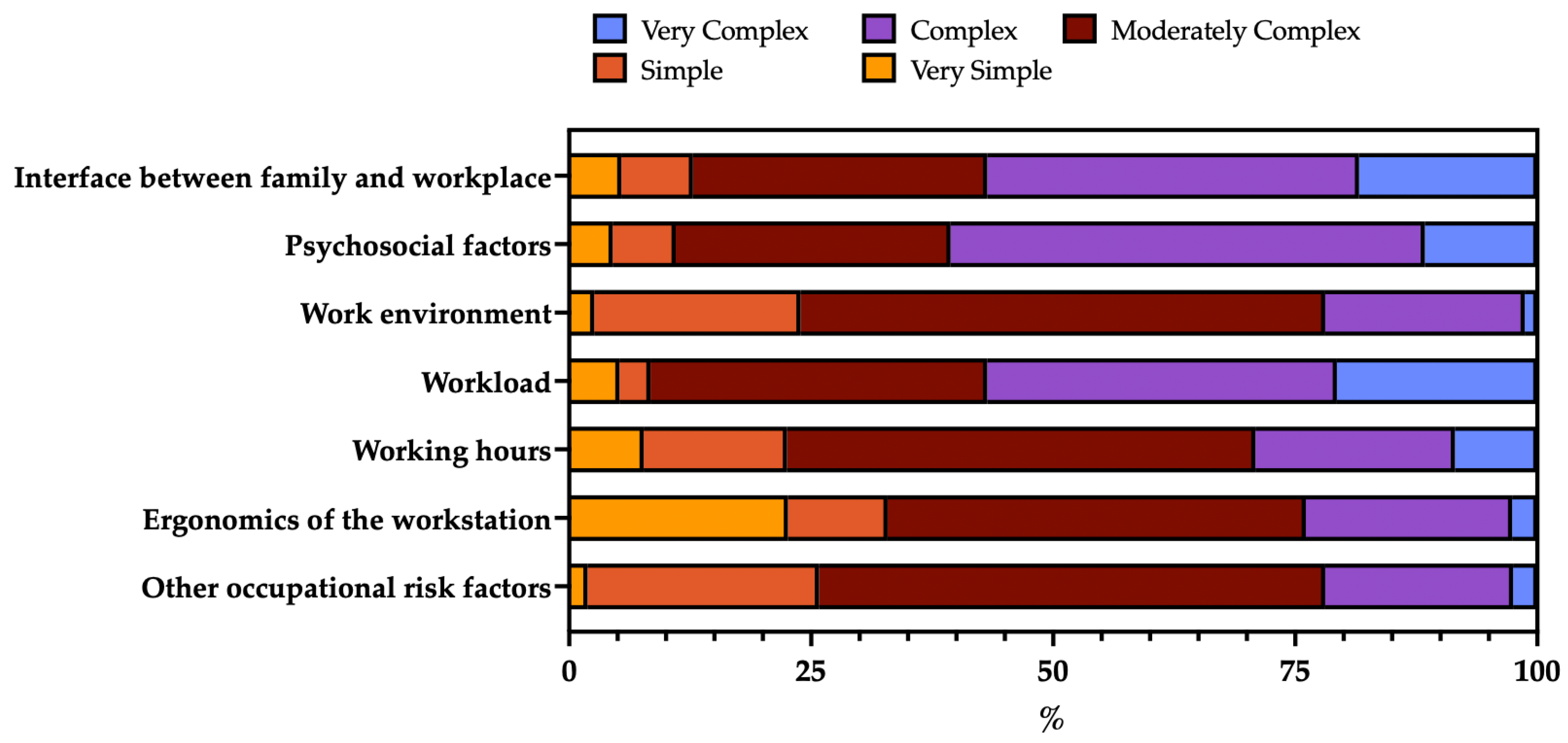
Figure 4.
Results of multivariable analysis on the outcome variable of having issued conditioned fitness to work (aOR = adjusted odds ratio, 95%CI).
Figure 4.
Results of multivariable analysis on the outcome variable of having issued conditioned fitness to work (aOR = adjusted odds ratio, 95%CI).
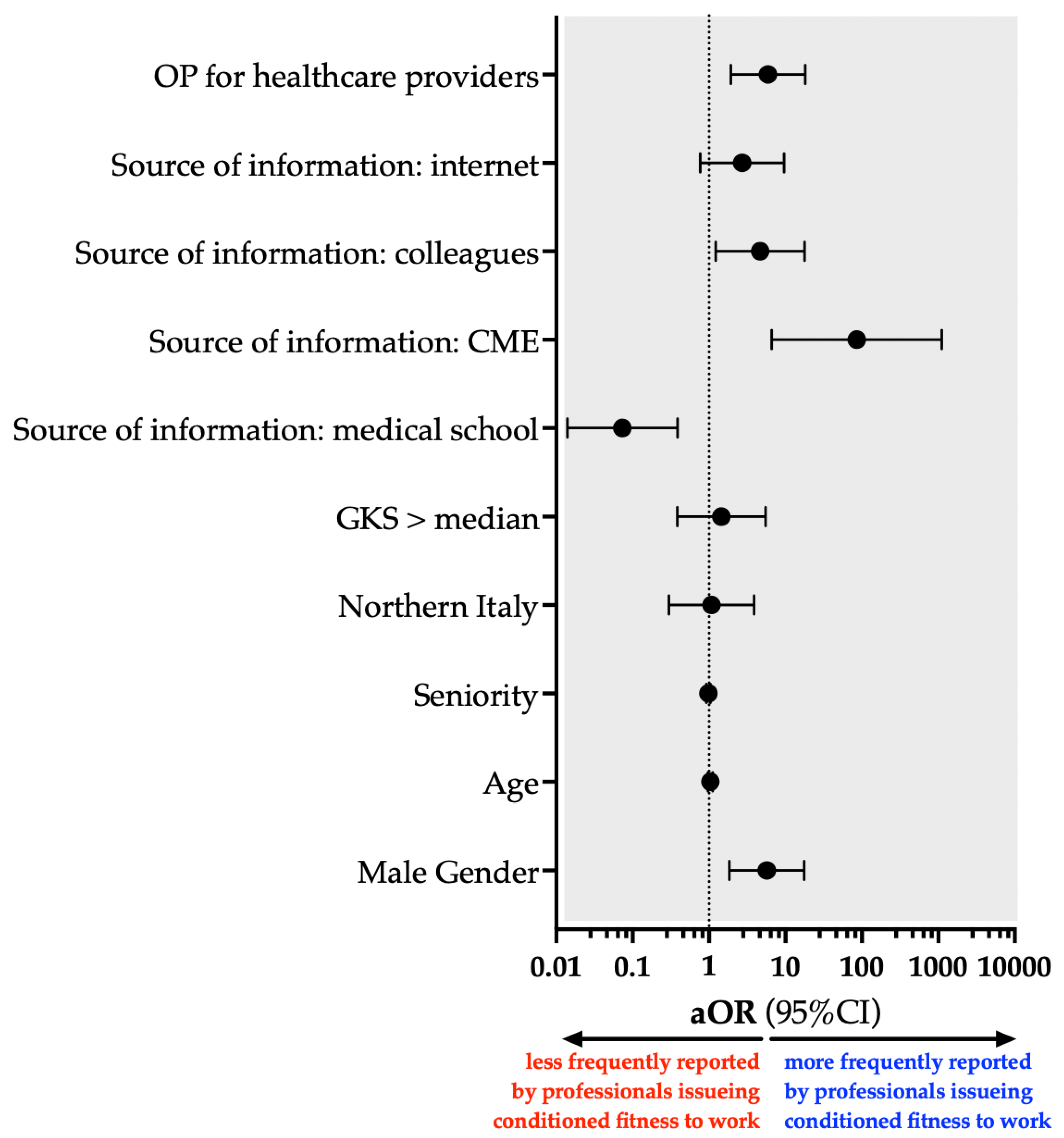

Table 1.
General characteristics of the sample (Note: 95%CI = 95% confidence interval).
| Variable | No./155, % | Average, 95%CI |
|---|---|---|
| Age (years) | 43.75 (42.27; 45.24) | |
| Seniority (years) | 17.05 (15.45; 18.64) | |
| Male Gender | 91, 58.7% | |
| Region of origin | ||
| Northern Italy | 103, 66.5% | |
| Central Italy | 20, 12.9% | |
| Southern Italy | 32, 20.6% | |
| Qualification as Occupational physician | ||
| Residency in Occupational Medicine | 136, 87.7% | |
| Residency in Hygiene and Public Health | 18, 11.6% | |
| Residency in Legal medicine | 1, 0.6% | |
| Occupational physicians of healthcare providers | 104, 67.1% | |
| Free practitioner | 116, 74.8% | |
| Self-assessed proper knowledge of endometriosis | 121, 78.1% | |
| Endometriosis acknowledged as somehow severe | 110, 71.0% | |
| Endometriosis acknowledged as somehow frequent | 86, 55.5% | |
| Risk Perception Score (%) | 52.52 (50.64; 54.40) | |
| General Knowledge Score (%) | 64.14 (62.21; 66.07) | |
| General Knowledge Score (simplified) (%) | 60.00 (55.25; 62.17) | |
| Previous formation on endometriosis | ||
| During medical school | 105, 67.7% | |
| During medical specialty training | 4, 2.6% | |
| Continuous Medical Education | 29, 18.7% | |
| Colleagues (Gynecologists) | 47, 30.3% | |
| Internet (i.e., online courses, articles, official websites) | 49, 31.6% | |
| Knowledge of any guidelines on occupational management of endometriosis | 17, 11.0% | |
| Background in … | ||
| Gynecology | 19, 12.3% | |
| Psychiatry | 13, 8.4% | |
| Internal medicine | 102, 65.8% | |
| Any previous experience with patients with endometriosis | 126, 81.3% | |
| Conditioned Fitness to work assessment | ||
| Any restriction | 102, 65.8% | |
| Avoid night shift | 47, 30.3% | |
| Avoid shift work | 36, 23.2% | |
| Avoid exposure to extreme temperatures | 15, 9.7% | |
| Increased number of work breaks | 78, 50.3% | |
| Avoid exposure to chemical agents | 3, 1.9% | |
| Avoid front office duties | 18, 11.6% |
Table 2.
Detailed list of items included in the knowledge test and correlation of the proportion of correct answers with the cumulative general knowledge test (GKS).
Table 2.
Detailed list of items included in the knowledge test and correlation of the proportion of correct answers with the cumulative general knowledge test (GKS).
| Question / Statement | Correct answer | No., % | Correlation with GKS (rho, p value) |
|---|---|---|---|
| W01. What is the prevalence of endometriosis among women of reproductive age? | 10 to 14% | 41, 26.5% | -0.073 (0.363) |
| W02. Endometriosis is caused by the presence of endometrium-like tissue outside the uterus. | TRUE | 155, 100% | - |
| W03. Endometriosis is associated with abnormalities of the pelvic musculature. | TRUE | 111, 71.6% | 0.172 (0.033) |
| W04. Early menarche is a risk factor for endometriosis. | TRUE | 70, 45.2% | 0.338 (< 0.001) |
| W05. Women with endometriosis typically have a low body mass index (<18 kg/m²). | FALSE | 86, 55.5% | 0.122 (0.132) |
| W06. Endometriosis is characterized by a strong familial predisposition. | TRUE | 54, 34.8% | 0.063 (0.440) |
| W07. Endometriosis is usually diagnosed … | … between 25 and 35 years of age | 96, 61.9% | -0.159 (0.048) |
| W08. The gold standard for the diagnosis of endometriosis is transvaginal ultrasound. | FALSE | 49, 31.6% | 0.166 (0.040) |
| W09. Endometriosis is frequently associated with infertility. | TRUE | 129, 83.2% | 0.312 (< 0.001) |
| W10. Which of the following psychiatric disorders is most commonly associated with endometriosis? | Depression | 141, 91.0% | 0.128 (0.113) |
| W11. The treatment of endometriosis aims to reduce pain and maximise residual reproductive potential. | TRUE | 127, 81.9% | -0.074 (0.362) |
| W12. The treatment of endometriosis benefits from hormone replacement therapy. | TRUE | 120, 77.4% | -0.127 (0.114) |
Table 3.
Distribution of main variables assessed within the survey with the outcome variable of having formulated medical restrictions based on the underlying status of endometriosis. OR = odds ratio, 95%CI = 95% confidence interval.
Table 3.
Distribution of main variables assessed within the survey with the outcome variable of having formulated medical restrictions based on the underlying status of endometriosis. OR = odds ratio, 95%CI = 95% confidence interval.
| Variable | Previously issuing restricted fitness-to-work appraisal of women affected by endometriosis | p value | |
| Yes (N = 102) | No (N = 53) | ||
| Gender | < 0.001 | ||
| Male | 76, 74.5% | 15, 28.3% | |
| Female | 26, 25.5% | 38, 71.7% | |
| Age (Average, 95%CI) | 44.88 (42.97; 46.80) | 41.58 (39.33; 43.84) | 0.036 |
| Seniority (Average, 95%CI) | 18.37 (16.35; 20.39) | 14.49 (11.99; 16.99) | 0.022 |
| Region of Italy | 0.024 | ||
| Northern Italy | 61, 59.8% | 42, 79.2% | |
| Central / Southern Italy | 41, 40.2% | 11, 20.8% | |
| Self assessed good knowledge | 80, 78.4% | 41, 77.4% | 1.000 |
| RPS > median | 48, 47.1% | 18, 34.0% | 0.164 |
| Simplified GKS > median | 42, 41.2% | 8, 15.1% | 0.002 |
| Source of information | |||
| Medical school | 55, 53.9% | 50, 94.3% | < 0.001 |
| Continous Medical Education | 28, 27.5% | 1, 1.9% | < 0.001 |
| Medical Specialty Training | 3, 2.9% | 1, 1.9% | 1.000 |
| Colleagues | 41, 40.2% | 6, 11.3% | < 0.001 |
| Internet, social media | 39, 38.2% | 10, 18.9% | 0.023 |
| Any background in … | |||
| … gynecology | 14, 13.7% | 5, 9.4% | 0.607 |
| … psychiatry | 7, 6.9% | 6, 11.3% | 0.519 |
| … internal medicine | 68, 66.7% | 34, 64.2% | 0.893 |
| Occupational features of respondents | |||
| Full residency in Occupational Medicine | 89, 87.3% | 47, 88.7% | 1.000 |
| Being a free practitioner | 78, 76.5% | 38, 71.7% | 0.650 |
| Working in Healthcare settings | 85, 83.3% | 19, 35.8% | < 0.001 |
Disclaimer/Publisher’s Note: The statements, opinions and data contained in all publications are solely those of the individual author(s) and contributor(s) and not of MDPI and/or the editor(s). MDPI and/or the editor(s) disclaim responsibility for any injury to people or property resulting from any ideas, methods, instructions or products referred to in the content. |
© 2026 by the authors. Licensee MDPI, Basel, Switzerland. This article is an open access article distributed under the terms and conditions of the Creative Commons Attribution (CC BY) license (http://creativecommons.org/licenses/by/4.0/).
Copyright: This open access article is published under a Creative Commons CC BY 4.0 license, which permit the free download, distribution, and reuse, provided that the author and preprint are cited in any reuse.