

Submitted:
25 June 2026
Posted:
26 June 2026
You are already at the latest version
Abstract
Scientific inquiry relies on causal explanation, whereby phenomena are understood through the antecedent conditions, interactions and laws producing the current configuration of a system. We introduce a complementary approach termed Future Compatibility (FC), which evaluates a present state not only through its causal history, but also through the set of future states structurally accessible from it. The central premise is that scientific understanding may be enriched by characterizing the opportunities and constraints associated with a given state. Rather than focusing exclusively on origins or on the prediction of a specific outcome, FC quantifies the repertoire of coherent futures available from a present configuration and their stability under perturbation. To explore this approach, we implemented simulations of evolving networked systems undergoing branching developmental pathways and external perturbations. For each system state, a set of novel observables describing future accessibility, entropy, robustness and persistence was computed from admissible trajectories satisfying predefined coherence constraints. These compatibility landscapes exposed organizational properties that were not captured by causal reconstruction alone, providing additional information regarding adaptability, resilience and developmental potential. Potential applications include developmental biology, evolutionary theory, ecology, neuroscience, complex systems research and the assessment of resilience and adaptability in technological, organizational and socioeconomic networks.
Keywords:
prospection
; teleonomy
; persistence
; robustness
; emergence
Introduction
Scientific inquiry has traditionally been organized around causal explanation. Across disciplines as diverse as physics, biology, geology and neuroscience, understanding a phenomenon generally means identifying the preceding conditions, mechanisms and interactions responsible for its occurrence (Davidson 2015; Riglin et al. 2021; Baedke 2021; Fang 2022; Gebharter and Feldbacher-Escamilla 2023; Go 2023). Within this perspective, explanation proceeds retrospectively: present states are interpreted as consequences of past events, with scientific theories seeking to reconstruct the chains of causation that link antecedents to observations. However, causal explanation does not exhaust all aspects of scientific understanding. Many systems exhibit multiple causal pathways leading to similar outcomes, while others follow markedly different trajectories despite apparently similar histories (Marx et al. 2017; Reutrakul and Van Cauter 2018; Hou et al. 2022; Sandran et al. 2024; Arruda et al. 2025). Complex adaptive systems, developmental processes, evolutionary trajectories and networked structures could display a degree of future openness not captured by purely retrospective analyses. Two systems may appear nearly identical at a given moment, share comparable causal histories and satisfy the same present constraints, yet differ in the range of their available future configurations.
We introduce Future Compatibility (FC), a complementary framework for scientific inquiry based on prospective accessibility rather than exclusively on retrospective causation. Our premise is that a scientific state may be characterized not only by the generating events, but also by the ensemble of future states with which it is structurally compatible (Pei, Cane, and Shaman 2019; Ray et al. 2023; Sala et al. 2023; Abbas and Ali 2024). Within this perspective, explanation involves identifying the future trajectories, configurations or transformations that preserve the coherence of a system under specified constraints (Gantenbein and Kanaka-Gantenbein 2022; Yi et al. 2024; Kang et al. 2025). The conceptual motivation arises from a simple observation: scientific descriptions usually classify systems according to their current properties while assigning relatively little attention to the organization of their accessible future space. A biological organism, an ecological community or a technological network may occupy a present state that is stable and functional. Nevertheless, the future possibilities available from that state may vary dramatically. Some configurations retain access to a broad repertoire of coherent futures, whereas others are viable only within a narrow set of trajectories. FC proposes that this distinction could stand for a scientific property deserving explicit quantification. Rather than asking exclusively why a present state exists, FC asks how many coherent futures are available to that state and how robust those futures are under perturbation. The resulting description is prospective rather than predictive. Scientific interest shifts from determining a specific future outcome to evaluating the structure of the future space accessible from the current configuration. To illustrate the FC framework, we examine a simplified model of embryonic vascular development, in which a finite set of developmental decisions and structural constraints is used to build a future space of possible vascular architectures.
We will proceed as follows. First, we introduce the conceptual framework of FC and discuss its relationship to conventional causal explanation. We develop a quantitative description of future accessibility through a set of dedicated observables and indices. Next, we employ simulations designed to compare compatibility-preserving dynamics with random exploration and attractor-driven convergence. Then, we discuss an operative example from embryonic vascular development. Finally, we discuss the implications, limitations and potential applications of FC across biological, physical and complex adaptive systems.
The Mathematics of Future Compatibility: Quantitative Observables and Metrics
Our FC framework treats the present state as a gateway to a structured space of admissible futures. The objective is not to identify a single future outcome, but to characterize the geometry, accessibility, diversity and robustness of the future space associated with a given present configuration. This requires the introduction of quantitative observables describing future accessibility independently of retrospective causal reconstruction.
Future space. Consider a system occupying a present state . Let denote the set of all theoretically reachable future states under the dynamical rules governing the system. The cardinality of this future space is
Not all reachable futures are compatible with the structural constraints defining the system. Let
denote the subset of compatible futures. The number of compatible futures is
Compatibility. The first quantitative descriptor introduced here is the Future Compatibility Index:
This index varies between 0 and 1. A value close to 1 indicates that most theoretically reachable futures are compatible with the structural requirements of the system, while a value close to 0 indicates severe restriction of future accessibility. Unlike conventional state variables, the FCI does not describe what the system currently is, but rather the fraction of future space that are still available.
FC may also be represented as a time-dependent quantity. Let denote the state of the system at time . The temporal evolution of future accessibility is then given by
The derivative
measures the rate at which future accessibility expands or contracts during system evolution. Negative values indicate progressive closure of future possibilities, whereas positive values indicate increasing future openness.
Entropy. Future accessibility alone does not characterize the internal organization of compatible futures. Two systems may possess identical values of while exhibiting very different distributions of future states. To distinguish these situations, a probabilistic representation can be introduced. Let
be the probability associated with compatible future . The probabilities satisfy
The Future Compatibility Entropy is defined as
This quantity measures the diversity of compatible futures. Low entropy indicates concentration of probability within a few futures, whereas high entropy indicates broad dispersion across many alternatives. Therefore, Future Compatibility Entropy quantifies future diversity rather than present uncertainty.
When empirical probabilities are unavailable, a structural entropy may be defined using equal weighting:
This yields
The structural entropy depends only on the number of admissible futures and is independent of observational data.
A normalized entropy can be introduced:
This quantity ranges between 0 and 1 and measures the degree of uniformity of future accessibility.
Robustness. The persistence of future accessibility under perturbation can be quantified through the Future Robustness coefficient. Let
be the number of compatible futures before perturbation and
the number after perturbation. Future Robustness is defined as
Values close to 1 indicate preservation of future opportunities, whereas values near 0 indicate collapse of future accessibility. This quantity provides a prospective measure of resilience.
Networks. FC may also be interpreted geometrically. Consider the compatible futures as nodes of a graph
where vertices correspond to future states and edges connect futures that can be transformed into one another through elementary transitions. The average future degree is
where is the degree of future state .
The quantity
measures local navigability within future space. Large values indicate that compatible futures are richly interconnected.
A Future Clustering Coefficient can also be defined:
where denotes the number of edges among the neighbors of node . This quantity measures the tendency of compatible futures to organize into coherent clusters.
Distances. Future accessibility may further be characterized through distances. Given two compatible futures and , define a metric
The average pairwise distance becomes
Large values indicate wide dispersion of compatible futures. Small values indicate concentration around similar outcomes.
A Future Diameter may be introduced:
This quantity measures the maximal extent of compatible future space.
Topology. Future accessibility may also possess topological structure. Let
denote the Betti numbers of the future-state complex. The zeroth Betti number counts disconnected future regions. The first Betti number counts loops in future accessibility. Higher Betti numbers characterize higher-dimensional holes. These quantities describe the global organization of future space independently of geometry.
A Future Connectivity Index may be defined as
A single connected future region yields , whereas fragmentation decreases connectivity.
Persistence. The persistence of future structure across scales can be characterized using persistent homology. Let
denote the persistence diagram generated from future-state distances. The average persistence is
where is the number of topological features. Large values indicate stable future structures that are present across multiple scales.
Horizon. An additional quantity concerns the temporal extent of compatibility. Define the Future Horizon as
This observable measures how long compatible futures continue to exist before compatibility vanishes entirely.
Dispersion. The future space may also exhibit directional organization. Let
represent coordinates of future state in an embedding space. The future centroid is
The Future Dispersion is
This quantity measures the spread of compatible futures around their center.
Potential. A particularly informative quantity is the Future Accessibility Potential:
where represents the functional value, utility or viability associated with future state . This measure incorporates qualitative differences among compatible futures rather than merely counting them.
Taken together, these observables define a mathematical description of future accessibility capable of complementing conventional causal descriptions of complex systems. A summary is provided in Table 1.
Future Compatibility Dynamics: A Simulation Study
To show the behavior of FC and compare it with alternative future-generation strategies, we implemented a simulation in which three different models evolve from an identical present state toward a finite future horizon. The objective was not to reproduce a specific biological system, but rather to investigate how different organizational principles could shape the structure of accessible future spaces.
Three scenarios represent conceptually distinct regimes of future organization:
- The first model corresponds to our FC framework. Future states emerge through branching trajectories constrained by compatibility requirements. New future states are generated only if they satisfy predefined coherence conditions relative to previously established structures. The resulting future space is organized, interconnected and progressively expandable.
- The second model serves as a random null model, in which future states are generated through unconstrained stochastic exploration without compatibility preservation.
- The third model represents a deterministic one-point attractor system in which all trajectories progressively converge toward a single terminal state.
All simulations began from the same initial state and evolved for six successive future horizons (Fig. A). The initial state consisted of a population of abstract agents representing elementary future-generating units. These agents do not correspond to specific biological entities but serve as generic carriers of state transitions within future space. At each horizon, every agent generated descendant states. The resulting future space was represented as a directed graph , where vertices corresponded to future states and edges denoted admissible transitions between consecutive horizons. For the FC condition, each candidate state was evaluated through a compatibility operator , defined as a set of structural constraints preserving coherence with previously established states. Only descendants satisfying were retained and allowed to generate further futures. In the random condition, descendant states were generated with identical branching statistics but without application of the compatibility operator. In the attractor condition, a convergence operator progressively redirected trajectories toward a predefined terminal state, reducing the number of distinct accessible futures at each horizon.
To reduce stochastic fluctuations, independent simulation trials were performed for each condition. For every trial, FC observables were computed after each horizon, including Future Compatibility Index (), Future Compatibility Entropy (), Future Robustness (), Future Horizon () and Future Accessibility Potential (). Results reported in the figures correspond to trial-averaged values. The choice of six horizons represented a compromise between sufficient future-space expansion and computational tractability, producing future graphs containing between and nodes depending on the simulation condition. This procedure enabled direct quantitative comparison of future accessibility, future diversity and future persistence across the three different scenarios of compatibility-preserving, random and attractor-driven dynamics.
To quantify future accessibility, we calculated the FCI at each future horizon. The FC model maintained substantially larger compatibility values throughout the simulation (Fig. B). Starting from an initial value of 1.0, compatibility gradually decreased but was still appreciable even at the final horizon. By contrast, the random model exhibited a rapid decline, indicating extensive loss of coherent future accessibility. The one-point attractor displayed the fastest collapse, approaching zero compatibility after only a few time steps.
These findings suggest that future-space organization is governed by a trade-off between diversification and coherence. Excessive diversification leads to fragmentation of accessible futures, whereas excessive convergence eliminates future diversity. Compatibility-preserving dynamics occupy an intermediate regime in which future opportunities are abundant, interconnected and persistent.
Future diversity was evaluated through the (Fig. C). The random model exhibited the largest entropy values throughout the simulation. Although this indicates many explored futures, the associated futures lack structural organization and compatibility. The one-point attractor displayed entropy values approaching zero, because all trajectories converged toward a single outcome. The FC model occupied an intermediate regime, reaching approximately 3.4 bits while maintaining high compatibility. This suggests that FC generates a balance between excessive randomness and excessive determinism, preserving diversity without sacrificing coherence.
To evaluate global properties of future organization, several observables were calculated at the final simulation horizon (Fig. D). The FC model retained a higher Future Compatibility Index compared with both the random model and the attractor model. Future Robustness , defined as the proportion of compatible futures preserved after secondary perturbation, reached 0.71 for FC but only 0.13 for the random model. The Future Horizon , representing the temporal persistence of non-negligible compatibility, reached ten steps for FC compared with three for the random model and one for the attractor. Connectivity was still maximal in the FC future space, with all compatible futures belonging to a single connected component. In contrast, the random model fragmented into partially disconnected regions, while the attractor model effectively removed future-space connectivity.
Analysis of branching behavior provided additional insight into the organization of future space. The random model exhibited the largest average branching factor, indicating the greatest number of local future alternatives. However, this increased branching did not translate into improved future accessibility. Instead, it generated fragmented and unstable future spaces characterized by low robustness and rapid compatibility loss. Conversely, the FC model achieved greater long-term accessibility despite a lower branching factor. This suggests that future accessibility emerges from the organization of future possibilities rather than from their mere abundance. An increase in local alternatives does not necessarily translate into greater future potential if those alternatives lack coherence, connectivity or persistence across successive horizons.
Overall, our simulations considered three distinct regimes of future-space organization. Random exploration maximizes diversity but sacrifices coherence and robustness. One-point attractors maximize determinism but eliminate future accessibility. FC occupies an intermediate region characterized by simultaneously high diversity, high connectivity and high robustness. Therefore, FC trajectories preserve a repertoire of coherent future possibilities inaccessible to both extreme cases. This suggests that scientific systems may be characterized not only by their present state or causal history, but also by the organization, persistence and accessibility of their compatible future spaces.
Figure 1.
Comparison of future-space organization across three alternative dynamic regimes. (A) Schematic representation of the future-state spaces generated by three models starting from the same present state. The Future Compatibility (FC) model generates a structured hierarchy of branching trajectories that preserve multiple coherent developmental possibilities across successive future horizons. The random-path model explores the future space without organizational constraints, producing highly dispersed trajectories. The one-point attractor model progressively collapses all trajectories toward a single terminal state. Colors represent temporal progression from early to late future states. (B) Temporal evolution of the Future Compatibility Index (FCI). The FC model maintains larger values of future accessibility throughout the simulation (repeated-measures ANOVA with Tukey post hoc test,
Figure 1.
Comparison of future-space organization across three alternative dynamic regimes. (A) Schematic representation of the future-state spaces generated by three models starting from the same present state. The Future Compatibility (FC) model generates a structured hierarchy of branching trajectories that preserve multiple coherent developmental possibilities across successive future horizons. The random-path model explores the future space without organizational constraints, producing highly dispersed trajectories. The one-point attractor model progressively collapses all trajectories toward a single terminal state. Colors represent temporal progression from early to late future states. (B) Temporal evolution of the Future Compatibility Index (FCI). The FC model maintains larger values of future accessibility throughout the simulation (repeated-measures ANOVA with Tukey post hoc test,
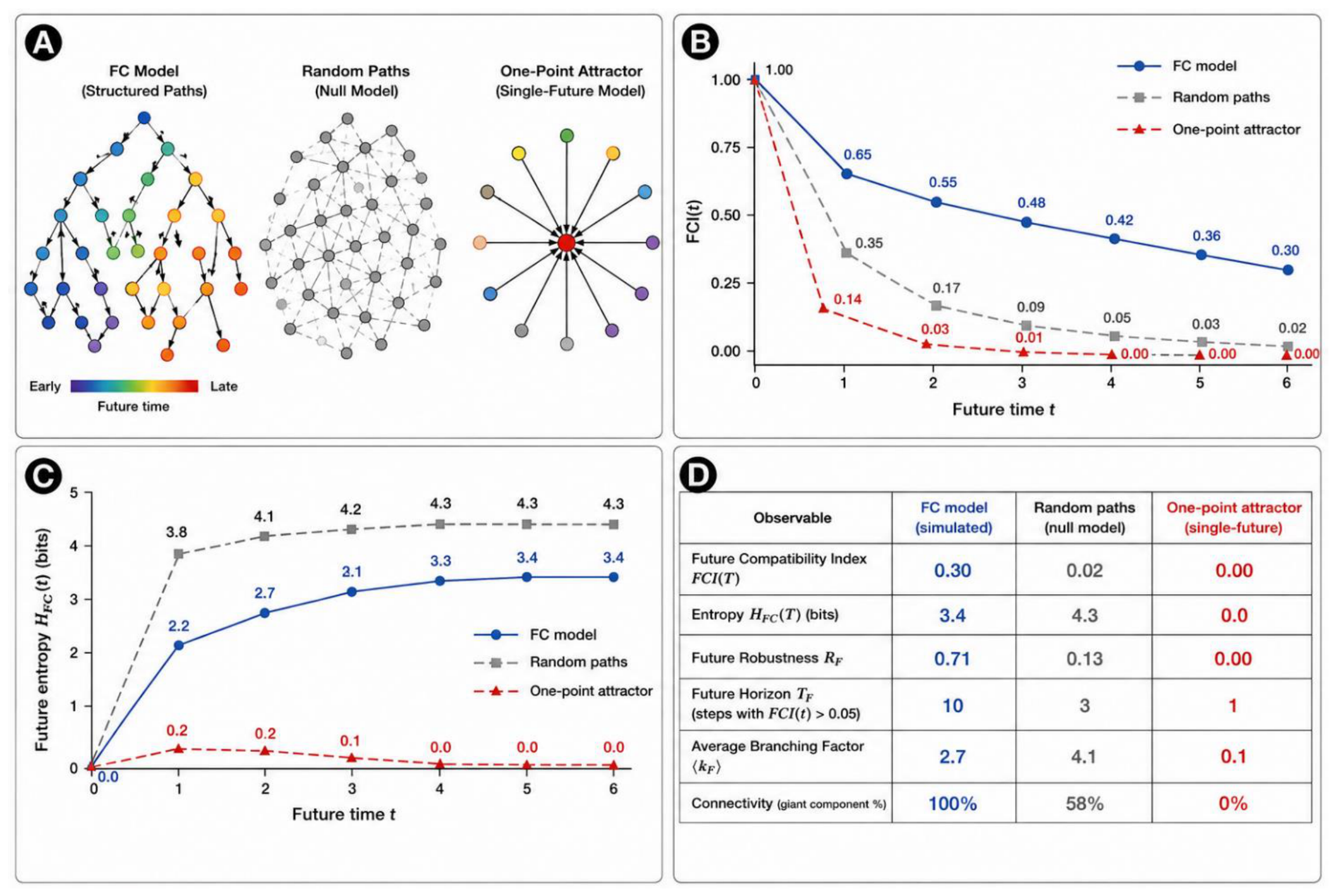
), indicating preservation of compatible future states across increasing horizons. Random trajectories rapidly lose compatibility as future space becomes fragmented, whereas the one-point attractor rapidly approaches compatibility collapse due to convergence toward a single outcome. (C) Temporal evolution of Future Compatibility Entropy (). The FC model exhibits intermediate entropy values, reflecting a balance between excessive randomness and excessive determinism (repeated-measures ANOVA with Tukey post hoc test, ). The random-path model displays the highest entropy because of unconstrained exploration of future configurations. The attractor model exhibits entropy values approaching zero because future diversity progressively disappears. (D) Summary of future observables at the final simulation horizon (). The FC model preserves higher Future Compatibility Index, Future Robustness (), Future Horizon () and connectivity than either comparison model (repeated-measures ANOVA and one-way ANOVA with Tukey post hoc test, ). Although the random model displays larger branching factors and entropy, this diversity is associated with reduced robustness and fragmented future organization. The one-point attractor model exhibits near-zero compatibility, entropy, robustness and connectivity due to convergence toward a single future state.
Overall, systems organized according to compatibility constraints occupy an intermediate regime between unrestricted randomness and deterministic collapse, preserving diverse, coherent and robust future opportunities inaccessible to conventional descriptions based solely on present states or causal histories.
Accessible Futures Before Phenotypic Change: A Developmental Example
Embryonic vascular development provides a useful example for illustrating the principles of FC. During early development, vascular networks are generated through branching, fusion and remodeling processes, progressively establishing functional pathways for blood transport (Darland and D'Amore 2001; Wang et al. 2018; Bhakuni et al. 2024; Li et al. 2025; Song et al. 2025). Developmental biology explains these events through causal mechanisms involving genetic regulation, molecular signaling, cellular migration and biomechanical interactions. These accounts describe how present vascular configurations arise from prior developmental events.
FC introduces an additional perspective. Instead of asking only how a vascular configuration was produced, FC asks how many structurally coherent futures are still accessible from the present state. The emphasis shifts from developmental origins to developmental accessibility. Therefore, a present vascular architecture is characterized not only by its causal history, but also by the extent of its compatible future space.
Consider a simplified embryonic vascular system confronted with four binary developmental decisions. The developing network may generate a left branch (A), a right branch (B), an anastomotic connection between branches (C) and a secondary collateral vessel (D). Since each developmental decision can occur or not occur, the complete future space contains:
possible future vascular architectures.
However, not all theoretically possible architectures are biologically coherent, since imposed structural constraints define the admissible future space. First, at least one primary branch must form, requiring A or B. Second, an anastomosis requires the existence of at least one primary branch. Third, a collateral vessel can emerge only if an anastomotic connection already exists. Enumeration of all possible configurations reveals that only nine of the sixteen futures satisfy the structural constraints. Therefore, the Future Compatibility Index is:
This indicates that approximately fifty-six percent of the theoretically accessible developmental futures are compatible with the structural requirements of vascular organization.
Now suppose a perturbation, i.e., a genetic alteration which prevents the formation of anastomotic connections. In our model, this corresponds to imposing:
Since collateral vessels require anastomoses, the condition
must also be imposed. This means that the future space contracts substantially. Only three admissible configurations are still compatible with all structural requirements. The Future Compatibility Index becomes:
with a marked reduction in future accessibility. Although no pathological phenotype is yet detectable, the compatible future space has already contracted by nearly two-thirds. Therefore, the system retains normal function while simultaneously losing a large fraction of its accessible developmental opportunities, revealing a hidden vulnerability that is not evident from present-state observations alone. While classical developmental analysis would focus on whether the mutation currently affects vascular performance, FC evaluates whether the mutation restricts the repertoire of coherent developmental trajectories available to the system.
The reduction can be quantified through a Future Robustness coefficient:
This means that only one-third of the previously accessible compatible futures are still available after the perturbation. Therefore, Future Robustness measures the persistence of developmental opportunities under constraint.
Two embryos may exhibit identical vascular morphology at a given developmental stage. They may have equivalent vessel diameters, comparable blood flow and indistinguishable anatomical appearance. Conventional analysis would classify them as functionally equivalent, while FC may reveal a different picture. One embryo may retain access to a broad space of coherent developmental trajectories, whereas the other may be confined to a narrow set of possibilities because of hidden structural constraints. Although the present states appear identical, their developmental potential differs substantially.
Our framework can be extended beyond vascular development. Neural development organogenesis, tissue regeneration and evolutionary diversification all involve systems that progressively navigate spaces of future possibilities under multiple constraints. In each case, the relevant question becomes not only how a structure was produced, but also how many coherent futures are available to it. Within this perspective, the explanatory target is no longer restricted to causal ancestry. A developmental state acquires scientific meaning through the structure of the future space it can still access. Even in a highly simplified model like our embryonic vascular network, FC identifies quantitative differences between states that are invisible to conventional causal analysis. The resulting observables, including the Future Compatibility Index and Future Robustness, provide measures of developmental openness, resilience and constraint that could complement traditional biological descriptions.
Conclusions
We asked whether scientific understanding can be expanded beyond retrospective causal explanation by introducing a complementary description based on the accessibility of compatible futures. We investigated whether present states can be characterized not only through the events that generated them, but also through the organization of the available future states. Our simulations compared three distinct modes of future-space organization originating from identical initial conditions. We quantified future accessibility, diversity, robustness, connectivity and temporal persistence through a series of dedicated observables complementary to conventional causal descriptions.
Our framework differs from forecasting, prediction and probabilistic inference because it does not attempt to determine which future state will occur. Unlike many probabilistic approaches, our framework does not rely on empirical frequency estimates (Coram and Tang 2007; Bruce et al. 2020; Neal et al. 2020). Traditional probabilistic approaches require observations of repeated events or historical datasets from which transition probabilities can be inferred. FC can instead be formulated through structural, logical or organizational constraints alone. Therefore, FC may be evaluated even when empirical probabilities are unavailable, incomplete or unknowable. The relevant quantity becomes the fraction of the theoretically accessible future space compatible with the constraints defining the system. Unlike dynamical systems approaches that emphasize realized trajectories, attractors and asymptotic states (Tanze Wontchui et al. 2022; Popova, Hilgetag, and Hütt 2024; Shaikhet and Korobeinikov 2024; Ságodi et al. 2025), FC focuses on the structure of the accessible future space. Unlike Bayesian inference, which updates probabilities in response to evidence, FC evaluates structural accessibility independently of observed frequencies. The resulting quantities provide direct measurements of future accessibility, future robustness and future-space topology, allowing systems with similar present characteristics to be distinguished according to their prospective organization.
Our study has limitations. Theoretical models and simulations relied on abstract future-state spaces rather than experimentally reconstructed systems. Compatibility relations were imposed through predefined structural constraints that could generate different compatibility landscapes. We focused on discrete future spaces and finite horizons, whereas many real systems evolve in continuous, high-dimensional state spaces. Sources of potential bias include the choice of compatibility rules, graph construction procedures and horizon length. Generalizability across biological, physical and social systems is not established. Furthermore, the relationship between FC observables and conventional quantities like entropy, resilience, controllability and adaptability are incompletely understood. Several questions are still unresolved, including whether future accessibility predicts subsequent system behavior, how compatibility landscapes vary across scales and whether systems sharing identical compatibility metrics can nevertheless follow different long-term trajectories.
Experimentally testable hypotheses could be suggested. First, biological systems occupying similar present states should exhibit measurable differences in future accessibility. In developmental systems, reconstructed lineage graphs could be used to estimate Future Compatibility Index values, with the prediction that states possessing larger FCI values will maintain a greater number of viable developmental trajectories after perturbation.
Second, future robustness should scale positively with recovery capacity. If is measured before experimental perturbation, systems with larger values are predicted to retain a larger fraction of functional states following intervention.
Third, future-space entropy should exhibit intermediate values in adaptive systems. Excessively low entropy should correlate with rigidity and limited adaptability, whereas excessively high entropy should correlate with instability and fragmentation.
Fourth, Future Horizon should scale with resilience. Systems characterized by larger values are predicted to preserve compatibility under repeated perturbations for longer intervals.
Fifth, topological observables should possess predictive value. Systems exhibiting larger connectivity and persistence measures are expected to display lower rates of compatibility collapse. Quantitatively, one may predict positive correlations between , and experimentally measured recovery rates and negative correlations between future-space fragmentation and long-term viability.
Future research may investigate these predictions in developmental biology, ecological succession, neural plasticity, evolutionary diversification and adaptive technological systems. More sophisticated simulations involving continuous state spaces, stochastic constraints and experimentally derived compatibility relations may further clarify the relationship between future accessibility and observable system behavior.
Potential applications extend beyond the examples considered here. FC can be applied across multiple scales, from embryonic development, where it may quantify the repertoire of accessible morphogenetic pathways, to large-scale adaptive systems. In each case, the focus shifts from predicting specific outcomes or exclusively reconstructing causal histories to quantifying the organization, accessibility and persistence of future opportunities available from a given present state. FC observables may support decision-making in situations where direct prediction is unreliable and where multiple interacting constraints limit the usefulness of outcome-based approaches.
In medicine, compatibility metrics may assist in evaluating intervention flexibility and latent developmental opportunities. In engineering and technological systems, they may identify designs that preserve adaptability, operational options and structural flexibility under changing conditions, component failure or redesign. In environmental management and ecology, they may quantify the range of sustainable responses available to ecosystems and characterize community resilience under environmental change. In neuroscience, they may evaluate the accessibility of future functional states from a given network configuration. In artificial intelligence, future-space descriptors may guide adaptive exploration strategies. In organizational and socioeconomic systems, compatibility measures may help assess strategic flexibility under uncertainty.
In conclusion, we introduced a quantitative description of future accessibility based on compatible future states and examined its behavior through simulations. Our analyses suggest that future accessibility, robustness, persistence and connectivity could be formalized and measured independently of retrospective explanations. This suggests that the structure of accessible futures may provide an additional dimension for the scientific characterization of complex systems.
Ethics approval and consent to participate: Ethics approval statement is not applicable. This research does not contain any studies with human participants or animals performed by the Author.
Consent for publication: The Author transfers all copyright ownership, in the event the work is published. The undersigned author warrants that the article is original, does not infringe on any copyright or other proprietary right of any third part, is not under consideration by another journal and has not been previously published.
Availability of data and materials: All data and materials generated or analyzed during this study are included in the manuscript. The Author had full access to all the data in the study and took responsibility for the integrity of the data and the accuracy of the data analysis.
Authors' contributions: The Author performed: study concept and design, acquisition of data, analysis and interpretation of data, drafting of the manuscript, critical revision of the manuscript for important intellectual content, statistical analysis, obtained funding, administrative, technical and material support, study supervision.
Declaration of generative AI and AI-assisted technologies in the writing process: During the preparation of this work, the author used ChatGPT 5.3 to assist with data analysis and manuscript drafting and to improve spelling, grammar and general editing. After using this tool, the author reviewed and edited the content as needed, taking full responsibility for the content of the publication.
Funding
This research did not receive any specific grant from funding agencies in the public, commercial or not-for-profit sectors.
References
- Abbas, H.; Ali, Z. A Novel Statistical Framework of Drought Projection by Improving Ensemble Future Climate Model Simulations under Various Climate Change Scenarios. Environ. Monit. Assess. 2024, 196(10), 938. [Google Scholar] [CrossRef] [PubMed]
- Arruda, A. L.; Bocher, O.; Taylor, H. J.; Cammann, D.; Yoshiji, S.; Yin, X.; Zhao, C.; Chen, J.; Wood, A. C.; Suzuki, K.; Mercader, J.; Spracklen, C. N.; Meigs, J. B.; Vujkovic, M.; Smith, G. Davey; Rotter, J. I.; Voight, B. F.; Morris, A. P.; Zeggini, E. The Effect of Type 2 Diabetes Genetic Predisposition on Non-Cardiovascular Comorbidities. Nat. Commun. 2025, 16(1), 9042. [Google Scholar] [CrossRef] [PubMed]
- Baedke, Jan. What’s Wrong with Evolutionary Causation? Acta Biotheor. 2021, 69(1), 79–89. [Google Scholar] [CrossRef] [PubMed]
- Bhakuni, T.; Norden, P. R.; Ujiie, N.; Tan, C.; Lee, S. K.; Tedeschi, T.; Hsieh, Y. W.; Wang, Y.; Liu, T.; Fawzi, A. A.; Kume, T. FOXC1 Regulates Endothelial CD98 (LAT1/4F2hc) Expression in Retinal Angiogenesis and Blood-Retina Barrier Formation. Nat. Commun. 2024, 15(1), 4097. [Google Scholar] [CrossRef] [PubMed]
- Bruce, S. A.; Tang, C. Y.; Hall, M. H.; Krafty, R. T. Empirical Frequency Band Analysis of Nonstationary Time Series. J. Am. Stat. Assoc. 2020, 115(532), 1933–45. [Google Scholar] [CrossRef] [PubMed]
- Coram, M.; Tang, H. Improving Population-Specific Allele Frequency Estimates by Adapting Supplemental Data: An Empirical Bayes Approach. Ann. Appl. Stat. 2007, 1(2), 459–79. [Google Scholar] [CrossRef] [PubMed]
- Darland, D. C.; D'Amore, P. A. Cell-Cell Interactions in Vascular Development. Curr. Top. Dev. Biol. 2001, 52, 107–49. [Google Scholar] [CrossRef] [PubMed]
- Davidson, Eric H. Genomics, ‘Discovery Science,’ Systems Biology, and Causal Explanation: What Really Works? Perspect. Biol. Med. 2015, 58(2), 165–81. [Google Scholar] [CrossRef] [PubMed]
- Fang, Weining. Design Principles and Mechanistic Explanation. Hist. Philos. Life Sci. 2022, 44(4), 55. [Google Scholar] [CrossRef] [PubMed]
- Gantenbein, K. V.; Kanaka-Gantenbein, C. Highlighting the Trajectory from Intrauterine Growth Restriction to Future Obesity. Front. Endocrinol. 2022, 13, 1041718. [Google Scholar] [CrossRef] [PubMed]
- Gebharter, Alexander; Feldbacher-Escamilla, Christian J. Unification and Explanation from a Causal Perspective. Stud. Hist. Philos. Sci. 2023, 99, 28–36. [Google Scholar] [CrossRef] [PubMed]
- Go, Julian. Unveiling Power, or Why Social Science’s Task Is Explanation. In British Journal of Sociology. Advance online publication.; 2023. [Google Scholar] [CrossRef] [PubMed]
- Hou, L.; Yu, Y.; Sun, X.; Liu, X.; Yu, Y.; Li, H.; Xue, F. Causal Mediation Analysis with Multiple Causally Non-Ordered and Ordered Mediators Based on Summarized Genetic Data. Stat. Methods Med. Res. 2022, 31(7), 1263–79. [Google Scholar] [CrossRef] [PubMed]
- Kang, Z.; Zhang, J.; Liu, W.; Zhu, C.; Zhu, Y.; Li, P.; Li, K.; Tong, Q.; Dai, S. M. Plasma Proteomic Profiles Predict Individual Future Osteoarthritis Risk. Arthritis Rheumatol. 2025, 77(8), 981–995. [Google Scholar] [CrossRef] [PubMed]
- Li, G.; Gao, J.; Ding, P.; Gao, Y. The Role of Endothelial Cell-Pericyte Interactions in Vascularization and Diseases. J. Adv. Res. 2025, 67, 269–88. [Google Scholar] [CrossRef] [PubMed]
- Marx, W.; Moseley, G.; Berk, M.; Jacka, F. Nutritional Psychiatry: The Present State of the Evidence. Proc. Nutr. Soc. 2017, 76(4), 427–36. [Google Scholar] [CrossRef] [PubMed]
- Neal, J. J.; Prybylski, D.; Sanchez, T.; Hladik, W. Population Size Estimation Methods: Searching for the Holy Grail. JMIR Public Health Surveill. 2020, 6(4), e25076. [Google Scholar] [CrossRef] [PubMed]
- Pei, S.; Cane, M. A.; Shaman, J. Predictability in Process-Based Ensemble Forecast of Influenza. PLoS Comput. Biol. 2019, 15(2), e1006783. [Google Scholar] [CrossRef] [PubMed]
- Popova, M.; Hilgetag, C. C.; Hütt, M. T. Perturbation Therapies for Neurodegenerative Disorders: How Attractors of Excitable Networks Can Help. Phys. Rev. E 2024, 110(5-1), 054406. [Google Scholar] [CrossRef] [PubMed]
- Ray, E. L.; Brooks, L. C.; Bien, J.; Biggerstaff, M.; Bosse, N. I.; Bracher, J.; Cramer, E. Y.; Funk, S.; Gerding, A.; Johansson, M. A.; Rumack, A.; Wang, Y.; Zorn, M.; Tibshirani, R. J.; Reich, N. G. Comparing Trained and Untrained Probabilistic Ensemble Forecasts of COVID-19 Cases and Deaths in the United States. Int. J. Forecast. 2023, 39(3), 1366–83. [Google Scholar] [CrossRef] [PubMed]
- Reutrakul, S.; Van Cauter, E. Sleep Influences on Obesity, Insulin Resistance, and Risk of Type 2 Diabetes. Metabolism 2018, 84, 56–66. [Google Scholar] [CrossRef] [PubMed]
- Riglin, Lucy; Leppert, Beate; Dardani, Christina; Thapar, Anna K.; Rice, Frances; O'Donovan, Michael C.; Smith, George Davey; Stergiakouli, Evie; Tilling, Kate; Thapar, Anita. ADHD and Depression: Investigating a Causal Explanation. Psychol. Med. 2021, 51(11), 1890–97. [Google Scholar] [CrossRef] [PubMed]
- Ságodi, Á.; Martín-Sánchez, G.; Sokół, P.; Park, I. M. Back to the Continuous Attractor. arXiv 2025, arXiv:2408.00109v3. [Google Scholar]
- Sala, D.; Engelberger, F.; Mchaourab, H. S.; Meiler, J. Modeling Conformational States of Proteins with AlphaFold. Curr. Opin. Struct. Biol. 2023, 81, 102645. [Google Scholar] [CrossRef] [PubMed]
- Sandran, N. G.; Badawi, N.; Gecz, J.; van Eyk, C. L. Cerebral Palsy as a Childhood-Onset Neurological Disorder Caused by Both Genetic and Environmental Factors. Semin. Fetal Neonatal Med. 2024, 29(2–3), 101551. [Google Scholar] [CrossRef] [PubMed]
- Shaikhet, L.; Korobeinikov, A. Asymptotic Properties of the Lotka-Volterra Competition and Mutualism Model under Stochastic Perturbations. Math. Med. Biol. 2024, 41(1), 19–34. [Google Scholar] [CrossRef] [PubMed]
- Song, Y. S.; Wang, S.; Inampudi, S.; Risa, H.; Sorenson, C. M.; Sheibani, N. Pericyte Expression of VEGF-A Minimally Impacts Ocular Vascular Development and Neovascularization. Cells 2025, 14(18), 1473. [Google Scholar] [CrossRef] [PubMed]
- Tanze Wontchui, T.; Ekonde Sone, M.; Ujjwal, S. R.; Effa, J. Y.; Fouda, H. P. Ekobena; Ramaswamy, R. Intermingled Attractors in an Asymmetrically Driven Modified Chua Oscillator. Chaos 2022, 32(1), 013106. [Google Scholar] [CrossRef] [PubMed]
- Wang, X.; Li, J.; Yang, Z.; Wang, L.; Li, L.; Deng, W.; Zhou, J.; Wang, L.; Xu, C.; Chen, Q.; Wang, Q. K. phlda3 Overexpression Impairs Specification of Hemangioblasts and Vascular Development. FEBS J. 2018, 285(21), 4071–81. [Google Scholar] [CrossRef] [PubMed]
- Yi, L.; Shuai, T.; Zhou, J.; Cheng, L.; Jiménez-Herrera, M. F.; Tian, X. Development and Validation of a Machine Learning-Based Predictive Model for Compassion Fatigue in Chinese Nursing Interns: A Cross-Sectional Study Utilizing Latent Profile Analysis. BMC Med. Educ. 2024, 24(1), 1495. [Google Scholar] [CrossRef] [PubMed]

Table 1.
Quantitative observables for characterization of future accessibility. These metrics quantify properties of compatible future spaces rather than states or realized trajectories. They provide complementary information about future opportunities, constraints and vulnerabilities, revealing differences between systems that conventional causal or functional analyses would otherwise treat as equivalent.
Table 1.
Quantitative observables for characterization of future accessibility. These metrics quantify properties of compatible future spaces rather than states or realized trajectories. They provide complementary information about future opportunities, constraints and vulnerabilities, revealing differences between systems that conventional causal or functional analyses would otherwise treat as equivalent.
| OBSERVABLE | SYMBOL | DEFINITION | RANGE | INTERPRETATION |
|
Future Compatibility Index |
Fraction of all reachable futures that are still structurally compatible |
|||
| Future Compatibility Entropy | computed only over compatible futures | Diversity of the compatible future space | ||
| Future Robustness |
Fraction of compatible futures preserved after perturbation |
|||
| Future Horizon |
Maximum temporal extent over which compatible futures persist |
|||
| Future Accessibility Potential |
Aggregate viability or utility of compatible futures |
|||
| Future Compatibility Velocity |
Rate of expansion or contraction of future accessibility |
|||
| Future Compatibility Acceleration |
Rate of change of future-space expansion or collapse |
|||
| Future Compatibility Loss |
Fraction of future space rendered inaccessible by constraints |
|||
| Future Accessibility Density |
Average number of compatible futures available per future horizon |
|||
| Future Collapse Threshold |
Earliest point at which future accessibility becomes negligible |
Disclaimer/Publisher’s Note: The statements, opinions and data contained in all publications are solely those of the individual author(s) and contributor(s) and not of MDPI and/or the editor(s). MDPI and/or the editor(s) disclaim responsibility for any injury to people or property resulting from any ideas, methods, instructions or products referred to in the content. |
© 2026 by the author. Licensee MDPI, Basel, Switzerland. This article is an open access article distributed under the terms and conditions of the Creative Commons Attribution (CC BY) license.
Copyright: This open access article is published under a Creative Commons CC BY 4.0 license, which permit the free download, distribution, and reuse, provided that the author and preprint are cited in any reuse.


