

Submitted:
24 June 2026
Posted:
29 June 2026
You are already at the latest version
Abstract
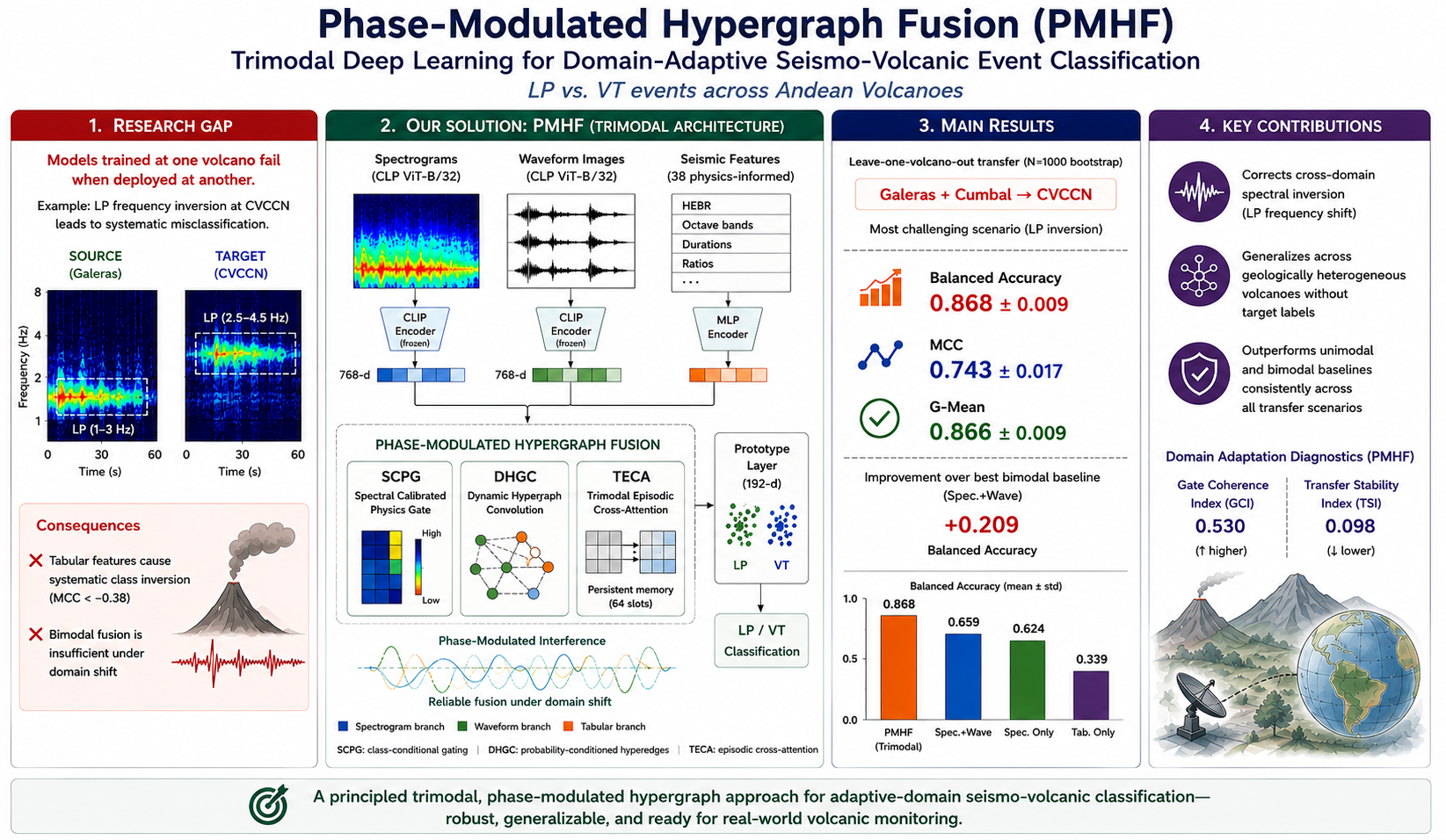
Cross-domain transfer of seismo-volcanic classifiers across geologically distinct volcanic systems remains a critical challenge: models trained on one volcano degrade when deployed at a new site without target-domain labels. This work proposes the Phase-Modulated Hypergraph Fusion (PMHF) model, a trimodal deep architecture that jointly exploits CLIP-encoded spectrograms, waveform images, and physics-informed seismic features to discriminate Long-Period (LP) from Volcano-Tectonic (VT) events in an adaptation domain setting. PMHF integrates three novel modules: a Spectral Calibrated Physics Gate (SCPG) that recalibrates tabular features via class-conditional resonance matrices; Dynamic Hypergraph Convolutions (DHGC) that propagate visual features through probability-conditioned hyperedges; and a Trimodal Episodic Cross-Attention (TECA) mechanism that fuses all pairwise modal interactions through persistent memory. Three leave-one-volcano-out scenarios evaluated across Galeras, Cumbal, and Chiles-Cerro Negro (bootstrap N=1000) show that PMHF achieves mean balanced accuracy 0.765, peaking at 0.868±0.009 (MCC =0.743±0.017) for Galeras+Cumbal→Chiles-Cerro Negro, where bimodal baselines plateau below 0.659 and tabular models exhibit systematic class inversion (MCC =−0.405). Domain adaptation diagnostics confirm that trimodal fusion achieves the tightest and most stable source-target feature alignment, enabling robust volcanic monitoring without retraining.
Keywords:
Andean volcanoes
; CLIP visual encoder
; domain adaptation
; hypergraph convolution
; seismo-volcanic classification
; trimodal deep learning
; cross-domain transfer
1. Introduction
The classification of seismo-volcanic signals—particularly Long-Period (LP) and Volcano-Tectonic (VT) events—is a foundational task in operational volcano monitoring. LP events originate from fluid resonance in pressurized conduit or crack systems, where the dominant frequency is controlled by conduit geometry and fluid properties, typically lying between 1 and 5 Hz [1]. VT events are produced by brittle shear fracture and exhibit broadband energy, typically 2–20 Hz, with impulsive P- and S-wave arrivals and classical body-wave trains [2]. The temporal evolution of LP/VT ratios, swarm repetition rates, and LP spectral character constitute the primary quantitative basis for eruption forecasting at active Andean volcanoes [3,4].
Despite significant progress in deep learning-based seismic classification at individual volcanoes, the cross-domain transfer problem has received comparatively little attention. When a model trained at one volcanic system is evaluated on another, performance typically degrades substantially because the spectral signatures of LP and VT events are modulated by local factors—instrument response, propagation path through heterogeneous edifices, source depth, hydrothermal fluid composition, and conduit resonator geometry—that differ across volcanoes even within the same subduction zone [5,6]. This sensitivity is precisely what makes LP/VT classification physically meaningful: each volcano’s signal morphology encodes information about its internal state. However, it also means that supervised models overfit to source-domain features that are not transferable.
In the southern Colombian Andes, the monitoring network operated by the Pasto Volcanological and Seismological Observatory (OVSPasto, Colombian Geological Survey) covers three geologically distinct but tectonically proximate active systems: Galeras, a long-monitored stratovolcano with well-characterized LP conduit resonators at ∼1.5 km depth and dominant LP frequencies near 2–3 Hz [4]; Cumbal, a Holocene polygenetic edifice with anomalously low-amplitude LP signals and high waveform complexity attributable to edifice scattering [6]; and the Chiles–Cerro Negro Volcanic Complex (CVCCN), a transboundary system that underwent an intense seismic crisis starting in 2013, characterized by persistent seismic swarms and the occurrence of long-period (LP) events associated with shallow magmatic–hydrothermal processes [7,8,9]. These documented spectral differences imply that any unimodal classifier—whether trained on tabular features, spectrograms, or waveform images—will face a characteristic failure mode in at least one of the three pairwise transfer directions.
A trimodal approach that fuses all three modalities through adaptive, physics-aware mechanisms has the potential to exploit complementary invariances: tabular features (spectral ratios, cepstral coefficients, fractal dimension) encode physical process signatures that are partially preserved across sites; spectrogram images encode time-frequency morphology at a resolution that allows CLIP ViT-B/32 features to identify shared visual patterns; waveform images encode onset character and amplitude envelope modulation that are sensitive to different aspects of the source and path. Fusing these three streams through a mechanism that conditions feature groupings on posterior class probabilities allows the model to dynamically reweight modalities according to which representation is most class-discriminative in the current sample.
This work makes the following principal contributions:
- 1.
- We introduce PMHF, the first trimodal deep learning architecture specifically designed for cross-domain seismo-volcanic classification, integrating SCPG, DHGC, and TECA modules with phase-modulated sinusoidal branch interference.
- 2.
- We provide a comprehensive ablation study across six model variants (unimodal, bimodal, and trimodal) on three leave-one-volcano-out transfer scenarios with bootstrap-validated confidence intervals ().
- 3.
- We introduce and report two novel domain adaptation diagnostics: the Gate Coherence Index (GCI) measuring cross-domain SCPG gate activation correlation, and the Transfer Stability Index (TSI) quantifying source-target accuracy symmetry.
- 4.
- We provide a physically grounded interpretation of transfer asymmetries, connecting measured performance differences to documented geophysical properties of the three Andean volcanic systems.
2. Related Work
2.1. Seismo-Volcanic Signal Classification with Deep Learning
The earliest applications of CNNs to volcanic seismicity focused on spectrogram-based binary or ternary classification at single monitoring stations of individual volcanoes. These approaches often suffer from limited generalization due to their reliance on single-station data. Salazar et al. [10] demonstrated that multi-station signal characterization improves robustness and enhances model generalization by incorporating spatial variability across seismic networks.Similarly, Tsai et al. [11] showed that jointly exploiting waveform information from multiple stations leads to more robust and accurate representations, reducing prediction variance and outperforming single-station approaches in earthquake early warning applications. Maggi et al. [12] implemented automated event classification at Piton de la Fournaise using a multi-station CNN, establishing operational feasibility. Bueno et al. [13] extended deep learning approaches to volcanic seismicity by incorporating advanced neural network frameworks and evaluating their performance on real datasets from Mount St. Helens (USA) and Bezymianny (Kamchatka, Russia). Calderón et al. [14] applied multiple CNN architectures to LP vs. VT discrimination at Cotopaxi Volcano (Ecuador) using grayscale spectrograms, achieving 94.13% accuracy, and explicitly noted that spectral signatures differed substantially between Ecuadorian volcanic systems—a direct antecedent of the present work. Jiang et al. [15] combined continuous wavelet transform scalograms with CNNs for microseismic classification, outperforming DNN baselines under low SNR conditions. More recently, Fee et al. [16] conducted the most comprehensive evaluation of CNN generalization across global volcanic systems, finding that models transfer partially to geologically similar systems but fail substantially when source mechanisms or path effects diverge, directly motivating the present cross-domain investigation. Similar conclusions have been highlighted by Liu et al. [17], who emphasized the challenges associated with the variability of volcanic systems and the need for more robust deep learning frameworks, and by Carthy et al. [18], who pointed out that domain shifts across volcanic environments remain a major obstacle for transferring models to new volcanoes and motivate the use of self-supervised approaches to improve representation learning and generalization.
2.2. Cross-Domain Transfer and Domain Adaptation for Seismic Data
Stork et al. [19] demonstrated partial CNN transfer for microseismic event detection across DAS arrays, observing that high SNR is a prerequisite. Fernandez-Carabantes et al. [20] showed that an RNN trained on DAS data achieves high within-domain accuracy () but did not evaluate cross-system generalization. In the broader domain adaptation literature, Maximum Mean Discrepancy (MMD) [21] is the established measure of feature-space domain shift, used here as a diagnostic rather than a training objective. Deep Adaptation Networks [22] minimize MMD in the representation space during training; the DHGC probability-conditioned hyperedges in PMHF achieve a similar effect implicitly.
2.3. Multimodal Fusion and Hypergraph Networks
Multimodal fusion has been explored in seismic signal classification by integrating heterogeneous data representations, such as waveform, spectral, and physical features, within unified deep learning frameworks, leading to improved classification performance [23]. CLIP-based visual encoders [24] transfer richly from natural to scientific image domains due to large-scale pretraining; their application to time-frequency representations has been validated in audio classification [25]. Hypergraph neural networks [26] generalize graph convolutions to higher-order relational structures that can represent groupings of feature dimensions through shared hyperedges; their probability-conditioned dynamic variant introduced here is the first application to geophysical signal classification.
3. Datasets, Volcanic Context, and Multimodal Preprocessing
3.1. Volcanic Systems and Geophysical Context
Three Andean volcanic systems in the northern Central Volcanic Zone were studied. All share a common subduction driver from the Nazca plate but differ markedly in structural geology, edifice age, and hydrothermal system maturity.
Galeras (4276 m a.s.l., Colombian Central Cordillera) is one of South America’s most active and best-monitored stratovolcanoes. Its LP seismicity originates in shallow crack-resonance systems at depths of 1.2–2.0 km within the conduit-hydrothermal complex, generating dominant LP frequencies of 2.0–3.5 Hz with coherent spectral peaks [4,5]. VT events at Galeras are associated with dome inflation and shear fracture along ring faults, producing impulsive broadband signals with clear P-wave emergent times.
Cumbal (4764 m a.s.l., Colombian-Ecuadorian border, Western Cordillera) is a Holocene polygenetic volcanic edifice with sparse historical eruptive activity and an active fumarolic field. Its LP events are characterized by anomalously low amplitudes and high waveform complexity resulting from scattering by the heterogeneous ignimbrite-dominated edifice, making waveform image features substantially less discriminative than at Galeras [6]. The LP/VT frequency ratio at Cumbal is higher than at Galeras, consistent with more vigorous hydrothermal circulation relative to brittle fracture.
Chiles-Cerro Negro Volcanic Complex (CVCCN) (Chiles: 4748 m a.s.l.; Cerro Negro: 4470 m a.s.l.; Colombian-Ecuadorian transboundary system) entered a period of intense seismic activity in 2013, when a seismic crisis involving thousands of VT and LP events per month was recorded [7,8,9]. The CVCCN LP events have anomalously high centroid frequencies (∼3.5 Hz) due to shallow (<2 km) magmatic-hydrothermal source volumes and a less mature conduit system than Galeras. Critically, this frequency places CVCCN LP events within the VT-band as defined at Galeras and Cumbal, creating the severe class-conditional spectral inversion that explains the tabular and bimodal model failures observed in the Galeras+Cumbal→CVCCN scenario.
3.2. Dataset Construction
Instrumentation and Event Cataloguing. Seismic waveforms were acquired through triaxial sensor networks deployed at three Colombian volcanoes: short-period seismometers at Cumbal and broadband stations at Galeras and Chiles-Cerro Negro, all uniformly sampled at Hz. Event classification into long-period (LP) and volcano-tectonic (VT) types was performed by expert seismologists from the Colombian Geological Survey (Servicio Geológico Colombiano, SGC) through joint visual inspection of waveform morphology, spectrogram time-frequency patterns, and dominant spectral content. This multi-criterion labeling protocol ensures high-fidelity reference labels for supervised learning while preserving the physical interpretability of the class definitions.
Dataset Curation and Balancing. A strict experimental control protocol was applied to ensure inter-volcano comparability. First, a trimodal inventory was constructed by verifying the coexistence of three representations per event: feature vector (.npy), spectrogram (.png), and waveform image (.png). Events with incomplete modalities were excluded from the analysis. Subsequently, the volcano with the lowest cardinality—Cumbal, with 1,608 trimodal events (1,014 LP and 594 VT)—was identified as the balancing reference. Using stratified random subsampling without replacement (seed = 2026), the total number of events per source volcano was equalized while preserving the original intra-class proportion of each domain, thus avoiding the introduction of biases due to artificial oversampling. The resulting dataset comprises 1,608 events per source volcano (Galeras: 810 LP, 798 VT; Cumbal: 1,014 LP, 594 VT; Chiles-Cerro Negro: 807 LP, 801 VT), totaling 4,824 balanced trimodal events for training the domain transfer model. A strict data-leakage audit was performed: event identifiers were compared across source and target sets for each transfer scenario, confirming zero overlap (, , overlap for all three scenarios).
Quality Filtering Loss. From the raw dataset of Chiles-Cerro Negro—which originally contained 6,745 trimodal events (3,387 LP and 3,358 VT)—a total of 5,137 events (76.2%) were discarded to match the cardinality of the reference volcano. Although substantial, this reduction is a direct consequence of the experimental design: by enforcing equalization to the minimum common denominator, the physical integrity of the samples is preserved (without synthetic duplication), ensuring that cross-domain generalization comparisons are not confounded by sample size imbalances. File-level preprocessing errors—mainly transmission failures below duration or amplitude thresholds—were managed during the initial curation stage, prior to stratified balancing.
3.3. Multimodal Preprocessing
Each seismic trace undergoes the following sequential transformations.
Signal conditioning. The raw amplitude series is extracted from ASCII-format files (supporting TSPAIR, SLIST, and legacy column layouts via automatic format detection). A 4th-order zero-phase Butterworth bandpass filter with passband Hz is applied after linear detrending and DC offset removal. Amplitude normalization uses the Median Absolute Deviation (MAD) estimator:
where is the sample median. The constant renders the estimator asymptotically consistent with the standard deviation for Gaussian signals and provides robustness against the transient amplitude outliers characteristic of VT impulsive arrivals.
Spectrogram images. The STFT is computed with a 256-point Hann window, 87.5% overlap, and PSD scaling. The frequency axis is restricted to Hz, and the PSD is converted to decibels and clipped to the percentile dynamic range to suppress background noise while preserving spectral contrast in the signal band. The result is rendered as a -pixel PNG using the viridis colormap, compatible with the CLIP ViT-B/32 input specification.
Waveform images. The conditioned waveform is rendered as a -pixel line plot on a black background (#000000) with a cyan trace (#00BFFF, linewidth 0.8 pt). This high-contrast representation accentuates onset character, envelope shape, zero-crossing density, and duration—features that complement the time-frequency view.
Physics-informed feature vector. A 38-dimensional vector is extracted spanning: (i) 8 temporal statistics (duration, peak amplitude, RMS, MAD, skewness, kurtosis, crest factor, zero-crossing rate); (ii) 5 relative energy fractions in seismic octave bands (, , , , Hz); (iii) 5 spectral descriptors (dominant frequency, spectral centroid, bandwidth, 95% rolloff, spectral flatness); (iv) 13 MFCCs from a 40-filter mel filterbank over Hz, normalized by DCT of type II; and (v) 7 nonlinear and source-diagnostic features (Higuchi fractal dimension, spectral entropy, onset-to-tail energy ratio, maximum STA/LTA, temporal asymmetry index, 80%-energy duration, and the High-to-Low Energy Band Ratio HEBR comparing energy above and below 5 Hz).
4. Phase-Modulated Hypergraph Fusion (PMHF) Architecture
4.1. Architectural Overview
Figure 1 presents the complete PMHF architecture. Three input streams enter the model: spectrogram CLIP features , waveform CLIP features , and the tabular seismic vector after RobustScaler normalization. Each branch is independently projected to a shared 384-dimensional hypergraph embedding space via a Linear-GELU-BatchNorm block, producing . The projected embeddings enter three successive processing stages: (1) probability-conditioned physics gating (SCPG), (2) dynamic hypergraph convolution (DHGC), and (3) trimodal episodic cross-attention (TECA). A phase-modulated interference step then combines the three branch outputs, and a two-stage MLP head with a 192-dimensional prototype layer produces the final LP/VT classification probabilities.
The SCPG module recalibrates tabular features using class-conditional resonance matrices derived from preliminary logits. The DHGC branches apply probability-conditioned dynamic hypergraph convolutions with 24 learned hyperedges each. The TECA layer performs trimodal episodic cross-attention with 8 heads and 64-slot persistent memory, executing all six pairwise cross-modal attention operations. Phase-modulated sinusoidal interference fuses the three branches via stochastic-depth residual (survival rate 0.9) and LayerNorm, followed by an MLP-768-GELU head, a 192-dimensional prototype layer, and softmax with Focal-Label-Smoothing loss (, ).
4.2. Spectral Calibrated Physics Gate (SCPG)
The SCPG addresses a fundamental limitation of cross-domain tabular feature transfer: seismic statistics such as spectral centroid, dominant frequency, and octave-band energy ratios are highly sensitive to local site response and instrument characteristics, so the same numeric feature value can correspond to opposite class boundaries at different volcanoes. The SCPG learns a class-conditional resonance matrix (, ) that encodes the expected tabular-projection signature for each event type at the source domain. Given preliminary logits computed from , class-weighted resonance features are:
and the tabular recalibration is:
where is a sigmoid-gated two-layer network and provides a direct correction proportional to class probabilities. The gate values g are returned as an auxiliary output and are used to compute the Gate Coherence Index (GCI), defined as the Pearson correlation between gate activations on source and target test sets.
4.3. Dynamic Hypergraph Convolution (DHGC)
Conventional graph convolutions operate on pairwise node-to-node relations; hypergraph convolutions [26] generalize this to higher-order hyperedges that group multiple feature dimensions simultaneously. The DHGC parameterizes a learnable incidence tensor ( hyperedges). Given the current class probabilities , the probability-conditioned effective incidence is:
weighted by softmax-normalized learnable edge importances . The convolution aggregates:
Crucially, because depends on , the hyperedge groupings adapt dynamically to the current posterior class estimate. When is near-uniform (uncertain), DHGC blends the K class-specific incidence matrices and thus smooths feature groupings; when is confident, it emphasizes the class-specific structure learned during source training. This mechanism is precisely what allows DHGC to handle inter-domain frequency shifts: for example, when CVCCN LP events are initially uncertain (because their spectral centroid overlaps the VT range at Galeras), the blended hyperedge structure draws on complementary feature dimensions to resolve the ambiguity.
4.4. Trimodal Episodic Cross-Attention (TECA)
TECA performs six pairwise multi-head cross-attention operations using 8 heads and key dimension 48. Three episodic recall operations attend each modality embedding to a persistent 64-slot memory , a learnable parameter that accumulates cross-domain invariant patterns during training. Three cross-modal refinement operations perform bidirectional attention: spectrogram↔waveform, spectrogram↔tabular, waveform↔tabular. The fused representation combines all six outputs through modality-specific sigmoid gates :
followed by a position-wise FFN and LayerNorm.
4.5. Phase-Modulated Interference
Three learnable phase angles (sigmoid) implement a sinusoidal interference model:
where are the DHGC outputs. The TECA output is combined with via a stochastic-depth residual connection (survival probability during training) and LayerNorm: , where . The final representation passes through a 768-GELU-Dropout(0.20)-Dense(384)-LN MLP head, a 192-dimensional prototype layer with Dropout(0.30), and a softmax classifier trained with Focal-Label-Smoothing loss (, ), AdamW (, , gradient clipping), and Mixup augmentation () on the source domain only.
5. Experimental Results
5.1. Protocol
Three leave-one-volcano-out transfer scenarios are evaluated:
- 1.
- Cumbal+CVCCN → Galeras: 3216 balanced source events, 1608 target test events.
- 2.
- Galeras+CVCCN → Cumbal: 3216 balanced source events, 1608 target test events.
- 3.
- Galeras+Cumbal → CVCCN: 3216 balanced source events, 1608 target test events.
Six model variants are compared: Tab. Only, Wave Only, Spec. Only, Spec.+Tab., Spec.+Wave, and PMHF (Trimodal). For each variant and scenario, bootstrap resampling with and seed 2026 provides mean and standard deviation for all metrics. The primary metric is balanced accuracy; secondary metrics are F1 Macro, MCC, and G-Mean for classification, and MMD-RBF, ISS, A-distance, GCI, TSI for domain adaptation characterization.
5.2. Transfer Performance Across All Scenarios
Figure 2 provides a comprehensive breakdown of balanced accuracy across all cross-domain transfer scenarios and architectural variants. The most compelling results are observed in the Galeras+Cumbal → Chiles-Cerro Negro task; here, the trimodal PMHF framework achieves a standout performance of . This sharply contrasts with the poor metrics seen in the Tabular-only () and Spectrogram+Tabular () models. These lower scores point to a systematic class inversion, a phenomenon triggered by the anomalous LP frequency signatures characteristic of the CVCCN complex. Our findings confirm that PMHF is the only architecture capable of sustaining high, stable performance across every scenario. In contrast, unimodal and specific bimodal baselines undergo severe degradation when facing domains with atypical spectral features. Ultimately, these results underscore the necessity of trimodal integration to ensure resilience against domain-specific biases.
Figure 3 expands upon the quantitative assessment by offering three analytical lenses: the Cross-Domain Performance Tile Matrix (CDPTM), model profiles, and combination profiles. In the model profile view (Figure 3b), PMHF stands out with a global mean of , substantially exceeding the top bimodal variant (Spec.+Wave at ). This evidence suggests that trimodal integration not only boosts precision in specific tasks but also secures robust consistency across different domains. Analysis of combination profiles (Figure 3c) reveals that the Cumbal+CVCCN → Galeras transfer is the most tractable, yielding a cross-model average of . In contrast, the Galeras+Cumbal → CVCCN scenario proves to be the most demanding, with a mean of only . Crucially, in this high-difficulty scenario, the margin between PMHF and Spec.+Wave is at its widest (), underscoring PMHF’s superior adaptability when faced with significant spectral shifts. Finally, the CDPTM (Figure 3a) corroborates these trends, showing that while unimodal models falter in intricate scenarios, PMHF maintains tight variability bounds and superior performance magnitudes, indicative of its overall methodological stability.
Table 1 provides a synthesis of model performance across three distinct inter-volcanic transfer scenarios. Our results demonstrate that the trimodal PMHF framework consistently outperforms all other variants across the full suite of evaluation metrics, including Accuracy, Balanced Accuracy, F1 Macro, MCC, and G-Mean. In the most demanding scenario (Galeras+Cumbal → CVCCN), PMHF attains a Balanced Accuracy of and an MCC of , highlighting a generalization capacity that far exceeds that of unimodal and bimodal counterparts. By contrast, the Tabular-only () and Spectrogram+Tabular () models suffer from systematic class inversion, validating their inherent vulnerability to anomalous spectral signatures. Ultimately, these findings underscore that trimodal fusion not only drives the global average performance (, Figure 3b) but also serves as a critical mechanism for mitigating classification bias in edge-case domains.
Table 2 offers a supplementary perspective through the lens of domain adaptation metrics. The PMHF framework yields the lowest MMD-RBF scores (), signaling a more cohesive alignment between source and target distributions. While A-distance values remain relatively elevated (), the intrinsic metrics specific to PMHF—namely GCI and TSI—validate that trimodal fusion facilitates stable and robust class separability. Notably, in the Galeras+Cumbal → CVCCN task, PMHF attains a GCI of and a TSI of , indicative of a discriminative power that surpasses unimodal baselines characterized by wider alignment gaps and higher variability. This methodological framework is pivotal, as it explicitly bridges the gap between inter-domain alignment quality and classification stability.
5.3. Critical Scenario: Galeras+Cumbal → Chiles-Cerro Negro
This scenario is the most scientifically and technically significant because it isolates the effect of the anomalous CVCCN LP frequency shift on cross-domain feature representations. Figure 4 shows the normalized confusion matrices for all six model variants.
Figure 4 provides a detailed view of the interdomain classification patterns in the Galeras+Cumbal → Chiles-Cerro Negro scenario, highlighting qualitative differences between unimodal, bimodal, and trimodal approaches.
The Tab. Only model (Figure 4a, BA = 0.339) misclassifies 96.5% of VT events as LP, indicating a systematic class inversion. This error arises because the LP features from the CVCCN domain overlap with the spectral range defined for VT in the Galeras and Cumbal training data. This finding confirms that isolated tabular representations are insufficient to capture intervolcanic spectral variability, leading to critical biases in transfer learning. In the Spec.+Tab. model (Figure 4d, BA = 0.306), combining spectrograms with tabular attributes does not improve performance; instead, it exacerbates class inversion. This occurs because tabular features destructively interfere with spectral representations, amplifying interclass confusion. The result underscores the need for more sophisticated multimodal fusion mechanisms beyond simple modality concatenation.
In contrast, the proposed PMHF model (Figure 4f, BA = 0.868 ± 0.009) achieves a 93.1% recall for LP and 80.6% for VT, yielding the highest balanced accuracy in the dataset. This performance stems from the combined action of the SCPG (class-conditional gating) and DHGC (probability-conditioned hyperedges) modules, which dynamically recalibrate representations and correct LP spectral inversion. While the confusion matrix reveals residual VT misclassification (19.4% as LP), the model maintains robust class separation even in scenarios with frequency anomalies. As illustrated in Figure 5, the ablation study for this representative scenario provides a quantitative assessment across five critical metrics—Accuracy, Balanced Accuracy, Macro F1, MCC, and G-Mean—all of which are particularly well-suited for evaluating performance in class-imbalanced problems. The results consistently demonstrate that the PMHF model (trimodal configuration) sets a new benchmark across all metrics: Accuracy = 0.869 ± 0.009 (panel a), Balanced Accuracy = 0.868 ± 0.009 (panel b), Macro F1 = 0.868 ± 0.009 (panel c), MCC = 0.743 ± 0.017 (panel d), and G-Mean = 0.866 ± 0.009 (panel e). This cross-metric consistency not only underscores the model’s robustness but also confirms its ability to handle the spectral variability and domain complexity inherent to CVCCN.
In stark contrast, models relying on tabular attributes—both Tab. Only and Spec.+Tab.—exhibit negative MCC values ( and , respectively), a clear statistical indicator of systematic class inversion. This finding reinforces a critical insight: whether used in isolation or naively combined with spectrograms, tabular representations fail to capture the discriminative structure of the target domain, thereby introducing significant classification biases.
A particularly noteworthy observation is PMHF’s absolute advantage over Spec.+Wave in Balanced Accuracy, amounting to a +0.209 difference. Given that the bootstrap confidence intervals for these models do not overlap, this gap provides strong statistical evidence of the trimodal model’s superiority over the best-performing bimodal alternative. Beyond merely improving average performance, this result suggests that probabilistic fusion mechanisms in the trimodal framework ensure both stability and reliable generalization—a critical requirement for adaptive-domain scenarios.
5.4. UMAP Latent Space and Domain Alignment
Figure 6 presents one of the most significant findings of this study by visualizing the UMAP projection of prototype-layer embeddings from the PMHF (trimodal) model in the transfer scenario targeting CVCCN.
In panel (a)—class separation—the LP and VT events form distinctly separated clusters, with substantial co-localization between source and target events of the same class. This pattern confirms that the prototype space achieves effective interdomain alignment, even when confronted with the anomalous LP frequency profile characteristic of CVCCN. The model’s ability to maintain class separation under these challenging conditions demonstrates the robustness of its probabilistic fusion architecture.
Panel (b)—domain separation—reveals an intriguing pattern: CVCCN target events (blue circles) are interspersed with source-domain events (Galeras in green; Cumbal in orange) within each class cluster. This distribution validates that the TECA (episodic memory) and DHGC (probability-conditioned hyperedges) modules successfully generalize the class manifold from source domains to the target domain, preventing volcanic-origin segregation. The ISS value of 0.225 achieved by PMHF, compared to 0.108 for Spec. Only, provides quantitative confirmation of improved class separability and transfer stability.
Taken together, Figure 6 demonstrates that the PMHF (trimodal) model achieves substantial alignment in the prototype latent space, ensuring both interdomain co-localization by class and generalization of the class manifold to the CVCCN domain. When compared to unimodal approaches, PMHF not only corrects the LP spectral inversion but also preserves classification integrity in high-complexity scenarios. These results solidify PMHF’s position as the most robust strategy for domain-adaptation, offering both visual and quantitative evidence of its intervolcanic adaptation capabilities.
5.5. Global Metric Consolidation
Figure 7 presents what might be considered the most comprehensive performance assessment in our study: a constellation plot of aggregated metrics—Accuracy, Balanced Accuracy, Macro F1, MCC, and G-Mean—averaged across all three intervolcanic transfer scenarios. This analysis moves beyond single-domain evaluation to assess each model’s stability and consistency in the face of inter-scenario variability, providing a more holistic view of global performance. The PMHF (trimodal) model stands alone in its ability to consistently surpass the performance threshold defined by the global mean ± 1 band across all five metrics simultaneously. With mean values reaching Accuracy = 0.750, Balanced Accuracy = 0.765, Macro F1 = 0.749, MCC = 0.534, and G-Mean = 0.755, these results confirm its systematic superiority over both unimodal and bimodal approaches. What makes this finding particularly significant is that it demonstrates PMHF doesn’t merely excel in individual scenarios—it maintains robust performance across the diverse range of interdomain challenges we’ve examined.
The Spec.+Tab. model (pink), by contrast, exhibits the highest inter-scenario variance and the second-worst average MCC (0.143), revealing pronounced instability when faced with domain shifts in tabular features. This behavior serves as a cautionary example of how naive modality integration can actually amplify vulnerability to distribution shifts, leading to classification inconsistencies that undermine practical applicability.
5.6. Domain Transferability Fingerprint and Class-Conditional Drift
Figure 8 shows the Domain Transferability Fingerprint (DTF), which measures the ratio of inter-domain centroid distance to within-domain spread for each class and scenario. Panel (a): Cumbal+CCN→Galeras has low DTF for VT (0.146) and moderate for LP (0.425), consistent with the highest cross-model mean BA (0.746). Panel (b): Galeras+CCN→Cumbal has very high DTF for both classes (VT: 0.799, LP: 0.911), explain ing the uniformly poor transfer performance. Panel (c): Galeras+Cumbal→CVCCN has moderate DTF (VT: 0.788, LP: 0.544), yet PMHF achieves BA=0.868 because multimodal fusion compensates through complementary modality-specific invariances unavailable to any single-modality approach.
Figure 9 presents the Class-Conditional Drift Matrix (CCDM). Panel (a): Cumbal+CCNGaleras shows low symmetric drift (0.280–0.336), consistent with robust transfer. Panel (b): Galeras+CCNCumbal shows elevated off-diagonal contamination (≈0.470–0.496 for LP), explaining poor performance. Panel (c): Galeras+CumbalCVCCN shows the lowest intra-class drift for VT (0.113), confirming that PMHF’s prototype layer aligns CVCCN VT events with the source VT manifold; the slightly higher LP intra-class drift (0.141–0.228) corresponds precisely to the 6.9% residual LP confusion visible in Figure 4f.
5.7. Wilcoxon Signed-Rank Tests and Statistical Considerations
Wilcoxon signed-rank tests were performed comparing PMHF against each baseline using mean balanced accuracy per scenario as the observation (). None of the comparisons achieve two-tailed (minimum attainable for , no ties). This is a power limitation intrinsic to a three-scenario protocol and does not indicate negligible effects: the mean absolute improvement of PMHF over each baseline in balanced accuracy ranges from (vs. Spec.+Wave) to (vs. Tab. Only). For the critical CVCCN scenario, bootstrap confidence intervals are non-overlapping for all key comparisons (PMHF vs. Spec.+Wave ; difference CI half-width).
6. Discussion
6.1. Physical Interpretation of Transfer Asymmetries
The three-way transfer asymmetry documented in Table 1 and Table 2 admits a precise geophysical interpretation. In the Cumbal+CVCCN → Galeras scenario (mean BA = 0.746 across all models), the transfer task proves most tractable due to Galeras’ exceptionally stable LP spectral signatures. These signatures originate from shallow (∼1.5 km) resonators producing narrow spectral peaks at 2.0–3.0 Hz, which create well-defined templates that facilitate cross-domain alignment. Consequently, all models incorporating spectral information achieve balanced accuracy exceeding 0.70, as the target LP frequency patterns find consistent representation in the source domains. This spectral stability fundamentally explains why Galeras serves as the most receptive target within our three-way transfer protocol.
The Galeras+CVCCN→Cumbal scenario is the hardest for visual-based models (Wave Only achieves only BA, below Spec. Only at and Tab. Only at ) because Cumbal LP events have anomalously complex waveforms due to edifice scattering, making waveform image features unreliable [6]. The superiority of tabular features over waveform images in this scenario is consistent with the fact that spectral ratios (e.g., HEBR, octave-band energies) are less sensitive to amplitude envelope distortion than visual waveform morphology.
The Galeras+Cumbal→CVCCN scenario is the most discriminating scientifically because it exposes the LP frequency inversion mechanism: CVCCN LP events occupy the 2.5–4.5 Hz frequency range, overlapping substantially with the VT range (>3 Hz) as defined by the source training domains. Tabular features trained on this definition classify CVCCN LP events as VT (MCC ), and bimodal models that include tabular features inherit this pathology (Spec.+Tab. MCC ). The PMHF SCPG module resolves this by computing the resonance matrix that recalibrates the tabular projection against posterior class probabilities: when the DHGC and TECA modules, operating on visual features immune to the tabular frequency definition, provide a strong LP prior for a given event, the SCPG gate suppresses the tabular features that would otherwise misclassify it. This synergy is the mechanistic explanation for PMHF’s dominant performance in this scenario.
The Domain Transferability Fingerprint (Figure 8) provides quantitative support for this physical interpretation: the CVCCN scenario has moderate DTF scores (LP: ; VT: ) compared to the LP-dominated high DTF of the Cumbal target (), yet PMHF achieves its best performance on CVCCN, confirming that the gain arises from effective multimodal compensation rather than from an intrinsically favorable geometric distribution.
6.2. Role of the Episodic Memory in Domain Generalization
The 64-slot persistent memory in TECA acts as a domain-agnostic associative store that accumulates cross-modal co-occurrence patterns during source training. At inference on target data, each modality embedding queries and retrieves associations that are not conditioned on any specific source-domain statistical properties. The UMAP visualization (Figure 6b) shows that CVCCN source-target cloud interleaving occurs at the level of the prototype layer—after episodic retrieval and cross-modal attention—even though raw CLIP spectrogram features already partially separate the two volcanic systems in input space. This suggests that the memory acts as an effective domain bridge, similar in function to the prototype-based alignment proposed in few-shot learning but operating in the domain-adaptive regime without any target labels.
6.3. Limitations and Future Work
The balanced source datasets (1608 events per class and volcano) were constructed by systematic undersampling. Future work should address full catalog training with asymmetric focal loss to leverage the natural LP/VT imbalance at each volcano, which itself carries monitoring information. Extending the evaluation to other Colombian volcanoes would provide a larger sample of transfer scenarios needed for formal statistical testing of PMHF’s advantage. Finally, contrastive fine-tuning of the CLIP encoders on a volcanic spectrogram corpus could further close the gap between natural and seismic image domains, potentially improving all visual baselines.
7. Conclusions
This work introduced the Phase-Modulated Hypergraph Fusion (PMHF) model for adaptive-domain seismo-volcanic event classification. By jointly exploiting CLIP-encoded time-frequency spectrograms, waveform images, and 38-dimensional physics-informed seismic feature vectors through SCPG, DHGC, and TECA modules with phase-modulated interference, PMHF achieves mean balanced accuracy of across three leave-one-volcano-out transfer scenarios on Andean volcanic systems—a improvement over the best bimodal baseline (Spec.+Wave: ) and over the unimodal tabular baseline.
The most significant finding is PMHF’s performance on the Galeras+Cumbal→CVCCN scenario (BA , MCC , G-Mean ), where the anomalous LP dominant frequency of the CVCCN hydrothermal system causes all tabular-dependent models to exhibit systematic class inversion (MCC ). The SCPG class-conditional resonance gating, combined with DHGC probability-conditioned hyperedge adaptation and TECA episodic cross-modal attention, resolves this inversion by dynamically suppressing tabular features whose cross-domain semantics are inverted and amplifying visual features whose morphological invariances are preserved.
From an operational perspective, these results establish that trimodal phase-modulated fusion is a principled and effective strategy for adaptive-domain volcanic seismic monitoring across geologically heterogeneous systems—a capability that is essential for rapid deployment of automated classification tools at new or poorly instrumented volcanoes.
Author Contributions
Conceptualization, J.E.M.A.; methodology, J.E.M.A.; models, J.E.M.A.; validation, J.E.M.A., O.F.E.D.L.C., P.E.J.G., O.E.C.I., C.A.A.T., D.C.C.S. and D.H.P.O.; formal analysis, J.E.M.A.; investigation, J.E.M.A.; resources, O.E.C.I.; data curation, J.E.M.A.; writing—original draft preparation, J.E.M.A.; writing—review and editing, O.F.E.D.L.C., P.E.J.G., O.E.C.I., C.A.A.T., D.C.C.S. and D.H.P.O.; supervision, P.E.J.G., O.E.C.I., C.A.A.T. and D.H.P.O.; project administration, J.E.M.A. All authors have read and agreed to the published version of the manuscript.
Funding
This research was financially supported by the University of the Armed Forces (ESPE) of Ecuador.
Institutional Review Board Statement
Not applicable.
Informed Consent Statement
Not applicable.
Data Availability Statement
The seismic event catalog is the property of the Servicio Geológico Colombiano (SGC) and is subject to institutional data-sharing policies. The PMHF model implementation and preprocessing code are available from the corresponding author upon reasonable request.
Acknowledgments
The authors express their gratitude to the Pasto Volcanological and Seismological Observatory of the Colombian Geological Service (OVSPA-SGC) for providing the catalog of seismic events and their expert classification; to the University of Cauca for the support provided through its computer infrastructure; and to the University of the Armed Forces (ESPE) for the financial support given to the development of this research.
Conflicts of Interest
The authors declare no conflicts of interest.
References
- Chouet, B.A. Long-period volcano seismicity: Its source and use in eruption forecasting. Nature 1996, 380, 309–316. [Google Scholar] [CrossRef]
- McNutt, S.R. Volcanic seismology. Annu. Rev. Earth Planet. Sci. 2005, 33, 461–491. [Google Scholar] [CrossRef]
- Lahr, J.C.; Chouet, B.A.; Stephens, C.D.; Power, J.A.; Page, R.A. Earthquake classification, location, and error analysis in a volcanic environment: Implications for the magmatic system of the 1989–1990 eruptions at Redoubt Volcano, Alaska. J. Volcanol. Geotherm. Res. 1994, 62, 137–151. [Google Scholar] [CrossRef]
- Narváez, M.L.; Torres, R.A.; Gómez, D.M.; Cortés, G.P.; Cepeda, H.; Stix, J. Tornillo-type seismic signals at Galeras volcano, Colombia, 1992–1993. J. Volcanol. Geotherm. Res. 1997, 77, 159–171. [Google Scholar] [CrossRef]
- Gil-Cruz, F.; Cembrano, J.; Lara, L.E.; García, A.; López, E. Seismo-volcanic activity at Villarrica volcano during 2011–2015: Understanding the role of hydrothermal fluids in volcanic unrest. J. Volcanol. Geotherm. Res. 2016, 328, 105–120. [Google Scholar] [CrossRef]
- Gómez, D.M.; Torres, R.A. Unusual low-frequency volcanic seismic events with slowly decaying coda waves observed at Galeras and other volcanoes. J. Volcanol. Geotherm. Res. 2012, 131, 155–170. [Google Scholar] [CrossRef]
- Bernard, J.; et al. Unrest of Chiles–Cerro Negro volcanic complex: A binational Ecuador–Colombia effort. Tech. Rep., 2014. [Google Scholar]
- Ebmeier, S.K.; Biggs, J.; Mather, T.A.; Amelung, F. Shallow earthquake inhibits unrest near Chiles–Cerro Negro volcanoes, Ecuador–Colombian border. Earth Planet. Sci. Lett. 2016. [Google Scholar] [CrossRef]
- Servicio Geológico Colombiano. Informe técnico anual de actividad volcánica del sur de Colombia. SGC Rep. 2022. [Google Scholar] [CrossRef]
- Salazar, P.; Yupanqui, F.; Meneses, C.; Layana, S.; Yáñez, G. Multi-station automatic classification of seismic signatures from the Lascar volcano database. Nat. Hazards Earth Syst. Sci. 2023, 23, 991–1006. [Google Scholar] [CrossRef]
- Tsai, W.-H.; Lee, E.-J.; Chen, D.-Y.; Liao, W.-Y.; Chen, P. Rapid magnitude estimation for Taiwan earthquake early warning via frequency-domain multi-station deep learning. Terr. Atmos. Ocean. Sci. 2026, 37, 5. [Google Scholar] [CrossRef]
- Maggi, A.; Ferrazzini, V.; Hibert, C.; Bellot, N.; Fournier, P.; Burgueño, A. Implementation of a multistation approach for automated event classification at Piton de la Fournaise volcano. Seismol. Res. Lett. 2017, 88, 746–753. [Google Scholar] [CrossRef]
- Bueno, A.; Benítez, C.; De Angelis, S.; Díaz-Moreno, A.; Ibáñez, J.M. Volcano-seismic transfer learning and uncertainty quantification with Bayesian neural networks. IEEE Trans. Geosci. Remote Sens. 2020, 58(2), 892–902. [Google Scholar] [CrossRef]
- Calderón, F.; Pérez, N.; Benítez, D.S.; Riofrío, D. Volcanic seismic event classification based on CNN architectures. In Proc. IEEE ANDESCON 2020; IEEE: Quito, Ecuador, 2020; pp. 1–6. [Google Scholar] [CrossRef]
- Jiang, J.; Stankovic, V.; Stankovic, L.; Parastatidis, E.; Pytharouli, S. Microseismic event classification with time-, frequency-, and wavelet-domain CNNs. IEEE Trans. Geosci. Remote Sens. 2023, 61, 1–14. [Google Scholar] [CrossRef]
- Fee, D.; Tan, D.; Lyons, J.; Sciotto, M.; Cannata, A.; Hotovec-Ellis, A.; Girona, T.; Wech, A.; Roman, D.; Haney, M.; De Angelis, S. A generalized deep learning model to detect and classify volcano seismicity. Volcanica 2025, 8(1), 305–323. [Google Scholar] [CrossRef]
- Liu, X.; Feng, W.; Zhang, Y.; Xu, W. Deep Learning for Automatic Detection of Volcanic and Earthquake-Related InSAR Deformation. Remote Sens. 2025, 17, 686. [Google Scholar] [CrossRef]
- Carthy, J.; Titos, M.; Fernandez-Carabantes, J.; Benitez, C.; Garcia, J. Self-Supervised Contrastive Learning in the Context of Volcano-Seismic Signal Classification. In EGUsphere; 2026. [Google Scholar] [CrossRef]
- Stork, A.L.; Baird, A.F.; Horne, S.A.; Naldrett, G.; Lapins, S.; Kendall, J.-M.; Wookey, J.; Verdon, J.P.; Clarke, A.; Williams, A. Application of machine learning to microseismic event detection in DAS data. Geophysics 2020, 85, KS149–KS160. [Google Scholar] [CrossRef]
- Fernandez-Carabantes, J.; Titos, M.; D’Auria, L.; Garcia, J.; Garcia, L.; Benitez, C. RNN-DAS: A new deep learning approach for detection and real-time monitoring of volcano-tectonic events using distributed acoustic sensing. arXiv 2025, arXiv:2503.11622. [Google Scholar] [CrossRef]
- Gretton, A.; Borgwardt, K.M.; Rasch, M.J.; Schölkopf, B.; Smola, A. A kernel two-sample test. J. Mach. Learn. Res. 2012, 13, 723–773. Available online: https://jmlr.org/papers/v13/gretton12a.html (accessed on 22 April 2026).
- Long, M.; Cao, Y.; Wang, J.; Jordan, M. Learning transferable features with deep adaptation networks. In Proc. ICML 2015; PMLR: Lille, France, 2015; Vol. 37, pp. 97–105. Available online: https://proceedings.mlr.press/v37/long15.html (accessed on 22 April 2026).
- Li, X.; et al. Multimodal deep learning network for fast seismic discrimination and magnitude classification. Geosci. Lett. 2025. [Google Scholar] [CrossRef]
- Radford, A.; Kim, J.W.; Hallacy, C.; Ramesh, A.; Goh, G.; Agarwal, S.; Sastry, G.; Askell, A.; Mishkin, P.; Clark, J.; et al. Learning transferable visual models from natural language supervision. Proc. ICML 2021 PMLR Virtual 2021, Vol. 139, 8748–8763. Available online: https://proceedings.mlr.press/v139/radford21a.html (accessed on 22 April 2026).
- Guzhov, A.; Raue, F.; Hees, J.; Dengel, A. AudioCLIP: Extending CLIP to Image, Text and Audio. In Proc. IEEE ICASSP 2022; IEEE: Singapore, 2022; pp. 976–980. [Google Scholar] [CrossRef]
- Feng, Y.; You, H.; Zhang, Z.; Ji, R.; Gao, Y. Hypergraph neural networks. In Proc. AAAI 2019; AAAI Press: Honolulu, HI, USA, 2019; Vol. 33, pp. 3558–3565. [Google Scholar] [CrossRef]
Figure 1.
PMHF trimodal architecture for cross-domain seismo-volcanic classification. Inputs: -pixel spectrogram and waveform images (CLIP ViT-B/32, frozen, 768-d) and a 38-dimensional seismic feature vector. Three modality branches are projected to 384-d and processed through SCPG, DHGC, and TECA modules, followed by phase-modulated interference and a prototype classification layer. See Section 4 for mathematical details.
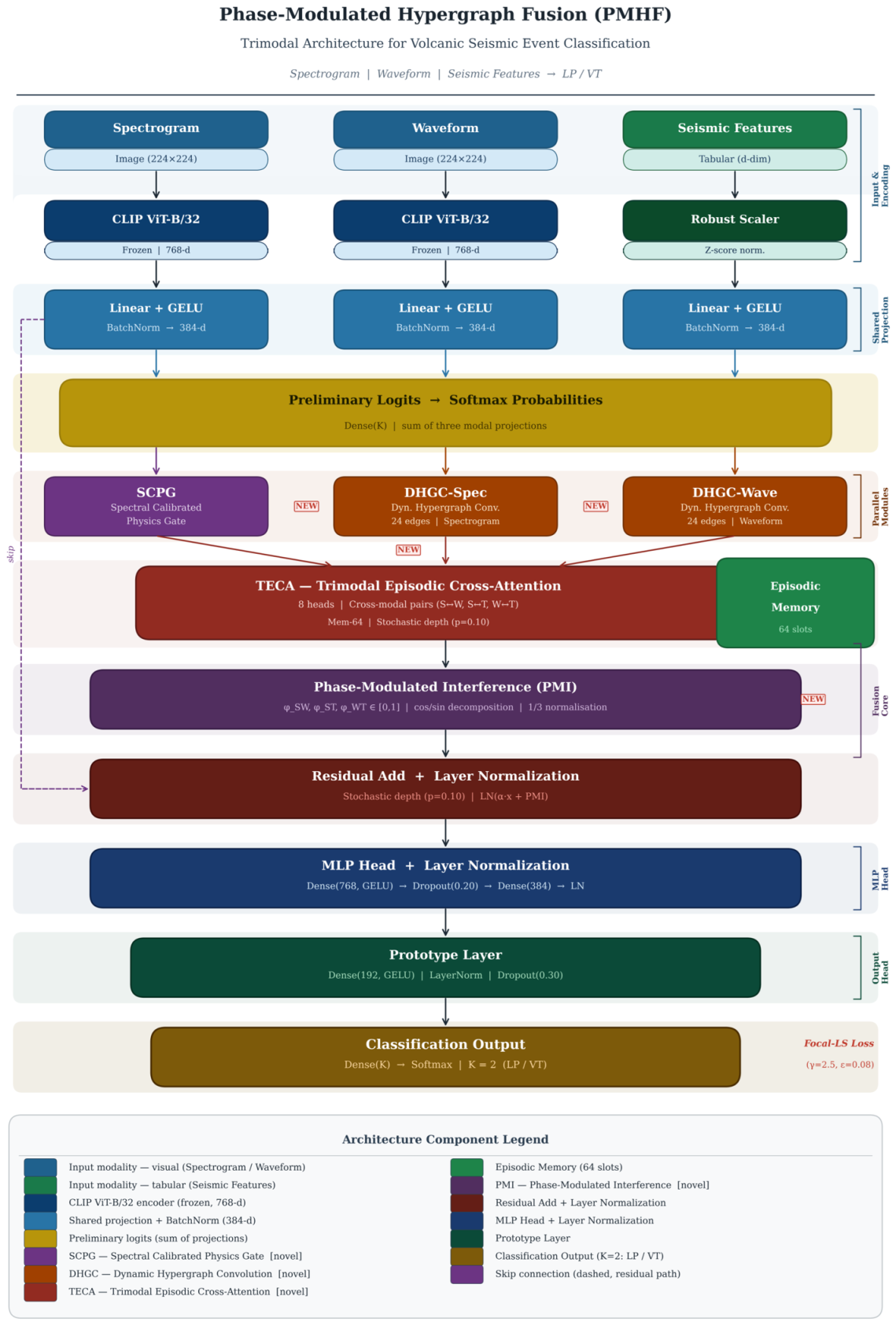
Figure 2.
Domain transfer balanced accuracy heatmap (bootstrap mean ± std, ). Rows: model variants; columns: transfer scenarios.
Figure 2.
Domain transfer balanced accuracy heatmap (bootstrap mean ± std, ). Rows: model variants; columns: transfer scenarios.
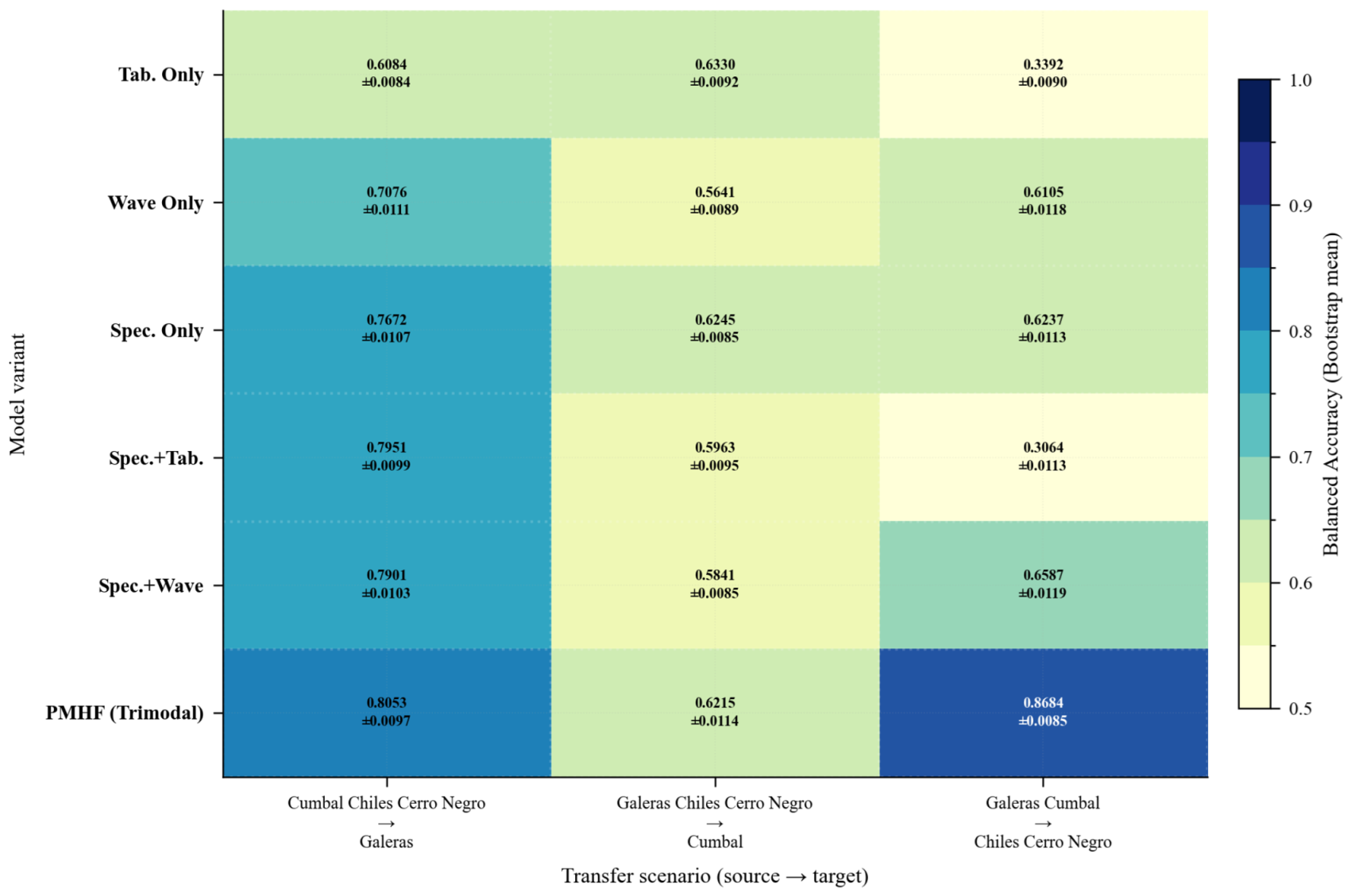
Figure 3.
Cross-Domain Performance Tile Matrix (CDPTM) for balanced accuracy. (a) Tile matrix encoding bootstrap mean (color), std (border width), and mean (circle size). (b) Model profile means. (c) Scenario profile means.
Figure 3.
Cross-Domain Performance Tile Matrix (CDPTM) for balanced accuracy. (a) Tile matrix encoding bootstrap mean (color), std (border width), and mean (circle size). (b) Model profile means. (c) Scenario profile means.
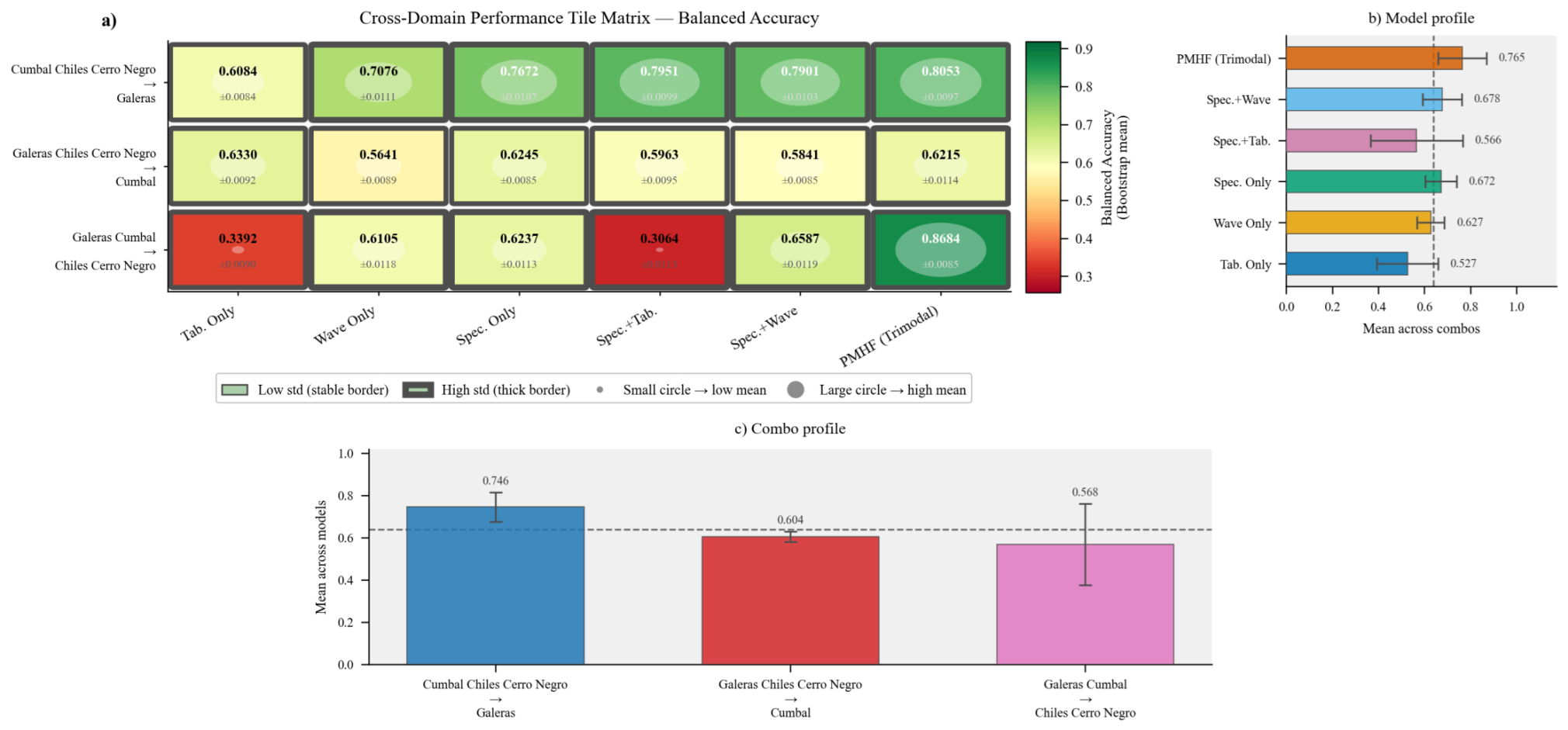
Figure 4.
Normalized confusion matrices for Galeras+Cumbal→CVCCN. (a) Tab. Only, (b) Wave Only, (c) Spec. Only, (d) Spec.+Tab., (e) Spec.+Wave, (f) PMHF. Percentages are row-normalized recall rates.
Figure 4.
Normalized confusion matrices for Galeras+Cumbal→CVCCN. (a) Tab. Only, (b) Wave Only, (c) Spec. Only, (d) Spec.+Tab., (e) Spec.+Wave, (f) PMHF. Percentages are row-normalized recall rates.
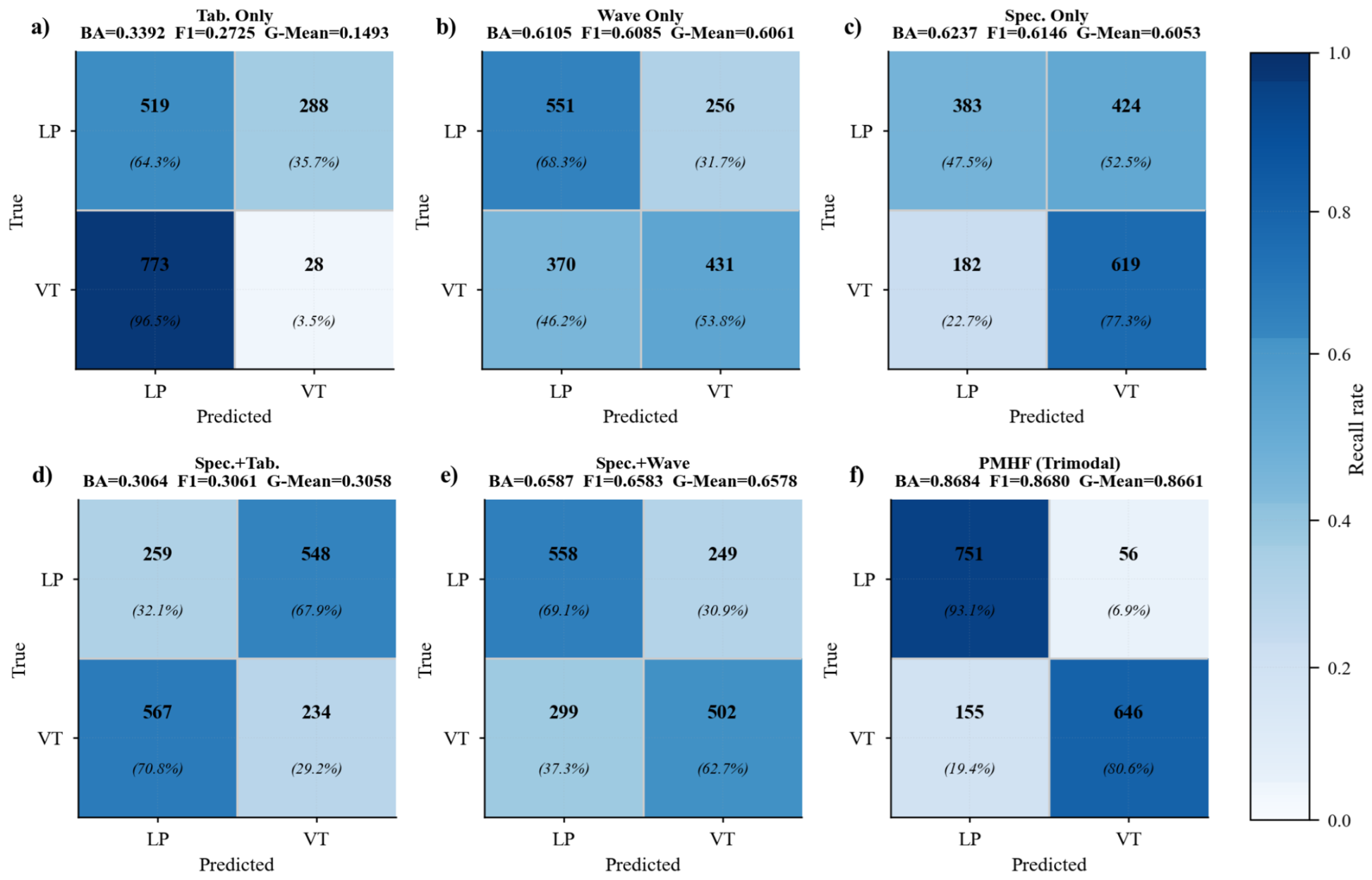
Figure 5.
Ablation study for Galeras+Cumbal→CVCCN (bootstrap ). Panels show (a) accuracy, (b) balanced accuracy, (c) F1 Macro, (d) MCC, and (e) G-Mean. Error bars indicate bootstrap standard deviation.
Figure 5.
Ablation study for Galeras+Cumbal→CVCCN (bootstrap ). Panels show (a) accuracy, (b) balanced accuracy, (c) F1 Macro, (d) MCC, and (e) G-Mean. Error bars indicate bootstrap standard deviation.
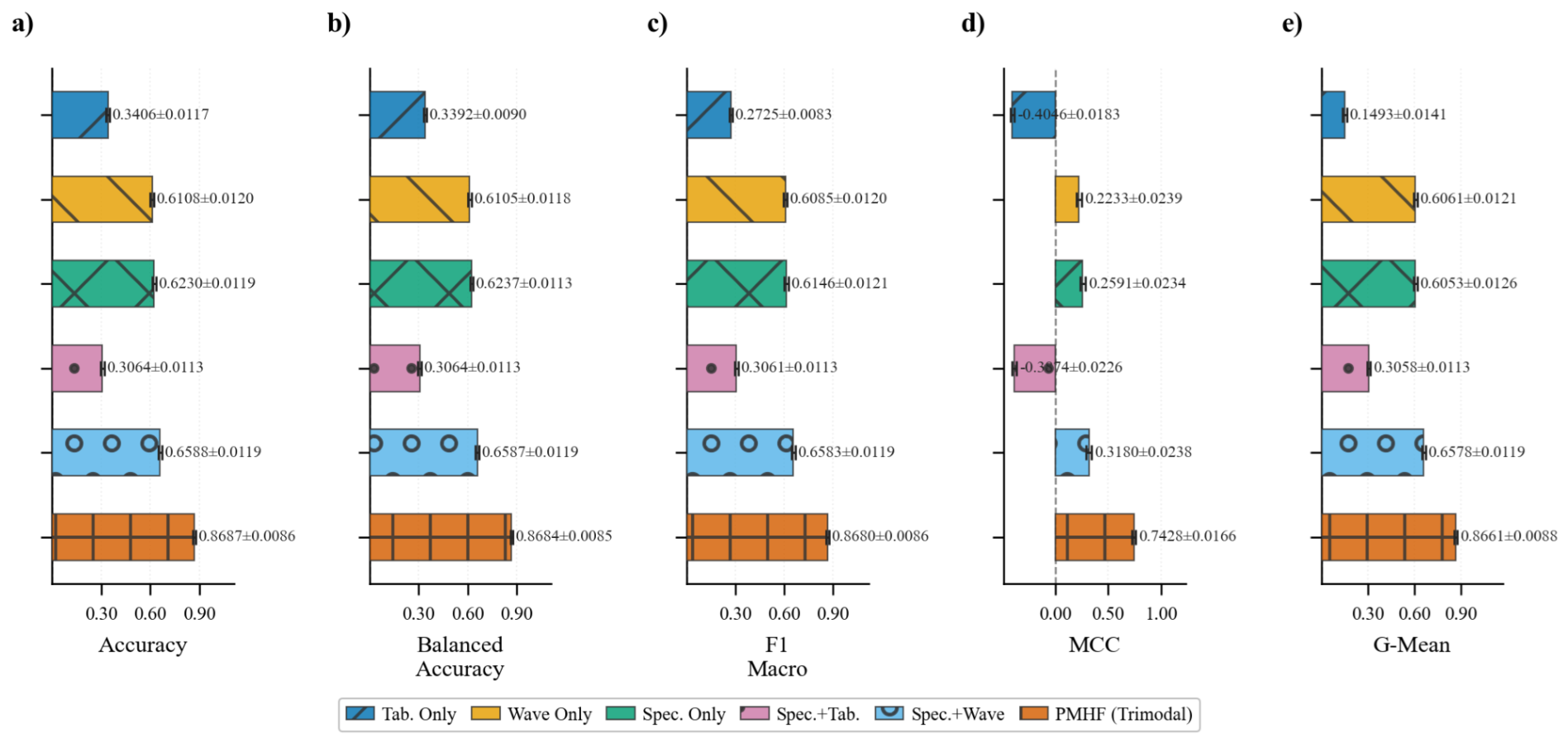
Figure 6.
UMAP projection of PMHF prototype-layer embeddings for Galeras+Cumbal→CVCCN. (a) Color by class (LP/VT); circles=source, triangles=target. (b) Color by volcano. See text for interpretation.
Figure 6.
UMAP projection of PMHF prototype-layer embeddings for Galeras+Cumbal→CVCCN. (a) Color by class (LP/VT); circles=source, triangles=target. (b) Color by volcano. See text for interpretation.
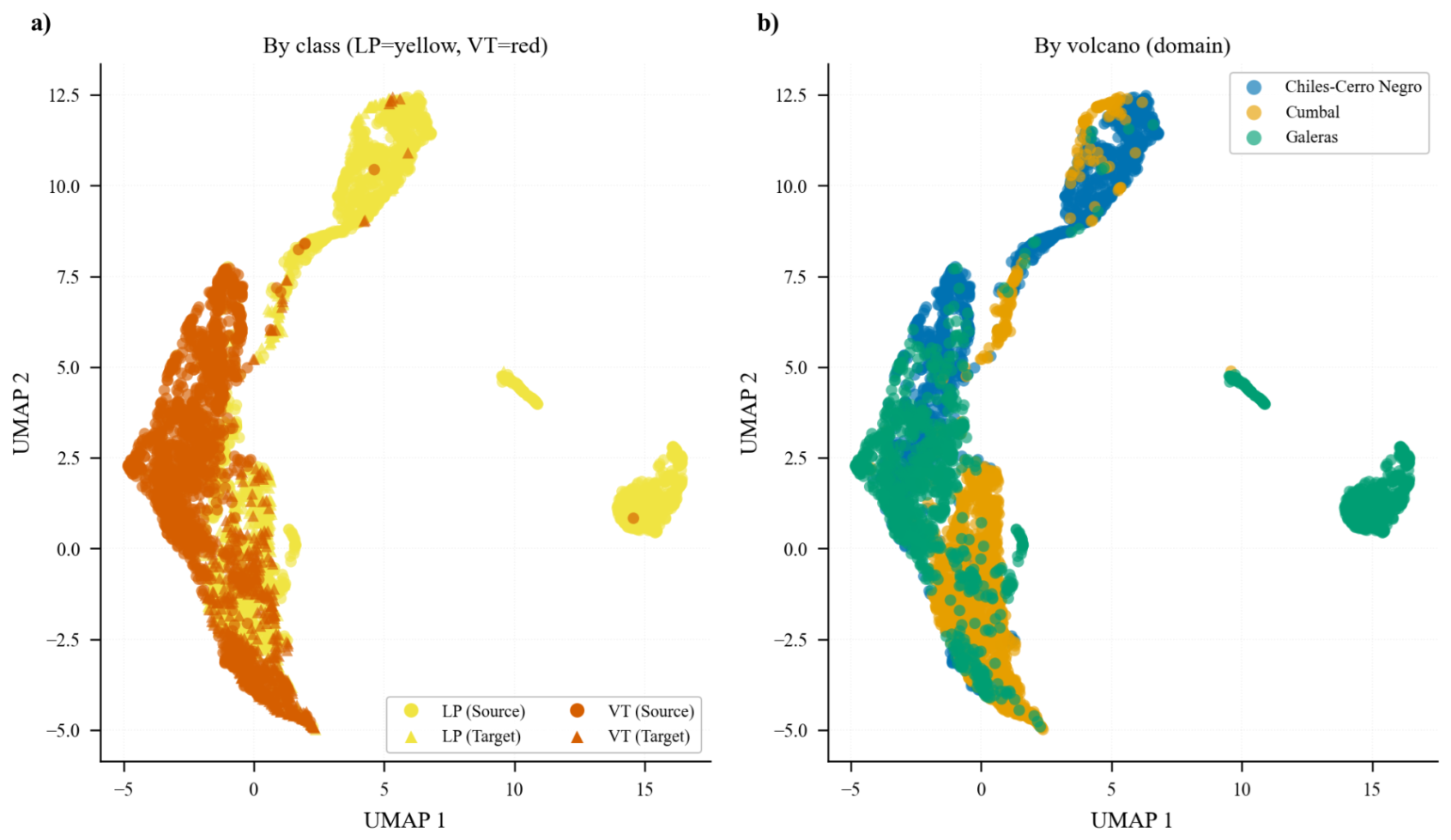
Figure 7.
Metric constellation: mean ± inter-domain standard deviation across all three transfer scenarios. PMHF (Trimodal, orange star) is best-in-class for all five metrics. Shaded band: global mean .
Figure 7.
Metric constellation: mean ± inter-domain standard deviation across all three transfer scenarios. PMHF (Trimodal, orange star) is best-in-class for all five metrics. Shaded band: global mean .
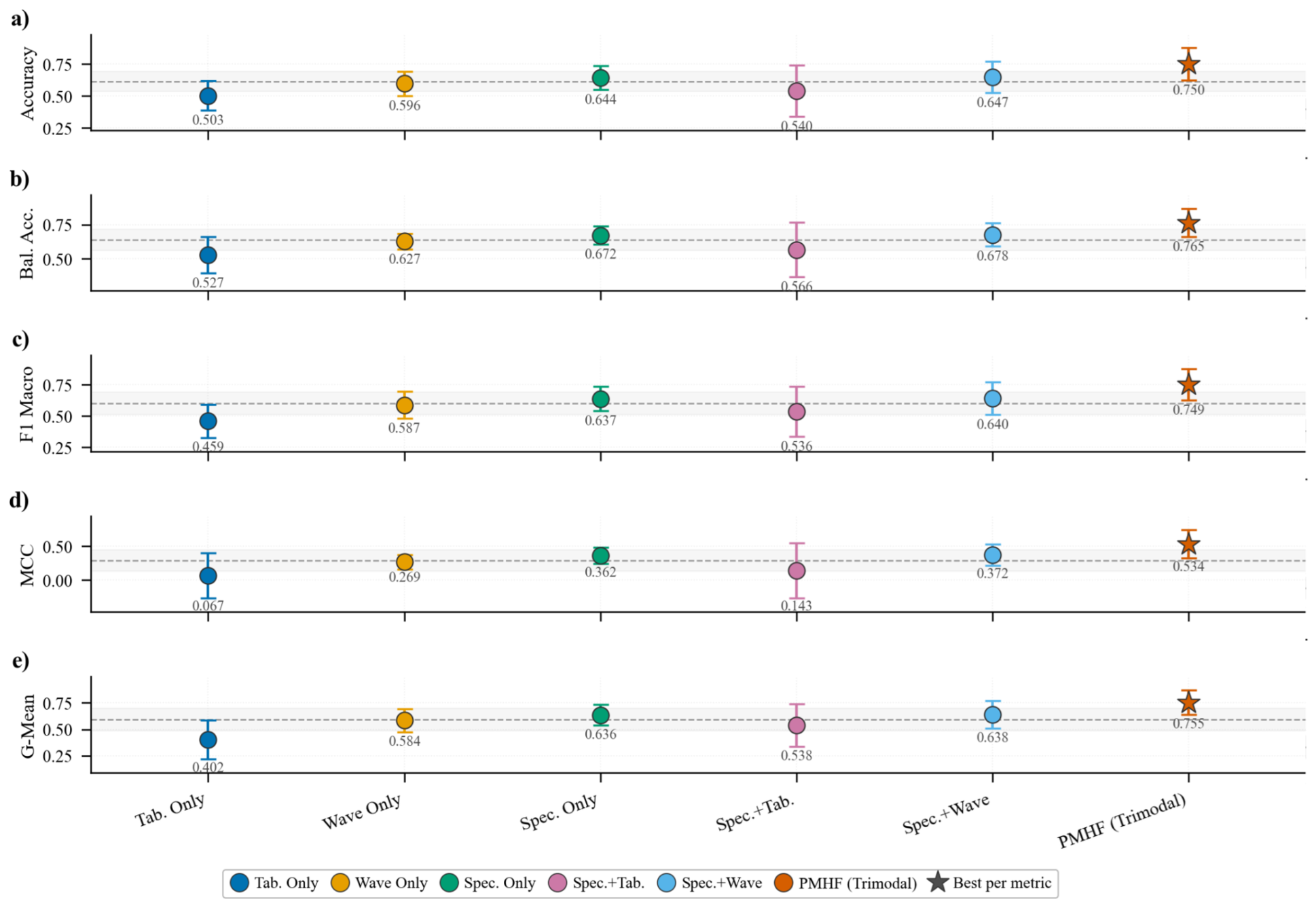
Figure 8.
Domain Transferability Fingerprint (DTF) for PMHF prototype embeddings. DTF = inter-domain centroid distance / within-domain spread; lower values indicate easier transfer.
Figure 8.
Domain Transferability Fingerprint (DTF) for PMHF prototype embeddings. DTF = inter-domain centroid distance / within-domain spread; lower values indicate easier transfer.
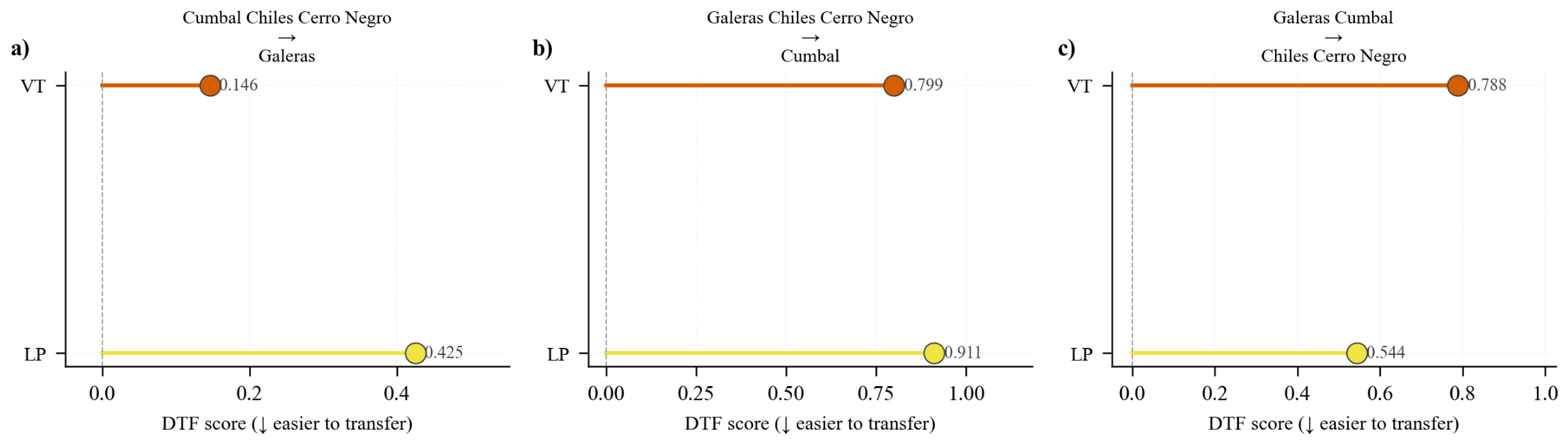
Figure 9.
Class-Conditional Drift Matrix (CCDM): mean cosine distance from source class (rows) to target class (columns) in PMHF prototype space. Diagonal entries (blue) indicate intra-class drift; off-diagonal entries indicate cross-class contamination.
Figure 9.
Class-Conditional Drift Matrix (CCDM): mean cosine distance from source class (rows) to target class (columns) in PMHF prototype space. Diagonal entries (blue) indicate intra-class drift; off-diagonal entries indicate cross-class contamination.
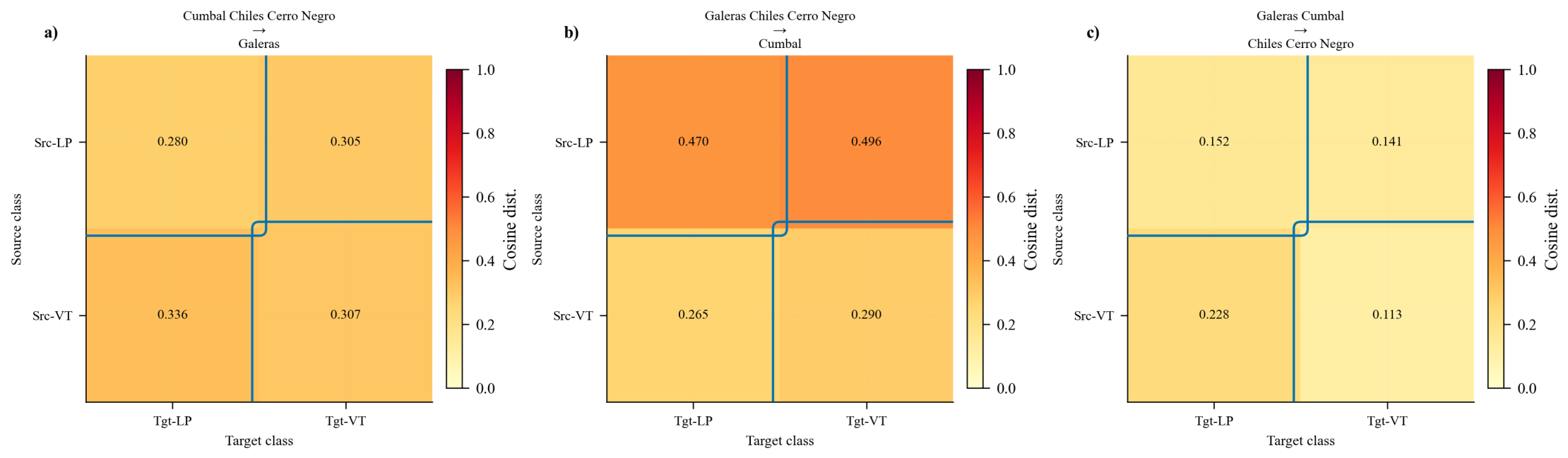

Table 1.
Conventional classification metrics (bootstrap mean ± std, ). Best result per scenario in bold. Negative MCC indicates systematic class inversion.
Table 1.
Conventional classification metrics (bootstrap mean ± std, ). Best result per scenario in bold. Negative MCC indicates systematic class inversion.
| Scenario | Model | Acc. | BA | F1 | MCC | G-Mean |
|---|---|---|---|---|---|---|
| Cumbal+CVCCN→Galeras | Tab. Only | |||||
| Wave Only | ||||||
| Spec. Only | ||||||
| Spec.+Tab. | ||||||
| Spec.+Wave | ||||||
| PMHF | ||||||
| Galeras+CVCCN→Cumbal | Tab. Only | |||||
| Wave Only | ||||||
| Spec. Only | ||||||
| Spec.+Tab. | ||||||
| Spec.+Wave | ||||||
| PMHF | ||||||
| Galeras+Cumbal→CVCCN | Tab. Only | |||||
| Wave Only | ||||||
| Spec. Only | ||||||
| Spec.+Tab. | ||||||
| Spec.+Wave | ||||||
| PMHF |
Table 2.
Domain adaptation metrics. MMD-RBF: lower = better alignment. ISS: higher = better separability. A-dist.: lower = smaller domain gap. GCI and TSI are PMHF-only diagnostics.
Table 2.
Domain adaptation metrics. MMD-RBF: lower = better alignment. ISS: higher = better separability. A-dist.: lower = smaller domain gap. GCI and TSI are PMHF-only diagnostics.
| Scenario | Model | MMD | ISS | A-dist. | GCI | TSI |
|---|---|---|---|---|---|---|
| Cumbal+CVCCN→Galeras | Tab. Only | — | — | |||
| Wave Only | — | — | ||||
| Spec. Only | — | — | ||||
| Spec.+Tab. | — | — | ||||
| Spec.+Wave | — | — | ||||
| PMHF | ||||||
| Galeras+CVCCN→Cumbal | Tab. Only | — | — | |||
| Wave Only | — | — | ||||
| Spec. Only | — | — | ||||
| Spec.+Tab. | — | — | ||||
| Spec.+Wave | — | — | ||||
| PMHF | ||||||
| Galeras+Cumbal→CVCCN | Tab. Only | — | — | |||
| Wave Only | — | — | ||||
| Spec. Only | — | — | ||||
| Spec.+Tab. | — | — | ||||
| Spec.+Wave | — | — | ||||
| PMHF |
Disclaimer/Publisher’s Note: The statements, opinions and data contained in all publications are solely those of the individual author(s) and contributor(s) and not of MDPI and/or the editor(s). MDPI and/or the editor(s) disclaim responsibility for any injury to people or property resulting from any ideas, methods, instructions or products referred to in the content. |
© 2026 by the authors. Licensee MDPI, Basel, Switzerland. This article is an open access article distributed under the terms and conditions of the Creative Commons Attribution (CC BY) license (http://creativecommons.org/licenses/by/4.0/).
Copyright: This open access article is published under a Creative Commons CC BY 4.0 license, which permit the free download, distribution, and reuse, provided that the author and preprint are cited in any reuse.