

Submitted:
23 June 2026
Posted:
25 June 2026
You are already at the latest version
Abstract
Background/Objectives: Children with sickle cell disease (SCD) experience gastrointes-tinal symptoms; the contribution of disorders of gut–brain interaction (DGBIs) to this symptom burden remains underrecognized, particularly in low-middle-income coun-tries. This study aimed to determine the prevalence of DGBIs and associated factors in children with SCD. Methods: Descriptive cross-sectional study conducted in two pediatric centers in Cali, Colombia. Children aged 4-18 years with confirmed SCD were included. DGBIs were identified using the Questionnaire for Pediatric Gastrointestinal Symptoms–Rome IV. Sociodemographic/familial/clinical variables were obtained. Quality of Life was assessed using the Pediatric Quality of Life Inventory. Uni-bivariate, and multivariable logistic regression analyses were performed. Results A total of 103 patients were included. Prevalence of DGBIs was 11.7%. The most common functional constipation (7.8%), fol-lowed by functional dyspepsia (3.9%). Overlap was observed in 1.0%. Quality of life was impaired in 34.9%. This was reflected in 66.7% school absenteeism of patients with DGBIs compared of those without (38.5%) (OR=3.20; 95%CI=0.77-15.45; p=0.062). In the bivariate analysis, living with both parents, asthma, positive sickling test, and history of hema-tologic replacement therapy showed a trend toward association with DGBI. In the mul-tivariable analysis, asthma and history of transfusion also showed a trend toward asso-ciation, statistical significance was not reached. Conclusions: DGBIs are present in a clinically relevant proportion of children with SCD and represent a potentially under-diagnosed comorbidity. Quality of life was impaired. The incorporation of systematic screening using standardized Rome Criteria may improve the identification of DGBIs and strengthen the comprehensive management of these children.
Keywords:
sickle cell disease
; hemoglobin S disease
; disorders of gut–brain interaction
; children
1. Introduction
Sickle cell disease (SCD) is an inherited hemoglobin disorder caused by a variante in the β-globin gene that leads to the synthesis of hemoglobin S [1]. This structural alteration induces changes in erythrocyte morphology, promoting cellular rigidity, chronic hemolysis, and recurrent vaso-occlusive events with multiorgan involvement [1]. Globally, SCD is one of the most prevalent hemoglobinopathies and represents a major public health concern, particularly among populations of African ancestry [2].
It is estimated that more than 300 000 children are born annually with SCD, reflecting a substantial global burden that is unevenly distributed and concentrated in regions with greater socioeconomic vulnerability [3].
In Colombia, SCD shows a heterogeneous distribution, with higher prevalence among Afro-descendant communities from the Pacific coastal region, where disparities in access to healthcare services may further amplify its clinical and epidemiological impact [4,5]. Although its prevalence is lower compared with other chronic diseases, SCD has been recognized as a rare disease, which has promoted the implementation of strategies aimed at early diagnosis and comprehensive management [6,7].
From a clinical perspective, SCD is characterized by a broad spectrum of systemic manifestations. Among these, abdominal pain and gastrointestinal symptoms are common and have a multifactorial etiology, associated not only with organic processes but also with vaso-occlusive phenomena, hemolysis, intestinal microcirculatory alterations, and potentially coexisting disorders of gut–brain interaction (DGBIs) [8,10].
Functional gastrointestinal disorders have recently been redefined as DGBIs. These conditions are characterized by persistent gastrointestinal symptoms arising from dysregulation in the bidirectional communication between the central nervous system and the gastrointestinal tract, rather than from overt structural abnormalities [11,12]. Their pathophysiology involves a complex interplay among the enteric nervous system, central modulation, immune responses, and the intestinal microbiota, ultimately contributing to altered gastrointestinal motility and visceral hypersensitivity [12,13].
The diagnosis of these disorders is based on the Rome IV Criteria, which provide standardized clinical definitions according to the chronology and characteristics of symptoms [14,15].
From an epidemiological standpoint, a high prevalence of DGBIs has been documented in the general population. The global study conducted by the Rome Foundation reported that more than 40% of individuals experience at least one of these disorders, with a substantial impact on Quality of Life and healthcare utilization. In the pediatric population, the estimated prevalence is approximately 25%, although variations have been attributed to geographic and methodological factors [14]. Recent studies have demonstrated that DGBIs in children and adolescents may be associated with psychological conditions such as anxiety and depression [17], as well as neurodevelopmental conditions including autism spectrum disorder [18], highlighting the complexity of the interaction between gastrointestinal and neuropsychological systems.
Although the prevalence of structural gastrointestinal symptoms in patients with SCD has been reported in approximately 23% of cases [8], the available evidence regarding the prevalence of DGBIs in this population remains limited. Recent studies suggest that children with SCD may experience a greater burden of gastrointestinal symptoms and undergo more abdominal pain-related diagnostic evaluations compared with the general pediatric population [8]. Under these circumstances, understanding the frequency of DGBIs in children with SCD is relevant for improving the clinical characterization of these patients and for guiding more comprehensive diagnostic and therapeutic strategies [5,9,10].
Therefore, the present study aimed to determine the prevalence of DGBIs and associated factors among children with SCD treated at two pediatric referral centers in Cali, Colombia.
2. Materials and Methods
2.1. Study Design and Setting
A descriptive cross-sectional study with an analytical component was conducted to estimate the prevalence of DGBIs among children and adolescents with SCD. The study was carried out at Fundación Clínica Infantil Club Noel (FCIC) and Hospital Universitario del Valle (HUV), two pediatric referral centers located in Cali, Colombia, between January 1, 2019, and December 31, 2025.
2.2. Ethical Considerations
The study was conducted in accordance with the principles of the Declaration of Helsinki and current Colombian regulations governing research involving human subjects. The study protocol was approved by the Ethics Committee of FCIC (protocol code No. 290 – September 18, 2024) and the Ethics Committee of HUV (protocol code INT 265 – October 22, 2024). Since the study involved the administration of clinical questionnaires and medical record review without direct intervention on participants, it was classified as minimal-risk research according to Resolution 8430 of 1993 issued by the Colombian Ministry of Health. Written informed consent was obtained from parents or legal guardians, and assent was obtained from minors when applicable. Confidentiality and anonymity of the collected information were strictly guaranteed throughout the study.
2.3. Participants
Patients aged 4 to 18 years old with a confirmed diagnosis of SCD (HbSS, HbSC, Sβ0-thalassemia, Sβ+-thalassemia, or sickle cell trait) established by hemoglobin electrophoresis or molecular testing when required were included. Patients with recent acute complications (hemolytic crisis, acute chest syndrome, or cerebrovascular event within the previous three months), current hospitalization, opioid use within the last month, or previously diagnosed structural gastrointestinal diseases were excluded in order to minimize the potential misclassification of gastrointestinal symptoms (Figure 1).
2.4. Data Collection and Definitions
Eligible patients were identified through medical record review. After obtaining written informed consent and assent when applicable, the validated Spanish version of the Questionnaire for Pediatric Gastrointestinal Symptoms–Rome IV (QPGS-IV)[15,19] was administered by previously trained personnel, including pediatric residents and pediatric gastroenterologists. The questionnaire was conducted by telephone interview, and responses were recorded in a structured digital form (Google Forms) specifically designed for the QPGS-IV.
According to Rome IV recommendations, in children younger than 8 years old the questionnaire was completed by parents or primary caregivers, whereas in older children and adolescents it was self-administered, with assistance provided when necessary. Additionally, the Pediatric Quality of Life Inventory (PedsQL) questionnaire was administered to assess pediatric Quality of Life. Complementary clinical, familial, and sociodemographic information was obtained from medical records.
The diagnostic classification of DGBIs was established using the standardized Rome IV algorithms based on the frequency, duration, and characteristics of symptoms reported in the QPGS-IV, allowing each patient to be assigned a specific DGBIs diagnosis.
2.5. Statistical Analysis
A descriptive analysis of the sociodemographic, clinical, familial, and quality-of-life characteristics of the study population was performed. Categorical variables were expressed as absolute frequencies and percentages, whereas continuous variables were summarized as mean and standard deviation (SD) according to data distribution.
For the bivariate analysis, the association between independent variables and the presence of DGBIs was evaluated. Categorical variables were compared using the chi-square test or Fisher’s exact test when appropriate (expected frequencies <5). Continuous variables were analyzed using Student’s t-test or the Mann–Whitney U test according to distribution normality.
Crude odds ratios (ORs) with their corresponding 95% confidence intervals (95% CI) were estimated as measures of association. Subsequently, a multivariable binary logistic regression model was constructed to identify factors independently associated with the presence of DGBIs. The dependent variable was the presence of DGBIs. Variables with clinical relevance and/or those presenting a p-value <0.20 in the bivariate analysis were included in the model to avoid the premature exclusion of potentially important variables.
Variable selection was performed using a stepwise selection approach with the sw logistic command in Stata, applying an inclusion criterion of p <0.20. Adjusted odds ratios (aORs) with their corresponding 95% CIs were reported in the final model to estimate the magnitude of associations. A p-value <0.05 was considered statistically significant. All analyses were conducted using Stata software version 18.
Multivariable logistic regression was performed using a complete-case approach, including only patients with complete data for all variables included in the model.
3. Results
A total of 103 children with confirmed SCD were included, with a mean age of 10.7±3.8 years old (range: 4–18 years). Most participants were female, Afro-descendant, residents from Cali, and enrolled in Public Educational Institutions. Additional familial, clinical, laboratory, and Quality of Life characteristics are presented in Table 1.
The overall prevalence of DGBIs was 11.7%, with defecation disorders, particularly functional constipation, being the most frequent subtype. Diagnostic overlap among DGBIs was observed in one patient presenting with both abdominal migraine and postprandial distress syndrome (Table 2).
In the bivariate analysis, significant associations were observed between DGBIs and living with both parents (OR= 7.88, 95%CI: 1.04–348.17; p= 0.024), diagnosis of asthma (OR= 6.25, 95% CI: 0.41–60.98; p= 0.044), positive sickling test (OR= 6.25, 95%CI: 0.41–60.98; p= 0.044), and history of blood transfusion replacement therapy (OR= 7.81, 95% CI: 0.93–92.65; p= 0.013). The remaining evaluated variables did not show statistically significant associations (Table 3).
In the multivariable logistic regression model, the variables asthma diagnosis and history of blood transfusion replacement therapy remained in the final model, showing a trend toward association with DGBIs in patients with SCD (Table 4).
4. Discussion
The present study evaluated the frequency of DGBIs in a pediatric cohort with SCD, a population in which gastrointestinal morbidity has historically received limited attention. A DGBI prevalence of 11.7% was identified, with functional constipation and functional dyspepsia representing the predominant subtypes. To the best of our knowledge, this is one of the first studies in Latin America to evaluate this association using Rome IV Criteria in a predominantly Afro-descendant pediatric population with SCD [8,15,20,21]. These findings expand the currently available evidence regarding the interaction between chronic hematologic diseases and DGBI in pediatric populations [8].
The prevalence observed in our cohort was lower than that reported in general pediatric populations evaluated using Rome IV Criteria [14,15,20]. This difference may be related to the clinical characteristics of patients with SCD, in whom abdominal pain and other gastrointestinal symptoms are more frequently attributed to organic mechanisms associated with the underlying disease. In this context, Dike, et al., [8] described a high burden of gastrointestinal symptoms and multiple abdominal diagnostic evaluations among children with SCD, highlighting the complexity of differentiating between organic etiologies and DGBIs in this population.
In clinical practice, SCD is commonly dominated by vaso-occlusive crises, chronic hemolysis, and severe pain [10], which may contribute to the underrecognition of symptoms such as constipation, abdominal distension, or early satiety [8,10]. Consequently, these manifestations may be interpreted as part of the underlying disease process or its structural complications, without systematically considering the possibility of coexisting DGBIs.
Functional constipation was the most frequent DGBI subtype, affecting 7.8% of patients, although this prevalence was lower than that described in the general pediatric population [22,23]. Beyond its frequency, functional constipation in children with SCD may represent a complex manifestation in which disease-specific systemic mechanisms converge. Endothelial dysfunction and reduced nitric oxide bioavailability, characteristic features of chronic hemolysis, may interfere with the regulation of colonic motility, thereby promoting delayed intestinal transit [9,10,24].
Endothelial dysfunction and nitric oxide depletion associated with chronic hemolysis in SCD may also interfere with overall gastrointestinal motility regulation. Additionally, mesenteric hypoperfusion secondary to subclinical vaso-occlusive phenomena could impair enteric nervous system function, favoring intestinal dysmotility and visceral hypersensitivity [9,10,13]. Although these mechanisms have not been fully demonstrated in SCD, studies in neurogastroenterology have shown that alterations of the enteric nervous system play a central role in the pathophysiology of DGBI [13].
The development of DGBIs in this population may therefore be explained by the interaction between systemic and local mechanisms. Chronic hemolysis reduces nitric oxide bioavailability, promoting endothelial dysfunction and microvascular impairment [9,10,24]. Since nitric oxide regulates gastrointestinal motility through smooth muscle relaxation, its depletion may alter intestinal transit [10]. Furthermore, microvascular dysfunction could compromise mesenteric perfusion and generate episodes of subclinical ischemia, affecting the enteric nervous system and contributing to neuromuscular dysfunction and visceral hypersensitivity [10,13,24].
In our study, impaired Quality of Life was identified in 34.9% of patients, confirming the functional burden associated with SCD, with a similar proportion observed among patients presenting both SCD and DGBIs (33.3%). Additionally, through the application of Rome IV Criteria, functional outcomes such as school and social absenteeism were explored. School and social absenteeism were more frequent among patients with both SCD and DGBIs, although these differences did not reach statistical significance, suggesting a potential functional impact of DGBIs on academic and social participation. These findings are consistent with previous studies demonstrating that DGBIs and chronic pediatric diseases may adversely affect Quality of Life, school functioning, and psychosocial well-being [16,25,26].
The observed trend toward an association between asthma and DGBIs suggests the presence of shared pathophysiological mechanisms. Both conditions may be interconnected through the mucosal immune axis, in which low-grade inflammation, epithelial dysfunction, and neuroimmune signaling play a central role, as previously described by Kumari, et al., [27] and Sjölund, et al., [28]. In SCD, asthma has been associated with increased disease severity [29,30], which could further amplify neuroenteric dysfunction. Similarly, asthma has been linked to a higher frequency of DGBIs in pediatric populations, supporting the hypothesis of shared pathophysiological pathways resulting from a bidirectional interaction between the respiratory and gastrointestinal systems [31].
Likewise, patients with a history of blood transfusion replacement therapy exhibited a greater likelihood of presenting DGBI. In addition, a trend toward a higher frequency of DGBIs was observed among patients with a positive sickling test, that is, those with the presence of hemoglobin S. These findings may suggest a potential relationship between disease burden or severity and gastrointestinal involvement [10,24]. However, these associations should be interpreted cautiously, as they did not reach statistical significance in the multivariable analysis. From a pathophysiological perspective, greater severity of SCD could favor intestinal microcirculatory alterations, tissue hypoxia, and dysfunction of the gut–brain axis, thereby contributing to the development of functional gastrointestinal symptoms [10,13,24].
In the multivariable analysis, asthma and blood transfusion replacement therapy showed a trend toward association with the presence of DGBIs. Nevertheless, these findings should be interpreted cautiously because of the wide confidence intervals observed, suggesting limited precision of the estimates, likely related to the reduced number of patients with DGBIs included in the analysis.
The association observed between living with both parents and a higher frequency of DGBIs likely reflects a phenomenon of increased symptom recognition and reporting rather than a true increase in biological risk. In pediatric DGBIs, symptom identification largely depends on caregiver reporting, which may introduce potential detection bias [15,19].
Finally, these findings should be interpreted within the context of the structural inequities associated with SCD. The disease predominantly affects Afro-descendant populations and remains linked to limitations in healthcare access and quality [5,32]. Within this context, DGBIs may represent an underdiagnosed comorbidity that increases the clinical and functional burden of the disease, particularly regarding Quality of Life, school performance, and social interaction among affected patients [25,33].
Strengths
This study provides original evidence regarding the presence of DGBIs in children with SCD within a predominantly Afro-descendant Latin American pediatric population. The use of Rome IV Criteria and the validated Spanish version of the QPGS-IV enabled a systematic diagnostic approach comparable with international studies. In addition, the integration of clinical and Quality of Life variables provided a comprehensive assessment of the functional impact of DGBIs in this population.
Furthermore, the exploratory analysis of associated factors, including multivariable models, allowed the identification of potentially relevant clinical signals within a real-world clinical setting. Collectively, these findings contribute to increasing awareness of a potentially underdiagnosed comorbidity and support the incorporation of Rome Criteria–based screening strategies in children with SCD.
Limitations
This study has several limitations. First, the cross-sectional design precludes the establishment of causal relationships. Second, the impact of specific therapeutic interventions, such as laxative use or dietary modifications, was not evaluated, limiting the understanding of treatment effects on DGBIs and Quality of Life. Additionally, the QPGS-IV relies on symptom reporting over the previous two months, which may introduce recall bias.
The presence of missing data in some clinical and laboratory variables reduced the sample size for specific analyses. Moreover, the low number of patients with DGBIs likely limited the precision of the estimates, as reflected by the wide confidence intervals, as well as the statistical power to detect significant associations. Finally, the inclusion of patients with sickle cell trait (HbAS) may have introduced clinical heterogeneity into the sample.
Studies with larger sample sizes will be necessary to confirm these findings. Since the present study was conducted using Rome IV Criteria, future studies based on the recently proposed Rome V Criteria [34,35] may contribute to improved clinical and diagnostic characterization of DGBIs in children with SCD.
5. Conclusions
DGBIs, particularly functional constipation and functional dyspepsia, are present in a clinically relevant proportion of children with SCD and represent a potentially underdiagnosed comorbidity. The systematic application of standardized Rome IV Criteria enabled the identification of functional gastrointestinal alterations with potential impact on quality of life and on school and social functioning in this population.
A history of asthma and blood transfusion replacement therapy showed a trend toward association with DGBIs, suggesting possible links with mechanisms related to systemic inflammation and greater clinical severity of the disease; however, these findings require confirmation in studies with larger sample sizes.
The present study was developed using Rome IV Criteria, which were current during the data collection period. Future investigations may evaluate this population using the newly proposed Rome V Criteria [34,35] in order to explore potential changes in the diagnostic classification, prevalence, and clinical characterization of DGBIs among children with SCD.
Author Contributions
Conceptualization: A.K.M.I, E.R.L, J.F.G.U, R.P.L, C.A.V.B, and D.A.V.S; methodology: A.K.M.I, E.R.L, J.F.G.U, R.P.L, C.A.V.B and D.A.V.S; software: A.K.M.I, R.P.L, C.A.V.B and D.A.V.S; validation: A.K.M.I, R.P.L, C.A.V.B and D.A.V.S; formal analysis: A.K.M.I, R.P.L, C.A.V.B and D.A.V.S; investigation: A.K.M.I, E.R.L, C.A.V.B and D.A.V.S; resources: A.K.M.I, E.R.L, C.A.V.B and D.A.V.S.; data curation: A.K.M.I, R.P.L, C.A.V.B and D.A.V.S; writing—original draft preparation: A.K.M.I, E.R.L, J.F.G.U, C.A.V.B and D.A.V.S; writing—review and editing: A.K.M.I, E.R.L, C.A.V.B and D.A.V.S; visualization: A.K.M.I, C.A.V.B and D.A.V.S; supervision: C.A.V.B and D.A.V.S; project administration: C.A.V.B and D.A.V.S. All authors have read and agreed to the published version of the manuscript.
Funding
This research received no external funding.
Institutional Review Board Statement
The study was conducted in accordance with the Declaration of Helsinki, and approved by the Ethics Committee of Clínica Infantil Club Noel (protocol code No. 290 – September 18, 2024) and the Ethics Committee of Hospital Universitario del Valle (protocol code INT 265 – October 22, 2024).
Informed Consent Statement
Informed consent was obtained from all subjects involved in the study.
Acknowledgments
The authors express their sincere gratitude to the children and adolescents living with SCD and to their families for their willingness to participate in this study. We especially acknowledge their collaboration and the resilience with which they face the daily challenges associated with this condition. Their participation made this research possible.
Conflicts of Interest
The authors declare no conflicts of interest.
Abbreviations
The following abbreviations are used in this manuscript:
| SCD | Sickle cell disease |
| DGBIs | Disorders of Gut-Brain Interaction |
| FCIC | Clínica Infantil Club Noel |
| HUV | Hospital Universitario del Valle |
| HbSS | Hemoglobin SS |
| HbSC | Hemoglobin SC |
| Sβ0 | Hemoglobin S/β0 |
| Sβ+ | Hemoglobin S/β+ |
| QPGS-IV | Questionnaire for Pediatric Gastrointestinal Symptoms-Rome IV |
| PedsQL | Pediatric Quality of Life Inventory |
| SD | Standard Deviation |
| ORs | Odds Ratios |
| 95% CI | 95% Confidence Intervals |
| aORs | Adjusted Odds Ratios |
| QoL | Quality of life |
| HbAS | Hemoglobin AS |
References
- Piel, F.B.; Steinberg, M.H.; Ress, D.C. Sickle cell disease. N Engl. J. Med. 2017, 376, 1561–1573. [Google Scholar] [CrossRef] [PubMed]
- López, M.; Morado, M.; Ricard, M.P.; Villegas, A. Guía de enfermedad de células falciformes.; MEDEA: Madrid, España, 2021. [Google Scholar]
- Wastnedge, E.; Waters, D.; Patel, S.; Morrison, K.; Goh, M.Y.; Adeloye, D.; Rudan, I. The global burden of sickle cell disease in children under five years of age: a systematic review and meta-analysis. J. Glob. Health 2018, 8, 021103. [Google Scholar] [CrossRef] [PubMed]
- Departamento Nacional de Planeación (DNP). Concepto y caracterización de comunidades negras, afrocolombianas, raizales y palenqueras (NARP).; DNP: Bogotá, Colombia, 2018. [Google Scholar]
- Khan, H.; Krull, M.; Hankins, J.S.; Wang, W.C.; Porter, J.S. Sickle cell disease and social determinants of health: a scoping review. Pediatr. Blood Cancer 2023, 70, e30089. [Google Scholar] [CrossRef] [PubMed]
- Congreso de la República. Ley 1392 de 2010, por la cual se reconocen las enfermedades huérfanas como de especial interés; Colombia, 2010.
- Instituto Nacional de Salud. Informe de evento: enfermedades huérfanas-raras, Colombia 2023; INS: Bogotá, Colombia, 2023. [Google Scholar]
- Dike, C.R.; Fittro, S.; Oster, R.A.; Morrow, C.D.; Brandow, A.; Demark-Wahnefried, W.; Lebensburger, J. Gastrointestinal symptoms, diagnostic evaluations, and abdominal pathology in children with sickle cell disease. Pediatr. Blood Cancer 2023, 70, e30699. [Google Scholar] [CrossRef] [PubMed]
- Sagi, V.; Mittal, A.; Tran, H.; Gupta, K. Pain in sickle cell disease: current and potential translational therapies. Transl. Res. 2021, 234, 141–158. [Google Scholar] [CrossRef] [PubMed]
- Sundd, P.; Gladwin, M.T.; Novelli, E.M. Pathophysiology of sickle cell disease. Annu Rev. Pathol. 2019, 14, 263–292. [Google Scholar] [CrossRef] [PubMed]
- Blanding, D.; Belkind-Gerson, J.; Kilgore, A.L. Disorders of gut-brain interaction in children: what is new. Curr. Opin. Pediatr. 2025, 37, 452–456. [Google Scholar] [CrossRef] [PubMed]
- Thapar, N.; Benninga, M.A.; Crowell, M.D.; Di Lorenzo, C.; Mack, I.; Nurko, S.; Saps, M.; Shulman, R.J.; Szajewska, H.; van Tilburg, M.A.L.; Enk, P. Paediatric functional abdominal pain disorders. Nat. Rev. Dis. Prim. 2020, 6, 89. [Google Scholar] [CrossRef] [PubMed]
- Holland, A.M.; Bon-Frauches, A.C.; Keszthelyi, D.; Melotte, V.; Boesmans, W. The enteric nervous system in gastrointestinal disease etiology. Cell Mol. Life Sci. 2021, 78, 4713–4733. [Google Scholar] [CrossRef] [PubMed]
- Robin, S.G.; Keller, C.; Zwiener, R.; Hyman, P.E.; Nurko, S.; Saps, M.; Di Lorenzo, C.; Shulman, R.J.; Hyams, J.S.; Palsson, O.; van Tilburg, M.A.L. Prevalence of pediatric functional gastrointestinal disorders utilizing the Rome IV criteria. J. Pediatr. 2018, 195, 134–139. [Google Scholar] [CrossRef] [PubMed]
- Velasco-Benítez, C.A.; Gómez-Oliveros, L.F.; Rubio-Molina, L.M.; Tovar-Cuevas, J.R.; Saps, M. Diagnostic accuracy of the Rome IV criteria for functional gastrointestinal disorders in children. J. Pediatr. Gastroenterol. Nutr. 2021, 72, 538–541. [Google Scholar] [CrossRef] [PubMed]
- Sperber, A.D.; Bangdiwala, S.I.; Drossman, D.A.; Ghoshal, U.C.; Simren, M.; Tack, J.; Whitehead, W.E.; Dumitrascu, D.L.; Fang, X.; Fukudo, S.; et al. Worldwide prevalence and burden of functional gastrointestinal disorders, results of Rome Foundation global study. Gastroenterology 2021, 160, 99–114.e3. [Google Scholar] [CrossRef] [PubMed]
- Chen, Z.; Chen, Q.; Zhou, L. Anxiety and depression in pediatric patients with disorder of brain-gut interaction: the role of diarrhea and abdominal pain as key determinants. Front Pediatr. 2025, 13, 1628222. [Google Scholar] [CrossRef] [PubMed]
- Velasco-Benítez, C.A.; Rojas-Cerón, C.A.; Ortiz-Rivera, C.J.; Velasco-Suárez, D.A.; Juvinao-Quintero, M.C.; Zubiri, C.E.; Fernández, J.M.; Bigliardi, R.; Zosi, A.; Chanis, R.A.; et al. Exploring disorders of gut-brain interaction in school-children and adolescents with autism. Life 2025, 15, 912. [Google Scholar] [CrossRef] [PubMed]
- Velasco-Benítez, C.A.; Ortíz-Rivera, C.J.; Sánchez-Pérez, M.P.; Játiva-Mariño, E.; Villamarín-Betancourt, E.A.; Saps, M. Utilidad de los cuestionarios de Roma IV en español para identificar desórdenes gastrointestinales funcionales en pediatría. Acta Gastroenterol. Latinoam. 2019, 49, 260–297. [Google Scholar]
- Velasco-Benítez, C.A.; Collazos-Saa, L.I.; García-Perdomo, H.A. A systematic review and meta-analysis in schoolchildren and adolescents with functional gastrointestinal disorders according to Rome IV criteria. Arq. Gastroenterol. 2022, 59, 304–313. [Google Scholar] [CrossRef] [PubMed]
- Játiva, E.; Velasco-Benítez, C.A.; Koppen, I.J.N.; Játiva-Cabezas, Z.; Saps, M. Prevalence of Functional Gastrointestinal Disorders in Schoolchildren in Ecuador. J. Pediatr. Gastroenterol. Nutr. 2016, 63, 25–28. [Google Scholar] [CrossRef] [PubMed]
- Saps, M.; Velasco-Benítez, C.A.; Langshaw, A.H.; Ramírez-Hernández, C.R. Prevalence of functional gastrointestinal disorders in children and adolescents: comparison between Rome III and Rome IV criteria. J. Pediatr. 2018, 199, 212–216. [Google Scholar] [CrossRef] [PubMed]
- Tran, D.L.; Sintusek, P. Functional constipation in children: what physicians should know. World J. Gastroenterol. 2023, 29, 1261–1288. [Google Scholar] [CrossRef] [PubMed]
- Coates, T.D.; Chalacheva, P.; Zeltzer, L.; Khoo, M.C.K. Autonomic nervous system involvement in sickle cell disease. Clin. Hemorheol. Microcirc. 2018, 68, 251–262. [Google Scholar] [CrossRef] [PubMed]
- Stokoe, M.; Zwicker, H.M.; Forbes, C.; Abu-Saris, N.E.L.H.; Fay-McClymont, T.B.; Désiré, N.; Guilcher, G.M.T.; Singh, G.; Leaker, M.; Yeates, K.O.; et al. Health-related quality of life in children with sickle cell disease: a systematic review and meta-analysis. Blood Rev. 2022, 56, 100982. [Google Scholar] [CrossRef]
- Varni, J.W.; Burwinkle, T.M.; Seid, M. The PedsQL™ 4.0 as a School Population Health Measure: Feasibility, Reliability, and Validity. Qual. Life Res. 2006, 15, 203–215. [Google Scholar] [CrossRef] [PubMed]
- Kumari, M.V.; Amarasiri, L.; Rajindrajith, S.; Devanarayana, N.M. Functional abdominal pain disorders and asthma: two disorders, but similar pathophysiology? Expert Rev. Gastroenterol. Hepatol. 2021, 15, 9–24. [Google Scholar] [CrossRef] [PubMed]
- Sjölund, J.; Kull, I.; Bergström, A.; Järås, J.; Ludvigsson, J.F.; Törnblom, H.; Simrén, M.; Olén, O. Allergy-related diseases in childhood and risk for abdominal pain-related functional gastrointestinal disorders at 16 years: a birth cohort study. BMC Med. 2021, 19, 214. [Google Scholar] [CrossRef] [PubMed]
- Ross, J.G.; Bernaudin, F.; Strunk, R.C.; Kamdem, A.; Arnaud, C.; Hervé, M.; Delacourt, C.; DeBaun, M.R. Asthma is a distinct comorbid condition in children with sickle cell anemia with elevated total and allergen-specific IgE levels. J. Pediatr. Hematol. Oncol. 2011, 33, e205-8. [Google Scholar] [CrossRef] [PubMed]
- Brandow, A.M.; Carroll, C.P.; Creary, S.; Edwards-Elliott, R.; Glassberg, J.; Hurley, R.W.; Kutlar, A.; Seisa, M.; Stinson, S.; Strouse, J.J.; et al. American Society of Hematology 2020 guidelines for sickle cell disease: management of acute and chronic pain. Blood Adv. 2020, 4, 2656–2701. [Google Scholar] [CrossRef] [PubMed]
- Orbay, E.; Usta, M.; Sipahi, S.; Urganci, N. Assessment of functional gastrointestinal disorders in children with asthma. Clin. Pediatr. (Phila) 2026, 65, 473–480. [Google Scholar] [CrossRef] [PubMed]
- Piel, F.B.; Hay, S.I.; Gupta, S.; Weatherall, D.J.; Williams, T.N. Global burden of sickle cell anaemia in children under five, 2010-2050: modelling based on demographics, excess mortality, and interventions. PLoS Med. 2013, 7, e1001484. [Google Scholar] [CrossRef] [PubMed]
- Sharma, A.; Locatelli, F.; Bhatia, M.; Molinari, L.; Mapara, M.Y.; Liem, R.I.; Dedeken, L.; Wall, D.; Eckrich, M.J.; Kuo, K.H.M.; et al. Improvements in health-related quality of life in patients with severe sickle cell disease after exagamglogene autotemcel. Blood Adv. 2025, 9, 6481–6490. [Google Scholar] [CrossRef] [PubMed]
- Rosen, R.; Borrelli, O.; Faure, C.; Karrento, K.; Krishnan, U.; Nurko, S.; Rommel, N.; Silverman, A.; van Wijk, M.; Benninga, M. Rome V pediatric upper gastrointestinal disorders of gut-brain interaction. Gastroenterology 2026, 170, 1347–1366. [Google Scholar] [CrossRef] [PubMed]
- Di Lorenzo, C.; Saps, M.; Cumpitazi, B.P.; Rajindrajith, S.; Staiano, A.; Thapar, N.; van Tilburg, M.; Velasco-Benítez, C.; Vlieger, A. Lower and Biliary Disorders of Gut-Brain Interaction: Child and Adolescent. Gastroenterology 2026, 170, 1367–1387. [Google Scholar] [CrossRef] [PubMed]
Figure 1.
Flowchart of participant selection and distribution of DGBIs among children and adolescents with SCD included in the study.
Figure 1.
Flowchart of participant selection and distribution of DGBIs among children and adolescents with SCD included in the study.
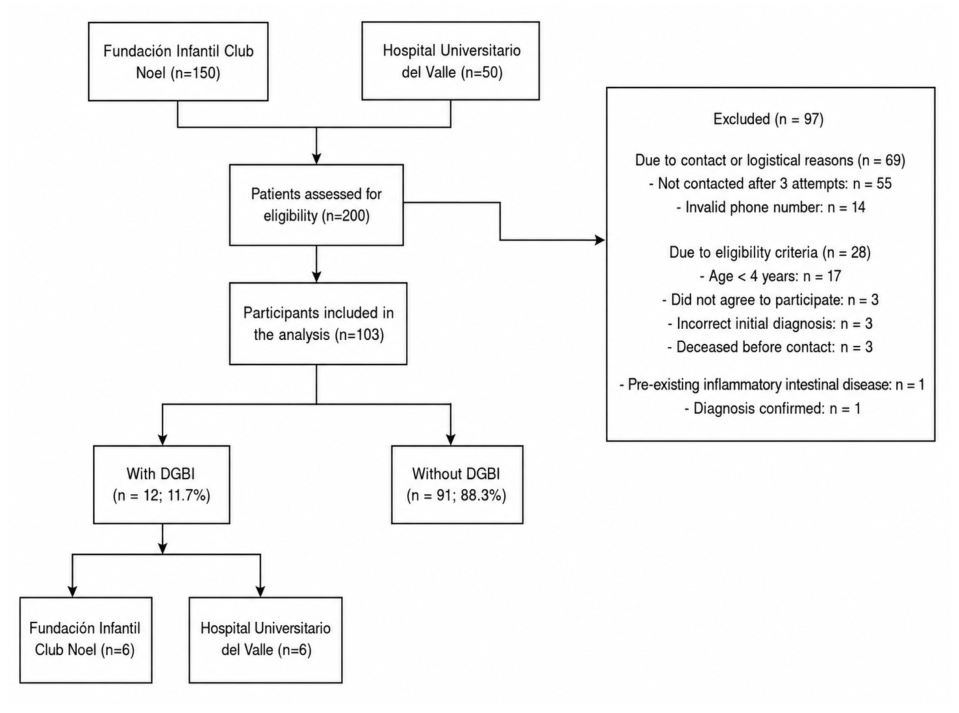

Table 1.
Sociodemographic, familial, clinical, and quality-of-life characteristics of the pediatric population with SCD.
Table 1.
Sociodemographic, familial, clinical, and quality-of-life characteristics of the pediatric population with SCD.
| Description | Summary measure | |
|---|---|---|
| n | % / mean ± SD (range) | |
| Sociodemographic characteristics | ||
| Age (years), mean ± SD (range) | 103 | 10.7 ± 3.8 (4–18) |
| Preschool children (4–8 years) | 33 | 32.0 |
| School-aged children (9–12 years) | 31 | 30.1 |
| Adolescents (13–18 years) | 39 | 37.9 |
| Sex (n = 103) | ||
| Male | 56 | 54.4 |
| Female | 47 | 45.6 |
| Ethnicity (n = 103) | ||
| Afro-descendant | 86 | 83.5 |
| White | 4 | 3.9 |
| Mixed-race | 13 | 12.6 |
| Type of Educational Institution (n = 99) | ||
| Government-funded | 81 | 81.8 |
| Privately funded | 18 | 18.2 |
| City of residence (n = 103) | ||
| Cali (urban area) | 56 | 54.4 |
| Within Valle del Cauca | 32 | 31.2 |
| Outside Valle del Cauca | 15 | 14.6 |
| Family characteristics |
||
| Only child | 13 | 12.6 |
| Firstborn child |
35 | 34.0 |
| Living with both parents |
64 | 62.1 |
| Family history of DGBIs | 0 | 0.0 |
| Family history of SCD (n = 60) | 24 | 40.0 |
| Clinical characteristics | ||
| Personal medical history (n = 102) | ||
| Cesarean delivery | 33 | 32.4 |
| History of prematurity | 10 | 9.8 |
| History of diarrheal disease (n = 103) | 6 | 5.8 |
| Diagnosis of asthma (n = 60) | 6 | 10.0 |
| Diagnosis of allergic rhinitis (n = 60) | 5 | 8.3 |
| Diagnostic method for SCD (n = 60) | ||
| Sickling test | 60 | 100.0 |
| Hemoglobin electrophoresis in alkaline medium | 6 | 10.0 |
| Capillary hemoglobin electrophoresis | 1 | 1.7 |
| HbS genotype (n = 60) | ||
| SS | 31 | 51.7 |
| SC | 13 | 21.7 |
| AS | 16 | 26.6 |
|
Vaccination status (n = 60) | ||
| Complete national immunization schedule | 58 | 96.7 |
| Risk-specific complementary vaccination | 28 | 46.7 |
| Medical treatment (n = 60) | ||
| Antibiotic prophylaxis | 10 | 16.7 |
| Folic acid supplementation | 43 | 71.7 |
| Hydroxyurea treatment | 45 | 75.0 |
| Opioid use | 7 | 11.7 |
| Blood replacement therapy | 15 | 25.0 |
| Red blood cell transfusion | 28 | 46.7 |
| Admission to the Intensive Care Unit | 11 | 18.3 |
| Age at diagnosis (years), mean ± SD (range) | 60 | 4.0 ± 3.7 (0–17) |
| Number of hospitalizations, mean ± SD (range) | 60 | 2.7 ± 3.6 (0–10) |
| Laboratory characteristics | ||
| HbS (%) (n = 46), mean ± SD (range) | 46 | 51.4 ± 24.1 (0–95.9) |
| Hemoglobin (g/dL), mean ± SD (range) | 51 | 10.1 ± 2.0 (6–13.5) |
| Reticulocytes (%), mean ± SD (range) | 38 | 6.1 ± 8.0 (0.5–37) |
| Total bilirubin (mg/dL), mean ± SD (range) | 43 | 1.9 ± 1.5 (0.15–6.6) |
| Direct bilirubin (mg/dL), mean ± SD (range) | 41 | 1.4 ± 2.2 (0.08–12.5) |
| Nutritional status characteristics | ||
| According to body mass index (n = 89) | ||
| Eutrophic | 57 | 64.0 |
| Malnourished | 32 | 36.0 |
| According to height-for-age (n = 89) | ||
| Normal | 63 | 70.8 |
| Altered | 26 | 29.2 |
| Quality of life | ||
| PedsQL questionnaire (n = 63) | ||
| Normal quality of life | 41 | 65.1 |
| Impaired quality of life | 22 | 34.9 |
| School/social absenteeism (n = 103) | ||
| School absences | 43 | 41.8 |
| Social absences | 26 | 25.2 |
SD= Standard Deviation; DGBIs= Disorders of Gut Brain Interaction; SCD= Sickle Cell Disease; Hb= Hemoglobin; PedsQL= Pediatric Quality of Life Inventory. Note: Data are presented as n (%) or mean ± SD. For continuous variables, ranges (minimum–maximum) are also reported. Denominators vary due to missing data in medical records.
Table 2.
Prevalence and distribution of DGBIs according to Rome IV Criteria among children with SCD.
Table 2.
Prevalence and distribution of DGBIs according to Rome IV Criteria among children with SCD.
| Variable | Description | Summary measure N=103 (%) |
|
| Prevalence of DGBI | No | 91 | 88.3 |
| Yes | 12 | 11.7 | |
| Types of DGBI according to Rome IV |
Subtype | n=103 |
(%) |
| Abdominal pain–related disorders | |||
| Functional dyspepsia | 4 | 3.9 | |
| Postprandial distress syndrome | 3 | 2.9 | |
| Epigastric pain syndrome | 1 | 1.0 | |
| Defecation disorders | |||
| Functional constipation | 8 | 7.8 | |
DGBI=Disorders of Gut-Brain Interaction. Note: Data are presented as absolute frequencies (n) and percentages (%). Percentages were calculated based on the total study population (N = 103). The classification of DGBI was established according to the pediatric Rome IV diagnostic criteria.
Table 3.
Bivariate analysis of factors associated with DGBIs among children with SCD.
| Characteristics of patients with SCD | DGBIs | OR | p-value |
|||||||
| No n (%) | Yes n (%) | |||||||||
| Sociodemographic characteristics | ||||||||||
| Age in years (n=103) | ||||||||||
| Mean ± SD (range) |
10.9 ± 3.9 (4–18) |
9.1 ± 2.8 (6-14) |
N/A | 0.125 | ||||||
| Age groups (n=103) | n=91 | n=12 | ||||||||
| Preschool children (4–8 years) | ||||||||||
| No | 64 (70.3) | 6 (50.0) | 1.00 | 0.156 | ||||||
| Yes | 27 (29.7) | 6 (50.0) | 2.37 (0.57-9.66) | |||||||
| School-aged children (9–12 years) | ||||||||||
| No | 63 (69.2) | 9 (75.0) | 1.00 | 0.682 | ||||||
| Yes | 28 (30.8) | 3 (25.0) | 0.75 (0.12-3.32) | |||||||
| Adolescents (13–18 years) | ||||||||||
| No | 55 (60.4) | 9 (75.0) | 1.00 | |||||||
| Yes | 36 (39.6) | 3 (25.0) | 0.5 (0.08-2.23) | 0.328 | ||||||
| Sex (n=103) | ||||||||||
| Female | 47 (51.6) | 9 (75.0) | 1.00 | 0.126 | ||||||
| Male | 44 (48.4) | 3 (25.0) | 0.35 (0.05-1.56) | |||||||
| Ethnoracial group (n=103) n=91 n=12 | ||||||||||
| Mixed-race | ||||||||||
| No | 79 (86.8) | 11 (91.7) | 1.00 | 0.634 | ||||||
| Yes | 12 (13.2) | 1 (8.3) | 0.59 (0.01-4.89) | |||||||
| Afro-descendant | ||||||||||
| No | 16 (17.6) | 1 (8.3) | 1.00 | 0.417 | ||||||
| Yes | 75 (82.4) | 11 (91.7) | 2.34 (0.29-107.21) | |||||||
| Family characteristics | n=91 | n=12 | ||||||||
| Living with both parents (n=103) | ||||||||||
| No | 38 (41.8) | 1 (8.3) | 1.00 | 0.024 | ||||||
| Yes | 53 (58.2) | 11 (91.7) | 7.88 (1.04-348.17) | |||||||
| Firstborn child | ||||||||||
| No | 61 (67.0) | 7 (58.3) | 1.00 | 0.549 | ||||||
| Yes | 30 (33.0) | 5 (41.7) | 1.45 (0.33-5.81) | |||||||
| Family history of SCD (n=60) | n=54 | n=6 | ||||||||
| No | 32 (59.3) | 4 (66.7) | 1.00 | 0.725 | ||||||
| Yes | 22 (40.7) | 2 (33.3) | 0.72 (0.06-5.62) | |||||||
| Clinical characteristics | n=90 | n=12 | ||||||||
| Cesarean delivery (n=102) | ||||||||||
| No | 60 (66.7) | 9 (75.0) | 1.00 | |||||||
| Yes | 30 (33.3) | 3 (25.0) | 0.66 (0.10-2.94) | 0.562 | ||||||
| History of preterm birth (n=102) | ||||||||||
| No | 82 (91.1) | 10 (83.3) | 1.00 | 0.394 | ||||||
| Yes | 8 (8.9) | 2 (16.7) | 2.05 (0.18-12.43) | |||||||
| Diagnosis of asthma (n=60) | n=54 | n=6 | ||||||||
| No | 50 (92.6) | 4 (66.7) | 1.00 |
0.044 |
||||||
| Yes | 4 (7.4) | 2 (33.3) | 6.25 (0.41-60.98) | |||||||
| Diagnosis of allergic rhinitis (n=60) | ||||||||||
| No | 50 (92.6) | 5 (83.3) | 1.00 | 0.436 | ||||||
| Yes | 4 (7.4) | 1 (16.7) | 2.50 (0.04-32.67) | |||||||
| Positive sickling test (n=60) | ||||||||||
| No | 50 (92.6) | 4 (66.7) | 1.00 | 0.044 | ||||||
| Yes | 4 (7.4) | 2 (33.3) | 6.25 (0.41-60.98) | |||||||
| SS | ||||||||||
| No | 27 (50.0) | 2 (33.3) | 1.00 | 0.438 | ||||||
| Yes | 27 (50.0) | 4 (66.7) | 2.00 (0.25-23.59) | |||||||
| SC | ||||||||||
| No | 42 (77.8) | 5 (83.3) | 1.00 | |||||||
| Yes | 12 (22.2) | 1 (16.7) | 0.70 (0.01-7.23) | 0.754 | ||||||
| AS | ||||||||||
| No | 39 (72.2) | 5 (83.3) | 1.00 | 0.640 | ||||||
| Yes | 15 (27.8) | 1 (16.7) | 0.52 (0.06–4.83) | |||||||
| Risk-specific complementary vaccination | ||||||||||
| No | 29 (53.7) | 3 (50.0) | 1.00 | 0.863 | ||||||
| Yes | 25 (46.3) | 3 (50.0) | 1.16 (0.14-9.43) | |||||||
| Antibiotic prophylaxis | ||||||||||
| No | 46 (85.2) | 4 (66.7) | 1.00 | |||||||
| Yes | 8 (14.8) | 2 (33.3) | 2.87 (0.21-23.89) | 0.248 | ||||||
| Folic acid supplementation | ||||||||||
| No | 14 (25.9) | 3 (50.0) | 1.00 | 0.214 | ||||||
| Yes | 40 (74.1) | 3 (50.0) | 0.35 (0.04-2.97) | |||||||
| Hydroxyurea treatment | ||||||||||
| No | 14 (25.9) | 1 (16.7) | 1.00 | |||||||
| Yes | 40 (74.1) | 5 (83.3) | 1.75 (0.17-88.58) | 0.619 | ||||||
| Blood replacement therapy | ||||||||||
| No | 43 (79.6) | 2 (33.3) | 1.00 | |||||||
| Yes | 11 (20.4) | 4 (66.7) | 7.81 (0.93-92.65) | 0.013 | ||||||
| Red blood cell transfusions | ||||||||||
| No | 28 (51.8) | 4 (66.7) | 1.00 | |||||||
| Yes | 26 (48.2) | 2 (33.3) | 0.53 (0.04-4.16) | 0.490 | ||||||
| Nutritional status (n=89) | n=78 | n=11 | ||||||||
| According to body mass index | ||||||||||
| Eutrophic | 49 (62.8) | 8 (72.7) | 1.00 | |||||||
| Malnourished | 29 (37.2) | 3 (27.3) | 0.63 (0.10-2.93) | 0.521 | ||||||
| According to height-for-age | ||||||||||
| Normal | 55 (70.5) | 8 (72.7) | 1.00 | |||||||
| Altered | 23 (29.5) | 3 (27.3) | 0.89 (0.14-4.18) | 0.879 | ||||||
| Quality of life n=57 n=6 | ||||||||||
| PedsQL questionnaire (n=63) | ||||||||||
| Normal | 37 (64.9) | 4 (66.7) | 1.00 | |||||||
| Impaired | 20 (35.1) | 2 (33.3) | 0.92 (0.07-7.12) | 0.931 | ||||||
| School absenteeism (n=103) n=91 n=12 | ||||||||||
| No | 56 (61.5) | 4 (33.3) | 1.00 | |||||||
| Yes | 35 (38.5) | 8 (66.7) | 3.20 (0.77-15.45) | 0.062 | ||||||
| Social absenteeism (n=103) | ||||||||||
| No | 70 (76.9) | 7 (58.3) | 1.00 | |||||||
| Yes | 21 (23.1) | 5 (41.7) | 2.38 (0.53-9.70) | 0.163 | ||||||
SCD= Sickle Cell Disease; DGBIs= Disorders of Gut-Brain Interaction; OR= Odds Ratios; SD= Standard Deviation; N/A= Not Applicable; PedsQL= Pediatric Quality of Life Inventory. Note: Data are presented as n (%) or mean ± SD. Continuous variables were compared using Student’s t-test or the Mann–Whitney U test according to data distribution. A p-value <0.05 was considered statistically significant. Subgroup analyses were performed exclusively based on patients with available data.
Table 4.
Multivariable analysis of clinical factors associated with DGBIs among children SCD.
| Variable | Crude OR | Adjusted OR (aOR) | 95%CI of the aOR | p-value |
|---|---|---|---|---|
| Diagnosis of asthma | 6.25 | 14.03 | 0.87–224.35 | 0.062 |
| Blood replacement therapy | 7.81 | 9.05 | 0.87–93.33 | 0.064 |
Note: Adjusted odds ratios (aORs) were estimated using multivariable logistic regression analysis. 95%CI: 95% confidence interval. A p-value <0.05 was considered statistically significant. Multivariable logistic regression was performed using a complete-case analysis approach, including only patients with complete data for all variables included in the model; therefore, the final sample size was reduced.
Disclaimer/Publisher’s Note: The statements, opinions and data contained in all publications are solely those of the individual author(s) and contributor(s) and not of MDPI and/or the editor(s). MDPI and/or the editor(s) disclaim responsibility for any injury to people or property resulting from any ideas, methods, instructions or products referred to in the content. |
© 2026 by the authors. Licensee MDPI, Basel, Switzerland. This article is an open access article distributed under the terms and conditions of the Creative Commons Attribution (CC BY) license (http://creativecommons.org/licenses/by/4.0/).
Copyright: This open access article is published under a Creative Commons CC BY 4.0 license, which permit the free download, distribution, and reuse, provided that the author and preprint are cited in any reuse.


