

Submitted:
23 June 2026
Posted:
24 June 2026
You are already at the latest version
Abstract
This article describes the mineralogical and geochemical features of the Marsyaty sedimentary deposit of Fe and Mn ores in the Northern Urals (Russia). Oolitic ironstones are localized in coastal sandstones of the Cenomanian age. Сarbonate Mn ores lies within siliciclastic sediments of the Lower Paleocene and are separated from the oolitic ironstone by a layer of gravel. Authigenic iron oxyhydroxides, chamosite/bertierite and superimposed siderite predominate in the ironstones; kaolinite, apatite, perhamite, calcite and dolomite are minor and rare. Rhodochrosite and rencieite are major minerals of the Mn ore; layer Mn-silicates (caryopilite, parsettensite?) are minor and rare. Both ore types contain authigenic glauconite, montmorillonite, sulfides (sphalerite/wurtzite, galena, pyrite), gibbsite/boemite, REE phosphates. The detrital component of both types of ores is represented by clasts of quartz, ilmenite, zircon, monazite, epidote, titanite, muscovite, and feldspars. The δ13Сcarb varies from -18.5 to -23.3 in carbonate ironstone and -10.0 to -41.0 ‰ PDB in manganese ore. The light isotopic composition of carbon and numerous organic relics indicate the participation of microbes in both types carbonate ore formation process. It is concluded that iron and manganese ores belong to a joint transgressive series of sedimentary rocks that arose sequentially during the evolution of the West-Siberian basin. The unique feature of the Marsyaty deposit is that, within a limited area and over a short geological period, favorable conditions were realized first for the accumulation of iron and manganese, and then only for manganese.
Keywords:
West-Siberian basin
; Northern Urals
; Marsyaty
; oolitic ironstone
; rhodochrosite ores
1. Introduction
A combination of iron and manganese ores is typical for stratiform deposits associated with volcanic formations, and much less common in deposits confined to sedimentary strata [1,2,3,4,5,6]. Oolitic iron ore bodies are rarely accompanied by detached bodies of manganese ores. Even if oolitic iron ores contain elevated concentrations of manganese, this element usually enters to rock-forming iron oxides* (*here and below, the term oxides of iron and manganese refers to oxyhydroxides) (most often, goethite) or forms independent minerals (most often, rhodochrosite), which are dispersed in the rock or grouped into small lenses and layers, but do not form large clusters isolated from iron ores [7,8,9,10]. In this regard, the Marsyaty deposit deserves special attention, since the layer of carbonate manganese ore lies directly on oolitic iron ore.
The Marsyaty Mn-Fe deposit is located in the Sverdlovsk region (Northern Urals, 60.06778⁰ N, 60.45167⁰E). It belongs to a group of sedimentary manganese deposits of Cretaceous-Paleogene age, localized within a narrow meridional band stretching about 300 km along the eastern slope of the Northern Urals (Figure 1a). Fifteen Mn deposits, several ore occurrences and 8 potential areas from this belt are combined into the Northern Ural manganese ore basin [1,11,12,13]. The Marsyaty deposit is less mentioned as an iron ore deposit. Nevertheless, it is a typical example of sheeted accumulations of oolitic iron ores that formed on the periphery of the West Siberian sedimentary basin near its boundary with the surrounding folded structures (Figure 1b). There are numerous oolitic ironstone deposits here, including giant ones like Bakchar and Ayat, with similar ages and lithology of the host strata (Figure 1b) [15,16]. Thus, deposits of both manganese and iron ores are quite widespread in the region and are natural components of the sedimentary formations here. However, areas of iron and manganese concentration are typically separated in space and time and rarely overlap. The Marsyaty deposit is one such rare occurrence. At this deposit, iron and manganese ores form a sequence: the first are localized in Upper Cretaceous sediments, the latter - in Lower Paleocene sediments.
The Marsyaty deposit was discovered in 1894 by the great Russian crystallographer Evgraf Fedorov. The manganese ores were explored and periodically mined until the middle of XX century. Associated iron ores were evaluated but did not generate commercial interest. The data obtained during exploration and exploitation work of the middle of XX sentury were summarized in [11,12,17]. Our mineralogical studies of iron oolitic and carbonate manganese ores, made using a modern local methods [18,19], and the receipt of geochemical and isotopic data provided grounds for revision of existing view to iron and manganese accumulation in sedimentary basins. The purpose of this article is to generalize the new mineralogical and geochemical data and creating a model for iron and manganese ore sedimentation and subsequent transformation of sediments during evolution of the pericratonic basin.
2. Geological Background
The Marsyaty deposit is located in the Sverdlovsk region (Northern Urals) (Figure 2a) and confined to the Mesozoic-Cenozoic sedimentary cover of the West Siberian Plate overlying the Paleozoic volcanogenic-sedimentary sequences of the Ural folded system (Figure 2b). Terrigenous rocks of the area of the deposit formed in coastal continental and shallow marine environments. To the west, underlying Paleozoic rocks are exposed.
Gravelstones, sandstones, sands, and siltstones of polymictic and glauconite-quartz composition, clays and mudstones of montmorillonite and beidellite composition with admixtures of glauconite are the host rocks. Phosphorite nodules are also found in the sedimentary section [11,12,17]. Two ore-bearing horizons, lying one above the other and separated by a layer of clastic rocks, have been established at the deposit. The lower horizon containing iron ores is composed of coastal deposits of Cenomanian age (Figure 2c). The upper horizon contains carbonate manganese ores and is composed of sisliciclastic sediments of the Lower Paleocene. The structure of both ore horizons is heterogeneous and characterized by facies replacement of ores by host sandstones, gravelstones and sandy-clayey rocks. Both ore horizons strike meridionally and dip to the east at angles of 5–15°, concordant with the general dip of sedimentary strata. The ore-bearing stratum had been traced for 8.7 km along strike and to a depth of 50 m. The thickness of the lower ore-bearing seam ranges from 1.0 to 12.0 m, and the upper one ranges from 0.1 to 3.8 m. Currently, the deposit consists of a chain of old workings extending from south to north near of the village of Marsyaty.
3. Materials and Methods
The material for the study was collected from outcrops and ore stockpiles. Sampling of the native outcrop was carried out from macroscopically distinguishable rock varieties across the ctrike (Figure 4). A total of 12 iron ore samples and 5 manganese ore samples were studied in details.
Primary diagnostics of minerals was carried out using optical microscopy and scanning electron microscope (SEM) TM 3000 (Hitachi, Japan), with energo-dispersive analyzer EDA Oxford Instruments (Great Britain) in Resource Center (RC) of “Microscopy and Microanalysis” (Scientific Park (SP), SPbU). Chemical composition of minerals was detected using SEM S-3400N (Hitachi, Japan)) with EDS AzTec Energy X-Max 20 (Oxford Instruments, Great Britain) at an accelerating voltage of 20 kV, a beam current of 10 nA, and a beam diameter of 1-5 μm, accumulation time of 60 sec in (GEOMODEL RC, SP SPbU, analyst N. Vlasenko). The reference materials included native and artificial matters. X-ray analysis were carried out using Shimadzu XRD6000, Cu-Kα radiation with graphite monocromator in 4-70° 2θ with 2°/minute (South Urals Federal Research Center of Mineralogy and Geoecology, Miass, Analyst E. Belogub) and with difractometer Mini Flex II (Rigaku, Japan) with CoKα-radiation in 5-60° 2θ with 1°/minute (RC “X-ray methods of study” SPbU, analyst N.Platonova). The Raman spectra were taken from the polished sample surface in the backscattering geometry in the range 200–2000 cm–1 using a Horiba Labram HR800 high-resolution spectrometer equipped with an Olimpus BX41 microscope and a Ar+ laser with a working radiation frequency of 532 nm, a power of 50 mW, the grid of 1800 d/mm in the range 200–4000 nm (GEOMODEL RC, SP SPbU, analyst V.Bocharov).
The chemical composition of the ores was created in South Urals Federal Research Center of Mineralogy and Geoecology, Miass using follow methods: SiO2 – gravimetric, Al2O3, FeO, Fe2O3, CaO, CO2 – titrimetric, TiO2, P2O5 – photometric, Na, K – atomic-emission (analysts M.Malyarenok and T.Semenova). Rare and Rare-Earth elements were determined using by ICP-MS using an Agilent 7700x mass spectrometer using the MassHunter software package with standards SGD-2а.
Isotope composition of carbon was determines using mass-spectrometer Delta+ Advantage (Thermo Finnigan) with mated interface of ConFlo III and element analyzer EA Flash1112, reference material NBS19 (Limestone (Carbon and Oxygen Isotopes in Carbonate)), (Reference Value NBS19 δ13C = +1.95 ‰, VPDB), measurement error 0.08 ‰.
4. Results
The following lithological varieties are distinguished in the part of the iron ore layer accessible for study (from top to bottom) (Figure 3):
- -
- dense, unsorted, medium-to-fine-grained, essentially quartz sandstone with limonite (a mixture of goethite and amorphous iron oxides/hydroxides) cement and rare glauconite grains (15 cm thick),
- -
- loose quartz-smectite-limonite ocher (20 cm thick),
- -
- dense essentially quartzose sandstone with apatite-goethite cement, isolated goethite and apatite-goethite ooids, and rare bauxite bean-like grains (20 cm thick),
- -
- loose goethite oolitic ironstone (1 m thick),
- -
- dense, platy goethite oolitic ironstone (1.2 m thick),
- -
- dense essentially siderite oolitic ironstone with calcite veinlets developed along fractures (visible thickness 0.5 m).
The iron ores are overlain by a 0.5 m thick layer of coarse-grained, poorly sorted rock with ocher and clay cement, above which lies a layer of significantly weathered carbonate-oxide manganese ores with a visible thickness of 0.5 m.
4.1. Petrography and Mineralogy
4.1.1. Iron Ores
Iron ores of the Marsyaty deposit are the typical example of oolitic ironstones (Figure 4). They consist of ooids, litoclastic detrite and ocher cement. Ironstones form packs of alternating layers of more and less loose structure (Figure 4a, b). The layers differ in size and content of detrital components (Figure 4 c, d) with similar ooide sizes.
Figure 4.
Locations and structure of iron ores. a and b – oolitic iron ore with a poorly defined layered structure due to the varying strength of the rocks and the varying content of detrital material: a – general view; b – fragment; c-f – coarse and fine textures of iron ores: c – general view, d – detail (rounded fragments of quartz and various rocks (light inclusions), cemented by a fine-grained oolitic aggregate, composed mainly of goethite and chamosite (dark mass); e and f – oolitic structure of the main mass of iron ores: e – general view, f – fragment: goethite ± chamosite ooids, cemented by fine-grained aggregates, consisting mainly of goethite and chamosite. Areas enriched in chamosite are dark green. Photos: a and b – outcrops; c, d, e and f – samples.
Figure 4.
Locations and structure of iron ores. a and b – oolitic iron ore with a poorly defined layered structure due to the varying strength of the rocks and the varying content of detrital material: a – general view; b – fragment; c-f – coarse and fine textures of iron ores: c – general view, d – detail (rounded fragments of quartz and various rocks (light inclusions), cemented by a fine-grained oolitic aggregate, composed mainly of goethite and chamosite (dark mass); e and f – oolitic structure of the main mass of iron ores: e – general view, f – fragment: goethite ± chamosite ooids, cemented by fine-grained aggregates, consisting mainly of goethite and chamosite. Areas enriched in chamosite are dark green. Photos: a and b – outcrops; c, d, e and f – samples.
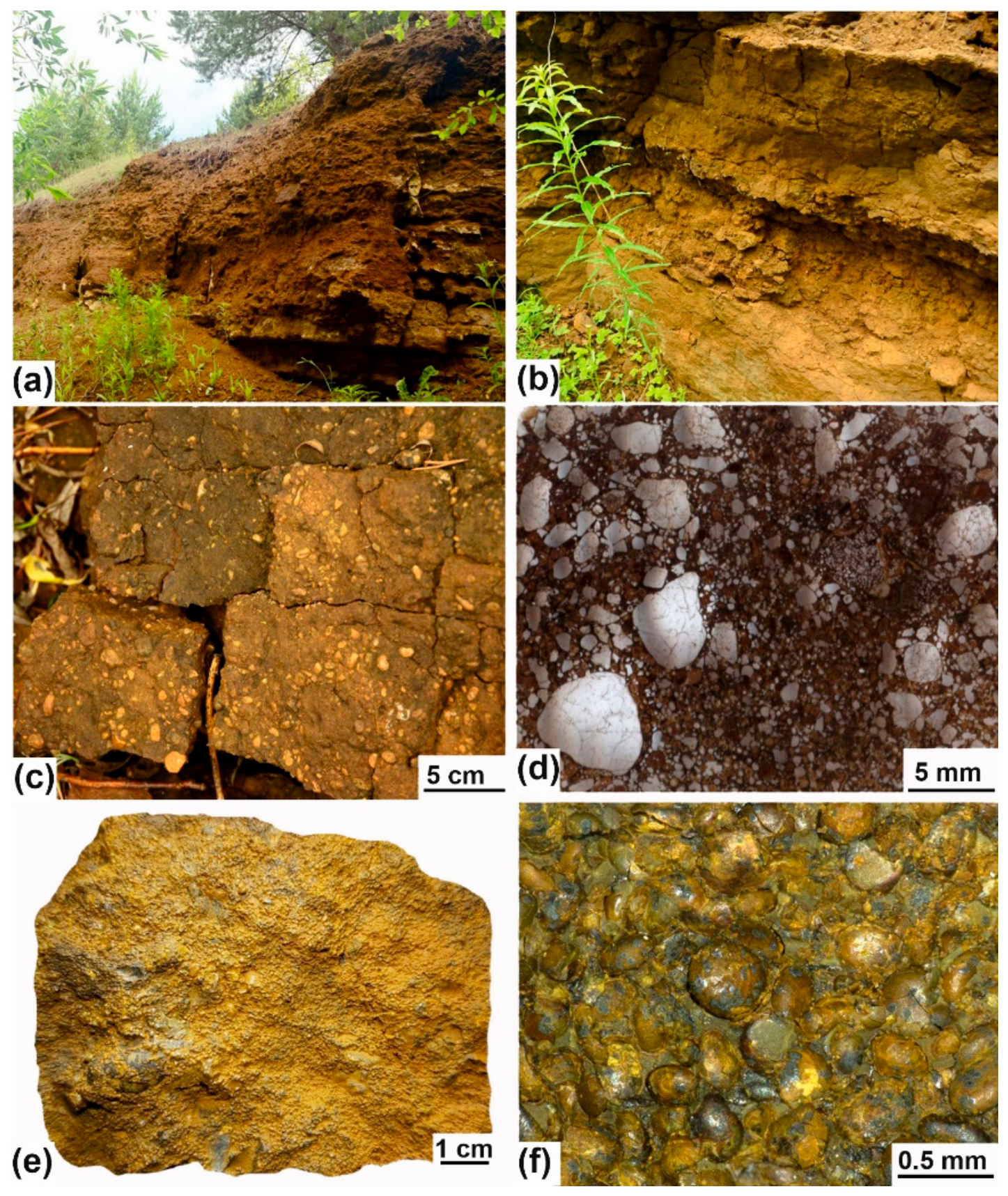
The amount of medium- and coarse-grained material varies from 10 to 70% of the rock volume. Large (5–20 mm across) fragments are represented predominantly by rounded quartz grains. The grains of feldspar, granite, and some other rocks, fragments of mineralized plant remains, and mollusk shells are less common. Glauconite globules, grains of ilmenite, rutile (anatase?), zircon, epidote, monazite (rhabdophane?), xenotime, and rounded segregations of aluminum hydroxides (bauxite) consist of more fine fraction. Ferruginous ooides cemented by a fine mass of authigenic minerals fill the space between the detrital fragments. The sizes of ooides are very consistent, on average ranging from 0.2 to 0.5 mm in diameter, rarely reaching 1 mm (Figure 5e, f).
Based on the mineral composition, iron ores are divided into two main mineral varieties (Table 1): 1) oxide quartz-chamosite-goethite (predominant); 2) carbonate kaolinite-quartz-siderite. Both varieties form a single layer. Carbonate ores have a greenish tint on fresh surface and are characterized by a denser (massive) structure and fracturing perpendicular to the bedding. They are also characterized by presence of thin calcite veinlets developing along fractures. Oxide ores are looser, brown, and lack carbonate mineralization.
The main authigenic mineral of oxide (quartz-chamosite-goethite) ores is goethite. Almost half of the total goethite is concentrated in ooids. They are typically had a fine concentric-zoned structure (Figure 5a). Massive goethite, fragments of earlier zoned ooids, grains of quartz, ilmenite, and other minerals, and sometimes plant relics can be found as ooide core. The cortex (outer concentric zones) most often consist of rhythmically alternating layers composed either of goethite with varying contents of trace elements (Al, Si, P, Ca, and Mn) (Figure 5b), or of alternation of goethite and chamosite. Outer zones of ooids composed of chamosite with thin goethite zones are less common (Figure 5c). Sometimes apatite inclusions emphasize the zoning of ooids. Ooids may contain not one, but two or more nuclei with different composition. Traces of mechanical deformation and rotation of ooids with repeated deposition of iron matter can be determined. In some ooids, apatite is arranged in conformity with the cortex patterns. The matrix consists predominantly of goethite and/or chamosite, and less commonly, apatite. Goethite grains in the interooidal space are often zoned (Figure 5d). Their cores are dense and homogeneous. Thin rims are porous and contain microscopic grains of quartz, chamosite, and apatite. Overgrowth and replacement of relics of microorganisms (algae ?) and goethite are periodically observed in the ores (Figure 5e).
Wide reflections and high background at the XRD-patterns and diffuse character of the bands in Raman spectra corresponds to a low degree of crystallinity of iron oxides. The iron oxides from the matrix have the most imperfect structure.
Varying admixtures of Si, Al, Mn, Ca, Mg, and P are characteristic of the chemical composition of goethite. The highest contents of these elements are found in goethite from ooids: 18–25 at. %. In the iron oxides from matrix, the amount of admixtures in grain cores is up to 9 at. %; in the rims of same grains – 13 at.%. Most of the Mn is concentrated in iron oxides from matrix. This is consistent with findings rhodochrosite relics in the cement.
Glauconite, muscovite-phengite, montmorillonite, kaolinite, aluminum hydroxides (gibbsite and/or boehmite?), siderite, calcite, dolomite, and rhodochrosite are identified as minor and accessory minerals of oxide ores (Table 1).
Carbonate (kaolinite-quartz-siderite) iron ores contain permanent but variable amounts of siderite. We define ores with a siderite content of at least 20% by volume as carbonate ores.
Siderite is represented by aggregates of two morphological types. The first type is pseudomorphic after goethite and chamosite-goethite ooids. Almost all stages of goethite and chamosite replacement by siderite are observed. In oxide ores, small amounts of siderite develop only as irregularly shaped “spots” within goethite ooids or form within them in separate concentric zones (Figure 5f). Rarely, rhodochrosite form platy crystals in cement together with apatite. In the carbonate ores, goethite oolites are already completely replaced by siderite, and their traces are preserved in the main mass of the rock only as more or less well-defined rounded “shadows”. The internal structure of siderite-replaced ooids no longer exhibits distinct zones. The former rhythmic concentric structure can sometimes be traced by relict goethite microinclusions or by the perchamite inclusions (Figure 5g). Siderite itself, however, forms either lumpy segregations or radial spherulites, irregularly oriented within the former ooide. The spherulite centers can be located both in its core and in shell. The acicular siderite individuals that compose the spherulites are often seen intersecting the growth zones of the original goethite ooides. The second type of siderite segregation is small (approximately 100 µm in diameter) lumpy-spherulitic aggregates that fill the space between replaced oolites (Figure 5h). Needle-like rhodochrosite associating with apatite in interstitial is rare (Figure 5ш).
The chemical composition of siderite of both morphological types is similar. The content of the FeCO3 end member is 71–95 mol %. The typical impurities are Ca, Mg, and Mn. Siderite with high Mn contents—up to 36 mol % MnCO3—manganous siderite is much less common. Plate-shaped grains of rhodochrosite with 79 mol % MnCO3 have been identified as a rare mineral.
4.1.2. Manganese Ores
Two types of manganese ores have been identified at the Marsyaty deposit: 1) carbonate (rhodochrosite) and 2) carbonate-oxide (rhodochrosite-goethite-rancieite) (Figure 6). According to previous geological exploration results, carbonate ores initially predominated at the deposit. Currently, they are accessible only as isolated blocks in former ore stockpiles. On the surface, along fractures and pore systems, the carbonate ores have been extensively replaced by supergene iron and manganese oxides and hydroxides, but the rhodochrosite rock remains within large samples. Carbonate-oxide primary ores were less typical of the deposit. They formed only small fragments of the base of manganese ore bodies, one of which is now exposed in the wall of an old quarry above the iron ore deposit (Figure 6a).
Carbonate (rhodochrosite) ores are fine-grained of light beige and light gray color. They have typically “stromatolitic” structure (Figure 6b–d). In cross section “stromatolites” have a shell-like, wavy, or truncated concentric-zoned structure caused by the rhythmic alternation of thin (1–2 mm thick), unilaterally convex or curved laminae separated by small pores, partially or completely filled with hypergene minerals. In sections along the “stromatolite” elongations, the carbonate layers are slightly curved, and the rock exhibits a uniform banded pattern.
The ore texture is lumpy and spherulitic (Figure 7a). The groundmass of the rocks contains rhodochrosite spherulites up to 500 µm in diameter with a clearly defined concentric-zoned structure (Figure b). The zoning is due to variations in the contents of the major elements (Mn, Fe, Ca, and Mg) in rhodochrosite, as well as the presence of finely dispersed iron oxide inclusions (goethite?) in some zones (Figure 7d). Both single spherulites and their intergrowths have been identified. In the latter case, a uniform (synchronous) change in the composition of the concentric growth zones is observed in adjacent spherulites, and the outermost shells are common to the entire spherulite aggregate. It is possible that such spherulites are microbial formations (microstromatolites). The average content of MnCO3 in spherulitic rhodochrosite is 65–70 mol %. A negative correlation was established between Mn and Fe contents (RMn–Fe = –0.82, N=41), and a positive correlation was established between Mg and Ca (RCa–Mg = 0.77, N=41) (in both cases, statistical significance with a probability of 95%) (Figure 7e). Rhodochrosite from the main lumpy-spherulitic mass has a more uniform chemical composition. Cores (up to 100 µm in diameter) with elevated Ca and Mg concentrations (up to 15 mol% CaMg(CO3)2) are sometimes observed in the center of the microspheres, but their bulk is composed of rhodochrosite, averaging 85 mol% MnCO3.
The carbonate matrix binding the large spherulites has a globular, lumpy, and in some areas microspherulitic structure. Numerous elongated or irregular pores measuring 5–50 µm are concentrated along the boundaries of the rhodochrosite globules and microspherulites. Faceted rhomboid crystals of Mn-bearing siderite often encrusted the pores (Figure 7c).
Manganese carbonate ores contain numerous micropores encrusted with carbonate crystals with comparable iron and manganese concentrations: 34 mol% MnCO3 and up to 56 mol% FeCO3. A mineral with Fe > Mn should be called manganese siderite. Compared to rhodochrosite in spherulites and the groundmass of the rock, manganese siderite is a distinctly later mineral (Figure 7c).
Isometric globules of microflaky glauconite are often found within the pores, as well as lamellar grains or, more often, tangled-flaky clusters of layered silicates (muscovite-phengite, montmorillonite, parsettensite, and caryopilite) (Figure 7f). Layered silicate grains are also present directly in the groundmass, where they overgrow and cement the lumpy rhodochrosite precipitates. The total amount of silicates does not exceed 1–5% of the ore volume. Quartz is found in comparable quantities. Sphalerite (wurtzite?), galena, pyrite, rutile (anatase?), ilmenite, aluminum oxide (gibbsite/or boehmite?), zircon, epidote, albite, calcite, apatite, and monazite are rare accessory minerals of rhodochrosite ores.
Carbonate-oxide (rhodochrosite-goethite-rancieite) ores are black to brownish-black in color. In most cases they have a coarse clastic structure (Figure 6e,f). Rounded and irregularly shaped clasts of quartz, metavolcanics, schists, granites, 0.5–3 cm in diameter, constitute 50–70% of the ore volume. The clasts are cemented by a micro- and fine-grained mass consisting of rhodochrosite and manganese and iron oxides (Figure 7g). Small (50–200 µm across), partially rounded fragments of rhodochrosite spherulites of isometric, elongated, or irregular shapes are abundant in the cement. Rhodochrosite aggregates is completely covered by a rim (50–100 µm thick) of tightly columnar rancieite (Figure 7h). The elongation of the rancieite grains is typically oriented perpendicular to the surface of the rhodochrosite spherulites. Together, rhodochrosite and rancieite form aggregates with cockade or microconcretion structure.
Сarbonate-oxide ores with a rhythmically layered texture occur at the deposit also. In structure and composition, they have much in common with the coarse-clastic ores discussed above. But layered ores contain significantly fewer and smaller detritic quartz, granite, and other rocks (on average 10–30 vol. % and 0.3-3 mm in size). Thin (50–100 µm thick) lens-shaped accumulations of montmorillonite, sometimes “pierced” by filamentary segregations of manganese and iron oxides is characteristic for layered ore. Zigzag traces of the activity of benthic organisms burrowing through the mud are sometimes visible in them.
The size of rhodochrosite-rancieite aggregates can vary even within a single thin section. Rhodochrosite-rancieite aggregates are held together by a finely dispersed and microporous mixture of iron oxides with high and variable manganese contents (“manganese goethite”). The same oxide mixture sometimes fills interstices in rancieite microdruses. The amount of “manganese goethite” varies widely. The ores retain a large volume of pores of varying sizes and shapes. Thin (10–30 µm) rims of rhomboid goethite crystals, closely intergrown with microfibrous montmorillonite, are widespread on the pore walls. Furthermore, filiform aggregates of manganese and iron oxides are periodically observed within the pores (Figure 7i). They always have a zonal structure: the axes of the “threads” are composed of either rancieite or “manganese goethite”, while the outer edges are always goethite. Most likely, the filamentary segregations of manganese and iron oxides formed not in voids, but within the previously filled finely dispersed mass of montmorillonite. Subsequently, the montmorillonite was almost completely washed out of the pores, leaving the oxide threads suspended in the void. This scenario is supported by the fact that some samples still retain clusters of montmorillonite containing filamentary aggregates of manganese and iron oxides. Sphalerite (wurtzite?), rutile (anatase?), ilmenite, zircon, titanite, epidote, chamosite, glauconite, albite, potassium feldspar, apatite and monazite have been identified among the accessory minerals in carbonate-oxide ores.
In all textural varieties of carbonate-oxide ores, manganese and iron mineralization is entirely concentrated in the cement. Despite the heterogeneous structure of the cement, a well-defined sequence of manganese and iron mineral formation can be traced: 1) rhodochrosite (mechanical fragments of rhodochrosite spherulites) → 2) rancieite overgrowing rhodochrosite clasts → 3) a mixture of manganese and iron oxides (“manganese goethite”) binding rhodochrosite-rancieite aggregates → 4) goethite encrusting pores, and Mn–Fe ± Ca oxides forming filiform segregations in pores and montmorillonite clusters. Rhodochrosite spherulite clasts from manganese carbonate-oxide ores is characterized by higher manganese contents (up to 86–98 mol% MnCO3), similar or even higher than those in rhodochrosite from the spherulites of carbonate ores.
We also note the general similarity in the structural appearance of manganese carbonate-oxide and oolitic iron ores, which reflects the similar facies conditions of accumulation of the primary metal-bearing sediments.
4.2. Chemical Composition of the Ores
The chemical composition of iron and manganese ores is presented in Tables S1–S3 of the Supplemental Material. The major constituents of iron ores are SiO2, Fe2O3, and volatile components (H2O and CO2), represented as loss on ignition (LOI). The total content of SiO2 + Fe2O3+ FeO + LOI ranges from 85.06 to 99.04%. Significantly smaller amounts of Al2O3 (1.79–7.59%), CaO (0.39–10.62%), P2O5 (0.35–6.37%), and MnO (0.57–2.43%) are present in the ores. The content of TiO2, Na2O, and K2O is less than 1 wt.% for each element (Table S1).
In the composition of carbonate manganese ores MnO and CO2 predominate: MnO + CO2 = 72.38–78.69%. SiO2, Fe2O3, Al2O3, Fe2O3, FeO, MgO and CaO contents are an order of magnitude lower, while TiO2, Na2O, K2O, and P2O5 contain less than 1 wt.% of each element. The ores are clearly specialized for manganese; their Mn/Fe ratio (4.61–17.99) is 100 times higher or more than that of iron ores and the average for the Earth’s crust. Compared to iron ores, manganese ores contain more MgO, which is generally characteristic of carbonate deposits.
The distribution of trace elements in all ore types of the Marsyaty deposit is similar (Figure 8). Minor discrepancies are due to variations in element concentrations (Table S2).
Among the 33 analyzed microelements, the concentrations of only 7 are comparable to or higher than in the upper part of the Earth’s crust (the values of Ci/CUpper crust are given in brackets, where CUpper crust is taken from [21]), these are Co (0.69–2.61), Ni (0.71–3.05), Zn (1.13–4.01), Ge (1.38–9.07), As (2.39–21.88), Cd (2.00–14.40) and Sb (2.25–14.60). The concentrations of 14 other elements are most often below this level: Li (0.24–1.34), Sc (0.13–0.84), Ga (0.22–0.81), Rb (0.04–0.12), Zr (0.14–0.50), Nb (0.03–0.15), Sn (0.08 – 0.24), Cs (0.05–0.24), Ba (0.13–1.00), Hf (0.07–0.24), Ta (0.06–0.11) and Th (0.11–0.51), Se and Te are usually below the detection limit. The contents of the remaining 12 elements can be both higher and lower than the reference values: Be (0.13–2.57), V (0.46–3.71), Cr (0.19–4.01), Cu (0.17–2.52), Sr (0.17–3.66), Y (0.29–1.56), Mo (0.32–3.82), W (0.22–2.09), Tl (0.02–5.75), Pb (0.33–2.83), Bi (0.24–7.22) and U (0.41–6.59).
The total content of rare earth element (REE) in the iron and manganese ores of the Marsyaty deposit ∑REE = 30.58–135.82 ppm are comparable to or lower than those in the upper Earth’s crust ∑REE = 139.58 g/t (Figure 9). The REE spectra are flat, subhorizontal with a slight slope toward light elements in the iron ores and a slight rise in the middle REE in the manganese ores. A slight deficiency of light REE was found in iron ores: (La/Lu)n = 0.30–0.44 and (La/Sm)n = 0.40–0.57. In manganese ores it is less clearly expressed: (La/Lu)n = 0.85–1.09 and (La/Sm)n = 0.70–0.76. Europium and cerium anomalies are practically absent in all ores: Eu/Eu* = 0.87–1.09, averaging 0.97, and Ce/Ce* = 0.86–1.20, averaging 1.05. A slight enrichment in cerium is manifested only in some samples of iron ores, where Ce/Ce* = 1.10–1.20. The REE spectra of iron oxide and carbonate ores are practically identical.
Carbon isotope composition of carbonates. All analyzed carbonates are enriched in the light carbon isotope 12C (Table 8). In iron ores, where siderite is the main carbonate, δ13Ccarb (VPDB) values vary within a relatively narrow range: from –24.8 to –18.5, averaging –22.0‰.
Rhodochrosite from manganese ores is characterized by a wider range of δ13C values. The highest values were found in carbonate ores: from –12.2 to –10.0 ‰. These values are almost twice as high as those for iron ore carbonates. The minimum δ13C values (–41.0 to –39.4 ‰) for the studied deposit were determined in rhodochrosite, which forms fragments of spherulites in manganese carbonate-oxide ores.
5. Discussion
Summarizing the results of studying the occurrence patterns, textures, structures, and mineralogy of iron and manganese ores, the following can be concluded:
- The ores are undoubtedly of primary sedimentary origin. This is evidenced by their textural features: alternating coarse and fine clastic layers with varying contents of unaltered detritus and the wide presence of organic remains with saved cellular texture as well as of preserve of water-bearing Fe oxihydroxides and layer silicates of a collomorphic textures.
- The iron and manganese ores are of different ages and are separated by a layer of unsorted coarse clastic sediment, the detritus of which includes fragments of manganese carbonates.
- The earliest minerals of iron ores are hydrous iron oxides (goethite) and chamosite, which compose the ooids. The presence of ooid fragments as cores of later ooids suggests their formation in an active hydrodynamic environment. The authigenic minerals of ooids and cement are similar in composition but differ in structure. These differences are likely due to the different dynamics of the environment in which the material initially accumulated: more mobile in the case of ooides and more stable in the case of cement. In manganese ores, judging by their structure, the earliest formations are rhodochrosite spherulites.
- Siderite in iron carbonate ores is clearly secondary to iron oxides and chamosite in the ooids. Siderite microspherulites in the cement do not show clear signs of replacement of the original oxide and silicate-iron substrate, i.e., they could have formed in the pore medium of unlithified sediment. Manganese carbonate-oxide ores consistently contain fragments of rhodochrosite spherulites, similar to those typical of manganese carbonate ores. Apparently, the destruction of carbonate-manganese strata was the source of rhodochrosite spherulite fragments in the carbonate-oxide ores.
An attempt to reconstruct the facies environments of ore accumulation is based on the above observations.
Iron and manganese accumulation facies settings
In the Mesozoic-Cenozoic, the West Siberian Plate comprised a large marine basin and adjacent coastal plains [22]. The land-sea boundary controlled the location of iron- and manganese-bearing deposits (see Figure 1). These deposits are accumulated from the Turonian to the Oligocene in various facies settings including: floodplains and river deltas, lakes, marine lagoons, etc. [7,15,23].
The Marsyaty deposit area was located on the western edge of the West Siberian Sea near a large landmass formed by the Ural folded structures, which formed in the late Permian–early Triassic. By the Late Cretaceous, the eastern slope of the Urals was an uplifted peneplain, transitioning to a lowland plain periodically flooded by the West Siberian Sea [14,22,23,24,25,26]. At least six major transgressive cycles, within which smaller phases of sea level fluctuations are distinguished [11,25], have been recorded in the area of manganese ore deposits in the Northern Urals at the Cretaceous-Paleogene boundary. The formation of the Marsyaty deposit is associated with one of these cycles.
The iron and manganese ores of the Marsyaty deposit occur at two different stratigraphic levels: the iron ores are hosted by Upper Cretaceous rocks, and the manganese ores by Lower Paleocene rocks. The facies environment of the host terrigenous sedimentation is interpreted ambiguously. It was defined as a shallow-water marine environment or as a continental lacustrine environment due to the finding of wood fragments, leaf and needle imprints, and the results of spore-pollen analysis [11,26]. The consistent presence of well-rounded coarse-grained material in the iron ores, poor sorting of the clastic fraction, and oolitic structures indicate the formation of iron-enriched sediments under high hydrodynamic activity. The large scale of the iron ore seam indicates that high water energy was maintained over a long period of time and over a large area. Those conditions could have occurred in the coastal wave zone of a large water reservoir (a large lake, a bay) and possibly at the mouth of a major river. In any case, the accumulation of large masses of iron oxides under conditions of high water mobility requires an effective geomorphic trap — the presence of a relatively enclosed basin (e.g., a lagoon).
It should also be noted that iron ores are characterized by high phosphorus content, up to the appearance of apatite-goethite cement in some lithological varieties. Intensive precipitation of phosphorus occurs more often in marine reservoirs than in freshwater ones [28]. Globular (peloidal) glauconite, which is widespread in iron ores, usually forms in marine settings also [29,30,31,32]; and references therein]. The association of glauconite with calcium phosphates and iron oxides is typical for sediments of marine origin [33,34]; and references therein].
Thus, the accumulation of iron-bearing sediments most likely occurred in a large sea bay, deeply incised into the land and partially separated from the open sea by shallow banks, bars etc.
Manganiferous rocks of the Northern Urals are considered to be marine shelf deposits [11,12,35]. Carbonate manganese ore deposits form at some distance from land (the source of coarse-grained material), at shallow depths, in a sedimentation zone of terrigenous sandy-clayey material, above the base of storm or tidal waves. Overall, the replacement of oolitic ironstones by carbonate manganese ores in the Marsyaty deposit section corresponds to a transgressive deposition.
The carbonate-oxide manganese ores of the Marsyatskoye deposit are formed by the destruction and redeposition of carbonate manganese ores. The destruction of the original carbonate rocks likely occurred during severe storms. The accumulation and burial of rhodochrosite detritus and the newly formed manganese oxides that cemented it occurred under conditions similar to those of oolitic ironstone formation in the coastal zone of a sea bay. High content of medium- and coarse-grained lithogenic material in the carbonate-oxide manganese ores, and the general similarity in appearance between these ores and oolitic ironstones confirm proposed model. Thus, the rhodochrosite-detrital-bearing layers of carbonate-oxide manganese ores mark shallow-water dispersal areas of disintegration products from carbonate deposits located far from the shore. Such areas could have formed during both the initial and final phases of the transgressive cycle. For the Marsyaty deposit, where carbonate-oxide manganese ores lie above oolitic ironstones, the first scenario is more likely.
Geochemical features of ores
Main elements
The Si content in the ores negatively correlates with the Fe (Figure 10a) and Al (Figure 10b) contents. The correlation coefficients RSi–Fe = –0.94 and RSi–Al = –0.90 are statistically significant for n = 12 with a confidence level of 95%. Such correlations reflect the changes ratio between detrital quartz, and both authigenic iron minerals and clay minerals. In four analyzed iron ore samples, the Si/Al value of 2.00–3.10 is comparable to that in clays, while in the other eight samples, Si/Al = 5.37–18.97, which is confirmed by the increased amount of quartz detritus. Iron contents correlate positively with aluminum contents (Figure 10c). This means that conditions for iron accumulation are also favorable for clayey material. It’s possible that during formation, finely dispersed iron oxides absorbed dust-like particles of clay minerals, and vice versa, the clayey material absorbed finely dispersed iron oxides. The abnormally high aluminum concentrations in iron ores for the deposit are due to the presence of bauxite in the “bean grains.”
An important lithochemical indicator is the Al/Ti ratio. Both elements precipitate primarily as detrital material, but aluminum is primarily present in clays, and titanium in rutile and ilmenite of the siltstone-sand fraction. For the Earth’s crust, the average Al/Ti ratio is 42.17 [21]. In the studied ores, only two cases show an Al/Ti ratio close to than this value: 41.33 and 52.64, respectively. In all other samples, Al/Ti = 5.85–35.80, and the average value is 21.00, that is, almost two times lower than the average for the Earth’s crust. Furthermore, excluding the single anomalously high titanium concentration (0.48% TiO2), a statistically significant positive correlation is observed between Ti and Al contents (Figure 10d). Clearly, such conjugate variations in aluminum and titanium contents are due to changes in the total amount of detrital material in the iron ores. At the same time, low Al/Ti values indicate that the accumulation of coarser-grained siltstone-sand material was more intense than that of fine-grained clayey material. This is typical of sediments formed in the coastal areas of marine basins.
High phosphorus concentration is characterized in iron ores. It exceeds by 1.7–30.9, on average by 9.8 times the average value for the Earth’s crust (0.086% P [21]). High phosphorus contents are typical of oolitic iron ores of many deposits [7,8,9,10,36,37,38,39]. So, iron ore of the Marsyaty deposit confirm a previously well-known pattern. Apatite is the main phosphorus concentrator in oolitic ironstones [18]. Therefore, phosphorus concentrations directly correlate with calcium concentrations (Figure 10e). However, the average Ca/P ratio in the Marsyaty’s ores and in stoechiometric apatite differ significantly: 5:2.3 and 5:3, respectively. Apparently, this is due to the deviation of the apatite stoichiometry from the Marsyaty deposit ores from the Ca5(PO4)3(F,OH,Cl) standard. In particular, this is due to the replacement of calcium by sodium, as indicated by the positive correlation between the concentrations of these elements (Figure 10f). In addition, it is important to note that the calculated Ca–P regression line intersects the phosphorus concentration axis at a value other than zero (at Ca = 0, P > 0). This suggests that apatite is not the only phosphorus accumulator in iron ores. This element is also concentrated as an impurity in goethite, as well as in monazite and perhamite [18,19].
High concentrations of manganese have been found in the iron ores, exceeding the average values for the Earth’s crust (0.077% Mn [21]) by 4.6–23.4 times, on average 7.5 times. At the same time, the Mn/Fe ratio in the iron ores varies little and ranges from 0.01 to 0.05, on average 0.02. This value coincides with the average Mn/Fe = 0.02 for the Earth’s crust. Thus, the process of iron accumulation is accompanied by an equivalent accumulation of manganese without significant differentiation. Elevated concentrations of manganese have also been found at some other deposits of oolitic iron ores of marine origin [7,8,10].
Trace elements
The conditions that led to the sedimentation of Fe and Mn were also favorable for the accumulation of Co, Ni, Zn, Ge, As, Cd, and Sb. The contents of these elements are higher than in the Earth’s crust (Ci/CUpper crust ≥ 1). These elements could have been introduced in a dissolved and suspended state by continental (river, ground, etc.) waters, hydrothermal solutions (of any origin), sorbed from seawater, supplied with biogenic matter, or concentrated by diffusion with pore diagenetic solutions. Which of these options were definitely realized is unclear. However, statistically significant (with a probability of 95% for n = 12) positive correlations were observed between the contents of Fe and Ge, As, and Sb in iron ores, with RFe–Me coefficients equal to 0.96, 0.85, and 0.83, respectively. Most likely, it is caused by the intensive sorption of these microelements by the finely dispersed iron oxides.
The main source of trace elements with (Ci/CUpper crust < 1) is most likely detrital aluminosilicate material. The concentrations of some of these elements are positively correlated with the aluminum contents (numbers in brackets are the RAl–Me correlation coefficients): Al – Li (0.75) – Sc (0.74) – Ga (0.92) – Zr (0.65) – Nb (0.87) – Hf (0.74) – Th (0.89). The aluminum-normalized [Ci/CAl] = [Ci/CAl]Sample/[Ci/CAlUpper crust] concentrations of Ga, Rb, Nb, Sn, Cs, Ba, Hf, Ta, Tl and Th are less than or equal to unity (see Figure 8). That is, the presence of aluminosilicate matter in the original sediments is quite sufficient to create the contents of these trace elements established in the ores. Rubidium and cesium concentrations correlate positively with potassium contents: K – Rb (0.84) – Cs (0.85). This is entirely reasonable, since Rb and Cs are concentrated due to the substitution of K in feldspars and layered silicates.
The distribution of Be, V, Cr, Cu, Sr, Y, Mo, Pb, Bi and U varies from Ci/CUpper crust < 1 to Ci/CUpper crust ≥ 1. For most of these elements, Ci/CAl >> 1. Consequently, the contents of these elements are excessive relative to the detrital component of metalliferous sediments and they were additionally supplied to the sediment with hydrogenic, biogenic and, possibly, hydrothermal matter or were intensively redistributed during diagenesis. However, compared to Co, Ni, Zn, Ge, As, Cd and Sb, the processes of accumulation of Be, V, Cr, Cu, Sr, Y, Mo, Pb, Bi and U were less intensive. Therefore, their “excess” concentrations are “masked” by high contents of Fe, Mn, as well as volatile components (LOI), and are revealed only with additional recalculations of analyses (normalization to Al).
REE distribution
The REE spectra both iron and manganese ores are generally typical for terrigenous and carbonate sediments, sedimentary rocks, as well as iron and manganese ores of sedimentogenic-diagenetic origin [10,23,40,41,42,43,44,45]. The similarity of both the contents and the shape of the REE spectra of iron oxide and carbonate ores reflect the similar conditions of their formation. REE concentrations correlate positively with aluminum content in the ores with RAl–REE = 0.76. Therefore, lithogenic aluminosilicate material was one of the sources of lanthanides in sediments. At the same time, the ∑REE/Al ratio = 24.39–83.30 in the ores is 1.4–4.7 times higher than the similar indicator for the Earth’s crust ∑REE/Al = 17.83. This means that the amount of REE in the ores is significantly higher than could have been introduced into the sediment by lithogenic matter. The additional REE input is most likely due to sorption of lanthanides by iron oxide or clay minerals from bottom waters.
Carbon isotope composition
The δ13Сcarb correspond to authigenic carbonates forming by carbon dioxide after microbial oxidation of organic matter in the sediments at the stage of diagenesis or catagenesis [48,49]. Carbonates of those genesis have δ13Сcarb from –25 to –5 ‰. The obtained values are close to the lower boundary of this interval. This is due to the fact that oolitic ironstones accumulated in the coastal zone of the basin with a terrigenous sedimentation type. There were no conditions here for the precipitation of carbonates, which concentrate the isotopically heavy carbon 13С of carbon dioxide dissolved in seawater. All reactive carbon precipitates as “sapropelic” organic matter (OM), which is characterized by low δ13C values. A similar isotopic composition of carbon has been established in oolitic iron ore from other deposits [44,50].
The carbon isotopic composition of rhodochrosite from manganese ores varies more widely. Most likely, isotopically heavy carbon 13С from sea water also took part in that formation. Mixing carbon from different sources contributed to the increase in values δ13Сcarb. However, the proportion of precipitated seawater carbon dioxide was relatively small, which is why the carbon isotope signatures generally correspond to carbonates of biogenic nature. Minimum value of δ13Сcarb. (from –41.0 to –39.4 ‰) is determined in rhodochrosite from the spherulite clasts in carbonate-oxide manganese ore. Such low δ13Ccarb values are an indicator of carbon dioxide produced during microbial oxidation of biogenic methane in the sediment layer at the stage of early diagenesis [49]. Authigenic carbonates, including manganese ones, formed by the oxidation of methane, are periodically found in the sediments of both modern and ancient seas [51,52,53,54,55,56]. Most often, such carbonates mark zones of methane seeps onto the seafloor. Probably this is the first time methane isotopic signatures have been observed for manganese carbonates in the Northern Urals. Thus, the rhodochrosite of the Marsyaty deposit are formed by carbon dioxide from various sources with biogenic source predominate.
Iron and manganese sources
The Marsyaty deposit area is composed exclusively of sedimentary rocks. There are no igneous including volcanogenic complexes here that could be associated with the formation of iron and manganese ores. In this situation, ore elements could have been supplied to the sedimentation area by three pathways: 1) river and groundwater from continental weathering crusts, 2) exfiltration (elision) solutions seeping to the seafloor, and 3) bottom currents directed from the deep parts of the reservoir to the shallows [2,6,7,9,37,57,58,59,60,61,62,63,64,65,66].
Available data on the Marsyaty deposit do not allow a clear preference for any one of the metal sources mentioned above. For oolitic ironstones, which contain a large proportion of detrital material imported from land, it is reasonable to assume that iron, manganese, and some other elements also came predominantly from a continental source. There is no evidence to contradict this assumption, although other element sources cannot be completely ruled out. It is safe to conclude that iron and manganese were supplied together, as high iron contents are accompanied by high manganese concentrations, and the average Mn/Fe ratio in the ores, 0.02, coincides with the average value for the Earth’s crust.
However, for carbonate manganese ores, continental erosion as the primary supplier of ore elements is far from obvious. These ores formed at the onset of marine transgression, far from the coastline. Their fine- and medium-clastic content is low, and their ore textures indicate a biogenic mechanism of manganese accumulation at low background sedimentation rates. The Fe/Mn ratio in manganese ores is two to three orders of magnitude higher than that in iron ores and the average crustal ratio. “Excess” manganese could well have been supplied to the sedimentation area by pathways independent of iron, and possibly from different sources. Nevertheless, the following should be noted. Iron and manganese ores exhibit a similar pattern of rare element distribution (see Figure 8). Therefore, it is reasonable to assume that both iron and manganese ores formed with the participation of a united source of elements. If continental erosion is assumed to be the source for iron ores, then this also influenced the formation of manganese ores, at least with respect to rare elements.
Model of formation of the Marsyaty deposit
The geochemical conditions of iron and manganese accumulation in sedimentary strata have been well studied [2,3,5,6,9,67]. Сhanges in the Eh and/or pH of the solution control the processes of precipitation and dissolution of iron and manganese. Both metals are soluble under reducing and acidic environments but precipitate with increasing oxidation potential and alkalinity. Compared with iron, manganese precipitates in more oxidizing and/or more alkaline environments. Differences in precipitation conditions facilitate metal differentiation, which can occur at any stage of sedimentation: during the selective leaching of iron and/or manganese from source rocks, during metal transport by solutions, or during accumulation in sediment. The most complete separation of iron and manganese occurs in a calm hydrodynamic environment, with a slow flow of ore material into the water basin and a gradual change in the Eh and pH of the water mass. Depending on the geological setting, either zonal Fe → Mn deposits form, or one of the metals (Fe or Mn) disperses into the surrounding space, while the other concentrates in the sediment, giving rise to metalliferous deposits. However, if at least one of the above conditions is not met, iron and manganese differentiation does not occur or is realized to a minor degree, and metalliferous sediments are characterized by low Mn/Fe values. In the initial sediments, iron and manganese accumulate mainly in the form of oxides Fe3+, Mn3+ and Mn4+; with further dia- and catagenesis, the formation of silicates and carbonates occurs.
Taking the above into account, the formation of metalliferous sediments of the Marsyaty deposit appears to be as follows (Figure 11). Regardless of the sources of metals, the formation of ferruginous sediments (Mn/Fe ≈ 0.02) occurred in the coastal zone of the marine basin. The intensive influx of ore matter, the abrupt change in physicochemical conditions with high hydrodynamics of the water mass prevented the separation of iron and manganese. Therefore, both metals is accumulated in the sediment. The accumulation of matter took place against the background of constant wave movements and periodic storms, which contributed to the formation of oolitic structures of oxide-iron sediments, regular rewashing and redeposition of metalliferous sediments, and their dilution with coarse- and fine-grained material, including clayey ones. In addition, the sediments also contained organic matter (siliceous, carbonate, phosphate, carbonaceous), the distribution of which predetermined the postsedimentation transformations of the mineral composition of the rocks.
During diagenesis, the destruction of reactive organic matter (OM) buried in sediments led to the absorption of oxygen from the pore solution and the formation of carbon dioxide. When OM is deficient or when sediment is incompletely isolated from bottom waters, moderately oxidizing conditions with low carbon dioxide concentrations prevail in the mineral-forming environment, facilitating the reaction of goethite with quartz and a clay mineral (kaolinite) to form chamosite. This reaction, coupled with low aluminum content in the rock, resulted in the formation of a quartz+chamosite+goethite association, typical of oxide iron ores. This association develops both within and between oolites. Diagenesis also leads to a local redistribution of manganese. Manganese is concentrated primarily in the interoolite space, where it most often is included in goethite and less commonly forms rhodochrosite grains.
Initially higher OM contents lead to a reduce conditions in the sediment, where oxygen concentrations in the pore solution drop sharply, while carbon dioxide can rise to a level where iron carbonate becomes stable instead of oxides. This leads, firstly, to the replacement of goethite and chamosite-goethite ooides with siderite, and secondly, to the crystallization of siderite in the interstices between the replaced ooides. As a result, iron ores acquire a predominantly carbonate (± quartz and kaolinite) composition. The diagenetic origin of siderite, which is later than that of iron oxides and silicates, is clearly documented by mineralogical observations. The participation of biogenic carbon dioxide in the formation of siderite is confirmed by the isotopic composition of carbon in the carbonate. Calculations also show that siderite formation requires relatively high concentrations of carbon dioxide, which occur in relatively confined areas of the sediment, preventing the penetration of new portions of oxygen-rich bottom waters [68]. The replacement of goethite by siderite is accompanied by the release of Si, Al, and P initially sorbed within goethite, which facilitate the formation of perchamite and some other minerals [19].
The formation of manganese-enriched sediments (Mn/Fe >> 1) occurred during periods of calm hydrodynamic conditions, with a relatively low rate of accumulation of detrital material, and with a fairly complete separation of manganese from iron (Figure 11b) under different physicochemical environment.
In modern reservoirs, manganese initially accumulates primarily as Mn3+/Mn4+ oxides. Manganese carbonates do not precipitate, as the carbon dioxide concentration in bottom waters, even in stagnant areas of basins, is insufficient [69]. Carbonates (rhodochrosite and kutnahorite) are formed during diagenesis by the reaction of initially sedimentogenic manganese oxides with carbon dioxide produced during the microbial decomposition of organic matter [5,70]. The composition and structure of the carbonate manganese ores of the Marsyaty deposit are generally consistent with these concepts. They are characterized by typical diagenetic spherulitic structures of rhodochrosite aggregates, and the carbon isotope composition of the carbonates clearly indicates the participation of microbiota in their formation. However, it is necessary to note several important points.
The carbonate ores of the Marsyaty deposit lack any relics of sedimentogenic manganese oxides. These were most likely represented by finely dispersed particles, which were completely replaced by rhodochrosite during the earliest stages of diagenesis. The ores exhibit wavy-banded textures similar to those of stromatolitic structures. The rhodochrosite mass consistently contains intergrowths of concentrically zoned spherulites, which are interpreted as microbial formations (microstromatolites). Along with isotopic data, this ore structure reflects the direct involvement of a biological community in the formation of manganese carbonates. These carbonate rock likely represents fragments of organogenic (bacterial-algal?) structures that formed within unconsolidated sediment near the seafloor. The unique feature of these structures was that the benthic biocenosis that created them developed through phyto- and chemosynthesis processes associated with the precipitation of manganese oxides and their subsequent transformation into rhodochrosite.
The possibility of the existence of such biocenoses has been widely discussed in recent decades and is substantiated by both geological and geochemical data and the results of laboratory experiments [70,71,72,73,74,75]. Isotopic data give reason to believe that at least part of the organogenic-manganese structures of the Marsyaty deposit could have arisen in areas of methane seepage.
Carbonate manganese buildups formed at the water-sediment interface. Initially, they were porous and incompletely cemented sediments, easily eroded by strong storms. This allowed rhodochrosite detritus to accumulate on the flanks of the carbonate deposits. Partial oxidation of this detritus in oxygen-rich bottom waters led to the formation of manganese carbonate-oxide ores. The accumulation and subsequent burial of carbonate-oxide deposits occurred rapidly. Otherwise, numerous relics of rhodochrosite spherulites would not have been preserved in the rock. Furthermore, complete oxidation of rhodochrosite was apparently prevented by the formation of a dense crust of newly formed rancieite. It is possible that erosion products of underlying oolitic iron ores also contributed to the formation of carbonate-oxide ores. This is indicated by the widespread occurrence of manganese goethite in the cement of such ores.
6. Conclusions
Oolitic ironstones and manganese ores at the Marsyaty deposit are spatially contiguous and separated in vertical section only by a thin interlayer of sand and gravelstone. The oolitic ironstone layer consists of alternating essentially iron oxide and siderite varieties. Ontogenic observations have established the superimposed nature of siderite on primary chamosite-oxyhydroxide associations. These primary associations formed in a coastal oxidizing environment. The carbon isotope composition of siderite (δ13Сcarb -18.5…-24.8‰, VPDB) indicates a biogenic source of carbon dioxide associated with the oxidation of buried organic matter. Primary manganese carbonate ores were formed with the participation of biota, as evidenced by the numerous organic remains in the manganese ores. Extremely light carbon (up to -40.0 δ13Ccarb ‰, VPDB) in rhodochrosite may indicate methane as a carbon source.
As a rule, sedimentary manganese and iron deposits are spatially separated because the facies and physicochemical conditions for iron and manganese accumulation in sedimentary rocks differ. These are lead to differences in the distribution of sedimentary oolitic ironstones and manganese ores. Ironstone deposits that are not accompanied by manganese ores are widespread on the periphery of the Cretaceous-Paleogene West Siberian sedimentary basin, while manganese deposits have been discovered only along the eastern slope of the Northern Urals. Moreover, iron and manganese ores are spatially coexistent at only two sites, one of which is the Marsyaty deposit studied here. Facies reconstructions indicate that the iron and manganese ores of the Marsyaty deposit belong to a common transgressive series of sedimentary rocks overlying each other. It is clear that the iron and manganese ores formed sequentially during the evolution of a single marine basin. The degree of element differentiation, measured by the Mn/Fe ratio, increases with rising sea level: iron precipitates predominantly in the coastal zone, while manganese precipitates on the shallow shelf.
A unique feature of the Marsyaty deposit is that, within a limited area and over a short geological period, favorable conditions were created first for the accumulation of iron and manganese, and then for manganese alone.
Supplementary Materials
The following supporting information can be downloaded at the website of this paper posted on Preprints.org, Table S1: Chemical composition (wt.%) of iron and manganese ores of Marsyaty deposit; Table S2: Content of the rare elements (ppm) of iron and manganese ores of Marsyaty deposit; Table S3: Content of the REE (ppm) of iron and manganese ores of Marsyaty deposit.
Author Contributions
Conceptualization, E.B. and A.B.; methodology, E.B. and A.B.; investigation, E.B., A.B., K.N., K.F., M.R., S.S.; writing—original draft preparation, A.B. and E.B.; writing—review and editing, E.B. and K.N.; visualization, A.B., E.B., and K.N. All authors have read and agreed to the published version of the manuscript.
Funding
Please add: This research was funded by State contract, grant number 122 0316 00292-6 of the SU FNC MiG, Ural Branch of the Russian Academy of Sciences.
Data Availability Statement
Data are contained within the article and Supplementary Materials
Acknowledgments
The authors are grateful to E. Perova (Department of Mineralogy, St. Petersburg State University) and I. Zhukov (Laboratory of Ore Genesis Mineralogy, SU FNC MiG, Ural Branch of the Russian Academy of Sciences) for their assistance with field research. The research was conducted using the analytical capabilities of the resource centers of St. Petersburg State University («Microscopy and Microanalysis», analyst S. Yansen, «Geomodel», analyst N. Vlasenko, «X-ray Diffraction Research Methods», analyst N. Platonova) and the the SU FNC MiG, Ural Branch of the Russian Academy of Sciences (analysts M.Rassomakhin, K.Filippova and M.Malyarenok).
Conflicts of Interest
The authors declare no conflicts of interest. The funders had no role in the design of the study; in the collection, analyses, or interpretation of data; in the writing of the manuscript; or in the decision to publish the results.
Abbreviations
The following abbreviations are used in this manuscript: Ap – apatite, Chm – chamosite, Cpl – caryopilite, Fhy – ferrihydrite, Gln – glauconite, Gtn – goethite, Ilm – ilmenite, Kln – kaolinite, Mnt – montmorillonite, Mnz – monazite, Ms – muscovite, Phm – perhamite, Psn – parsettensite, Qz – quartz, Rds – rhodochrosite, Rnc – rancieite, Rt – rutile, Sd – siderite.
References
- Varentsov, I.M.; Rakhmanov, V.P. Manganese deposits. In Ore deposits of the USSR, (in Russian), 2nd ed.; Smirnov, V.I., Ed.; Nedra: Moscow, Russia, 1978; Volume 1, p. 112−171. [Google Scholar]
- Maynard, B. Geochemistry of Sedimentary Ore Deposits; Springer: Berlin, 1983; p. 306 p. [Google Scholar]
- Roy, S. Manganese deposits; Academic Press: London, 1981; p. 458 p. [Google Scholar]
- Brusnitsyn, A. Geochemistry and genetic model of the ore-bearing sediments of the Parnok ferromanganese deposit, Polar Urals. Geochem. Int. 2013, 51, 623–645. [Google Scholar] [CrossRef]
- Kuleshov, V.N. Manganese rocks and ores: geochemistry of isotopes, genesis, evolution of ore genesis; (in Russian). Scientific world: Moscow, Russia, 2013; p. 506 p. [Google Scholar]
- Maynard, J.B. Manganiferous sediments, rocks and ores. In Treatise on Geochemistry, 2nd ed.; Holland, Heinrich, Turekian, Karl, Eds.; Elsevier: Amsterdam, 2014; Volume 9, pp. 327–349. [Google Scholar]
- Kholodov, V.N.; Nedumov, R.I.; Golubovskaya, E.V. Facies types of sedimentary iron ore deposits and their geochemical features: Communication 2. Problems of the geochemistry of phanerozoic iron ores. Lithol. Min. Resour. 2013, 48, 14–47. [Google Scholar] [CrossRef]
- Baioumy, H.M.; Ahmed, A.H.; Khedr, M.Z. A mixed hydrogenous and hydrotermal origin of the Bahariya iron ores, Egypt: evidences from the trance and rare earth element geochemistry. J. Geochem. Explor. 2014, 146, 149–162. [Google Scholar] [CrossRef]
- Ramanaidou, E.R.; Wells, M.A. Sedimentary hosted iron ores. In Treatise on Geochemistry, 2nd ed.; Holland, Heinrich, Turekian, Karl, Eds.; Elsevier: Amsterdam, 2014; Volume 13, pp. 313–355. [Google Scholar]
- Sokol, E.V.; Kokh, S.N.; Kozmenko, O. A.; Nekipelova, A.V.; Rudmin, M.; Khvorov, P.V.; Artemyev, D.A. Geochemistry and mineralogy of rate elements in high-phosphorus ooidal ironstones: a case study of the Kamysh-Burun deposits (Azov-Black sea privince). Ore Geol. Rev. 2020, 127, 103827. [Google Scholar] [CrossRef]
- Rabinovich, S.D. North Ural manganese ore basin; (in Russian). Nedra: Moscow, 1971; p. 264 p. [Google Scholar]
- Kontar, E.S.; Savelyeva, K.P.; Surganov, A.V.; Aleshin, B.M.; Shishkin, M.A.; Gerasimov, N.N.; Kostromin, D.A.; Papulova, O.B.; Sergeeva, V.V. Manganese deposits of the Urals; (in Russian). Uralgeolkom: Ekaterinburg, 1999; p. 120 p. [Google Scholar]
- Mikhailov, B.M. Actual Problems of Prediction of Manganese Deposits in the Urals. Lithol. Min. Resour. 2001, 36, 1–12. [Google Scholar] [CrossRef]
- Surkov, V.S. (Ed.) Atlas of paleotectonic and paleogeological-landscape maps of hydrocarbon provinces of Siberia; SNIIGG&MS: Novosibirsk, 1995. [Google Scholar]
- Rudmin, M.; Mazurov, A.; Banerjee, S. Origin of ooidal ironstones in relation to warming events: Cretaceous-Eocene Bakchar deposit, south-east Western Siberia. Mar. Pet. Geol. 2019, 100, 309–325. [Google Scholar] [CrossRef]
- Maximov, P.; Rudmin, M. Origin of Upper Cretaceous marine ironstones of Ayat Formation (Turgay depression, Northern Kazakhstan). Solid Earth Sci. 2023, 8, 1–11. [Google Scholar] [CrossRef]
- Umova, L.A. Petrographic study of Cretaceous and Paleogene deposits containing iron and manganese ores in the Northern Urals (Marsyaty deposit); (in Russian). Ural Geological Directorate for Metal Prospecting and Exploration: Sverdlovsk, 1949; p. 136 p. [Google Scholar]
- Belogub, E.V.; Novoselov, K.A.; Brusnitsyn, A.I.; Rassomakhin, M.A.; Bocharov, V.N. Mineral forms of phosphorus in oolitic iron ores of the Marsyatskoye deposit (Northern Urals). Mineralogy in Russian. 2024, 10, 126–149. [Google Scholar]
- Brusnitsyn, A.I.; Belogub, E.V.; Novoselov, K.A.; Platonova, N.V.; Vlasenko, N.S.; Bocharov, V.N. Perchamite from oolitic iron ores of the Marsyatskoe deposit (Northern Urals). Proc. Russ. Mineral. Soc. in Russian. 2025, 154, 58–75. [Google Scholar]
- Lisov, N.S.; Korovin, N.F. State Geological Map of the USSR, scale 1:200,000. Middle Ural Series. Sheet O-41-I. Explanatory Note; 173 p. (in Russian). 1971. [Google Scholar]
- Li, Y.-H.; Schoonmaker, J.E. Chemical composition and mineralogy of marine sediments. In Treatise on Geochemistry. Sediments, diagenesis, and sedimentary rocks; Mackenzie, F.T., Ed.; Elsevier: Amsterdam, 2003; Volume 7, pp. 1–35. [Google Scholar]
- Kontorovich, A.E.; Ershov, S.V.; Kazanenkov, V.A.; Karogodin, Y.u.N.; Kontorovich, V.A.; Lebedeva, N.K.; Nikitenko, B.L.; Popova, N.I.; Shurygin, B.N. Cretaceous paleogeography of the West Siberian sedimentary basin. Russ. Geol. Geophys. 2014, 55, 582–609. [Google Scholar] [CrossRef]
- Novoselov, K.A.; Belogub, E.V.; Kotlyarov, V.V.; Filippova, K.A.; Sadykov, S.A. Mineralogical and geochemical features of oolitic ironstones from the Sinara-Techa deposit, Kurgan district, Russia. Geol. Ore Depos. 2018, 60, 265–276. [Google Scholar] [CrossRef]
- Umova, L.A.; Tsaur, G.I.; Shatrov, V.P. Paleogeography of the Eastern Slope of the Urals and Trans-Urals in Cretaceous and Paleocene Times; (in Russian). Ufa Branch of the USSR Academy of Sciences: Sverdlovsk, Russia, 1968; p. 84 p. [Google Scholar]
- Sigov, A.P. Metallogeny of the Mesozoic and Cenozoic of the Urals; (in Russian). Nedra: Moscow, Russia, 1969; p. 296 p. [Google Scholar]
- Papulov, G.N. Cretaceous deposits of the Urals (stratigraphy, paleogeography, paleotectonics); (in Russian). Nauka: Moscow, Russia, 1974; p. 203 p. [Google Scholar]
- Amon, E.O. Marine waters of the Ural region in the Middle and Late Cretaceous. Geol. Geophys. in Russian. 2001, 42, 471–483. [Google Scholar]
- Kholodov, V.N. Geochemistry of the sedimentary process; (in Russian). GEOS: Moscow, Russia.
- Bentor, Y.; Kastner, M. Notes on the mineralogy and origin of glauconite. J. Sediment. Petrol. 1965, 35, 155–166. [Google Scholar] [CrossRef]
- Banerjee, S.; Bansal, U.; Thorat, A.V. A review on palaeogeographic implications and temporal variation in glaucony composition. J. Palaeogeogr. 2016, 5, 43–71. [Google Scholar] [CrossRef]
- Velde, B. Green clay minerals. In Treatise on Geochemistry. Sediments, diagenesis, and sedimentary rocks.; Mackenzie, F.T., Ed.; Elsevier: Amsterdam, 2003; Volume 7, pp. pp. 309–324. [Google Scholar]
- Belousov, P.E.; Chupalenkov, N.M.; Rudmin, M.A.; Krupskaya, V.V. Glauconite deposits in Russia; geological position, formation conditions, and development perspectives. Lithol. Min. Resour. 2022, 3, 234–247. [Google Scholar] [CrossRef]
- Johnson, H.D.; Baldwin, C.T. Shallow siliciclastic seas. In Sedimentary environments and facies.; Reading, H.G., Ed.; Blackwell scientific publications; pp. 229–282.
- Yudovich, Y.a.E.; Ketris, M.P. Mineral indicators of lithogenesis; (in Russian). Geoprint: Syktyvkar, 2008; p. 564 p. [Google Scholar]
- Betekhtin, A.G. Industrial manganese ores of the USSR; Publishing House of the USSR Academy of Sciences: Moscow, 1946; p. 315 p. [Google Scholar]
- Baioumy, H.; Omran, M.; Fabritius, T. Minqralogy, geochemistry and origin of high-phosphorus oolitic iron ores of Aswan, Egypt. Ore Geol. Rev. 2017, 80, 185–199. [Google Scholar] [CrossRef]
- Han, K.; Han, Zh.; Garzanti, E.; Zhu, Sh.; Yao, H.; Guo, H.; Liu, X.; Wang, Ch. Middle Jurassic ooidal ironstones (southern Tibet): Formation processes and implications for the paleoceanography of eastern Neo-Tethys. Front. Earth Sci. 2023, 10. [Google Scholar] [CrossRef]
- Yudovich, Y.a.E.; Ketris, M.P. Geochemistry and mineralogy of phosphorus as indicators of geological processes; (in Russian). FITsKomiNTsURORAN: Syktyvkar, 2023; p. 196 p. [Google Scholar]
- Kalinina, N.; Maximov, P.; Molukpayeva, D.; Sherstyukov, M.; Kerimov, A.; Rudmin, M. Depositional paleoenvironment of the Middle Jurassic (Aalenian) ooidal ironstones in Labino-Malkin zone (north-western Caucasus). Mar. Pet. Geol. 2024, 162. [Google Scholar] [CrossRef]
- Dubinin, A.V. Geochemistry of rare earth elements in the ocean; (in Russian). Nauka: Moscow, 2006; Volume 40, p. 359 p. [Google Scholar]
- Bau, M.; Scmidt, K.; Koschinsky, A.; Hein, J.; Kuhn, T.; Usui, A. Discriminating between different genetic types of marine ferro-manganese crusts and nodules on rare earth elements and yttrium. Chem. Geol. 2014, 381, 1–9. [Google Scholar] [CrossRef]
- Tostevin, R.; Shields, A.G.; Tarbuck, G.M.; He, T.; Clarkson, M.O.; Wood, R.A. Effective use of cerium anomalies as a redox proxy in carbonate-dominated marine settings. Chem. Geol. 2016, 438, 146–162. [Google Scholar] [CrossRef]
- Brusnitsyn, A.I.; Zhukov, I.G.; Letnikova, E.F. Geochemistry of rare and Rare-Earth elements in manganiferous sediments of the Polar Urals and Pai-Khoi. Lithol. Min. Resour. 2020, 55, 36–54. [Google Scholar] [CrossRef]
- Nekipelova, A.V. Rare earth elements in Kerch iron ores: distribution features and occurrence forms. Abstract of Cand. Geol.-Min. Sci.. IGM SB RAS, (in Russian). Novosibirsk, 2023. [Google Scholar]
- Sasmaz, A.; Sasmaz, B.; Hein, J. Geochemical approach to the genesis of the Oligocene-stratiform manganese-oxide deposit, Chiatura (Georgia). Ore Geol. Rev. 2021, 128. [Google Scholar] [CrossRef]
- Sasmaz, A.; Zagnitko, V.; Sasmaz, B. Major, trace and rare earth element (REE) geochemistry of the Oligocene stratiform manganese oxide-hydroxide deposits in the Nikopol, Ukraine. Ore Geol. Rev. 2020, 126. [Google Scholar] [CrossRef]
- Afify, M.; Sanz-Montero, M.E.; Calvo, J.P. Differentiation of ironstone types by using rare earth elements and yttrium geochemistry – A case study from the Bahariya region, Egypt. Ore Geol. Rev. 2018, 96, 247–281. [Google Scholar] [CrossRef]
- Kuleshov, V.N. Evolution of isotopic carbon dioxide-water systems in lithogenesis: Comminication 1. Sedimentogenesis and diagenesis. Lithol. Min. Resour. 2001, 36, 429–444. [Google Scholar] [CrossRef]
- Hoefs, J. Stable isotope geochemistry; Springer-Verlag: Berlin Heidelberg, 2018; p. 437 p. [Google Scholar]
- Rudmin, M.; Banerjee, S.; Sinkina, E.; Ruban, A.; Kalinina, N.; Smirnov, P. A study of iron carbonates and clay minerals for understanding the origin of marine ooidal ironstone deposits. Mar. Pet. Geol. 2022, 142, 105777. [Google Scholar] [CrossRef]
- Hein, J.R.; Koski, R.A. Bacterially mediated diagenetic origin for chert-hosted manganese deposits in the Franciscan Complex, California Coast Ranges. Geology 1987, 15, 722−726. [Google Scholar] [CrossRef]
- Lein AYu Gorshkov, A.I.; Pimenov, N.V.; Bogdanov, Y.u.A.; Vogt, P.; Bogdanova OYu Kuptsov, V.M.; Ul’anova, N.V.; Sagalevich, A.M.; Ivanov, M.V. Authigenic carbonates in methane seeps from the Norwegian sea: Mineralogy, geochemistry, and genesis. Lithol. Min. Resour. 2000, 35, 295–310. [Google Scholar] [CrossRef]
- Belenkaya, I.Yu. Influence of hydrocarbon gases on authigenic mineral formation in cold seep sediments. Bull. Mosc. Univ. Ser. 4 Geol. (in Russian). 2003, no. 3, 15−21. [Google Scholar]
- Kuleshov, V.N.; Brusnitsyn, A.I. Isotopic composition (δC13, δO18) and the origin of carbonates from manganese deposits of the Southern Urals. Lithol. Min. Resour. 2005, 40(no 4), 416–429. [Google Scholar] [CrossRef]
- Hiruta, A.; Klugel, A.; Matsumoto, R. Increase in methane flux and dissociation of iron and manganese oxides recorded in a methane-derived carbonate nodule in the eastern margin of the Sea of Japan. GeoResJ 2016, 9–12, 104–116. [Google Scholar] [CrossRef]
- Ruban, A.; Rudmin, M.; Mazurov, A.; Chernykh, D.; Dudarev, O.; Semiletov, I. Cold-seep carbonates of the Laptev Sea continental slope: Constraints from fluid sources and environment of formation. Chem. Geol. 2022, 610, 121103. [Google Scholar] [CrossRef]
- Kimberley, M.M. Origin of oolitic iron formations. J. Sediment. Petrol. 1979, 49, 111–131. [Google Scholar] [CrossRef]
- Van Houten, F.; Bhattacharyya, D. Phanerozoic Oolitic Ironstones - Geologic Record and Facies Model. Annu. Rev. Earth Plan. Sci. 1982, 10, 441–457. [Google Scholar] [CrossRef]
- Pavlov, D.I. Relationship of sedimentary deposits of iron and manganese with oil and gas basins. Geol. Ore Depos. (in Russian). 1989, no. 2, 80–91. [Google Scholar]
- Frakes, L.; Bolton, B. Effects of oceanic chemistry, sea level, and climate on the formation of primary sedimentary manganese ore deposits. Econ. Geol. 1992, 87, 1207–1217. [Google Scholar] [CrossRef]
- Kimberley, M.M. Debate about ironstone: has solute supply been surficial weathering, hydrothermal convection, or exhalation of deep fluids? Terra Nova 1994, 6, 116–132. [Google Scholar] [CrossRef]
- Young, T.P. Phanerozoic ironstones: an introduction and review; Young, T.P, Tailor, W.E.G., Eds.; GSL: London, 1989; pp. ix–xxv. [Google Scholar]
- Kholodov, V.N.; Nedumov, R.I. Association of manganese ore and phosphorite-bearing facies in sedimentary sequences: Communication 1. Parastereses and parageneses of phosphorus and manganese in Mesozoic-Cenozoic and Upper Paleozoic rocks. Lithol. Min. Resour. 2009, 44, 1–18. [Google Scholar] [CrossRef]
- Dellwig, O.; Leipe, T.; Marz, C.; Glockzin, M.; Pollehne, F.; Schnetger, B.; Yakushev, E.V.; Bottcher, M.E.; Brumsack, H.-J. A new particulate Mn–Fe–P at the redoxcline of anoxic basin. Geochim. Et. Cosmochim. Acta 2010, 74, 7100–0 7115. [Google Scholar] [CrossRef]
- Ossa, F.O.; Hofmann, A.; Wille, M.; Spangenberg, J.E.; Bekker, A.; Poulton, S.W.; Eickmann, B.; Schoenberg, R. Aerobic iron and manganese cycling in a redox-stratified Mesoarchean epicontinental sea. Earth Planet. Sci. Lett. 2018, 500, 28–40. [Google Scholar] [CrossRef]
- Matheson, E.J.; Malone, J.D.; Pufahl, P.K.; Hiatt, E.E. Late Ordovician ironstone and its relation to ocean redox instability, climate and glaciation. Sedimentology 2024, 72, 631–665. [Google Scholar] [CrossRef]
- Kalinina, N.; Rudmin, M.; Sherstyukov, M.; Maximov, P.; Kerimov, A. Origin of iron-rich minerals, ooids and pisoids in the Jurassic ooidal ironstones of the Labino-Malkin region (Caucasus). J. Palaeogeogr. 2024, 13, 475–494. [Google Scholar] [CrossRef]
- Brusnitsyn, A.I.; Kuleshov, V.N.; Perova, E.N.; Zaitsev, A.N. Ferromanganese carbonate metasediments of the Sob area, Polar Urals: Bedding conditions, composition, and genesis. Lithol. Min. Resour. 2017, 52, 192–213. [Google Scholar] [CrossRef]
- Calvert, S.E.; Pedersen, T.F. Sedimentary geochemistry of manganese: implications for the environment of formation of manganiferous black shale. Econ. Geol. 1996, 91, 36–47. [Google Scholar] [CrossRef]
- Konhauser, K. Introduction to geomicrobiology; Blackwell Publishing, 2007; p. 425 p. [Google Scholar]
- Pinevich, A.V. Microbiology of Iron and Manganese; (in Russian). St. Petersburg State University Press: St. Petersburg, 2005; p. 374 p. [Google Scholar]
- Tebo, B.M.; Johnson, H.A.; McCarthy, J.K.; Templeton, A.S. Geomicrobiology of manganese(II) oxidation. Trends Microbiol. 2005, 13, 421–428. [Google Scholar] [CrossRef] [PubMed]
- Learman, D.R.; Wankel, S.D.; Webb, S.M.; Martinez, N.; Madden, A.S.; Hansel, C.M. Coupled biotic–abiotic Mn(II) oxidation pathway mediates the formation and structural evolution of biogenic Mn oxides. Geochim. Et. Cosmochim. Acta 2011, 75, 6048–6063. [Google Scholar] [CrossRef]
- Bodor, S.; Polgari, M.; Szentpetery, I.; Foldessy, J. Microbially mediated iron ore formation, Silicic Superunit, Rudabanya, Hungary. Ore Geol. Rev. 2016, 72, 391–401. [Google Scholar] [CrossRef]
- Polgari, M.; Gyollai, I. Geochemical constraints on the element enrichments of microbially mediated manganese and iron ores – An overview. Ore Geol. Rev. 2021, 136, 104203. [Google Scholar] [CrossRef]
Figure 1.
Iron and manganese deposits: at the Northern Urals (a) and at the boundary of West-Siberian basin. Created by (a) A.I.Brusnitsyn using materials of [11,12] and (b) K.A.Novoselov using [14]. EEP – East-European platform, WSP – West-Siberian platform.
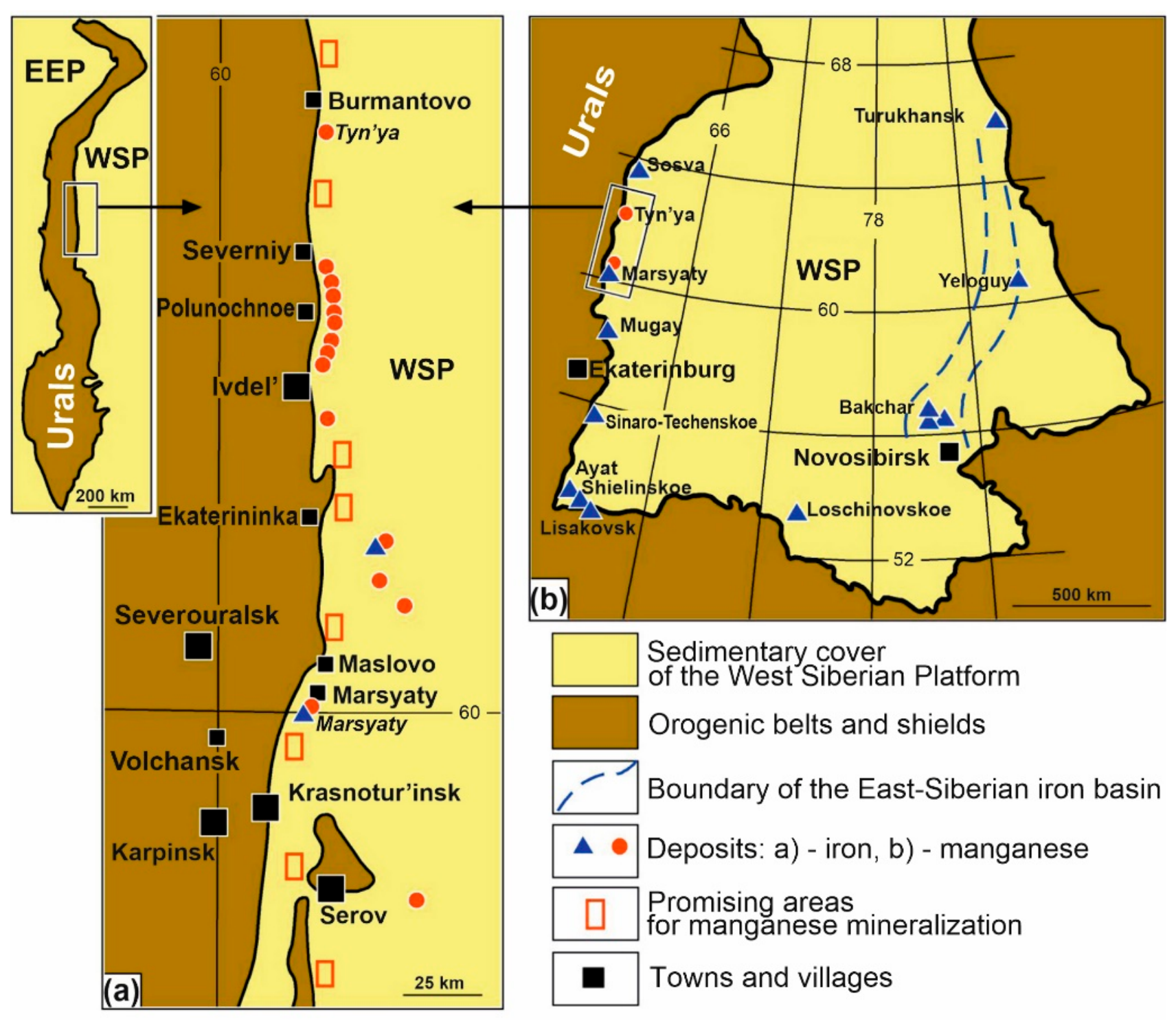
Figure 2.
Location of old open pits south-west of the Marsyaty village. Sampling point indicates by star (a). Geological sketch of the Marsyaty area, created at the base of geological maps 1:200000 [20]. Cross-section of Marsyaty deposit [11] (c).
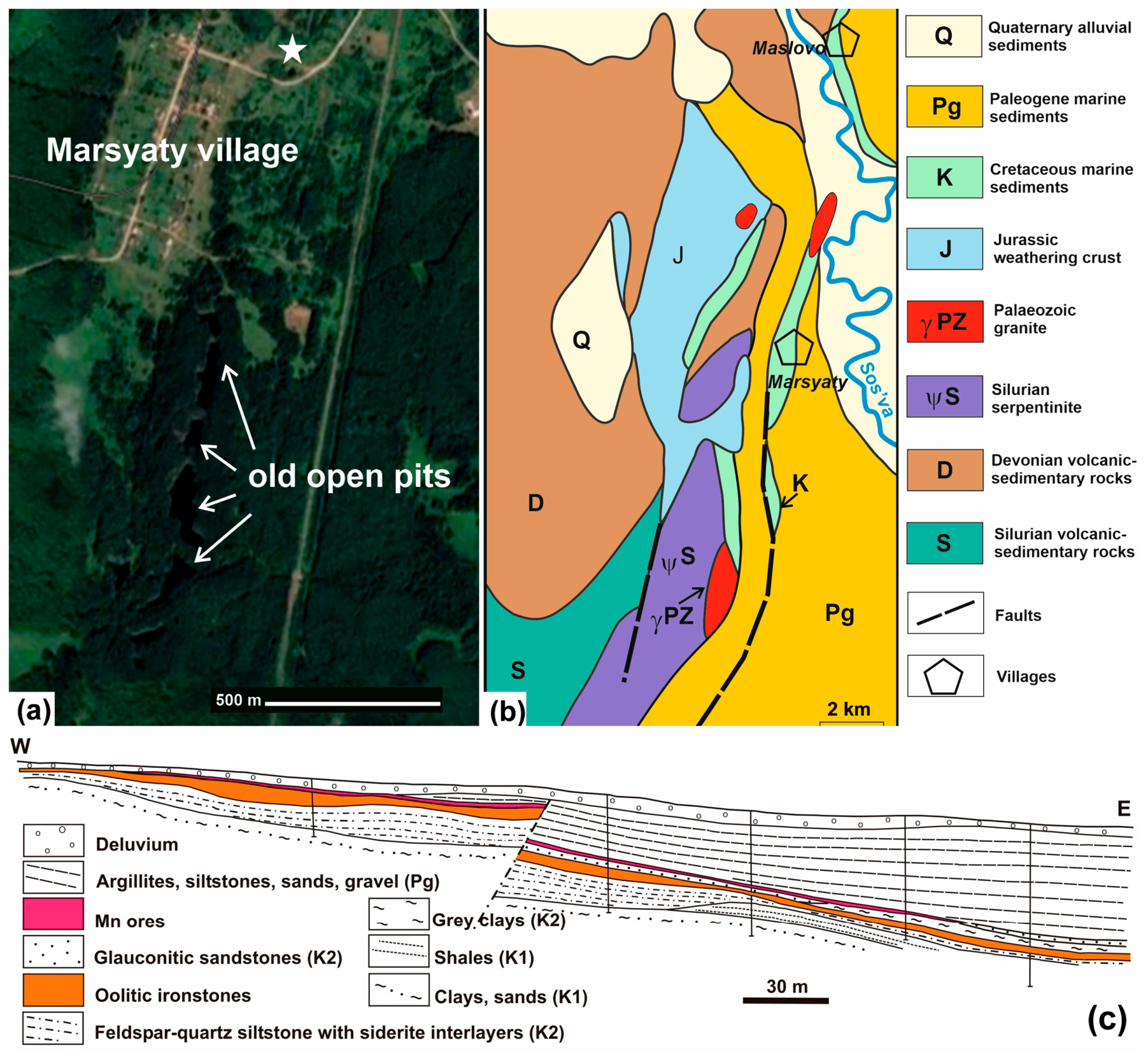
Figure 3.
Lithological column of the studied part of the ore-bearing unit of the Marsyaty deposit and location of the samples (black squares). Mineralogical types of iron and manganese ores are shown in italics, while lithological varieties of iron ores are shown in roman font. The stratigraphic position of carbonate manganese ores is based on the data of [11]. Dashed lines indicate the proposed facies transitions between oxide-carbonate and carbonate manganese ores.
Figure 3.
Lithological column of the studied part of the ore-bearing unit of the Marsyaty deposit and location of the samples (black squares). Mineralogical types of iron and manganese ores are shown in italics, while lithological varieties of iron ores are shown in roman font. The stratigraphic position of carbonate manganese ores is based on the data of [11]. Dashed lines indicate the proposed facies transitions between oxide-carbonate and carbonate manganese ores.
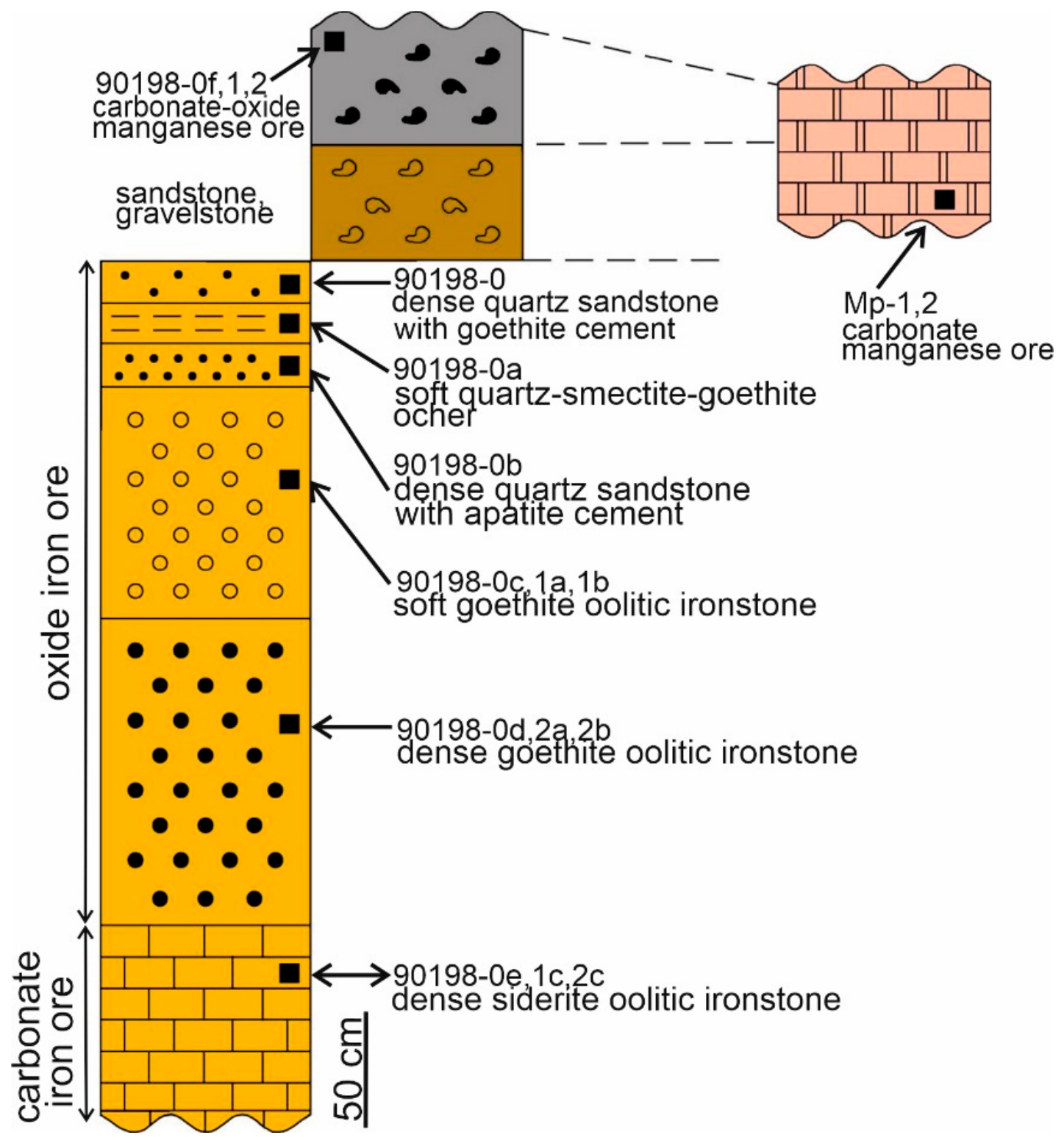
Figure 5.
Structures and minerals of oxide (a-e) and carbonate (f-i) iron ores. а – general view of oxide iron ore, b-e – details, b – goethite ooid with goethite(light grains and chamosite (dark aggregates); c – two core with united cortex of goethite-chamosite ooid and mainly chamosite ooids in the apatite-goethite ground mass; d and e – varieties of ground mass: d – zonal goethite grains with porous rim and chamosite in intersticial, e - biomorphic goethite grains (goethite replacing of an algae?) in the layer silicate mass, f - general view of carbonate iron ore, g - siderite ooids with microinclusion of monazite in the core of the ooid with zonal distribution of perhamite; h – siderite and kaolinite in the inerstitial space of ooids; i – needle-like rhodochrosite associating with apatite and goethite in the ground mass. Photo: a-g – BSE, i – transmitted light.
Figure 5.
Structures and minerals of oxide (a-e) and carbonate (f-i) iron ores. а – general view of oxide iron ore, b-e – details, b – goethite ooid with goethite(light grains and chamosite (dark aggregates); c – two core with united cortex of goethite-chamosite ooid and mainly chamosite ooids in the apatite-goethite ground mass; d and e – varieties of ground mass: d – zonal goethite grains with porous rim and chamosite in intersticial, e - biomorphic goethite grains (goethite replacing of an algae?) in the layer silicate mass, f - general view of carbonate iron ore, g - siderite ooids with microinclusion of monazite in the core of the ooid with zonal distribution of perhamite; h – siderite and kaolinite in the inerstitial space of ooids; i – needle-like rhodochrosite associating with apatite and goethite in the ground mass. Photo: a-g – BSE, i – transmitted light.
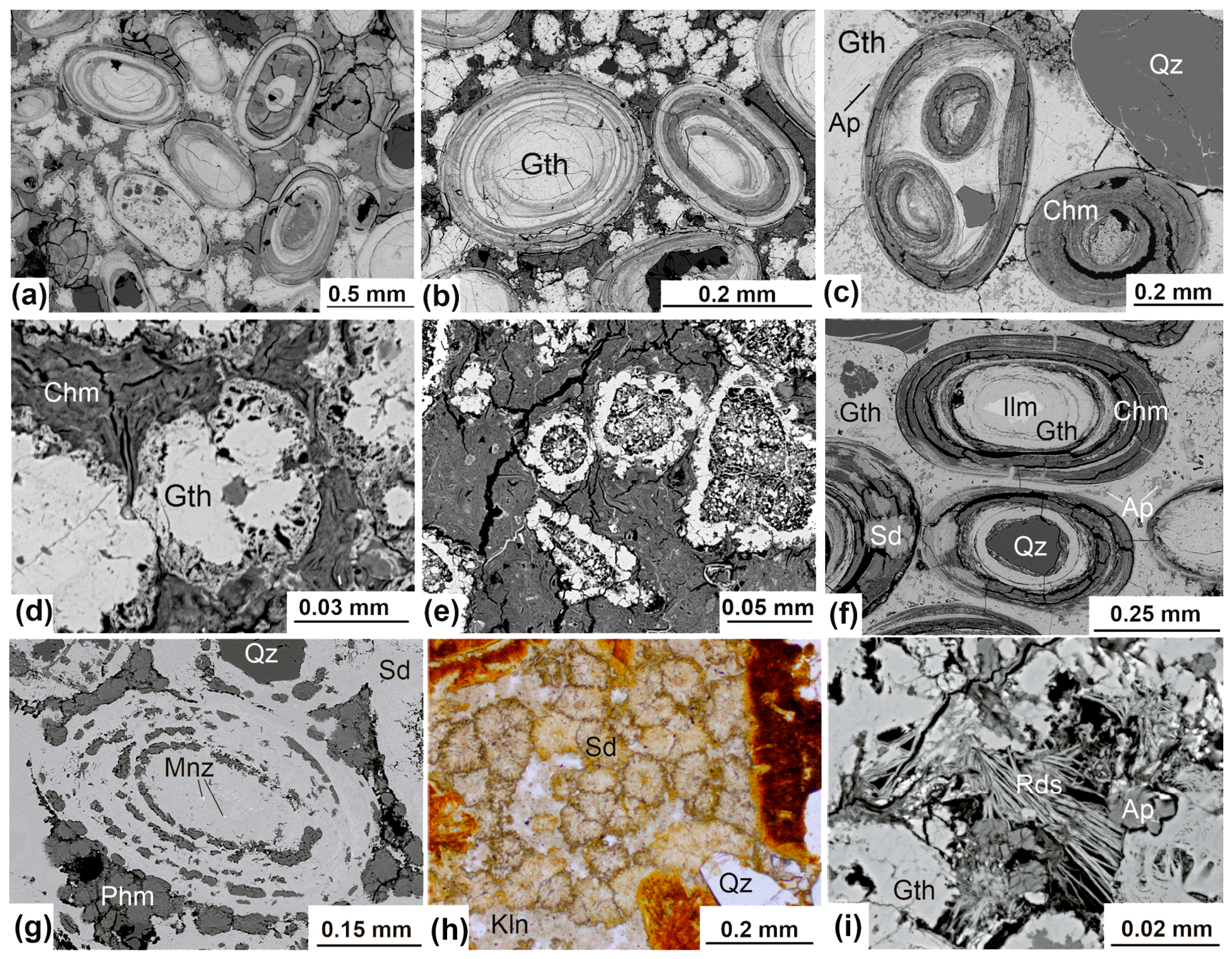
Figure 6.
Locations and structure of manganese ores. Photo: a – outcrop, b–e – samples. a – general view of the outcrop; b–c – partially oxidized carbonate manganese ores with a stromatolite-like structure: cross-sections (b and c) and section along the elongation (d) of stromatolite (the gray and light beige mass is rhodochrosite, the brown and black areas are hypergene iron and manganese oxihydroxides, respectively; d and e – carbonate-oxide manganese ores of coarse-clastic structure from the basal horizon of a manganese ore layer: rounded fragments of rocks of various compositions are cemented by fine-grained material consisting mainly of rhodochrosite, rancieite and goethite: d – view of the sample along the bedding plane, e – in section.
Figure 6.
Locations and structure of manganese ores. Photo: a – outcrop, b–e – samples. a – general view of the outcrop; b–c – partially oxidized carbonate manganese ores with a stromatolite-like structure: cross-sections (b and c) and section along the elongation (d) of stromatolite (the gray and light beige mass is rhodochrosite, the brown and black areas are hypergene iron and manganese oxihydroxides, respectively; d and e – carbonate-oxide manganese ores of coarse-clastic structure from the basal horizon of a manganese ore layer: rounded fragments of rocks of various compositions are cemented by fine-grained material consisting mainly of rhodochrosite, rancieite and goethite: d – view of the sample along the bedding plane, e – in section.
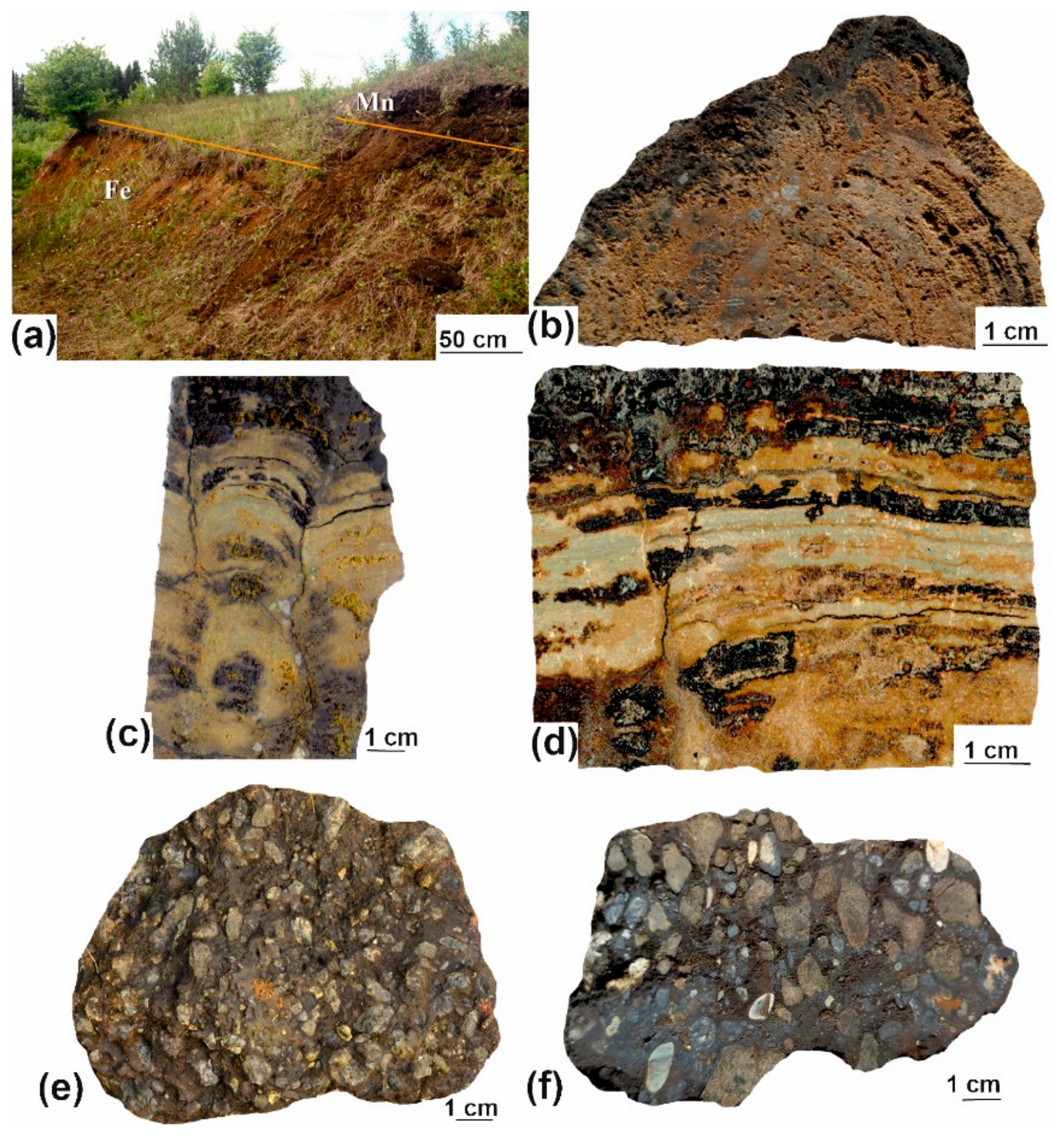
Figure 7.
Textures and minerals of carbonate (a-f) and carbonate-oxide (g-i) manganese ores. a-b – aggregate of the rhodochrosite spherulites in siderite ground mass (a – transmitted light with analyzer, c - BSE); c – siderite crystals around rhodochrosite spherulite and glauconite globule (BSE); d – inhomogeneous distribution of chemical elements and points of analysis (BSE); e – distribution of elements in spherulite in a.p.f.u., points of analysis marked at (e); f – lumpy aggregate of rhodochrosite (baige) with layer silicates in interstital (brown); g – fragments of the rhodochrosite within secondary oxihydroxides of iron and manganese (transmitted light without analyzer); h – fragment of rhodochrosite-rancieite ore with Mn-goethite rim; i – zonal aggregate of goethite with various Fe and Mn content at the surface of the glauconite globule.
Figure 7.
Textures and minerals of carbonate (a-f) and carbonate-oxide (g-i) manganese ores. a-b – aggregate of the rhodochrosite spherulites in siderite ground mass (a – transmitted light with analyzer, c - BSE); c – siderite crystals around rhodochrosite spherulite and glauconite globule (BSE); d – inhomogeneous distribution of chemical elements and points of analysis (BSE); e – distribution of elements in spherulite in a.p.f.u., points of analysis marked at (e); f – lumpy aggregate of rhodochrosite (baige) with layer silicates in interstital (brown); g – fragments of the rhodochrosite within secondary oxihydroxides of iron and manganese (transmitted light without analyzer); h – fragment of rhodochrosite-rancieite ore with Mn-goethite rim; i – zonal aggregate of goethite with various Fe and Mn content at the surface of the glauconite globule.
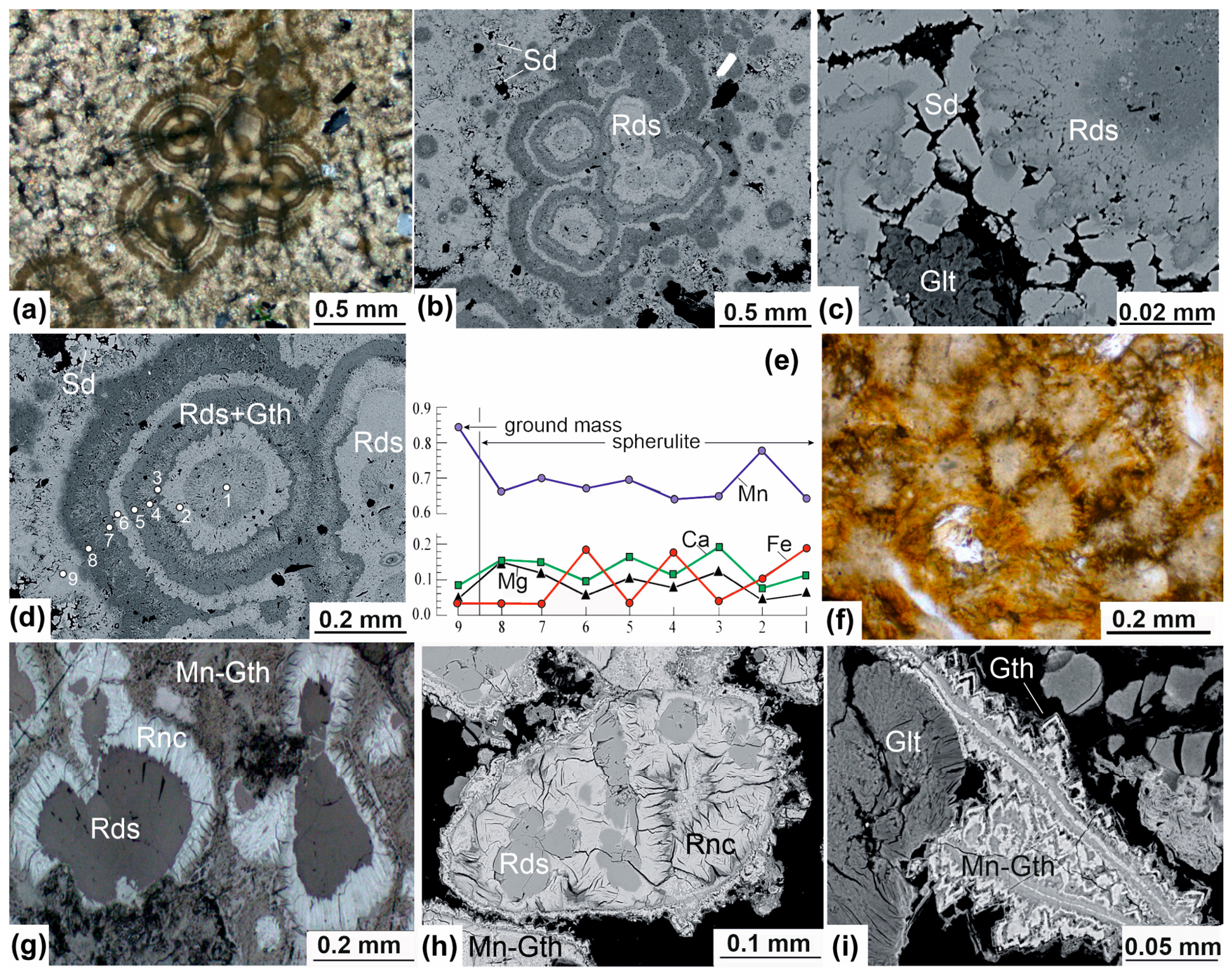
Figure 8.
Contents of the chemical elements in ores normalized to the Upper Crust after [21]. The gray line indicates values normalized according to [Ci/CAl] = [Ci/CAl]sample/[Ci/CAl]Upper crust .
Figure 8.
Contents of the chemical elements in ores normalized to the Upper Crust after [21]. The gray line indicates values normalized according to [Ci/CAl] = [Ci/CAl]sample/[Ci/CAl]Upper crust .
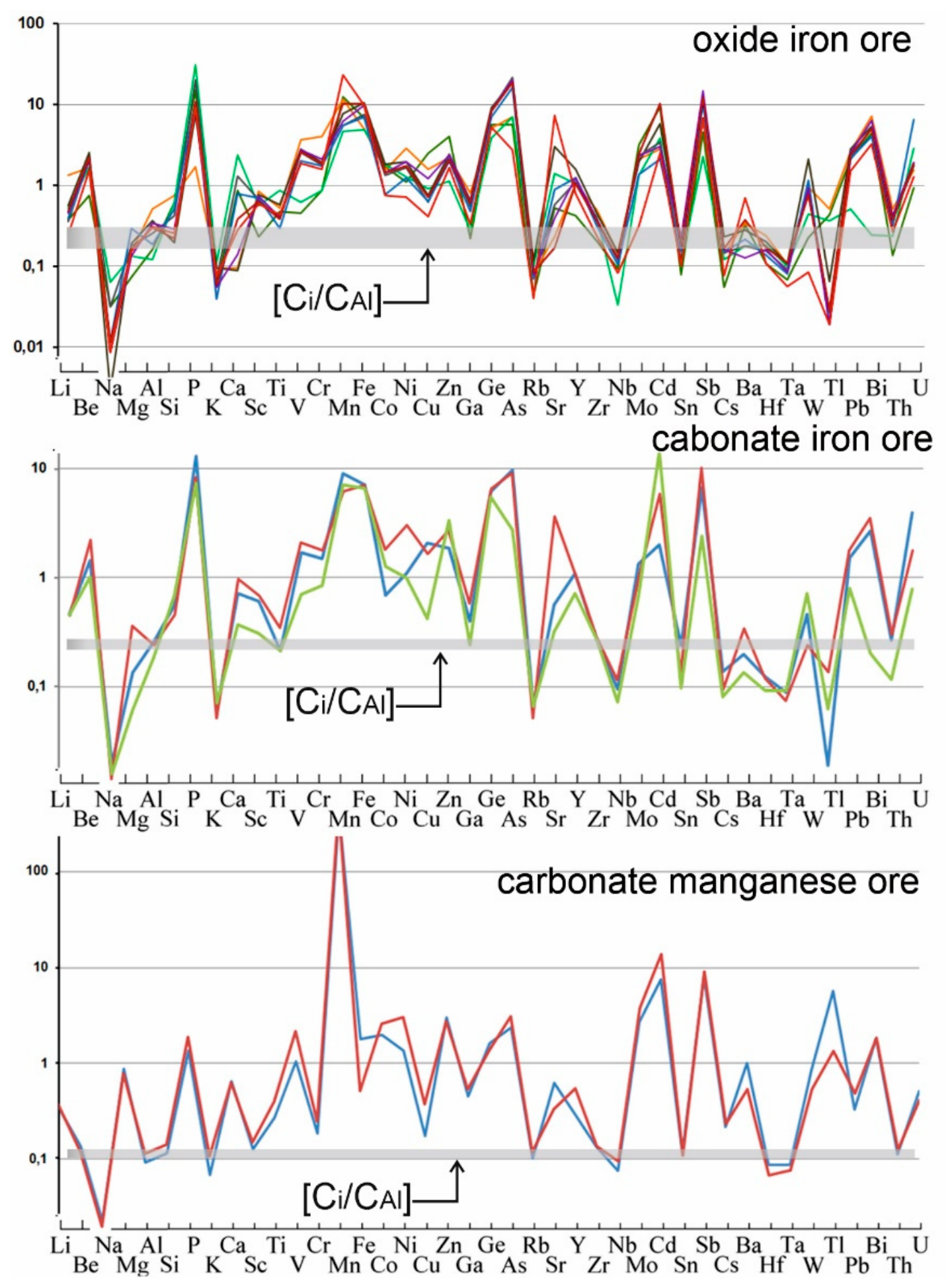
Figure 9.
REE contents in iron and manganese ores normalized to average concentrations for the Upper crust. The average composition of the Upper Crust is taken from [21].
Figure 9.
REE contents in iron and manganese ores normalized to average concentrations for the Upper crust. The average composition of the Upper Crust is taken from [21].
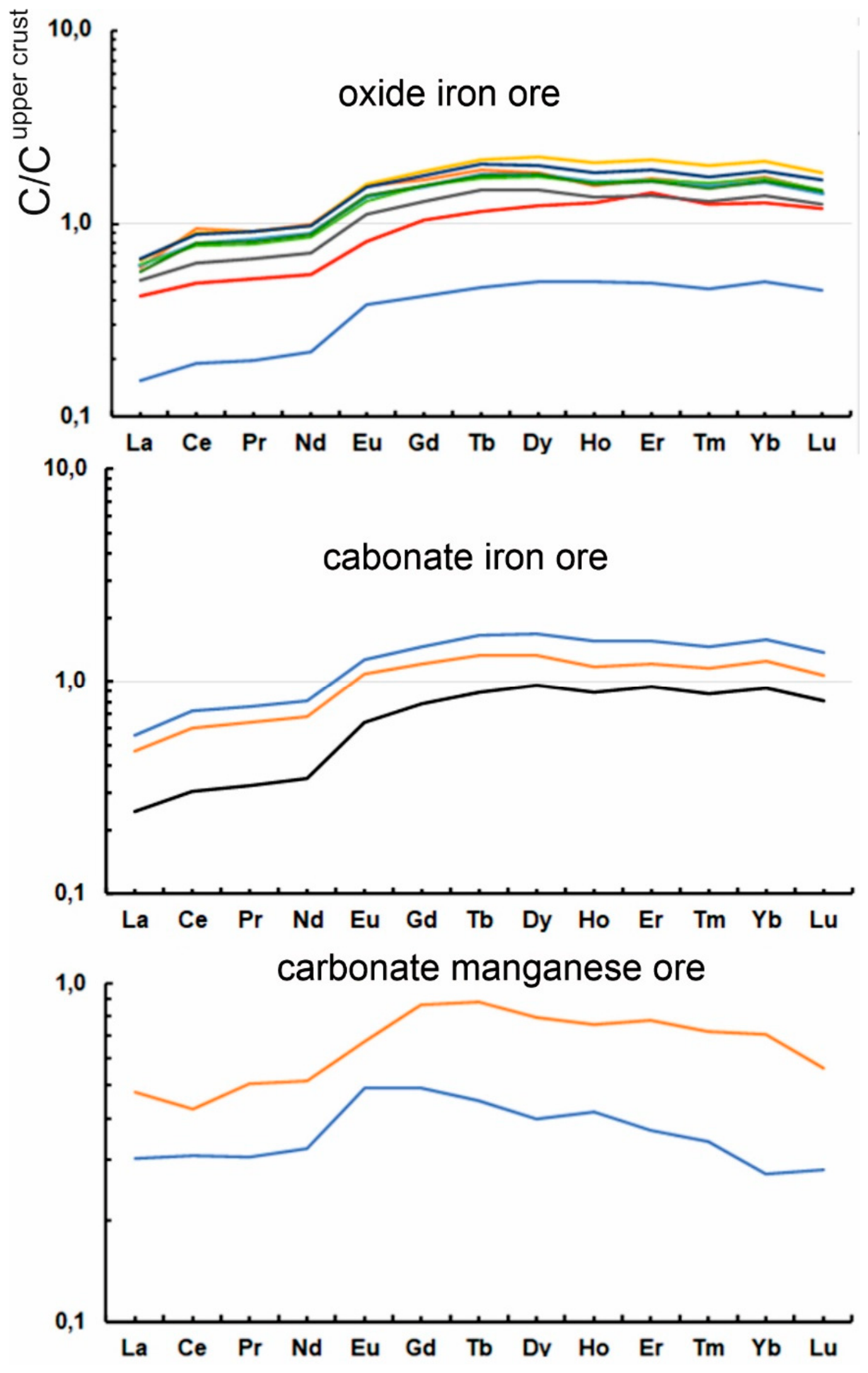
Figure 10.
Binary plots of the main components of iron and manganese ores. 1 – iron oxide ore, 2 – iron carbonate ore, 3 – manganese carbonate ore. Content of elements recalculated from oxides to atomic % *100. Bold line indicates regression lines, estimated excluding of anomalous values, dush line in (d) indicate average Al:Ti in the Upper Crust [21]; thin line in (с) Ca:P ratio in apatite; r – pair coefficient of correlation for iron ore.
Figure 10.
Binary plots of the main components of iron and manganese ores. 1 – iron oxide ore, 2 – iron carbonate ore, 3 – manganese carbonate ore. Content of elements recalculated from oxides to atomic % *100. Bold line indicates regression lines, estimated excluding of anomalous values, dush line in (d) indicate average Al:Ti in the Upper Crust [21]; thin line in (с) Ca:P ratio in apatite; r – pair coefficient of correlation for iron ore.
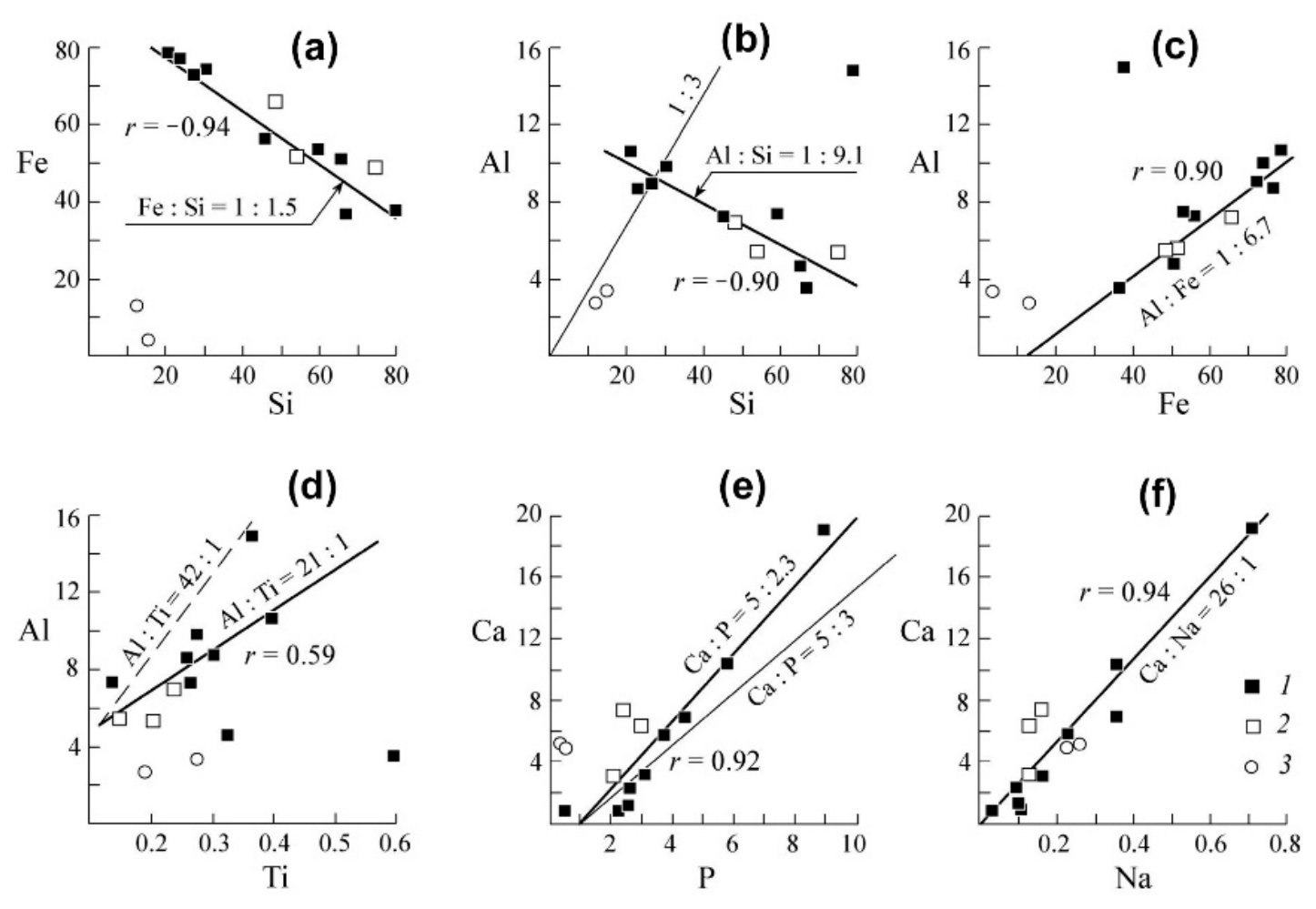
Figure 11.
Genetic model of Marsyaty deposit at the stages of accumulation of iron (a) and manganese (b).
Figure 11.
Genetic model of Marsyaty deposit at the stages of accumulation of iron (a) and manganese (b).
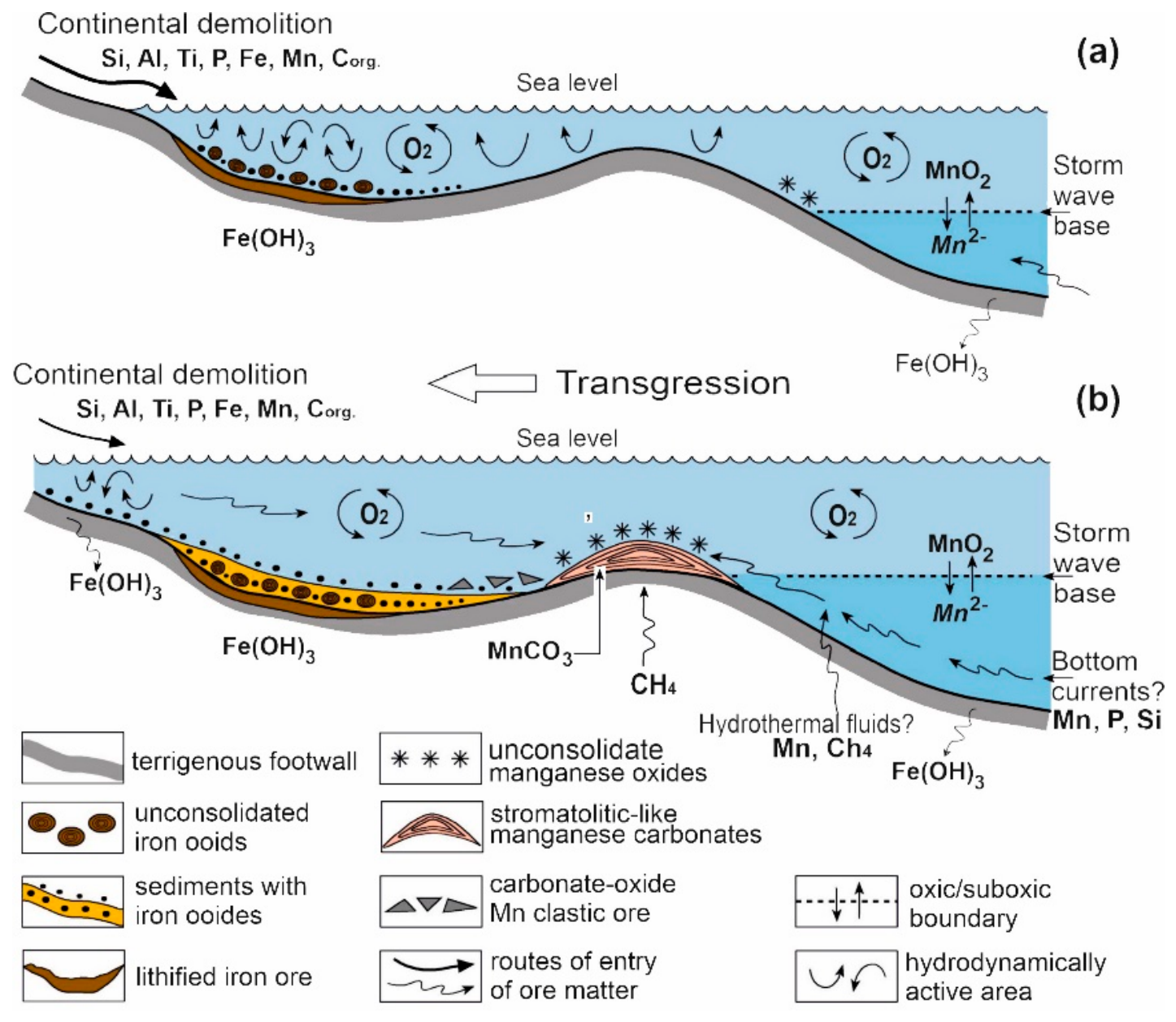

| Mineral | Methods | Fe_ox | Fe_cb | Mn_cb | Mn_cb-ox |
|---|---|---|---|---|---|
| Sphalerite/wurtzite ZnS | 2 | + | + | + | |
| Galena PbS | 1, 2 | + | + | ||
| Pyrite FeS2 | 1, 2 | + | + | ||
| Chalcopyrite CuFeS2 | 1, 2 | + | |||
| Quartz / Opal SiO2 | 1, 2, 3 | ■ | ■ | ● | ● |
| Rutile / Anatase TiO2 | 2 | + | + | + | + |
| Ilmenite (Fe,Mn)TiO3 | 2 | + | + | + | + |
| Goethite FeO(OH) | 1, 2, 3, 4 | ■ | ● | ■ | |
| Ferrihydrite Fe5O7(OH) | 3 | + | |||
| Rancieite CaMn5O10 · 3H2O | 1, 2, 3, 4 | ■ | |||
| Gibbsite / boemite AlO(OH) | 1, 2, 3 | + | + | ||
| Zircon Zr(SiO4) | 1, 2 | + | + | + | |
| Titanite CaTi(SiO4)O | 2 | + | |||
| Epidote Ca2FeAl2(SiO4)(Si2O7)O(OH) | 1, 2 | + | + | + | + |
| Kaolinite Al2(Si2O5)(OH)4 | 2 | + | ● | ||
| Cariopilite ? Mn5(Si4O10)(OH)6 | 2 | + | |||
| Shamosite / Bertierite Fe5Al(AlSi3O10)(OH)8 | 1, 2, 3 | ■ | + | ||
| Glaukonite K0.8(Fe,Mg,Al)2[(Si,Al)4O10](OH)2 | 1, 2, 3 | ● | + | ● | + |
| Muscovite-phengite K(Al,Mg,Fe,Mn)2[(Si,Al)4O10)](OH)2 | 1, 2, 3 | + | + | ||
| Parsettensite ? KMn7(AlSi9O24](OH)6 · nH2O | 2 | ● | |||
| Montmorillonite K0.5(Fe,Al,Mg)2(Si4O10)(OH)2 · nH2O | 2, 3 | + | + | ● | ● |
| Albite Na(AlSi3O8) | 2, 3 | + | + | ||
| Potassic field spare K(AlSi3O8) | 1, 2, 3 | + | + | + | |
| Calcite CaCO3 | 1, 2, 3 | + | + | ||
| Rhodochrosite MnCO3 | 1, 2, 3 | + | ■ | ■ | |
| Siderite (Fe,Mn)CO3 | 1, 2, 3 | + | ■ | + | |
| Dolomite CaMg(CO3)2 | 1, 2 | + | |||
| Apatite Ca5(PO4)3(OH,F) | 1, 2, 3 | + | + | + | + |
| Monazite / rabdofane Ce(PO4) | 2 | + | + | + | + |
| Xenotime Y(PO4) | 2 | + | |||
| Perhamite (Ca,Sr)3Al7.7(Si3P4O23.5)(OH)14.1 · 8H2O | 1, 2, 4 | + |
Note. Ore types: Fe_ox – iron oxide, Fe_cb – iron carbonate, Mn_cb – manganese carbonate, Mn_cb-ox – manganese carbonate-oxide. Methods of mineral diagnostics: 1 – optical microscopy, 2 – electron microscopy and microanalysis, 3 – xrd analysis, 4 – Raman spectroscopy. Minerals: ■ – major (> 5 vol.%), ● – minor (1–5 vol.%), + – accessory (< 1 vol.%). A question is marked minerals whose diagnostics require clarification.
Table 8.
Isotope composition of carbon.
| No | No sample | Ore/lithological variety | δ13Сcarb ‰, VPDB |
|---|---|---|---|
| Iron oxide ores | |||
| 1 | 90198-0 | Loose quartz-smectite-goethite ochre | –21.2 |
| 2 | 90198-0b | Dense quartz sandstone with apatite-goethite cement | –21.2 |
| 3 | 90198-1c | Dense siderite oolitic ironstone | –22.7 |
| 4 | 90198-2b | Dense goethite oolitic ironstone | –24.8 |
| Iron carbonate ores | |||
| 5 | 90198-0e | Dense siderite oolitic ironstone | –23.3 |
| 6 | 90198-2c | Dense siderite oolitic ironstone | –18.5 |
| Manganese carbonate ores | |||
| 7 | Mp-1 | Rhodochrosite ore with stromatolitic texture | –10.0 |
| 8 | Mp-2 | Rhodochrosite ore with stromatolitic texture | –12.2 |
| Manganese carbonate-oxide ores | |||
| 9 | 90198-0f-1 | Coarse-clastic rock with rancieite-goethite cement | –39.4 |
| 10 | 90198-0f-2 | Coarse-clastic rock with rancieite-goethite cement | –41.0 |
Note: Sampling locations are shown in Figure 4.
Disclaimer/Publisher’s Note: The statements, opinions and data contained in all publications are solely those of the individual author(s) and contributor(s) and not of MDPI and/or the editor(s). MDPI and/or the editor(s) disclaim responsibility for any injury to people or property resulting from any ideas, methods, instructions or products referred to in the content. |
© 2026 by the authors. Licensee MDPI, Basel, Switzerland. This article is an open access article distributed under the terms and conditions of the Creative Commons Attribution (CC BY) license (http://creativecommons.org/licenses/by/4.0/).
Copyright: This open access article is published under a Creative Commons CC BY 4.0 license, which permit the free download, distribution, and reuse, provided that the author and preprint are cited in any reuse.