
Submitted:
23 June 2026
Posted:
24 June 2026
You are already at the latest version
Abstract
Background: Artificial intelligence (AI) is increasingly transforming radiology by improving diagnostic efficiency, optimizing workflows, and enhancing healthcare sustainability. However, successful implementation depends on workforce readiness, organizational capacity, and effective governance. This study evaluated radiology professionals' perceptions of AI integration in Saudi Arabia in the context of sustainable healthcare development. Methods: A national cross-sectional survey was conducted using a validated 30-item questionnaire covering knowledge, attitudes, implementation readiness, and perceived barriers. Responses from 295 healthcare professionals were analyzed using descriptive statistics, Cronbach's alpha, exploratory factor analysis, Spearman correlation, and Kruskal–Wallis testing. Results: Participants demonstrated positive attitudes toward AI integration (3.57 ± 0.69) and moderate knowledge (3.35 ± 0.70), whereas implementation readiness was comparatively lower (3.04 ± 0.79). Perceived barriers showed the highest domain score (3.67 ± 0.64). Major barriers included implementation costs (3.98 ± 0.71), limited digital infrastructure (3.90 ± 0.75), insufficient staff training (3.84 ± 0.77), and lack of technical expertise (3.82 ± 0.78). Exploratory factor analysis identified four latent implementation dimensions: governance and trust, workforce capability, infrastructure integration, and organizational readiness. Positive correlations were observed between knowledge, attitudes, and implementation readiness. Conclusions: Radiology professionals support AI integration, but sustainable implementation is constrained by organizational, infrastructural, and governance-related barriers. Strategic investment in workforce development, digital infrastructure, governance frameworks, and cybersecurity is essential for responsible AI adoption and sustainable healthcare transformation.
Keywords:
artificial intelligence
; radiology
; sustainability
; healthcare
; transformation
; Saudi Arabia
1. Introduction
Radiology is one of the most technologically advanced fields in modern healthcare, playing a crucial role in disease diagnosis, treatment planning, image-guided interventions, and patient monitoring [2,7]. The evolution of imaging technology has significantly enhanced healthcare outcomes and broadened diagnostic capabilities in recent decades. However, the rapid increase in imaging utilization has also resulted in challenges for healthcare sustainability, including escalating operational costs, heightened energy consumption, expanding digital storage needs, workforce pressures, and growing healthcare infrastructure demands [2,7,8,9,10]. These challenges have driven healthcare systems worldwide to explore innovative strategies to enhance efficiency while upholding quality, accessibility, and long-term resilience [1,2,3,4,5,6]. Sustainable healthcare encompasses economic viability, workforce resilience, technological adaptability, digital governance, and equitable access to healthcare services, extending beyond environmental considerations [1,2,3,4,5,6,7,8]. Within radiology, sustainability has become a strategic priority because imaging departments are among the most resource-intensive components of healthcare systems [7,8,9,10]. Consequently, healthcare organizations are seeking solutions to optimize resource utilization, enhance operational performance, reduce waste, and support long-term healthcare transformation [7,8,9,10].
The integration of artificial intelligence (AI) into radiology is increasingly recognized as a strategic pathway toward sustainable healthcare development [2,3,4,5,6,11,12,13,14,15,16]. Through advances in machine learning, deep learning, and computer vision, AI technologies can assist image interpretation, automate repetitive tasks, streamline workflow management, improve quality assurance processes, and facilitate clinical decision-making [11,12,14,31,32]. Numerous studies have demonstrated the potential of AI for lesion detection, image segmentation, diagnostic support, workflow prioritization, and predictive analytics, thereby improving both clinical performance and operational efficiency [11,12,13,14,15,16,31,32]. These capabilities have generated substantial interest among healthcare organizations seeking to enhance healthcare quality while improving resource utilization and sustainability [7,8,9,10,15,16].
Beyond its direct clinical applications, AI integration is increasingly being explored within the broader framework of healthcare sustainability [8,9,10,17,18,35,36,37]. AI-driven workflow optimization may reduce unnecessary imaging examinations, minimize redundant studies, improve scheduling efficiency, optimize resource allocation, and support evidence-based service planning [8,12,17,18]. Furthermore, emerging reporting and governance frameworks for AI in healthcare and medical imaging have established standards for the responsible development, evaluation, and implementation of AI technologies, promoting transparency and facilitating sustainable clinical adoption [19,20,21,22,23]. Collectively, these advances have the potential to strengthen healthcare system resilience while promoting more effective utilization of available resources.
This perspective closely aligns with the United Nations Sustainable Development Goals (SDGs), particularly SDG 3 (Good Health and Well-Being), SDG 9 (Industry, Innovation and Infrastructure), SDG 12 (Responsible Consumption and Production), and SDG 13 (Climate Action) [1,2,3,4]. AI integration into radiology may improve diagnostic quality and healthcare accessibility, thereby supporting SDG 3, while simultaneously strengthening digital health infrastructure and technological innovation consistent with SDG 9 [1,2,39,40]. More efficient resource utilization and waste reduction may contribute to SDG 12, whereas improvements in operational efficiency could indirectly support climate-related objectives under SDG 13 [7,8,9,10,17,18,38].
However, successful implementation of AI is not guaranteed. It requires robust digital infrastructure, interoperability frameworks, cybersecurity systems, governance policies, technical expertise, and continuous workforce development [3,4,5,6,15,16,24,25,26,27,28,29,30]. AI systems require substantial computational resources and may introduce organizational, ethical, regulatory, and operational challenges if implementation is inadequately planned [3,4,5,6,13,15,16]. Consequently, AI integration presents both opportunities and challenges for sustainable healthcare development. Contemporary implementation science suggests that successful healthcare innovation depends not only on technological performance but also on sociotechnical factors, including organizational readiness, governance structures, stakeholder engagement, workforce capability, and institutional support [13,15,16,35,36,37].
In radiology, healthcare professionals serve as the primary users, supervisors, and operational stakeholders responsible for integrating AI technologies into routine clinical practice. Their perceptions, expectations, and concerns therefore substantially influence implementation success. Previous studies indicate that healthcare professionals generally have positive attitudes toward AI but remain concerned about data privacy, cybersecurity, ethical accountability, regulatory uncertainty, workflow integration, and professional responsibility [3,4,13,14,15,16,24,25,26,27,28,29,30]. These findings suggest that positive perceptions alone are insufficient for successful implementation. Sustainable adoption requires alignment between technological capability, workforce preparedness, organizational capacity, and governance frameworks [15,16,35,36,37].
Saudi Arabia provides an important setting for examining AI integration in radiology. Through Vision 2030 and national healthcare transformation initiatives, the Kingdom has prioritized healthcare modernization, digital innovation, artificial intelligence, and technology-driven development [39,40]. Significant investments have been directed toward digital health infrastructure, smart healthcare systems, and advanced clinical technologies [39,40,41,42]. Although these developments provide substantial opportunities for AI adoption, empirical evidence regarding workforce readiness, organizational capacity, and implementation challenges remains limited. Most existing studies have focused primarily on algorithm development, technical validation, diagnostic accuracy, and performance benchmarking rather than implementation science and sustainability outcomes [11,12,31,32,33,34]. Furthermore, the relationship between AI integration and sustainable healthcare development within rapidly evolving Middle Eastern healthcare systems remains underexplored [35,36,37,38,39,40,41,42].
Understanding workforce readiness and implementation challenges is essential because successful adoption depends on institutional preparedness, governance confidence, technical competence, and stakeholder acceptance. Positive attitudes toward AI may facilitate adoption; however, sustainable implementation requires practical organizational capacity and effective implementation strategies [15,16,35,36,37]. Therefore, this study aimed to assess workforce readiness, organizational capacity, and implementation challenges associated with integrating artificial intelligence into radiology practice. By evaluating knowledge, attitudes, implementation readiness, and perceived barriers, this study sought to generate evidence to support policy development and facilitate the sustainable integration of AI into radiology services.
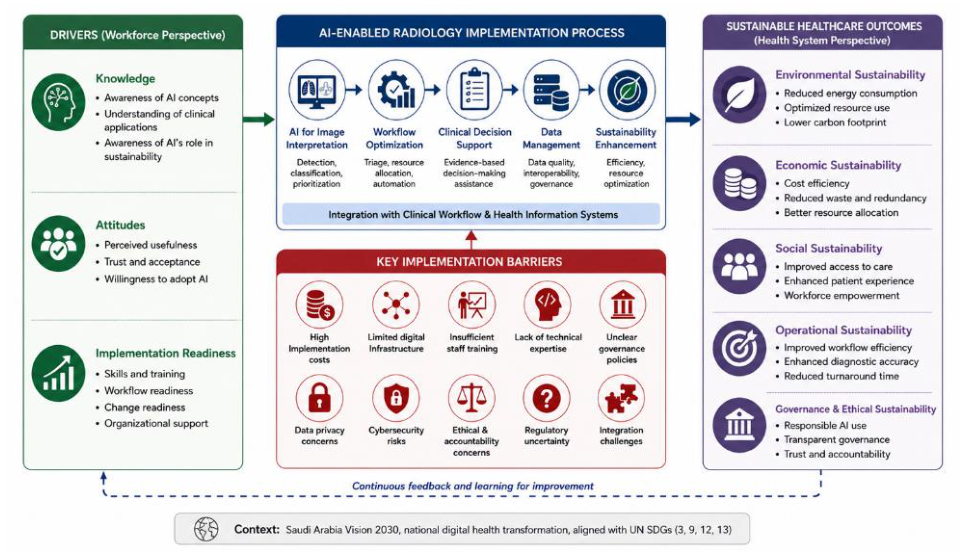
Figure 1.
Conceptual framework illustrating workforce readiness, organizational capacity, implementation challenges, and sustainable healthcare outcomes associated with artificial intelligence integration in radiology.
Figure 1.
Conceptual framework illustrating workforce readiness, organizational capacity, implementation challenges, and sustainable healthcare outcomes associated with artificial intelligence integration in radiology.
2. Materials and Methods
2.1. Study Design and Setting
This study used a cross-sectional survey design to evaluate workforce readiness, organizational capacity, and implementation challenges associated with AI integration in radiology practice. The research was conducted in healthcare institutions across Saudi Arabia, focusing on healthcare professionals involved in radiology services, imaging operations, healthcare administration, medical physics, and AI-supported clinical activities. The cross-sectional approach was chosen for its effectiveness in evaluating perceptions, readiness for implementation, and organizational barriers among various professional groups within a specific timeframe. The study was conducted within the context of digital healthcare transformation and sustainable healthcare development, with a specific focus on understanding the factors influencing successful AI integration in radiology. It was executed in line with the Strengthening the Reporting of Observational Studies in Epidemiology (STROBE) guidelines for cross-sectional studies.
2.2. Study Population and Participant Recruitment
The study focused on healthcare professionals in radiology services in Saudi Arabia: radiologists, radiologic technologists, medical physicists, healthcare administrators, AI and data science professionals, and other specialists.
To be eligible for participation, respondents were required to:
- be currently practicing or employed in a radiology-related healthcare setting;
- possess familiarity with radiology workflows, imaging services, or healthcare technologies; and
- provide voluntary informed consent.
The exclusion criteria included the following:
- students and trainees without professional responsibilities;
- incomplete questionnaire submissions;
- duplicate responses; and
- individuals without professional involvement in radiology-related services.
Participants were recruited using a convenience-based electronic sampling strategy. The survey was conducted through professional communication networks, institutional mailing lists, professional radiology professional groups, and online platforms. Participation was voluntary, anonymous, and uncompensated.
Following data cleaning, 295 valid questionnaires were retained for analysis. Among the participants, 203 (68.8%) were male, and 92 (31.2%) were female. The respondents represent various healthcare sectors and geographic regions across Saudi Arabia, indicating the wide applicability of our findings.
2.3. Survey Instrument Development and Validation
Data were collected using a structured, self-administered questionnaire designed to evaluate the perceptions of AI integration in radiology. Moreover, the data collection aids in understanding potential contributions of AI in sustainable healthcare development.
Questionnaire development was informed by an extensive review of contemporary literature on the following topics:
- AI in healthcare;
- AI in radiology;
- digital transformation and healthcare innovation;
- organizational readiness for technological change; and
- sustainable healthcare systems and implementation science.
The final questionnaire consisted of 30 items distributed across four conceptual domains:
- Knowledge of Artificial Intelligence and Healthcare Sustainability (7 items)
- Attitudes Toward AI Integration in Radiology (7 items)
- Implementation Readiness and Organizational Capacity (8 items)
- Perceived Barriers and Implementation Challenges (8 items)
All items were evaluated using a five-point Likert scale:
- 1 = Strongly disagree
- 2 = Disagree
- 3 = Neutral
- 4 = Agree
- 5 = Strongly agree
To ensure content validity, the preliminary questionnaire was reviewed by ten experts. Their feedback was used to enhance item wording, clarity, and alignment with the study objectives. A pilot then assessed usability, comprehensibility, and completion time, after which minor adjustments were made before final distribution. The comprehensive questionnaire and domain allocations can be found in Supplementary Table S2.
2.4. Reliability Assessment
Internal consistency reliability was evaluated using Cronbach’s alpha coefficients. The questionnaire as a whole exhibited outstanding reliability, achieving a Cronbach’s alpha value of 0.89.
Domain-specific reliability coefficients were:
- Knowledge: α = 0.89
- Attitudes: α = 0.86
- Implementation Readiness: α = 0.80
- Perceived Barriers: α = 0.76
All values exceeded the recommended threshold of 0.70, indicating acceptable to excellent internal consistency and supporting the instrument’s reliability in assessing workforce readiness and implementation challenges associated with AI integration in radiology.
2.5. Ethical Considerations
The study was conducted following the ethical principles outlined in the Declaration of Helsinki and the relevant institutional research governance requirements. Ethical approval was obtained from the Research Ethics Committee (MUREC) of Majmaah University, Saudi Arabia (Institutional Registration No. HA-01-R-088, approval no. MUREC-Feb.16/COM-2026/362).
Prior to participation, all respondents received an electronic information sheet describing:
- the objectives of the study;
- voluntary participation requirements;
- confidentiality safeguards;
- data protection procedures; and
- the right to withdraw at any time without penalty.
Informed consent was obtained from all participants before they were granted access to the questionnaire. No personally identifiable information was collected, and all responses were anonymized before analysis.
2.6. Statistical Analysis
Statistical analyses were performed using IBM SPSS Statistics version 30.0 (IBM Corp., Armonk, NY, USA). Descriptive statistics summarized participant characteristics. Continuous variables were presented as means ± standard deviation (SD) . The normality of questionnaire domain scores was assessed using the Shapiro–Wilk test. Several variables departed significantly from normality (p < 0.05), supporting nonparametric methods. Professional groups were compared using the Kruskal–Wallis H test, reflecting the ordinal nature of Likert-scale data and observed distribution characteristics. Associations among the principal questionnaire domains were evaluated using Spearman’s rank correlation analysis. Exploratory factor analysis (EFA) was performed. The dataset’s suitability for factor analysis was assessed using the Kaiser–Meyer–Olkin (KMO) measure and Bartlett’s test of sphericity. Factor extraction was performed using principal component analysis with varimax rotation. Statistical significance was set at a two-sided p-value < 0.05.
2.7. Conceptual Framework
The study’s conceptual framework was based on a sociotechnical implementation perspective, acknowledging that effective AI integration in radiology relies on the interplay of technological capability, workforce readiness, organizational capacity, governance structures, and digital infrastructure.
The framework assumed the following:
- Greater knowledge of AI would be associated with more favorable attitudes toward integration.
- Positive attitudes would contribute to stronger implementation readiness.
- Organizational barriers would influence implementation capacity.
- Sustainable AI integration necessitates aligning technology, governance, infrastructure, and workforce readiness.
Workforce readiness comprises knowledge, attitudes, organizational preparedness, and perceptions of implementation challenges. These factors collectively affect the likelihood of successful and sustainable AI integration in radiology. The framework guided the development, analysis, and interpretation of the questionnaire within the context of sustainable healthcare development.
2.7. Bias Reduction
Several measures were implemented to reduce potential sources of bias. Anonymous participation minimized social desirability effects, duplicate responses were excluded during data cleaning, and standardized electronic data collection reduced interviewer bias. Expert review and pilot testing improved content validity and questionnaire clarity.
2.9. Clinical Trial Registration
Clinical trial number: not applicable.
This study was observational and did not include clinical intervention, patient randomization, or experimental treatment allocation. Therefore, clinical trial registration is not necessary.
3. Results
3.1. Participant Characteristics
In total, 295 valid responses were included in the final analysis. The study population consisted of a multidisciplinary radiology workforce involved in clinical imaging, healthcare administration, medical physics, and digital health innovations. Among the participants, 203 (68.8%) were male, and 92 (31.2%) were female. Radiologists constituted the largest professional category (n = 97, 32.9%), followed by radiographers (n = 89, 30.2%). Medical physicists accounted for 36 participants (12.2%), while healthcare administrators and AI/data science professionals represented 29 participants (9.8%). Other radiology-related professionals comprised 15 (5.1%) participants. subgroup had 5–10 years (34.2%), followed by those with less than 5 years (25.8%), 11–15 years (20.3%), and more than 15 years (19.7%). Educational attainment was predominantly at the bachelor’s degree level (53.2%), followed by master’s degree holders (34.6%), professional certification holders (8.1%), and doctorate level participants (4.1%). Participants were recruited from all major regions of Saudi Arabia, with the highest representation originating from the Central Region (42.4%), followed by the Western Region (21.4%), Eastern Region (17.3%), Southern Region (11.5%), and Northern Region (7.4%) (Appendix Table A1).

Table 1.
Demographic and Professional Characteristics of Participants (n = 295).
| Variable | Category | n (%) |
|---|---|---|
| Gender | Male | 203 (68.8) |
| Female | 92 (31.2) | |
| Professional Role | Radiologist | 97 (32.9) |
| Radiologic Technologist | 89 (30.2) | |
| Medical Physicist | 36 (12.2) | |
| Healthcare Administrator | 29 (9.8) | |
| AI/Data Scientist | 29 (9.8) | |
| Other | 15 (5.1) | |
| Years of Experience | <5 years | 76 (25.8) |
| 5–10 years | 101 (34.2) | |
| 11–15 years | 60 (20.3) | |
| >15 years | 58 (19.7) | |
| Education Level | Bachelor’s degree | 157 (53.2) |
| Master’s degree | 102 (34.6) | |
| Professional certification | 24 (8.1) | |
| Doctorate | 12 (4.1) |
Table 2.
Mean Scores Across Principal Study Domains.
| Domain | Mean ± SD |
|---|---|
| nowledge | 3.35 ± 0.70 |
| Attitudes | 3.57 ± 0.69 |
| Implementation Readiness | 3.04 ± 0.79 |
| Perceived Barriers | 3.67 ± 0.64 |
Figure 2.
Radar plot comparing questionnaire domain mean scores.
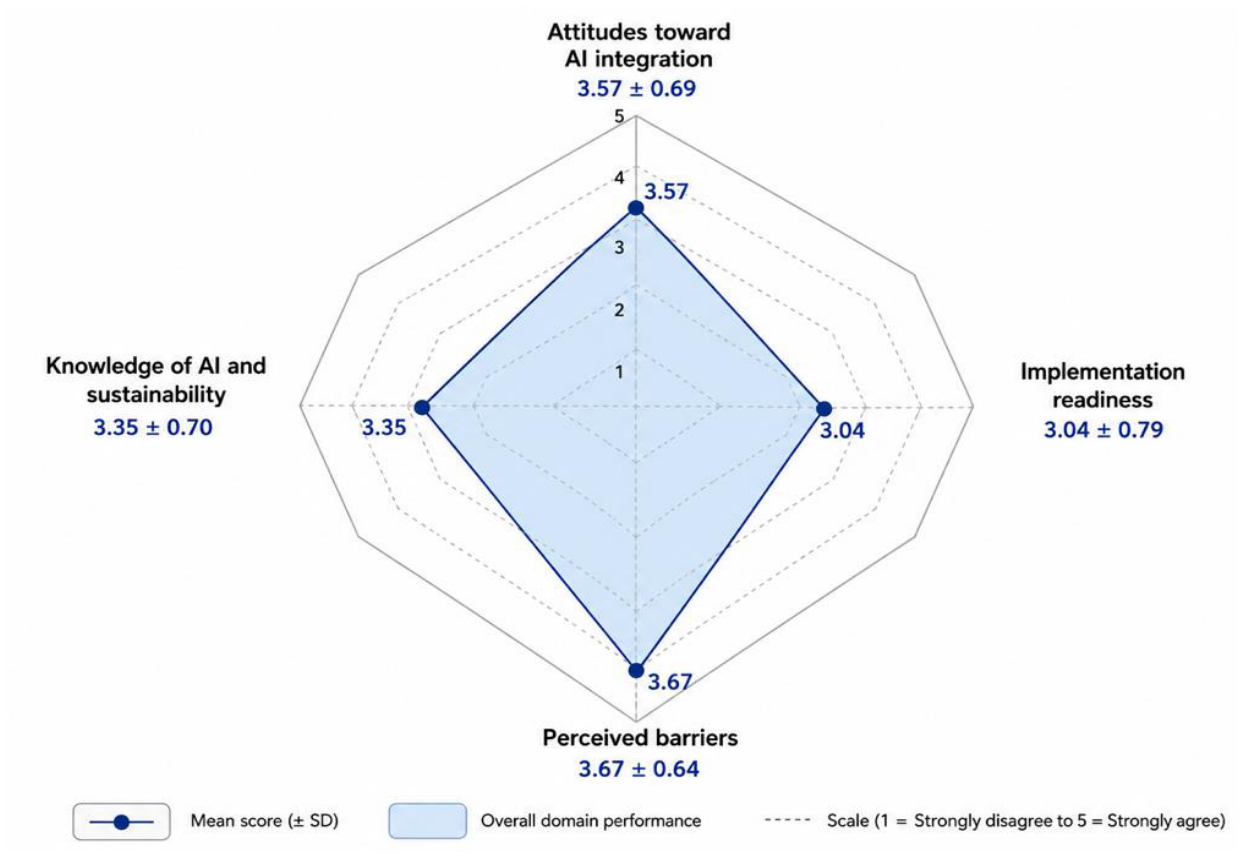
Figure 2 shows mean scores across the four domains. Perceived barriers exhibited the highest overall score, followed by attitudes toward AI integration. On the other hand, implementation readiness had the lowest overall score, indicating a gap between perceptions and organizational readiness. To further explore participant responses, descriptive statistics for each of the 30 questionnaire items were analyzed. Overall, respondents expressed positive views on the potential benefits of AI in terms of diagnostic accuracy, workflow efficiency, and healthcare sustainability. However, lower scores were noted for institutional readiness, digital infrastructure availability, and implementation support. Item-level analysis demonstrated generally positive perceptions regarding the potential benefits of AI in radiology, particularly for diagnostic accuracy (Q8; mean = 3.55 ± 0.91), workflow efficiency (Q9; mean = 3.68 ± 0.83), and healthcare sustainability (Q10; mean = 3.61 ± 0.86). In contrast, implementation-related items revealed lower scores, particularly regarding digital infrastructure availability (Q16; mean = 2.97 ± 1.15) and technical support (Q20; mean = 3.03 ± 1.18). Among the barriers identified, implementation cost (Q23; mean = 3.98 ± 0.71) and limited digital infrastructure (Q24; mean = 3.90 ± 0.75) were highlighted as the most significant obstacles to AI adoption (Appendix Table A3).
3.3. Barrier Analysis
A thorough analysis of the implementation barriers revealed significant organizational and operational constraints impacting AI integration in radiology. The most prominent barrier was the high implementation cost (3.98 ± 0.71), with limited digital infrastructure (3.90 ± 0.75), inadequate staff training (3.84 ± 0.77), and lack of technical expertise (3.82 ± 0.78).
Governance-related concerns were prominent, including unclear governance policies (3.79 ± 0.74), data privacy issues (3.75 ± 0.76), cybersecurity risks (3.72 ± 0.79), and ethical accountability concerns (3.69 ± 0.80). Shapiro–Wilk tests revealed significant deviations from normality for all barrier variables (p < 0.001), justifying the application of nonparametric analyses.
Table 3.
Barrier Analysis for AI Integration in Radiology.
| Barrier | Mean ± SD | Median | Shapiro–Wilk p |
|---|---|---|---|
| High implementation costs | 3.98 ± 0.71 | 4.0 | <0.001 |
| Limited digital infrastructure | 3.90 ± 0.75 | 4.0 | <0.001 |
| Insufficient staff training | 3.84 ± 0.77 | 4.0 | <0.001 |
| Lack of technical expertise | 3.82 ± 0.78 | 4.0 | <0.001 |
| Governance uncertainty | 3.79 ± 0.74 | 4.0 | <0.001 |
| Data privacy concerns | 3.75 ± 0.76 | 4.0 | <0.001 |
| Cybersecurity risks | 3.72 ± 0.79 | 4.0 | <0.001 |
| Ethical accountability concerns | 3.69 ± 0.80 | 4.0 | <0.001 |
| Regulatory uncertainty | 3.66 ± 0.78 | 4.0 | <0.001 |
| Integration challenges | 3.64 ± 0.82 | 4.0 | <0.001 |
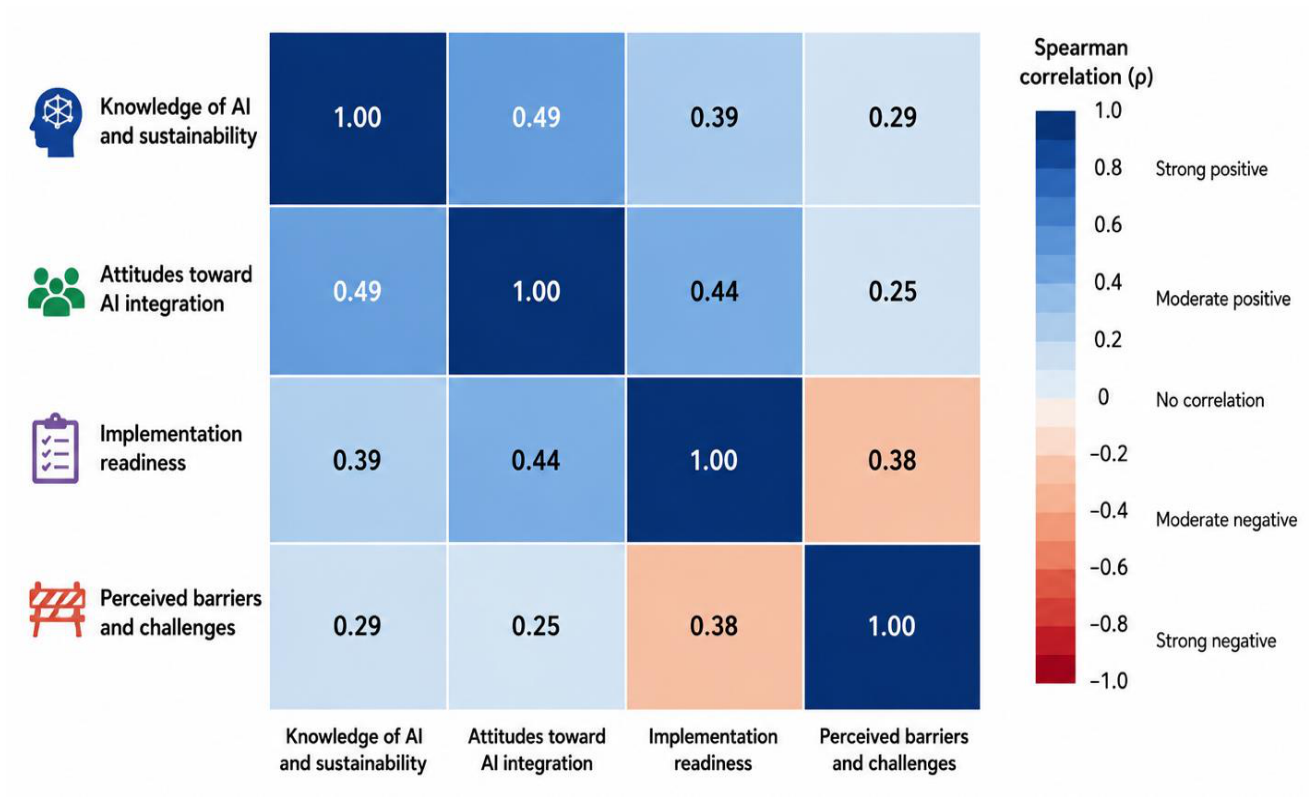
Figure 3.
Heatmap of Spearman correlation matrix between major study domains.
Exploratory factor analysis was performed to identify latent organizational dimensions affecting implementation readiness. The Kaiser–Meyer–Olkin measure indicated satisfactory sampling adequacy (KMO = 0.73), and Bartlett’s test of sphericity validated the suitability of the dataset for factor analysis (χ2 = 895.4; df = 105; p < 0.001).
The explanatory factory analysis identified four principal latent dimensions:
- Governance, Privacy, and Trust
- Workforce Capability and Organizational Adaptation
- Infrastructure and Systems Integration
- Implementation Readiness and Operational Evidence
The factor-loading matrix for all extracted components is presented in Appendix Table A4. Together, these dimensions explain 76.7% of the total variance, offering a comprehensive framework for comprehending the multidimensional nature of AI integration challenges in radiology. Eigenvalues and variance explained by each extracted factor are provided in Appendix Table A5.
Table 4.
Factorability Assessment.
| Metric | Value |
|---|---|
| KMO | 0.73 |
| Bartlett’s χ2 | 895.4 |
| Degrees of freedom | 105 |
| p-value | <0.001 |
Additional factorability statistics, including KMO and Bartlett’s test results, are presented in Appendix Table S6.
Table 5.
Latent Organizational Dimensions Identified Through EFA.
| Factor | Theme |
|---|---|
| Factor 1 | Governance, Privacy and Trust |
| Factor 2 | Workforce Capability and Organizational Adaptation |
| Factor 3 | Infrastructure and Systems Integration |
| Factor 4 | Implementation Readiness and Operational Evidence |
Detailed factor loadings, eigenvalues, and variance explained are provided in Appendix Table A4. The four-factor solution accounted for 62.0% of the total variance and exhibited acceptable construct validity, supported by a KMO value of 0.73 and a significant Bartlett’s test of sphericity (p < 0.001).
3.5. Reliability Analysis
The internal consistency analysis showed strong psychometric reliability across all questionnaire domains. Cronbach’s alpha coefficients ranged from 0.76 to 0.89, indicating acceptable to excellent reliability.
Table 6.
Reliability Assessment.
| Domain | Cronbach’s α |
|---|---|
| Knowledge | 0.89 |
| Attitudes | 0.86 |
| Implementation Readiness | 0.80 |
| Perceived Barriers | 0.76 |
| Overall Instrument | 0.89 |
The findings support the questionnaire’s reliability in assessing workforce readiness and challenges related to AI integration in radiology.
3.6. Correlation Analysis
Significant positive associations were observed among the primary study domains. Knowledge shows a moderately positive correlation with the following:
- Attitudes (r = 0.49)
- Implementation readiness (r = 0.39)
- Perceived barriers (r = 0.29)
The positive correlation between knowledge and perceived barriers indicates heightened awareness among knowledgeable professionals. Attitudes were positively correlated with implementation readiness (r = 0.44) and perceived barriers (r = 0.25). Implementation readiness exhibited the most robust correlation with perceived barriers (r = 0.38), highlighting the effect of organizational constraints on implementation preparedness.
Table 7.
Spearman Correlation Matrix.
| Domain | Knowledge | Attitudes | Implementation Readiness | Barriers |
|---|---|---|---|---|
| Knowledge | 1.00 | 0.49 | 0.39 | 0.29 |
| Attitudes | 0.49 | 1.00 | 0.44 | 0.25 |
| Implementation Readiness | 0.39 | 0.44 | 1.00 | 0.38 |
| Barriers | 0.29 | 0.25 | 0.38 | 1.00 |
The structural relationships among knowledge, attitudes, implementation readiness, and perceived barriers are illustrated in Supplementary Figure S1.
3.7. Professional Group Comparisons
A comparative analysis across professional categories showed similar perceptions of AI integration. Radiologic technologists reported the highest barrier scores (3.75), while medical physicists exhibited the highest readiness scores for implementation (3.13).
However, Kruskal–Wallis testing identified no statistically significant differences among professional groups across the principal study domains (all p > 0.05), indicating a broad consensus regarding the opportunities and challenges associated with AI integration in radiology practice.
Table 8.
Domain Scores Across Professional Groups.
| Professional Group | Knowledge | Attitudes | Readiness | Barriers |
|---|---|---|---|---|
| AI/Data Scientist | 3.33 | 3.43 | 2.97 | 3.59 |
| Healthcare Administrator | 3.33 | 3.54 | 2.91 | 3.69 |
| Medical Physicist | 3.39 | 3.44 | 3.13 | 3.63 |
| Other | 3.23 | 3.62 | 2.99 | 3.53 |
| Radiologic Technologist | 3.41 | 3.63 | 3.07 | 3.75 |
| Radiologist | 3.31 | 3.61 | 3.05 | 3.67 |
Overall, the findings suggest that implementation challenges are widely shared across the radiology ecosystem and are not limited to specific professional categories. This consistency supports the necessity for organization-wide and system-level strategies to facilitate sustainable AI integration in radiology.
4. Discussion
This study presents evidence on workforce readiness and challenges related to the integration of AI in radiology within the context of sustainable healthcare development. The findings indicated a consistent pattern among radiology professionals in Saudi Arabia. Participants exhibited positive attitudes toward AI integration. However, readiness for implementation was limited due to organizational, infrastructural, and governance-related barriers. This gap between acceptance of AI in theory and preparedness for practical implementation highlights the need to address critical barriers to ensure the sustainable integration of AI in radiology practice. A notable discovery was the high attitude scores among participants, indicating that radiology professionals increasingly view AI as a supportive technology that enhances clinical practice rather than a replacement for healthcare professionals. This perception aligns with international reports where radiologists and imaging professionals see AI as a complementary tool that can enhance workflow efficiency, reduce repetitive tasks, aid in image interpretation, and support quality assurance activities. The increased visibility of AI applications in medical imaging, coupled with growing awareness of digital transformation initiatives, likely contributed to these positive perceptions.
In Saudi Arabia, favorable attitudes toward AI integration may also indicate alignment with Vision 2030. The Kingdom has prioritized digital transformation, healthcare innovation, and advanced technologies as strategic drivers of healthcare improvement. Consequently, healthcare professionals may view AI integration as a natural extension of national modernization the ongoing efforts to modernize healthcare delivery and enhance system performance. Thus, the positive attitudes identified in this study mirror global technological trends and national policy priorities.
Despite favorable attitudes, implementation readiness remained significantly lower than the attitude and knowledge scores. This finding suggests that enthusiasm for AI integration has not yet translated into confidence in practical implementation. Similar implementation gaps have been reported in healthcare systems globally, where healthcare professionals often endorse technological innovation while expressing concerns about infrastructure, governance, workforce capacity, and organizational preparedness. These findings underscore the principle that technological acceptance alone is insufficient to guarantee successful implementation. Sustainable integration demands that healthcare organizations have the organizational capacities essential to facilitate long-term adoption.
The study highlighted the significance of barriers to implementation, with high implementation costs identified as the primary obstacle, followed by limitations in digital infrastructure, inadequate staff training, and a lack of technical expertise. These concerns align with those of prior research on healthcare technology adoption and digital transformation initiatives. Integrating AI typically demands considerable investments in software platforms, computational infrastructure, interoperability solutions, cybersecurity systems, technical support services, and workforce development programs. Consequently, organizations may encounter substantial financial and operational challenges during implementation, particularly when resources and digital maturity differ among institutions.
Infrastructure-related barriers warrant attention as they directly affect the feasibility of AI integration. Successful implementation necessitates well-established digital ecosystems that facilitate secure data exchange, high-performance computing, interoperability among healthcare systems, and smooth integration with Picture Archiving and Communication Systems (PACS) and Radiology Information Systems (RIS). Despite significant advancements in healthcare digitalization in Saudi Arabia, the research indicates that differences in institutional readiness continue to be significant factors. Hence, sustainable implementation demands that infrastructure development be treated as a fundamental requirement.
Workforce capability is crucial for readiness. Participants consistently highlighted inadequate training and a shortage of technical expertise as significant barriers to integrating AI. This finding reflects growing global concern regarding AI literacy among healthcare professionals. Successful AI integration necessitates not only proficiency in using software systems but also comprehension of algorithm limitations, performance variability, model biases, validation requirements, ethical concerns, and governance responsibilities. In the absence of sufficient training, healthcare institutions face the potential of deploying technologies that are poorly comprehended, inconsistently utilized, or inadequately supervised.
The significant focus on workforce development highlighted in this study has important implications for sustainable healthcare progress. Workforce readiness is crucial to healthcare sustainability. Therefore, investments in professional education and training may be highly effective strategies for sustainable AI integration in radiology. Governance-related concerns were also prominently discussed by the participants. Concerns regarding privacy, cybersecurity, ethical responsibility, regulatory ambiguity, and governance policies consistently garnered high ratings. These findings align with a growing body of literature emphasizing that AI implementation presents both governance and technological challenges. Successful implementation requires transparent accountability, ethical oversight, validation, cybersecurity, and regulatory clarity. In the field of radiology, governance challenges are particularly critical due to the presence of highly sensitive patient data in imaging datasets and the potential impact of AI-generated results on crucial diagnostic decisions. Consequently, healthcare professionals may hesitate to trust AI without clear guidance on responsibility, accountability, validation, and data protection. These findings highlight the importance of establishing robust governance frameworks that promote innovation and patient safety concurrently.
The exploratory factor analysis provides further insights into the multidimensional nature of implementation readiness. Factor analysis yielded four latent dimensions: governance and trust, workforce capability, infrastructure integration, and implementation readiness. These dimensions support a sociotechnical interpretation of AI integration, emphasizing that successful implementation depends on interactions among technology, people, organizational systems, and governance structures. This finding is particularly important because healthcare innovation initiatives often focus heavily on technological performance while underestimating organizational and human factors. These results suggest that implementation success is more likely to depend on institutional preparedness, governance maturity, infrastructure capacity, and workforce capability than on algorithmic performance. Consequently, healthcare organizations should adopt comprehensive implementation strategies that simultaneously address the technological, organizational, educational, and governance dimensions. The observed correlations among knowledge, attitudes, implementation readiness, and perceived barriers provide further insights into the dynamics of AI integration. Participants with greater AI knowledge reported more positive attitudes and a stronger readiness for implementation. This finding suggests that educational initiatives may play an important role in facilitating AI adoption by improving familiarity with AI technologies and reducing uncertainty regarding their use. Interestingly, knowledge is positively associated with perceived barriers. Rather than indicating resistance, this relationship may reflect a greater awareness among knowledgeable professionals regarding practical implementation challenges. Individuals with a deeper understanding of AI technologies may be better equipped to identify issues in governance, infrastructure, validation, cybersecurity, and organizational preparation. The absence of significant differences among professional groups is notable. Although minor variations were observed across professions, the perceptions remained remarkably consistent among radiologists, radiologic technologists, medical physicists, healthcare administrators, and AI specialists. This suggests that implementation challenges are broadly shared throughout the radiology ecosystem rather than restricted to specific professional groups. This consistency may be advantageous from an implementation perspective because it indicates a common understanding of both opportunities and barriers. From a sustainable healthcare perspective, these findings contribute to the emerging discussion on the role of AI integration in healthcare transformation. Sustainable healthcare encompasses economic efficiency, workforce resilience, technological adaptability, governance maturity, environmental responsibility, and long-term organizational viability. AI integration has the potential to support each of these dimensions by improving workflow efficiency, reducing unnecessary imaging, optimizing resource allocation, supporting evidence-based decision-making, and enhancing operational performance.
However, the findings also show that sustainability benefits are not automatic. Without proper governance, workforce preparation, infrastructure investment, and implementation planning, AI integration can introduce new costs, risks, and operational challenges. Therefore, sustainable implementation requires a careful balance of innovation opportunities with organizational realities. Healthcare institutions must avoid seeing AI as a standalone technological solution. The Saudi Arabian healthcare system is well positioned to benefit from AI integration. However, the findings suggest that achieving sustainable implementation requires continued attention to infrastructure development, workforce education, governance frameworks, cybersecurity preparedness, and organizational change management. National strategies that address these factors simultaneously are likely to yield more successful and sustainable outcomes than technology-focused initiatives. Overall, this study shows that radiology professionals in Saudi Arabia recognize the significant potential of AI integration in supporting healthcare innovation and sustainable healthcare development. Simultaneously, they acknowledge the substantial organizational challenges that must be addressed before these benefits can be fully realized. Bridging the gap between positive perceptions and implementation readiness is essential to translate AI integration into measurable improvements in healthcare quality, efficiency, resilience, and sustainability.
Implications for Sustainable Development and Future Implementation
4.1. Implications for Sustainable Development Goals
The findings have important implications for multiple United Nations Sustainable Development Goals (SDGs), demonstrating how successful AI integration into radiology contributes to broader healthcare sustainability objectives. Although AI is commonly discussed as a technological innovation, this study suggests that its successful implementation is closely tied to workforce readiness, organizational preparedness, governance maturity, and infrastructure development. Therefore, AI integration should be seen as a multidimensional sustainability initiative, not solely a technological one.
4.1.1. SDG 3: Good Health and Well-Being
The favorable attitudes toward AI integration indicated strong professional endorsement. AI-assisted image interpretation, workflow prioritization, automated quality assurance, and decision support systems have the potential to enhance patient outcomes through early diagnosis, efficient service delivery, and enhanced resource allocation. However, the low implementation readiness score suggests that substantial barriers remain before these benefits can be fully realized. In the absence of adequate infrastructure, governance systems, and workforce readiness, healthcare organizations may face challenges in translating technological potential into measurable enhancements in patient care. Therefore, achieving SDG 3 through AI integration in radiology necessitates investment not only in technology but also in organizational and human capacity.
4.1.2. SDG 9: Industry, Innovation and Infrastructure
One of the most notable findings of this study is the significance of infrastructure-related barriers. Participants consistently highlighted digital infrastructure limitations, interoperability challenges, and implementation costs as obstacles to AI integration. These findings are directly relevant to SDG 9, which underscores resilient infrastructure, innovation, and technological advancement. The incorporation of AI into radiology relies on robust digital ecosystems that facilitate secure data exchange, cloud computing, interoperability, high-performance computing, and cybersecurity. Therefore, national investment in digital health infrastructure is essential for sustainable implementation. These findings indicate that enhancing healthcare infrastructure may be among the most crucial steps in enabling widespread AI integration across healthcare institutions.
4.1.3. SDG 12: Responsible Consumption and Production
Radiology departments are resource-intensive, with high energy use, equipment demands, and digital storage requirements. AI integration has the potential to enhance responsible resource utilization by decreasing unnecessary imaging examinations, reducing repeat studies, enhancing workflow efficiency and optimizing equipment use. However, AI implementation consumes resources and may introduce extra computational requirements. Sustainable adoption therefore requires weighing both advantages and costs. Healthcare organizations should aim to maximize operational efficiency while minimizing unnecessary computational waste. Responsible AI integration can aid in achieving SDG 12 by fostering efficient healthcare operations and decreasing resource-intensive practices.
4.1.4. SDG 13: Climate Action
Although climate-related outcomes were not directly measured in this study, AI integration may indirectly contribute to climate-related goals by enhancing operational efficiency and optimizing healthcare resource utilization. This can be achieved through reduced repeat imaging, streamlined workflows, predictive maintenance, and optimized scheduling, which may lead to decreased energy consumption and improved departmental efficiency. However, AI systems require computational infrastructure that consumes energy and may contribute to the environmental burden if implemented without sustainability considerations. Therefore, organizations should adopt environmentally responsible strategies prioritizing efficient computing, optimized algorithms, and sustainable infrastructure. These findings suggest that AI integration can support climate-related objectives when accompanied by appropriate sustainability planning, governance, and environmental oversight.
Table 9.
Alignment of Major Implementation Barriers with Sustainable Development Goals.
| Barrier Domain | Mean Score | Relevant SDG | Strategic Action |
|---|---|---|---|
| High implementation costs | 3.98 | SDG 3, SDG 9 | Value-based implementation models and public-private partnerships |
| Limited digital infrastructure | 3.90 | SDG 9 | Investment in interoperable digital health infrastructure |
| Insufficient staff training | 3.84 | SDG 4, SDG 3 | AI literacy programs and workforce development initiatives |
| Lack of technical expertise | 3.82 | SDG 4 | Professional certification and continuing education programs |
| Governance and privacy concerns | 3.79 | SDG 16 | National AI governance and ethical oversight frameworks |
| Cybersecurity risks | 3.72 | SDG 9 | Enhanced cybersecurity standards and risk-management systems |
| Regulatory uncertainty | 3.66 | SDG 16 | Development of clear regulatory guidance for healthcare AI |
4.2. Environmental Sustainability Considerations
Environmental sustainability is increasingly important in healthcare, including radiology. While AI integration is often touted as a means to enhance efficiency, its environmental implications necessitate thorough evaluation. AI systems rely on computational infrastructure, data storage resources, cloud computing services, and ongoing software maintenance. The development, validation, and deployment of large-scale machine learning models may demand significant computational power. Consequently, the environmental impact of AI is influenced by various factors such as model complexity, computing architecture, energy sources, and operational practices. Several studies have indicated that large-scale deep-learning models can produce substantial carbon emissions during training and deployment. However, the environmental impacts can vary significantly based on model design, hardware efficiency, energy sources, and implementation strategies. Therefore, AI sustainability should be assessed not by computational cost alone but through comprehensive evaluation of environmental costs and operational benefits.
Within radiology, AI integration may contribute positively to environmental sustainability by:
- reducing unnecessary imaging examinations;
- minimizing repeat studies caused by workflow inefficiencies;
- enhancing scheduling efficiency;
- supporting predictive maintenance of imaging equipment;
- optimizing resource utilization across imaging departments; and
- reducing waste associated with low-value imaging practices.
These benefits may partially offset the environmental costs associated with computational infrastructure. The findings of the present study suggest that healthcare institutions should adopt a “Green AI” approach that prioritizes efficient algorithms, responsible computing practices, and environmentally conscious implementation strategies. Such approaches may help maximize sustainability benefits while minimizing the environmental burden. Future research should move beyond perception-based assessments to directly evaluate the environmental impact of AI integration in radiology through objective measurements of energy consumption, carbon emissions, and resource utilization.
4.3. Study Limitations
This study has several limitations. First, its cross-sectional design precluded causal inferences about knowledge, attitudes, and perceived barriers related to AI in clinical practice. Longitudinal studies are necessary to track changing perceptions. Second, the reliance on self-reported data introduces potential biases. Third, convenience sampling may have introduced selection bias, potentially misrepresenting the views of all radiology professionals in Saudi Arabia. Fourth, it did not measure objective sustainability indicators. Finally, the Saudi Arabian healthcare system limit the applicability of our findings to other contexts. Despite these limitations, this study offers valuable insights into workforce readiness and challenges of AI integration in radiology.
Table 10.
Strategic Recommendations for Sustainable AI Integration in Radiology.
| Timeframe | Strategic Action | Responsible Stakeholders | Expected Outcome |
|---|---|---|---|
| Short-term (1–2 years) | Develop national AI literacy curriculum for radiology professionals | Ministry of Health, universities, professional societies | Improved workforce readiness |
| Short-term (1–2 years) | Establish national AI governance and ethics framework | Regulatory agencies and healthcare authorities | Enhanced trust, transparency, and governance |
| Medium-term (3–5 years) | Invest in interoperable PACS/RIS infrastructure | Healthcare organizations and government agencies | Improved implementation capacity |
| Medium-term (3–5 years) | Pilot AI-supported radiology workflows in high-volume centers | Tertiary hospitals and healthcare networks | Improved efficiency and service delivery |
| Long-term (5–10 years) | Establish national AI validation and monitoring center | National health innovation agencies | Continuous performance monitoring |
| Long-term (5–10 years) | Incorporate sustainability metrics into AI procurement and evaluation processes | Healthcare regulators and policymakers | Environmentally responsible implementation |
The recommendations provide a practical roadmap for translating positive workforce perceptions into sustainable implementation strategies, balancing innovation with governance, infrastructure, workforce capability, and environmental responsibility.
5. Conclusions
This study examined workforce readiness and integrating AI into radiology. Radiology professionals exhibit positive attitudes toward AI and a moderate understanding of its clinical applications. However, readiness for implementation is hindered by organizational barriers such as high costs, insufficient training, and cybersecurity concerns. The results indicate that successful AI integration necessitates more than technology; coordinated organizational preparedness and infrastructure readiness are crucial. AI should be considered a strategic element in healthcare transformation. Aligning AI strategies with healthcare objectives is crucial for achieving SDGs. The research highlights the importance of a socio-technical approach to ensure stakeholder engagement and ongoing evaluation throughout the implementation process. Bridging the gap between positive attitudes and operational readiness is essential for enhancing healthcare quality, efficiency, and patient outcomes. Future research should concentrate on objective measures of implementation success and the long-term effects of AI integration.
Supplementary Materials
The following supporting information can be downloaded at the website of this paper posted on Preprints.org, Supplementary Table S1 (Region distribution), Supplementary Table S2 (Questionnaire items) Supplementary Table S3 (Item-level statistics), Supplementary Table S4 (Factor loading matrix), Supplementary Table S5 (Variance explained), Supplementary Table S6 (Factorability statistics), STROBE Checklist.
Author Contributions
Conceptualization, A.A. and Y.A.; methodology, Y.A.; software, Y.A.; validation, A.A., and Y.A; formal analysis, A.A.; investigation, Y.A; resources, Y.A; data curation, A.A.; writing—original draft preparation, Y.A; writing—review and editing, Y.A; visualization, Y.A; supervision, A.A.; project administration, Y.A; funding acquisition, Y.A. All authors have read and agreed to the published version of the manuscript.
Funding
This research was funded by the Deanship of Postgraduate Studies and Scientific Research, Majmaah University, Saudi Arabia, through grant number R-2026-XXX.
Institutional Review Board Statement
The study was conducted in accordance with the Declaration of Helsinki and approved by the Institutional Review Board of Majmaah University Research Ethics Committee (MUREC), Majmaah University, Saudi Arabia (Institutional Registration No. HA-01-R-088; Approval No. MUREC-Feb.16/COM-2026/362).
Informed Consent Statement
Informed consent was obtained from all subjects involved in the study.
Data Availability Statement
The datasets generated and/or analyzed during the current study are available from the corresponding author upon reasonable request, subject to institutional ethical and data governance requirements.
Acknowledgments
The authors sincerely thank all radiology professionals, healthcare practitioners, healthcare administrators, medical physicists, and technical specialists who voluntarily participated in this study and generously shared their experiences and perspectives. The authors also acknowledge the support of the Department of Radiological Sciences and Medical Imaging, College of Applied Medical Sciences, Majmaah University, and the Deanship of Postgraduate Studies and Scientific Research at Majmaah University for research activities that contribute to healthcare innovation and sustainable development.
Conflicts of Interest
The authors declare no conflicts of interest.
Abbreviations
The following abbreviations are used in this manuscript:
| AI | Artificial Intelligence |
| SDGs | Sustainable Development Goals |
| STROBE | Strengthening the Reporting of Observational Studies in Epidemiology |
| SD | Standard Deviation |
| EFA | Exploratory Factor Analysis |
| KMO | Kaiser–Meyer–Olkin |
| PACS | Picture Archiving and Communication Systems |
| RIS | Radiology Information Systems |
Appendix A
Table A1.
Geographical distribution of participants across the five major administrative regions of Saudi Arabia (n = 295).
Table A1.
Geographical distribution of participants across the five major administrative regions of Saudi Arabia (n = 295).
| Region | Number of Participants (n) | Percentage (%) |
|---|---|---|
| Central Region (Riyadh, Qassim, Majmaah and surrounding areas) | 125 | 42.4 |
| Western Region (Makkah, Madinah, Jeddah, Taif) | 63 | 21.4 |
| Eastern Region (Dammam, Khobar, Jubail and surrounding areas) | 51 | 17.3 |
| Southern Region (Asir, Jazan, Najran, Al-Baha) | 34 | 11.5 |
| Northern Region (Tabuk, Hail, Al-Jouf, Northern Borders) | 22 | 7.4 |
| Total | 295 | 100.0 |
Table A2.
Questionnaire items and domain allocation used for the assessment of AI integration and sustainable radiology implementation.
Table A2.
Questionnaire items and domain allocation used for the assessment of AI integration and sustainable radiology implementation.
| Domain | Item Code | Questionnaire Item |
|---|---|---|
|
Knowledge of AI and Sustainability (Q1-Q7) |
Q1 | I have a good understanding of artificial intelligence concepts used in radiology. |
| Q2 | I am familiar with current AI applications in medical imaging. | |
| Q3 | I understand how AI can contribute to healthcare sustainability. | |
| Q4 | I am aware of AI-assisted diagnostic tools used in radiology practice. | |
| Q5 | I understand the benefits and limitations of AI systems. | |
| Q6 | I am familiar with ethical considerations related to AI in healthcare. | |
| Q7 | I have sufficient knowledge to work with AI-enabled radiology systems. | |
|
Attitudes toward AI and Sustainability (Q8-Q14) |
Q8 | AI can improve diagnostic accuracy in radiology. |
| Q9 | AI can enhance workflow efficiency in imaging departments. | |
| Q10 | AI can support more sustainable healthcare delivery. | |
| Q11 | AI should be integrated into routine radiology practice. | |
| Q12 | AI can reduce unnecessary imaging examinations. | |
| Q13 | AI can improve patient outcomes and service quality. | |
| Q14 | I support broader implementation of AI technologies in radiology. | |
|
Implementation Readiness and Practice (Q15-Q22) |
Q15 | My institution is prepared for AI implementation in radiology services. |
| Q16 | Adequate digital infrastructure exists to support AI deployment. | |
| Q17 | Staff members receive sufficient training regarding AI applications. | |
| Q18 | AI-related policies and procedures are available within my institution. | |
| Q19 | Radiology workflows can be effectively integrated with AI systems. | |
| Q20 | Technical support is available for AI implementation and maintenance. | |
| Q21 | Leadership supports AI adoption initiatives. | |
| Q22 | I feel prepared to use AI technologies in my professional practice. | |
|
Perceived Barriers and Challenges (Q23-Q30) |
Q23 | High implementation costs limit AI adoption. |
| Q24 | Limited digital infrastructure represents a major obstacle. | |
| Q25 | Insufficient staff training hinders AI implementation. | |
| Q26 | Lack of technical expertise is a barrier to adoption. | |
| Q27 | Data privacy and security concerns impede implementation. | |
| Q28 | Ethical and legal uncertainties affect AI acceptance. | |
| Q29 | Integration with existing systems is challenging. | |
| Q30 | Lack of clear governance and regulatory frameworks limits AI adoption. |
Table A3.
Item-level descriptive statistics for all questionnaire items (n = 295).
| Item | Questionnaire Statement (Abbreviated) | Mean ± SD |
|---|---|---|
| Q1 | Understanding of AI concepts in radiology | 3.36 ± 0.87 |
| Q2 | Familiarity with AI applications in medical imaging | 3.42 ± 0.85 |
| Q3 | Understanding AI contribution to healthcare sustainability | 3.35 ± 0.91 |
| Q4 | Awareness of AI-assisted diagnostic tools | 3.38 ± 0.82 |
| Q5 | Understanding benefits and limitations of AI | 3.44 ± 0.79 |
| Q6 | Familiarity with ethical aspects of AI | 3.29 ± 0.86 |
| Q7 | Knowledge sufficient for AI-enabled practice | 3.23 ± 0.90 |
| Q8 | AI improves diagnostic accuracy | 3.55 ± 0.91 |
| Q9 | AI enhances workflow efficiency | 3.68 ± 0.83 |
| Q10 | AI supports healthcare sustainability | 3.61 ± 0.86 |
| Q11 | AI should be integrated into radiology practice | 3.59 ± 0.88 |
| Q12 | AI reduces unnecessary imaging | 3.54 ± 0.99 |
| Q13 | AI improves patient outcomes | 3.58 ± 0.87 |
| Q14 | Support for broader AI implementation | 3.46 ± 0.92 |
| Q15 | Institutional readiness for AI implementation | 3.11 ± 1.06 |
| Q16 | Availability of digital infrastructure | 2.97 ± 1.15 |
| Q17 | Availability of AI training programs | 3.02 ± 1.11 |
| Q18 | Existence of AI policies and procedures | 3.06 ± 1.09 |
| Q19 | Integration of AI into existing workflows | 3.09 ± 1.12 |
| Q20 | Availability of technical support | 3.03 ± 1.18 |
| Q21 | Leadership support for AI adoption | 3.05 ± 1.10 |
| Q22 | Personal readiness to use AI tools | 3.00 ± 1.13 |
| Q23 | High implementation costs | 3.98 ± 0.71 |
| Q24 | Limited digital infrastructure | 3.90 ± 0.75 |
| Q25 | Insufficient staff training | 3.84 ± 0.77 |
| Q26 | Lack of technical expertise | 3.82 ± 0.78 |
| Q27 | Data privacy and cybersecurity concerns | 3.75 ± 0.76 |
| Q28 | Ethical and legal accountability concerns | 3.69 ± 0.80 |
| Q29 | System integration challenges | 3.64 ± 0.82 |
| Q30 | Lack of governance and regulatory clarity | 3.66 ± 0.78 |
Table S4.
Exploratory factor analysis (EFA) factor-loading matrix and variance explained for perceived barriers to AI implementation.
Table S4.
Exploratory factor analysis (EFA) factor-loading matrix and variance explained for perceived barriers to AI implementation.
| Item Code | Barrier Item | Factor 1 Governance, Privacy & Trust | Factor 2 Workforce Capability & Organizational Adaptation | Factor 3 Infrastructure & Systems Integration | Factor 4 Implementation Evidence & Operational Readiness |
| B01 | High implementation costs | 0.12 | 0.09 | 0.69 | 0.05 |
| B02 | Limited digital infrastructure | 0.08 | 0.14 | 0.72 | 0.11 |
| B03 | Insufficient staff training | 0.06 | 0.82 | 0.05 | 0.09 |
| B04 | Lack of technical expertise | 0.11 | 0.81 | 0.08 | 0.07 |
| B05 | Unclear AI governance policies | 0.74 | 0.12 | 0.09 | 0.04 |
| B06 | Data privacy concerns | 0.79 | 0.08 | 0.05 | 0.06 |
| B07 | Cybersecurity risks | 0.76 | 0.10 | 0.07 | 0.08 |
| B08 | Ethical accountability issues | 0.72 | 0.14 | 0.05 | 0.11 |
| B09 | Lack of regulatory clarity | 0.71 | 0.09 | 0.11 | 0.07 |
| B10 | Integration with existing systems | 0.15 | 0.07 | 0.80 | 0.12 |
| B11 | Limited evidence of sustainability benefits | 0.09 | 0.12 | 0.08 | 0.75 |
| B12 | Concerns about algorithm bias | 0.68 | 0.11 | 0.14 | 0.13 |
| B13 | Resistance to organizational change | 0.08 | 0.73 | 0.06 | 0.17 |
| B14 | Workflow disruption fears | 0.10 | 0.68 | 0.09 | 0.18 |
| B15 | Lack of leadership support | 0.11 | 0.76 | 0.12 | 0.16 |
Table A5.
Variance explained by extracted factors.
| Factor | Theme | Eigenvalue | Variance Explained (%) | Cumulative Variance (%) |
|---|---|---|---|---|
| Factor 1 | Governance, Privacy & Trust | 4.21 | 28.1 | 28.1 |
| Factor 2 | Workforce Capability & Organizational Adaptation | 2.46 | 16.4 | 44.5 |
| Factor 3 | Infrastructure & Systems Integration | 1.53 | 10.2 | 54.7 |
| Factor 4 | Implementation Evidence & Operational Readiness | 1.09 | 7.3 | 62.0 |
Table A6.
Factorability statistics.
| Test | Value |
|---|---|
| Kaiser–Meyer–Olkin (KMO) Measure | 0.73 |
| Bartlett’s Test χ² | 895.4 |
| Degrees of Freedom | 105 |
| p-value | <0.001 |
| Total Variance Explained | 62.0% |
References
- United Nations. Transforming Our World: The 2030 Agenda for Sustainable Development; United Nations: New York, NY, USA, 2015; Available online: https://sdgs.un.org/2030agenda (accessed on 15 June 2026).
- World Health Organization. Global Strategy on Digital Health 2020–2025; World Health Organization: Geneva, Switzerland, 2021; Available online: https://www.who.int/publications/i/item/9789240020924 (accessed on 15 June 2026).
- World Health Organization. Ethics and Governance of Artificial Intelligence for Health; World Health Organization: Geneva, Switzerland, 2021; Available online: https://www.who.int/publications/i/item/9789240029200.
- UNESCO. Recommendation on the Ethics of Artificial Intelligence; UNESCO: Paris, France, 2021; Available online: https://unesdoc.unesco.org/ark:/48223/pf0000381137.
- National Institute of Standards and Technology. Artificial Intelligence Risk Management Framework (AI RMF 1.0); NIST: Gaithersburg, MD, USA, 2023. [Google Scholar] [CrossRef]
- Vinuesa, R.; Azizpour, H.; Leite, I.; Balaam, M.; Dignum, V.; Domisch, S.; Felländer, A.; Langhans, S.D.; Tegmark, M.; Fuso Nerini, F. The Role of Artificial Intelligence in Achieving the Sustainable Development Goals. Sustainability 2020, 12, 5213. [Google Scholar] [CrossRef]
- Rockall, A.G. Sustainability in radiology: Moving from awareness to measurable action. Korean J. Radiol. 2025, 26, 294–303. [Google Scholar] [CrossRef] [PubMed]
- Doo, F.X.; Vosshenrich, J.; Cook, T.S.; Moy, L.; et al. Environmental sustainability and AI in radiology: A double-edged sword. Radiology 2024, 310, e232030. [Google Scholar] [CrossRef] [PubMed]
- Woolen, S.A.; Becker, A.E.; Martin, A.J.; et al. Strategies to reduce the environmental footprint of radiology practice. Radiology 2023, 307, e230441. [Google Scholar] [CrossRef] [PubMed]
- Roletto, A.; Savio, A.; Masperi, A.; et al. Energy usage assessment in radiology departments: Operational opportunities for sustainability. Energies 2025, 18, 1936. [Google Scholar] [CrossRef]
- Esteva, A.; Robicquet, A.; Ramsundar, B.; et al. A guide to deep learning in healthcare. Nat. Med. 2019, 25, 24–29. [Google Scholar] [CrossRef] [PubMed]
- Rajpurkar, P.; Chen, E.; Banerjee, O.; Topol, E.J. AI in health and medicine. Nat. Med. 2022, 28, 31–38. [Google Scholar] [CrossRef] [PubMed]
- Kelly, C.J.; Karthikesalingam, A.; Suleyman, M.; Corrado, G.; King, D. Key challenges for delivering clinical impact with artificial intelligence. BMC Med. 2019, 17, 195. [Google Scholar] [CrossRef] [PubMed]
- Alsehani, F.N. Harnessing Artificial Intelligence and Digital Technologies for Sustainable Healthcare Delivery in Saudi Arabia: A Comprehensive Review, Issues, and Future Perspectives. Sustainability 2026, 18, 1461. [Google Scholar] [CrossRef]
- Reddy, S.; Allan, S.; Coghlan, S.; Cooper, P. A governance model for the application of AI in health care. BMJ Health Care Inform. 2020, 27, e100026. [Google Scholar] [CrossRef]
- Vinuesa, R.; Azizpour, H.; Leite, I.; Balaam, M.; Dignum, V.; Domisch, S.; Felländer, A.; Langhans, S.D.; Tegmark, M.; Fuso Nerini, F. The Role of Artificial Intelligence in Achieving the Sustainable Development Goals. Sustainability 2020, 12, 5213. [Google Scholar] [CrossRef]
- Schwartz, R.; Dodge, J.; Smith, N.A.; Etzioni, O. Green AI. Commun. ACM 2020, 63, 54–63. [Google Scholar] [CrossRef]
- Vinuesa, R.; Azizpour, H.; Leite, I.; Balaam, M.; Dignum, V.; Domisch, S.; Felländer, A.; Langhans, S.D.; Tegmark, M.; Fuso Nerini, F. The Role of Artificial Intelligence in Achieving the Sustainable Development Goals. Sustainability 2020, 12, 5213. [Google Scholar] [CrossRef]
- Collins, G.S.; Moons, K.G.M.; Dhiman, P.; et al. TRIPOD+AI statement: Updated guidance for reporting clinical prediction models that use regression or machine learning methods. BMJ 2024, 385, e078378. [Google Scholar] [CrossRef] [PubMed]
- Liu, X.; Rivera, S.C.; Moher, D.; Calvert, M.J.; Denniston, A.K. Reporting guidelines for clinical trial reports for interventions involving artificial intelligence: The CONSORT-AI extension. Nat. Med. 2020, 26, 1364–1374. [Google Scholar] [CrossRef] [PubMed]
- Mongan, J.; Moy, L.; Kahn, C.E., Jr. Checklist for artificial intelligence in medical imaging (CLAIM): A guide for authors and reviewers. Radiol. Artif. Intell. 2020, 2, e200029. [Google Scholar] [CrossRef] [PubMed]
- Cruz Rivera, S.; Liu, X.; Chan, A.W.; Denniston, A.K.; Calvert, M.J. Guidelines for clinical trial protocols for interventions involving artificial intelligence: The SPIRIT-AI extension. Nat. Med. 2020, 26, 1351–1363. [Google Scholar] [CrossRef] [PubMed]
- Moons, K.G.M.; et al. PROBAST-AI: A tool to assess risk of bias and applicability in prediction model studies using artificial intelligence. BMJ 2025, 388, e082505. [Google Scholar] [PubMed]
- European Union. Regulation (EU) 2017/745 of the European Parliament and of the Council on Medical Devices; European Union: Brussels, Belgium, 2017; Available online: https://eur-lex.europa.eu/eli/reg/2017/745/oj (accessed on 15 June 2026).
- European Union. Regulation (EU) 2024/1689 Laying Down Harmonised Rules on Artificial Intelligence (Artificial Intelligence Act); European Union: Brussels, Belgium, 2024; Available online: https://eur-lex.europa.eu/eli/reg/2024/1689/oj (accessed on 15 June 2026).
- U.S. Food and Drug Administration; Health Canada; Medicines and Healthcare Products Regulatory Agency. Good Machine Learning Practice for Medical Device Development: Guiding Principles; FDA: Silver Spring, MD, USA, 2021; Available online: https://www.fda.gov/medical-devices/software-medical-device-samd/good-machine-learning-practice-medical-device-development-guiding-principles (accessed on 15 June 2026).
- U.S. Food and Drug Administration. Artificial Intelligence/Machine Learning-Based Software as a Medical Device Action Plan; FDA: Silver Spring, MD, USA, 2021; Available online: https://www.fda.gov/media/145022/download (accessed on 15 June 2026).
- U.S. Food and Drug Administration. Predetermined Change Control Plans for Artificial Intelligence-Enabled Medical Devices; FDA: Silver Spring, MD, USA, 2025; Available online: https://www.fda.gov/medical-devices/software-medical-device-samd/predetermined-change-control-plans-artificial-intelligence-enabled-medical-devices (accessed on 15 June 2026).
- National Electrical Manufacturers Association. Digital Imaging and Communications in Medicine (DICOM) Standard; NEMA: Rosslyn, VA, USA; Available online: https://www.dicomstandard.org/ (accessed on 15 June 2026).
- Office of the National Coordinator for Health Information Technology. HL7 FHIR Interoperability Standards Overview; ONC: Washington, DC, USA; Available online: https://www.healthit.gov/ (accessed on 15 June 2026).
- Litjens, G.; Kooi, T.; Bejnordi, B.E.; et al. A survey on deep learning in medical image analysis. Med. Image Anal. 2017, 42, 60–88. [Google Scholar] [CrossRef] [PubMed]
- McKinney, S.M.; Sieniek, M.; Godbole, V.; et al. International evaluation of an AI system for breast cancer screening. Nature 2020, 577, 89–94. [Google Scholar] [CrossRef] [PubMed]
- Maiter, A. Quality of reporting of studies on artificial intelligence in radiology: what is the current state of the field? Diagn. Interv. Radiol. 2025. [Google Scholar] [CrossRef] [PubMed]
- Mousavian Anaraki, S.A.; Croce, D.; Basili, R. Large Language Models for Sustainability Reporting: A Systematic Review and Research Agenda. Sustain. Futur. 2025, 10, 101494. [Google Scholar] [CrossRef]
- Akinola, S.; Telukdarie, A. Sustainable Digital Transformation in Healthcare: A Systematic Review of Vascular Healthcare Innovation and Resilience. Sustainability 2023, 15, 10417. [Google Scholar] [CrossRef]
- Chansanguan, S.; et al. Sustainable Digital Transformation in Public Hospitals: Leadership, Knowledge Management, and Technology Acceptance for Smart Hospital Development. Sustainability 2025, 17, 8614. [Google Scholar] [CrossRef]
- Westover, J.H.; et al. Sustainable AI Transformation: A Critical Framework for Organizational Resilience, Workforce Adaptation, and Responsible Artificial Intelligence Adoption. Sustainability 2025, 17, 9822. [Google Scholar] [CrossRef]
- Karliner, J.; Slotterback, S.; Boyd, R.; Ashby, B.; Steele, K. Health Care’s Climate Footprint: How the Health Sector Contributes to the Global Climate Crisis and Opportunities for Action; Health Care Without Harm: Reston, VA, USA, 2019; Available online: https://healthcareclimateaction.org/sites/default/files/2021-09/HealthCaresClimateFootprint_092319.pdf (accessed on 15 June 2026).
- Saudi Vision. Health Sector Transformation Program; Kingdom of Saudi Arabia: Riyadh, Saudi Arabia, 2030; Available online: https://www.vision2030.gov.sa/ (accessed on 15 June 2026).
- Ministry of Health Saudi Arabia. Digital Health Transformation Strategy; Ministry of Health: Riyadh, Saudi Arabia; Available online: https://www.moh.gov.sa/ (accessed on 15 June 2026).
- Alsehani, F.N.; et al. Harnessing Artificial Intelligence and Digital Technologies for Sustainable Healthcare Transformation in Saudi Arabia: A Systematic Literature Review. Sustainability 2026, 18, 1461. [Google Scholar] [CrossRef]
- Doo, F.X.; Vosshenrich, J.; Cook, T.S.; Moy, L.; et al. Environmental Sustainability and Artificial Intelligence in Radiology: A Double-Edged Sword. Radiology 2024, 310, e232030. [Google Scholar] [CrossRef] [PubMed]
- Rockall, A.G.; Allen, B.; et al. Sustainability in Radiology: International Perspectives and Implementation Strategies. J. Am. Coll. Radiol. 2025. [Google Scholar] [CrossRef] [PubMed]
- Rajpurkar, P.; Chen, E.; Banerjee, O.; Topol, E.J. Artificial Intelligence in Health and Medicine. Nat. Med. 2022, 28, 31–38. [Google Scholar] [CrossRef] [PubMed]
- Mani, Z.A.; Goniewicz, K. Transforming Healthcare in Saudi Arabia: A Comprehensive Evaluation of Vision 2030’s Impact. Sustainability 2024, 16, 3277. [Google Scholar] [CrossRef]
Disclaimer/Publisher’s Note: The statements, opinions and data contained in all publications are solely those of the individual author(s) and contributor(s) and not of MDPI and/or the editor(s). MDPI and/or the editor(s) disclaim responsibility for any injury to people or property resulting from any ideas, methods, instructions or products referred to in the content. |
© 2026 by the authors. Licensee MDPI, Basel, Switzerland. This article is an open access article distributed under the terms and conditions of the Creative Commons Attribution (CC BY) license (http://creativecommons.org/licenses/by/4.0/).
Copyright: This open access article is published under a Creative Commons CC BY 4.0 license, which permit the free download, distribution, and reuse, provided that the author and preprint are cited in any reuse.