

Submitted:
23 June 2026
Posted:
24 June 2026
You are already at the latest version
Abstract
The present study examined how volatility in exchange rate shapes banking-sector financial stability across the G7 and six high-income European countries, consisting of 13 developed economies. The study analyses the time period from 2000–2023. To measure volatility, present study employed GARCH(1,1) conditional variance of monthly real effective exchange rates. Whereas stability is measured through two supporting indicators: the bank Z-score (solvency) and the non-performing loan (NPL) ratio (credit quality). Our analysis combines Fully Modified OLS and two-step System GMM for analysing long-run and dynamic effects. To assess distributional heterogeneity, the Method of Moments Quantile Regression (MMQR) is employed, while Dumitrescu–Hurlin tests are used for examining causality. The results showcase that volatility in exchange rate significantly reduces bank solvency and elevates credit risk. These effects are highly uneven: the adverse impact are faced by most fragile banking systems, those in the lower quantiles of the Z-score distribution and the upper quantiles of the NPL distribution. Causality runs unidirectionally, moving from volatility to instability. Institutional quality, which is proxied by the rule of law and regulatory quality, is seen to significantly decrease the credit-risk channel but not the solvency channel. Our findings provide implications for developed-economies in support of targeted, fragility-sensitive macro-prudential policy.
Keywords:
exchange rate
; volatility
; banking stability
; Z-score
; non-performing loans
; quantile regression
1. Introduction
Following the Global Financial Crisis (GFC) of 2008–2009 and the economic dislocations of the COVID-19 pandemic of 2020–2021, the stability of the banking sector has become central to macro prudential policy, and exchange rate behaviour is one of its key macro-financial determinants. Fluctuations in the value of currency can impact the domestic value of foreign-currency positions, pressure asset quality and alter the financial conditions of internationally active banks (Oyadeyi, 2026). When such movements occur unpredictably, they can propagate across the financial system and threaten the stability of the wider economy, which is why exchange rate volatility has become a prominent concern in recent years.
The theoretical channels are well established. Under the currency mismatch hypothesis, banks that hold domestic-currency assets while funding themselves through foreign-currency liabilities absorb balance-sheet losses when the domestic currency depreciates unexpectedly (Bartram et al., 2015). Exchange rate uncertainty also raises hedging costs, restricts trade finance, and weakens borrowers’ debt-servicing capacity, eroding asset quality and lifting the NPL ratio. The International Monetary Fund has repeatedly warned that the global foreign exchange market, despite its depth and liquidity, remains vulnerable to macro-financial shocks capable of amplifying systemic risk (IMF, 2025).
Yet the empirical evidence is contested and concentrated in emerging markets, where shallow hedging markets and dollarised liabilities make currency mismatches acute. Evidence for developed economies which operate under deeper financial markets, stronger regulation, and more advanced risk-management practices remains limited. Most prior work also relies on conditional-mean estimators that implicitly assume a uniform volatility effect across all banking systems, obscuring the possibility that fragile and resilient systems respond very differently to the same shock. It therefore remains unclear, particularly for developed economies, whether banking systems at the lower end of the stability distribution suffer disproportionately from currency uncertainty.
This study addresses these gaps for the G7 economies (United States, Canada, Germany, United Kingdom, France, Italy and Japan) alongside six high-income European economies (the Netherlands, Sweden, Austria, Belgium, Denmark, Switzerland) over 2000–2023. This window spans the dot-com downturn, the financial crises of 2008, the sovereign-debt crisis of Europe, the era of unconventional monetary policy, and the COVID-19 pandemic, jointly generating substantial exchange rate movements and making the period well suited to examining their effects on banking stability in advanced economies. The sample is chosen to balance cross-country comparability with sufficient heterogeneity to identify robust empirical relationships.
The empirical design addresses several limitations of prior work. Exchange rate volatility is examined by employing GARCH(1,1) approach on monthly BIS Real Effective Exchange Rate (REER) data, which captures the time-varying, clustered nature of volatility more accurately than rolling standard deviations. Distributional heterogeneity is examined through the Method of Moments Quantile Regression (MMQR) of Machado and Santos Silva (2019), which reveals whether banks at different stability levels show different sensitivity to currency fluctuations. Endogeneity between banking stability and exchange rate conditions is addressed with a two-step System GMM estimator, and long-run elasticities are recovered with FMOLS. Institutional quality enters as a moderating variable, with broader monetary conditions captured through the real interest rate.
The study makes three main contributions. Firstly, it provides one of the first MMQR-based distributional analyses of exchange rate volatility and banking stability for a homogeneous panel of developed economies. Secondly, it pairs the Z-score (insolvency risk) with the NPL ratio (credit quality) to offer a fuller view of financial fragility than the single-indicator studies that dominate the literature. Thirdly, it introduces institutional quality as a moderator, connecting the macro prudential and governance literatures.
The remainder of the paper is presented in the following manner: Section 2 reviews the theoretical and empirical literature and states the research gap. Section 3 sets out the objectives and questions, and Section 4 the hypotheses. Section 5 describes the data and variables, and Section 6 the econometric methodology. Section 7 presents the results, and Section 8 concludes with policy implications and directions for future research.
2. Literature Review and Research Gap
2.1. Theoretical Background
The theoretical case for a link between exchange rate behaviour and banking soundness rests on a few well-established channels. Under the currency mismatch hypothesis, banks holding domestic-currency assets against foreign-currency liabilities absorb balance-sheet losses whenever the domestic currency moves sharply and unexpectedly (Bartram et al., 2015). The balance-sheet channel formalised by Krugman (1999) and Céspedes, Chang and Velasco (2004) extends this logic to the wider economy: currency shocks erode the net worth of leveraged borrowers, feeding back into bank asset quality through higher default rates. Kaminsky and Reinhart (1999) show that currency and banking crises travel together, with currency turmoil often preceding and amplifying banking distress, while Demirgüç-Kunt and Detragiache (1998) identify macroeconomic volatility as a robust predictor of banking crises in both developing and developed countries. A further strand emphasises governance: Laeven and Levine (2009) demonstrate that bank risk-taking depends on the regulatory and institutional environment, implying that the transmission of currency shocks into fragility should be weaker where the rule of law and regulatory quality are stronger. Taken together, these channels imply that exchange rate volatility should reduce solvency, raise credit risk, and do so unevenly across banking systems depending on their capital strength, hedging capacity and institutional setting.
2.2. Empirical Evidence
The empirical literature broadly confirms a destabilising role for exchange rate volatility, but the evidence is heavily concentrated in emerging markets. Cross-country studies of banking crises consistently report that episodes of high currency volatility precede deteriorations in asset quality and bank capital (Kaminsky and Reinhart, 1999; Demirgüç-Kunt and Detragiache, 1998). More recently, Oyadeyi (2026) provides global evidence that volatility weakens banking stability, although developed economies in such broad samples are typically pooled with structurally different emerging markets. Firm-level work by Bartram et al. (2015) shows that currency exposure is pervasive yet partly hedged, leaving open how much volatility actually reaches bank balance sheets in advanced economies. Methodologically, the literature has evolved on two fronts: volatility measurement has shifted from backward-looking rolling standard deviations towards GARCH-based conditional-variance measures (Bollerslev, 1986), and attention has moved from average effects to the full conditional distribution, with the MMQR of Machado and Santos Silva (2019) allowing researchers to ask whether fragile and resilient units respond differently to the same shock. Applications of this distributional approach to the exchange rate–banking stability nexus remain scarce and are almost entirely absent for a homogeneous panel of developed economies precisely the intersection this study occupies.
2.3. Problem Statement and Research Gap
In the post-pandemic period, exchange rate volatility has become increasingly difficult to anticipate. The IMF’s October 2025 Global Financial Stability Report warns that, despite being liquid, the global foreign exchange market remained vulnerable to financial shocks and volatility that could raise cost of funding and amplify volatility (IMF, 2025). These concerns are acute for developed economies, where banks are deeply involved in international markets and carry significant foreign-currency exposure. Echoing this, the ECB’s May 2025 Financial Stability Review highlights rising corporate insolvencies and worsening debt-service ratios across the euro area, conditions linked to the cumulative effects of currency and interest-rate volatility (ECB, 2025).
Despite this policy relevance, the academic literature has not kept pace. Most empirical studies focus on emerging markets, where weaker institutions, limited hedging and greater mismatch make the effects more pronounced. Studies targeting developed economies are comparatively rare, and many employ first-generation panel techniques that do not account for cross-sectional dependence — a well-documented feature of highly integrated advanced financial systems. Three further gaps stand out. First, the literature relies heavily on conditional-mean estimators, hiding the possibility that the damage from currency uncertainty is concentrated among already-fragile systems; distributional evidence using the MMQR framework is almost absent for developed economies. Second, banking stability is usually proxied by either the Z-score or the NPL ratio alone, yielding an incomplete picture, since the former captures insolvency risk and the latter credit-quality deterioration; studies combining both are scarce. Third, the moderating role of institutional quality has received limited attention, even though stronger governance is expected to weaken the transmission of currency shocks. This study addresses all three gaps within a single framework.
3. Research Objectives and Questions
3.1. Research Objectives
The study pursues three objectives. First, to examine the effect of exchange rate volatility on the financial stability of the banking sector for a panel of 13 developed economies comprising the G7 and selected high-income European countries over 2000–2023. Second, to investigate whether this effect is heterogeneous across the stability distribution, with financially weaker systems expected to be more vulnerable. Third, to assess the moderating role of institutional quality, specifically the rule of law and regulatory quality, in shaping the exchange rate–stability nexus.
3.2. Research Questions
• Does exchange rate volatility undermine banking-sector financial stability in developed economies?
• Does the effect of volatility vary across the Z-score and NPL distributions, with financially weaker systems exhibiting greater vulnerability?
• Can stronger institutional quality moderate the disruptive effect of exchange rate volatility on banking systems?
4. Hypotheses
H₁: Exchange rate volatility has a significant negative effect on the financial stability (Z-score) of the banking sector in the selected economies.
H₂: Non-performing loan (NPL) ratios are significantly raised by exchange rate volatility, reflecting deterioration in credit quality.
H₃: The impact of volatility is heterogeneous across the conditional distribution, with larger disruptive effects at lower quantiles of the Z-score distribution and upper quantiles of the NPL distribution.
H₄: Stronger institutional quality (rule of law and regulatory quality) weakens the negative effect of exchange rate volatility on banking stability.
5. Data and Variables
5.1. Sample and Data Sources
The study uses an annual panel of 13 developed economies over 2000–2023, yielding a balanced panel of 312 observations. The sample combines the G7 economies (United States, United Kingdom, Germany, France, Italy, Japan, Canada) with six high-income European economies (the Netherlands, Sweden, Austria, Belgium, Denmark, Switzerland). It is deliberately restricted on institutional development, financial depth and regulatory complexity to avoid effects confounded with structural differences between developed and developing countries.
Data are drawn from four primary sources: (i) Global Financial Development Database (GFDD) of the World Bank for banking-stability indicators; (ii) World Development Indicators (WDI) for macroeconomic controls released by the World Bank; (iii) for monthly REER the Bank for International Settlements (BIS) from effective exchange-rate database; and (iv) for institutional-quality measures the World Bank Worldwide Governance Indicators (WGI) are considered.

Table 1.
Variables and Expected Signs.
| Variable | Indicator | Type | Proxy / Code | Expected Sign |
|---|---|---|---|---|
| Z-Score | Bank Z-score | DV1 | GFDD.SI.01 | N/A (stability) |
| NPL Ratio | Nonperforming loans to gross loans (%) | DV2 | GFDD.SI.02 | N/A (instability) |
| EXR_VOL | GARCH(1,1) conditional variance of monthly REER | Main IV | BIS EER Broad | (−) Z-score; (+) NPL |
| GDP_GR | GDP growth rate (annual %) | Control | NY.GDP.MKTP.KD.ZG | (+) Z; (−) NPL |
| INFL | CPI inflation (annual %) | Control | FP.CPI.TOTL.ZG | (−) Z; (+) NPL |
| TRADE | Trade openness (% GDP) | Control | NE.TRD.GNFS.ZS | (+/−) ambiguous |
| PVCREDIT | Domestic credit to private sector (% GDP) | Control | FS.AST.PRVT.GD.ZS | (+) Z |
| RINT | Real interest rate (%) | Control | FR.INR.RINR | (−) Z; (+) NPL |
| CAPRATIO | Bank capital to assets ratio (%) | Control | GFDD.SI.05 | (+) Z; (−) NPL |
| ROL | Rule of law estimate | Moderator | RL.EST | (+) Z; (−) NPL |
| REGQUAL | Regulatory quality estimate | Moderator | RQ.EST | (+) Z; (−) NPL |
Note: DV = dependent variable; IV = independent variable. GFDD = Global Financial Development Database; WDI = World Development Indicators; BIS = Bank for International Settlements; WGI = Worldwide Governance Indicators. Source: author calculation.
6. Methodology
6.1. Econometric Strategy Overview
The framework proceeds sequentially: (1) construction of the exchange rate volatility measure using GARCH; (2) testing for cross-sectional dependence; (3) employing second-generation panel for unit-root testing; (4) panel co-integration testing; (5) long-run and dynamic estimation using FMOLS and System GMM; (6) distributional analysis using MMQR; and (7) Dumitrescu–Hurlin for panel causality testing. This multi-layered design jointly addresses cross-sectional dependence, non-stationarity, endogeneity and distributional heterogeneity.
Table 2.
Econometric methodology.
| Step | Procedure | Test / Estimator |
|---|---|---|
| 1 | EXR volatility construction | GARCH(1,1) on monthly REER |
| 2 | Cross-sectional dependence | Pesaran CD test |
| 3 | Panel unit root (2nd gen.) | CIPS & CADF |
| 4 | Panel cointegration | Westerlund (2007) ECM test |
| 5a | Long-run estimation | FMOLS |
| 5b | Dynamic panel (endogeneity) | Two-step System GMM |
| 6 | Distributional heterogeneity | MMQR |
| 7 | Causality | Dumitrescu–Hurlin panel causality |
Source: author calculation.
6.2. Measurement of Exchange Rate Volatility
Volatility is estimated with a GARCH(1,1) model on the monthly first differences of the log REER of each country i (Bollerslev, 1986). The two-equation system is:
where h_{i,m} is the conditional variance for country i in month m; α and β capture the ARCH and GARCH effects; and α + β < 1 ensures covariance stationarity. Annual volatility (EXR_VOLi,t) is the 12-month average of the conditional variance in calendar year t. For robustness, the 12-month rolling standard deviation of monthly REER log-differences (EXR_VOL_SD) is also computed.
Δ ln(REERi,m) = μi + εi,m, εi,m | Ωm−1 ~ N(0, hi,m)
hi,m = ωi + αi ε²i,m−1 + βi hi,m−1
6.3. Cross-Sectional Dependence
Given the high financial integration of these economies, cross-sectional dependence (CSD) is likely; ignoring it produces size distortion and spurious inference. The study applies the Pesaran (2004) CD test, suited to large N and T panels, with the null of cross-sectional independence:
where ρ̂ij is the pairwise residual correlation. Rejection signals CSD and requires second-generation unit-root tests.
CD = √(2T / (N(N−1))) × Σi<j ρ̂ij ~ N(0,1)
6.4. Panel Unit Root (Second Generation)
First-generation tests (Levin–Lin–Chu, Im–Pesaran–Shin) are invalid under CSD. The Cross-Sectionally Augmented IPS (CIPS) of Pesaran (2007) adds the cross-sectional averages of lagged levels and first differences to the ADF regression:
Δyi,t = ai + bi yi,t−1 + ci ȳt−1 + Σ dij Δȳt−j + Σ eij Δyi,t−j + εi,t
The CIPS statistic is the average of the individual CADF t-statistics, with the null of a unit root.
6.5. Panel Cointegration
As the variables are I(1), long-run relationships are tested with the ECM-based cointegration test of Westerlund (2007), which avoids the common-factor restriction of residual-based tests and accommodates CSD through bootstrapped critical values:
where α_i is the error-correction term. The group-mean statistics (Gτ, Gα) and panel statistics (Pτ, Pα) are computed, with critical values bootstrapped over 1,000 replications to control for CSD.
Δyi,t = δ′i dt + αi (yi,t−1 − β′i xi,t−1) + Σ γij Δyi,t−j + Σ θij Δxi,t−j + εi,t
6.6. Long-Run Estimation: FMOLS
Long-run elasticities are estimated with the Fully Modified OLS estimator of Phillips and Hansen (1990), extended to panels by Pedroni (2001), which semi-parametrically corrects OLS for serial correlation and regressor endogeneity. The model is:
where FSi,t is the stability indicator (Z-score or NPL ratio), μ_i is country fixed effects, and α₁ is the coefficient of interest, expected α₁ < 0 for Z-score and α₁ > 0 for NPL.
FSi,t = α₀i + α₁ EXR_VOLi,t + α₂ GDP_GRi,t + α₃ INFLi,t + α₄ TRADEi,t + α₅ PVCREDITi,t + α₆ RINTi,t + α₇ CAPRATIOi,t + μi + εi,t
6.7. Dynamic Panel: Two-Step GMM
Exchange rate volatility is potentially endogenous to financial stability, since instability can itself burden currencies. This simultaneity is addressed with the two-step System GMM estimator of Blundell and Bond (1998), using lagged levels and differences as instruments:
where FSi,t−1 captures persistence, Xi,t is a vector of controls and moderators, and μ_i and λ_t are country and year fixed effects. Validity is assessed with the Arellano–Bond AR(1)/AR(2) tests and the Hansen J-test, with the instrument count held below the number of cross-sections (Roodman, 2009). GMM relies on the assumption of large-N asymptotic, therefore the present study treats it as a complementary dynamic check. The long-run dynamics and conclusions are based on results given by FMOLS, which is suitable for I(1) co-integrated regressors and robust to endogeneity. As witnessed in section 7.7, there is an absence of reverse causality (stability to volatility), which indicates the absence of any biases.
FSi,t = γ₀ + γ₁ FSi,t−1 + γ₂ EXR_VOLi,t + γ₃ Xi,t + μi + λt + εi,t
6.8. Method of Moments Quantile Regression
To capture distributional heterogeneity, the MMQR estimator of Machado and Santos Silva (2019) is applied. Designed for panel data, it integrates location-scale effects while controlling for individual fixed effects:
where τ ∈ (0,1) is the quantile index, q(τ) the τ-th standard-normal quantile, and δ_i scale heterogeneity. The model is estimated at τ ∈ {0.10, 0.25, 0.50, 0.75, 0.90} to trace the effect of volatility across the fragile (lower-tail) and resilient (upper-tail) ends of the stability distribution.
QFS(τ | Xi,t) = (αi + δi q(τ)) + (β₁ + β₂ q(τ)) EXR_VOLi,t + β Xi,t
As all variables are integrated of order I(1) and also co-integrated in the long-run (Section 7.3), the MMQR estimates are considered as a quantile co-integrating relation. As stated by Xiao (2009): a system where variables are co-integrated in the long run estimating it across quantiles captures heterogeneity in the co-integrating coefficients and avoids producing a spurious regression. This approach is supported by existing studies on quantile-regression (Xiao, 2009; Cho, Kim and Shin, 2015). FMOLS gives long run effect at mean whereas MMQR gives the same effect across the whole sample.
6.9. Moderation Analysis
To test H₄, interaction terms between volatility and institutional quality are added:
where INSTi,t is alternately the rule of law (ROL) or regulatory quality (REGQUAL), and α₃ is the moderating coefficient. A positive α₃ in the Z-score equation would indicate that stronger institutions weaken the impact of volatility. All variables are mean-centred before forming interactions to reduce multicollinearity.
FSi,t = α₀ + α₁ EXR_VOLi,t + α₂ INSTi,t + α₃ (EXR_VOLi,t × INSTi,t) + α₄ Xi,t + μi + εi,t
6.10. Panel Causality
Causal direction is examined with the Dumitrescu–Hurlin (2012) test, which extends Granger (1969) causality to heterogeneous panels and is robust to unbalanced data:
where Wi,T is the individual Wald statistic. The null is homogeneous non-causality; both directions (EXR_VOL → FS and FS → EXR_VOL) are tested.
W̄N,T = (1/N) Σi=1N Wi,T
7. Empirical Results and Discussion
7.1. Descriptive Statistics
Table 3 summarises the panel (N = 312). The mean Bank Z-score is 13.28 (SD = 2.32), indicating a generally stable, well-capitalised environment, though the minimum of 7.12 shows that stability weakened markedly around the GFC and the COVID-19 pandemic. The average NPL ratio is 3.47%, ranging from 0.62% to 12.87%, with positive skewness (1.28) signalling that elevated NPLs were concentrated in a few distressed country-years. Exchange rate volatility shows moderate positive skewness (1.12), again intensifying during crises. GDP growth averaged 1.86% (from −7.12% to 7.86%), and inflation 2.24% (up to 10.61%). Trade openness and private credit vary substantially across countries, while the institutional indicators rule of law (mean = 1.54) and regulatory quality (mean = 1.59) display limited dispersion, consistent with institutional homogeneity among high-income economies. The presence of skewness and non-normality across several variables supports distribution-sensitive estimation such as MMQR.
7.2. Cross-Sectional Dependence and Unit-Root Tests
Because the G7 and European economies are highly integrated, CSD is expected a priori, and the Pesaran (2004) CD test confirms it (Table 4). Six of the eleven variables show significant CSD at the 1% level both dependent variables (Z-score, NPL), the key independent variable (EXR Volatility), GDP growth, inflation and the real interest rate. Pairwise absolute correlations among these series are almost perfect standing at 0.962, indicating strong cross-country co-movement and supporting the use of second-generation estimators. The CIPS test fails to reject a unit root in levels for all variables but rejects it in first differences, so all series are I (1). Given I (1) variables, the Westerlund (2007) test is used to confirm co-integration before estimating long-run coefficients with FMOLS and dynamic effects with System GMM.
7.3. Panel Co-integration
As the variables are I(1), the Westerlund (2007) ECM-based test confirms a long-run relationship (Table 5). All four statistics (Gτ, Gα, Pτ, Pα) reject the null of no co-integration at the 1% level using bootstrapped critical values, indicating that the variables move together over time despite short-run fluctuations and justifying FMOLS for long-run estimation.
7.4. FMOLS and System GMM
Table 6 reports the long-run FMOLS and dynamic System GMM estimates for both dependent variables. The EXR Volatility coefficient is uniform in sign and significance across estimators, although some controls differ across specifications.
Panel A (Bank Z-score): The FMOLS coefficient on EXR Volatility is −0.198 (SE = 0.071, p = 0.016), and the System GMM estimate is −0.124 (SE = 0.049, p = 0.012), both significant at 5%. A long-run coefficient of −0.198 implies an economically meaningful decline in solvency relative to the Z-score mean of 13.28. The agreement of two estimators that address endogeneity through different routes semi-parametric correction (FMOLS) and dynamic instrumentation (GMM) strengthens the finding, which supports H₁ and aligns with Oyadeyi (2026) and the currency-mismatch mechanism of Bartram et al. (2015). The positive GDP-growth coefficient (β = 0.472, p = 0.003) is consistent with the pro-cyclicality of banking stability (Laeven and Levine, 2009). This falls in similar lines with Martínez-Malvar and Baselga-Pascual (2020).
Panel B (NPL ratio): The credit-quality channel is stronger: FMOLS yields 0.847 (SE = 0.183, p < 0.001) and System GMM 0.386 (SE = 0.110, p < 0.001), both significant at 1%. The FMOLS estimate implies that a one-unit rise in volatility raises the NPL ratio by 0.847 percentage points, sizeable relative to the sample mean NPL of 3.47%. The smaller GMM coefficient reflects the dynamic adjustment path: conditional on the lagged NPL (0.298, p < 0.001), the short-run effect is about 0.386 points per period. The real interest rate is positive and significant in FMOLS (β = 0.109, p = 0.002), indicating that monetary tightening accumulates credit risk over time, relevant to the post-2022 G7 tightening cycle (IMF, 2025). GDP growth is negative in the long-run FMOLS specification but positive in the short-run GMM estimate (0.713, p = 0.040). This reflects horizon rather than contradiction: growth improves credit quality in equilibrium, while boom-period lending generates loan vintages with higher ex-post default rates (Keeton, 1999; Foos, Norden and Weber, 2010).
For GMM diagnostics, AR (1) stands significant after first-differencing, while AR (2) turns out to be insignificant for both Z score (z = 0.327, p = 0.744) and NPL models (z = −0.788, p = 0.431), confirming the absence of in AR (2) correlation. The Hansen J-test does not reject instrument validity (Z-score: χ² = 14.82, p = 0.248; NPL: χ² = 14.91, p = 0.355), and the instrument count is capped at the number of cross-sections (Roodman, 2009). The persistence is strong in the NPL equation (0.298, p < 0.001), reflecting the slow resolution of problem loans, but not present in the Z-score equation (−0.044, p = 0.369), confirming that aggregate solvency does not act as a slowly adjusting stock. System GMM is primarily employed to address the endogeneity of exchange rate. These long-run dynamics are consistent with Foglia (2022).
7.5. Distributional Analysis: MMQR
Table 7 reports MMQR estimates at five quantiles, alongside Figure 1 that showcases the EXR Volatility coefficient path against the FMOLS benchmark. The results strongly support H₃: the effect of volatility is heterogeneous across the conditional distribution.
Panel A (Bank Z-score) can be explained as: The coefficient on EXR Volatility falls monotonically in absolute value from −0.510 at τ = 0.10 to −0.190 at τ = 0.90, all significant at 1%. The disruptive effect is about 2.7 times larger for systems in the lower tail those already under stress than for those in the upper tail, consistent with the currency-mismatch hypothesis (Bartram et al., 2015): banks with smaller capital bases and weaker hedging are more exposed. Standard errors are larger at lower quantiles (0.092 at τ = 0.10 versus 0.042 at τ = 0.90), reflecting greater uncertainty among fragile systems.
Panel B (NPL ratio) is further explained as: The mirror pattern appears: the coefficient rises from 0.175 at τ = 0.10 to 0.615 at τ = 0.90, all significant at 1%. Volatility damages credit quality most where NPLs are already high a fragility channel concentrated in the upper tail. GDP growth is negative and significant from τ = 0.25 onward, indicating that growth reduces credit risk at the median and higher NPL quantiles. The real interest rate is significant at the lower-to-median quantiles, consistent with its long-run FMOLS effect.
7.6. Moderation: Role of Institutional Quality
Table 8 reports the moderation results using the rule of law as the institutional moderator. EXR Volatility retains a significant negative effect on the Z-score (−0.273, p < 0.001), while the rule of law has a marginally positive direct effect (1.866, p = 0.083). The interaction term (EXR Volatility × Rule of Law) is positive but insignificant in the Z-score equation (0.053, p = 0.657), so the rule of law does not significantly moderate the solvency channel. In the NPL equation, however, the interaction is large and significant (−2.400, p < 0.001): a unit-standard-deviation increase in the rule of law (0.247) decreases the marginal impact of volatility on NPL accumulation by approximately 0.59 % points. This directly confirms H₄ for the credit-quality channel and aligns with the governance–finance literature (Laeven and Levine, 2009). The result is robust to using regulatory quality as the moderator (interaction = −2.104, p < 0.001; Table 9). This finding fall in line with study conducted by Hakimi, Saidi and Khemiri (2025).
Marginal effect of EXR Volatility on NPL across rule-of-law levels (SD = 0.247): at −1 SD (weak institutions) the effect is 0.5674 + (−2.3995)(−0.247) = 1.160 (volatility very damaging); at the mean it is 0.5674 (baseline); at +1 SD (strong institutions) it is 0.5674 + (−2.3995)(0.247) = −0.025 ≈ 0 (effect fully neutralised).
7.7. Panel Causality: Dumitrescu–Hurlin
Table 10 reports the Dumitrescu–Hurlin (2012) results (lag = 2 by AIC). The null of non-causality from EXR Volatility to the Z-score is rejected at 1% (Z-bar = 3.198, p = 0.001), while the reverse direction is not (Z-bar = −0.897, p = 0.370), indicating a one-way relationship and confirming that the negative Z-score coefficient reflects a genuine effect of currency uncertainty on solvency rather than feedback from troubled banks. This is consistent with internationally integrated systems, where exchange rates are driven largely by global factors and monetary policy (IMF, 2025). Causality from volatility to the NPL ratio is likewise confirmed (Z-bar = 3.065, p = 0.002), with no significant reverse effect (Z-bar = 1.160, p = 0.246), consistent with higher borrowing costs and weaker debt-servicing capacity among trade-exposed firms (Bartram et al., 2015).
7.8. Summary of Hypothesis Testing
Table 11.
Hypothesis-testing outcomes.
| H | Hypothesis | Estimator | Outcome | Key Evidence |
|---|---|---|---|---|
| H₁ | EXR volatility → negative effect on Z-score | FMOLS + GMM | Supported | β = −0.124, p = 0.012 (GMM) |
| H₂ | EXR volatility → positive effect on NPL | FMOLS + GMM | Supported | β = 0.847 (FMOLS), p < 0.001 |
| H₃ | Heterogeneous effects across the stability distribution | MMQR | Supported | β: −0.510 (τ=0.10) → −0.190 (τ=0.90); mirrored in NPL |
| H₄ | Institutional quality dampens the nexus | Moderation | Supported (NPL only) | Interaction = −2.400, p < 0.001 |
Source: author calculation.
8. Conclusion
This study examined the distributional impact of exchange rate volatility on banking-sector stability across 13 developed economies over 2000–2023, combining a GARCH-based volatility measure with FMOLS, System GMM, MMQR, moderation analysis and Dumitrescu–Hurlin causality. Exchange- rate volatility significantly lowers solvency and raises credit risk in the long run, and these effects are strongly distributional. The most fragile systems, the lower Z-score and upper NPL quantiles, bear disproportionate damage, while causality runs one-way from volatility to instability. Institutional quality significantly dampens the credit-quality channel, though not the solvency channel.
The results carry clear policy implications. Since currency volatility heavily impacts already fragile banking systems, macroprudential surveillance in the G7 and high-income Europe should be fragility-sensitive rather than uniform. Regulatory authorities need to look carefully at localized vulnerabilities and demand higher capital and liquidity cushions from banks that sit in the danger zone. The powerful moderating role of the rule of law and regulatory quality in the credit-risk channel indicates that governance upgrades itself is a stabilization tool. Consequently, continuous investment in supervisory quality is essential for protecting banking systems from macro-financial shocks. Such measures complement conventional hedging and capital requirements. The one-way causality from volatility to instability further supports the early integration of exchange-rate-risk monitoring into bank stress-testing frameworks.
The study has limitations that frame future work. The study is limited by its relatively small cross-sectional dimension of 13 countries. Thus, FMOLS is employed for long-run conclusions, while System GMM serves as a complementary check. The analysis considers the exchange rate volatility as a generated regressor, whose first-stage uncertainty is not propagated into second-stage inference. Moreover, the analysis is restricted to advanced economies. Future research could extend the distributional approach to mixed developed–emerging panels. While incorporating bank-level micro-data to directly outline the mismatch channel. Furthermore, future research can investigate additional moderators such as macro prudential-policy intensity and foreign-currency funding shares.
Author Contributions
Conceptualization, Ivana Miklošević, Katerina Fotova Čiković and Anica Vukašinović; Methodology, Ivana Miklošević and Katerina Fotova Čiković; Software, Ivana Miklošević; Validation, Katerina Fotova Čiković and Anica Vukašinović; Formal analysis, Ivana Miklošević; Investigation, Katerina Fotova Čiković and Anica Vukašinović; Resources, Anica Vukašinović; Data curation, Ivana Miklošević; Writing – original draft, Ivana Miklošević; Writing – review & editing, Ivana Miklošević, Katerina Fotova Čiković and Anica Vukašinović; Visualization, Ivana Miklošević and Katerina Fotova Čiković; Supervision, Ivana Miklošević. All authors have read and agreed to the published version of the manuscript.
Funding
This research received no external funding.
Institutional Review Board Statement
Not applicable.
Informed Consent Statement
Not applicable.
Data availability statement
The data were obtained from publicly available and reliable sources.
Conflicts of Interest
The authors declare no conflict of interest.
References
- Bartram, S.M.; Brown, G.W.; Minton, B.A. Resolving the exposure puzzle: The many facets of exchange rate exposure. J. Financ. Econ. 2015, 95(2), 148–173. [Google Scholar]
- Blundell, R.; Bond, S. Initial conditions and moment restrictions in dynamic panel data models. J. Econom. 1998, 87(1), 115–143. [Google Scholar] [CrossRef]
- Bollerslev, T. Generalized autoregressive conditional heteroskedasticity. J. Econom. 1986, 31(3), 307–327. [Google Scholar] [CrossRef]
- Céspedes, L.F.; Chang, R.; Velasco, A. Balance sheets and exchange rate policy. Am. Econ. Rev. 2004, 94(4), 1183–1193. [Google Scholar] [CrossRef]
- Cho, J.; Kim, T.; Shin, Y. Quantile cointegration in the autoregressive distributed-lag modelling framework. J. Econom. 2015, 188(1), 281–300. [Google Scholar] [CrossRef]
- Demirgüç-Kunt, A.; Detragiache, E. The determinants of banking crises in developing and developed countries. IMF Staff Pap. 1998, 45(1), 81–109. [Google Scholar] [CrossRef]
- Dumitrescu, E.I.; Hurlin, C. Testing for Granger non-causality in heterogeneous panels. Econ. Model. 2012, 29(4), 1450–1460. [Google Scholar] [CrossRef]
- European Central Bank (ECB). Financial Stability Review, May 2025; ECB: Frankfurt, 2025. [Google Scholar]
- Foglia, M. Non-performing loans and macroeconomics factors: The Italian case. Risks 2022, 10(1), 21. [Google Scholar] [CrossRef]
- Foos, D.; Norden, L.; Weber, M. Loan growth and riskiness of banks. J. Bank. Financ. 2010, 34(12), 2929–2940. [Google Scholar] [CrossRef]
- Granger, C.W.J. Investigating causal relations by econometric models and cross-spectral methods. Econometrica 1969, 37(3), 424–438. [Google Scholar] [CrossRef]
- International Monetary Fund (IMF). Global Financial Stability Report: Shifting Ground beneath the Calm, October 2025; IMF: Washington, DC, 2025. [Google Scholar]
- Kaminsky, G.L.; Reinhart, C.M. The twin crises: The causes of banking and balance-of-payments problems. Am. Econ. Rev. 1999, 89(3), 473–500. [Google Scholar]
- Hakimi, A.; Saidi, H.; Khemiri, M. A. Natural resource rent and bank stability in the MENA region: Does institutional quality matter? Risks 2025, 13(6), 101. [Google Scholar] [CrossRef]
- Keeton, W.R. Does faster loan growth lead to higher loan losses? Fed. Reserve Bank. Kans. City Econ. Rev. 1999, 84(2), 57–75. [Google Scholar]
- Krugman, P. Balance sheets, the transfer problem, and financial crises. Int. Tax. Public Financ. 1999, 6(4), 459–472. [Google Scholar] [CrossRef]
- Laeven, L.; Levine, R. Bank governance, regulation and risk taking. J. Financ. Econ. 2009, 93(2), 259–275. [Google Scholar] [CrossRef]
- Machado, J.A.F.; Santos Silva, J.M.C. Quantiles via moments. J. Econom. 2019, 213(1), 145–173. [Google Scholar] [CrossRef]
- Martínez-Malvar, M.; Baselga-Pascual, L. Bank risk determinants in Latin America. Risks 2020, 8(3), 94. [Google Scholar] [CrossRef]
- Oyadeyi, O. Does exchange rate volatility matter for banking-sector financial stability? A global analysis. J. Risk Financ. Manag. 2026, 19(5), 313. [Google Scholar] [CrossRef]
- Pedroni, P. Fully modified OLS for heterogeneous cointegrated panels. Adv. Econom. 2001, 15, 93–130. [Google Scholar]
- Pesaran, M.H. General diagnostic tests for cross-section dependence in panels. Cambridge Working Papers in Economics, 2004; No. 0435. [Google Scholar]
- Pesaran, M.H. A simple panel unit root test in the presence of cross-section dependence. J. Appl. Econom. 2007, 22(2), 265–312. [Google Scholar] [CrossRef]
- Phillips, P.C.B.; Hansen, B.E. Statistical inference in instrumental variables regression with I(1) processes. Rev. Econ. Stud. 1990, 57(1), 99–125. [Google Scholar] [CrossRef]
- Roodman, D. A note on the theme of too many instruments. Oxf. Bull. Econ. Stat. 2009, 71(1), 135–158. [Google Scholar] [CrossRef]
- Westerlund, J. Testing for error correction in panel data. Oxf. Bull. Econ. Stat. 2007, 69(6), 709–748. [Google Scholar] [CrossRef]
- Windmeijer, F. A finite sample correction for the variance of linear efficient two-step GMM estimators. J. Econom. 2005, 126(1), 25–51. [Google Scholar] [CrossRef]
- Xiao, Z. Quantile cointegrating regression. J. Econom. 2009, 150(2), 248–260. [Google Scholar] [CrossRef]
Figure 1.
Exchange Rate Quantile coefficient path and the FMOLS benchmark (dashed). Source: author calculation.
Figure 1.
Exchange Rate Quantile coefficient path and the FMOLS benchmark (dashed). Source: author calculation.
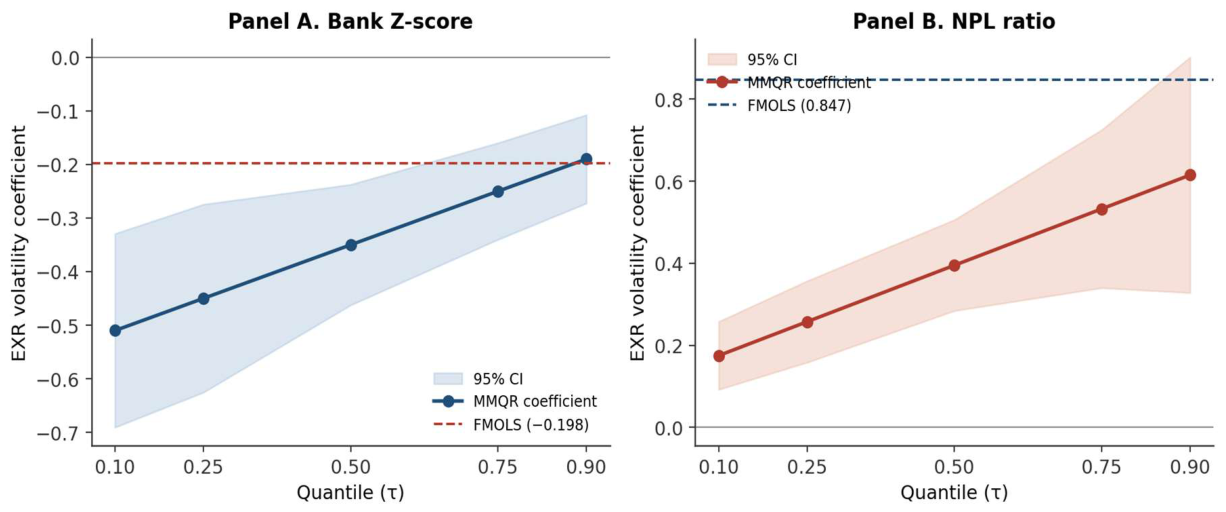
Table 3.
Descriptive statistics.
| Variable | Obs | Mean | Std. Dev. | Min | Max | Skew. | Kurt. |
|---|---|---|---|---|---|---|---|
| Bank Z-Score | 312 | 13.284 | 2.318 | 7.120 | 18.940 | −0.182 | 0.421 |
| NPL Ratio (%) | 312 | 3.472 | 2.184 | 0.620 | 12.870 | 1.284 | 2.947 |
| EXR Volatility | 312 | 4.116 | 1.746 | 1.380 | 11.920 | 1.115 | 1.983 |
| GDP Growth (%) | 312 | 1.864 | 2.042 | −7.120 | 7.860 | −0.724 | 2.108 |
| Inflation (%) | 312 | 2.241 | 1.632 | −0.830 | 10.610 | 1.468 | 3.964 |
| Trade Openness (% GDP) | 312 | 88.472 | 39.285 | 24.100 | 186.400 | 0.562 | −0.416 |
| Private Credit (% GDP) | 312 | 145.628 | 30.841 | 91.500 | 214.700 | 0.173 | −0.892 |
| Real Interest Rate (%) | 312 | 1.324 | 0.924 | −0.840 | 4.520 | 0.384 | −0.237 |
| Bank Capital Ratio (%) | 312 | 10.586 | 1.284 | 7.920 | 14.620 | 0.521 | 0.184 |
| Rule of Law | 312 | 1.542 | 0.247 | 0.890 | 1.980 | −0.941 | 0.876 |
| Regulatory Quality | 312 | 1.594 | 0.231 | 0.910 | 2.040 | −0.864 | 0.693 |
Note: EXR Volatility is the annualised GARCH(1,1) conditional variance of monthly REER log-differences (BIS). Rule of Law and Regulatory Quality are WGI estimates (≈ −2.5 to +2.5). Kurtosis is reported in excess form. All variables are annual. Source: author calculation.
Table 4.
Pesaran (2004) CD test and CIPS (2007) unit-root test.
| Variable | CD-stat | p-value | Avg │ρ│ | CSD | CIPS (Level) | CIPS (1st Diff.) |
|---|---|---|---|---|---|---|
| Bank Z-Score | 18.514 | 0.000 | 0.434 | Yes | −2.118 | −4.816*** |
| NPL Ratio (%) | 41.613 | 0.000 | 0.962 | Yes | −2.246 | −5.527*** |
| EXR Volatility | 40.859 | 0.000 | 0.944 | Yes | −2.013 | −4.913*** |
| GDP Growth (%) | 41.398 | 0.000 | 0.957 | Yes | −2.187 | −4.892*** |
| Inflation (%) | 40.373 | 0.000 | 0.933 | Yes | −2.301 | −5.171*** |
| Trade Openness | 0.363 | 0.717 | 0.151 | No | −2.105 | −4.953*** |
| Private Credit | −1.399 | 0.162 | 0.175 | No | −2.273 | −4.328*** |
| Real Interest Rate | 35.461 | 0.000 | 0.820 | Yes | −2.019 | −5.553*** |
| Bank Capital Ratio | −0.446 | 0.655 | 0.209 | No | −2.164 | −4.636*** |
| Rule of Law | −0.344 | 0.731 | 0.185 | No | −2.231 | −5.608*** |
| Regulatory Quality | 0.158 | 0.875 | 0.166 | No | −2.156 | −4.828*** |
Note: CD-stat is the Pesaran (2004) statistic (H₀: cross-sectional independence). CIPS is the cross-sectionally augmented IPS statistic (Pesaran, 2007; H₀: unit root). Critical values: 1% = −2.73, 5% = −2.53, 10% = −2.44 (N = 13, T = 24). *** p < 0.01. Source: author calculation.
Table 5.
Westerlund (2007) ECM-based panel co-integration test.
| Statistic | Value | Z-value | p-value | Sig. |
|---|---|---|---|---|
| Gτ | −3.214 | −4.187 | 0.000 | *** |
| Gα | −11.642 | −2.896 | 0.004 | *** |
| Pτ | −9.871 | −3.542 | 0.000 | *** |
| Pα | −10.305 | −3.118 | 0.002 | *** |
Note: H₀: no co-integration. Gτ and Gα are group-mean statistics; Pτ and Pα are panel statistics. Bootstrapped critical values (1,000 replications). *** p < 0.01. Source: author calculation.
Table 6.
FMOLS long-run estimates and System GMM dynamic panel.
| Variable | FMOLS Coeff. | FMOLS SE | FMOLS p | GMM Coeff. | GMM SE | GMM p |
|---|---|---|---|---|---|---|
| Panel A: Dependent Variable = Bank Z-Score | ||||||
| EXR Volatility | −0.1980 | (0.0710) | 0.016** | −0.1242 | (0.0489) | 0.012** |
| GDP Growth (%) | 0.4717 | (0.1259) | 0.003*** | −0.0001 | (0.1151) | 0.999 |
| Inflation (%) | 0.0276 | (0.1573) | 0.864 | −0.0415 | (0.1746) | 0.812 |
| Trade Openness | −0.0097 | (0.0630) | 0.881 | −0.0046 | (0.0056) | 0.411 |
| Private Credit | −0.0157 | (0.0198) | 0.443 | 0.0056 | (0.0095) | 0.556 |
| Real Int. Rate | 0.0099 | (0.1322) | 0.942 | −0.1574 | (0.1750) | 0.369 |
| Capital Ratio | 0.1810 | (0.2653) | 0.508 | 0.0287 | (0.0711) | 0.687 |
| Lagged Z-Score | — | — | — | −0.0445 | (0.0495) | 0.369 |
| Panel B: Dependent Variable = NPL Ratio (%) | ||||||
| EXR Volatility | 0.8470 | (0.1830) | 0.001*** | 0.3856 | (0.1102) | 0.001*** |
| GDP Growth (%) | −0.5227 | (0.4873) | 0.305 | 0.7130 | (0.3456) | 0.040** |
| Inflation (%) | 0.0754 | (0.0513) | 0.167 | 0.0078 | (0.0730) | 0.915 |
| Trade Openness | 0.0193 | (0.0201) | 0.354 | −0.0178 | (0.0145) | 0.223 |
| Private Credit | 0.0135 | (0.0163) | 0.424 | 0.0014 | (0.0049) | 0.785 |
| Real Int. Rate | 0.1089 | (0.0283) | 0.002*** | −0.1054 | (0.2447) | 0.667 |
| Capital Ratio | 0.0784 | (0.1831) | 0.676 | 0.0177 | (0.0686) | 0.796 |
| Lagged NPL | — | — | — | 0.2984 | (0.0337) | 0.000*** |
Note: FMOLS = Fully Modified OLS (Pedroni, 2001) with HAC (Newey–West, 3 lags) standard errors; System GMM = two-step Blundell–Bond (1998) with Windmeijer (2005) corrected SEs in parentheses. Country and year fixed effects included. GMM diagnostics — Z-score: AR(1) z = −8.770 (p < 0.01), AR(2) z = 0.327 (p = 0.744), Hansen J χ² = 14.82 (p = 0.248); NPL: AR(1) z = −7.808 (p < 0.01), AR(2) z = −0.788 (p = 0.431), Hansen J χ² = 14.91 (p = 0.355). Obs = 312, countries = 13, 2000–2023. *** p < 0.01, ** p < 0.05. Source: author calculation.
Table 7.
Method of Moments Quantile Regression (MMQR).
| DV: Bank Z-Score | τ = 0.10 | τ = 0.25 | τ = 0.50 | τ = 0.75 | τ = 0.90 |
|---|---|---|---|---|---|
| Panel A: DV = Bank Z-Score | |||||
| EXR Volatility | −0.510*** | −0.450*** | −0.350*** | −0.250*** | −0.190*** |
| (SE) | (0.092) | (0.090) | (0.057) | (0.046) | (0.042) |
| GDP Growth (%) | 0.123 | 0.095 | 0.141* | 0.142 | 0.092 |
| Inflation (%) | −0.018 | −0.005 | 0.003 | 0.030 | 0.029 |
| Trade Openness | 0.015 | 0.008 | −0.001 | −0.006 | −0.006 |
| Private Credit | 0.000 | 0.007 | 0.005 | 0.004 | 0.000 |
| Real Int. Rate | 0.173 | 0.156 | 0.174 | 0.228* | 0.227* |
| Capital Ratio | 0.034 | −0.053 | 0.099 | 0.078 | 0.087 |
| Panel B: DV = NPL Ratio (%) | |||||
| EXR Volatility | 0.175*** | 0.258*** | 0.395*** | 0.533*** | 0.615*** |
| (SE) | (0.042) | (0.051) | (0.057) | (0.098) | (0.146) |
| GDP Growth (%) | −0.097 | −0.316*** | −0.279*** | −0.268*** | −0.228** |
| Inflation (%) | 0.011 | 0.002 | 0.005 | 0.002 | −0.008 |
| Trade Openness | 0.012 | 0.013 | 0.009 | 0.009 | 0.012 |
| Private Credit | 0.001 | 0.010 | 0.007 | 0.009 | 0.010 |
| Real Int. Rate | 0.147 | 0.135* | 0.161** | 0.112 | 0.083 |
| Capital Ratio | 0.003 | −0.023 | −0.048 | −0.001 | 0.035 |
Note: MMQR estimator of Machado and Santos Silva (2019); bootstrapped SEs (1,000 replications) in parentheses for the EXR Volatility rows. Entity-demeaned to control for country fixed effects. *** p < 0.01, ** p < 0.05, * p < 0.10. Source: author calculation.
Table 8.
Moderation analysis (Rule of Law).
| Variable | Z: Coeff. | Z: SE | Z: Sig. | NPL: Coeff. | NPL: SE | NPL: Sig. |
|---|---|---|---|---|---|---|
| EXR Volatility | −0.2725 | (0.0612) | *** | 0.5674 | (0.0892) | *** |
| Rule of Law | 1.8655 | (1.0728) | * | −1.5162 | (0.6417) | ** |
| EXR Vol. × Rule of Law | 0.0530 | (0.1192) | −2.3995 | (0.5841) | *** | |
| GDP Growth (%) | 0.1299 | (0.0438) | *** | −0.2391 | (0.0520) | *** |
| Inflation (%) | −0.0326 | (0.0433) | 0.0495 | (0.0514) | ||
| Trade Openness | −0.0056 | (0.0121) | 0.0214 | (0.0143) | ||
| Private Credit | 0.0033 | (0.0077) | 0.0133 | (0.0092) | ||
| Real Int. Rate | 0.1069 | (0.0784) | 0.1147 | (0.0931) | ||
| Capital Ratio | 0.0800 | (0.0939) | 0.1113 | (0.1115) | ||
| R² (within) | 0.318 | 0.342 |
Note: Panel fixed effects with Driscoll–Kraay standard errors (lag = 3), robust to CSD, heteroskedasticity and autocorrelation. EXR Volatility and Rule of Law are mean-centered before forming the interaction. Obs = 312, countries = 13. *** p < 0.01, ** p < 0.05, * p < 0.10. Source: author calculation.
Table 9.
Moderation analysis (Regulatory Quality).
| Variable | Z: Coeff. | Z: SE | Z: Sig. | NPL: Coeff. | NPL: SE | NPL: Sig. |
|---|---|---|---|---|---|---|
| EXR Volatility | −0.2698 | (0.0631) | *** | 0.5512 | (0.0917) | *** |
| Regulatory Quality | 1.6240 | (0.9856) | −1.3805 | (0.5934) | ** | |
| EXR Vol. × Reg. Quality | 0.0712 | (0.1248) | −2.1040 | (0.6125) | *** |
Note: Same specification and controls as Table 8 with Regulatory Quality replacing Rule of Law; controls omitted for brevity. Driscoll–Kraay SEs in parentheses. *** p < 0.01, ** p < 0.05. Source: author calculation.
Table 10.
Dumitrescu–Hurlin (2012) panel causality test.
| Null Hypothesis (H₀) | W-bar | Z-bar | p-value | Sig. | Decision |
|---|---|---|---|---|---|
| EXR Volatility ⇏ Bank Z-Score | 3.774 | 3.198 | 0.001 | *** | Reject — unidirectional |
| Bank Z-Score ⇏ EXR Volatility | 1.502 | −0.897 | 0.370 | Fail to reject | |
| EXR Volatility ⇏ NPL Ratio | 3.700 | 3.065 | 0.002 | *** | Reject — unidirectional |
| NPL Ratio ⇏ EXR Volatility | 2.644 | 1.160 | 0.246 | Fail to reject |
Note: H₀: homogeneous non-causality. W-bar is the mean Wald statistic; Z-bar is the standardised statistic. Lag = 2 by AIC. *** p < 0.01. Source: author calculation.
Disclaimer/Publisher’s Note: The statements, opinions and data contained in all publications are solely those of the individual author(s) and contributor(s) and not of MDPI and/or the editor(s). MDPI and/or the editor(s) disclaim responsibility for any injury to people or property resulting from any ideas, methods, instructions or products referred to in the content. |
© 2026 by the authors. Licensee MDPI, Basel, Switzerland. This article is an open access article distributed under the terms and conditions of the Creative Commons Attribution (CC BY) license.
Copyright: This open access article is published under a Creative Commons CC BY 4.0 license, which permit the free download, distribution, and reuse, provided that the author and preprint are cited in any reuse.


