

Submitted:
03 July 2026
Posted:
07 July 2026
You are already at the latest version
Abstract
Background and Clinical Significance: Phosphatidylinositol-3-kinase (PI3K) inhibitors have transformed the treatment of advanced hormone receptor-positive, HER2-negative breast cancer harboring PIK3CA mutations. Hyperglycemia is a well-recognized on-target adverse effect of this drug class; however, progression to diabetic ketoacidosis (DKA) is rare and potentially life-threatening. Inavolisib, a next-generation PI3Kα-selective inhibi-tor, has demonstrated promising efficacy, yet no detailed case of inavolisib-associated DKA has been reported in the peer-reviewed literature. We present what appears to be the first such case, highlighting an important and underrecognized endocrine toxicity.Case Presentation: A 76-year-old woman with metastatic hormone receptor-positive, HER2-negative, PIK3CA-mutated breast cancer and type 2 diabetes well controlled on oral hypoglycemics for over a decade was started on inavolisib in combination with palbo-ciclib and fulvestrant for newly diagnosed pulmonary metastases. Approximately two weeks after treatment initiation, she presented with generalized weakness, inability to tol-erate oral intake, and a mechanical fall. Laboratory evaluation revealed severe hypergly-cemia (glucose >500 mg/dL), metabolic acidosis (venous pH 7.27, bicarbonate 14 mmol/L), an elevated anion gap (27), and moderate ketonuria, consistent with DKA. Her glycated hemoglobin had risen from 5.8% to 8.9% within two months. No alternative precipitants, including infection, steroid use, or dietary changes, were identified. She was admitted to the intensive care unit and treated with intravenous fluids and insulin infusion, with dis-continuation of inavolisib, resulting in rapid metabolic recovery. At two-month follow-up, her HbA1c had normalized to 4.7% on her prior oral regimen alone. Conclusions: This case represents the first detailed peer-reviewed report of DKA associat-ed with inavolisib. The close temporal relationship, absence of alternative precipitants, and rapid recovery after drug discontinuation strongly support a causal association. Cli-nicians prescribing PI3Kα inhibitors should implement rigorous baseline metabolic as-sessment and close glucose monitoring, particularly during the first two weeks of therapy, even in patients with previously well-controlled diabetes.
Keywords:
inavolisib
; phosphatidylinositol 3-kinase (PI3K) inhibitor
; diabetic ketoacidosis
; hyperglycemia
; breast cancer
; PIK3CA mutation
; oncoendocrinology
1. Introduction and Clinical Significance
The phosphatidylinositol-3-kinase (PI3K)/AKT/mTOR signaling pathway regulates cellular proliferation, survival, and metabolism. Activating PIK3CA mutations occur in approximately 40% of hormone receptor-positive (HR+), HER2-negative breast cancers, making PI3Kα-selective inhibitors a major therapeutic advance for this population [1].
Hyperglycemia is the most clinically significant metabolic toxicity of PI3Kα inhibitors, arising as a direct on-target effect of PI3Kα inhibition in insulin signaling. In clinical trials, all-grade hyperglycemia occurred in 63.7% of alpelisib-treated and 58.6% of inavolisib-treated patients [2,3,4]. While hyperglycemia is common and typically reversible with dose modification, progression to diabetic ketoacidosis (DKA) is rare and potentially fatal. A pharmacovigilance analysis of the FDA Adverse Event Reporting System identified 87 DKA cases associated with alpelisib, indicating a tenfold higher risk compared with other anticancer therapies [2]. Management remains an area of active investigation; current ADA 2026 guidelines recommend metformin as first-line therapy, with caution against SGLT2 inhibitors due to markedly elevated DKA risk in this setting [5].
Inavolisib is a next-generation, highly selective PI3Kα inhibitor recently approved in combination with palbociclib and fulvestrant for endocrine-resistant, PIK3CA-mutated, HR+/HER2− advanced breast cancer [6]. The FDA prescribing information warns that severe or fatal hyperglycemia, including ketoacidosis, can occur, and postmarketing fatal ketoacidosis has been reported [7]. However, one published case described inavolisib-induced hyperosmolar hyperglycemic state without ketoacidosis, and no detailed clinical case report of inavolisib-associated DKA has appeared in the peer-reviewed literature [8].
This case represents the first published peer-reviewed report of DKA associated with inavolisib. While hyperglycemia is a recognized on-target effect of PI3Kα inhibitors, progression to DKA is rare and potentially fatal. This report provides a practical clinical framework for early recognition and management of this life-threatening complication, reinforces the ADA recommendation for weekly glucose monitoring during the first two weeks of PI3Kα inhibitor therapy, and highlights the need for caution with SGLT2 inhibitors in this setting.
2. Case Presentation
2.1. Patient Demographics and Medical History
A 76-year-old woman presented to the emergency department with generalized weakness, inability to eat or drink, and a mechanical fall. Her oncologic history was notable for stage III hormone receptor-positive (HR+), human epidermal growth factor receptor 2-negative (HER2−) breast cancer diagnosed four years prior, for which she underwent left mastectomy and adjuvant therapy. She remained in remission until two months before this presentation, when surveillance imaging revealed new pulmonary and lymph node metastases consistent with disease recurrence. Molecular profiling of the recurrent disease identified a PIK3CA mutation. She was subsequently initiated on inavolisib in combination with palbociclib and fulvestrant two weeks prior to this admission.
Her medical history also included type 2 diabetes mellitus diagnosed ten years earlier, consistently well controlled on oral hypoglycemic therapy (pioglitazone) without ever requiring insulin. She also had hypertension, hyperlipidemia, and hypothyroidism. Her baseline glycosylated hemoglobin (HbA1c) two months prior to presentation was 5.8%, reflecting long-standing glycemic control. The patient reported full compliance with her medications, and there were no recent dietary changes, infections, or other identifiable precipitants. The only change in her medication regimen was the addition of inavolisib two weeks earlier.
2.2. Clinical Presentation and Diagnostic Assessment
On arrival, the patient was alert and oriented. Vital signs were as follows: temperature: 98.6°F, heart rate: 78 bpm, respiratory rate: 18 breaths/min, blood pressure: 139/71 mmHg, oxygen saturation: 98% on room air. Physical examination was notable for left mastectomy scars and vitiligo. The neurological examination was grossly normal. There were no signs of infection or acute decompensated heart failure. Laboratory evaluation revealed the following: serum glucose: >500 mg/dL, venous pH: 7.27, serum bicarbonate: 14 mmol/L, anion gap: 27, urine ketones: moderate, corrected sodium: 160 mmol/L, potassium: 4.4 mmol/L, creatinine: 2.0 mg/dL and HbA1c: 8.9%.
These findings were consistent with a diagnosis of diabetic ketoacidosis (DKA) with concurrent hypernatremia and acute kidney injury. The HbA1c of 8.9% represented a 3.1% increase from her baseline of 5.8% measured two months earlier, indicating rapid and severe glycemic deterioration temporally associated with inavolisib initiation.
2.3. Treatment and Hospital Course
The patient was admitted to the intensive care unit and managed with intravenous fluid resuscitation and a continuous insulin infusion per institutional DKA protocol. Once the anion gap closed and the patient tolerated oral intake, the insulin infusion was transitioned to subcutaneous insulin.
The endocrinology service was consulted and recommended ongoing glucose monitoring with insulin dose titration. The hematology-oncology service recommended withholding inavolisib. Following multidisciplinary discussion, inavolisib was permanently discontinued given the severity of the metabolic derangement.
The patient's DKA resolved, and she demonstrated rapid clinical and metabolic recovery. She was discharged in stable condition on her home medication, pioglitazone, with close outpatient follow-up.
2.4. Outcome and Follow-Up
At her most recent follow-up, approximately two months after discharge, her HbA1c had normalized to 4.7%, confirming the reversibility of the hyperglycemic episode following inavolisib discontinuation. Pioglitazone was subsequently stopped given the normalized glycemic status. Her metastatic breast cancer remained stable, and she was continued on single-agent fulvestrant.
2.5. Ethical and Methodological Disclosures
Informed consent was obtained from the patient for publication of this case report. Generative artificial intelligence tools were not used in the design, data collection, analysis, or interpretation of this case.
3. Discussion
This case reflects a broader trend in modern oncology: as targeted therapies improve cancer outcomes, their metabolic and endocrine toxicities are emerging as significant sources of morbidity requiring multidisciplinary management, a growing field recently termed oncoendocrinology [9].
Our patient had multiple recognized risk factors for severe PI3Kα inhibitor-induced hyperglycemia: preexisting type 2 diabetes, age >65 years, and likely elevated BMI. In the INAVO120 trial, hyperglycemia occurred in 65.5% of patients with BMI ≥30.0 versus 56.8% with BMI <30.0 [5]. In the phase I/Ib GO39374 study, patients with two or more risk factors had hyperglycemia rates of 87.9%, with grade 3–4 events in 39.4% [10]. A real-world cohort from Memorial Sloan Kettering reported any-grade hyperglycemia in 58% of 40 inavolisib-treated patients, with a median time to onset of 42 days [11].
The close temporal relationship, DKA developing approximately two weeks after starting inavolisib, in the absence of alternative precipitants such as infection, steroid use, or other pharmacologic triggers, strongly supports a causal association. Importantly, the other components of the patient's regimen are not known to cause clinically significant hyperglycemia. Fulvestrant does not list hyperglycemia among its adverse reactions; in the SERENA-2 trial, hyperglycemia occurred in only 1.4% at grade 1, and a FAERS analysis of 6,947 fulvestrant reports did not identify hyperglycemia as a safety signal [12]. Palbociclib is similarly not associated with hyperglycemia in adult humans; FAERS disproportionality analyses did not identify hyperglycemia as a safety signal [13]. The INAVO120 trial provides the most direct evidence: fasting glucose elevation occurred in 85% of patients receiving the inavolisib-containing triplet versus 43% receiving palbociclib–placebo–fulvestrant, with grade 3–4 hyperglycemia in 12% versus 0%, respectively [12]. Furthermore, the patient had well-controlled diabetes on pioglitazone alone for a decade with a baseline HbA1c of 5.8%, and the only pharmacologic change preceding DKA was the addition of inavolisib. After discontinuation, her glucose normalized and HbA1c declined to 4.7% while she continued fulvestrant without recurrence of hyperglycemia.
Our patient was already on pioglitazone, which is recommended as a second-line agent for PI3Kα inhibitor-induced hyperglycemia per ADA guidelines [14]. Yet pioglitazone was insufficient to prevent DKA, likely due to its slow onset of action [14]. This suggests that patients with preexisting diabetes may require additional prophylactic measures, such as metformin initiation, before starting PI3Kα inhibitors. During hospitalization, insulin was appropriately used for acute DKA management; however, for chronic glycemic management, insulin and sulfonylureas should be considered only as a last resort, as increased insulin levels may reactivate the PI3K pathway and counteract antitumor effects [8,14]. Unlike immune checkpoint inhibitor-induced diabetes, which involves autoimmune β-cell destruction and typically requires lifelong insulin replacement, PI3Kα inhibitor-associated hyperglycemia reflects on-target pharmacologic insulin resistance that is generally reversible with drug discontinuation, a distinction with important implications for long-term management [9]. This reversibility was clearly demonstrated in our patient.
Had weekly glucose monitoring been performed during the first two weeks, the hyperglycemia might have been detected before progressing to DKA. The FDA label recommends monitoring fasting glucose every 3 days for the first week, then weekly for weeks 2–4, then every 2 weeks for weeks 5–12, then every 4 weeks thereafter. As the field of oncoendocrinology continues to evolve, standardized, therapy-specific endocrine monitoring frameworks, as recently proposed by Shapoo et al.[9], will be essential to prevent, detect, and manage metabolic complications across the growing landscape of targeted cancer therapies.
This report has inherent limitations. As a single case, causality can be inferred but not definitively established. The patient's preexisting diabetes and age represent confounders that may have lowered her threshold for DKA. C-peptide and insulin levels were not measured during the acute episode, which would have helped characterize the mechanism of ketoacidosis. Despite these limitations, the strong temporal association, absence of alternative precipitants, and rapid metabolic recovery after drug discontinuation support a probable causal relationship. Prospective studies are needed to identify predictive biomarkers for severe hyperglycemic events, define optimal prophylactic antihyperglycemic strategies for high-risk patients, and clarify the safety of SGLT2 inhibitors in combination with PI3Kα inhibitors. As the indication for inavolisib expands, registry-based studies capturing real-world metabolic outcomes across diverse patient populations will be essential to refine risk stratification and monitoring protocols.
4. Conclusions
This case represents the first detailed peer-reviewed report of DKA associated with inavolisib. The close temporal relationship, absence of alternative precipitants, and rapid metabolic recovery after drug discontinuation strongly support a causal association. Well-controlled preexisting diabetes did not protect against severe metabolic decompensation, underscoring that all patients initiated on PI3Kα inhibitors require vigilant glucose monitoring, particularly during the first two weeks of therapy, consistent with current ADA recommendations. Clinicians should maintain a low threshold for evaluating ketoacidosis in patients presenting with nonspecific symptoms during PI3Kα inhibitor treatment. Multidisciplinary collaboration between oncology and endocrinology teams is essential to optimize metabolic surveillance and guide management decisions. Prospective registries are needed to better define the incidence, risk factors, and optimal management of PI3Kα inhibitor–associated DKA.
Figure 1.
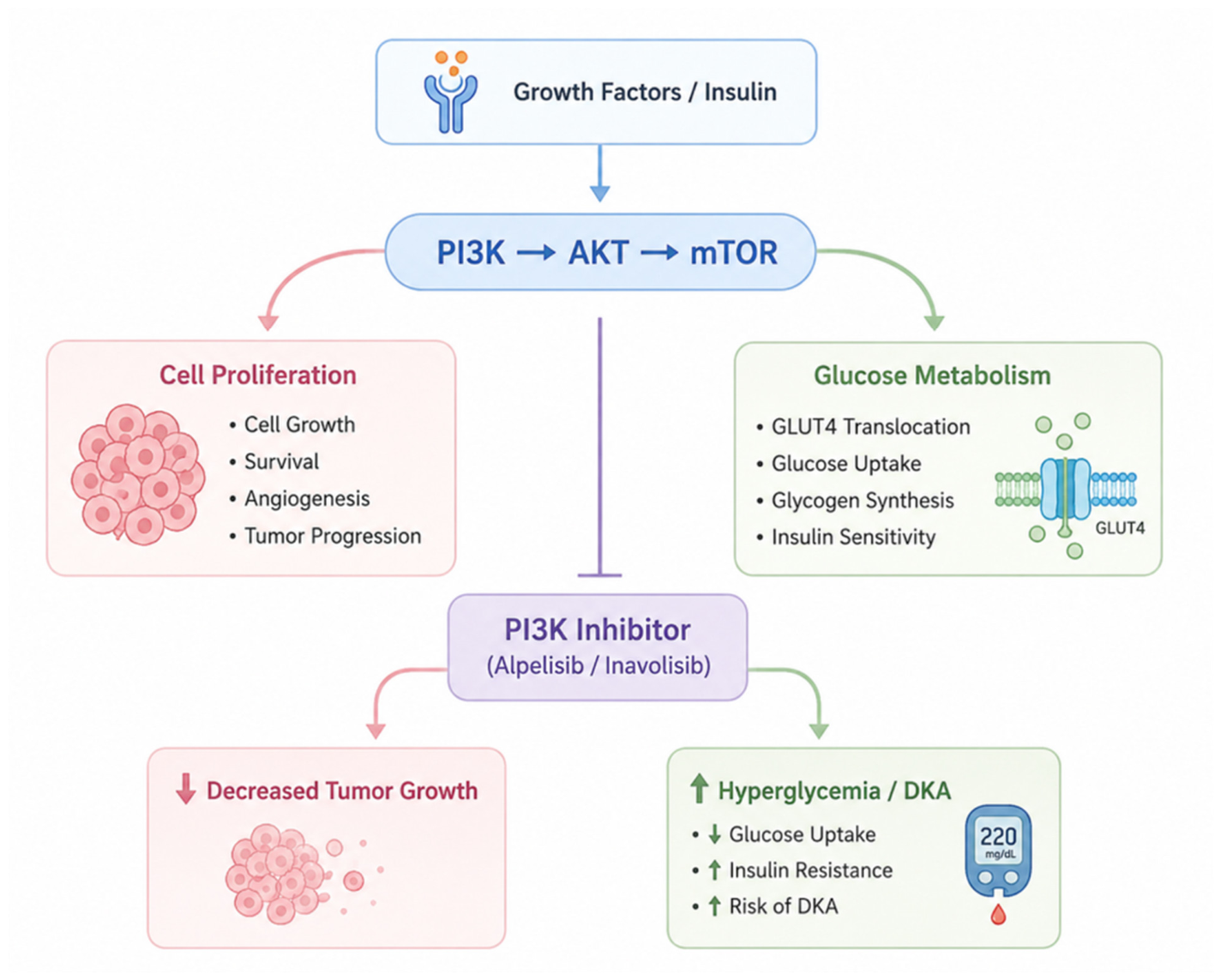
Dual role of the PI3K/AKT/mTOR pathway in tumor growth and glucose metabolism. PI3K inhibition reduces tumor proliferation but impairs insulin signaling, leading to hyperglycemia and diabetic ketoacidosis. PI3K – Phosphatidylinositol 3-Kinase, AKT – Protein Kinase B (PKB), commonly referred to as AKT, mTOR – Mechanistic Target of Rapamycin,GLUT4 - Glucose Transporter Type 4, DKA – Diabetic Ketoacidosis.
Figure 1.
Dual role of the PI3K/AKT/mTOR pathway in tumor growth and glucose metabolism. PI3K inhibition reduces tumor proliferation but impairs insulin signaling, leading to hyperglycemia and diabetic ketoacidosis. PI3K – Phosphatidylinositol 3-Kinase, AKT – Protein Kinase B (PKB), commonly referred to as AKT, mTOR – Mechanistic Target of Rapamycin,GLUT4 - Glucose Transporter Type 4, DKA – Diabetic Ketoacidosis.
5. Patents
This section is not mandatory but may be added if there are patents resulting from the work reported in this manuscript.
Author Contributions
Conceptualization, N.S. and A.V.; methodology, N.S., A.V., N.B., J.M., A.F.; data curation, N.S., A.V., N.B.,.; writing—original draft preparation, N.S., A.V.; writing—review and editing, N.S., N.B., J.M., A.F.; supervision, N.B., J.M., A.F. All authors have read and agreed to the published version of the manuscript.
Funding
This research received no external funding.
Informed Consent Statement
Informed consent was obtained from the patient for publication of this case report.
Conflicts of Interest
The authors declare no conflicts of interest.
Abbreviations
The following abbreviations are used in this manuscript:
ADA, American Diabetes Association; AKT, protein kinase B; DKA, diabetic ketoacidosis; FDA, Food and Drug Administration; GLUT-4, glucose transporter type 4; HbA1c, glycated hemoglobin; HER2, human epidermal growth factor receptor 2; HR+, hormone receptor-positive; ICU, intensive care unit; mTOR, mechanistic target of rapamycin; PI3K, phosphatidylinositol-3-kinase; PI3Kα, phosphatidylinositol-3-kinase alpha; PIK3CA, phosphatidylinositol-4,5-bisphosphate 3-kinase catalytic subunit alpha; SGLT2, sodium-glucose cotransporter 2; SpO₂, peripheral oxygen saturation.
References
- Sirico, M.; D'Angelo, A.; Gianni, C.; Casadei, C.; Merloni, F.; De Giorgi, U. Current State and Future Challenges for PI3K Inhibitors in Cancer Therapy. Cancers 2023, 15(3), 703. [Google Scholar] [CrossRef] [PubMed] [PubMed Central]
- Hee, N.K.; Lim, Q.H.; Khunti, K.; Ooi, Y.G.; Yen, I.W.; Saad, M.; Ekinci, E.I.; Li, H.Y.; Vethakkan, S.R.; Chan, J.C.N.; Lim, L.L. Secondary causes of diabetes: a crossroad of endocrinology and oncology. Lancet Diabetes Endocrinol. 2026, 14(5), 422–436. [Google Scholar] [CrossRef] [PubMed]
- Sriravindrarajah, A.; Hurwitz, J.; Lim, E.; Greenfield, J.R. Hyperglycemia secondary to phosphatidylinositol-3 kinase (PI3K) inhibition. Endocrinol. Diabetes Metab. Case Rep. 2024, 2024(4), 24–0040. [Google Scholar] [CrossRef] [PubMed] [PubMed Central]
- Ziegengeist, J.L.; Elmes, J.B.; Strassels, S.A.; Patel, J.N.; Moore, D.C. Alpelisib-Induced Diabetic Ketoacidosis: A Pharmacovigilance Analysis of the FDA Adverse Event Reporting System and Review of the Literature. Clin. Breast Cancer 2024, 24(4), e204–e209. [Google Scholar] [CrossRef] [PubMed]
- American Diabetes Association Professional Practice Committee for Diabetes*. 9. Pharmacologic Approaches to Glycemic Treatment: Standards of Care in Diabetes-2026. Diabetes Care 2026, 49 (Suppl 1), S183–S215. [Google Scholar] [CrossRef] [PubMed] [PubMed Central]
- Turner, N.C.; Im, S.A.; Saura, C.; Juric, D.; Loibl, S.; Kalinsky, K.; Schmid, P.; Loi, S.; Sunpaweravong, P.; Musolino, A.; Li, H.; Zhang, Q.; Nowecki, Z.; Leung, R.; Thanopoulou, E.; Shankar, N.; Lei, G.; Stout, T.J.; Hutchinson, K.E.; Schutzman, J.L.; Song, C.; Jhaveri, K.L. Inavolisib-Based Therapy in PIK3CA-Mutated Advanced Breast Cancer. N Engl. J. Med. 2024, 391(17), 1584–1596. [Google Scholar] [CrossRef] [PubMed]
- Wedam, S.; Narayan, P.; Gittleman, H.; Cheng, J.; Bhatnagar, V.; Sabit, H.; Price, L.S.L.; Rahman, N.A.; Chiu, H.J.; Biel, N.; Ricks, T.; Fiero, M.; Tang, S.; Osgood, C.; Pierce, W.; Pazdur, R.; Kluetz, P.G.; Amiri-Kordestani, L. US Food and Drug Administration Approval Summary: Inavolisib With Palbociclib and Fulvestrant for Endocrine-Resistant, PIK3CA-Mutated, Hormone Receptor-Positive, Human Epidermal Growth Factor Receptor 2-Negative, Locally Advanced or Metastatic Breast Cancer. J. Clin. Oncol. 2025, 43(28), 3123–3131. [Google Scholar] [CrossRef] [PubMed]
- Li, H.; Cao, C.; Jin, L.; Xiao, J.; Zhao, W.; Wang, X. Inavolisib-induced fulminant-like diabetes and hyperosmolar hyperglycemic state: a case report. Front Endocrinol. 2026, 17, 1747317. [Google Scholar] [CrossRef] [PubMed] [PubMed Central]
- Shapoo, N.; Boma, N.; Gotlieb, V.; Mattana, J.; Belokovskaya, R.; Franco, A. The Rise of Oncoendocrinology: How Modern Cancer Therapies Are Reshaping Endocrine Practice. Med. Sci. 2026, 14(3), 347. [Google Scholar] [CrossRef]
- Jhaveri, K.L.; Im, S.A.; Saura, C.; Loibl, S.; Kalinsky, K.; Schmid, P.; Loi, S.; Thanopoulou, E.; Shankar, N.; Jin, Y.; Stout, T.J.; Clark, T.D.; Song, C.; Juric, D.; Turner, N.C. Overall Survival with Inavolisib in PIK3CA-Mutated Advanced Breast Cancer. N Engl. J. Med. Epub. 2025, 393(2), 151–161. [Google Scholar] [CrossRef] [PubMed]
- Shen, S.; Blotta, D.; Bromberg, M.; et al. Characterization of inavolisib-associated hyperglycemia in metastatic hormone receptor–positive (HR+) breast cancer. J. Clin. Oncol. 2026, 44. [Google Scholar] [CrossRef]
- Im, S.A.; Kalinsky, K.; Jhaveri, K.L.; Loibl, S.; Turner, N.; Saura, C.; Schmid, P.; Loi, S.; Hamilton, E.; Karadurmus, N.; Wang, S.; Awan, A.A.; Ciruelos, E.M.; Chung, C.F.; Thanopoulou, E.; Shankar, N.; Lim, S.; Jin, Y.; Song, C.; Juric, D. Safety analyses of the INAVO120 randomised phase III trial of inavolisib or placebo with palbociclib-fulvestrant in patients with PIK3CA-mutated, hormone receptor-positive, HER2-negative, endocrine-resistant advanced breast cancer. ESMO Open 2026, 11(6), 107735. [Google Scholar] [CrossRef] [PubMed] [PubMed Central]
- Gambardella, V.; Accordino, M.K.; Bedard, P.L.; Cervantes, A.; Hamilton, E.; Italiano, A.; Kalinsky, K.; Krop, I.E.; Oliveira, M.; Saura, C.; Schmid, P.; Turner, N.C.; Varga, A.; Fernandez-Saranillo, A.; Jin, Y.; Royer-Joo, S.; Peters, U.; Shankar, N.; Schutzman, J.L.; Juric, D.; Jhaveri, K.L. Safety overview and management of inavolisib alone and in combination therapies in PIK3CA-mutated, HR-positive, HER2-negative advanced breast cancer (GO39374). ESMO Open 2025, 10(7), 105303. [Google Scholar] [CrossRef] [PubMed] [PubMed Central]
- André, F.; Ciruelos, E.; Rubovszky, G.; Campone, M.; Loibl, S.; Rugo, H.S.; Iwata, H.; Conte, P.; Mayer, I.A.; Kaufman, B.; Yamashita, T.; Lu, Y.S.; Inoue, K.; Takahashi, M.; Pápai, Z.; Longin, A.S.; Mills, D.; Wilke, C.; Hirawat, S.; Juric, D. SOLAR-1 Study Group. Alpelisib for PIK3CA-Mutated, Hormone Receptor-Positive Advanced Breast Cancer. N Engl. J. Med. 2019, 380(20), 1929–1940. [Google Scholar] [CrossRef] [PubMed]
Disclaimer/Publisher’s Note: The statements, opinions and data contained in all publications are solely those of the individual author(s) and contributor(s) and not of MDPI and/or the editor(s). MDPI and/or the editor(s) disclaim responsibility for any injury to people or property resulting from any ideas, methods, instructions or products referred to in the content. |
© 2026 by the authors. Licensee MDPI, Basel, Switzerland. This article is an open access article distributed under the terms and conditions of the Creative Commons Attribution (CC BY) license (http://creativecommons.org/licenses/by/4.0/).
Copyright: This open access article is published under a Creative Commons CC BY 4.0 license, which permit the free download, distribution, and reuse, provided that the author and preprint are cited in any reuse.


