
Submitted:
15 June 2026
Posted:
23 June 2026
You are already at the latest version
Abstract
Environmental, Social, and Governance (ESG) frameworks are increasingly popular and yet, these are often under-supported with short term managerial choices to abandon sustainability commitments in the face of unknown and financial difficulty. In this study, the research design is taken into account in the Pāli Canon, Buddhist economics scholarship, the strategic resilience literature and previous work at this time in designing the Buddhism-Resilience-ESG mediation model (BREM). The BREM claims that this methodology in Buddhist ESG management is the basis of three layers of resilience, which are absorptive, adaptable and transformative and it is that those three factors of strategic resilience constitute the linkage between the Buddhist aspect of ESG governance in this practice and the long term performance of the corporation. The model is organised around five foundational Buddhist principles drawn from the Pāli Canon, each mapped onto the three resilience capacities that mediate ESG governance and long-term performance. We show the altruism-performance paradox presented in the earlier works is solved by the BREM because in Buddhist ESG governance, resilience of asset rather than performance sacrifice with it.
Keywords:
Buddhist economics
; ESG
; strategic resilience
; dynamic capabilities
; stakeholder governance
; managerial ethics
; conceptual-interpretive research
1. Introduction
ESG frameworks have grown rapidly in corporate practice globally, but adoption has far outstripped institutional frameworks that would help sustain it. In emerging Asian economies (in particular, those where Buddhist governance is still important) companies that face financial pressure and/or external uncertainty are more likely to walk away from ESG commitments rather than absorb them as the foundation for long-term strategic objectives. Environmental uncertainty, for instance, has been shown to deter ecological investment by listed firms in a cost-minimisation manner, particularly when ESG commitments are perceived to be discretionary, not tied to firm identity (Bin-Feng et al., 2024). And geography adds to this problem: companies across ownership structures, not just state-owned companies, are less likely to engage in ESG activities when external risks put short-term performance at the center of corporate activities (Author, 2026). Consequently, there is an identified implementation gap in the extent to which corporate ESG commitments are disclosed, audited, and reported to investors but not where there is any sense of firm resilience and for what extent these work as a structural factor in organisational decision-making. This gap between ESG performance as signal and ESG governance as structural commitment is the problem this paper addresses.
Earlier work has established the ethical and governance architecture of Buddhist ESG practice but has not yet addressed the mechanism linking that architecture to strategic durability. Author (2025) identified a persistent ethical gap in contemporary ESG frameworks, developing the Comparative Ethical Mapping Framework (CEMF) to show how Buddhist economic principles — particularly those associated with the Noble Eightfold Path — can supply an ethical logic that precedes governance procedures rather than following them. Author (2026) extended this analysis by developing a four-dimensional Dharmic Governance Framework, translating Buddhist principles into specific board-level governance design levers: mindful decision-making structures, compassionate stakeholder engagement, wise leadership development, and interdependent accountability systems.
What neither framework addresses is the mechanism by which this governance orientation produces strategic durability — the capacity to sustain ESG commitments through market volatility, financial pressure, and systemic shocks. This is the problem of strategic resilience: not whether ethical governance is desirable, but how it generates the adaptive capacity that allows ESG-committed organisations to persist when circumstances make persistence costly (Hamel & Välikangas, 2003; Colberg, 2022).
The present paper addresses this gap by developing the Buddhism-Resilience-ESG Mediation Model (BREM). It is based on the central theory that firms that are governed according to Buddhist ethical principles are not simply motivated to adopt ESG practices for compliance or signalling reasons, but are structurally positioned to sustain those commitments under adversity. What has not been the focus of the framework so far is how this governance orientation translates to ESG performance that is sustainable—particularly when ethical commitment and financial pressure are closely linked. In this paper we argue that the mediating mechanism is strategic resilience—which is here a combination of three organisational capacities: absorptive, adaptive and transformative. It is through this development and maintenance that Buddhist ESG governance becomes strategic in nature and not just ethical in nature.
This view offers a perspective on the altruism–performance paradox and such findings like those of Fu et al. (2024), which found a weaker ESG–performance relationship in the short run, may be conditional on the performance measurement. If some effects play out slowly, particularly among those in stress in the short run, short-term indicators probably may not accurately depict how well these influences play out on performance levels.
Under this perspective, Buddhist ESG oriented firms might not expect that they trade off performance for ethical duties over time and they may have to put in more focus resilience-driving work on time that the effect from all of it grows in duration. Firms that have reduced the emphasis on such processes can probably still achieve the same end result but will have a harder time carrying on ESG pledges when things get more complex and demanding.
The paper is organised as follows. The next section describes the research methodology and positions this paper within the conceptual-interpretive tradition. The third section presents the conceptual framework — the BREM diagram — as the original contribution of the paper. The fourth section reviews the ethical foundations established by Author (2025, 2026). The fifth section clarifies the concept of strategic resilience and its dimensional structure. The sixth section maps Buddhist ESG managerial practices onto ESG domains. The seventh section develops the mediation model and five formal propositions. The eighth section presents the theoretical contributions. The final sections address practical implications, limitations, and directions for future research.
2. Methodology
2.1. Research Design and Philosophical Positioning
The design of this paper is conceptual and interpretive research work that is consistent with the management theory development, Buddhist management scholarship and strategic resilience research (Author, 2025, 2026; Colberg, 2022; Sutcliffe & Vogus, 2003). Conceptual-oriented research does not collect the empirical and theoretical details of participants and organisations; the process is based on a deep-level investigation, discussion and reinterpretation of existing theoretical-empirical evidence (Jaakkola, 2020). It is interpretivism that is the basis of the paper to understand and learn meaning and values about governance concepts from texts and in particular Buddhist ethics principles instead of just from observation (Creswell, 2007).
This design is appropriate for the research question addressed here. The question — how do Buddhism-based ESG managerial practices build strategic resilience, and through what mechanisms does this resilience mediate the ESG-performance relationship — is a how question requiring theoretical architecture that specifies mechanisms, not a what or how much question answerable through statistical analysis alone. As Sutton and Staw (1995, p. 378) observe, “theory is about the connections among phenomena, a story about why acts, events, structure, and thoughts occur.” The BREM constitutes precisely this kind of story: a theoretically specified account of the causal pathways through which Buddhist ethics generates organisational resilience.
2.2. Data Sources and Selection
We use three types of sources, selected in detail according to explicit criteria: Primary Buddhist sources. The Pāli Canon is the foundation of Buddhist ethical concepts from which managerial ideas are based. The concepts are drawn from canonical scholarship (Harvey 2000; Payutto 1992; Schumacher 1973) and not from ancient texts, so philosophical translations are based on the highest standards of Buddhist studies research and are not susceptible to misinterpretation. The conservative reading strategy advocated by Author (2026) is used and should not lead to a superficial extraction of Buddhist concepts used for managerial applications. Management and ESG papers reviewed. We have collected the data from Scopus, Web of Science, and EconLit in terms of keywords such as “ESG performance,” “strategic resilience,” “Buddhist economics,” “dynamic capabilities,” and “organisational resilience.” Literature published between 2000 and 2026 was considered for thematic relevance and we have retained the information if it was relevant in the relevant aspects of the three analytical aspects of the BREM: Buddhist ethics in governance, strategic resilience, and ESG performance in the event of uncertainty. We consider thirty-five sources for core analysis as in order to satisfy the thematic saturation criterion for the BREM (Author, 2025). We decided to use peer-reviewed empirical studies that had the potential to put our ideas in the evidence base rather than theoretical or practitioner-based sources. Theoretical lineage and source integration. This paper builds on and extends Author (2025, 2026) and her ethical and governance arguments for resilience which were the theoretical predecessor to BREM. These are the actual sources of data (not theoretical) not the data. The triangulation between the three main sources of information - Buddhist scholarship, management science, and the previous programme - is in fact a methodological issue to make the framework philosophically sound, empirically sound, and programmatically coherent.
2.3. Analytical Approach
The analytical procedure consists of four stages. The first stage involved conceptual extraction: identifying the governance-relevant implications of each Buddhist principle from primary sources and Buddhist economics scholarship, following the same interpretive logic developed in Author (2025). The second stage involved theoretical mapping: systematically relating the extracted Buddhist principles to the three dimensions of strategic resilience identified in the management literature (Hamel & Välikangas, 2003; Teece et al., 1997; Sutcliffe & Vogus, 2003; Colberg, 2022). This mapping was conducted by asking, for each Buddhist principle: which resilience mechanism does this principle most directly activate, and what is the causal logic?
The third stage involved proposition formulation: translating the theoretical mappings into five formal propositions that specify the expected direction and boundary conditions of the relationships identified. Propositions were formulated to be theoretically falsifiable — each can, in principle, be tested with longitudinal ESG and financial performance data from Buddhist-majority economies. The fourth stage involved model synthesis: assembling the propositions, mechanisms, and outcomes into the BREM framework, presented visually in Figure 1 and elaborated discursively in the sections that follow. The visual model was designed to make the logical chain — from Buddhist principle through resilience dimension to performance outcome, moderated by contextual conditions — fully transparent and directly traceable.
2.4. Quality Criteria
Conceptual research is assessed against different quality criteria than empirical research. Following Whetten (1989) and Weick (1995), the quality of a conceptual framework is evaluated on three dimensions: novelty (does it offer a genuinely new theoretical insight?), parsimony (does it explain the phenomenon with appropriate economy?), and testability (does it generate propositions that could be empirically examined?). The BREM satisfies all three: it introduces a new mechanism not identified in prior work (resilience as mediator of the Buddhism-ESG-performance relationship); it achieves parsimony by organising complex philosophical and management concepts into a three-dimensional model with five propositions; and it generates directly testable hypotheses using existing ESG and financial datasets.
3. The Conceptual Framework: The Buddhism-Resilience-ESG Mediation Model
The original conceptual contribution of this paper is the Buddhism-Resilience-ESG Mediation Model (BREM), presented in Figure 1. The BREM is a three-stage mediation framework that specifies the causal pathway from Buddhist ESG managerial practices, through strategic resilience, to long-run firm performance and ESG durability. It also identifies the contextual conditions that moderate the strength of the mediation relationship. Figure 1 should be read as the architectural map of the entire argument: each section that follows elaborates one component of the model in theoretical and evidential detail.
The framework has three principal components, connected by two directional pathways and moderated by a contextual condition. Reading Figure 1 from left to right:
Stage 1 — Buddhist ESG Managerial Practices (left column). Six Buddhist principles — Impermanence, Interdependence, Intentional Causality, Compassion, Skilful Means, and Ethical Restraint — are translated into specific managerial practices within the E, S, and G domains of corporate governance. The arrow labelled Builds (P1–P3) represents the claim that consistent application of these practices cultivates the resilience stock shown in the central column. This pathway is the subject of Propositions 1 through 3.
Stage 2 — Strategic Resilience (central column, Mediator). The three dimensions of strategic resilience — Absorptive Capacity, Adaptive Capacity, and Transformative Capacity — are the mediating mechanism through which Buddhist ESG governance produces long-run performance benefits. Each dimension is activated by a specific Buddhist mechanism: Impermanence and Compassion build absorptive capacity; Interdependence and Skilful Means build adaptive capacity; Intentional Causality and Ethical Restraint build transformative capacity. The three dimensions are mutually reinforcing: absorptive capacity buys time; adaptive capacity reconfigures; transformative capacity deepens. The arrow labelled Mediates (P4–P5) represents the claim that accumulated resilience stock mediates the ESG-performance relationship.
Stage 3 — Long-Run Firm Performance and ESG Durability (right column). The outcomes of the mediation include four empirically measurable performance indicators: ESG Commitment Persistence through shocks, Lower Performance Volatility, Higher Survival Rates, and Competitive Differentiation during adversity. These outcomes correspond to the long-run performance measures validated empirically by Ortiz-de-Mandojana and Bansal (2016) across 242 firms over 15 years.
Contextual Moderator (bottom). The contextual moderator of Proposition 5 is: Environmental Uncertainty, Geopolitical Risk, and Post-crisis Recovery. These conditions moderate the strength of the mediation pathway — when they intensify, the strategic value of Buddhist ESG resilience increases, because non-Buddhist ESG firms reduce their commitments while BREM-aligned firms sustain them.
Institutional Learning Feedback Loop (dotted arrow). The dotted feedback arrow at the base of Figure 1 represents the long-run institutional learning dynamic: sustained ESG performance outcomes reinforce the organisational culture, governance structures, and leadership capabilities that generate Buddhist ESG managerial practices in the first place. This feedback loop explains why the BREM is not a one-time intervention but a self-reinforcing governance orientation — one that deepens over time rather than eroding under repeated adversity.
The BREM resolves a key limitation of prior work in this programme. Author (2025) diagnosed the ethical gap; Author (2026) designed the governance architecture; but neither explained why the governance architecture should produce durable performance. Figure 1 provides that explanation: it is not the ethical orientation itself that produces performance, but the resilience assets that the orientation systematically builds over time. This is the mechanism that converts Buddhist altruism from a strategic liability — as Fu et al. (2024) characterise it — into a long-run competitive advantage.
More recent ESG frameworks include Global Reporting Initiative (GRI), Sustainability Accounting Standards Board (SASB), and International Sustainability Standards Board (ISSB) which have certainly had some impact in terms of structure and comparability of sustainability disclosure. Their role in establishing standards on what companies need and do report should not go unnoticed, but whether they are even taking the moral side of our ethics ahead of the disclosure is less certain. As Author (2025) says, it is still more about getting out a result (the organization is doing so or not) and less about the motive (Edmans, 2023; Martiny et al., 2024).
This represents a subtle but important change in who is responsible. Sustainability is not something that is solely to demonstrate — to show with data and evidence and audit on the inside — but one through which one argues and debates. Moral judgment in this case is procedural as much as substantive. This lack is exacerbated by literature which has begun to analyze if other kinds of ethical tradition might help fill this gap. For example, Author (2025) draws six ESG issues from Buddhist thinking: ethical conduct, right livelihood, loving-kindness, wisdom, and impermanence. Author (2026) proposes a governance system to embed and operationalize these ideas, at board level, committees, and leadership development level. That integration does not imply religious sentiment; it can be put to the test in a secular context.
The present paper takes the governance architecture of Author (2026) as its starting point and asks a further question: how does Buddhist ethical governance generate strategic resilience, and why does resilience matter for ESG performance durability? This moves the analysis from ethical design to adaptive capacity — from the question of how to embed Buddhist ethics into governance structures, to the question of how those structures enable organisations to sustain ESG under adverse conditions. Table 1 positions this paper explicitly relative to the two prior works on the issue, mapping the differences across six dimensions: primary focus, core contribution, treatment of resilience, engagement with the altruism-performance paradox, methodology, and empirical grounding. Readers unfamiliar with the prior work are encouraged to consult Table 1 before proceeding, as it clarifies the original contribution of the present paper and prevents any conflation with the governance design work of Author (2026).
4. Strategic Resilience: Conceptual Clarification
Resilience is seen at many different levels of organisational analysis. Hepfer and Lawrence (2022) provide a clearly delineated line between functional resilience, operational resilience and strategic resilience. Strategic resilience — at the level of direction and positioning — is the most relevant for understanding how organisations sustain ESG commitments through adversity.
At this point resilience is a different picture from recovery in that it’s about continuity in an organisation under change. Hamel and Välikangas (2003) and Välikangas and Merlyn (2005) identified strategic resilience as the capacity of the firm to adapt and build from failure alone — not for business crisis to bring about adaptation. That is significant because most organisations are driven by failure with a lack of growth, external shocks or reputational issues too when they fail. Strategic resilience signals a different sort of change: not merely reactive adjustment, but proactive maintenance of purpose under pressure.
Strategic resilience comes early, usually under wraps and often through covert action, and this will determine whether an organisation can survive under pressure without straying away from commitments and decisions — and specifically in the situation where trade-offs can erupt under conditions like those. The dynamic capabilities literature might provide a useful context to this work (Teece et al., 1997). Strategic resilience can be understood as emerging from a number of interrelated abilities instead of one in isolation, describable in three-dimensional terms.
A key component is that the organisation is able to hold its ground — to resist the loss of basic operational commitments but to not simply abandon such when things don’t get how they need to be. This may be called absorptive capacity. The ESG focus is on whether or not commitments survive or are costly (or inconvenient) in such cases, as documented by Ortiz-de-Mandojana and Bansal (2016).
A second element involves adjustment. Most organisations are not going to get disrupted without adjusting strategies and governance practices and expectations. The term adaptive capacity means flexibility around change in organisation structure or adaptation over time, without staying completely committed or throwing away old plans in an opportunistic way (Shin & Park, 2021; Khurshid et al., 2026).
The third component is more difficult — we can only see over longer time. It hinges on whether or not the organization can withstand deeper changes in its business model, leadership structure or understanding of purpose. Hamel and Välikangas (2003) define this as the capacity to maintain a continuous reinvention. In an ESG environment, the problem arises if reinvention enhances rather than undermines what is established. This is transformative capacity.
Together, these dimensions have been found to relate to resilience in earlier studies from Sutcliffe & Vogus (2003) and to broader strategic issues. Khurshid et al. (2026), using firm-level data from China, show that organisational resilience is associated with more ESG performance, in part from how these firms cope with dynamic capabilities. Resilience is not only a buffer to shocks in organizations, but also an element of how ESG capacities are built and maintained through the life cycle.
Table 2 ties these pieces together by listing the three resilience dimensions in systematic fashion, identifying for each the underlying mechanism and the empirical work that supports it.
5. Buddhism-Based ESG Managerial Practices
5.1. Buddhist Ethics as an Organisational Governance Logic
Buddhist ethics, as documented in the Pāli Canon and developed through Buddhist economics scholarship, provides a governance logic that is institutionally portable without requiring devotional commitment (Van den Muyzenberg, 2014; Author, 2026). The critical distinction from Western business ethics is ontological: where most governance frameworks evaluate actions by their consequences, Buddhist ethics evaluates actions by the quality of intention that gives rise to them (Payutto, 1992; Author, 2025). This shifts the locus of governance from outcome monitoring to intention cultivation — a shift with profound implications for how organisations sustain ESG commitments when outcomes are temporarily unfavourable.
Buddhist economics, introduced by Schumacher (1973) and developed by Payutto (1992) and Brown (2015), treats economic activity as a site of ethical cultivation rather than purely instrumental exchange. It does not reject markets or governance mechanisms; it questions how they shape, and are shaped by, ethical orientation (Author, 2025). This framing aligns closely with the social purpose orientation identified in the literature (Laszlo, 2020) and positions Buddhist economics as a generative theoretical framework for rethinking ESG beyond compliance.
5.2. Six Buddhist Principles and Their Managerial Translations
Table 3 presents the full mapping of six Buddhist principles onto specific managerial practices, ESG domains, and the mechanisms through which each principle operates within governance contexts. Each row in Table 3 should be read as a testable governance proposition: if the managerial practice in column two is adopted, the mechanism in column four is activated within the ESG domain identified in column three. The mapping draws on Author (2025, 2026), Abeydeera et al. (2016), Van den Muyzenberg (2014), Song (2021), and canonical Buddhist sources.
Anicca (impermanence) is probably the most important principle in ESG governance at the level of strategy. By normalising impermanence as a governance norm and not as an anomaly that needs to be corrected, organisations internalise change tolerance into their strategic culture. This prevents the panic-driven ESG divestment Bin-Feng et al. (2024) describe in a world of uncertainty. When managers accept that all conditions are transient, the short-term financial instability that typically results in ESG abandonment becomes less significant as a decision criterion.
Paṭiccasamuppāda (dependent origination or interdependence) provides the onto-logical basis for stakeholder governance. It makes explicit the causal entangle-ment between firm-level choices and social-ecological outcomes - entanglement that the dominant shareholder-primacy paradigm systematically ignores (Bhandari et al., 2022). In managerial terms, interdependence means systemic stakeholder mapping and consequence-scanning protocols that function as early-warning systems for ESG-relevant risks (Author, 2026).
Cetanā (intention) and karma (ethical causality) together provide the long-term accountability mechanism that existing ESG frameworks lack. Where ESG metrics incentivise disclosure as we know it in the short term, karma-based ethics incentivizes consequence in the long term—providing an internal motivation to achieve ESG commitments even when external monitoring is absent or short-term incentives are not (Payutto, 1992; Abeydeera et al., 2016). Mettā (loving-kindness or compassion) is primarily driven by the social dimension of ESG, generating the relational capital that is an organisational buffer in crisis. Organizations committed to ESG that care about people, communities and suppliers (as opposed to reputational management) are much more likely to maintain the trust and loyalty that would be needed in the event of a business being financially weak (Sarkis, 2012; Van den Muyzenberg, 2014).
In fact, upāya (skilful means) provides the flexibility that prevents Buddhist ESG governance from being dogmatic. Upāya teaches that the expression of ethical commitment must be contextualised: the same underlying values are acted on differently under the circumstances. This translates into a contextually calibrated ESG strategy: organisations do not sacrifice their ethical foundation and change their priorities based on changing circumstances (Author, 2026).
Sīla (ethical restraint) establishes non-negotiable ethical floors in governance, the same as constitutional constraints that cannot be undermined by strategic convenience. Because ESG commitments are grounded in sīla and not just compliance requirements, they are structurally protected from this kind of shift as identity commitments rather than instrumental choices (Harvey, 2000; Brown, 2015).
6. The Buddhism-Resilience-ESG Mediation Model
6.1. The Mediation Logic
The Buddhism-Resilience-ESG Mediation Model (BREM) proposes that Buddhism-based ESG managerial practices build the three dimensions of strategic resilience — absorptive, adaptive, and transformative capacity — and that this resilience stock mediates the relationship between Buddhist ESG governance orientation and long-run firm performance. The mediation operates through a sequential logic: ethical orientation shapes managerial practices; managerial practices cultivate specific resilience capacities; resilience capacities sustain ESG commitments under adverse conditions; sustained ESG commitments yield long-run performance benefits that short-horizon analysis fails to capture.
This logic resolves a fundamental confusion in the existing literature. Fu et al. (2024), analysing 29,922 Chinese firm-year observations, find that Buddhism negatively moderates the immediate ESG-performance relationship. Their interpretation — that Buddhist altruism reduces the strategic effectiveness of ESG — is empirically correct but theoretically incomplete. The BREM offers a structural explanation: the performance benefits of Buddhist ESG governance are realised over longer time horizons and through conditions of adversity, not in the short-run cross-sectional windows typically analysed. Ortiz-de-Mandojana and Bansal (2016), examining 242 US firms over 15 years, demonstrate precisely this temporal logic: sustainable business practices produce no short-term profit advantage, but yield significantly lower financial volatility, higher sales growth, and higher survival rates over 15 years. The Buddhist ESG firm that appears to underperform in a two-year panel study is building resilience that manifests as performance durability across a decade.
6.2. Buddhist ESG Practice and Absorptive Capacity
Absorptive capacity — the ability to withstand shocks without fundamental disruption to ESG commitments — is built primarily through the combined operation of anicca and mettā. The normalisation of impermanence as a governance orientation prevents the threat-rigidity response (Staw, Sandelands, & Dutton, 1981, as cited in Sutcliffe & Vogus, 2003) that causes organisations to abandon long-term commitments under short-term stress. Simultaneously, mettā-grounded stakeholder investment creates social capital stocks — employee loyalty, community goodwill, supply chain trust — that function as concrete buffers during crisis periods, reducing operational costs and stabilising revenue when financial performance deteriorates.
Proposition 1 (P1):
Organisations that embed Buddhist ethical principles — particularly impermanence (anicca) and compassion (mettā) — into ESG governance exhibit higher absorptive capacity, enabling them to sustain ESG commitments through financial and geopolitical shocks without strategic divestment.
6.3. Buddhist ESG Practice and Adaptive Capacity
Adaptive capacity — the ability to reconfigure strategy and governance in response to disruption while maintaining the ethical core — is built through paṭiccasamuppāda and upāya. Interdependence-grounded stakeholder governance creates systemic awareness structures that function as early-warning detection systems: organisations embedded in dense stakeholder networks detect disruption signals earlier than firms operating with shareholder-primacy orientations that restrict information inflows (Bhandari et al., 2022; Author, 2026). Skilful means then provides the deliberative logic for recalibrating ESG strategy in response to detected signals — adapting the expression of ethical commitment without abandoning its substance.
Khurshid et al. (2026) provide empirical support for this mechanism, showing that dynamic capabilities — which correspond closely to what we conceptualise as adaptive capacity — partially mediate the resilience-ESG performance relationship. Their decomposition of dynamic capabilities into innovation, absorption, and adaptation components maps directly onto the upāya principle of contextual recalibration. The Buddhist-grounded adaptive capacity is not improvisation but skilled responsiveness — a distinction that Välikangas and Romme (2013) capture in their identification of mindful engagement as a foundational condition for strategic resilience design.
Proposition 2 (P2):
Organisations whose ESG governance is anchored in interdependence (paṭiccasamuppāda) and skilful means (upāya) demonstrate higher adaptive capacity, enabling strategic reconfiguration under uncertainty without abandoning ethical commitments.
6.4. Buddhist ESG Practice and Transformative Capacity
Transformative capacity — the ability to renew organisational purpose and business model while deepening ESG commitment — is built through the intentional causality cluster: cetanā, karma, and sīla. These principles operate through a long-horizon accountability mechanism that is structurally absent from conventional ESG frameworks (Author, 2025). Where compliance-based ESG commitments are vulnerable to reversal when regulatory enforcement weakens or investor attention shifts, karma-grounded commitments are sustained by an internalised causal logic that connects present action to future welfare — for the organisation, its stakeholders, and the natural environment.
Sīla establishes non-negotiable ethical floors that function as constitutional constraints on strategic reversal. Unlike reputational commitments — which can be abandoned when reputational risk declines — sīla-grounded commitments are identity-constitutive: they are part of what the organisation is, not merely what it does (Harvey, 2000). This is the Buddhist expression of what Hamel and Välikangas (2003) describe as the ideological challenge of strategic resilience: learning that strategic renewal is as important as optimisation, and that purpose is not negotiable in the face of short-term pressure.
Proposition 3 (P3):
Buddhist-grounded intentional causality (cetanā, karma, sīla) builds transformative capacity by anchoring long-horizon governance accountability that resists short-term pressure to downgrade ESG ambition, enabling purpose renewal rather than purpose retreat.
6.5. Strategic Resilience as Mediator
The three resilience dimensions are mutually reinforcing rather than additive or independent. Absorptive capacity buys time during shocks; adaptive capacity reconfigures strategy while maintaining ethical core; transformative capacity deepens purpose through the renewal process. Together they constitute the resilience stock that mediates the Buddhism-ESG-performance relationship: an organisation that has invested in Buddhist-grounded governance builds resilience assets that yield performance returns over extended periods and through conditions of adversity. The cross-sectional negative finding of Fu et al. (2024) — that Buddhism negatively moderates the short-run ESG-performance relationship — is a measurement artefact of a short time horizon, not evidence that Buddhist ethics is strategically ineffective.
Proposition 4 (P4):
Strategic resilience — as constituted by absorptive, adaptive, and transformative capacity — mediates the relationship between Buddhist ESG managerial practice and long-run firm performance, resolving the altruism-performance paradox. The negative short-run moderation documented by Fu et al. (2024) reflects the time horizon of measurement, not the strategic ineffectiveness of Buddhist ESG governance.
6.6. Contextual Moderation
The mediating effect of strategic resilience is not uniform across all environmental conditions. Under conditions of high environmental uncertainty, geopolitical risk, and post-crisis recovery, the resilience stock built through Buddhist ESG governance becomes strategically decisive — precisely because other firms are divesting ESG commitments under pressure, creating competitive differentiation for organisations that sustain them (Bin-Feng et al., 2024; Hortovanyi & Szepesi, 2026). Under conditions of market stability and low uncertainty, the short-run performance cost of Buddhist-grounded ESG governance is more visible, while the resilience benefit is latent and not yet activated.
Proposition 5 (P5):
The mediating effect of strategic resilience on the Buddhism-ESG-performance relationship is stronger under conditions of high environmental uncertainty, geopolitical disruption, and post-crisis recovery, and weaker under conditions of market stability.
Table 4 presents all five propositions of the BREM in consolidated form. For each proposition, the table specifies the resilience dimension activated, the full statement, and the Buddhist principles and empirical studies providing the theoretical basis. Readers are encouraged to read Table 4 alongside Table 2 and Table 3: each proposition in Table 4 traces back to a specific mechanism identified in Table 3 and a resilience dimension defined in Table 2, making the logical chain from Buddhist principle to governance practice to resilience capacity to performance outcome fully transparent.
7. Theoretical Contributions
This paper makes five substantive contributions to the literature, each addressing a distinct gap across the intersecting domains of Buddhist management, ESG theory, and strategic resilience research.
First, the BREM makes explicit what earlier studies have stayed largely hidden: how Buddhist-oriented ESG governance leads to sustained organisational performance. Fu et al. (2024) reveal that Buddhist ethics impacts ESG adoption rates, while Author (2025, 2026) present a concept-based paradigm towards ESG and a governance model at board level. The BREM addresses the remaining gap by identifying strategic resilience as the key mediating mechanism. Buddhist practices do not simply “improve performance,” but build absorptive, adaptive and transformative capacities in response to disruption — capacities that develop over time and show significance when under pressure.
Second, the BREM resolves the altruism-performance paradox (Fu et al., 2024). The negative short-run consequences are a matter of measurement: resilience investments are by nature too costly and slow to produce tangible returns in brief time frames. However, in the longer term, they add stable, durable management used precisely at a time when recovery is needed. Buddhist ESG-driven companies are not necessarily underperforming; rather, their short-term performance may be uneven. This has implications on how both investors and researchers interpret ESG outcomes, particularly in business environments where volatility and systemic risk are important.
Third, the paper provides a new typological mapping of Buddhist ethical principles to strategic resilience. While resilience has been well studied in management research, its connection with Buddhist philosophy has remained very little researched. The frameworks described in Table 2 and Table 3 put forward the notion of linkages between a set of ethical principles and organisational capabilities, placing Buddhist ethics into the language of dynamic capabilities and resilience, extending both literatures.
Fourth, the BREM constitutes a testable propositional framework. The link between governance orientation and ESG commitment sustainability in a time of financial distress is testable with longitudinal data as in Ortiz-de-Mandojana and Bansal (2016). This is a transition from earlier work (Author, 2025, 2026) at a purely conceptual level, defining what would be required to be tested and at what cost.
Fifth, the paper contributes to the cumulative Buddhist-ESG research programme. The previous papers made suggestions on how to address the existing ESG framework and constructed a governance architecture based on Buddhist principles. The present work adds depth to the performance mechanism — explaining how a governance process may be durable in organisations over time. That progression, from diagnosis to design to mechanism, is beginning to explain a programme where Buddhist ethics is not viewed abstractly, but as something which can, with some degree of difficulty, work in practice.
8. Practical and Policy Implications
8.1. For Senior Managers and Boards
The BREM provides senior managers with a theoretically grounded rationale for investing in Buddhism-based governance practices as a strategic resilience-building exercise. Rather than framing mindfulness programmes, stakeholder empathy training, and long-horizon accountability systems as ethical expenditures, managers can understand them as investments in absorptive, adaptive, and transformative capacity. The implementation pathway established by Author (2026) — beginning with leadership competency development, proceeding through structural governance modifications, and culminating in cultural transformation — provides a practical sequencing for this investment.
The contextual moderation in Proposition 5 has immediate practical implications: organisations facing elevated geopolitical risk, climate-related disruption, or post-crisis recovery phases should prioritise resilience-building investments precisely when financial pressure makes such investments feel unaffordable. The evidence from Khurshid et al. (2026) and Hortovanyi and Szepesi (2026) confirms that organisations that maintain ESG commitments through adversity emerge with greater dynamic capabilities and competitive differentiation than those that divest.
8.2. For ESG Investors and Analysts
The BREM implies that conventional short-horizon ESG rating systems systematically misvalue Buddhist-influenced firms. A Buddhist ESG firm that sustains commitments through a period of financial underperformance is building resilience assets that will yield returns over longer periods — assets that are invisible to ESG scoring systems calibrated for quarterly or annual assessment windows (Avramov et al., 2022; Edmans, 2023). Investors with long-horizon mandates — sovereign wealth funds, pension funds, and endowments — should give explicit attention to the governance quality indicators associated with Buddhist ESG practices: leadership mindfulness programmes, stakeholder representation structures, long-horizon KPI sets, and evidence of ESG commitment persistence through prior adversity.
8.3. For Policymakers in Buddhist-Majority Economies
Thailand and other Buddhist-majority economies have existing cultural infrastructure — monastic institutions, Sufficiency Economy philosophy, corporate mindfulness programmes — that could be leveraged to embed Buddhist ESG governance at a systemic level (Speece, 2019). The BREM suggests that policymakers in these contexts should design ESG regulatory frameworks that reward long-horizon commitment persistence rather than just short-horizon disclosure compliance. Carbon markets, ESG disclosure mandates, and green finance instruments that take a 15-year performance window rather than a three-year window would provide structural incentives aligned with the Buddhist-resilience governance logic.
9. Limitations and Future Research
This paper is conceptual in scope, and the propositions advanced are theoretical rather than empirically tested. While the argument draws on substantial empirical support from prior work — particularly Fu et al. (2024), Khurshid et al. (2026), and Ortiz-de-Mandojana and Bansal (2016) — the BREM itself has not been directly tested. Future research should address this through longitudinal panel studies examining ESG commitment persistence across crisis periods in Buddhist-majority economies, and through qualitative case studies of the governance mechanisms identified in Table 3.
The paper is also culturally situated. As Author (2026) explicitly notes, Buddhist governance frameworks cannot be assumed to transfer across cultural contexts without modification. The BREM’s applicability outside Buddhist-majority or Buddhist-influenced corporate contexts remains an open empirical question that deserves careful investigation.
Finally, future research should examine whether the resilience-building mechanisms identified here are specific to Buddhist ethics or whether other religious and spiritual traditions — Islamic finance principles, Confucian governance ethics, Catholic social teaching — generate analogous resilience outcomes through different principled pathways. Cross-traditional comparative analysis would significantly enrich the JMSR research agenda on spirituality, governance, and organisational performance.
10. Conclusions
ESG frameworks are widely accepted but structurally vulnerable: they are best in favourable scenarios and worse in adverse ones. The persistence gap— the inability of most ESG-committed organisations to sustain their promises even when under significant pressure— is a strategic failure and an ethical one. This paper has argued that Buddhism-based ESG managerial practices build the strategic resilience which fills this gap and that this resilience is the key to interdependence between Buddhist ethical governance and long-term performance stability.
The Buddhism-Resilience-ESG Mediation Model (BREM) makes five formal propositions that connect six Buddhist principles (anicca, paṭiccasamuppāda, cetanā, karma, mettā, upāya and sīla) to three types of strategic resilience: absorptive capacity, adaptive capacity and transformative capacity, which resolves the altruism-performance paradox presented by Fu et al. (2024): Buddhist ESG governance does not underperform because it is altruistic. It creates resilience assets that are able to deliver performance returns over the long run and through adversities that short-run measurement models cannot account for.
The implication is not just theoretical. It is a reorientation of what strategic ESG commitment means. The only real ESG governance is not the choice of a metric set; it is cultivating an ethical orientation that, once integrated into governance processes, makes organisations the absorptive, adaptive and transformative actors to sustain their deepest commitments— to people, to nature and to future generations— when it’s hardest.
Funding
This research received no external funding.
Institutional Review Board Statement
Not applicable.
Informed Consent Statement
Not applicable.
Data Availability Statement
No new data were created or analyzed in this study. Data sharing is not applicable to this article.
Acknowledgments
During the preparation of this manuscript, the author used Claude (Anthropic) for the purposes of language refinement. The author has reviewed and edited the output and takes full responsibility for the content of this publication.
Conflicts of Interest
The author declares no conflicts of interest.
References
- Abeydeera, S.; Kearins, K.; Tregidga, H. Buddhism, sustainability and organizational practices: Fertile ground? Journal of Corporate Citizenship 2016, 61, 44–70. [Google Scholar] [CrossRef]
- Avramov, D.; Cheng, S.; Lioui, A.; Tarelli, A. Sustainable investing with ESG rating uncertainty. Journal of Financial Economics 2022, 145, 642–664. [Google Scholar] [CrossRef]
- Bhandari, K. R.; Ranta, M.; Salo, J. The resource-based view, stakeholder capitalism, ESG, and sustainable competitive advantage. Business Strategy and the Environment 2022, 31, 1525–1537. [Google Scholar]
- Bin-Feng, C.; Mirza, S. S.; Ahsan, T.; Qureshi, M. A. How uncertainty can determine corporate ESG performance? Corporate Social Responsibility and Environmental Management 2024, 31, 2290–2310. [Google Scholar]
- Bond, P.; Levit, D. ESG: A panacea for market power? ECGI Working Paper 947, 2024.
- Brown, C. Buddhist economics: An enlightened approach to the dismal science. Challenge 2015, 58, 23–28. [Google Scholar] [CrossRef]
- Chang, Y.-J.; Lee, B.-H. The impact of ESG activities on firm value: Multi-level analysis of industrial characteristics. Sustainability 2022, 14, 14444. [Google Scholar] [CrossRef]
- Colberg, T. Strategic resilience: A systematic review of leading literature. Journal of Business Management 2022, 20. [Google Scholar] [CrossRef]
- Creswell, J. W. Qualitative Inquiry and Research Design: Choosing Among Five Approaches, 2nd ed.; Thousand Oaks; Sage Publications, 2007. [Google Scholar]
- Edmans, A. The end of ESG. Financial Management 2023, 52, 3–17. [Google Scholar] [CrossRef]
- Ehrlich, Paul R.; Holdren, John P. Impact of Population Growth. Science 1971, 171, 1212–1217. [Google Scholar] [CrossRef] [PubMed]
- Freeman, R. E. Strategic Management: A Stakeholder Approach; Boston; Pitman, 1984. [Google Scholar]
- Fu, P.; Ren, Y.-S.; Tian, Y.; Narayan, S. W.; Weber, O. Reexamining the relationship between ESG and firm performance: Evidence from the role of Buddhism. Borsa Istanbul Review 2024, 24, 47–60. [Google Scholar]
- Hamel, G.; Välikangas, L. The quest for resilience. Harvard Business Review 2003, 81, 52–63. [Google Scholar] [PubMed]
- Harvey, P. An Introduction to Buddhist Ethics; Cambridge; Cambridge University Press, 2000. [Google Scholar]
- Hepfer, M.; Lawrence, T. B. The heterogeneity of organizational resilience: Exploring functional, operational and strategic resilience. Organization Theory 2022, 3, 1–27. [Google Scholar] [CrossRef]
- Hortovanyi, L.; Szepesi, B. Resilience and innovation: SME responses in global value chains under uncertainty. Journal of Business Research 2026, 209, 116120. [Google Scholar] [CrossRef]
- Jaakkola, E. Designing conceptual articles: Four approaches. AMS Review 2020, 10, 18–26. [Google Scholar] [CrossRef]
- Jung, Y. L.; Yoo, H. S. Environmental, social, and governance activities and firm performance: Global evidence and the moderating effect of market competition. Corporate Social Responsibility and Environmental Management 2023, 30, 2830–2839. [Google Scholar] [CrossRef]
- Khurshid, A.; Xu, S.; Khan, K.; Cifuentes-Faura, J. Resilience, dynamic capabilities, and ESG: The strategic connection; Business Strategy and the Environment, 2026; pp. 1–15. [Google Scholar]
- Author, K. 2025.
- Author, K. 2026.
- Martiny, A.; Taglialatela, J.; Testa, F.; Iraldo, F. Determinants of environmental, social and governance (ESG) performance: A systematic literature review. Journal of Cleaner Production 2024, 456, 142213. [Google Scholar] [CrossRef]
- Ortiz-de-Mandojana, N.; Bansal, P. The long-term benefits of organizational resilience through sustainable business practices. Strategic Management Journal 2016, 37, 1615–1631. [Google Scholar]
- Payutto, P. A. Buddhist Economics: A Middle Way for the Marketplace; Bangkok; Buddhadhamma Foundation, 1992. [Google Scholar]
- Rohendi, H.; Ghozali, I.; Ratmono, D. Environmental, social, and governance (ESG) disclosure and firm value: The role of competitive advantage as a mediator. Cogent Business & Management 2024, 11, 2297446. [Google Scholar] [CrossRef]
- Sarkis, J. Models for compassionate operations. International Journal of Production Economics 2012, 139, 359–365. [Google Scholar] [CrossRef]
- Schumacher, E. F. Small Is Beautiful: Economics as if People Mattered; New York; Harper & Row, 1973. [Google Scholar]
- Shin, N.; Park, S. Supply chain leadership driven strategic resilience capabilities management: A leader-member exchange perspective. Journal of Business Research 2021, 122, 1–13. [Google Scholar] [CrossRef]
- Song, H.-C. Buddhist approach to corporate sustainability. Business Strategy and the Environment 2021, 30, 3040–3052. [Google Scholar] [CrossRef]
- Speece, M. W. Sustainable development and Buddhist economics in Thailand. International Journal of Social Economics 2019, 46, 704–721. [Google Scholar] [CrossRef]
- Sutcliffe, K. M.; Vogus, T. J. Organizing for resilience. In Positive Organizational Scholarship: Foundations of a New Discipline; Cameron, K. S., Dutton, J. E., Quinn, R. E., Eds.; San Francisco; Berrett-Koehler, 2003; pp. 94–110. [Google Scholar]
- Sutton, R. I.; Staw, B. M. What theory is not. Administrative Science Quarterly 1995, 40, 371–384. [Google Scholar] [CrossRef]
- Teece, D. J.; Pisano, G.; Shuen, A. Dynamic capabilities and strategic management. Strategic Management Journal 1997, 18, 509–533. [Google Scholar] [CrossRef]
- Terzani, S.; Turzo, T. Religious social norms and corporate sustainability: The effect of religiosity on environmental, social, and governance disclosure. Corporate Social Responsibility and Environmental Management 2021, 28, 485–496. [Google Scholar]
- Välikangas, L.; Merlyn, P. Strategic resilience: Staying ahead of a crisis. Handbook of Business Strategy 2005, 6, 55–58. [Google Scholar] [CrossRef]
- Välikangas, L.; Romme, A. G. L. How to design for strategic resilience: A case study in retailing. Journal of Organization Design 2013, 2, 44–53. [Google Scholar] [CrossRef]
- Van den Muyzenberg, L. The contribution of Buddhist wisdom to management development. Journal of Management Development 2014, 33, 741–750. [Google Scholar] [CrossRef]
- Weick, K. E. Sensemaking in Organizations; Thousand Oaks; Sage Publications, 1995. [Google Scholar]
- Whetten, D. A. What constitutes a theoretical contribution? Academy of Management Review 1989, 14, 490–495. [Google Scholar] [CrossRef]
- Xiong, L.; Xiao, L.; Bai, M.; Qin, Y.; Yang, L. The religion effect on corporate cash holding in China: Buddhism and Taoism. International Journal of Finance & Economics 2023, 28, 4420–4457. [Google Scholar]
Figure 1.
The Buddhism-Resilience-ESG Mediation Model (BREM). Note. The BREM lays out a three-stage mediation path: Buddhist ESG managerial practices (left) influence three dimensions of strategic resilience (centre), which in turn affect long-run firm performance and ESG durability (right). Environmental uncertainty, geopolitical risk, and post-crisis recovery conditions moderate the mediation relationship (Proposition 5). The dotted feedback arrow is the institutional learning loop through which sustained performance outcomes reinforce the governance orientation over time. ESG = Environmental, Social, and Governance.
Figure 1.
The Buddhism-Resilience-ESG Mediation Model (BREM). Note. The BREM lays out a three-stage mediation path: Buddhist ESG managerial practices (left) influence three dimensions of strategic resilience (centre), which in turn affect long-run firm performance and ESG durability (right). Environmental uncertainty, geopolitical risk, and post-crisis recovery conditions moderate the mediation relationship (Proposition 5). The dotted feedback arrow is the institutional learning loop through which sustained performance outcomes reinforce the governance orientation over time. ESG = Environmental, Social, and Governance.
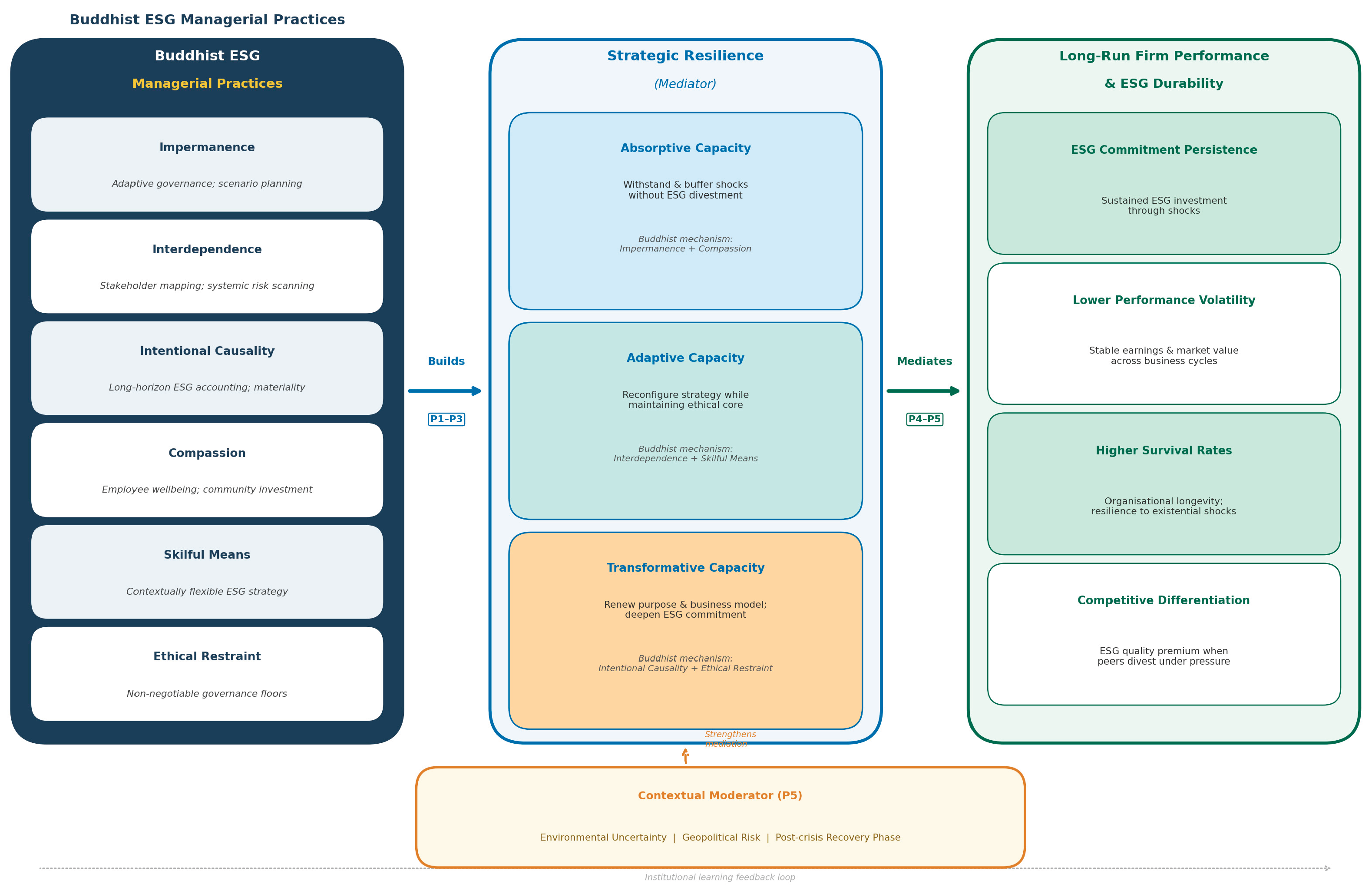

Table 1.
Positioning the BREM Relative to Prior Work in the Buddhist-ESG Research Programme.
| Dimension | Comparative Ethical Mapping Framework (CEMF) | Dharmic Governance | This Paper | Key Gap Addressed |
|---|---|---|---|---|
| Primary Focus | Ethical intention gap in ESG frameworks | Governance architecture for Buddhist ESG | Strategic resilience as mediating mechanism | Mechanism linking Buddhist governance to performance durability |
| Core Contribution | Comparative Ethical Mapping Framework (CEMF) | Four-dimensional Dharmic Governance Framework | Buddhism-Resilience-ESG Mediation Model (BREM) | Explains HOW Buddhist ESG governance sustains performance under uncertainty |
| Resilience Treatment | Not addressed | Mentioned as organisational benefit | Central construct; three-dimensional typology | Resilience as the strategic output of Buddhist governance design |
| Performance Paradox | Not addressed | Partially addressed through governance design | Resolved through resilience mediation logic | Altruism ≠ underperformance; resilience converts ethics to durability |
| Methodology | Conceptual; thematic review; CEMF construction | Conceptual; governance framework design; implementation logic | Conceptual; formal propositions; mediation model | Formal propositions enable empirical testing in future research |
| Empirical Grounding | Limited | Moderate (McKinsey data; neuroscience evidence) | Substantial (Fu et al.; Khurshid et al.; Ortiz-de-Mandojana & Bansal) | Propositions are directly testable with existing ESG and resilience datasets |
Note. CEMF = Comparative Ethical Mapping Framework (Author, 2025). BREM = Buddhism-Resilience-ESG Mediation Model (this paper). The three papers constitute a cumulative research programme: ethical diagnosis (Stage 1), governance design (Stage 2), and resilience mechanism (Stage 3).
Table 2.
Strategic Resilience Dimensions and Buddhist Mechanism Mapping.
| Resilience Dimension | Definition | Buddhist Mechanism | Supporting Evidence |
|---|---|---|---|
| Absorptive Capacity | Ability to withstand and buffer external shocks without fundamental disruption to ESG commitments | Impermanence + Compassion: Acceptance of impermanence prevents panic divestment; social capital from compassionate practice buffers shocks | Ortiz-de-Mandojana & Bansal (2016); Fu et al. (2024) |
| Adaptive Capacity | Ability to reconfigure strategy, governance, and stakeholder relationships in response to disruption | Interdependence + Skilful Means: Systemic awareness enables early detection; skilful means enables contextually flexible strategic response | Khurshid et al. (2026); Teece et al. (1997) |
| Transformative Capacity | Ability to renew organisational purpose and business model while maintaining and deepening ethical core | Intentional Causality + Ethical Restraint: Long-horizon accountability anchors purpose renewal; ethical restraint maintains non-negotiable governance floors | Hamel & Välikangas (2003); Välikangas & Merlyn (2005) |
Note. Buddhist Mechanism column uses English translations for accessibility. Pāli equivalents: Impermanence = anicca; Interdependence = paṭiccasamuppāda; Intentional Causality = cetanā/karma; Ethical Restraint = sīla; Compassion = mettā; Skilful Means = upāya. Resilience dimension definitions draw on Teece et al. (1997), Sutcliffe & Vogus (2003), and Colberg (2022). Buddhist mechanism mappings are derived from Payutto (1992), Harvey (2000), and Author (2025, 2026).
Table 3.
Buddhist Principles, Managerial Practices, and ESG Domains.
| Buddhist Principle (English) | Managerial Practice | ESG Domain | Mechanism |
|---|---|---|---|
| Impermanence (anicca) | Scenario planning; adaptive governance; acceptance of volatility as a governance constant | E: Climate risk management; G: Long-horizon KPIs | Normalises uncertainty as an inherent condition rather than an aberration, preventing panic-driven ESG divestment |
| Interdependence (paṭiccasamuppāda) | Stakeholder mapping; supply chain ethics; consequence-scanning protocols; systemic risk assessment | E: Ecosystem stewardship; S: Community engagement; G: Consequence assessment at board level | Embeds causal entanglement between firm choices and social-ecological outcomes into decision criteria, enabling early-warning detection |
| Intentional Causality (cetanā/karma) | Long-horizon ESG accounting; materiality assessment; ethical audit; consequences-before-approval gates | G: Accountability systems; S: Stakeholder protection; E: Environmental liability | Internalises long-run accountability across stakeholders and time horizons, resisting short-term pressure to divest ESG commitments |
| Compassion (mettā) | Employee wellbeing programmes; community investment; needs-first stakeholder engagement; fair supply chain standards | S: Workforce welfare; S: Community resilience; E: Local ecological protection | Builds relational social capital as an organisational buffer during crisis, enabling absorptive capacity through stakeholder loyalty |
| Skilful Means (upāya) | Contextually flexible ESG strategy; adaptive KPI recalibration; situation-sensitive governance responses | G: Disclosure architecture; E: Adaptive environmental strategy; S: Tailored stakeholder engagement | Enables responsive recalibration of ESG commitments to changing conditions without abandoning ethical core or strategic purpose |
| Ethical Restraint (sīla) | Board conduct codes; ethical decision gates; conflict-of-interest protocols; non-negotiable ESG floors | G: Governance integrity; S: Fair labour standards; E: Regulatory compliance and beyond-compliance commitments | Establishes identity-constitutive ethical floors that structurally prevent ESG collapse under financial or political pressure |
Note. ESG = Environmental, Social, and Governance. Columns use English translations for accessibility. Pāli equivalents: Impermanence = anicca; Interdependence = paṭiccasamuppāda; Intentional Causality = cetanā/karma; Compassion = mettā; Skilful Means = upāya; Ethical Restraint = sīla. Sources: Payutto (1992); Harvey (2000); Author (2025, 2026); Abeydeera et al. (2016); Van den Muyzenberg (2014); Song (2021).
Table 4.
Summary of Formal Propositions: The Buddhism-Resilience-ESG Mediation Model (BREM).
| Propotision | Resilience Dimension | Proposition | Theoretical Basis |
|---|---|---|---|
| P1 | Absorptive Capacity | Organisations that embed Buddhist ethical principles — particularly Impermanence and Compassion — into ESG governance exhibit higher absorptive capacity, enabling them to sustain ESG commitments through financial and geopolitical shocks without divestment. | Impermanence, Compassion; Ortiz-de-Mandojana & Bansal (2016); Bin-Feng et al. (2024) |
| P2 | Adaptive Capacity | Organisations whose ESG governance is anchored in Interdependence and Skilful Means demonstrate higher adaptive capacity, enabling strategic reconfiguration under uncertainty without abandoning ethical commitments. | Interdependence, Skilful Means; Teece et al. (1997); Khurshid et al. (2026); Shin & Park (2021) |
| P3 | Transformative Capacity | Buddhist-grounded Intentional Causality and Ethical Restraint build transformative capacity by anchoring long-horizon governance accountability that resists short-term pressure to downgrade ESG ambition. | Intentional Causality, Ethical Restraint; Hamel & Välikangas (2003); Välikangas & Merlyn (2005) |
| P4 | Full Mediation | Strategic resilience — as constituted by absorptive, adaptive, and transformative capacity — mediates the relationship between Buddhist ESG managerial practice and long-run firm performance, resolving the altruism-performance paradox. | Fu et al. (2024); Khurshid et al. (2026); Colberg (2022); Hepfer & Lawrence (2022) |
| P5 | Contextual Moderation | The mediating effect of strategic resilience is stronger in environments characterised by high environmental uncertainty, geopolitical risk, and post-crisis recovery phases than under conditions of market stability. | Bin-Feng et al. (2024); Hortovanyi & Szepesi (2026); Välikangas & Romme (2013) |
Note. BREM = Buddhism-Resilience-ESG Mediation Model. All propositions are theoretically derived and subject to empirical testing in future research. Key empirical anchors for each proposition are listed in the Theoretical Basis column.
Disclaimer/Publisher’s Note: The statements, opinions and data contained in all publications are solely those of the individual author(s) and contributor(s) and not of MDPI and/or the editor(s). MDPI and/or the editor(s) disclaim responsibility for any injury to people or property resulting from any ideas, methods, instructions or products referred to in the content. |
© 2026 by the author. Licensee MDPI, Basel, Switzerland. This article is an open access article distributed under the terms and conditions of the Creative Commons Attribution (CC BY) license.
Copyright: This open access article is published under a Creative Commons CC BY 4.0 license, which permit the free download, distribution, and reuse, provided that the author and preprint are cited in any reuse.


