
Submitted:
16 June 2026
Posted:
23 June 2026
You are already at the latest version
Abstract
Concentric (ring-shaped) structures expressed in surface morphology and in potential-field data are widespread at the junction of the Tien Shan orogen and the Fergana Depression in Eastern Uzbekistan, yet their deep architecture and origin remain debated. Here we integrate regional gravity, aeromagnetic, and deep seismic sounding (DSS) data with radially averaged power-spectrum depth analysis, three-dimensional (3D) inversion, and geographic information system (GIS) mapping to reconstruct the crustal distribution of density and magnetic susceptibility to depths of about 25 km, and to test whether these structures are rooted endogenic features or surficial landforms. The 3D inversion resolves concentric low-density cores (density contrasts of 150–350 kg/m³) and magnetic susceptibilities of (1–8) × 10⁻³ SI that are spatially coincident with inferred Palaeozoic–Mesozoic magmatic centres and with intersections of deep-seated faults of the Talas–Fergana system. DSS profiles place the Conrad and Mohorovičić (Moho) discontinuities at 15–25 km and 35–55 km, respectively, and show that the concentric features extend coherently into the lower crust. The absence of shock-metamorphic indicators, together with smooth radial gradients and deep fault-controlled roots, excludes an impact origin and supports a tectono-magmatic model of mantle upwelling, magmatic differentiation, and repeated post-collisional fault reactivation. The results refine the regional geodynamic model and inform seismic-hazard and mineral-prospectivity assessment in Central Asia.
Keywords:
deep crustal structure
; ring (concentric) structures
; gravity and magnetic anomalies
; 3D inversion
; deep seismic sounding
; Talas–Fergana Fault
; tectono-magmatic processes
; Tien Shan
; Eastern Uzbekistan
1. Introduction
Eastern Uzbekistan occupies a tectonically pivotal position at the junction of the Tien Shan orogenic belt and the northern margin of the Fergana Depression, within the broad intracontinental deformation zone generated by the ongoing convergence between the Indian and Eurasian plates [1]. Although it lies more than 1000 km north of the Himalayan front, the Tien Shan has absorbed a substantial fraction of this convergence through Cenozoic reactivation of inherited Palaeozoic structures, producing some of the highest intracontinental shortening rates and seismicity on Earth [2,3]. Space-geodetic measurements confirm that present-day shortening across the Tien Shan reaches roughly 20 mm yr⁻¹ and is strongly partitioned onto deep-seated fault systems [3,4], while geological and geomorphological studies document active thrusting and folding along the range margins [5].
The crustal framework on which this deformation is superimposed was assembled during the Palaeozoic amalgamation of the Central Asian Orogenic Belt (CAOB), one of the largest sites of juvenile continental growth in the Phanerozoic [6,7]. In the western Tien Shan this framework comprises Precambrian–Palaeozoic crystalline basement, Variscan granitoid batholiths, and intervening accretionary and volcanic complexes, all repeatedly dissected by long-lived fault zones. The most prominent of these, the dextral Talas–Fergana Fault (TFF), is among the largest active strike-slip faults in Central Asia and has accumulated tens of kilometres of right-lateral offset since the late Palaeozoic, with demonstrable Cenozoic reactivation [8,9]. The interplay between this inherited architecture and Cenozoic stress fields makes the Tien Shan–Fergana junction a natural laboratory for studying how deep lithospheric heterogeneities localize deformation and magmatism.
Among the most distinctive features of the region are concentric, ring-shaped structures expressed simultaneously in surface morphology, drainage patterns, and subsurface geophysical fields. Such structures occur at multiple scales across Central Asia and have long attracted attention because of their spatial association with magmatic centres and their demonstrated relevance to porphyry- and epithermal-style mineralization, including the world-class Cu–Au systems of the Chatkal–Kurama domain [10]. Ring structures are, however, genetically ambiguous: comparable surface expressions can result from intrusive doming, mantle upwelling, salt or shale diapirism, tectonic interference of fault sets, or meteorite impact. Discriminating among these origins therefore requires constraints on their depth extent and internal architecture rather than on surface form alone.
Previous investigations in Eastern Uzbekistan have largely relied on surface mapping or on individual geophysical datasets—most commonly gravity or aeromagnetic surveys—and have tended to treat concentric structures as isolated, near-surface features. As a result, their vertical continuity and their relationship to deep crustal and upper-mantle processes have remained poorly constrained, and the role of inherited magmatic domains and deep-penetrating faults in localizing and reactivating them has not been evaluated systematically. Modern regional studies of the Tien Shan crust based on receiver functions, gravity modelling, and joint inversion have substantially refined the geometry of the Conrad and Moho discontinuities and imaged pronounced crustal heterogeneity and segmentation [11,12,13,14,15], and recent work links this heterogeneity to mantle dynamics beneath Central Asia [16]. Yet these crustal-scale models have rarely been integrated with the local potential-field expression of concentric structures, leaving a gap between regional geodynamics and the kilometre-scale features observed at the surface.
The aim of this study is to provide an integrated, crust-scale geophysical characterization of the deep concentric structures of Eastern Uzbekistan and to clarify their origin and geodynamic significance. We combine regional gravity, aeromagnetic, and DSS data with radially averaged power-spectrum depth analysis, 3D inversion of density and magnetic susceptibility, and GIS-based integration to reconstruct crustal structure to depths of approximately 25 km. We test two competing hypotheses: (H1) the concentric structures are vertically coherent, deeply rooted features controlled by inherited magmatic domains and reactivated deep faults of the Talas–Fergana system; and (H2) they are shallow features—including the possibility of an impact origin—that lack deep structural roots. The results consistently support H1 and reject H2: the structures image as deeply rooted, fault-bounded, low-density and variably magnetized domains that extend into the lower crust, consistent with a tectono-magmatic origin within an active segment of the Central Asian plume–tectonic system. We further discuss the implications of these findings for seismic-hazard assessment and mineral prospectivity in the region.
2. Geological and Tectonic Setting
2.1. Regional Framework
The study area lies in the eastern part of the Fergana Valley, in the Namangan region of Eastern Uzbekistan, spanning the transition from the subsiding Fergana intermontane basin to the surrounding mountain belts. The Fergana Depression is a roughly triangular Cenozoic basin bounded by the Chatkal–Kurama Range to the northwest, the Fergana Range to the northeast and east, and the Alai and Turkestan ranges to the south and southwest. It is one of the most rapidly subsiding and seismically active intermontane basins of the Tien Shan, and its margins are defined by major reverse and strike-slip fault systems that root into the crystalline basement [8,9]. The principal structures examined here are located near the towns of Pap and Chartak, along the northeastern margin of the basin.
2.2. Basement and Cover
The crust of the region is a heterogeneous Palaeozoic assemblage. Precambrian to lower Palaeozoic metamorphic rocks and Variscan (Carboniferous–Permian) granitoid intrusions form the crystalline basement exposed in the Chatkal–Kurama and Fergana ranges, whereas the basin interior is filled by a Mesozoic–Cenozoic sedimentary succession that locally exceeds several kilometres in thickness. The strong density and magnetic-susceptibility contrasts between dense, magnetized basement and low-density sedimentary cover, and between felsic and mafic–intermediate intrusive bodies, provide favourable conditions for potential-field imaging of crustal heterogeneity.
2.3. Magmatism, Faulting, and Seismicity
The region has experienced repeated magmatic activity, and the Chatkal–Kurama domain hosts a major Late Palaeozoic magmatic arc and associated porphyry Cu–Au and epithermal mineralization that constitute one of the principal metallogenic provinces of the western Tien Shan [10]. Magmatism was strongly controlled by deep faults of predominantly NW–SE, NE–SW, and sub-latitudinal orientation; these faults extend through the basement and locally penetrate the entire crust, acting as conduits for melt ascent and as boundaries that partition seismicity. The dextral Talas–Fergana Fault and the marginal Fergana fault systems dominate the present-day stress field, and instrumental and historical seismicity—including damaging earthquakes along the basin margins—attests to ongoing reactivation of these structures [3,4].
2.4. Concentric Structures of the Study Area
Within this framework, several concentric and semi-concentric structures, with diameters ranging from a few kilometres to several tens of kilometres, are expressed in topography and in the gravity and magnetic fields. Their ring-like geometry, their persistence across independent datasets, and their spatial coincidence with fault intersections and inferred magmatic centres motivate the integrated analysis presented below (Figure 1).
3. Materials and Methods
3.1. Geophysical and Remote-Sensing Datasets
This study integrates four complementary datasets compiled from regional surveys carried out by national geological and geophysical agencies and from open global products (Table 1). Regional Bouguer gravity data, with an effective spatial resolution of approximately 2–5 km, were used to map lateral variations in crustal density. Aeromagnetic data, with a resolution of approximately 1–3 km, were used to identify magnetized bodies associated with intrusions and structural discontinuities. Deep seismic sounding profiles crossing the study area provided independent estimates of crustal thickness and of the depths of the Conrad and Mohorovičić (Moho) discontinuities. Digital elevation data (30–90 m) and satellite imagery supported the delineation of surface expressions of the concentric structures and provided topographic control for terrain corrections [17]. The regional Bouguer field was cross-checked against a global gravity-field model [18], and crustal-thickness priors were taken from regional and global crustal models [19,20]. All datasets were assembled in a common geographic reference frame within a GIS to enable joint interpretation.
3.2. Potential-Field Reduction and Separation
Gravity observations were reduced to the complete Bouguer anomaly following standard procedures [21,22]. The Bouguer anomaly was obtained as
ΔgB = gobs − γ0 + δgFA − δgBP + δgT , (1)
where gobs is the observed gravity, γ0 the theoretical (latitude) gravity, δgFA the free-air correction, δgBP the Bouguer-plate correction computed with a reduction density of 2670 kg/m³, and δgT the terrain correction derived from the DEM [17]. Aeromagnetic data were corrected for the International Geomagnetic Reference Field and reduced to the pole (RTP) to centre anomalies over their sources [22,23].
Regional and residual components were separated to isolate anomalies arising from crustal-scale sources. We combined low-order polynomial trend removal with upward continuation and wavelength filtering, so that long-wavelength regional fields associated with deep mantle and Moho topography were suppressed and the residual fields reflect mid- to upper-crustal heterogeneity. Source-edge and derivative transforms—including the horizontal gradient, the analytic-signal amplitude, and the tilt derivative—were applied to enhance structural boundaries and to map the geometry of concentric features [23,24].
3.3. Spectral Depth Estimation
Ensemble source depths were estimated from the radially averaged power spectrum of the gravity and magnetic fields [25]. For a statistical ensemble of sources, the logarithm of the radially averaged power spectrum P(k) decays approximately linearly with the radial wavenumber k, and the depth to the top of the source ensemble zt is obtained from the spectral slope:
zt = −(1/2) × d[ln P(k)] / dk , (2)
Distinct spectral segments were interpreted as shallow and deep source populations, allowing the separation of near-surface contributions from deep-seated crustal sources. Independent depth estimates were obtained from Euler deconvolution using structural indices appropriate for contact- and dyke-like sources [26], and the two methods were compared for consistency.
3.4. Three-Dimensional Inversion
Three-dimensional distributions of density contrast and magnetic susceptibility were reconstructed by regularized inversion of the residual gravity and magnetic fields to depths of approximately 25 km [27,28]. The subsurface was discretized into a mesh of rectangular prisms, and a model was sought that minimizes an objective function of the form
Φ = Φd + μ Φm , (3)
in which Φd measures the misfit between observed and predicted fields, Φm is a model-norm (smoothness and reference-model) term, and μ is a regularization parameter selected by the discrepancy principle. To reduce the inherent non-uniqueness of potential-field inversion, the inversions were constrained by the DSS-derived geometry of crustal discontinuities and by petrophysically reasonable bounds on density and susceptibility. Forward modelling along selected profiles was used to verify that the recovered models reproduce the observed anomalies.
3.5. Seismic Interpretation
DSS records were interpreted to pick the principal intracrustal and crust–mantle boundaries. Travel-time and wide-angle reflection/refraction phases were used to constrain the depth and lateral variation of the Conrad and Moho discontinuities, providing the structural skeleton against which the potential-field models were calibrated [11,12,14].
3.6. GIS-Based Integration and Software
All datasets, derived transforms, and inversion results were integrated and visualized within a GIS environment (Table 2). This enabled the spatial correlation of concentric structures with fault systems, inferred magmatic bodies, and geophysical anomalies, and the identification of vertically coherent features linking surface expressions to deep crustal heterogeneities. Potential-field processing, spectral analysis, and inversion were performed using [specify software package and version], and GIS integration and digital mapping were carried out in [specify GIS software and version].
4. Results
4.1. Gravity Field and Density Structure
The Bouguer gravity field of the study area is characterized by a complex pattern of positive and negative anomalies that reflect pronounced lateral and vertical variations in crustal density. The residual gravity map resolves a series of concentric and semi-concentric anomalies that are spatially associated with major fault intersections and with the margins of the Fergana Depression (Figure 2). These anomalies delineate alternating zones of contrasting crustal composition and thickness.
Three-dimensional inversion of the residual gravity field reveals concentric low-density cores, with density contrasts of approximately 150–350 kg/m³ (0.15–0.35 g/cm³) relative to the surrounding crust, surrounded by higher-density blocks interpreted as uplifted crystalline basement. The low-density cores are interpreted as relic magmatic domains and thermally and structurally modified crustal volumes. Critically, the concentric gravity pattern persists with depth in the inverted model, indicating that the structures are not superficial but are rooted at mid-crustal levels.
4.2. Magnetic Anomalies and Magnetization
The reduced-to-pole magnetic field displays pronounced positive and negative anomalies associated with intrusive complexes and deep-seated structural features. Concentric magnetic patterns are particularly well developed around the inferred Palaeozoic–Mesozoic magmatic centres, indicating heterogeneous magnetization of the crust (Figure 3). Quantitative interpretation yields magnetic susceptibilities of (1–8) × 10⁻³ SI, consistent with mafic to intermediate intrusive bodies and magnetized basement. The magnetic anomalies are spatially correlated with the mapped fault zones and their intersections, indicating structural control on magmatic emplacement. The coincidence of magnetic highs with gravity-derived low-density cores supports the interpretation of the concentric structures as zones of magmatic modification and repeated tectonic reactivation.
4.3. Spectral Depth Estimates
The radially averaged power spectra of the gravity and magnetic fields display two to three distinct linear segments, indicating multiple source populations. The steeper, low-wavenumber segments yield source-top depths consistent with mid- to lower-crustal sources, whereas the shallower, high-wavenumber segments correspond to near-surface sources within the sedimentary cover and uppermost basement. Euler-deconvolution solutions cluster along the mapped faults and around the magmatic centres and are consistent, within uncertainty, with the spectral depth estimates, supporting the interpretation that the concentric structures extend to depths of at least about 25 km.
4.4. Seismic Constraints on Crustal Architecture
Interpretation of the DSS profiles reveals significant lateral variation in crustal thickness and in the geometry of the principal discontinuities. The Conrad discontinuity lies at depths of approximately 15–25 km and the Moho at 35–55 km, with the greatest crustal thicknesses beneath the orogenic flanks and thinner crust beneath the basin. These variations define a strongly segmented crust whose boundaries coincide with the deep faults inferred from the potential-field data. The seismic sections indicate that the concentric structures are vertically coherent features that extend into the lower crust and that their geometry is governed by deep-penetrating faults linking surface expressions to deep crustal levels (Figure 4).
4.5. Integrated Crustal Model
Integration of the gravity, magnetic, and seismic results within the GIS framework yields a self-consistent crustal model in which the concentric structures appear as vertically extensive, fault-bounded domains of reduced density and variable magnetization, rooted beneath thinned granitic crust and underlain by elevated lower-crustal gradients. The principal quantitative parameters of the model are summarized in Table 3.
5. Discussion
5.1. Deeply Rooted, Fault-Controlled Structures
The integrated interpretation demonstrates that the concentric structures of Eastern Uzbekistan are deeply rooted lithospheric features rather than superficial morphological phenomena. Their persistent expression across gravity, magnetic, and seismic datasets indicates vertical coherence extending from the upper crust into the middle and lower crust, in agreement with regional images of pronounced crustal heterogeneity and segmentation beneath the Tien Shan [14,16]. The close spatial association of the structures with major fault intersections, inferred magmatic domains, and zones of strong density and susceptibility contrast indicates that their development is controlled by long-lived lithospheric weaknesses that have been repeatedly reactivated. Beneath the concentric zones, the reduction in granitic-layer thickness and the increased gradients in the deeper crust point to focused lithospheric modification and enhanced crust–mantle coupling, analogous to the sub-crustal modification imaged beneath other intracontinental magmatic provinces [29].
5.2. A Tectono-Magmatic Origin
These observations are best explained by a tectono-magmatic model in which mantle upwelling and magmatic differentiation produced dome-like crustal modification and concentric fault systems that evolved over geological timescales and were subsequently reactivated during post-collisional deformation. The inherited Palaeozoic architecture of the CAOB, with its abundant Variscan granitoids and deep faults [6,7], provided both the fertile magmatic substrate and the structural pathways required to localize and maintain such systems. The spatial coincidence of the concentric structures with the magmatic and metallogenic domains of the Chatkal–Kurama region [10] reinforces this interpretation and links the structures to the broader magmatic evolution of the western Tien Shan.
5.3. Exclusion of an Impact Origin
Although the surface morphology of some concentric structures may superficially resemble impact craters, the integrated geophysical evidence strongly excludes an extraterrestrial origin. Confirmed impact structures are diagnosed by shock-metamorphic features—planar deformation features in quartz, shatter cones, and high-pressure polymorphs—and by impact breccias and melt rocks, none of which are reported from the study area [31]. Geophysically, simple impact structures typically produce a central gravity low bounded by a rim, a broadly circular magnetic low reflecting demagnetization and limited-depth disturbance, and a structurally shallow disruption that does not extend coherently into the lower crust [30]. In contrast, the structures examined here exhibit smooth radial gravity and magnetic gradients, central low-density cores coincident with magnetic highs, and vertically extensive, fault-controlled roots reaching mid- to lower-crustal depths. This combination is incompatible with impact cratering and is instead diagnostic of endogenic, tectono-magmatic processes.
5.4. Regional Geodynamic Context
Comparable concentric structures documented within the Tien Shan orogen, Central Kazakhstan, and the Mongolian Plateau exhibit similar concentric anomaly patterns, density contrasts, and deep structural continuity, and have been interpreted as manifestations of mantle-driven processes superimposed on pre-existing lithospheric architecture. The similarities across Central Asia indicate that the structures of Eastern Uzbekistan are not isolated features but form part of a broader tectono-magmatic framework shaped by prolonged interaction between mantle dynamics and intracontinental deformation, inherited within the thermally and compositionally heterogeneous lithosphere of the region [32]. In this context, the concentric structures can be regarded as long-lived geodynamic markers recording the evolution of the lithosphere under combined plume-related and tectonic influences, consistent with the view that Eastern Uzbekistan constitutes an active segment of the Central Asian plume–tectonic system.
5.5. Implications for Seismic Hazard and Mineral Potential
The observed relationships between the concentric structures, crustal-thickness variations, and contemporary seismicity highlight their role as long-lived pathways for stress redistribution and magmatic ascent. Their spatial coincidence with deep fault intersections and with zones of elevated seismicity [3,4] underscores their relevance for seismic-hazard assessment, since such deep, vertically coherent fault systems can focus deformation and localize earthquakes. From an applied perspective, the refined crustal model improves constraints on the depth and geometry of major structural horizons, including the Conrad and Moho discontinuities. Moreover, the zones of enhanced density and magnetic susceptibility identified here are characteristic of magmatic-related mineralization and, given the metallogenic endowment of the adjacent Chatkal–Kurama domain [10], provide a geophysical basis for regional mineral exploration and geodynamic monitoring.
5.6. Limitations and Future Work
Several limitations should be acknowledged. Potential-field inversion is inherently non-unique, and although the use of seismic constraints and petrophysical bounds reduces this ambiguity, the absolute values of density and susceptibility and the precise geometry of deep sources remain model-dependent. The spatial resolution of the regional gravity and aeromagnetic data limits the detail with which small structures can be resolved at depth. Future work should incorporate magnetotelluric sounding to constrain the thermal and fluid state of the crust, local-earthquake and ambient-noise tomography to image the structures with independent seismic resolution, and targeted geochronology and geochemistry to test the proposed magmatic origin and the timing of reactivation. Full 3D joint inversion of multiple datasets would further reduce non-uniqueness and refine the model.
6. Conclusions
This study provides an integrated, crust-scale geophysical characterization of the deep concentric structures of Eastern Uzbekistan based on gravity, aeromagnetic, and deep seismic sounding data combined with spectral analysis, 3D inversion, and GIS-based mapping. The principal conclusions are as follows. (1) The concentric structures are not superficial morphological features but deeply rooted tectono-magmatic formations that extend into the middle and lower crust, to depths of approximately 25–30 km. (2) Their internal architecture is defined by concentric low-density cores (density contrasts of 150–350 kg/m³) and heterogeneous magnetization (susceptibility (1–8) × 10⁻³ SI), interpreted as relic magmatic domains surrounded by uplifted basement, with their geometry controlled by deep-penetrating faults of the Talas–Fergana system. (3) Deep seismic sounding confirms pronounced crustal segmentation, with the Conrad and Moho discontinuities at 15–25 km and 35–55 km, respectively, beneath the structures. (4) The absence of shock-metamorphic indicators, together with smooth radial gradients and deep fault-controlled roots, excludes an impact origin and supports a tectono-magmatic model of mantle upwelling, magmatic differentiation, and post-collisional reactivation, placing Eastern Uzbekistan within an active segment of the Central Asian plume–tectonic system. (5) The coincidence of the structures with deep faults, elevated seismicity, and magmatic-related petrophysical signatures makes them relevant targets for seismic-hazard assessment and mineral exploration. The integrated approach demonstrated here can be applied to other tectonically active regions of Central Asia with similar lithospheric architecture.
Author Contributions
Conceptualization, O.M.Y. and B.T.T.; methodology, O.M.Y. and B.F.A.; software, B.F.A.; validation, O.M.Y., B.T.T. and B.F.A.; formal analysis, O.M.Y. and B.F.A.; investigation, O.M.Y., B.T.T. and B.F.A.; data curation, B.T.T. and B.F.A.; writing—original draft preparation, O.M.Y.; writing—review and editing, N.U.D.; visualization, B.T.T.; supervision, B.T.T. All authors have read and agreed to the published version of the manuscript.
Funding
This research received no external funding.
Data Availability Statement
The gravity, aeromagnetic, and deep seismic sounding datasets analysed in this study were obtained from national geological and geophysical agencies and are subject to distribution restrictions. The processed grids and model outputs supporting the findings of this study are available from the corresponding author upon reasonable request. Publicly available datasets used in this study include the SRTM digital elevation model [17] and global gravity- and crustal-structure models [18,19,20].
Acknowledgments
The authors thank the national geological and geophysical agencies for access to the regional datasets, and the editors and anonymous reviewers for their constructive comments. [If generative AI tools were used, complete or delete the following per the journal’s policy:] During the preparation of this manuscript, the author(s) used [tool name and version] for the purposes of [e.g., language editing / figure drafting]; the authors have reviewed and edited the output and take full responsibility for the content of this publication.
Conflicts of Interest
The authors declare no conflicts of interest.
References
- Molnar, P.; Tapponnier, P. Cenozoic Tectonics of Asia: Effects of a Continental Collision. Science 1975, 189, 419–426. [Google Scholar] [CrossRef] [PubMed]
- Tapponnier, P.; Molnar, P. Active Faulting and Cenozoic Tectonics of the Tien Shan, Mongolia, and Baykal Regions. J. Geophys. Res. 1979, 84, 3425–3459. [Google Scholar] [CrossRef]
- Abdrakhmatov, K.Y.; Aldazhanov, S.A.; Hager, B.H.; Hamburger, M.W.; Herring, T.A.; Kalabaev, K.B.; Makarov, V.I.; Molnar, P.; Panasyuk, S.V.; Prilepin, M.T.; et al. Relatively Recent Construction of the Tien Shan Inferred from GPS Measurements of Present-Day Crustal Deformation Rates. Nature 1996, 384, 450–453. [Google Scholar] [CrossRef]
- Reigber, C.; Michel, G.W.; Galas, R.; Angermann, D.; Klotz, J.; Chen, J.Y.; Papschev, A.; Arslanov, R.; Tzurkov, V.E.; Ishanov, M.C. New Space Geodetic Constraints on the Distribution of Deformation in Central Asia. Earth Planet. Sci. Lett. 2001, 191, 157–165. [Google Scholar] [CrossRef]
- Avouac, J.-P.; Tapponnier, P.; Bai, M.; You, H.; Wang, G. Active Thrusting and Folding along the Northern Tien Shan and Late Cenozoic Rotation of the Tarim Relative to Dzungaria and Kazakhstan. J. Geophys. Res. 1993, 98, 6755–6804. [Google Scholar] [CrossRef]
- Şengör, A.M.C.; Natal’in, B.A.; Burtman, V.S. Evolution of the Altaid Tectonic Collage and Palaeozoic Crustal Growth in Eurasia. Nature 1993, 364, 299–307. [Google Scholar] [CrossRef]
- Windley, B.F.; Alexeiev, D.; Xiao, W.; Kröner, A.; Badarch, G. Tectonic Models for Accretion of the Central Asian Orogenic Belt. J. Geol. Soc. Lond. 2007, 164, 31–47. [Google Scholar] [CrossRef]
- Burtman, V.S.; Skobelev, S.F.; Molnar, P. Late Cenozoic Slip on the Talas–Ferghana Fault, the Tien Shan, Central Asia. Geol. Soc. Am. Bull. 1996, 108, 1004–1021. [Google Scholar]
- Burtman, V.S. Cenozoic Crustal Shortening between the Pamir and Tien Shan and a Reconstruction of the Pamir–Tien Shan Transition Zone for the Cretaceous and Palaeogene. Tectonophysics 2000, 319, 69–92. [Google Scholar] [CrossRef]
- Seltmann, R.; Porter, T.M.; Pirajno, F. Geodynamics and Metallogeny of the Central Eurasian Porphyry and Related Epithermal Mineral Systems: A Review. J. Asian Earth Sci. 2014, 79, 810–841. [Google Scholar] [CrossRef]
- Artemieva, I.M. The Lithosphere: An Interdisciplinary Approach; Cambridge University Press: Cambridge, UK, 2011. [Google Scholar]
- Almadani, S.A.; Abdelfattah, A.K.; Mohamed, A.K. Crustal Characteristics beneath the Tien Shan Belt, Central Asia, from Receiver Function Analysis. J. Asian Earth Sci. 2020, 198, 104371. [Google Scholar]
- An, S.; Zhao, L.; Nie, S. Crustal Structure of the Tian Shan Orogen and Its Adjacent Areas from Gravity Modeling. Tectonophysics 2023, 874, 229701. [Google Scholar]
- Kaviani, A.; Sandvol, E.; Moghadas, D.; Zhu, L. Generalization of the H–κ Stacking Method to Anisotropic Media. J. Geophys. Res. Solid Earth 2015, 120, 2053–2065. [Google Scholar]
- Li, Y.; Wang, C.-Y.; Shen, X. Active Crustal Deformation in the Tian Shan Region, Central Asia. Tectonophysics 2021, 812, 228919. [Google Scholar]
- Gao, Y.; Chen, Y.; Fang, H. Mantle Dynamics in Central Asia from Joint Inversion of Receiver Functions and Surface Waves. J. Geophys. Res. Solid Earth 2025, 130, e2024JB030061. [Google Scholar]
- Farr, T.G.; Rosen, P.A.; Caro, E.; Crippen, R.; Duren, R.; Hensley, S.; Kobrick, M.; Paller, M.; Rodriguez, E.; Roth, L.; et al. The Shuttle Radar Topography Mission. Rev. Geophys. 2007, 45, RG2004. [Google Scholar] [CrossRef]
- Pavlis, N.K.; Holmes, S.A.; Kenyon, S.C.; Factor, J.K. The Development and Evaluation of the Earth Gravitational Model 2008 (EGM2008). J. Geophys. Res. Solid Earth 2012, 117, B04406. [Google Scholar] [CrossRef]
- Bassin, C.; Laske, G.; Masters, G. The Current Limits of Resolution for Surface Wave Tomography in North America (CRUST2.0). Eos Trans. AGU 2000, 81, F897. [Google Scholar]
- Mooney, W.D.; Laske, G.; Masters, T.G. CRUST 5.1: A Global Crustal Model at 5° × 5°. J. Geophys. Res. Solid Earth 1998, 103, 727–747. [Google Scholar] [CrossRef]
- Blakely, R.J. Potential Theory in Gravity and Magnetic Applications; Cambridge University Press: Cambridge, UK, 1995. [Google Scholar]
- Telford, W.M.; Geldart, L.P.; Sheriff, R.E. Applied Geophysics, 2nd ed.; Cambridge University Press: Cambridge, UK, 1990. [Google Scholar]
- Nabighian, M.N.; Grauch, V.J.S.; Hansen, R.O.; LaFehr, T.R.; Li, Y.; Peirce, J.W.; Phillips, J.D.; Ruder, M.E. The Historical Development of the Magnetic Method in Exploration. Geophysics 2005, 70, 33ND–61ND. [Google Scholar] [CrossRef]
- Miller, H.G.; Singh, V. Potential Field Tilt—A New Concept for Location of Potential Field Sources. J. Appl. Geophys. 1994, 32, 213–217. [Google Scholar] [CrossRef]
- Spector, A.; Grant, F.S. Statistical Models for Interpreting Aeromagnetic Data. Geophysics 1970, 35, 293–302. [Google Scholar] [CrossRef]
- Reid, A.B.; Allsop, J.M.; Granser, H.; Millett, A.J.; Somerton, I.W. Magnetic Interpretation in Three Dimensions Using Euler Deconvolution. Geophysics 1990, 55, 80–91. [Google Scholar] [CrossRef]
- Li, Y.; Oldenburg, D.W. 3-D Inversion of Gravity Data. Geophysics 1998, 63, 109–119. [Google Scholar] [CrossRef]
- Li, Y.; Oldenburg, D.W. 3-D Inversion of Magnetic Data. Geophysics 1996, 61, 394–408. [Google Scholar] [CrossRef]
- Dueker, K.G.; Sheehan, A.F. Mantle Discontinuity Structure from Midpoint Stacks of Converted P to S Waves across the Yellowstone Hotspot Track. J. Geophys. Res. Solid Earth 1997, 102, 8313–8327. [Google Scholar] [CrossRef]
- Grieve, R.A.F.; Pilkington, M. The Signature of Terrestrial Impacts. AGSO J. Aust. Geol. Geophys. 1996, 16, 399–420. [Google Scholar]
- French, B.M.; Koeberl, C. The Convincing Identification of Terrestrial Meteorite Impact Structures: What Works, What Doesn’t, and Why. Earth-Sci. Rev. 2010, 98, 123–170. [Google Scholar]
- Artemieva, I.M. Lithosphere Structure in Europe from Thermal Isostasy. Earth Planet. Sci. Lett. 2019, 506, 179–195. [Google Scholar]
Figure 1.
Location and tectonic framework of the study area at the junction of the Tien Shan orogen and the northeastern Fergana Depression, Eastern Uzbekistan. Major fault systems (including the dextral Talas–Fergana Fault), surrounding mountain ranges (Chatkal–Kurama and Fergana ranges), the Fergana Depression, and the towns of Namangan, Pap and Chartak are indicated. Blue ellipses mark the surface expression of the concentric structures; the inset shows the location within Uzbekistan and Central Asia.
Figure 1.
Location and tectonic framework of the study area at the junction of the Tien Shan orogen and the northeastern Fergana Depression, Eastern Uzbekistan. Major fault systems (including the dextral Talas–Fergana Fault), surrounding mountain ranges (Chatkal–Kurama and Fergana ranges), the Fergana Depression, and the towns of Namangan, Pap and Chartak are indicated. Blue ellipses mark the surface expression of the concentric structures; the inset shows the location within Uzbekistan and Central Asia.
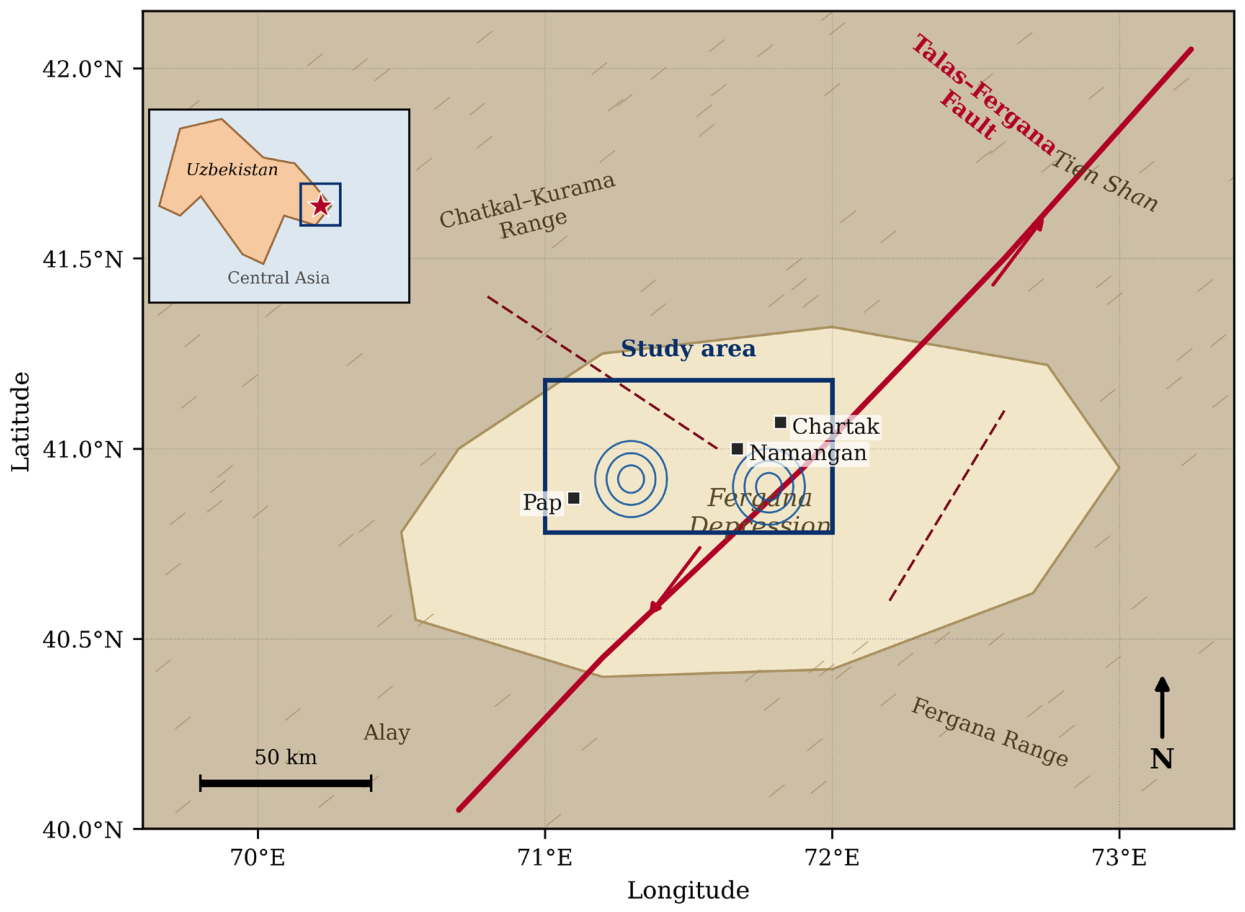
Figure 2.
(a) Residual Bouguer gravity anomaly of the study area, showing two concentric gravity lows centred on the inferred ring structures; the black line A–A′ marks the modelled profile and the red line the trace of the Talas–Fergana Fault (TFF). (b) Density-contrast model along profile A–A′ obtained by three-dimensional inversion, resolving low-density cores (negative density contrast, in kg/m³) rooted at mid-crustal depths of about 25 km.
Figure 2.
(a) Residual Bouguer gravity anomaly of the study area, showing two concentric gravity lows centred on the inferred ring structures; the black line A–A′ marks the modelled profile and the red line the trace of the Talas–Fergana Fault (TFF). (b) Density-contrast model along profile A–A′ obtained by three-dimensional inversion, resolving low-density cores (negative density contrast, in kg/m³) rooted at mid-crustal depths of about 25 km.
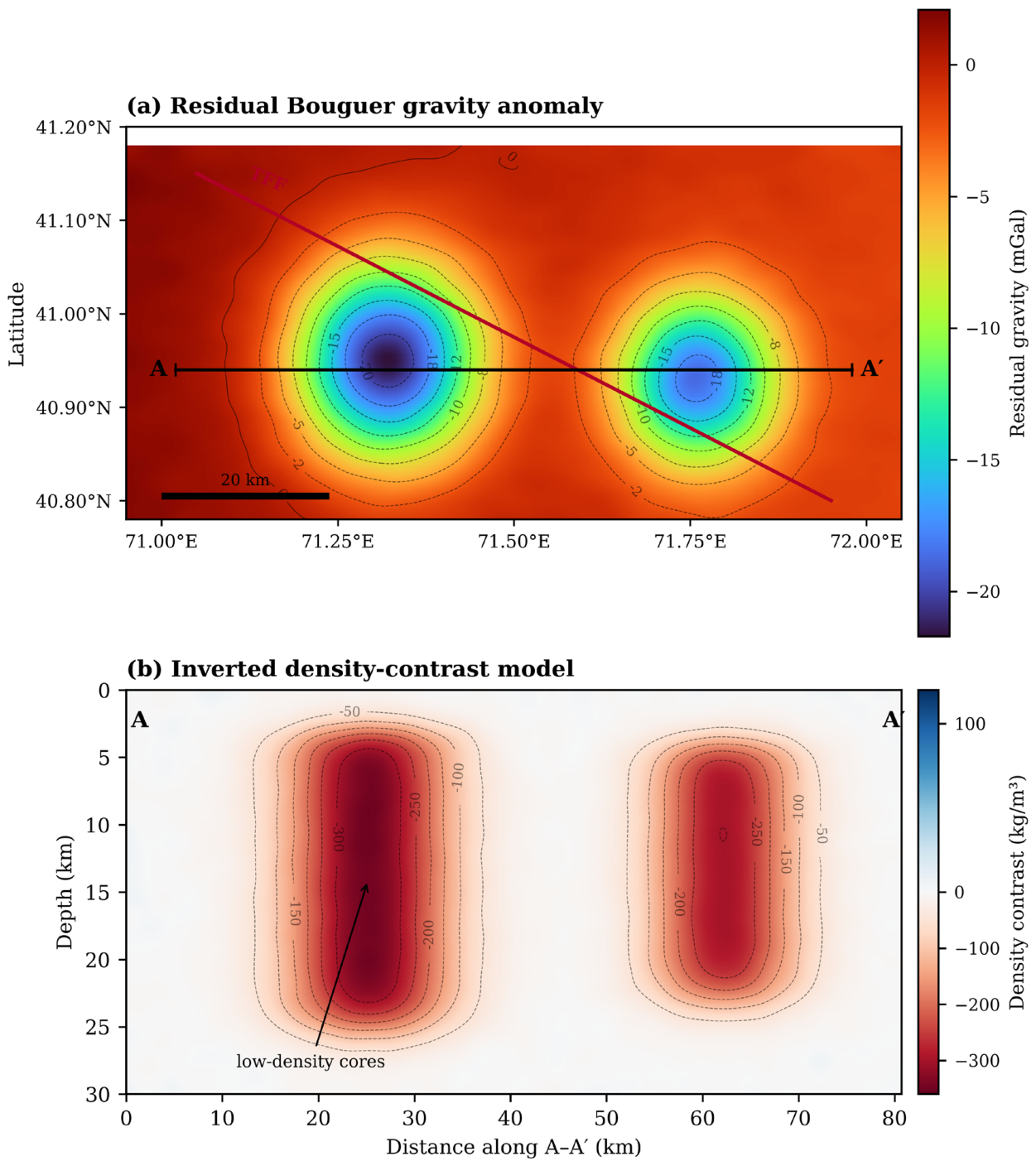
Figure 3.
(a) Reduced-to-pole aeromagnetic anomaly (ΔT, in nT) of the study area, showing concentric magnetic highs developed around the inferred magmatic centres, with the profile A–A′ and the Talas–Fergana Fault (TFF) indicated. (b) Magnetic-susceptibility model along profile A–A′ from three-dimensional inversion, with elevated susceptibility (in 10⁻³ SI) beneath the magmatic centres extending to about 20 km depth.
Figure 3.
(a) Reduced-to-pole aeromagnetic anomaly (ΔT, in nT) of the study area, showing concentric magnetic highs developed around the inferred magmatic centres, with the profile A–A′ and the Talas–Fergana Fault (TFF) indicated. (b) Magnetic-susceptibility model along profile A–A′ from three-dimensional inversion, with elevated susceptibility (in 10⁻³ SI) beneath the magmatic centres extending to about 20 km depth.
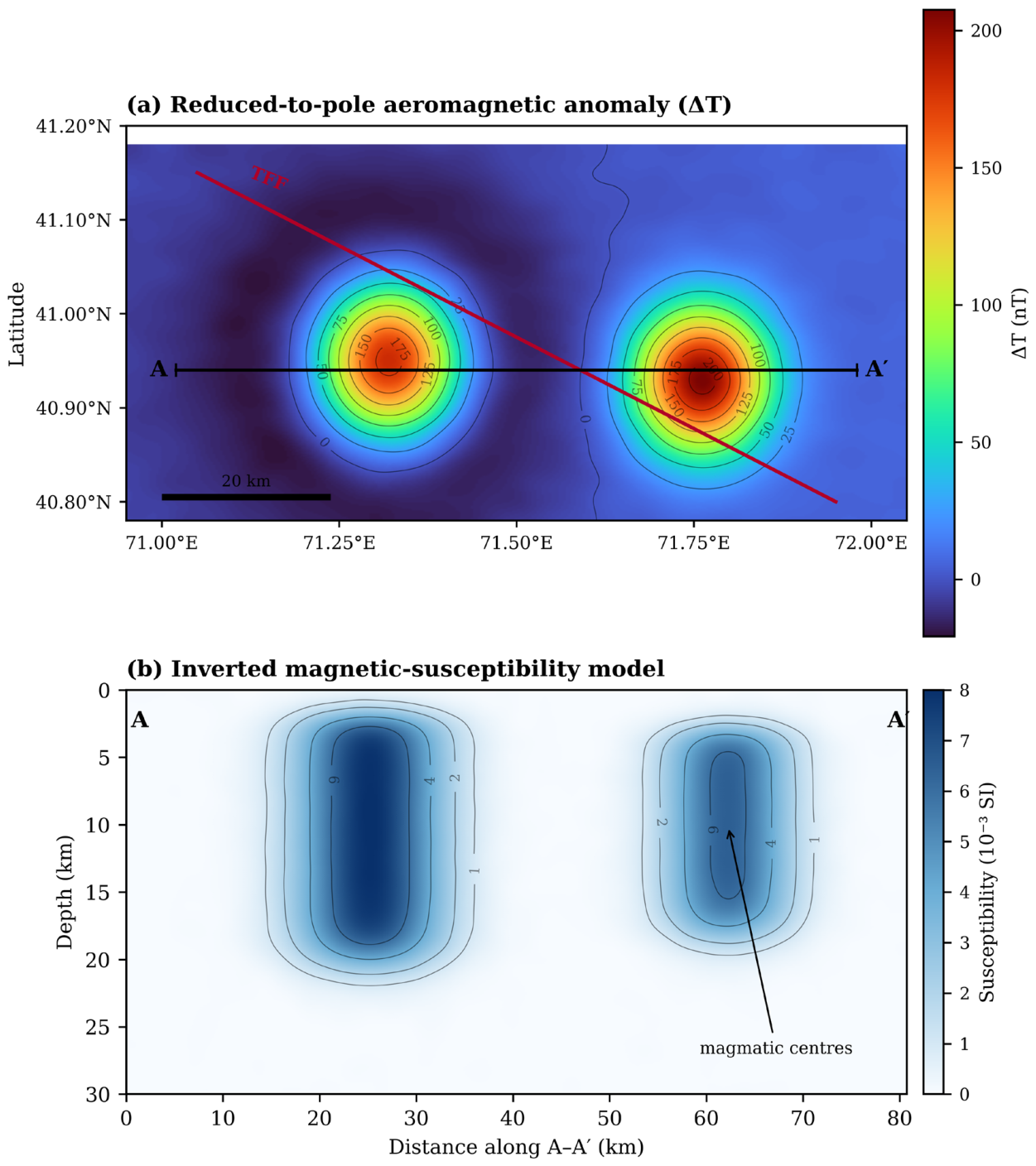
Figure 4.
Interpreted crustal architecture along profile A–A′, integrating deep seismic sounding and potential-field constraints. The Conrad (15–25 km) and Mohorovičić (Moho, 35–55 km) discontinuities are shown together with the deep, fault-controlled roots of the concentric structures, which extend from the near-surface to mid-crustal depths and are bounded by steep faults linked to the Talas–Fergana Fault system. Depths are in km.
Figure 4.
Interpreted crustal architecture along profile A–A′, integrating deep seismic sounding and potential-field constraints. The Conrad (15–25 km) and Mohorovičić (Moho, 35–55 km) discontinuities are shown together with the deep, fault-controlled roots of the concentric structures, which extend from the near-surface to mid-crustal depths and are bounded by steep faults linked to the Talas–Fergana Fault system. Depths are in km.
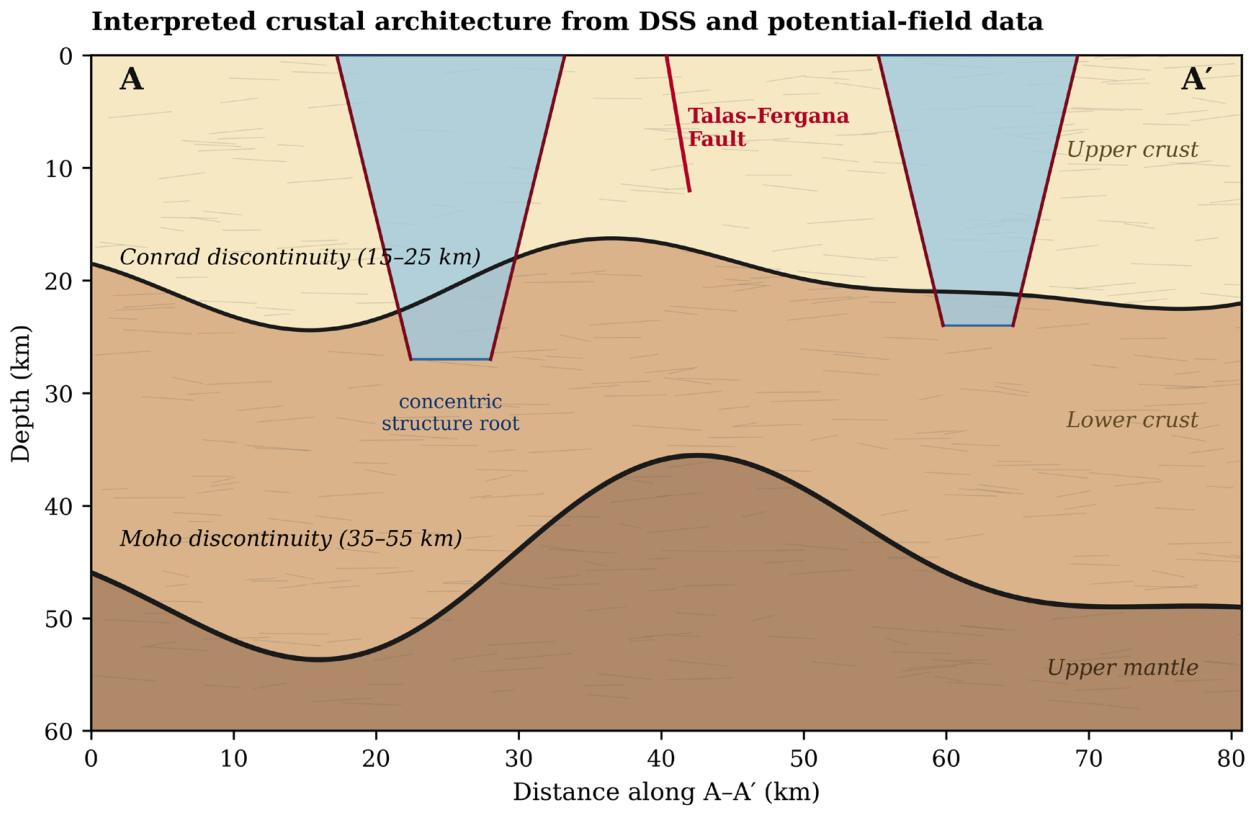

Table 1.
Summary of the geophysical and remote-sensing datasets used in this study. RTP, reduction to the pole; DEM, digital elevation model; SRTM, Shuttle Radar Topography Mission.
Table 1.
Summary of the geophysical and remote-sensing datasets used in this study. RTP, reduction to the pole; DEM, digital elevation model; SRTM, Shuttle Radar Topography Mission.
| Data type | Source / method | Spatial resolution | Purpose |
|---|---|---|---|
| Gravity | Regional gravimetric surveys; global model cross-check [18] | 2–5 km | Mapping crustal density heterogeneity |
| Magnetic | Aeromagnetic surveys (RTP) | 1–3 km | Mapping magnetized bodies and intrusions |
| Seismic | Deep seismic sounding (DSS) profiles | Profile-based | Conrad and Moho depths; crustal segmentation |
| Remote sensing | DEM (SRTM) and satellite imagery [17] | 30–90 m | Surface structure mapping; terrain correction |
Table 2.
Applied geophysical analysis methods and their objectives. DSS, deep seismic sounding.
| Method | Data used | Objective |
|---|---|---|
| 3D inversion | Gravity, magnetic | Reconstruction of density and susceptibility |
| Spectral analysis | Gravity, magnetic | Estimation of ensemble source depths |
| Euler deconvolution | Gravity, magnetic | Independent depth and edge estimation |
| Seismic interpretation | DSS profiles | Identification of crustal discontinuities |
| GIS-based mapping | Integrated datasets | Visualization and spatial analysis |
Table 3.
Key quantitative parameters of the crustal structure beneath the concentric structures in Eastern Uzbekistan.
Table 3.
Key quantitative parameters of the crustal structure beneath the concentric structures in Eastern Uzbekistan.
| Parameter | Value range |
|---|---|
| Crustal thickness (Moho depth) | 35–55 km |
| Depth to Conrad discontinuity | 15–25 km |
| Density contrast of concentric cores | 150–350 kg/m³ (0.15–0.35 g/cm³) |
| Magnetic susceptibility | (1–8) × 10⁻³ SI |
| Imaged depth extent of structures | ≈ 25–30 km |
Disclaimer/Publisher’s Note: The statements, opinions and data contained in all publications are solely those of the individual author(s) and contributor(s) and not of MDPI and/or the editor(s). MDPI and/or the editor(s) disclaim responsibility for any injury to people or property resulting from any ideas, methods, instructions or products referred to in the content. |
© 2026 by the authors. Licensee MDPI, Basel, Switzerland. This article is an open access article distributed under the terms and conditions of the Creative Commons Attribution (CC BY) license (http://creativecommons.org/licenses/by/4.0/).
Copyright: This open access article is published under a Creative Commons CC BY 4.0 license, which permit the free download, distribution, and reuse, provided that the author and preprint are cited in any reuse.


