

Submitted:
22 June 2026
Posted:
23 June 2026
You are already at the latest version
Abstract
Increasing evidence suggests that acquired dysfunction of the cystic fibrosis transmembrane conductance regulator (CFTR) Cl- channel occurs as a result of cigarette smoke exposure in Chronic obstructive pulmonary disease (COPD). CFTR-targeted therapies were developed for the treatment of genetic CFTR defects in cystic fibrosis, but they have not demonstrated consistent clinical efficacy in small trials of patients with COPD. Here, we aimed to characterise CFTR activity, other ion channels, and differentiation to cilia in primary bronchial epithelial cells (pBECs) from COPD donors, compare to healthy controls, and to determine the extent to which CFTR dysfunction can be rescued by clinically relevant CFTR modulators. Conditionally reprogrammed (CR) air-liquid interface (ALI) cultures of pBECs from healthy controls (n = 7) and COPD donors (n = 7) were comprehensively assessed for transepithelial electrical resistance, immunofluorescence, cilia activity, ion channel function and expression of cell markers at transcript level. COPD cultures exhibited reduced active area of ciliated cells, accompanied by significantly decreased forskolin/IBMX stimulated CFTR-mediated Cl- transport and ATP induced calcium activated chloride currents compared to healthy controls cultures, despite preserved CFTR mRNA expression. Treatment with CFTR potentiators (VX-770, GLPG1837 and Icenticaftor) resulted in modest and highly variable functional responses, with no statistically significant improvement compared with vehicle-treated control. Notably, CFTR function did not correlate with cumulative smoking exposure (pack-years), indicating that smoking burden alone does not predict the extent of acquired CFTR dysfunction. Collectively, these findings demonstrate that COPD airway epithelium exhibits intrinsic defects in ion transport and mucociliary differentiation consistent with acquired CFTR dysfunction phenotype but this is not readily reversible with the tested CFTR modulators. These results highlight fundamental differences between genetic and acquired CFTR dysfunction and underscore the need for alternative or combinatorial therapeutic strategies targeting epithelial dysfunction in COPD.
Keywords:
airway epithelium
; COPD
; CFTR
; air liquid interface
; icenticaftor
; ivacaftor
1. Introduction
Chronic obstructive pulmonary disease (COPD) is a progressive respiratory disorder, with more than two thirds of patients exhibiting chronic bronchitis, defined by a persistent productive cough for at least three months over two consecutive years. This phenotype is associated with accelerated lung function decline and increased exacerbation frequency (Kim et al., 2011; Seemungal et al., 2000). Pathologically, COPD with chronic bronchitis is characterised by persistent airway inflammation, with increased neutrophils, macrophages, and lymphocytes, alongside mucus hypersecretion, goblet cell hyperplasia, airway remodeling, and microbial colonization (Di Stefano et al., 1998; Hill et al., 2000; Simpson et al., 2016, 2013). More recently advanced CT imaging has shown that patients with COPD have airway occluding mucus plugs that are associated with worse symptoms, lung function and an increased risk of exacerbations (Lin et al., 2026). A subset of patients also develop bronchiectasis, reflecting more severe airway structural damage (Martinez-Garcia and Miravitlles, 2017).
These pathological features overlap with those observed in cystic fibrosis (CF), a genetic disease caused by mutations in the cystic fibrosis transmembrane conductance regulator (CFTR), an epithelial anion channel that conducts Cl- and HCO3-. CFTR plays a central role in regulating airway surface liquid (ASL) volume and composition, and its dysfunction leads to impaired mucociliary clearance, mucus stasis, chronic inflammation, and persistent infection, which are central features of chronic airway disease (Frizzell and Hanrahan, 2012). The development of CFTR modulators, including potentiators and correctors, has transformed CF care by partially restoring CFTR function, improving clinical outcomes (Rowe et al., 2014; Van Goor et al., 2011, 2009).
Consistent with this, there is increasing recognition that CFTR dysfunction may also contribute to non-CF airway diseases, including COPD. Cigarette smoke, the principal risk factor for COPD, has been shown to induce acquired CFTR dysfunction in individuals without CFTR mutations. Both in vitro and in vivo studies demonstrate that cigarette smoke reduces CFTR-mediated ion transport through multiple mechanisms, including channel internalization, altered gating, and reduced protein stability (Cantin et al., 2006; Clunes et al., 2012; Cohen et al., 2009; Courville et al., 2014; Dransfield et al., 2013; Kreindler et al., 2005; Raju et al., 2013; Sloane et al., 2012; Teerapuncharoen et al., 2019). This acquired dysfunction has been implicated in mucus dehydration and defective mucociliary clearance, and increased susceptibility to infection in COPD.
These observations have led to the hypothesis that restoring CFTR function could ameliorate key pathological features of COPD. However, while preclinical studies report improvements in ion transport and mucus properties following CFTR activation, clinical outcomes have been inconsistent (Kaza et al., 2022). Early pilot studies suggested that ivacaftor (VX-770), a CFTR potentiator that enhances channel gating, may augment CFTR activity and improve selected symptoms in COPD (Solomon et al., 2016), but larger trials have shown acceptable safety without significant improvement in lung function (Vijaykumar et al., 2025). Similarly, icenticaftor, another CFTR potentiator, has shown modest symptomatic benefit without consistent FEV1 improvement (Martinez et al., 2023). Collectively, these findings suggest that CFTR dysfunction in COPD is mechanistically distinct from CF and may not be fully corrected by current modulators.
A major limitation in the field is that most mechanistic studies on CFTR dysfunction in COPD rely on acute cigarette smoke extract (CSE) exposure models, which fail to recapitulate the chronic, heterogeneous, and patient-specific nature of the disease. Moreover, CFTR function has not been comprehensively characterised in patient-derived primary bronchial epithelial cells differentiated at air-liquid interface (ALI), where intrinsic disease phenotypes are preserved. As a result, it remains unclear whether CFTR dysfunction in COPD airway epithelium is driven by cumulative smoking exposures or reflects additional intrinsic, disease-specific mechanisms.
Here, we address this gap using conditionally reprogrammed primary bronchial epithelial cells (CRpBECs) derived from COPD donors and differentiated at ALI without exogenous smoke exposure. We hypothesized that if cigarette smoke is the dominant driver of acquired CFTR dysfunction, CFTR functional impairment would scale with cumulative smoking exposure. Conversely, a lack of such association would indicate the presence of intrinsic disease-specific defects.
In this study COPD-derived cultures exhibited impaired epithelial barrier integrity, defective mucociliary differentiation, and reduced CFTR and CaCC-mediated chloride transport despite preserved CFTR expression. Residual CFTR activity was detectable but showed only modest and heterogeneous response to CFTR potentiators. These findings provide a functional characterization of ion transport abnormalities in COPD airway epithelium and highlight the limited and variable responsiveness to current CFTR-targeted therapies.
2. Materials and Methods
Human pBECs procurement and processing
The study was performed in accordance with approvals from the Hunter New England Area Health Service Ethics Committee (05/08/10/3.09) and the University of Newcastle (Newcastle, NSW, Australia) Safety Committee (R5/2017). Human pBECs were obtained from healthy controls and COPD individuals (n = 7 donors for each group) by endobronchial brushing during fibre-optic bronchoscopy (Wark et al., 2005). COPD donors were stage II or III as defined by the Global Initiative for Obstructive Lung Disease (GOLD) guidelines (Gómez and Rodriguez-Roisin, 2002). Written informed consent was obtained from all study participants prior to the collection of samples. Patient-derived pBECs were expanded using standard BEGM media (BEGM;Lonza) and cryopreserved for later use.
NIH/3T3 feeder cell culture and irradiation
NIH/3T3 mouse embryonic fibroblast cells were cultured in DMEM (Sigma D5796) supplemented with 10% FBS and 1% (v/v) penicillin/streptomycin (Life Technologies, Australia). At 80-90% confluency, cells were trypsinized, resuspended in fresh culture media and subsequently exposed to 30 Gy γ-irradiation (RS 2000 X-Ray irradiator, RAD SOURCE). Irradiated NIH/3T3 cells were seeded into collagen I (PureCol; Advanced Biomatrix 5005) coated flasks at a 1:1 ratio with pBECs as previously described .
Conditional reprogramming (CR) cell expansion culture/co-culture
Cryopreserved pBECs were revived and expanded in BEGM media. To establish CRpBECs, Passage 1 pBECs were co-cultured with an equal amount of irradiated NIH/3T3 feeder cells in Collagen I-coated flasks in F-media containing ROCK inhibitor Y-27632 as described previously (Awatade et al., 2023). After reaching 50% confluency, cells were gradually weaned off Y-27632, and no Y-27632 added to culture media after 85% confluency (Awatade et al., 2023). Cells were differentially trypsinized using a Trypsin/EDTA reagent pack (Lonza). Cell count and cell viability were obtained using the trypan-blue method.
Air-liquid interface (ALI) cultures
CRpBECs were seeded on collagen I coated 24-well Transwell membranes (Sigma CLS3470) at a density of 1.5x10⁵ cells/insert and cultured in bronchial epithelial base medium and Dulbecco’s modified eagle medium BEBM:DMEM (50:50) differentiation media as described previously (Awatade et al., 2023). Apical media was removed once cells were confluent after 3-5 days to establish air-liquid interface culture conditions. Media in the basal compartment was changed every second day for 28 days. Phosphate-buffered saline (PBS, no Ca2+ and Mg2+) wash of the apical compartment was performed once a week at 37 °C to remove excess mucus.
Transepithelial electrical resistance (TEER) measurements
TEER measurements were performed at days 7, 14, 21 and 28 of ALI cultures using EVOM2 Voltohmmeter and STX2 electrodes (World Precision Instruments, Sarasota, USA). TEER values (expressed as Ω.cm2) were calculated by subtracting the values of the blank reference insert (no cells) and then corrected to the surface area of the inserts (0.33 cm2).
Transepithelial ion transport assay
Differentiated CRpBECs ALI cultures (28-30 days) were mounted in circulating Ussing chambers (Physiologic Instruments VCC MC8 multichannel voltage/current clamp). Short-circuit currents (Isc) were measured under voltage-clamp conditions, with at least three transwells analyzed per donor per condition. For Isc recordings, cells were bathed in 5ml of 37 °C Krebs-bicarbonate-Ringer containing (mM): 115 NaCl, 25 NaHCO3, 2.4 K2HPO4, 0.4 KH2PO4, 1.2 CaCl2, 1.2 MgCl2 and 10 glucose, pH 7.4, which was continuously gassed with 95% O2-5% CO2. After 15min of stable baseline Isc recording, cells were sequentially treated with pharmacological compounds: (1) 100µM amiloride (apical), (2) 5µM VX-770 or 5µM G1837 or 5µM Icenticaftor (apical), (3) 10µM forskolin and 100µM IBMX (apical and basal), (4) 30µM CFTRinh-172 (apical) and (5) 100µM ATP (apical). Data analyses were performed using Acquire and Analyze software (v2.3, Physiologic Instruments).
Cilia beating frequency and active area measurements
Live imaging of cilia beating in CRpBECs ALI cultures (frequency 3-20 Hz) was performed using a Nikon eclipse Ti2 microscope (Nikon, Japan) connected to a high-speed digital video recorder and Video Savant 4.0 software. Images were captured at 300 frames per second (fps) and a minimum of 512 frames were acquired. Five fields of view were captured at random for each donor per insert. Data analysis for median cilia beat frequency were performed using the CiliaFA plugin (Smith et al., 2012) together with free open-source Fiji-ImageJ software (v1.53, Image J, US). Ciliary active area was calculated using the in-built ‘Stack difference’ analysis in Fiji-Image J software by highlighting areas of ciliary motion for each 512-frame file. Thresholding was then applied identically to all projected images and active areas measured. Results from each sample are the mean of 5 fields of view.
Whole-mount immunolabelling and fluorescent microscopy
CRpBECs ALI cultures were fixed in 4% paraformaldehyde for 15min followed by storage in PBS containing 50mM Glycine at 4 °C as previously described (Reid et al., 2020). Membranes were permeabilized with 0.1% v/v Triton-X 100, blocked with 10% v/v Goat serum in PBS and incubated with antibodies against acetylated tubulin (T7451, Sigma) and ZO-1 (33-9100, Invitrogen) overnight at 4 °C. After washing with PBS, membranes were incubated with anti-mouse Alexafluor 594 secondary antibody (8890, Cell signaling technology, USA). Membranes were mounted with Fluoromount-G containing DAPI (00-4959-52, Invitrogen, USA). A minimum of 3 images were captured per donor at random using Nikon Eclipse DS-Qi2 fitted with CoolLED box (pE-300). Images were then processed using ImageJ software (National Institute of Health, Bethesda, MD).
RNA extraction, cDNA synthesis, and quantitative PCR
Total RNA was extracted from CRpBECs ALI cultures lysed with RLT buffer containing β-mercaptoethnaol (QIAGEN). RNA was extracted using RNeasy Mini Kits (QIAGEN, Germany) according to manufacturer’s instructions. RNA quality and quantity were measured using a nano-drop 2000 spectrophotometer (Thermo Scientific). RNA (200ng) was reverse transcribed to cDNA using high-capacity cDNA reverse transcription kits (Thermo Scientific). qPCR was performed using a QuanStudio 6 as per manufacturer’s instructions using TaqMan gene expression assays (ThermoFisher Scientific, Australia) and normalized to the ribosomal RNA (18s) housekeeping gene (Table S1). Relative gene expression was calculated using the 2-ΔΔCt method (where Ct is the threshold cycle) as described previously (Hsu et al., 2017).
Statistical Analysis
Data are represented as dot plots with mean ± standard error of the mean (SEM) except for qPCR data which are represented with mean ± standard deviation (SD). For statistical analysis, unpaired t test, Mann Whitney t test, and paired Wilcoxon tests were used as appropriate. Correlation between smoking exposure (pack-years) and CFTR function (ΔIsc) was assessed using Pearson’s correlation coefficient (two-tailed), with 95% confidence intervals calculated using Fisher’s z-transformation. Statistical analysis was performed with GraphPad Prism software (v9.3.1, San Diego, CA). A p-value <0.05 was considered statistically significant.
3. Results
Donor characteristics define a clinically relevant COPD cohort enriched for chronic bronchitis phenotype
Clinical characteristics of healthy controls and COPD donors are summarized in Table 1. COPD donors were significantly older than healthy controls (70 ± 7.4 vs 54 ± 13.8 years, p = 0.026) and had a substantial cumulative smoking history (53.3 ± 38.9 pack-years), whereas controls were non-smokers. Consistent with moderate-to-severe airflow limitation, COPD donors exhibited markedly reduced lung function compared to controls, including FEV1 (% predicted: 44.3 ± 6.8 vs 90.1 ± 8.3, p = 0.0006), FVC (% predicted: 68.6 ± 14.0 vs 96.6 ± 11.1, p = 0.004), and FEV1/FVC ratio (51.8 ± 7.5 vs 73.2 ± 6.4, p = 0.001).
Symptom burden, assessed by the COPD Assessment Test (CAT), was elevated in COPD donors (total CAT: 15.9 ± 2.7), with prominent cough (CAT1: 2.43 ± 0.53) and sputum production (CAT2: 2.14 ± 0.89). Based on combined CAT1+CAT2 scores (>2), the majority of COPD donors were consistent with a chronic bronchitis phenotype. None of the COPD patients had bronchiectasis.
Together, these data establish a clinically well-characterised COPD cohort with features relevant to airway mucus dysfunction, providing a robust framework for interpreting epithelial functional phenotypes.
COPD airway epithelial cultures exhibit preserved differentiation but reduced barrier function
Primary CRpBECs from healthy controls and COPD donors formed well-differentiated, pseudostratified epithelium following 28 days of ALI culture. Both groups displayed appropriate epithelial organization and mucociliary differentiation, indicating successful culture establishment.
Epithelial barrier integrity assessed by TEER, displayed inter-individual variability in both groups. COPD cultures exhibited lower TEER values compared to healthy controls (308.9 ± 63.79 vs 506.8 ± 104.5 Ω.cm2), although this did not reach statistical significance (p = 0.137) (Figure 1A). The TEER values for healthy controls cultures ranged from 295 to 1094 Ω.cm2 while those in COPD donors ranged from 143.1 to 549.5 Ω.cm2.
Despite this reduction, tight junction organization remained intact, as demonstrated by comparable ZO-1 (tight junction protein) localisation between groups (Figure S1A). These findings indicate that while epithelial barrier function is modestly reduced in COPD cultures, overall structural integrity is preserved. Given that epithelial barrier integrity and differentiation are closely linked, we next assessed whether cellular composition was also altered in COPD cultures.
Lower abundance of multiciliated cells in COPD CRpBECs ALI cultures
We then examined whether the epithelial differentiation profiles were also altered. Cell markers were assessed by qPCR. No disparity was observed in the expression of the club cells marker (SCGB1A1) (Figure 1B). However, there was a trend towards lower expression of FOXJ1 (Figure 1C), a marker of ciliogenesis, SPDEF (Figure 1D), a marker of goblet cells and MUC5AC (Figure 1E) a marker of mucus secretory cells in COPD ALI cultures when compared to healthy controls cultures.
Notably, expression of the proinflammatory cytokine IL-6 was significantly increased in COPD cultures compared to controls (p = 0.009) (Figure 1F), indicating a heightened inflammatory state.
Immunofluorescence analysis further revealed a marked reduction in ciliated cell abundance in COPD cultures. While healthy control cultures exhibited evenly distributed ciliated cells, COPD cultures showed sparse and clustered ciliation (anti-acetylated tubulin, red, Figure 1G-H, Figure S2 A-C). Quantification confirmed an approximately 4-fold reduction in active ciliated area in COPD cultures (27.42 ± 4.85 vs 6.65 ± 1.86%; p = 0.0006) (Figure 1I).
Despite this reduction in ciliated cell abundance, ciliary beat frequency (CBF) was comparable between groups (COPD: 12.36 ± 1.48 Hz vs controls: 11.56 ± 1.08 Hz), with substantial inter-individual variability observed in both cohorts (Figure 1J).
Collectively, these findings demonstrate that COPD airway epithelium is characterised by altered cellular composition most notably reduced ciliation alongside increased inflammatory signaling, despite preserved overall differentiation. As epithelial differentiation state can directly influence ion transport activity, we next evaluated functional ion channel activity in these cultures.
COPD ALI cultures have impaired CFTR- and CaCC-mediated chloride channel transport
Transepithelial ion transport in healthy controls and COPD ALI cultures was assessed by measuring amiloride-inhibited sodium channel (ENaC) currents, forskolin (Fsk)/IBMX stimulated and CFTRinh-172-inhibited CFTR currents and ATP-induced calcium-activated chloride channel (CaCC) currents (Figure 2A-B). Some heterogeneity was observed in all ion channel measurements in both healthy controls and COPD cultures (Figure 2C-F). No difference in the inhibition of sodium channel (ENaC) currents by amiloride was observed between healthy controls and COPD cultures (ΔIsc-Amiloride -7.67 ± 1.90 vs -7.78 ± 1.55 µA/cm2, respectively, p = 0.966) (Figure 2A-C), indicating preserved sodium absorption.
CFTR-mediated Cl- secretion was assessed using cAMP agonist Fsk and phosphodiesterase inhibitor IBMX, followed by CFTR specific inhibitor CFTRInh-172. COPD cultures exhibited significantly impaired Fsk/IBMX-induced currents, approximately 2.5 times lower than healthy controls cultures (ΔIsc-Fsk/IBMX 6.64 ± 2.10 vs 16.55 ± 1.58 µA/cm2, p = 0.008, Figure 2A-B, D). A similar finding was observed in CFTR-inhibited currents, whereby COPD cultures displayed significantly lower CFTRinh-172 inhibited currents compared to healthy-control cultures (ΔIsc-CFTR-inh-172 -10.93 ± 1.48 vs -19.60 ± 1.94 µA/cm2, p = 0.008, Figure 2A-B, E).
In addition to CFTR dysfunction, ATP-induced calcium-activated chloride channel (CaCC) currents were also significantly reduced in COPD cultures, approximately 2-fold lower than healthy-control cultures (ΔIsc-ATP 1.24 ± 0.22 vs 2.43 ± 0.42 µA/cm2, p = 0.025, Figure 2A-B, F).
Importantly, CFTR mRNA expression did not differ between healthy controls and COPD cultures (Figure 2G), indicating that the observed defect is functional rather than transcriptional.
Together, these results demonstrate a coordinated impairment in epithelial chloride secretion in COPD airway epithelium, affecting both CFTR-dependent and alternative chloride transport pathways.
CFTR potentiators partially restore CFTR function in COPD airway epithelium with marked inter-donor variability
Given the presence of residual CFTR activity despite functional impairment, we next investigated whether pharmacological potentiation could restore CFTR function in COPD cultures. CFTR potentiators VX-770, GLPG1837, and Icenticaftor were tested in selected COPD donors representing high (D4 and D7) and low (D5 and D6) baseline CFTR activity.
All potentiators produced variable, donor-dependent increase in CFTR-mediated currents. Treatment with VX-770 in COPD donors 4, 5, and 7 induced modest improvement in CFTR restoration compared to DMSO (vehicle), ranging between 0.87 to 4.54 µA/cm2. However, this difference did not reach statistical significance (Figure 3 A, B, D, Supp Figure S3 A, B, D). Treatment with potentiator G1837 in COPD donors 5 and 7, increased Fsk/IBMX currents by 1.00 and 12.03 µA/cm2 respectively when compared to DMSO (Figure 3 B, D, Supp Figure S3 B, D). Treatment with Icenticaftor in donors 5, 6, and 7 increased CFTR currents compared to DMSO, ranging between 0.52 and 10.71 µA/cm2 (Figure 3 B, C, D, Supp Figure S3 B, C, D).
Overall, these findings indicate that while individual donors displayed evidence of improved CFTR function in response to one or more potentiators, the effects were modest, highly variable, and did not reach statistically significance across all samples regardless of baseline CFTR activity. This is consistent with the presence of residual functional CFTR at the epithelial surface, which serves as the foundation for potentiators action.
CFTR dysfunction is independent of cumulative smoking exposure
We next assessed whether cumulative cigarette exposure (pack-years) was associated with CFTR-mediated chloride transport in COPD donors. No correlation was observed between pack-years and CFTR function (Spearman r = 0.12, 95% CI -0.70 to 0.80, p = 0.80, Figure 4), indicating that smoking burden alone does not predict the extent of CFTR dysfunction. Notably, donors with high smoking exposure exhibited divergent CFTR activity, with some individuals demonstrating markedly impaired function (e.g., D2), while others retained relatively high CFTR activity (e.g., D7). These findings highlight substantial inter-donor variability and suggest that factors beyond smoking exposure contribute to CFTR dysfunction in COPD.
4. Discussion
COPD is characterised by airway mucus obstruction, chronic inflammation, and recurrent infection—features that overlap with CF and have led to increasing recognition of acquired CFTR dysfunction in COPD. While this has generated interest in repurposing CFTR-targeted therapies, most experimental models rely on exogenous CSE, which incompletely recapitulates disease complexity. Here, using CRpBECs differentiated at ALI, we demonstrate that COPD airway epithelium exhibits intrinsic abnormalities in epithelial differentiation, barrier integrity, and ion transport, including reduced CFTR and CaCC function, independent of acute smoke exposure.
Intrinsic epithelial dysfunction in COPD
Although COPD and healthy control cultures both formed a mucociliary epithelium, COPD-derived cultures exhibited reduced barrier integrity (lower TEER), decreased expression of key differentiation markers (FOXJ1, SPDEF, and MUC5AC), and a reduced abundance of multiciliated cells, consistent with previous reports (Aghapour et al., 2018; Carlier et al., 2021; Guo-Parke et al., 2022; Haswell et al., 2010; Park et al., 2021; Schamberger et al., 2015; Shaykhiev et al., 2011). Notably, these abnormalities were observed in the absence of acute exogenous smoke exposure, indicating that COPD airway epithelium retains intrinsic structural and functional defects. The reduction in multiciliated cells may further limit effective ion transport at the tissue level, linking epithelial differentiation state to functional CFTR capacity. Given that mature multiciliated cells serve as a major site of apical anion transport (Collin et al., 2021; Sears et al., 2015), their depletion is likely to reduce overall tissue-level CFTR function (Boucher, 2007) and contribute to impaired airway surface homeostasis.
Acquired CFTR dysfunction in COPD is independent of transcriptional and smoking burden
A central finding of this study is that CFTR-mediated chloride secretion is markedly reduced in COPD cultures despite preserved CFTR mRNA expression, supporting a post-transcriptional mechanism of dysfunction. This is consistent with prior human and animal studies (Tilley et al., 2016; Kaza et al., 2022) and aligns with established mechanisms of acquired CFTR dysfunction, including altered channel gating, internalisation, and reduced protein stability (Clunes et al., 2012; Marklew et al., 2019; Raju et al., 2017). Inflammatory processes may further contribute, as neutrophil-derived proteases have been shown to degrade CFTR in the COPD airway (Le Gars et al., 2013).
Importantly, we observed no correlation between cumulative smoking exposure (pack-years) and CFTR function, with individuals of similar smoking histories exhibiting markedly different levels of CFTR activity. This lack of association indicates that CFTR dysfunction in COPD is not a simple dose-dependent consequence of cigarette smoke exposure but instead reflects differential susceptibility and additional disease-specific mechanisms. Consistent with this, acquired CFTR dysfunction is not universal in COPD and some studies have shown it to be present in only a subset of individuals, including up to ~40% of smokers (Dransfield et al., 2022; Mall et al., 2023). Together, these findings support a model in which CFTR dysfunction arises from convergent environmental, inflammatory, and epithelial remodeling processes rather than smoking exposure alone.
Divergent regulation of epithelial ion channels in COPD
Beyond CFTR, we identified a reduction in calcium-activated chloride channel (CaCC) activity in COPD cultures, potentially reflecting impaired calcium signaling and altered expression of regulators such as ORAI3 (ORAI—Calcium release activated calcium modulator 3), as previously shown by (Petit et al., 2019). In contrast, ENaC activity was not significantly altered in COPD cultures, diverging from observation in CSE-based models (Cantin et al., 2006; Kreindler et al., 2005; Tyrrell et al., 2023). This discrepancy highlights important differences between acute exposure systems and patient-derived epithelial models and underscores the value of primary cell systems in capturing disease-relevant physiology.
Residual CFTR activity provides a rationale for therapeutic potentiation
Despite reduced function, COPD cultures retained substantial residual CFTR activity (~50–60% of healthy controls), indicating the presence of functional channels at the cell surface and providing a rationale for pharmacological potentiation. CFTR potentiators increase channel open probability and/or conductance (Van Goor et al., 2009), with the potential to improve airway hydration, mucociliary clearance, and host defence (Raju et al., 2017). Consistent with this, indirect CFTR activation has been implicated in the clinical efficacy of agents such as roflumilast (Lambert et al., 2014), suggesting that CFTR modulation may contribute to therapeutic benefit in COPD.
Limited and heterogenous responses to CFTR modulators
Despite this mechanistic rationale, CFTR potentiators (VX-770, GLPG1837, and icenticaftor) produced modest, highly variable, and non-significant improvements in CFTR function across COPD donors. The addition of highly effective triple therapy (elexacaftor/tezacaftor/ivacaftor) conferred no additional benefit. These heterogeneous responses provide a mechanistic explanation for the inconsistent outcomes observed in clinical trials, where ivacaftor and icenticaftor have shown limited or delayed efficacy (Martinez et al., 2023; Vijaykumar et al., 2025).
Several factors likely contribute to this limited responsiveness. First, CFTR dysfunction in COPD is likely to arise from multiple mechanisms. This may include a direct effect on the CFTR protein such as oxidative modification, altered gating, and proteolytic degradation, that may also be inherently less amenable to potentiator-based rescue. Second, reduced apical membrane CFTR density may limit the available substrate for pharmacological activation. Third, pharmacokinetic factors and suboptimal drug exposure in COPD populations may further constrain efficacy.
Mechanistic basis of variability and therapeutic resistance
The marked inter-donor variability observed in this study highlights the heterogeneity of COPD at the molecular level. Cigarette smoke–derived reactive species can induce oxidative and covalent modifications of CFTR, potentially altering channel conformation in ways that are not rescued by potentiators. In parallel, smoke-induced internalization and epithelial remodeling may reduce functional channel availability. These effects are likely compounded by distinct disease endotypes, which differentially influence CFTR dysfunction and drug responsiveness. Notably, tobacco smoke exposure itself may antagonize modulator efficacy, as suggested in CF populations (Baker et al., 2021). Collectively, these findings indicate that CFTR dysfunction in COPD is mechanistically diverse and unlikely to be corrected by a uniform therapeutic strategy.
Therapeutic implications and future directions
Taken together, our data suggest that CFTR potentiators alone are insufficient to restore acquired CFTR dysfunction in COPD. More effective approaches may require combination strategies incorporating CFTR correctors and or amplifiers, or emerging modalities such as CFTR mRNA delivery. Mechanistically informed patient stratification will be critical to identify individuals most likely to benefit from CFTR-targeted interventions.
Limitations
This study is limited by the relatively small donor cohort, which restricts statistical power and may not fully capture the heterogeneity of COPD. In addition, donor genotyping was not performed, preventing assessment of whether observed variability in CFTR function and therapeutic responsiveness is related to underlying genetic variation, including CFTR gene variants. Larger, well-characterised cohorts and in vivo validation studies will be required to confirm the clinical relevance of these findings.
5. Conclusions
In summary, COPD airway epithelial cultures exhibit intrinsic defects in epithelial differentiation, barrier integrity, and ion channel function, including acquired CFTR dysfunction and reduced CaCC activity. Although residual CFTR activity is preserved, pharmacological potentiation results in limited and heterogeneous functional improvement. These findings demonstrate that CFTR dysfunction in COPD is a multifactorial process not solely determined by smoking exposure and provide a mechanistic framework for the limited efficacy of current CFTR modulators. Stratified, mechanism-based therapeutic approaches will be required to achieve meaningful clinical benefit.
Supplementary Materials
The following supporting information can be downloaded at the website of this paper posted on Preprints.org.
Author Contributions
NTA, KFB, and PABW conceived and designed research, NTA and KFB performed experiments, NTA, ATR, PSP, KFB and PABW analyzed data; NTA, KFB, ATR, PSP, KN and PABW interpreted results of experiments, NTA and KFB prepared figures; NTA and KFB drafted manuscript; NTA, KFB, PSP, ATR, KN, and PABW edited and revised manuscript; NTA, KFB, PSP, ATR, KN and PABW approved final version of manuscript.
Funding
This work was funded by the John Hunter Hospital (JHH) Charitable Trust Grant Round 2023 to NTA, KFB, PSP and PABW and School of Medicine and Public Health (SMPH) pilot grant funding scheme (2024) to NTA and PSP.
Data Availability Statement
All data generated or analyzed during this study are included in the present article (and its Supplementary Information files).
Conflicts of Interest
None of the authors has any conflicts of interest, financial or otherwise, to disclose.
References
- Awatade, N.T.; Reid, A.T.; Nichol, K.S.; Budden, K.F.; Veerati, P.C.; Pathinayake, P.S.; Grainge, C.L.; Hansbro, P.M.; Wark, P.A.B. Comparison of commercially available differentiation media on cell morphology, function, and anti-viral responses in conditionally reprogrammed human bronchial epithelial cells. Sci. Rep. 2023, 13, 11200. [Google Scholar] [CrossRef] [PubMed]
- Baker, E.; Harris, W.T.; Rowe, S.M.; Rutland, S.B.; Oates, G.R. Tobacco smoke exposure limits the therapeutic benefit of tezacaftor/ivacaftor in pediatric patients with cystic fibrosis. J. Cyst. Fibros. 2021, 20, 612–617. [Google Scholar] [CrossRef] [PubMed]
- Boucher, R.C. Cystic fibrosis: a disease of vulnerability to airway surface dehydration. Trends Mol. Med. 2007, 13, 231–240. [Google Scholar] [CrossRef] [PubMed]
- Cantin, A.M.; Hanrahan, J.W.; Bilodeau, G.; Ellis, L.; Dupuis, A.; Liao, J.; Zielenski, J.; Durie, P. Cystic Fibrosis Transmembrane Conductance Regulator Function Is Suppressed in Cigarette Smokers. Am. J. Respir. Crit. Care Med. 2006, 173, 1139–1144. [Google Scholar] [CrossRef] [PubMed]
- Clunes, L.A.; Davies, C.M.; Coakley, R.D.; Aleksandrov, A.A.; Henderson, A.G.; Zeman, K.L.; Worthington, E.N.; Gentzsch, M.; Kreda, S.M.; Cholon, D.; Bennett, W.D.; Riordan, J.R.; Boucher, R.C.; Tarran, R. Cigarette smoke exposure induces CFTR internalization and insolubility, leading to airway surface liquid dehydration. FASEB J. 2012, 26, 533–545. [Google Scholar] [CrossRef] [PubMed]
- Cohen, N.A.; Zhang, S.; Sharp, D.B.; Tamashiro, E.; Chen, B.; Sorscher, E.J.; Woodworth, B.A. Cigarette smoke condensate inhibits transepithelial chloride transport and ciliary beat frequency. The Laryngoscope 2009, 119, 2269–2274. [Google Scholar] [CrossRef] [PubMed]
- Collin, A.M.; Lecocq, M.; Detry, B.; Carlier, F.M.; Bouzin, C.; De Sany, P.; Hoton, D.; Verleden, S.; Froidure, A.; Pilette, C.; Gohy, S. Loss of ciliated cells and altered airway epithelial integrity in cystic fibrosis. J. Cyst. Fibros. 2021, 20, e129–e139. [Google Scholar] [CrossRef] [PubMed]
- Courville, C.A.; Tidwell, S.; Liu, B.; Accurso, F.J.; Dransfield, M.T.; Rowe, S.M. Acquired defects in CFTR-dependent β-adrenergic sweat secretion in chronic obstructive pulmonary disease. Respir. Res. 2014, 15, 25. [Google Scholar] [CrossRef] [PubMed]
- Csanády, L.; Vergani, P.; Gadsby, D.C. Structure, Gating, and Regulation of the CFTR Anion Channel. Physiol. Rev. 2019, 99, 707–738. [Google Scholar] [CrossRef] [PubMed]
- Di Stefano, A.; Capelli, A.; Lusuardi, M.; Balbo, P.; Vecchio, C.; Maestrelli, P.; Mapp, C.E.; Fabbri, L.M.; Donner, C.F.; Saetta, M. Severity of Airflow Limitation Is Associated with Severity of Airway Inflammation in Smokers. Am. J. Respir. Crit. Care Med. 1998, 158, 1277–1285. [Google Scholar] [CrossRef] [PubMed]
- Dransfield, M.T.; Wilhelm, A.M.; Flanagan, B.; Courville, C.; Tidwell, S.L.; Raju, S.V.; Gaggar, A.; Steele, C.; Tang, L.P.; Liu, B.; Rowe, S.M. Acquired Cystic Fibrosis Transmembrane Conductance Regulator Dysfunction in the Lower Airways in COPD. Chest 2013, 144, 498–506. [Google Scholar] [CrossRef] [PubMed]
- Frizzell, R.A.; Hanrahan, J.W. Physiology of Epithelial Chloride and Fluid Secretion. Cold Spring Harb. Perspect. Med. 2012, 2, a009563–a009563. [Google Scholar] [CrossRef] [PubMed]
- Gómez, F.P.; Rodriguez-Roisin, R. Global Initiative for Chronic Obstructive Lung Disease (GOLD) guidelines for chronic obstructive pulmonary disease. Curr. Opin. Pulm. Med. 2002, 8, 81–86. [Google Scholar] [CrossRef] [PubMed]
- Hill, A.T.; Campbell, E.J.; Hill, S.L.; Bayley, D.L.; Stockley, R.A. Association between airway bacterial load and markers of airway inflammation in patients with stable chronic bronchitis. Am. J. Med. 2000, 109, 288–295. [Google Scholar] [CrossRef] [PubMed]
- Hsu, A.C.-Y.; Dua, K.; Starkey, M.R.; Haw, T.-J.; Nair, P.M.; Nichol, K.; Zammit, N.; Grey, S.T.; Baines, K.J.; Foster, P.S.; Hansbro, P.M.; Wark, P.A. MicroRNA-125a and -b inhibit A20 and MAVS to promote inflammation and impair antiviral response in COPD. JCI Insight 2017, 2, e90443. [Google Scholar] [CrossRef] [PubMed]
- Kim, V.; Han, M.K.; Vance, G.B.; Make, B.J.; Newell, J.D.; Hokanson, J.E.; Hersh, C.P.; Stinson, D.; Silverman, E.K.; Criner, G.J. The Chronic Bronchitic Phenotype of COPD. Chest 2011, 140, 626–633. [Google Scholar] [CrossRef] [PubMed]
- Kreindler, J.L.; Jackson, A.D.; Kemp, P.A.; Bridges, R.J.; Danahay, H. Inhibition of chloride secretion in human bronchial epithelial cells by cigarette smoke extract. Am. J. Physiol.-Lung Cell. Mol. Physiol. 2005, 288, L894–L902. [Google Scholar] [CrossRef] [PubMed]
- Lin, L.; Li, T.; Zhang, P.; Song, Q.; Liu, C.; Chen, J.; Zeng, Y.; Chen, Y.; Chen, S.; Chen, P. Airway mucus plugs in COPD clinical phenotypes and prognosis across stable and exacerbation states. Sci. Rep. 2026, 16, 8178. [Google Scholar] [CrossRef] [PubMed]
- Martinez, F.J.; Criner, G.J.; Gessner, C.; Jandl, M.; Scherbovsky, F.; Shinkai, M.; Siler, T.M.; Vogelmeier, C.F.; Voves, R.; Wedzicha, J.A.; Bartels, C.; Bottoli, I.; Byiers, S.; Cardenas, P.; Eckert, J.H.; Gutzwiller, F.S.; Knorr, B.; Kothari, M.; Parlikar, R.; Tanase, A.-M.; Franssen, F.M.E. Icenticaftor, a CFTR Potentiator, in COPD: A Multicenter, Parallel-Group, Double-Blind Clinical Trial. Am. J. Respir. Crit. Care Med. 2023, 208, 417–427. [Google Scholar] [CrossRef] [PubMed]
- Martinez-Garcia, M.A.; Miravitlles, M. Bronchiectasis in COPD patients: more than a comorbidity? Int. J. Chron. Obstruct. Pulmon. Dis. 2017, 12, 1401–1411. [Google Scholar] [CrossRef] [PubMed]
- Mejza, F.; Gnatiuc, L.; Buist, A.S.; Vollmer, W.M.; Lamprecht, B.; Obaseki, D.O.; Nastalek, P.; Nizankowska-Mogilnicka, E.; Burney, P.G.J. Prevalence and burden of chronic bronchitis symptoms: results from the BOLD study. Eur. Respir. J. 2017, 50, 1700621. [Google Scholar] [CrossRef] [PubMed]
- Petit, A.; Knabe, L.; Khelloufi, K.; Jory, M.; Gras, D.; Cabon, Y.; Begg, M.; Richard, S.; Massiera, G.; Chanez, P.; Vachier, I.; Bourdin, A. Bronchial Epithelial Calcium Metabolism Impairment in Smokers and Chronic Obstructive Pulmonary Disease. Decreased ORAI3 Signaling. Am. J. Respir. Cell Mol. Biol. 2019, 61, 501–511. [Google Scholar] [CrossRef] [PubMed]
- Raju, S.V.; Jackson, P.L.; Courville, C.A.; McNicholas, C.M.; Sloane, P.A.; Sabbatini, G.; Tidwell, S.; Tang, L.P.; Liu, B.; Fortenberry, J.A.; Jones, C.W.; Boydston, J.A.; Clancy, J.P.; Bowen, L.E.; Accurso, F.J.; Blalock, J.E.; Dransfield, M.T.; Rowe, S.M. Cigarette Smoke Induces Systemic Defects in Cystic Fibrosis Transmembrane Conductance Regulator Function. Am. J. Respir. Crit. Care Med. 2013, 188, 1321–1330. [Google Scholar] [CrossRef] [PubMed]
- Reid, A.T.; Nichol, K.S.; Chander Veerati, P.; Moheimani, F.; Kicic, A.; Stick, S.M.; Bartlett, N.W.; Grainge, C.L.; Wark, P.A.B.; Hansbro, P.M.; Knight, D.A. Blocking Notch3 Signaling Abolishes MUC5AC Production in Airway Epithelial Cells from Individuals with Asthma. Am. J. Respir. Cell Mol. Biol. 2020, 62, 513–523. [Google Scholar] [CrossRef] [PubMed]
- Rowe, S.M.; Heltshe, S.L.; Gonska, T.; Donaldson, S.H.; Borowitz, D.; Gelfond, D.; Sagel, S.D.; Khan, U.; Mayer-Hamblett, N.; Van Dalfsen, J.M.; Joseloff, E.; Ramsey, B.W. Clinical Mechanism of the Cystic Fibrosis Transmembrane Conductance Regulator Potentiator Ivacaftor in G551D-mediated Cystic Fibrosis. Am. J. Respir. Crit. Care Med. 2014, 190, 175–184. [Google Scholar] [CrossRef] [PubMed]
- Sears, P.R.; Yin, W.-N.; Ostrowski, L.E. Continuous mucociliary transport by primary human airway epithelial cells in vitro. Am. J. Physiol.-Lung Cell. Mol. Physiol. 2015, 309, L99–L108. [Google Scholar] [CrossRef] [PubMed]
- Seemungal, T.A.R.; Donaldson, G.C.; Bhowmik, A.; Jeffries, D.J.; Wedzicha, J.A. Time Course and Recovery of Exacerbations in Patients with Chronic Obstructive Pulmonary Disease. Am. J. Respir. Crit. Care Med. 2000, 161, 1608–1613. [Google Scholar] [CrossRef] [PubMed]
- Simpson, J.L.; Baines, K.J.; Horvat, J.C.; Essilfie, A.; Brown, A.C.; Tooze, M.; McDonald, V.M.; Gibson, P.G.; Hansbro, P.M. COPD is characterized by increased detection of Haemophilus influenzae, Streptococcus pneumoniae and a deficiency of Bacillus species. Respirology 2016, 21, 697–704. [Google Scholar] [CrossRef] [PubMed]
- Simpson, J.L.; McDonald, V.M.; Baines, K.J.; Oreo, K.M.; Wang, F.; Hansbro, P.M.; Gibson, P.G. Influence of Age, Past Smoking, and Disease Severity on TLR2, Neutrophilic Inflammation, and MMP-9 Levels in COPD. Mediat. Inflamm. 2013, 1–13. [Google Scholar] [CrossRef] [PubMed]
- Sloane, P.A.; Shastry, S.; Wilhelm, A.; Courville, C.; Tang, L.P.; Backer, K.; Levin, E.; Raju, S.V.; Li, Y.; Mazur, M.; Byan-Parker, S.; Grizzle, W.; Sorscher, E.J.; Dransfield, M.T.; Rowe, S.M. A Pharmacologic Approach to Acquired Cystic Fibrosis Transmembrane Conductance Regulator Dysfunction in Smoking Related Lung Disease. PLoS ONE 2012, 7, e39809. [Google Scholar] [CrossRef] [PubMed]
- Smith, C.M.; Djakow, J.; Free, R.C.; Djakow, P.; Lonnen, R.; Williams, G.; Pohunek, P.; Hirst, R.A.; Easton, A.J.; Andrew, P.W.; O’Callaghan, C. ciliaFA: a research tool for automated, high-throughput measurement of ciliary beat frequency using freely available software. Cilia 2012, 1, 14. [Google Scholar] [CrossRef] [PubMed]
- Solomon, G.M.; Hathorne, H.; Liu, B.; Raju, S.V.; Reeves, G.; Acosta, E.P.; Dransfield, M.T.; Rowe, S.M. Pilot evaluation of ivacaftor for chronic bronchitis. Lancet Respir. Med. 2016, 4, e32–e33. [Google Scholar] [CrossRef] [PubMed]
- Teerapuncharoen, K.; Wells, J.M.; Raju, S.V.; Raraigh, K.S.; Atalar Aksit, M.; Cutting, G.R.; Rasmussen, L.; Nath, P.H.; Bhatt, S.P.; Solomon, G.M.; Dransfield, M.T.; Rowe, S.M. Acquired Cystic Fibrosis Transmembrane Conductance Regulator Dysfunction and Radiographic Bronchiectasis in Current and Former Smokers: A Cross-Sectional Study. Ann. Am. Thorac. Soc. 2019, 16, 150–153. [Google Scholar] [CrossRef] [PubMed]
- Tyrrell, J.; Ghosh, A.; Manzo, N.D.; Randell, S.H.; Tarran, R. Evaluation of chronic cigarette smoke exposure in human bronchial epithelial cultures. J. Appl. Toxicol. 2023, 43, 862–873. [Google Scholar] [CrossRef] [PubMed]
- Van Goor, F.; Hadida, S.; Grootenhuis, P.D.J.; Burton, B.; Cao, D.; Neuberger, T.; Turnbull, A.; Singh, A.; Joubran, J.; Hazlewood, A.; Zhou, J.; McCartney, J.; Arumugam, V.; Decker, C.; Yang, J.; Young, C.; Olson, E.R.; Wine, J.J.; Frizzell, R.A.; Ashlock, M.; Negulescu, P. Rescue of CF airway epithelial cell function in vitro by a CFTR potentiator, VX-770. Proc. Natl. Acad. Sci. U. S. A. 2009, 106, 18825–18830. [Google Scholar] [CrossRef] [PubMed]
- Van Goor, F.; Hadida, S.; Grootenhuis, P.D.J.; Burton, B.; Stack, J.H.; Straley, K.S.; Decker, C.J.; Miller, M.; McCartney, J.; Olson, E.R.; Wine, J.J.; Frizzell, R.A.; Ashlock, M.; Negulescu, P.A. Correction of the F508del-CFTR protein processing defect in vitro by the investigational drug VX-809. Proc. Natl. Acad. Sci. 2011, 108, 18843–18848. [Google Scholar] [CrossRef] [PubMed]
- Vijaykumar, K.; Solomon, G.M.; Guimbellot, J.; Acosta, E.P.; Bhambhavni, P.G.; White, S.; Kim, H.; Raju, S.V.; Rasmussen, L.W.; Harris, N.; Liu, B.; Hathorne, H.; Rowe, S.M.; Dransfield, M.T. Ivacaftor for Chronic Obstructive Pulmonary Disease: Results from a Phase 2, Randomized Controlled Trial. Am. J. Respir. Crit. Care Med. 2025, 211, 823–831. [Google Scholar] [CrossRef] [PubMed]
- Wark, P.A.B.; Johnston, S.L.; Bucchieri, F.; Powell, R.; Puddicombe, S.; Laza-Stanca, V.; Holgate, S.T.; Davies, D.E. Asthmatic bronchial epithelial cells have a deficient innate immune response to infection with rhinovirus. J. Exp. Med. 2005, 201, 937–947. [Google Scholar] [CrossRef] [PubMed]
Figure 1.
Characterization of the differentiation profile of healthy controls and COPD CRpBECs ALI cultures. (A) Trans-epithelial electrical resistance (TEER, RTE) values of healthy controls (n=7) and COPD (n=7) ALI cultures. Each TEER data point represents an average of 10–15 transwells from each donor. Gene expression marker for (B) SCGB1A1, (C) FOXJ1, (D) SPDEF, (E) MUC5AC and (F) IL-6 is reported as [fold change (2^ddct)]. Representative images of (G) Healthy controls (Scale bar: 100 μm) and (H) COPD (Scale bar: 58 μm) immunofluorescence staining of ciliated cells (anti-acetylated α-tubulin, red) with DAPI (blue). (I) Active cilia area and (J) cilia beat frequency measurements in healthy controls and COPD ALI cultures. Five different fields of view were sampled per donor. Open circles represent healthy controls donors and filled squares with different colors represent different COPD donors. Data presented as mean ± SEM (Figure 1A, I and J) and mean ± SDM (Figure 1 B-F). Data were analyzed using Unpaired t test (A, I, J) or Mann Whitney t test (B, C, D, E, F), P < 0.05 was considered significant. COPD donors (D): D1: Black, D2: Blue, D3: Brown, D4: Green, D5: Orange, D6: Purple and D7: Red.
Figure 1.
Characterization of the differentiation profile of healthy controls and COPD CRpBECs ALI cultures. (A) Trans-epithelial electrical resistance (TEER, RTE) values of healthy controls (n=7) and COPD (n=7) ALI cultures. Each TEER data point represents an average of 10–15 transwells from each donor. Gene expression marker for (B) SCGB1A1, (C) FOXJ1, (D) SPDEF, (E) MUC5AC and (F) IL-6 is reported as [fold change (2^ddct)]. Representative images of (G) Healthy controls (Scale bar: 100 μm) and (H) COPD (Scale bar: 58 μm) immunofluorescence staining of ciliated cells (anti-acetylated α-tubulin, red) with DAPI (blue). (I) Active cilia area and (J) cilia beat frequency measurements in healthy controls and COPD ALI cultures. Five different fields of view were sampled per donor. Open circles represent healthy controls donors and filled squares with different colors represent different COPD donors. Data presented as mean ± SEM (Figure 1A, I and J) and mean ± SDM (Figure 1 B-F). Data were analyzed using Unpaired t test (A, I, J) or Mann Whitney t test (B, C, D, E, F), P < 0.05 was considered significant. COPD donors (D): D1: Black, D2: Blue, D3: Brown, D4: Green, D5: Orange, D6: Purple and D7: Red.
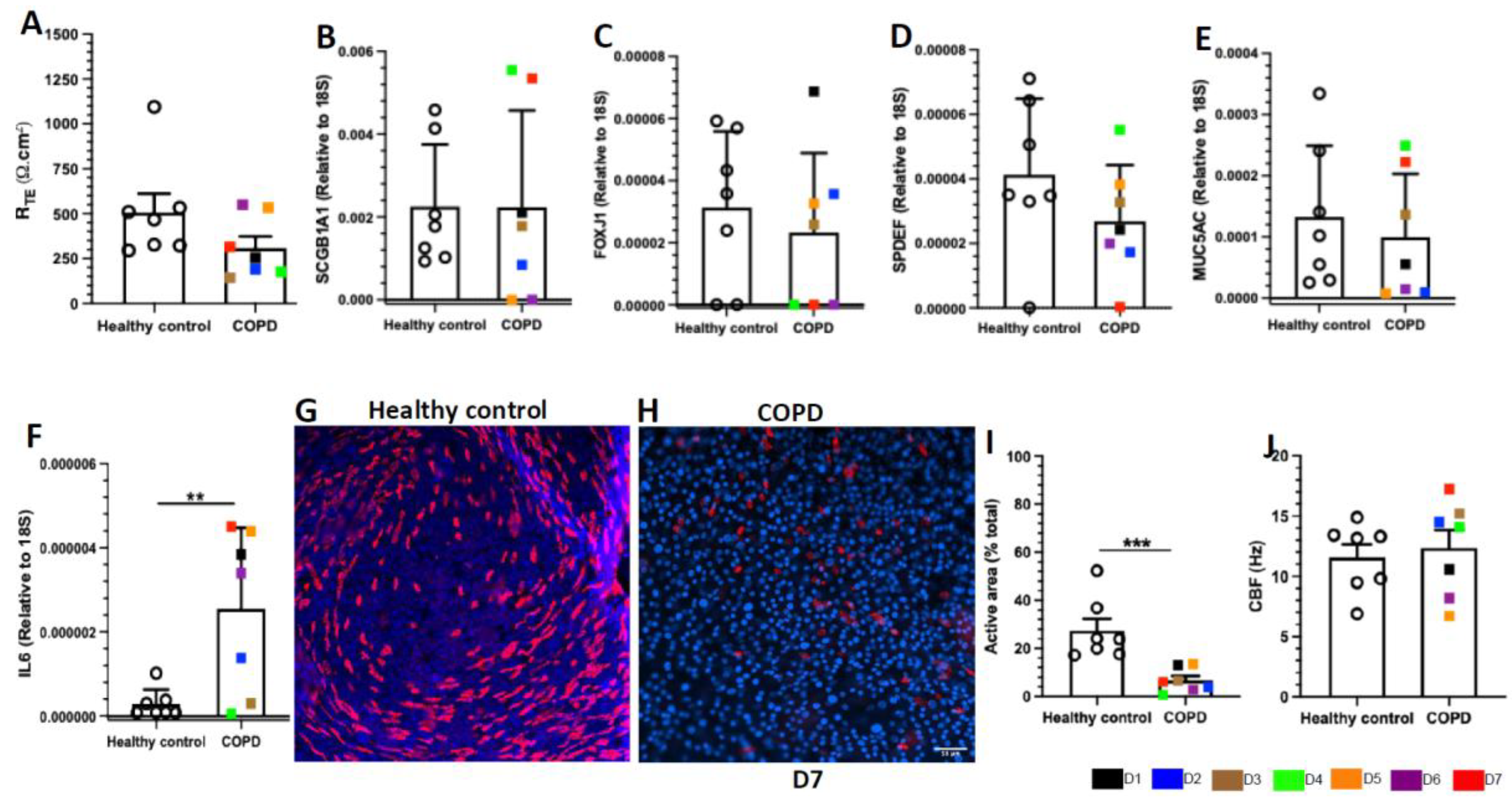
Figure 2.
Transepithelial ion transport measurements in healthy controls and COPD CRpBECs ALI cultures. Representative Ussing chamber short circuit current (Isc) tracings from (A) healthy controls (black line) and (B) COPD (dashed orange line), recorded at 37 °C. Mean values of, (C) Amiloride-sensitive ENaC currents, (D) Forskolin (Fsk) + IBMX activated CFTR currents, (E) CFTRinh-172 inhibited CFTR currents, (F) ATP-activated CaCC currents n = 6 for healthy controls and n = 7 for COPD donors, and (G) CFTR mRNA expression levels in healthy controls and COPD cultures. Data presented as mean ± SEM (Fig C-F) and mean ± SDM (Figure 1 G). Open circles represent healthy controls donors and filled squares with different colors represent different COPD donors. Data were analyzed using Unpaired t test, P < 0.05 was considered significant.
Figure 2.
Transepithelial ion transport measurements in healthy controls and COPD CRpBECs ALI cultures. Representative Ussing chamber short circuit current (Isc) tracings from (A) healthy controls (black line) and (B) COPD (dashed orange line), recorded at 37 °C. Mean values of, (C) Amiloride-sensitive ENaC currents, (D) Forskolin (Fsk) + IBMX activated CFTR currents, (E) CFTRinh-172 inhibited CFTR currents, (F) ATP-activated CaCC currents n = 6 for healthy controls and n = 7 for COPD donors, and (G) CFTR mRNA expression levels in healthy controls and COPD cultures. Data presented as mean ± SEM (Fig C-F) and mean ± SDM (Figure 1 G). Open circles represent healthy controls donors and filled squares with different colors represent different COPD donors. Data were analyzed using Unpaired t test, P < 0.05 was considered significant.
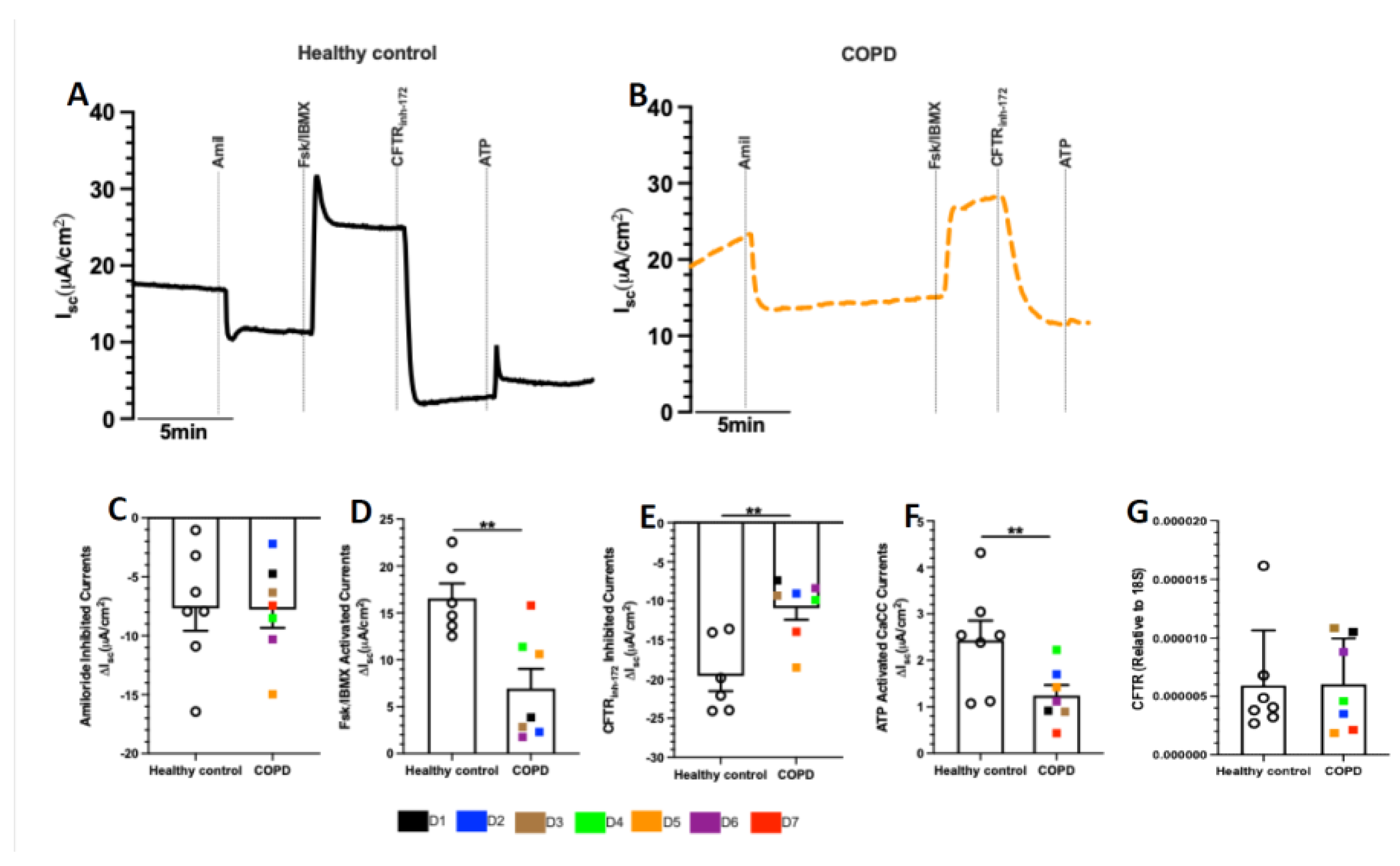
Figure 3.
CFTR functional response of COPD CRpBECs ALI cultures following treatment with CFTR potentiators VX-770, G1837 and Icenticaftor. Figure 3 A, B, C and D represent bar graph summary of the mean values of Forskolin/IBMX + respective potentiator activated currents. CFTR potentiator response was not tested in COPD donors 1 to 3 (baseline CFTR activity). Each closed circle represents a single transwell, and per patient per treatment 3-4 transwells were analysed. Data presented as mean ± SEM. Paired Wilcoxon test was used to determine statistical difference, P < 0.05 was considered significant.
Figure 3.
CFTR functional response of COPD CRpBECs ALI cultures following treatment with CFTR potentiators VX-770, G1837 and Icenticaftor. Figure 3 A, B, C and D represent bar graph summary of the mean values of Forskolin/IBMX + respective potentiator activated currents. CFTR potentiator response was not tested in COPD donors 1 to 3 (baseline CFTR activity). Each closed circle represents a single transwell, and per patient per treatment 3-4 transwells were analysed. Data presented as mean ± SEM. Paired Wilcoxon test was used to determine statistical difference, P < 0.05 was considered significant.
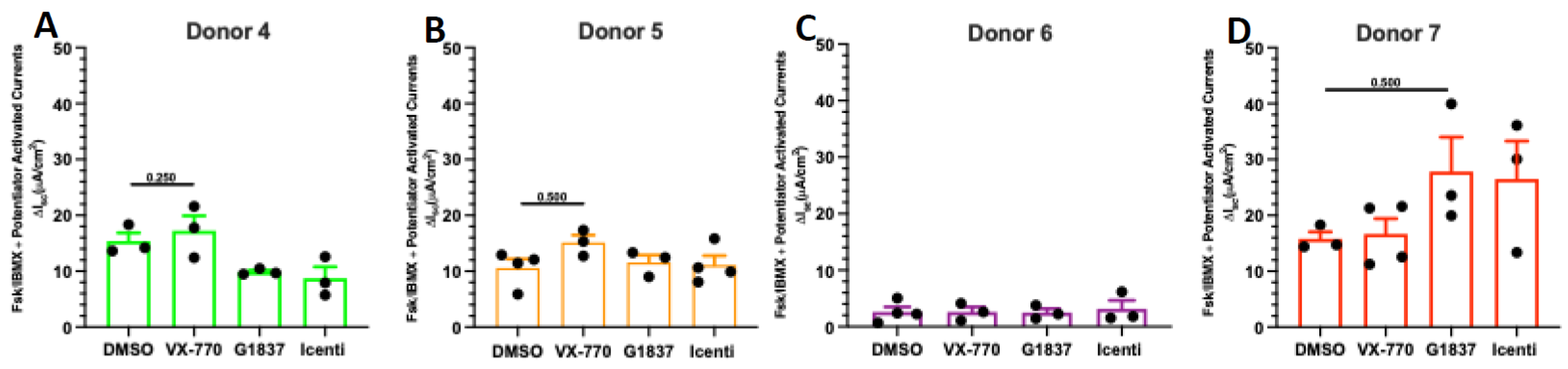
Figure 4.
Relationship between smoking exposure and CFTR-mediated ion transport in primary bronchial epithelial cultures. Scatter plot showing the relationship between cumulative smoking exposure (pack-years) and CFTR-dependent short-circuit current (ΔIsc, µA/cm2) across individual donors (n = 7). Each point represents a single donor. Statistical analysis (Pearson’s correlation, two-tailed) confirms no significant association (r = 0.12, 95% CI −0.70 to 0.80, p = 0.80).
Figure 4.
Relationship between smoking exposure and CFTR-mediated ion transport in primary bronchial epithelial cultures. Scatter plot showing the relationship between cumulative smoking exposure (pack-years) and CFTR-dependent short-circuit current (ΔIsc, µA/cm2) across individual donors (n = 7). Each point represents a single donor. Statistical analysis (Pearson’s correlation, two-tailed) confirms no significant association (r = 0.12, 95% CI −0.70 to 0.80, p = 0.80).
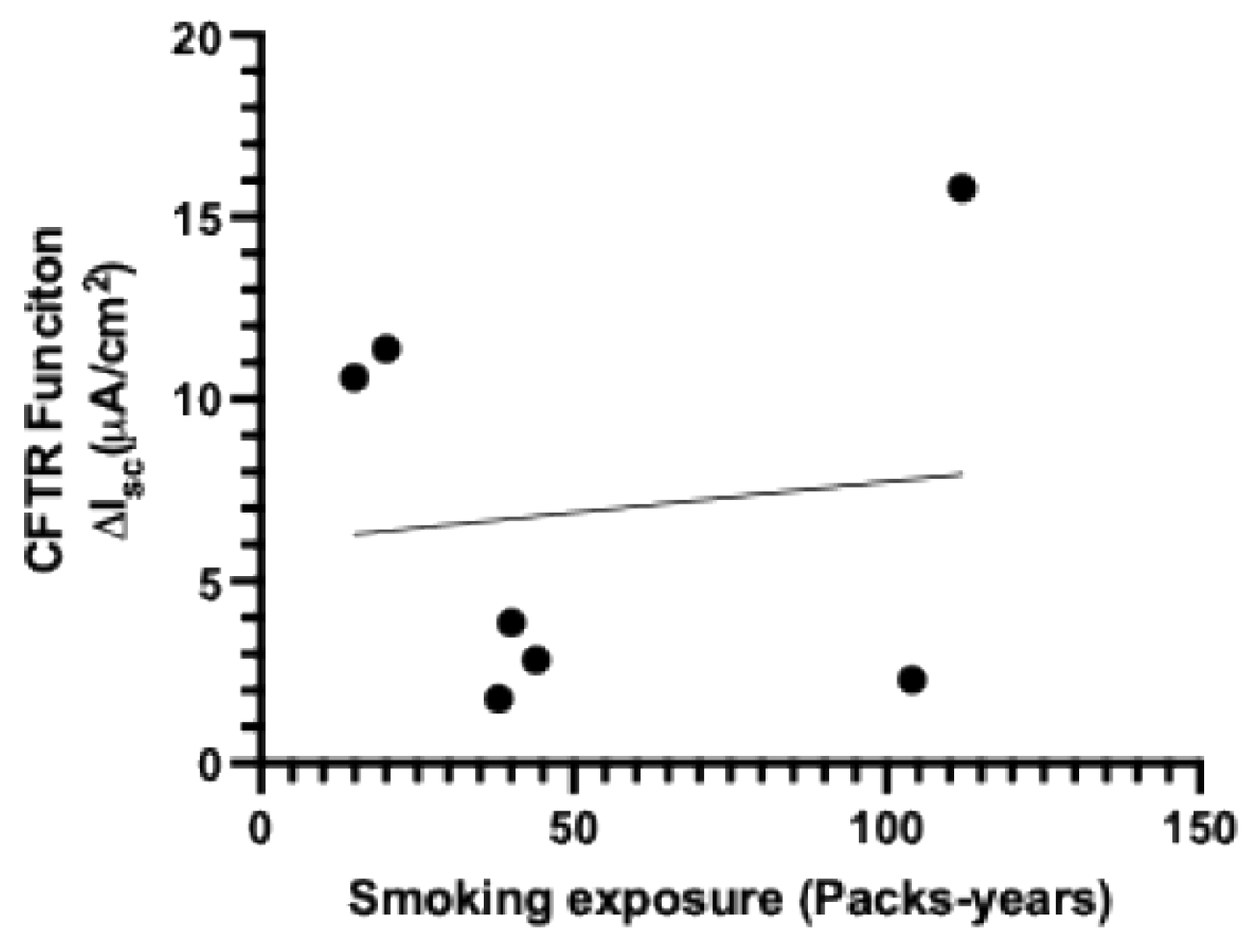

Table 1.
Clinical characteristics of healthy controls and COPD donors of primary broncho-epithelial cells.
Table 1.
Clinical characteristics of healthy controls and COPD donors of primary broncho-epithelial cells.
| Clinical Characteristics | Healthy controls | COPD | Difference, p Values |
|---|---|---|---|
| Number, n | 7 | 7 | - |
| Age, yr (SD) | 54 (13.80) | 70 (7.40) | 0.026 |
| Male, n (%) | 3(42) | 2 (33) | - |
| BMI (SD) | 29.76 (7.90) | 29.50 (6.85) | 0.904 |
| Cumulative smoking, pack-years, (SD) | 0 | 53.29 (38.92) | - |
| FEV1, % predicted (SD) | 90.14 (8.27) | 44.29 (6.75) | 0.0006 |
| FVC, % predicted (SD) | 96.57 (11.12) | 68.57 (14.01) | 0.004 |
| (FEV1/FVC) % (SD) | 73.15 (6.37) | 51.83 (7.54) | 0.001 |
| CAT 1 score (cough) (SD) | 0 | 2.43 (0.53) | - |
| CAT 2 score (sputum productions) (SD) | 0 | 2.14 (0.89) | - |
| CAT total (SD) | 0 | 15.86 (2.67) | - |
| Antibiotics# (SD) | 0 | 2.14 (1.34) | - |
| OCS# (SD) | 0 | 1.85 (1.57) | - |
Definition of abbreviations: yr: year, SD: standard deviation, FEV1: forced expiratory volume in 1 second, FVC: forced vital capacity, BMI: body mass index, CAT: COPD assessment test, OCS: Oral corticosteroids, #: number of courses in the previous 12 months.
Disclaimer/Publisher’s Note: The statements, opinions and data contained in all publications are solely those of the individual author(s) and contributor(s) and not of MDPI and/or the editor(s). MDPI and/or the editor(s) disclaim responsibility for any injury to people or property resulting from any ideas, methods, instructions or products referred to in the content. |
© 2026 by the authors. Licensee MDPI, Basel, Switzerland. This article is an open access article distributed under the terms and conditions of the Creative Commons Attribution (CC BY) license (http://creativecommons.org/licenses/by/4.0/).
Copyright: This open access article is published under a Creative Commons CC BY 4.0 license, which permit the free download, distribution, and reuse, provided that the author and preprint are cited in any reuse.


