

Submitted:
22 June 2026
Posted:
23 June 2026
You are already at the latest version
Abstract
The study of sacred discourse has attracted growing attention across linguistics, discourse studies, communication, rhetoric, theology, and religious studies. Although these disciplines have generated valuable insights into how sacred meanings are expressed, communicated, and interpreted, their contributions remain fragmented, limiting integration between linguistic, rhetorical, communicative, theological, and cognitive perspectives. This article proposes Sacred Discourse Studies (SDS) as an emerging interdisciplinary field dedicated to the systematic study of how sacred meanings are constructed, communicated, interpreted, negotiated, and transformed through discourse. Adopting a conceptual and integrative review approach, the article examines major traditions relevant to the study of sacred discourse, including language and religion, theolinguistics, discourse studies of religion, sacred rhetoric, communication theory, hermeneutics, and cognitive-semiotic approaches. The analysis identifies four recurring challenges: disciplinary fragmentation, the absence of an integrative framework, limited dialogue between scholarly traditions, and the growing complexity of sacred discourse in digital and computational environments. In response, the article develops a conceptual framework for SDS that brings together scriptural traditions, analytical domains, and emerging research frontiers. The framework encompasses Qur'anic, Prophetic, and Biblical forms of discourse while integrating stylistic, pragmatic, rhetorical, and semiotic approaches, alongside emerging areas such as computational methods, digital religion, and AI-assisted interpretation. The article argues that SDS provides a shared intellectual space for connecting previously separate traditions of inquiry and offers a foundation for a more coherent and comprehensive study of sacred discourse across disciplinary, scriptural, and technological boundaries.
Keywords:
Sacred Discourse Studies
; sacred discourse
; theolinguistics
; religious discourse
; AI-assisted interpretation
1. Introduction
Language lies at the heart of religious life. Sacred texts are revealed, preserved, interpreted, and transmitted through linguistic forms, while prayers, sermons, rituals, and theological writings depend upon discourse to communicate belief, cultivate devotion, and sustain communal identity. Yet religious language does more than convey information. It shapes how the sacred is understood, experienced, and authorised within particular communities and traditions. Pihlaja and Ringrow (2023) note that religious meaning is inseparable from the discursive processes through which it is articulated, interpreted, and circulated. This recognition has stimulated growing interest in the study of language and religion across linguistics, discourse studies, communication, rhetoric, theology, and religious studies.
The growing interest in sacred discourse has not produced a single field of study. Instead, it has generated several overlapping traditions of inquiry. Within linguistics, theolinguistics examines the relationship between language, religion, and theology, highlighting how linguistic structures shape religious understanding and identity (Kusherbayeva & Kurmanaliyeva, 2025; Gadomski et al., 2025). At the same time, discourse-oriented approaches have shifted attention from religious doctrines to the processes through which meanings, identities, and truth claims are constructed and legitimised, leading scholars to conceptualise religion as a discursive phenomenon (von Stuckrad, 2010; Hjelm, 2020). Related developments in communication and rhetoric have emphasised the persuasive, symbolic, and identity-forming functions of sacred discourse (Barbee & Sleasman, 2024), while historical studies point to a longstanding association between sacred discourse, authority, and interpretation, evident in classical conceptions of hieros logos (Tasseva, 2009).
Yet the growth of scholarship has not been accompanied by comparable theoretical integration. Different disciplines continue to approach sacred discourse through distinct conceptual lenses, emphasising language, identity, persuasion, or interpretation. Wijsen (2013) observes that discourse-oriented approaches remain insufficiently integrated into mainstream religious studies, limiting opportunities for dialogue across disciplinary traditions. Similar concerns are raised by Maingueneau (2021), who notes the fragmented character of research on religious discourse. As a result, scholarship on sacred discourse remains dispersed across disciplinary boundaries, making it difficult to explain how linguistic, rhetorical, communicative, theological, cognitive, and socio-cultural processes interact in the production of sacred meaning.
This article argues that these developments justify the emergence of Sacred Discourse Studies (SDS) as an interdisciplinary field dedicated to the systematic study of sacred meaning-making. Rather than replacing existing disciplines, SDS seeks to provide a common intellectual space within which their insights may be brought into dialogue. Its central concern is the study of how sacred meanings are constructed, communicated, interpreted, negotiated, and transformed through discourse across different traditions, contexts, and media environments. To develop this argument, the article addresses four questions:
- How has sacred discourse been conceptualised across different disciplines?
- What theoretical foundations underpin its study?
- What limitations in existing scholarship justify the emergence of SDS?
- What scope, structure, and future directions might define the field?
In answering these questions, the article makes three contributions. First, it synthesises dispersed scholarship on sacred discourse across multiple traditions of inquiry. Second, it conceptualises Sacred Discourse Studies (SDS) as an emerging interdisciplinary field and integrative framework. Third, it proposes a research architecture comprising scriptural subfields, analytical domains, and emerging computational frontiers. These contributions provide a foundation for organising and advancing future research on sacred discourse.
2. Sacred Discourse Across Disciplines
Sacred discourse has attracted scholarly attention across linguistics, discourse studies, communication, rhetoric, theology, and religious studies. Each discipline offers valuable insights into how sacred meanings are constructed, communicated, interpreted, and sustained, yet tends to emphasise particular dimensions of the phenomenon. Examining these perspectives is essential for understanding both the richness and fragmentation of existing scholarship and for establishing the foundations of Sacred Discourse Studies (SDS).
2.1. Linguistics and Language Studies
The relationship between language and religion has emerged as a significant area of interdisciplinary inquiry. Within this tradition, religious language is understood not only as a means of expressing theological doctrines but also as a linguistic phenomenon through which sacred meanings, beliefs, values, and identities are constructed and communicated. Research has examined sacred texts, ritual language, sermons, prayers, religious narratives, and everyday religious communication, demonstrating the central role of language in religious life. The growing field of Language and Religion has further expanded this agenda by bringing together perspectives from cognitive linguistics, sociolinguistics, pragmatics, discourse analysis, and conversation analysis to investigate how religious meanings are produced and negotiated across diverse communicative contexts (Pihlaja & Ringrow, 2023).
A more specialised development within this tradition is theolinguistics, an interdisciplinary field concerned with the relationship between language, religion, and theology. Kusherbayeva and Kurmanaliyeva (2025) argue that theolinguistic study seeks to explain how linguistic structures shape religious understanding, spiritual experience, and collective identity through the analysis of sacred texts and religious communication. Expanding this discussion, Gadomski et al. (2025) observe that the accumulation of linguistic studies on religious language has contributed to the emergence of theolinguistics as a distinct domain with its own theoretical concerns and methodological debates. These developments have broadened the study of sacred language beyond traditional philological approaches and strengthened the role of linguistics in the analysis of religious discourse.
The contribution of linguistics to the study of sacred discourse lies in its systematic analysis of language structure and meaning. Through tools for examining lexical choice, grammar, semantics, pragmatics, style, and discourse organisation, linguistic approaches reveal how sacred meanings are encoded and communicated within texts and religious practices. Their principal limitation, however, is a tendency to focus on language itself, often leaving broader questions of authority, interpretation, persuasion, and religious experience to other disciplines.
2.2. Discourse Studies
While linguistics primarily focuses on language structure and meaning, discourse studies extend the analysis to the ways meanings, identities, ideologies, and social realities are produced through communicative practices. Within this tradition, discourse is understood as a form of social action that both reflects and shapes cultural, political, and institutional processes. Consequently, discourse-oriented approaches have increasingly been applied to religion, providing new perspectives on how religious meanings are produced, negotiated, and legitimised within particular historical and social contexts (Hjelm, 2020).
A major development in this area is the Discursive Study of Religion, which conceptualises religion as an ongoing process of meaning-making rather than a fixed system of beliefs or doctrines. Von Stuckrad (2003, 2010) argues that religious identities, authorities, traditions, and truth claims are continuously constructed and negotiated through discourse. Similarly, discourse-analytic approaches, including Critical Discourse Analysis, have been employed to investigate sermons, religious media, institutional documents, scriptural interpretation, and public debates concerning religion. These studies demonstrate that religious discourse functions not only as a means of communication but also as a mechanism for constructing authority, shaping collective identities, and regulating social behaviour (Wijsen, 2013). Building on this tradition, Maingueneau (2021) highlights the distinctive features of religious discourse, including its unique forms of legitimacy, authority, and intertextuality.
Discourse studies extend the analysis beyond language to the social processes through which religious meanings are produced, circulated, and contested. By examining the construction of identity, authority, and ideology, discourse-oriented approaches illuminate how sacred meanings operate within particular historical and institutional contexts. Yet their emphasis on social and discursive processes can sometimes underplay theological concerns such as revelation, sacred authority, and doctrinal truth.
2.3. Communication and Rhetoric
Beyond linguistic structures and discursive processes, sacred discourse has also been examined from the perspectives of communication and rhetoric. These traditions focus on how religious messages are transmitted, interpreted, and received by audiences, emphasising the communicative and persuasive dimensions of religious language. Rather than viewing sacred texts and religious speech merely as repositories of doctrine, communication and rhetorical scholars investigate how they function as forms of symbolic action that shape beliefs, values, identities, and social relationships (Zulick, 2009).
A significant contribution to this area is the concept of sacred rhetoric, which explores the interaction between religion, discourse, and public life. Barbee and Sleasman (2024) define sacred rhetoric as a mode of communication through which religious meanings, identities, and cultural values are articulated and negotiated within both religious and public spheres. Historical scholarship similarly demonstrates that sacred discourse has long been associated with revelation, authority, and sacred knowledge. Tasseva (2009), for example, traces the notion of hieros logos in Greek antiquity and shows that sacred discourse was understood as a specialised form of communication linking human communities with transcendent realities. Complementing these perspectives, Burke's (1970) theory of symbolic action highlights how rhetoric creates identification, shared meanings, and persuasive influence through narratives, symbols, and collective values.
Communication and rhetorical approaches add another dimension by directing attention to audience reception, persuasion, symbolic action, and identity formation. From this perspective, sacred discourse functions as a form of communicative action that shapes communal belonging, moral commitments, and religious experience. Nevertheless, these approaches are generally more concerned with communicative effectiveness than with the linguistic structures or theological foundations that underlie sacred discourse.
2.4. Theology and Religious Studies
Whereas communication and rhetoric examine how sacred meanings are transmitted and received, theology and religious studies focus on questions of revelation, authority, and interpretation. Within theological traditions, sacred discourse is commonly understood as a form of divine communication through which religious truths, moral guidance, and theological doctrines are conveyed to humanity. Consequently, theological inquiry seeks to explain the meaning, authority, and implications of sacred texts within particular religious traditions.
A central concern within this tradition is hermeneutics, the study of interpretation. Gadamer (2004) argues that understanding is historically situated and shaped by the interpreter's horizon of meaning, while Ricoeur (1976) emphasises that texts generate a surplus of meaning that extends beyond their original contexts. Building on these insights, Thiselton (2009) demonstrates the importance of hermeneutics for interpreting sacred texts within changing historical and cultural circumstances. Together, these perspectives highlight the interpretive processes through which sacred discourse acquires meaning and relevance within religious communities.
These concerns are reflected in both Biblical and Qur'anic studies. Biblical scholarship has employed historical-critical methods, literary analysis, canonical interpretation, narrative criticism, and theological exegesis to investigate scriptural meaning. Similarly, Qur'anic scholarship has developed extensive traditions of tafsīr, linguistic analysis, balāghah, legal interpretation, and theological exegesis. Despite methodological differences, both traditions share a common concern with understanding how sacred discourse communicates divine intent and religious meaning. Religious studies broaden this perspective by examining sacred texts and religious discourse as cultural and social phenomena that shape beliefs, identities, institutions, and communal practices across different traditions.
The distinctive contribution of theology and religious studies lies in their attention to revelation, authority, interpretation, and religious meaning. These traditions explain how sacred discourse acquires normative significance within communities and how interpretive frameworks shape understandings of the sacred. Their focus, however, tends to privilege doctrinal and hermeneutical concerns, often engaging less directly with questions of language, discourse, rhetoric, and communication.

Table 1.
Major Disciplinary Approaches to Sacred Discourse.
| Discipline | Primary Focus | Key Contribution to SDS | Limitation |
| Linguistics | Language and meaning | Analysis of lexical, grammatical, semantic, pragmatic, and stylistic features | Limited theological and socio-cultural dimension |
| Discourse Studies | Meaning-making and social construction | Analysis of identity, authority, ideology, and power relations | Limited engagement with revelation and doctrinal meaning |
| Communication and Rhetoric | Communication and persuasion | Audience reception, symbolic action, persuasion, and identity formation | Limited linguistic and theological analysis |
| Theology | Revelation and doctrine | Sacred authority, interpretation, and religious truth claims | Limited discourse and communication analysis |
| Religious Studies | Religion as a cultural and social phenomenon | Comparative understanding of beliefs, rituals, identities, and institutions | Fragmented engagement with language and discourse |
These disciplinary traditions demonstrate that sacred discourse cannot be adequately understood through a single analytical lens. Linguistics explains how sacred meanings are encoded in language. Discourse studies examine how those meanings are socially constructed and negotiated. Communication and rhetoric investigate how they are transmitted, received, and embodied within communities. Theology and religious studies, meanwhile, explore their revelatory, interpretive, and doctrinal dimensions. Each tradition illuminates an important aspect of sacred discourse, yet each also leaves significant dimensions unexplored. The result is a fragmented body of scholarship characterised by parallel rather than integrated lines of inquiry. It is within this intellectual space that Sacred Discourse Studies (SDS) is proposed, not as a replacement for existing disciplines, but as a framework for bringing their complementary insights into systematic dialogue.
3. Theoretical Foundations of Sacred Discourse Studies
Sacred discourse cannot be adequately explained through a single theoretical lens. As demonstrated in the preceding discussion, different disciplines illuminate different dimensions of the phenomenon, including language, meaning, communication, persuasion, interpretation, cognition, and religious authority. The challenge for Sacred Discourse Studies (SDS) is therefore not the selection of a single explanatory theory but the integration of complementary theoretical traditions capable of accounting for the multidimensional nature of sacred discourse. This section identifies five major theoretical foundations that collectively underpin SDS: discourse theory, communication theory, rhetorical theory, theological-hermeneutical perspectives, and cognitive-semiotic approaches.
3.1. Discourse Theory
Discourse theory provides one of the most important foundations for SDS because it conceptualises discourse as a social practice through which knowledge, identities, institutions, and systems of meaning are constructed. Rather than treating sacred texts and religious communication as neutral containers of information, discourse theory emphasises their role in shaping social realities and establishing forms of authority.
A significant contribution comes from Foucault (1972), who argued that discourse constitutes systems of knowledge that define what can be said, who may speak, and what counts as truth within particular social contexts. From this perspective, sacred discourse may be understood as a specialised discursive formation through which religious communities construct and regulate claims concerning revelation, morality, authority, and truth. Religious institutions, interpretive traditions, and theological doctrines may therefore be viewed as products of historically situated discursive practices.
Building upon this tradition, Fairclough (1992) developed Critical Discourse Analysis (CDA) as an approach for examining the relationship between discourse, ideology, and power. He later extended this framework by demonstrating how discourse contributes to the production and reproduction of social practices and institutional structures (Fairclough, 1995). Applied to religious contexts, CDA highlights how sacred texts, sermons, and institutional communications participate in the construction of authority, legitimacy, and collective identity.
A complementary perspective is provided by van Dijk (1998), who emphasises the ideological dimensions of discourse and their role in shaping social cognition. He subsequently expanded this argument by demonstrating how discourse influences mental models, shared knowledge, and collective representations (van Dijk, 2017). These insights are particularly relevant to the study of sacred discourse because religious meanings are often embedded within broader cognitive and cultural frameworks.
Recent scholarship on the discursive study of religion further extends these insights. Von Stuckrad (2003) argues that religion should be understood as a process of discursive construction rather than a fixed social reality. He later refined this position by emphasising the role of discourse in the production and negotiation of religious knowledge, authority, and truth claims (von Stuckrad, 2010). Similarly, Hjelm (2020) demonstrates how discourse-oriented approaches have become increasingly important for understanding the formation and transformation of religious meanings in contemporary societies.
Discourse theory therefore establishes an essential foundation for SDS by explaining how sacred meanings emerge within broader systems of knowledge, authority, and social interaction.
3.2. Communication Theory
Communication theory provides a second foundation for SDS by explaining how sacred meanings are transmitted, interpreted, and negotiated. Since sacred discourse fundamentally involves communication between texts, speakers, communities, and audiences, communication models offer valuable insights into the processes through which religious meanings circulate within society.
The classical model of Shannon and Weaver (1997) remains important as a starting point because it identifies the fundamental components of communication, including source, message, channel, receiver, and noise. In religious contexts, these components may involve revelation, sacred texts, religious authorities, media platforms, and interpretive communities. However, the transmission model alone cannot fully explain how sacred meanings are understood and appropriated.
Schramm (1955) moved beyond transmission by emphasising interpretation, feedback, and shared fields of experience. Meaning, in this view, emerges through interaction between sender and receiver rather than through simple message delivery. Barnlund (2017) further developed this insight through a transactional model that conceptualises communication as an ongoing process of meaning negotiation. These perspectives are particularly relevant to sacred discourse because religious meanings are constantly interpreted, debated, and reconstructed across different communities, historical periods, and media environments.
Communication theory thus reminds us that sacred meanings do not reside solely in texts. They emerge through dynamic processes of transmission, reception, interpretation, and negotiation.
3.3. Rhetorical Theory
Rhetorical theory provides another essential foundation for SDS because sacred discourse is inherently persuasive, interpretive, and audience-oriented. Across religious traditions, sacred texts and religious communication do more than convey information; they seek to guide belief, shape behaviour, cultivate moral values, and establish relationships between human beings and transcendent realities.
The classical foundations of rhetoric may be traced to Aristotle's Rhetoric, which conceptualised persuasion through the interaction of ethos, pathos, and logos (Aristotle, trans. 2007). These concepts remain highly relevant because sacred discourse frequently combines moral authority, emotional appeal, and rational argumentation in order to influence belief and action. Through narratives, exhortations, warnings, promises, and symbolic representations, sacred discourse seeks not only to inform but also to transform.
A more contemporary perspective is provided by Burke (1970), who reconceptualised rhetoric as symbolic action and identification. Religious language often establishes shared identities and symbolic worlds through narratives, metaphors, rituals, and doctrinal formulations. Building on these insights, scholars of sacred rhetoric have argued that religious discourse functions as a specialised form of communication through which religious meanings, values, and identities are articulated and negotiated within both religious and public spheres (Barbee & Sleasman, 2024). Historical studies of hieros logos likewise demonstrate that sacred discourse has long been associated with revelation, authority, and the transmission of sacred knowledge (Tasseva, 2009).
Rhetorical theory therefore highlights the persuasive and identity-forming dimensions of sacred discourse, demonstrating how sacred meanings influence understanding, belief, and action.
3.4. Theological and Hermeneutical Perspectives
Theological and hermeneutical perspectives constitute another foundational component of SDS because sacred discourse is inseparable from questions of revelation, authority, and interpretation. Unlike ordinary discourse, sacred discourse is frequently regarded by religious communities as possessing transcendent significance and normative authority. Understanding sacred discourse therefore requires engagement with the theological assumptions and interpretive traditions through which religious communities understand sacred texts and religious communication.
A central concept within theology is revelation, which refers to the communication of divine knowledge to humanity. In many religious traditions, sacred texts are understood as products of revelation and therefore possess a unique status that distinguishes them from other forms of discourse. Theological approaches investigate the nature of revelation, the relationship between divine and human agency, and the implications of sacred texts as authoritative sources of religious knowledge (McGrath, 2016).
Closely related to revelation is hermeneutics, the study of interpretation. Gadamer (2004) argues that understanding is historically situated and shaped by the interpreter's horizon of meaning, while Ricoeur (1976) emphasises that texts generate a surplus of meaning extending beyond their original contexts. Building on these insights, Thiselton (2009) demonstrates the importance of hermeneutics for interpreting sacred texts within changing historical and cultural circumstances. These perspectives highlight the interaction between text, interpreter, tradition, and context in the construction of religious meaning.
Theological and hermeneutical approaches therefore illuminate dimensions of sacred discourse that cannot be fully explained through language, communication, or rhetoric alone, particularly questions of revelation, sacred authority, interpretation, and religious truth.
3.5. Cognitive and Semiotic Perspectives
A further theoretical foundation for SDS is provided by cognitive and semiotic approaches, both of which focus on how meaning is constructed, represented, and interpreted. These perspectives are particularly valuable because sacred discourse frequently operates through symbols, metaphors, narratives, and conceptual structures that shape human understanding and experience.
Within cognitive linguistics, meaning is viewed as grounded in embodied experience and conceptual structures rather than existing independently of human cognition (Johnson & Lakoff, 1980; Langacker, 1987). Religious language frequently relies on conceptual metaphors and symbolic mappings to communicate abstract theological concepts such as divine guidance, mercy, salvation, judgment, and spiritual growth. Cognitive approaches therefore offer important insights into how sacred discourse influences perception, reasoning, and religious understanding.
Semiotic perspectives complement this approach by examining sacred discourse as a system of signs. Drawing upon the traditions of Saussure and Peirce, semiotics investigates how linguistic and non-linguistic signs generate meaning within cultural and religious contexts (Chandler, 2025). Sacred texts, rituals, symbols, sacred spaces, visual representations, and religious practices may all be analysed as semiotic resources through which religious communities communicate and negotiate meaning.
Together, cognitive and semiotic approaches reveal how sacred meanings are mentally processed, symbolically represented, and culturally interpreted, thereby illuminating the cognitive and symbolic dimensions of sacred discourse.
These theoretical traditions reveal the multidimensional character of sacred discourse. Discourse theory explains how sacred meanings are embedded within systems of knowledge, authority, and power. Communication theory illuminates the processes through which those meanings are transmitted, interpreted, and negotiated. Rhetorical theory examines how sacred discourse persuades and shapes collective identities. Theological and hermeneutical perspectives address questions of revelation, sacred authority, and interpretation, while cognitive and semiotic approaches explain how sacred meanings are represented, processed, and symbolised. No single theory can account for all of these dimensions. SDS therefore draws upon their combined insights to provide an integrative framework for understanding sacred discourse as simultaneously linguistic, discursive, communicative, rhetorical, theological, cognitive, and semiotic.
4. Why Sacred Discourse Studies?
The preceding discussion demonstrates that sacred discourse has attracted substantial scholarly attention across linguistics, discourse studies, communication, rhetoric, theology, and religious studies. Collectively, these traditions have generated important insights into the linguistic, social, communicative, rhetorical, theological, and cognitive dimensions of sacred discourse. Yet they have done so from different intellectual starting points and with different analytical priorities. As a result, the study of sacred discourse remains dispersed across disciplinary boundaries, with no single framework capable of bringing these perspectives into a coherent whole. This situation raises an important question: why is a distinct field of Sacred Discourse Studies (SDS) needed?
4.1. Disciplinary Fragmentation
A fundamental obstacle to the systematic study of sacred discourse is the fragmentation of scholarship across disciplinary traditions. Linguistics investigates grammatical structures, semantics, pragmatics, and stylistic features of religious language. Discourse studies examine identity construction, ideology, and power relations. Communication and rhetorical approaches focus on persuasion, audience engagement, and symbolic action, while theology and religious studies emphasise revelation, doctrine, interpretation, and religious authority. Each tradition contributes valuable insights, yet each tends to operate within its own conceptual and methodological boundaries.
The consequence is that sacred discourse is often approached as a linguistic phenomenon, a social practice, a communicative act, or a theological text, rather than as a phenomenon encompassing all of these dimensions simultaneously. Pihlaja and Ringrow (2023) demonstrate the diversity of approaches that currently characterise research on language and religion. Hjelm (2020) similarly notes that discourse-oriented approaches remain insufficiently integrated within mainstream religious studies. In the field of theolinguistics, Gadomski et al. (2025) identify ongoing debates concerning disciplinary boundaries, theoretical foundations, and methodological orientation. What emerges is not a unified field of inquiry but a collection of partially connected perspectives.
4.2. The Absence of an Integrative Framework
Closely related to disciplinary fragmentation is the absence of a framework capable of integrating existing approaches. Although numerous traditions investigate aspects of sacred discourse, none currently provides a sufficiently broad conceptual structure for explaining how linguistic, discursive, communicative, rhetorical, theological, and cognitive dimensions interact in the production and interpretation of sacred meaning.
This gap becomes particularly visible in the study of sacred texts. Scriptural discourse simultaneously exhibits linguistic form, rhetorical strategy, communicative intent, theological significance, and cognitive effects. Yet these dimensions are frequently examined in isolation. Theolinguistics foregrounds language and religion, discourse studies emphasise meaning-making and social processes, communication theories focus on transmission and reception, while theological and hermeneutical traditions concentrate on revelation, authority, and interpretation. The result is a fragmented understanding of phenomena that are inherently interconnected.
4.3. Limited Dialogue Between Scholarly Traditions
A further difficulty lies in the limited interaction between the scholarly communities that investigate sacred discourse. Researchers often engage primarily with literature produced within their own disciplinary traditions, resulting in intellectual silos that restrict opportunities for theoretical exchange and cumulative knowledge development.
This pattern is especially visible in the relationship between discourse studies and religious studies. Wijsen (2013) argues that discourse analysis remains underutilised within religious studies despite its potential to illuminate processes of meaning-making, identity formation, and authority construction. Similarly, Hjelm (2020) observes that discourse-oriented approaches have yet to be fully integrated into mainstream religious studies, limiting opportunities for sustained interdisciplinary engagement. Comparable divisions may be observed between theolinguistics and communication studies, between rhetorical scholarship and theology, and between linguistic analysis and hermeneutics. Consequently, insights generated within one tradition are not always incorporated into others. The result is a fragmented body of scholarship characterised by parallel conversations rather than sustained interdisciplinary dialogue.
4.4. Emerging Digital and Computational Contexts
The need for a more integrated approach becomes even more apparent in contemporary digital environments. Sacred discourse is no longer confined to traditional texts, institutions, or ritual settings. Religious meanings now circulate through digital media, online communities, social networks, algorithmic systems, digital archives, and artificial intelligence platforms. These developments have transformed how sacred knowledge is produced, disseminated, interpreted, and contested.
At the same time, advances in corpus linguistics, computational linguistics, digital humanities, natural language processing, and artificial intelligence have created new possibilities for the analysis of sacred texts and religious communication. Recent work in computational Qur'anic stylistics has demonstrated how corpus-assisted and AI-supported methods can facilitate the systematic analysis of rhetorical and stylistic patterns in sacred texts (Ahmad & Ghafar, 2026a). Related scholarship in digital hermeneutics has explored the role of artificial intelligence as an interpretive aid rather than an interpretive authority, proposing ethical and theological safeguards for the use of computational tools in Qur'anic analysis (Ahmad & Ghafar, 2025a). Yet many existing disciplinary frameworks struggle to address issues such as algorithmic interpretation, digital authority, multimodal religious communication, and AI-mediated engagement with sacred texts. These developments highlight the need for conceptual frameworks capable of integrating linguistic, rhetorical, theological, computational, and ethical perspectives beyond the traditional boundaries of individual disciplines.
4.5. Towards Sacred Discourse Studies
These developments highlight the need for a broader intellectual framework. The present article proposes Sacred Discourse Studies (SDS) as a response to this need.
SDS is conceived not as a replacement for existing disciplines but as an interdisciplinary field that brings their insights into systematic dialogue. It seeks to integrate contributions from linguistics, discourse studies, communication, rhetoric, theology, religious studies, cognitive science, semiotics, and digital humanities in order to investigate how sacred meanings are constructed, communicated, interpreted, negotiated, and transformed through discourse. Its focus extends across religious traditions, communicative contexts, and media environments, encompassing both classical forms of sacred communication and emerging digital expressions.
The significance of SDS lies in its capacity to provide a shared conceptual space for the study of sacred discourse. By connecting perspectives that have often developed separately, SDS enables a more comprehensive understanding of how sacred meanings function within texts, communities, institutions, and societies. In this sense, SDS represents not the creation of another specialised subfield, but the emergence of an integrative framework through which existing traditions may be brought into productive conversation.
5. Scope and Structure of Sacred Discourse Studies
Having established the need for an integrative framework, the next task is to define the scope and internal structure of Sacred Discourse Studies (SDS). SDS is conceived as an interdisciplinary field dedicated to the systematic study of how sacred meanings are constructed, communicated, interpreted, negotiated, and transformed through discourse. Drawing upon linguistics, discourse studies, communication, rhetoric, theology, religious studies, cognitive science, semiotics, and digital humanities, the field seeks to provide a common framework for analysing sacred discourse across religious traditions, communicative contexts, and media environments.
At its broadest level, SDS is concerned with sacred discourse as a distinctive form of human communication. This includes revealed texts, prophetic traditions, theological writings, ritual language, sermons, prayers, devotional expressions, religious media, and other communicative practices through which communities engage with the sacred. Consequently, SDS extends beyond the study of individual texts to encompass the interpretive traditions, symbolic systems, communicative processes, and institutional structures through which sacred meanings are produced, transmitted, and sustained.
5.1. Scriptural Subfields
The first layer of SDS consists of scriptural subfields organised around major traditions of sacred discourse.
- Qur'anic Discourse Studies (QDS) examines the linguistic, rhetorical, stylistic, pragmatic, and communicative dimensions of the Qur'an. Bringing together insights from balāghah, tafsīr, linguistics, discourse analysis, stylistics, and digital humanities, it investigates how Qur'anic discourse constructs meaning, engages audiences, and generates interpretive traditions. Areas of inquiry include rhetorical strategies, discourse structure, thematic coherence, stylistic variation, audience design, and computational approaches to Qur'anic analysis.
- Prophetic Discourse Studies (PDS) focuses on the communicative dimensions of Hadith literature and Prophetic speech. It explores how prophetic discourse functions as a medium of instruction, persuasion, ethical formation, and community building while examining the relationship between classical ḥadīth scholarship and contemporary approaches to discourse, communication, and interpretation.
- Biblical Discourse Studies (BDS) investigates the language, rhetoric, narrative structures, and interpretive traditions of Biblical texts. Drawing upon Biblical studies, hermeneutics, discourse analysis, stylistics, and communication theory, it examines how sacred meanings are articulated, transmitted, and interpreted within Biblical traditions.
Although centred on different scriptural traditions, these subfields share a common concern with the communicative, rhetorical, and interpretive dimensions of sacred discourse and therefore operate within the broader framework of SDS.
5.2. Analytical Domains
Complementing the scriptural subfields are several analytical domains that cut across religious traditions and textual corpora.
- Sacred Discourse Stylistics investigates how linguistic and aesthetic choices contribute to the construction of sacred meaning. Topics include lexical selection, figurative language, foregrounding, repetition, parallelism, cohesion, narrative techniques, and other stylistic resources through which sacred discourse achieves communicative and aesthetic effects.
- Sacred Discourse Pragmatics examines meaning in context. Particular attention is given to speaker intention, audience interpretation, speech acts, implicature, relevance, politeness, and contextual inference, thereby illuminating how sacred discourse functions within specific communicative situations and interpretive communities.
- Sacred Discourse Rhetoric focuses on persuasion, authority, audience engagement, and symbolic action. Drawing upon both classical rhetoric and contemporary communication theory, it explores how sacred discourse shapes beliefs, values, identities, and patterns of behaviour.
- Sacred Discourse Semiotics extends the analysis beyond language to the study of symbols, rituals, metaphors, visual representations, and cultural codes through which religious communities communicate and negotiate sacred meanings.
These domains collectively form a complementary framework for analysing sacred discourse across diverse traditions and communicative contexts.
5.3. Emerging Research Frontiers
The rapid transformation of communication technologies has expanded the scope of sacred discourse research beyond traditional textual and interpretive approaches. New methodological developments have created opportunities for investigating sacred discourse within digital, computational, and AI-mediated environments.
- Computational Sacred Discourse Studies applies corpus linguistics, natural language processing, machine learning, and data analytics to the study of sacred texts and religious communication. Such approaches enable large-scale analyses of discourse patterns, stylistic features, thematic structures, and semantic relationships that complement established qualitative methods.
- AI-Assisted Interpretation explores the use of artificial intelligence for thematic analysis, discourse annotation, semantic modelling, knowledge extraction, and interpretive support. Recent work in digital hermeneutics and AI-assisted Qur'anic stylistics suggests that artificial intelligence may function as a valuable interpretive aid while simultaneously raising important questions concerning authority, reliability, transparency, and the epistemological limits of machine-assisted interpretation (Ahmad & Ghafar, 2025a).
- Digital Sacred Discourse Analysis investigates sacred discourse within digital environments, including online religious communities, social media platforms, virtual rituals, digital sermons, and algorithmically mediated forms of religious communication. This area examines how digital technologies reshape the production, circulation, interpretation, and contestation of sacred meanings in contemporary society.
5.4. Conceptual Architecture of SDS
The proposed structure of SDS may be visualised as a multi-layered framework consisting of scriptural subfields, analytical domains, and emerging research frontiers.
Figure 1.
Conceptual Framework of Sacred Discourse Studies (SDS).
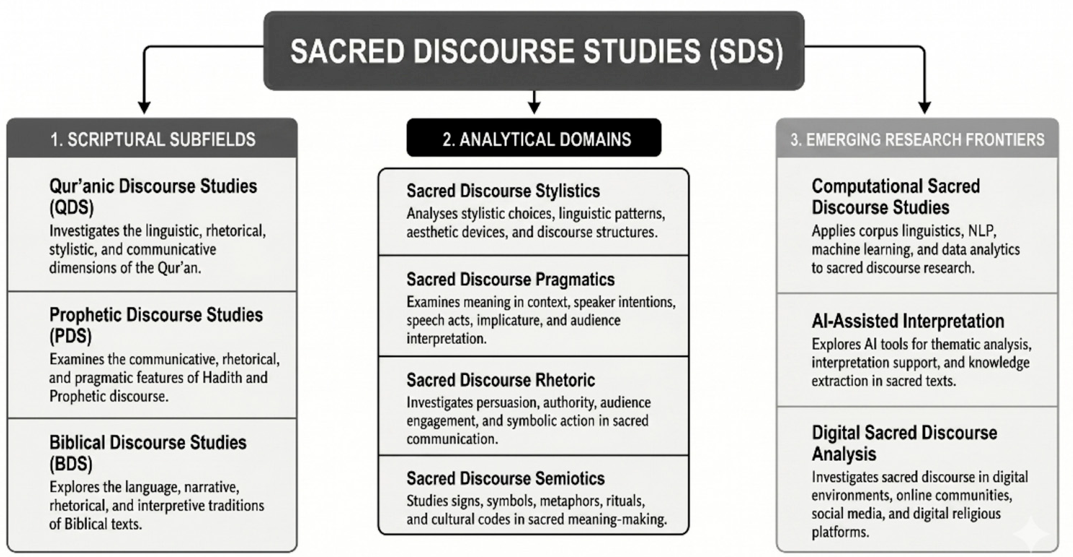
This framework is not intended to be exhaustive or definitive. Rather, it provides an initial architecture for organising existing scholarship, facilitating interdisciplinary dialogue, and identifying future directions for research. By integrating diverse traditions of inquiry within a shared conceptual structure, SDS offers a foundation for a more systematic, theoretically informed, and globally relevant study of sacred discourse.
6. Future Directions
The emergence of Sacred Discourse Studies (SDS) creates new possibilities for advancing research on sacred communication, interpretation, and meaning-making. By bringing together insights from linguistics, discourse studies, communication, rhetoric, theology, religious studies, cognitive science, semiotics, and digital humanities, SDS provides a platform for theoretical integration and methodological innovation. The future development of the field will depend on its ability to generate new frameworks, methodologies, and research communities capable of addressing both classical and contemporary forms of sacred discourse.
6.1. Theoretical Development
One of the most important tasks facing SDS is the development of integrative theories capable of explaining how linguistic structures, rhetorical strategies, communicative processes, interpretive traditions, cognitive mechanisms, and socio-cultural contexts interact in the production of sacred meaning. Existing scholarship often examines these dimensions separately. Future research should therefore seek to construct explanatory models that account for the multidimensional nature of sacred discourse across different religious traditions and communicative settings.
Particular attention should be given to concepts such as revelation, authority, persuasion, identity formation, interpretation, and meaning-making. Comparative research across scriptural traditions may further contribute to the development of more comprehensive theories capable of identifying both shared and tradition-specific features of sacred discourse.
6.2. Methodological Innovation
The future of SDS also depends upon methodological pluralism. Traditional approaches such as textual analysis, hermeneutics, rhetorical criticism, and qualitative interpretation remain indispensable. However, these methods may be complemented by discourse analysis, corpus linguistics, stylistics, pragmatics, semiotics, ethnography, mixed methods research, and computational approaches.
The long-term goal should not be methodological replacement but methodological integration. Such an approach would enable researchers to examine sacred discourse simultaneously as language, communication, interpretation, social practice, and cultural phenomenon. Equally important is the development of analytical frameworks specifically designed for sacred discourse rather than the uncritical adoption of models developed for secular communication.
6.3. Digital and Computational Horizons
Digital technologies represent one of the most significant developments shaping the future of sacred discourse research. Advances in corpus linguistics, natural language processing, machine learning, artificial intelligence, and digital humanities have created new possibilities for analysing sacred texts and religious communication at scales previously unimaginable.
Emerging research suggests that computational methods can make important contributions to the study of sacred discourse. Work in digital hermeneutics has explored how artificial intelligence may function as an interpretive aid while remaining subject to theological and ethical safeguards (Ahmad & Ghafar, 2025a). Complementing this perspective, studies in computational Qur'anic stylistics and digital tafsir have demonstrated the value of corpus-assisted approaches for analysing rhetorical, stylistic, and discourse patterns within sacred texts (Ahmad & Ghafar, 2026a). Future research may extend these developments through semantic network analysis, discourse annotation, rhetorical pattern recognition, thematic extraction, intertextuality detection, knowledge graph construction, and multimodal analyses of religious communication. At the same time, such developments raise important questions concerning authority, transparency, bias, and the epistemological limits of machine-assisted interpretation.
6.4. Interdisciplinary and Applied Engagement
The future success of SDS depends on its capacity to foster sustained dialogue among scholars working across disciplinary, methodological, and religious boundaries. Greater collaboration between linguists, discourse analysts, communication scholars, rhetoricians, theologians, digital humanists, and specialists in sacred texts may generate more comprehensive understandings of sacred discourse than any single discipline can provide independently.
Beyond academic research, SDS possesses significant applied potential. The framework may contribute to religious education, interfaith communication, media analysis, digital religion, public discourse, and the study of religious authority in contemporary societies. It may also provide analytical tools for understanding how sacred discourse shapes social attitudes, cultural identities, ethical reasoning, and public debates in increasingly interconnected and digitally mediated environments.
6.5. Towards a Research Programme for SDS
For SDS to mature as a field, it must develop a coherent and cumulative research programme. Such a programme should integrate scriptural traditions, analytical domains, and emerging methodologies within a shared conceptual framework. Scriptural subfields such as Qur'anic Discourse Studies (QDS), Prophetic Discourse Studies (PDS), and Biblical Discourse Studies (BDS) provide foundational areas of inquiry. These may be complemented by analytical domains including Sacred Discourse Stylistics, Sacred Discourse Pragmatics, Sacred Discourse Rhetoric, and Sacred Discourse Semiotics.
At the same time, emerging frontiers such as Computational Sacred Discourse Studies, Digital Sacred Discourse Analysis, and AI-Assisted Interpretation expand the scope of the field and create opportunities for methodological innovation. Together, these developments suggest that SDS possesses the potential to evolve into a mature interdisciplinary field capable of addressing both classical and contemporary questions concerning sacred meaning, communication, interpretation, and knowledge production.
The long-term significance of SDS lies in its ability to bring previously disconnected traditions of inquiry into a shared intellectual conversation. By integrating diverse strands of scholarship while remaining open to technological and methodological innovation, SDS provides a foundation for a more systematic, theoretically informed, and globally relevant study of sacred discourse in the twenty-first century.
7. Conclusion
The study of sacred discourse has expanded across linguistics, discourse studies, communication, rhetoric, theology, and religious studies. While these traditions have generated valuable insights into language, meaning, interpretation, persuasion, and religious communication, they have largely developed within separate disciplinary frameworks. This article has argued that sacred discourse is a multidimensional phenomenon that cannot be adequately understood through any single perspective and therefore requires a more integrative approach.
In response, the article has proposed Sacred Discourse Studies (SDS) as an emerging interdisciplinary framework for investigating how sacred meanings are constructed, communicated, interpreted, negotiated, and transformed through discourse. Drawing upon multiple theoretical traditions, SDS provides a conceptual structure that integrates scriptural subfields, analytical domains, and emerging research frontiers, including computational and AI-assisted approaches to sacred discourse. Rather than replacing existing disciplines, SDS seeks to create a shared intellectual space through which their complementary insights may be brought into systematic dialogue.
The significance of SDS lies in its potential to advance a more coherent and comprehensive study of sacred discourse across religious traditions, communicative contexts, and media environments. As sacred communication continues to evolve within increasingly digital and technologically mediated societies, SDS offers a foundation for future scholarship that is theoretically integrated, methodologically diverse, and responsive to both classical questions of interpretation and contemporary challenges of religious communication.
Acknowledgments
Portions of the manuscript were developed with the assistance of ChatGPT (OpenAI) for language refinement and editorial support. All interpretations, analyses, and final content were reviewed and approved by the authors.
References
- Ahmad, H.; Ghafar, N. A. AI as interpretive aid in Qur'anic stylistics: Ethical foundations for digital hermeneutics. Int. J. Arts Soc. Sci. 2025a, 8(9), 9–24. [Google Scholar]
- Ahmad, H.; Ghafar, N. A. Elliptical eloquence in the Qur'an: A framework for rhetorical-stylistic and digital tafsir computational models. QURANICA Int. J. Quranic Res. 2026a, 18(1), 208–229. [Google Scholar]
- Aristotle. On rhetoric: A theory of civic discourse, 2nd ed.; Kennedy, G. A., Translator; Oxford University Press, 2007. [Google Scholar]
- Barbee, D. M.; Sleasman, B. C. Sacred rhetoric: Discourses in identity and meaning; Bloomsbury Publishing USA, 2024. [Google Scholar]
- Barnlund, D. C. A transactional model of communication. In Communication theory; Routledge, 2017; pp. 47–57. [Google Scholar]
- Burke, K. The rhetoric of religion: Studies in logology; Univ of California Press, 1970; Vol. 188. [Google Scholar]
- Chandler, D. Semiotics: the basics; Routledge, 2025. [Google Scholar]
- Fairclough, N. Discourse and social change; Polity Press, 1992. [Google Scholar]
- Fairclough, N. Critical discourse analysis: The critical study of language; Longman, 1995. [Google Scholar]
- Foucault, M. The archaeology of knowledge; Smith, A. M. Sheridan, Translator; Pantheon Books, 1972. [Google Scholar]
- Gadamer, H.-G. Truth and method, 2nd rev. ed.; Weinsheimer, J.; Marshall, D. G., Translators; Continuum, 2004. [Google Scholar]
- Gadomski, A.; Itskovich, T.; Levushkina, R.; Novak, M.; Borodin, A. Theolinguistics: Pro et contra [Теoлингвистика: pro et contra]. Quaestio Ross. 2025, 13(4), 1511–1528. [Google Scholar] [CrossRef]
- Hjelm, T. Mapping the discursive study of religion. J. Am. Acad. Relig. 2020, 88(4), 1002–1025. [Google Scholar] [CrossRef]
- Johnson, M.; Lakoff, G. Metaphors we live by; University of Chicago press: Chicago, 1980; Vol. 1, p. 980. [Google Scholar]
- Kusherbayeva, A.; Kurmanaliyeva, A. Subject and current problems of theolinguistic research in world religious studies. Pharos J. Theol. 2025, 106(3), 1–13. [Google Scholar] [CrossRef]
- Langacker, R. W. Foundations of cognitive grammar. In Theoretical prerequisites; Stanford University Press, 1987; Volume 1. [Google Scholar]
- Maingueneau, D. Religious discourse and its modules. Discourse Res. Religion–Disciplinary Use Interdiscip. Dialogues 2021, 57–75. [Google Scholar]
- McGrath, A. E. The Christian theology reader; John Wiley & Sons, 2016. [Google Scholar]
- Pihlaja, S. Analysing religious discourse; Cambridge University Press, 2021. [Google Scholar] [CrossRef]
- Pihlaja, S.; Ringrow, H. (Eds.) The Routledge handbook of language and religion; Routledge, 2023. [Google Scholar] [CrossRef]
- Richardson, P.; Mueller, C. M.; Pihlaja, S. Cognitive linguistics and religious language: An introduction; Routledge, 2021. [Google Scholar] [CrossRef]
- Ricoeur, P. Interpretation theory: Discourse and the surplus of meaning; Texas Christian University Press, 1976. [Google Scholar]
- Schramm, W. Information theory and mass communication. Journal. Q. 1955, 32(2), 131–146. [Google Scholar] [CrossRef]
- Shannon, C. E. The mathematical theory of communication. MD Comput. 1997, 14(4), 306–317. [Google Scholar] [PubMed]
- Tasseva, M. “Sacred discourse” (hieros logos): A form of religious rhetoric in ancient Greece. In International Studies in the History of Rhetoric; 2009; pp. 445–465. [Google Scholar]
- Thiselton, A. C. Hermeneutics: An introduction; Eerdmans, 2009. [Google Scholar]
- van Dijk, T. A. Ideology: A multidisciplinary approach; Sage, 1998. [Google Scholar]
- Van Dijk, T. A. Discourse and power; Bloomsbury Publishing, 2017. [Google Scholar]
- von Stuckrad, K. Discursive study of religion: From states of mind to communication and action. Method Theory Study Relig. 2003, 15(3), 255–271. [Google Scholar] [CrossRef]
- Von Stuckrad, K. Locations of knowledge in medieval and early modern Europe: Esoteric discourse and Western identities; Brill, 2010; Vol. 186. [Google Scholar]
- Wijsen, F. Discourse analysis in religious studies. Religion 2013, 43(1), 1–3. [Google Scholar]
- Zulick, M. D. Rhetoric of religion. In The SAGE handbook of rhetorical studies; 2009; p. 125. [Google Scholar]
Disclaimer/Publisher’s Note: The statements, opinions and data contained in all publications are solely those of the individual author(s) and contributor(s) and not of MDPI and/or the editor(s). MDPI and/or the editor(s) disclaim responsibility for any injury to people or property resulting from any ideas, methods, instructions or products referred to in the content. |
© 2026 by the authors. Licensee MDPI, Basel, Switzerland. This article is an open access article distributed under the terms and conditions of the Creative Commons Attribution (CC BY) license (http://creativecommons.org/licenses/by/4.0/).
Copyright: This open access article is published under a Creative Commons CC BY 4.0 license, which permit the free download, distribution, and reuse, provided that the author and preprint are cited in any reuse.