
Submitted:
19 June 2026
Posted:
23 June 2026
You are already at the latest version
Abstract
Urothelial carcinoma of the bladder remains challenging to assess in real time. Standard tools such as white-light cystoscopy and urine cytology are essential but have recognized limitations, particularly for carcinoma in situ and for repeated, long-term surveillance in non-muscle-invasive bladder cancer (NMIBC). Conventional risk models also show imperfect performance in contemporary practice, contributing to both overtreatment and delayed escalation in biologically aggressive disease. Long non-coding RNAs (lncRNAs) are emerging as attractive biomarkers because of their context-specific expression and their detectability in urine, including within extracellular vesicles/exosomes that protect RNA from degradation. Urinary lncRNAs show promise as non-invasive tools for hematuria triage and diagnostic support, risk stratification for recurrence and progression, and treatment guidance in selected settings. Repeatedly studied candidates include UCA1 and several exosomal/uEV-associated lncRNAs (e.g., TERC, SNHG16), while multi-lncRNA panels and combined strategies (including integration with established urine tests such as NMP22) may stabilize performance across biological and pre-analytical variability. Evidence also supports the concept of longitudinal “molecular response” monitoring using liquid-based lncRNA readouts, although truly predictive, treatment-interaction evidence remains limited. Across studies, performance is strongly influenced by the urine compartment analyzed (pellet/sediment, cell-free urine, or uEVs/exosomes) and by pre-analytical handling and normalization choices. lncRNA assays are unlikely to replace cystoscopy in the near term, but they have clear potential as decision-support tests that complement clinical risk assessment, cytology, and other urine-based platforms. This work synthesizes mechanistic and clinically annotated evidence on lncRNAs in bladder cancer, with an emphasis on urine-based and urinary extracellular vesicle (uEV)/exosomal assays. The search strategy covered publications from 1 January 2015 to 30 December 2025, with emphasis on most recent clinically relevant studies, and included mechanistic studies with functional validation, liquid biopsy/urine studies, and evidence syntheses.
Keywords:
bladder cancer
; urothelial carcinoma
; long non-coding RNA (lncRNA)
; urinary biomarkers
; liquid biopsy
; urine cytology
; urinary extracellular vesicles
; exosomes
; non-muscle-invasive bladder cancer (NMIBC)
; muscle-invasive bladder cancer (MIBC)
; hematuria
; recurrence
; progression
; risk stratification
; surveillance
1. Introduction
Bladder cancer (BC) is the ninth most commonly diagnosed malignancy of the urinary tract and continues to pose great health and economic burden because of its high incidence, male predominance, and chronic relapsing natural history. According to recent global estimates for 2022, there were >600,000 new cases and >200,000 deaths worldwide, with substantial geographic variation [1]. Tobacco smoking followed by occupational exposures (mostly aromatic amines) and contamination of drinking water with arsenic remains the dominant modifiable risk factor in most regions, while infection-related pathways (e.g., schistosomiasis) contribute to distinct epidemiological and histological patterns in some endemic settings (sub-Saharan Africa) [1,2]. Clinically, approximately three-quarters of patients present with non-muscle-invasive bladder cancer (NMIBC), whereas the remainder present with muscle-invasive bladder cancer (MIBC) or metastatic disease [3]. These subtypes follow divergent clinical pathways with markedly different treatment intensity and prognosis [4]. Reliable real-time assessment of this disease remains challenging: diagnostic sensitivity varies across modalities, longitudinal monitoring is burdensome, and the risk of progression is often recognized only after clinically meaningful time has been lost, which complicates timely treatment escalation [5,6,7].
Recent analyses confirm that even updated risk groupings may fail to accurately predict high-grade recurrence-free and progression-free outcomes in bacillus Calmette-Guérin (BCG)-treated populations, emphasizing a persistent gap between trial-derived models and real-world heterogeneity [8,9]. These limitations may contribute directly to the problems of overtreatment and undertreatment. Some patients with indolent, low-grade NMIBC may undergo repeated resections and intensive cystoscopic schedules with marginal clinical benefit, whereas others with biologically aggressive disease may be falsely reassured, delaying escalation (including timely cystectomy in selected BCG-refractory settings) [10,11]. Alongside imperfect risk prediction, the performance constraints of standard surveillance tests remain clinically important. For example, emerging surveillance enhancements can increase lesion detection but may also increase false positives, reinforcing the need for better risk-adapted strategies rather than “more testing for all” [12].
In this context, lncRNAs are emerging as clinically attractive biomarkers for urothelial carcinoma because they can show tissue- and context-specific expression patterns, are measurable with widely available nucleic-acid methods, and can be detected in urine, often within extracellular vesicles/exosomes that protect RNA from degradation [7,13,14]. A growing body of evidence supports urinary lncRNAs as diagnostic and potentially prognostic tools, and exosome-focused approaches appear particularly relevant for surveillance and early detection [13,15]. For instance, urinary exosomal lncRNAs such as SNHG16 have been reported to outperform urine cytology in diagnostic discrimination in case-control cohorts, supporting continued development of vesicle-enriched assays for non-invasive testing [16]. However, lncRNA assays should not be viewed as replacements for established molecular platforms, instead, they can add value within an integrated testing strategy. Urinary tumor DNA and targeted sequencing panels are progressing rapidly and offer mutation-level resolution, yet remain relatively costly and analytically complex for frequent longitudinal testing [5]. In contrast, lncRNA-based tests, especially robust multiplex assays using urine or urinary exosomes, may offer a balance between clinical performance, cost and workflow feasibility. They are scalable, non-invasive, and suitable for repeat testing, with potential roles as triage tests to reduce unnecessary cystoscopies, or as add-on tests alongside cytology or NGS to improve sensitivity for clinically relevant disease while maintaining acceptable specificity [7,17,18].
The aim of this narrative review is to summarize current evidence on the biological and clinical relevance of lncRNAs in bladder cancer, with a particular focus on urine-based and urinary extracellular vesicle (uEV)/exosomal lncRNA assays, and to discuss their potential roles in hematuria triage, diagnosis, risk stratification, and surveillance within contemporary urological practice.
2. Methods
This manuscript is a narrative review of evidence on lncRNAs in bladder cancer, with a particular focus on urine-based and urinary uEV/exosomal biomarkers and their potential clinical applications. The literature was identified using targeted searches combining terms related to bladder/urothelial carcinoma, lncRNAs, and key translational themes (including urine, extracellular vesicles/exosomes, NMIBC/MIBC, and treatment-related topics). The search window covered 1 January 2015 to 30 December 2025, with emphasis on the most recent clinically relevant studies. Evidence was synthesized qualitatively, prioritizing studies with clinical annotation and/or functional validation and highlighting how pre-analytical factors and the analyzed urine compartment (sediment/pellet, cell-free urine, or uEVs/exosomes) may influence reported performance. Figure 1 shows PRISMA 2020 flow diagram of papers selection process.
3. Current Standard of Care in Bladder Cancer and Unmet Needs
Hematuria evaluation underpins the diagnostic pathway for BC, as hematuria remains the commonest presenting symptom for urothelial malignancy. At the same time, the prevalence of cancer among patients referred with microhematuria is low, meaning that most patients undergo invasive or resource-intensive tests to exclude disease rather than to confirm it [20]. Contemporary guidance therefore emphasizes a structured, risk-stratified diagnostic workflow that balances the need to avoid missed clinically significant disease (particularly high-grade tumors and carcinoma in situ) against the harms and low yield of indiscriminate cystoscopy [20,21]. The 2025 update of the AUA/SUFU microhematuria guideline formalizes this approach by incorporating patient and hematuria features into risk categories and outlining where urine-based biomarkers might be considered as adjuncts in selected scenarios rather than as replacements for cystoscopy [21]. In practice, evaluation typically begins with confirmation and contextualization (repeat urinalysis where appropriate, consideration of infection, stones or contamination, and a focused exposure history) followed by risk-aligned investigation. For higher-risk presentations, flexible cystoscopy remains the reference test for bladder evaluation, while upper urinary tract assessment is commonly achieved with imaging that escalates with risk, often ranging from renal-bladder ultrasound to CT urography when robust exclusion of upper tract malignancy is required [21]. Importantly, health-economic work supports selective intensification in higher-risk strata rather than uniform investigation for all, because risk-aligned pathways can improve cost-effectiveness while limiting unnecessary procedures [22,23]. These realities define a key unmet need at the diagnostic front door—a reliable, non-invasive method to rule out clinically important cancer with very high negative predictive value, while also supporting rule-in prioritization when capacity constraints make rapid triage clinically valuable [21,24,25].
Within both hematuria work-up and post-treatment follow-up, current standard tests have well-described constraints. White-light cystoscopy remains the gold standard for diagnosis and surveillance; however, it is invasive, operator-dependent, and less reliable for subtle or flat lesions such as carcinoma in situ [26,27,28]. It also drives substantial patient burden and system workload when applied repeatedly across a large NMIBC population [28,29]. Urine cytology continues to be used because of its high specificity, particularly for high-grade disease, but it has consistently low sensitivity for low-grade tumors and suffers from interpretive variability [18,30]. Standardization through The Paris System (including recent updates) has improved reporting consistency and risk identification, but borderline categories still generate uncertainty and do not fully overcome biological limitations such as low tumor shedding in low-grade disease [30,31]. Recent studies suggest that artificial intelligence can support cytology interpretation and may improve sensitivity or reporting confidence, but robust external validation and careful workflow integration are essential before these approaches can be adopted widely [32,33,34,35]. As a consequence, many centers still depend on repeated invasive assessment to compensate for imperfect non-invasive tools, reinforcing patient anxiety, disruption to daily life, and cumulative discomfort during surveillance [28,29].
After diagnosis, management pathways diverge by stage. NMIBC is typically treated with transurethral resection followed by risk-adapted intravesical therapy and structured endoscopic surveillance, whereas MIBC often requires multimodal management with radical cystectomy and/or trimodality bladder-preserving strategies [26,36]. In NMIBC, repeated cystoscopies, intravesical instillations, and recurrent endoscopic resections drives cumulative morbidity and sustained resource utilization, which contributes to NMIBC being among the most expensive malignancies to manage on a per-patient, lifetime basis [37]. Guideline-recommended surveillance intensity is central to this burden. Risk-stratified schedules recommend concentration of cystoscopy and cytology in the first years after diagnosis, with de-escalation for selected low-risk disease but prolonged (often lifelong), follow-up for higher-risk phenotypes [26]. Even when oncologically justified, intensive surveillance has meaningful downstream consequences for patients, including pain and discomfort, procedural anxiety, embarrassment, disruption to work, and the cumulative “scanxiety” of repeated testing and waiting for results, while also driving substantial health-system costs [28,29]. Economic analyses demonstrate that surveillance and treatment costs rise sharply with risk category, and modelling studies suggest that carefully selected de-escalation strategies in high-risk NMIBC could reduce costs with minimal impact on survival outcomes, underscoring the need for more precise tools to safely individualize follow-up [37,38,39].
A further unmet need is risk prediction that performs reliably in modern practice. Tools used to guide treatment and surveillance (EORTC, CUETO, EAU) have imperfect translation into contemporary cohorts, with validations reporting limited discrimination and systematic miscalibration, often overestimating recurrence and/or progression risks in populations treated according to current standards [40,41,42]. This uncertainty contributes directly to both overtreatment and undertreatment: some patients with indolent disease undergo repeated invasive procedures with limited clinical benefit, while others with biologically aggressive tumors may be falsely reassured, delaying timely escalation. In this broader context, the most realistic near-term goal for urine-based assays is not replacement of cystoscopy, but adjunctive deployment in clearly defined roles. These include hematuria triage to reduce low-yield cystoscopy, prioritization of patients most likely to harbor clinically significant disease, and reflex testing after equivocal cytology, use-cases that align with guideline emphasis on structured, risk-adapted care and that can be evaluated in intended-use populations rather than idealized case-control settings [21,24,43]. Multimodal approaches may be particularly attractive, as lncRNA signals measured in urine or urinary extracellular vesicles could complement existing markers and clinical risk factors, provided thresholds are transparent and performance is reported with grade- and CIS-specific detail in real hematuria and surveillance cohorts [25,44,45,46]. There is increasing biological interest in CIS as a molecularly distinct precursor state, and multi-omics profiling studies highlight potentially actionable pathways and signatures in CIS that could, in time, inform urinary detection strategies as well as therapy selection [47].
4. Long Non-Coding RNAs as Clinical Biomarkers
Long non-coding RNAs are RNA transcripts typically >200 nucleotides that do not encode proteins but can regulate gene expression through diverse mechanisms, including chromatin modulation, transcriptional control and post-transcriptional regulation. Their biological features make them particularly relevant to urothelial carcinogenesis, because the same lncRNA can influence several cancer hallmarks depending on its subcellular localization, structure, and binding partners. These properties help explain why lncRNA dysregulation can be tightly linked to tumor phenotype, recurrence risk, and treatment response, while still being measurable at the RNA level in clinical material [48]. Nuclear lncRNAs commonly participate in chromatin regulation by recruiting or scaffolding chromatin-modifying complexes at specific genomic loci, thereby shaping histone marks and transcriptional accessibility [49,50,51]. In NMIBC, the lncRNA UNMIBC (Up-regulated in Non-muscle Invasive Bladder Cancer) was shown to physically associate with Polycomb Repressive Complex 2 (PRC2) components (including Enhancer of Zeste 2 [EZH2] and Suppressor of Zeste 12 [SUZ12]) and alter H3K27 methylation at target genes, linking a clinically measurable transcript to a plausible epigenetic mechanism [52]. Clinically, this matters because chromatin-linked lncRNAs effects tend to align with durable phenotypes such as proliferation capacity, lineage programs, and long-term recurrence risk or progression trajectories [53]. Beyond chromatin, lncRNAs can exert transcriptional control in two complementary directions. First, they can regulate transcription of downstream genes (often by guiding chromatin regulators or interacting with transcription factors and co-regulators) [53,54]. Second, their own expression is frequently driven by oncogenic transcription factors and microenvironmental cues, which makes them informative readouts of pathway activity [53,55,56,57]. In the cytoplasm (and within extracellular vesicles), many bladder cancer-associated lncRNAs operate through miRNA sponging (competitive endogenous RNA behavior), sequestering miRNAs and de-repressing miRNA targets [58]. This can amplify oncogenic signaling through coordinated de-repression of multiple mRNA targets that sit downstream of the same miRNA. lncRNAs can also function as RNA-protein scaffolds, organizing ribonucleoprotein complexes that influence transcription, RNA stability, or signaling [59]. Importantly, these “mechanism classes” overlap in practice: localization can be dynamic, isoforms can differ in binding capacity, and lncRNAs can couple epigenetic and post-transcriptional regulation. This mechanistic flexibility helps explain why lncRNAs can mirror clinically meaningful tumor states and transitions, including early progression and recurrence, while remaining measurable with nucleic-acid assays.
A key reason lncRNAs are attractive biomarkers is their tissue- and context-specific expression, which can provide higher biological specificity than many protein-coding transcripts. However, their clinical interpretation depends on the sampling matrix and the molecular compartment in which the RNA is measured. In biofluids such as urine and blood, extracellular RNA is exposed to abundant RNases, yet lncRNA signals persist because RNA can be packaged within EVs, including exosomes, or protected in ribonucleoprotein or other non-vesicular complexes [46,60]. EVs are clinically relevant not only because they protect RNA, but also because cargo packaging can reflect cellular state and stress responses, and may capture tumor-microenvironment interactions that are difficult to infer from a single tissue timepoint. Reviews of EV-RNA biology emphasize that RNA sorting and delivery are regulated processes, supporting the rationale for EV-associated RNA as a biomarker class rather than a technical artefact [61]. In bladder cancer, these considerations matter because the urinary tract provides direct access to tumor-adjacent biofluids, enabling repeated sampling with low burden, while still allowing tissue to anchor biological interpretation. Within urothelial cancer care, lncRNAs can be assessed in urine, tumor tissue, and blood, each offering a slightly different biological “image” of the disease that should be viewed as complementary rather than interchangeable.
Tissue remains the reference matrix for defining tumor biology and stage. In bladder cancer, tissue-based lncRNA measurement is feasible from routine transurethral resection of a bladder tumor (TURBT) and cystectomy specimens, including formalin-fixed paraffin-embedded (FFPE) material. FFPE is particularly important in translation because it reflects real pathology workflows; however, FFPE-derived RNA is often fragmented and chemically modified, so assay design (amplicon length, transcript region choice) and quality control become critical [62]. Tissue profiling serves to connected clinical aims: first, to identify lncRNAs associated with grade, stage, recurrence/progression or therapy response, and second, to inform molecular stratification that can later be translated to less invasive assays. Clinically relevant urine fractions include the pellet/sediment (enriched for exfoliated urothelial and inflammatory cells), cell-free urine (supernatant), and urinary EVs/exosomes, which may enrich tumor-derived RNA and reduce background [46,63]. From an analytical perspective, urine lncRNA assays can be viewed across three overlapping compartments, each with distinct strengths and pitfalls. Cellular RNA (urine pellet/sediment) may enrich tumor signal when malignant cells exfoliate, but cellular yield can fluctuate, and inflammatory cells contribute background. EV-associated RNA is protected from degradation and may better reflect tumor biology, but variability in EV isolation methods and limited reporting standardization remain barriers to reproducibility and implementation [13,64]. Cell-free urine RNA offers workflow simplicity and scalability, but the signal may be dilute and is sensitive to hematuria burden, fragmentation, and inflammatory confounding. The chosen fraction determines what biology is captured. Cell-associated RNA in the pellet more strongly reflects cellular composition and whole-cell transcriptional programs, whereas EV-enriched preparations may better reflect secreted or selectively packaged signals. Exosomal ncRNAs in urine and blood have been suggested to have overall diagnostic promise for bladder cancer [13]. A recent diagnostic meta-analysis of exosomal ncRNAs reported a pooled sensitivity of 0.75 and specificity of 0.79 for bladder cancer detection, with overall performance varying by RNA class and specimen type [13]. This reinforces that biomarker performance is influenced not only by the transcript selected, but also by the compartment and analytical pipeline used to measure it.
Blood offers a systemic window, particularly relevant to MIBC or metastatic disease, and can be evaluated through cell-free RNA, EVs/exosomal RNA, and less commonly but conceptually important, in circulating tumor cells (CTCs)-associated RNA after circulating tumor cell enrichment [65,66]. Blood-based exosomal lncRNA signatures continue to emerge in bladder cancer, including a three-lncRNA serum exosome model (G023016, RP11-553N19.1, and LINC0087) derived from genome-wide microarray profiling and evaluated as an early diagnostic approach for non-muscle invasive disease [67]. Across all matrices, discovery is usually best served by RNA-seq because it enables unbiased detection, including isoforms and previously unannotated transcripts. For clinical deployment, however, targeted, multiplex assays (most commonly qRT-PCR-based) are usually preferred because they are faster, cheaper per sample, and easier to standardize, and more compatible with defined decision thresholds [68]. The platform should therefore be selected based on the clinical use case (triage vs risk stratification vs monitoring) and the compartment being measured, rather than by analytical convenience alone. Pre-analytical standardization is a decisive requirement for clinically reliable lncRNA biomarkers, particularly for EV/urinary assays where upstream variation can dominate measured differences. The urine fraction and processing workflow must be defined because pellet, supernatant and EVs preparations contain different material, and centrifugation and isolation steps directly shape signal-to-noise and background composition [63]. Storage and handling also matter, as EV integrity and RNA yield can shift with temperature, buffer conditions, and freeze–thaw exposure, which can alter apparent transcript abundance and destabilize clinical cut-offs [69,70,71]. For blood-based assays, analogous attention is required for collection tubes, processing times, hemolysis, and storage. Hematuria and inflammation are major confounders in hematuria pathways, as blood and inflammatory increase background RNA and urinary inhibitors can impair amplification, so biomarker performance must be validated in representative clinical cohorts rather than “clean” case–control sets [72]. Normalization is another recurrent failure point. Reference targets can behave differently across pellet, supernatant and EV fractions, and classical housekeeping genes may not be stable across disease states or biofluid compartments, making empirical validation of reference controls and/or spike-ins essential in the intended matrix. MIQE 2.0 emphasizes transparent reporting of pre-analytics, assay performance and normalization because small technical biases can materially affect low-abundance targets and clinical thresholds [68,73]. Finally, the reporting format should reflect the clinical decision being supported: some assays are best suited to binary cut-offs for “rule-in/rule-out” triage, whereas others are more informative as continuous scores capturing risk gradients for recurrence, progression, or treatment response, as illustrated by studies using explicit qRT-PCR thresholds versus classifier-style approaches derived from broader expression profiles [15,46,69,74]. The mechanistic roles of selected lncRNAs in progression of bladder cancer are shown in Figure 2.
5. Urine-Based lncRNA Candidates and Panels—Diagnosis and Screening
Urine is an attractive substrate for RNA biomarker testing in bladder cancer because it is in direct contact with the tumor surface and can capture tumor-derived material through exfoliated cells, cell-free nucleic acids, and EVs/exosomes [75]. This proximity can enrich tumor signal and supports both diagnosis (for patients presenting with hematuria or other symptoms) and surveillance-like testing (to help manage follow-up intensity after treatment) [76]. However, urine is also a biologically “noisy” inflammatory fluid [77]. Infection, stones, instrumentation, radiation cystitis and other benign urological conditions can change RNA abundance and integrity [21]. In real hematuria pathways and NMIBC follow-up clinics, the key question is therefore not whether a marker separates cancer from healthy controls, but whether it separates cancer from benign hematuria and inflammation, the clinical differential that drives decision-making [78]. Recent evidence syntheses support the feasibility of urine EV and urine RNA markers in bladder cancer, while consistently highlighting heterogeneity between studies, pre-analytical sensitivity, and the need for prospective validation in representative cohorts [13,64,79]. This is also reflected in broader evaluations of urine-derived exosome diagnostics, where pooled performance appears encouraging but variable across platforms and study designs [64].
True population screening for bladder cancer remains challenging because prevalence is low, so even accurate tests can generate harmful false positives [80]. Urinary lncRNAs are unlikely to “replace” cystoscopy outright, but could support triage, prioritization and pathway tailoring [81]. Recent evidence syntheses of urinary exosome approaches support this direction while highlighting the need for standardized pipelines and external validation. Recent evaluations of urinary EV approaches reinforce this direction, while again emphasizing the need for standardized pipelines and external validation. For example, a urinary EV lncRNA panel combined with NMP22 improved diagnostic value for bladder cancer and high-grade disease, supporting the principle that lncRNA signals may add orthogonal information to established urine tests [45].
Urine-based lncRNA studies broadly fall into three practical categories: single lncRNA markers with replicated evidence, multi-lncRNA panels designed to stabilize performance across biological and technical variation and combined strategies where lncRNAs are assessed alongside cytology or established urine assays to increase clinical confidence.
Single lncRNA Urine Markers with Replicated Evidence
Among urine-based lncRNAs, UCA1 is the most frequently examined single marker across different analytical formats and clinical settings. Its repeated detectability is biologically plausible given its reported roles in supporting malignant cell fitness and metabolic reprogramming, including promotion of aerobic glycolysis via HK2 upregulation [82]. Clinically, UCA1 has been detected using a PCR-free nanoparticle hybridization assay in urine with high sensitivity and specificity, supporting feasibility in routine-type workflows [83]. More recently, UCA1 has been explored as an adjunct to urine cytology format via RNA in situ hybridization on cytology preparations, improving sensitivity and negative predictive value for high-grade tumors, an important characteristic for hematuria triage and surveillance-like testing where missing high-grade disease is unacceptable [84]. Contemporary studies continue to evaluate UCA1’s diagnostic accuracy, reflecting sustained interest in its translational potential [85]. Beyond UCA1, several urinary exosome/uEV lncRNAs have emerged with plausible single-candidate markers. TERC (the telomerase RNA component) aligns with telomerase-driven replicative immortality [86,87] and has been reported in urinary exosomes with diagnostic performance exceeding NMP22 and cytology in the original study. Since urinary exosomal TERC achieved sensitivity of 78.65% and overall accuracy of 77.78%, this lncRNA could become a diagnostic and prognostic biomarker for bladder urothelial carcinoma [74]. Also, Small Nucleolar RNA Host Gene 16 (SNHG16) has been measured in urinary exosomes and enabled diagnostic discrimination between cancer and controls in a case-control design, with performance reported as superior to cytology in that cohort. Mechanistically, it has been linked to bladder cancer progression via a miR-98/STAT3/Wnt/β-catenin axis, providing some biological plausibility alongside statistical separation [16]. Finally, the Small Ubiquitin Modifier 1 Pseudogene 3 (SUMO1P3) has recently emerged as a urine candidate marker associated with aggressive phenotypes. In a retrospective cohort SUMO1P3 increased with higher-risk disease states (high grade NMIBC and MIBC) and was explored together with its interacting microRNA (miR-320a) as a biologically coherent ratio metric, providing a mechanistic narrative (RNA–RNA interaction) and a potential link to progression risk [88]. Despite these signals, single-marker approaches remain the most vulnerable to center-to-center variation and benign inflammatory confounding. In hematuria populations, cystitis- or infection-driven false positives are common rather than exceptional, and this is why single-marker performance often drops when moving from case-control studies to true referral cohorts [18,89,90].
Multi-lncRNA Panels and Combined Strategies.
Given heterogeneity in tumor biology (grade, stage, tumor burden) and urinary confounding (inflammation, benign urological disease), multi-marker modelling is increasingly favored because panels can stabilize performance when any single transcript fluctuates. A widely cited example is the urinary exosome panel MALAT1/PCAT-1/SPRY4-IT1, developed in a training cohort and confirmed in an independent validation cohort with reported diagnostic and prognostic value including recurrence-related information for NMIBC [91]. The proposed biology of these lncRNAs is consistent with a “signal enrichment” malignant programs, including EMT, proliferation and epigenetic regulation. MALAT1 promotes EMT and metastatic traits in bladder cancer (including Wnt-associated EMT programs), PCAT-1 supports proliferation and survival (silencing induces growth arrest and apoptosis), and SPRY4-IT1 can act as a competing endogenous RNA that increases EZH2 by sponging miR-101-3p, thereby facilitating proliferation and metastasis [91,92,93,94]. The panel outperformed urine cytology showing an area under the receiver-operating characteristic (ROC) curve (AUC) of 0.813 in the validation set and 0.619 in urine cytology. A complementary “cell-free urine” approach selected a four-lncRNA panel (UCA1-201/HOTAIR/HYMA1/MALAT1) specifically to distinguish bladder cancer from chronic urocystitis, addressing a clinically realistic differential diagnosis rather than healthy-only controls [95]. This is directly relevant to hematuria pathways, where inflammation is common and specificity is typically the limiting factor. HOTAIR is associated with bladder cancer progression and is detectable in patients’ urinary exosomes, where it contributes to invasive behavior. The knockdown of this lncRNA has been demonstrated to reduce migration/invasion in model systems [96]. Compartment-aware panel development is another important direction because pellet/sediment RNA and EV RNA are not interchangeable. In a study with training and independent validation, an exosomal panel (including RMRP/UCA1/MALAT1) outperformed sediment-based markers, and was used to build an SVM classifier, illustrating the practical value of selecting the most informative compartment for each transcript. Mechanistically, RMRP has functional evidence in bladder cancer (supports proliferation, migration and invasion) and has been linked to epigenetic repression of tumor-suppressive programs in more recent mechanistic work, making it a credible “biology-backed” panel component rather than a purely statistical feature [97,98]. Similarly, a two-lncRNA cell-free urine signature (uc004cox.4 + GAS5) was developed using microarray discovery and evaluated in large training and validation sets. It reported AUCs that exceeded urine cytology across stages, including Ta disease—AUC was 0.843, 0.867 for T1, and 0.923 for T2–T4, and each value was significantly greater than the AUC obtained with urine cytology (all p < 0.05) [99]. This type of design is relevant for both detection and surveillance, because recurrence monitoring places sustained demands on non-invasive testing, especially when the aim is to safely extend cystoscopy intervals. More recently, multi-phase studies have continued to expand the panel landscape. Li et al. [15] reported a three-lncRNA urine exosome “fingerprint” (CCDC148-AS1, XLOC_006419, RP5-1148A21.3), verified across several phases including a cohort of 200 NMIBC participants. The signature was reported as superior to urinary cytology for discriminating NMIBC from healthy controls. Similarly, Chen et al. [45] identified a urinary EV lncRNA panel (MALAT1, SCARNA10, LINC00963, LINC01578) and showed improved discrimination when combined with NMP22, including for high-grade disease (reported AUCs: 0.917). These studies reinforce a practical principle: lncRNA panels may be most useful when they complement, rather than duplicate, established urine tests and cytology. Across panel studies, the most persuasive designs share two features: inclusion of clinically meaningful non-cancer controls (cystitis, stones, benign hematuria), and transparent reporting for high-grade disease and CIS. Without these, apparent performance gains may not translate into hematuria clinics or surveillance programs [100,101,102]. Even when biological rationale is strong, urinary lncRNA testing can fail clinically for reasons that are more “workflow” than “biology”. Pre-analytical variability (urine volume, timing, storage temperature, hematuria degree, bacterial contamination) can influence RNA yield and EV recovery. Standardization of the chosen compartment is also critical, as pellet/sediment, cell-free urine and uEV fractions can yield different results for the same transcript [97]. Finally, implementation depends on assay practicality. Emerging rapid workflows, such as RT-RAA-CRISPR/Cas12a detection of urinary exosomal RMRP, illustrate a translational pivot towards speed and laboratory fit, not only biomarker selection [103].
6. lncRNAs for Risk Stratification (Prognosis, Recurrence, Progression)
lncRNAs are increasingly being explored as risk-stratifying biomarkers in bladder cancer, with the main clinical rationale being their potential to refine prognosis beyond conventional clinicopathological variables. This is particularly relevant in NMIBC, where TURBT followed by risk-adapted intravesical therapy still leaves a substantial burden of recurrence surveillance and uncertainty around progression risk. Recent synthesis of the NMIBC literature confirms a consistent signal that selected lncRNAs associate with recurrence- and progression-related endpoints, while also underscoring the limitations of small cohorts, variable assays, and non-harmonized cut-offs [104]. Taken together, these data support a model in which lncRNA readouts capture biological risk that is only partially reflected by stage, grade, tumor size, multiplicity, and concomitant CIS. Within NMIBC, tissue-based lncRNA programs linked to chromatin regulation provide a clear example of biologically anchored prognostication. Polycomb-associated circuitry centered on HOTAIR has been repeatedly connected to aggressive behavior, consistent with the concept that lncRNAs can amplify residual malignant potential even when routine features appear favorable [105,106]. Martínez-Fernández et al. [105] reported that gene sets regulated by the HOTAIR-EZH2 axis could effectively distinguish non-tumoral samples from bladder cancer, and could further separate recurrent from non-recurrent disease. This work also framed HOTAIR as an epigenetic reprogramming node, providing a plausible mechanistic link between expression levels and clinical trajectory. Importantly for risk modelling, focused single-marker studies illustrate what “good” prognostic evidence can look like when analytics move beyond simple association. The UCA1 program incorporated internal validation and formally evaluated clinical utility using decision-curve analysis [104,107]. In that study, lower UCA1 expression was linked to a more aggressive disease, including MIBC and higher stage and grade. In patients with NMIBC, decreased UCA1 levels were also associated with worse short-term outcomes, showing an increased risk of early recurrence (HR 1.974; P=0.032) and a higher likelihood of progression to invasive disease (HR 3.476; P=0.023) [107]. These examples collectively indicate that lncRNAs can add incremental information to established clinical predictors, provided the modelling strategy is rigorous and transparent. Liquid-based lncRNA testing is especially attractive for recurrence forecasting after TURBT, where clinicians need non-invasive tools to complement cystoscopy during follow-up. Urinary EVs (uEVs) are a pragmatic substrate because they protect RNA cargo and can be sampled serially. A uEV lncRNA panel incorporating MALAT1 and PCAT-1 was associated with poorer recurrence-free survival in NMIBC, and exosomal PCAT-1 remained independently linked to recurrence risk in multivariable analyses, supporting the feasibility of non-invasive monitoring alongside standard surveillance [91]. Complementary blood-based evidence also supports prognostic potential. A serum exosome panel including PCAT-1/UBC1/SNHG16 was associated with recurrence risk, and higher exosomal UBC1 tracked with inferior recurrence-free survival in NMIBC [108]. Conceptually, these approaches may be most useful for re-stratifying the heterogeneous “intermediate-risk” NMIBC population. In that setting, lncRNA score could separate patients with recurrence-dominant trajectories from those at higher risk of progression, helping to rationalize follow-up intensity without conflating prognostic assessment with treatment selection. In MIBC, where outcomes are driven by occult spread and early relapse, multiple transcriptome-derived lncRNA signatures have been developed for survival endpoints and recurrence after definitive therapy, typically using The Cancer Genome Atlas discovery followed by risk-score construction and nomogram integration [109]. An eight-lncRNA signature is a representative example, reporting stratification of disease-free outcomes and nomogram performance in the C-index ~0.7 range, which illustrates how lncRNAs can be positioned as additive predictors rather than substitutes for clinical staging [109]. Beyond survival, “hidden” dissemination phenotypes such as nodal involvement appear biologically linked to specific lncRNA programs. Individual markers, including PVT1, have been associated with adverse clinicopathological features and poorer outcomes in cystectomy-treated cohorts, and newer multi-lncRNA models frequently report enrichment of node-positive disease within high-risk groups [110]. In that study, a multivariable Cox proportional hazards model, higher PVT1 expression remained independently associated with overall survival in patients with muscle-invasive bladder cancer (HR 2.381, 95% CI 1.821–7.012; P=0.014). More broadly, large-scale profiling supports the idea that lncRNA patterns are not purely statistical artefacts: clustering by lncRNA expression aligns with established molecular subtype structure and meaningful survival differences [111]. Recent work using non-coding RNA-based classifiers further reinforces this biological anchoring by identifying clinically organ-confined tumors with a less aggressive “luminal favorable” profile and better overall survival after radical cystectomy [112]. From a methodological perspective, credible prognostic positioning of lncRNAs requires multivariable modelling that forces in core clinicopathological predictors (e.g., stage/grade, CIS, tumor size and multiplicity and, where available, lymphovascular invasion), alongside reporting of discrimination and calibration. Decision-curve analysis should be used to demonstrate net benefit across clinically plausible threshold risks, and external validation should be performed in temporally and geographically distinct cohorts using pre-specified assays and cut-offs rather than post hoc optimization. Finally, translational alignment matters: when lncRNA readouts are interpreted as part of coherent tumor biology, rather than isolated markers, they offer a rational bridge from static prognosis to dynamic surveillance, including the concept of serial urine or blood lncRNAs as a minimal residual disease surrogate that may precede cystoscopic or radiological relapse [91,108].
7. lncRNAs for Treatment Guidance (Predictive Biomarkers) and Mortality Prediction
lncRNAs are being positioned not only as descriptors of tumor biology but also as predictive tools that could guide treatment choice and timing, provided they demonstrate a true treatment-biomarker interaction rather than merely mirroring baseline risk. In NMIBC treated with intravesical BCG, the key clinical problem is early identification of BCG-unresponsive disease so that ineffective repeat BCG can be avoided and alternative options are not delayed. Integrative comparisons of “BCG durable” versus “BCG non-durable” cases have identified MIR4435-2HG as a candidate lncRNA linked to BCG response and to post-treatment shifts in paired samples, supporting the notion that a small set of lncRNAs may capture relevant immune-tumor dynamics in the urothelium [113]. However, recent reviews of BCG response consistently emphasize that molecular predictors remain immature and that prospective validation in well-defined, BCG-exposed cohorts using contemporary endpoints and clear, accepted BCG-unresponsive definitions is essential before escalation decisions can be anchored to any single biomarker [114]. A practical strength of lncRNAs is their compatibility with urine sampling, which creates an opportunity for longitudinal monitoring during induction and maintenance rather than relying solely on interval cystoscopy. Urine exosomal lncRNA fingerprints are already feasible at NMIBC cohort scale, even though most published studies have focused on diagnosis rather than response tracking [15,64,91]. The value of dynamic lncRNA behavior is illustrated by liquid biopsy studies showing post-clearance declines [115]. Serum exosomal BCYRN1 levels falls after complete surgical removal of bladder tumors and, in an instructive clinical vignette, a lack of decline after TUR was followed by residual tumor at second TUR and recurrence within a year [115]. Patients who showed this post-operative decline remained recurrence-free for over two years after surgery. While these observations do not yet establish prediction of benefit from a specific intravesical regimen, they support the concept of “molecular response” monitoring and early detection of inadequate tumor control, which is highly relevant to preventing downstream progression and bladder cancer–specific mortality [115].
In MIBC, treatment guidance questions are often framed around cisplatin-based neoadjuvant/adjuvant chemotherapy (NAC/AC) and whether an individual is likely to benefit sufficiently to justify toxicity and potential delays to definitive local therapy. Several lncRNAs have been mechanistically linked to platinum sensitivity/resistance mechanisms, spanning drug-induced apoptosis, DNA damage signaling, and stress-response circuitry, which supports biological plausibility but does not, on its own, establish clinical-level prediction [116]. Fo example, MST1P2 has been proposed to act as a competing endogenous RNA that sequesters miR-133b, thereby relieving miR-133b–mediated repression of Sirt1 and modulating cisplatin (DDP) resistance in bladder cancer cells through downstream Sirt1-p53 signaling [116]. Translationally, LINC00857 is one of the more clinically oriented examples. Higher expression was linked to platinum non-response and inferior outcomes, and knockdown increased cisplatin sensitivity via an LMAN1-associated mechanism [117]. Additional mechanistic reports implicate UCA1 (linked to cisplatin resistance via Wnt-related signaling), MALAT1 (connected to cisplatin resistance through a miRNA/VEGF-C axis) and NEAT1 (which silencing can enhance cisplatin effects in vitro) in cisplatin resistance circuits, but a recurrent translational limitation is that many signals arise from cell-line experiments or retrospective series without the trial structure needed to separate prognostic effects from true predictive value [118,119,120]. For lncRNAs to support choices between NAC, immediate cystectomy, or bladder-sparing strategies, evidence standards should mirror other predictive biomarkers—multivariable modelling that accounts for performance status, renal function and clinical stage, explicit interaction testing where feasible, and validation in prospective or randomized datasets where treatment exposure is not confounded by baseline risk. A related point is mortality prediction: if a biomarker is proposed to “guide” NAC, it should ultimately identify patients with a survival gain (overall survival or bladder cancer–specific mortality reduction), not merely different response rates [121,122]. Radiotherapy and trimodality therapy introduce additional biology, because radiosensitivity is shaped by hypoxia and DNA damage response capacity. Bladder-specific data include both single-lncRNA biology, such as TUG1, where down-regulation increased radiosensitivity via HMGB1-associated mechanisms, and multigene approaches, such as a bladder-derived 10-lncRNA radiosensitivity signature trained on cell-line measurements and tested against local relapse-free outcomes after radiotherapy [123,124]. In parallel, hypoxia-related lncRNA signatures in bladder cancer reinforce the biological link between oxygen-deprived tumor states, treatment resistance, and adverse survival [125,126]. For immunotherapy (checkpoint blockade), the most credible lncRNA “predictive” signals are those tied to the immune microenvironment and interferon/antigen-presentation programs (interferon signaling, antigen presentation, immune cell recruitment and exhaustion) because these pathways sit upstream of PD-1/PD-L1 biology and response heterogeneity [127,128]. Interferon-regulated lncRNAs can also act as pathway “controls”. For example, the Interferon-Stimulated Noncoding RNA 1 (INCR1) transcribed from the PD-L1 locus, was shown to modulate interferon-gamma (IFNγ) signaling and PD-L1-related gene expression in tumor cells (across cancer types) [129]. Immune- and immunotherapy related lncRNA signatures in bladder cancer have been reported to correlate with immune cell infiltration patterns and to estimate immunotherapy responsiveness using established frameworks (for example, TIDE-based modelling) while also stratifying overall survival [127,130]. Moving closer to real-world treatment-annotated prediction, a 2025 study reported that an extracellular vesicle-derived MAFG Antisense RNA 1 (MAFG-AS1) in advanced urothelial carcinoma associated with clinical response to pembrolizumab, exemplifying the minimally invasive, therapy-linked biomarker design that could also support mortality prediction if validated in larger series with robust survival endpoints [131]. In the metastatic disease, where targeted and antibody-drug conjugates are rapidly expanding, may be a near-term role for RNA biomarkers as contextual stratifiers rather than stand-alone selectors. FGFR-altered disease is currently selected by FGFR2/3 alterations, but lncRNAs related to FGFR biology (e.g., FGFR3-AS1) could plausibly help identify pathway-active states, epithelial lineage programs, or adaptive resistance adaptations programs downstream of DNA-level alterations [132,133]. For antibody-drug conjugates such as enfortumab vedotin, patient selection still centers on target biology (e.g., Nectin-4) and broader genomic correlates, leaving conceptual niche for transcriptomic or lncRNA-derived measures of lineage state, antigen expression programs and heterogeneity, although bladder-specific evidence remains limited [134,135,136,137]. Finally, the theranostic strategies using lncRNAs as both biomarkers and therapeutic targets, are particularly attractive in bladder cancer because intravesical access may support local nucleic-acid delivery. Experimental work combining CRISPR-mediated UCA1 disruption with PD-1 pathway modulation highlights the potential, while also underscoring the practical hurdles of delivery, stability, mucosal penetration, off-target effects and immune activation that must be addressed before lncRNA-directed interventions can be evaluated clinically [138,139,140,141]. Table 1 summarizes lncRNA-based biomarker panels that are tested for the diagnosis and prognosis of bladder cancer.
Integrating lncRNAs into clinical pathways is most realistic when they are treated as decision-support tools that complement clinicopathological risk factors, imaging and cytology, rather than being positioned as stand-alone replacements for cystoscopy [142]. Clinical adoption requires an explicit “intended-use” statement: where the lncRNA test sits in the pathway, what decision it changes, and how downstream outcomes will be measured (procedures avoided, delays prevented, and clinically meaningful cancers detected), which aligns with established diagnostic-test clinical utility concepts and evaluation frameworks [100,143]. A pragmatic model is to embed urinary lncRNAs as actionable “gates” within guideline-driven workflows, with pre-specified safety nets for persistent symptoms or high-risk clinical features. In haematuria evaluation, an operational algorithm can begin with standard risk stratification (age, sex, smoking history, haematuria type, anticoagulation and appropriate imaging), then add a urine lncRNA panel, preferably measured in a reproducible matrix such as uEVs/exosomes or cell-free urine RNA, to refine urgency [21,46,144]. Patients with a positive/high-risk molecular score can be prioritised for earlier cystoscopy and complete upper-tract assessment, whereas those with a negative/low-risk score and otherwise low-risk features may undergo deferred cystoscopy with structured follow-up and repeat testing. The clinical utility target is a reduction in low-yield endoscopy without compromising detection of clinically significant disease. Recent uEV/exosomal lncRNA panel studies and reviews support this “triage add-on” role by showing strong diagnostic performance and incremental value when combined with established urine markers [15,45,97]. The same logic extends to NMIBC surveillance: cystoscopy schedules remain anchored to guidelines, while serial urine lncRNA monitoring is used to modulate intensity between planned procedures. Persistently negative results could support maintaining, under protocol control and in carefully selected settings, potentially de-intensifying, endoscopy frequency, whereas a new positive result or upward molecular trajectory triggers earlier cystoscopy and enhanced assessment. This approach is aligned with emerging monitoring candidates such as urinary SUMO1P3, which is increased in urine from patients with high-grade NMIBC/MIBC and has been proposed for tracking progression risk, including in combination with other urinary RNAs [88]. For MIBC, where cisplatin-based neoadjuvant chemotherapy (NAC), immunotherapy strategies in appropriate settings and bladder-preserving trimodality therapy each carry distinct benefit–toxicity trade-offs, the most defensible near-term role for lncRNAs is within validated multivariable models that estimate residual risk and treatment-linked outcomes to support multidisciplinary decision-making, rather than dictate a single option. However, it is crucial to acknowledge that the European Association of Urology explicitly notes that there are still no reliable tools to select patients most likely to benefit from NAC, so any lncRNA-informed model must show clear incremental value over stage, grade, imaging, and established molecular features and must be tested prospectively [36,145,146]. Across all intended uses, “clinical-grade” evidence means moving beyond promising AUCs to prospective studies with pre-specified endpoints, locked-down cut-offs, and explicit decision rules (including how equivocal results are managed), with direct comparison against standard practice (cytology, imaging, risk calculators and contemporary urine tests) and outcomes framed around patient impact and service delivery. The bar for pathway-level utility is illustrated by the STRATA randomised trial in low-risk asymptomatic microhaematuria, where a structured urine-test-guided approach (Cxbladder Triage) reduced cystoscopy utilisation by ~59% [147]. lncRNA-based tests aiming for adoption should be designed to meet similar standards of prospective, pathway-level evidence and health-economic relevance. The molecular pathways associated with discussed lncRNA, and their clinical relevance were summarized in Table 2.
Although the translational narrative for lncRNAs in urothelial oncology is compelling, the evidence base still contains clear limitations that are best understood as problems of generalisability, comparability and decision relevance, rather than isolated shortfalls in statistical performance. First, most urinary lncRNA panels have been developed in relatively constrained settings, often with limited numbers of recruiting sites and heterogeneous pre-analytical workflows. This leaves uncertainty about signal stability when urine is collected and processed across different hospitals, laboratories and clinical pathways. Even well-conducted recent studies, including a urinary uEV lncRNA panel that combined four uEV lncRNAs with NMP22 and an exosomal lncRNA “fingerprint” derived from microarray discovery with phased verification in NMIBC participants remain largely single-system developments that now require large, multi-centre prospective validation before they can be considered practice-changing [15,45]. Second, there is still a shortage of head-to-head comparisons against cytology and established urine tests performed within the same patients using the same endpoints and thresholds. Without such comparisons, it is difficult to judge whether a new lncRNA assay offers meaningful incremental value, or whether it mainly reflects spectrum bias, differences in sample handling, or selective recruitment [24,45]. The evidence from meta-analysis concerning urine-derived exosome testing reinforces the message that diagnostic performance is promising overall, but heterogeneity is substantial and clinical feasibility still needs confirmation in trials designed around real pathways and decision thresholds [64]. We can learn from how clinical utility has been proven for other urine-based approaches. The STRATA randomised trial showed that a biomarker-guided strategy in low-risk microhaematuria reduced cystoscopy utilisation by 59%, illustrating pragmatic, pathway-embedded evidence (procedure reduction, safety outcomes, and patient impact) that lncRNA assays will also need to demonstrate [147]. Third, many studies remain cross-sectional case-control comparisons, which are poorly suited to answering the clinical questions urologists actually face: when should a positive test trigger escalation, and how safely can repeated negative results reassure over time? This is particularly relevant for monitoring candidates such as SUMO1P3, which has been linked to higher-grade disease and proposed for progression monitoring but is still supported mainly by observational designs [88]. Longitudinal sampling with protocolised timing around routine visits is therefore essential to determine whether lncRNA dynamics anticipate clinically meaningful relapse early enough to change outcomes, especially as rapid and deployable detection chemistries for urinary exosomal lncRNAs (e.g., RMRP assays) are emerging [24,103]. Finally, real-world confounding needs to be handled deliberately. Common urological states, such as UTI, stones, recent instrumentation/catheterisation, intravesical therapy and inflammatory bladder conditions, may alter extracellular RNA payloads and inflate false positives unless modelled explicitly and addressed in reporting [24,46]. Work on uEV pre-analytics highlights how collection and processing variables can materially influence transcriptomic readouts, and the MISEV2023 consensus provides practical expectations for EV isolation and characterisation that are directly relevant to reproducible clinical research [69,144].
Future progress will therefore depend less on discovering additional candidates and more on urologist-led studies that make lncRNA assays usable, comparable and decision-relevant across real services. The immediate priority is prospective, multi-centre validation anchored in three settings where unmet need is clearest: haematuria clinics, testing urine lncRNA panels in consecutive referrals with outcomes linked to complete work-up and clinically meaningful cancer definitions, NMIBC surveillance cohorts with protocolised cystoscopy schedules and fixed urine collection time points, to assess whether an lncRNA result can safely support fewer endoscopies without missing high-grade recurrence, and BCG-treated cohorts, where standardised disease states (including consistent “BCG-unresponsive” definitions and complete treatment histories) are essential to avoid mixing biologically distinct trajectories. Across these settings, trials should directly compare lncRNA assays with cytology and existing urine tests in the same patients using pre-specified thresholds and endpoints, rather than relying on historical comparators [24,148]. Composite approaches are likely to be the most productive—integrated models that combine lncRNA readouts with structured clinical risk (age, smoking, prior tumour risk group), cytology and imaging, with transparent reporting of calibration and clinical net benefit rather than AUC alone. Recent work has already combined multi-lncRNA panels with established urine markers such as NMP22, providing a realistic template for augmentation rather than replacement [45]. To make such models transferable, specimen and processing standardisation must be treated as a deliverable. studies should pre-specify whether the assay targets urine pellet, cell-free urine or uEVs/exosomes, then publish harmonised protocols for collection timing, stabilisation, centrifugation/EV isolation, storage, RNA extraction and normalisation, mapped where appropriate to MISEV2023 expectations [46,144,148]. The near-term research agenda is concrete and testable: large multi-centre validation with harmonised protocols, head-to-head comparisons using locked thresholds, longitudinal designs focused on early relapse detection, and explicit accounting for real-world confounding. If delivered through urologist-led consortia and pragmatic trials, this agenda offers the clearest path for lncRNAs to reshape how we allocate invasive testing and follow-up intensity, even if they do not replace cystoscopy or pathology in the near term.
10. Conclusions
lncRNA are increasingly credible biomarkers in bladder cancer because they can reflect tumour biology while remaining measurable with practical nucleic-acid methods, including in urine and uEV/exosomes. In current clinical reality, where cystoscopy is invasive and resource-intensive, cytology has limited sensitivity for low-grade disease, and standard risk models are often miscalibrated, lncRNA testing is best viewed as an adjunct that helps tailor pathways, rather than as a replacement for established diagnostics. The most persuasive evidence supports urinary and uEV/exosomal lncRNAs as tools for haematuria triage and diagnostic support, particularly when used as panels and/or combined with existing urine tests to improve discrimination for clinically important disease. Compartment choice matters: pellet/sediment, cell-free urine, and uEV/exosomal fractions capture different biology and introduce different sources of variability, which directly affects performance and transferability. Beyond diagnosis, lncRNAs may refine risk stratification in NMIBC, where the unmet need is greatest for safer individualisation of surveillance intensity and earlier identification of patients on a progression trajectory. Liquid-based approaches, especially uEV/exosomal signatures, are well suited to serial sampling and therefore align with the concept of dynamic monitoring alongside guideline-anchored cystoscopy schedules. In muscle-invasive bladder cancer (MIBC) and advanced disease, lncRNA signatures and selected extracellular vesicle-associated candidates are promising as components of multivariable models for outcome estimation, but truly predictive evidence that can guide treatment choice (rather than simply reflecting baseline risk) remains immature. Key barriers to clinical adoption are now less about discovering additional candidates and more about proving decision-level utility. The field needs prospective, multi-centre validation in representative haematuria and surveillance cohorts; direct, within-patient comparisons against cytology and established urine tests using pre-specified thresholds; and rigorous control of pre-analytical factors, normalisation, and confounding from common benign urological conditions and recent interventions. If these standards are met, lncRNA-based assays could help reduce low-yield cystoscopy, prioritise patients at highest risk, and support more precise, less burdensome follow-up, while maintaining safety for detection of high-grade disease and carcinoma in situ.
Funding
This research received no external funding.
Institutional Review Board Statement
Not applicable.
Informed Consent Statement
Not applicable.
Data Availability Statement
Not applicable.
Acknowledgments
None.
Conflicts of Interest
The authors declare no conflicts of interest.
Abbreviations
The following abbreviations are used in this manuscript:
| AUC | area under the receiver-operating characteristic curve |
| AUA | American Urological Association; |
| BC | bladder cancer; |
| BCG | bacillus Calmette–Guérin; |
| BCYRN1 | brain cytoplasmic RNA 1; |
| CCDC148-AS1 | CCDC148 antisense RNA 1; |
| ceRNA | competing endogenous RNA; |
| CIS | carcinoma in situ; |
| CT | computed tomography; |
| CTCs | circulating tumor cells; |
| DDP | cisplatin; |
| EAU | European Association of Urology; |
| EMT | epithelial–mesenchymal transition; |
| EVs | extracellular vesicles; |
| EZH2 | enhancer of zeste homolog 2; |
| FFPE | formalin-fixed paraffin-embedded; |
| FGFR | fibroblast growth factor receptor; |
| FGFR3-AS1 | FGFR3 antisense RNA 1; |
| GAS5 | growth arrest-specific transcript 5; |
| H3K27 | histone H3 lysine 27; |
| H3K27me3 | histone H3 lysine 27 trimethylation; |
| HK2 | hexokinase 2; |
| HMGB1 | high mobility group box 1; |
| HOTAIR | HOX transcript antisense RNA; |
| HR | hazard ratio; |
| HYMA1 | HYMAI imprinted transcript; |
| IFNγ | interferon-gamma; |
| INCR1 | interferon-stimulated noncoding RNA 1; |
| LINC00857 | long intergenic non-protein coding RNA 857; |
| LMAN1 | lectin mannose-binding 1; |
| lncRNA | long non-coding RNA; |
| MAFG-AS1 | MAFG antisense RNA 1; |
| MALAT1 | metastasis-associated lung adenocarcinoma transcript 1; |
| MIBC | muscle-invasive bladder cancer; |
| MIR4435-2HG | MIR4435-2 host gene; |
| miR | miRNA |
| microRNA; | |
| mRNA | messenger RNA; |
| MST1P2 | macrophage-stimulating 1 pseudogene 2; |
| NAC/AC | neoadjuvant chemotherapy/adjuvant chemotherapy; |
| ncRNA | non-coding RNA; |
| NEAT1 | nuclear paraspeckle assembly transcript 1; |
| NGS | next-generation sequencing; |
| NMIBC | non-muscle-invasive bladder cancer; |
| NMP22 | nuclear matrix protein 22; |
| NPV | negative predictive value; |
| PCAT-1 | prostate cancer-associated transcript 1; |
| PCR | polymerase chain reaction; |
| PD-1 | programmed cell death protein 1; |
| PD-L1 | programmed death-ligand 1; |
| PRC2 | polycomb repressive complex 2; |
| PVT1 | plasmacytoma variant translocation 1; |
| qRT-PCR | quantitative reverse-transcription polymerase chain reaction; |
| RFS | recurrence-free survival; |
| RMRP | RNA component of mitochondrial RNA-processing endoribonuclease; |
| RNA | ribonucleic acid; |
| ROC | receiver-operating characteristic; |
| RT-RAA | reverse transcription recombinase-aided amplification; |
| SCARNA10 | small Cajal body-specific RNA 10; |
| SIRT1 | sirtuin 1; |
| SNHG16 | small nucleolar RNA host gene 16; |
| SPRY4-IT1 | SPRY4 intronic transcript 1; |
| STAT3 | signal transducer and activator of transcription 3; |
| SUMO1P3 | small ubiquitin-like modifier 1 pseudogene 3; |
| SUZ12 | suppressor of zeste 12; |
| SVM | support vector machine; |
| TCGA | The Cancer Genome Atlas; |
| TERC | telomerase RNA component; |
| TERT | telomerase reverse transcriptase; |
| TIDE | tumor immune dysfunction and exclusion; |
| TUG1 | taurine-upregulated gene 1; |
| TUR | transurethral resection; |
| TURBT | transurethral resection of bladder tumor; |
| UBC1 | ubiquitin C pseudogene 1; |
| UCA1 | urothelial carcinoma-associated 1; |
| uEVs | urinary extracellular vesicles; |
| UNMIBC | up-regulated in non-muscle-invasive bladder cancer; |
| UTI | urinary tract infection; |
| VEGF-C | vascular endothelial growth factor C; |
| Wnt | wingless/integrated signaling pathway. |
References
- Bray, F.; Laversanne, M.; Sung, H.; Ferlay, J.; Siegel, R.L.; Soerjomataram, I.; Jemal, A. Global cancer statistics 2022: GLOBOCAN estimates of incidence and mortality worldwide for 36 cancers in 185 countries. CA A Cancer J. Clin. 2024, 74, 229–263. [Google Scholar] [CrossRef] [PubMed]
- Filho, A.M.; Briganti, A.; Jemal, A.; Bray, F. Bladder Cancer Incidence and Mortality: A Global Overview and Recent Trends. Eur. Urol. 2025. [Google Scholar] [CrossRef] [PubMed]
- Tsukahara, S.; Shiota, M.; Matsumoto, T.; Takamatsu, D.; Nagakawa, S.; Noda, N.; Matsumoto, S.; Yagi, M.; Uchiumi, T.; Kunisaki, Y.; et al. Monitoring circulating tumor DNA by recurrent hotspot mutations in bladder cancer. BJC Rep. 2025, 3, 26. [Google Scholar] [CrossRef] [PubMed]
- Jung, A.; Nielsen, M.E.; Crandell, J.L.; Palmer, M.H.; Bryant, A.L.; Smith, S.K.; Mayer, D.K. Quality of Life in Non-Muscle-Invasive Bladder Cancer Survivors: A Systematic Review. Cancer Nurs. 2019, 42, E21–e33. [Google Scholar] [CrossRef] [PubMed]
- Lee, J.; Chen, F.; Lopez-Beltran, A.; Necchi, A.; Cimadamore, A.; Spiess, P.E.; Li, R.; Roy-Chowdhuri, S.; Montironi, R.; Golijanin, D.; et al. Urinary Tumor DNA-based Liquid Biopsy in Bladder Cancer Management: A Systematic Review. Eur. Urol. Focus 2025, 11, 978–990. [Google Scholar] [CrossRef] [PubMed]
- Narayan, V.M.; Tholomier, C.; Mokkapati, S.; Martini, A.; Caruso, V.M.; Goudarzi, M.; Mazzarella, B.C.; Phillips, K.G.; Bicocca, V.T.; Levin, T.G.; et al. Minimal Residual Disease Detection with Urine-derived DNA Is Prognostic for Recurrence-free Survival in Bacillus Calmette-Guérin-unresponsive Non-muscle-invasive Bladder Cancer Treated with Nadofaragene Firadenovec. Eur. Urol. Oncol. 2025, 8, 425–434. [Google Scholar] [CrossRef] [PubMed]
- Tomassen, Y.L.; Gibb, E.A.; Lotan, Y.; de Jong, J.J. Unlocking the potential of long non-coding RNAs in bladder cancer. Expert Rev. Mol. Diagn. 2025, 1–4. [CrossRef] [PubMed]
- Ślusarczyk, A.; Garbas, K.; Pustuła, P.; Zapała, Ł.; Radziszewski, P. Assessing the Predictive Accuracy of EORTC, CUETO and EAU Risk Stratification Models for High-Grade Recurrence and Progression after Bacillus Calmette-Guérin Therapy in Non-Muscle-Invasive Bladder Cancer. Cancers 2024, 16. [Google Scholar] [CrossRef] [PubMed]
- Miyake, M.; Kitamura, H.; Nishimura, N.; Miyamoto, T.; Nakahama, T.; Fujii, T.; Matsumoto, H.; Matsuyama, H.; Yonemori, M.; Enokida, H.; et al. Validation of non-muscle-invasive bladder cancer risk stratification updated in the 2021 European Association of Urology guidelines. BJUI Compass 2024, 5, 269–280. [Google Scholar] [CrossRef] [PubMed]
- Parrao, D.; Lizana, N.; Saavedra, C.; Larrañaga, M.; Lindsay, C.B.; San Francisco, I.F.; Bravo, J.C. Active Surveillance in Non-Muscle Invasive Bladder Cancer, the Potential Role of Biomarkers: A Systematic Review. Curr. Oncol. 2024, 31, 2201–2220. [Google Scholar] [CrossRef] [PubMed]
- Finati, M.; Schiavone, N.; Barone, B.; Contieri, R.; Fanelli, A.; Cinelli, F.; Ricapito, A.; d’Altilia, N.; Falagario, U.G.; Naspro, R.; et al. Refining Active Surveillance Eligibility in Intermediate-risk Non-muscle-invasive Bladder Cancer: The Impact of Time to First Recurrence. Eur. Urol. Open Sci. 2025, 82, 155–159. [Google Scholar] [CrossRef] [PubMed]
- Sari Motlagh, R.; Ghoreifi, A.; Yanagisawa, T.; Kawada, T.; Ahyai, S.; Merseburger, A.S.; Abufaraj, M.; Abern, M.; Djaladat, H.; Daneshmand, S.; et al. Surveillance of non-muscle-invasive bladder cancer with blue-light cystoscopy: a meta-analysis. BJU Int. 2024, 134, 526–533. [Google Scholar] [CrossRef] [PubMed]
- Zhao, L.; Li, J.; Xue, Z.; Wang, J. Exosomal noncoding RNAs as noninvasive biomarkers in bladder cancer: a diagnostic meta-analysis. Clin. Transl. Oncol. 2024, 26, 1497–1507. [Google Scholar] [CrossRef] [PubMed]
- Zhao, J.; Ma, Y.; Zheng, X.; Sun, Z.; Lin, H.; Du, C.; Cao, J. Bladder cancer: non-coding RNAs and exosomal non-coding RNAs. Funct. Integr. Genom. 2024, 24, 147. [Google Scholar] [CrossRef] [PubMed]
- Li, J.; Zhao, L.; Li, L.; Wang, X.; Gao, Y.; Gao, Y.; Wang, J. Urine exosomal lncRNAs as novel biomarkers for early diagnosis of bladder cancer based on microarray differential expression profiling. Int. J. Biol. Markers 2025, 40, 24–34. [Google Scholar] [CrossRef] [PubMed]
- Liu, C.; Xu, P.; Shao, S.; Wang, F.; Zheng, Z.; Li, S.; Liu, W.; Li, G. The value of urinary exosomal lncRNA SNHG16 as a diagnostic biomarker for bladder cancer. Mol. Biol. Rep. 2023, 50, 8297–8304. [Google Scholar] [CrossRef] [PubMed]
- Schroeck, F.R.; Grubb, R.; MacKenzie, T.A.; Ould Ismail, A.A.; Jensen, L.; Tsongalis, G.J.; Lotan, Y. Clinical Trial Protocol for “Replace Cysto”: Replacing Invasive Cystoscopy with Urine Testing for Non-muscle-invasive Bladder Cancer Surveillance-A Multicenter, Randomized, Phase 2 Healthcare Delivery Trial Comparing Quality of Life During Cancer Surveillance with Xpert Bladder Cancer Monitor or Bladder EpiCheck Urine Testing Versus Frequent Cystoscopy. Eur. Urol. Open Sci. 2024, 63, 19–30. [Google Scholar] [CrossRef] [PubMed]
- Yang, Z.; Song, F.; Zhong, J. Urinary Biomarkers in Bladder Cancer: FDA-Approved Tests and Emerging Tools for Diagnosis and Surveillance. Cancers 2025, 17. [Google Scholar] [CrossRef] [PubMed]
- Haddaway, N.R.; Page, M.J.; Pritchard, C.C.; McGuinness, L.A. PRISMA2020: An R package and Shiny app for producing PRISMA 2020-compliant flow diagrams, with interactivity for optimised digital transparency and Open Synthesis. Campbell Syst. Rev. 2022, 18, cl2.1230. [Google Scholar] [CrossRef] [PubMed]
- Waisbrod, S.; Natsos, A.; Wettstein, M.S.; Saba, K.; Hermanns, T.; Fankhauser, C.D.; Müller, A. Assessment of Diagnostic Yield of Cystoscopy and Computed Tomographic Urography for Urinary Tract Cancers in Patients Evaluated for Microhematuria: A Systematic Review and Meta-analysis. JAMA Netw. Open 2021, 4, e218409. [Google Scholar] [CrossRef] [PubMed]
- Barocas, D.A.; Lotan, Y.; Matulewicz, R.S.; Raman, J.D.; Westerman, M.E.; Kirkby, E.; Pak, L.J.; Souter, L. Updates to Microhematuria: AUA/SUFU Guideline (2025). J. Urol. 2025, 213, 547–557. [Google Scholar] [CrossRef] [PubMed]
- Sridalla, K.; Patel, H.D.; French, D.D.; Meeks, J.J.; Zhao, L.; Xing, Y.; Bentrem, D.J. Evaluating Cost-Effective Strategies for Asymptomatic Microhematuria Diagnosis: A Risk-Based Alternative to the American Urological Association Guidelines. J. Surg. Oncol. 2025, 131, 1661–1669. [Google Scholar] [CrossRef] [PubMed]
- Hannemann, A.; Pessoa, R.R.; Flaig, T.; Kuna, E.M.; Warren, A.; Robin, T.; Kim, S.P.; Ballon-Landa, E. Cost of upper tract imaging obtained during hematuria evaluation: Analysis of a national claims database. Urol. Oncol. 2024, 42, 246.e241–246.e245. [Google Scholar] [CrossRef] [PubMed]
- Miyake, M. Current perspectives of urine-based tests for screening and post-treatment monitoring of urothelial carcinoma of the bladder. Transl. Androl. Urol. 2025, 14, 872–876. [Google Scholar] [CrossRef] [PubMed]
- Oyaert, M.; Van Praet, C.; Delrue, C.; Speeckaert, M.M. Novel Urinary Biomarkers for the Detection of Bladder Cancer. Cancers 2025, 17. [Google Scholar] [CrossRef] [PubMed]
- Gontero, P.; Birtle, A.; Capoun, O.; Compérat, E.; Dominguez-Escrig, J.L.; Liedberg, F.; Mariappan, P.; Masson-Lecomte, A.; Mostafid, H.A.; Pradere, B.; et al. European Association of Urology Guidelines on Non-muscle-invasive Bladder Cancer (TaT1 and Carcinoma In Situ)-A Summary of the 2024 Guidelines Update. Eur. Urol. 2024, 86, 531–549. [Google Scholar] [CrossRef] [PubMed]
- Tortora, F.; Guastaferro, A.; Barbato, S.; Febbraio, F.; Cimmino, A. New Challenges in Bladder Cancer Diagnosis: How Biosensing Tools Can Lead to Population Screening Opportunities. Sensors 2024, 24. [Google Scholar] [CrossRef] [PubMed]
- Koo, K.; Zubkoff, L.; Sirovich, B.E.; Goodney, P.P.; Robertson, D.J.; Seigne, J.D.; Schroeck, F.R. The Burden of Cystoscopic Bladder Cancer Surveillance: Anxiety, Discomfort, and Patient Preferences for Decision Making. Urology 2017, 108, 122–128. [Google Scholar] [CrossRef] [PubMed]
- Nayak, A.; Cresswell, J.; Mariappan, P. Quality of life in patients undergoing surveillance for non-muscle invasive bladder cancer-a systematic review. Transl. Androl. Urol. 2021, 10, 2737–2749. [Google Scholar] [CrossRef] [PubMed]
- Wojcik, E.M. The Paris system for reporting urinary cytology: what worked and what still needs to be improved. Histopathology 2026, 88, 131–136. [Google Scholar] [CrossRef] [PubMed]
- Khairwa, A.; Diwaker, P. Impact of the 2022 Paris System on diagnostic accuracy and estimating the risk of high-grade malignancy in urine cytology. Ann. Diagn. Pathol. 2025, 78, 152495. [Google Scholar] [CrossRef] [PubMed]
- Shen, R.; Jiang, F.; Huang, X.; Hong, G.; Luo, Y.; Wan, H.; Xie, Y.; Zhu, M.; Wang, Y.; Liu, B.; et al. Artificial Intelligence-Assisted Urine Cytology for Noninvasive Detection of Muscle-Invasive Urothelial Carcinoma: A Multi-Center Diagnostic Study with Prospective Validation. Adv. Sci. (Weinh) 2025, 12, e08977. [Google Scholar] [CrossRef] [PubMed]
- Wu, S.; Shen, R.; Hong, G.; Luo, Y.; Wan, H.; Feng, J.; Chen, Z.; Jiang, F.; Wang, Y.; Liao, C.; et al. Development and validation of an artificial intelligence-based model for detecting urothelial carcinoma using urine cytology images: a multicentre, diagnostic study with prospective validation. EClinicalMedicine 2024, 71, 102566. [Google Scholar] [CrossRef] [PubMed]
- Chen, C.C.; Yen, T.H.; Li, J.R.; Chen, C.J.; Yang, C.S.; Lai, J.Y.; Lin, S.J.; Yeh, C.H.; Hsu, S.W.; Lin, M.Y.; et al. Artificial intelligence algorithms enhance urine cytology reporting confidence in postoperative follow-up for upper urinary tract urothelial carcinoma. Int. Urol. Nephrol. 2025, 57, 801–808. [Google Scholar] [CrossRef] [PubMed]
- Li, J.; Chong, T.W.; Fong, K.Y.; Han, B.L.J.; Tan, S.Y.; Mui, J.T.S.; Khor, L.Y.; Somoni, B.K.; Herrmann, T.R.W.; Gauhar, V.; et al. Will artificial intelligence (AI) replace cytopathologists: a scoping review of current applications and evidence of A.I. in urine cytology. World J. Urol. 2025, 43, 200. [Google Scholar] [CrossRef] [PubMed]
- Alfred Witjes, J.; Max Bruins, H.; Carrión, A.; Cathomas, R.; Compérat, E.; Efstathiou, J.A.; Fietkau, R.; Gakis, G.; Lorch, A.; Martini, A.; et al. European Association of Urology Guidelines on Muscle-invasive and Metastatic Bladder Cancer: Summary of the 2023 Guidelines. Eur. Urol. 2024, 85, 17–31. [Google Scholar] [CrossRef] [PubMed]
- Mossanen, M.; Wang, Y.; Szymaniak, J.; Tan, W.S.; Huynh, M.J.; Preston, M.A.; Trinh, Q.D.; Sonpavde, G.; Kibel, A.S.; Chang, S.L. Evaluating the cost of surveillance for non-muscle-invasive bladder cancer: an analysis based on risk categories. World J. Urol. 2019, 37, 2059–2065. [Google Scholar] [CrossRef] [PubMed]
- Su, Z.T.; Florissi, I.S.; Mahon, K.M.; Li, T.; Rezaee, M.E.; Singla, N.; Patel, S.H.; Townsend, J.P.; Kates, M.R. Varying the intensity of cystoscopic surveillance for high-risk non-muscle-invasive bladder cancer. BJU Int. 2025, 135, 148–155. [Google Scholar] [CrossRef] [PubMed]
- Scilipoti, P.; Moschini, M.; Li, R.; Lerner, S.P.; Black, P.C.; Necchi, A.; Rouprêt, M.; Shariat, S.F.; Gupta, S.; Morgans, A.K.; et al. The Financial Burden of Localized and Metastatic Bladder Cancer. Eur. Urol. 2025, 87, 536–550. [Google Scholar] [CrossRef] [PubMed]
- Xylinas, E.; Kent, M.; Kluth, L.; Pycha, A.; Comploj, E.; Svatek, R.S.; Lotan, Y.; Trinh, Q.D.; Karakiewicz, P.I.; Holmang, S.; et al. Accuracy of the EORTC risk tables and of the CUETO scoring model to predict outcomes in non-muscle-invasive urothelial carcinoma of the bladder. Br. J. Cancer 2013, 109, 1460–1466. [Google Scholar] [CrossRef] [PubMed]
- Jobczyk, M.; Stawiski, K.; Fendler, W.; Różański, W. Validation of EORTC, CUETO, and EAU risk stratification in prediction of recurrence, progression, and death of patients with initially non-muscle-invasive bladder cancer (NMIBC): A cohort analysis. Cancer Med. 2020, 9, 4014–4025. [Google Scholar] [CrossRef] [PubMed]
- Pazır, Y.; Esmeray, A.; Gelmis, M.; Caglar, U.; Ozgor, F.; Sarılar, O.; Akbulut, F. Performance of the EORTC and CUETO Models to Predict Recurrence and Progression in High-risk Non-muscle-invasive Bladder Cancer Patients. Urol. J. 2024, 21, 169–174. [Google Scholar] [CrossRef] [PubMed]
- Martel, A.; Raue, L.; Avogbe, P.H.; Raisch, J.; Jeldres, C.; Ecke, T.; Vian, E.; Hosen, M.I.; Rabien, A.; Le Calvez-Kelm, F.; et al. Urinary biomarkers in multicentric studies: Shaping the future of bladder cancer diagnosis and follow-up. BJUI Compass 2025, 6, e70124. [Google Scholar] [CrossRef] [PubMed]
- Tomiyama, E.; Fujita, K.; Hashimoto, M.; Uemura, H.; Nonomura, N. Urinary markers for bladder cancer diagnosis: A review of current status and future challenges. Int. J. Urol. 2024, 31, 208–219. [Google Scholar] [CrossRef] [PubMed]
- Chen, C.; Wu, Y.; Wu, J.; Sun, R.; Li, Y.; Yao, Y.; Li, D. Identification of a panel of lncRNAs derived from urinary extracellular vesicles as non-invasive diagnostic biomarkers for bladder cancer. Clin. Chim. Acta 2025, 575, 120376. [Google Scholar] [CrossRef] [PubMed]
- Tomiyama, E.; Urabe, F.; Fujita, K.; Kimura, T.; Nonomura, N.; Black, P.C. Urothelial carcinoma and the potential clinical application of urinary extracellular vesicles: Current Status and prospects. Bladder Cancer 2025, 11, 23523735251395361. [Google Scholar] [CrossRef] [PubMed]
- Anurag, M.; Strandgaard, T.; Kim, S.H.; Dou, Y.; Comperat, E.; Al-Ahmadie, H.; Inman, B.A.; Taber, A.; Nordentoft, I.; Jensen, J.B.; et al. Multiomics profiling of urothelial carcinoma in situ reveals CIS-specific gene signature and immune characteristics. iScience 2024, 27, 109179. [Google Scholar] [CrossRef] [PubMed]
- Mattick, J.S.; Amaral, P.P.; Carninci, P.; Carpenter, S.; Chang, H.Y.; Chen, L.L.; Chen, R.; Dean, C.; Dinger, M.E.; Fitzgerald, K.A.; et al. Long non-coding RNAs: definitions, functions, challenges and recommendations. Nat. Rev. Mol. Cell Biol. 2023, 24, 430–447. [Google Scholar] [CrossRef] [PubMed]
- Statello, L.; Guo, C.-J.; Chen, L.-L.; Huarte, M. Gene regulation by long non-coding RNAs and its biological functions. Nat. Rev. Mol. Cell Biol. 2021, 22, 96–118. [Google Scholar] [CrossRef] [PubMed]
- Tsai, M.C.; Manor, O.; Wan, Y.; Mosammaparast, N.; Wang, J.K.; Lan, F.; Shi, Y.; Segal, E.; Chang, H.Y. Long noncoding RNA as modular scaffold of histone modification complexes. Science 2010, 329, 689–693. [Google Scholar] [CrossRef] [PubMed]
- Marchese, F.P.; Huarte, M. Long non-coding RNAs and chromatin modifiers. Epigenetics 2014, 9, 21–26. [Google Scholar] [CrossRef] [PubMed]
- Zhang, S.; Zhong, G.; He, W.; Yu, H.; Huang, J.; Lin, T. lncRNA Up-Regulated in Nonmuscle Invasive Bladder Cancer Facilitates Tumor Growth and Acts as a Negative Prognostic Factor of Recurrence. J. Urol. 2016, 196, 1270–1278. [Google Scholar] [CrossRef] [PubMed]
- Schmitt, A.M.; Chang, H.Y. Long Noncoding RNAs in Cancer Pathways. Cancer Cell 2016, 29, 452–463. [Google Scholar] [CrossRef] [PubMed]
- Arunkumar, G. LncRNAs: the good, the bad, and the unknown. Biochem Cell Biol. 2024, 102, 9–27. [Google Scholar] [CrossRef] [PubMed]
- Iaccarino, I. lncRNAs and MYC: An Intricate Relationship. Int. J. Mol. Sci. 2017, 18. [Google Scholar] [CrossRef] [PubMed]
- Mao, X.; Su, Z.; Mookhtiar, A.K. Long non-coding RNA: a versatile regulator of the nuclear factor-κB signalling circuit. Immunology 2017, 150, 379–388. [Google Scholar] [CrossRef] [PubMed]
- Peng, P.H.; Hsu, K.W.; Chieh-Yu Lai, J.; Wu, K.J. The role of hypoxia-induced long noncoding RNAs (lncRNAs) in tumorigenesis and metastasis. BioMed J. 2021, 44, 521–533. [Google Scholar] [CrossRef] [PubMed]
- Gao, Y.; Wang, X.; Luo, H.; Chen, C.; Li, J.; Sun, R.; Li, D.; Sun, Z. Exosomal Long Non-Coding Ribonucleic Acid Ribonuclease Component of Mitochondrial Ribonucleic Acid Processing Endoribonuclease Is Defined as a Potential Non-Invasive Diagnostic Biomarker for Bladder Cancer and Facilitates Tumorigenesis via the miR-206/G6PD Axis. Cancers 2023, 15. [Google Scholar] [CrossRef] [PubMed]
- Logotheti, S.; Marquardt, S.; Gupta, S.K.; Richter, C.; Edelhäuser, B.A.H.; Engelmann, D.; Brenmoehl, J.; Söhnchen, C.; Murr, N.; Alpers, M.; et al. LncRNA-SLC16A1-AS1 induces metabolic reprogramming during Bladder Cancer progression as target and co-activator of E2F1. Theranostics 2020, 10, 9620–9643. [Google Scholar] [CrossRef] [PubMed]
- Lee, N.; Canagasingham, A.; Bajaj, M.; Shanmugasundaram, R.; Hutton, A.; Bucci, J.; Graham, P.; Thompson, J.; Ni, J. Urine exosomes as biomarkers in bladder cancer diagnosis and prognosis: From functional roles to clinical significance. Front Oncol. 2022, 12, 1019391. [Google Scholar] [CrossRef] [PubMed]
- O’Brien, K.; Breyne, K.; Ughetto, S.; Laurent, L.C.; Breakefield, X.O. RNA delivery by extracellular vesicles in mammalian cells and its applications. Nat. Rev. Mol. Cell Biol. 2020, 21, 585–606. [Google Scholar] [CrossRef] [PubMed]
- Grätz, C.; Schuster, M.; Brandes, F.; Meidert, A.S.; Kirchner, B.; Reithmair, M.; Schelling, G.; Pfaffl, M.W. A pipeline for the development and analysis of extracellular vesicle-based transcriptomic biomarkers in molecular diagnostics. Mol. Asp. Med. 2024, 97, 101269. [Google Scholar] [CrossRef] [PubMed]
- Ferro, M.; La Civita, E.; Liotti, A.; Cennamo, M.; Tortora, F.; Buonerba, C.; Crocetto, F.; Lucarelli, G.; Busetto, G.M.; Del Giudice, F.; et al. Liquid Biopsy Biomarkers in Urine: A Route towards Molecular Diagnosis and Personalized Medicine of Bladder Cancer. J. Pers. Med. 2021, 11. [Google Scholar] [CrossRef] [PubMed]
- Long, C.; Shi, H.; Li, J.; Chen, L.; Lv, M.; Tai, W.; Wang, H.; Xu, Y. The diagnostic accuracy of urine-derived exosomes for bladder cancer: a systematic review and meta-analysis. World J. Surg. Oncol. 2024, 22, 285. [Google Scholar] [CrossRef] [PubMed]
- Lin, D.; Shen, L.; Luo, M.; Zhang, K.; Li, J.; Yang, Q.; Zhu, F.; Zhou, D.; Zheng, S.; Chen, Y.; et al. Circulating tumor cells: biology and clinical significance. Signal Transduct. Target Ther. 2021, 6, 404. [Google Scholar] [CrossRef] [PubMed]
- Morrison, G.J.; Cunha, A.T.; Jojo, N.; Xu, Y.; Xu, Y.; Kwok, E.; Robinson, P.; Dorff, T.; Quinn, D.; Carpten, J.; et al. Cancer transcriptomic profiling from rapidly enriched circulating tumor cells. Int. J. Cancer 2020, 146, 2845–2854. [Google Scholar] [CrossRef] [PubMed]
- Zhao, L.; Tian, G.; Wang, X.; Li, L.; Gao, Y.; Gao, Y.; Wang, J. Clinical significance of a new early diagnostic model for bladder cancer based on genome-wide microarray profiling of serum exosomal lncRNAs. Int. Urol. Nephrol. 2025, 57, 1771–1783. [Google Scholar] [CrossRef] [PubMed]
- Bustin, S.A.; Ruijter, J.M.; van den Hoff, M.J.B.; Kubista, M.; Pfaffl, M.W.; Shipley, G.L.; Tran, N.; Rödiger, S.; Untergasser, A.; Mueller, R.; et al. MIQE 2.0: Revision of the Minimum Information for Publication of Quantitative Real-Time PCR Experiments Guidelines. Clin. Chem. 2025, 71, 634–651. [Google Scholar] [CrossRef] [PubMed]
- Barreiro, K.; Dwivedi, O.P.; Valkonen, S.; Groop, P.H.; Tuomi, T.; Holthofer, H.; Rannikko, A.; Yliperttula, M.; Siljander, P.; Laitinen, S.; et al. Urinary extracellular vesicles: Assessment of pre-analytical variables and development of a quality control with focus on transcriptomic biomarker research. J. Extracell. Vesicles 2021, 10, e12158. [Google Scholar] [CrossRef] [PubMed]
- Barreiro, K.; Dwivedi, O.P.; Rannikko, A.; Holthöfer, H.; Tuomi, T.; Groop, P.H.; Puhka, M. Capturing the Kidney Transcriptome by Urinary Extracellular Vesicles-From Pre-Analytical Obstacles to Biomarker Research. Genes 2023, 14. [Google Scholar] [CrossRef] [PubMed]
- Barreiro, K.; Karttunen, J.; Valo, E.; Viippola, E.; Quintero, I.; Käräjämäki, A.; Rannikko, A.; Holthöfer, H.; Ganna, A.; Sandholm, N.; et al. Selected miRNAs in Urinary Extracellular Vesicles Show Promise for Early and Specific Diagnostics of Diabetic Kidney Disease. J. Extracell. Biol. 2025, 4, e70089. [Google Scholar] [CrossRef] [PubMed]
- Schmitz-Dräger, C.; Goebell, P.J.; Paxinos, E.; Bismarck, E.; Chen, J.; Balakrishnan, P.; Bates, M.; Ebert, T.; Schmitz-Dräger, B.J.; Benderska-Söder, N. Potential of an mRNA-Based Urine Assay (Xpert(®) Bladder Cancer Detection(1)) in Hematuria Patients—Results from a Cohort Study. Bladder Cancer 2024, 10, 25–33. [Google Scholar] [CrossRef] [PubMed]
- Bustin, S.A. MIQE 2.0 and the Urgent Need to Rethink qPCR Standards. Int. J. Mol. Sci. 2025, 26. [Google Scholar] [CrossRef] [PubMed]
- Chen, C.; Shang, A.; Sun, Z.; Gao, Y.; Huang, J.; Ping, Y.; Chang, W.; Gu, C.; Sun, J.; Ji, P.; et al. Urinary Exosomal Long Noncoding RNA TERC as a Noninvasive Diagnostic and Prognostic Biomarker for Bladder Urothelial Carcinoma. J. Immunol. Res. 2022, 2022, 9038808. [Google Scholar] [CrossRef] [PubMed]
- Oliveira, M.C.; Caires, H.R.; Oliveira, M.J.; Fraga, A.; Vasconcelos, M.H.; Ribeiro, R. Urinary Biomarkers in Bladder Cancer: Where Do We Stand and Potential Role of Extracellular Vesicles. Cancers 2020, 12. [Google Scholar] [CrossRef] [PubMed]
- Batista, R.; Vinagre, N.; Meireles, S.; Vinagre, J.; Prazeres, H.; Leão, R.; Máximo, V.; Soares, P. Biomarkers for Bladder Cancer Diagnosis and Surveillance: A Comprehensive Review. Diagnostics 2020, 10. [Google Scholar] [CrossRef] [PubMed]
- Dickson, K.; Zhou, J.; Lehmann, C. Lower Urinary Tract Inflammation and Infection: Key Microbiological and Immunological Aspects. J. Clin. Med. 2024, 13. [Google Scholar] [CrossRef] [PubMed]
- Sathianathen, N.J.; Butaney, M.; Weight, C.J.; Kumar, R.; Konety, B.R. Urinary Biomarkers in the Evaluation of Primary Hematuria: A Systematic Review and Meta-Analysis. Bladder Cancer 2018, 4, 353–363. [Google Scholar] [CrossRef] [PubMed]
- Liu, J.; Zhijin, Z.; Zhang, W.; Niraj, M.; Yang, F.; Changcheng, G.; Shen, L.; Xu, T.; Liu, S.; Junfeng, Z.; et al. Urinary exosomes: Potential diagnostic markers and application in bladder cancer. Heliyon 2024, 10, e32621. [Google Scholar] [CrossRef] [PubMed]
- Chou, R.; Dana, T. Introduction. Screening Adults for Bladder Cancer: Update of the 2004 Evidence Review for the US Preventive Services Task Force [Internet]; 2010. [Google Scholar]
- Ramasamy, R.P.; Chai, C.A.; Cormio, A.; Rajandram, R.; Castellani, D.; Tan, W.S.; Gauhar, V.; Pang, S.T.; Mariappan, P.; Teoh, J.Y.C.; et al. Evaluating diagnostic performance of urinary biomarkers in the surveillance of non-muscle invasive bladder carcinoma: A systematic review. Investig. Clin. Urol. 2025, 66, 482–490. [Google Scholar] [CrossRef] [PubMed]
- Li, Z.; Li, X.; Wu, S.; Xue, M.; Chen, W. Long non-coding RNA UCA1 promotes glycolysis by upregulating hexokinase 2 through the mTOR-STAT3/microRNA143 pathway. Cancer Sci. 2014, 105, 951–955. [Google Scholar] [CrossRef] [PubMed]
- Eissa, S.; Matboli, M.; Essawy, N.O.; Shehta, M.; Kotb, Y.M. Rapid detection of urinary long non-coding RNA urothelial carcinoma associated one using a PCR-free nanoparticle-based assay. Biomarkers 2015, 20, 212–217. [Google Scholar] [CrossRef] [PubMed]
- Higgins, M.I.; Li, J.; Ahmed, W.; Lu, C.; Horie, K.; Cheaib, J.G.; Sepehri, S.; VandenBussche, C.J.; Luo, J.; Kates, M. Detection of High-grade Bladder Cancer in Urine Samples Using In Situ Hybridization of Long Noncoding RNA UCA1. Urology 2025, 201, 77–83. [Google Scholar] [CrossRef] [PubMed]
- He, S.; Xu, J.; Chen, M.; Li, J.; Li, S.; Ye, J. A meta-analysis of UCA1 accuracy in the detection of bladder cancer. Expert Rev. Anticancer Ther. 2024, 24, 447–455. [Google Scholar] [CrossRef] [PubMed]
- Hanahan, D.; Weinberg, R.A. Hallmarks of cancer: the next generation. Cell 2011, 144, 646–674. [Google Scholar] [CrossRef] [PubMed]
- Zhang, Q.; Kim, N.-K.; Feigon, J. Architecture of human telomerase RNA. Proc. Natl. Acad. Sci. 2011, 108, 20325–20332. [Google Scholar] [CrossRef] [PubMed]
- Galbiati, S.; Bettiga, A.; Colciago, G.; Senti, C.; Trevisani, F.; Villa, G.; Marzinotto, I.; Ghidini, M.; Passalacqua, R.; Montorsi, F.; et al. The long noncoding RNA SUMO1P3 as urinary biomarker for monitoring bladder cancer progression. Front Oncol. 2024, 14, 1325157. [Google Scholar] [CrossRef] [PubMed]
- Chou, R.; Gore, J.L.; Buckley, D.; Fu, R.; Gustafson, K.; Griffin, J.C.; Grusing, S.; Selph, S. Urinary Biomarkers for Diagnosis of Bladder Cancer: A Systematic Review and Meta-analysis. Ann. Intern Med. 2015, 163, 922–931. [Google Scholar] [CrossRef] [PubMed]
- Martel, A.; Raue, L.; Avogbe, P.H.; Raisch, J.; Jeldres, C.; Ecke, T.; Vian, E.; Hosen, M.I.; Rabien, A.; Le Calvez-Kelm, F.; et al. Urinary biomarkers in multicentric studies: Shaping the future of bladder cancer diagnosis and follow-up. BJUI Compass 2025, 6, e70124. [Google Scholar] [CrossRef] [PubMed]
- Zhan, Y.; Du, L.; Wang, L.; Jiang, X.; Zhang, S.; Li, J.; Yan, K.; Duan, W.; Zhao, Y.; Wang, L.; et al. Expression signatures of exosomal long non-coding RNAs in urine serve as novel non-invasive biomarkers for diagnosis and recurrence prediction of bladder cancer. Mol. Cancer 2018, 17, 142. [Google Scholar] [CrossRef] [PubMed]
- Ying, L.; Chen, Q.; Wang, Y.; Zhou, Z.; Huang, Y.; Qiu, F. Upregulated MALAT-1 contributes to bladder cancer cell migration by inducing epithelial-to-mesenchymal transition. Mol. Biosyst. 2012, 8, 2289–2294. [Google Scholar] [CrossRef] [PubMed]
- Liu, L.; Liu, Y.; Zhuang, C.; Xu, W.; Fu, X.; Lv, Z.; Wu, H.; Mou, L.; Zhao, G.; Cai, Z.; et al. Inducing cell growth arrest and apoptosis by silencing long non-coding RNA PCAT-1 in human bladder cancer. Tumour Biol. 2015, 36, 7685–7689. [Google Scholar] [CrossRef] [PubMed]
- Liu, D.; Li, Y.; Luo, G.; Xiao, X.; Tao, D.; Wu, X.; Wang, M.; Huang, C.; Wang, L.; Zeng, F.; et al. LncRNA SPRY4-IT1 sponges miR-101-3p to promote proliferation and metastasis of bladder cancer cells through up-regulating EZH2. Cancer Lett. 2017, 388, 281–291. [Google Scholar] [CrossRef] [PubMed]
- Yu, X.; Wang, R.; Han, C.; Wang, Z.; Jin, X. A Panel of Urinary Long Non-coding RNAs Differentiate Bladder Cancer from Urocystitis. J. Cancer 2020, 11, 781–787. [Google Scholar] [CrossRef] [PubMed]
- Berrondo, C.; Flax, J.; Kucherov, V.; Siebert, A.; Osinski, T.; Rosenberg, A.; Fucile, C.; Richheimer, S.; Beckham, C.J. Expression of the Long Non-Coding RNA HOTAIR Correlates with Disease Progression in Bladder Cancer and Is Contained in Bladder Cancer Patient Urinary Exosomes. PLoS ONE 2016, 11, e0147236. [Google Scholar] [CrossRef] [PubMed]
- Qiu, T.; Xue, M.; Li, X.; Li, F.; Liu, S.; Yao, C.; Chen, W. Comparative evaluation of long non-coding RNA-based biomarkers in the urinary sediment and urinary exosomes for non-invasive diagnosis of bladder cancer. Mol. Omics 2022, 18, 938–947. [Google Scholar] [CrossRef] [PubMed]
- Cao, H.L.; Liu, Z.J.; Huang, P.L.; Yue, Y.L.; Xi, J.N. lncRNA-RMRP promotes proliferation, migration and invasion of bladder cancer via miR-206. Eur. Rev. Med. Pharmacol. Sci. 2019, 23, 1012–1021. [Google Scholar] [CrossRef] [PubMed]
- Du, L.; Duan, W.; Jiang, X.; Zhao, L.; Li, J.; Wang, R.; Yan, S.; Xie, Y.; Yan, K.; Wang, Q.; et al. Cell-free lncRNA expression signatures in urine serve as novel non-invasive biomarkers for diagnosis and recurrence prediction of bladder cancer. J. Cell Mol. Med. 2018, 22, 2838–2845. [Google Scholar] [CrossRef] [PubMed]
- Bossuyt, P.M.; Reitsma, J.B.; Bruns, D.E.; Gatsonis, C.A.; Glasziou, P.P.; Irwig, L.; Lijmer, J.G.; Moher, D.; Rennie, D.; de Vet, H.C.; et al. STARD 2015: an updated list of essential items for reporting diagnostic accuracy studies. BMJ 2015, 351, h5527. [Google Scholar] [CrossRef] [PubMed]
- Davidson, P.J.; McGeoch, G.; Shand, B. Inclusion of a molecular marker of bladder cancer in a clinical pathway for investigation of haematuria may reduce the need for cystoscopy. N Z. Med. J. 2019, 132, 55–64. [Google Scholar] [PubMed]
- Drożdż, A.; Duggan, B.; Ruddock, M.W.; Reid, C.N.; Kurth, M.J.; Watt, J.; Irvine, A.; Lamont, J.; Fitzgerald, P.; O’Rourke, D.; et al. Stratifying risk of disease in haematuria patients using machine learning techniques to improve diagnostics. Front Oncol. 2024, 14, 1401071. [Google Scholar] [CrossRef] [PubMed]
- Gao, Y.; Zhang, X.; Wang, X.; Sun, R.; Li, Y.; Li, J.; Quan, W.; Yao, Y.; Hou, Y.; Li, D.; et al. The clinical value of rapidly detecting urinary exosomal lncRNA RMRP in bladder cancer with an RT-RAA-CRISPR/Cas12a method. Clin. Chim. Acta 2024, 562, 119855. [Google Scholar] [CrossRef] [PubMed]
- Hendri, A.Z.; Suryawati, S.; Heriyanto, D.S.; Hardianti, M.S.; Pikatan, N.W.; Shaleh, S.; Robert, R.; Febriyanto, T.; Liliana, B.; Angga Dm, P. Long non-coding RNAs as prognostic biomarkers in non-muscle invasive bladder cancer: A systematic review. Narra J. 2024, 4, e1233. [Google Scholar] [CrossRef] [PubMed]
- Martínez-Fernández, M.; Feber, A.; Dueñas, M.; Segovia, C.; Rubio, C.; Fernandez, M.; Villacampa, F.; Duarte, J.; López-Calderón, F.F.; Gómez-Rodriguez, M.J.; et al. Analysis of the Polycomb-related lncRNAs HOTAIR and ANRIL in bladder cancer. Clin. Epigenet. 2015, 7, 109. [Google Scholar] [CrossRef] [PubMed]
- Gupta, R.A.; Shah, N.; Wang, K.C.; Kim, J.; Horlings, H.M.; Wong, D.J.; Tsai, M.C.; Hung, T.; Argani, P.; Rinn, J.L.; et al. Long non-coding RNA HOTAIR reprograms chromatin state to promote cancer metastasis. Nature 2010, 464, 1071–1076. [Google Scholar] [CrossRef] [PubMed]
- Avgeris, M.; Tsilimantou, A.; Levis, P.K.; Rampias, T.; Papadimitriou, M.A.; Panoutsopoulou, K.; Stravodimos, K.; Scorilas, A. Unraveling UCA1 lncRNA prognostic utility in urothelial bladder cancer. Carcinogenesis 2019, 40, 965–974. [Google Scholar] [CrossRef] [PubMed]
- Zhang, S.; Du, L.; Wang, L.; Jiang, X.; Zhan, Y.; Li, J.; Yan, K.; Duan, W.; Zhao, Y.; Wang, L.; et al. Evaluation of serum exosomal LncRNA-based biomarker panel for diagnosis and recurrence prediction of bladder cancer. J. Cell Mol. Med. 2019, 23, 1396–1405. [Google Scholar] [CrossRef] [PubMed]
- Li, Z.; Jiang, L.; Zhang, Z.; Deng, M.; Wei, W.; Tang, H.; Guo, S.; Ye, Y.; Yao, K.; Liu, Z.; et al. Long noncoding RNAs to predict postoperative recurrence in bladder cancer and to develop a new molecular classification system. Cancer Med. 2022, 11, 539–552. [Google Scholar] [CrossRef] [PubMed]
- Li, B.; Guo, L.H.; Ban, Z.Q.; Liu, L.; Luo, L.; Cui, T.Y. Upregulation of lncRNA plasmacytoma variant translocation 1 predicts poor prognosis in patients with muscle-invasive bladder cancer. Medicine 2020, 99, e21059. [Google Scholar] [CrossRef] [PubMed]
- Robertson, A.G.; Kim, J.; Al-Ahmadie, H.; Bellmunt, J.; Guo, G.; Cherniack, A.D.; Hinoue, T.; Laird, P.W.; Hoadley, K.A.; Akbani, R.; et al. Comprehensive Molecular Characterization of Muscle-Invasive Bladder Cancer. Cell 2017, 171, 540–556.e525. [Google Scholar] [CrossRef] [PubMed]
- de Jong, J.J.; Proudfoot, J.A.; Daneshmand, S.; Svatek, R.S.; Narayan, V.; Gibb, E.A.; Davicioni, E.; Joshi, S.; Dahmen, A.; Li, R.; et al. A luminal non-coding RNA-based genomic classifier confirms favourable outcomes in patients with clinically organ-confined bladder cancer treated with radical cystectomy. BJU Int. 2025, 135, 648–656. [Google Scholar] [CrossRef] [PubMed]
- Hu, Z.; Ma, S.; Sun, Y.; Long, G.; Chen, K. Identification of Long Non-Coding RNA MIR4435-2HG as a Prognostic Biomarker in Bladder Cancer. Genes 2022, 13. [Google Scholar] [CrossRef] [PubMed]
- Soltani-Tehrani, A.M.; Kumar, A.; Pohar, K.S. Predicting response to bacillus Calmette-Guerin in high-risk non-muscle invasive bladder cancer. Transl. Cancer Res. 2024, 13, 6489–6502. [Google Scholar] [CrossRef] [PubMed]
- Arima, J.; Yoshino, H.; Fukumoto, W.; Kawahara, I.; Saito, S.; Li, G.; Fukuda, I.; Iizasa, S.; Mitsuke, A.; Sakaguchi, T.; et al. LncRNA BCYRN1 as a Potential Therapeutic Target and Diagnostic Marker in Serum Exosomes in Bladder Cancer. Int. J. Mol. Sci. 2024, 25. [Google Scholar] [CrossRef] [PubMed]
- Chen, J.; Li, Y.; Li, Z.; Cao, L. LncRNA MST1P2/miR-133b axis affects the chemoresistance of bladder cancer to cisplatin-based therapy via Sirt1/p53 signaling. J. Biochem Mol. Toxicol. 2020, 34, e22452. [Google Scholar] [CrossRef] [PubMed]
- Dudek, A.M.; van Kampen, J.G.M.; Witjes, J.A.; Kiemeney, L.; Verhaegh, G.W. LINC00857 expression predicts and mediates the response to platinum-based chemotherapy in muscle-invasive bladder cancer. Cancer Med. 2018, 7, 3342–3350. [Google Scholar] [CrossRef] [PubMed]
- Fan, Y.; Shen, B.; Tan, M.; Mu, X.; Qin, Y.; Zhang, F.; Liu, Y. Long non-coding RNA UCA1 increases chemoresistance of bladder cancer cells by regulating Wnt signaling. Febs J. 2014, 281, 1750–1758. [Google Scholar] [CrossRef] [PubMed]
- Liu, P.; Li, X.; Cui, Y.; Chen, J.; Li, C.; Li, Q.; Li, H.; Zhang, X.; Zu, X. LncRNA-MALAT1 mediates cisplatin resistance via miR-101-3p/VEGF-C pathway in bladder cancer. Acta Biochim Biophys. Sin. 2019, 51, 1148–1157. [Google Scholar] [CrossRef] [PubMed]
- Zhao, W.; Li, W.; Jin, X.; Niu, T.; Cao, Y.; Zhou, P.; Zheng, M. Silencing long non-coding RNA NEAT1 enhances the suppression of cell growth, invasion, and apoptosis of bladder cancer cells under cisplatin chemotherapy. Int. J. Clin. Exp. Pathol. 2019, 12, 549–558. [Google Scholar] [PubMed]
- McShane, L.M.; Altman, D.G.; Sauerbrei, W.; Taube, S.E.; Gion, M.; Clark, G.M. for the Statistics Subcommittee of the, N.C.I.E.W.G.o.C.D. REporting recommendations for tumour MARKer prognostic studies (REMARK). Br. J. Cancer 2005, 93, 387–391. [Google Scholar] [CrossRef] [PubMed]
- Grossman, H.B.; Natale, R.B.; Tangen, C.M.; Speights, V.O.; Vogelzang, N.J.; Trump, D.L.; deVere White, R.W.; Sarosdy, M.F.; Wood, D.P., Jr.; Raghavan, D.; et al. Neoadjuvant chemotherapy plus cystectomy compared with cystectomy alone for locally advanced bladder cancer. N Engl. J. Med. 2003, 349, 859–866. [Google Scholar] [CrossRef] [PubMed]
- Jiang, H.; Hu, X.; Zhang, H.; Li, W. Down-regulation of LncRNA TUG1 enhances radiosensitivity in bladder cancer via suppressing HMGB1 expression. Radiat. Oncol. 2017, 12, 65. [Google Scholar] [CrossRef] [PubMed]
- Khan, M.T.; Yang, L.; More, E.; Irlam-Jones, J.J.; Valentine, H.R.; Hoskin, P.; Choudhury, A.; West, C.M.L. Developing Tumor Radiosensitivity Signatures Using LncRNAs. Radiat. Res. 2021, 195, 324–333. [Google Scholar] [CrossRef] [PubMed]
- Zhang, F.; Wang, X.; Hu, H.; Yang, Y.; Wang, J.; Tang, Y.; Li, D.; Bai, Y.; Han, P. A hypoxia related long non-coding RNA signature could accurately predict survival outcomes in patients with bladder cancer. Bioengineered 2021, 12, 3802–3823. [Google Scholar] [CrossRef] [PubMed]
- Kuo, T.C.; Kung, H.J.; Shih, J.W. Signaling in and out: long-noncoding RNAs in tumor hypoxia. J. BioMed Sci. 2020, 27, 59. [Google Scholar] [CrossRef] [PubMed]
- Wu, Y.; Zhang, L.; He, S.; Guan, B.; He, A.; Yang, K.; Gong, Y.; Li, X.; Zhou, L. Identification of immune-related LncRNA for predicting prognosis and immunotherapeutic response in bladder cancer. Aging 2020, 12, 23306–23325. [Google Scholar] [CrossRef] [PubMed]
- Xiao, Y.; Dong, Y.; Yu, T.; Wang, R.; Gao, Y.; Li, S.; Nong, S.; Li, W. Characterization of the immune related lncRNAs in bladder cancer to aid immunotherapy. Front Immunol. 2022, 13, 941189. [Google Scholar] [CrossRef] [PubMed]
- Mineo, M.; Lyons, S.M.; Zdioruk, M.; von Spreckelsen, N.; Ferrer-Luna, R.; Ito, H.; Alayo, Q.A.; Kharel, P.; Giantini Larsen, A.; Fan, W.Y.; et al. Tumor Interferon Signaling Is Regulated by a lncRNA INCR1 Transcribed from the PD-L1 Locus. Mol. Cell 2020, 78, 1207–1223.e1208. [Google Scholar] [CrossRef] [PubMed]
- Feng, Z.H.; Liang, Y.P.; Cen, J.J.; Yao, H.H.; Lin, H.S.; Li, J.Y.; Liang, H.; Wang, Z.; Deng, Q.; Cao, J.Z.; et al. m6A-immune-related lncRNA prognostic signature for predicting immune landscape and prognosis of bladder cancer. J. Transl. Med. 2022, 20, 492. [Google Scholar] [CrossRef] [PubMed]
- Fujii, N.; Hirata, H.; Ban, Y.; Oka, S.; Tokunaga, T.; Hitaka, Y.; Shimizu, K.; Kobayashi, K.; Isoyama, N.; Shiraishi, K. Extracellular vesicles-derived LncRNA MAFG-AS1 predicts clinical response to pembrolizumab in patients with advanced urothelial carcinoma. Mol. Biol. Rep. 2025, 53, 23. [Google Scholar] [CrossRef] [PubMed]
- Liao, X.; Chen, J.; Liu, Y.; He, A.; Wu, J.; Cheng, J.; Zhang, X.; Lv, Z.; Wang, F.; Mei, H. Knockdown of long noncoding RNA FGFR3- AS1 induces cell proliferation inhibition, apoptosis and motility reduction in bladder cancer. Cancer Biomark. 2018, 21, 277–285. [Google Scholar] [CrossRef] [PubMed]
- Facchinetti, F.; Hollebecque, A.; Braye, F.; Vasseur, D.; Pradat, Y.; Bahleda, R.; Pobel, C.; Bigot, L.; Déas, O.; Florez Arango, J.D.; et al. Resistance to Selective FGFR Inhibitors in FGFR-Driven Urothelial Cancer. Cancer Discov. 2023, 13, 1998–2011. [Google Scholar] [CrossRef] [PubMed]
- Mishra, A.; Sharma, A.K.; Gupta, K.; Banka, D.S.; Johnson, B.A.; Hoffman-Censits, J.; Huang, P.; McConkey, D.J.; Nimmagadda, S. Nectin-4 PET for predicting enfortumab vedotin dose-response in urothelial carcinoma. Sci. Adv. 2026, 12, eady1111. [Google Scholar] [CrossRef] [PubMed]
- Eckstein, M. NECTIN4 amplification as a predictive biomarker for enfortumab vedotin response. Pathologie (Heidelb) 2026, 47, 6–8. [Google Scholar] [CrossRef] [PubMed]
- Roessler, N.; Miszczyk, M.; Berger, W.; Englinger, B.; Eckstein, M.; Shariat, S.F. Nectin-4 in bladder cancer: biology and predictive biomarker potential. Curr. Opin. Urol. 2025. [Google Scholar] [CrossRef] [PubMed]
- Jindal, T.; Jiang, C.; Alhalabi, O.; Nizam, A.; Nguyen, C.; Talukder, R.; Bakaloudi, D.; Davidsohn, M.; Freeman, D.; Glover, M.; et al. Genomic Biomarkers Associated with Enfortumab Vedotin Outcomes for Patients with Advanced Urothelial Carcinoma: Analysis of UNITE Study Data. Eur. Urol. Oncol. 2025, 8, 258–262. [Google Scholar] [CrossRef] [PubMed]
- Zhen, S.; Lu, J.; Chen, W.; Zhao, L.; Li, X. Synergistic Antitumor Effect on Bladder Cancer by Rational Combination of Programmed Cell Death 1 Blockade and CRISPR-Cas9-Mediated Long Non-Coding RNA Urothelial Carcinoma Associated 1 Knockout. Hum. Gene Ther. 2018, 29, 1352–1363. [Google Scholar] [CrossRef] [PubMed]
- Nogawa, M.; Yuasa, T.; Kimura, S.; Tanaka, M.; Kuroda, J.; Sato, K.; Yokota, A.; Segawa, H.; Toda, Y.; Kageyama, S.; et al. Intravesical administration of small interfering RNA targeting PLK-1 successfully prevents the growth of bladder cancer. J. Clin. Invest 2005, 115, 978–985. [Google Scholar] [CrossRef] [PubMed]
- Zhao, X.; Qi, X.; Liu, D.; Che, X.; Wu, G. A Novel Approach for Bladder Cancer Treatment: Nanoparticles as a Drug Delivery System. Int. J. Nanomed. 2024, 19, 13461–13483. [Google Scholar] [CrossRef] [PubMed]
- Mehmandar-Oskuie, A.; Jahankhani, K.; Rostamlou, A.; Arabi, S.; Sadat Razavi, Z.; Mardi, A. Molecular landscape of LncRNAs in bladder cancer: From drug resistance to novel LncRNA-based therapeutic strategies. BioMed Pharmacother. 2023, 165, 115242. [Google Scholar] [CrossRef] [PubMed]
- EAU Guidelines on Non–Muscle-Invasive Bladder Cancer: Diagnosis (Urinary cytology and molecular marker tests; cystoscopy) [Internet]. Available online: (accessed on 2026 Feb 6.).
- Fryback, D.G.; Thornbury, J.R. The efficacy of diagnostic imaging. Med. Decis. Mak. 1991, 11, 88–94. [Google Scholar] [CrossRef] [PubMed]
- Welsh, J.A.; Goberdhan, D.C.I.; O’Driscoll, L.; Buzas, E.I.; Blenkiron, C.; Bussolati, B.; Cai, H.; Di Vizio, D.; Driedonks, T.A.P.; Erdbrügger, U.; et al. Minimal information for studies of extracellular vesicles (MISEV2023): From basic to advanced approaches. J. Extracell. Vesicles 2024, 13, e12404. [Google Scholar] [CrossRef] [PubMed]
- Muscle-invasive and Metastatic Bladder Cancer. 7. DISEASE MANAGEMENT. Available online: (accessed on 30.01.2026).
- van der Heijden, A.G.; Bruins, H.M.; Carrion, A.; Cathomas, R.; Compérat, E.; Dimitropoulos, K.; Efstathiou, J.A.; Fietkau, R.; Kailavasan, M.; Lorch, A.; et al. European Association of Urology Guidelines on Muscle-invasive and Metastatic Bladder Cancer: Summary of the 2025 Guidelines. Eur. Urol. 2025, 87, 582–600. [Google Scholar] [CrossRef] [PubMed]
- Lotan, Y.; Daneshmand, S.; Shore, N.; Black, P.; Scarpato, K.R.; Patel, A.; Lough, T.; Shoskes, D.A.; Raman, J.D. A Multicenter Prospective Randomized Controlled Trial Comparing Cxbladder Triage to Cystoscopy in Patients With Microhematuria: The Safe Testing of Risk for Asymptomatic Microhematuria Trial. J. Urol. 2024, 212, 41–51. [Google Scholar] [CrossRef] [PubMed]
- Chen, J.; Yang, X.; Hao, Z.; Guo, H.; Sun, Y.; Yang, R. Extracellular vesicles-derived extracellular RNA in bladder cancer: current progress and future prospects. Ther. Adv. Med. Oncol. 2025, 17, 17588359251349288. [Google Scholar] [CrossRef] [PubMed]
Figure 1.
PRISMA 2020 flow diagram of study selection process [19].
Figure 1.
PRISMA 2020 flow diagram of study selection process [19].
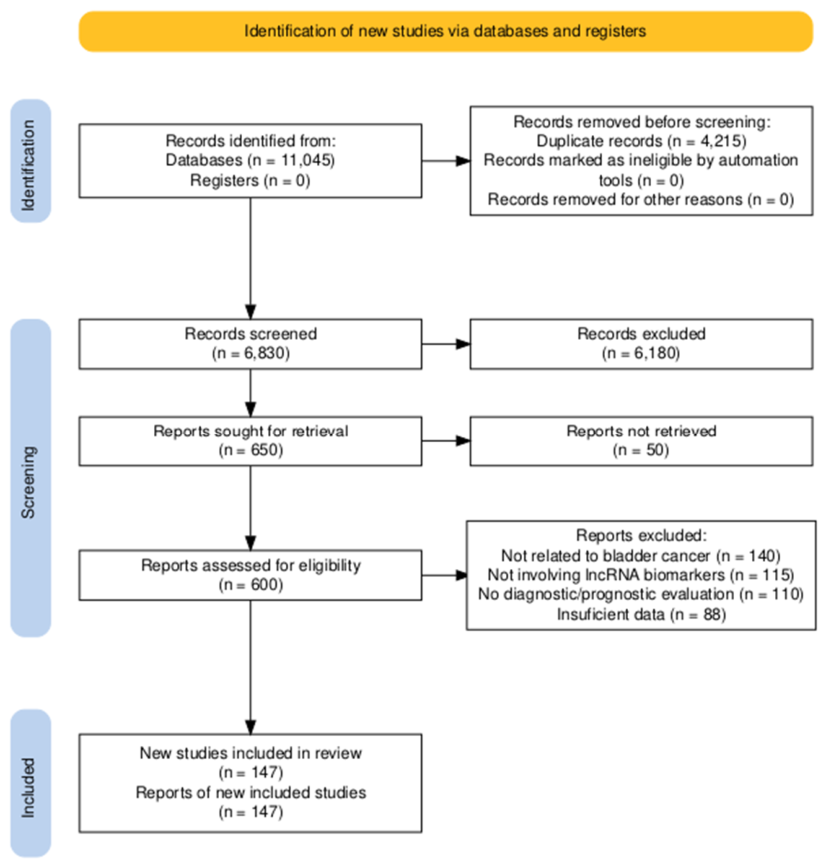
Figure 2.
Mechanistic roles of selected lncRNAs in bladder cancer progression. Image provided by Servier Medical Art (https://smart.servier.com/), licensed under CC BY 4.0 (https://creativecommons.org/licenses/by/4.0/). (A) HOTAIR mediates PRC2-dependent H3K27 trimethylation and tumor suppressor genes silencing. (B) UCA1, MALAT1, and MST1P2 act as miRNA sponges regulating glycolysis, angiogenesis or proliferation. (C) NEAT1 and FGFR-AS1 modulate Wnt/β-catenin and FGFR3 signaling. Together, these mechanisms drive malignant phenotypes. Abbreviations: lncRNAs, long non-coding RNA; ceRNA, competing endogenous RNA; PRC2, polycomb repressive complex 2; H3K27, histone H3 lysine 27; FGFR3, fibroblast growth factor receptor 3.
Figure 2.
Mechanistic roles of selected lncRNAs in bladder cancer progression. Image provided by Servier Medical Art (https://smart.servier.com/), licensed under CC BY 4.0 (https://creativecommons.org/licenses/by/4.0/). (A) HOTAIR mediates PRC2-dependent H3K27 trimethylation and tumor suppressor genes silencing. (B) UCA1, MALAT1, and MST1P2 act as miRNA sponges regulating glycolysis, angiogenesis or proliferation. (C) NEAT1 and FGFR-AS1 modulate Wnt/β-catenin and FGFR3 signaling. Together, these mechanisms drive malignant phenotypes. Abbreviations: lncRNAs, long non-coding RNA; ceRNA, competing endogenous RNA; PRC2, polycomb repressive complex 2; H3K27, histone H3 lysine 27; FGFR3, fibroblast growth factor receptor 3.
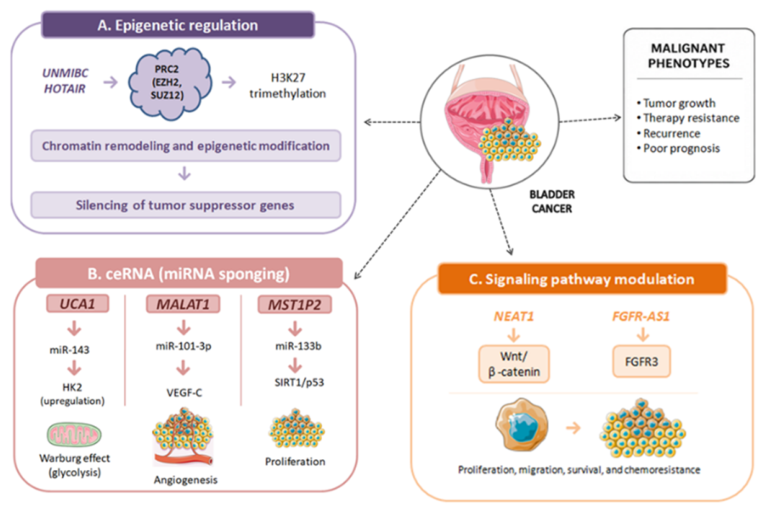

Table 1.
lncRNA-based biomarker panels tested for the diagnosis and prognosis of bladder cancer.
| Panel | Biological material/ model |
Clinical application | Diagnostic performance | Ref. |
|---|---|---|---|---|
| G023016, RP11-553N19.1, LINC0087 | Serum exosomes; NMIBC patients | Diagnosis of NMIBC | AUC = 0.809–0.827 | [67] |
| MALAT1, PCAT-1, SPRY4-IT1 | Urinary extracellular vesicles (uEVs); BC patients vs controls |
Diagnosis and recurrence prediction | AUC up to 0.854 Recurrence is associated with PCAT-1 and MALAT1 |
[91] |
| UCA1-201, HOTAIR, HYMA1, MALAT1 | Urinary cell-free RNA; BC vs cystitis | Differential diagnosis | Sensitivity = 95.7%; specificity = 94.3% | [95] |
| RMRP, UCA1, MALAT1 | Urinary extracellular vesicles (uEVs); BC patients vs controls | Diagnosis of BC | AUC = 0.875 (SVM model) | [97] |
| uc004cox.4 + GAS5 | Urinary cell-free RNA; BC patients vs controls |
Diagnosis and prognosis | AUC = 0.885 Outperforms urine cytology; associated with poor recurrence-free survival (RFS) in NMIBC |
[99] |
| CCDC148-AS1, XLOC_006419, RP5-1148A21.3 | Urinary extracellular vesicles (uEVs); NMIBC patients | Diagnosis of NMIBC | AUC up to 0.873 outperforms urine cytology |
[15] |
| MALAT1, SCARNA10, LINC00963, LINC01578 | Urinary extracellular vesicles (uEVs); BC patients | Diagnosis (BC and high-grade tumours) | AUC = 0.900 (BC) AUC = 0.917 (high-grade) |
[45] |
| PCAT-1, UBC1, SNHG16 | Serum; BC patients vs controls | Diagnosis and recurrence prediction | AUC up to 0.857 UBC1 associated with recurrence risk |
[108] |
Abbreviations: lncRNA, long non-coding RNA; BC, bladder cancer; NMIBC, non–muscle-invasive bladder cancer; uEVs, urinary extracellular vesicles; AUC, area under the curve; SVM, support vector machine; RFS, recurrence-free survival8. Integrating lncRNAs into clinical pathways.
Table 2.
Long non-coding RNAs in bladder cancer: mechanisms and clinical relevance.9. Limitations, gaps, and future perspectives.
Table 2.
Long non-coding RNAs in bladder cancer: mechanisms and clinical relevance.9. Limitations, gaps, and future perspectives.
| lncRNA | Biological material/ model | Expression | Mechanism | Functional role/ clinical relevance | References |
|---|---|---|---|---|---|
| UNMIBC | NMIBC tissues; BC cell lines; xenograft model | ↑ | PRC2/EZH2-mediated epigenetic regulation | Promotes tumour growth and is associated with recurrence | [52] |
| UCA1 | BC cell lines | ↑ | ceRNA mechanism via miR-143 regulating glycolysis | Enhances glycolysis (Warburg effect), proliferation, and tumour progression | [82] |
| TERC | Urinary exosomes (BC vs controls) | ↑ | T Telomerase-associated regulation (TERC/TERT axis) |
Diagnostic and prognostic biomarker | [74] |
| SNHG16 | Urinary exosomes (BC vs healthy); BC cell lines | ↑ | Not fully elucidated | Tumour-promoting, potential diagnostics biomarker | [16] |
| SUMO1P3 | Urine samples (NMIBC/MIBC) | ↑ | miRNA-mediated regulatory axis (miR-320a) | Associated with tumour aggressiveness and progression | [88] |
| HOTAIR | NMIBC/ MIBC tissues; TCGA datasets; BC cell lines | ↑ | PRC2/EZH2-mediated epigenetic regulation | Associated with recurrence and poor overall survival | [105] |
| PVT1 | MIBC tissues | ↑ | Not fully elucidated | Associated with advanced stage, metastasis, and Poor prognosis | [110] |
| MIR4435-2HG | TCGA and MiTranscriptome datasets; NMIBC/ MIBC cohorts | ↑ | Not fully elucidated | Prognostic biomarker, associated with response to BCG therapy | [113] |
| BCYRN1 | BC cell lines | ↑ | Cell cycle–associated regulation | Promotes proliferation and invasion | [115] |
| MST1P2 | Cisplatin-resistant BC cell lines | ↑ | miR-133b/SIRT1/p53 signalling axis |
Mediates cisplatin resistance | [116] |
| LINC00857 | TCGA and MiTranscriptome datasets; BC cell lines | ↑ | LMAN1-associated regulation | Associated with chemoresistance and poor prognosis | [117] |
| MALAT1 | BC tissues; BC cell lines | ↑ | miR-101-3p/VEGF-C signalling axis |
Promotes cisplatin resistance | [92,119] |
| NEAT1 | Cisplatin-sensitive/ resistant BC cells | ↑ | Wnt/β-catenin signalling pathway |
Contributes to chemoresistance | [120] |
| TUG1 | BC tissues; irradiated cells; xenograft model | ↑ | HMGB1-mediated regulation | Induces radioresistance | [123] |
| MAFG-AS1 | Extracellular vesicles (EVs); BC tissues; pembrolizumab-treated patients | ↑ | Immune/ tumour microenvironment-associated regulation | predicts poor response to immunotherapy | [131] |
| FGFR-AS1 | BC tissues; BC cell lines | ↑ | FGFR3-associated regulation | Promotes proliferation, migration, and tumour progression | [132] |
Abbreviations: lncRNA, long non-coding RNA ; BC, bladder cancer; NMIBC, non-muscle invasive bladder cancer; MIBC, muscle invasive bladder cancer; TCGA, The Cancer Genome Atlas; BCG, Bacillus Calmette–Guérin; PRC2, Polycomb Repressive Complex 2; EZH2, Enhancer of Zeste Homolog 2; ceRNA, competing endogenous RNA; miRNA (miR), microRNA; TERC, telomerase RNA component; TERT, telomerase reverse transcriptase; VEGF-C, vascular endothelial growth factor C; SIRT1, sirtuin 1; HMGB1, high mobility group box 1; FGFR3, fibroblast growth factor receptor 3; LMAN1, lectin mannose binding 1; EVs, extracellular vesicles; ↑, upregulation.
Disclaimer/Publisher’s Note: The statements, opinions and data contained in all publications are solely those of the individual author(s) and contributor(s) and not of MDPI and/or the editor(s). MDPI and/or the editor(s) disclaim responsibility for any injury to people or property resulting from any ideas, methods, instructions or products referred to in the content. |
© 2026 by the authors. Licensee MDPI, Basel, Switzerland. This article is an open access article distributed under the terms and conditions of the Creative Commons Attribution (CC BY) license (http://creativecommons.org/licenses/by/4.0/).
Copyright: This open access article is published under a Creative Commons CC BY 4.0 license, which permit the free download, distribution, and reuse, provided that the author and preprint are cited in any reuse.