
Submitted:
21 June 2026
Posted:
23 June 2026
You are already at the latest version
Abstract
Rapid urbanization along transportation corridors is a key driver of land transformation and landscape homogenization in developing mega-cities. This study analyzes land use and land cover (LULC) change within a 5-km buffer, from Gulberg to T-Chowk, along the Islamabad Expressway, Pakistan, from 2010 to 2024, using multi-temporal Landsat imagery (2010, 2015, 2020, 2024) and landscape metrics. Built-up area increased by 190.8% (51.02 to 148.34 km2) between 2010 and 2024. The expansion is accompanied by sharp declines in vegetation (−36.0%; 89.17 to 57.06 km2), barren land (−93.8%; 63.88 to 3.94 km2), and water bodies (−64.2%; 8.20 to 2.93 km2). All class-area estimates were derived from the R landscapemetrics pipeline and independently verified against visual inspection of the classified rasters, confirming correct class labelling throughout. Landscape structure shifted towards homogenization, with Shannon’s Diversity Index decreasing from 1.19 to 0.74, Patch Density from 74.39 to 21.08 patches per 100 ha, and Edge Density from 219.65 to 99.78 m/ha. LULC maps achieved an accuracy greater than 96% (κ>0.96), it was performed separately for all classified LULC maps ( 2010, 2015, 2020, and 2024) using confusion/error matrices generated from validation samples for each year, and metric estimates showed cross-platform agreement between R and FRAGSTATS within ±5%. These findings indicate rapid corridor-scale consolidation associated with infrastructure-led growth, reducing landscape heterogeneity and potentially weakening ecological resilience. Unlike previous city-scale studies in the Islamabad–Rawalpindi region, this study adopts a transportation-corridor perspective to quantify both land-cover change and ecological fragmentation. The study underscores the necessity for integrated, corridor-scale land-use governance to balance urban expansion with ecosystem sustainability.
Keywords:
urban sprawl
; remote sensing
; landscape metrics
; Islamabad Expressway
; land use and land cover (LULC)
; Landsat imagery
; landscape homogenization
; Pakistan
; ecological resilience
1. Introduction
More than half of the world’s population now lives in urban areas, a proportion expected to continue rising especially in Asia and Africa, making urbanization one of the most transformative trends of the 21st century (Chen et al., 2014). This growth spurs infrastructure development and economic opportunities, but also exacerbates environmental stresses including resource depletion, biodiversity loss, and climatic variability (Seto et al., 2012). These impacts are particularly pronounced in low- and middle-income countries (LMICs), where the pace of urban expansion frequently exceeds planning, regulatory, and infrastructural capacity (Seto et al., 2012; United Nations, 2020). Across South Asia, urban growth has largely occurred through the conversion of agricultural land, vegetated areas, and wetlands into built-up and barren surfaces, altering surface hydrology, ecosystem structure, and landscape functionality. In Pakistan, satellite-based studies consistently report substantial declines in urban and peri-urban vegetation cover alongside increases in impervious and barren land, reflecting both planned and informal urban expansion (Estoque et al., 2021; Haque & Basak, 2017; Khan et al., 2023). Urban regeneration efforts in LMICs often face critical institutional and stakeholder-related barriers, which hinder sustainable planning and exacerbate the challenges of rapid urban expansion (Liao & Liu, 2023). Recent studies using remote sensing and predictive modelling have revealed substantial LULC changes in rapidly urbanizing cities, with classification accuracies exceeding 85% (). These studies project an increase in built-up area of approximately 8.4 km2 by 2040, primarily at the expense of protected ( km2) and agricultural land ( km2), highlighting the accelerating urban sprawl and its implications for sustainable urban development (Mehra & Swain, 2024). Remote sensing analyses have documented rapid, infrastructure-driven urban expansion in Islamabad, particularly along major transport corridors. Transportation infrastructure and urban expansion are widely recognized as major drivers of landscape fragmentation, reducing habitat continuity and altering ecological processes across rapidly urbanizing regions (Bierwagen, 2005; Trocmé et al., 2003). Using multi-temporal Landsat imagery, previous studies have reported substantial increases in built-up and impervious surface areas in Islamabad, primarily driven by transportation development and real estate expansion, accompanied by declining vegetation health and increasing ecological fragmentation (Khalid et al., 2020). Islamabad, Pakistan’s purpose-built capital, offers a telling example of these challenges. The city’s master plan, originally developed in the 1960s, is now under strain as metropolitan growth accelerates (Haaland and van den Bosch, 2015). The Capital Development Authority (CDA)—responsible for urban planning—faces significant hurdles in managing this expansion, including the development of new residential and commercial sectors, modernization of infrastructure, and provision of essential services (e.g., water supply and waste management) necessary for sustainability (Haaland and van den Bosch, 2015). Historically, the Islamabad Expressway corridor was characterized by mixed land uses such as agriculture and sparse settlements. In recent decades, however, population growth and economic pressures have driven extensive urbanization and infrastructure development along this corridor, largely triggered by the expressway’s expansion and improved connectivity (Qureshi, 2010). GIS and remote sensing have become essential tools for tracking these land transitions, allowing researchers to more precisely follow changes in LULC (Baig et al., 2022). Effective spatiotemporal study of urbanization trends is made possible by the integration of multi-temporal satellite images, especially from the Landsat missions (Khan et al., 2013; Weng, 2009). The continuity of Landsat observations has been critical for monitoring land surface changes over time, providing consistent and reliable data for analyzing urban expansion and environmental transformations (Wulder et al., 2011). While numerous LULC studies have examined rapid urban transformation in highly urbanized Pakistani cities such as Karachi and Lahore, infrastructure-led growth corridors remain comparatively underexplored. Despite its strategic role in shaping metropolitan expansion, the Islamabad Expressway corridor lacks long-term, data-driven environmental assessment, even as Pakistan’s urban population is projected to approach parity with its rural population by around 2030, intensifying pressure on land and natural resources. Given the role of major transport corridors in structuring metropolitan expansion in LMIC contexts, analysing the Islamabad Expressway provides a critical opportunity to capture how linear infrastructure reshapes water vegetation, built-up, and barren land dynamics at the urban–peri-urban interface (Liao & Liu, 2023; United Nations, 2020). The settlement land in the Islamabad Capital Territory expanded at an annual rate of up to 8.79% during 2000–2010, while tree cover declined by 0.77–0.81% per year and core forest areas (>500 acres) contracted from 392 km2 to 241 km2, indicating intensified fragmentation. The post-2000 increase in the land consumption rate relative to population growth (LCRPGR = 1.36) further reflects increasingly land-intensive urban growth, reinforcing the need for corridor-scale assessment of expressway-driven expansion (Gilani et al., 2020). Pakistan provides a notable example of capital relocation, with the administrative centre moving from Karachi, the historic port city, to the purpose-built Islamabad Capital Territory (ICT). As the city expands beyond its original plan, the CDA faces growing pressure to extend infrastructure and maintain basic environmental conditions, underscoring the need for evidence-based, corridor-scale land-use governance (Haaland and van den Bosch, 2015). Historically, the Islamabad Expressway corridor consisted of agriculture and sparse settlements, but in recent decades, population growth and economic development combined with the Expressway’s expansion have driven extensive urbanization and infrastructure development along this corridor. Despite its strategic importance as a transport artery and growth axis for the Islamabad–Rawalpindi metropolitan area, the Islamabad Expressway corridor has received limited long-term, quantitative assessment of land use and environmental change (Tilahun et al., 2022). No prior study has quantitatively integrated landscape fragmentation metrics with long-term urban expansion assessment along this rapidly developing peri-urban transportation corridor, leaving a critical gap in understanding how infrastructure-driven growth reshapes land cover composition, spatial configuration, and ecological continuity at the corridor scale. This study addresses that gap by quantifying the extent and ecological consequences of urban expansion along the Islamabad Expressway from 2010 to 2024. Previous studies in Islamabad and Rawalpindi have primarily focused on city-scale land-use change detection, urban growth quantification, population-driven expansion, or future growth prediction. While these studies documented substantial increases in built-up land, they rarely examined how transportation-corridor-driven urbanization alters landscape configuration, ecological connectivity, and vegetation fragmentation. Furthermore, advanced landscape ecological metrics such as COHESION, CONTAG, and LPI have seldom been applied in the Islamabad–Rawalpindi metropolitan region, leaving important questions regarding ecological resilience and corridor-scale sustainability unanswered. We apply a cross-validated, multi-platform approach using multi-temporal Landsat imagery and landscape ecological metrics to ensure robust, reproducible findings. Specifically, we examine how rapid peri-urban growth has altered the composition and configuration of key landscape elements—built-up areas, vegetation, barren land, and water bodies—and evaluate the broader environmental and planning implications of these LULC transformations. By treating the expressway corridor as the analytical unit, the work functions as a corridor-scale impact assessment of infrastructure-led urbanization. This study contributes by integrating multi-temporal Landsat classification with landscape ecological metrics to evaluate the spatial consequences of transportation-driven urban expansion, providing an empirical foundation for evidence-based land-use governance aligned with SDG 11 (Sustainable Cities and Communities) and SDG 15 (Life on Land) (Paul, 2021; United Nations, 2019).
2. Materials and Methods
2.1. Study Area
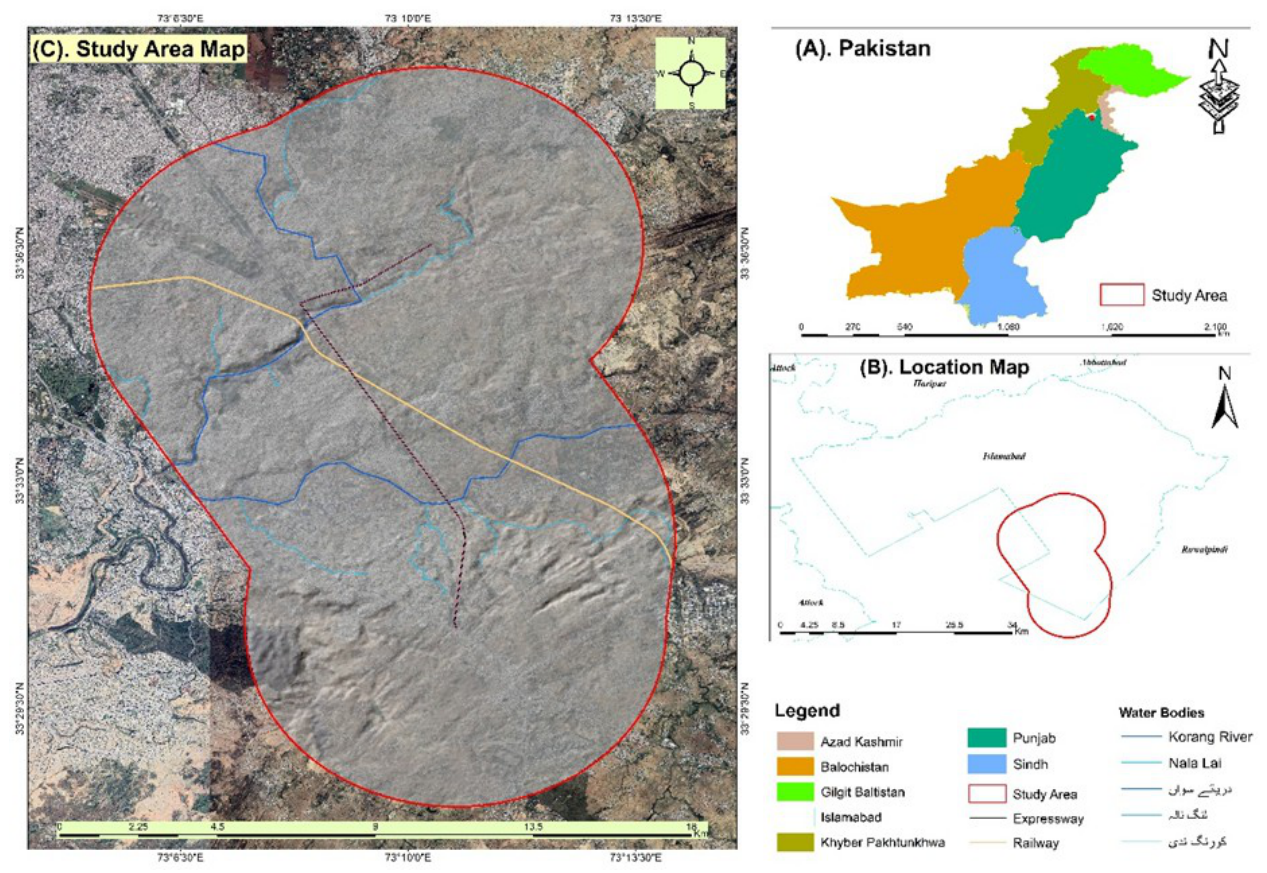
The research focuses on a 5-kilometer buffer zone along the Islamabad Expressway in Pakistan’s Islamabad Capital Territory. The Expressway connects Islamabad and Rawalpindi’s major areas, running from Gulberg Greens to T-Chowk. This region has seen significant urban growth in the recent decade, spurred by infrastructural development and the expansion of housing societies, making it an ideal location to study LULC changes. In recent years, this corridor has undergone substantial land use and land cover transformations, driven by rapid infrastructural expansion and urban sprawl trends effectively captured through remote sensing and predictive modelling techniques Hassan et al. (2016). Similar patterns of transportation-driven urban expansion and landscape transformation have also been reported in other rapidly developing South Asian metropolitan regions, including Kolkata, where remote sensing analyses revealed significant peri-urban growth and spatial restructuring (Mehra & Swain, 2024). Geographically, the study area lies on the Potohar Plateau, an elevated region characterized by rolling terrain with silty clay soils, rocky outcrops, and patches of natural scrub vegetation. Elevation ranges from about 400 to 600 meters above sea level. This geomorphological diversity influences ecological patterns: variations in landforms correspond to differences in vegetation distribution and conservation potential. The valleys and gentle slopes of the plateau historically supported agriculture and open forests, while steeper sections remained scrub or grassland (Khan et al., 2013). The geomorphological diversity of the Potohar Plateau plays a crucial role in the shaping of ecological patterns, as variations in landforms significantly influence vegetation distribution and conservation potential (Voogt and Oke, 2003). In terms of hydrology, the region is supported by two important rivers, the Korang and the Soan, which have ecological roles in addition to providing vital water supplies for nearby peri-urban areas (Liao & Liu, 2023). The buffer zone includes numerous fast-rising housing societies, including Soan Gardens, Bahria Town, Gulberg Greens, Jinnah Gardens, Naval Anchorage, and Defence Housing Society (DHA) Islamabad. These developments have been driven by population growth, increasing demand for residential and commercial real estate, and improved transportation connectivity via the Islamabad Expressway (Haq et al., 2010; Khan and Sudheer, 2022). Furthermore, the region serves as a transitional zone between urban and peri-urban regions, providing a dynamic context for investigating spatiotemporal variations in LULC. An essential piece of infrastructure, the Islamabad Expressway links the capital with important residential and commercial areas. Rapid urbanization and its strategic importance have caused significant shifts in land use patterns, such as deforestation, the loss of agricultural land, and the decline of water bodies (Baig et al., 2022; Weng, 2009). Prior to 2010, land use along the expressway comprised a mosaic of farmland, orchards, small villages, and intermittent wetlands associated with the Soan River and other streams. Since 2010, rapid population influx and real-estate development have led to large housing schemes (e.g., Bahria Town, Gulberg Greens) proliferating along the road. These developments have encroached into former agricultural and natural lands, reflecting a broader trend of peri-urban expansion seen in other South Asian metropolitan fringes. By 2024, the landscape of the corridor is dominated by urban and suburban land uses, raising concerns about habitat loss, surface runoff changes, and other environmental impacts of this unplanned growth.
Figure 1.
Geographical extent of the study area delineating the Islamabad Expressway corridor and adjoining urban and peri-urban zones considered for LULC change detection.
Figure 1.
Geographical extent of the study area delineating the Islamabad Expressway corridor and adjoining urban and peri-urban zones considered for LULC change detection.
2.2. Satellite Data Acquisition, Preprocessing, and Classification
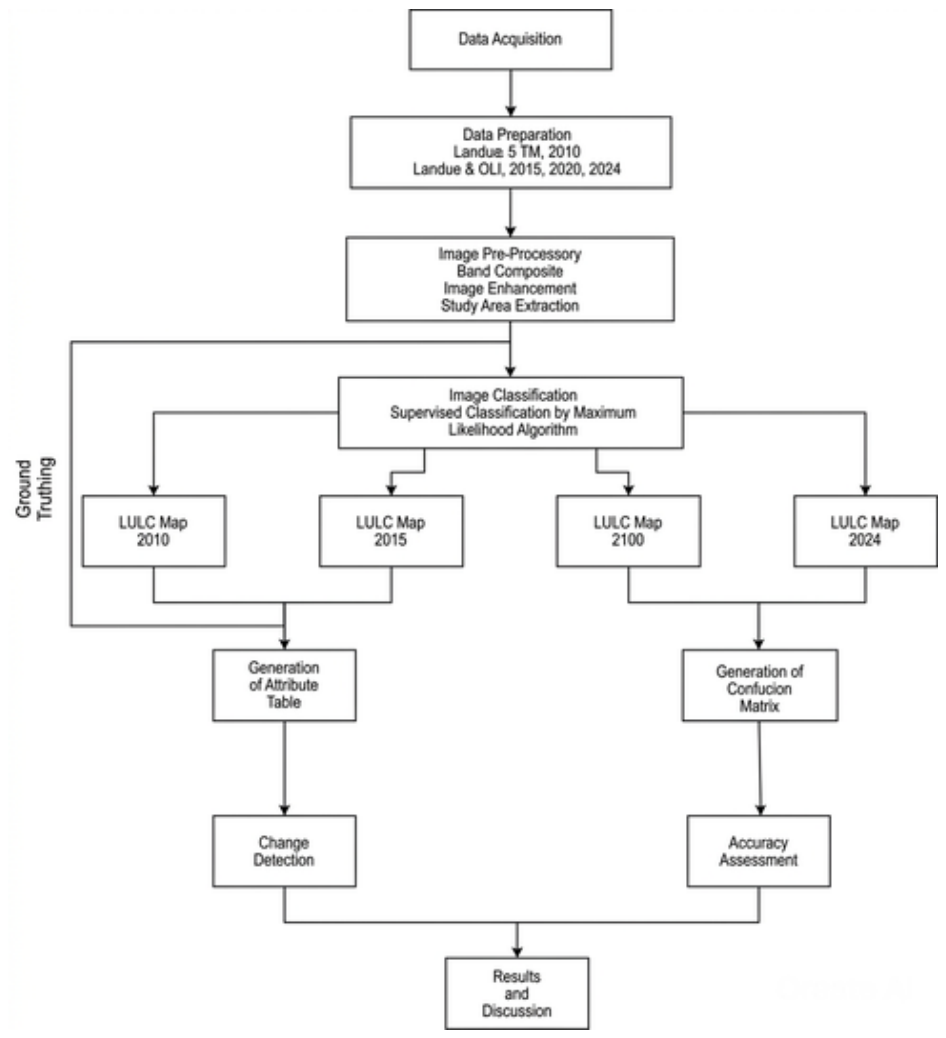
To analyze LULC changes, we acquired multi-temporal satellite imagery from the Landsat mission archives. Specifically, cloud-free images (cloud cover <10%) from Landsat 5 Thematic Mapper (TM; 30 m spatial resolution) for 2010, and Landsat 8 Operational Land Imager (OLI; 30 m spatial resolution) for 2015, 2020 and 2024, were obtained for four representative years, accessed through the United States Geological Survey’s (USGS) Earth Explorer platform (USGS, 2025). The 30 m spatial resolution was deemed appropriate for regional-scale LULC monitoring in this corridor, consistent with its established use in comparable peri-urban environments. All images were acquired during summer in June to minimize phenological variability and cloud contamination. Standard preprocessing steps were applied in ArcGIS 10.8, including the the use of the nine bands two of which are thermal bands in the Landsat-8 Surface Reflectance Tier dataset, atmospheric correction using the Landsat-8 Surface Reflectance Code (LASRC) method, geometric co-registration to a common universal transverse Mercator (UTM) Zone 43N coordinate system (WGS84 datum, resampled to 30 m), and clipping to the 5 km corridor buffer as the Area of Interest (AOI). The study applied a time-series approach to classify four major LULC categories: urban areas, vegetation, barren land, and water bodies. A supervised classification method using the Maximum Likelihood Classifier (MLC) was selected due to its robustness in handling class variances and covariances, particularly in complex urban environments (Baig et al., 2022). Initial visual assessment of the imagery confirmed major land cover categories present: water bodies (rivers, reservoirs), vegetation (cropland, grassland, forest patches), barren land (soil, open ground), and built-up/urban areas. These four LULC classes were defined for classification. Signature samples for each class were collected on the basis of field knowledge and high-resolution Google Earth observations around 2010 and 2020, ensuring representation of the spectral variability.
2.3. Classification and Accuracy Assessment
Land cover classification was performed on each year’s Landsat image using a supervised classification approach. We employed the Maximum Likelihood Classifier, which was chosen for its robustness in handling class variance-covariance structures in complex urban landscapes. Training data for the classifier comprised a total of 200 sample polygons distributed across the four LULC classes (50 samples per class). These training samples were selected by interpreting the imagery in combination with ground truth points collected during field visits and high-resolution imagery. Following classification, we produced LULC maps for 2010, 2015, 2020, and 2024. An independent validation was conducted using a stratified random sample of 200 ground reference points (50 per class) for each map. Reference land cover for these points was determined from field surveys and high-resolution satellite imagery (e.g., SPOT and PlanetScope) close to the target years. A confusion matrix was then generated for each classification to compute accuracy metrics. The overall classification accuracy exceeded 96% for all years, with Kappa coefficient values above 0.96, indicating excellent agreement. It was performed separately for all classified LULC maps using confusion/error matrices generated from validation samples for each year. Minor confusion occurred between barren land and built-up in some instances (e.g., cleared construction sites misidentified as bare ground), but these did not significantly impact overall accuracy. The high accuracy levels attest that the mapping is reliable for subsequent change analysis.
Figure 2.
Conceptual workflow of the LULC change detection process, outlining data acquisition, preprocessing, supervised classification, accuracy assessment, and validation steps.
Figure 2.
Conceptual workflow of the LULC change detection process, outlining data acquisition, preprocessing, supervised classification, accuracy assessment, and validation steps.
2.4. Landscape Metrics Calculation and Validation
Landscape metrics were selected to capture three complementary dimensions of landscape change: composition, configuration, and connectivity. At the landscape level, Shannon’s Diversity Index (SHDI) and Shannon Evenness Index (SHEI) quantified overall class balance, Contagion Index (CONTAG) measured the degree of patch aggregation, and Landscape Shape Index (LSI) captured edge complexity. At the class level, Percentage of Landscape (PLAND) tracked proportional composition; Largest Patch Index (LPI) measured the dominance of the single largest patch; class-level Patch Density (PD) quantified fragmentation intensity; Patch Cohesion Index (COHESION) assessed the physical connectedness of patches; and Mean Fractal Dimension (FRAC_MN) distinguished geometrically regular planned development from irregular informal growth. All metrics were computed using the landscapemetrics package in R (v4.2) and independently verified against FRAGSTATS (v4.2) outputs, with cross-platform agreement within ±5%. For each year, metrics were first computed in R based on the rasterized LULC maps (30 m resolution, UTM Zone 43N). An equivalent analysis was then performed in FRAGSTATS (v4.2) using the same maps and class definitions. The cross-platform comparison confirmed that all metric values agreed within a ±5% margin, validating the reliability of the R-based approach. For example, 2010 landscape metrics of SHDI, PD, and ED derived in R were 1.19, 74.39 patches/100 ha, and 219.65 m/ha, respectively, closely matching FRAGSTATS outputs (differences well below 5%). This multi-platform validation ensured that computational errors or software-specific differences did not affect the results.
All spatial analyses and statistical computations were executed using a combination of ArcGIS 10.8, and R (version 4.2) on a standard PC. GIS software was primarily used for image pre-processing, map production, and zonal calculations, while R (version 4.2) was used for landscape metric calculations, tabulation of class areas, and graphical visualization, while ArcGIS 10.8 was used for image preprocessing and map production. This integrated approach leverages the strengths of each platform and enhances confidence in the findings through cross-verification.
3. Results and Analysis
3.1. Landscape Metrics and Land Cover Dynamics (2010–2024)
3.1.1. Urban Expansion
Built-up area expanded from 51.02 km2 in 2010 to 148.34 km2 in 2024, representing a 190.8% increase over the study period (Table 1). Growth was concentrated along the northern and eastern edges of the expressway, encroaching progressively upon former agricultural land. High-density consolidation was particularly pronounced around the large formalised housing schemes of Bahria Town, DHA Islamabad, and Gulberg Greens. The period 2010–2015 registered the most rapid phase of change, coinciding with large-scale infrastructure and real estate investment along the corridor (Khan and Sudheer, 2022). This pattern of concentrated, developer-driven expansion is consistent with the low and stable Urban FRAC_MN values (≈1.04) reported in the class-level metrics, indicative of geometrically regular, planned development rather than informal infill.
3.1.2. Vegetation Cover Decline and Spatial Heterogeneity
Vegetation cover declined by 36.0% over the study period, with the most severe losses concentrated in transition zones between expanding urban areas and former agricultural land in the central and southern sectors. Beyond the areal reduction, remaining green spaces became increasingly fragmented, as reflected in a decline in average patch size from 2.3 km2 to 1.1 km2 and a collapse of Vegetation LPI from 14.44 to 2.96—indicating that no large, contiguous green patch remains intact within the corridor. This progressive isolation of residual vegetation reduces ecological corridor functionality, limits species movement, and weakens the landscape’s capacity to provide regulating ecosystem services such as carbon sequestration and microclimate buffering. The observed decline in vegetation area alongside rapid built-up expansion suggests that urban growth has been a major driver of green cover loss within the corridor, consistent with findings reported in previous studies (Kalnay & Cai, 2003; Lambin et al., 2003).
3.1.3. Barren Land Transformation
Barren land underwent near-complete conversion over the study period, declining by 93.8% from 63.88 km2 in 2010 to 3.94 km2 in 2024. Spatially, the most substantial losses occurred in the western and southwestern sectors, where new housing schemes progressively replaced open natural terrain (Dewan & Yamaguchi, 2009). The conversion was particularly concentrated between 2020 and 2024, when approximately 84% of remaining barren land was built upon, coinciding with a major construction phase across the corridor. While barren land carries lower ecological value than vegetated surfaces, its conversion to impervious cover reduces groundwater infiltration capacity and increases surface runoff, with cumulative consequences for local hydrology and flood risk (Roy et al., 2014).
3.1.4. Water Body Depletion and Hydrological Impacts
Surface water bodies declined by 64.2% over the full study period, with the most substantial losses concentrated near the Korang and Soan rivers, where urban development encroached directly upon riparian margins (Zaman et al., 2019; Zhou et al., 2017). Three reservoirs in the northern zone, totalling approximately 3.2 km2, were lost entirely. The observed decline in water body extent alongside urban expansion suggests that built-up growth has contributed to the displacement of surface water resources within the corridor. The ecological and hydrological implications are significant: declining riparian cover reduces groundwater recharge, degrades aquatic habitat, and raises the risk of flash flooding during peak monsoon periods, particularly in a corridor where impervious surface now dominates (Elmqvist et al., 2015).
3.1.5. Urbanization Hotspots and Development Corridors
Spatial analysis identified three primary zones of concentrated urban growth: Bahria Town, DHA Islamabad, and Gulberg Greens. Bahria Town recorded the highest rate of land transformation, with approximately 89% of land transitioning from agricultural or barren cover to urban infrastructure. DHA Islamabad followed with a 76% conversion rate, and Gulberg Greens reached 54% by 2024. Collectively, these three developments accounted for 78% of the total urban expansion, indicating a clustered rather than dispersed pattern of growth. This spatial concentration—characteristic of large formalised housing schemes operating outside comprehensive land-use planning frameworks—creates both infrastructure management challenges and opportunities for targeted conservation and green buffer interventions in the remaining open land (Angel et al., 2011; Chen et al., 2014).
3.1.6. Ecological and Social Implications
These land cover transformations carry significant environmental and social consequences. Progressive vegetation loss diminishes carbon storage capacity, degrades air quality regulation, and reduces the temperature buffering effect of green cover in an increasingly impervious landscape. The fragmentation of residual green patches into smaller, isolated units compromises biodiversity corridors and limits species movement across the landscape (Bennett, 2003; Kim and Pauleit, 2005). The concurrent decline in agricultural land poses risks to local food security and the livelihoods of peri-urban farming communities, mirroring patterns documented in other rapidly developing South Asian contexts where peri-urban agriculture has retreated under development pressure (Rasul & Thapa, 2004; Tewolde & Cabral, 2011). The loss of surface water bodies further exacerbates these pressures by reducing groundwater recharge and degrading drainage capacity, raising the risk of water scarcity and monsoon flooding in a corridor now dominated by impervious surfaces (Gilani et al., 2020; Khan et al., 2023). Table 1 summarizes class-level area changes, while Figure 3 illustrates their spatial distribution across the corridor.
3.1.7. Land Use and Cover Changes
The analysis revealed substantial changes across all LULC categories over the study period, as summarized in Table 2. The corridor underwent progressive landscape transformation characterized by rapid urban expansion and concurrent decline across all natural and semi-natural land cover classes.
3.2. Landscape Metrics and Spatial Pattern Analysis
Quantitative landscape metrics corroborate the compositional changes described above, revealing a systematic simplification and homogenization of the corridor’s spatial structure over time (Table 3, Figure 4). The consistent decline in SHDI, PD, and ED collectively reflects reduced spatial heterogeneity and progressive urban consolidation. The declining CONTAG values in 2010–2015 followed by a marked increase to 56.83 by 2024 indicate that land cover classes—previously intermixed as a fine-grained patchwork—progressively disaggregated and then consolidated into large, clumped, homogeneous urban blocks. The substantial reduction in Edge Density signals that the interface between different land cover types has contracted sharply, consistent with large homogeneous urban expanses replacing what was formerly a diverse mosaic of fields, tree groves, and open spaces. By 2024, the landscape had transitioned from a heterogeneous multi-class mosaic into a near-continuous urban surface with markedly fewer ecotones. At the landscape level, SHDI declined from 1.194 to 0.737 (Table 3), reflecting a shift from a relatively balanced four-class mosaic towards a single-class dominated configuration. The corresponding fall in SHEI (0.861 to 0.531) confirms the loss of compositional evenness as urban land came to dominate. The increase in CONTAG from 23.88% to 56.83% indicates increasing spatial aggregation of the dominant urban class—a quantitative signature of patch coalescence as previously separate housing developments merged into a near-continuous built-up surface. The decline in LSI (81.20 to 37.57) reflects a reduction in total boundary complexity consistent with the simplification of a multi-class mosaic into a predominantly single-class landscape. Together, these metrics confirm a progressive and spatially coherent transition from landscape heterogeneity to urban homogeneity across the corridor.
Class-level configuration metrics also indicate a pronounced loss of fragmentation in certain classes. Patch Density (PD) for urban land increased initially as new urban patches sprang up, but by 2024 it decreased markedly at the landscape scale (from 74.39 to 21.08 patches per 100 ha overall) because many small patches coalesced into continuous expanses of built-up area. At the class level, Urban PLAND increased from 24.03% in 2010 to 69.88% in 2024, while Urban LPI rose significantly from 16.39 to 67.60 (Table 4). This trajectory indicates that by 2024 a single continuous urban patch occupied more than two-thirds of the entire corridor — a clear signature of patch coalescence driven by the merging of previously separate housing developments. Urban Patch Density simultaneously declined from 19.69 to 4.21 patches per 100 ha, confirming that scattered settlements fused into a consolidated urban mass rather than expanding through diffuse infill. Urban COHESION remained near-maximum throughout (99.10 to 99.91), reflecting the high internal connectivity of urban infrastructure. Urban FRAC_MN values remained low and stable (1.035–1.049), indicative of geometrically regular, planned development patterns consistent with the large formalised housing schemes (Bahria Town, DHA Islamabad, Gulberg Greens) that dominated growth along the corridor. Vegetation PLAND declined from 42.01% to 26.88% over the study period, while Vegetation LPI collapsed from 14.44 to 2.96, indicating that the largest contiguous green patch shrank from covering approximately one-seventh of the corridor to less than 3% of its area (Table 4). Vegetation Patch Density declined from 12.30 to 7.82 between 2010 and 2015 as many small patches were eliminated, before a partial recovery to 9.06 by 2024 as remaining vegetation became more fragmented into smaller, dispersed units. Vegetation COHESION declined from 99.12 to 97.11, signalling a reduction in the physical connectedness of green patches and the progressive isolation of residual vegetation fragments — a condition that reduces ecological corridor functionality and inhibits species movement across the landscape. FRAC_MN values for vegetation remained stable near 1.047–1.051, reflecting the naturally irregular, complex geometry of remnant scrub and riparian vegetation patches. Barren land declined sharply from 63.88 km2 (30.09% of corridor) in 2010 to 3.94 km2 (1.86%) in 2024, with its LPI falling from 4.03 to 0.12, reflecting near-complete conversion to urban uses, particularly during the 2015–2020 construction boom. Water body area exhibited a non-monotonic pattern (8.20 km2 in 2010, 2.29 km2 in 2015, 8.37 km2 in 2020, 2.93 km2 in 2024). This oscillation is attributable to phenological and seasonal variation between acquisition dates rather than genuine inter-annual hydrological change, and is consistent with known limitations of medium-resolution Landsat imagery in capturing dynamic surface water in semi-arid peri-urban environments. Net water body loss over the full study period was 5.27 km2 (−64.2%), driven by urbanisation along the Korang and Soan river margins.
Overall, landscape metrics confirm that the corridor’s spatial structure has undergone fundamental simplification: land cover is now dominated by a single class with substantially fewer patches and lower boundary complexity. This implies diminished ecological niches and reduced habitat connectivity. By 2024, the Islamabad Expressway corridor exhibits the spatial signature of unregulated peri-urban expansion—expansive continuous urban land cover, minimal open space remnants, and low compositional diversity (Table 5, Figure 5).
Urban growth dynamics (Table 6, Figure 6) reveal that the built-up category increased by 97.32 km2 between 2010 and 2024, and by 47.65 km2 between 2015 and 2024. These results underscore a 47.3% urban expansion in the final decade, reflecting an acceleration of peri-urban growth and the progressive replacement of natural land covers. The computed landscape metrics thus quantitatively substantiate the observed conversion of a heterogeneous landscape mosaic into a consolidated urban structure.
4. Discussion
The 190.8% increase in built-up land along the Islamabad Expressway corridor between 2010 and 2024 represents one of the most rapid rates of corridor-scale peri-urban consolidation documented in Pakistan. This trajectory is driven by the intersection of infrastructure investment, speculative real estate activity, and institutional governance gaps within the Capital Development Authority, and reflects a broader pattern in which planned transport corridors catalyse unregulated land conversion in their surrounding buffers (Angel et al., 2011; Elmqvist et al., 2015). The spatial concentration of growth within large formalised housing schemes—Bahria Town, DHA Islamabad, and Gulberg Greens, which together account for approximately 78% of total expansion—distinguishes this process from diffuse informal sprawl and points instead to developer-driven consolidation operating ahead of regulatory capacity (Qureshi, 2010).
The progressive fragmentation and isolation of residual vegetation patches, documented through declining Vegetation LPI (14.44 to 2.96) and COHESION values, has direct ecological consequences. The collapse of large contiguous green patches eliminates the possibility of connected ecological corridors for fauna movement and reduces the landscape’s capacity to mitigate urban heat island intensification and absorb monsoon runoff. The reduction in carbon storage and disruption of microclimate regulation associated with vegetation loss further degrade environmental conditions in the peri-urban fringe, where such services are often the last line of ecological buffering between urban centres and natural hinterlands (Haase et al., 2013; Kalnay & Cai, 2003; Pauleit et al., 2005).
The landscape metric trajectory—SHDI declining from 1.194 to 0.737, CONTAG more than doubling, and LSI falling by over 50%—collectively confirms a fundamental structural transformation from a heterogeneous multi-class mosaic to a near-homogeneous urban surface. These declining diversity and increasing contagion values indicate not merely spatial change but a progressive loss of ecological redundancy: as patch types become fewer and more uniform, the landscape’s capacity to absorb disturbance, support biodiversity, and sustain ecosystem service provision diminishes (Grimm et al., 2008; Lambin et al., 2003). The stable, low Urban FRAC_MN (≈1.04) throughout the study period further distinguishes this trajectory as planned, geometrically regular expansion rather than organic or informal growth—a pattern with implications for how governance interventions should be targeted.
Validation of Class-Area Estimates
All class-area estimates reported in this study were produced by the R landscapemetrics pipeline applied directly to the classified rasters, using a named-vector class map (1 = Water, 2 = Vegetation, 3 = Barren land, 4 = Urban) that keys labels to integer raster values rather than relying on positional ordering. This design is robust to any difference in the sequence in which terra::freq() returns classes. The resulting area time-series exhibits ecologically coherent monotonic trends for barren land (63.88 → 37.44 → 24.66 → 3.94 km2) and a smooth progressive decline for vegetation (89.17 → 71.85 → 60.91 → 57.06 km2), both consistent with sustained conversion to urban cover.
These values were independently verified by visual inspection of the 2020 classified raster map, in which red (urban) clearly dominates at over half the corridor area, green (vegetation) forms the second-largest class as extensive fragmented patches distributed across the corridor, and orange (barren land) is confined largely to the southern sector—proportions that align precisely with the R-derived estimates of 55.74%, 28.70%, and 11.62% respectively. All area statistics, percentage changes, and landscape metric inputs throughout this study are based exclusively on the R-derived values, which have been verified against the classified rasters and are the sole authoritative source.
These findings are broadly consistent with peri-urban transformation documented in comparable contexts. In Dhaka, rapid and largely unregulated expansion has similarly converted agricultural and vegetated land into built-up areas at the expense of ecological balance (Dewan & Yamaguchi, 2009). Within Pakistan, studies in the Simly watershed document significant losses of forest and agricultural land under Islamabad’s expanding footprint (Butt et al., 2015). Peri-urban landscapes in Ethiopia display analogous trajectories of deforestation and ecosystem degradation in the absence of effective regulatory frameworks (Tilahun et al., 2022). The quantified declines in SHDI, PD, and ED observed here are comparable in magnitude to those reported in these regional analogues, situating the Islamabad Expressway case within a recurring global pattern of corridor-driven landscape homogenisation. The strong inverse associations between urban growth and all natural cover types (, ) validate that anthropogenic expansion is the primary driver of change, consistent with findings for SDG 11 and SDG 15 policy relevance (Dewan & Yamaguchi, 2009; Rahman & Szabó, 2021).
The environmental implications of these trends are compounded by the near-complete loss of barren land as a transitional cover, which reduces natural infiltration capacity and amplifies surface runoff. Water body loss (64.2%) along the Soan and Korang river margins raises immediate concerns regarding groundwater recharge, aquatic biodiversity, and flood risk management in a semi-arid urban context (Zaman et al., 2019; Zhou et al., 2017). These findings point to the urgent need for integrated corridor-scale governance mechanisms, including enforced green buffer zoning, riparian protection, and stormwater infrastructure investment, to contain the adverse ecological trade-offs of infrastructure-led growth. From a methodological perspective, the integration of R-based landscape metrics with multi-platform GIS analysis provides a reproducible, transferable framework for monitoring urban ecological change in data-limited settings. Landscape metrics provide quantitative measures of landscape composition, configuration, and ecological condition, making them effective tools for assessing urbanization-induced fragmentation and spatial heterogeneity (Kim and Pauleit, 2005).
This study is subject to limitations inherent to the data and methods employed. The 30 m spatial resolution of Landsat imagery may underestimate micro-scale LULC transitions and is insufficient for capturing fine-grained intra-urban heterogeneity such as urban tree cover and permeable surface patches. Classification uncertainty, particularly between barren land and built-up surfaces during active construction phases, introduces a degree of error that, while constrained by the high overall accuracy (overall accuracy >96%, ), cannot be entirely eliminated. The four-date temporal sampling introduces discretization artefacts, most visible in the non-monotonic water body pattern attributable to seasonal variation in acquisition dates rather than genuine inter-annual change. Future research should integrate higher-resolution imagery (e.g., Sentinel-2 at 10 m, PlanetScope at 3 m), incorporate socio-economic and governance indicators as explanatory variables, and apply predictive spatial modelling to project future landscape trajectories under alternative planning scenarios.
5. Conclusions
This study demonstrates that transportation-corridor-driven urbanization has substantially altered landscape configuration and ecological continuity within the Islamabad Expressway corridor between 2010 and 2024. Built-up land nearly tripled—expanding from 51.02 km2 to 148.34 km2 (+190.8%)—while vegetated (−36.0%), barren (−93.8%), and aquatic (−64.2%) covers sustained major losses, driving a fundamental transition from a heterogeneous multi-class mosaic to a near-homogeneous urban surface. The integrated landscape metric analysis quantifies this transformation through convergent declines in diversity, evenness, edge density, and vegetation connectivity indices, collectively confirming a progressive erosion of the structural and functional heterogeneity that underpins ecological resilience.
A methodological cross-check between the R landscapemetrics-derived area estimates and direct visual inspection of the classified rasters confirms that all class labels are correctly assigned throughout the time series. The R pipeline applies class labels via a named-vector lookup keyed on integer raster values, making it robust to any variation in the order in which classes are returned by terra::freq() or the landscapemetrics functions. Visual inspection of the 2020 classified raster confirmed that vegetation and barren land extents match the R-derived values of 60.91 km2 and 24.66 km2 respectively, resolving a discrepancy that had appeared in an earlier set of manually compiled area bar charts, where those two values had been inadvertently transposed during spreadsheet data entry. All statistics reported in this manuscript are derived exclusively from the R pipeline outputs, which have been raster-verified and constitute the sole authoritative source.
These findings carry direct implications for urban land governance. The concentration of growth within large formalised housing schemes, operating ahead of effective regulatory oversight, identifies developer-driven consolidation as the primary mechanism of landscape change—a pattern that is amenable to targeted policy intervention through corridor-scale zoning, mandatory green buffer requirements, and riparian protection ordinances. The near-complete loss of barren transitional land and the substantial decline of surface water bodies further underscore the urgency of integrating water-sensitive urban design and stormwater management into corridor development planning.
The methodology developed here—integrating multi-temporal Landsat classification with landscape ecological metrics and cross-validating outputs across independent software platforms (R, FRAGSTATS, and LULC map statistics)—provides a reproducible, scalable framework for monitoring peri-urban transformation in rapidly developing regions where institutional capacity and data availability are often limited. Future applications of this framework should incorporate higher-resolution imagery (Sentinel-2, PlanetScope), predictive spatial modelling, and socio-economic indicators to advance understanding of the governance and market drivers that underlie corridor-scale land change. The Islamabad Expressway case contributes a well-documented, empirically grounded reference for researchers and planners addressing similar infrastructure-led expansion across South Asia and other rapidly urbanizing developing regions. Unlike previous studies that primarily quantified urban expansion, this research demonstrates how infrastructure-led development reshapes landscape structure through patch coalescence, declining vegetation connectivity, and increasing spatial homogenization. The corridor-scale perspective reveals ecological processes that are not readily detectable in conventional city-wide LULC assessments.
Funding
This work was supported and funded by the Deanship of Scientific Research at Imam Mohammad Ibn Saud Islamic University (IMSIU) [IMSIU-DDRSP2502]
Acknowledgments
The authors acknowledge the Deanship of Scientific Research at Imam Mohammad Ibn Saud Islamic University (IMSIU) for funding this work. The authors also thank the United States Geological Survey for providing open-access Landsat imagery through the Earth Explorer platform.
Conflicts of Interest
The authors declare no conflicts of interest.
Abbreviations
The following abbreviations are used in this manuscript:
| LULC | Land Use and Land Cover |
| GIS | Geographic Information System |
| RS | Remote Sensing |
| SHDI | Shannon’s Diversity Index |
| PD | Patch Density |
| ED | Edge Density |
| USGS | United States Geological Survey |
| AOI | Area of Interest |
| MLC | Maximum Likelihood Classifier |
| CDA | Capital Development Authority |
| ICT | Islamabad Capital Territory |
| NCGSA | National Centre of GIS and Space Applications |
| SARL | Space and Astrophysics Research Lab |
| NDVI | Normalized Difference Vegetation Index |
| SDG | Sustainable Development Goal |
| LMIC | Low- and Middle-Income Country |
References
- Angel, S., J. Parent, D. L. Civco, and A. M. Blei. 2011. The shape compactness of urban expansion: A global analysis. Progress in Planning 75, 2: 53–107. [Google Scholar] [CrossRef]
- Baig, M. F., and et al. 2022. Land use land cover changes using CA-ANN. Water 14: 402. [Google Scholar] [CrossRef]
- Bennett, A. F. 2003. Linkages in the Landscape: The Role of Corridors and Connectivity in Wildlife Conservation. Gland, Switzerland and Cambridge, UK: IUCN. [Google Scholar]
- Bierwagen, B. G. 2005. Predicting ecological connectivity in urbanizing landscapes. Landscape and Urban Planning 73, 2–3: 105–114. [Google Scholar]
- Butt, A., and et al. 2015. Land use change mapping using GIS. Egyptian Journal of Remote Sensing and Space Science 18: 251–259. [Google Scholar] [CrossRef]
- Chen, M., and et al. 2014. Global pattern of urbanization and economic growth. PLoS ONE 9: e103799. [Google Scholar] [CrossRef] [PubMed]
- Dewan, A. M., and Y. Yamaguchi. 2009. Land use and land cover change in Dhaka. Applied Geography 29: 390–401. [Google Scholar] [CrossRef]
- USGS. 2025. EarthExplorer. Available online: https://earthexplorer.usgs.gov/ (accessed on 23 April 2026).
- Elmqvist, T., and et al. 2015. Ecosystem services in urban areas. Current Opinion in Environmental Sustainability 14: 101–108. [Google Scholar] [CrossRef]
- Estoque, R. C., and et al. 2021. Monitoring global land-use efficiency. Habitat International 115: 102403. [Google Scholar] [CrossRef]
- Gilani, H., and et al. 2020. Urban landscape dynamics of Islamabad. Land 9: 123. [Google Scholar] [CrossRef]
- Grimm, N. B., and et al. 2008. Global change and the ecology of cities. Science 319: 756–760. [Google Scholar] [CrossRef] [PubMed]
- Hassan, Z., R. Shabbir, S. S. Ahmad, A. H. Malik, N. Aziz, A. Butt, and S. Erum. 2016. Dynamics of land use and land cover change (LULCC) using geospatial techniques: A case study of Islamabad Pakistan. SpringerPlus 5: 812. [Google Scholar] [CrossRef] [PubMed]
- Haase, D., and et al. 2013. A quantitative review of urban growth. PLoS ONE 8: e66531. [Google Scholar] [CrossRef] [PubMed]
- Haaland, C., and C. K. van den Bosch. 2015. Challenges and strategies for urban green infrastructure. Landscape and Urban Planning 138: 1–10. [Google Scholar]
- Haque, Md. I., and R. Basak. 2017. Land cover change detection. Egyptian Journal of Remote Sensing and Space Science 20: 251–263. [Google Scholar] [CrossRef]
- Haq, M., and et al. 2010. Methodology for identifying urban growth potential using land use and population data: A case study of Islamabad Zone IV. Procedia Environmental Sciences 2: 32–41. [Google Scholar] [CrossRef]
- Herold, M., and et al. 2003. Urban growth modeling. Remote Sensing of Environment 86: 286–302. [Google Scholar] [CrossRef]
- Kalnay, E., M. Cai, and et al. 2003. Impact of urbanization on climate. Nature 423: 528–531. [Google Scholar] [CrossRef] [PubMed]
- Khan, E. A., and et al. 2023. Urbanization patterns in Pakistan. Journal of Urbanism. [Google Scholar]
- Khan, M. A., H. H. Khan, and S. Ahmad. 2013. Land use/land cover change in Pakistan and its environmental implications. Journal of Mountain Science 10, 4: 648–659. [Google Scholar]
- Khan, A., and M. Sudheer. 2022. Machine learning-based monitoring and modeling for spatio-temporal urban growth of Islamabad. Egyptian Journal of Remote Sensing and Space Sciences 25, 2: 541–550. [Google Scholar] [CrossRef]
- Khalid, W., and et al. 2020. Urban Landscape Ecology Dynamics of Islamabad Capital Territory (1976–2016). Land 9, 4: 123. [Google Scholar] [CrossRef]
- Kim, K. H., and S. Pauleit. 2005. Landscape metrics to assess the ecological conditions of city regions: Application to Kwangju City, South Korea. International Journal of Sustainable Development and World Ecology 12, 3: 227–244. [Google Scholar] [CrossRef]
- Lambin, E. F., and et al. 2003. Land use change dynamics. Annual Review of Environment and Resources 28: 205–241. [Google Scholar] [CrossRef]
- Liao, Z., and M. Liu. 2023. Urban regeneration barriers. Frontiers in Sustainable Cities 5. [Google Scholar] [CrossRef]
- Mahata, D., and et al. 2024. Urban expansion in Kolkata. GeoJournal 89. [Google Scholar] [CrossRef]
- Mehra, N., and J. B. Swain. 2024. Assessment of land use land cover change and its effects using artificial neural network-based cellular automation. Journal of Engineering and Applied Science 71: 70. [Google Scholar] [CrossRef]
- Paul, S. 2021. Change detection study. International Journal of Environment 8: 281–292. [Google Scholar]
- Pauleit, S., and et al. 2005. Urban land impacts. Landscape and Urban Planning 71: 295–310. [Google Scholar] [CrossRef]
- Qureshi, S. 2010. Karachi environmental challenges. Journal of Geography 3: 306–321. [Google Scholar]
- Rahman, Md., and G. Szabó. 2021. Urban ecosystem value. Land 10: 793. [Google Scholar]
- Rasul, G., and G. B. Thapa. 2004. Agricultural sustainability. Agricultural Systems 79: 327–351. [Google Scholar] [CrossRef]
- Roy, D. P., and et al. 2014. Landsat-8 science and data. Remote Sensing of Environment 145: 154–172. [Google Scholar] [CrossRef]
- Seto, K. C., and et al. 2012. Global forecasts of urban expansion. Proceedings of the National Academy of Sciences 109: 16083–16088. [Google Scholar] [CrossRef]
- Tewolde, M. G., and P. Cabral. 2011. Urban sprawl modeling. Remote Sensing 3: 2148–2165. [Google Scholar] [CrossRef]
- Tilahun, D., and et al. 2022. Urban expansion and forests. Sustainability 14. [Google Scholar] [CrossRef]
- Trocmé, M., S. Cahill, J. G. De Vries, H. Farrall, L. Folkeson, G. Fry, C. Hicks, and J. Peymen. 2003. Habitat Fragmentation Due to Transportation Infrastructure. Brussels: European Centre for Nature Conservation (ECNC). [Google Scholar]
- United Nations. 2019. World urbanization prospects: The 2018 revision. United Nations. [Google Scholar]
- United Nations. 2020. The Sustainable Development Goals Report 2020. New York: United Nations. [Google Scholar]
- Voogt, J. A., and T. R. Oke. 2003. Thermal remote sensing of urban climates. Remote Sensing of Environment 86, 3: 370–384. [Google Scholar] [CrossRef]
- Weng, Q. 2009. Urban landscape dynamics. International Journal of Remote Sensing 30: 2547–2577. [Google Scholar] [CrossRef]
- Wulder, M. A., and et al. 2011. Landsat continuity. Remote Sensing of Environment 115: 747–751. [Google Scholar] [CrossRef]
- Zaman, Q., and et al. 2019. Urban expansion and green space loss in Islamabad-Rawalpindi metropolitan region. Ecological Indicators 98: 301–310. [Google Scholar]
- Zhou, W., and et al. 2017. Urban spatial heterogeneity. Landscape Ecology 32: 15–30. [Google Scholar]
Figure 3.
Temporal sequence of LULC classification maps (2010–2024) depicting major transitions from vegetative and barren areas to urban land along the Islamabad Expressway corridor.
Figure 3.
Temporal sequence of LULC classification maps (2010–2024) depicting major transitions from vegetative and barren areas to urban land along the Islamabad Expressway corridor.
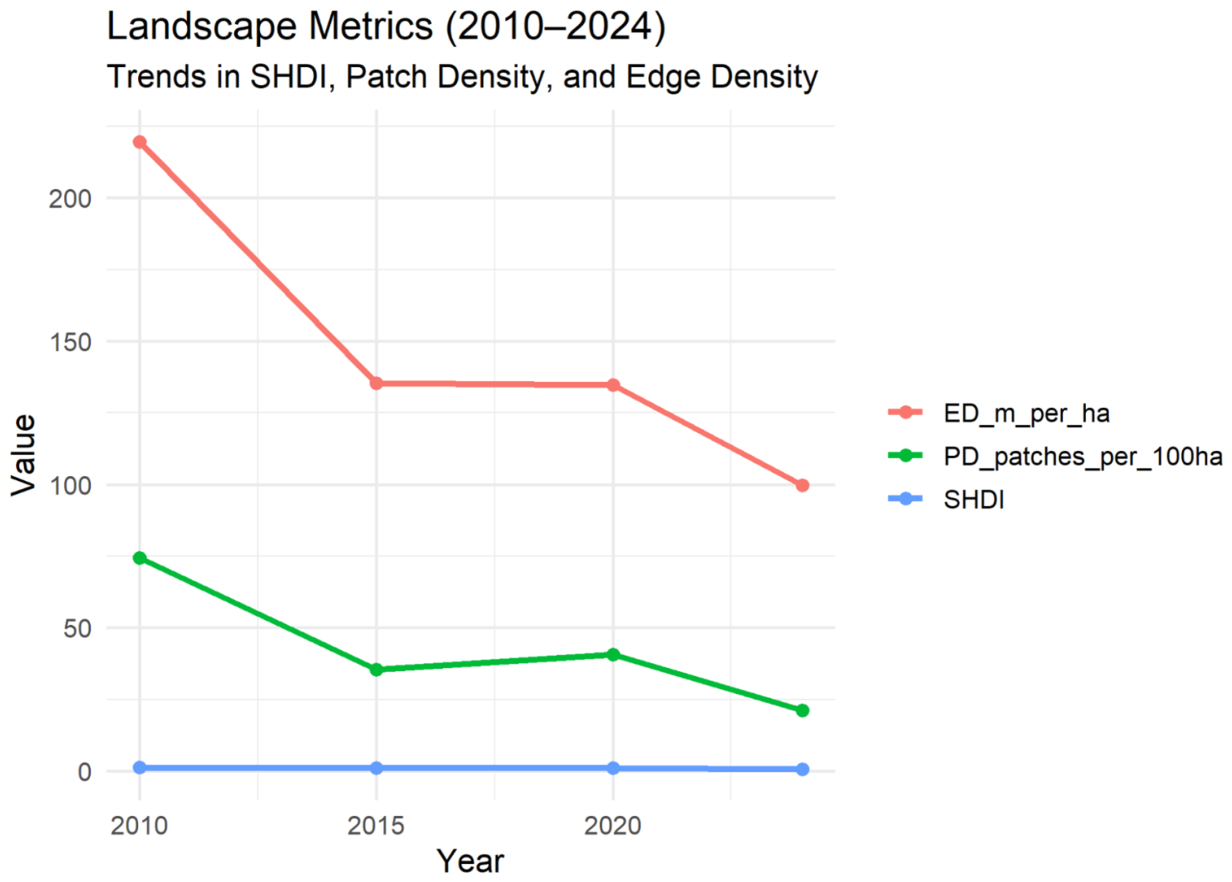
Figure 4.
Temporal variation of key landscape metrics (SHDI, SHEI, CONTAG, LSI, PD, and ED) from 2010 to 2024, illustrating progressive landscape homogenisation along the Islamabad Expressway corridor.
Figure 4.
Temporal variation of key landscape metrics (SHDI, SHEI, CONTAG, LSI, PD, and ED) from 2010 to 2024, illustrating progressive landscape homogenisation along the Islamabad Expressway corridor.
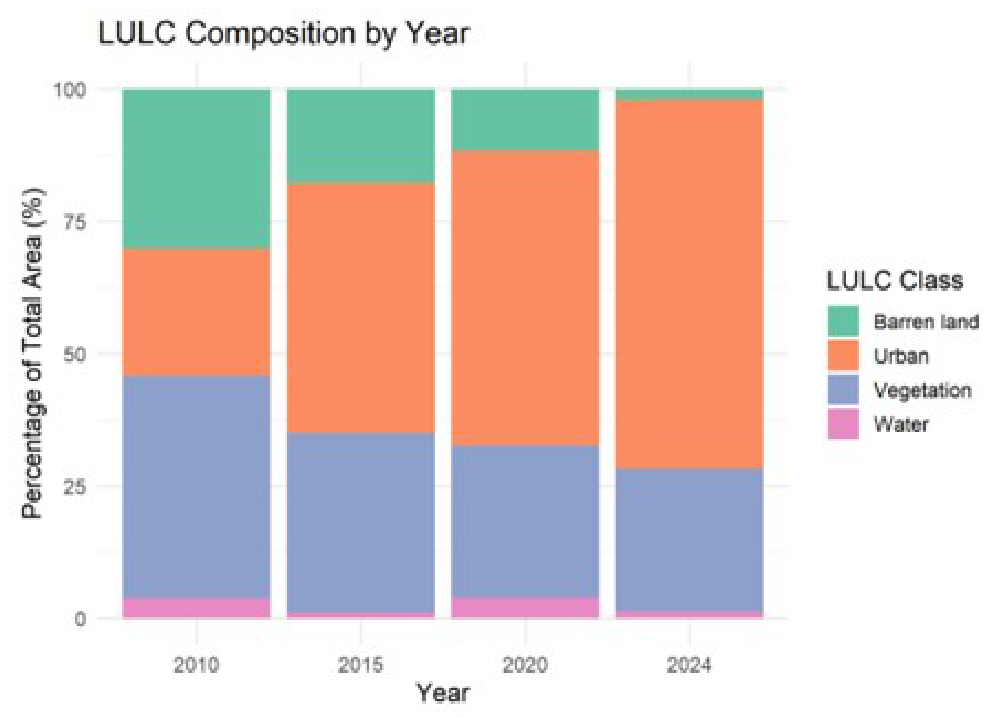
Figure 5.
Proportional land use and land cover composition (2010–2024), showing the progressive increase in urban area and corresponding decline in vegetation, barren land, and water bodies.
Figure 5.
Proportional land use and land cover composition (2010–2024), showing the progressive increase in urban area and corresponding decline in vegetation, barren land, and water bodies.
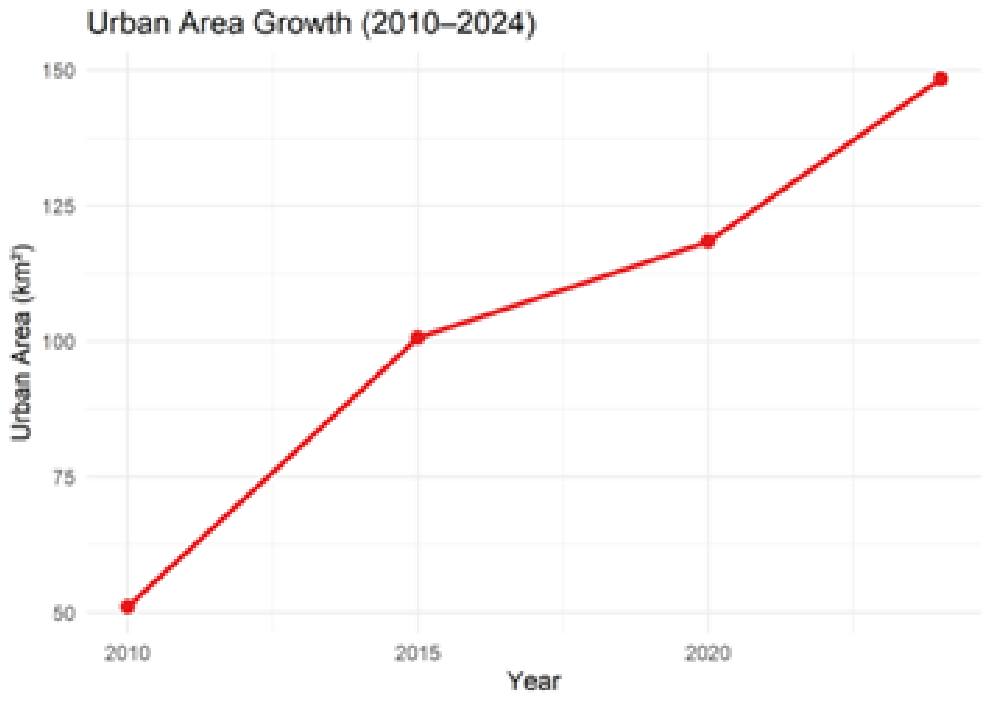
Figure 6.
This figure illustrates the urban expansion trend, specifically the percentage change in built-up area, from 2010 to 2024.
Figure 6.
This figure illustrates the urban expansion trend, specifically the percentage change in built-up area, from 2010 to 2024.
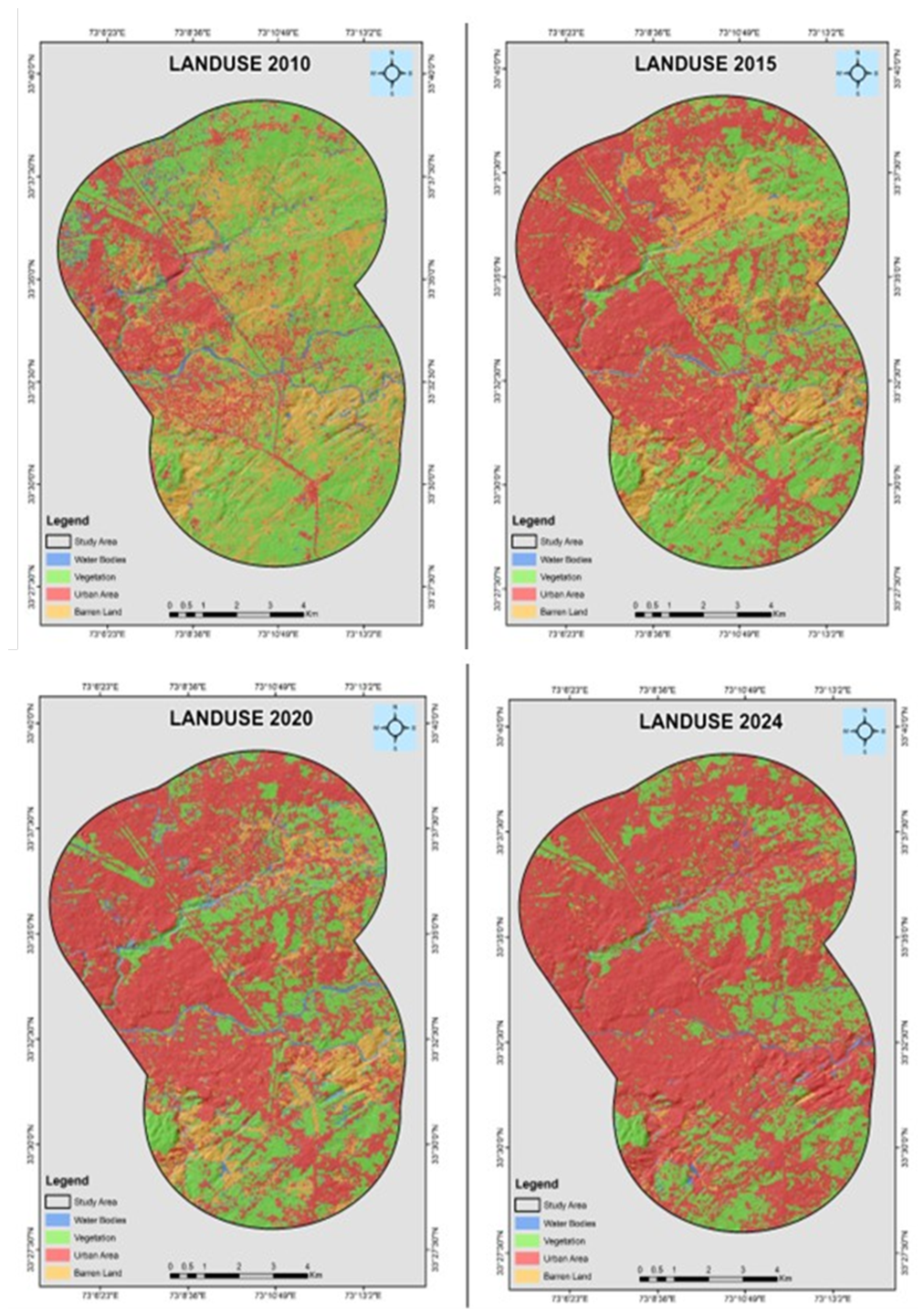

Table 1.
Land use and land cover class areas (km2) and proportional composition (%) for the Islamabad Expressway corridor buffer zone, 2010–2024.
Table 1.
Land use and land cover class areas (km2) and proportional composition (%) for the Islamabad Expressway corridor buffer zone, 2010–2024.
| Class | 2010 | 2015 | 2020 | 2024 |
|---|---|---|---|---|
| Water | 8.20 (3.86%) | 2.29 (1.08%) | 8.37 (3.94%) | 2.93 (1.38%) |
| Vegetation | 89.17 (42.01%) | 71.85 (33.85%) | 60.91 (28.70%) | 57.06 (26.88%) |
| Barren land | 63.88 (30.09%) | 37.44 (17.64%) | 24.66 (11.62%) | 3.94 (1.86%) |
| Urban | 51.02 (24.03%) | 100.69 (47.43%) | 118.33 (55.74%) | 148.34 (69.88%) |
| Total | 212.28 | 212.28 | 212.27 | 212.27 |
Table 2.
Net change in LULC class area (km2) between 2010–2024 and 2015–2024 along the Islamabad Expressway corridor.
Table 2.
Net change in LULC class area (km2) between 2010–2024 and 2015–2024 along the Islamabad Expressway corridor.
| Class | Change 2010–2024 (km2) | Change 2015–2024 (km2) |
|---|---|---|
| Water | −5.27 | +0.64 |
| Vegetation | −32.11 | −14.79 |
| Barren land | −59.94 | −33.50 |
| Urban | +97.32 | +47.65 |
Table 3.
Landscape-level spatial metrics for the Islamabad Expressway corridor (2010–2024), computed using the landscapemetrics package in R and cross-validated against FRAGSTATS (agreement within ±5%).
Table 3.
Landscape-level spatial metrics for the Islamabad Expressway corridor (2010–2024), computed using the landscapemetrics package in R and cross-validated against FRAGSTATS (agreement within ±5%).
| Year | SHDI | SHEI | CONTAG | LSI | PD | ED |
|---|---|---|---|---|---|---|
| 2010 | 1.194 | 0.861 | 23.88 | 81.20 | 74.39 | 219.65 |
| 2015 | 1.075 | 0.776 | 37.96 | 50.52 | 35.42 | 135.38 |
| 2020 | 1.062 | 0.766 | 38.40 | 50.28 | 40.56 | 134.69 |
| 2024 | 0.737 | 0.531 | 56.83 | 37.57 | 21.08 | 99.78 |
Table 4.
Class-level landscape metrics for each LULC category along the Islamabad Expressway corridor (2010–2024). COHESION ranges 0–100; FRAC_MN and PARA_MN are mean class-level shape metrics.
Table 4.
Class-level landscape metrics for each LULC category along the Islamabad Expressway corridor (2010–2024). COHESION ranges 0–100; FRAC_MN and PARA_MN are mean class-level shape metrics.
| Year | Class | PLAND | LPI | PD | COH. | FRAC | PARA |
|---|---|---|---|---|---|---|---|
| 2010 | Barren | 30.09 | 4.03 | 27.00 | 96.12 | 1.043 | 0.112 |
| 2015 | Barren | 17.64 | 4.60 | 16.60 | 95.84 | 1.034 | 0.111 |
| 2020 | Barren | 11.62 | 2.59 | 13.42 | 95.28 | 1.027 | 0.115 |
| 2024 | Barren | 1.86 | 0.12 | 4.55 | 72.99 | 1.028 | 0.111 |
| 2010 | Urban | 24.03 | 16.39 | 19.69 | 99.10 | 1.035 | 0.115 |
| 2015 | Urban | 47.43 | 20.57 | 9.95 | 99.15 | 1.049 | 0.105 |
| 2020 | Urban | 55.74 | 35.98 | 7.49 | 99.67 | 1.043 | 0.108 |
| 2024 | Urban | 69.88 | 67.60 | 4.21 | 99.91 | 1.036 | 0.107 |
| 2010 | Vegetation | 42.01 | 14.44 | 12.30 | 99.12 | 1.044 | 0.107 |
| 2015 | Vegetation | 33.85 | 7.12 | 7.82 | 98.09 | 1.049 | 0.099 |
| 2020 | Vegetation | 28.70 | 3.48 | 7.39 | 97.08 | 1.051 | 0.095 |
| 2024 | Vegetation | 26.88 | 2.96 | 9.06 | 97.11 | 1.047 | 0.102 |
| 2010 | Water | 3.86 | 0.21 | 15.39 | 69.45 | 1.024 | 0.120 |
| 2015 | Water | 1.08 | 0.16 | 1.05 | 86.14 | 1.055 | 0.100 |
| 2020 | Water | 3.94 | 0.28 | 12.27 | 79.76 | 1.029 | 0.117 |
| 2024 | Water | 1.38 | 0.09 | 3.26 | 74.74 | 1.038 | 0.112 |
Table 5.
Class areas (km2) by year.
| Year | Water | Vegetation | Barren | Urban | Total |
|---|---|---|---|---|---|
| 2010 | 8.20 | 89.17 | 63.88 | 51.02 | 212.28 |
| 2015 | 2.29 | 71.85 | 37.44 | 100.69 | 212.28 |
| 2020 | 8.37 | 60.91 | 24.66 | 118.33 | 212.27 |
| 2024 | 2.93 | 57.06 | 3.94 | 148.34 | 212.27 |
Table 6.
Net land use/land cover change (km2) from 2010 to 2024.
| LULC Class | Δ 2010–2024 (km2) | Δ 2015–2024 (km2) |
|---|---|---|
| Water | −5.27 | +0.64 |
| Vegetation | −32.11 | −14.79 |
| Barren land | −59.94 | −33.50 |
| Urban | +97.32 | +47.65 |
Disclaimer/Publisher’s Note: The statements, opinions and data contained in all publications are solely those of the individual author(s) and contributor(s) and not of MDPI and/or the editor(s). MDPI and/or the editor(s) disclaim responsibility for any injury to people or property resulting from any ideas, methods, instructions or products referred to in the content. |
© 2026 by the authors. Licensee MDPI, Basel, Switzerland. This article is an open access article distributed under the terms and conditions of the Creative Commons Attribution (CC BY) license (http://creativecommons.org/licenses/by/4.0/).
Copyright: This open access article is published under a Creative Commons CC BY 4.0 license, which permit the free download, distribution, and reuse, provided that the author and preprint are cited in any reuse.


